Questions with solutions
Question 1NEET 2026, Q58
Two products X and Y are formed in the following reaction sequence.
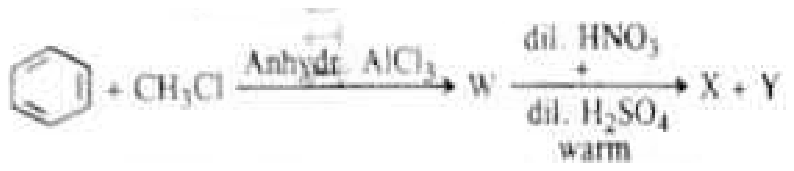
The suitable method that can be used for the separation of products X and Y is:
- 1Continuous extraction
- 2Differential extraction
- 3Fractional distillation
- 4Sublimation
Show answer and solution
Correct: option 3, Fractional distillation
Friedel-Crafts methylation of benzene gives toluene (W), and nitration of toluene gives a mixture of o-nitrotoluene and p-nitrotoluene (X and Y). These are isomers with different boiling points, so they are separated by fractional distillation.
Question 2NEET 2026, Q64
During Lassaigne's test, the elements present in an organic compound are converted from:
- 1covalent form to covalent form
- 2ionic form to ionic form
- 3covalent form to ionic form
- 4ionic form to covalent form
Show answer and solution
Correct: option 3, covalent form to ionic form
Fusing the compound with sodium converts covalently bound N, S and halogens into ionic sodium salts (NaCN, , NaX), which dissolve in water and can then be tested as ions.
Question 3NEET 2026, Q66
The pair of molecules that are metamers among the following is:
- 1 and
- 2 and
- 3 and
- 4 and
Show answer and solution
Correct: option 2, and
Metamers have the same functional group but different alkyl groups on either side of it. Methyl propyl ether and diethyl ether (both ) are metamers. Pair (1) are position isomers, pair (3) are functional isomers and pair (4) are chain isomers.
Question 4NEET 2026, Q81
The correct IUPAC name of the following compound is:
- 12,4-diethylhexane
- 23,5-diethylhexane
- 33-ethyl-5-methylheptane
- 43-methyl-5-ethylheptane
Show answer and solution
Correct: option 3, 3-ethyl-5-methylheptane
The longest chain has seven carbons (heptane) with substituents on C-3 and C-5 from either end. Substituents are cited alphabetically and the first-cited one gets the lower number, so ethyl is on C-3 and methyl on C-5: 3-ethyl-5-methylheptane.
Question 5NEET 2026 Re-exam, Q48
The following carbocation is stabilized by the interaction of the empty orbital with
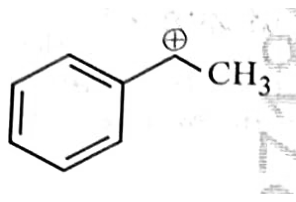
- 1filled and filled orbitals
- 2empty and empty orbitals
- 3empty and filled orbitals
- 4empty and empty orbitals
Show answer and solution
Correct: option 1, filled and filled orbitals
The cation is the 1-phenylethyl carbocation. Its empty orbital can only accept electrons, so it is stabilised by filled orbitals: the filled C-H orbitals of the neighbouring group (hyperconjugation) and the filled orbitals of the benzene ring (resonance).
Question 6NEET 2026 Re-exam, Q55
The amino acid that gives a red-blood colour on treating its sodium fusion extract with sodium nitroprusside is
- 1leucine
- 2threonine
- 3methionine
- 4serine
Show answer and solution
Correct: option 3, methionine
The sodium nitroprusside test on the sodium fusion extract detects sulphur: the sulphide ion formed in the fusion gives a coloured complex with nitroprusside. Of the four amino acids only methionine, , contains sulphur.
Question 7NEET 2026 Re-exam, Q89
Arrange the following compounds in the increasing order of polarity
A.
B.
C.
D.
Choose the correct answer from the options given below.
- 1A < B < C < D
- 2C < A < D < B
- 3C < A < B < D
- 4A < C < B < D
Show answer and solution
Correct: option 4, A < C < B < D
Diethyl ether has only weakly polar C-O-C bonds and is the least polar. Acetone has a polar C=O group. Ethanol has an O-H group and forms hydrogen bonds, and acetic acid has both C=O and O-H groups and is the most polar. This is the order in which these classes of compounds are held on an adsorbent in chromatography: ether < ketone < alcohol < carboxylic acid, that is A < C < B < D.
Question 8NEET 2025, Q72
Match List I with List II
| List I (Mixture) | List II (Method of Separation) |
|---|
| A. + | I. Distillation under reduced pressure |
| B. Crude oil in petroleum industry | II. Steam distillation |
| C. Glycerol from spent-lye | III. Fractional distillation |
| D. Aniline - water | IV. Simple distillation |
Choose the correct answer from the options given below:
- 1A-IV, B-III, C-I, D-II
- 2A-IV, B-III, C-II, D-I
- 3A-III, B-IV, C-I, D-II
- 4A-III, B-IV, C-II, D-I
Show answer and solution
Correct: option 1, A-IV, B-III, C-I, D-II
Chloroform (b.p. 334 K) and aniline (b.p. 457 K) differ widely in boiling point, so simple distillation separates them (IV). Crude oil is split into its fractions by fractional distillation (III). Glycerol decomposes near its boiling point, so it is recovered from spent-lye by distillation under reduced pressure (I). Aniline is steam volatile and immiscible with water, so steam distillation is used (II). Option (1).
Question 9NEET 2025, Q76
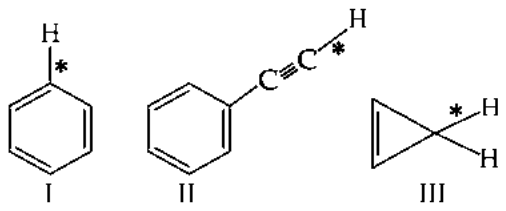
Among the given compounds I-III, the correct order of bond dissociation energy of C-H bond marked with * is:
- 1II > I > III
- 2I > II > III
- 3III > II > I
- 4II > III > I
Show answer and solution
Correct: option 1, II > I > III
A C-H bond is stronger when the carbon orbital has more s-character. In II the marked hydrogen is on an sp carbon (alkyne), in I on an carbon (benzene) and in III on the carbon of cyclopropene. So the bond dissociation energy falls in the order II > I > III, option (1).
Question 10NEET 2025, Q90
Which one of the following reactions does NOT belong to "Lassaigne's test"?
- 1
- 2
- 3
- 4
Show answer and solution
Correct: option 4,
In Lassaigne's test the compound is fused with sodium, which turns nitrogen into NaCN, sulphur into and halogens into NaX. Heating with CuO to form is the test for carbon, not part of Lassaigne's test. Option (4).
Question 11NEET 2024, Q69
The most stable carbocation among the following is:
- 1
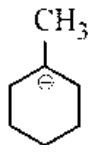
- 2
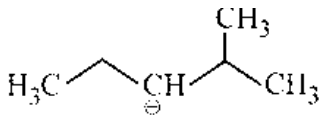
- 3
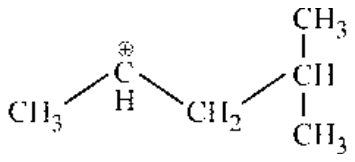
- 4
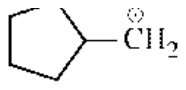
Show answer and solution
Correct: option 1
Carbocation stability follows tertiary > secondary > primary, because more alkyl groups on the charged carbon give more hyperconjugation and a larger electron-releasing inductive effect. In option (1) the charged ring carbon carries the methyl group and two ring carbons, so it is tertiary. In options (2) and (3) the charged carbon is secondary, and in option (4) it is a primary outside the ring. The tertiary ion of option (1) is the most stable.
Question 12NEET 2024, Q74
On heating, some solid substances change from solid to vapour state without passing through liquid state. The technique used for the purification of such solid substances based on the above principle is known as
- 1Chromatography
- 2Crystallization
- 3Sublimation
- 4Distillation
Show answer and solution
Correct: option 3, Sublimation
A direct change from solid to vapour on heating is sublimation. It is used to separate sublimable compounds such as camphor, naphthalene or iodine from non-sublimable impurities. So option (3).
Question 13NEET 2024, Q82
A compound with a molecular formula of has two tertiary carbons. Its IUPAC name is:
- 12,2-dimethylbutane
- 2n-hexane
- 32-methylpentane
- 42,3-dimethylbutane
Show answer and solution
Correct: option 4, 2,3-dimethylbutane
A tertiary carbon is bonded to three other carbons. 2,3-Dimethylbutane, , has two such carbons (C-2 and C-3). 2,2-Dimethylbutane has one quaternary carbon and no tertiary carbon, n-hexane has none, and 2-methylpentane has only one. So option (4).
Question 14NEET 2024 Re-exam, Q65
The correct IUPAC name of the compound
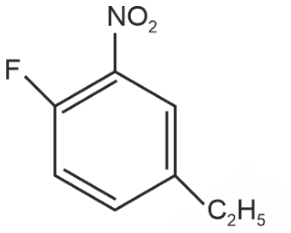
- 14-ethyl-1-fluoro-2-nitrobenzene
- 24-ethyl-1-fluoro-6-nitrobenzene
- 33-ethyl-6-fluoro-1-nitrobenzene
- 41-ethyl-4-fluoro-3-nitrobenzene
Show answer and solution
Correct: option 1, 4-ethyl-1-fluoro-2-nitrobenzene
The ring carries F and on neighbouring carbons and the ethyl group para to F. The ring is numbered to give the lowest set of locants. Starting at the carbon bearing F and going towards gives 1, 2, 4, which is lower than any other choice (for example 1, 3, 4 starting from ethyl, or 1, 2, 5 starting from nitro). The substituents are then listed alphabetically: 4-ethyl-1-fluoro-2-nitrobenzene.
Question 15NEET 2024 Re-exam, Q82
A steam volatile organic compound which is immiscible with water has a boiling point of 250°C. During steam distillation, a mixture of this organic compound and water will boil:
- 1above 100°C but below 250°C
- 2above 250°C
- 3at 250°C
- 4close to but below 100°C
Show answer and solution
Correct: option 4, close to but below 100°C
Two immiscible liquids each exert their own vapour pressure, and the mixture boils when the sum equals atmospheric pressure. Because the organic liquid adds a little to the vapour pressure of water, this happens at a temperature slightly lower than 100°C, far below the compound's own boiling point.
Question 16NEET 2024 Re-exam, Q93
On complete combustion, 0.3 g of an organic compound gave 0.2 g of and 0.1 g of . The percentage composition of carbon and hydrogen in the compound, respectively is:
- 14.07% and 15.02%
- 218.18% and 3.70%
- 315.02% and 4.07%
- 43.70% and 18.18%
Show answer and solution
Correct: option 2, 18.18% and 3.70%
Carbon: 44 g of holds 12 g of C, so the percentage of carbon is . Hydrogen: 18 g of holds 2 g of H, so the percentage of hydrogen is .
Question 17NEET 2024 Re-exam, Q100
Methyl group attached to a positively charged carbon atom stabilizes the carbocation due to
- 1–I inductive effect
- 2electromeric effect
- 3hyperconjugation
- 4mesomeric effect
Show answer and solution
Correct: option 3, hyperconjugation
The electrons of a C-H sigma bond of the methyl group overlap with the empty p orbital of the neighbouring positively charged carbon. This delocalisation of sigma electrons, called hyperconjugation, spreads the positive charge and stabilises the carbocation. A methyl group has a +I effect, not –I, and has no lone pair or pi bond for a mesomeric effect.
Question 18NEET 2023, Q54
In Lassaigne's extract of an organic compound, both nitrogen and sulphur are present, which gives blood red colour with due to the formation of -
- 1
- 2NaSCN
- 3
- 4
Show answer and solution
Correct: option 4,
When nitrogen and sulphur are both present, sodium fusion gives sodium thiocyanate, NaSCN. Its thiocyanate ion reacts with to give the blood red complex . Prussian blue (option 1) is the test for nitrogen alone and the violet nitroprusside complex (option 3) is the test for sulphur.
Question 19NEET 2023, Q66
The number of bonds, bonds and lone pair of electrons in pyridine, respectively are:
- 111, 2, 0
- 212, 3, 0
- 311, 3, 1
- 412, 2, 1
Show answer and solution
Correct: option 3, 11, 3, 1
Pyridine, , has a six-membered ring with 6 ring bonds (four C-C and two C-N) and 5 C-H bonds, 11 in all. The ring has 3 bonds, and nitrogen carries 1 lone pair that is not part of the system. So the answer is 11, 3, 1.
Question 20NEET 2023 Manipur, Q66
Match List-I with List-II.
| List-I (Mixtures/Sample) | List-II (Technique used for purification) |
|---|
| (A) Glycerol from spent lye | (I) Steam distillation |
| (B) Chloroform + Aniline | (II) Fractional distillation |
| (C) Fractions of crude oil | (III) Distillation under reduced pressure |
| (D) Aniline + Water | (IV) Distillation |
Choose the correct answer from the options given below:
- 1A-I, B-II, C-III, D-IV
- 2A-I, B-III, C-II, D-IV
- 3A-III, B-IV, C-II, D-I
- 4A-IV, B-II, C-I, D-III
Show answer and solution
Correct: option 3, A-III, B-IV, C-II, D-I
Glycerol decomposes near its boiling point, so it is recovered from spent lye by distillation under reduced pressure (A-III). Chloroform (b.p. 334 K) and aniline (b.p. 457 K) boil far apart, so simple distillation works (B-IV). Crude oil fractions have close boiling ranges and need fractional distillation (C-II). Aniline is steam volatile and immiscible with water, so steam distillation is used (D-I).
Question 21NEET 2023 Manipur, Q87
Given below are two statements:
Statement I: In an organic compound, when inductive and electromeric effects operate in opposite directions, the inductive effect predominates.
Statement II: Hyperconjugation is observed in o-xylene.
In the light of the above statements, choose the correct answer from the options given below
- 1Both Statement I and Statement II are true.
- 2Both Statement I and Statement II are false.
- 3Statement I is true but Statement II is false.
- 4Statement I is false but Statement II is true.
Show answer and solution
Correct: option 4, Statement I is false but Statement II is true.
When the inductive and electromeric effects oppose each other it is the electromeric effect that predominates, so Statement I is false. In o-xylene each methyl carbon is attached to an ring carbon and has C-H bonds that can delocalise into the ring, so hyperconjugation operates and Statement II is true.
Question 22NEET 2022, Q80
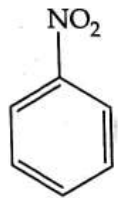
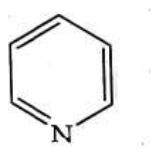
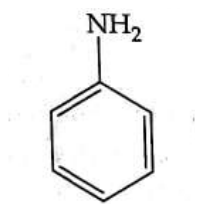
The Kjeldahl's method for the estimation of nitrogen can be used to estimate the amount of nitrogen in which one of the following compounds?
- 1
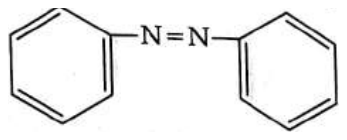
- 2
- 3
- 4
Show answer and solution
Correct: option 4
Kjeldahl's method works only when the nitrogen is converted to ammonium sulphate on heating with concentrated . It fails for nitrogen in azo groups (1), nitro groups (2) and in a ring such as pyridine (3). Aniline (4), with its group, can be estimated.
Question 23NEET 2022, Q94
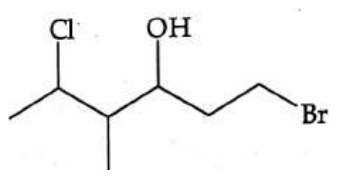
The correct IUPAC name of the following compound is:
- 16-bromo-4-methyl-2-chlorohexan-4-ol
- 21-bromo-5-chloro-4-methylhexan-3-ol
- 36-bromo-2-chloro-4-methylhexan-4-ol
- 41-bromo-4-methyl-5-chlorohexan-3-ol
Show answer and solution
Correct: option 2, 1-bromo-5-chloro-4-methylhexan-3-ol
The longest chain has six carbons and the -OH group, as the principal functional group, gets the lowest number. Numbering from the end carrying Br puts OH on C-3 (from the other end it would be C-4). That gives Br on C-1, methyl on C-4 and Cl on C-5, and the substituents are listed alphabetically: 1-bromo-5-chloro-4-methylhexan-3-ol.
Question 24NEET 2022 Re-exam, Q79
What is the hybridization shown by and carbons, respectively in the given compound?
- 1 and
- 2 and
- 3 and
- 4 and
Show answer and solution
Correct: option 2, and
The ester is the principal group, so the chain is numbered from the carbon. is the ester carbonyl carbon, which has a double bond to oxygen and three sigma bonds: . is the carbon with four sigma bonds: . This copy prints no numbers on the carbon atoms, so the numbering used here is the IUPAC one.
Question 25NEET 2022 Re-exam, Q88
Which of the following is the most stable carbocation?
- 1
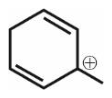
- 2
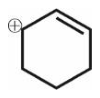
- 3
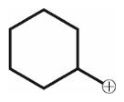
- 4
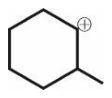
Show answer and solution
Correct: option 1
In (1) the positive carbon carries a methyl group and lies next to the conjugated double bonds of the ring, so the charge is spread by resonance over the ring as well as being helped by the methyl group. The cations in (3) and (4) are on saturated rings and have no resonance at all, and the cation in (2) has less delocalisation and no alkyl group on the charged carbon. The resonance-stabilised cation (1) is the most stable.
Question 26NEET 2021, Q73
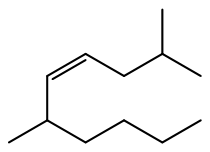
The correct structure of 2,6-Dimethyl-dec-4-ene is:
- 1
- 2
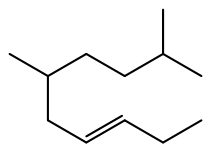
- 3
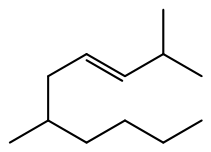
- 4
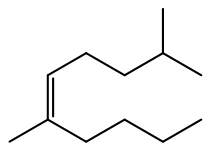
Show answer and solution
Correct: option 1
The name needs a ten-carbon chain with methyl branches on C-2 and C-6 and a double bond between C-4 and C-5. In the first structure, counting from the branched end at the top right, C-2 carries a methyl group, the double bond is C-4 to C-5, and C-6 carries the second methyl group before a four-carbon tail. In the other structures the double bond is in a different position.
Question 27NEET 2021, Q84
The compound which shows metamerism is:
- 1
- 2
- 3
- 4
Show answer and solution
Correct: option 4,
Metamers have the same functional group but different alkyl groups on either side of it. can be diethyl ether () or methyl propyl ether (), which are metamers. has only one ether and only one ketone, and an alkane has no functional group.
Question 28NEET 2020, Q19
Paper chromatography is an example of:
- 1Adsorption chromatography
- 2Partition chromatography
- 3Thin layer chromatography
- 4Column chromatography
Show answer and solution
Correct: option 2, Partition chromatography
In paper chromatography the water held in the fibres of the paper is the stationary phase and the solvent is the mobile phase. The components separate by distributing (partitioning) themselves differently between these two liquids, so it is partition chromatography.
Question 29NEET 2020, Q22
A tertiary butyl carbocation is more stable than a secondary butyl carbocation because of which of the following?
- 1 effect of groups
- 2 effect of groups
- 3 effect of groups
- 4Hyperconjugation
Show answer and solution
Correct: option 4, Hyperconjugation
The tertiary butyl carbocation has nine α-hydrogens whose C-H bonds can overlap with the empty p orbital, while the secondary butyl carbocation has only five. More hyperconjugation spreads the positive charge better, so the tertiary cation is more stable. Methyl groups have a effect, not , and show no resonance effect.
Question 30NEET 2020 Phase 2, Q154
A liquid compound (x) can be purified by steam distillation only if it is
- 1Not steam volatile, miscible with water
- 2Steam volatile, miscible with water
- 3Not steam volatile, immiscible with water
- 4Steam volatile, immiscible with water
Show answer and solution
Correct: option 4, Steam volatile, immiscible with water
Steam distillation is used for a substance that is volatile in steam but does not mix with water. The mixture boils when the sum of the two vapour pressures equals atmospheric pressure, so the compound distils below its own boiling point and then separates from the water in the distillate as a second layer.
Question 31NEET 2020 Phase 2, Q155
How many (i) hybridised carbon atoms and (ii) bonds are present in the following compound?
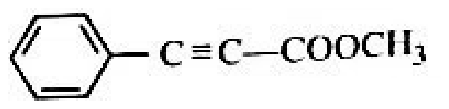
- 18, 6
- 27, 6
- 38, 5
- 47, 5
Show answer and solution
Correct: option 2, 7, 6
The six ring carbons and the carbonyl carbon of the ester group are : 7 in all. The two carbons of are and the carbon is . The bonds are 3 in the ring, 2 in the triple bond and 1 in : 6 in all.
Question 32NEET 2019, Q46
The number of sigma () and pi () bonds in pent-2-en-4-yne is:
- 110 bonds and 3 bonds
- 28 bonds and 5 bonds
- 311 bonds and 2 bonds
- 413 bonds and no bond
Show answer and solution
Correct: option 1, 10 bonds and 3 bonds
The molecule is . It has 4 C–C bonds and 6 C–H bonds, 10 in all. The double bond gives 1 bond and the triple bond gives 2, so there are 3 bonds.
Question 33NEET 2019 Odisha, Q69
The most stable carbocation, among the following, is -
- 1
- 2
- 3
- 4
Show answer and solution
Correct: option 1,
Option (2) is a primary carbocation and the least stable. The other three are secondary, so the number of hydrogens on the carbons next to the positive carbon decides, because each one adds a hyperconjugation structure. Option (1) has 5 such hydrogens ( and ), option (4) has 4 and option (3) has 3. So (1) is the most stable.
Question 34NEET 2018, Q63
Which of the following molecules represents the order of hybridisation , , , from left to right atoms?
- 1
- 2
- 3
- 4
Show answer and solution
Correct: option 2,
A doubly bonded carbon is and a triply bonded carbon is . In the first two carbons are in a double bond (, ) and the last two are in a triple bond (, ).
Question 35NEET 2018, Q64
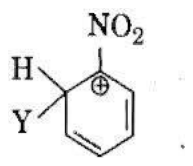
Which of the following carbocations is expected to be most stable?
- 1
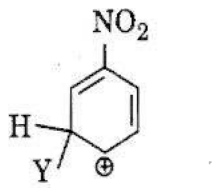
- 2
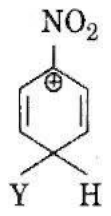
- 3
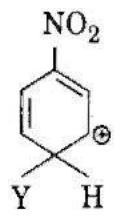
- 4
Show answer and solution
Correct: option 1
is a strong electron-withdrawing group, so the carbocation is least destabilised when the positive charge never sits on the carbon that carries it. The charge is spread over the positions ortho and para to the carbon holding H and Y. In option (1) the carbon is meta to that carbon, so no resonance form puts the charge on it; in the others the charge is on or can reach the carbon.
Question 36NEET 2018, Q65
Which of the following is correct with respect to – I effect of the substituents? (R = alkyl)
- 1
- 2
- 3
- 4
Show answer and solution
Correct: option 3,
The effect grows with the electronegativity of the atom attached to the chain: N < O < F. So , which is the keyed option.
Question 37NEET 2017, Q70
The correct statement regarding electrophile is:
- 1Electrophile is a negatively charged species and can form a bond by accepting a pair of electrons from a nucleophile
- 2Electrophile is a negatively charged species and can form a bond by accepting a pair of electrons from another electrophile
- 3Electrophiles are generally neutral species and can form a bond by accepting a pair of electrons from a nucleophile
- 4Electrophile can be either neutral or positively charged species and can form a bond by accepting a pair of electrons from a nucleophile
Show answer and solution
Correct: option 4, Electrophile can be either neutral or positively charged species and can form a bond by accepting a pair of electrons from a nucleophile
An electrophile is an electron-deficient species that accepts an electron pair from a nucleophile to form a bond. It may be positively charged, such as or a carbocation, or neutral, such as or .
Question 38NEET 2017, Q78
The most suitable method of separation of 1 : 1 mixture of ortho and para-nitrophenols is:
- 1Sublimation
- 2Chromatography
- 3Crystallisation
- 4Steam distillation
Show answer and solution
Correct: option 4, Steam distillation
o-Nitrophenol has intramolecular hydrogen bonding, so it is more volatile and distils over with steam. p-Nitrophenol has intermolecular hydrogen bonding, is much less volatile and stays behind. Steam distillation therefore separates them.
Question 39NEET 2017, Q89
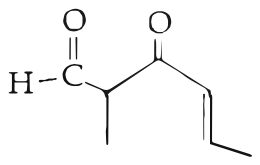
The IUPAC name of the compound is
- 13-keto-2-methylhex-4-enal
- 25-formylhex-2-en-3-one
- 35-methyl-4-oxohex-2-en-5-al
- 43-keto-2-methylhex-5-enal
Show answer and solution
Correct: option 1, 3-keto-2-methylhex-4-enal
The aldehyde is the principal group, so its carbon is C-1 of a six-carbon chain. C-2 carries a methyl group, C-3 is the keto carbon and the double bond lies between C-4 and C-5. The name is 3-keto-2-methylhex-4-enal (2-methyl-3-oxohex-4-enal).
Question 40NEET 2016 Phase 1, Q84
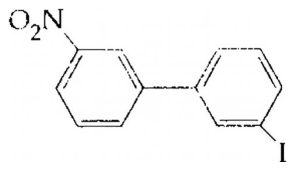
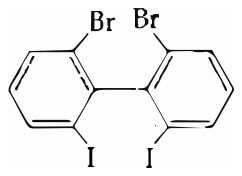
Which of the following biphenyls is optically active?
- 1
- 2
- 3
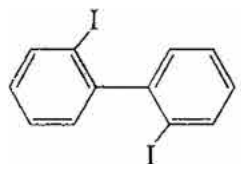
- 4
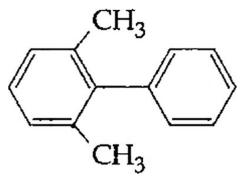
Show answer and solution
Correct: option 2
A biphenyl is optically active when rotation about the bond joining the two rings is blocked and neither ring is symmetrically substituted about that bond. That needs bulky groups at the ortho positions of both rings. In option (2) each ring carries a bromine and an iodine at its two ortho positions, so the rings are locked at an angle and the molecule has no plane of symmetry: it is chiral. The others have too few ortho groups to stop rotation, or (option 4) one ring that is symmetric.
Question 41NEET 2016 Phase 1, Q90
The pair of electron in the given carbanion, , is present in which of the following orbitals?
- 1
- 2
- 3
- 4
Show answer and solution
Correct: option 4,
The negatively charged carbon is part of a triple bond, so it has two positions (one to the other carbon and one for the lone pair) and two bonds. Two positions mean hybridisation, and the lone pair sits in one of the hybrid orbitals.
Question 42NEET 2016 Phase 2, Q77
In which of the following molecules, all atoms are coplanar?
- 1
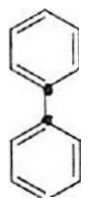
- 2

- 3
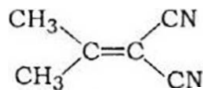
- 4
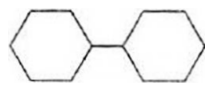
Show answer and solution
Correct: option 1
Option (1) is biphenyl. Every carbon in it is hybridised, so each ring with its hydrogens is flat and the two rings can lie in one plane; this is the answer given in the key. Option (2) is cyclohexane and option (4) is two joined cyclohexane rings, both made of carbons and puckered. Option (3) has two groups whose hydrogens cannot all lie in the plane of the double bond.
Question 43NEET 2016 Phase 2, Q79
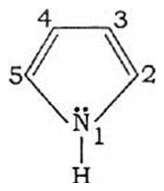
the electron density is maximum on
- 12 and 3
- 23 and 4
- 32 and 4
- 42 and 5
Show answer and solution
Correct: option 3, 2 and 4
The lone pair on nitrogen is part of the aromatic sextet and is spread over the ring, so the resonance structures of pyrrole carry a negative charge on each of the carbons 2, 3, 4 and 5 in turn. The official answer key gives option (3), 2 and 4, and that is the answer marked here. Most textbooks would instead pick 2 and 5, the two carbons next to nitrogen, where pyrrole is attacked by electrophiles, so treat this keyed answer with caution.
Question 44AIPMT 2015, Q2
In Duma's method for estimation of nitrogen, 0.25 g of an organic compound gave 40 mL of nitrogen collected at 300 K temperature and 725 mm pressure. If the aqueous tension at 300 K is 25 mm, the percentage of nitrogen in the compound is:
- 118.20
- 216.76
- 315.76
- 417.36
Show answer and solution
Correct: option 2, 16.76
Pressure of dry nitrogen mm. Volume at STP mL. Mass of nitrogen g, so the percentage is , option (2).
Question 45AIPMT 2015, Q16
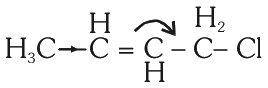
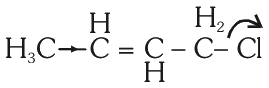
Which of the following is the most correct electron displacement for a nucleophilic reaction to take place?
- 1
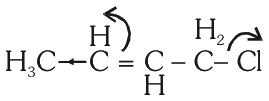
- 2
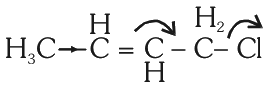
- 3
- 4
Show answer and solution
Correct: option 2
For the chloride to be replaced, the bond pair must shift on to chlorine, and the loss is helped when the electrons of the neighbouring double bond move towards the bond next to it (allylic assistance), with the methyl group pushing electrons towards the double bond. Option (2) shows all three shifts in these directions: methyl towards the double bond, the pair towards the carbon, and the bond pair on to Cl.
Question 46AIPMT 2015, Q19
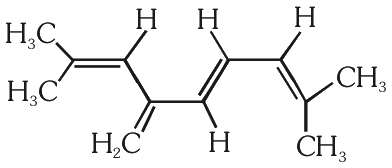
The total number of -bond electrons in the following structure is:
- 18
- 212
- 316
- 44
Show answer and solution
Correct: option 1, 8
The structure has four carbon-carbon double bonds: two at the ends carrying the methyl groups, the group and the unit in the chain. Each double bond has one bond holding two electrons, so there are electrons, option (1).
Question 47AIPMT 2015, Q24
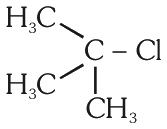
In which of the following compounds, the bond ionisation shall give most stable carbonium ion?
- 1
- 2
- 3
- 4
Show answer and solution
Correct: option 2
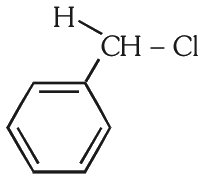
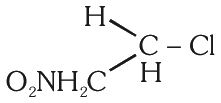
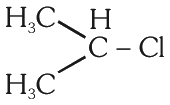
Ionisation gives, in turn, the tert-butyl cation (1), the benzyl cation (2), a primary cation with an electron-withdrawing nitro group nearby (3) and the isopropyl cation (4). The key takes the benzyl cation as the most stable because its positive charge is spread over the ring by resonance, option (2). The tert-butyl cation, stabilised by nine hyperconjugating hydrogens, is very close in stability, which is why some keys give option (1).
Question 48AIPMT 2015, Q26
Consider the following compounds
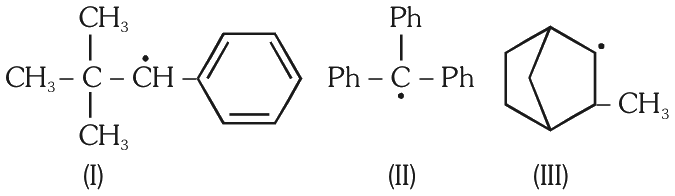
Hyperconjugation occurs in:
- 1II only
- 2III only
- 3I and III
- 4I only
Show answer and solution
Correct: option 2, III only
Hyperconjugation needs a bond on the carbon next to the radical centre. In (I) the neighbours of the radical carbon are a quaternary carbon and a ring carbon, neither with such a hydrogen; in (II) the three neighbours are phenyl carbons. In (III) the carbon next to the radical centre, the one bearing the methyl group, carries a hydrogen. So hyperconjugation occurs in III only, option (2).
Question 49AIPMT 2015, Q37
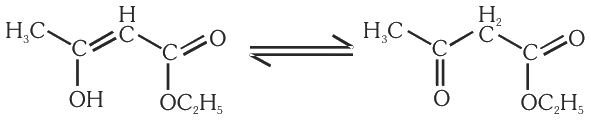
The enolic form of ethyl acetoacetate as below has:
- 116 sigma bonds and 1 pi - bond
- 29 sigma bonds and 2 pi - bonds
- 39 sigma bonds and 1 pi - bond
- 418 sigma bonds and 2 pi - bonds
Show answer and solution
Correct: option 4, 18 sigma bonds and 2 pi - bonds
The enol is . Sigma bonds: 9 C-H, 1 O-H, 4 C-C (counting the sigma part of and the one inside the ethyl group) and 4 C-O (to OH, the sigma part of , and the two of the ester oxygen), 18 in all. Pi bonds: one in and one in . Hence option (4).
Question 50AIPMT 2015 Re-test, Q21
Which of the following statements is not correct for a nucleophile?
- 1Nucleophiles attack low density sites
- 2Nucleophiles are not electron seeking
- 3Nucleophile is a Lewis acid
- 4Ammonia is a nucleophile
Show answer and solution
Correct: option 3, Nucleophile is a Lewis acid
A nucleophile is an electron-rich species that donates an electron pair to an electron-poor site; it seeks a nucleus, not electrons. A species that donates an electron pair is a Lewis base, not a Lewis acid. Ammonia, with its lone pair, is a typical nucleophile. The incorrect statement is option (3).
Question 51AIPMT 2014, Q176
Which of the following organic compounds has same hybridization as its combustion product-()?
- 1Ethanol
- 2Ethane
- 3Ethyne
- 4Ethene
Show answer and solution
Correct: option 3, Ethyne
The carbon in forms two double bonds and is hybridised (linear). Ethyne, , also has carbons. The carbons of ethane and ethanol are and those of ethene are .
Question 52AIPMT 2014, Q180
In the Kjeldahl's method for estimation of nitrogen present in a soil sample, ammonia evolved from 0.75 g of sample neutralized 10 mL of 1M . The percentage of nitrogen in the soil is:
- 143.33
- 237.33
- 345.33
- 435.33
Show answer and solution
Correct: option 2, 37.33
10 mL of 1 M is 0.01 mol of acid, which neutralises 0.02 mol of (). That is 0.02 mol of nitrogen, or g. Percentage of nitrogen .
Question 53NEET 2013, Q4
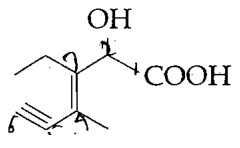
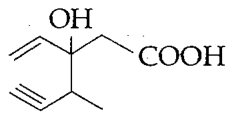
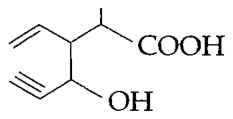
Structure of the compound whose IUPAC name is 3-Ethyl-2-hydroxy-4-methylhex-3-en-5-ynoic acid is:
- 1
- 2
- 3
- 4
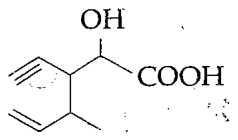
Show answer and solution
Correct: option 1
Number the six-carbon chain from the carbon. C-2 carries , C-3 carries the ethyl group, the double bond joins C-3 and C-4, C-4 carries the methyl group, and the triple bond joins C-5 and C-6. Only the structure in option (1) has the ethyl group and the methyl group on the two carbons of the double bond with the next to .
Question 54NEET 2013, Q38
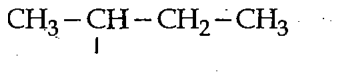
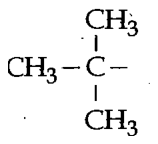
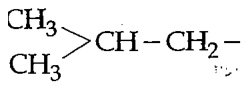
The structure of isobutyl group in an organic compound is:
- 1
- 2
- 3
- 4
Show answer and solution
Correct: option 4
The isobutyl group is 2-methylpropyl, : the free bond is on a that is joined to a CH carrying two methyl groups. That is option (4). Option (1) is sec-butyl, option (2) is n-butyl and option (3) is tert-butyl.
Question 55NEET 2013 Karnataka, Q7
Arrange the following in increasing order of stability:
(a)
(b)
(c)
(d)
(e)
- 1e < d < c < a < b
- 2d < e < c < a < b
- 3a < e < d < c < b
- 4e < d < c < b < a
Show answer and solution
Correct: option 1, e < d < c < a < b
Carbocation stability rises with the number of alkyl groups on the positive carbon and with the number of -hydrogens available for hyperconjugation: methyl (e, 0) < ethyl (d, 3) < isopropyl (c, 6) < tertiary. Of the two tertiary ions, (a) has 8 -hydrogens and (b) has 9, so (b) is the most stable. The order is e < d < c < a < b.
Question 56NEET 2013 Karnataka, Q13
What is the hybridisation state of benzyl carbonium ion ?
- 1
- 2
- 3
- 4
Show answer and solution
Correct: option 1,
The positively charged carbon forms three sigma bonds (two C–H and one C–C) and has no lone pair, so it is hybridised and planar. Its empty p orbital overlaps with the ring's system, which is why the ion is resonance stabilised.
Question 57NEET 2013 Karnataka, Q24
Nitrogen detection in an organic compound is carried out by Lassaigne's test. The blue colour formed corresponds to which of the following formulae:
- 1
- 2
- 3
- 4
Show answer and solution
Correct: option 2,
The cyanide in the sodium fusion extract reacts with to form , which then combines with to give Prussian blue, ferric ferrocyanide. Balancing four against three gives .
Question 58NEET 2013 Karnataka, Q25
Homolytic fission of the following alkanes form free radicals , , Increasing order of Stability of the radicals is:
- 1
- 2
- 3
- 4
Show answer and solution
Correct: option 2,
Free radical stability follows primary < secondary < tertiary and grows with the number of -hydrogens available for hyperconjugation. Ethyl has 3, isopropyl 6, the tertiary radical has 8 and tert-butyl has 9. That gives the order in option (2).
Question 59AIPMT 2012 Prelims, Q179
Which nomenclature is not according to IUPAC system?
- 1, 1-Bromo-prop-2-ene
- 2, 4-Bromo, 2, 4-di-methylhexane
- 3, 2-Methyl-3-phenylpentane
- 4 5-oxohexanoic acid
Show answer and solution
Correct: option 1, , 1-Bromo-prop-2-ene
In the double bond must get the lowest number, so the chain is numbered from the end and the name is 3-bromoprop-1-ene, not 1-bromoprop-2-ene. The other three names follow the lowest-locant rules: the hexane has methyl groups on C2 and C4 and Br on C4, the pentane has methyl on C2 and phenyl on C3, and the acid carbon is C1 with the keto group on C5. So option (1).
Question 60AIPMT 2012 Prelims, Q195
Which of the following acids does not exhibit optical isomerism?
- 1Maleic acid
- 2-amino acids
- 3Lactic acid
- 4Tartaric acid
Show answer and solution
Correct: option 1, Maleic acid
Maleic acid, cis-, has no chiral carbon; it shows geometrical isomerism only. Lactic acid, tartaric acid and -amino acids (other than glycine) have a carbon carrying four different groups and are optically active. So option (1).
Question 61AIPMT 2011 Prelims, Q1
Considering the state of hybridization of carbon atoms, find out the molecule among the following which is linear?
- 1
- 2
- 3
- 4
Show answer and solution
Correct: option 2,
A carbon chain is linear only where the carbons are sp hybridised (bond angle ). In but-2-yne the two triple-bonded carbons are sp, so all four carbons lie on one straight line. The other molecules contain or carbons in the chain, which bend it.
Question 62AIPMT 2011 Prelims, Q18
The correct IUPAC name of the compound
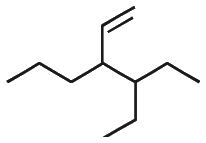
- 14-Ethyl-3-propyl hex-1-ene
- 23-Ethyl-4-ethenyl heptane
- 33-Ethyl-4-propyl hex-1-ene
- 43-(1-ethylpropyl) hex-1-ene
Show answer and solution
Correct: option 1, 4-Ethyl-3-propyl hex-1-ene
The parent chain must contain the double bond and is numbered from the end nearest to it, giving a six-carbon chain, hex-1-ene. C3 carries a propyl group and C4 an ethyl group. Substituents are listed in alphabetical order, so the name is 4-ethyl-3-propylhex-1-ene.
Question 63AIPMT 2011 Prelims, Q23
In Dumas' method of estimation of nitrogen 0.35 g of an organic compound gave 55 mL of nitrogen collected at 300 K temperature and 715 mm pressure. The percentage composition of nitrogen in the compound would be: (Aqueous tension at 300 K = 15 mm)
- 115.45
- 216.45
- 317.45
- 414.45
Show answer and solution
Correct: option 2, 16.45
Pressure of dry nitrogen mm. Volume at STP mL. Since 22400 mL of at STP weighs 28 g, mass of nitrogen g. Percentage of nitrogen .
Question 64AIPMT 2011 Prelims, Q28
The Lassaigne's extract is boiled with conc. while testing for halogens. By doing so it:
- 1decomposes and NaCN, if formed.
- 2helps in the precipitation of AgCl.
- 3increases the solubility product of AgCl.
- 4increases the concentration of ions.
Show answer and solution
Correct: option 1, decomposes and NaCN, if formed.
If the compound also contains nitrogen or sulphur, the extract holds NaCN or , which would give precipitates of AgCN or with silver nitrate and spoil the halogen test. Boiling with concentrated nitric acid drives them off as HCN and before is added.
Question 65AIPMT 2011 Mains, Q11
The IUPAC name of the following compound
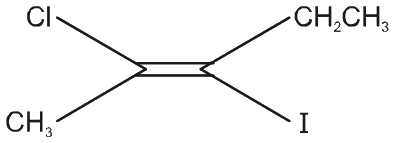
- 1trans-2-chloro-3-iodo-2-pentene
- 2cis-3-iodo-4-chloro-3-pentene
- 3trans-3-iodo-4-chloro-3-pentene
- 4cis-2-chloro-3-iodo-2-pentene
Show answer and solution
Correct: option 1, trans-2-chloro-3-iodo-2-pentene
The longest chain through the double bond has five carbons: (C1), the carbon carrying Cl (C2), the carbon carrying I (C3) and the ethyl group (C4, C5). Numbering from this end gives the double bond position 2, and the substituents are named alphabetically: 2-chloro-3-iodo-2-pentene. Cl and I lie on opposite sides of the double bond, so the name is trans-2-chloro-3-iodo-2-pentene.
Question 66AIPMT 2010 Mains, Q39
Which of the following species is not electrophilic in nature?
- 1
- 2
- 3
- 4
Show answer and solution
Correct: option 3,
An electrophile must be able to accept an electron pair. and are electron-deficient cations and has an incomplete octet with a vacant orbital on boron. In the oxygen already has a complete octet and no vacant orbital, so despite its positive charge it cannot accept an electron pair and is not an electrophile.
Question 67AIPMT 2010 Mains, Q53
The IUPAC name of the compound is:
- 1Pent-4-yn-2-ene
- 2Pent-3-en-1-yne
- 3Pent-2-en-4-yne
- 4Pent-1-yn-3-ene
Show answer and solution
Correct: option 2, Pent-3-en-1-yne
The chain has five carbons with one double and one triple bond. Numbering from the alkyne end gives the multiple bonds the locants 1 and 3, lower than 2 and 4 from the other end. The 'ene' is written before the 'yne', so the name is pent-3-en-1-yne.
Question 68AIPMT 2009 Prelims, Q151
The state of hybridization of , , and of the hydrocarbon,
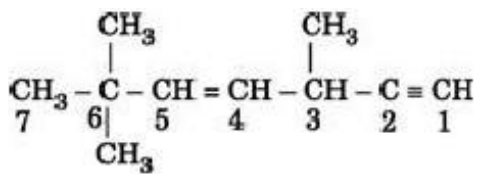
is in the following sequence:
- 1, , and
- 2, , and
- 3, , and
- 4, , and
Show answer and solution
Correct: option 4, , , and
Count the sigma bonds on each carbon. is part of the triple bond, so it is . has four single bonds, so it is . is part of the double bond, so it is . carries four single bonds (three methyl groups and ), so it is .
Question 69AIPMT 2009 Prelims, Q183
The IUPAC name of the compound having the formula is:
- 11-butyn-3-ene
- 2but-1-yne-3-ene
- 31-butene-3-yne
- 43-butene-1-yne
Show answer and solution
Correct: option 3, 1-butene-3-yne
The chain has four carbons with one double and one triple bond. When numbering from either end gives the same set of positions, the double bond gets the lower number, and the ending for the double bond is written before the ending for the triple bond. So the name is 1-butene-3-yne (but-1-en-3-yne).
Question 70AIPMT 2008 Prelims, Q85
In the hydrocarbon
The state of hybridization of carbons 1, 3 and 5 are in the following sequence
- 1, ,
- 2, ,
- 3, ,
- 4, ,
Show answer and solution
Correct: option 3, , ,
Carbon 1 is part of the triple bond, so it is . Carbon 3 is a with four single bonds, so it is . Carbon 5 is part of the double bond, so it is .
Question 71AIPMT 2008 Prelims, Q89
The stability of carbanions in the following
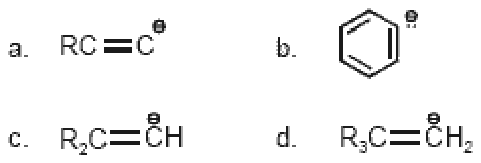
- 1a > c > b > d
- 2a > b > c > d
- 3b > c > d > a
- 4d > b > c > a
Show answer and solution
Correct: option 2, a > b > c > d
A carbanion is more stable when the negative carbon has more s-character, because the electrons are then held closer to the nucleus. In a the carbon is ; in b and c it is ; in d it is . Of the two ions, c carries electron-releasing alkyl groups that make it less stable than the phenyl anion b. So a > b > c > d.
Question 72AIPMT 2008 Prelims, Q91
Base strength of
a.
b.
c.
is in the order of
- 1a > b > c
- 2b > a > c
- 3c > b > a
- 4a > c > b
Show answer and solution
Correct: option 1, a > b > c
The parent acids are ethane, ethene and ethyne, whose acidity rises with the s-character of the carbon: ethane () < ethene () < ethyne (). The weaker the acid, the stronger its conjugate base, so the base strength is a > b > c.
Question 73AIPMT 2008 Prelims, Q95
An organic compound contains carbon, hydrogen and oxygen. Its elemental analysis gave C, 38.71% and H, 9.67%. The empirical formula of the compound would be
- 1
- 2
- 3
- 4CHO
Show answer and solution
Correct: option 2,
Oxygen = 100 − 38.71 − 9.67 = 51.62%. Moles: C = 38.71/12 = 3.22, H = 9.67/1 = 9.67, O = 51.62/16 = 3.22. Dividing by 3.22 gives C : H : O = 1 : 3 : 1, so the empirical formula is .
Question 74AIPMT 2007 Prelims, Q144
If there is no rotation of plane polarized light by a compound in a specific solvent, thought to be chiral, it may mean that
- 1the compound may be a racemic mixture
- 2the compound is certainly a chiral
- 3the compound is certainly meso
- 4there is no compound in the solvent
Show answer and solution
Correct: option 3, the compound is certainly meso
A sample with chiral centres shows no rotation when the rotations cancel. That happens inside one molecule in a meso compound, which has a plane of symmetry, and it also happens in a racemic mixture, where equal amounts of the two mirror-image forms cancel each other. The answer key of the source used here marks "certainly meso"; since a racemic mixture is equally possible, most textbooks give "may be a racemic mixture" as the answer.
Question 75AIPMT 2006 Prelims, Q92
The correct order regarding the electronegativity of hybrid orbitals of carbon is:
- 1
- 2
- 3
- 4
Show answer and solution
Correct: option 2,
Electrons in an s orbital are held closer to the nucleus than those in a p orbital, so a hybrid orbital with more s character is more electronegative. The s character is 50% in , 33% in and 25% in , which gives .
Question 76AIPMT 2006 Prelims, Q100
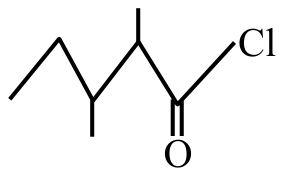
- 13,4-dimethylpentanoyl chloride
- 21-chloro-1-oxo-2,3-dimethylpentane
- 32-ethyl-3-methylbutanoyl chloride
- 42,3-dimethylpentanoyl chloride
Show answer and solution
Correct: option 4, 2,3-dimethylpentanoyl chloride
The compound is an acid chloride, so the name ends in "oyl chloride" and the carbonyl carbon is C-1. The longest chain that includes it has five carbons (pentanoyl), and the two branches are methyl groups on C-2 and C-3. The name is 2,3-dimethylpentanoyl chloride.
Question 77AIPMT 2005 Prelims, Q53
The best method for the separation of naphthalene and benzoic acid from their mixture is -
- 1Sublimation
- 2Chromatography
- 3Crystallisation
- 4Distillation
Show answer and solution
Correct: option 1, Sublimation
The answer key gives sublimation, taking naphthalene as the volatile solid that passes directly into vapour on gentle heating and is collected apart from the residue. Note that benzoic acid also sublimes on heating, so many books prefer crystallisation from hot water, in which benzoic acid dissolves and naphthalene does not; the keyed answer is kept here.
Question 78AIPMT 2005 Prelims, Q58
Which amongst the following is the most stable carbocation:-
- 1
- 2
- 3
- 4
Show answer and solution
Correct: option 3,
Alkyl groups stabilise a positive carbon by the +I effect and by hyperconjugation, so stability rises as tertiary > secondary > primary > methyl. The tert-butyl cation has three methyl groups (nine hyperconjugating C–H bonds) on the charged carbon and is the most stable.
Question 79AIPMT 2005 Prelims, Q95
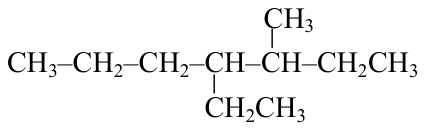
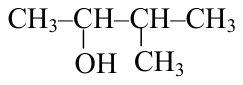
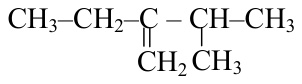
IUPAC Name of some compounds are given. Which one is incorrect -
- 13-Methyl-4-ethyl-heptane
- 23-Methyl-2-butanol
- 32-Ethyl-3-methyl-but-1-ene
- 4
4-Methyl-2-pentyne
Show answer and solution
Correct: option 1, 3-Methyl-4-ethyl-heptane
Substituents must be cited in alphabetical order, so the first compound, a heptane with methyl on C3 and ethyl on C4, is 4-ethyl-3-methylheptane and the given name is wrong. The other three names are correct: the –OH gets the lowest number in 3-methyl-2-butanol, the chain containing the double bond is butene in 2-ethyl-3-methylbut-1-ene, and the triple bond gets the lowest number in 4-methyl-2-pentyne.
Question 80AIPMT 2004 Prelims, Q97
The molecular formula of diphenyl methane,
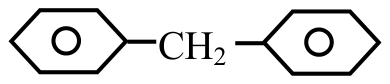
is .
How many structural isomers are possible when one of the hydrogens is replaced by a chlorine atom:
- 14
- 28
- 37
- 46
Show answer and solution
Correct: option 1, 4
The two phenyl rings are equivalent, so diphenylmethane has only four different kinds of hydrogen: those of the group and the ring hydrogens ortho, meta and para to it. Replacing one hydrogen of each kind by chlorine gives 4 structural isomers.
Question 81AIPMT 2003 Prelims, Q74
IUPAC name of the compound given below is:
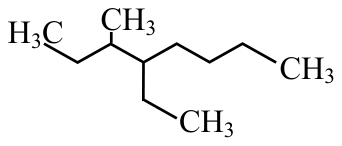
- 14-Ethyl-3-methyloctane
- 23-Methyl-4-ethyloctane
- 32, 3-Diethylheptane
- 45-Ethyl-6-methyloctane
Show answer and solution
Correct: option 1, 4-Ethyl-3-methyloctane
The longest chain has eight carbons (octane). Numbering from the end nearer the branches puts the methyl group on C-3 and the ethyl group on C-4 (3,4 is lower than 5,6 from the other end). Substituents are listed alphabetically, ethyl before methyl, giving 4-ethyl-3-methyloctane.
Question 82AIPMT 2003 Prelims, Q76
Which of the following pairs of compounds are enantiomers:
- 1
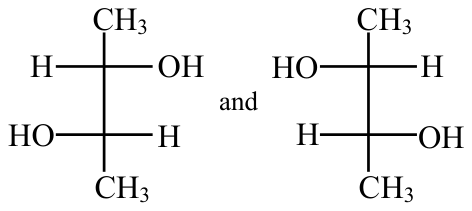
- 2
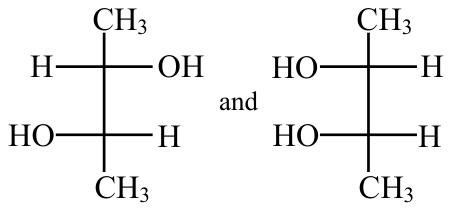
- 3
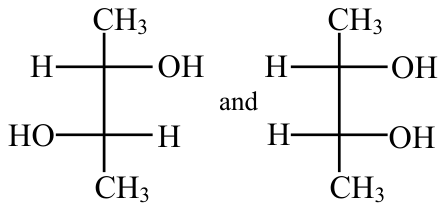
- 4
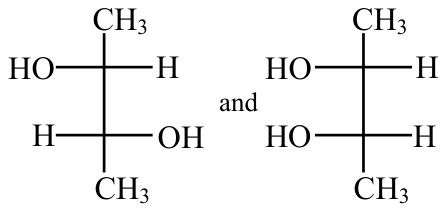
Show answer and solution
Correct: option 1
Enantiomers are non-superimposable mirror images. In pair (1) the second Fischer projection has H and OH swapped at both carbons, which is the mirror image of the first, and the first structure (OH groups on opposite sides) is chiral. In (2) and (3) only one carbon differs, giving diastereomers (the second structure has both OH groups on the same side and is the meso form). In (4) too the second structure is the meso form, not a mirror image of the first.
Question 83AIPMT 2002 Prelims, Q85
IUPAC name of the following is
- 11, 5-hexenyne
- 21-hexene-5-yne
- 31-hexyne-5-ene
- 41, 5-hexynene
Show answer and solution
Correct: option 2, 1-hexene-5-yne
The six-carbon chain contains a double bond and a triple bond at the two ends. When numbering from either end gives the same set of positions, the double bond gets the lower number, and "ene" is written before "yne". The name is 1-hexene-5-yne (hex-1-en-5-yne).
Question 84AIPMT 2002 Prelims, Q89
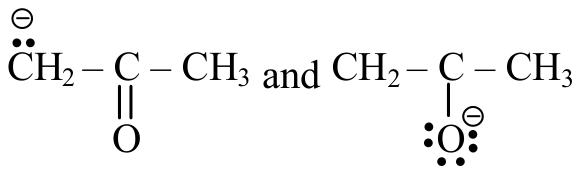
- 1Resonating structures
- 2Tautomers
- 3Geometrical isomers
- 4Optical isomers
Show answer and solution
Correct: option 1, Resonating structures
The two structures are the carbanion form and the oxygen-anion (enolate) form of the same ion. They have the same arrangement of atoms and differ only in where the electrons and the negative charge are placed, so they are resonating structures. Tautomers would differ in the position of a hydrogen atom.
Question 85AIPMT 2002 Prelims, Q98
Geometrical isomers are differ in:
- 1Position of functional group
- 2Position of atoms
- 3Spatial arrangement of atoms
- 4Length of carbon chain
Show answer and solution
Correct: option 3, Spatial arrangement of atoms
Geometrical (cis–trans) isomers have the same atoms joined in the same order; they differ only in how the groups are arranged in space about a double bond or a ring. A different position of the functional group or a different chain length would make them structural isomers.
Question 86AIPMT 2001 Prelims, Q60
The incorrect IUPAC name is:
- 1 2-methyl-3-butanone
- 2 2, 3-dimethyl pentane
- 3 4-methyl-2-pentyne
- 4 2-bromo-3-chloro butane
Show answer and solution
Correct: option 1, 2-methyl-3-butanone
The carbonyl group must get the lowest number, so the chain in (1) is numbered from the end nearer C=O and the name is 3-methyl-2-butanone. The other names are right: the longest chain in (2) has five carbons with methyls on C2 and C3, the triple bond in (3) gets position 2, and in (4) the substituents are numbered 2 and 3 with bromo cited first alphabetically.
Question 87AIPMT 2001 Prelims, Q66
In steam distillation of toluene, the pressure of toluene in vapour is:
- 1Equal pressure of barometer
- 2Less than pressure of barometer
- 3Equal to vapour pressure to toluene in simple distillation
- 4More than vapour pressure of toluene in simple distillation
Show answer and solution
Correct: option 2, Less than pressure of barometer
In steam distillation the mixture boils when the sum of the vapour pressures of water and the organic liquid equals atmospheric pressure, . The partial pressure of toluene alone is therefore less than the barometric pressure.
Question 88AIPMT 2001 Prelims, Q67
A compound of molecular formula is shows optical isomerism, compound will be
- 12, 3-dimethyl pentane
- 22, 2-dimethyl butane
- 32-methyl hexane
- 4None of the above
Show answer and solution
Correct: option 1, 2, 3-dimethyl pentane
In 2,3-dimethylpentane, C3 carries four different groups: H, methyl, ethyl and isopropyl, so it is a chiral centre and the compound is optically active. 2-Methylhexane has no such carbon, and 2,2-dimethylbutane is .
Question 89AIPMT 2000 Prelims, Q53
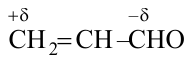
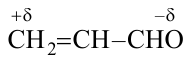
Polarization in acrolein as:
- 1
- 2
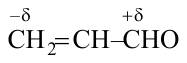
- 3
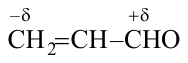
- 4
Show answer and solution
Correct: option 4
In acrolein the C=C bond is conjugated with the C=O group. Oxygen is the most electronegative atom, so the electrons are drawn towards it through the conjugated system: . The terminal carbon therefore carries the partial positive charge and the oxygen the partial negative charge, which is the picture in option 4.
Question 90AIPMT 1999 Prelims, Q59
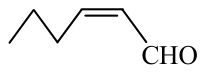
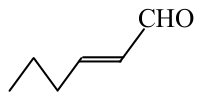
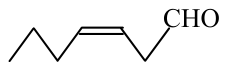
Structure of trans 2-hexanal is:
- 1
- 2
- 3
- 4None of the above
Show answer and solution
Correct: option 2
The name is meant as trans-2-hexenal: a six-carbon chain with CHO as carbon 1 and a double bond between carbons 2 and 3, with the CHO group and the propyl group on opposite sides. Option (1) has the two groups on the same side of the double bond (cis), and option (3) has a between the double bond and CHO, so its double bond is at carbon 3. Option (2) has the CHO directly on the double bond with the chain on the opposite side, which is the trans form.
Question 91AIPMT 1999 Prelims, Q63
Which of the following is a chiral compound:
- 12-methyl pentanoic acid
- 23-methyl pentanoic acid
- 34-methyl pentanoic acid
- 4None of these
Show answer and solution
Correct: option 1 or 2
The answer key accepts options 1 and 2.
In 2-methylpentanoic acid, C-2 carries H, , and propyl: four different groups, so it is chiral. In 3-methylpentanoic acid, C-3 carries H, , and , so it is chiral too. In 4-methylpentanoic acid, C-4 carries two methyl groups and is not chiral. The key accepts both (1) and (2).
Question 92AIPMT 1998 Prelims, Q51
Correct order of –I effect is:
- 1
- 2
- 3
- 4
Show answer and solution
Correct: option 3,
The –I effect measures how strongly a group pulls electrons through sigma bonds. A group carrying a full positive charge, , pulls hardest. Between the neutral groups, fluorine is more electronegative than oxygen, so F comes before OR. The order is .
Question 93AIPMT 1998 Prelims, Q53
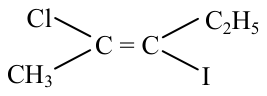
- 1(Z)-2-chloro-3-iodo-2-pentene
- 2(E)-2-chloro-3-iodo-2-pentene
- 32-iodo-3-chloro-pentene
- 4None of the above
Show answer and solution
Correct: option 2, (E)-2-chloro-3-iodo-2-pentene
The chain is pent-2-ene with Cl on C-2 and I on C-3, so the name is 2-chloro-3-iodo-2-pentene. On C-2 the higher-priority group is Cl (over ); on C-3 it is I (over ). Cl and I lie on opposite sides of the double bond, so the configuration is E.