Questions with solutions
Question 1NEET 2026, Q75
The correct statement with regard to the secondary structure of DNA/RNA is:
- 1DNA possesses a single strand helix structure and contains uracil as one of the four bases.
- 2RNA possesses a single strand helix structure and contains thymine as one of the four bases.
- 3DNA possesses a double strand helix structure and contains thymine as one of the four bases.
- 4RNA possesses a double strand helix structure and contains uracil as one of the four bases.
Show answer and solution
Correct: option 3, DNA possesses a double strand helix structure and contains thymine as one of the four bases.
DNA is a double-stranded helix with the bases adenine, guanine, cytosine and thymine. RNA is a single-stranded helix in which uracil takes the place of thymine. Only statement (3) fits.
Question 2NEET 2026 Re-exam, Q50
The correct statement about peptides and proteins is
- 1Tertiary structure of proteins has two or more polypeptide subunits.
- 2Only the proteins having a quaternary structure are biologically active.
- 3In -pleated sheet structures, peptide chains are held together by intermolecular hydrogen bonds.
- 4In -helices, the polypeptide chain is twisted into a left-handed screw (helix) through intramolecular hydrogen bonds.
Show answer and solution
Correct: option 3, In -pleated sheet structures, peptide chains are held together by intermolecular hydrogen bonds.
In a -pleated sheet the stretched peptide chains lie side by side and are held together by intermolecular hydrogen bonds, so (3) is correct. Two or more subunits are a feature of quaternary, not tertiary, structure; many proteins with a single chain are active; and the -helix is a right-handed screw.
Question 3NEET 2026 Re-exam, Q80
Match the vitamins in List I with their sources in List II
| List I | List II |
|---|
| A. vitamin A | I. meat |
| B. vitamin | II. sunflower oil |
| C. vitamin E | III. green leafy vegetables |
| D. vitamin K | IV. carrots |
Choose the correct answer from the options given below.
- 1A-II, B-III, C-IV, D-I
- 2A-IV, B-I, C-II, D-III
- 3A-IV, B-II, C-I, D-III
- 4A-III, B-I, C-IV, D-II
Show answer and solution
Correct: option 2, A-IV, B-I, C-II, D-III
Vitamin A comes from carrots, fish liver oil, butter and milk. Vitamin comes from meat, fish, egg and curd. Vitamin E is found in vegetable oils such as sunflower oil and wheat germ oil. Vitamin K is found in green leafy vegetables. So A-IV, B-I, C-II, D-III.
Question 4NEET 2025, Q69
Match List I with List II.
| List I (Name of Vitamin) | List II (Deficiency disease) |
|---|
| A. Vitamin | I. Cheilosis |
| B. Vitamin D | II. Convulsions |
| C. Vitamin | III. Rickets |
| D. Vitamin | IV. Pernicious anaemia |
Choose the correct answer from the options given below:
- 1A-I, B-III, C-II, D-IV
- 2A-IV, B-III, C-I, D-II
- 3A-II, B-III, C-I, D-IV
- 4A-IV, B-III, C-II, D-I
Show answer and solution
Correct: option 2, A-IV, B-III, C-I, D-II
Lack of vitamin causes pernicious anaemia (IV), vitamin D rickets (III), vitamin (riboflavin) cheilosis (I) and vitamin (pyridoxine) convulsions (II). Option (2).
Question 5NEET 2025, Q82
Sugar 'X'
A. is found in honey.
B. is a keto sugar.
C. exists in and - anomeric forms.
D. is laevorotatory.
'X' is:
- 1D-Glucose
- 2D-Fructose
- 3Maltose
- 4Sucrose
Show answer and solution
Correct: option 2, D-Fructose
Fructose occurs in honey, is a ketohexose, forms and anomers in its cyclic form, and D-()-fructose is laevorotatory. Glucose is an aldose and dextrorotatory, and maltose and sucrose are dextrorotatory disaccharides. Option (2).
Question 6NEET 2024, Q60
The reagents with which glucose does not react to give the corresponding tests/products are
A. Tollen's reagent
B. Schiff's reagent
C. HCN
D.
E.
Choose the correct options from the given below:
- 1E and D
- 2B and C
- 3A and D
- 4B and E
Show answer and solution
Correct: option 4, B and E
Glucose exists mostly as a cyclic hemiacetal, so very little free group is present. It still reduces Tollen's reagent, adds HCN to give a cyanohydrin and forms an oxime with . But it does not restore the colour of Schiff's reagent and does not form the addition product with , which is one of the facts the open-chain structure cannot explain. So the answer is B and E, option (4).
Question 7NEET 2024 Re-exam, Q83
Given below are two statements:
Statement I: Glycogen is similar to amylose in its structure.
Statement II: Glycogen is found in yeast and fungi also.
In the light of the above statements, choose the correct answer from the options given below:
- 1Statement I is true but Statement II is false.
- 2Statement I is false but Statement II is true.
- 3Both Statement I and Statement II are true.
- 4Both Statement I and Statement II are false.
Show answer and solution
Correct: option 2, Statement I is false but Statement II is true.
Glycogen is a highly branched polymer of α-D-glucose with C1-C4 chains and C1-C6 branch points, so it resembles amylopectin (and is even more branched), not amylose, which is an unbranched chain. Statement I is false. Glycogen is the storage carbohydrate of animals and is also found in yeast and fungi, so Statement II is true.
Question 8NEET 2023, Q62
Given below are two statements:
Statement I: A unit formed by the attachment of a base to position of sugar is known as nucleoside
Statement II: When nucleoside is linked to phosphorous acid at -position of sugar moiety, we get nucleotide.
In the light of the above statements, choose the correct answer from the options given below:
- 1Both Statement I and Statement II are true.
- 2Both Statement I and Statement II are false.
- 3Statement I is true but Statement II is false.
- 4Statement I is false but Statement II is true.
Show answer and solution
Correct: option 3, Statement I is true but Statement II is false.
A nucleoside is a base joined to the carbon of the sugar, so Statement I is true. A nucleotide is formed when the nucleoside is linked to phosphoric acid () at the position, not to phosphorous acid (), so Statement II is false.
Question 9NEET 2023 Manipur, Q55
Cheilosis occurs due to deficiency of _________.
- 1Pyridoxamine
- 2Riboflavin
- 3Thiamine
- 4Nicotinamide
Show answer and solution
Correct: option 2, Riboflavin
Cheilosis (cracking at the corners of the mouth and lips) is the deficiency disease of vitamin , which is riboflavin. Thiamine () deficiency gives beri-beri and pyridoxine () deficiency gives convulsions.
Question 10NEET 2022, Q67
The incorrect statement regarding enzymes is:
- 1Enzymes are very specific for a particular reaction and substrate.
- 2Enzymes are biocatalysts.
- 3Like chemical catalysts enzymes reduce the activation energy of bio processes.
- 4Enzymes are polysaccharides.
Show answer and solution
Correct: option 4, Enzymes are polysaccharides.
Almost all enzymes are globular proteins, not polysaccharides. They are biological catalysts, highly specific for their substrate and reaction, and they work by lowering the activation energy. So statement (4) is incorrect.
Question 11NEET 2022 Re-exam, Q84
The incorrect statement about denaturation of proteins is:
- 1Uncoiling of the helical structure takes place
- 2It results due to change of temperature and/or pH
- 3It results in loss of biological activity of proteins
- 4A protein is formed from amino acids linked by peptide bonds
Show answer and solution
Correct: option 4, A protein is formed from amino acids linked by peptide bonds
Denaturation is caused by a change of temperature or pH; hydrogen bonds are disturbed, the helix uncoils and the protein loses its biological activity, while the primary structure stays intact. Statements (1), (2) and (3) describe this. Statement (4) is about how a protein is built, not about denaturation, so it is the one that does not belong.
Question 12NEET 2021, Q76
The RBC deficiency is deficiency disease of:
- 1Vitamin
- 2Vitamin
- 3Vitamin
- 4Vitamin
Show answer and solution
Correct: option 1, Vitamin
Lack of vitamin causes pernicious anaemia, a deficiency of red blood cells. Deficiency of causes convulsions, beri-beri and cheilosis.
Question 13NEET 2020, Q1
Which of the following is a basic amino acid?
- 1Serine
- 2Alanine
- 3Tyrosine
- 4Lysine
Show answer and solution
Correct: option 4, Lysine
An amino acid is basic when it has more amino groups than carboxyl groups. Lysine carries a second group in its side chain, so it is basic. Serine, alanine and tyrosine each have one amino and one carboxyl group and are neutral.
Question 14NEET 2020, Q8
Sucrose on hydrolysis gives:
- 1β-D-Glucose + α-D-Fructose
- 2α-D-Glucose + β-D-Glucose
- 3α-D-Glucose + β-D-Fructose
- 4α-D-Fructose + β-D-Fructose
Show answer and solution
Correct: option 3, α-D-Glucose + β-D-Fructose
Sucrose is made of α-D-glucose and β-D-fructose joined by a glycosidic linkage between C1 of glucose and C2 of fructose. Hydrolysis breaks this linkage and gives these two units.
Question 15NEET 2020 Phase 2, Q137
Deficiency of which vitamin causes osteomalacia?
- 1Vitamin D
- 2Vitamin K
- 3Vitamin E
- 4Vitamin A
Show answer and solution
Correct: option 1, Vitamin D
Vitamin D is needed for absorbing calcium and laying it down in bone. Its deficiency causes rickets in children and osteomalacia (soft bones and joint pain) in adults. Lack of vitamin K affects blood clotting, vitamin E causes fragile red blood cells and muscular weakness, and vitamin A causes night blindness and xerophthalmia.
Question 16NEET 2020 Phase 2, Q146
Which of the following statement is not true about glucose?
- 1It contains five hydroxyl groups.
- 2It is a reducing sugar.
- 3It is an aldopentose.
- 4It is an aldohexose.
Show answer and solution
Correct: option 3, It is an aldopentose.
Glucose, , has six carbon atoms and an aldehyde group, so it is an aldohexose and not an aldopentose. It has five groups (it forms a pentaacetate) and it reduces Tollens' reagent and Fehling's solution. Statement (3) is the false one.
Question 17NEET 2019, Q64
The non-essential amino acid among the following is:
- 1valine
- 2leucine
- 3alanine
- 4lysine
Show answer and solution
Correct: option 3, alanine
Non-essential amino acids are the ones the body can make for itself. Alanine is one of them, while valine, leucine and lysine cannot be synthesised in the body and must come from the diet.
Question 18NEET 2019 Odisha, Q88
Which structure(s) of proteins remain(s) intact during denaturation process?
- 1Secondary structure only
- 2Tertiary structure only
- 3Both secondary and tertiary structures
- 4Primary structure only
Show answer and solution
Correct: option 4, Primary structure only
Denaturation by heat or a change of pH breaks the hydrogen bonds and other weak interactions that hold the secondary and tertiary structures, so the helices and folds are lost. The peptide bonds are not broken, so the amino acid sequence, the primary structure, stays intact.
Question 19NEET 2018, Q53
Which of the following compounds can form a zwitterion?
- 1Benzoic acid
- 2Acetanilide
- 3Aniline
- 4Glycine
Show answer and solution
Correct: option 4, Glycine
A zwitterion needs an acidic group and a basic group in the same molecule. Glycine, , has both; the proton moves from to to give . The other three have only one such group.
Question 20NEET 2018, Q56
The difference between amylose and amylopectin is
- 1Amylopectin have -linkage and -linkage
- 2Amylose have -linkage and -linkage
- 3Amylopectin have -linkage and -linkage
- 4Amylose is made up of glucose and galactose
Show answer and solution
Correct: option 3, Amylopectin have -linkage and -linkage
Both are polymers of -D-glucose only. Amylose is an unbranched chain with C1–C4 -linkages. Amylopectin is branched: its chains have C1–C4 -linkages and the branches are joined by C1–C6 -linkages.
Question 21NEET 2017, Q74
Which of the following statements is not correct?
- 1Insulin maintains sugar level in the blood of a human body.
- 2Ovalbumin is a simple food reserve in egg-white.
- 3Blood proteins thrombin and fibrinogen are involved in blood clotting.
- 4Denaturation makes the proteins more active.
Show answer and solution
Correct: option 4, Denaturation makes the proteins more active.
Denaturation destroys the secondary and tertiary structure of a protein, and with it the biological activity. So a denatured protein is less active, not more; statement (4) is not correct.
Question 22NEET 2016 Phase 1, Q56
In a protein molecule various amino acids are linked together by:
- 1 - glycosidic bond
- 2 - glycosidic bond
- 3peptide bond
- 4dative bond
Show answer and solution
Correct: option 3, peptide bond
The group of one amino acid condenses with the group of the next, losing water and forming a link called a peptide bond. Glycosidic bonds join sugar units in carbohydrates, not amino acids.
Question 23NEET 2016 Phase 1, Q87
The correct statement regarding RNA and DNA, respectively is:
- 1The sugar component in RNA is arabinose and the sugar component in DNA is 2'-deoxyribose.
- 2The sugar component in RNA is ribose and the sugar component in DNA is 2'-deoxyribose.
- 3The sugar component in RNA is arabinose and the sugar component in DNA is ribose.
- 4The sugar component in RNA is 2'-deoxyribose and the sugar component in DNA is arabinose.
Show answer and solution
Correct: option 2, The sugar component in RNA is ribose and the sugar component in DNA is 2'-deoxyribose.
RNA (ribonucleic acid) contains the pentose sugar -D-ribose. DNA (deoxyribonucleic acid) contains -D-2-deoxyribose, the same sugar without the group on carbon 2'. Arabinose is not part of either.
Question 24NEET 2016 Phase 1, Q89
Which one given below is a non-reducing sugar?
- 1Maltose
- 2Lactose
- 3Glucose
- 4Sucrose
Show answer and solution
Correct: option 4, Sucrose
A sugar is reducing only if it has a free aldehyde or ketone (hemiacetal) group. In sucrose the glycosidic bond joins C1 of glucose to C2 of fructose, so the reducing groups of both units are used up and sucrose does not reduce Tollens' or Fehling's reagent. Maltose, lactose and glucose each have a free hemiacetal group.
Question 25NEET 2016 Phase 2, Q82
The central dogma of molecular genetics states that the genetic information flows from
- 1Amino acids Proteins DNA
- 2DNA Carbohydrates Proteins
- 3DNA RNA Proteins
- 4DNA RNA Carbohydrates
Show answer and solution
Correct: option 3, DNA RNA Proteins
The central dogma says that information stored in DNA is copied into RNA by transcription, and the RNA is then read to build a protein by translation. So the flow is DNA to RNA to proteins.
Question 26NEET 2016 Phase 2, Q83
The correct corresponding order of names of four aldoses with configuration given below
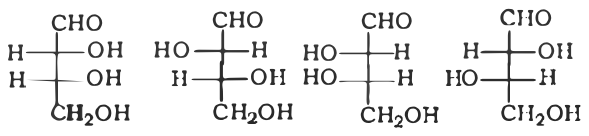
- 1L-erythrose, L-threose, L-erythrose, D-threose
- 2D-threose, D-erythrose, L-threose, L-erythrose
- 3L-erythrose, L-threose, D-erythrose, D-threose
- 4D-erythrose, D-threose, L-erythrose, L-threose
Show answer and solution
Correct: option 4, D-erythrose, D-threose, L-erythrose, L-threose
In a Fischer projection the sugar is D if the on the lowest chiral carbon is on the right and L if it is on the left. It is erythrose if the two groups are on the same side and threose if they are on opposite sides. First: both on the right, D-erythrose. Second: lower on the right, upper on the left, D-threose. Third: both on the left, L-erythrose. Fourth: lower on the left, upper on the right, L-threose.
Question 27AIPMT 2014, Q148
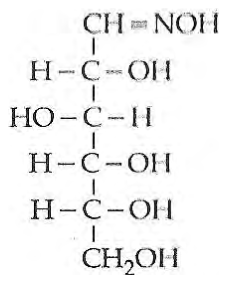
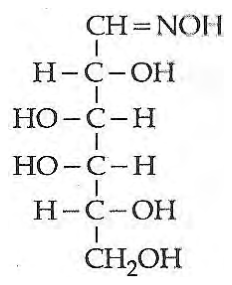
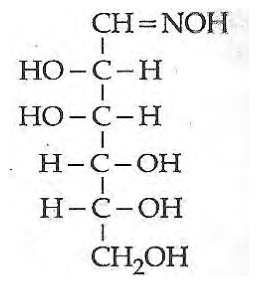
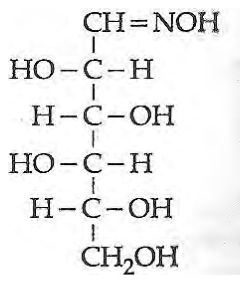
D(+) glucose reacts with hydroxyl amine and yields an oxime. The structure of the oxime would be:
- 1
- 2
- 3
- 4
Show answer and solution
Correct: option 1
Hydroxylamine reacts only with the aldehyde group at C-1, turning into ; the rest of the chain is unchanged. In the Fischer projection of D-glucose the groups on C-2, C-3, C-4 and C-5 are on the right, left, right and right. Only option (1) has this arrangement.
Question 28AIPMT 2014, Q156
Which of the following hormones is produced under the condition of stress which stimulates glycogenolysis in the liver of human beings?
- 1Estradiol
- 2Thyroxin
- 3Insulin
- 4Adrenaline
Show answer and solution
Correct: option 4, Adrenaline
Adrenaline (epinephrine) is released by the adrenal medulla under stress, the emergency hormone. It stimulates the breakdown of liver glycogen to glucose (glycogenolysis), raising blood sugar. Insulin does the opposite, thyroxin controls metabolic rate and estradiol is a sex hormone.
Question 29NEET 2013 Karnataka, Q36
In DNA, the linkages between different nitrogenous bases are:
- 1Phosphate linkage
- 2H-bonding
- 3Glycosidic linkage
- 4Peptide linkage
Show answer and solution
Correct: option 2, H-bonding
The two strands of DNA are held together by hydrogen bonds between complementary bases: two between adenine and thymine and three between guanine and cytosine. Phosphodiester links join the sugars, glycosidic links join base to sugar, and peptide links belong to proteins.
Question 30AIPMT 2012 Prelims, Q169
Deficiency of vitamin causes the disease
- 1Convulsions
- 2Beri-Beri
- 3Cheilosis
- 4Sterility
Show answer and solution
Correct: option 2, Beri-Beri
Vitamin is thiamine and its deficiency causes beri-beri. Convulsions are linked with lack of vitamin , cheilosis with and sterility with vitamin E. So option (2).
Question 31AIPMT 2012 Prelims, Q173
Which one of the following sets of monosaccharides forms sucrose?
- 1-D-Galactopyranose and -D-Glucopyranose
- 2-D-Glucopyranose and -D-fructofuranose
- 3-D-Glucopyranose and -D-fructofuranose
- 4-D-Glucopyranose and -D-fructopyranose
Show answer and solution
Correct: option 2, -D-Glucopyranose and -D-fructofuranose
Sucrose is made of one -D-glucose unit in the six-membered pyranose form and one -D-fructose unit in the five-membered furanose form, joined through C1 of glucose and C2 of fructose. That is option (2).
Question 32AIPMT 2011 Prelims, Q15
Which one of the following statements is not true regarding (+) Lactose?
- 1On hydrolysis (+) Lactose gives equal amount of D(+) glucose and D(+) galactose.
- 2(+) Lactose is a -glycoside formed by the union of a molecule of D(+) glucose and a molecule of D(+) galactose.
- 3(+) Lactose is a reducing sugar and does not exhibit mutarotation.
- 4(+) Lactose, contains 8-OH groups.
Show answer and solution
Correct: option 3, (+) Lactose is a reducing sugar and does not exhibit mutarotation.
In lactose, C1 of -D-galactose is linked to C4 of D-glucose, so the glucose unit keeps a free hemiacetal group at its C1. That makes lactose a reducing sugar, and every sugar with a free hemiacetal group also shows mutarotation. The statement that it does not exhibit mutarotation is therefore false; the other three statements are true.
Question 33AIPMT 2011 Mains, Q1
Which of the following is not a fat soluble vitamin?
- 1Vitamin B complex
- 2Vitamin D
- 3Vitamin E
- 4Vitamin A
Show answer and solution
Correct: option 1, Vitamin B complex
Vitamins A, D, E and K dissolve in fats and are stored in fatty tissue and the liver. The B group vitamins and vitamin C dissolve in water. So vitamin B complex is the one that is not fat soluble.
Question 34AIPMT 2011 Mains, Q2
Which of the statements about "Denaturation" given below are correct?
Statements
(a) Denaturation of proteins causes loss of secondary and tertiary structures of the protein.
(b) Denaturation leads to the conversion of double strand of DNA into single strand
(c) Denaturation affects primary structure which gets distorted
Options:
- 1(b) and (c)
- 2(a) and (c)
- 3(a) and (b)
- 4(a), (b) and (c)
Show answer and solution
Correct: option 3, (a) and (b)
Denaturation breaks the weak forces (hydrogen bonds and the like) that hold a folded molecule together. In a protein this destroys the secondary and tertiary structures, so (a) is correct. In DNA the hydrogen bonds between the two strands break and the double strand separates into single strands, so (b) is correct. The primary structure, the covalently bonded sequence, is not changed, so (c) is wrong. Hence (a) and (b).
Question 35AIPMT 2010 Mains, Q59
Fructose reduces Tollen's reagent due to:
- 1Asymmetric carbons
- 2Primary alcoholic groups
- 3Secondary alcoholic group
- 4Enolisation of fructose followed by conversion to aldehyde by base
Show answer and solution
Correct: option 4, Enolisation of fructose followed by conversion to aldehyde by base
Fructose is a ketose, but Tollens' reagent is alkaline. In base fructose forms an enediol, which rearranges to the aldoses glucose and mannose. Their aldehyde group reduces the reagent to silver.
Question 36AIPMT 2010 Prelims, Q54
Which one of the following does not exhibit the phenomenon of mutarotation?
- 1(+) Sucrose
- 2(+) Lactose
- 3(+) Maltose
- 4(–) Fructose
Show answer and solution
Correct: option 1, (+) Sucrose
Mutarotation needs a free hemiacetal or hemiketal group, so that the ring can open and the two anomers can interconvert in solution. In sucrose the anomeric carbons of glucose and fructose are joined to each other in the glycosidic bond, so neither is free and sucrose (a non-reducing sugar) shows no mutarotation. Lactose, maltose and fructose are reducing sugars and do show it.
Question 37AIPMT 2009 Prelims, Q167
The segment of DNA which acts as the instrumental manual for the synthesis of the protein is:
- 1ribose
- 2gene
- 3nucleoside
- 4nucleotide
Show answer and solution
Correct: option 2, gene
A gene is the stretch of DNA whose base sequence codes for one protein. Ribose is a sugar, a nucleoside is a base joined to a sugar, and a nucleotide is a nucleoside with a phosphate group; these are only building units.
Question 38AIPMT 2009 Prelims, Q200
Which of the following hormones contains iodine?
- 1testosterone
- 2adrenaline
- 3thyroxine
- 4insulin
Show answer and solution
Correct: option 3, thyroxine
Thyroxine, the hormone of the thyroid gland, is an amino acid derivative with four iodine atoms in each molecule. Testosterone is a steroid, adrenaline is an amine and insulin is a protein; none of them contains iodine.
Question 39AIPMT 2008 Prelims, Q93
In DNA, the complementary bases are
- 1Uracil and adenine; cytosine and guanine
- 2Adenine and thymine; guanine and cytosine
- 3Adenine and thymine; guanine and uracil
- 4Adenine and guanine; thymine and cytosine
Show answer and solution
Correct: option 2, Adenine and thymine; guanine and cytosine
In the DNA double helix adenine pairs with thymine through two hydrogen bonds and guanine pairs with cytosine through three. Uracil is found in RNA, not DNA.
Question 40AIPMT 2008 Prelims, Q100
Which one of the following is an amine hormone?
- 1Progesterone
- 2Thyroxine
- 3Oxypurin
- 4Insulin
Show answer and solution
Correct: option 2, Thyroxine
Thyroxine is made from the amino acid tyrosine and is classed as an amine hormone. Progesterone is a steroid and insulin is a polypeptide.
Question 41AIPMT 2007 Prelims, Q148
Which one of the following vitamins is water-soluble?
- 1Vitamin A
- 2Vitamin B
- 3Vitamin E
- 4Vitamin K
Show answer and solution
Correct: option 2, Vitamin B
The B group vitamins and vitamin C dissolve in water and are not stored in the body to any extent. Vitamins A, D, E and K dissolve in fats and are stored in the liver and fatty tissue.
Question 42AIPMT 2007 Prelims, Q149
RNA and DNA are chiral molecules, their chirality is due to
- 1D-sugar component
- 2L-sugar component
- 3Chiral bases
- 4Chiral phosphate ester units
Show answer and solution
Correct: option 1, D-sugar component
Each nucleotide is made of a base, a sugar and a phosphate. The bases are flat ring molecules and the phosphate group has no chiral centre, but the sugar (ribose in RNA, 2-deoxyribose in DNA) has chiral carbons and belongs to the D series. The chirality of the nucleic acids therefore comes from the D-sugar.
Question 43AIPMT 2006 Prelims, Q56
During the process of digestion, the proteins present in food materials are hydrolysed to amino acids. The two enzymes involved in the process:
Proteins Polypeptides Amino acids,
are respectively:
- 1Amylase and Maltase
- 2Diastase and Lipase
- 3Pepsin and Trypsin
- 4Invertase and Zymase
Show answer and solution
Correct: option 3, Pepsin and Trypsin
Pepsin (in the stomach) and trypsin (from the pancreas) are the protein-digesting enzymes that break peptide bonds. Amylase, maltase, diastase, invertase and zymase act on carbohydrates, and lipase acts on fats, so only option (3) names two proteases.
Question 44AIPMT 2006 Prelims, Q57
The human body does not produce:
- 1DNA
- 2Vitamin
- 3Hormones
- 4Enzymes
Show answer and solution
Correct: option 2, Vitamin
DNA, hormones and enzymes are all made in the body's own cells. Most vitamins cannot be synthesised by the body and have to come from the diet, which is why they are essential dietary factors.
Question 45AIPMT 2006 Prelims, Q72
Which one of the following is a peptide hormone:
- 1Glucagon
- 2Testosterone
- 3Thyroxin
- 4Adrenaline
Show answer and solution
Correct: option 1, Glucagon
Glucagon is a chain of 29 amino acids made by the pancreas, so it is a peptide hormone. Testosterone is a steroid, while thyroxin and adrenaline are small molecules derived from the amino acid tyrosine.
Question 46AIPMT 2005 Prelims, Q78
Which functional group participates in disulphide bond formation in proteins:-
- 1Thioether
- 2Thiol
- 3Thioester
- 4Thiolactone
Show answer and solution
Correct: option 2, Thiol
A disulphide bridge (–S–S–) forms when the –SH (thiol) groups of two cysteine residues are oxidised and join. Thioethers, as in methionine, thioesters and thiolactones have no free S–H to couple in this way.
Question 47AIPMT 2005 Prelims, Q87
The cell membranes are mainly composed of:-
- 1Phospholipids
- 2Proteins
- 3Fats
- 4Carbohydrates
Show answer and solution
Correct: option 1, Phospholipids
The basic framework of a cell membrane is a double layer of phospholipid molecules, with their polar heads facing the water on both sides and their fatty acid tails inside. Proteins are embedded in this bilayer and carbohydrates are attached only in small amounts; fats (triglycerides) are storage lipids, not membrane lipids.
Question 48AIPMT 2004 Prelims, Q55
The correct statement in respect of protein haemoglobin is that it:
- 1Maintains blood sugar level
- 2Acts as an oxygen carrier in the blood
- 3Forms antibodies and offers resistance to diseases
- 4Functions as a catalyst for biological reactions
Show answer and solution
Correct: option 2, Acts as an oxygen carrier in the blood
Haemoglobin is the iron-containing transport protein of red blood cells; it binds oxygen in the lungs and releases it in the tissues. Blood sugar is controlled by hormones such as insulin, antibodies are immunoglobulins, and biological catalysts are enzymes.
Question 49AIPMT 2004 Prelims, Q56
A sequence of how many nucleotides in messenger RNA makes a codon for an amino acid:
- 1Four
- 2One
- 3Two
- 4Three
Show answer and solution
Correct: option 4, Three
The genetic code is a triplet code: three consecutive nucleotides of mRNA make one codon, which specifies one amino acid. Three bases give codons, enough for the 20 amino acids, whereas two bases would give only 16.
Question 50AIPMT 2004 Prelims, Q57
The hormone that helps in the conversion of glucose to glycogen is:
- 1Bile acids
- 2Adrenaline
- 3insulin
- 4Cortisone
Show answer and solution
Correct: option 3, insulin
Insulin lowers blood glucose by promoting its uptake and its conversion to glycogen in the liver and muscles. Adrenaline does the opposite (it breaks glycogen down to glucose), cortisone raises blood glucose, and bile acids help digest fats.
Question 51AIPMT 2004 Prelims, Q63
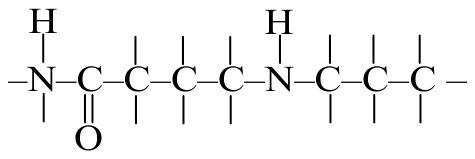
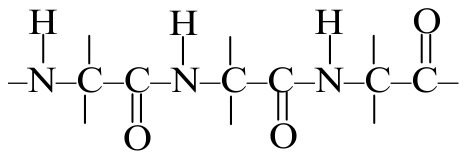
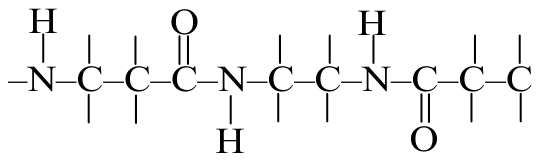
Which one of the following structures represents the peptide chain:
- 1
- 2
- 3
- 4
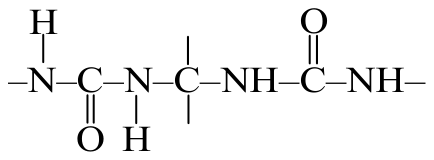
Show answer and solution
Correct: option 2
A peptide chain is made of -amino acid units joined by amide (–CO–NH–) links, so its backbone repeats the unit –NH–C–C(=O)–: a nitrogen carrying H, then the -carbon, then a carbonyl carbon, and then the next nitrogen. Only the structure in option (2) shows this repeating N–C–C(=O) pattern three times.
Question 52AIPMT 2004 Prelims, Q68
Number of chiral carbons in -D-(+)-glucose is:
- 1Six
- 2Three
- 3Four
- 4Five
Show answer and solution
Correct: option 4, Five
-D-(+)-glucose is the cyclic (pyranose) form. Ring closure makes C-1 a new chiral centre, so C-1, C-2, C-3, C-4 and C-5 are all chiral; C-6 is a group and is not. That gives five chiral carbons (the open-chain form has four).
Question 53AIPMT 2004 Prelims, Q69
The helical structure of protein is stabilized by:
- 1Hydrogen bonds
- 2Ether bonds
- 3Peptide bonds
- 4Dipeptide bonds
Show answer and solution
Correct: option 1, Hydrogen bonds
In the -helix the chain is held in its coiled shape by hydrogen bonds between the N–H of one amide group and the C=O of the amide group four residues further along. Peptide bonds only join the amino acids into the chain (the primary structure).
Question 54AIPMT 2004 Prelims, Q85
The enzyme which hydrolyses triglycerides to fatty acids and glycerol is called:
- 1Lipase
- 2Zymase
- 3Pepsin
- 4Maltase
Show answer and solution
Correct: option 1, Lipase
Triglycerides are fats, the esters of glycerol with three fatty acids, and lipases are the enzymes that hydrolyse these ester links. Zymase ferments glucose to ethanol, pepsin breaks down proteins and maltase splits maltose into glucose.
Question 55AIPMT 2003 Prelims, Q98
- 1Oxidation of glucose to glutamate
- 2Conversion of pyruvate to citrate
- 3Oxidation of glucose to pyruvate
- 4Conversion of glucose to haem
Show answer and solution
Correct: option 3, Oxidation of glucose to pyruvate
Glycolysis is the first stage of the breakdown of glucose: in ten enzyme steps in the cytoplasm one glucose molecule is partly oxidised to two molecules of pyruvate, with a net gain of 2 ATP and 2 NADH.
Question 56AIPMT 2003 Prelims, Q99
Phospholipids are esters of glycerol with:-
- 1Three carboxylic acid residues
- 2Two carboxylic acid residues and one phosphate group
- 3One carboxylic acid residue and two phosphate groups
- 4Three phosphate groups
Show answer and solution
Correct: option 2, Two carboxylic acid residues and one phosphate group
In a phospholipid two of the three hydroxyl groups of glycerol are esterified with fatty acids and the third with phosphoric acid (which usually carries a further group such as choline). Three fatty acid residues would make a triglyceride (a fat).
Question 57AIPMT 2003 Prelims, Q100
Chargaff's rule states that in an organism: -
- 1Amount of adenine (A) is equal to that of thymine (T) and the amount of guanine (G) is equal to that of cytosine (C)
- 2Amount of adenine (A) is equal to that of guanine (G) and the amount of thymine (T) is equal to that of cytosine (C)
- 3Amount of adenine (A) is equal to that of cytosine (C) and the amount of thymine (T) is equal to that of guanine (G)
- 4Amounts of all bases are equal
Show answer and solution
Correct: option 1, Amount of adenine (A) is equal to that of thymine (T) and the amount of guanine (G) is equal to that of cytosine (C)
Chargaff found that in double-stranded DNA the amount of adenine equals that of thymine and the amount of guanine equals that of cytosine. This follows from base pairing: A always pairs with T and G with C.
Question 58AIPMT 2002 Prelims, Q93
- 1Glucose
- 2Fructose
- 3Ribose
- 4Sucrose
Show answer and solution
Correct: option 1, Glucose
Cellulose is a straight-chain polysaccharide made only of -D-glucose units joined by -1,4-glycosidic linkages.
Question 59AIPMT 2002 Prelims, Q97
- 1Edible proteins
- 2Proteins with specific structure
- 3Nitrogen containing carbohydrates
- 4Carbohydrates
Show answer and solution
Correct: option 2, Proteins with specific structure
Enzymes are globular proteins. Each one has a definite three-dimensional structure with an active site of a particular shape, which is what makes an enzyme specific for its substrate.
Question 60AIPMT 2002 Prelims, Q100
Which is not true statement:
- 1-carbon of -amino acid is asymmetric
- 2All proteins are found in L-form
- 3Human body can synthesize all proteins they need
- 4At pH = 7 both amino and carboxylic groups exist in ionised form
Show answer and solution
Correct: option 2, All proteins are found in L-form
The amino acids of natural proteins have the L configuration, but \"L-form\" describes an amino acid, not a whole protein, and D-amino acids do occur in some natural peptides, so option 2 is the statement taken as not true. Near pH 7 an amino acid exists as a zwitterion with and , and the body builds all its own proteins from amino acids. Option 1 is true for every protein amino acid except glycine.
Question 61AIPMT 2001 Prelims, Q57
Which of following give positive Fehling solution test
- 1Sucrose
- 2Glucose
- 3Fats
- 4Protein
Show answer and solution
Correct: option 2, Glucose
Fehling solution is reduced by a free aldehyde group. Glucose is a reducing sugar and gives the red precipitate of . Sucrose is non-reducing because both anomeric carbons are tied up in the glycosidic link, and fats and proteins have no such group.
Question 62AIPMT 2001 Prelims, Q59
Which of the following is correct:
- 1Cyclo heptane is an aromatic compound
- 2Diastase is an enzyme
- 3Acetophenone is an ether
- 4All the above
Show answer and solution
Correct: option 2, Diastase is an enzyme
Diastase is the enzyme that breaks starch down to maltose. Cycloheptane is a saturated alicyclic ring with no delocalised electrons, so it is not aromatic, and acetophenone () is a ketone, not an ether.
Question 63AIPMT 2001 Prelims, Q63
Which of the following is correct about H-bonding in nucleotide:
- 1A–T G–C
- 2A–G T–C
- 3G–T A–C
- 4A–A T–T
Show answer and solution
Correct: option 1, A–T G–C
In DNA a purine always pairs with its complementary pyrimidine: adenine with thymine through two hydrogen bonds and guanine with cytosine through three.
Question 64AIPMT 2001 Prelims, Q64
Which is correct statement:
- 1Starch is polymer of -glucose
- 2Amylose is a component of cellulose
- 3Proteins are composed of only one type of amino acid
- 4In cyclic structure of fructose, there are four carbons and one oxygen atom
Show answer and solution
Correct: option 1, Starch is polymer of -glucose
Starch (amylose and amylopectin) is built from -D-glucose units, so (1) is correct. Amylose is a component of starch, not of cellulose, and proteins contain many different amino acids. Free fructose exists mainly as a six-membered pyranose ring of five carbons and one oxygen; only its furanose form, as found in sucrose, has four ring carbons, so (4) is not taken as correct.
Question 65AIPMT 2001 Prelims, Q65
(peptide bond)
which statement is incorrect about peptide bond:
- 1C–N bond length in proteins is longer than usual bond length of N-bond
- 2Spectroscopic analysis show planar structure of group
- 3C–N bond length in proteins is smaller than usual bond length of C–N bond
- 4None of above
Show answer and solution
Correct: option 1, C–N bond length in proteins is longer than usual bond length of N-bond
The lone pair on nitrogen is delocalised into the C=O group, which gives the C–N bond partial double-bond character. The bond is therefore shorter than a normal C–N single bond and the group is planar, so (2) and (3) are true and the statement that the bond is longer is the incorrect one.
Question 66AIPMT 2000 Prelims, Q59
-D-glucose and -D-glucose are:
- 1Epimers
- 2Anomer
- 3Enantiomers
- 4Diastereomers
Show answer and solution
Correct: option 2, Anomer
The two cyclic forms of D-glucose differ only in the configuration at C-1, the hemiacetal (anomeric) carbon created when the ring closes. Stereoisomers that differ only at this carbon are called anomers.
Question 67AIPMT 2000 Prelims, Q64
Which one is responsible for produce energy in bio reaction:
- 1Thyroxine
- 2Adrenelene
- 3Oestrogen
- 4Projestrone
Show answer and solution
Correct: option 1, Thyroxine
Thyroxine, the iodine-containing hormone of the thyroid gland, controls the basal metabolic rate, that is, the rate at which food is oxidised in the cells to release energy. Oestrogen and progesterone are sex hormones, and adrenaline acts only in emergency responses, so thyroxine is the keyed answer.
Question 68AIPMT 1999 Prelims, Q70
Sucrose on hydrolysis gives:
- 1L(+) Glucose + D(+) Fructose
- 2L(–) Glucose + L(–) Fructose
- 3D(+) Glucose + D(–) Fructose
- 4D(+) Glucose + L(–) Fructose
Show answer and solution
Correct: option 3, D(+) Glucose + D(–) Fructose
Sucrose is made of one glucose and one fructose unit, both of the D family. Hydrolysis gives dextrorotatory D(+)-glucose and laevorotatory D(–)-fructose; because fructose rotates more strongly, the mixture is laevorotatory (invert sugar).
Question 69AIPMT 1999 Prelims, Q73
Which of the following does not reduce Fehling solution:
- 1Glucose
- 2Fructose
- 3Sucrose
- 4Maltose
Show answer and solution
Correct: option 3, Sucrose
A sugar reduces Fehling solution only if it has a free aldehyde or ketone (hemiacetal) group. In sucrose the reducing groups of glucose (C-1) and fructose (C-2) are both used up in the glycosidic bond, so it is a non-reducing sugar. Glucose, fructose and maltose are all reducing sugars.
Question 70AIPMT 1999 Prelims, Q96
Which of the following is steroid hormones:
- 1Progesterone
- 2Cholesterol
- 3ACTH
- 4Adrenaline
Show answer and solution
Correct: option 1, Progesterone
Progesterone is a sex hormone with the steroid ring skeleton. Cholesterol is a steroid but not a hormone, ACTH is a peptide hormone and adrenaline is an amine hormone derived from an amino acid.
Question 71AIPMT 1998 Prelims, Q60
Glucose + x phenyl hydrazine osazone 'x' will be:
- 12
- 23
- 34
- 41
Show answer and solution
Correct: option 2, 3
Osazone formation uses three molecules of phenylhydrazine per glucose. The first forms the phenylhydrazone at C-1, the second oxidises the C-2 –CHOH– group to a carbonyl (and is itself reduced to aniline and ammonia), and the third condenses with that new carbonyl. So x = 3.
Question 72AIPMT 1998 Prelims, Q61
The base found in DNA but not in RNA:
- 1Thymine
- 2Adenine
- 3Guanine
- 4Cytosine
Show answer and solution
Correct: option 1, Thymine
Adenine, guanine and cytosine occur in both nucleic acids. The fourth base is thymine in DNA and uracil in RNA, so thymine is the one found only in DNA.
Question 73AIPMT 1998 Prelims, Q94
The number of molecules of ATP produced in the lipid metabolism of a molecule of palmitic acid is:
- 156
- 236
- 3130
- 486
Show answer and solution
Correct: option 3, 130
Palmitic acid () goes through 7 rounds of -oxidation, giving 8 acetyl-CoA, 7 and 7 NADH. With the older values this is ATP. Of the options, 130 is the accepted figure (2 ATP equivalents are spent in activating the acid, giving a net of 129).