Questions with solutions
Question 1NEET 2026, Q82
Match List I with List II:
| List I (Complex/ion) | List II (Shape/geometry) |
|---|
| A. | I. Octahedral |
| B. | II. Trigonal bipyramidal |
| C. | III. Square planar |
| D. | IV. Tetrahedral |
Choose the correct answer from the options given below:
- 1A-I, B-III, C-IV, D-II
- 2A-III, B-IV, C-I, D-II
- 3A-IV, B-I, C-III, D-II
- 4A-III, B-I, C-IV, D-II
Show answer and solution
Correct: option 4, A-III, B-I, C-IV, D-II
is a Pt(II) complex with hybridisation, square planar (III). has six ligands, octahedral (I). with the weak-field chloride is , tetrahedral (IV). has five ligands, trigonal bipyramidal (II).
Question 2NEET 2026, Q84
Which one of the following is an ambidentate ligand?
- 1Ethylenediaminetetraacetate ion
- 2Oxalate
- 3Ethane-1,2-diamine
- 4Thiocyanate
Show answer and solution
Correct: option 4, Thiocyanate
An ambidentate ligand can bind through either of two different donor atoms. Thiocyanate can bind through S () or through N (). EDTA is hexadentate, and oxalate and ethane-1,2-diamine are didentate.
Question 3NEET 2026, Q90
Match List I with List II:
| List I (Complex) | List II (Type of isomerism) |
|---|
| A. | I. Optical |
| B. | II. Solvate |
| C. | III. Geometrical |
| D. | IV. Linkage |
Choose the correct answer from the options given below:
- 1A-III, B-I, C-II, D-IV
- 2A-I, B-III, C-II, D-IV
- 3A-III, B-I, C-IV, D-II
- 4A-II, B-IV, C-III, D-I
Show answer and solution
Correct: option 3, A-III, B-I, C-IV, D-II
Square planar has cis and trans forms, geometrical (III). is chiral, optical (I). The ligand can bind through N or O, linkage (IV). has hydrate isomers such as , solvate (II).
Question 4NEET 2026 Re-exam, Q47
Given below are two statements:
Statement-I: is chiral.
Statement-II: trans- is chiral.
(Given: )
In light of the above statements, choose the most appropriate answer from the options given below:
- 1Both Statement-I and Statement-II are correct.
- 2Both Statement-I and Statement-II are incorrect.
- 3Statement-I is correct but Statement-II is incorrect.
- 4Statement-I is incorrect but Statement-II is correct.
Show answer and solution
Correct: option 3, Statement-I is correct but Statement-II is incorrect.
A tris-chelate octahedral complex such as has no plane of symmetry and exists as a pair of non-superimposable mirror images, so Statement-I is correct. In trans- the two oxalate rings lie in one plane, which is a plane of symmetry, so the trans form is not chiral (only the cis form is). Statement-II is incorrect.
Question 5NEET 2026 Re-exam, Q58
According to crystal field theory, the correct order of ligands with respect to their decreasing order of field strength is
- 1
- 2
- 3
- 4
Show answer and solution
Correct: option 1,
In the spectrochemical series the field strength increases as . Written in decreasing order this is .
Question 6NEET 2026 Re-exam, Q66
Among the species given below, the spin-only magnetic moment is highest for
(Given: Atomic number of Ti = 22, Mn = 25, Fe = 26 and Co = 27)
- 1
- 2
- 3
- 4
Show answer and solution
Correct: option 1,
has (, low spin, ) with 2 unpaired electrons. (, low spin) has 1, (, low spin) has 0 and () has 1. The spin-only moment BM is largest for the manganese complex.
Question 7NEET 2026 Re-exam, Q68
The formula of tetraammineaquachloridocobalt(III) chloride is
- 1
- 2
- 3
- 4
Show answer and solution
Correct: option 4,
The complex cation holds four , one and one on Co(III), so its charge is . Two chloride counter ions balance it, giving .
Question 8NEET 2026 Re-exam, Q78
The complex which has facial and meridional isomers is
(Given: py = pyridine and en = )
- 1
- 2
- 3
- 4
Show answer and solution
Correct: option 1,
Facial (fac) and meridional (mer) isomers occur in octahedral complexes of the type . Only is of this type. The others are (no isomers) or of the kind, which show cis and trans isomers.
Question 9NEET 2026 Re-exam, Q87
A 1:3 electrolyte in an aqueous solution is
- 1
- 2
- 3
- 4
Show answer and solution
Correct: option 3,
Only the ions outside the coordination sphere are released in water. gives one and three ions, a 1:3 electrolyte. Option (1) is 1:1, option (2) is 1:2 and option (4) is a non-electrolyte.
Question 10NEET 2025, Q51
Which of the following are paramagnetic?
A.
B.
C.
D.
E.
Choose the correct answer from the options given below:
- 1A and C only
- 2B and E only
- 3A and D only
- 4A, D and E only
Show answer and solution
Correct: option 3, A and D only
(tetrahedral , , weak field) and (octahedral ) each have two unpaired electrons, so they are paramagnetic. is square planar with all electrons paired, and and contain Ni(0), , so these three are diamagnetic. Hence A and D only, option (3).
Question 11NEET 2025, Q57
The correct order of the wavelength of light absorbed by the following complexes is,
A.
B.
C.
D.
Choose the correct answer from the options given below:
- 1B < D < A < C
- 2B < A < D < C
- 3C < D < A < B
- 4C < A < D < B
Show answer and solution
Correct: option 2, B < A < D < C
A larger crystal field splitting means light of shorter wavelength is absorbed. is the strongest ligand here, so absorbs at the shortest wavelength (about 310 nm), then (about 475 nm), then (about 498 nm), and at the longest (about 600 nm). The order is B < A < D < C, option (2).
Question 12NEET 2025, Q63
Out of the following complex compounds, which of the compound will be having the minimum conductance in solution?
- 1
- 2
- 3
- 4
Show answer and solution
Correct: option 1 or 2
The answer key accepts options 1 and 2.
Conductance depends on the number of ions a complex gives in solution. has all three chlorides inside the coordination sphere and gives no ions, so it conducts least; options (3) and (4) have chloride outside the bracket and ionise. Option (2) is also printed with no ion outside the bracket, so as written it is a non-electrolyte as well, and the final answer key accepts both (1) and (2).
Question 13NEET 2024, Q63
Given below are two statements:
Statement I: Both and complexes are octahedral but differ in their magnetic behaviour.
Statement II: is diamagnetic whereas is paramagnetic.
In the light of the above statements, choose the correct answer from the options given below:
- 1Statement I is false but Statement II is true.
- 2Both Statement I and Statement II are true.
- 3Both Statement I and Statement II are false.
- 4Statement I is true but Statement II is false.
Show answer and solution
Correct: option 2, Both Statement I and Statement II are true.
Both complexes contain () with six ligands, so both are octahedral. is a strong-field ligand: the six d electrons pair up (, inner orbital) and the complex is diamagnetic. is a weak-field ligand: no pairing occurs (, outer orbital), four electrons stay unpaired and the complex is paramagnetic. Both statements are true, option (2).
Question 14NEET 2024, Q80
Match List I with List II.
| List I (Complex) | List II (Type of isomerism) |
|---|
| A. | I. Solvate isomerism |
| B. | II. Linkage isomerism |
| C. | III. Ionization isomerism |
| D. | IV. Coordination isomerism |
Choose the correct answer from the options given below:
- 1A-II, B-IV, C-III, D-I
- 2A-II, B-III, C-IV, D-I
- 3A-I, B-III, C-IV, D-II
- 4A-I, B-IV, C-III, D-II
Show answer and solution
Correct: option 2, A-II, B-III, C-IV, D-I
A: is ambidentate and can bind through N or O, giving linkage isomerism (II). B: sulphate inside and bromide outside can swap places, giving , ionization isomerism (III). C: both the cation and the anion are complexes, so ligands can be exchanged between Co and Cr, coordination isomerism (IV). D: water ligands can change places with chloride and become water of crystallisation, solvate isomerism (I). So A-II, B-III, C-IV, D-I, option (2).
Question 15NEET 2024, Q94
Given below are two statements:
Statement I: is a homoleptic complex whereas is a heteroleptic complex.
Statement II: Complex has only one kind of ligands but has more than one kind of ligands.
In the light of the above statements, choose the correct answer from the options given below:
- 1Statement I is false but Statement II is true.
- 2Both Statement I and Statement II are true.
- 3Both Statement I and Statement II are false.
- 4Statement I is true but Statement II is false.
Show answer and solution
Correct: option 2, Both Statement I and Statement II are true.
A homoleptic complex has its metal bound to only one kind of donor group, and a heteroleptic complex to more than one kind. has only ligands, so it is homoleptic; has both and , so it is heteroleptic. Statement I is true and Statement II, which is the definition behind it, is also true. Option (2).
Question 16NEET 2024 Re-exam, Q69
Ethylene diaminetetraacetate ion is a/an:
- 1hexadentate ligand
- 2ambidentate ligand
- 3monodentate ligand
- 4bidentate ligand
Show answer and solution
Correct: option 1, hexadentate ligand
has six donor atoms, two nitrogen atoms and four carboxylate oxygen atoms, and can bind one metal ion through all six. It is a hexadentate ligand.
Question 17NEET 2024 Re-exam, Q75
Which of the following is not an ambidentate ligand?
- 1
- 2
- 3
- 4
Show answer and solution
Correct: option 1,
An ambidentate ligand has two different donor atoms but uses only one of them at a time: binds through S or N, through N or O, and through C or N. Oxalate, , binds through two oxygen atoms at once; it is a bidentate (chelating) ligand, not an ambidentate one.
Question 18NEET 2024 Re-exam, Q99
and structures have
A. Metal-Metal linkage
B. Terminal CO groups
C. Bridging CO groups
D. Metal in zero oxidation state
Choose the correct answer from the options given below
- 1Only A, B, C
- 2Only B, C, D
- 3Only A, C, D
- 4Only A, B, D
Show answer and solution
Correct: option 4, Only A, B, D
CO is a neutral ligand, so the metal is in the zero oxidation state in both carbonyls (D). is two units joined only by a Mn-Mn bond, with all ten CO groups terminal. has a Co-Co bond, six terminal CO groups and two bridging CO groups. Both therefore share a metal-metal bond (A) and terminal CO groups (B), but bridging CO groups (C) are present only in the cobalt compound.
Question 19NEET 2023, Q80
Homoleptic complex from the following complexes is:
- 1Potassium trioxalatoaluminate (III)
- 2Diamminechloridonitrito - N - platinum (II)
- 3Pentaamminecarbonatocobalt (III) chloride
- 4Triamminetriaquachromium (III) chloride
Show answer and solution
Correct: option 1, Potassium trioxalatoaluminate (III)
A homoleptic complex has only one kind of ligand bound to the metal. In all three ligands are oxalate. The other complexes each contain two or more kinds of ligand (ammine with chlorido and nitrito, ammine with carbonato, ammine with aqua), so they are heteroleptic.
Question 20NEET 2023, Q88
Which complex compound is most stable?
- 1
- 2
- 3
- 4
Show answer and solution
Correct: option 3,
Only option (3) contains a chelating ligand: ethane-1,2-diamine (en) is bidentate and forms five-membered rings with the metal. Because of this chelate effect the complex is more stable than the others, which have only unidentate ligands.
Question 21NEET 2023 Manipur, Q80
Which of the following forms a set of a complex and a double salt, respectively?
- 1 and
- 2 and
- 3 and
- 4 and
Show answer and solution
Correct: option 1, and
A double salt breaks up completely into its simple ions in water, while a complex keeps its coordination entity. is potash alum, a double salt, and it is the second member only in option (1), where the first member is a platinum compound with and Cl bound to Pt, a complex. In the other options the second member (, , and , which is ) is itself a complex.
Question 22NEET 2023 Manipur, Q86
Type of isomerism exhibited by compounds , , and the value of coordination number (CN) of central metal ion in all these compounds, respectively is:
- 1Ionisation isomerism, CN = 4
- 2Solvate isomerism, CN = 6
- 3Geometrical isomerism, CN = 4
- 4Optical isomerism, CN = 4
Show answer and solution
Correct: option 2, Solvate isomerism, CN = 6
The three compounds have the same composition and differ only in how many water molecules are ligands and how many are water of crystallisation. That is solvate (hydrate) isomerism. In each one six donor groups ( and together) are attached to Cr inside the bracket, so the coordination number is 6.
Question 23NEET 2022, Q75
The IUPAC name of the complex -
is:
- 1diaquasilver(I) dicyanidoargentate(I)
- 2dicyanidosilver(II) diaquaargentate(II)
- 3diaquasilver(II) dicyanidoargentate(II)
- 4dicyanidosilver(I) diaquaargentate(I)
Show answer and solution
Correct: option 1, diaquasilver(I) dicyanidoargentate(I)
The cation is named first. has neutral water ligands, so silver is +1: diaquasilver(I). The anion has two , so silver is again +1, and a metal in an anion takes the ending -ate: dicyanidoargentate(I).
Question 24NEET 2022, Q96
The order of energy absorbed which is responsible for the color of complexes
(A)
(B) and
(C)
is
- 1(B) > (A) > (C)
- 2(A) > (B) > (C)
- 3(C) > (B) > (A)
- 4(C) > (A) > (B)
Show answer and solution
Correct: option 4, (C) > (A) > (B)
Ethane-1,2-diamine (en) is a stronger field ligand than water, so the more en ligands a complex has, the larger its crystal field splitting and the higher the energy of the light it absorbs. (C) has three en, (A) two and (B) one, so the order is (C) > (A) > (B).
Question 25NEET 2022 Re-exam, Q65
Match List-I with List-II:
| List-I (Complexes) | List-II (Types) |
|---|
| (a) and | (i) ionisation isomerism |
| (b) and | (ii) coordination isomerism |
| (c) and | (iii) linkage isomerism |
| (d) and | (iv) solvate isomerism |
Choose the correct answer from the options given below:
- 1a-iv, b-iii, c-ii, d-i
- 2a-iii, b-i, c-ii, d-iv
- 3a-ii, b-iii, c-iv, d-i
- 4a-iii, b-ii, c-i, d-iv
Show answer and solution
Correct: option 4, a-iii, b-ii, c-i, d-iv
In (a) the ligand is bound through N in one complex and through O in the other: linkage isomerism (iii). In (b) the ligands are exchanged between the two metal ions of the cation and the anion: coordination isomerism (ii). In (c) sulphate and bromide swap between the coordination sphere and the counter ion: ionisation isomerism (i). In (d) a water molecule is a ligand in one and water of crystallisation in the other: solvate isomerism (iv).
Question 26NEET 2022 Re-exam, Q86
Given below are two statements: one is labelled as Assertion (A) and the other is labelled as Reason (R).
Assertion (A): The metal carbon bond in metal carbonyls possesses both and character.
Reason (R): The ligand to metal bond is a bond and metal to ligand bond is a bond.
In the light of the above statements, choose the most appropriate answer from the options given below.
- 1(A) is not correct but (R) is correct
- 2Both (A) and (R) are correct and (R) is the correct explanation of (A)
- 3Both (A) and (R) are correct but (R) is not the correct explanation of (A)
- 4(A) is correct but (R) is not correct
Show answer and solution
Correct: option 4, (A) is correct but (R) is not correct
In a metal carbonyl CO gives its lone pair on carbon to an empty metal orbital, a ligand to metal bond, and the metal gives electrons from a filled d orbital back into the empty orbital of CO, a metal to ligand bond. So the M-C bond does have both and character and (A) is correct, but (R) has the two bond types the wrong way round.
Question 27NEET 2021, Q71
Ethylene diaminetetraacetate (EDTA) ion is:
- 1Hexadentate ligand with four "O" and two "N" donor atoms
- 2Unidentate ligand
- 3Bidentate ligand with two "N" donor atoms
- 4Tridentate ligand with three "N" donor atoms
Show answer and solution
Correct: option 1, Hexadentate ligand with four "O" and two "N" donor atoms
binds a metal ion through the two nitrogen atoms of the ethylenediamine part and one oxygen atom from each of its four carboxylate groups. That makes six donor atoms, so it is hexadentate.
Question 28NEET 2021, Q86
Match List - I with List - II.
| List - I | List - II |
|---|
| (a) | (i) 5.92 BM |
| (b) | (ii) 0 BM |
| (c) | (iii) 4.90 BM |
| (d) | (iv) 1.73 BM |
Choose the correct answer from the options given below.
- 1a-iv, b-ii, c-i, d-iii
- 2a-ii, b-iv, c-iii, d-i
- 3a-i, b-iii, c-iv, d-ii
- 4a-iv, b-i, c-ii, d-iii
Show answer and solution
Correct: option 4, a-iv, b-i, c-ii, d-iii
The spin-only moment is BM for n unpaired electrons. (a) () with strong-field has 1 unpaired electron: 1.73 BM (iv). (b) with weak-field water has 5: 5.92 BM (i). (c) () with has none: 0 BM (ii). (d) with water has 4: 4.90 BM (iii).
Question 29NEET 2020, Q27
Which of the following is the correct order of increasing field strength of ligands to form coordination compounds?
- 1
- 2
- 3
- 4
Show answer and solution
Correct: option 1,
The spectrochemical series runs . Picking out the four ligands gives .
Question 30NEET 2020 Phase 2, Q141
Match the coordination number and type of hybridisation with distribution of hybrid orbitals in space based on Valence bond theory.
| Coordination number and type of hybridisation | Distribution of hybrid orbitals in space |
|---|
| (a) 4, | (i) trigonal bipyramidal |
| (b) 4, | (ii) octahedral |
| (c) 5, | (iii) tetrahedral |
| (d) 6, | (iv) square planar |
Select the correct option:
- 1a-iii, b-iv, c-i, d-ii
- 2a-iv, b-i, c-ii, d-iii
- 3a-iii, b-i, c-iv, d-ii
- 4a-ii, b-iii, c-iv, d-i
Show answer and solution
Correct: option 1, a-iii, b-iv, c-i, d-ii
Four hybrid orbitals point to the corners of a tetrahedron (a-iii). Four orbitals lie in one plane, giving a square planar arrangement (b-iv). Five orbitals are trigonal bipyramidal (c-i), and six orbitals are octahedral (d-ii).
Question 31NEET 2019, Q75
What is the correct electronic configuration of the central atom in based on crystal field theory?
- 1
- 2
- 3
- 4
Show answer and solution
Correct: option 2,
Iron is () in an octahedral field. is a strong field ligand, so is larger than the pairing energy and all six electrons pair up in the lower set: .
Question 32NEET 2019 Odisha, Q56
The Crystal Field Stabilisation Energy (CFSE) for is . The CFSE for will be -
- 1
- 2
- 3
- 4
Show answer and solution
Correct: option 2,
For the same metal ion and the same ligand, the tetrahedral splitting is four ninths of the octahedral splitting: .
Question 33NEET 2018, Q71
Iron carbonyl, is
- 1trinuclear
- 2mononuclear
- 3tetranuclear
- 4dinuclear
Show answer and solution
Correct: option 2, mononuclear
The nuclearity of a carbonyl is the number of metal atoms in one molecule. has a single iron atom, so it is mononuclear.
Question 34NEET 2018, Q72
The type of isomerism shown by the complex is
- 1Ionization isomerism
- 2Coordination isomerism
- 3Geometrical isomerism
- 4Linkage isomerism
Show answer and solution
Correct: option 3, Geometrical isomerism
This is an octahedral complex of the type . The two chlorides can be next to each other (cis) or opposite each other (trans), so it shows geometrical isomerism. It has no counter ion, no second complex ion and no ambidentate ligand, which rules out the other three types.
Question 35NEET 2018, Q73
The geometry and magnetic behaviour of the complex are
- 1square planar geometry and paramagnetic
- 2tetrahedral geometry and diamagnetic
- 3square planar geometry and diamagnetic
- 4tetrahedral geometry and paramagnetic
Show answer and solution
Correct: option 2, tetrahedral geometry and diamagnetic
Ni is in the zero oxidation state, . CO is a strong-field ligand and pushes the 4s electrons into 3d, giving with all electrons paired. The empty 4s and 4p orbitals form hybrids, so the complex is tetrahedral and diamagnetic.
Question 36NEET 2017, Q66
The correct order of the stoichiometries of AgCl formed when in excess is treated with the complexes: , , respectively is:
- 11 AgCl, 3 AgCl, 2 AgCl
- 23 AgCl, 1 AgCl, 2 AgCl
- 33 AgCl, 2 AgCl, 1 AgCl
- 42 AgCl, 3 AgCl, 1 AgCl
Show answer and solution
Correct: option 3, 3 AgCl, 2 AgCl, 1 AgCl
Only chloride ions outside the coordination sphere are precipitated by . Cobalt(III) has coordination number 6, so the complexes are , and , which give 3, 2 and 1 AgCl.
Question 37NEET 2017, Q73
Correct increasing order for the wavelengths of absorption in the visible region for the complexes of is:
- 1
- 2
- 3
- 4
Show answer and solution
Correct: option 1,
In the spectrochemical series the field strength is . A stronger ligand gives a larger splitting , so light of higher energy and shorter wavelength is absorbed. The wavelength therefore increases in the order en, , .
Question 38NEET 2017, Q75
An example of a sigma bonded organometallic compound is
- 1Ruthenocene
- 2Grignard's reagent
- 3Ferrocene
- 4Cobaltocene
Show answer and solution
Correct: option 2, Grignard's reagent
In a Grignard reagent, R–Mg–X, the carbon is joined to magnesium by a sigma bond. Ferrocene, ruthenocene and cobaltocene are metallocenes in which the metal is bonded to the electrons of cyclopentadienyl rings.
Question 39NEET 2017, Q84
Pick out the correct statement with respect to :
- 1It is hybridised and octahedral
- 2It is hybridised and tetrahedral
- 3It is hybridised and octahedral
- 4It is hybridised and square planar
Show answer and solution
Correct: option 3, It is hybridised and octahedral
Manganese is in the +3 state, . is a strong field ligand and pairs the electrons into three 3d orbitals, leaving two inner 3d orbitals empty for bonding. The six ligands are held by hybrid orbitals, giving an inner orbital octahedral complex.
Question 40NEET 2016 Phase 1, Q74
Which of the following has longest bond length? (Free bond length in CO is .)
- 1
- 2
- 3
- 4
Show answer and solution
Correct: option 3,
A metal pushes electron density back into the antibonding orbitals of CO (back bonding), which weakens and lengthens the bond. The more negative charge on the metal, the stronger the back donation. carries the largest negative charge of the four, so its bond is the longest.
Question 41NEET 2016 Phase 2, Q73
The correct increasing order of trans-effect of the following species is
- 1
- 2
- 3
- 4
Show answer and solution
Correct: option 2,
The trans effect is the ability of a ligand to speed up replacement of the ligand opposite to it. Strong pi-acceptor and strong sigma-donor ligands rank highest. The known series runs , which is option (2). Note that the question says \"increasing\" but every option is written with \"greater than\" signs, so the option is read as the order from strongest to weakest.
Question 42NEET 2016 Phase 2, Q75
Jahn-Teller effect is not observed in high spin complexes of
- 1
- 2
- 3
- 4
Show answer and solution
Correct: option 2,
Jahn-Teller distortion appears when a set of degenerate orbitals is unevenly filled. In a high spin octahedral field, is : the set is full and the set is exactly half filled, so the arrangement is symmetrical and there is no distortion. (), () and () are all unevenly filled.
Question 43AIPMT 2015, Q28
Cobalt (III) chloride forms several octahedral complexes with ammonia. Which of the following will not give test of chloride ions with silver nitrate at 25°C?
- 1
- 2
- 3
- 4
Show answer and solution
Correct: option 4,
Cobalt(III) keeps six ligands in its coordination sphere, and only chloride outside the sphere is precipitated by . is , with all three chlorides bound to the metal and none ionisable, so it gives no precipitate. The others have 1, 2 and 3 ionisable chlorides. Hence option (4).
Question 44AIPMT 2015, Q40
Which of these statements about is true:
- 1 has four unpaired electrons and will be in a low-spin configuration.
- 2 has four unpaired electrons and will be in a high spin configuration.
- 3 has no unpaired electrons and will be in a high-spin configuration.
- 4 has no unpaired electrons and will be in a low-spin configuration.
Show answer and solution
Correct: option 4, has no unpaired electrons and will be in a low-spin configuration.
Cobalt is , . Cyanide is a strong-field ligand, so the six d-electrons pair up in the three lower () orbitals, leaving no unpaired electron. A complex in which the electrons pair like this is a low-spin complex. Hence option (4).
Question 45AIPMT 2015 Re-test, Q19
The name of complex ion, is:
- 1Tricyanoferrate (III) ion
- 2Hexacyanidoferrate (III) ion
- 3Hexacyanoiron (III) ion
- 4Hexacyanitoferrate (III) ion
Show answer and solution
Correct: option 2, Hexacyanidoferrate (III) ion
There are six cyanide ligands, named cyanido, so the prefix is hexa. The complex is an anion, so iron takes the ending -ate (ferrate). Its oxidation state is , giving . The name is hexacyanidoferrate(III) ion, option (2).
Question 46AIPMT 2015 Re-test, Q23
The hybridization involved in complex is: (At. No. Ni = 28)
- 1
- 2
- 3
- 4
Show answer and solution
Correct: option 3,
Nickel is in the +2 state, . Cyanide is a strong-field ligand, so the eight electrons pair up in four orbitals and leave one orbital empty. This orbital mixes with the and two orbitals to give hybridisation, a square planar and diamagnetic complex. Option (3).
Question 47AIPMT 2015 Re-test, Q31
The sum of coordination number and oxidation number of the metal M in the complex (where en is ethylenediamine) is:
- 17
- 28
- 39
- 46
Show answer and solution
Correct: option 3, 9
Ethylenediamine and oxalate are both bidentate, so the three ligands give donor atoms: coordination number 6. For the charge, en is neutral, oxalate is and the chloride outside makes the complex ion : , so . The sum is , option (3).
Question 48AIPMT 2015 Re-test, Q37
Number of possible isomers for the complex will be: (en = ethylenediamine)
- 13
- 24
- 32
- 41
Show answer and solution
Correct: option 1, 3
The octahedral ion has a cis and a trans form. The trans form has a plane of symmetry and is optically inactive, while the cis form has none and exists as a pair of mirror-image (d and l) isomers. Total: 1 trans + 2 cis = 3 isomers, option (1).
Question 49AIPMT 2014, Q145
Which of the following complexes is used to be as an anticancer agent?
- 1
- 2mer-
- 3cis-
- 4cis-
Show answer and solution
Correct: option 3, cis-
cis- is cisplatin, the well-known platinum complex used in cancer chemotherapy; it binds to DNA and stops tumour cells dividing.
Question 50AIPMT 2014, Q159
Among the following complexes the one which shows Zero crystal field stabilization energy (CFSE) is:
- 1
- 2
- 3
- 4
Show answer and solution
Correct: option 3,
is a weak field ligand, so these are high-spin octahedral complexes. is : , giving CFSE . (), () and () all have non-zero CFSE.
Question 51NEET 2013, Q2
A magnetic moment of 1.73 BM will be shown by one among the following:
- 1
- 2
- 3
- 4
Show answer and solution
Correct: option 4,
A spin-only moment of 1.73 BM means one unpaired electron, since for . is square planar with no unpaired electron, is , and is high-spin with three. is with one unpaired electron, so option (4) is right.
Question 52NEET 2013, Q21
An excess of is added to 100 mL of a 0.01M solution of dichlorotetraaquachromium(III) chloride. The number of moles of AgCl precipitated would be:
- 10.002
- 20.003
- 30.01
- 40.001
Show answer and solution
Correct: option 4, 0.001
The complex is : two chlorides are bound to chromium inside the coordination sphere and only one is a free ion. Moles of complex , so 0.001 mol of free gives 0.001 mol of AgCl, option (4).
Question 53NEET 2013 Karnataka, Q6
Crystal field splitting energy for high spin octahedral complex is:
- 1
- 2
- 3
- 4
Show answer and solution
Correct: option 2,
A high spin octahedral ion has the configuration . Each electron contributes and each electron , so the stabilisation energy is .
Question 54NEET 2013 Karnataka, Q10
In a particular isomer of , the Cl–Co–Cl angle is , the isomer is known as:
- 1Optical isomer
- 2cis-isomer
- 3position isomer
- 4linkage isomer
Show answer and solution
Correct: option 2, cis-isomer
In an octahedral complex the two B ligands are either adjacent (B–M–B = , the cis form) or opposite (B–M–B = , the trans form). A Cl–Co–Cl angle of therefore identifies the cis-isomer.
Question 55NEET 2013 Karnataka, Q18
The anion of acetylacetone (acac) forms chelate with . The rings of the chelate are:
- 1Five membered
- 2Four membered
- 3Six membered
- 4Three membered
Show answer and solution
Correct: option 3, Six membered
The acac anion, , binds through its two oxygen atoms. Each ring contains Co, the two O atoms and the three carbons that link them (C–C–C), which makes six atoms, so the chelate rings are six membered.
Question 56NEET 2013 Karnataka, Q31
The correct IUPAC name for is:
- 1Chloro difluorido ethylene diaminechromium (III) chloride
- 2Difluoridobis (ethylene diamine) chromium (III) chloride
- 3Difluorobis-(ethylene diamine)chromium(III) chloride
- 4chloro difluoridobis (ethylene diamine) chromium (III)
Show answer and solution
Correct: option 2, Difluoridobis (ethylene diamine) chromium (III) chloride
The complex cation is and chloride is the counter ion, named last. Ligands go in alphabetical order: fluorido (two, so difluorido) and then ethylenediamine, which takes the prefix bis because its own name contains a numerical prefix. Chromium is +3 since . The name is difluoridobis(ethylenediamine)chromium(III) chloride.
Question 57NEET 2013 Karnataka, Q37
Which among the following is a paramagnetic complex:
(At. No. Mo = 42, Pt = 78)
- 1
- 2
- 3
- 4
Show answer and solution
Correct: option 3,
is a tetrahedral () complex with weak field bromide ligands, so it has three unpaired electrons and is paramagnetic. is low spin , is square planar and is low spin ; all three have every electron paired.
Question 58NEET 2013 Karnataka, Q40
- 1
- 2
- 3
- 4
Show answer and solution
Correct: option 2,
In the strong field cyanide ligands pair up the eight d electrons of , giving hybridisation, a square planar shape and no unpaired electrons, so it is diamagnetic. is high spin with four unpaired electrons and tetrahedral has two.
Question 59AIPMT 2012 Prelims, Q155
Which one of the following is an outer orbital complex and exhibits paramagnetic behaviour?
- 1
- 2
- 3
- 4
Show answer and solution
Correct: option 1,
is : it cannot free two 3d orbitals, so the six ligands use outer 4d orbitals () and two unpaired electrons remain, making the complex paramagnetic. () is also outer orbital but has no unpaired electron. () and ( with ) form inner orbital complexes. So option (1).
Question 60AIPMT 2012 Mains, Q43
Red precipitate is obtained when ethanol solution of dimethylglyoxime is added to ammoniacal Ni(II). Which of the following statements is not true?
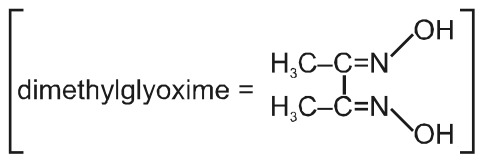
- 1Red complex has a square planar geometry.
- 2Complex has symmetrical H-bonding
- 3Red complex has a tetrahedral geometry.
- 4Dimethylglyoxime functions as bidentate ligand.
Show answer and solution
Correct: option 3, Red complex has a tetrahedral geometry.
The red precipitate is bis(dimethylglyoximato)nickel(II). Each dimethylglyoxime ion binds through its two nitrogen atoms (bidentate), () uses hybrid orbitals to give a square planar complex, and the two ligands are held together by symmetrical O–H···O hydrogen bonds. The statement that the complex is tetrahedral is therefore the false one.
Question 61AIPMT 2012 Mains, Q44
Low spin complex of -cation in an octahedral field will have the following energy:
( = Crystal Field Splitting Energy in an octahedral field, P = Electron pairing energy)
- 1
- 2
- 3
- 4
Show answer and solution
Correct: option 2,
In a low spin octahedral complex all six electrons are in the set (). Each electron is stabilised by , giving , and the six electrons form three pairs, costing . The energy is .
Question 62AIPMT 2011 Prelims, Q17
Of the following complex ions, which is diamagnetic in nature?
- 1
- 2
- 3
- 4
Show answer and solution
Correct: option 2,
is . is a strong-field ligand, so the eight d electrons pair up in four orbitals and the complex is square planar () with no unpaired electron: diamagnetic. With the weak-field , is tetrahedral with 2 unpaired electrons; () has 1 and (high-spin ) has 4.
Question 63AIPMT 2011 Prelims, Q37
The complexes and are the examples of which type of isomerism?
- 1Linkage isomerism
- 2Ionization isomerism
- 3Coordination isomerism
- 4Geometrical isomerism
Show answer and solution
Correct: option 3, Coordination isomerism
Both the cation and the anion are complex ions, and the two compounds differ only in which metal holds which set of ligands: the ammonia and cyanide ligands are exchanged between cobalt and chromium. This interchange of ligands between two metal centres is coordination isomerism.
Question 64AIPMT 2011 Prelims, Q38
The complex, will have how many geometrical isomers?
- 13
- 24
- 30
- 42
Show answer and solution
Correct: option 1, 3
Pt(II) complexes are square planar, and this one is of the type [Mabcd] with four different ligands. Fix one ligand, say pyridine: the ligand trans to it can be any one of the other three, and each choice gives a different arrangement. So there are 3 geometrical isomers.
Question 65AIPMT 2011 Prelims, Q40
The d-electron configurations of , , and are , , and respectively. Which one of the following will exhibit minimum paramagnetic behaviour?
(At. nos. Cr = 24, Mn = 25, Fe = 26, Co = 27)
- 1
- 2
- 3
- 4
Show answer and solution
Correct: option 3,
Water is a weak-field ligand, so all four complexes are high spin and keep the free-ion number of unpaired electrons: () 4, () 5, () 4 and () 3. Paramagnetism grows with the number of unpaired electrons, so is the least paramagnetic.
Question 66AIPMT 2011 Mains, Q9
Which of the following carbonyls will have the strongest C–O bond?
- 1
- 2
- 3
- 4
Show answer and solution
Correct: option 1,
The metal weakens the C–O bond by donating electron density into the orbitals of CO (back bonding). A positive charge on the complex makes the metal hold its electrons more tightly, so back bonding is weakest in and its C–O bond stays strongest. A negative charge, as in , has the opposite effect.
Question 67AIPMT 2011 Mains, Q26
Which of the following complex compounds will exhibit highest paramagnetic behaviour?
(At. No.: Ti = 22, Cr = 24, Co = 27, Zn = 30)
- 1
- 2
- 3
- 4
Show answer and solution
Correct: option 2,
Paramagnetism grows with the number of unpaired electrons. is (one unpaired electron). is , with three unpaired electrons in the orbitals whatever the ligand. is and with forms a low spin complex with all electrons paired. is , also with none unpaired. So is the most paramagnetic.
Question 68AIPMT 2010 Mains, Q51
Which of the following complexes is not expected to exhibit isomerism?
- 1
- 2
- 3
- 4
Show answer and solution
Correct: option 3,
is tetrahedral, and a tetrahedral complex of the type has no geometrical or optical isomers. The octahedral and square planar show cis-trans isomerism, and is optically active.
Question 69AIPMT 2010 Prelims, Q56
Which of the following complex ions is not expected to absorb visible light?
- 1
- 2
- 3
- 4
Show answer and solution
Correct: option 1,
Colour from d-d transitions is expected when the complex has unpaired d electrons. In , is and the strong-field pairs all the electrons (, square planar), leaving none unpaired. (), (, high spin) and with the weak-field water have 3, 4 and 2 unpaired electrons and are coloured.
Question 70AIPMT 2010 Prelims, Q75
Crystal field stabilization energy for high spin octahedral complex is:
- 1
- 2
- 3
- 4
Show answer and solution
Correct: option 4,
In a high spin octahedral complex the electrons are arranged , with no pairing. Each electron contributes and each electron , so CFSE .
Question 71AIPMT 2010 Prelims, Q82
The existence of two different coloured complexes with the composition of is due to:
- 1linkage isomerism
- 2geometrical isomerism
- 3coordination isomerism
- 4ionization isomerism
Show answer and solution
Correct: option 4, ionization isomerism
is an octahedral complex of the type . The two chloride ligands can sit next to each other (cis, violet) or opposite each other (trans, green), which is geometrical isomerism, option (2). The ion has no ambidentate ligand, no second complex ion and no counter ion in the formula, so linkage, coordination and ionization isomerism do not arise. The answer key of the source copy prints (4); the working does not support it.
Question 72AIPMT 2009 Prelims, Q181
Out of , , and (Z of Ti = 22, Co = 27, Cu = 29, Ni = 28) the colourless species are:
- 1 and
- 2 and
- 3 and
- 4 and
Show answer and solution
Correct: option 2, and
Colour needs a partly filled subshell so that - transitions can happen. in is and in is , so both are colourless. () and () have unpaired electrons and are coloured.
Question 73AIPMT 2009 Prelims, Q185
Which of the following does not show optical isomerism?
- 1
- 2
- 3
- 4 (en = ethylenediamine)
Show answer and solution
Correct: option 1,
is of the type ; both its facial and meridional forms have a plane of symmetry, so neither is optically active. The complexes with the chelating ligand en can form non-superimposable mirror images, for example and the cis form of .
Question 74AIPMT 2009 Prelims, Q196
Which of the following complex ions is expected to absorb visible light?
- 1
- 2
- 3
- 4
Show answer and solution
Correct: option 2,
Absorption of visible light comes from - transitions, which need a partly filled subshell. is , so its complex is coloured. and are and is , so their complexes are colourless.
Question 75AIPMT 2008 Prelims, Q73
Which of the following complexes exhibits the highest paramagnetic behaviour?
(Where gly = glycine, en = ethylenediamine and bpy = bipyridyl moieties). (At. number Ti = 22, V = 23, Fe = 26, Co = 27)
- 1
- 2
- 3
- 4
Show answer and solution
Correct: option 4,
Paramagnetism grows with the number of unpaired electrons. is (1 unpaired); vanadium here is , (none); is and with the strong-field en and bpy ligands all six electrons pair (none). In cobalt is +5, , and with weak-field oxalate and hydroxide ligands it keeps 4 unpaired electrons, the most of the four.
Question 76AIPMT 2008 Prelims, Q80
In which of the following coordination entities the magnitude of (CFSE in octahedral field) will be maximum (at. no. Co = 27)?
- 1
- 2
- 3
- 4
Show answer and solution
Correct: option 4,
All four are complexes of , so the splitting depends only on the ligand. In the spectrochemical series , cyanide is the strongest-field ligand, so has the largest .
Question 77AIPMT 2007 Prelims, Q133
Which of the following will give a pair of enantiomorphs?
(en = )
- 1
- 2
- 3
- 4
Show answer and solution
Correct: option 4,
Enantiomorphs are non-superimposable mirror images. In the octahedral ion the cis form, with the two chelating en ligands, has no plane of symmetry and so exists as a pair of mirror-image forms (its trans form is not optically active). The other three complexes have only single-atom-donor ligands arranged with planes of symmetry and cannot be optically active.
Question 78AIPMT 2006 Prelims, Q61
Copper sulphate dissolved in excess of KCN to give:
- 1
- 2
- 3
- 4
Show answer and solution
Correct: option 2,
Cyanide first gives , which is unstable and breaks down to CuCN and cyanogen, so copper is reduced to the +1 state. CuCN then dissolves in excess KCN as the complex , that is the ion .
Question 79AIPMT 2006 Prelims, Q79
exhibits:
- 1Linkage isomerism, ionization isomerism and optical isomerism
- 2Linkage isomerism, ionization isomerism and geometrical isomerism
- 3Ionization isomerism, geometrical isomerism and optical isomerism
- 4Linkage isomerism, geometrical isomerism and optical isomerism
Show answer and solution
Correct: option 2, Linkage isomerism, ionization isomerism and geometrical isomerism
can bind through N or through O, which gives linkage isomers. Chloride outside the sphere can change places with a nitrite inside it, which gives ionization isomers. The octahedral arrangement has cis and trans forms, which are geometrical isomers. Both of those forms have a plane of symmetry, so there is no optical isomerism.
Question 80AIPMT 2006 Prelims, Q80
(at. No. of Cr = 24) has a magnetic moment of 3.83 B.M. The correct distribution of 3d electrons in the Chromium of the complex is:
- 1
- 2
- 3
- 4
Show answer and solution
Correct: option 3,
A moment of 3.83 B.M. matches with unpaired electrons, as expected for (). In an octahedral field the three lower orbitals are , and (the set), and the three electrons occupy them singly. The and orbitals are the higher set and stay empty.
Question 81AIPMT 2005 Prelims, Q51
Which one of the following is an inner orbital complex as well as diamagnetic in behaviour -
- 1
- 2
- 3
- 4
Show answer and solution
Correct: option 4,
In the ion is ; ammonia pairs all six electrons in three orbitals, leaving two orbitals for (inner orbital) hybridisation with no unpaired electron, so it is diamagnetic. () and () have no two empty orbitals and must use outer orbitals, and is inner orbital but has three unpaired electrons.
Question 82AIPMT 2005 Prelims, Q70
Which one of the following pair represents stereo isomerism:-
- 1Linkage isomerism and Geometrical isomerism
- 2Chain isomerism and Rotational isomerism
- 3Optical isomerism and Geometrical isomerism
- 4Structural isomerism and Geometrical isomerism
Show answer and solution
Correct: option 3, Optical isomerism and Geometrical isomerism
Stereoisomers have the same atoms joined in the same order and differ only in arrangement in space. Optical and geometrical isomerism are both of this kind. Linkage, chain and structural isomerism involve different connectivity, so the other pairs each contain a structural type.
Question 83AIPMT 2005 Prelims, Q74
Which one of the following is expected to exhibit optical isomerism?
(en = ethylenediamine)
- 1cis –
- 2cis –
- 3trans –
- 4trans –
Show answer and solution
Correct: option 2, cis –
The octahedral cis- has no plane of symmetry, so it and its mirror image cannot be superimposed and it is optically active. The trans form has a plane of symmetry, and the square planar platinum complexes are flat, so none of the others is chiral.
Question 84AIPMT 2004 Prelims, Q53
Which of the following does not have a metal-carbon bond:
- 1
- 2
- 3
- 4
Show answer and solution
Correct: option 4,
In aluminium ethoxide, , each ethyl group is joined to aluminium through oxygen (Al-O-C), so there is no metal-carbon bond. The Grignard reagent has an Mg-C bond, Zeise's salt binds ethene to Pt through its carbon atoms, and in each CO is bonded to Ni through carbon.
Question 85AIPMT 2004 Prelims, Q58
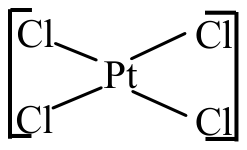
Which of the following is considered to be an anticancer species:
- 1
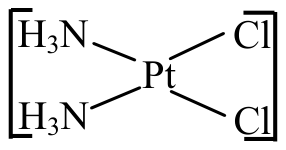
- 2
- 3
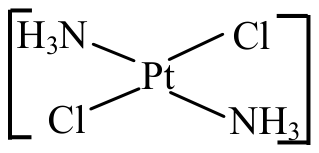
- 4
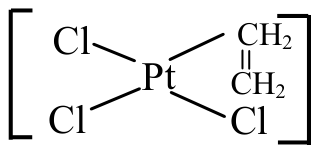
Show answer and solution
Correct: option 2
The anticancer drug is cisplatin, cis-, the square planar complex in which the two ligands are next to each other and the two Cl ligands are next to each other. That is the structure in option (2). Option (3) is the trans isomer, which is not active.
Question 86AIPMT 2004 Prelims, Q65
In an octahedral structure, the pair of d orbitals involved in hybridization is:
- 1
- 2
- 3
- 4
Show answer and solution
Correct: option 4,
In an octahedral complex the six ligands lie along the x, y and z axes. The hybrid orbitals must point along these axes, so the two d orbitals used are the ones whose lobes lie along the axes: and . The , and orbitals point between the axes.
Question 87AIPMT 2004 Prelims, Q74
is a strong field ligand. This is due to the fact that:
- 1It is a pseudohalide
- 2It can accept electrons from metal species
- 3It forms high spin complexes with metal species
- 4It carries negative charge
Show answer and solution
Correct: option 2, It can accept electrons from metal species
has empty orbitals that accept electron density from the filled metal d orbitals (back bonding). This -acceptor action strengthens the metal-ligand bond and increases the crystal field splitting, which makes cyanide a strong field ligand; it gives low spin, not high spin, complexes.
Question 88AIPMT 2004 Prelims, Q75
Considering as a weak field ligand, the number of unpaired electrons in will be –
(At. no. of Mn = 25)
- 1Five
- 2Two
- 3Four
- 4Three
Show answer and solution
Correct: option 1, Five
The complex ion is hexaaquamanganese(II). Mn (Z = 25) is , so is . With a weak field ligand the electrons do not pair up and the configuration is , with all five d electrons unpaired.
Question 89AIPMT 2004 Prelims, Q92
Among , , species, the hybridization states at the Ni atom are, respectively: (At. No. of Ni = 28)
- 1
- 2
- 3
- 4
Show answer and solution
Correct: option 1,
In nickel is Ni(0); the strong ligand CO pushes the 4s electrons into 3d (), leaving 4s and 4p for (tetrahedral). In nickel is (); the strong ligand pairs the electrons and frees one 3d orbital, giving (square planar). In the weak ligand causes no pairing, so uses (tetrahedral).
Question 90AIPMT 2004 Prelims, Q94
Which of the following coordination compounds would exhibit optical isomerism
- 1Diamminedichloroplatinum (II)
- 2Trans-dicyanobis (ethylenediamine) chromium (III) chloride
- 3Tris-(ethylenediamine) cobalt (III) bromide
- 4Pentaamminenitrocobalt (III) iodide
Show answer and solution
Correct: option 3, Tris-(ethylenediamine) cobalt (III) bromide
has three bidentate ligands around an octahedral centre; it has no plane of symmetry and exists as two non-superimposable mirror images, so it is optically active. The square planar platinum complex, the trans isomer of and all have a plane of symmetry and are not.
Question 91AIPMT 2003 Prelims, Q84
According to IUPAC nomenclature sodium nitroprusside is named as:
- 1Sodium nitroferricyanide
- 2Sodium nitroferrocyanide
- 3Sodium pentacyanonitrosyl ferrate (II)
- 4Sodium pentacyanonitrosyl ferrate (III)
Show answer and solution
Correct: option 3, Sodium pentacyanonitrosyl ferrate (II)
Sodium nitroprusside is . The NO ligand is present as , so with five and an overall charge of on the complex ion, iron is : . Ligands are named alphabetically (cyano before nitrosyl) and the anion ends in -ate: sodium pentacyanonitrosylferrate(II).
Question 92AIPMT 2003 Prelims, Q85
The number of unpaired electrons in the complex ion is: (At. No. Co = 27)
- 12
- 23
- 34
- 4zero
Show answer and solution
Correct: option 3, 4
Cobalt is here, with configuration . Fluoride is a weak field ligand, so the electrons do not pair up and the complex is high spin (, hybridisation). That leaves 4 unpaired electrons.
Question 93AIPMT 2003 Prelims, Q86
Which one of the following octahedral complexes will not show geometric isomerism?
(A and B are monodentate ligands)
- 1
- 2
- 3
- 4
Show answer and solution
Correct: option 4,
In all six octahedral positions are equivalent, so wherever the single B is placed the same arrangement results: no geometric isomers. and have cis and trans forms, and has fac and mer forms.
Question 94AIPMT 2003 Prelims, Q87
- 1Fe(II)
- 2Co(III)
- 3Zn(II)
- 4Ca(II)
Show answer and solution
Correct: option 2, Co(III)
Vitamin (cyanocobalamin) is a coordination compound of cobalt, with Co(III) held at the centre of a corrin ring.
Question 95AIPMT 2003 Prelims, Q88
Among the following which is not the -bonded organometallic compound:
- 1
- 2
- 3
- 4
Show answer and solution
Correct: option 4,
In Zeise's salt, ferrocene and dibenzenechromium the metal is bonded to the electrons of ethene, cyclopentadienyl and benzene. In tetramethyltin each methyl group is joined to tin by an ordinary Sn-C sigma bond, so it is a -bonded organometallic compound.
Question 96AIPMT 2002 Prelims, Q78
Atomic number of Cr and Fe are respectively 24 and 26, which of the following is paramagnetic with the spin of electron:
- 1
- 2
- 3
- 4
Show answer and solution
Correct: option 4,
is , so has three unpaired electrons and is paramagnetic. In the carbonyls the strong-field CO pairs all the electrons of Cr(0) and Fe(0), and in the electrons of are all paired, so those three are diamagnetic.
Question 97AIPMT 2002 Prelims, Q79
The hypothetical complex chloro diaquatriammine cobalt (III) chloride can be represented as:
- 1
- 2
- 3
- 4
Show answer and solution
Correct: option 1,
The name gives one chloro, two aqua and three ammine ligands on cobalt(III), with chloride outside as the counter ion. The complex ion has charge , so two chloride ions are needed outside the bracket.
Question 98AIPMT 2002 Prelims, Q81
when reacts with forms , which is insoluble in water. It is soluble in excess of , due to formation of the following complex:
- 1
- 2
- 3
- 4
Show answer and solution
Correct: option 2,
Cyanide reduces copper(II) to copper(I), which is why is formed. The copper stays in the state when it dissolves in excess cyanide: . The anion needs three potassium ions.
Question 99AIPMT 2001 Prelims, Q85
Which of the following will give maximum number of isomers:
- 1
- 2
- 3
- 4
Show answer and solution
Correct: option 4,
shows cis-trans isomerism and, because SCN is ambidentate (bonding through S or N), linkage isomerism as well, giving the largest number of isomers. has only cis and trans forms, (2) has no isomers and (3) has only an optical pair.
Question 100AIPMT 2001 Prelims, Q86
Coordination number of Ni in is
- 13
- 26
- 34
- 42
Show answer and solution
Correct: option 2, 6
The complex meant is . Oxalate is a bidentate ligand that binds through two oxygen atoms, so three oxalate ions give bonds to nickel: coordination number 6.
Question 101AIPMT 2001 Prelims, Q87
Which of following organometallic compound is and bonded:
- 1
- 2
- 3
- 4
Show answer and solution
Correct: option 3,
In a metal carbonyl, CO gives its carbon lone pair to the metal (a bond) and the metal gives electrons back into the empty orbital of CO (a bond), so the M–CO bond has both and character. Ferrocene and Zeise's salt are complexes and is only bonded.
Question 102AIPMT 2001 Prelims, Q88
Which statement is incorrect:
- 1 – Tetrahedral, paramagnetic
- 2 - Square planar, diamagnetic
- 3 - Tetrahedral, diamagnetic
- 4 – Tetrahedral, paramagnetic
Show answer and solution
Correct: option 1, – Tetrahedral, paramagnetic
In nickel is in the zero state; the strong-field CO pairs all ten electrons in , giving hybridisation: tetrahedral and diamagnetic. Calling it paramagnetic is wrong. is and diamagnetic, and is with two unpaired electrons.
Question 103AIPMT 2001 Prelims, Q91
Which of the following will exhibit maximum ionic conductivity:
- 1
- 2
- 3
- 4
Show answer and solution
Correct: option 1,
Conductivity grows with the number of ions a complex gives in solution. gives 5 ions ( and the complex anion), gives 4, gives 3 and gives none.
Question 104AIPMT 2000 Prelims, Q71
In quantitative analysis of second group in lab. gas is passed in acidic medium for ppt. When and react with KCN, then in which of the following condition, ppt will not be formed due to relative stability:
- 1 - More stable
- Less stable
- 2 - Less stable
- More stable
- 3 - More stable
- Less stable
- 4 - Less stable
- More stable
Show answer and solution
Correct: option 3, - More stable
- Less stable
Excess KCN reduces to copper(I) and forms the very stable complex , which gives almost no free copper ions, so cannot precipitate copper sulphide. Cadmium stays as cadmium(II) in , which is much less stable and releases enough for yellow CdS to precipitate. Option 3 has both the correct formulas and the correct stabilities.
Question 105AIPMT 2000 Prelims, Q79
- 1Octahedral
- 2Square planar
- 3Trigonal bipyramidal
- 4Square pyramidal
Show answer and solution
Correct: option 3, Trigonal bipyramidal
Iron is in the zero oxidation state. The strong-field CO ligands pair up its eight valence electrons into four 3d orbitals, leaving one 3d, the 4s and the three 4p orbitals for hybridisation. Five hybrid orbitals point to the corners of a trigonal bipyramid.
Question 106AIPMT 2000 Prelims, Q87
Which complex compound will give four isomers:
- 1
- 2
- 3
- 4
Show answer and solution
Correct: option 3,
The complex ion in option 3 is octahedral of the type . The three groups can sit on one face (fac, one arrangement) or in one plane (mer), and in the mer form the position opposite a can be taken by , Cl or Br (three arrangements). That gives four geometrical isomers. has only two optical isomers, has three (trans, and a cis pair of mirror images), and option 4 has none.
Question 107AIPMT 1999 Prelims, Q66
Which of the following compound contain zero oxidation state of Fe:
- 1
- 2
- 3
- 4All the above
Show answer and solution
Correct: option 3,
CO is a neutral ligand and has no charge, so iron is in the 0 state. With as the ligand, iron is +2 in and +3 in .
Question 108AIPMT 1999 Prelims, Q68
reacts with in excess of water gives:
- 1
- 2
- 3
- 4None of the above
Show answer and solution
Correct: option 2,
The acid protonates the ammonia ligands to , which breaks up the complex and frees . With nitrate as the anion the copper is left as copper nitrate: , that is .
Question 109AIPMT 1999 Prelims, Q69
Cr in has number of unpaired electron:
- 14
- 23
- 31
- 42
Show answer and solution
Correct: option 2, 3
Ammonia is neutral and the three bromide ions are outside the complex, so chromium is with configuration . The three d electrons occupy the three orbitals singly, giving 3 unpaired electrons.
Question 110AIPMT 1998 Prelims, Q65
A complex compound which is formed by ligands nitrate and chloride. It gives two moles of AgCl precipitate with . What will be its formulae:
- 1
- 2
- 3
- 4
Show answer and solution
Correct: option 1,
Only chloride outside the coordination sphere is ionised and precipitated by . Two moles of AgCl mean two ionisable chlorides per formula unit. That is ; the other formulae have one or no chloride outside the bracket.
Question 111AIPMT 1998 Prelims, Q76
Number of isomers of complex are:
- 12
- 23
- 34
- 45
Show answer and solution
Correct: option 3, 4
Both ions are complexes, so the ligands can be exchanged between the two metals (coordination isomerism). The possible salts are , , and , which is 4 isomers.
Question 112AIPMT 1998 Prelims, Q86
The IUPAC name of will be:
- 1Triaminebromochloronitrocobaltate (III)
- 2Triaminebromochloronitrocobalt (III)
- 3Triaminebromonitrochlorocobalt (III)
- 4Triaminenitrochlorocobalt (III)
Show answer and solution
Correct: option 2, Triaminebromochloronitrocobalt (III)
The complex is neutral, so the metal is named cobalt, not cobaltate. With , and as ligands, cobalt is in the +3 state. Ligands are named in alphabetical order: ammine, bromo, chloro, nitro. This gives triamminebromochloronitrocobalt(III), which is option (2).