NEET 2026 Re-exam Physics questions
Question 1NEET 2026 Re-exam, Q1
A particle of mass M moves along a horizontal axis from to . The coefficient of kinetic friction varies as a function of as , where , are constants of appropriate dimensions, so that . The total work done by the frictional force during the motion is , where g is the acceleration due to gravity. The value of n is:
- 13
- 21
- 3
- 4
Show answer and solution
Correct: option 4,
Since , . The friction force is , so the magnitude of the work it does is . Comparing with gives , option (4). (The work is negative in sign; the options give its size.)
Question 2NEET 2026 Re-exam, Q2
The mean free path of molecules in an ideal gas A is half that of another ideal gas B. The diameter of the spherical molecules of gas A is twice the diameter of the molecules of B. If number densities of the gases A and B are and , respectively, then the correct option is:
- 1
- 2
- 3
- 4
Show answer and solution
Correct: option 4,
The mean free path is , so . Then , which is option (4).
Question 3NEET 2026 Re-exam, Q3
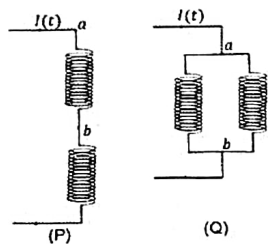
Two identical inductors are connected in two different configurations P and Q, where a time varying current is flowing, as shown in the figure. The induced emf between points and for configuration P is and that for configuration Q is . The ratio is:
[Neglect the effect of mutual inductance.]
- 11/4
- 21/2
- 31
- 42
Show answer and solution
Correct: option 4, 2
In P the points and are the two ends of one inductor carrying the full current, so . In Q the two identical inductors are in parallel between and , each carries , so . The ratio is 2, option (4).
Question 4NEET 2026 Re-exam, Q4
For sound waves, if the number of nodes for the 5th harmonic of an open-ended pipe is and that for the 9th harmonic of the same pipe with one of its ends closed is , the ratio is:
- 1
- 2
- 31
- 4
Show answer and solution
Correct: option 3, 1
In the 5th harmonic of an open pipe the length holds five half-wavelengths with an antinode at each end, which gives 5 nodes, so . In the 9th harmonic of a closed pipe the length is with a node at the closed end and an antinode at the open end, which also gives 5 nodes, so . The ratio is 1, option (3).
Question 5NEET 2026 Re-exam, Q5
Consider a long solenoid of length and radius r. If n is the number of turns per unit length and is the permeability of free space, the inductance of the solenoid is:
- 1
- 2
- 3
- 4
Show answer and solution
Correct: option 1,
The field inside is . The flux through all turns is , and dividing by gives , option (1).
Question 6NEET 2026 Re-exam, Q6
Consider a particle moving along a straight line, whose position as a function of time is given by , where , and . The average speed of the particle, in , from to is:
- 112
- 26
- 33
- 40
Show answer and solution
Correct: option 3, 3
Here and , so the particle reverses at . The positions are , and m, so the distance covered is m. Average speed , option (3). (The average velocity is zero, but the question asks for speed.)
Question 7NEET 2026 Re-exam, Q7
Consider the following nuclear reaction:
Take masses of , and as 238.050 u, 234.043 u and 4.003 u, respectively. The Q value for the reaction, in keV, is:
[Given: ]
- 13726
- 23730
- 33736
- 43740
Show answer and solution
Correct: option 1, 3726
The mass lost is u. , option (1).
Question 8NEET 2026 Re-exam, Q8
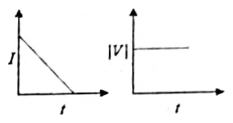
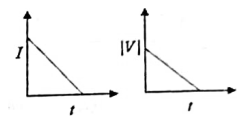
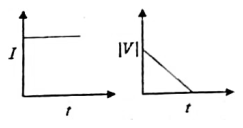
A beam of light falls on a metal surface such that photo-electrons are generated. If power of the light source starts to decrease linearly with time , then variation of the photocurrent and magnitude of the stopping potential with time is best represented by:
- 1
- 2
- 3
- 4
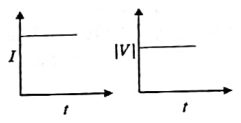
Show answer and solution
Correct: option 1
The photocurrent is proportional to the number of photons arriving each second, that is to the power of the source, so falls linearly with time. The stopping potential depends only on the frequency of the light and the work function, not on the intensity, so stays constant. That is the pair of graphs in option (1).
Question 9NEET 2026 Re-exam, Q9
Three identical capacitors , and , each of the capacitance C, are connected to a battery of voltage , as shown in the figure. If the energy stored in the capacitor and total energy stored in the system are and , respectively, then the ratio is:
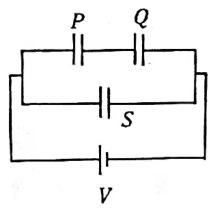
- 12/3
- 21/3
- 31/2
- 41/6
Show answer and solution
Correct: option 4, 1/6
and are in series across the battery, so each has and . is directly across the battery. The total capacitance is , so . The ratio is , option (4).
Question 10NEET 2026 Re-exam, Q10
Water flows in a streamline motion through a horizontal pipe of circular cross-section as shown in the figure. The pressure difference of water between and is . The area of cross-section at and are and , respectively. The rate of flow of water through the pipe, in , is:
[Take density of water ]
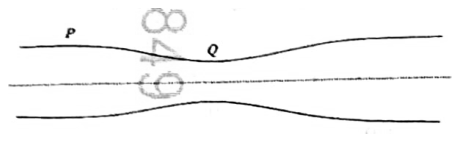
- 1100
- 2200
- 3300
- 4400
Show answer and solution
Correct: option 4, 400
Continuity gives because the area halves. Bernoulli's equation for a horizontal pipe gives , so and . Rate of flow , option (4).
Question 11NEET 2026 Re-exam, Q11
A current flows through a metallic circular loop of radius r as shown in the figure. Resistance of the segment ABC is half that of ADC. Magnitude of magnetic field at the center O of the loop is:
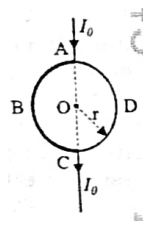
- 1
- 2
- 3
- 4
Show answer and solution
Correct: option 1,
The two semicircles are in parallel, so the current divides inversely as the resistance: ABC carries and ADC carries . A semicircle carrying current gives at the centre, and the two halves give fields in opposite directions. The net field is , option (1).
Question 12NEET 2026 Re-exam, Q12
In the measurement of viscosity of liquids using terminal velocity experiment, spherical balls of same radius but having different densities are used. The variation of the terminal velocity () with the ratio of density of spherical ball () to density of the liquid (), is best represented by:
- 1
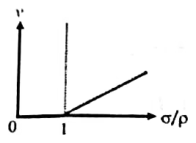
- 2
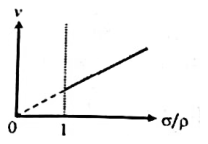
- 3
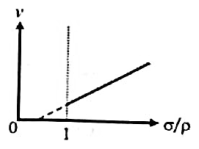
- 4
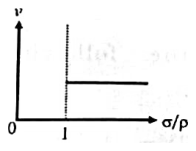
Show answer and solution
Correct: option 1
The terminal velocity is . It is zero when and rises linearly with beyond that; a ball less dense than the liquid does not sink. This is the graph in option (1).
Question 13NEET 2026 Re-exam, Q13
Two planets and with equal mass have radii and , respectively, where . The escape speeds of and are and , respectively. Then is:
- 1
- 21
- 3
- 42
Show answer and solution
Correct: option 3,
Escape speed is , so for equal masses . Then , option (3).
Question 14NEET 2026 Re-exam, Q14
In a solar system, the time-period of revolution of a planet tracing a circular orbit of radius R is proportional to:
- 1
- 2
- 3
- 4
Show answer and solution
Correct: option 2,
Kepler's third law says (for a circular orbit, gravity supplies the centripetal force, giving ). So , option (2).
Question 15NEET 2026 Re-exam, Q15
Two infinitely long parallel conducting wires A and B carry currents I and 2I, respectively, in the same direction. The wire A has uniform mass per unit length and lies on an insulated floor. The wire B is kept fixed at a height h above the floor. The minimum magnitude of h so that the wire A does not rise from the floor is:
[g is the acceleration due to gravity and is the permeability of free space.]
- 1
- 2
- 3
- 4
Show answer and solution
Correct: option 2,
Parallel currents in the same direction attract, so B pulls A upward with force per unit length . A stays on the floor while this does not exceed its weight per unit length , so . The minimum height is option (2).
Question 16NEET 2026 Re-exam, Q16
An ideal Zener diode with breakdown voltage of V is reverse biased with a negative input voltage V. The magnitude of voltage difference between points and is:
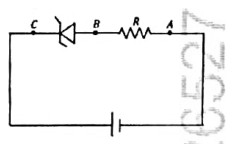
- 13 V
- 22 V
- 31 V
- 40 V
Show answer and solution
Correct: option 2, 2 V
The 5 V input is larger than the 3 V breakdown voltage, so the Zener diode is in breakdown and holds 3 V across itself (between and ). The rest of the input voltage drops across the series resistor between and : V, option (2).
Question 17NEET 2026 Re-exam, Q17
In an adiabatic expansion, the temperature of one mole of an ideal monatomic gas () decreases from 60K to 50K. The work done by the gas in the process is:
(Take the universal gas constant as )
- 141.5 J
- 283 J
- 3124.5 J
- 4166 J
Show answer and solution
Correct: option 3, 124.5 J
In an adiabatic process no heat is exchanged, so the work done by the gas equals the fall in internal energy: J, option (3).
Question 18NEET 2026 Re-exam, Q18
A ray of light with wavelength is incident on three different photo-electric cells namely 1, 2 and 3. The threshold wavelength of these photo-electric cells are , , and , respectively and the magnitude of stopping potentials of these cells are , and , respectively. The relation between and threshold wavelengths are , and . The correct option is:
- 1,
- 2,
- 3,
- 4,
Show answer and solution
Correct: option 1, ,
Electrons are emitted only when the incident wavelength is shorter than the threshold wavelength. For cell 1, , so there is no emission and . For the others , which is larger when the threshold wavelength is longer, so . This is option (1).
Question 19NEET 2026 Re-exam, Q19
A photon and an electron, each of 20 eV energy, move in free space. The ratio of linear momentum of electron to that of photon , is:
(Take speed of light , charge of electron C and mass of electron kg)
- 1
- 2
- 3225
- 4275
Show answer and solution
Correct: option 3, 225
J. For the electron . For the photon . The ratio is 225, option (3).
Question 20NEET 2026 Re-exam, Q20
Which of the following measurements require 'index correction'?
- 1Measurement of resistance of a wire using meter bridge
- 2Measurement of gravitational acceleration using simple pendulum
- 3Measurement of focal length of lenses using optical bench
- 4Measurement of speed of sound using resonance tube
Show answer and solution
Correct: option 3, Measurement of focal length of lenses using optical bench
On an optical bench the distances are read from the index marks of the uprights, which need not be in line with the optical centre of the lens or the tips of the needles. The difference between the real distance and the reading is the index correction, applied when finding the focal length of a lens or mirror. The other three experiments use end correction or no such correction, so option (3) is right.
Question 21NEET 2026 Re-exam, Q21
A unit positive point charge is taken slowly through an infinitesimally thin tube that is inside a charged dielectric sphere of radius , having uniform positive charge density , as shown in the figure. The initial and final positions of the charge are marked by and at distances and respectively, from the centre of the sphere. In this process, the magnitude of the total work done on the point charge is . The value of is:
( is the permittivity of vacuum)
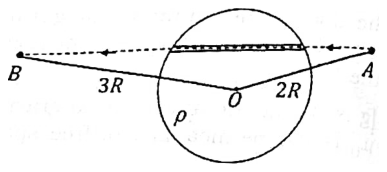
- 12
- 26
- 39
- 418
Show answer and solution
Correct: option 4, 18
The electrostatic force is conservative, so the work depends only on the end points, both of which are outside the sphere. With , the potential outside is . For a unit charge , so , option (4).
Question 22NEET 2026 Re-exam, Q22
Consider three media P, Q and R with refractive indices 1, 1.25, and 1.5, respectively. The medium Q having a thickness of 5 cm is placed between extended media P and R as shown in the figure. An object O is placed at the center of medium Q. If viewed from medium P near the normal direction, the apparent depth of O is . For similar observation from medium R, the apparent depth is . The value of , in cm, is:
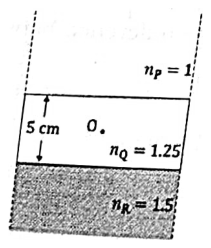
- 10
- 21
- 32
- 43
Show answer and solution
Correct: option 2, 1
The object is 2.5 cm from each face of Q. For near-normal viewing, apparent depth real depth . From P: cm. From R: cm. The difference is 1 cm, option (2).
Question 23NEET 2026 Re-exam, Q23
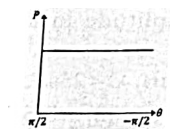
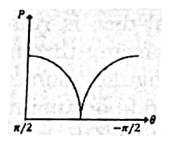
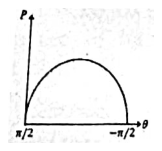
A frictionless circular wire of unit radius is fixed on the horizontal plane. Two point particles of unit mass start moving simultaneously from point with identical uniform angular speeds in opposite directions, and meet again at point . During this time, which of the following figures schematically represent the magnitude of the total linear momentum of the system, as a function of ?
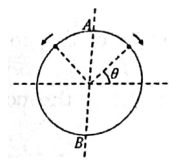
- 1
- 2
- 3
- 4
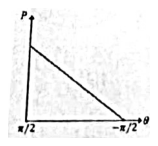
Show answer and solution
Correct: option 3
At every instant the two particles are mirror images of each other in the line . Each has speed along the tangent (unit mass, unit radius). The components of their momenta perpendicular to cancel and the components along add, giving . This is zero at , largest at and zero again at , the arch-shaped graph of option (3).
Question 24NEET 2026 Re-exam, Q24
The temperature of a metallic sphere of radius R is increased by a small amount . If the linear coefficient of thermal expansion of the metal is , the approximate increase in the volume of the sphere is:
- 1
- 2
- 3
- 4
Show answer and solution
Correct: option 3,
The coefficient of volume expansion is , so , option (3).
Question 25NEET 2026 Re-exam, Q25
A cylindrical cork of uniform density floats in a liquid of density . If the cork is depressed slightly and released, it oscillates harmonically with time period T. If the same cork floats in another liquid of density , then the similar oscillation has time period 2T. The value of is:
- 14
- 22
- 31/2
- 41/4
Show answer and solution
Correct: option 4, 1/4
When the cork of cross-section is pushed down by , the extra buoyant force acts as the restoring force, so and . Doubling the period needs a quarter of the density: , option (4).
Question 26NEET 2026 Re-exam, Q26
One main scale division of a Vernier calliper is equal to 1 mm and the number of divisions on the Vernier scale is 10. When both the jaws touch each other, the Vernier scale shifts to the left of zero of the main scale in such a way that 4th Vernier division coincides with a division of the main scale. If this Vernier calliper measures the length of a wire to be 1 cm, the actual length of the wire is:
- 10.60 cm
- 20.96 cm
- 31.00 cm
- 41.04 cm
Show answer and solution
Correct: option 4, 1.04 cm
The examiners dropped this question and gave every candidate the 4 marks.
The official answer key marks this question as dropped, so every candidate gets the marks. The least count is mm, and a Vernier zero lying to the left of the main scale zero means a negative zero error, which has to be added to the reading. Read in the usual way, the 4th division coinciding gives a zero error of mm and a true length of 1.06 cm, which is not among the options. Taking the error as mm gives 1.04 cm, option (4), which is the option stored here.
Question 27NEET 2026 Re-exam, Q27
A solid sphere of radius R and mass M is attached at a point to a smaller solid sphere of radius and mass . Assume that the line joining their centres lies along the horizontal. The moment of inertia of the system calculated about a vertical axis passing through the centre of is and that calculated about a vertical axis passing through the centre of is . The difference is:
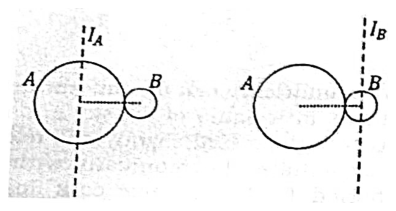
- 1
- 2
- 3
- 40
Show answer and solution
Correct: option 2,
The centres are apart. By the parallel axis theorem, and . Subtracting, , option (2).
Question 28NEET 2026 Re-exam, Q28
Consider a spring-mass simple harmonic oscillator in one dimension. The mass of the particle is kg and the spring constant is . At a given instant, the extension of the spring is meter and the speed of the particle is . On the - plane, if the graph of as a function of is a circle, then the correct option is:
- 1
- 2
- 3
- 4
Show answer and solution
Correct: option 2,
Energy conservation gives , that is . This is an ellipse in general and becomes a circle only when the two denominators are equal, which needs (numerically). That is option (2).
Question 29NEET 2026 Re-exam, Q29
The lens combination as shown in the figure, consists of two lenses, and , of the focal lengths cm and cm, respectively. The position of the image formed is:
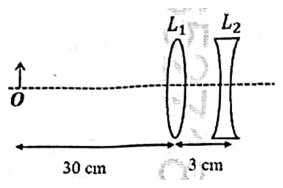
- 120 cm to the left of the concave lens
- 260 cm to the left of the concave lens
- 330 cm to the right of the concave lens
- 460 cm to the right of the concave lens
Show answer and solution
Correct: option 2, 60 cm to the left of the concave lens
For : cm, cm, so and cm. This image would lie cm to the right of , so it is a virtual object with cm for the concave lens. Then , so cm: the final image is 60 cm to the left of the concave lens, option (2).
Question 30NEET 2026 Re-exam, Q30
An ac voltage Volt is applied to a series LCR circuit. Then the current amplitude in this circuit is:
(Given: mH, , )
- 12.2 A
- 25.5 A
- 311.0 A
- 422.0 A
Show answer and solution
Correct: option 1, 2.2 A
Here . and . The reactances cancel (resonance), so the impedance is just and the current amplitude is A, option (1).
Question 31NEET 2026 Re-exam, Q31
A thin horizontal disc is rotating about a vertical axis passing through its fixed centre . Its angular momentum is and computed about points and , respectively, with . The value of is:
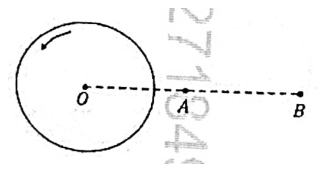
- 1
- 2
- 31
- 42
Show answer and solution
Correct: option 3, 1
The angular momentum about any point is the spin angular momentum about the centre of mass plus . The centre of the disc is fixed, so and the second term vanishes for every point. The angular momentum is therefore about and about alike, and the ratio is 1, option (3).
Question 32NEET 2026 Re-exam, Q32
A conducting loop of finite resistance lies on the - plane. There is a constant magnetic field in the direction. The area of the loop varies with time , as in appropriate units. The figure that correctly indicates the qualitative behaviour of the power dissipated in the loop as a function of time is:
- 1
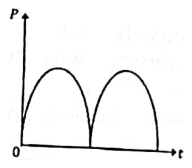
- 2
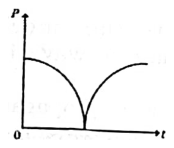
- 3
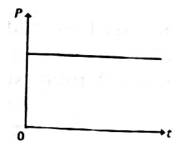
- 4
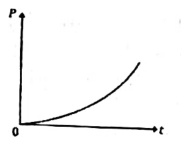
Show answer and solution
Correct: option 2
The flux is , so the induced emf has magnitude and the power dissipated is . It is largest at , falls to zero at and then rises again, which is the graph in option (2).
Question 33NEET 2026 Re-exam, Q33
A point charge Q is placed inside a cavity within a solid isolated conducting sphere. Consider points A, B and C as shown in the figure, where the magnitudes of the electric fields are , and , respectively. The points B and C are at the same distance from the center of the solid sphere. The correct option is:
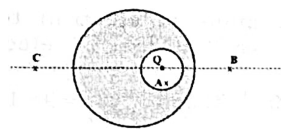
- 1,
- 2,
- 3,
- 4,
Show answer and solution
Correct: option 2, ,
Point A lies inside the cavity, where the field of the charge Q (and of the charge induced on the cavity wall) is not zero, so . The conductor shields the outside from the position of the charge: the charge Q induced on the outer surface spreads uniformly, so the field outside is that of a point charge at the centre of the sphere. B and C are equally far from the centre, so . This is option (2).
Question 34NEET 2026 Re-exam, Q34
Consider a fixed uniformly charged insulating sphere with radius R and total charge . A point charge () with mass m is released from rest at a distance of 3R from the centre of the charged sphere. When the point charge reaches the surface of the sphere, its speed is:
( is the permittivity of vacuum, neglect gravitational forces).
- 1
- 2
- 3
- 4
Show answer and solution
Correct: option 3,
Outside the sphere the potential is that of a point charge Q at the centre. The loss of potential energy equals the kinetic energy gained: . So , option (3).
Question 35NEET 2026 Re-exam, Q35
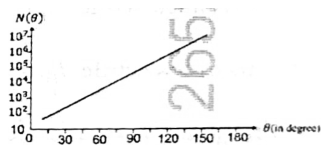
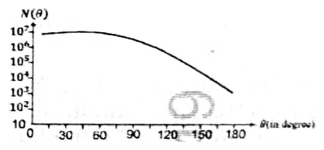
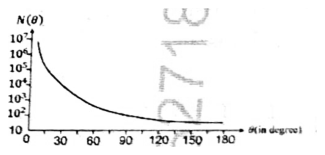
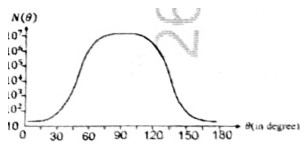
In Geiger-Marsden experiment, the number of scattered -particles is plotted as a function of scattering angle . Which of the following options represents the correct plot?
- 1
- 2
- 3
- 4
Show answer and solution
Correct: option 3
Rutherford's scattering formula gives . Most -particles pass almost undeflected, so the count is very large at small angles, drops steeply as the angle grows and is very small but not zero near . Only the steadily falling curve of option (3) shows this.
Question 36NEET 2026 Re-exam, Q36
Consider two circuits, (A) and (B), each having two resistors. One of them has a positive temperature coefficient of resistance, , while the other one has a negative temperature of coefficient, , as shown in the figure. The current through these circuits are denoted by and . At initial temperature, the resistance of the two resistors is . As the temperature is increased, the correct option that describes the variation of current in these circuits is:
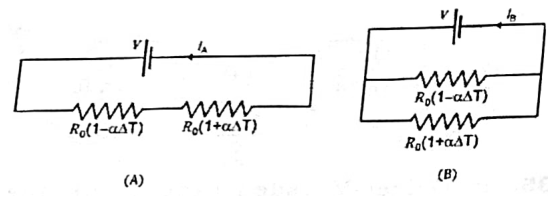
- 1 remains constant while increases
- 2 decreases while increases
- 3 increases while decreases
- 4both and remain constant
Show answer and solution
Correct: option 1, remains constant while increases
In circuit (A) the resistors are in series: , which does not change, so stays constant. In circuit (B) they are in parallel: , which falls as the temperature rises, so increases. This is option (1).
Question 37NEET 2026 Re-exam, Q37
Consider that , , b represent Stefan-Boltzmann constant, Boltzmann constant and Wien's displacement law constant, respectively. The dimension of is:
- 1
- 2
- 3
- 4
Show answer and solution
Correct: option 1,
From power per unit area , . From energy , . From , . So , option (1).
Question 38NEET 2026 Re-exam, Q38
An electromagnetic wave travelling in a lossless dielectric medium having a dielectric constant, , has the electric field, where is the amplitude and k is the wave vector. Among the following options, the incorrect choice is:
- 1The speed of the electromagnetic wave inside the medium is
- 2The wavelength of the electromagnetic wave inside the medium is 300 m
- 3The magnetic field is given by the relation where is the speed of the electromagnetic wave inside the medium
- 4The direction of propagation of the electromagnetic wave is along
Show answer and solution
Correct: option 2 or 3
The answer key accepts options 2 and 3.
The speed in the medium is , so (1) is correct. The frequency is Hz, so the wavelength is m, not 300 m (that is the wavelength in vacuum), so (2) is incorrect. The phase means the wave travels along , so (4) is correct. The magnetic field is along with amplitude ; option (3) writes , so it is also not correct as printed. The official key accepts both (2) and (3).
Question 39NEET 2026 Re-exam, Q39
One mole of an ideal monatomic gas undergoes a cyclic process as shown in the figure. The total heat supplied to the gas is:
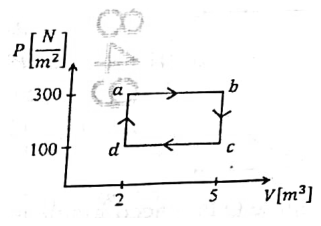
- 1400 J
- 2500 J
- 3600 J
- 4800 J
Show answer and solution
Correct: option 3, 600 J
Over a complete cycle the internal energy returns to its starting value, so the net heat supplied equals the net work done by the gas, which is the area enclosed by the cycle on the P-V diagram. The cycle runs clockwise, so the work is positive: J, option (3).
Question 40NEET 2026 Re-exam, Q40
Consider that an electron is revolving in an excited state of Hydrogen atom with velocity . The radius of the orbit is m. The value of is:
[Take the mass of electron to be kg, charge of electron C and ]
- 14
- 23
- 32
- 41
Show answer and solution
Correct: option 4, 1
The Coulomb attraction supplies the centripetal force: , so m. So , option (4).
Question 41NEET 2026 Re-exam, Q41
A car travels on a circular racetrack of radius 50 m, which is banked at an angle . If the car travels at a speed , then the wear and tear on its tyres is minimum. Taking the acceleration due to gravity to be , the value of is:
- 1
- 2
- 3
- 4
Show answer and solution
Correct: option 1,
Wear and tear is least when no friction is needed, that is when the horizontal part of the normal force alone supplies the centripetal force. Then , option (1).
Question 42NEET 2026 Re-exam, Q42
Three identical p-n junction diodes , and are connected across a battery as shown in the figure. If the width of the depletion regions of , and are , and , respectively, then the correct option is:
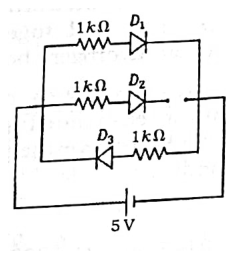
- 1
- 2
- 3
- 4
Show answer and solution
Correct: option 3,
is forward biased, which narrows its depletion region. The branch of is broken (open), so no voltage acts on it and it keeps its unbiased width. faces the other way and is reverse biased, which widens its depletion region. Hence , option (3).
Question 43NEET 2026 Re-exam, Q43
The following table presents the part of the electromagnetic spectrum and their corresponding major applications.
| Part of the electromagnetic spectrum | | Applications |
|---|
| P | Microwave | I | For purifying the water |
| Q | UV rays | II | For warming the food |
| R | Gamma rays | III | For AM and FM communication systems |
| S | Radio wave | IV | For treating the Cancer cells |
The correct option is:
- 1P-I, Q-II, R-III, S-IV
- 2P-I, Q-IV, R-II, S-III
- 3P-II, Q-I, R-IV, S-III
- 4P-II, Q-IV, R-III, S-I
Show answer and solution
Correct: option 3, P-II, Q-I, R-IV, S-III
Microwaves heat food in microwave ovens (P-II). UV rays kill germs and are used in water purifiers (Q-I). Gamma rays are used in radiotherapy to destroy cancer cells (R-IV). Radio waves carry AM and FM broadcasts (S-III). This is option (3).
Question 44NEET 2026 Re-exam, Q44
Bob of mass at rest is hanging vertically from the ceiling via a massless string of length 10 m, as shown in the figure. Point mass of mass travelling horizontally with speed hits bob elastically. The bob rises meter after the collision. Taking the acceleration due to gravity and neglecting the size of the bob, the value of is:
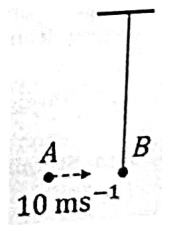
- 18
- 27
- 35
- 42.5
Show answer and solution
Correct: option 3, 5
In a head-on elastic collision between equal masses the velocities are exchanged, so stops and moves off at . Energy conservation for the bob gives m, which is less than the string length, so the bob simply swings up to that height. Option (3).
Question 45NEET 2026 Re-exam, Q45
An ideal gas is made of polyatomic molecules. Each of the molecules has three translational, three rotational and number of vibrational modes. If the ratio of heat capacities of the gas is 8/7, then the value of is:
- 14
- 23
- 32
- 41
Show answer and solution
Correct: option 1, 4
Each translational and rotational degree of freedom contributes to and each vibrational mode contributes . So and . Setting gives , so , option (1).
NEET 2026 Re-exam Chemistry questions
Question 46NEET 2026 Re-exam, Q46
For the following reaction sequence, choose the correct option
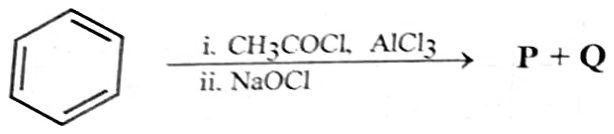
- 1If P is the sodium salt of a carboxylic acid, Q is a primary alcohol.
- 2P and Q are aromatic compounds.
- 3If P gives a carboxylic acid on acidification, Q gives a poisonous gas on exposure to air and light.
- 4Both P and Q are carbonyl compounds.
Show answer and solution
Correct: option 3, If P gives a carboxylic acid on acidification, Q gives a poisonous gas on exposure to air and light.
Friedel-Crafts acylation of benzene with gives acetophenone, a methyl ketone. NaOCl then carries out the haloform reaction, giving sodium benzoate and chloroform. Sodium benzoate gives benzoic acid on acidification, and chloroform is slowly oxidised by air in light to the poisonous gas phosgene, . Chloroform is neither an alcohol, an aromatic compound nor a carbonyl compound, so only option (3) fits.
Question 47NEET 2026 Re-exam, Q47
Given below are two statements:
Statement-I: is chiral.
Statement-II: trans- is chiral.
(Given: )
In light of the above statements, choose the most appropriate answer from the options given below:
- 1Both Statement-I and Statement-II are correct.
- 2Both Statement-I and Statement-II are incorrect.
- 3Statement-I is correct but Statement-II is incorrect.
- 4Statement-I is incorrect but Statement-II is correct.
Show answer and solution
Correct: option 3, Statement-I is correct but Statement-II is incorrect.
A tris-chelate octahedral complex such as has no plane of symmetry and exists as a pair of non-superimposable mirror images, so Statement-I is correct. In trans- the two oxalate rings lie in one plane, which is a plane of symmetry, so the trans form is not chiral (only the cis form is). Statement-II is incorrect.
Question 48NEET 2026 Re-exam, Q48
The following carbocation is stabilized by the interaction of the empty orbital with
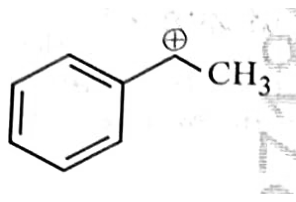
- 1filled and filled orbitals
- 2empty and empty orbitals
- 3empty and filled orbitals
- 4empty and empty orbitals
Show answer and solution
Correct: option 1, filled and filled orbitals
The cation is the 1-phenylethyl carbocation. Its empty orbital can only accept electrons, so it is stabilised by filled orbitals: the filled C-H orbitals of the neighbouring group (hyperconjugation) and the filled orbitals of the benzene ring (resonance).
Question 49NEET 2026 Re-exam, Q49
In potash alum, the ratio of and ions is
- 11:2
- 22:1
- 32:3
- 43:2
Show answer and solution
Correct: option 1, 1:2
Potash alum is . One formula unit has 2 ions and ions, so the ratio is 2:4 = 1:2.
Question 50NEET 2026 Re-exam, Q50
The correct statement about peptides and proteins is
- 1Tertiary structure of proteins has two or more polypeptide subunits.
- 2Only the proteins having a quaternary structure are biologically active.
- 3In -pleated sheet structures, peptide chains are held together by intermolecular hydrogen bonds.
- 4In -helices, the polypeptide chain is twisted into a left-handed screw (helix) through intramolecular hydrogen bonds.
Show answer and solution
Correct: option 3, In -pleated sheet structures, peptide chains are held together by intermolecular hydrogen bonds.
In a -pleated sheet the stretched peptide chains lie side by side and are held together by intermolecular hydrogen bonds, so (3) is correct. Two or more subunits are a feature of quaternary, not tertiary, structure; many proteins with a single chain are active; and the -helix is a right-handed screw.
Question 51NEET 2026 Re-exam, Q51
The numbers 17.0145 and 21.0235 were rounded to three figures after the decimal point. The resulting numbers, respectively, are
- 117.014 and 21.023
- 217.015 and 21.023
- 317.014 and 21.024
- 417.015 and 21.024
Show answer and solution
Correct: option 3, 17.014 and 21.024
When the digit to be dropped is exactly 5, the preceding digit is left unchanged if it is even and raised by one if it is odd. In 17.0145 the preceding digit 4 is even, giving 17.014. In 21.0235 the preceding digit 3 is odd, giving 21.024.
Question 52NEET 2026 Re-exam, Q52
The correct order of solubility of the given salts in water at 298 K is
| Salt | at 298 K |
|---|
| |
| |
| |
- 1
- 2
- 3
- 4
Show answer and solution
Correct: option 4,
For AgBr, , so M. For and (which gives and ), , so M and M. The order of solubility is .
Question 53NEET 2026 Re-exam, Q53
Among the following options, the correct trend in the electron gain enthalpy is
- 1F > Cl > Br > I
- 2Br > Cl > F > I
- 3Cl > F > Br > I
- 4I > Br > Cl > F
Show answer and solution
Correct: option 3, Cl > F > Br > I
Electron gain enthalpy becomes less negative down the halogen group, but fluorine is an exception: its very small 2p subshell is crowded, so the incoming electron feels strong repulsion. Chlorine therefore has the most negative value, followed by F, Br and I.
Question 54NEET 2026 Re-exam, Q54
Assertion A: For an ideal solution formed by mixing liquids P and Q, and
Reason R: No interactions occur between P and Q
In the light of the above statements, choose the most appropriate answer from the options given below.
- 1Both A and R are correct and R is the correct explanation of A
- 2Both A and R are correct but R is NOT the correct explanation of A
- 3A is correct but R is not correct
- 4A is not correct but R is correct
Show answer and solution
Correct: option 3, A is correct but R is not correct
For an ideal solution the enthalpy of mixing and the volume change on mixing are both zero, so A is correct. This is because the P-Q interactions are nearly the same as the P-P and Q-Q interactions, not because there are no interactions between P and Q, so R is not correct.
Question 55NEET 2026 Re-exam, Q55
The amino acid that gives a red-blood colour on treating its sodium fusion extract with sodium nitroprusside is
- 1leucine
- 2threonine
- 3methionine
- 4serine
Show answer and solution
Correct: option 3, methionine
The sodium nitroprusside test on the sodium fusion extract detects sulphur: the sulphide ion formed in the fusion gives a coloured complex with nitroprusside. Of the four amino acids only methionine, , contains sulphur.
Question 56NEET 2026 Re-exam, Q56
The standard electrode potential (E°) for the half-cell reaction at 298 K is
(Given: and at 298 K)
- 1+0.40 V
- 2+0.76 V
- 3−0.48 V
- 4+0.92 V
Show answer and solution
Correct: option 2, +0.76 V
Electrode potentials are not additive, but is. has and has . Subtracting the second from the first gives with V.
Question 57NEET 2026 Re-exam, Q57
In an acidic medium, 10 mL of 0.25 M oxalic acid is titrated with solution. If the volume of solution required to reach end point is 10 mL, the strength of the solution is
- 10.10 M
- 20.20 M
- 30.25 M
- 40.15 M
Show answer and solution
Correct: option 1, 0.10 M
In acid, . Moles of oxalic acid mmol, which needs mmol of . This is contained in 10 mL, so the concentration is 0.10 M.
Question 58NEET 2026 Re-exam, Q58
According to crystal field theory, the correct order of ligands with respect to their decreasing order of field strength is
- 1
- 2
- 3
- 4
Show answer and solution
Correct: option 1,
In the spectrochemical series the field strength increases as . Written in decreasing order this is .
Question 59NEET 2026 Re-exam, Q59
Two moles of an ideal gas undergo free expansion from 10 L to 100 L at 300 K. The values of and are
(R is universal gas constant)
- 1;
- 2;
- 3;
- 4;
Show answer and solution
Correct: option 4, ;
Entropy is a state function, so . In a free expansion of an ideal gas no work is done and no heat is exchanged with the surroundings, so .
Question 60NEET 2026 Re-exam, Q60
is a zero-order reaction, where . If the initial concentration of A is 2 M, then the time taken to complete 75% of the reaction will be
- 11.5 min
- 20.75 min
- 31.0 min
- 42.0 min
Show answer and solution
Correct: option 2, 0.75 min
For the rate is , so A is used up at . 75% of 2 M is 1.5 M, and for a zero-order reaction the time is min.
Question 61NEET 2026 Re-exam, Q61
Given below are two statements: One is labelled as Assertion A and the other is labelled as Reason R.
Assertion A: Generally, 3d transition metals have high melting points.
Reason R: Involvement of 3d-electrons in addition to 4s-electrons in the interatomic metallic bonding.
In light of the above statements, choose the most appropriate answer from the options given below:
- 1Both A and R are correct and R is the correct explanation of A.
- 2Both A and R are correct and R is NOT the correct explanation of A.
- 3A is correct but R is not correct.
- 4A is not correct but R is correct.
Show answer and solution
Correct: option 1, Both A and R are correct and R is the correct explanation of A.
The 3d transition metals generally melt at high temperatures. The reason is that the 3d electrons as well as the 4s electrons take part in metallic bonding, which makes the bonding between the atoms strong. Both statements are correct and R explains A.
Question 62NEET 2026 Re-exam, Q62
For a salt XY, which is a strong electrolyte, the plot of versus has a slope of at 298 K. At 0.01 M concentration of XY, the value of is . The limiting molar conductivity of ion (, in ) at 298 K will be
(Given: )
- 180.0
- 2100.0
- 390.0
- 476.0
Show answer and solution
Correct: option 1, 80.0
For a strong electrolyte with . At M, , so . By Kohlrausch's law .
Question 63NEET 2026 Re-exam, Q63
The amount of carbon dioxide evolved upon complete combustion of 116 g of n-butane is
(Given: atomic mass in amu H = 1, C = 12 and O = 16)
- 1352 g
- 2322 g
- 3176 g
- 4362 g
Show answer and solution
Correct: option 1, 352 g
. The molar mass of butane is 58 g, so 116 g is 2 mol, which gives 8 mol of , that is g.
Question 64NEET 2026 Re-exam, Q64
For an elementary chemical reaction, the Arrhenius plot is given below.
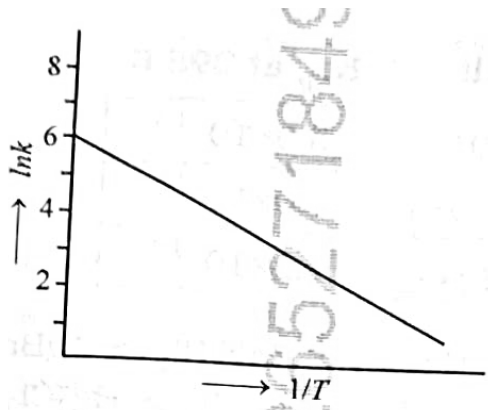
If the energy of activation is and , the temperature at which the rate constant becomes , is
- 1125 K
- 2150 K
- 3200 K
- 4250 K
Show answer and solution
Correct: option 3, 200 K
, and the intercept of the plot gives . For , , so and K.
Question 65NEET 2026 Re-exam, Q65
Given below are two statements:
Statement-I: Heating NaCl with concentrated and results in oxidation of Mn.
Statement-II: Heating NaI with concentrated and results in reduction of Mn.
In light of the above statements, choose the most appropriate answer from the options given below:
- 1Both Statement-I and Statement-II are correct.
- 2Both Statement-I and Statement-II are incorrect.
- 3Statement-I is correct but Statement-II is incorrect.
- 4Statement-I is incorrect but Statement-II is correct.
Show answer and solution
Correct: option 4, Statement-I is incorrect but Statement-II is correct.
In both reactions is the oxidising agent: it oxidises the halide to the free halogen ( or ) and is itself reduced from Mn(IV) to . So Mn is reduced in both cases; Statement-I is incorrect and Statement-II is correct.
Question 66NEET 2026 Re-exam, Q66
Among the species given below, the spin-only magnetic moment is highest for
(Given: Atomic number of Ti = 22, Mn = 25, Fe = 26 and Co = 27)
- 1
- 2
- 3
- 4
Show answer and solution
Correct: option 1,
has (, low spin, ) with 2 unpaired electrons. (, low spin) has 1, (, low spin) has 0 and () has 1. The spin-only moment BM is largest for the manganese complex.
Question 67NEET 2026 Re-exam, Q67
The lanthanide ion having four unpaired electrons is
(Given: Atomic numbers of Ce = 58, Nd = 60, Tb = 65 and Ho = 67)
- 1
- 2
- 3
- 4
Show answer and solution
Correct: option 4,
The ions have the configuration : is (1 unpaired), is (3), is (6) and is , which has unpaired electrons.
Question 68NEET 2026 Re-exam, Q68
The formula of tetraammineaquachloridocobalt(III) chloride is
- 1
- 2
- 3
- 4
Show answer and solution
Correct: option 4,
The complex cation holds four , one and one on Co(III), so its charge is . Two chloride counter ions balance it, giving .
Question 69NEET 2026 Re-exam, Q69
Consider the reversible processes for 1.0 mol of an ideal gas as shown in the figure.
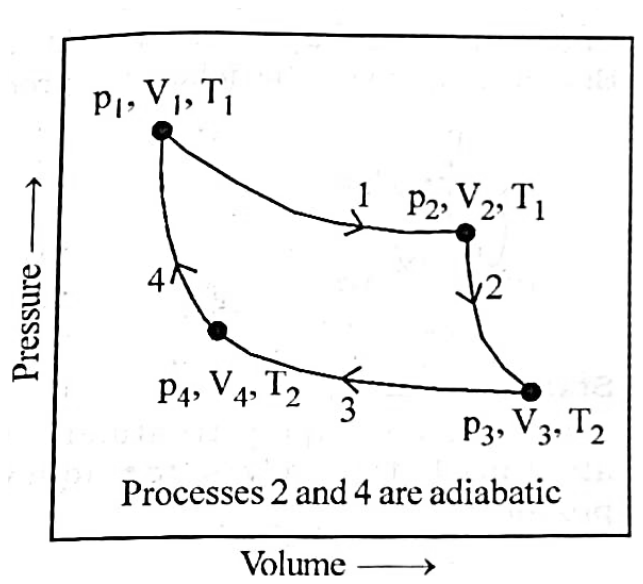
, , and represent work done (in calories) in the processes 1, 2, 3 and 4, respectively; and are changes in the internal energy for the processes 2 and 4, respectively.
[use ]
The correct option is
- 1
- 2
- 3
- 4
Show answer and solution
Correct: option 1,
Processes 1 and 3 are isothermal (at and ), and for a reversible isothermal change . With and , and , which add up to option (1). For the adiabatic steps , so , and the net work over the cycle is not zero.
Question 70NEET 2026 Re-exam, Q70
Given below are two statements: One is labelled as Assertion A and the other is labelled as Reason R.
Assertion A: The first ionization enthalpy of O is lower than that of N and F.
Reason R: The loss of an electron from O leads to stable half-filled p orbital.
In light of the above statements, choose the most appropriate answer from the options given below:
- 1Both A and R are correct and R is the correct explanation of A.
- 2Both A and R are correct and R is NOT the correct explanation of A.
- 3A is correct but R is not correct.
- 4A is not correct but R is correct.
Show answer and solution
Correct: option 1, Both A and R are correct and R is the correct explanation of A.
Oxygen () has a lower first ionization enthalpy than both nitrogen () and fluorine. Removing one electron from O leaves the stable half-filled arrangement (and relieves the repulsion in the paired 2p orbital), which is why its value falls below that of N. Both statements are correct and R explains A.
Question 71NEET 2026 Re-exam, Q71
Consider the following statements about the solutions formed by mixing two liquids.
A. An ideal solution thus formed obeys Raoult's law throughout the composition range.
B. Mixture of chloroform and acetone shows negative deviation from Raoult's law.
C. Mixture of aniline and phenol shows positive deviation from Raoult's law.
- 1A and B only
- 2B and C only
- 3A only
- 4A and C only
Show answer and solution
Correct: option 1, A and B only
A is the definition of an ideal solution. Chloroform and acetone form a hydrogen bond with each other, which lowers the escaping tendency, so B (negative deviation) is correct. Aniline and phenol also attract each other through hydrogen bonding between the phenolic hydrogen and the nitrogen of aniline, so they too show negative, not positive, deviation; C is wrong.
Question 72NEET 2026 Re-exam, Q72
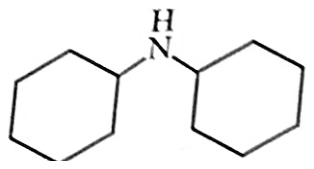
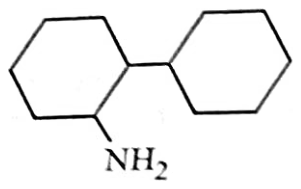
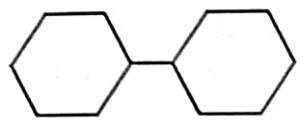
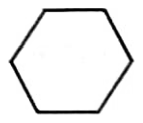
One of the products formed in the following reaction is

- 1
- 2
- 3
- 4
Show answer and solution
Correct: option 4
A Grignard reagent is a very strong base and reacts with any compound that has an acidic hydrogen. The N-H hydrogen of cyclohexylamine protonates the cyclohexyl group of cyclohexylmagnesium bromide, giving the hydrocarbon cyclohexane (option 4) along with the magnesium salt of the amine. No new C-C or C-N bond is formed.
Question 73NEET 2026 Re-exam, Q73
- 1Boron has a maximum covalency of four.
- 2Beryllium has three valence orbitals.
- 3Magnesium has a maximum covalency of four.
- 4Aluminium has five valence orbitals.
Show answer and solution
Correct: option 1, Boron has a maximum covalency of four.
Second period elements have only four valence orbitals (one 2s and three 2p), so boron and beryllium cannot exceed a covalency of four, as in . Beryllium therefore has four valence orbitals, not three. Third period elements such as Mg and Al have nine valence orbitals (3s, 3p and 3d) and can show a covalency above four, as in .
Question 74NEET 2026 Re-exam, Q74
A protein undergoes reversible thermal denaturation from its initial state N to denatured state D according to . At , the concentrations of both N and D are equal at equilibrium, and the standard enthalpy change of denaturation is . The standard entropy change ( in ) of the protein upon denaturation at is closest to
- 12.0
- 22000.0
- 3333.0
- 411.1
Show answer and solution
Correct: option 1, 2.0
Equal concentrations of N and D mean , so . Then and , taking as 333 K.
Question 75NEET 2026 Re-exam, Q75
Match the species in List I with their geometry in List II
| List I | List II |
|---|
| A. | I. Tetrahedral |
| B. | II. Square Planar |
| C. | III. Trigonal bipyramidal |
| D. | IV. Square pyramidal |
Choose the correct answer from the options given below:
- 1A-IV, B-III, C-I, D-II
- 2A-III, B-IV, C-I, D-II
- 3A-III, B-I, C-II, D-IV
- 4A-III, B-II, C-I, D-IV
Show answer and solution
Correct: option 2, A-III, B-IV, C-I, D-II
has five bond pairs and is trigonal bipyramidal. has five bond pairs and one lone pair, so it is square pyramidal. has four bond pairs and is tetrahedral. is a complex and is square planar. So A-III, B-IV, C-I, D-II.
Question 76NEET 2026 Re-exam, Q76
Given below are two statements:
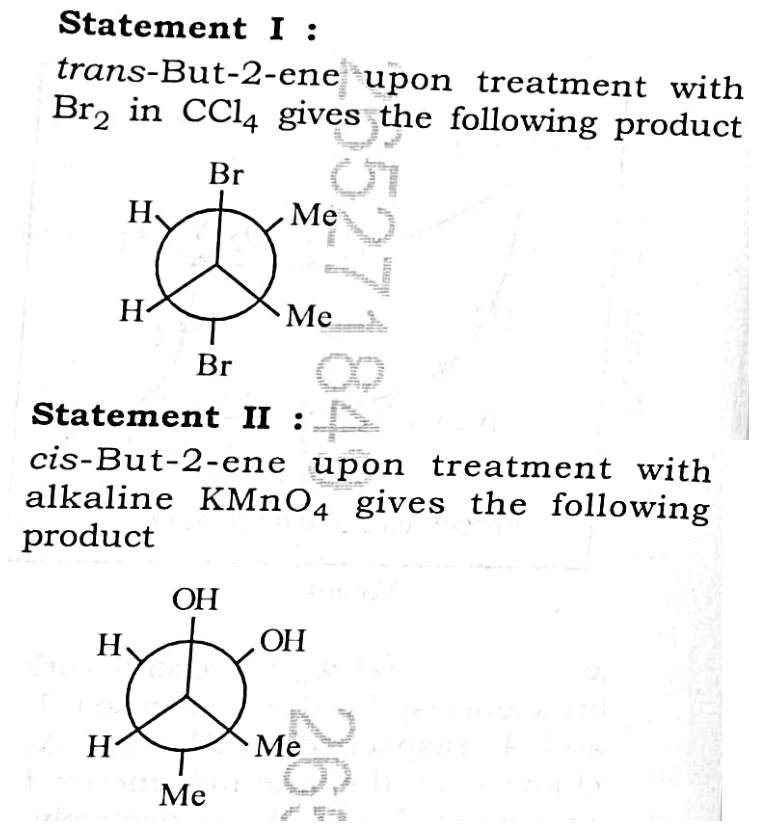
In the light of the above statements, choose the most appropriate answer from the options given below.
- 1Both Statement I and Statement II are correct
- 2Both Statement I and Statement II are incorrect
- 3Statement I is correct but Statement II is incorrect
- 4Statement I is incorrect but Statement II is correct
Show answer and solution
Correct: option 4, Statement I is incorrect but Statement II is correct
adds anti to an alkene, so trans-but-2-ene gives meso-2,3-dibromobutane. In the meso form with the two Br atoms anti, each H must also be anti to the other H and each Me anti to the other Me; the projection shown has the two H atoms on the same side, so it is one of the optically active forms and Statement I is incorrect. Alkaline adds the two OH groups syn, so cis-but-2-ene gives meso-butane-2,3-diol. Turning the back carbon of the second projection until the OH groups eclipse also brings H over H and Me over Me, so it is the meso diol and Statement II is correct.
Question 77NEET 2026 Re-exam, Q77
Consider the following reaction sequences and choose the correct option.
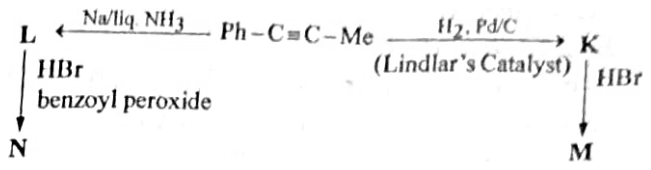
- 1K and L are geometrical isomers
- 2K and L are enantiomers
- 3M and N are geometrical isomers
- 4M and N are stereoisomers
Show answer and solution
Correct: option 1, K and L are geometrical isomers
Sodium in liquid ammonia reduces the alkyne to the trans alkene (L), while hydrogen on Lindlar's catalyst gives the cis alkene (K). K and L are cis and trans forms of , that is geometrical isomers. HBr adds to K to place Br on the benzylic carbon (M), whereas HBr with benzoyl peroxide adds the other way round to L (N), so M and N are position isomers, not stereoisomers.
Question 78NEET 2026 Re-exam, Q78
The complex which has facial and meridional isomers is
(Given: py = pyridine and en = )
- 1
- 2
- 3
- 4
Show answer and solution
Correct: option 1,
Facial (fac) and meridional (mer) isomers occur in octahedral complexes of the type . Only is of this type. The others are (no isomers) or of the kind, which show cis and trans isomers.
Question 79NEET 2026 Re-exam, Q79
Identify the reactions which give aniline as the major product.
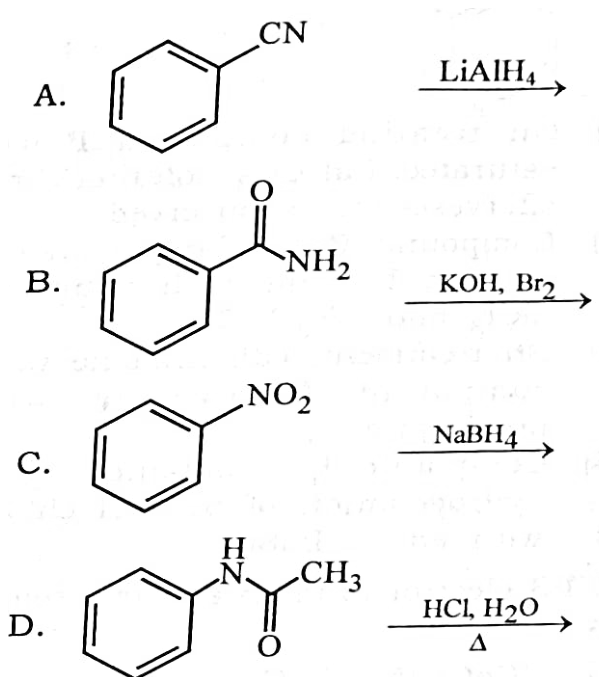
Choose the correct answer from the options given below.
- 1A and B only
- 2B and D only
- 3A and C only
- 4C and D only
Show answer and solution
Correct: option 2, B and D only
A: reduces benzonitrile to benzylamine, , not aniline. B: benzamide with and KOH undergoes Hoffmann bromamide degradation and loses the carbonyl carbon to give aniline. C: does not reduce a nitro group to an amine. D: acid hydrolysis of acetanilide gives aniline (as its salt) and acetic acid. So B and D give aniline.
Question 80NEET 2026 Re-exam, Q80
Match the vitamins in List I with their sources in List II
| List I | List II |
|---|
| A. vitamin A | I. meat |
| B. vitamin | II. sunflower oil |
| C. vitamin E | III. green leafy vegetables |
| D. vitamin K | IV. carrots |
Choose the correct answer from the options given below.
- 1A-II, B-III, C-IV, D-I
- 2A-IV, B-I, C-II, D-III
- 3A-IV, B-II, C-I, D-III
- 4A-III, B-I, C-IV, D-II
Show answer and solution
Correct: option 2, A-IV, B-I, C-II, D-III
Vitamin A comes from carrots, fish liver oil, butter and milk. Vitamin comes from meat, fish, egg and curd. Vitamin E is found in vegetable oils such as sunflower oil and wheat germ oil. Vitamin K is found in green leafy vegetables. So A-IV, B-I, C-II, D-III.
Question 81NEET 2026 Re-exam, Q81
The correct decreasing order of oxidation state of the underlined atom in each molecule is
- 1
- 2
- 3
- 4
Show answer and solution
Correct: option 2,
The oxidation states are: (1) P +5, S +6, O −2; (2) N +5, Al +3, S −2; (3) Pb +4, N +3, S +6; (4) P +3, Cl +7, Al +3. Only in option (2) do the values fall steadily, +5 > +3 > −2.
Question 82NEET 2026 Re-exam, Q82
The compound that CANNOT be obtained from the aldol condensation reaction shown below, is
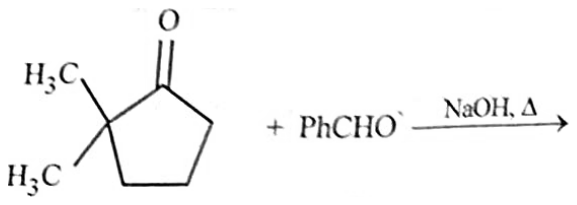
- 1
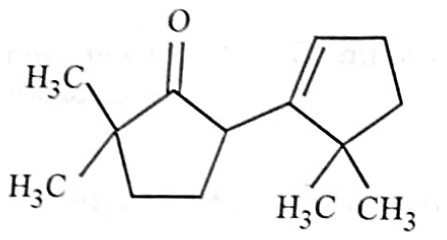
- 2
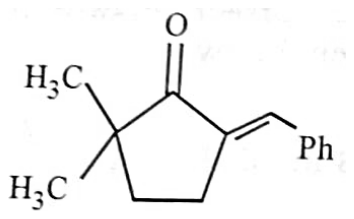
- 3
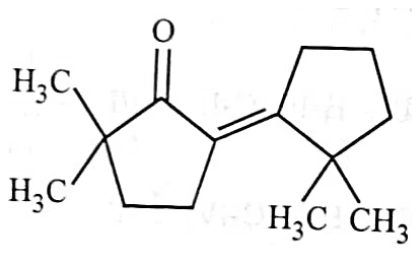
- 4
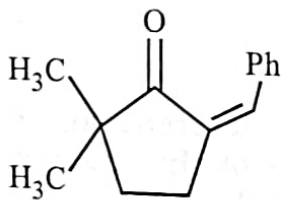
Show answer and solution
Correct: option 1
2,2-Dimethylcyclopentanone has -hydrogens only on C5, and benzaldehyde has none. The enolate can attack benzaldehyde and lose water to give the benzylidene ketone, as either geometrical isomer (options 2 and 4), or attack another molecule of the ketone and lose water to give the conjugated product with a C=C between the two rings (option 3). Aldol condensation always gives an -unsaturated carbonyl compound; option (1), with the double bond inside the second ring and not conjugated with the C=O group, is not formed.
Question 83NEET 2026 Re-exam, Q83
Among the following, the compound having conjugated double bonds is
- 1hepta-1,3-diene
- 2hepta-1,4-diene
- 3hepta-1,5-diene
- 4hepta-1,6-diene
Show answer and solution
Correct: option 1, hepta-1,3-diene
Double bonds are conjugated when they are separated by exactly one single bond. Hepta-1,3-diene, , has this arrangement. In the other three the double bonds are separated by one or more carbons, so they are isolated.
Question 84NEET 2026 Re-exam, Q84
Given below are two statements:
Statement-I: Oxidation of p-nitrotoluene with acidic gives an acid that is stronger than benzoic acid.
Statement-II: Reduction of p-nitrotoluene with Sn/HCl followed by neutralization gives an amine that is more basic than aniline.
In light of the above statements, choose the most appropriate answer from the options given below.
- 1Both Statement-I and Statement-II are correct.
- 2Both Statement-I and Statement-II are incorrect.
- 3Statement-I is correct but Statement-II is incorrect.
- 4Statement-I is incorrect but Statement-II is correct.
Show answer and solution
Correct: option 1, Both Statement-I and Statement-II are correct.
Oxidation of the methyl group gives p-nitrobenzoic acid; the electron-withdrawing group stabilises the carboxylate ion, so it is a stronger acid than benzoic acid. Reduction of the nitro group gives p-toluidine; the electron-releasing group raises the electron density on nitrogen, so it is more basic than aniline. Both statements are correct.
Question 85NEET 2026 Re-exam, Q85
The green paramagnetic species formed by heating at 513 K is
- 1
- 2
- 3
- 4
Show answer and solution
Correct: option 1,
. Potassium manganate, , is green and contains Mn(VI) with one unpaired electron, so it is paramagnetic.
Question 86NEET 2026 Re-exam, Q86
Consider the following reaction, and choose the correct option.
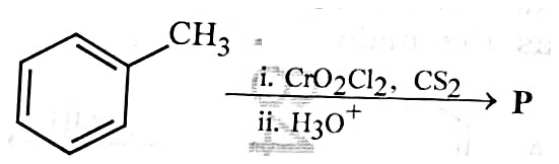
- 1On treating compound P with saturated solution, brisk effervescence is observed.
- 2Compound P can be prepared by treating benzene with anhydrous and .
- 3On treatment with bromine water, compound P gives a white precipitate.
- 4Compound P is obtained by the hydrogenation of benzoyl chloride with Pd on .
Show answer and solution
Correct: option 4, Compound P is obtained by the hydrogenation of benzoyl chloride with Pd on .
Toluene with chromyl chloride followed by hydrolysis (Etard reaction) gives benzaldehyde, P. Benzaldehyde is also made by the Rosenmund reduction of benzoyl chloride with hydrogen over Pd on . It is not an acid (no effervescence with ), Friedel-Crafts acylation with gives acetophenone, and the white precipitate with bromine water is given by phenol or aniline.
Question 87NEET 2026 Re-exam, Q87
A 1:3 electrolyte in an aqueous solution is
- 1
- 2
- 3
- 4
Show answer and solution
Correct: option 3,
Only the ions outside the coordination sphere are released in water. gives one and three ions, a 1:3 electrolyte. Option (1) is 1:1, option (2) is 1:2 and option (4) is a non-electrolyte.
Question 88NEET 2026 Re-exam, Q88
Consider the following schematic plots of orbital wavefunction () against distance () from the nucleus.
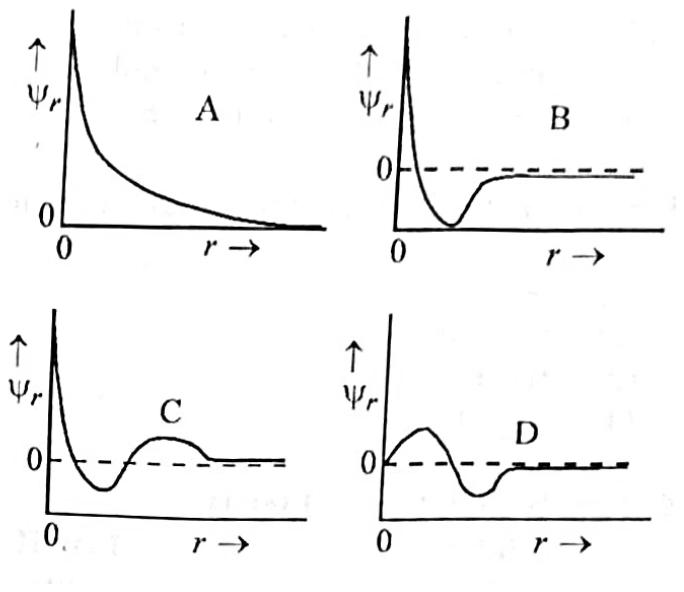
The figure representing two radial nodes in the orbital is
- 1A
- 2B
- 3C
- 4D
Show answer and solution
Correct: option 3, C
A radial node is a distance at which passes through zero and changes sign. Curve A never crosses zero, curves B and D each cross it once, and curve C crosses it twice (it goes negative and then positive again), so C has two radial nodes, as in a 3s orbital.
Question 89NEET 2026 Re-exam, Q89
Arrange the following compounds in the increasing order of polarity
A.
B.
C.
D.
Choose the correct answer from the options given below.
- 1A < B < C < D
- 2C < A < D < B
- 3C < A < B < D
- 4A < C < B < D
Show answer and solution
Correct: option 4, A < C < B < D
Diethyl ether has only weakly polar C-O-C bonds and is the least polar. Acetone has a polar C=O group. Ethanol has an O-H group and forms hydrogen bonds, and acetic acid has both C=O and O-H groups and is the most polar. This is the order in which these classes of compounds are held on an adsorbent in chromatography: ether < ketone < alcohol < carboxylic acid, that is A < C < B < D.
Question 90NEET 2026 Re-exam, Q90
The highest occupied molecular orbital for is
- 1
- 2
- 3
- 4
Show answer and solution
Correct: option 4,
would have 20 electrons, which fill every molecular orbital formed from the n = 1 and n = 2 shells: , , , , , , and finally . The highest occupied orbital is therefore (and the bond order is zero).
NEET 2026 Re-exam Biology questions
Question 91NEET 2026 Re-exam, Q91
The number of vertebrae in a human is ________.
- 17
- 212
- 326
- 4206
Show answer and solution
Correct: option 3, 26
The human vertebral column is made of 26 serially arranged vertebrae: 7 cervical, 12 thoracic, 5 lumbar, 1 sacral (fused) and 1 coccygeal (fused). 7 and 12 are only the cervical and thoracic counts, and 206 is the total number of bones in the body.
Question 92NEET 2026 Re-exam, Q92
Symbiotic association between fungi and algae are called ________.
- 1lichens
- 2sponges
- 3mycorrhiza
- 4chrysophytes
Show answer and solution
Correct: option 1, lichens
A lichen is a mutually useful association of an alga (the phycobiont, which makes food) and a fungus (the mycobiont, which gives shelter and absorbs water and minerals). Mycorrhiza is the association of a fungus with the roots of higher plants, so it does not fit.
Question 93NEET 2026 Re-exam, Q93
Cell theory was formulated by ________.
- 1Schleiden and Schwann
- 2Robert Brown
- 3Singer and Nicolson
- 4Antonie Von Leeuwenhoek
Show answer and solution
Correct: option 1, Schleiden and Schwann
Matthias Schleiden (a botanist) and Theodore Schwann (a zoologist) together put forward the cell theory. Robert Brown discovered the nucleus, Singer and Nicolson gave the fluid mosaic model of the membrane, and Leeuwenhoek first saw a living cell.
Question 94NEET 2026 Re-exam, Q94
Which of the following are characteristics of prokaryotic cells?
(a) Ribosomes are made of 50S and 30S subunits
(b) They can have plasmids
(c) They contain mesosome
(d) They have peroxisomes
Choose the correct answer from the options given below:
- 1(b) and (c) only
- 2(a) and (c) only
- 3(a), (c) and (d) only
- 4(a), (b) and (c) only
Show answer and solution
Correct: option 4, (a), (b) and (c) only
Prokaryotes have 70S ribosomes built from 50S and 30S subunits, many carry small circular plasmids, and the cell membrane folds inwards to form mesosomes, so (a), (b) and (c) are right. Peroxisomes are membrane-bound organelles, and prokaryotes have no membrane-bound organelles, so (d) is wrong.
Question 95NEET 2026 Re-exam, Q95
Which of the following is not a part of human central neural system?
- 1Arachnoid
- 2Dura mater
- 3Pia mater
- 4Pericardium
Show answer and solution
Correct: option 4, Pericardium
The brain is covered by three cranial meninges: the outer dura mater, the middle arachnoid and the inner pia mater. The pericardium is the double-walled sac around the heart, so it has nothing to do with the central neural system.
Question 96NEET 2026 Re-exam, Q96
Mitochondrial inner membrane encloses ________.
- 1matrix
- 2cytosol
- 3mucus
- 4aqueous humor
Show answer and solution
Correct: option 1, matrix
A mitochondrion has two membranes. The outer one forms the boundary of the organelle, and the inner one surrounds the inner compartment, which is filled with a dense substance called the matrix.
Question 97NEET 2026 Re-exam, Q97
Match List-I with List-II.
| List-I | List-II |
|---|
| A. Cristae | I. Flat membrane sacs in stroma of chloroplast |
| B. Cisternae | II. Infoldings in mitochondria |
| C. Thylakoids | III. Cell membrane |
| D. Phospholipid | IV. Disc shaped sacs in the Golgi apparatus |
Choose the correct answer from the options given below:
- 1A-III, B-IV, C-I, D-II
- 2A-II, B-IV, C-I, D-III
- 3A-II, B-IV, C-III, D-I
- 4A-IV, B-III, C-I, D-II
Show answer and solution
Correct: option 2, A-II, B-IV, C-I, D-III
Cristae are the infoldings of the inner mitochondrial membrane (A-II). Cisternae are the flat, disc-shaped sacs of the Golgi apparatus (B-IV). Thylakoids are the flattened membrane sacs in the stroma of the chloroplast (C-I). Phospholipids are the main lipids of the cell membrane (D-III).
Question 98NEET 2026 Re-exam, Q98
The plastid that stores xanthophyll is known as ________.
- 1chloroplast
- 2chromoplast
- 3aleuroplast
- 4amyloplast
Show answer and solution
Correct: option 2, chromoplast
Chromoplasts hold fat-soluble carotenoid pigments such as carotene and xanthophylls, which give yellow, orange or red colours. Amyloplasts store starch and aleuroplasts store proteins; both are colourless leucoplasts.
Question 99NEET 2026 Re-exam, Q99
Which of the following statements related to pituitary gland are correct?
(a) It is divided anatomically into adenohypophysis and neurohypophysis
(b) It secretes follicle stimulating hormone
(c) It secretes melanocyte stimulating hormone
(d) It does not secrete prolactin
Choose the correct answer from the options given below:
- 1(a) and (b) only
- 2(a), (b) and (c) only
- 3(c) and (d) only
- 4(b) and (c) only
Show answer and solution
Correct: option 2, (a), (b) and (c) only
The pituitary is divided into the adenohypophysis and the neurohypophysis, so (a) is right. The pars distalis secretes FSH along with GH, PRL, TSH, ACTH and LH, and the pars intermedia secretes MSH, so (b) and (c) are right. Prolactin is a pituitary hormone, so (d) is wrong.
Question 100NEET 2026 Re-exam, Q100
Photorespiration reaction catalyzed by RuBisCo is shown below:
RuBP + 3-Phosphoglycerate + X
Identify "X" from the given options:
- 1Phosphoenolpyruvate
- 22-Phosphoglycolate
- 3Oxaloacetate
- 4Malate
Show answer and solution
Correct: option 2, 2-Phosphoglycolate
When RuBisCO acts as an oxygenase, the five-carbon RuBP combines with and splits into one molecule of 3-phosphoglycerate (3 carbons) and one molecule of phosphoglycolate (2 carbons). So X is 2-phosphoglycolate.
Question 101NEET 2026 Re-exam, Q101
Mad cow disease is caused by ________.
- 1prions
- 2viroids
- 3Aspergillus sp.
- 4Mycoplasma sp.
Show answer and solution
Correct: option 1, prions
Mad cow disease (bovine spongiform encephalopathy) is caused by prions, which are abnormally folded infectious proteins with no nucleic acid. Viroids are naked RNA that infect plants, Aspergillus is a fungus and Mycoplasma is a bacterium without a cell wall.
Question 102NEET 2026 Re-exam, Q102
Which pigment has absorption peak at 700 nm in the photosynthetic reaction centre PS I (P700)?
- 1Chlorophyll b
- 2Chlorophyll a
- 3Xanthophylls
- 4Carotenoids
Show answer and solution
Correct: option 2, Chlorophyll a
The reaction centre of each photosystem is a single chlorophyll a molecule. In PS I this chlorophyll a absorbs best at 700 nm and is called P700. Chlorophyll b, xanthophylls and carotenoids are accessory pigments of the antenna.
Question 103NEET 2026 Re-exam, Q103
In water, frogs respire using ________.
- 1skin
- 2buccal cavity
- 3lungs
- 4trachea
Show answer and solution
Correct: option 1, skin
In water the frog's moist skin acts as the respiratory organ: dissolved oxygen diffuses in through it (cutaneous respiration). On land the buccal cavity, skin and lungs are all used.
Question 104NEET 2026 Re-exam, Q104
Which of the following represents the correct sequence of arrangement of bones in the lower limb of humans?
- 1Femur-tibia-patella-tarsal
- 2Patella-femur-tibia-tarsal
- 3Femur-patella-tibia-tarsal
- 4Femur-tarsal-patella-tibia
Show answer and solution
Correct: option 3, Femur-patella-tibia-tarsal
From the hip downwards the bones are the femur (thigh), the patella (knee cap), the tibia and fibula (lower leg), then the tarsals (ankle), metatarsals and phalanges. Only femur-patella-tibia-tarsal keeps this order.
Question 105NEET 2026 Re-exam, Q105
Phyllotaxy is the pattern of arrangement of ________.
- 1leaves
- 2flowers
- 3fruits
- 4sepals
Show answer and solution
Correct: option 1, leaves
Phyllotaxy is the pattern in which leaves are arranged on the stem or branch. It is of three types: alternate, opposite and whorled. The arrangement of flowers is called inflorescence.
Question 106NEET 2026 Re-exam, Q106
Match List-I with List-II.
| List-I | List-II |
|---|
| A. Starch | I. Fights infection |
| B. Antibody | II. Energy storage |
| C. Concanavalin A | III. Glucose transport |
| D. Glut-4 | IV. Lectin |
Choose the correct answer from the options given below:
- 1A-I, B-II, C-IV, D-III
- 2A-II, B-I, C-IV, D-III
- 3A-II, B-I, C-III, D-IV
- 4A-I, B-II, C-III, D-IV
Show answer and solution
Correct: option 2, A-II, B-I, C-IV, D-III
Starch is the storage polysaccharide of plants, an energy store (A-II). An antibody is a protein that fights infectious agents (B-I). Concanavalin A is a lectin, a secondary metabolite (C-IV). GLUT-4 is the protein that carries glucose into cells (D-III).
Question 107NEET 2026 Re-exam, Q107
Given below are two statements:
Statement I: When any plane passing through the central axis of the body divides the organism into two identical halves, it is called radial symmetry.
Statement II: In phylum Echinodermata, both adults and larvae are radially symmetrical.
In the light of the above statements, choose the most appropriate answer from the options given below:
- 1Both Statement I and Statement II are correct
- 2Both Statement I and Statement II are incorrect
- 3Statement I is correct but Statement II is incorrect
- 4Statement I is incorrect but Statement II is correct
Show answer and solution
Correct: option 3, Statement I is correct but Statement II is incorrect
Statement I is the definition of radial symmetry, so it is correct. In echinoderms only the adults are radially symmetrical; the larvae are bilaterally symmetrical. So Statement II is incorrect.
Question 108NEET 2026 Re-exam, Q108
Endomembrane system includes ________.
- 1endoplasmic reticulum, Golgi complex, lysosomes and vacuole
- 2endoplasmic reticulum, chloroplast, peroxisomes and vacuole
- 3mitochondria, chloroplast, peroxisomes and vacuole
- 4Golgi complex, chloroplast, peroxisomes and vacuole
Show answer and solution
Correct: option 1, endoplasmic reticulum, Golgi complex, lysosomes and vacuole
The endomembrane system is the set of organelles whose functions are coordinated: the endoplasmic reticulum, Golgi complex, lysosomes and vacuoles. Mitochondria, chloroplasts and peroxisomes work independently of these and are not part of it, which rules out the other three options.
Question 109NEET 2026 Re-exam, Q109
How many molecules of pyruvic acid are produced at the end of glycolysis from 206 molecules of glucose?
- 1206
- 2309
- 3103
- 4412
Show answer and solution
Correct: option 4, 412
In glycolysis one six-carbon glucose is split into two three-carbon molecules of pyruvic acid. So 206 molecules of glucose give molecules of pyruvic acid.
Question 110NEET 2026 Re-exam, Q110
Which of the following plant growth regulators is used as herbicide?
- 12,4-D
- 2Kinetin
- 3Abscisic acid
- 4Gibberellin
Show answer and solution
Correct: option 1, 2,4-D
2,4-D is a synthetic auxin that is widely used to kill dicotyledonous weeds without harming mature monocot crops, so it works as a herbicide. Kinetin is a cytokinin, and abscisic acid and gibberellin are not used as weedkillers.
Question 111NEET 2026 Re-exam, Q111
Given below are two statements:
Statement I: In gymnosperms, the male and female gametophytes remain within the sporangia.
Statement II: In gymnosperms, seeds are not covered.
In the light of the above statements, choose the most appropriate answer from the options given below:
- 1Both Statement I and Statement II are correct
- 2Both Statement I and Statement II are incorrect
- 3Statement I is correct but Statement II is incorrect
- 4Statement I is incorrect but Statement II is correct
Show answer and solution
Correct: option 1, Both Statement I and Statement II are correct
In gymnosperms the male and female gametophytes have no independent free-living existence; they stay inside the sporangia, which are retained on the sporophyte. Their ovules are not enclosed by an ovary wall, so the seeds are naked. Both statements are correct.
Question 112NEET 2026 Re-exam, Q112
Match List-I with List-II.
| List-I | List-II |
|---|
| A. Spherical | I. Vibrio |
| B. Rod | II. Cocci |
| C. Comma | III. Spirilla |
| D. Spirillum | IV. Bacilli |
Choose the correct answer from the options given below:
- 1A-I, B-III, C-II, D-IV
- 2A-III, B-II, C-I, D-IV
- 3A-II, B-I, C-IV, D-III
- 4A-II, B-IV, C-I, D-III
Show answer and solution
Correct: option 4, A-II, B-IV, C-I, D-III
Bacteria are grouped by shape: spherical ones are cocci (A-II), rod-shaped ones are bacilli (B-IV), comma-shaped ones are vibrio (C-I) and spiral ones are spirilla (D-III).
Question 113NEET 2026 Re-exam, Q113
Which of the following are characteristic features of Solanaceae family?
(a) Flowers are bisexual and actinomorphic
(b) Calyx have five sepals and are united
(c) Androecium have five stamens and are epipetalous
(d) Ovary is inferior
Choose the correct answer from the options given below:
- 1(a), (b) and (c) only
- 2(d) only
- 3(a) and (b) only
- 4(b), (c) and (d) only
Show answer and solution
Correct: option 1, (a), (b) and (c) only
In Solanaceae the flower is bisexual and actinomorphic, the calyx has five united sepals, and the five stamens are epipetalous, so (a), (b) and (c) are right. The ovary is superior, not inferior, so (d) is wrong.
Question 114NEET 2026 Re-exam, Q114
Select the correct sequence of experiments that led to a gradual understanding of photosynthesis in green plants.
- 1Absorption spectra of chlorophyll a and b production of glucose release of oxygen role of air
- 2Role of air release of oxygen production of glucose absorption spectra of chlorophyll a and b
- 3Release of oxygen production of glucose absorption spectra of chlorophyll a and b role of air
- 4Production of glucose role of air release of oxygen absorption spectra of chlorophyll a and b
Show answer and solution
Correct: option 2, Role of air release of oxygen production of glucose absorption spectra of chlorophyll a and b
Priestley (1770s) first showed the role of air in the growth of green plants. Ingenhousz then showed that green parts release oxygen in sunlight. Sachs (1854) found that glucose is made and stored as starch. Later work with action and absorption spectra showed which wavelengths chlorophyll a and b absorb. That order is option (2).
Question 115NEET 2026 Re-exam, Q115
The number of action potentials generated by sino-arterial node (SAN) in a healthy human is ________ per minute.
- 128 - 30
- 270 - 75
- 3100 - 110
- 4120 - 140
Show answer and solution
Correct: option 2, 70 - 75
The SA node is the pacemaker of the heart and sets the heartbeat by generating the largest number of action potentials, 70 to 75 per minute. This is why the normal heart rate is about 72 beats per minute.
Question 116NEET 2026 Re-exam, Q116
How many turns of Calvin cycle are required for the formation of three molecules of glucose?
- 16
- 23
- 31
- 418
Show answer and solution
Correct: option 4, 18
Each turn of the Calvin cycle fixes one , so one six-carbon glucose needs 6 turns. Three molecules of glucose need turns.
Question 117NEET 2026 Re-exam, Q117
Which of the following statements is incorrect?
- 1Blood coagulates in response to an injury
- 2Blood clot consists of fibrins
- 3Fibrin is produced from fibrinogen
- 4Fibrinogen is produced from fibrin
Show answer and solution
Correct: option 4, Fibrinogen is produced from fibrin
Blood clots in response to injury. The clot is a network of fibrin threads, and fibrin is formed from the inactive plasma protein fibrinogen by the enzyme thrombin. The change runs from fibrinogen to fibrin, never the other way, so statement (4) is the incorrect one.
Question 118NEET 2026 Re-exam, Q118
Match List-I with List-II.
| List-I | List-II |
|---|
| A. Family | I. Sapindales |
| B. Genus | II. Dicotyledonae |
| C. Class | III. Anacardiaceae |
| D. Phylum | IV. Angiospermae |
| E. Order | V. Mangifera |
Choose the correct answer from the options given below:
- 1A-I, B-V, C-II, D-IV, E-III
- 2A-II, B-I, C-III, D-IV, E-V
- 3A-II, B-III, C-V, D-I, E-IV
- 4A-III, B-V, C-II, D-IV, E-I
Show answer and solution
Correct: option 4, A-III, B-V, C-II, D-IV, E-I
This is the classification of mango, Mangifera indica. Its genus is Mangifera (B-V), family Anacardiaceae (A-III), order Sapindales (E-I), class Dicotyledonae (C-II) and division or phylum Angiospermae (D-IV).
Question 119NEET 2026 Re-exam, Q119
Arrange the following taxonomic categories in ascending order.
(a) Genus
(b) Class
(c) Order
(d) Phylum
(e) Family
(f) Kingdom
(g) Species
Choose the correct answer from the options given below:
- 1(g), (a), (e), (c), (b), (d), (f)
- 2(a), (c), (d), (g), (f), (b), (e)
- 3(g), (c), (d), (b), (e), (a), (f)
- 4(f), (c), (b), (g), (d), (e), (a)
Show answer and solution
Correct: option 1, (g), (a), (e), (c), (b), (d), (f)
The taxonomic hierarchy from lowest to highest is species, genus, family, order, class, phylum, kingdom. In the given letters that is (g), (a), (e), (c), (b), (d), (f).
Question 120NEET 2026 Re-exam, Q120
Match List-I with List-II.
| List-I | List-II |
|---|
| A. Marginal placentation | I. Argemone |
| B. Axile placentation | II. Tomato |
| C. Parietal placentation | III. Primrose |
| D. Free central placentation | IV. Pea |
Choose the correct answer from the options given below:
- 1A-II, B-IV, C-I, D-III
- 2A-IV, B-II, C-III, D-I
- 3A-IV, B-III, C-I, D-II
- 4A-IV, B-II, C-I, D-III
Show answer and solution
Correct: option 4, A-IV, B-II, C-I, D-III
Marginal placentation, with ovules along the ventral suture, is seen in pea (A-IV). Axile placentation is seen in tomato, china rose and lemon (B-II). Parietal placentation is seen in mustard and Argemone (C-I). Free central placentation is seen in Dianthus and Primrose (D-III).
Question 121NEET 2026 Re-exam, Q121
Sphenopsida class belongs to ________.
- 1bryophytes
- 2angiosperms
- 3gymnosperms
- 4pteridophytes
Show answer and solution
Correct: option 4, pteridophytes
Pteridophytes are divided into four classes: Psilopsida, Lycopsida, Sphenopsida (for example Equisetum) and Pteropsida. So Sphenopsida belongs to the pteridophytes.
Question 122NEET 2026 Re-exam, Q122
Which of the following statements regarding photorespiration are correct?
(a) Do not occur in C3 plants
(b) is consumed and is generated
(c) Phosphoglycolate is formed
(d) No synthesis of ATP and NADPH
Choose the correct answer from the options given below:
- 1(a) and (d) only
- 2(c) and (d) only
- 3(b) and (d) only
- 4(a) and (b) only
Show answer and solution
Correct: option 2, (c) and (d) only
Photorespiration happens in C3 plants and is absent in C4 plants, so (a) is wrong. It uses up and releases , the reverse of (b). RuBP joins with to give phosphoglycerate and phosphoglycolate, and the pathway makes neither ATP nor NADPH, so (c) and (d) are right.
Question 123NEET 2026 Re-exam, Q123
Smooth endoplasmic reticulum ________.
- 1has ribosomes attached to its surface
- 2is the major site for the synthesis of lipids
- 3is actively involved in protein synthesis
- 4is a site for the synthesis of carbohydrates
Show answer and solution
Correct: option 2, is the major site for the synthesis of lipids
Smooth endoplasmic reticulum has no ribosomes and is the main site of lipid synthesis; in animal cells steroid hormones are made there. Bearing ribosomes and making proteins are features of the rough endoplasmic reticulum.
Question 124NEET 2026 Re-exam, Q124
Which one of the following statements is incorrect?
- 1-cells of pancreas secrete glucagon
- 2-cells of pancreas secrete insulin
- 3Glucagon stimulates glycogenolysis
- 4-cells of pancreas secrete insulin
Show answer and solution
Correct: option 2, -cells of pancreas secrete insulin
In the islets of Langerhans the -cells secrete glucagon and the -cells secrete insulin. Glucagon acts on liver cells and stimulates glycogenolysis, which raises blood sugar. So the statement that -cells secrete insulin is the incorrect one.
Question 125NEET 2026 Re-exam, Q125
Genus represents ________.
- 1an individual plant or animal
- 2a population of plants and animals
- 3a group of closely related species
- 4a group of closely related families
Show answer and solution
Correct: option 3, a group of closely related species
A genus is a group of related species that share more characters with each other than with species of other genera, for example lion, leopard and tiger in the genus Panthera. A group of related families is an order.
Question 126NEET 2026 Re-exam, Q126
Which of the following is not a prokaryote?
- 1Bacteria
- 2Blue green algae
- 3Mycoplasma
- 4Fungi
Show answer and solution
Correct: option 4, Fungi
Bacteria, blue-green algae (cyanobacteria) and mycoplasma all belong to Kingdom Monera and are prokaryotes. Fungi have a true nucleus and membrane-bound organelles, so they are eukaryotes.
Question 127NEET 2026 Re-exam, Q127
Which of the following plant growth regulators promotes internode elongation prior to flowering in cabbage?
- 1Abscisic acid
- 2Gibberellin
- 3Indole butyric acid
- 4Ethephon
Show answer and solution
Correct: option 2, Gibberellin
Gibberellins cause bolting, the sudden lengthening of the internodes just before flowering, in rosette plants such as beet and cabbage. Abscisic acid is a growth inhibitor, indole butyric acid is an auxin and ethephon releases ethylene.
Question 128NEET 2026 Re-exam, Q128
The correct sequence of adult cell cycle phases is ________.
- 1G1-G2-S-M
- 2G1-M-G2-S
- 3G1-S-G2-M
- 4S-M-G2-G1
Show answer and solution
Correct: option 3, G1-S-G2-M
Interphase runs through G1 (growth), then S (DNA synthesis), then G2 (growth and preparation for division), and is followed by the M phase. So the order is G1-S-G2-M.
Question 129NEET 2026 Re-exam, Q129
Match List-I with List-II.
| List-I | List-II |
|---|
| A. Fusion of protoplasms between gametes | I. Meiosis |
| B. Fusion of two nuclei | II. Plasmogamy |
| C. Generation of haploid spores | III. Karyogamy |
Choose the correct answer from the options given below:
- 1A-II, B-III, C-I
- 2A-II, B-I, C-III
- 3A-III, B-II, C-I
- 4A-I, B-III, C-II
Show answer and solution
Correct: option 1, A-II, B-III, C-I
These are the three steps of the sexual cycle in fungi. Plasmogamy is the fusion of the protoplasms of two gametes (A-II), karyogamy is the fusion of the two nuclei (B-III), and meiosis in the zygote produces haploid spores (C-I).
Question 130NEET 2026 Re-exam, Q130
Given below are two statements:
Statement I: The class name Reptilia refers to creeping or crawling mode of locomotion.
Statement II: All organisms belonging to Reptilia have three chambered heart.
In the light of the above statements, choose the most appropriate answer from the options given below:
- 1Both Statement I and Statement II are correct
- 2Both Statement I and Statement II are incorrect
- 3Statement I is correct but Statement II is incorrect
- 4Statement I is incorrect but Statement II is correct
Show answer and solution
Correct: option 3, Statement I is correct but Statement II is incorrect
The name Reptilia comes from the Latin for creeping or crawling, so Statement I is correct. The heart of reptiles is usually three-chambered, but crocodiles have a four-chambered heart, so "all" makes Statement II incorrect.
Question 131NEET 2026 Re-exam, Q131
Given below are two statements:
Statement I: Chromosomes are fully condensed at the end of prophase I.
Statement II: Meiosis I resembles mitosis.
In the light of the above statements, choose the most appropriate answer from the options given below:
- 1Both Statement I and Statement II are true
- 2Both Statement I and Statement II are false
- 3Statement I is correct, but Statement II is false
- 4Statement I is incorrect, but Statement II is true
Show answer and solution
Correct: option 3, Statement I is correct, but Statement II is false
Prophase I ends with diakinesis, when the chromosomes are fully condensed, so Statement I is correct. Meiosis I is the reduction division in which homologous chromosomes separate; it is meiosis II that resembles a normal mitosis. So Statement II is false.
Question 132NEET 2026 Re-exam, Q132
Which of the following is not a characteristic of chordates?
- 1Presence of notochord
- 2Central nervous system is dorsal
- 3Absence of gills
- 4Presence of post anal part (tail)
Show answer and solution
Correct: option 3, Absence of gills
Chordates have a notochord, a dorsal hollow central nervous system, a pharynx perforated by gill slits and a post-anal tail. Gill slits are present, so "absence of gills" is a feature of non-chordates and is the odd one out.
Question 133NEET 2026 Re-exam, Q133
Length of the stem at time 0 is 20 cm. The arithmetic growth rate is 30 cm per day. What is the length of the stem at the end of the 7th day?
- 150 cm
- 2170 cm
- 3230 cm
- 4460 cm
Show answer and solution
Correct: option 3, 230 cm
In arithmetic growth . Here cm, cm per day and days, so cm.
Question 134NEET 2026 Re-exam, Q134
Arrange the following elements in descending order of their contribution to percentage weight of the human body.
(a) Oxygen
(b) Carbon
(c) Hydrogen
(d) Nitrogen
Choose the correct answer from the options given below:
- 1(a), (b), (c), (d)
- 2(c), (a), (b), (d)
- 3(b), (c), (d), (a)
- 4(b), (a), (c), (d)
Show answer and solution
Correct: option 1, (a), (b), (c), (d)
By weight the human body is roughly 65% oxygen, 18% carbon, 10% hydrogen and 3% nitrogen. Oxygen leads because most of the body is water. So the descending order is oxygen, carbon, hydrogen, nitrogen: (a), (b), (c), (d).
Question 135NEET 2026 Re-exam, Q135
In frogs, the number of pairs of cranial nerves arising from the brain are ________.
- 16
- 29
- 310
- 412
Show answer and solution
Correct: option 3, 10
A frog has ten pairs of cranial nerves arising from the brain. Twelve pairs is the number in humans and other mammals.
Question 136NEET 2026 Re-exam, Q136
Which of the following is used as a clot buster?
- 1Streptokinase
- 2Penicillin
- 3Cyclosporin A
- 4Statins
Show answer and solution
Correct: option 1, Streptokinase
Streptokinase, made by the bacterium Streptococcus, dissolves clots in the blood vessels of patients who have had a heart attack, so it is called a clot buster. Penicillin is an antibiotic, cyclosporin A suppresses the immune system and statins lower blood cholesterol.
Question 137NEET 2026 Re-exam, Q137
The inactive form of Bt toxin is converted to the active form in the insect gut __________.
- 1due to alkaline pH
- 2due to acidic pH
- 3by proteases
- 4by nucleases
Show answer and solution
Correct: option 1, due to alkaline pH
Bacillus thuringiensis makes the toxin as inactive protoxin crystals. When an insect eats them, the alkaline pH of its gut dissolves the crystals and the toxin becomes active, binds to the midgut cells and makes pores in them. So the answer is the alkaline pH.
Question 138NEET 2026 Re-exam, Q138
Given below are two statements:
Statement I: Down's syndrome is caused by the absence of one of the X-chromosomes.
Statement II: Turner's syndrome is caused by the presence of an additional copy of the chromosomes.
In the light of the above statements, choose the correct answer from the options given below:
- 1Both Statement I and Statement II are correct
- 2Both Statement I and Statement II are incorrect
- 3Statement I is correct but Statement II is incorrect
- 4Statement I is incorrect but Statement II is correct
Show answer and solution
Correct: option 2, Both Statement I and Statement II are incorrect
The two causes are swapped. Down's syndrome comes from an extra copy of chromosome 21 (trisomy 21), and Turner's syndrome comes from the absence of one X chromosome (45, XO). Both statements are therefore incorrect.
Question 139NEET 2026 Re-exam, Q139
Which of the following disease is not sexually transmitted?
- 1Syphilis
- 2Tuberculosis
- 3Gonorrhoea
- 4Genital warts
Show answer and solution
Correct: option 2, Tuberculosis
Syphilis, gonorrhoea and genital warts all spread through sexual contact. Tuberculosis is a bacterial disease of the lungs that spreads through the air in droplets, so it is not a sexually transmitted infection.
Question 140NEET 2026 Re-exam, Q140
Sperm motility is due to __________.
- 1flagellar movement
- 2ciliary movement
- 3amoeboid movement
- 4muscular movement
Show answer and solution
Correct: option 1, flagellar movement
A sperm swims by lashing its tail, which is a flagellum. Its movement is therefore flagellar, not ciliary, amoeboid or muscular.
Question 141NEET 2026 Re-exam, Q141
Natural selection can lead to __________.
(a) stabilisation
(b) genetic drift
(c) directional change
(d) disruption
Choose the correct answer from the options given below:
- 1(a) only
- 2(a), (c) and (d) only
- 3(a), (b), (c) and (d)
- 4(a) and (c) only
Show answer and solution
Correct: option 2, (a), (c) and (d) only
Natural selection acts in three ways: stabilisation (more individuals get the mean value), directional change (more get a value away from the mean) and disruption (more get the values at both ends). Genetic drift is a chance change in allele frequency, not a result of selection. So (a), (c) and (d) are right.
Question 142NEET 2026 Re-exam, Q142
The method of directly of injecting a sperm into ovum in assisted reproductive technology is called:
- 1Gamete intra fallopian transfer (GIFT)
- 2Zygote intra fallopian transfer (ZIFT)
- 3Intra cytoplasmic sperm injection (ICSI)
- 4Embryo transfer (ET)
Show answer and solution
Correct: option 3, Intra cytoplasmic sperm injection (ICSI)
In intra cytoplasmic sperm injection (ICSI) a single sperm is injected straight into the ovum in the laboratory to form an embryo. GIFT moves an ovum into the fallopian tube, ZIFT moves a zygote or early embryo there, and ET is the general transfer of an embryo.
Question 143NEET 2026 Re-exam, Q143
Which of the following structure is not a part of the male reproductive system?
- 1Rete testis
- 2Epididymis
- 3Vasa efferentia
- 4Infundibulum
Show answer and solution
Correct: option 4, Infundibulum
Rete testis, vasa efferentia and epididymis are male ducts that carry sperm away from the seminiferous tubules. The infundibulum is the funnel-shaped end of the fallopian tube near the ovary, so it belongs to the female system.
Question 144NEET 2026 Re-exam, Q144
Arrange the following in descending order of number of species in the Amazonian rain forest.
(a) Plants
(b) Birds
(c) Fishes
(d) Invertebrates
(e) Mammals
Choose the correct answer from the options given below:
- 1(c) > (b) > (d) > (e) > (a)
- 2(d) > (a) > (c) > (b) > (e)
- 3(e) > (b) > (a) > (c) > (d)
- 4(b) > (a) > (d) > (c) > (e)
Show answer and solution
Correct: option 2, (d) > (a) > (c) > (b) > (e)
The Amazonian rain forest holds more than 1,25,000 invertebrate species, over 40,000 plant species, about 3,000 fishes, about 1,300 birds and 427 mammals. In descending order that is invertebrates, plants, fishes, birds, mammals: (d) > (a) > (c) > (b) > (e).
Question 145NEET 2026 Re-exam, Q145
Given below are two statements:
Statement I: Ovulation is caused by LH surge leading to rupture of Graafian follicles.
Statement II: Graafian follicle remaining after ovulation transform into corpus luteum and secretes large amount of estrogen.
In the light of the above statements, choose the most appropriate answer from the options given below:
- 1Both Statement I and Statement II are correct
- 2Both Statement I and Statement II are incorrect
- 3Statement I is correct but Statement II is incorrect
- 4Statement I is incorrect but Statement II is correct
Show answer and solution
Correct: option 3, Statement I is correct but Statement II is incorrect
Statement I is correct: the mid-cycle LH surge ruptures the Graafian follicle and releases the ovum. Statement II is incorrect because the corpus luteum that forms from the remains of the follicle secretes large amounts of progesterone, not estrogen.
Question 146NEET 2026 Re-exam, Q146
Which of the following are primary consumers in a food chain?
- 1Parasites
- 2Predators
- 3Herbivores
- 4Carnivores
Show answer and solution
Correct: option 3, Herbivores
Primary consumers feed directly on the producers, the green plants. These are the herbivores. Carnivores and predators eat other animals and stand at higher trophic levels.
Question 147NEET 2026 Re-exam, Q147
A population of diploid organisms is at Hardy-Weinberg equilibrium. If the frequency of allele A is 0.1, the frequency of AA is __________.
- 10.01
- 20.02
- 30.10
- 40.99
Show answer and solution
Correct: option 1, 0.01
At Hardy-Weinberg equilibrium the frequency of the homozygote AA is , where is the frequency of allele A. Here .
Question 148NEET 2026 Re-exam, Q148
Match List-I with List-II.
| List-I | List-II |
|---|
| A. Excess growth hormone | I. Reabsorption of water and electrolytes in kidney |
| B. Luteinizing hormone | II. Contraction of uterus during child birth |
| C. Vasopressin | III. Acromegaly |
| D. Oxytocin | IV. Ovulation |
Choose the correct answer from the options given below:
- 1A-III, B-IV, C-II, D-I
- 2A-III, B-IV, C-I, D-II
- 3A-II, B-IV, C-I, D-III
- 4A-IV, B-III, C-I, D-II
Show answer and solution
Correct: option 2, A-III, B-IV, C-I, D-II
Excess growth hormone in an adult causes acromegaly (III). Luteinizing hormone brings about ovulation (IV). Vasopressin makes the kidney tubules reabsorb water and electrolytes (I). Oxytocin makes the uterus contract during child birth (II). So A-III, B-IV, C-I, D-II.
Question 149NEET 2026 Re-exam, Q149
The opening between the right atrium and the right ventricle is guarded by __________.
- 1bicuspid valve
- 2tricuspid valve
- 3semilunar valve
- 4sino-atrial node
Show answer and solution
Correct: option 2, tricuspid valve
The right atrio-ventricular opening is guarded by a valve of three flaps, the tricuspid valve. The bicuspid (mitral) valve is on the left side, semilunar valves guard the openings into the arteries, and the sino-atrial node is the pacemaker, not a valve.
Question 150NEET 2026 Re-exam, Q150
Sponges exchange with by __________.
- 1simple diffusion over their entire body surfaces
- 2moist cuticle
- 3tracheal tubes
- 4gills
Show answer and solution
Correct: option 1, simple diffusion over their entire body surfaces
Lower invertebrates such as sponges, coelenterates and flatworms have no breathing organs; gases pass by simple diffusion over the whole body surface. Earthworms use the moist cuticle, insects use tracheal tubes and aquatic arthropods and molluscs use gills.
Question 151NEET 2026 Re-exam, Q151
How many theca are present in each lobe of a typical bilobed angiosperm anther?
- 12
- 26
- 38
- 412
Show answer and solution
Correct: option 1, 2
A typical angiosperm anther is bilobed and each lobe has two theca, which is why the anther is called dithecous. So the answer is 2.
Question 152NEET 2026 Re-exam, Q152
Muscle contraction is initiated by a signal sent by the central nervous system by the release of __________.
- 1acetyl choline
- 2acetyl coenzyme A
- 3cyclic guanine monophosphate
- 4cyclic adenine monophosphate
Show answer and solution
Correct: option 1, acetyl choline
When the nerve signal reaches the neuromuscular junction, the motor neuron releases the neurotransmitter acetyl choline. It sets up an action potential in the sarcolemma, which releases calcium ions and starts the contraction.
Question 153NEET 2026 Re-exam, Q153
Which of the following statements about lac-operon is correct?
- 1Gene i is constitutively expressed
- 2Lactose activates repressor to bind to the operator
- 3Genes i, z, y and a share single common promoter
- 4Galactose can act as an inducer of lac operon
Show answer and solution
Correct: option 1, Gene i is constitutively expressed
The i gene makes the repressor all the time, that is, constitutively. Lactose (the inducer) inactivates the repressor, it does not help it bind the operator. Only z, y and a share one promoter; the i gene has its own. Glucose and galactose cannot act as inducers of the lac operon.
Question 154NEET 2026 Re-exam, Q154
Which of the following in female gametophyte of an angiosperm helps in guiding the pollen tube for fertilizing the eggs?
- 1Antipodals
- 2Synergids
- 3Central cells
- 4Polar nucleus
Show answer and solution
Correct: option 2, Synergids
The synergids have a filiform apparatus at their micropylar tip, and it guides the pollen tube into the synergid on its way to the egg. Antipodals, the central cell and the polar nuclei do not guide the pollen tube.
Question 155NEET 2026 Re-exam, Q155
Which of the following plant produces non-albuminous seeds?
- 1Wheat
- 2Maize
- 3Barley
- 4Pea
Show answer and solution
Correct: option 4, Pea
In non-albuminous seeds the endosperm is fully used up by the growing embryo, as in pea and groundnut. Wheat, maize and barley keep part of the endosperm in the mature seed, so they are albuminous.
Question 156NEET 2026 Re-exam, Q156
If the diploid chromosome number of typical angiosperm is 36, what would be the chromosome number in its endosperm?
- 118
- 236
- 354
- 472
Show answer and solution
Correct: option 3, 54
The endosperm is triploid: it forms when one male gamete (n) fuses with the two polar nuclei (n + n). With , , so the endosperm has chromosomes.
Question 157NEET 2026 Re-exam, Q157
Which of the following statements about the reabsorption process in Henle's loop are correct?
(a) The descending limb of Henle's loop is permeable to water but almost impermeable to electrolytes.
(b) Urine gets concentrated in Henle's loop.
(c) Reabsorption of and water takes place in Henle's loop.
(d) Active or passive transport of electrolytes occurs in the ascending limb of Henle's loop.
Choose the correct answer from the options given below:
- 1(a) and (b) only
- 2(b), (c) and (d) only
- 3(a), (b) and (c) only
- 4(a), (b) and (d) only
Show answer and solution
Correct: option 4, (a), (b) and (d) only
The descending limb lets water out but almost no electrolytes, so the filtrate gets concentrated as it moves down: (a) and (b) are correct. The ascending limb is impermeable to water and moves electrolytes out actively or passively: (d) is correct. The key does not accept (c); water and are not reabsorbed together in the loop, each leaves in a different limb. So the answer is (a), (b) and (d) only.
Question 158NEET 2026 Re-exam, Q158
Which of the following is the correct order of arrangement of vertebrate column from the head to toe?
- 1Cervical vertebra, thoracic vertebra, sacrum, lumbar vertebra
- 2Sacrum, lumbar vertebra, thoracic vertebra, cervical vertebra
- 3Cervical vertebra, lumbar vertebra, thoracic vertebra, sacrum
- 4Cervical vertebra, thoracic vertebra, lumbar vertebra, sacrum
Show answer and solution
Correct: option 4, Cervical vertebra, thoracic vertebra, lumbar vertebra, sacrum
From the skull downwards the vertebral column has 7 cervical, 12 thoracic and 5 lumbar vertebrae, then the fused sacrum and the coccyx. The order is cervical, thoracic, lumbar, sacrum.
Question 159NEET 2026 Re-exam, Q159
Which of the following is not evidence for evolution?
- 1Convergent evolution of traits like wings of birds and butterflies
- 2Paleontological evidence from fossil records
- 3Embryological support for evolution as proposed by Ernst Heckel
- 4Divergent evolution of anatomical structures such as forelimbs
Show answer and solution
Correct: option 3, Embryological support for evolution as proposed by Ernst Heckel
Fossils, homologous organs (divergent evolution) and analogous organs (convergent evolution) are all accepted evidence for evolution. The embryological support proposed by Ernst Haeckel was disproved by Karl Ernst von Baer, who showed that embryos never pass through the adult stages of other animals, so it does not count as evidence.
Question 160NEET 2026 Re-exam, Q160
Given below are two statements:
Statement I: Modern Homo sapiens arose in Australia and moved across continents.
Statement II: Homo sapiens arose around 75000 to 10000 years ago.
In the light of the above statements, choose the most appropriate answer from the options given below:
- 1Both Statement I and Statement II are correct
- 2Both Statement I and Statement II are incorrect
- 3Statement I is correct but Statement II is incorrect
- 4Statement I is incorrect but Statement II is correct
Show answer and solution
Correct: option 4, Statement I is incorrect but Statement II is correct
Homo sapiens arose in Africa, not Australia, and then moved across the continents, so Statement I is incorrect. Modern Homo sapiens arose during the ice age between 75,000 and 10,000 years ago, so Statement II is correct.
Question 161NEET 2026 Re-exam, Q161
Consider a population of 10 million cells. Given the per-capita birth rate of 0.002 (per unit time) and the per-capita death rate of 0.002 (per unit time), the expected number of cells after 10 generations is __________.
- 11 million
- 25 million
- 310 million
- 4100 million
Show answer and solution
Correct: option 3, 10 million
The intrinsic rate of increase is . With , , so the population does not change and stays at 10 million.
Question 162NEET 2026 Re-exam, Q162
During PCR, primers bind to the DNA strands in the __________ step.
- 1denaturation
- 2extension
- 3annealing
- 4ligation
Show answer and solution
Correct: option 3, annealing
Each PCR cycle has three steps. Denaturation separates the two DNA strands, annealing is the step in which the primers bind to the complementary ends of the single strands, and extension is the step in which Taq polymerase adds nucleotides. Ligation is not a PCR step.
Question 163NEET 2026 Re-exam, Q163
Given below are two statements: one is labelled as Assertion A and the other is labelled as Reason R.
Assertion A: The logistic growth model of populations is considered more realistic than the exponential growth model.
Reason R: Resources are finite.
In the light of the above statements, choose the most appropriate answer from the options given below:
- 1Both A and R are correct and R is the correct explanation of A
- 2Both A and R are correct but R is not the correct explanation of A
- 3A is correct but R is not correct
- 4A is not correct but R is correct
Show answer and solution
Correct: option 1, Both A and R are correct and R is the correct explanation of A
No population in nature has unlimited resources, so growth cannot stay exponential; it slows as the population nears the carrying capacity, which is what the logistic model describes. Both A and R are correct, and the finite resources are the reason the logistic model is more realistic.
Question 164NEET 2026 Re-exam, Q164
Adaptive radiation in placental mammals and Australian Marsupials leading to similarity between distant species is an example of __________.
- 1divergent evolution
- 2convergent evolution
- 3founder effect
- 4genetic drift
Show answer and solution
Correct: option 2, convergent evolution
Placental mammals and Australian marsupials radiated separately, yet each group produced forms that look alike, such as the placental wolf and the Tasmanian wolf. When unrelated groups come to resemble each other because they adapt to similar habitats, it is convergent evolution.
Question 165NEET 2026 Re-exam, Q165
Which of the following are secondary lymphoid organs?
(a) Bone marrow
(b) Tonsils
(c) Spleen
(d) Thymus
Choose the correct answer from the options given below:
- 1(a) and (b) only
- 2(b) and (c) only
- 3(b) and (d) only
- 4(a) and (d) only
Show answer and solution
Correct: option 2, (b) and (c) only
Bone marrow and thymus are primary lymphoid organs, where lymphocytes are formed and mature. Tonsils and spleen, like the lymph nodes and Peyer's patches, are secondary lymphoid organs where lymphocytes meet antigens. So (b) and (c) only.
Question 166NEET 2026 Re-exam, Q166
Which of the following hormone is not secreted by human placenta?
- 1hCG
- 2Estrogen
- 3Progesterone
- 4LH
Show answer and solution
Correct: option 4, LH
The placenta secretes human chorionic gonadotropin (hCG), human placental lactogen, estrogens and progestogens. LH is a gonadotropin of the anterior pituitary, not of the placenta.
Question 167NEET 2026 Re-exam, Q167
Which of the following enzymes synthesizes precursor mRNA?
- 1RNA polymerase I
- 2RNA polymerase II
- 3RNA polymerase III
- 4DNA polymerase
Show answer and solution
Correct: option 2, RNA polymerase II
In eukaryotes RNA polymerase II transcribes the precursor of mRNA, called hnRNA. RNA polymerase I makes rRNAs (28S, 18S and 5.8S) and RNA polymerase III makes tRNA, 5S rRNA and snRNAs. DNA polymerase copies DNA.
Question 168NEET 2026 Re-exam, Q168
Given below are two statements:
Statement I:
Plasmids are autonomously replicating DNA.
Statement II:
Plasmids are extrachromosomal DNA.
In the light of the above statements, choose the most appropriate answer from the options given below:
- 1Both Statement I and Statement II are correct
- 2Both Statement I and Statement II are incorrect
- 3Statement I is correct but Statement II is incorrect
- 4Statement I is incorrect but Statement II is correct
Show answer and solution
Correct: option 1, Both Statement I and Statement II are correct
A plasmid is a small circular DNA molecule that lies outside the bacterial chromosome and replicates on its own, independent of the chromosomal DNA. Both statements are correct.
Question 169NEET 2026 Re-exam, Q169
For a person with blood group 'O', which of the following is not a possible combination of parents' blood group genotypes?
- 1Father: and Mother:
- 2Father: and Mother:
- 3Father: and Mother:
- 4Father: and Mother:
Show answer and solution
Correct: option 4, Father: and Mother:
A person with blood group O has the genotype and must get one allele from each parent. In the first three options both parents carry . A father with genotype has no allele to pass on, so that combination is not possible.
Question 170NEET 2026 Re-exam, Q170
Given below are two statements: one is labelled as Assertion A and the other is labelled as Reason R.
Assertion A: Forelimbs of human and bats are homologous.
Reason R: Forelimbs of humans and bats have similar anatomical structure.
In the light of the above statements, choose the most appropriate answer from the options given below:
- 1Both A and R are correct and R is the correct explanation of A
- 2Both A and R are true, but R is not the correct explanation of A
- 3A is true but R is false
- 4A is false but R is true
Show answer and solution
Correct: option 1, Both A and R are correct and R is the correct explanation of A
Homologous organs have the same basic structure because of common ancestry, even when they do different work. The forelimbs of humans and bats have the same pattern of bones (humerus, radius, ulna, carpals, metacarpals and phalanges), and that similar structure is what makes them homologous. Both are correct and R explains A.
Question 171NEET 2026 Re-exam, Q171
Colostrum, secreted by mother during initial days of lactation, is abundant in __________.
- 1IgG
- 2IgM
- 3IgA
- 4IgD
Show answer and solution
Correct: option 3, IgA
The yellowish colostrum produced in the first days of lactation is rich in IgA antibodies, which protect the newborn. This is an example of passive immunity.
Question 172NEET 2026 Re-exam, Q172
Given below are two statements: one is labelled as Assertion A and the other is labelled as Reason R.
Assertion A: Abingdon tortoise in Galapagos islands became extinct within a decade after goats were introduced.
Reason R: Goats were more efficient at browsing than Abingdon tortoise.
In the light of the above statements, choose the most appropriate answer from the options given below:
- 1Both A and R are correct and R is the correct explanation of A
- 2Both A and R are correct but R is not the correct explanation of A
- 3A is correct but R is not correct
- 4A is not correct but R is correct
Show answer and solution
Correct: option 1, Both A and R are correct and R is the correct explanation of A
The Abingdon tortoise died out within a decade of goats being brought to its island, because the goats browsed the vegetation more efficiently and outcompeted it for food. Both A and R are correct and R is the reason for A.
Question 173NEET 2026 Re-exam, Q173
The covering of ovum at ovulation is __________.
- 1endometrium
- 2zona radiata
- 3zona pellucida
- 4chorion
Show answer and solution
Correct: option 3, zona pellucida
The secondary oocyte forms a membrane around itself called the zona pellucida, and it is released at ovulation still surrounded by it. The endometrium is the lining of the uterus and the chorion is a membrane of the embryo.
Question 174NEET 2026 Re-exam, Q174
Match List-I with List-II.
| List-I | List-II |
|---|
| A. Both species are harmed | I. Predation |
| B. One species is harmed and the other is benefited | II. Mutualism |
| C. Both species are benefited | III. Competition |
| D. One is benefited while the other has no effect | IV. Commensalism |
Choose the correct answer from the options given below:
- 1A-III, B-IV, C-II, D-I
- 2A-I, B-II, C-III, D-IV
- 3A-II, B-I, C-IV, D-III
- 4A-III, B-I, C-II, D-IV
Show answer and solution
Correct: option 4, A-III, B-I, C-II, D-IV
Competition harms both species (III). In predation one species gains and the other is harmed (I). Mutualism benefits both (II). In commensalism one species benefits and the other is unaffected (IV). So A-III, B-I, C-II, D-IV.
Question 175NEET 2026 Re-exam, Q175
Given below are two statements: one is labelled as Assertion A and the other is labelled as Reason R.
Assertion A: In an experiment, Mendel observed that the F1 progeny plants are all tall and none are dwarf.
Reason R: Stem height is a contrasting trait, with tall being dominant and dwarf being recessive.
In the light of the above statements, choose the most appropriate answer from the options given below:
- 1Both A and R are correct and R is the correct explanation of A
- 2Both A and R are correct but R is not the correct explanation of A
- 3A is correct but R is not correct
- 4A is not correct but R is correct
Show answer and solution
Correct: option 1, Both A and R are correct and R is the correct explanation of A
When Mendel crossed true-breeding tall and dwarf pea plants, every F1 plant was tall. This happens because the F1 plants are heterozygous and the factor for tall is dominant over the factor for dwarf. Both are correct and R explains A.
Question 176NEET 2026 Re-exam, Q176
Given below are two statements: one is labelled as Assertion A and the other is labelled as Reason R.
Assertion A: In recombinant DNA technology, lysozyme is used for disrupting bacterial cells while cellulase is for plant cells.
Reason R: Isolation of genetic material needs disruption of cells.
In the light of the above statements, choose the most appropriate answer from the options given below:
- 1Both A and R are correct and R is the correct explanation of A
- 2Both A and R are correct but R is not the correct explanation of A
- 3A is correct but R is not correct
- 4A is not correct but R is correct
Show answer and solution
Correct: option 1, Both A and R are correct and R is the correct explanation of A
DNA sits inside the cell, so the cell has to be broken open to release it. Lysozyme breaks the bacterial cell wall and cellulase breaks the plant cell wall (chitinase is used for fungi). Both are correct, and the need to break the cells open is why these enzymes are used.
Question 177NEET 2026 Re-exam, Q177
Which of the following is used as an effective sedative and painkiller for treating post-surgery patients?
- 1Interferon
- 2Antibiotics
- 3Morphine
- 4Anti-retroviral drugs
Show answer and solution
Correct: option 3, Morphine
Morphine is an opioid obtained from the latex of the poppy plant. It is a very effective sedative and painkiller and is given to patients who have undergone surgery.
Question 178NEET 2026 Re-exam, Q178
Which of the following statements are correct?
(a) Energy flow from producers to consumers is unidirectional
(b) Energy pyramid can never be inverted
(c) Transfer of energy follows the 1% law
Choose the correct answer from the options given below:
- 1(a), (b) and (c)
- 2(a) and (b) only
- 3(a) and (c) only
- 4(b) and (c) only
Show answer and solution
Correct: option 2, (a) and (b) only
Energy flows one way, from the sun to producers and on to consumers, so (a) is correct. Energy is lost as heat at every step, so the pyramid of energy is always upright: (b) is correct. Only 10 per cent of the energy passes to the next trophic level (the 10 per cent law), so (c) is wrong.
Question 179NEET 2026 Re-exam, Q179
Which of the following statements is correct about Plasmodium?
- 1Reproduces sexually in liver cells
- 2Reproduces sexually in RBCs
- 3Gametocytes develop in mosquito gut
- 4Fertilization takes place in mosquito gut
Show answer and solution
Correct: option 4, Fertilization takes place in mosquito gut
In humans Plasmodium multiplies asexually, first in liver cells and then in red blood cells, and the gametocytes develop in the red blood cells. The female Anopheles takes up the gametocytes with a blood meal, and fertilization takes place in the mosquito's gut.
Question 180NEET 2026 Re-exam, Q180
Match List-I with List-II.
| List-I | List-II |
|---|
| A. Transformation | I. Restriction enzyme |
| B. Cloning site | II. Transfer DNA to host bacteria |
| C. Selection | III. Replication |
| D. Ori | IV. Antibiotic |
Choose the correct answer from the options given below:
- 1A-II, B-I, C-IV, D-III
- 2A-I, B-II, C-IV, D-III
- 3A-III, B-IV, C-II, D-I
- 4A-IV, B-I, C-III, D-II
Show answer and solution
Correct: option 1, A-II, B-I, C-IV, D-III
Transformation is the uptake of DNA by host bacteria (II). A cloning site is a recognition site for a restriction enzyme (I). Antibiotic resistance genes serve as selectable markers (IV). Ori is the sequence where replication starts (III). So A-II, B-I, C-IV, D-III.