NEET 2024 Re-exam Physics questions
Question 1NEET 2024 Re-exam, Q1
The magnetic potential energy, when a magnetic bar of magnetic moment is placed perpendicular to the magnetic field is
- 1
- 2Zero
- 3
- 4
Show answer and solution
Correct: option 2, Zero
The potential energy of a magnetic dipole in a field is . When the bar is perpendicular to the field, and , so .
Question 2NEET 2024 Re-exam, Q2
A bob is whirled in a horizontal circle by means of a string at an initial speed of 10 rpm. If the tension in the string is quadrupled while keeping the radius constant, the new speed is:
- 120 rpm
- 240 rpm
- 35 rpm
- 410 rpm
Show answer and solution
Correct: option 1, 20 rpm
The tension supplies the centripetal force, , so at a fixed radius . Making the tension four times larger doubles the angular speed: rpm.
Question 3NEET 2024 Re-exam, Q3
A metal cube of side 5 cm is charged with 6 μC. The surface charge density on the cube is
- 1
- 2
- 3
- 4
Show answer and solution
Correct: option 4,
The charge on a conductor spreads over its whole outer surface. A cube has six faces, so the area is . Then .
Question 4NEET 2024 Re-exam, Q4
The incorrect relation for a diamagnetic material (all the symbols carry their usual meaning and is a small positive number) is:
- 1
- 2
- 3
- 4
Show answer and solution
Correct: option 4,
A diamagnetic material has a small negative susceptibility, , so lies between 0 and 1 and . The relation describes a paramagnetic material, so it is the incorrect one here.
Question 5NEET 2024 Re-exam, Q5
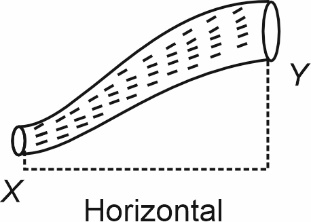
An ideal fluid is flowing in a non-uniform cross-sectional tube XY (as shown in the figure) from end X to end Y. If and are the kinetic energy per unit volume of the fluid at X and Y respectively, then the correct option is:
- 1
- 2
- 3
- 4
Show answer and solution
Correct: option 3,
By the equation of continuity is constant, so the fluid moves faster where the tube is narrower. The figure shows the tube narrow at X and wide at Y, so . Kinetic energy per unit volume is , hence .
Question 6NEET 2024 Re-exam, Q6
The escape velocity for earth is . A planet having 9 times mass that of earth and radius, 16 times that of earth, has the escape velocity of:
- 1
- 2
- 3
- 4
Show answer and solution
Correct: option 3,
Escape velocity is , so it varies as . For the planet, .
Question 7NEET 2024 Re-exam, Q7
An electron and an alpha particle are accelerated by the same potential difference. Let and denote the de-Broglie wavelengths of the electron and the alpha particle, respectively, then:
- 1
- 2
- 3
- 4
Show answer and solution
Correct: option 1,
A particle of charge and mass accelerated through a potential difference has . The alpha particle has twice the charge and about 7300 times the mass of the electron, so is far larger for it and its wavelength is far smaller. Hence (the ratio is about 120, not 4).
Question 8NEET 2024 Re-exam, Q8
An object moving along horizontal x-direction with kinetic energy 10 J is displaced through m by the force N. The kinetic energy of the object at the end of the displacement is
- 110 J
- 216 J
- 34 J
- 46 J
Show answer and solution
Correct: option 3, 4 J
Work done by the force is J. By the work-energy theorem the final kinetic energy is J.
Question 9NEET 2024 Re-exam, Q9
An object falls from a height of 10 m above the ground. After striking the ground it loses 50% of its kinetic energy. The height upto which the object can rebounce from the ground is:
- 17.5 m
- 210 m
- 32.5 m
- 45 m
Show answer and solution
Correct: option 4, 5 m
Just before impact the kinetic energy is . Half of it is lost, so the object leaves the ground with , which carries it to a height where , that is m.
Question 10NEET 2024 Re-exam, Q10
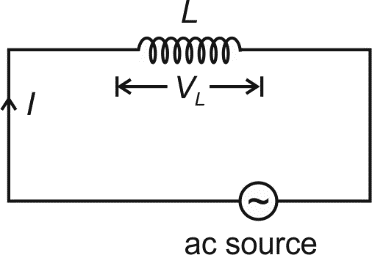
In the circuit shown below, the inductance is connected to an ac source. The current flowing in the circuit is . The voltage drop () across is
- 1
- 2
- 3
- 4
Show answer and solution
Correct: option 4,
The voltage across an inductor is . Differentiating gives : the amplitude is times the reactance , and the voltage leads the current by .
Question 11NEET 2024 Re-exam, Q11
A 12 pF capacitor is connected to a 50 V battery, the electrostatic energy stored in the capacitor in nJ is
- 115
- 27.5
- 30.3
- 4150
Show answer and solution
Correct: option 1, 15
J, which is 15 nJ.
Question 12NEET 2024 Re-exam, Q12
A uniform wire of diameter carries a current of 100 mA when the mean drift velocity of electrons in the wire is . For a wire of diameter of the same material to carry a current of 200 mA, the mean drift velocity of electrons in the wire is
- 1
- 2
- 3
- 4
Show answer and solution
Correct: option 2,
, so for the same material. Halving the diameter makes the area one quarter, and the current is doubled, so the drift velocity becomes times, that is .
Question 13NEET 2024 Re-exam, Q13
In an electrical circuit, the voltage is measured as volt and the current is measured as A. The value of the resistance is:
- 1
- 2
- 3
- 4
Show answer and solution
Correct: option 2,
. For a quotient the relative errors add: , so and .
Question 14NEET 2024 Re-exam, Q14
A step up transformer is connected to an ac mains supply of 220 V to operate at 11000 V, 88 watt. The current in the secondary circuit, ignoring the power loss in the transformer, is
- 18 mA
- 24 mA
- 30.4 A
- 44 A
Show answer and solution
Correct: option 1, 8 mA
The secondary delivers 88 W at 11000 V, so A = 8 mA. (0.4 A is the primary current, .)
Question 15NEET 2024 Re-exam, Q15
A particle is moving along x-axis with its position () varying with time () as . The ratio of its initial velocity to its initial acceleration, respectively, is:
- 1
- 2
- 3
- 4
Show answer and solution
Correct: option 4,
Velocity is and acceleration is . At these are and , so the ratio is .
Question 16NEET 2024 Re-exam, Q16
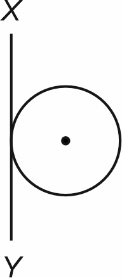
The radius of gyration of a solid sphere of mass 5 kg about XY is 5 m as shown in figure. The radius of the sphere m, then the value of is:
- 15
- 2
- 3
- 4
Show answer and solution
Correct: option 4,
XY is a tangent to the sphere, so by the parallel axis theorem and . With m, m. Comparing with gives .
Question 17NEET 2024 Re-exam, Q17
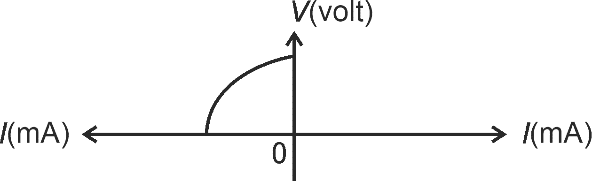
The I-V characteristics shown above are exhibited by a:
- 1Light emitting diode
- 2Zener diode
- 3Photodiode
- 4Solar cell
Show answer and solution
Correct: option 4, Solar cell
The curve does not pass through the origin: it meets the voltage axis at a finite value with no current (the open circuit voltage) and meets the current axis with no voltage (the short circuit current). A device that gives a voltage and a current of its own, with no external bias, is a solar cell. An LED, a Zener diode and a photodiode all need an applied bias.
Question 18NEET 2024 Re-exam, Q18
The magnetic moment and moment of inertia of a magnetic needle as shown are, respectively, and . If it completes 10 oscillations in 10 s, the magnitude of the magnetic field is:
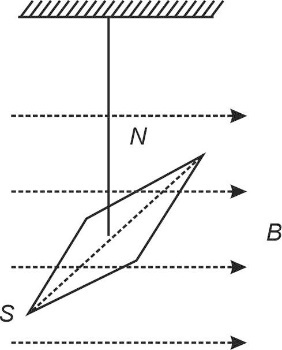
- 10.4 T
- 24 T
- 30.4 mT
- 44 mT
Show answer and solution
Correct: option 3, 0.4 mT
The period is s. For a needle oscillating in a uniform field, , so T = 0.4 mT.
Question 19NEET 2024 Re-exam, Q19
The capacitance of a capacitor with charge and a potential difference depends on:
- 1both and
- 2the geometry of the capacitor
- 3 only
- 4 only
Show answer and solution
Correct: option 2, the geometry of the capacitor
is only a way of measuring capacitance: doubling doubles and the ratio stays the same. Its value is fixed by the shape, size and spacing of the conductors (and the medium between them), for example for parallel plates.
Question 20NEET 2024 Re-exam, Q20
Given below are two statements:
Statement I: Image formation needs regular reflection and/or refraction.
Statement II: The variety in colour of objects we see around us is due to the constituent colours of the light incident on them.
In the light of the above statements, choose the most appropriate answer from the options given below:
- 1Statement I is correct but statement II is incorrect
- 2Statement I is incorrect but Statement II is correct
- 3Both Statement I and Statement II are correct
- 4Both Statement I and Statement II are incorrect
Show answer and solution
Correct: option 3, Both Statement I and Statement II are correct
Statement I is correct: an image forms only when rays from a point meet (or appear to meet) at a point again, which needs regular reflection or refraction, not diffuse scattering. Statement II is correct: an object shows the colours it reflects or transmits out of those present in the incident light, so the colours we see depend on the constituent colours of that light. Both statements are correct.
Question 21NEET 2024 Re-exam, Q21
A uniform metal wire of length has 10 Ω resistance. Now this wire is stretched to a length and then bent to form a perfect circle. The equivalent resistance across any arbitrary diameter of that circle is:
- 110 Ω
- 25 Ω
- 340 Ω
- 420 Ω
Show answer and solution
Correct: option 1, 10 Ω
Stretching keeps the volume fixed, so doubling the length halves the area and becomes four times: . Across a diameter the circle is two halves of each in parallel, giving .
Question 22NEET 2024 Re-exam, Q22
The spectral series which corresponds to the electronic transition from the levels to the level is
- 1Pfund series
- 2Brackett series
- 3Lyman series
- 4Balmer series
Show answer and solution
Correct: option 2, Brackett series
Hydrogen series are named by the lower level: Lyman ends on , Balmer on 2, Paschen on 3, Brackett on 4 and Pfund on 5. Transitions ending on form the Brackett series.
Question 23NEET 2024 Re-exam, Q23
Given below are two statements: One is labelled as Assertion A and the other is labelled as Reason R.
Assertion A: Houses made of concrete roofs overlaid with foam keep the room hotter during summer.
Reason R: The layer of foam insulation prohibits heat transfer, as it contains air pockets.
In the light of the above statements, choose the correct answer from the options given below.
- 1A is true but R is false.
- 2A is false but R is true.
- 3Both A and R are true and R is the correct explanation of A.
- 4Both A and R true but R is NOT the correct explanation of A.
Show answer and solution
Correct: option 2, A is false but R is true.
Foam holds trapped air, and air is a poor conductor of heat, so the foam layer cuts down the heat conducted through the roof: R is true. For that very reason the room stays cooler in summer, not hotter, so A is false.
Question 24NEET 2024 Re-exam, Q24
A particle executing simple harmonic motion with amplitude has the same potential and kinetic energies at the displacement
- 1
- 2
- 3
- 4
Show answer and solution
Correct: option 3,
Potential energy is and kinetic energy is . Setting them equal gives , so .
Question 25NEET 2024 Re-exam, Q25
Two slits in Young's double slit experiment are 1.5 mm apart and the screen is placed at a distance of 1 m from the slits. If the wavelength of light used is m then the fringe separation is
- 1 m
- 2 m
- 3 m
- 4 m
Show answer and solution
Correct: option 4, m
Fringe width is m.
Question 26NEET 2024 Re-exam, Q26
Water is used as a coolant in a nuclear reactor because of its
- 1high thermal expansion coefficient
- 2high specific heat capacity
- 3low density
- 4low boiling point
Show answer and solution
Correct: option 2, high specific heat capacity
A coolant must carry away a lot of heat without its own temperature rising much. Water has a very high specific heat capacity, so a given mass absorbs a large amount of heat for a small rise in temperature.
Question 27NEET 2024 Re-exam, Q27
The pitch of an error free screw gauge is 1 mm and there are 100 divisions on the circular scale. While measuring the diameter of a thick wire, the pitch scale reads 1 mm and 63rd division on the circular scale coincides with the reference line. The diameter of the wire is:
- 11.63 cm
- 20.163 cm
- 30.163 m
- 41.63 m
Show answer and solution
Correct: option 2, 0.163 cm
Least count = pitch / number of circular divisions = mm. Reading = mm = 0.163 cm.
Question 28NEET 2024 Re-exam, Q28
Let us consider two solenoids A and B, made from same magnetic material of relative permeability and equal area of cross-section. Length of A is twice that of B and the number of turns per unit length in A is half that of B. The ratio of self inductances of the two solenoids, is
- 11 : 2
- 22 : 1
- 38 : 1
- 41 : 8
Show answer and solution
Correct: option 1, 1 : 2
For a solenoid . The core and area are the same, so , that is 1 : 2.
Question 29NEET 2024 Re-exam, Q29
When the output of an OR gate is applied as input to a NOT gate, then the combination acts as a
- 1NAND gate
- 2NOR gate
- 3AND gate
- 4OR gate
Show answer and solution
Correct: option 2, NOR gate
The OR gate gives and the NOT gate inverts it to , which is the output of a NOR gate.
Question 30NEET 2024 Re-exam, Q30
Interference pattern can be observed due to superposition of the following waves:
A.
B.
C.
D.
Choose the correct answer from the options given below.
- 1B and C
- 2B and D
- 3A and C
- 4A and B
Show answer and solution
Correct: option 3, A and C
A steady interference pattern needs coherent waves: the same frequency and a constant phase difference. A and C both have angular frequency and differ by the fixed phase , so they interfere. B and D have frequencies and , different from the others and from each other.
Question 31NEET 2024 Re-exam, Q31
If is the work function of photosensitive material in eV and light of wavelength of numerical value metre, is incident on it with energy above its threshold value at an instant then the maximum kinetic energy of the photo-electron ejected by it at that instant (Take -Planck's constant, -velocity of light in free space) is (in SI units):
- 1
- 2
- 3
- 4
Show answer and solution
Correct: option 3,
The photon energy is (numerically, in joule). Einstein's equation gives .
Question 32NEET 2024 Re-exam, Q32
The electromagnetic radiation which has the smallest wavelength are
- 1X-rays
- 2Gamma rays
- 3Ultraviolet rays
- 4Microwaves
Show answer and solution
Correct: option 2, Gamma rays
In order of decreasing wavelength the spectrum runs radio waves, microwaves, infrared, visible, ultraviolet, X-rays, gamma rays. Gamma rays have the highest frequency and so the smallest wavelength.
Question 33NEET 2024 Re-exam, Q33
The equilibrium state of a thermodynamic system is described by
A. Pressure
B. Total heat
C. Temperature
D. Volume
E. Work done
Choose the most appropriate answer from the options given below.
- 1A, B and E only
- 2B, C and D only
- 3A, B and C only
- 4A, C and D only
Show answer and solution
Correct: option 4, A, C and D only
An equilibrium state is described by state variables, which depend only on the state and not on how it was reached: pressure, volume and temperature (A, C, D). Heat and work are energy in transit and depend on the path, so they do not describe a state.
Question 34NEET 2024 Re-exam, Q34
Some energy levels of a molecule are shown in the figure with their wavelengths of transitions. Then:
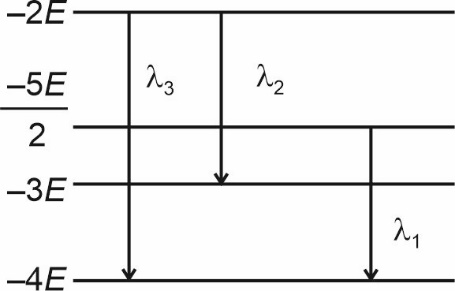
- 1,
- 2,
- 3,
- 4,
Show answer and solution
Correct: option 4, ,
The wavelength is . From the figure: is for , a gap of ; is for , a gap of ; is for , a gap of . So , , , which gives and .
Question 35NEET 2024 Re-exam, Q35
A box of mass 5 kg is pulled by a cord, up along a frictionless plane inclined at 30° with the horizontal. The tension in the cord is 30 N. The acceleration of the box is (Take )
- 1
- 2Zero
- 3
- 4
Show answer and solution
Correct: option 4,
Along the incline, . So , giving up the plane.
Question 36NEET 2024 Re-exam, Q36
If the ratio of relative permeability and relative permittivity of a uniform medium is 1 : 4. The ratio of the magnitudes of electric field intensity () to the magnetic field intensity () of an EM wave propagating in that medium is
:
- 1
- 2
- 3
- 4
Show answer and solution
Correct: option 3,
In a medium . The ratio is .
Question 37NEET 2024 Re-exam, Q37
The value of electric potential at a distance of 9 cm from the point charge C is
:
- 1 V
- 244.4 V
- 3 V
- 4 V
Show answer and solution
Correct: option 4, V
V.
Question 38NEET 2024 Re-exam, Q38
The displacement of a travelling wave where is time, is distance and is the wavelength, all in S.I. units. Then the frequency of the wave is:
- 1
- 2
- 3
- 4
Show answer and solution
Correct: option 4,
Comparing with , the angular frequency is . The frequency is (here is the wave speed).
Question 39NEET 2024 Re-exam, Q39
An object of mass 100 kg falls from point A to B as shown in figure. The change in its weight, corrected to the nearest integer is ( is the radius of the earth):
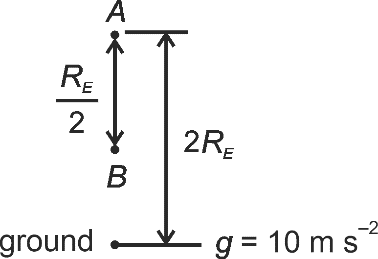
- 149 N
- 289 N
- 35 N
- 410 N
Show answer and solution
Correct: option 1, 49 N
Weight at a distance from the earth's centre is . A is above the ground, so and the weight is N. B is lower, so and the weight is N. The change is N.
Question 40NEET 2024 Re-exam, Q40
The potential energy of a particle moving along x-direction varies as . The dimensions of are:
- 1
- 2
- 3
- 4
Show answer and solution
Correct: option 3,
is added to , so . Then . So .
Question 41NEET 2024 Re-exam, Q41
The two-dimensional motion of a particle, described by is a/an:
A. parabolic path
B. elliptical path
C. periodic motion
D. simple harmonic motion
Choose the correct answer from the options given below:
- 1B, C and D only
- 2A, B and C only
- 3A, C and D only
- 4C and D only
Show answer and solution
Correct: option 4, C and D only
Here and , so : the path is a straight line, neither a parabola nor an ellipse. Along that line the displacement varies as , so , which is simple harmonic motion, and every SHM is periodic. Only C and D hold.
Question 42NEET 2024 Re-exam, Q42
A beam of unpolarized light of intensity is passed through a polaroid A, then through another polaroid B, oriented at 60º and finally through another polaroid C, oriented at 45º relative to B as shown. The intensity of emergent light is:
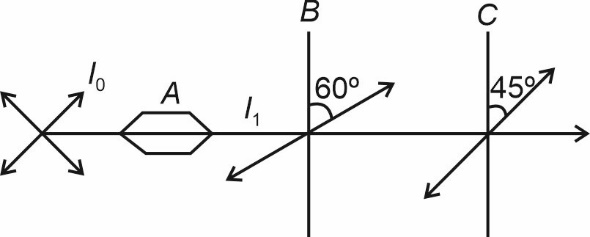
- 1
- 2
- 3
- 4
Show answer and solution
Correct: option 1,
The first polaroid passes half the unpolarized light: . By Malus's law B passes , and C passes .
Question 43NEET 2024 Re-exam, Q43
Select the correct statements among the following:
A. Slow neutrons can cause fission in than fast neutrons.
B. α-rays are Helium nuclei.
C. β-rays are fast moving electrons or positrons.
D. γ-rays are electromagnetic radiations of wavelengths larger than X-rays.
Choose the most appropriate answer from the options given below:
- 1A, B and C only
- 2A, B and D only
- 3A and B only
- 4C and D only
Show answer and solution
Correct: option 1, A, B and C only
A is correct: slow (thermal) neutrons are far more likely than fast ones to cause fission in uranium-235, which is why reactors use a moderator. B is correct: an alpha particle is a helium nucleus. C is correct: beta rays are fast electrons () or positrons (). D is wrong: gamma rays have shorter wavelengths than X-rays. So A, B and C only.
Question 44NEET 2024 Re-exam, Q44
Let , and be the angular speed of the second hand, minute hand and hour hand of a smoothly running analog clock, respectively. If , and are their respective angular distances in 1 minute then the factor which remains constant () is
- 1
- 2
- 3
- 4
Show answer and solution
Correct: option 1,
Each hand turns at a steady rate, so the angle it covers in a time is . With the same (1 minute) for all three hands, is the same for each: .
Question 45NEET 2024 Re-exam, Q45
The magnetic moment of an iron bar is . It is now bent in such a way that it forms an arc section of a circle subtending an angle of 60° at the centre. The magnetic moment of this arc section is
- 1
- 2
- 3
- 4
Show answer and solution
Correct: option 1,
Let the bar have pole strength and length , so . Bent into an arc of angle , its radius is , and the poles are now separated by the chord . The new moment is .
Question 46NEET 2024 Re-exam, Q46
The given circuit shows a uniform straight wire AB of 40 cm length fixed at both ends. In order to get zero reading in the galvanometer G, the free end of J is to be placed from B at:
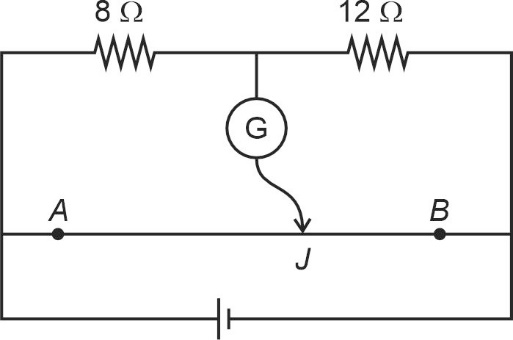
- 132 cm
- 28 cm
- 316 cm
- 424 cm
Show answer and solution
Correct: option 4, 24 cm
This is a balanced Wheatstone (metre bridge) arrangement: the galvanometer reads zero when , because the wire is uniform. With cm, cm and cm. So J is 24 cm from B.
Question 47NEET 2024 Re-exam, Q47
According to the law of equipartition of energy, the number of vibrational modes of a polyatomic gas of constant is ( where are the specific heat capacities of the gas at constant pressure and constant volume, respectively):
- 1
- 2
- 3
- 4
Show answer and solution
Correct: option 3,
A polyatomic molecule has 3 translational and 3 rotational degrees of freedom, and each vibrational mode counts twice (kinetic and potential), so and for vibrational modes. Then , which gives , so .
Question 48NEET 2024 Re-exam, Q48
The output for the inputs and of the given logic circuit is:
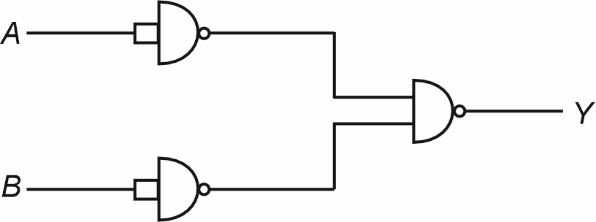
- 1
- 2
- 3
- 4
Show answer and solution
Correct: option 3,
Each of the first two NAND gates has its two inputs joined, so it works as a NOT gate and gives and . The third NAND gate gives , which by De Morgan's theorem is . The circuit is an OR gate.
Question 49NEET 2024 Re-exam, Q49
The amplitude of the charge oscillating in a circuit decreases exponentially as , where is the charge at s. The time at which charge amplitude decreases to is nearly:
[Given that , mH, ]
- 119.01 ms
- 211.09 ms
- 319.01 s
- 411.09 s
Show answer and solution
Correct: option 2, 11.09 ms
Setting gives , so s = 11.09 ms.
Question 50NEET 2024 Re-exam, Q50
The steady state current in the circuit shown below is:
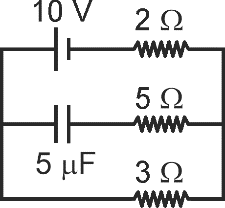
- 10.67 A
- 21.5 A
- 32 A
- 41 A
Show answer and solution
Correct: option 3, 2 A
In the steady state the capacitor is fully charged and carries no current, so the middle branch (5 μF with 5 Ω) can be ignored. The 10 V cell then drives current through the 2 Ω and 3 Ω resistors in series: A.
NEET 2024 Re-exam Chemistry questions
Question 51NEET 2024 Re-exam, Q51
The correct decreasing order of atomic radii (pm) of Li, Be, B and C is
- 1Be > Li > B > C
- 2Li > Be > B > C
- 3C > B > Be > Li
- 4Li > C > Be > B
Show answer and solution
Correct: option 2, Li > Be > B > C
All four elements are in the second period. Going left to right the nuclear charge rises while the electrons enter the same shell, so the atom shrinks steadily. The radii fall in the order Li (152 pm) > Be (111 pm) > B (88 pm) > C (77 pm).
Question 52NEET 2024 Re-exam, Q52
Following data is for a reaction between reactants A and B:
| Rate () | [A] | [B] |
|---|
| 0.1 M | 0.1 M |
| 0.2 M | 0.1 M |
| 0.2 M | 0.2 M |
The order of the reaction with respect to A and B, respectively, are
- 11, 0
- 20, 1
- 31, 2
- 42, 1
Show answer and solution
Correct: option 3, 1, 2
From the first to the second run [A] doubles at constant [B] and the rate doubles, so the order in A is 1. From the second to the third run [B] doubles at constant [A] and the rate becomes 4 times (), so the order in B is 2.
Question 53NEET 2024 Re-exam, Q53
Given below are two statements:
Statement I: Propene on treatment with diborane gives an addition product with the formula .
Statement II: Oxidation of with hydrogen peroxide in presence of NaOH gives propan-2-ol.
In the light of the above statements, choose the most appropriate answer from the options given below:
- 1Statement I is correct but Statement II is incorrect
- 2Statement I is incorrect but Statement II is correct
- 3Both Statement I and Statement II are correct
- 4Both Statement I and Statement II are incorrect
Show answer and solution
Correct: option 2, Statement I is incorrect but Statement II is correct
In hydroboration the boron atom adds to the less substituted (terminal) carbon of propene, so the product is tripropylborane, , not the isopropyl compound; Statement I is incorrect. Oxidation with alkaline replaces each C-B bond by C-OH on the same carbon, so the isopropyl borane named in Statement II would indeed give propan-2-ol; Statement II is correct.
Question 54NEET 2024 Re-exam, Q54
- 1Acidic potassium permanganate solution
- 2Acidic potassium dichromate solution
- 3Cold, dilute, aqueous solution of potassium permanganate
- 4Hot, concentrated solution of potassium permanganate
Show answer and solution
Correct: option 3, Cold, dilute, aqueous solution of potassium permanganate
Baeyer's reagent is a cold, dilute, aqueous (slightly alkaline) solution of . It converts an alkene to a vicinal diol and loses its purple colour, which is used as a test for unsaturation.
Question 55NEET 2024 Re-exam, Q55
Which of the following molecules has "NON ZERO" dipole moment value?
- 1
- 2HI
- 3
- 4
Show answer and solution
Correct: option 2, HI
(tetrahedral), (linear) and (trigonal planar) are symmetrical, so their bond dipoles cancel and the net dipole moment is zero. HI is a diatomic molecule of two different atoms, so its single bond dipole cannot cancel and the molecule is polar.
Question 56NEET 2024 Re-exam, Q56
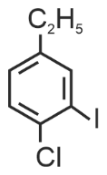
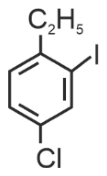
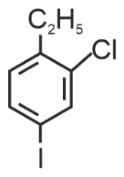
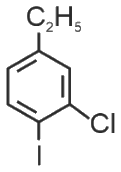
The major product X formed in the following reaction sequence is:
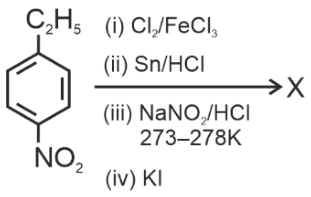
- 1
- 2
- 3
- 4
Show answer and solution
Correct: option 3
The starting compound is 1-ethyl-4-nitrobenzene. In chlorination the ethyl group directs ortho/para and the nitro group directs meta; both point to the position next to the ethyl group, so Cl enters ortho to . Sn/HCl reduces to , /HCl at 273-278 K turns it into the diazonium salt, and KI replaces the diazonium group by iodine. X therefore has Cl ortho to the ethyl group and I para to it, which is structure (3).
Question 57NEET 2024 Re-exam, Q57
Which indicator is used in the titration of sodium hydroxide against oxalic acid and what is the colour change at the end point?
- 1Phenolphthalein, pink to yellow
- 2Alkaline , colourless to pink
- 3Phenolphthalein, colourless to pink
- 4Methyl orange, yellow to pinkish red colour
Show answer and solution
Correct: option 3, Phenolphthalein, colourless to pink
Oxalic acid is a weak acid and NaOH a strong base, so the equivalence point lies on the basic side (pH above 7) and phenolphthalein is the suitable indicator. With the acid in the flask the solution is colourless and the first excess drop of NaOH turns it pink.
Question 58NEET 2024 Re-exam, Q58
Match List-I with List-II:
| List-I (Atom/Molecule) | List-II (Property) |
|---|
| A. Nitrogen atom | I. Paramagnetic |
| B. Fluorine molecule | II. Most reactive element in group 18 |
| C. Oxygen molecule | III. Element with highest ionisation enthalpy in group 15 |
| D. Xenon atom | IV. Strongest oxidising agent |
Identify the correct answer from the options given below:
- 1A-III, B-I, C-IV, D-II
- 2A-I, B-IV, C-III, D-II
- 3A-II, B-IV, C-I, D-III
- 4A-III, B-IV, C-I, D-II
Show answer and solution
Correct: option 4, A-III, B-IV, C-I, D-II
Nitrogen is the smallest atom of group 15 and has the highest ionisation enthalpy in the group (A-III). has the highest standard reduction potential and is the strongest oxidising agent (B-IV). has two unpaired electrons in its antibonding orbitals and is paramagnetic (C-I). Xenon, with the lowest ionisation enthalpy among the common noble gases, is the one that forms most compounds (D-II).
Question 59NEET 2024 Re-exam, Q59
From the following select the one which is not an example of corrosion.
- 1Rusting of iron object
- 2Production of hydrogen by electrolysis of water
- 3Tarnishing of silver
- 4Development of green coating on copper and bronze ornaments
Show answer and solution
Correct: option 2, Production of hydrogen by electrolysis of water
Corrosion is the slow, spontaneous oxidation of a metal by its surroundings: iron rusts, silver tarnishes to black , and copper and bronze grow a green basic carbonate layer. Electrolysis of water is a non-spontaneous reaction driven by an external current and no metal is eaten away, so it is not corrosion.
Question 60NEET 2024 Re-exam, Q60
Which of the following pairs of ions will have same spin only magnetic moment values within the pair?
A. ,
B. ,
C. ,
D. ,
Choose the correct answer from the options given below:
- 1C and D only
- 2A and D only
- 3A and B only
- 4B and C only
Show answer and solution
Correct: option 4, B and C only
The spin only moment BM depends only on the number of unpaired electrons . () has 0 and () has 2; () and () both have 4; () and () both have 1; () has 3 and () has 0. Only pairs B and C match.
Question 61NEET 2024 Re-exam, Q61
At a given temperature and pressure, the equilibrium constant values for the equilibria are given below:
,
,
The relation between and is:
- 1
- 2
- 3
- 4
Show answer and solution
Correct: option 4,
The second equation is the first one reversed and multiplied by one half. Reversing a reaction inverts the constant and halving the coefficients takes its square root, so .
Question 62NEET 2024 Re-exam, Q62
Arrange the following compounds in increasing order of their solubilities in chloroform:
NaCl, , cyclohexane,
- 1
- 2
- 3
- 4
Show answer and solution
Correct: option 3,
Like dissolves like, and chloroform is a weakly polar solvent that cannot easily break up an ionic lattice or a hydrogen-bonded liquid. Ionic NaCl is therefore the least soluble and non-polar cyclohexane the most. Between the two polar liquids, methanol molecules are held to each other by hydrogen bonds, while acetonitrile has only dipole-dipole attractions, so methanol comes below acetonitrile: .
Question 63NEET 2024 Re-exam, Q63
Identify the incorrect statement about .
- 1 possesses two different Cl – P – Cl bond angles
- 2All five P – Cl bonds are identical in length
- 3 exhibits hybridisation
- 4 consists of five P – Cl (sigma) bonds
Show answer and solution
Correct: option 2, All five P – Cl bonds are identical in length
is trigonal bipyramidal with hybridised phosphorus and five P-Cl sigma bonds. It has bond angles of 120° (between equatorial bonds) and 90° (axial to equatorial). The two axial bonds suffer more repulsion and are longer than the three equatorial bonds, so the statement that all five bonds are equal in length is the incorrect one.
Question 64NEET 2024 Re-exam, Q64
Choose the correct statement for the work done in the expansion and heat absorbed or released when 5 litres of an ideal gas at 10 atmospheric pressure isothermally expands into vacuum until volume is 15 litres:
- 1Both the heat and work done will be greater than zero
- 2Heat absorbed will be less than zero and work done will be positive
- 3Work done will be zero and heat will also be zero
- 4Work done will be greater than zero and heat will remain zero
Show answer and solution
Correct: option 3, Work done will be zero and heat will also be zero
Expansion into vacuum is free expansion: the external pressure is zero, so . For an ideal gas at constant temperature , and the first law then gives as well.
Question 65NEET 2024 Re-exam, Q65
The correct IUPAC name of the compound
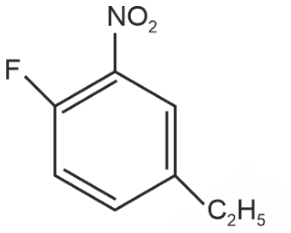
- 14-ethyl-1-fluoro-2-nitrobenzene
- 24-ethyl-1-fluoro-6-nitrobenzene
- 33-ethyl-6-fluoro-1-nitrobenzene
- 41-ethyl-4-fluoro-3-nitrobenzene
Show answer and solution
Correct: option 1, 4-ethyl-1-fluoro-2-nitrobenzene
The ring carries F and on neighbouring carbons and the ethyl group para to F. The ring is numbered to give the lowest set of locants. Starting at the carbon bearing F and going towards gives 1, 2, 4, which is lower than any other choice (for example 1, 3, 4 starting from ethyl, or 1, 2, 5 starting from nitro). The substituents are then listed alphabetically: 4-ethyl-1-fluoro-2-nitrobenzene.
Question 66NEET 2024 Re-exam, Q66
Which of the following set of ions act as oxidising agents?
- 1 and
- 2 and
- 3 and
- 4 and
Show answer and solution
Correct: option 1, and
The stable oxidation state of the lanthanoids is +3. Ions in the +4 state (, ) tend to gain an electron and return to +3, so they are oxidising agents. Ions in the +2 state (, ) lose an electron to reach +3 and are reducing agents, while and are already stable.
Question 67NEET 2024 Re-exam, Q67
Select the incorrect reaction among the following:
- 1
- 2
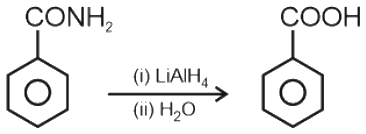
- 3
- 4
Show answer and solution
Correct: option 2
is a reducing agent: it reduces an amide to an amine, so benzamide gives benzylamine (), not benzoic acid. Reaction (2) is therefore wrong. The other three are correct: an acid chloride is hydrolysed by water to the acid, and primary alcohols are oxidised to carboxylic acids by alkaline or by in (Jones reagent).
Question 68NEET 2024 Re-exam, Q68
The UV-visible absorption bands in the spectra of lanthanoid ions are ‘X’, probably because of the excitation of electrons involving ‘Y’. The ‘X’ and ‘Y’, respectively, are:
- 1Broad and f orbitals
- 2Narrow and f orbitals
- 3Broad and d and f orbitals
- 4Narrow and d and f orbitals
Show answer and solution
Correct: option 2, Narrow and f orbitals
The colours of lanthanoid ions come from f-f transitions. The 4f orbitals lie deep inside the ion and are shielded from the surroundings by the outer 5s and 5p electrons, so the energy of the transition is hardly affected by the ligands and the absorption bands are narrow (sharp).
Question 69NEET 2024 Re-exam, Q69
Ethylene diaminetetraacetate ion is a/an:
- 1hexadentate ligand
- 2ambidentate ligand
- 3monodentate ligand
- 4bidentate ligand
Show answer and solution
Correct: option 1, hexadentate ligand
has six donor atoms, two nitrogen atoms and four carboxylate oxygen atoms, and can bind one metal ion through all six. It is a hexadentate ligand.
Question 70NEET 2024 Re-exam, Q70
The amount of glucose required to prepare 250 mL of aqueous solution is:
(Molar mass of glucose: )
- 12.25 g
- 24.5 g
- 30.44 g
- 41.125 g
Show answer and solution
Correct: option 1, 2.25 g
Moles needed = molarity × volume in litres mol. Mass g.
Question 71NEET 2024 Re-exam, Q71
Identify the incorrect statement from the following:
- 1The acidic strength of HX (X = F, Cl, Br and I) follows the order: HF > HCl > HBr > HI.
- 2Fluorine exhibits –1 oxidation state whereas other halogens exhibit +1, +3, +5 and +7 oxidation states also.
- 3The enthalpy of dissociation of is smaller than that of .
- 4Fluorine is stronger oxidising agent than chlorine.
Show answer and solution
Correct: option 1, The acidic strength of HX (X = F, Cl, Br and I) follows the order: HF > HCl > HBr > HI.
The H-X bond gets weaker down the group, so the acid strength rises: HF < HCl < HBr < HI. The order given in (1) is the reverse and is incorrect. The other statements are true: fluorine, the most electronegative element with no d orbitals, shows only –1; the F-F bond is weak because of lone pair repulsion in the small molecule; and is the strongest oxidising halogen.
Question 72NEET 2024 Re-exam, Q72
For the reaction in equilibrium
,
Reaction is favoured in forward direction by:
- 1use of catalyst
- 2decreasing concentration of
- 3low pressure, high temperature and high concentration of ammonia
- 4high pressure, low temperature and higher concentration of
Show answer and solution
Correct: option 4, high pressure, low temperature and higher concentration of
By Le Chatelier's principle, the forward reaction lowers the number of gas moles (4 to 2), so high pressure favours it; it is exothermic, so low temperature favours it; and adding a reactant such as pushes it forward. A catalyst speeds both directions equally and does not shift the equilibrium.
Question 73NEET 2024 Re-exam, Q73
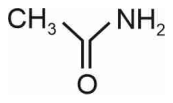
The major product D formed in the following reaction sequence is:
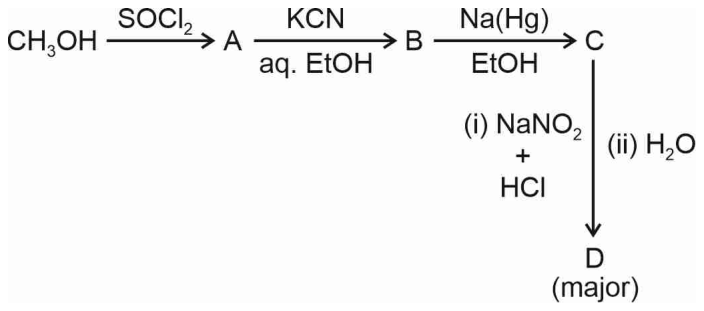
- 1
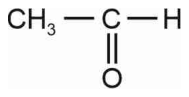
- 2
- 3
- 4
Show answer and solution
Correct: option 3,
converts methanol to (A). KCN replaces Cl by CN to give (B). Na(Hg) in ethanol reduces the nitrile to the primary amine (C). A primary aliphatic amine with + HCl forms an unstable diazonium salt that loses in water and gives the alcohol, so D is ethanol, .
Question 74NEET 2024 Re-exam, Q74
Match List-I with List-II:
| List-I (Block/group in periodic table) | List-II (Element) |
|---|
| A. Lanthanoid | I. Ce |
| B. d-block element | II. As |
| C. p-block element | III. Cs |
| D. s-block element | IV. Mn |
Choose the correct answer from the options given below:
- 1A-I, B-II, C-IV, D-III
- 2A-I, B-IV, C-III, D-II
- 3A-I, B-IV, C-II, D-III
- 4A-IV, B-I, C-II, D-III
Show answer and solution
Correct: option 3, A-I, B-IV, C-II, D-III
Cerium (Z = 58) is a lanthanoid (A-I). Manganese (Z = 25, ) is a d-block element (B-IV). Arsenic (group 15) is a p-block element (C-II). Caesium (group 1) is an s-block element (D-III).
Question 75NEET 2024 Re-exam, Q75
Which of the following is not an ambidentate ligand?
- 1
- 2
- 3
- 4
Show answer and solution
Correct: option 1,
An ambidentate ligand has two different donor atoms but uses only one of them at a time: binds through S or N, through N or O, and through C or N. Oxalate, , binds through two oxygen atoms at once; it is a bidentate (chelating) ligand, not an ambidentate one.
Question 76NEET 2024 Re-exam, Q76
The quantum numbers of four electrons are given below:
I.
II.
III.
IV.
The correct decreasing order of energy of these electrons is
- 1IV > II > III > I
- 2I > III > II > IV
- 3III > I > II > IV
- 4I > II > III > IV
Show answer and solution
Correct: option 2, I > III > II > IV
In a many-electron atom the energy of an orbital rises with , and for equal the orbital with the larger is higher. I is 4d (), II is 3d (5), III is 4p (5) and IV is 3p (4). Between II and III the 4p electron has the larger , so the order is I > III > II > IV.
Question 77NEET 2024 Re-exam, Q77
The major product C in the below mentioned reaction is:
- 1Propan-1-ol
- 2Propan-2-ol
- 3Propane
- 4Propyne
Show answer and solution
Correct: option 2, Propan-2-ol
Alcoholic KOH removes HBr from 1-bromopropane to give propene (A). HBr adds to propene by Markovnikov's rule, giving 2-bromopropane (B). Aqueous KOH replaces Br by OH, so C is propan-2-ol.
Question 78NEET 2024 Re-exam, Q78
The compound that does not undergo Friedel-Crafts alkylation reaction but gives a positive carbylamine test is:
- 1Aniline
- 2Pyridine
- 3N-methylaniline
- 4Triethylamine
Show answer and solution
Correct: option 1, Aniline
The carbylamine test (foul-smelling isocyanide with and alcoholic KOH) is given only by primary amines, and aniline is the only primary amine in the list. Aniline also fails the Friedel-Crafts reaction because its group, a Lewis base, forms a salt with the catalyst, which puts a positive charge on nitrogen and deactivates the ring.
Question 79NEET 2024 Re-exam, Q79
For an endothermic reaction:
(A) is negative.
(B) is positive.
(C) is negative.
(D) is positive.
Choose the correct answer from the options given, below:
- 1B and D
- 2C and D
- 3A and B
- 4A and C
Show answer and solution
Correct: option 1, B and D
An endothermic reaction absorbs heat from the surroundings, so the heat taken in at constant pressure, , is positive. Since , the enthalpy change is positive too. Statements B and D are correct.
Question 80NEET 2024 Re-exam, Q80
1.0 g of has same number of molecules as in:
- 114 g of
- 218 g of
- 316 g of CO
- 428 g of
Show answer and solution
Correct: option 1, 14 g of
Equal moles contain equal numbers of molecules. 1.0 g of is mol. 14 g of is mol, a match. The others are 18/18 = 1 mol of water, 16/28 = 0.57 mol of CO and 28/28 = 1 mol of .
Question 81NEET 2024 Re-exam, Q81
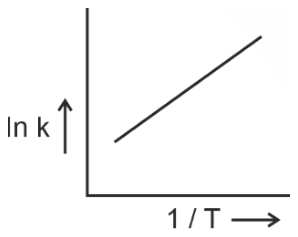
Which of the following plot represents the variation of versus in accordance with Arrhenius equation?
- 1
- 2
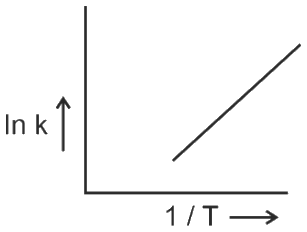
- 3
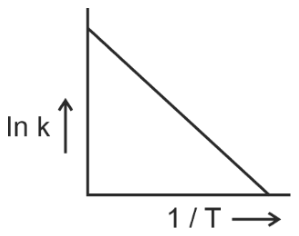
- 4
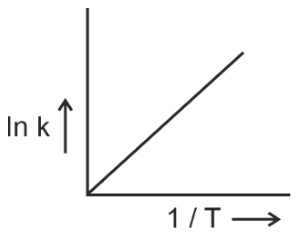
Show answer and solution
Correct: option 3
Taking logarithms of gives . This is a straight line with intercept and a negative slope , so falls linearly as increases. Only graph (3) slopes downward.
Question 82NEET 2024 Re-exam, Q82
A steam volatile organic compound which is immiscible with water has a boiling point of 250°C. During steam distillation, a mixture of this organic compound and water will boil:
- 1above 100°C but below 250°C
- 2above 250°C
- 3at 250°C
- 4close to but below 100°C
Show answer and solution
Correct: option 4, close to but below 100°C
Two immiscible liquids each exert their own vapour pressure, and the mixture boils when the sum equals atmospheric pressure. Because the organic liquid adds a little to the vapour pressure of water, this happens at a temperature slightly lower than 100°C, far below the compound's own boiling point.
Question 83NEET 2024 Re-exam, Q83
Given below are two statements:
Statement I: Glycogen is similar to amylose in its structure.
Statement II: Glycogen is found in yeast and fungi also.
In the light of the above statements, choose the correct answer from the options given below:
- 1Statement I is true but Statement II is false.
- 2Statement I is false but Statement II is true.
- 3Both Statement I and Statement II are true.
- 4Both Statement I and Statement II are false.
Show answer and solution
Correct: option 2, Statement I is false but Statement II is true.
Glycogen is a highly branched polymer of α-D-glucose with C1-C4 chains and C1-C6 branch points, so it resembles amylopectin (and is even more branched), not amylose, which is an unbranched chain. Statement I is false. Glycogen is the storage carbohydrate of animals and is also found in yeast and fungi, so Statement II is true.
Question 84NEET 2024 Re-exam, Q84
The oxidation states not shown by Mn in given reaction is:
A. +6
B. +2
C. +4
D. +7
E. +3
Choose the most appropriate answer from the options given below:
- 1D and E only
- 2B and D only
- 3A and B only
- 4B and E only
Show answer and solution
Correct: option 4, B and E only
With oxygen at –2, Mn is +6 in , +7 in and +4 in (manganate disproportionates in acid). The states +2 and +3 do not appear, so the answer is B and E.
Question 85NEET 2024 Re-exam, Q85
Given below are two statements:
Statement I: The Balmer spectral line for H atom with lowest energy is located at .
( = Rydberg constant)
Statement II: When the temperature of blackbody increases, the maxima of the curve (intensity of wavelength) shifts to shorter wavelength.
In the light of the above statements, choose the correct answer from the options given below:
- 1Statement I is true but Statement II is false
- 2Statement I is false but Statement II is true
- 3Both Statement I and Statement II are true
- 4Both Statement I and Statement II are false
Show answer and solution
Correct: option 3, Both Statement I and Statement II are true
The lowest-energy Balmer line is the jump from to : , so Statement I is true. For a black body the wavelength of maximum intensity is inversely proportional to temperature (Wien's law), so heating shifts the peak to shorter wavelength; Statement II is also true.
Question 86NEET 2024 Re-exam, Q86
Identify D in the following sequence of reactions:
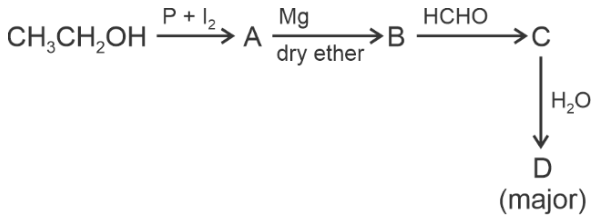
- 1n-propyl alcohol
- 2isopropyl alcohol
- 3propanal
- 4propionic acid
Show answer and solution
Correct: option 1, n-propyl alcohol
(which makes ) converts ethanol to ethyl iodide (A). Magnesium in dry ether gives the Grignard reagent (B). It adds to formaldehyde to give the alkoxide (C), and water hydrolyses this to the primary alcohol , n-propyl alcohol. Formaldehyde always gives a primary alcohol with one carbon more than the Grignard reagent.
Question 87NEET 2024 Re-exam, Q87
Identify the incorrect statement.
- 1 and as ligands can form - bond with transition metals
- 2The N – N single bond is as strong as the P – P single bond
- 3Nitrogen has unique ability to form - multiple bonds with nitrogen, carbon and oxygen
- 4Nitrogen cannot form - bond as other heavier elements of its group
Show answer and solution
Correct: option 2, The N – N single bond is as strong as the P – P single bond
The N-N single bond is weaker than the P-P single bond, because the short bond length brings the lone pairs on the two small nitrogen atoms close together and they repel strongly. Statement (2) is therefore incorrect. The others are true: nitrogen, being small, forms - multiple bonds but has no d orbitals for - bonding, while P and As in ligands such as and can use empty d orbitals for - back bonding with transition metals.
Question 88NEET 2024 Re-exam, Q88
Match List-I with List-II:
| List-I (Test/reagent) | List-II (Radical identified) |
|---|
| A. Lake Test | I. |
| B. Nessler’s Reagent | II. |
| C. Potassium sulphocyanide | III. |
| D. Brown Ring Test | IV. |
Choose the correct answer from the options given below:
- 1A-IV, B-II, C-III, D-I
- 2A-II, B-IV, C-III, D-I
- 3A-II, B-III, C-IV, D-I
- 4A-III, B-IV, C-II, D-I
Show answer and solution
Correct: option 4, A-III, B-IV, C-II, D-I
In the lake test adsorbs blue litmus and floats as a blue lake, identifying (A-III). Nessler's reagent ( in KOH) gives a brown precipitate with (B-IV). Potassium sulphocyanide (KSCN) gives a blood red colour with (C-II). The brown ring test with and concentrated detects (D-I).
Question 89NEET 2024 Re-exam, Q89
Match List-I with List-II:
| List-I Molecule | List-II Bond enthalpy () |
|---|
| A. HCl | I. 435.8 |
| B. | II. 498 |
| C. | III. 946.0 |
| D. | IV. 431.0 |
Choose the correct answer from the options given below:
- 1A-III, B-IV, C-I, D-II
- 2A-IV, B-I, C-III, D-II
- 3A-IV, B-III, C-II, D-I
- 4A-IV, B-III, C-I, D-II
Show answer and solution
Correct: option 4, A-IV, B-III, C-I, D-II
Bond enthalpy rises with bond order. has a triple bond and the largest value, 946.0 (B-III); has a double bond, 498 (D-II). Of the two single bonds, H-H is 435.8 (C-I) and H-Cl is slightly weaker at 431.0 (A-IV).
Question 90NEET 2024 Re-exam, Q90
The standard cell potential of the following cell is 0.32 V. Calculate the standard Gibbs energy change for the reaction:
(Given: 1 F = 96487 C)
- 1
- 2
- 3
- 4
Show answer and solution
Correct: option 1,
Two electrons are transferred, so J . The sign is negative because a cell with a positive potential runs spontaneously.
Question 91NEET 2024 Re-exam, Q91
Match List-I with List-II:
| List-I Solid salt treated with dil. | List-II Anion detected |
|---|
| A. effervescence of colourless gas | I. |
| B. gas with smell of rotten egg | II. |
| C. gas with pungent smell | III. |
| D. brown fumes | IV. |
Choose the correct answer from the options given below:
- 1A-II, B-III, C-IV, D-I
- 2A-IV, B-III, C-II, D-I
- 3A-I, B-II, C-III, D-IV
- 4A-II, B-III, C-I, D-IV
Show answer and solution
Correct: option 1, A-II, B-III, C-IV, D-I
With dilute a carbonate gives brisk effervescence of colourless, odourless (A-II); a sulphide gives , which smells of rotten eggs (B-III); a sulphite gives , which has a pungent smell of burning sulphur (C-IV); and a nitrite gives NO, which turns into brown fumes in air (D-I).
Question 92NEET 2024 Re-exam, Q92
The ratio of solubility of AgCl in 0.1 M KCl solution to the solubility of AgCl in water is:
(Given: Solubility product of AgCl = )
- 1
- 2
- 3
- 4
Show answer and solution
Correct: option 1,
In water M. In 0.1 M KCl the chloride concentration is fixed at about 0.1 M (common ion effect), so M. The ratio is .
Question 93NEET 2024 Re-exam, Q93
On complete combustion, 0.3 g of an organic compound gave 0.2 g of and 0.1 g of . The percentage composition of carbon and hydrogen in the compound, respectively is:
- 14.07% and 15.02%
- 218.18% and 3.70%
- 315.02% and 4.07%
- 43.70% and 18.18%
Show answer and solution
Correct: option 2, 18.18% and 3.70%
Carbon: 44 g of holds 12 g of C, so the percentage of carbon is . Hydrogen: 18 g of holds 2 g of H, so the percentage of hydrogen is .
Question 94NEET 2024 Re-exam, Q94
The following reaction method

is not suitable for the preparation of the corresponding haloarene products, due to high reactivity of halogen, when X is:
- 1F
- 2I
- 3Cl
- 4Br
Show answer and solution
Correct: option 1, F
Electrophilic halogenation of toluene with Fe in the dark works well for chlorine and bromine. Fluorine is so reactive that the reaction is violent and cannot be controlled, so fluoroarenes are not made this way. Iodination also fails by this simple method, but for the opposite reason: it is reversible and needs an oxidising agent. The halogen ruled out for high reactivity is F.
Question 95NEET 2024 Re-exam, Q95
The alkane that can be oxidized to the corresponding alcohol by as per the equation
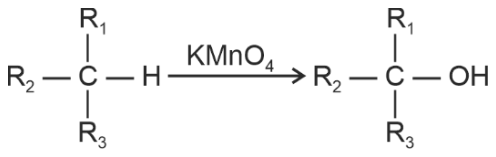
- 1
- 2
- 3
- 4
Show answer and solution
Correct: option 2,
Alkanes generally resist oxidation, but an alkane with a tertiary hydrogen is oxidised by to the corresponding tertiary alcohol; for example 2-methylpropane gives 2-methylpropan-2-ol. The C-H carbon is tertiary only when all three groups are alkyl, that is .
Question 96NEET 2024 Re-exam, Q96
For the following reaction at 300 K
the enthalpy change is +15 kJ, then the internal energy change is:
- 119988.4 J
- 2200 J
- 31999 J
- 41.9988 kJ
Show answer and solution
Correct: option 1, 19988.4 J
with . So J.
Question 97NEET 2024 Re-exam, Q97
Rate constants of a reaction at 500 K and 700 K are and , respectively; then, activation energy of the reaction is:
(Given: log 3.5 = 0.5441, R = )
- 1182310 J
- 218500 J
- 318219 J
- 418030 J
Show answer and solution
Correct: option 3, 18219 J
. Here and . So J. The nearest option is 18219 J; the last digits depend only on rounding.
Question 98NEET 2024 Re-exam, Q98
Mass of glucose () required to be dissolved to prepare one litre of its solution which is isotonic with solution of urea () is (Given: Molar mass in C: 12, H: 1, O: 16, N: 14)
- 155 g
- 215 g
- 330 g
- 445 g
Show answer and solution
Correct: option 4, 45 g
Isotonic solutions have the same osmotic pressure, and for non-electrolytes at the same temperature that means the same molar concentration. Urea (, molar mass 60) at 15 g per litre is M. Glucose (molar mass 180) must also be 0.25 M, so the mass needed in one litre is g.
Question 99NEET 2024 Re-exam, Q99
and structures have
A. Metal-Metal linkage
B. Terminal CO groups
C. Bridging CO groups
D. Metal in zero oxidation state
Choose the correct answer from the options given below
- 1Only A, B, C
- 2Only B, C, D
- 3Only A, C, D
- 4Only A, B, D
Show answer and solution
Correct: option 4, Only A, B, D
CO is a neutral ligand, so the metal is in the zero oxidation state in both carbonyls (D). is two units joined only by a Mn-Mn bond, with all ten CO groups terminal. has a Co-Co bond, six terminal CO groups and two bridging CO groups. Both therefore share a metal-metal bond (A) and terminal CO groups (B), but bridging CO groups (C) are present only in the cobalt compound.
Question 100NEET 2024 Re-exam, Q100
Methyl group attached to a positively charged carbon atom stabilizes the carbocation due to
- 1–I inductive effect
- 2electromeric effect
- 3hyperconjugation
- 4mesomeric effect
Show answer and solution
Correct: option 3, hyperconjugation
The electrons of a C-H sigma bond of the methyl group overlap with the empty p orbital of the neighbouring positively charged carbon. This delocalisation of sigma electrons, called hyperconjugation, spreads the positive charge and stabilises the carbocation. A methyl group has a +I effect, not –I, and has no lone pair or pi bond for a mesomeric effect.
NEET 2024 Re-exam Biology questions
Question 101NEET 2024 Re-exam, Q101
The regions with high level of species richness, high degree of endemism and a loss of 70% of the species and habitat are identified as:
- 1Natural Reserves
- 2Sacred Groves
- 3Biodiversity Hotspots
- 4Biogeographical Regions
Show answer and solution
Correct: option 3, Biodiversity Hotspots
Biodiversity hotspots are regions that hold very many species, a large share of which are endemic (found nowhere else), and that are losing habitat fast. These are exactly the criteria listed in the question, so the answer is biodiversity hotspots.
Question 102NEET 2024 Re-exam, Q102
Which of the following simple tissues are commonly found in the fruit walls of nuts and pulp of pear?
- 1Sclereids
- 2Fibres
- 3Parenchyma
- 4Collenchyma
Show answer and solution
Correct: option 1, Sclereids
Sclereids are short, dead sclerenchyma cells with very thick lignified walls. They make the shells of nuts hard and give the pulp of pear, guava and sapota its gritty feel. Fibres are long sclerenchyma cells, while parenchyma and collenchyma are living tissues with thinner walls.
Question 103NEET 2024 Re-exam, Q103
In a chromosome, there is a specific DNA sequence, responsible for initiating replication. It is called as:
- 1Recognition sequence
- 2Cloning site
- 3Restriction site
- 4ori site
Show answer and solution
Correct: option 4, ori site
Replication starts at a fixed sequence called the origin of replication, or ori. Any DNA joined to it is copied inside the host cell. A recognition or restriction site is where a restriction enzyme cuts, and a cloning site is where foreign DNA is inserted.
Question 104NEET 2024 Re-exam, Q104
Given below are two statements:
Statement I: When many alleles of a single gene govern a character, it is called polygenic inheritance.
Statement II: In Polygenic inheritance, the effect of each allele is additive.
In the light of the above statements, choose the correct answer from the options given below.
- 1Statement I is true but Statement II is false
- 2Statement I is false but Statement II is true
- 3Both Statement I and Statement II are true
- 4Both Statement I and Statement II are false
Show answer and solution
Correct: option 2, Statement I is false but Statement II is true
Statement I is false: many alleles of one gene is multiple allelism (as in ABO blood groups), whereas polygenic inheritance means a trait controlled by several different genes. Statement II is true: in polygenic inheritance each dominant allele adds a little to the phenotype, as in human skin colour.
Question 105NEET 2024 Re-exam, Q105
Which of the following are required for the light reaction of Photosynthesis?
A.
B.
C.
D. Chlorophyll
E. Light
Choose the correct answer from the options given below:
- 1A, C, D and E only
- 2C, D and E only
- 3A and B only
- 4A, C and E only
Show answer and solution
Correct: option 2, C, D and E only
In the light reaction chlorophyll absorbs light, and water is split to supply electrons, giving ATP, NADPH and oxygen. So water, chlorophyll and light are needed. is used only in the dark reaction, and is a product, not a requirement.
Question 106NEET 2024 Re-exam, Q106
Match List-I with List-II:
| List-I | List-II |
|---|
| A. Fleming | I. Disc shaped sacs or cisternae near cell nucleus |
| B. Robert Brown | II. Chromatin |
| C. George Palade | III. Ribosomes |
| D. Camillo Golgi | IV. Nucleus |
Choose the correct answer from the options given below:
- 1A-II, B-IV, C-III, D-I
- 2A-II, B-III, C-I, D-IV
- 3A-I, B-II, C-III, D-IV
- 4A-IV, B-II, C-III, D-I
Show answer and solution
Correct: option 1, A-II, B-IV, C-III, D-I
Flemming gave the name chromatin to the stained material of the nucleus (A-II). Robert Brown discovered the nucleus (B-IV). George Palade first saw ribosomes as dense particles under the electron microscope (C-III). Camillo Golgi found the stacked, disc-shaped cisternae near the nucleus now called the Golgi apparatus (D-I).
Question 107NEET 2024 Re-exam, Q107
Match List-I with List-II:
| List-I (Type of Inheritance) | List-II (Example) |
|---|
| A. Incomplete dominance | I. Blood groups in human |
| B. Co-dominance | II. Flower colour in Antirrhinum |
| C. Pleiotropy | III. Skin colour in human |
| D. Polygenic inheritance | IV. Phenylketonuria |
Choose the correct answer from the options given below:
- 1A-III, B-IV, C-II, D-I
- 2A-II, B-I, C-IV, D-III
- 3A-II, B-III, C-I, D-IV
- 4A-IV, B-I, C-III, D-II
Show answer and solution
Correct: option 2, A-II, B-I, C-IV, D-III
Flower colour in Antirrhinum (snapdragon) shows incomplete dominance: red crossed with white gives pink (A-II). ABO blood groups show co-dominance, since both alleles are expressed in group AB (B-I). Phenylketonuria is pleiotropy, one gene with several effects (C-IV). Human skin colour is controlled by several genes, which is polygenic inheritance (D-III).
Question 108NEET 2024 Re-exam, Q108
Which part of the ovule stores reserve food materials?
- 1Nucellus
- 2Integument
- 3Placenta
- 4Funicle
Show answer and solution
Correct: option 1, Nucellus
The nucellus is the mass of cells inside the integuments, and its cells hold plenty of reserve food. The integuments are protective coats, the funicle is the stalk of the ovule, and the placenta is the tissue of the ovary to which the ovule is attached.
Question 109NEET 2024 Re-exam, Q109
Which one of the following is not found in Gymnosperms?
- 1Sieve cells
- 2Albuminous cells
- 3Tracheids
- 4Vessels
Show answer and solution
Correct: option 4, Vessels
The xylem of gymnosperms has tracheids but no vessels; vessels are a feature of angiosperms. Gymnosperm phloem has sieve cells and albuminous cells in place of sieve tubes and companion cells. So vessels are the element not found.
Question 110NEET 2024 Re-exam, Q110
Which one of the following is not included under in-situ conservation?
- 1Wild-life sanctuary
- 2Botanical garden
- 3Biosphere reserve
- 4National park
Show answer and solution
Correct: option 2, Botanical garden
In-situ conservation protects species inside their natural habitat, as in national parks, wildlife sanctuaries and biosphere reserves. A botanical garden keeps plants outside their natural habitat, so it is ex-situ conservation.
Question 111NEET 2024 Re-exam, Q111
Given below are two statements:
Statement I: The Indian Government has set up GEAC, which will make decisions regarding the validity of GM research.
Statement II: Biopiracy is the term used to refer to the use of bio-resources by native people.
In the light of the above statements, choose the correct answer from the options given below:
- 1Statement I is true but Statement II is false
- 2Statement I is false but Statement II is true
- 3Both Statement I and Statement II are true
- 4Both Statement I and Statement II are false
Show answer and solution
Correct: option 1, Statement I is true but Statement II is false
Statement I is true: the Genetic Engineering Approval Committee (GEAC) decides on the validity of GM research and the safety of introducing GM organisms. Statement II is false: biopiracy is the use of bio-resources by multinational companies and other organisations without proper authorisation from, or payment to, the countries and people concerned.
Question 112NEET 2024 Re-exam, Q112
Pollen grains remain preserved as fossils due to the presence of:
- 1Epidermal layer
- 2Tapetum
- 3Exine layer
- 4Intine layer
Show answer and solution
Correct: option 3, Exine layer
The exine, the outer wall of the pollen grain, is made of sporopollenin. This is one of the most resistant organic materials known: it withstands high temperature, strong acids and alkalis, and no enzyme breaks it down. That is why pollen grains survive as fossils.
Question 113NEET 2024 Re-exam, Q113
Identify the incorrect pair:
- 1Sphenopsida – Adiantum
- 2Pteropsida – Dryopteris
- 3Psilopsida – Psilotum
- 4Lycopsida – Selaginella
Show answer and solution
Correct: option 1, Sphenopsida – Adiantum
Adiantum is a fern and belongs to Pteropsida, along with Dryopteris and Pteris. Sphenopsida is the class of Equisetum. The other three pairs are right: Psilotum is in Psilopsida and Selaginella is in Lycopsida.
Question 114NEET 2024 Re-exam, Q114
Which of the following is the correct match?
- 1Gymnosperms: Cedrus, Pinus, Sequoia
- 2Angiosperms: Wolffia, Eucalyptus, Sequoia
- 3Bryophytes: Polytrichum, Polysiphonia, Sphagnum
- 4Pteridophytes: Equisetum, Ginkgo, Adiantum
Show answer and solution
Correct: option 1, Gymnosperms: Cedrus, Pinus, Sequoia
Cedrus, Pinus and Sequoia are all gymnosperms, so option (1) is fully correct. In the others one member is out of place: Sequoia is a gymnosperm, not an angiosperm; Polysiphonia is a red alga, not a bryophyte; and Ginkgo is a gymnosperm, not a pteridophyte.
Question 115NEET 2024 Re-exam, Q115
Given below are two statements regarding RNA polymerase in prokaryotes.
Statement I: In prokaryotes, RNA polymerase is capable of catalysing the process of elongation during transcription.
Statement II: RNA polymerase associate transiently with 'Rho' factor to initiate transcription.
In the light of the above statements, choose the correct answer from the options given below:
- 1Statement I is true but Statement II is false
- 2Statement I is false but Statement II is true
- 3Both Statement I and Statement II are true
- 4Both Statement I and Statement II are false
Show answer and solution
Correct: option 1, Statement I is true but Statement II is false
Statement I is true: the bacterial RNA polymerase by itself can catalyse only elongation. Statement II is false: to initiate transcription the enzyme associates briefly with the sigma () factor. The rho () factor is the termination factor.
Question 116NEET 2024 Re-exam, Q116
Which of the following is a nucleotide?
- 1Uridine
- 2Adenylic acid
- 3Guanine
- 4Guanosine
Show answer and solution
Correct: option 2, Adenylic acid
A nucleotide is a nitrogen base joined to a sugar and a phosphate. Adenylic acid is adenine + ribose + phosphate, so it is a nucleotide. Guanine is only a base, while uridine and guanosine are nucleosides (base + sugar, no phosphate).
Question 117NEET 2024 Re-exam, Q117
Match List-I with List-II:
| List-I | List-II |
|---|
| A. Vexillary aestivation | I. Brinjal |
| B. Epipetalous stamens | II. Peach |
| C. Epiphyllous stamens | III. Pea |
| D. Perigynous flower | IV. Lily |
Choose the correct answer from the options given below:
- 1A-III, B-I, C-IV, D-II
- 2A-III, B-IV, C-I, D-II
- 3A-III, B-II, C-I, D-IV
- 4A-II, B-I, C-IV, D-III
Show answer and solution
Correct: option 1, A-III, B-I, C-IV, D-II
Vexillary (papilionaceous) aestivation is seen in pea (A-III). In brinjal the stamens are attached to the petals, that is, epipetalous (B-I). In lily the stamens are attached to the perianth, that is, epiphyllous (C-IV). Peach has a perigynous flower, with the ovary half inferior (D-II).
Question 118NEET 2024 Re-exam, Q118
Match List-I with List-II:
| List-I | List-II |
|---|
| A. China rose | I. Free central |
| B. Mustard | II. Basal |
| C. Primrose | III. Axile |
| D. Marigold | IV. Parietal |
Choose the correct answer from the options given below:
- 1A-IV, B-III, C-II, D-I
- 2A-II, B-III, C-IV, D-I
- 3A-III, B-IV, C-I, D-II
- 4A-III, B-IV, C-II, D-I
Show answer and solution
Correct: option 3, A-III, B-IV, C-I, D-II
These are types of placentation. China rose has axile placentation, with ovules on a central axis in a chambered ovary (A-III). Mustard has parietal placentation, with ovules on the inner wall of the ovary (B-IV). Primrose has free central placentation, with no septa (C-I). Marigold has basal placentation, a single ovule at the base of the ovary (D-II).
Question 119NEET 2024 Re-exam, Q119
Which of the following helps in maintenance of the pressure gradient in sieve tubes?
- 1Albuminous cells
- 2Sieve cells
- 3Phloem parenchyma
- 4Companion cells
Show answer and solution
Correct: option 4, Companion cells
Companion cells are specialised parenchyma cells joined to the sieve tube elements by pit fields. A mature sieve tube element has no nucleus, so the companion cell controls its working and helps keep up the pressure gradient that drives the flow of sap.
Question 120NEET 2024 Re-exam, Q120
- 1Membrane bound vesicular structure
- 2Chain of many ribosomes attached to a single mRNA
- 3Special structure formed by extension of plasma membrane
- 4Medium sized chromosome
Show answer and solution
Correct: option 3, Special structure formed by extension of plasma membrane
A mesosome is an infolding of the plasma membrane into the cell of a prokaryote, in the form of vesicles, tubules or lamellae. It helps in cell wall formation, DNA replication and respiration. A chain of ribosomes on one mRNA is a polysome, not a mesosome.
Question 121NEET 2024 Re-exam, Q121
Match List-I with List-II:
| List-I | List-II |
|---|
| A. Abscisic acid | I. Promotes female flowers in cucumber |
| B. Ethylene | II. Helps seeds to withstand desiccation |
| C. Gibberellin | III. Helps in nutrient mobilisation |
| D. Cytokinin | IV. Promotes bolting in beet, cabbage etc |
Choose the correct answer from the options given below:
- 1A-II, B-III, C-IV, D-I
- 2A-III, B-II, C-I, D-IV
- 3A-II, B-I, C-IV, D-III
- 4A-II, B-I, C-III, D-IV
Show answer and solution
Correct: option 3, A-II, B-I, C-IV, D-III
Abscisic acid brings about seed dormancy and helps seeds withstand desiccation (A-II). Ethylene promotes female flowers in cucumber (B-I). Gibberellins cause bolting, the sudden lengthening of internodes before flowering, in beet and cabbage (C-IV). Cytokinins promote nutrient mobilisation, which delays leaf senescence (D-III).
Question 122NEET 2024 Re-exam, Q122
Match List-I with List-II:
| List-I | List-II |
|---|
| A. Genetically engineered Human Insulin | I. Gene therapy |
| B. GM Cotton | II. E. coli |
| C. ADA Deficiency | III. Antigen-antibody interaction |
| D. ELISA | IV. Bacillus thuringiensis |
Choose the correct answer from the options given below:
- 1A-III, B-II, C-IV, D-I
- 2A-II, B-I, C-IV, D-III
- 3A-IV, B-III, C-I, D-II
- 4A-II, B-IV, C-I, D-III
Show answer and solution
Correct: option 4, A-II, B-IV, C-I, D-III
Human insulin was made by putting the genes for its A and B chains into E. coli (A-II). GM (Bt) cotton carries a toxin gene from Bacillus thuringiensis (B-IV). ADA deficiency was the first disorder treated by gene therapy (C-I). ELISA detects a disease through antigen-antibody interaction (D-III).
Question 123NEET 2024 Re-exam, Q123
Match List-I with List-II:
| List-I | List-II |
|---|
| A. ETS Complex I | I. NADH Dehydrogenase |
| B. ETS Complex II | II. Cytochrome |
| C. ETS Complex III | III. Cytochrome C oxidase |
| D. ETS Complex IV | IV. Succinate Dehydrogenase |
Choose the correct answer from the options given below:
- 1A-IV, B-I, C-III, D-II
- 2A-I, B-IV, C-II, D-III
- 3A-III, B-I, C-IV, D-II
- 4A-I, B-II, C-IV, D-III
Show answer and solution
Correct: option 2, A-I, B-IV, C-II, D-III
In the mitochondrial electron transport system, complex I is NADH dehydrogenase (A-I), complex II is succinate dehydrogenase (B-IV), complex III is the cytochrome complex (C-II), and complex IV is cytochrome c oxidase, which passes the electrons to oxygen (D-III).
Question 124NEET 2024 Re-exam, Q124
Cryopreservation technique is used for:
- 1Protection of environment
- 2Protection of Biodiversity hotspots
- 3Preservation of gametes in viable and fertile condition for a long period
- 4In-situ conservation
Show answer and solution
Correct: option 3, Preservation of gametes in viable and fertile condition for a long period
Cryopreservation means storing living material at a very low temperature, in liquid nitrogen at . Gametes of threatened species kept this way stay viable and fertile for a long time. It is an ex-situ method, not in-situ.
Question 125NEET 2024 Re-exam, Q125
Which of the following are correct about cellular respiration?
A. Cellular respiration is the breaking of C-C bonds of complex organic molecules by oxidation.
B. The entire cellular respiration takes place in Mitochondria.
C. Fermentation takes place under anaerobic condition in germinating seeds.
D. The fate of pyruvate formed during glycolysis depends on the type of organism also.
E. Water is formed during respiration as a result of accepting electrons and getting reduced.
Choose the correct answer from the options given below:
- 1A, C, D, E only
- 2A, B, E only
- 3A, B, C, E only
- 4B, C, D, E only
Show answer and solution
Correct: option 1, A, C, D, E only
B is wrong because glycolysis, the first stage of respiration, takes place in the cytoplasm, not in the mitochondria. The rest are correct: respiration breaks C-C bonds by oxidation (A); germinating seeds ferment when oxygen is lacking (C); what happens to pyruvate depends on the organism and on oxygen supply (D); and oxygen, the final electron acceptor, is reduced to water (E).
Question 126NEET 2024 Re-exam, Q126
Given below are two statements:
Statement I: In eukaryotes there are three RNA polymerases in the nucleus in addition to the RNA polymerase found in the organelles.
Statement II: All the three RNA polymerases in eukaryotic nucleus have different roles.
In the light of the above statements, choose the correct answer from the options given below:
- 1Statement I is correct but Statement II is incorrect
- 2Statement I is incorrect but Statement II is correct
- 3Both Statement I and Statement II are correct
- 4Both Statement I and Statement II are incorrect
Show answer and solution
Correct: option 3, Both Statement I and Statement II are correct
Both statements are correct. The eukaryotic nucleus has three RNA polymerases with a clear division of labour: RNA polymerase I makes rRNAs (28S, 18S and 5.8S), RNA polymerase II makes the precursor of mRNA (hnRNA), and RNA polymerase III makes tRNA, 5S rRNA and snRNAs. Mitochondria and chloroplasts have their own RNA polymerase.
Question 127NEET 2024 Re-exam, Q127
Match List-I with List-II:
| List-I | List-II |
|---|
| A. Histones | I. Loosely packed chromatin |
| B. Nucleosome | II. Densely packed Chromatin |
| C. Euchromatin | III. Positively charged basic proteins |
| D. Heterochromatin | IV. DNA wrapped around histone octamer |
Choose the correct answer from the options given below:
- 1A-IV, B-III, C-II, D-I
- 2A-III, B-I, C-IV, D-II
- 3A-II, B-III, C-IV, D-I
- 4A-III, B-IV, C-I, D-II
Show answer and solution
Correct: option 4, A-III, B-IV, C-I, D-II
Histones are positively charged basic proteins, rich in lysine and arginine (A-III). A nucleosome is DNA wrapped around an octamer of histones (B-IV). Euchromatin is loosely packed, lightly stained and active in transcription (C-I). Heterochromatin is densely packed, darkly stained and inactive (D-II).
Question 128NEET 2024 Re-exam, Q128
Given below are two statements:
Statement I: Failure of segregation of chromatids during cell cycle resulting in the gain or loss of whole set of chromosome in an organism is known as aneuploidy.
Statement II: Failure of cytokinesis after anaphase stage of cell division results in the gain or loss of a chromosome is called polyploidy.
In the light of the above statements, choose the correct answer from the options given below:
- 1Statement I is true but Statement II is false
- 2Statement I is false but Statement II is true
- 3Both Statement I and Statement II are true
- 4Both Statement I and Statement II are false
Show answer and solution
Correct: option 4, Both Statement I and Statement II are false
The two definitions have been swapped, so both are false. Aneuploidy is the gain or loss of one or a few chromosomes, caused by failure of chromatids to segregate. Polyploidy is the gain of a whole set of chromosomes, caused by failure of cytokinesis after telophase.
Question 129NEET 2024 Re-exam, Q129
Recombination between homologous chromosomes is completed by the end of
- 1Diakinesis
- 2Zygotene
- 3Diplotene
- 4Pachytene
Show answer and solution
Correct: option 4, Pachytene
Crossing over, the exchange of segments between non-sister chromatids of homologous chromosomes, takes place in pachytene of prophase I. Recombination is complete by the end of pachytene, and the chromosomes stay linked only at the points of crossing over. Zygotene is the stage of pairing, and chiasmata become visible in diplotene.
Question 130NEET 2024 Re-exam, Q130
Match List-I with List-II:
| List-I | List-II |
|---|
| A. Metacentric chromosome | I. Chromosome has a terminal centromere |
| B. Sub-metacentric chromosome | II. Middle centromere forming two equal arms of chromosome |
| C. Acrocentric chromosome | III. Centromere is slightly away from the middle of chromosome resulting into two unequal arms |
| D. Telocentric chromosome | IV. Centromere is situated close to its end forming one extremely short and one very long arm |
Choose the correct answer from the options given below:
- 1A-II, B-I, C-IV, D-III
- 2A-IV, B-I, C-II, D-III
- 3A-I, B-II, C-III, D-IV
- 4A-II, B-III, C-IV, D-I
Show answer and solution
Correct: option 4, A-II, B-III, C-IV, D-I
Chromosomes are named by the position of the centromere. Metacentric: in the middle, giving two equal arms (A-II). Sub-metacentric: slightly off the middle, giving one shorter and one longer arm (B-III). Acrocentric: close to one end, giving one very short and one very long arm (C-IV). Telocentric: at the tip (D-I).
Question 131NEET 2024 Re-exam, Q131
Ligases is a class of enzymes responsible for catalysing the linking together of two compounds.
Which of the following bonds is not catalysed by it?
- 1C – C
- 2P – O
- 3C – O
- 4C – N
Show answer and solution
Correct: option 1, C – C
The NCERT description of ligases says they join two compounds by forming C-O, C-S, C-N and P-O bonds. The C-C bond is not in that list, so by the textbook wording option (1) is the one asked for, and it is the keyed answer.
Question 132NEET 2024 Re-exam, Q132
F. Skoog observed that callus proliferated from the internodal segments of tobacco stem when auxins was supplied with one of the following except:
- 1Extract of Vascular tissues
- 2Coconut milk
- 3Abscisic acid
- 4Yeast Extract
Show answer and solution
Correct: option 3, Abscisic acid
Skoog and his co-workers found that the tobacco callus grew only when, besides auxin, the medium had extract of vascular tissue, yeast extract, coconut milk or DNA. All of these supply cytokinin-like substances that promote cell division. Abscisic acid is a growth inhibitor and was not one of them.
Question 133NEET 2024 Re-exam, Q133
Given below are some statements about plant growth regulators.
A. All GAs are acidic in nature.
B. Auxins are antagonists to GAs.
C. Zeatin was isolated from coconut milk.
D. Ethylene induces flowering in Mango.
E. Abscisic acid induces parthenocarpy.
Choose the correct set of statements from the option given below:
- 1A, C, D
- 2B, E
- 3A, B, C
- 4B, D, E
Show answer and solution
Correct: option 1, A, C, D
A is correct: all gibberellins are acidic (hence gibberellic acids). C is correct: zeatin was isolated from corn kernels and coconut milk. D is correct: ethylene induces flowering in mango. B is wrong because it is abscisic acid, not auxin, that acts against GAs. E is wrong because parthenocarpy is induced by auxins, not by abscisic acid.
Question 134NEET 2024 Re-exam, Q134
Identify the incorrect statement related to gel electrophoresis.
- 1Separated DNA fragments can be directly seen under UV radiation
- 2Separated DNA can be extracted from gel piece
- 3Fragment of DNA moves toward anode
- 4Sieving effect of agarose gel helps in separation of DNA fragments
Show answer and solution
Correct: option 1, Separated DNA fragments can be directly seen under UV radiation
DNA fragments in a gel cannot be seen directly, even under UV. They must first be stained with ethidium bromide, after which they show as bright orange bands in UV light. The other statements are true: DNA is negatively charged and moves to the anode, the gel sieves fragments by size, and the bands can be cut out and the DNA extracted (elution).
Question 135NEET 2024 Re-exam, Q135
Which of the following examples show monocarpellary, unilocular ovary with many ovules?
A. Sesbania
B. Brinjal
C. Indigofera
D. Tobacco
E. Asparagus
Choose the correct answer from the options given below:
- 1B and E only
- 2C, D and E only
- 3A, B and D only
- 4A and C only
Show answer and solution
Correct: option 4, A and C only
A monocarpellary, unilocular ovary with many ovules is the gynoecium of the family Fabaceae. Sesbania and Indigofera belong to Fabaceae. Brinjal and tobacco (Solanaceae) have a bicarpellary, bilocular ovary, and Asparagus (Liliaceae) has a tricarpellary, trilocular ovary.
Question 136NEET 2024 Re-exam, Q136
Given below are two statements:
Statement I: In the lac operon, the z gene codes for beta-galactosidase which is primarily responsible for the hydrolysis of lactose into galactose and glucose.
Statement II: In addition to lactose, glucose or galactose can also induce lac operon.
In the light of the above statements, choose the correct answer from the options given below:
- 1Statement I is true but Statement II is false
- 2Statement I is false but Statement II is true
- 3Both Statement I and Statement II are true
- 4Both Statement I and Statement II are false
Show answer and solution
Correct: option 1, Statement I is true but Statement II is false
Statement I is true: the z gene codes for beta-galactosidase, which splits lactose into galactose and glucose. Statement II is false: the inducer of the lac operon is lactose (allolactose). Glucose and galactose cannot act as inducers.
Question 137NEET 2024 Re-exam, Q137
The part marked as 'x' in the given figure is
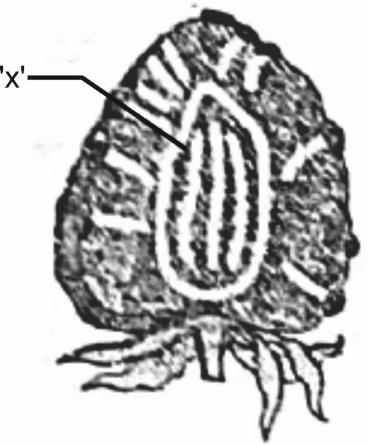
- 1Endosperm
- 2Thalamus
- 3Endocarp
- 4Mesocarp
Show answer and solution
Correct: option 2, Thalamus
The figure shows a false fruit, in which the thalamus, not just the ovary, takes part in forming the fruit, as in strawberry and apple. The fleshy part marked 'x' is the thalamus.
Question 138NEET 2024 Re-exam, Q138
Given below are two statements:
Statement I: In a dicotyledonous leaf, the adaxial epidermis generally bears more stomata than the abaxial epidermis.
Statement II: In a dicotyledonous leaf, the adaxially placed palisade parenchyma is made up of elongated cells, which are arranged vertically and parallel to each other.
In the light of the above statements, choose the correct answer from the options given below:
- 1Statement I is true but Statement II is false
- 2Statement I is false but Statement II is true
- 3Both Statement I and Statement II are true
- 4Both Statement I and Statement II are false
Show answer and solution
Correct: option 2, Statement I is false but Statement II is true
Statement I is false: in a dicot (dorsiventral) leaf the lower, abaxial epidermis generally has more stomata than the upper, adaxial one, which may have none. Statement II is true: the palisade parenchyma lies on the adaxial side and is made of elongated cells standing vertically, parallel to each other.
Question 139NEET 2024 Re-exam, Q139
Which of the following are not fatty acids?
A. Glutamic acid
B. Arachidonic acid
C. Palmitic acid
D. Lecithin
E. Aspartic acid
Choose the correct answer from the options given below:
- 1C, D and E only
- 2A and B only
- 3A, D and E only
- 4B and C only
Show answer and solution
Correct: option 3, A, D and E only
Palmitic acid (16 carbons) and arachidonic acid (20 carbons) are fatty acids. Glutamic acid and aspartic acid are acidic amino acids, and lecithin is a phospholipid. So A, D and E are not fatty acids.
Question 140NEET 2024 Re-exam, Q140
Consider the pyramid of energy of an ecosystem given below:
If is equivalent to 1000 J, what is the value at
- 1 J
- 2 J
- 310,000 J
- 410,00,000 J
Show answer and solution
Correct: option 4, 10,00,000 J
By the 10 per cent law only about one-tenth of the energy passes from one trophic level to the next, so each lower level holds ten times more. Going down three steps from to : J.
Question 141NEET 2024 Re-exam, Q141
Which one of the following products diffuses out of the chloroplast during photosynthesis?
- 1ADP
- 2NADPH
- 3
- 4ATP
Show answer and solution
Correct: option 3,
The light reaction gives ATP, NADPH and . ATP and NADPH are used up at once in the stroma to fix , and the ADP formed is used again. Oxygen is not needed there, so it diffuses out of the chloroplast.
Question 142NEET 2024 Re-exam, Q142
Recombinant DNA molecule can be created normally by cutting the vector DNA and source DNA respectively with:
- 1Hind II, Hind II
- 2Hind II, Alu I
- 3Hind II, EcoR I
- 4Hind II, BamHI
Show answer and solution
Correct: option 1, Hind II, Hind II
The vector and the source DNA are normally cut with the same restriction enzyme. The cut ends of the two are then of the same kind and can be joined by DNA ligase. Only option (1) uses the same enzyme for both.
Question 143NEET 2024 Re-exam, Q143
Which one of the following is not a limitation of ecological pyramids?
- 1Saprophytes are not given any place of ecological pyramids
- 2It assumes a simple food chain, that almost never exists in nature
- 3It accommodates a food web
- 4It does not take into account the same species belonging to two or more trophic levels
Show answer and solution
Correct: option 3, It accommodates a food web
The limitations of ecological pyramids are that they assume a simple food chain, ignore a species that feeds at two or more trophic levels, give no place to saprophytes, and do not accommodate a food web. Option (3) says the opposite of a real limitation, so it is the one that is not a limitation.
Question 144NEET 2024 Re-exam, Q144
The Bt toxin in genetically engineered Bt cotton kills the pest by:
- 1Creating pores in the midgut
- 2Damaging the respiratory system
- 3Degenerating the nervous system
- 4Altering the pH of body fluids
Show answer and solution
Correct: option 1, Creating pores in the midgut
The inactive Bt protoxin is activated by the alkaline pH of the insect's gut. The active toxin binds to the surface of the midgut epithelial cells and makes pores in them. The cells swell and burst, and the insect dies.
Question 145NEET 2024 Re-exam, Q145
Match List-I with List-II:
| List-I (Organisms) | List-II (Mode of Nutrition) |
|---|
| A. Euglenoid | I. Parasitic |
| B. Dinoflagellate | II. Saprophytic |
| C. Slime mould | III. Photosynthetic |
| D. Plasmodium | IV. Switching between photosynthetic and heterotrophic mode |
Choose the correct answer from the options given below:
- 1A-III, B-IV, C-II, D-I
- 2A-IV, B-II, C-I, D-III
- 3A-IV, B-III, C-II, D-I
- 4A-IV, B-II, C-III, D-I
Show answer and solution
Correct: option 3, A-IV, B-III, C-II, D-I
Euglenoids are photosynthetic in light but feed on other organisms like heterotrophs when kept without light (A-IV). Dinoflagellates are mostly photosynthetic (B-III). Slime moulds are saprophytic protists (C-II). Plasmodium, the malarial parasite, is parasitic (D-I).
Question 146NEET 2024 Re-exam, Q146
Which of the following graphs depicts the effect of substrate concentration on velocity of enzyme catalysed reaction?
- 1
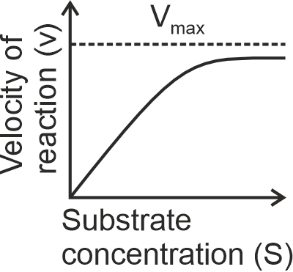
- 2
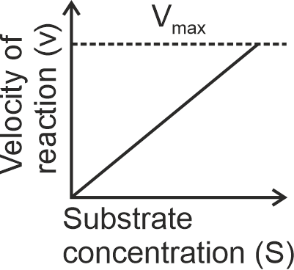
- 3
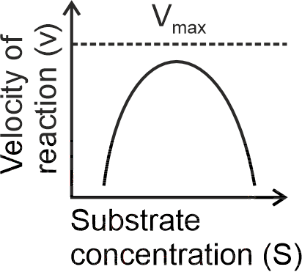
- 4
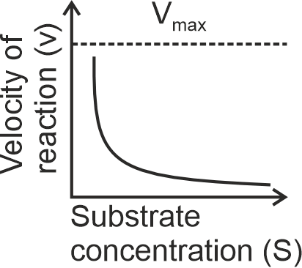
Show answer and solution
Correct: option 1
As substrate concentration rises, the velocity of the reaction rises at first and then levels off at a maximum, , which is not exceeded because all the enzyme molecules are then occupied by substrate. Only graph (1) shows a curve that climbs and then flattens just below .
Question 147NEET 2024 Re-exam, Q147
When will the population density increase, under special conditions?
When the number of:
- 1Deaths exceeds number of births and also number of emigrants equals number of immigrants.
- 2Births plus number of immigrants equals number of deaths plus number of emigrants.
- 3Births plus number of emigrants is more than the number of deaths plus number of immigrants.
- 4Births plus number of immigrants is more than the sum of number of deaths and number of emigrants.
Show answer and solution
Correct: option 4, Births plus number of immigrants is more than the sum of number of deaths and number of emigrants.
Population density changes as . Births (B) and immigration (I) add to the population, while deaths (D) and emigration (E) take away from it. The density rises only when is more than .
Question 148NEET 2024 Re-exam, Q148
When a tall pea plant with round seeds was selfed, it produced the progeny of:
(a) Tall plants with round seeds and
(b) Tall plants with wrinkled seeds.
Identify the genotype of the parent plant.
- 1TtRr
- 2TtRR
- 3TTRR
- 4TTRr
Show answer and solution
Correct: option 4, TTRr
All the progeny are tall, so the parent is pure for height: TT. Seed shape separates into round and wrinkled, so the parent is heterozygous for it: Rr. The genotype is TTRr, which on selfing gives tall round and tall wrinkled plants in a 3:1 ratio.
Question 149NEET 2024 Re-exam, Q149
Match List-I with List-II:
| List-I | List-II |
|---|
| A. Biodiversity hotspot | I. Khasi and Jaintia hills in Meghalaya |
| B. Sacred groves | II. World Summit on Sustainable |
| C. Johannesburg South Africa | III. Parthenium |
| D. Alien species invasion | IV. Western Ghats |
Choose the correct answer from the options given below:
- 1A-IV, B-I, C-II, D-III
- 2A-II, B-III, C-IV, D-I
- 3A-I, B-IV, C-III, D-II
- 4A-III, B-I, C-II, D-IV
Show answer and solution
Correct: option 1, A-IV, B-I, C-II, D-III
The Western Ghats (with Sri Lanka) are a biodiversity hotspot (A-IV). Sacred groves are found in the Khasi and Jaintia hills of Meghalaya (B-I). The World Summit on Sustainable Development was held in Johannesburg, South Africa, in 2002 (C-II). Parthenium (carrot grass) is an invasive alien species (D-III).
Question 150NEET 2024 Re-exam, Q150
Observe the given figure. Identify the different stages labelled with alphabets by selecting the correct option.
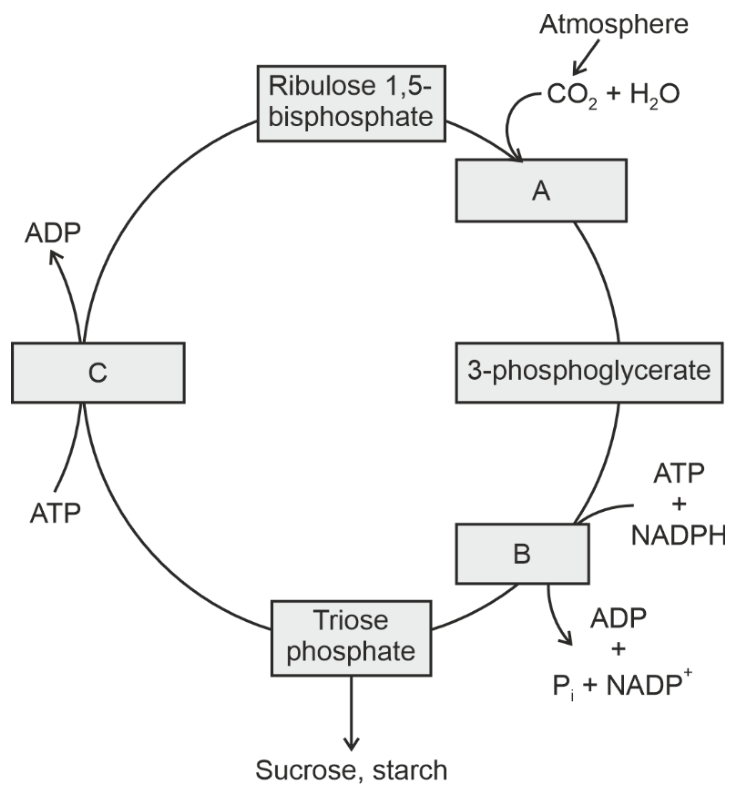
- 1A-Carboxylation, B-Regeneration, C-Reduction
- 2A-Reduction, B-Decarboxylation, C-Regeneration
- 3A-Carboxylation, B-Reduction, C-Regeneration
- 4A-Reduction, B-Carboxylation, C-Regeneration
Show answer and solution
Correct: option 3, A-Carboxylation, B-Reduction, C-Regeneration
The figure is the Calvin cycle. At A, joins ribulose 1,5-bisphosphate to give 3-phosphoglycerate: carboxylation. At B, ATP and NADPH are used to turn 3-phosphoglycerate into triose phosphate: reduction. At C, ATP is used to form ribulose 1,5-bisphosphate again: regeneration.
Question 151NEET 2024 Re-exam, Q151
Match List-I with List-II:
| List I | List II |
|---|
| A. Predator | I. Ophrys |
| B. Mutualism | II. Pisaster |
| C. Parasitism | III. Female wasp and fig |
| D. Sexual deceit | IV. Plasmodium |
Choose the correct answer from the options given below:
- 1A-III, B-II, C-I, D-IV
- 2A-IV, B-I, C-II, D-III
- 3A-II, B-II, C-I, D-IV
- 4A-II, B-III, C-IV, D-I
Show answer and solution
Correct: option 4, A-II, B-III, C-IV, D-I
Pisaster is a starfish that preys on the invertebrates of the rocky intertidal zone, so it is the predator. The fig and its female wasp pollinator depend on each other, which is mutualism. Plasmodium lives inside its host as a parasite. The orchid Ophrys gets pollinated by sexual deceit, because one of its petals looks like a female bee. So A-II, B-III, C-IV, D-I.
Question 152NEET 2024 Re-exam, Q152
Match List-I with List-II:
| List I - Location of Joint | List II - Type of Joint |
|---|
| A. Joint between humerus and pectoral girdle | I. Gliding joint |
| B. Knee joint | II. Ball and Socket joint |
| C. Joint between atlas and axis | III. Hinge joint |
| D. Joint between carpals | IV. Pivot joint |
Choose the correct answer from the options given below:
- 1A-II, B-III, C-IV, D-I
- 2A-III, B-II, C-I, D-IV
- 3A-I, B-IV, C-III, D-II
- 4A-II, B-I, C-III, D-IV
Show answer and solution
Correct: option 1, A-II, B-III, C-IV, D-I
The head of the humerus fits into the glenoid cavity of the pectoral girdle as a ball and socket joint. The knee bends in one plane only, so it is a hinge joint. The atlas turns on the axis, which is a pivot joint. The carpals slide over one another, which is a gliding joint. So A-II, B-III, C-IV, D-I.
Question 153NEET 2024 Re-exam, Q153
Following are the steps involved in action of toxin in Bt. Cotton
A. The inactive toxin converted into active form due to alkaline pH of gut of insect.
B. Bacillus thuringiensis produce crystals with toxic insecticidal proteins.
C. The alkaline pH solubilises the crystals.
D. The activated toxin binds to the surface of midgut cells, creates pores and causes death of the insect.
E. The toxin proteins exist as inactive protoxins in bacteria.
Choose the correct sequence of steps from the options given below:
- 1
- 2
- 3
- 4
Show answer and solution
Correct: option 4,
Bacillus thuringiensis makes protein crystals (B) in which the toxin is present as an inactive protoxin (E). When an insect eats it, the alkaline pH of the gut dissolves the crystals (C) and the protoxin becomes the active toxin (A). The active toxin then binds to the midgut cells, makes pores, and the insect dies (D). The order is B, E, C, A, D.
Question 154NEET 2024 Re-exam, Q154
Match List-I with List-II:
| List I | List II |
|---|
| A. Gene pool | I. Stable within a generation |
| B. Genetic drift | II. Change in gene frequency by chance |
| C. Gene flow | III. Transfer of genes into or out of population |
| D. Gene frequency | IV. Total number of genes and their alleles |
Choose the correct answer from the options given below:
- 1A-III, B-II, C-I, D-IV
- 2A-IV, B-II, C-III, D-I
- 3A-I, B-II, C-III, D-IV
- 4A-II, B-III, C-IV, D-I
Show answer and solution
Correct: option 2, A-IV, B-II, C-III, D-I
The gene pool is the total of all genes and their alleles in a population. Genetic drift is a change in gene frequency that happens by chance. Gene flow is the movement of genes into or out of a population through migration. By the Hardy-Weinberg principle the gene frequencies stay stable from generation to generation when nothing disturbs them. So A-IV, B-II, C-III, D-I.
Question 155NEET 2024 Re-exam, Q155
Which evolutionary phenomenon is depicted by the sketch given in figure?
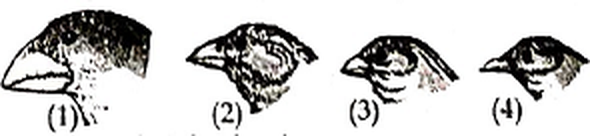
- 1Artificial selection
- 2Genetic drift
- 3Convergent evolution
- 4Adaptive radiation
Show answer and solution
Correct: option 4, Adaptive radiation
The sketch shows the beaks of Darwin's finches from the Galapagos Islands. From one seed-eating ancestor many forms with different beaks arose, each suited to a different food. Evolution of several species from one starting point, spreading into different habitats, is adaptive radiation.
Question 156NEET 2024 Re-exam, Q156
A person with blood group can receive the blood transfusion from which of the following types?
A.
B.
C.
D.
E.
Choose the correct answer from the options given below:
- 1D and E only
- 2D only
- 3A and B only
- 4C and D only
Show answer and solution
Correct: option 4, C and D only
A person of group A has anti-B antibodies in the plasma, so blood that carries the B antigen (groups B and AB) cannot be given. An Rh-negative person must also not receive Rh-positive blood, because it would lead to anti-Rh antibodies. That leaves A Rh-negative (the same group) and O Rh-negative (no A, B or Rh antigen), which are C and D.
Question 157NEET 2024 Re-exam, Q157
Enzymes that catalyse the removal of groups from substrates by mechanisms other than hydrolysis leaving double bonds, are known as:
- 1Transferases
- 2Oxidoreductases
- 3Dehydrogenases
- 4Lyases
Show answer and solution
Correct: option 4, Lyases
Lyases remove a group from a substrate without using water and leave a double bond behind. Transferases move a group from one substrate to another, and oxidoreductases (which include dehydrogenases) carry out oxidation and reduction between two substrates.
Question 158NEET 2024 Re-exam, Q158
Match List-I with List-II.
| List-I - Event | List-II - Stage of Prophase-I (Meiosis-I) |
|---|
| A. Chiasmata formation | I. Pachytene |
| B. Crossing over | II. Diakinesis |
| C. Synaptonemal complex formation | III. Diplotene |
| D. Terminalisation of chiasmata | IV. Zygotene |
Choose the correct answer from the options given below:
- 1A-III, B-I, C-IV, D-II
- 2A-II, B-I, C-III, D-IV
- 3A-III, B-I, C-II, D-IV
- 4A-II, B-III, C-IV, D-I
Show answer and solution
Correct: option 1, A-III, B-I, C-IV, D-II
In zygotene the homologous chromosomes pair and the synaptonemal complex forms. Crossing over between non-sister chromatids takes place in pachytene. In diplotene the complex dissolves and the homologues stay joined only at the X-shaped chiasmata. In diakinesis the chiasmata are terminalised. So A-III, B-I, C-IV, D-II.
Question 159NEET 2024 Re-exam, Q159
Match List-I with List-II.
| List-I | List-II |
|---|
| A. Primary structure of protein | I. Human haemoglobin |
| B. Secondary structure of protein | II. Disulphide bonds |
| C. Tertiary structure of protein | III. Polypeptide chain |
| D. Quaternary structure of protein | IV. Alpha helix and sheet |
Choose the correct answer from the options given below:
- 1A-III, B-IV, C-II, D-I
- 2A-III, B-II, C-I, D-IV
- 3A-I, B-III, C-II, D-IV
- 4A-IV, B-III, C-II, D-I
Show answer and solution
Correct: option 1, A-III, B-IV, C-II, D-I
The primary structure is the order of amino acids in the polypeptide chain. The secondary structure is the local folding into an alpha helix or a beta sheet. The tertiary structure is the three-dimensional folding of the whole chain, held by bonds such as disulphide bonds. The quaternary structure is the arrangement of more than one chain, as in human haemoglobin with its four subunits. So A-III, B-IV, C-II, D-I.
Question 160NEET 2024 Re-exam, Q160
Match List-I with List-II.
| List-I | List-II |
|---|
| A. Epinephrine | I. Hyperglycemia |
| B. Thyroxine | II. Smooth muscle contraction |
| C. Oxytocin | III. Basal metabolic rate |
| D. Glucagon | IV. Emergency hormone |
Choose the correct answer from the options given below:
- 1A-II, B-I, C-IV, D-III
- 2A-III, B-II, C-I, D-IV
- 3A-IV, B-III, C-II, D-I
- 4A-I, B-IV, C-III, D-II
Show answer and solution
Correct: option 3, A-IV, B-III, C-II, D-I
Epinephrine (adrenaline) is released in stress and is called the emergency hormone. Thyroxine controls the basal metabolic rate. Oxytocin makes smooth muscle contract, in the uterus at childbirth and in the mammary gland for milk ejection. Glucagon raises the blood glucose level, which is hyperglycemia. So A-IV, B-III, C-II, D-I.
Question 161NEET 2024 Re-exam, Q161
Which of the following statements is correct about the type of junction and their role in our body?
- 1Adhering junctions facilitate the cells to communicate with each other.
- 2Tight junctions help to stop substances from leaking across a tissue.
- 3Tight junctions help to perform cementing to keep neighbouring cells together.
- 4Gap junctions help to create gap between the cells and tissues.
Show answer and solution
Correct: option 2, Tight junctions help to stop substances from leaking across a tissue.
Tight junctions seal neighbouring cells so that substances cannot leak across the tissue. Cementing neighbouring cells together is the work of adhering junctions, and communication between cells is the work of gap junctions, which connect the cytoplasm of adjoining cells. Only statement (2) gives the right role.
Question 162NEET 2024 Re-exam, Q162
Select the restriction endonuclease enzymes whose restriction sites are present for the tetracycline resistance () gene in the pBR322 cloning vector.
- 1Bam HI and Sal I
- 2Sal I and Pst I
- 3Pst I and Pvu I
- 4Pvu I and Bam HI
Show answer and solution
Correct: option 1, Bam HI and Sal I
In pBR322 the sites for BamH I and Sal I lie inside the tetracycline resistance gene. The sites for Pst I and Pvu I lie inside the ampicillin resistance gene. So the pair for the tetracycline resistance gene is BamH I and Sal I.
Question 163NEET 2024 Re-exam, Q163
Match List-I with List-II.
| List-I | List-II |
|---|
| A. Chondrichthyes | I. Clarias |
| B. Cyclostomata | II. Carcharodon |
| C. Osteichthyes | III. Myxine |
| D. Amphibia | IV. Ichthyophis |
Choose the correct answer from the options given below:
- 1A-II, B-IV, C-I, D-III
- 2A-I, B-III, C-II, D-IV
- 3A-II, B-III, C-I, D-IV
- 4A-I, B-II, C-III, D-IV
Show answer and solution
Correct: option 3, A-II, B-III, C-I, D-IV
Carcharodon, the great white shark, is a cartilaginous fish (Chondrichthyes). Myxine, the hagfish, is a jawless cyclostome. Clarias, the magur, is a bony fish (Osteichthyes). Ichthyophis is a limbless amphibian. So A-II, B-III, C-I, D-IV.
Question 164NEET 2024 Re-exam, Q164
Given below are two statements: One is labelled as Assertion A and the other is labelled as Reason R.
Assertion A: During menstrual cycle, the ovulation takes place approximately on 14th day.
Reason R: Rapid secretion of LH in the middle of menstrual cycle induces rupture of Graafian follicle and thereby the release of ovum.
In the light of the above statements, choose the most appropriate answer from the options given below.
- 1A is correct but R is not correct.
- 2A is not correct but R is correct.
- 3Both A and R are correct and R is the correct explanation of A.
- 4Both A and R are correct but R is NOT the correct explanation of A.
Show answer and solution
Correct: option 3, Both A and R are correct and R is the correct explanation of A.
In a 28-day cycle ovulation happens at about the 14th day. It happens then because LH rises sharply in the middle of the cycle (the LH surge), and this makes the Graafian follicle rupture and release the ovum. Both statements are correct and R is the cause of A.
Question 165NEET 2024 Re-exam, Q165
Match List-I with List-II with respect to convergent evolution:
| List-I | List-II |
|---|
| A. Lemur | I. Flying phalanger |
| B. Bobcat | II. Numbat |
| C. Anteater | III. Spotted cuscus |
| D. Flying squirrels | IV. Tasmanian tiger cat |
Choose the correct answer from the options given below:
- 1A-III, B-IV, C-II, D-I
- 2A-III, B-II, C-IV, D-I
- 3A-IV, B-III, C-II, D-I
- 4A-IV, B-II, C-III, D-I
Show answer and solution
Correct: option 1, A-III, B-IV, C-II, D-I
Each placental mammal has an Australian marsupial that looks like it and lives in a similar way. The lemur matches the spotted cuscus, the bobcat matches the Tasmanian tiger cat, the anteater matches the numbat (the marsupial anteater) and the flying squirrel matches the flying phalanger. So A-III, B-IV, C-II, D-I.
Question 166NEET 2024 Re-exam, Q166
Match List-I with List-II.
| List-I | List-II |
|---|
| A. Cells are metabolically active and proliferate | I. phase |
| B. DNA replication takes place | II. phase |
| C. Proteins are synthesised | III. phase |
| D. Quiescent stage with metabolically active cells | IV. S phase |
Choose the correct answer from the options given below:
- 1A-IV, B-II, C-III, D-I
- 2A-I, B-III, C-IV, D-II
- 3A-I, B-I, C-III, D-IV
- 4A-II, B-IV, C-I, D-III
Show answer and solution
Correct: option 4, A-II, B-IV, C-I, D-III
DNA replicates in the S phase, and the quiescent stage in which cells stay metabolically active but do not divide is , so B-IV and D-III. Of the two that remain, the phase is when the cell is metabolically active and grows, and the phase is when proteins are synthesised in preparation for mitosis. So A-II, B-IV, C-I, D-III.
Question 167NEET 2024 Re-exam, Q167
Match List-I with List-II.
| List-I | List-II |
|---|
| A. Migratory flamingoes and resident fish in South American lakes | I. Interference competition |
| B. Abingdon tortoise became extinct after introduction of goats in their habitat | II. Competitive release |
| C. Chathamalus expands its distributional range in the absence of Balanus | III. Resource Partitioning |
| D. Five closely related species of Warblers feeding in different locations on same tree | IV. Interspecific competition |
Choose the correct answer from the options given below:
- 1A-I, B-IV, C-III, D-II
- 2A-IV, B-I, C-II, D-III
- 3A-III, B-I, C-II, D-IV
- 4A-II, B-IV, C-III, D-I
Show answer and solution
Correct: option 2, A-IV, B-I, C-II, D-III
Flamingoes and fish are unrelated species that compete for the same zooplankton, an example of interspecific competition. A species that widens its range when its competitor is removed, as Chathamalus does without Balanus, shows competitive release. MacArthur's warblers avoid competition by feeding in different parts of the same tree, which is resource partitioning. That leaves the Abingdon tortoise, driven out by the goats, for interference competition. So A-IV, B-I, C-II, D-III.
Question 168NEET 2024 Re-exam, Q168
Match List-I with List-II relating to microbes and their products:
| List-I (Microbes) | List-II (Products) |
|---|
| A. Streptococcus | I. Citric acid |
| B. Trichoderma polysporum | II. Clot buster |
| C. Monascus purpureus | III. Cyclosporin A |
| D. Aspergillus niger | IV. Statins |
Choose the correct answer from the options given below:
- 1A-II, B-III, C-IV, D-I
- 2A-I, B-II, C-III, D-IV
- 3A-I, B-III, C-II, D-IV
- 4A-I, B-IV, C-II, D-III
Show answer and solution
Correct: option 1, A-II, B-III, C-IV, D-I
Streptococcus gives streptokinase, the clot buster used after a heart attack. The fungus Trichoderma polysporum gives cyclosporin A, which suppresses the immune system in transplant patients. The yeast Monascus purpureus gives statins, which lower blood cholesterol. The fungus Aspergillus niger gives citric acid. So A-II, B-III, C-IV, D-I.
Question 169NEET 2024 Re-exam, Q169
Match List-I with List-II.
| List-I | List-II |
|---|
| A. Particles | I. Chromosomes |
| B. Histones | II. Cilia |
| C. Axoneme | III. Golgi apparatus |
| D. Cisternae | IV. Mitochondria |
Choose the correct answer from the options given below:
- 1A-II, B-I, C-IV, D-III
- 2A-IV, B-I, C-II, D-III
- 3A-IV, B-I, C-III, D-II
- 4A-IV, B-III, C-I, D-II
Show answer and solution
Correct: option 2, A-IV, B-I, C-II, D-III
particles are the ATP synthase heads on the inner membrane of mitochondria. Histones are the basic proteins around which the DNA of chromosomes is wound. The axoneme is the core of microtubules in a cilium or flagellum. Cisternae are the flat stacked sacs of the Golgi apparatus. So A-IV, B-I, C-II, D-III.
Question 170NEET 2024 Re-exam, Q170
Match List-I with List-II relating to examples of various kind of IUDs and barrier:
| List-I | List-II |
|---|
| A. Copper releasing IUD | I. Vaults |
| B. Non-medicated IUD | II. Multiload 375 |
| C. Contraceptive barrier | III. LNG-20 |
| D. Hormone releasing IUD | IV. Lippes loop |
Choose the correct answer from the options given below:
- 1A-II, B-IV, C-III, D-I
- 2A-IV, B-III, C-I, D-II
- 3A-II, B-I, C-III, D-IV
- 4A-II, B-IV, C-I, D-III
Show answer and solution
Correct: option 4, A-II, B-IV, C-I, D-III
Multiload 375 is a copper releasing IUD (like CuT and Cu7). Lippes loop is a non-medicated IUD. Vaults, like diaphragms and cervical caps, are rubber barriers placed over the cervix. LNG-20 is a hormone releasing IUD (like Progestasert). So A-II, B-IV, C-I, D-III.
Question 171NEET 2024 Re-exam, Q171
Given below are two statements:
Statement I: Antibiotics are chemicals produced by microbes that kill other microbes.
Statement II: Antibodies are chemicals formed in body that eliminate microbes.
In the light of the above statements, choose the most appropriate answer from the options given below.
- 1Statement I is correct but Statement II is incorrect
- 2Statement I is incorrect but Statement II is correct
- 3Both Statement I and Statement II are correct
- 4Both Statement I and Statement II are incorrect
Show answer and solution
Correct: option 3, Both Statement I and Statement II are correct
Antibiotics are chemical substances made by some microbes that kill or slow the growth of other, disease-causing microbes; penicillin from Penicillium is the classic case. Antibodies are proteins made by the B-lymphocytes of the body in response to pathogens, and they help to remove them. Both statements are correct.
Question 172NEET 2024 Re-exam, Q172
Arrange the following parts in human Mammary gland, traversing the route of milk ejection.
A. Mammary duct
B. Lactiferous duct
C. Mammary alveolus
D. Ampulla
E. Mammary tubule
Choose the correct answer from the options given below:
- 1
- 2
- 3
- 4
Show answer and solution
Correct: option 3,
Milk is secreted by the cells of the alveoli and stored in their cavities. The alveoli open into mammary tubules, the tubules of each lobe join to form a mammary duct, several mammary ducts join to form a wider mammary ampulla, and the ampulla is connected to the lactiferous duct through which milk is sucked out. The order is C, E, A, D, B.
Question 173NEET 2024 Re-exam, Q173
Which of the following are correct about EcoR1?
A. Cut the DNA with blunt end
B. Cut the DNA with sticky end
C. Recognise a specific palindromic sequence
D. Cut the DNA between the base G and A when encounters the DNA sequence ‘GAATTC’
E. Exonuclease
Choose the correct answer from the options given below:
- 1B, C, E only
- 2A, D, E only
- 3A, C, D only
- 4B, C, D only
Show answer and solution
Correct: option 4, B, C, D only
EcoRI is a restriction endonuclease: it cuts inside the DNA, not from the ends, so E is wrong. It recognises the palindromic sequence GAATTC (C) and cuts each strand between G and A (D). Because the two cuts are a little away from the centre of the palindrome, overhanging single-stranded sticky ends are left (B), not blunt ends. So B, C and D are correct.
Question 174NEET 2024 Re-exam, Q174
Which of the following is/are present in female cockroach?
A. Collateral gland
B. Mushroom gland
C. Spermatheca
D. Anal style
E. Phallic gland
Choose the most appropriate answer from the options given below:
- 1B and D only
- 2B and E only
- 3A only
- 4A and C only
Show answer and solution
Correct: option 4, A and C only
The female cockroach has collateral glands and a pair of spermathecae, which open into the genital chamber. The mushroom gland, the anal styles and the phallic gland belong to the male. So only A and C are found in the female.
Question 175NEET 2024 Re-exam, Q175
Match List-I with List-II:
| List I | List II |
|---|
| A. Malignant tumors | I. Destroy tumors |
| B. MALT | II. AIDS |
| C. NACO | III. Metastasis |
| D. -Interferons | IV. Lymphoid tissue |
Choose the correct answer from the options given below:
- 1A-III, B-IV, C-II, D-I
- 2A-IV, B-III, C-II, D-I
- 3A-III, B-IV, C-I, D-II
- 4A-III, B-I, C-IV, D-II
Show answer and solution
Correct: option 1, A-III, B-IV, C-II, D-I
Malignant tumours spread to distant sites, a property called metastasis. MALT is the mucosa-associated lymphoid tissue. NACO, the National AIDS Control Organisation, works on AIDS. Alpha-interferons are biological response modifiers that activate the immune system and help to destroy tumours. So A-III, B-IV, C-II, D-I.
Question 176NEET 2024 Re-exam, Q176
Open Circulatory system is present in:
- 1Palaemon, Nereis, Balanoglossus
- 2Hirudinaria, Bombyx, Salpa
- 3Anopheles, Limax, Limulus
- 4Pheretima, Musca, Pila
Show answer and solution
Correct: option 3, Anopheles, Limax, Limulus
An open circulatory system is found in arthropods and in most molluscs. Anopheles and Limulus are arthropods and Limax (the slug) is a mollusc, so all three in option (3) have it. Every other option includes an annelid (Nereis, Hirudinaria, Pheretima), and annelids have a closed circulatory system.
Question 177NEET 2024 Re-exam, Q177
In which of the following connective tissues, the cells secrete fibres of collagen or elastin?
A. Cartilage
B. Bone
C. Adipose tissue
D. Blood
E. Areolar tissue
Choose the most appropriate answer from the options given below:
- 1D, C, D and E only
- 2A, D, C and E only
- 3B, C and D only
- 4A, C and D only
Show answer and solution
Correct: option 2, A, D, C and E only
In every connective tissue except blood the cells secrete fibres of the structural proteins collagen or elastin. Cartilage, bone, adipose tissue and areolar tissue therefore qualify, and blood, whose matrix is the fibre-free plasma, does not. The four tissues are A, B, C and E. The keyed option (2) is the one meant for this set, but the available copy of the paper prints the letter D in place of B in options (1) and (2), so option (2) reads "A, D, C and E only".
Question 178NEET 2024 Re-exam, Q178
Which of the following pairs is an incorrect match?
- 1Annelids and arthropods-Bilateral symmetry
- 2Sponges-Acoelomates
- 3Coelenterates and Ctenophores-Radial symmetry
- 4Platyhelminthes-Diploblastic organisation
Show answer and solution
Correct: option 4, Platyhelminthes-Diploblastic organisation
Platyhelminthes (flatworms) are triploblastic: their body develops from three germ layers. Diploblastic animals are the coelenterates and ctenophores. The other pairs are right: annelids and arthropods are bilaterally symmetrical, sponges have no coelom, and coelenterates and ctenophores are radially symmetrical.
Question 179NEET 2024 Re-exam, Q179
Match List-I with List-II:
| List-I | List-II |
|---|
| A. Residual Volume | I. Maximum volume of air that can be breathed in after forced expiration |
| B. Vital Capacity | II. Volume of air inspired or expired during normal respiration |
| C. Expiratory Capacity | III. Volume of air remaining in lungs after forcible expiration |
| D. Tidal Volume | IV. Total volume of air expired after normal inspiration |
Choose the correct answer from the options given below:
- 1A-IV, B-III, C-II, D-I
- 2A-II, B-IV, C-I, D-III
- 3A-III, B-I, C-IV, D-II
- 4A-I, B-II, C-III, D-IV
Show answer and solution
Correct: option 3, A-III, B-I, C-IV, D-II
Residual volume is the air left in the lungs even after the most forcible expiration. Vital capacity is the maximum air a person can breathe in after a forced expiration. Expiratory capacity is the total air that can be expired after a normal inspiration (tidal volume plus expiratory reserve volume). Tidal volume is the air inspired or expired in one normal breath. So A-III, B-I, C-IV, D-II.
Question 180NEET 2024 Re-exam, Q180
Match List-I with List-II:
| List-I | List-II |
|---|
| A. Living Fossil | I. Elongated canine teeth |
| B. Connecting Link | II. Vermiform appendix |
| C. Vestigial Organ | III. Echidna |
| D. Atavism | IV. Latimeria |
Choose the correct answer from the options given below:
- 1A-IV, B-III, C-II, D-I
- 2A-IV, B-II, C-III, D-I
- 3A-IV, B-III, C-I, D-II
- 4A-III, B-IV, C-I, D-II
Show answer and solution
Correct: option 1, A-IV, B-III, C-II, D-I
Latimeria, the coelacanth, was thought to be extinct and has changed little over a very long time, so it is a living fossil. Echidna is an egg-laying mammal, a connecting link between reptiles and mammals. The vermiform appendix is a vestigial organ in humans. Atavism is the reappearance of an ancestral character, such as long canine teeth. So A-IV, B-III, C-II, D-I.
Question 181NEET 2024 Re-exam, Q181
Match List-I with List-II
| List-I | List-II |
|---|
| A. Schwann cells | I. Neurotransmitter |
| B. Synaptic knob | II. Cerebral cortex |
| C. Bipolar neurons | III. Myelin sheath |
| D. Multipolar neurons | IV. Retina |
Choose the correct answer from the options given below:
- 1A-III, B-I, C-IV, D-II
- 2A-I, B-IV, C-II, D-III
- 3A-IV, B-III, C-II, D-I
- 4A-II, B-III, C-I, D-IV
Show answer and solution
Correct: option 1, A-III, B-I, C-IV, D-II
Schwann cells wrap around the axon and form the myelin sheath. The synaptic knob at the end of an axon holds vesicles filled with neurotransmitter. Bipolar neurons, with one axon and one dendrite, are found in the retina of the eye. Multipolar neurons, with one axon and two or more dendrites, are found in the cerebral cortex. So A-III, B-I, C-IV, D-II.
Question 182NEET 2024 Re-exam, Q182
Diuresis is prevented by:
- 1Renin from JG cell via switching off the osmoreceptors
- 2ANF from adrenal medulla
- 3Aldosterone from adrenal medulla
- 4Vasopressin from Neurohypophysis
Show answer and solution
Correct: option 4, Vasopressin from Neurohypophysis
Diuresis is the loss of a large volume of water in the urine. Vasopressin (ADH), released from the neurohypophysis, makes the distal tubule and collecting duct take back water and so prevents diuresis. ANF comes from the atria of the heart and works against water retention, and aldosterone comes from the adrenal cortex, not the medulla.
Question 183NEET 2024 Re-exam, Q183
Following is the list of STD’s. Select the diseases which are not completely curable.
A. Genital warts
B. Genital herpes
C. Syphilis
D. Hepatitis-B
E. Trichomoniasis
Choose the correct answer from the options given below:
- 1A and D only
- 2B and D only
- 3A and C only
- 4D and E only
Show answer and solution
Correct: option 2, B and D only
Except for hepatitis-B, genital herpes and HIV infection, the sexually transmitted diseases are completely curable when they are found early and treated properly. Of the list, genital herpes (B) and hepatitis-B (D) are the two that cannot be cured completely.
Question 184NEET 2024 Re-exam, Q184
What is the correct order (old to recent) of periods in Paleozoic era?
- 1Silurian, Devonian, Permian, Carboniferous
- 2Silurian, Devonian, Carboniferous, Permian
- 3Permian, Devonian, Silurian, Carboniferous
- 4Silurian, Carboniferous, Permian, Devonian
Show answer and solution
Correct: option 2, Silurian, Devonian, Carboniferous, Permian
The periods of the Paleozoic era, from oldest to most recent, are Cambrian, Ordovician, Silurian, Devonian, Carboniferous and Permian. Among the four named here the order is Silurian, Devonian, Carboniferous, Permian.
Question 185NEET 2024 Re-exam, Q185
‘Lub’ sound of Heart is caused by the___________.
- 1closure of the semilunar valves
- 2opening of tricuspid and bicuspid valves
- 3opening of the semilunar valves
- 4closure of the tricuspid and bicuspid valves
Show answer and solution
Correct: option 4, closure of the tricuspid and bicuspid valves
The first heart sound, lub, is made when the tricuspid and bicuspid valves close at the start of ventricular systole. The second sound, dub, is made when the semilunar valves close. The opening of valves makes no sound.
Question 186NEET 2024 Re-exam, Q186
Match List-I with List-II relating to human female external genitalia.
| List I (Structures) | List II (Features) |
|---|
| a. Mons pubis | (i) A fleshy fold of tissue surrounding the vaginal opening |
| b. Clitoris | (ii) Fatty cushion of cells covered by skin and hair |
| c. Hymen | (iii) Tiny finger-like structure above labia minora |
| d. Labia majora | (iv) A thin membrane-like structure covering vaginal opening |
Choose the correct answer from the option given below:
- 1a-ii, b-iii, c-iv, d-i
- 2a-iv, b-iii, c-ii, d-i
- 3a-i, b-iv, c-iii, d-ii
- 4a-ii, b-iii, c-i, d-iv
Show answer and solution
Correct: option 1, a-ii, b-iii, c-iv, d-i
The mons pubis is a cushion of fatty tissue covered by skin and pubic hair. The clitoris is a tiny finger-like structure at the upper junction of the two labia minora. The hymen is a thin membrane that partly covers the opening of the vagina. The labia majora are fleshy folds of tissue that surround the vaginal opening. So a-ii, b-iii, c-iv, d-i.
Question 187NEET 2024 Re-exam, Q187
Aneuploidy is a chromosomal disorder where chromosome number is not the exact copy of its haploid set of chromosomes, due to:
(a) Substitution
(b) Addition
(c) Deletion
(d) Translocation
(e) Inversion
Choose the most appropriate answer from the options given below:
- 1(c) and (d) only
- 2(d) and (e) only
- 3(a) and (b) only
- 4(b) and (c) only
Show answer and solution
Correct: option 4, (b) and (c) only
Aneuploidy is the gain or loss of one or more chromosomes, caused by chromatids failing to separate during cell division. A gain is an addition (as in trisomy 21, Down's syndrome) and a loss is a deletion (as in Turner's syndrome, 45 with XO). Substitution, translocation and inversion change a gene or the structure of a chromosome, not the chromosome number.
Question 188NEET 2024 Re-exam, Q188
Given below are two statements:
Statement I: RNA interference takes place in all Eukaryotic organisms as method of cellular defense.
Statement II: RNAi involves the silencing of a specific mRNA due to a complementary single-stranded RNA molecule that binds and prevents translation of mRNA
In the light of the above statements, choose the correct answer from the options given below.
- 1Statement I is true but Statement II is false.
- 2Statement I is false but Statement II is true.
- 3Both Statement I and Statement II are true.
- 4Both Statement I and Statement II are false.
Show answer and solution
Correct: option 1, Statement I is true but Statement II is false.
RNA interference does take place in all eukaryotic organisms as a method of cellular defence, so Statement I is true. The silencing of the specific mRNA is brought about by a complementary double-stranded RNA molecule (dsRNA), not a single-stranded one, so Statement II is false.
Question 189NEET 2024 Re-exam, Q189
Identify the wrong statements:
(A) Erythropoietin is produced by juxtaglomerular cells of the kidney
(B) Leydig cells produce Androgens
(C) Atrial Natriuretic factor, a peptide hormone is secreted by the seminiferous tubules of the testes
(D) Cholecystokinin is produced by gastrointestinal tract
(E) Gastrin acts on intestinal wall and helps in the production of pepsinogen
Choose the most appropriate answer from the options given below:
- 1(D) and (E) only
- 2(A) and (B) only
- 3(C) and (E) only
- 4(A) and (C) only
Show answer and solution
Correct: option 3, (C) and (E) only
Atrial natriuretic factor is secreted by the atrial wall of the heart, not by the seminiferous tubules, so (C) is wrong. Gastrin acts on the gastric glands of the stomach, not on the intestinal wall, to stimulate the secretion of hydrochloric acid and pepsinogen, so (E) is wrong. The other three are right: the juxtaglomerular cells of the kidney produce erythropoietin, Leydig cells produce androgens, and cholecystokinin is a hormone of the gastrointestinal tract.
Question 190NEET 2024 Re-exam, Q190
Following are the steps involved in the process of PCR.
a. Annealing
b. Amplification (~1 billion times)
c. Denaturation
d. Treatment with Taq polymerase and deoxynucleotides
e. Extension
Choose the correct sequence of steps of PCR from the options given below:
- 1
- 2
- 3
- 4
Show answer and solution
Correct: option 1,
Each PCR cycle begins with denaturation, where heat separates the two strands of the DNA. The primers then anneal to the single strands. Taq polymerase uses the deoxynucleotides to extend the primers. Repeating the cycle many times amplifies the DNA about a billion times. The order is c, a, d, e, b.
Question 191NEET 2024 Re-exam, Q191
Given below are two statements:
Statement I: Concentrated urine is formed due to counter current mechanism in nephron.
Statement II: Counter current mechanism helps to maintain osmotic gradient in the medullary interstitium.
In the light of the above statements, choose the most appropriate answer from the options given below.
- 1Statement I is correct but Statement II is incorrect.
- 2Statement I is incorrect but Statement II is correct.
- 3Both Statement I and Statement II are correct.
- 4Both Statement I and Statement II are incorrect.
Show answer and solution
Correct: option 3, Both Statement I and Statement II are correct.
The opposite flow of filtrate in the two limbs of Henle's loop, and of blood in the two limbs of the vasa recta, is the counter current mechanism. It keeps the osmolarity of the medullary interstitium rising from the cortex to the inner medulla. This gradient draws water out of the collecting duct, so concentrated urine is formed. Both statements are correct.
Question 192NEET 2024 Re-exam, Q192
Given below are two statements:
Statement I: Concentrically arranged cisternae of Golgi complex are arranged near the nucleus with distinct convex cis or maturing and concave trans or forming face.
Statement II: A number of proteins are modified in the cisternae of Golgi complex before they are released from cis face.
In the light of the above statements, choose the correct answer from the option given below.
- 1Statement I is true but Statement II is false.
- 2Statement I is false but Statement II is true.
- 3Both Statement I and Statement II are true
- 4Both Statement I and Statement II are false
Show answer and solution
Correct: option 4, Both Statement I and Statement II are false
In the Golgi complex the convex cis face is the forming face and the concave trans face is the maturing face. Statement I swaps the two names, so it is false. Proteins modified in the cisternae are released from the trans face, not the cis face, so Statement II is also false.
Question 193NEET 2024 Re-exam, Q193
Match List-I with List-II:
| List-I | List-II |
|---|
| A. Parturition | I. Several antibodies for new-born babies |
| B. Placenta | II. Collection of ovum after ovulation |
| C. Colostrum | III. Foetal ejection reflex |
| D. Fimbriae | IV. Secretion of the hormone hCG |
Choose the correct answer from the option given below:
- 1A-III, B-IV, C-I, D-II
- 2A-I, B-IV, C-II, D-III
- 3A-II, B-III, C-IV, D-I
- 4A-III, B-IV, C-II, D-I
Show answer and solution
Correct: option 1, A-III, B-IV, C-I, D-II
Parturition is started by signals from the fully developed foetus and the placenta that set off the foetal ejection reflex. The placenta is also an endocrine tissue and secretes hCG. Colostrum, the milk of the first few days, carries several antibodies for the new-born. The fimbriae at the edge of the infundibulum collect the ovum after ovulation. So A-III, B-IV, C-I, D-II.
Question 194NEET 2024 Re-exam, Q194
Given below are two statements: One is labelled as Assertion A and the other is labelled as Reason R.
Assertion A: Members of subphylum vertebrates possess notochord during the embryonic period. The notochord is replaced by a cartilaginous or bony vertebral column in the adult.
Reason R: Thus all chordates are vertebrates not all vertebrates are chordates.
In the light of the above statements choose the correct answer from the option given below.
- 1A is true but R is false.
- 2A is false but R is true
- 3Both A and R are true and R is the correct explanation of A.
- 4Both A and R are true but R is NOT the correct explanation of A.
Show answer and solution
Correct: option 1, A is true but R is false.
Vertebrates have a notochord in the embryo, and in the adult a cartilaginous or bony vertebral column takes its place, so A is true. R has the relation the wrong way round: all vertebrates are chordates, but not all chordates are vertebrates (urochordates and cephalochordates have no vertebral column). So R is false.
Question 195NEET 2024 Re-exam, Q195
The mother has A+ blood group the father has B+ and the child is A+. What can be the possibility of genotypes of all three, respectively?
(A) | |
(B) | |
(C) | |
(D) | |
(E) | |
Choose the correct answer from the option given below:
- 1C and D
- 2D and A
- 3A and B
- 4B and E
Show answer and solution
Correct: option 4, B and E
A group A child of a group B father cannot have received from him, so the father gave and must be , and the child is . The came from the mother, who can be or . This fits (B) and (E). In (A) the child's genotype is group B, in (C) the mother is group B and the child AB, and in (D) an father could not give .
Question 196NEET 2024 Re-exam, Q196
What do ‘a’ and ‘b’ represent in the following population growth curve?
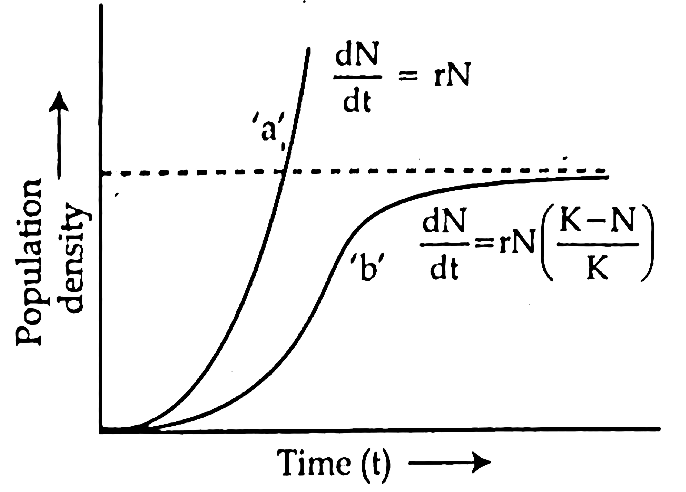
- 1‘a’ represents exponential growth when responses are not limiting the growth; and ‘b’ represents logistic growth when responses are limiting the growth.
- 2‘a’ represents logistic growth when responses are not limiting the growth; ‘b’ represents exponential growth when responses are limiting the growth.
- 3‘a’ represents carrying capacity and ‘b’ shows logistic growth when responses are limiting the growth.
- 4‘a’ represents exponential growth when responses are not limiting the growth and ‘b’ shows carrying capacity.
Show answer and solution
Correct: option 1, ‘a’ represents exponential growth when responses are not limiting the growth; and ‘b’ represents logistic growth when responses are limiting the growth.
Curve a is J-shaped and follows , which is exponential growth: the population keeps rising faster and faster because nothing limits it. Curve b is S-shaped and follows , which is logistic growth: limits slow the growth until the population levels off at the carrying capacity K, shown by the dashed line.
Question 197NEET 2024 Re-exam, Q197
Select the correct statements regarding mechanism of muscle contraction.
A. It is initiated by a signal sent by CNS via sensory neuron.
B. Neurotransmitter generates action potential in the sarcolemma.
C. Increased level leads to the binding of calcium with troponin on actin filaments.
D. Masking of active site for actin is activated.
E. Utilising the energy from ATP hydrolysis to form cross bridge.
Choose the most appropriate answer from the options given below:
- 1B, C and E only
- 2C, D and E only
- 3A and D only
- 4B, D and E only
Show answer and solution
Correct: option 1, B, C and E only
The signal from the CNS travels along a motor neuron, not a sensory neuron, so A is wrong. The neurotransmitter released at the neuromuscular junction sets up an action potential in the sarcolemma (B). Calcium ions are then released and bind to troponin on the actin filaments (C); this removes the masking of the active sites for myosin, so D is wrong. The myosin head uses the energy of ATP hydrolysis to bind actin and form a cross bridge (E). So B, C and E are correct.
Question 198NEET 2024 Re-exam, Q198
Match List I with List II:
| List - I | List - II |
|---|
| A. Squamous Epithelium | I. Goblet cells of alimentary canal |
| B. Ciliated Epithelium | II. Inner lining of pancreatic ducts |
| C. Glandular Epithelium | III. Walls of blood vessels |
| D. Compound Epithelium | IV. Inner surface of Fallopian tubes |
Choose the correct answer from the options given below:
- 1A-II, B-III, C-I, D-IV
- 2A-II, B-IV, C-III, D-I
- 3A-III, B-I, C-II, D-IV
- 4A-III, B-IV, C-I, D-II
Show answer and solution
Correct: option 4, A-III, B-IV, C-I, D-II
Squamous epithelium, a single layer of flat cells, lines the walls of blood vessels. Ciliated epithelium lines the inner surface of hollow organs such as the Fallopian tubes and bronchioles. Goblet cells of the alimentary canal are unicellular glandular epithelium. Compound epithelium, made of more than one layer, lines the inner surface of the ducts of the pancreas and salivary glands. So A-III, B-IV, C-I, D-II.
Question 199NEET 2024 Re-exam, Q199
Match List I with List II:
| List - I | List - II |
|---|
| A. B-Lymphocytes | I. Passive immunity |
| B. Interferons | II. Cell mediated immunity |
| C. T-Lymphocytes | III. Produce an army of proteins in response to pathogens |
| D. Colostrum | IV. Innate immunity |
Choose the correct answer from the options given below:
- 1A-I, B-IV, C-II, D-III
- 2A-IV, B-II, C-III, D-I
- 3A-III, B-IV, C-II, D-I
- 4A-II, B-IV, C-I, D-III
Show answer and solution
Correct: option 3, A-III, B-IV, C-II, D-I
B-lymphocytes produce an army of proteins, the antibodies, in response to pathogens. Interferons, released by virus-infected cells, are a cytokine barrier of innate immunity. T-lymphocytes carry out cell mediated immunity. Colostrum gives the infant ready-made antibodies, which is passive immunity. So A-III, B-IV, C-II, D-I.
Question 200NEET 2024 Re-exam, Q200
Given below are two statements: One is labelled as Assertion A and the other is labelled as Reason R.
Assertion A: During the transportation of gases, about 20-25 percent of is carried by Haemoglobin as carbamino-haemoglobin.
Reason R: This binding is related to high and low in tissues.
In the light of the above statements, choose the correct answer from the options given below.
- 1A is true but R is false.
- 2A is false but R is true.
- 3Both A and R are true and R is the correct explanation of A.
- 4Both A and R are true but R is NOT the correct explanation of A.
Show answer and solution
Correct: option 3, Both A and R are true and R is the correct explanation of A.
About 20 to 25 percent of carbon dioxide is carried by haemoglobin as carbamino-haemoglobin, so A is true. How much binds depends on the partial pressures: in the tissues is high and is low, so more carbon dioxide binds there, and in the alveoli the reverse conditions make it come off. R is true and explains why the binding in A takes place.