NEET 2020 Phase 2 Physics questions
Question 1NEET 2020 Phase 2, Q91
Three stars A, B, C have surface temperatures , , respectively. Star A appears bluish, star B appears reddish and star C yellowish. Hence,
- 1
- 2
- 3
- 4
Show answer and solution
Correct: option 3,
By Wien's displacement law is constant, so a hotter star radiates most strongly at a shorter wavelength. Blue has the shortest wavelength, then yellow, then red, so the bluish star A is hottest and the reddish star B is coolest: .
Question 2NEET 2020 Phase 2, Q92
Which of the following gate is called universal gate?
- 1AND gate
- 2NAND gate
- 3NOT gate
- 4OR gate
Show answer and solution
Correct: option 2, NAND gate
A universal gate is one from which every other gate can be built. NAND gates alone can be combined to make NOT, AND and OR gates, so the NAND gate is a universal gate (NOR is the other one). AND, OR and NOT alone cannot do this.
Question 3NEET 2020 Phase 2, Q93
The mean free path for a gas molecule depends upon diameter, of the molecule as
- 1
- 2
- 3
- 4
Show answer and solution
Correct: option 4,
The mean free path is , where is the number of molecules per unit volume. A molecule sweeps out a collision cross-section , so the bigger the molecule the more often it collides, and .
Question 4NEET 2020 Phase 2, Q94
The magnetic flux linked with a coil (in Wb) is given by the equation
The magnitude of induced emf in the coil at the fourth second will be
- 143 V
- 2108 V
- 310 V
- 433 V
Show answer and solution
Correct: option 1, 43 V
By Faraday's law the magnitude of the induced emf is . At this is .
Question 5NEET 2020 Phase 2, Q95
The angular speed of the wheel of a vehicle is increased from 360 rpm to 1200 rpm in 14 second. Its angular acceleration is,
- 1
- 2
- 3
- 4
Show answer and solution
Correct: option 4,
The change in speed is rpm revolutions per second, which is . The angular acceleration is .
Question 6NEET 2020 Phase 2, Q96
Two coherent sources of light interfere and produce fringe pattern on a screen. For central maximum, the phase difference between the two waves will be,
- 1
- 2
- 3
- 4zero
Show answer and solution
Correct: option 4, zero
The central maximum lies at the point equally distant from the two sources, so the path difference there is zero. The two waves therefore arrive in step, with phase difference , and add up to give the brightest fringe.
Question 7NEET 2020 Phase 2, Q97
What is the depth at which the value of acceleration due to gravity becomes times the value that at the surface of earth? (radius of earth = )
- 1
- 2
- 3
- 4
Show answer and solution
Correct: option 1,
At depth the acceleration due to gravity is . Setting gives , so .
Question 8NEET 2020 Phase 2, Q98
An object is placed on the principal axis of a concave mirror at a distance of ( is the focal length). The image will be at,
- 1
- 2
- 3
- 4
Show answer and solution
Correct: option 4,
With the sign convention, the object distance is and the focal length of the concave mirror is . The mirror formula gives , so . The image is real, in front of the mirror.
Question 9NEET 2020 Phase 2, Q99
The acceleration of an electron due to the mutual attraction between the electron and a proton when they are apart is,
(, )
(Take )
- 1
- 2
- 3
- 4
Show answer and solution
Correct: option 2,
The Coulomb force is . The acceleration of the electron is .
Question 10NEET 2020 Phase 2, Q100
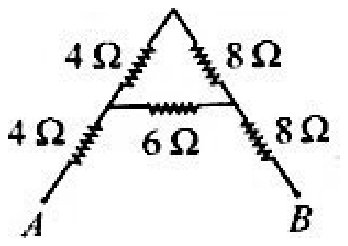
The equivalent resistance between A and B for the mesh shown in the figure is
- 1
- 2
- 3
- 4
Show answer and solution
Correct: option 1,
The upper and meet at the top and are in series, giving ; this is in parallel with the across the middle: . That is in series with the lower and arms, so .
Question 11NEET 2020 Phase 2, Q101
Identify the function which represents a periodic motion.
- 1
- 2
- 3
- 4
Show answer and solution
Correct: option 2,
A periodic function repeats its value after a fixed time. repeats every . The logarithm and the two exponentials only keep rising or falling with time and never repeat.
Question 12NEET 2020 Phase 2, Q102
A liquid does not wet the solid surface if angle of contact is:
- 1equal to
- 2greater than
- 3zero
- 4equal to
Show answer and solution
Correct: option 2, greater than
When the angle of contact is obtuse (greater than ), the molecules of the liquid attract each other more strongly than they are attracted by the solid, so the liquid gathers into drops and does not wet the surface, as mercury does on glass. An acute angle of contact means the liquid wets the solid.
Question 13NEET 2020 Phase 2, Q103
Out of the following which one is a forward biased diode?
- 1

- 2

- 3

- 4

Show answer and solution
Correct: option 3
In every picture the diode symbol points from left to right, so the left end is the p-side. The diode is forward biased only when the left end is at a higher potential than the right end. That happens only in option (3), where is higher than ; in the others the left end is lower (, , ), so they are reverse biased.
Question 14NEET 2020 Phase 2, Q104
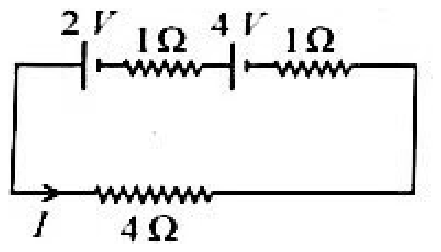
For the circuit shown in the figure, the current I will be
- 11 A
- 21.5 A
- 30.5 A
- 40.75 A
Show answer and solution
Correct: option 1, 1 A
The two cells are connected in series so that their emfs add: . The three resistors are in series in the single loop: . So .
Question 15NEET 2020 Phase 2, Q105
Time intervals measured by a clock give the following readings:
1.25 s, 1.24 s, 1.27 s, 1.21 s and 1.28 s.
What is the percentage relative error of the observations?
- 14%
- 216%
- 31.6%
- 42%
Show answer and solution
Correct: option 3, 1.6%
The mean is . The absolute errors are 0, 0.01, 0.02, 0.04 and 0.03 s, with mean . The percentage relative error is .
Question 16NEET 2020 Phase 2, Q106
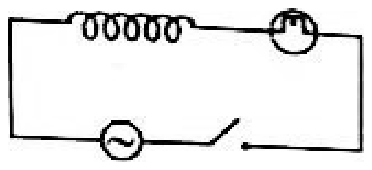
A light bulb and an inductor coil are connected to an ac source through a key as shown in the figure below. The key is closed and after sometime an iron rod is inserted into the interior of the inductor. The glow of the light bulb
- 1remains unchanged
- 2will fluctuate
- 3increases
- 4decreases
Show answer and solution
Correct: option 4, decreases
Putting an iron rod inside the coil raises its inductance , so its reactance goes up. The impedance of the series circuit rises, the current falls, and the bulb glows less brightly.
Question 17NEET 2020 Phase 2, Q107
Two solid conductors are made up of same material, have same length and same resistance. One of them has a circular cross section of area and the other one has a square cross section of area . The ratio is
- 11
- 20.8
- 32
- 41.5
Show answer and solution
Correct: option 1, 1
depends on the area of the cross-section, not on its shape. Since , and are the same for both conductors, the areas must be equal, so .
Question 18NEET 2020 Phase 2, Q108
The magnetic field in a plane electromagnetic wave is given by,
Calculate the wavelength.
- 1
- 2
- 3
- 4
Show answer and solution
Correct: option 1,
Comparing with , the wave number is . Since , the wavelength is .
Question 19NEET 2020 Phase 2, Q109
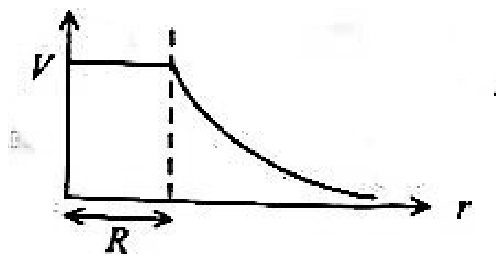
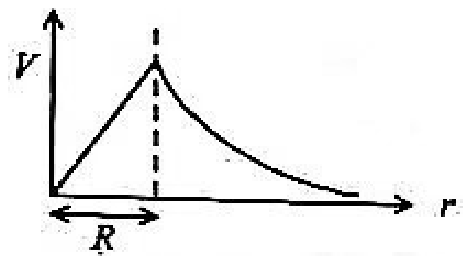
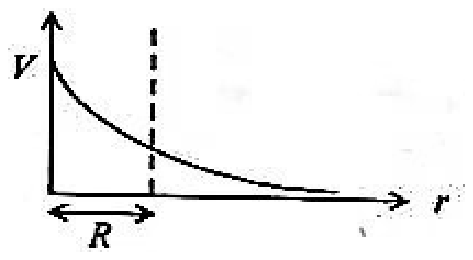
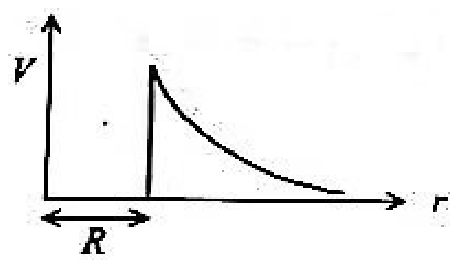
The variation of electrostatic potential with radial distance from the centre of a positively charged metallic thin shell of radius is given by the graph
- 1
- 2
- 3
- 4
Show answer and solution
Correct: option 1
Inside a charged conducting shell the electric field is zero, so the potential stays constant at its surface value for all . Outside, the shell acts like a point charge and falls off as . The graph that is flat up to and then decreases is option (1).
Question 20NEET 2020 Phase 2, Q110
The efficiency of a Carnot engine depends upon
- 1the temperatures of the source and sink
- 2the volume of the cylinder of the engine
- 3the temperature of the source only
- 4the temperature of the sink only
Show answer and solution
Correct: option 1, the temperatures of the source and sink
The efficiency of a Carnot engine is , where is the temperature of the source and that of the sink. It depends on both temperatures and on nothing else, not the working substance or the size of the cylinder.
Question 21NEET 2020 Phase 2, Q111
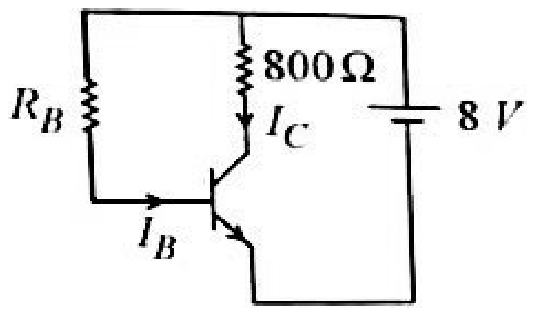
A n-p-n transistor is connected in common emitter configuration (see figure) in which collector voltage drop across load resistance () connected to the collector circuit is 0.8 V. The collector current is,
- 10.1 mA
- 21 mA
- 30.2 mA
- 42 mA
Show answer and solution
Correct: option 2, 1 mA
The collector current flows through the load resistance, so by Ohm's law .
Question 22NEET 2020 Phase 2, Q112
The total energy of an electron in the th stationary orbit of the hydrogen atom can be obtained by,
- 1
- 2
- 3
- 4
Show answer and solution
Correct: option 1,
In the Bohr model the energy of the electron in the th orbit of hydrogen is . The value is negative because the electron is bound to the nucleus, and the ground state () has energy .
Question 23NEET 2020 Phase 2, Q113
The de Broglie wavelength of an electron moving with kinetic energy of 144 eV is nearly,
- 1
- 2
- 3
- 4
Show answer and solution
Correct: option 4,
An electron of kinetic energy 144 eV has been accelerated through volt, and its de Broglie wavelength is .
Question 24NEET 2020 Phase 2, Q114
If the critical angle for total internal reflection from a medium to vacuum is , then velocity of light in the medium is,
- 1
- 2
- 3
- 4
Show answer and solution
Correct: option 1,
The refractive index of the medium is . The speed of light in it is .
Question 25NEET 2020 Phase 2, Q115
An ideal gas equation can be written as
where and are respectively,
- 1number density, molar mass
- 2mass density, molar mass
- 3number density, mass of the gas
- 4mass density, mass of the gas
Show answer and solution
Correct: option 2, mass density, molar mass
For mass of gas of molar mass , , so . Here is the mass density of the gas and is its molar mass.
Question 26NEET 2020 Phase 2, Q116
The P-V diagram for an ideal gas in a piston cylinder assembly undergoing a thermodynamic process is shown in the figure. The process is
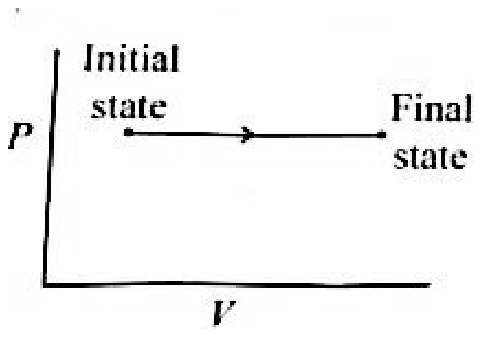
- 1isochoric
- 2isobaric
- 3isothermal
- 4adiabatic
Show answer and solution
Correct: option 2, isobaric
The path from the initial state to the final state is a horizontal line on the P-V diagram: the volume changes while the pressure stays the same. A process at constant pressure is isobaric.
Question 27NEET 2020 Phase 2, Q117
The half life of a radioactive sample undergoing -decay is . If the number of nuclei in the sample is , the activity of the sample is nearly
- 1
- 2
- 3
- 4
Show answer and solution
Correct: option 4,
The activity is , which is nearly .
Question 28NEET 2020 Phase 2, Q118
A barometer is constructed using a liquid (density = ). What would be the height of the liquid column, when a mercury barometer reads 76 cm?
(density of mercury = )
- 113.6 m
- 2136 m
- 30.76 m
- 41.36 m
Show answer and solution
Correct: option 1, 13.6 m
Both columns balance the same atmospheric pressure, so . The height of the liquid column is .
Question 29NEET 2020 Phase 2, Q119
What happens to the mass number and atomic number of an element when it emits -radiation?
- 1Mass number and atomic number remain unchanged.
- 2Mass number remains unchanged while atomic number decreases by one.
- 3Mass number increases by four and atomic number increases by two.
- 4Mass number decreases by four and atomic number decreases by two.
Show answer and solution
Correct: option 1, Mass number and atomic number remain unchanged.
A -ray is a photon: it has no charge and no rest mass. It is given out when an excited nucleus drops to a lower energy level, so the number of protons and the number of neutrons stay the same. Both the mass number and the atomic number are unchanged.
Question 30NEET 2020 Phase 2, Q120
The E.M. wave with shortest wavelength among the following is,
- 1X-rays
- 2Gamma-rays
- 3Microwaves
- 4Ultraviolet rays
Show answer and solution
Correct: option 2, Gamma-rays
In order of decreasing wavelength the electromagnetic spectrum runs: radio waves, microwaves, infrared, visible light, ultraviolet rays, X-rays, gamma rays. Of the four listed, gamma rays have the shortest wavelength (and the highest frequency).
Question 31NEET 2020 Phase 2, Q121
For the circuit given below, the Kirchhoff's loop rule for the loop BCDEB is given by the equation
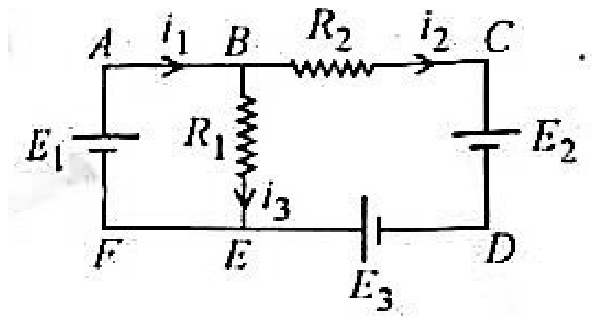
- 1
- 2
- 3
- 4
Show answer and solution
Correct: option 1,
Go round the loop B to C to D to E to B and add the changes in potential. From B to C along through : . From C to D through , from its positive plate to its negative plate: . From D to E through , from negative to positive: . From E to B against through : . So , which is the same as .
Question 32NEET 2020 Phase 2, Q122
A plano-convex lens of unknown material and unknown focal length is given. With the help of a spherometer we can measure the,
- 1radius of curvature of the curved surface
- 2aperture of the lens
- 3refractive index of the material
- 4focal length of the lens
Show answer and solution
Correct: option 1, radius of curvature of the curved surface
A spherometer measures the height of a curved surface above the plane of its three legs, which are a distance apart. From this the radius of curvature is found: . It cannot give the refractive index or the focal length on its own.
Question 33NEET 2020 Phase 2, Q123
The power of a biconvex lens is 10 dioptre and the radius of curvature of each surface is 10 cm. Then the refractive index of the material of the lens is,
- 1
- 2
- 3
- 4
Show answer and solution
Correct: option 3,
By the lens maker's formula, for a biconvex lens with equal radii. With and : , so .
Question 34NEET 2020 Phase 2, Q124
A point mass 'm' is moved in a vertical circle of radius 'r' with the help of a string. The velocity of the mass is at the lowest point. The tension in the string at the lowest point is
- 17 mg
- 28 mg
- 31 mg
- 46 mg
Show answer and solution
Correct: option 2, 8 mg
At the lowest point the tension acts up and the weight acts down, and their resultant supplies the centripetal force: . With , .
Question 35NEET 2020 Phase 2, Q125
A wire of length L metre carrying a current of I ampere is bent in the form of a circle. Its magnetic moment is,
- 1
- 2
- 3
- 4
Show answer and solution
Correct: option 3,
The wire forms one circle of circumference , so its radius is . The magnetic moment is current times area: .
Question 36NEET 2020 Phase 2, Q126
An intrinsic semiconductor is converted into n-type extrinsic semiconductor by doping it with
- 1Aluminium
- 2Silver
- 3Germanium
- 4Phosphorus
Show answer and solution
Correct: option 4, Phosphorus
An n-type semiconductor is made by adding a pentavalent (group 15) impurity. Four of its five valence electrons form bonds with the neighbouring atoms and the fifth is free to conduct. Phosphorus is pentavalent. Aluminium is trivalent and would give a p-type semiconductor, and germanium is itself an intrinsic semiconductor.
Question 37NEET 2020 Phase 2, Q127
Three identical spheres, each of mass M, are placed at the corners of a right angle triangle with mutually perpendicular sides equal to 2 m (see figure). Taking the point of intersection of the two mutually perpendicular sides as the origin, find the position vector of centre of mass.
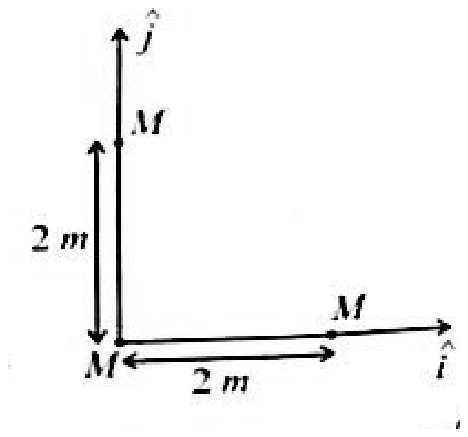
- 1
- 2
- 3
- 4
Show answer and solution
Correct: option 2,
The spheres are at , and . As the masses are equal, and . So the position vector of the centre of mass is .
Question 38NEET 2020 Phase 2, Q128
A parallel plate capacitor having cross-sectional area and separation has air in between the plates. Now an insulating slab of same area but thickness is inserted between the plates as shown in figure having dielectric constant . The ratio of new capacitance to its original capacitance will be,
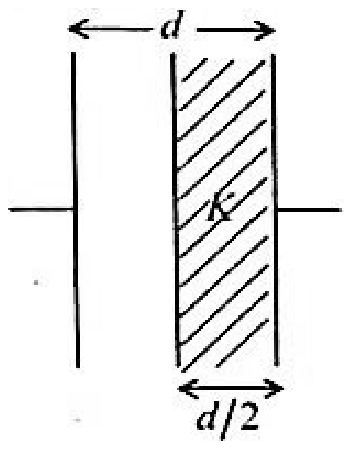
- 18:5
- 26:5
- 34:1
- 42:1
Show answer and solution
Correct: option 1, 8:5
The original capacitance is . With a slab of thickness , . So .
Question 39NEET 2020 Phase 2, Q129
A person sitting in the ground floor of a building notices through the window, of height 1.5 m, a ball dropped from the roof of the building crosses the window in 0.1 s. What is the velocity of the ball when it is at the topmost point of the window? ()
- 114.5 m/s
- 24.5 m/s
- 320 m/s
- 415.5 m/s
Show answer and solution
Correct: option 1, 14.5 m/s
Let be the speed at the top of the window. Across the window : . So .
Question 40NEET 2020 Phase 2, Q130
The angle of 1' (minute of arc) in radian is nearly equal to,
- 1
- 2
- 3
- 4
Show answer and solution
Correct: option 4,
, and one minute of arc is one sixtieth of a degree: .
Question 41NEET 2020 Phase 2, Q131
The wave nature of electrons was experimentally verified by,
- 1Hertz
- 2Einstein
- 3Davisson and Germer
- 4de Broglie
Show answer and solution
Correct: option 3, Davisson and Germer
de Broglie proposed that moving particles have a wavelength, but the proof came from the experiment of Davisson and Germer, who found that electrons scattered from a nickel crystal form a diffraction pattern, with a wavelength matching de Broglie's formula. Hertz discovered the photoelectric effect and Einstein explained it.
Question 42NEET 2020 Phase 2, Q132
The length of the string of a musical instrument is 90 cm and has a fundamental frequency of 120 Hz. Where should it be pressed to produce fundamental frequency of 180 Hz?
- 160 cm
- 245 cm
- 380 cm
- 475 cm
Show answer and solution
Correct: option 1, 60 cm
The fundamental frequency of a stretched string is , and the tension, so the wave speed , is unchanged. Hence and .
Question 43NEET 2020 Phase 2, Q133
A wheel with 20 metallic spokes each 1 m long is rotated with a speed of 120 rpm in a plane perpendicular to a magnetic field of 0.4 G. The induced emf between the axle and rim of the wheel will be, ()
- 1
- 2
- 3
- 4
Show answer and solution
Correct: option 4,
Each spoke is a rod rotating about one end, so the emf across it is . Here and , so . The spokes are in parallel between axle and rim, so the number of spokes does not change the emf.
Question 44NEET 2020 Phase 2, Q134
Calculate the acceleration of the block and trolly system shown in the figure. The coefficient of kinetic friction between the trolly and the surface is 0.05. (, mass of the string is negligible and no other friction exists).
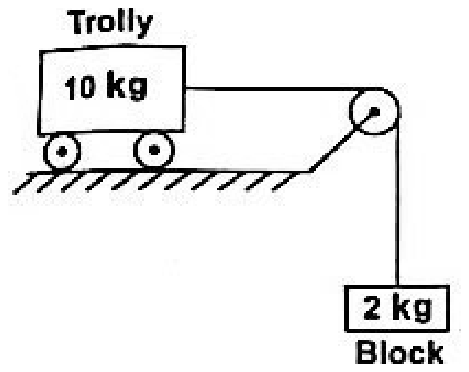
- 1
- 2
- 3
- 4
Show answer and solution
Correct: option 4,
The weight of the 2 kg block, , pulls the system, and friction on the 10 kg trolly, , opposes it. The whole 12 kg moves together, so .
Question 45NEET 2020 Phase 2, Q135
The electric field at a point on the equatorial plane at a distance from the centre of a dipole having dipole moment is given by,
( separation of two charges forming the dipole, - permittivity of free space)
- 1
- 2
- 3
- 4
Show answer and solution
Correct: option 3,
On the equatorial plane the fields of the two charges have equal size; their components along the perpendicular cancel and the components parallel to the dipole axis add, pointing from the positive charge towards the negative charge, which is opposite to the dipole moment. For much larger than the separation the result is . The field on the axis is twice as large and along , which is option (1).
NEET 2020 Phase 2 Chemistry questions
Question 46NEET 2020 Phase 2, Q136
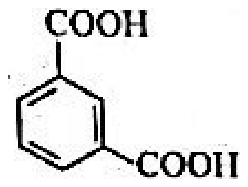
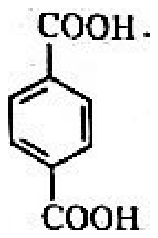
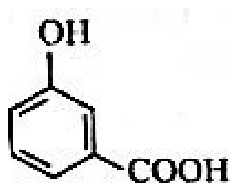
Which of the following acid will form an (a) Anhydride on heating and (b) Acid imide on strong heating with ammonia?
- 1
- 2
- 3
- 4
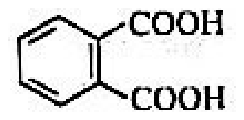
Show answer and solution
Correct: option 4
A cyclic anhydride or imide can form only when two groups sit on neighbouring ring carbons, so that a stable five-membered ring closes. Option (4) is phthalic acid (benzene-1,2-dicarboxylic acid): heating gives phthalic anhydride, and strong heating with ammonia gives phthalimide. The 1,3- and 1,4-diacids in (1) and (2) have their groups too far apart, and (3) has only one group.
Question 47NEET 2020 Phase 2, Q137
Deficiency of which vitamin causes osteomalacia?
- 1Vitamin D
- 2Vitamin K
- 3Vitamin E
- 4Vitamin A
Show answer and solution
Correct: option 1, Vitamin D
Vitamin D is needed for absorbing calcium and laying it down in bone. Its deficiency causes rickets in children and osteomalacia (soft bones and joint pain) in adults. Lack of vitamin K affects blood clotting, vitamin E causes fragile red blood cells and muscular weakness, and vitamin A causes night blindness and xerophthalmia.
Question 48NEET 2020 Phase 2, Q138
In which of the sols, the colloidal particles are with negative charge?
- 1Haemoglobin
- 2Starch
- 3Hydrated
- 4
Show answer and solution
Correct: option 2, Starch
Starch sol is a negatively charged sol, like sols of metals, metal sulphides, gums and clay. Haemoglobin, hydrated metal oxides such as and oxides such as form positively charged sols.
Question 49NEET 2020 Phase 2, Q139
Identify the reaction from following having top position in EMF series (Std. red. potential) according to their electrode potential at 298 K.
- 1
- 2
- 3
- 4
Show answer and solution
Correct: option 2,
The standard reduction potential table is headed by the couples with the highest (most positive) . The values are about for , for , for and for . Gold has the highest value, so its reaction is at the top.
Question 50NEET 2020 Phase 2, Q140
Which among the following salt solutions is basic in nature?
- 1Ammonium sulphate
- 2Ammonium nitrate
- 3Sodium acetate
- 4Ammonium chloride
Show answer and solution
Correct: option 3, Sodium acetate
Sodium acetate is the salt of a strong base () and a weak acid (). The acetate ion hydrolyses, , so the solution is basic. The three ammonium salts come from a weak base and strong acids, so their solutions are acidic.
Question 51NEET 2020 Phase 2, Q141
Match the coordination number and type of hybridisation with distribution of hybrid orbitals in space based on Valence bond theory.
| Coordination number and type of hybridisation | Distribution of hybrid orbitals in space |
|---|
| (a) 4, | (i) trigonal bipyramidal |
| (b) 4, | (ii) octahedral |
| (c) 5, | (iii) tetrahedral |
| (d) 6, | (iv) square planar |
Select the correct option:
- 1a-iii, b-iv, c-i, d-ii
- 2a-iv, b-i, c-ii, d-iii
- 3a-iii, b-i, c-iv, d-ii
- 4a-ii, b-iii, c-iv, d-i
Show answer and solution
Correct: option 1, a-iii, b-iv, c-i, d-ii
Four hybrid orbitals point to the corners of a tetrahedron (a-iii). Four orbitals lie in one plane, giving a square planar arrangement (b-iv). Five orbitals are trigonal bipyramidal (c-i), and six orbitals are octahedral (d-ii).
Question 52NEET 2020 Phase 2, Q142
Which of the following substituted phenols is the strongest acid?
- 1
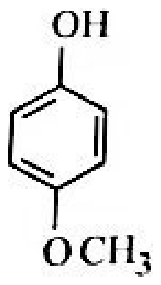
- 2
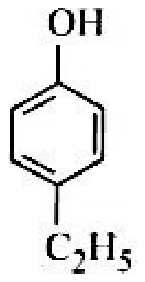
- 3
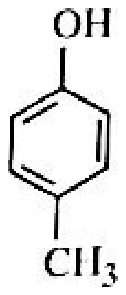
- 4
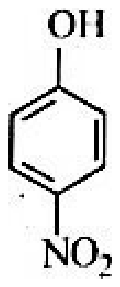
Show answer and solution
Correct: option 4
A phenol is more acidic when the phenoxide ion left behind is better stabilised. The group at the para position withdraws electrons by both the inductive and the resonance effect and spreads the negative charge, so p-nitrophenol (option 4) is the strongest acid. The , and groups release electrons and make the phenol weaker than phenol itself.
Question 53NEET 2020 Phase 2, Q143
In collision theory of chemical reaction, represents
- 1the collision frequency of reactants, A and B
- 2steric factor
- 3the fraction of molecules with energies equal to
- 4the fraction of molecules with energies greater than
Show answer and solution
Correct: option 1, the collision frequency of reactants, A and B
In collision theory the rate is written as . Here is the collision frequency of A and B (collisions per second per unit volume), is the steric factor and is the fraction of molecules with energy equal to or greater than .
Question 54NEET 2020 Phase 2, Q144
The reaction of concentrated sulphuric acid with carbohydrates is an example of
- 1Oxidation
- 2Reduction
- 3Sulphonation
- 4Dehydration
Show answer and solution
Correct: option 4, Dehydration
Concentrated has a strong affinity for water and pulls out the elements of water from sugar: . Only black carbon is left (charring), so the reaction is a dehydration.
Question 55NEET 2020 Phase 2, Q145
What is the role of gypsum, in setting of cement? Identify the correct option from the following:
- 1to provide water molecules for hydration process
- 2to help to remove water molecules
- 3to slow down the setting process
- 4to fasten the setting process
Show answer and solution
Correct: option 3, to slow down the setting process
Cement sets by hydration of its silicates and aluminates, and without a retarder it would stiffen almost at once. A small amount of gypsum (2 to 3%) is added to slow down the setting so that the cement hardens properly.
Question 56NEET 2020 Phase 2, Q146
Which of the following statement is not true about glucose?
- 1It contains five hydroxyl groups.
- 2It is a reducing sugar.
- 3It is an aldopentose.
- 4It is an aldohexose.
Show answer and solution
Correct: option 3, It is an aldopentose.
Glucose, , has six carbon atoms and an aldehyde group, so it is an aldohexose and not an aldopentose. It has five groups (it forms a pentaacetate) and it reduces Tollens' reagent and Fehling's solution. Statement (3) is the false one.
Question 57NEET 2020 Phase 2, Q147
The minimum pressure required to compress of a gas at 1 bar to at is
- 10.2 bar
- 21.0 bar
- 32.5 bar
- 44.0 bar
Show answer and solution
Correct: option 4, 4.0 bar
The temperature is constant, so Boyle's law applies: . Then .
Question 58NEET 2020 Phase 2, Q148
If 8 g of a non-electrolyte solute is dissolved in 114 g of n-octane to reduce its vapour pressure to 80%, the molar mass (in ) of the solute is
[Given that molar mass of n-octane is ]
- 160
- 280
- 320
- 440
Show answer and solution
Correct: option 4, 40
The vapour pressure falls to 80%, so the relative lowering is 0.2. Moles of n-octane . Using the dilute-solution form of Raoult's law, , gives mol and molar mass , the keyed option. (With the exact mole fraction one gets and , which is not among the options.)
Question 59NEET 2020 Phase 2, Q149
Which one of the following reactions does not come under hydrolysis type reaction?
- 1
- 2
- 3
- 4
Show answer and solution
Correct: option 2,
In a hydrolysis water splits a compound and no oxidation number changes; this is true for , and . In reaction (2) fluorine goes from 0 to and the oxygen of water from to 0, so water is oxidised by fluorine. It is a redox reaction, not a hydrolysis.
Question 60NEET 2020 Phase 2, Q150
Which of the following statement is NOT true about acid rain?
- 1Causes no damage to monuments like Taj Mahal.
- 2It is harmful for plants.
- 3Its pH is less than 5.6
- 4It is due to reaction of , and with rain water
Show answer and solution
Correct: option 1, Causes no damage to monuments like Taj Mahal.
Acid rain has a pH below 5.6 and forms when oxides of sulphur and nitrogen (with ) dissolve in rain water. It harms plants and aquatic life and attacks marble and other building stone, , which is how the Taj Mahal has been damaged. So statement (1) is not true.
Question 61NEET 2020 Phase 2, Q151
Identify the wrongly matched pair.
Molecule - Shape or geometry of molecule
- 1 - Octahedral
- 2 - Linear
- 3 - Trigonal pyramidal
- 4 - Trigonal planar
Show answer and solution
Correct: option 4, - Trigonal planar
has five bond pairs and no lone pair on phosphorus (), so it is trigonal bipyramidal, not trigonal planar. The others are right: has six bond pairs (octahedral), has two (linear) and has three bond pairs and one lone pair (trigonal pyramidal).
Question 62NEET 2020 Phase 2, Q152
One mole of carbon atom weighs 12 g, the number of atoms in it is equal to, (Mass of carbon - 12 is )
- 1
- 2
- 3
- 4
Show answer and solution
Correct: option 3,
Number of atoms , which is the Avogadro number.
Question 63NEET 2020 Phase 2, Q153
If for a certain reaction is at 450 K, the value of (in ) for which the same reaction will be spontaneous at the same temperature is
- 1
- 233
- 3
- 470
Show answer and solution
Correct: option 4, 70
The reaction is spontaneous when , that is . Of the options only 70 is larger than this.
Question 64NEET 2020 Phase 2, Q154
A liquid compound (x) can be purified by steam distillation only if it is
- 1Not steam volatile, miscible with water
- 2Steam volatile, miscible with water
- 3Not steam volatile, immiscible with water
- 4Steam volatile, immiscible with water
Show answer and solution
Correct: option 4, Steam volatile, immiscible with water
Steam distillation is used for a substance that is volatile in steam but does not mix with water. The mixture boils when the sum of the two vapour pressures equals atmospheric pressure, so the compound distils below its own boiling point and then separates from the water in the distillate as a second layer.
Question 65NEET 2020 Phase 2, Q155
How many (i) hybridised carbon atoms and (ii) bonds are present in the following compound?
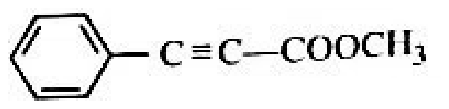
- 18, 6
- 27, 6
- 38, 5
- 47, 5
Show answer and solution
Correct: option 2, 7, 6
The six ring carbons and the carbonyl carbon of the ester group are : 7 in all. The two carbons of are and the carbon is . The bonds are 3 in the ring, 2 in the triple bond and 1 in : 6 in all.
Question 66NEET 2020 Phase 2, Q156
Reaction of propanamide with ethanolic sodium hydroxide and bromine will give
- 1Methylamine
- 2Propylamine
- 3Aniline
- 4Ethylamine
Show answer and solution
Correct: option 4, Ethylamine
This is the Hoffmann bromamide degradation, in which an amide gives a primary amine with one carbon atom less: . Propanamide (three carbons) therefore gives ethylamine.
Question 67NEET 2020 Phase 2, Q157
Identify the correct statement from the following.
- 1Lithium and Magnesium show some similarities in their physical properties as they are diagonally placed in periodic table.
- 2Lithium is softer among all alkali metals.
- 3Lithium chloride is deliquescent and crystallises as a hydrate, .
- 4The order of hydration enthalpies of alkaline earth cations
Show answer and solution
Correct: option 1, Lithium and Magnesium show some similarities in their physical properties as they are diagonally placed in periodic table.
Lithium and magnesium have similar sizes and charge-to-radius ratios, so they resemble each other (diagonal relationship); statement (1) is correct. Lithium is the hardest alkali metal, lithium chloride crystallises as , and hydration enthalpy falls as the ion gets bigger, so the true order is .
Question 68NEET 2020 Phase 2, Q158
Match the following aspects with the respective metal.
| Aspects | Metal |
|---|
| (a) The metal which reveals a maximum number of oxidation states | (i) Scandium |
| (b) The metal although placed in 3d block is considered not as a transition element | (ii) Copper |
| (c) The metal which does not exhibit variable oxidation states | (iii) Manganese |
| (d) The metal which in +1 oxidation state in aqueous solution undergoes disproportionation | (iv) Zinc |
Select the correct option:
- 1a-iii, b-iv, c-i, d-ii
- 2a-iii, b-i, c-iv, d-ii
- 3a-ii, b-iv, c-i, d-iii
- 4a-i, b-iv, c-ii, d-iii
Show answer and solution
Correct: option 1, a-iii, b-iv, c-i, d-ii
Manganese shows the most oxidation states in the 3d series, from +2 to +7 (a-iii). Zinc has a full shell in the atom and in , so it is not counted as a transition element (b-iv). Scandium shows only +3 (c-i). disproportionates in water, (d-ii).
Question 69NEET 2020 Phase 2, Q159
Match the element in column I with that in column II.
| Column I | Column II |
|---|
| (a) Copper | (i) Non-metal |
| (b) Fluorine | (ii) Transition metal |
| (c) Silicon | (iii) Lanthanoid |
| (d) Cerium | (iv) Metalloid |
Identify the correct match:
- 1a-ii, b-i, c-iv, d-iii
- 2a-iv, b-iii, c-i, d-ii
- 3a-i, b-ii, c-iii, d-iv
- 4a-ii, b-iv, c-i, d-iii
Show answer and solution
Correct: option 1, a-ii, b-i, c-iv, d-iii
Copper is a 3d transition metal (a-ii), fluorine is a non-metal (b-i), silicon is a metalloid (c-iv) and cerium (Z = 58) is a lanthanoid (d-iii).
Question 70NEET 2020 Phase 2, Q160
Among the compounds shown below which one revealed a linear structure?
- 1
- 2
- 3
- 4
Show answer and solution
Correct: option 3,
(N-N-O) has 16 valence electrons like ; its central nitrogen is hybridised with no lone pair, so the molecule is linear. and have lone pairs on the central oxygen and has an odd electron on nitrogen, so all three are bent.
Question 71NEET 2020 Phase 2, Q161
What is Z?
- 1
- 2
- 3
- 4
Show answer and solution
Correct: option 4,
Hydroboration followed by oxidation with alkaline adds water across the double bond in the anti-Markovnikov sense: boron, and then , ends up on the less substituted carbon. But-1-ene therefore gives the primary alcohol butan-1-ol, .
Question 72NEET 2020 Phase 2, Q162
Identify compound (A) in the following reaction:
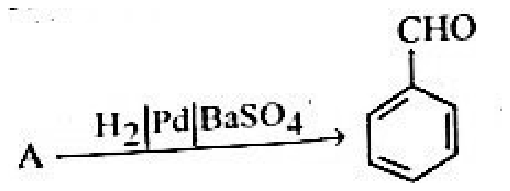
- 1Toluene
- 2Acetophenone
- 3Benzoic acid
- 4Benzoyl chloride
Show answer and solution
Correct: option 4, Benzoyl chloride
Hydrogen over palladium supported on (a partly poisoned catalyst) reduces an acid chloride only as far as the aldehyde. This is the Rosenmund reduction: . So A is benzoyl chloride.
Question 73NEET 2020 Phase 2, Q163
Which of the following statement is correct about Bakelite?
- 1It is an addition polymer.
- 2It is a branched chain polymer.
- 3It is a linear polymer.
- 4It is a cross linked polymer.
Show answer and solution
Correct: option 4, It is a cross linked polymer.
Bakelite is made by condensation of phenol with formaldehyde. The first product, novolac, is linear, but on heating with more formaldehyde the chains join through methylene bridges into a three-dimensional network. Bakelite is therefore a cross linked, thermosetting condensation polymer.
Question 74NEET 2020 Phase 2, Q164
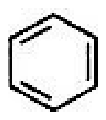
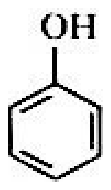
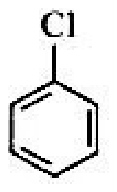
Which of the following compound is most reactive in electrophilic aromatic substitution?
- 1
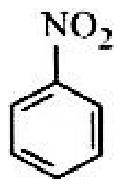
- 2
- 3
- 4
Show answer and solution
Correct: option 3
An electrophile attacks fastest the ring with the highest electron density. The group of phenol (option 3) pushes a lone pair into the ring by resonance and activates it strongly. deactivates slightly and deactivates strongly, so the order of reactivity is phenol > benzene > chlorobenzene > nitrobenzene.
Question 75NEET 2020 Phase 2, Q165
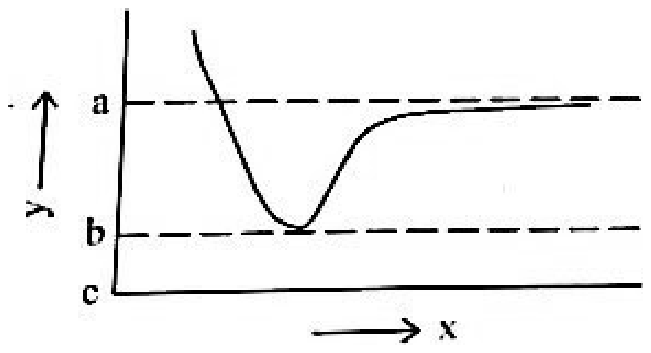
The potential energy (y) curve for formation as a function of internuclear distance (x) of the H atoms is shown below.
- 1
- 2
- 3
- 4
Show answer and solution
Correct: option 4,
Level a is the energy of two separate H atoms (large x) and level b is the bottom of the well, the energy of the molecule at its bond length. The bond energy is the gap between these two levels, the energy change when one bond forms, which the options write as . Level c is only the base line of the graph, and no halving is needed because the curve is for a single bond.
Question 76NEET 2020 Phase 2, Q166
Which one of the following compounds shows both, Frenkel as well as Schottky defects?
- 1
- 2
- 3
- 4
Show answer and solution
Correct: option 4,
In the small ion can move into an interstitial site (Frenkel defect), and the ions are close enough in size for pairs of cation and anion vacancies to form as well (Schottky defect). and show only Frenkel defects and shows only Schottky defects.
Question 77NEET 2020 Phase 2, Q167
Identify the incorrect statement from the following:
- 1Lanthanoids reveal only +3 oxidation state.
- 2The lanthanoid ions other than the type and the type are all paramagnetic.
- 3The overall decrease in atomic and ionic radii from lanthanum to lutetium is called lanthanoid contraction.
- 4Zirconium and Hafnium have identical radii of 160 pm and 159 pm, respectively as a consequence of lanthanoid contraction.
Show answer and solution
Correct: option 1, Lanthanoids reveal only +3 oxidation state.
+3 is the common oxidation state of the lanthanoids, but it is not the only one: and , and and , are also known. So statement (1) is incorrect. The other three statements are true: ions with unpaired f electrons are paramagnetic, the steady fall in size is the lanthanoid contraction, and it makes Zr and Hf almost equal in size.
Question 78NEET 2020 Phase 2, Q168
At standard conditions, if the change in the enthalpy for the following reaction is .
Given that bond energy of and is and , respectively, what is the bond energy (in ) of ?
- 1736
- 2518
- 3259
- 4368
Show answer and solution
Correct: option 4, 368
= (bond energies of reactants) (bond energies of products). So , which gives and for the bond.
Question 79NEET 2020 Phase 2, Q169
Which of the following oxide is amphoteric in nature?
- 1
- 2
- 3
- 4
Show answer and solution
Correct: option 4,
In group 14 the dioxides become less acidic down the group. , and are acidic, while and are amphoteric: they react with both acids and alkalis.
Question 80NEET 2020 Phase 2, Q170
The half-life for a zero order reaction having 0.02 M initial concentration of reactant is 100 s. The rate constant (in ) for the reaction is
- 1
- 2
- 3
- 4
Show answer and solution
Correct: option 4,
For a zero order reaction . So .
Question 81NEET 2020 Phase 2, Q171
Which of the following is not true about chloramphenicol?
- 1It is a broad spectrum antibiotic.
- 2It is not bactericidal.
- 3It is bacteriostatic.
- 4It inhibits the growth of only gram-positive bacteria.
Show answer and solution
Correct: option 4, It inhibits the growth of only gram-positive bacteria.
Chloramphenicol is a broad spectrum antibiotic: it acts on a wide range of both gram-positive and gram-negative bacteria. It works by stopping their growth (bacteriostatic) and not by killing them (not bactericidal). So the statement that it inhibits only gram-positive bacteria is not true.
Question 82NEET 2020 Phase 2, Q172
Match the elements in Column I with methods of purification in Column II.
| Column I | Column II |
|---|
| (a) Boron | (i) Van Arkel method |
| (b) Tin | (ii) Mond's process |
| (c) Zirconium | (iii) Liquation |
| (d) Nickel | (iv) Zone refining |
- 1a-iv, b-iii, c-ii, d-i
- 2a-ii, b-i, c-iv, d-iii
- 3a-iii, b-iv, c-i, d-ii
- 4a-iv, b-iii, c-i, d-ii
Show answer and solution
Correct: option 4, a-iv, b-iii, c-i, d-ii
Boron, like silicon and germanium, is obtained very pure by zone refining (a-iv). Tin has a low melting point and is run off from its impurities by liquation (b-iii). Zirconium is purified by the van Arkel method through its volatile iodide (c-i). Nickel is purified by Mond's process through volatile (d-ii).
Question 83NEET 2020 Phase 2, Q173
In a typical fuel cell, the reactants (R) and product (P) are
- 1
- 2
- 3
- 4
Show answer and solution
Correct: option 1,
The common hydrogen-oxygen fuel cell bubbles and through porous electrodes into aqueous alkali. The overall cell reaction is , so the reactants are hydrogen and oxygen and the only product is water.
Question 84NEET 2020 Phase 2, Q174
Isotonic solutions have same
- 1freezing temperature
- 2osmotic pressure
- 3boiling temperature
- 4vapour pressure
Show answer and solution
Correct: option 2, osmotic pressure
Isotonic solutions are, by definition, solutions that have the same osmotic pressure at a given temperature, so no net osmosis takes place when a semipermeable membrane separates them.
Question 85NEET 2020 Phase 2, Q175
The solubility product for a salt of the type AB is . What is the molarity of its standard solution?
- 1 mol/L
- 2 mol/L
- 3 mol/L
- 4 mol/L
Show answer and solution
Correct: option 4, mol/L
For with solubility , . So , the molarity of the saturated solution.
Question 86NEET 2020 Phase 2, Q176
Which of the following will NOT undergo reaction with ?
- 1
- 2
- 3
- 4
Show answer and solution
Correct: option 2
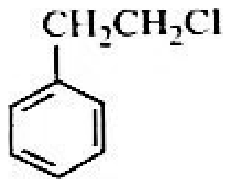
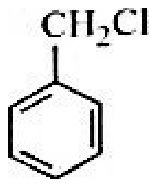
An reaction needs a stable carbocation. is tertiary, and the benzyl and allyl cations from (3) and (4) are stabilised by resonance. The halide in (2), 2-phenylethyl chloride, would give a primary carbocation that is one carbon away from the ring and not resonance stabilised, so it does not react by the path.
Question 87NEET 2020 Phase 2, Q177
Which of the following is a free radical substitution reaction?
- 1Acetylene with
- 2Methane with
- 3Propene with
- 4Benzene with
Show answer and solution
Correct: option 2, Methane with
Light splits into bromine radicals, which replace a hydrogen of methane by a chain mechanism: a free radical substitution. Acetylene with is an electrophilic addition, propene with and peroxide is a free radical addition, and benzene with is an electrophilic substitution.
Question 88NEET 2020 Phase 2, Q178
Match the compounds of Xe in column I with the molecular structure in column II.
| Column I | Column II |
|---|
| (a) | (i) Square planar |
| (b) | (ii) Linear |
| (c) | (iii) Square pyramidal |
| (d) | (iv) Pyramidal |
- 1a-ii, b-iv, c-iii, d-i
- 2a-ii, b-iii, c-i, d-iv
- 3a-ii, b-i, c-iv, d-iii
- 4a-ii, b-i, c-iii, d-iv
Show answer and solution
Correct: option 3, a-ii, b-i, c-iv, d-iii
has 2 bond pairs and 3 lone pairs: linear (a-ii). has 4 bond pairs and 2 lone pairs: square planar (b-i). has 3 bonds and 1 lone pair: pyramidal (c-iv). has 5 bonds and 1 lone pair: square pyramidal (d-iii).
Question 89NEET 2020 Phase 2, Q179
The number of angular nodes and radial nodes in 3s orbital are
- 11 and 0, respectively
- 23 and 0, respectively
- 30 and 1, respectively
- 40 and 2, respectively
Show answer and solution
Correct: option 4, 0 and 2, respectively
Angular nodes and radial nodes . For 3s, and , so there are 0 angular nodes and radial nodes.
Question 90NEET 2020 Phase 2, Q180
The oxidation number of the underlined atom in the following species
Identify the incorrect option.
- 1 is +5
- 2 is +6
- 3 is +3
- 4 is
Show answer and solution
Correct: option 4, is
In each copper is +1, so oxygen is , not ; option (4) is the incorrect one. The others check out: in is , so +5; in is , so +6; in is , so +3.
NEET 2020 Phase 2 Biology questions
Question 91NEET 2020 Phase 2, Q1
After about how many years of formation of earth, life appeared on this planet?
- 150 million years
- 2500 million years
- 350 billion years
- 4500 billion years
Show answer and solution
Correct: option 2, 500 million years
The earth is thought to have formed about 4.5 billion years ago, and life appeared roughly 500 million years after its formation, that is about 4 billion years ago. Billions of years are ruled out because the earth itself is only 4.5 billion years old.
Question 92NEET 2020 Phase 2, Q2
Which of the following statements about cork cambium is incorrect?
- 1It forms a part of periderm
- 2It is responsible for the formation of lenticels
- 3It is a couple of layers thick
- 4It forms secondary cortex on its outerside
Show answer and solution
Correct: option 4, It forms secondary cortex on its outerside
Cork cambium (phellogen) is a couple of layers thick and, with cork and secondary cortex, makes up the periderm; lenticels form where it cuts off loose parenchyma cells. It cuts off cork (phellem) on its outer side and secondary cortex (phelloderm) on its inner side, so the statement placing secondary cortex on the outer side is the incorrect one.
Question 93NEET 2020 Phase 2, Q3
Select the incorrect statement.
- 1Movement of minerals in xylem is unidirectional.
- 2Unloading of sucrose at sink does not involve the utilization of ATP.
- 3Elements most easily mobilized in plants from one region to another are: phosphorus, sulphur, nitrogen and potassium.
- 4Transport of molecules in phloem can be bidirectional.
Show answer and solution
Correct: option 2, Unloading of sucrose at sink does not involve the utilization of ATP.
Xylem carries minerals only upward, phloem transport can run in both directions, and phosphorus, sulphur, nitrogen and potassium are the readily remobilised elements. Both loading of sucrose at the source and unloading at the sink are active processes that use ATP, so the statement that unloading needs no ATP is incorrect.
Question 94NEET 2020 Phase 2, Q4
Which of the following statements is incorrect regarding the phosphorus cycle?
- 1Phosphorus solubilising bacteria facilitate the release of phosphorus from organic remains
- 2There is appreciable respiratory release of phosphorus into atmosphere
- 3It is sedimentary cycle
- 4Phosphates are the major form of phosphorus reservoir
Show answer and solution
Correct: option 2, There is appreciable respiratory release of phosphorus into atmosphere
Phosphorus has a sedimentary cycle: its reservoir is rock, where it is held as phosphates, and decomposers such as phosphate solubilising bacteria release it from dead organic matter. Unlike carbon, it has no gaseous phase worth the name, so there is no respiratory release of phosphorus into the atmosphere. That statement is the incorrect one.
Question 95NEET 2020 Phase 2, Q5
Match the items in Column I with those in Column II:
| Column I | Column II |
|---|
| (a) Herbivores-Plants | (i) Commensalism |
| (b) Mycorrhiza-Plants | (ii) Mutualism |
| (c) Sheep-Cattle | (iii) Predation |
| (d) Orchid-Tree | (iv) Competition |
Select the correct option from following:
- 1a-iii, b-ii, c-iv, d-i
- 2a-ii, b-i, c-iii, d-iv
- 3a-i, b-iii, c-iv, d-ii
- 4a-iv, b-ii, c-i, d-iii
Show answer and solution
Correct: option 1, a-iii, b-ii, c-iv, d-i
Herbivores feeding on plants count as predation in the ecological sense (iii). Mycorrhizal fungi and plant roots both gain, which is mutualism (ii). Sheep and cattle graze the same pasture and so compete (iv). An orchid growing as an epiphyte on a tree benefits while the tree is unaffected, which is commensalism (i).
Question 96NEET 2020 Phase 2, Q6
During non-cyclic photophosphorylation, when electrons are lost from the reaction centre at PS II, what is the source which replaces these electrons?
- 1Water
- 2Carbon dioxide
- 3Light
- 4Oxygen
Show answer and solution
Correct: option 1, Water
The electrons that leave the PS II reaction centre are replaced by the splitting of water, which is associated with PS II: . Oxygen is a product of this reaction, not the source of electrons.
Question 97NEET 2020 Phase 2, Q7
Which of the following statements is incorrect?
- 1Energy content gradually increases from first to fourth trophic level
- 2Number of individuals decreases from first trophic level to fourth trophic level
- 3Energy content gradually decreases from first to fourth trophic level
- 4Biomass decreases from first to fourth trophic level
Show answer and solution
Correct: option 1, Energy content gradually increases from first to fourth trophic level
Only about 10 per cent of the energy at one trophic level passes to the next, so energy content falls at every step and the pyramid of energy is always upright. In a typical ecosystem numbers and biomass also fall from producers to top carnivores. The statement that energy increases up the trophic levels is therefore incorrect.
Question 98NEET 2020 Phase 2, Q8
Male and female gametophytes do not have an independent free living existence in:
- 1Algae
- 2Angiosperms
- 3Bryophytes
- 4Pteridophytes
Show answer and solution
Correct: option 2, Angiosperms
In seed plants the gametophytes are much reduced and stay inside the sporophyte: in angiosperms the male gametophyte is the pollen grain and the female gametophyte is the embryo sac inside the ovule. In bryophytes the gametophyte is the main plant body, in pteridophytes it is a free-living prothallus, and algal gametophytes are free living too.
Question 99NEET 2020 Phase 2, Q9
Identify the statement which is incorrect.
- 1Glycine is an example of lipids.
- 2Lecithin contains phosphorus atom in its structure.
- 3Tyrosine possesses aromatic ring in its structure.
- 4Sulphur is an integral part of cysteine.
Show answer and solution
Correct: option 1, Glycine is an example of lipids.
Glycine is the simplest amino acid, not a lipid, so the first statement is incorrect. Lecithin is a phospholipid and contains phosphorus, tyrosine is an aromatic amino acid, and cysteine is a sulphur-containing amino acid.
Question 100NEET 2020 Phase 2, Q10
In the following in each set a conservation approach and an example of method of conservation are given
(a) In situ conservation - Biosphere Reserve
(b) Ex situ conservation - Sacred groves
(c) In situ conservation - Seed bank
(d) Ex situ conservation - Cryopreservation
Select the option with correct match of approach and method:
- 1(a) and (d)
- 2(b) and (d)
- 3(a) and (b)
- 4(a) and (c)
Show answer and solution
Correct: option 1, (a) and (d)
In situ conservation protects organisms in their natural habitat: biosphere reserves, national parks, sanctuaries and sacred groves. Ex situ conservation protects them outside it: seed banks, zoological parks, botanical gardens and cryopreservation. So pairs (a) and (d) are correct, while sacred groves (b) are in situ and seed banks (c) are ex situ.
Question 101NEET 2020 Phase 2, Q11
In a mitotic cycle, the correct sequence of phases is
- 1, S, , M
- 2M, , , S
- 3, , S, M
- 4S, , , M
Show answer and solution
Correct: option 1, , S, , M
Interphase runs in the order (growth), S (DNA synthesis) and (preparation for division), and it is followed by the M phase. Hence the sequence is , S, , M.
Question 102NEET 2020 Phase 2, Q12
Which of the following elements helps in maintaining the structure of ribosomes?
- 1Zinc
- 2Copper
- 3Molybdenum
- 4Magnesium
Show answer and solution
Correct: option 4, Magnesium
Magnesium ions hold the two ribosomal subunits together and so help to maintain ribosome structure; magnesium is also part of chlorophyll and activates enzymes of respiration and photosynthesis. Zinc, copper and molybdenum act mainly as enzyme activators or cofactors.
Question 103NEET 2020 Phase 2, Q13
Phycoerythrin is the major pigment in:
- 1Blue green algae
- 2Green algae
- 3Brown algae
- 4Red algae
Show answer and solution
Correct: option 4, Red algae
Red algae (Rhodophyceae) owe their colour to the predominance of the red pigment r-phycoerythrin, along with chlorophyll a and d. Green algae are dominated by chlorophyll a and b, and brown algae by fucoxanthin.
Question 104NEET 2020 Phase 2, Q14
Chromosomal theory of inheritance was proposed by:
- 1Bateson and Punnet
- 2T. H. Morgan
- 3Watson and Crick
- 4Sutton and Boveri
Show answer and solution
Correct: option 4, Sutton and Boveri
Sutton and Boveri noted in 1902 that the behaviour of chromosomes during meiosis runs parallel to the behaviour of Mendel's factors, and Sutton combined this with Mendel's laws as the chromosomal theory of inheritance. Morgan later verified it experimentally in Drosophila, and Watson and Crick gave the structure of DNA.
Question 105NEET 2020 Phase 2, Q15
A species which was introduced for ornamentation but has become a troublesome weed in India:
- 1Eichhornia crassipes
- 2Prosopis juliflora
- 3Trapa spinosa
- 4Parthenium hysterophorus
Show answer and solution
Correct: option 1, Eichhornia crassipes
Water hyacinth (Eichhornia crassipes) was brought to India for its attractive flowers and has since become the most troublesome aquatic weed, the "Terror of Bengal", choking water bodies. Parthenium came in accidentally with imported food grain rather than as an ornamental.
Question 106NEET 2020 Phase 2, Q16
Attachment of spindle fibers to kinetochores of chromosomes becomes evident in:
- 1Telophase
- 2Prophase
- 3Metaphase
- 4Anaphase
Show answer and solution
Correct: option 3, Metaphase
At metaphase the nuclear envelope has gone, the chromosomes lie at the equator, and spindle fibres are attached to the kinetochores of each chromosome. In anaphase these attached chromatids are already moving apart, and in prophase the spindle is still being assembled.
Question 107NEET 2020 Phase 2, Q17
First discovered restriction endonuclease that always cuts DNA molecule at a particular point by recognising a specific sequence of six base pairs is:
- 1Adenosine deaminase
- 2Thermostable DNA polymerase
- 3Hind II
- 4EcoR I
Show answer and solution
Correct: option 3, Hind II
Hind II was the first restriction endonuclease to be isolated and characterised; it always cuts DNA at a particular point by recognising a specific sequence of six base pairs. EcoR I was discovered later, and the other two options are not restriction enzymes.
Question 108NEET 2020 Phase 2, Q18
In Glycine max, the product of biological nitrogen fixation is transported from the root nodules to other parts as:
- 1Glutamate
- 2Nitrates
- 3Ureides
- 4Ammonia
Show answer and solution
Correct: option 3, Ureides
In the nodules of some plants such as soybean (Glycine max), fixed nitrogen is exported through the xylem as ureides, which have a very high nitrogen to carbon ratio. Ammonia is the first product of fixation but is toxic and is not transported as such.
Question 109NEET 2020 Phase 2, Q19
The term 'Nuclein' for the genetic material was used by:
- 1Meischer
- 2Chargaff
- 3Mendel
- 4Franklin
Show answer and solution
Correct: option 1, Meischer
Friedrich Miescher (printed as "Meischer" in the booklet) identified DNA in 1869 as an acidic substance in the nucleus and named it nuclein. Chargaff worked out base ratios and Franklin produced the X-ray diffraction data on DNA.
Question 110NEET 2020 Phase 2, Q20
Match the following concerning the activity/function and the phytohormone involved.
| |
|---|
| (a) Fruit ripener | (i) Abscisic acid |
| (b) Herbicide | (ii) |
| (c) Bolting agent | (iii) 2, 4-D |
| (d) Stress hormone | (iv) Ethephon |
Select the correct option from following:
- 1a-iii, b-iv, c-ii, d-i
- 2a-iv, b-iii, c-ii, d-i
- 3a-iv, b-ii, c-i, d-iii
- 4a-ii, b-iii, c-iv, d-i
Show answer and solution
Correct: option 2, a-iv, b-iii, c-ii, d-i
Ethephon releases ethylene and is used to ripen fruits (a-iv). 2, 4-D is a synthetic auxin used as a herbicide against dicot weeds (b-iii). Gibberellins such as cause bolting, the elongation of internodes before flowering (c-ii). Abscisic acid is the stress hormone (d-i).
Question 111NEET 2020 Phase 2, Q21
According to Alexander von Humboldt:
- 1Species richness increases with increasing area, but only up to limit
- 2There is no relationship between species richness and area explored.
- 3Species richness goes on increasing with increasing area of exploration
- 4Species richness decreases with increasing area of exploration
Show answer and solution
Correct: option 1, Species richness increases with increasing area, but only up to limit
Humboldt observed that within a region species richness increases with the area explored, but only up to a limit. This gives the species-area relationship, a rectangular hyperbola described by .
Question 112NEET 2020 Phase 2, Q22
The impact of immigration on population density is:
- 1Both positive and negative
- 2Neutralized by natality
- 3Positive
- 4Negative
Show answer and solution
Correct: option 3, Positive
Immigration is the arrival of individuals of the same species from elsewhere, so like natality it adds to the population: . Its effect on population density is therefore positive, while mortality and emigration are negative.
Question 113NEET 2020 Phase 2, Q23
Which of the following is incorrect for wind-pollinated plants?
- 1Many ovules in each ovary
- 2Flowers are small and not brightly coloured
- 3Pollen grains are light and non-sticky
- 4Well exposed stamens and stigma
Show answer and solution
Correct: option 1, Many ovules in each ovary
Wind-pollinated flowers are small and dull, with light, non-sticky pollen, well-exposed stamens and large feathery stigmas. They usually have a single ovule in each ovary and numerous flowers packed in an inflorescence, so "many ovules in each ovary" is the incorrect feature.
Question 114NEET 2020 Phase 2, Q24
Embryological support for evolution was proposed by:
- 1Karl Ernst von Baer
- 2Charles Darwin
- 3Alfred Wallace
- 4Ernst Heckel
Show answer and solution
Correct: option 4, Ernst Heckel
Ernst Haeckel (printed as "Heckel") proposed embryological support for evolution from features seen in the embryos of all vertebrates, such as vestigial gill slits, that are absent in the adult. Karl Ernst von Baer studied this proposal carefully and disapproved it, noting that embryos never pass through the adult stages of other animals.
Question 115NEET 2020 Phase 2, Q25
Which of the following is incorrect about Cyanobacteria?
- 1They lack heterocysts
- 2They often form blooms in polluted water bodies
- 3They have chlorophyll A similar to green plants
- 4They are photoautotrophs
Show answer and solution
Correct: option 1, They lack heterocysts
Cyanobacteria are photosynthetic autotrophs with chlorophyll a like green plants, and they often form blooms in polluted water. Some of them, such as Nostoc and Anabaena, fix atmospheric nitrogen in specialised cells called heterocysts, so the statement that they lack heterocysts is incorrect.
Question 116NEET 2020 Phase 2, Q26
Match the following:
| |
|---|
| (a) Aquaporin | (i) Amide |
| (b) Asparagine | (ii) Polysaccharide |
| (c) Abscisic acid | (iii) Polypeptide |
| (d) Chitin | (iv) Carotenoids |
Select the correct option:
- 1a-ii, b-iii, c-iv, d-i
- 2a-ii, b-i, c-iv, d-iii
- 3a-iii, b-i, c-ii, d-iv
- 4a-iii, b-i, c-iv, d-ii
Show answer and solution
Correct: option 4, a-iii, b-i, c-iv, d-ii
Aquaporins are membrane proteins that form water channels, so they are polypeptides (a-iii). Asparagine is an amide of the amino acid aspartic acid (b-i). Abscisic acid is a derivative of carotenoids (c-iv). Chitin is a structural polysaccharide of N-acetylglucosamine (d-ii).
Question 117NEET 2020 Phase 2, Q27
The biosynthesis of ribosomal RNA occurs in:
- 1Golgi apparatus
- 2Microbodies
- 3Nucleolus
- 4Ribosomes
Show answer and solution
Correct: option 3, Nucleolus
The nucleolus is the site of active ribosomal RNA synthesis, which is why it is larger and more numerous in cells that make a lot of protein. Ribosomes use rRNA but do not make it.
Question 118NEET 2020 Phase 2, Q28
Who coined the term 'Kinetin'?
- 1Darwin
- 2Went
- 3Kurosawa
- 4Skoog and Miller
Show answer and solution
Correct: option 4, Skoog and Miller
Skoog and Miller identified and crystallised the substance that promotes cytokinesis from autoclaved herring sperm DNA and named it kinetin. Darwin and Went are linked with auxin, and Kurosawa with gibberellins.
Question 119NEET 2020 Phase 2, Q29
The number of contrasting characters studied by Mendel for his experiments was:
- 14
- 22
- 37
- 414
Show answer and solution
Correct: option 3, 7
Mendel chose seven characters of the garden pea, each with a pair of contrasting traits: stem height, flower colour, flower position, pod shape, pod colour, seed shape and seed colour. The key therefore takes the answer as 7 (the seven pairs give 14 individual traits).
Question 120NEET 2020 Phase 2, Q30
Correct position of floral parts over thalamus in mustard plant is -
- 1Margin of the thalamus grows upward, enclosing the ovary completely, and other parts arise below the ovary.
- 2Gynoecium is present in the centre and other parts cover it partially.
- 3Gynoecium is situated in the centre, and other parts of the flower are located at the rim of the thalamus, at the same level.
- 4Gynoecium occupies the highest position, while the other parts are situated below it.
Show answer and solution
Correct: option 4, Gynoecium occupies the highest position, while the other parts are situated below it.
Mustard has a hypogynous flower: the gynoecium occupies the highest position on the thalamus and the other floral parts are situated below it, so the ovary is superior. Parts at the rim at the same level describes a perigynous flower, and a thalamus enclosing the ovary describes an epigynous one.
Question 121NEET 2020 Phase 2, Q31
In a mixture, DNA fragments are separated by
- 1Restriction digestion
- 2Electrophoresis
- 3Polymerase chain reaction
- 4Bioprocess engineering
Show answer and solution
Correct: option 2, Electrophoresis
DNA fragments are negatively charged and move towards the anode through an agarose gel, the smaller fragments travelling farther; this gel electrophoresis separates them by size. Restriction digestion produces the fragments and PCR amplifies them, but neither separates a mixture.
Question 122NEET 2020 Phase 2, Q32
In Recombinant DNA technology antibiotics are used:
- 1to detect alien DNA
- 2to impart disease-resistance to the host plant
- 3as selectable markers
- 4to keep medium bacteria-free
Show answer and solution
Correct: option 3, as selectable markers
Cloning vectors carry genes for resistance to antibiotics such as ampicillin or tetracycline. Growing the cells on a medium with the antibiotic lets only transformants survive, so the antibiotics work with these genes as selectable markers to pick out transformed cells from non-transformed ones.
Question 123NEET 2020 Phase 2, Q33
Which of the following statements is incorrect?
- 1In plants, the site of RuBisCO activity is mesophyll cell
- 2The substrate molecule for RuBisCO activity is a 5-carbon compound
- 3RuBisCO action requires ATP and NADPH
- 4RuBisCO is a bifunctional enzyme
Show answer and solution
Correct: option 1, In plants, the site of RuBisCO activity is mesophyll cell
In plants the mesophyll cells lack RuBisCO and fix carbon dioxide with PEP carboxylase; RuBisCO works in the bundle sheath cells, so the first statement is incorrect. RuBisCO acts on the 5-carbon RuBP and is bifunctional, working as both a carboxylase and an oxygenase. The key treats the statement about ATP and NADPH as correct, in the sense that the Calvin cycle RuBisCO drives depends on them.
Question 124NEET 2020 Phase 2, Q34
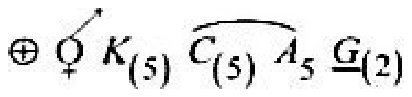
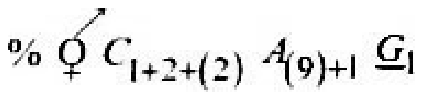
Which of the following is the correct floral formula of Liliaceae?
- 1
- 2
- 3
- 4
Show answer and solution
Correct: option 2
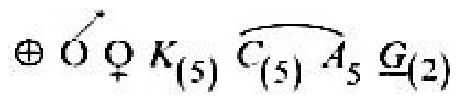
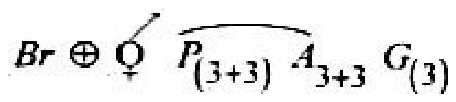
A Liliaceae flower is bracteate, actinomorphic and bisexual, with a perianth of six tepals in two whorls of three, six stamens in two whorls of three attached to the tepals, and a superior ovary of three fused carpels. Only the second formula, with , and , shows this. The formulas with five sepals and petals belong to dicot families, and the fourth one is that of Fabaceae.
Question 125NEET 2020 Phase 2, Q35
Inhibitory substances in dormant seeds cannot be removed by subjecting seeds to:
- 1Nitrate
- 2Ascorbic acid
- 3Chilling conditions
- 4Gibberellic acid
Show answer and solution
Correct: option 2, Ascorbic acid
The effect of inhibitory substances in dormant seeds can be removed by chilling conditions or by applying gibberellic acid or nitrates. Ascorbic acid is not one of these treatments; like abscisic acid and phenolic acids, it is itself among the chemical inhibitors of germination.
Question 126NEET 2020 Phase 2, Q36
Pyruvate dehydrogenase activity during aerobic respiration requires:
- 1Iron
- 2Cobalt
- 3Magnesium
- 4Calcium
Show answer and solution
Correct: option 3, Magnesium
Pyruvate is oxidatively decarboxylated to acetyl CoA in the mitochondrial matrix by pyruvate dehydrogenase, a reaction that needs NAD, coenzyme A and magnesium ions: pyruvic acid + CoA + NAD acetyl CoA + + NADH + .
Question 127NEET 2020 Phase 2, Q37
Large, empty colourless cells of the adaxial epidermis along the veins of grass leaves are
- 1Guard cells
- 2Bundle sheath cells
- 3Bulliform cells
- 4Lenticels
Show answer and solution
Correct: option 3, Bulliform cells
In grasses certain adaxial epidermal cells along the veins become large, empty and colourless; these are bulliform cells. When they lose water and turn flaccid the leaf curls inward, which cuts down water loss.
Question 128NEET 2020 Phase 2, Q38
Identify the correct features of Mango and Coconut fruits.
(i) In both fruit is a drupe
(ii) Endocarp is edible in both
(iii) Mesocarp in Coconut is fibrous, and in Mango it is fleshy
(iv) In both, fruit develops from monocarpellary ovary
Select the correct option from below:
- 1(i), (ii) and (iii) only
- 2(i) and (iv) only
- 3(i) and (ii) only
- 4(i), (iii) and (iv) only
Show answer and solution
Correct: option 4, (i), (iii) and (iv) only
Mango and coconut are both drupes that, as NCERT describes, develop from monocarpellary superior ovaries, so (i) and (iv) hold. The mesocarp is fleshy and edible in mango and fibrous in coconut, so (iii) holds. The endocarp is hard and stony in both and is not eaten, so (ii) is wrong.
Question 129NEET 2020 Phase 2, Q39
Match the following techniques or instruments with their usage:
| |
|---|
| (a) Bioreactor | (i) Separation of DNA fragments |
| (b) Electrophoresis | (ii) Production of large quantities of products |
| (c) PCR | (iii) Detection of pathogen, based on antigen - antibody reaction |
| (d) ELISA | (iv) Amplification of nucleic acids |
Select the correct option from following:
- 1a-ii, b-i, c-iv, d-iii
- 2a-iv, b-iii, c-ii, d-i
- 3a-ii, b-i, c-iii, d-iv
- 4a-iii, b-ii, c-iv, d-i
Show answer and solution
Correct: option 1, a-ii, b-i, c-iv, d-iii
A bioreactor is a large vessel for producing large quantities of products (a-ii). Electrophoresis separates DNA fragments by size (b-i). PCR amplifies nucleic acids (c-iv). ELISA detects a pathogen through the antigen-antibody reaction (d-iii).
Question 130NEET 2020 Phase 2, Q40
Which of the following statements is incorrect about gymnosperms?
- 1Male and female gametophytes are free living
- 2Most of them have narrow leaves with thick cuticle
- 3Their seeds are not covered
- 4They are heterosporous
Show answer and solution
Correct: option 1, Male and female gametophytes are free living
Gymnosperms are heterosporous, bear naked seeds, and conifers have needle-like leaves with a thick cuticle. Their male and female gametophytes have no independent free-living existence; they remain within the sporangia retained on the sporophyte. The first statement is therefore incorrect.
Question 131NEET 2020 Phase 2, Q41
In the polynucleotide chain of DNA, a nitrogenous base is linked to the -OH of:
- 1C pentose sugar
- 2C pentose sugar
- 3C pentose sugar
- 4C pentose sugar
Show answer and solution
Correct: option 3, C pentose sugar
A nitrogenous base is joined to the -OH of the carbon of the pentose sugar by an N-glycosidic linkage to form a nucleoside. The and carbons carry the phosphate links of the backbone.
Question 132NEET 2020 Phase 2, Q42
Air (Prevention and Control of Pollution) Act was amended in 1987 to include among pollutants
- 1Allergy causing pollen
- 2Noise
- 3Particulates of size 2.5 micrometer or below
- 4Vehicular exhaust
Show answer and solution
Correct: option 2, Noise
The Air (Prevention and Control of Pollution) Act came into force in India in 1981 and was amended in 1987 to include noise as an air pollutant.
Question 133NEET 2020 Phase 2, Q43
Inclusion bodies of blue-green, purple and green photosynthetic bacteria are:
- 1Gas vacuoles
- 2Centrioles
- 3Microtubules
- 4Contractile vacuoles
Show answer and solution
Correct: option 1, Gas vacuoles
Inclusion bodies are non-membrane-bound reserve structures lying free in the cytoplasm of prokaryotes. Gas vacuoles are the inclusion bodies found in blue-green, purple and green photosynthetic bacteria. Centrioles, microtubules and contractile vacuoles are features of eukaryotic cells.
Question 134NEET 2020 Phase 2, Q44
Vegetative propagule in Agave is termed as:
- 1Bulbil
- 2Offset
- 3Eye
- 4Rhizome
Show answer and solution
Correct: option 1, Bulbil
Agave reproduces vegetatively by bulbils, fleshy buds that fall off and grow into new plants. Offsets are the propagules of water hyacinth, eyes those of potato and rhizomes those of ginger.
Question 135NEET 2020 Phase 2, Q45
In some plants thalamus contributes to fruit formation. Such fruits are termed as:
- 1Aggregate fruits
- 2True fruits
- 3Parthenocarpic fruit
- 4False fruits
Show answer and solution
Correct: option 4, False fruits
A true fruit develops only from the ovary. When the thalamus also contributes to the fruit, as in apple, strawberry and cashew, the fruit is called a false fruit. Parthenocarpic fruits are those formed without fertilisation.
Question 136NEET 2020 Phase 2, Q46
- 1Cutting of separated DNA bands from the agarose gel
- 2Transfer of separated DNA fragments to synthetic membranes
- 3Collection of isolated DNA
- 4Amplification of DNA
Show answer and solution
Correct: option 3, Collection of isolated DNA
When chilled ethanol is added to a cell extract, the DNA comes out of solution as fine threads. Winding these threads onto a rod to lift the DNA out is called spooling, so it is the collection of isolated DNA. Cutting bands from a gel is elution, transfer to a membrane is blotting and amplification is done by PCR.
Question 137NEET 2020 Phase 2, Q47
The laws and rules to prevent unauthorised exploitation of bio-resources are termed as -
- 1Bioethics
- 2Bioengineering
- 3Biopiracy
- 4Biopatenting
Show answer and solution
Correct: option 4, Biopatenting
Biopiracy is the unauthorised use of bio-resources itself, not the rule against it. Bioethics is the set of moral standards for dealing with living things, and bioengineering is a technology. The legal protection that stops others from using a bio-resource or the knowledge about it without permission is given through patents, so the keyed answer is biopatenting.
Question 138NEET 2020 Phase 2, Q48
Select the correct statement:
- 1Angiotensin II is a powerful vasodilator.
- 2Counter current pattern of blood flow is not observed in vasa recta.
- 3Reduction in Glomerular Filtration Rate activates JG cells to release renin.
- 4Atrial Natriuretic Factor increases the blood pressure.
Show answer and solution
Correct: option 3, Reduction in Glomerular Filtration Rate activates JG cells to release renin.
A fall in glomerular blood flow or filtration rate makes the juxtaglomerular cells release renin, which starts the renin-angiotensin mechanism. Angiotensin II is a vasoconstrictor, not a vasodilator. Blood in the two limbs of the vasa recta does flow in a counter current pattern, and Atrial Natriuretic Factor causes vasodilation and lowers the blood pressure.
Question 139NEET 2020 Phase 2, Q49
In cockroach, identify the parts of the foregut in correct sequence:
- 1Mouth Crop Pharynx Oesophagus Gizzard
- 2Mouth Gizzard Crop Pharynx Oesophagus
- 3Mouth Pharynx Oesophagus Crop Gizzard
- 4Mouth Oesophagus Pharynx Crop Gizzard
Show answer and solution
Correct: option 3, Mouth Pharynx Oesophagus Crop Gizzard
In the cockroach the mouth opens into a short tubular pharynx, which leads to a narrow oesophagus. The oesophagus opens into the sac-like crop where food is stored, and the crop is followed by the gizzard (proventriculus) that grinds the food. So the order is mouth, pharynx, oesophagus, crop, gizzard.
Question 140NEET 2020 Phase 2, Q50
Select the correct statement from the following:
- 1The polymerase enzyme joins the gene of interest and the vector DNA.
- 2Restriction enzyme digestions are performed by incubating purified DNA molecules with the restriction enzymes of optimum conditions.
- 3PCR is used for isolation and separation of gene of interest.
- 4Gel electrophoresis is used for amplification of a DNA segment.
Show answer and solution
Correct: option 2, Restriction enzyme digestions are performed by incubating purified DNA molecules with the restriction enzymes of optimum conditions.
Restriction digestion is carried out by incubating purified DNA with the restriction enzyme under the conditions that are best for that enzyme. The gene of interest is joined to the vector by DNA ligase, not by a polymerase. PCR amplifies a DNA segment, and gel electrophoresis separates DNA fragments by size, so the other three statements are wrong.
Question 141NEET 2020 Phase 2, Q51
Which is the basis of genetic mapping of human genome as well as DNA finger printing?
- 1Single nucleotide polymorphism
- 2Polymorphism in hnRNA sequence
- 3Polymorphism in RNA sequence
- 4Polymorphism in DNA sequence
Show answer and solution
Correct: option 4, Polymorphism in DNA sequence
Polymorphism means inheritable variation in the DNA sequence at a locus within a population. Such variation, including the repeated sequences used as probes, is what lets genomes be mapped and individuals be told apart in DNA fingerprinting. Single nucleotide polymorphism is only one kind of DNA polymorphism, so the general statement, polymorphism in DNA sequence, is the answer.
Question 142NEET 2020 Phase 2, Q52
A Hominid fossil discovered in Java in 1891, now extinct, having cranial capacity of about 900 cc was:
- 1Neanderthal man
- 2Homo sapiens
- 3Australopithecus
- 4Homo erectus
Show answer and solution
Correct: option 4, Homo erectus
The fossil found in Java in 1891 is Java man, which belongs to Homo erectus. Homo erectus had a brain of about 900 cc and probably ate meat. Neanderthal man had a brain of about 1400 cc, and Australopithecus had a much smaller one.
Question 143NEET 2020 Phase 2, Q53
The phenomenon of evolution of different species in a given geographical area starting from a point and spreading to other habitats is called -
- 1Co-evolution
- 2Natural selection
- 3Adaptive radiation
- 4Saltation
Show answer and solution
Correct: option 3, Adaptive radiation
Adaptive radiation is the evolution of several species in one geographical area, starting from a common point and spreading out into different habitats. Darwin's finches on the Galapagos Islands and the Australian marsupials are the standard examples. Saltation is a single large mutation step, and co-evolution is the linked evolution of two interacting species.
Question 144NEET 2020 Phase 2, Q54
According to Central Pollution Control Board [CPCB] what size (in diameter) of particulate is responsible for causing greater harm to human health?
- 12.5 micrometers
- 24.0 micrometers
- 33.0 micrometers
- 43.5 micrometers
Show answer and solution
Correct: option 1, 2.5 micrometers
According to the CPCB, particulates of 2.5 micrometers or less in diameter (PM 2.5) do the greatest harm. They are small enough to be breathed deep into the lungs, where they cause breathing trouble, irritation, inflammation and lung damage.
Question 145NEET 2020 Phase 2, Q55
RNA interference is used for which of the following purposes in the field of biotechnology?
- 1to develop a pest resistant plant against infestation by nematode
- 2to enhance the mineral usage by the plant
- 3to reduce post harvest losses
- 4to develop a plant tolerant to abiotic stresses
Show answer and solution
Correct: option 1, to develop a pest resistant plant against infestation by nematode
RNA interference silences a specific mRNA by means of a complementary double-stranded RNA. It was used to protect tobacco plants from the nematode Meloidogyne incognita: the plant makes dsRNA against nematode genes, so the parasite cannot survive in the roots. This gives a pest resistant plant.
Question 146NEET 2020 Phase 2, Q56
Which of the following STDs are not curable?
- 1Chlamydiasis, Syphilis, Genital warts
- 2HIV, Gonorrhoea, Trichomoniasis
- 3Gonorrhoea, Trichomoniasis, Hepatitis B
- 4Genital herpes, Hepatitis B, HIV infection
Show answer and solution
Correct: option 4, Genital herpes, Hepatitis B, HIV infection
Hepatitis B, genital herpes and HIV infection are the sexually transmitted infections that cannot be completely cured. All the others, such as gonorrhoea, syphilis, chlamydiasis and trichomoniasis, are curable if detected early and treated properly. Only option (4) lists the three incurable ones.
Question 147NEET 2020 Phase 2, Q57
E. Coli has only base pairs and completes the process of replication within 18 minutes; then the average rate of polymerisation is approximately -
- 13000 base pairs/second
- 24000 base pairs/second
- 31000 base pairs/second
- 42000 base pairs/second
Show answer and solution
Correct: option 4, 2000 base pairs/second
18 minutes is 1080 seconds, so the whole genome is copied at about base pairs per second. Replication runs in both directions from the origin, so each of the two forks polymerises about half of this, roughly 2000 base pairs per second. This is the value the textbook gives for the average rate of polymerisation.
Question 148NEET 2020 Phase 2, Q58
Match the following columns and select the correct option:
| Column - I | Column - II |
|---|
| (a) Aptenodytes | (i) Flying fox |
| (b) Pteropus | (ii) Angel fish |
| (c) Pterophyllum | (iii) Lamprey |
| (d) Petromyzon | (iv) Penguin |
- 1a-iii, b-iv, c-i, d-ii
- 2a-iv, b-i, c-ii, d-iii
- 3a-ii, b-i, c-iv, d-iii
- 4a-iii, b-iv, c-ii, d-i
Show answer and solution
Correct: option 2, a-iv, b-i, c-ii, d-iii
Aptenodytes is the penguin (a bird), Pteropus is the flying fox (a mammal), Pterophyllum is the angel fish (a bony fish) and Petromyzon is the lamprey (a cyclostome). So the matching is a-iv, b-i, c-ii, d-iii.
Question 149NEET 2020 Phase 2, Q59
Match the following columns and select the correct option:
| Column - I | Column - II |
|---|
| (a) Pituitary hormone | (i) Steroid |
| (b) Epinephrine | (ii) Neuropeptides |
| (c) Endorphins | (iii) Peptides, proteins |
| (d) Cortisol | (iv) Biogenic amines |
- 1a-iii, b-iv, c-ii, d-i
- 2a-iv, b-iii, c-i, d-ii
- 3a-iii, b-iv, c-i, d-ii
- 4a-iv, b-i, c-ii, d-iii
Show answer and solution
Correct: option 1, a-iii, b-iv, c-ii, d-i
Pituitary hormones are peptides or proteins. Epinephrine is made from the amino acid tyrosine and is a biogenic amine. Endorphins are neuropeptides made in the brain, and cortisol from the adrenal cortex is a steroid. So the matching is a-iii, b-iv, c-ii, d-i.
Question 150NEET 2020 Phase 2, Q60
Match the following columns with reference to cockroach and select the correct option:
| Column - I | Column - II |
|---|
| (a) Grinding of the food particles | (i) Hepatic caecal |
| (b) Secrete gastric juice | (ii) 10th segment |
| (c) 10 pairs | (iii) Proventriculus |
| (d) Anal cerci | (iv) Spiracles |
| (v) Alary muscles |
- 1a-iv, b-iii, c-v, d-ii
- 2a-i, b-iv, c-iii, d-ii
- 3a-ii, b-iii, c-i, d-iv
- 4a-iii, b-i, c-iv, d-ii
Show answer and solution
Correct: option 4, a-iii, b-i, c-iv, d-ii
The proventriculus (gizzard) grinds the food. The hepatic caeca at the junction of foregut and midgut secrete digestive juice. A cockroach has 10 pairs of spiracles, and the anal cerci are borne on the 10th abdominal segment. So the matching is a-iii, b-i, c-iv, d-ii; alary muscles are left over.
Question 151NEET 2020 Phase 2, Q61
Match the following columns and select the correct option:
| Column - I | Column - II |
|---|
| (a) Ovary | (i) Human chorionic Gonadotropin |
| (b) Placenta | (ii) Estrogen & Progesterone |
| (c) Corpus luteum | (iii) Androgens |
| (d) Leydig cells | (iv) Progesterone only |
- 1a-i, b-ii, c-iii, d-iv
- 2a-i, b-iii, c-ii, d-iv
- 3a-ii, b-i, c-iv, d-iii
- 4a-iv, b-iii, c-ii, d-i
Show answer and solution
Correct: option 3, a-ii, b-i, c-iv, d-iii
The ovary secretes both estrogen and progesterone. The placenta produces human chorionic gonadotropin (hCG). The corpus luteum is matched with progesterone, its main hormone, and the Leydig cells of the testis make androgens. So the matching is a-ii, b-i, c-iv, d-iii.
Question 152NEET 2020 Phase 2, Q62
For the commercial and industrial production of Citric Acid, which of the following microbes is used?
- 1Lactobacillus sp
- 2Saccharomyces cerevisiae
- 3Clostridium butylicum
- 4Aspergillus niger
Show answer and solution
Correct: option 4, Aspergillus niger
Citric acid is made industrially with the fungus Aspergillus niger. Lactobacillus gives lactic acid, Clostridium butylicum gives butyric acid and Saccharomyces cerevisiae is the yeast used to make ethanol.
Question 153NEET 2020 Phase 2, Q63
In human beings, at the end of 12 weeks (first trimester) of pregnancy, the following is observed:
- 1Most of the major organ systems are formed
- 2The head is covered with fine hair
- 3Movement of the foetus
- 4Eyelids and eyelashes are formed
Show answer and solution
Correct: option 1, Most of the major organ systems are formed
By the end of the first trimester (12 weeks) most of the major organ systems are formed; the limbs and external genital organs are well developed. The first movements of the foetus and hair on the head appear during the fifth month, and the eyelids separate and eyelashes form by about the end of 24 weeks.
Question 154NEET 2020 Phase 2, Q64
Inbreeding depression is -
- 1Decreased productivity due to mating of superior male and inferior female
- 2Decrease in body mass of progeny due to continued close inbreeding
- 3Reduced fertility and productivity due to continued close inbreeding
- 4Reduced motility and immunity due to close inbreeding
Show answer and solution
Correct: option 3, Reduced fertility and productivity due to continued close inbreeding
Continued inbreeding, especially close inbreeding, usually lowers fertility and even productivity. This loss is called inbreeding depression. It is overcome by mating the selected animals with unrelated superior animals of the same breed (out-crossing).
Question 155NEET 2020 Phase 2, Q65
Match the following columns and select the correct option:
| Column - I | Column - II |
|---|
| (i) Typhoid | (a) Haemophilus influenzae |
| (ii) Malaria | (b) Wuchereria bancrofti |
| (iii) Pneumonia | (c) Plasmodium vivax |
| (iv) Filariasis | (d) Salmonella typhi |
- 1i-c, ii-d, iii-b, iv-a
- 2i-a, ii-c, iii-b, iv-d
- 3i-a, ii-b, iii-d, iv-c
- 4i-d, ii-c, iii-a, iv-b
Show answer and solution
Correct: option 4, i-d, ii-c, iii-a, iv-b
Typhoid is caused by the bacterium Salmonella typhi. Malaria is caused by Plasmodium, for example Plasmodium vivax. Pneumonia is caused by Haemophilus influenzae (and Streptococcus pneumoniae), and filariasis by the worm Wuchereria bancrofti. So the matching is i-d, ii-c, iii-a, iv-b.
Question 156NEET 2020 Phase 2, Q66
The increase in osmolarity from outer to inner medullary interstitium is maintained due to:
(i) Close proximity between Henle's loop and vasa recta
(ii) Counter current mechanism
(iii) Selective secretion of and hydrogen ions in PCT
(iv) Higher blood pressure in glomerular capillaries
- 1(iii) and (iv)
- 2(i), (ii) and (iii)
- 3(i) and (ii)
- 4Only (ii)
Show answer and solution
Correct: option 3, (i) and (ii)
The osmolarity gradient of the medulla, from about 300 mOsmol/L in the cortex to about 1200 mOsmol/L in the inner medulla, is kept up by the counter current flow in the two limbs of Henle's loop and of the vasa recta, helped by their lying close together. Secretion of ions in the PCT controls pH and ionic balance, and glomerular blood pressure drives filtration; neither maintains the gradient. So (i) and (ii) are right.
Question 157NEET 2020 Phase 2, Q67
The proteolytic enzyme rennin is found in:
- 1Bile juice
- 2Gastric juice
- 3Pancreatic juice
- 4Intestinal juice
Show answer and solution
Correct: option 2, Gastric juice
Rennin is a proteolytic enzyme found in the gastric juice of infants. It helps in the digestion of milk proteins. Bile has no enzymes, and rennin is not part of the pancreatic or intestinal juice.
Question 158NEET 2020 Phase 2, Q68
The rate of decomposition is faster in the ecosystem due to following factors EXCEPT:
- 1Warm and moist environment
- 2Presence of aerobic soil microbes
- 3Detritus richer in lignin and chitin
- 4Detritus rich in sugars
Show answer and solution
Correct: option 3, Detritus richer in lignin and chitin
Decomposition needs oxygen and is quickest in a warm and moist environment, and when the detritus is rich in nitrogen and water-soluble substances such as sugars. Detritus rich in lignin and chitin breaks down slowly. So lignin and chitin are the exception.
Question 159NEET 2020 Phase 2, Q69
Match the following columns and select the correct option:
| Column - I | Column - II |
|---|
| (a) Pneumotaxic Centre | (i) Alveoli |
| (b) Dissociation curve | (ii) Pons region of brain |
| (c) Carbonic Anhydrase | (iii) Haemoglobin |
| (d) Primary site of exchange of gases | (iv) R.B.C. |
- 1a-ii, b-iii, c-iv, d-i
- 2a-iii, b-ii, c-iv, d-i
- 3a-iv, b-i, c-iii, d-ii
- 4a-i, b-iii, c-ii, d-iv
Show answer and solution
Correct: option 1, a-ii, b-iii, c-iv, d-i
The pneumotaxic centre lies in the pons region of the brain. The oxygen dissociation curve shows the percentage saturation of haemoglobin with oxygen. Carbonic anhydrase is present in very high concentration in the red blood cells, and the alveoli are the primary sites of gas exchange. So the matching is a-ii, b-iii, c-iv, d-i.
Question 160NEET 2020 Phase 2, Q70
Match the following events that occur in their respective phases of cell cycle and select the correct option:
(a) phase
(b) S phase
(c) phase
(d) Metaphase in M - phase
(i) Cell grows and organelle duplication
(ii) DNA replication and chromosome duplication
(iii) Cytoplasmic growth
(iv) Alignment of chromosomes
- 1a-iii, b-iv, c-i, d-ii
- 2a-iv, b-i, c-ii, d-iii
- 3a-i, b-ii, c-iii, d-iv
- 4a-ii, b-iii, c-iv, d-i
Show answer and solution
Correct: option 3, a-i, b-ii, c-iii, d-iv
In the phase the cell grows and its organelles are duplicated. DNA replication, and with it chromosome duplication, takes place in the S phase. In the cytoplasm keeps growing and proteins are made for mitosis. At metaphase the chromosomes line up at the equator. So the matching is a-i, b-ii, c-iii, d-iv.
Question 161NEET 2020 Phase 2, Q71
Match the following columns and select the correct option:
| Column - I | Column - II |
|---|
| (a) Dragonflies | (i) Biocontrol agents of several plant pathogens |
| (b) Bacillus thuringiensis | (ii) Get rid of Aphids and mosquitoes |
| (c) Glomus | (iii) Narrow spectrum insecticidal applications |
| (d) Baculoviruses | (iv) Biocontrol agents of lepidopteran plant pests |
| (v) Absorb phosphorus from soil |
- 1a-ii, b-i, c-iii, d-iv
- 2a-ii, b-iii, c-iv, d-v
- 3a-ii, b-iv, c-v, d-iii
- 4a-iii, b-v, c-iv, d-i
Show answer and solution
Correct: option 3, a-ii, b-iv, c-v, d-iii
Dragonflies and ladybirds are used to get rid of mosquitoes and aphids. Bacillus thuringiensis is used against butterfly caterpillars, which are lepidopteran pests. Glomus is a mycorrhizal fungus that absorbs phosphorus from the soil. Baculoviruses, mostly of the genus Nucleopolyhedrovirus, are narrow spectrum insecticides. So the matching is a-ii, b-iv, c-v, d-iii; the biocontrol agent of plant pathogens (Trichoderma) is left over.
Question 162NEET 2020 Phase 2, Q72
Match the following group of organisms with their respective distinctive characteristics and select the correct option:
| Organisms | Characteristics |
|---|
| (a) Platyhelminthes | (i) Cylindrical body with no segmentation |
| (b) Echinoderms | (ii) Warm blooded animals with direct development |
| (c) Hemichordates | (iii) Bilateral symmetry with incomplete digestive system |
| (d) Aves | (iv) Radial symmetry with indirect development |
- 1a-ii, b-iii, c-iv, d-i
- 2a-iv, b-i, c-ii, d-iii
- 3a-i, b-ii, c-iii, d-iv
- 4a-iii, b-iv, c-i, d-ii
Show answer and solution
Correct: option 4, a-iii, b-iv, c-i, d-ii
Flatworms (Platyhelminthes) are bilaterally symmetrical and have an incomplete digestive system with a single opening. Adult echinoderms are radially symmetrical and develop indirectly through a larva. Hemichordates have a worm-like cylindrical body without segmentation. Birds are warm blooded and develop directly. So the matching is a-iii, b-iv, c-i, d-ii.
Question 163NEET 2020 Phase 2, Q73
Select the correct option of haploid cells from the following groups:
- 1Secondary spermatocyte, First polar body, Ovum
- 2Spermatogonia, Primary spermatocyte, Spermatid
- 3Primary spermatocyte, Secondary spermatocyte, Second polar body
- 4Primary oocyte, Secondary oocyte, Spermatid
Show answer and solution
Correct: option 1, Secondary spermatocyte, First polar body, Ovum
Cells formed by the first meiotic division and later are haploid: secondary spermatocytes, secondary oocytes, polar bodies, spermatids, sperms and the ovum. Spermatogonia, primary spermatocytes and primary oocytes are diploid. Only option (1) has three haploid cells.
Question 164NEET 2020 Phase 2, Q74
The Total Lung Capacity (TLC) is the total volume of air accommodated in the lungs at the end of a forced inspiration. This includes:
- 1RV; ERV; IC and EC
- 2RV; ERV; VC (Vital Capacity) and FRC (Functional Residual Capacity)
- 3RV (Residual Volume); ERV (Expiratory Reserve Volume); TV (Tidal Volume); and IRV (Inspiratory Reserve Volume)
- 4RV; IC (Inspiratory Capacity); EC (Expiratory Capacity); and ERV
Show answer and solution
Correct: option 3, RV (Residual Volume); ERV (Expiratory Reserve Volume); TV (Tidal Volume); and IRV (Inspiratory Reserve Volume)
Total lung capacity is the sum of the four lung volumes that do not overlap: residual volume, expiratory reserve volume, tidal volume and inspiratory reserve volume. It can also be written as vital capacity plus residual volume. The other options add capacities that already contain one another, so they count some volumes twice.
Question 165NEET 2020 Phase 2, Q75
Match the following columns and select the correct option:
| Column - I | Column - II |
|---|
| (a) Smooth Endoplasmic Reticulum | (i) Protein synthesis |
| (b) Rough endoplasmic reticulum | (ii) Lipid synthesis |
| (c) Golgi complex | (iii) Glycosylation |
| (d) Centriole | (iv) Spindle formation |
- 1a-iii, b-i, c-ii, d-iv
- 2a-iv, b-ii, c-i, d-iii
- 3a-i, b-ii, c-iii, d-iv
- 4a-ii, b-i, c-iii, d-iv
Show answer and solution
Correct: option 4, a-ii, b-i, c-iii, d-iv
Smooth endoplasmic reticulum is the main site of lipid synthesis. Rough endoplasmic reticulum carries ribosomes and is engaged in protein synthesis. The Golgi complex is the important site where glycoproteins and glycolipids are formed (glycosylation), and centrioles give rise to the spindle apparatus. So the matching is a-ii, b-i, c-iii, d-iv.
Question 166NEET 2020 Phase 2, Q76
Select the incorrectly matched pair from following:
- 1Neurons – Nerve cells
- 2Fibroblast – Areolar tissue
- 3Osteocytes – Bone cells
- 4Chondrocytes – Smooth muscle cells
Show answer and solution
Correct: option 4, Chondrocytes – Smooth muscle cells
Chondrocytes are the cells of cartilage, enclosed in small cavities in its matrix; they are not smooth muscle cells. The other pairs are right: neurons are nerve cells, fibroblasts are found in areolar tissue and osteocytes are bone cells.
Question 167NEET 2020 Phase 2, Q77
Which of the following is associated with decrease in cardiac output?
- 1Parasympathetic neural signals
- 2Pneumotaxic centre
- 3Adrenal medullary hormones
- 4Sympathetic nerves
Show answer and solution
Correct: option 1, Parasympathetic neural signals
Parasympathetic signals slow the heart beat and the conduction of the action potential, so the cardiac output falls. Sympathetic nerves and the hormones of the adrenal medulla do the opposite and raise the cardiac output. The pneumotaxic centre controls breathing, not the heart.
Question 168NEET 2020 Phase 2, Q78
Intrinsic factor that helps in the absorption of vitamin is secreted by:
- 1Hepatic cells
- 2Oxyntic cells
- 3Chief cells
- 4Goblet cells
Show answer and solution
Correct: option 2, Oxyntic cells
The oxyntic (parietal) cells of the gastric glands secrete hydrochloric acid and the intrinsic factor, which is essential for the absorption of vitamin . Chief cells secrete pepsinogen and goblet cells secrete mucus.
Question 169NEET 2020 Phase 2, Q79
Match the following columns and select the correct option:
| Column - I | Column - II |
|---|
| (a) Gout | (i) Decreased levels of estrogen |
| (b) Osteoporosis | (ii) Low ions in the blood |
| (c) Tetany | (iii) Accumulation of uric acid crystals |
| (d) Muscular dystrophy | (iv) Auto immune disorder |
| (v) Genetic disorder |
- 1a-iii, b-i, c-ii, d-v
- 2a-iv, b-v, c-i, d-ii
- 3a-i, b-ii, c-iii, d-iv
- 4a-ii, b-i, c-iii, d-iv
Show answer and solution
Correct: option 1, a-iii, b-i, c-ii, d-v
Gout is inflammation of joints caused by the accumulation of uric acid crystals. Osteoporosis is commonly caused by decreased levels of estrogen. Tetany is rapid spasms of muscle due to low calcium ions in the body fluid. Muscular dystrophy is a genetic disorder. So the matching is a-iii, b-i, c-ii, d-v; the auto immune disorder (myasthenia gravis) is left over.
Question 170NEET 2020 Phase 2, Q80
The best example for pleiotropy is:
- 1Phenylketonuria
- 2Colour Blindness
- 3ABO Blood group
- 4Skin colour
Show answer and solution
Correct: option 1, Phenylketonuria
In pleiotropy a single gene has several phenotypic effects. In phenylketonuria one mutated gene, for the enzyme phenylalanine hydroxylase, causes mental retardation and also reduced hair and skin pigmentation. ABO blood group shows multiple alleles and co-dominance, and skin colour is polygenic.
Question 171NEET 2020 Phase 2, Q81
Match the following columns and select the correct option:
| Column - I | Column - II |
|---|
| (a) Rods and Cones | (i) Absence of photoreceptor cells |
| (b) Blind Spot | (ii) Cones are densely packed |
| (c) Fovea | (iii) Photoreceptor cells |
| (d) Iris | (iv) Visible coloured portion of the eye |
- 1a-ii, b-iii, c-i, d-iv
- 2a-iii, b-iv, c-ii, d-i
- 3a-ii, b-iv, c-iii, d-i
- 4a-iii, b-i, c-ii, d-iv
Show answer and solution
Correct: option 4, a-iii, b-i, c-ii, d-iv
Rods and cones are the photoreceptor cells of the retina. The blind spot, where the optic nerve leaves the eye, has no photoreceptor cells. The fovea is the point where only cones are densely packed, and the iris is the visible coloured portion of the eye. So the matching is a-iii, b-i, c-ii, d-iv.
Question 172NEET 2020 Phase 2, Q82
Which of the following conditions cause erythroblastosis foetalis?
- 1Mother and foetus
- 2Both mother and foetus
- 3Both mother and foetus
- 4Mother and foetus
Show answer and solution
Correct: option 1, Mother and foetus
An Rh negative mother carrying an Rh positive foetus is exposed to the foetal Rh antigen during the delivery of the first child and starts making antibodies against it. In a later pregnancy these antibodies cross the placenta and destroy the red blood cells of an Rh positive foetus. This is erythroblastosis foetalis.
Question 173NEET 2020 Phase 2, Q83
During Meiosis I, in which stage synapsis takes place?
- 1Zygotene
- 2Diplotene
- 3Leptotene
- 4Pachytene
Show answer and solution
Correct: option 1, Zygotene
Synapsis, the pairing of homologous chromosomes with the formation of the synaptonemal complex, takes place in zygotene of prophase I. Crossing over follows in pachytene, and in diplotene the synaptonemal complex dissolves.
Question 174NEET 2020 Phase 2, Q84
The size of Pleuropneumonia - like Organism (PPLO) is:
- 1
- 2
- 3
- 4
Show answer and solution
Correct: option 3,
PPLO (mycoplasma) are the smallest cells, about across (the textbook gives 0.3 micrometre in length). A typical bacterium is 1 to 2 micrometres, a typical eukaryotic cell is 10 to 20 micrometres and viruses are 0.02 to 0.2 micrometre.
Question 175NEET 2020 Phase 2, Q85
The yellowish fluid "colostrum" secreted by mammary glands of mother during the initial days of lactation has abundant antibodies (IgA) to protect the infant. This type of immunity is called as:
- 1Active immunity
- 2Acquired immunity
- 3Autoimmunity
- 4Passive immunity
Show answer and solution
Correct: option 4, Passive immunity
The infant does not make these antibodies; it receives them ready-made from the mother. Protection by ready-made antibodies given to the body is passive immunity. In active immunity the body makes its own antibodies after meeting the antigen.
Question 176NEET 2020 Phase 2, Q86
Which of the following options does correctly represent the characteristic features of phylum Annelida?
- 1Triploblastic, segmented body and bilaterally symmetrical.
- 2Triploblastic, flattened body and acoelomate condition.
- 3Diploblastic, mostly marine and radially symmetrical.
- 4Triploblastic, unsegmented body and bilaterally symmetrical.
Show answer and solution
Correct: option 1, Triploblastic, segmented body and bilaterally symmetrical.
Annelids are triploblastic, bilaterally symmetrical, coelomate animals whose body is divided into segments (metameres). A flattened acoelomate body describes flatworms, and a diploblastic, radially symmetrical, mostly marine body describes cnidarians.
Question 177NEET 2020 Phase 2, Q87
Cyclosporin A, used as immuno-suppression agent, is produced from:
- 1Saccharomyces cerevisiae
- 2Penicillium notatum
- 3Trichoderma polysporum
- 4Monascus purpureus
Show answer and solution
Correct: option 3, Trichoderma polysporum
Cyclosporin A, the immunosuppressive agent used in organ transplant patients, is produced by the fungus Trichoderma polysporum. Monascus purpureus (a yeast) gives the cholesterol-lowering statins, Penicillium notatum gives penicillin and Saccharomyces cerevisiae gives ethanol.
Question 178NEET 2020 Phase 2, Q88
Hormones stored and released from neurohypophysis are:
- 1Oxytocin and Vasopressin
- 2Follicle stimulating hormone and Luteinizing hormone
- 3Prolactin and Vasopressin
- 4Thyroid stimulating hormone and Oxytocin
Show answer and solution
Correct: option 1, Oxytocin and Vasopressin
The neurohypophysis (posterior pituitary) stores and releases oxytocin and vasopressin, which are actually made in the hypothalamus and carried down the axons. FSH, LH, prolactin and TSH are made by the adenohypophysis (anterior pituitary).
Question 179NEET 2020 Phase 2, Q89
Progestogens alone or in combination with estrogens can be used as a contraceptive in the form of -
- 1Injections only
- 2Pills, injections and implants
- 3Pills only
- 4Implants only
Show answer and solution
Correct: option 2, Pills, injections and implants
Progestogens alone or with estrogens are taken by mouth as pills, and progestogens alone or with estrogen are also given to females as injections or as implants under the skin. So all three forms, pills, injections and implants, are used.
Question 180NEET 2020 Phase 2, Q90
All vertebrates are chordates but all chordates are not vertebrates, why?
- 1Ventral hollow nerve cord remains throughout life in some chordates.
- 2All chordates possess vertebral column.
- 3All chordates possess notochord throughout their life.
- 4Notochord is replaced by vertebral column in adult of some chordates.
Show answer and solution
Correct: option 4, Notochord is replaced by vertebral column in adult of some chordates.
Every chordate has a notochord at some stage. Only in vertebrates is the notochord replaced by a cartilaginous or bony vertebral column in the adult; protochordates never get one. So vertebrates are chordates, but chordates without a vertebral column are not vertebrates. The chordate nerve cord is dorsal, not ventral.