NEET 2019 Odisha Physics questions
Question 1NEET 2019 Odisha, Q1
Two small spherical metal balls, having equal masses, are made from materials of densities and and have radii of 1 mm and 2 mm, respectively. They are made to fall vertically (from rest) in a viscous medium whose coefficient of viscosity equals and whose density is . The ratio of their terminal velocities would be,
- 1
- 2
- 3
- 4
Show answer and solution
Correct: option 2,
Terminal velocity is , so with . Then .
Question 2NEET 2019 Odisha, Q2
A particle starting from rest, moves in a circle of radius 'r'. It attains a velocity of m/s in the nth round. Its angular acceleration will be,
- 1
- 2
- 3
- 4
Show answer and solution
Correct: option 1,
Use with , and after n rounds. This gives .
Question 3NEET 2019 Odisha, Q3
A person standing on the floor of an elevator drops a coin. The coin reaches the floor in time if the elevator is at rest and in time if the elevator is moving uniformly. Then
- 1
- 2
- 3 or depending upon whether the lift is going up or down
- 4
Show answer and solution
Correct: option 2,
An elevator moving with uniform velocity is an inertial frame, just like one at rest. Relative to the floor the coin starts from rest and falls the same height with acceleration g in both cases, so .
Question 4NEET 2019 Odisha, Q4
A truck is stationary and has a bob suspended by a light string, in a frame attached to the truck. The truck, suddenly moves to the right with an acceleration of . The pendulum will tilt
- 1to the left and angle of inclination of the pendulum with the vertical is
- 2to the left and angle of inclination of the pendulum with the vertical is
- 3to the left and angle of inclination of the pendulum with the vertical is
- 4to the left and angle of inclination of the pendulum with the vertical is
Show answer and solution
Correct: option 4, to the left and angle of inclination of the pendulum with the vertical is
In the truck's frame a pseudo force acts on the bob towards the left, so it swings to the left. In equilibrium and , so and .
Question 5NEET 2019 Odisha, Q5
Two metal spheres, one of radius and the other of radius respectively have the same surface charge density . They are brought in contact and separated. What will be the new surface charge densities on them?
- 1
- 2
- 3
- 4
Show answer and solution
Correct: option 2,
Total charge is . In contact the potentials become equal, so the charge divides in the ratio of the radii, 1 : 2, giving and . Dividing by the areas and gives and .
Question 6NEET 2019 Odisha, Q6
The distance covered by a particle undergoing SHM in one time period is (amplitude = ),
- 1
- 2
- 3zero
- 4
Show answer and solution
Correct: option 2,
In one period the particle goes from the mean position to one extreme, back through the mean position to the other extreme, and back again. That is four stretches of length , so the distance is (the displacement is zero).
Question 7NEET 2019 Odisha, Q7
A mass falls from a height 'h' and its time of fall 't' is recorded in terms of time period of a simple pendulum. On the surface of earth it is found that . The entire set up is taken on the surface of another planet whose mass is half of that of earth and radius the same. Same experiment is repeated and corresponding times noted as and . Then we can say
- 1
- 2
- 3
- 4
Show answer and solution
Correct: option 2,
The time of fall is and the pendulum period is , so both vary as . Changing g (here to g/2) multiplies both by the same factor, so their ratio stays the same and .
Question 8NEET 2019 Odisha, Q8
A tuning fork with frequency 800 Hz produces resonance in a resonance column tube with upper end open and lower end closed by water surface. Successive resonances are observed at lengths 9.75 cm, 31.25 cm and 52.75 cm. The speed of sound in air is,
- 1344 m/s
- 2172 m/s
- 3500 m/s
- 4156 m/s
Show answer and solution
Correct: option 1, 344 m/s
Successive resonance lengths of a closed column differ by . Here the difference is cm, so cm m. Then m/s.
Question 9NEET 2019 Odisha, Q9
An object flying in air with velocity suddenly breaks into two pieces whose masses are in the ratio 1:5. The smaller mass flies off with a velocity . The velocity of the larger piece will be,
- 1
- 2
- 3
- 4
Show answer and solution
Correct: option 3,
Take the masses as and . Momentum is conserved: . So and .
Question 10NEET 2019 Odisha, Q10
A circuit when connected to an AC source of 12 V gives a current of 0.2 A. The same circuit when connected to a DC source of 12 V, gives a current of 0.4 A. The circuit is
- 1series LC
- 2series LCR
- 3series LR
- 4series RC
Show answer and solution
Correct: option 3, series LR
A steady DC current flows, so there is no capacitor in series (a capacitor blocks DC). The current is smaller on AC, so the impedance is larger than the resistance, which needs an inductor. The circuit is a series LR circuit.
Question 11NEET 2019 Odisha, Q11
A cycle wheel of radius 0.5 m is rotated with constant angular velocity of 10 rad/s in a region of magnetic field of 0.1 T which is perpendicular to the plane of the wheel. The EMF generated between its centre and the rim is,
- 10.5 V
- 2zero
- 30.25 V
- 40.125 V
Show answer and solution
Correct: option 4, 0.125 V
Each spoke is a rod rotating about one end, so the EMF between centre and rim is V.
Question 12NEET 2019 Odisha, Q12
For a transparent medium, relative permeability and permittivity, and are 1.0 and 1.44 respectively. The velocity of light in this medium would be,
- 1 m/s
- 2 m/s
- 3 m/s
- 4 m/s
Show answer and solution
Correct: option 3, m/s
The refractive index is . So m/s.
Question 13NEET 2019 Odisha, Q13
A sphere encloses an electric dipole with charges C. What is the total electric flux across the sphere?
- 1
- 2
- 3
- 4Zero
Show answer and solution
Correct: option 4, Zero
By Gauss's law the flux through a closed surface is . A dipole has charges and , so the net enclosed charge is zero and the total flux is zero.
Question 14NEET 2019 Odisha, Q14
Two identical capacitors and of equal capacitance are connected as shown in the circuit. Terminals a and b of the key k are connected to charge capacitor using battery of emf volt. Now disconnecting a and b the terminals b and c are connected. Due to this, what will be the percentage loss of energy?
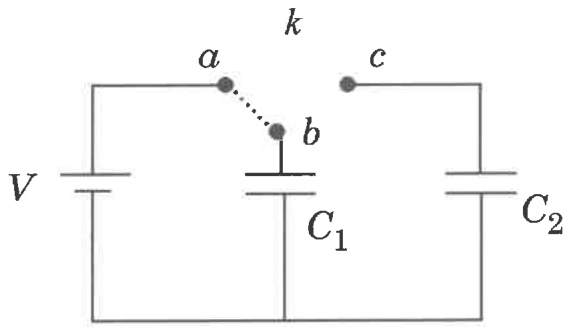
- 150 %
- 225 %
- 375 %
- 40 %
Show answer and solution
Correct: option 1, 50 %
Initially holds charge and energy . When it is joined to the identical uncharged , the charge is shared equally and the common potential is , so the final energy is . Half of the energy is lost, that is 50 %.
Question 15NEET 2019 Odisha, Q15
The radius of the first permitted Bohr orbit, for the electron, in a hydrogen atom equals and its ground state energy equals eV. If the electron in the hydrogen atom is replaced by muon [charge same as electron and mass ], the first Bohr radius and ground state energy will be,
- 1 m, keV
- 2 m, eV
- 3 m, eV
- 4 m, eV
Show answer and solution
Correct: option 1, m, keV
In the Bohr model and . With a mass 207 times larger, the radius becomes about m and the energy becomes eV keV. (The options use the usual Bohr radius of 0.53 angstrom.)
Question 16NEET 2019 Odisha, Q16
The stress-strain curves are drawn for two different materials X and Y. It is observed that the ultimate strength point and the fracture point are close to each other for material X but are far apart for material Y. We can say that materials X and Y are likely to be (respectively),
- 1brittle and plastic
- 2plastic and ductile
- 3ductile and brittle
- 4brittle and ductile
Show answer and solution
Correct: option 4, brittle and ductile
A material that breaks soon after reaching its ultimate strength is brittle, so X is brittle. A material that stretches a lot between the ultimate strength point and the fracture point is ductile, so Y is ductile.
Question 17NEET 2019 Odisha, Q17
In a u-tube as shown in the fig. water and oil are in the left side and right side of the tube respectively. The heights from the bottom for water and oil columns are 15 cm and 20 cm respectively. The density of the oil is
[take ]
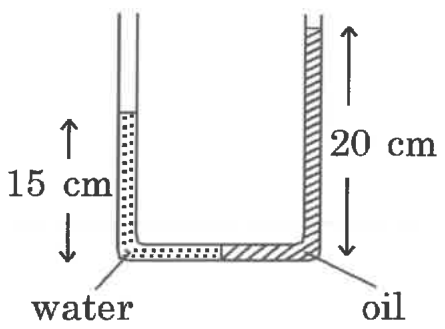
- 1
- 2
- 3
- 4
Show answer and solution
Correct: option 4,
The pressures at the bottom level of the two columns are equal: . So .
Question 18NEET 2019 Odisha, Q18
A deep rectangular pond of surface area A, containing water (density = , specific heat capacity = ), is located in a region where the outside air temperature is at a steady value of . The thickness of the frozen ice layer in this pond, at a certain instant is . Taking the thermal conductivity of ice as , and its specific latent heat of fusion as , the rate of increase of the thickness of ice layer, at this instant, would be given by
- 1
- 2
- 3
- 4
Show answer and solution
Correct: option 1,
Water just below the ice is at and the air is at , so heat is conducted through the ice at the rate . This heat comes from freezing a layer in time : . Equating, .
Question 19NEET 2019 Odisha, Q19
An LED is constructed from a p-n junction diode using GaAsP. The energy gap is 1.9 eV. The wavelength of the light emitted will be equal to
- 1
- 2 m
- 3 m
- 4654 nm
Show answer and solution
Correct: option 4, 654 nm
The photon energy equals the energy gap, so nm, which is red light.
Question 20NEET 2019 Odisha, Q20
The circuit diagram shown here corresponds to the logic gate,
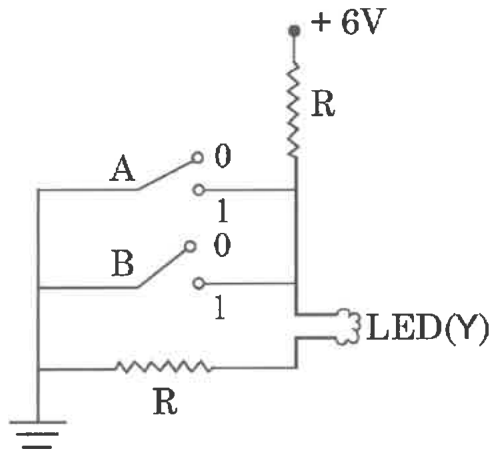
- 1OR
- 2NAND
- 3NOR
- 4AND
Show answer and solution
Correct: option 3, NOR
With both switches at 0 (open) the current from +6 V flows through the LED and it glows, so Y = 1. If either A or B is at 1 (closed), that switch joins the point above the LED directly to ground, the LED is bypassed and Y = 0. The output is 1 only when both inputs are 0, which is the NOR gate.
Question 21NEET 2019 Odisha, Q21
The value of , for hydrogen, helium and another ideal diatomic gas X (whose molecules are not rigid but have an additional vibrational mode), are respectively equal to,
- 1
- 2
- 3
- 4
Show answer and solution
Correct: option 3,
. Hydrogen is a rigid diatomic gas with , so . Helium is monatomic with , so . A diatomic gas with one vibrational mode has , so .
Question 22NEET 2019 Odisha, Q22
An object kept in a large room having air temperature of takes 12 minutes to cool from to .
The time taken to cool for the same object from to would be nearly,
- 120 min
- 215 min
- 310 min
- 412 min
Show answer and solution
Correct: option 2, 15 min
By Newton's law of cooling the rate of cooling is proportional to the average excess temperature. First interval: . Second interval: . Dividing, min.
Question 23NEET 2019 Odisha, Q23
The main scale of a vernier callipers has n divisions/cm. n divisions of the vernier scale coincide with divisions of main scale. The least count of the vernier callipers is,
- 1 cm
- 2 cm
- 3 cm
- 4 cm
Show answer and solution
Correct: option 1, cm
One main scale division is cm. One vernier division equals main scale divisions. Least count = 1 MSD 1 VSD cm.
Question 24NEET 2019 Odisha, Q24
A person travelling in a straight line moves with a constant velocity for certain distance 'x' and with a constant velocity for next equal distance. The average velocity is given by the relation
- 1
- 2
- 3
- 4
Show answer and solution
Correct: option 4,
Total distance is and total time is . So , which rearranges to .
Question 25NEET 2019 Odisha, Q25
Assuming that the gravitational potential energy of an object at infinity is zero, the change in potential energy (final initial) of an object of mass , when taken to a height from the surface of earth (of radius ), is given by,
- 1
- 2
- 3
- 4
Show answer and solution
Correct: option 4,
. The change is .
Question 26NEET 2019 Odisha, Q26
1 g of water, of volume 1 at , is converted into steam at same temperature under normal atmospheric pressure Pa. The volume of steam formed equals 1671 . If the specific latent heat of vaporisation of water is 2256 J/g, the change in internal energy is,
- 1167 J
- 22256 J
- 32423 J
- 42089 J
Show answer and solution
Correct: option 4, 2089 J
Heat supplied is J. Work done by the steam is J. By the first law, J.
Question 27NEET 2019 Odisha, Q27
Angular width of the central maxima in the Fraunhofer diffraction for is . When the same slit is illuminated by another monochromatic light, the angular width decreases by 30%. The wavelength of this light is,
- 1
- 2
- 3
- 4
Show answer and solution
Correct: option 4,
The angular width of the central maximum is , proportional to for the same slit. A width that is 30% smaller means angstrom.
Question 28NEET 2019 Odisha, Q28
The work function of a photosensitive material is 4.0 eV. The longest wavelength of light that can cause photon emission from the substance is (approximately)
- 131 nm
- 2310 nm
- 33100 nm
- 4966 nm
Show answer and solution
Correct: option 2, 310 nm
The longest (threshold) wavelength has photon energy equal to the work function: nm.
Question 29NEET 2019 Odisha, Q29
A proton and an -particle are accelerated from rest to the same energy. The de Broglie wavelengths and are in the ratio,
- 1
- 24:1
- 32:1
- 41:1
Show answer and solution
Correct: option 3, 2:1
, so for the same kinetic energy . Since , , that is 2:1.
Question 30NEET 2019 Odisha, Q30
The rate of radioactive disintegration at an instant for a radioactive sample of half life s is . The number of radioactive atoms in that sample at that instant is,
- 1
- 2
- 3
- 4
Show answer and solution
Correct: option 2,
The activity is with . So .
Question 31NEET 2019 Odisha, Q31
The time period of a geostationary satellite is 24 h, at a height ( is radius of earth) from surface of earth. The time period of another satellite whose height is from surface will be,
- 1 h
- 2 h
- 3 h
- 4 h
Show answer and solution
Correct: option 3, h
The orbital radii are and , a ratio of 2 : 1. By Kepler's third law , so h.
Question 32NEET 2019 Odisha, Q32
The variation of EMF with time for four types of generators are shown in the figures. Which amongst them can be called AC?
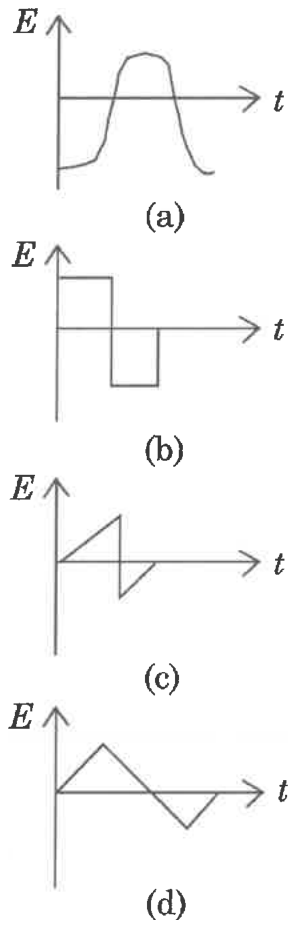
- 1(a) and (b)
- 2only (a)
- 3(a) and (d)
- 4(a), (b), (c), (d)
Show answer and solution
Correct: option 4, (a), (b), (c), (d)
An EMF is alternating if its direction (sign) reverses periodically; the wave does not have to be a sine curve. In all four graphs E is positive for part of the cycle and negative for the rest, so all of (a), (b), (c) and (d) are AC.
Question 33NEET 2019 Odisha, Q33
A body of mass is kept on a rough horizontal surface (coefficient of friction = ). A horizontal force is applied on the body, but it does not move. The resultant of normal reaction and the frictional force acting on the object is given by , where is,
- 1
- 2
- 3
- 4
Show answer and solution
Correct: option 1,
The normal reaction is and, since the body does not move, the friction is static with . The two are perpendicular, so .
Question 34NEET 2019 Odisha, Q34
A particle of mass at rest suddenly breaks on its own into three fragments. Two fragments of mass each move along mutually perpendicular direction with speed each. The energy released during the process is,
- 1
- 2
- 3
- 4
Show answer and solution
Correct: option 2,
The two small fragments have total momentum . The third fragment of mass must carry equal and opposite momentum, so its speed is . Energy released = total kinetic energy .
Question 35NEET 2019 Odisha, Q35
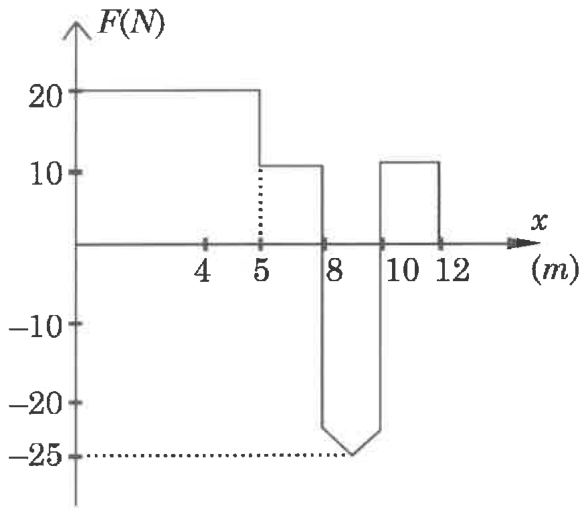
An object of mass 500 g, initially at rest, is acted upon by a variable force whose X-component varies with X in the manner shown. The velocities of the object at the points m and m, would have the respective values of (nearly)
- 123 m/s and 20.6 m/s
- 218 m/s and 20.6 m/s
- 318 m/s and 24.4 m/s
- 423 m/s and 24.4 m/s
Show answer and solution
Correct: option 1, 23 m/s and 20.6 m/s
Work done is the area under the F-x graph and equals the gain in kinetic energy. Up to 8 m: J, so and m/s. From 8 m to 10 m the area is J and from 10 m to 12 m it is J, so the total is 105 J and m/s, nearest to 20.6 m/s.
Question 36NEET 2019 Odisha, Q36
A solid cylinder of mass 2 kg and radius 50 cm rolls up an inclined plane of angle of inclination . The centre of mass of the cylinder has speed of 4 m/s. The distance travelled by the cylinder on the inclined surface will be, [take ]
- 11.2 m
- 22.4 m
- 32.2 m
- 41.6 m
Show answer and solution
Correct: option 2, 2.4 m
For a rolling solid cylinder the kinetic energy is . Setting this equal to gives m. The distance along the incline is m.
Question 37NEET 2019 Odisha, Q37
An equiconvex lens has power . It is cut into two symmetrical halves by a plane containing the principal axis. The power of one part will be,
- 1
- 2
- 30
- 4
Show answer and solution
Correct: option 2,
A cut along a plane containing the principal axis leaves both curved surfaces of each half with the same radii of curvature and the same refractive index. By the lens maker's formula the focal length is unchanged, so the power of each part is still (only the aperture and brightness are reduced).
Question 38NEET 2019 Odisha, Q38
In a Young's double slit experiment, if there is no initial phase difference between the light from the two slits, a point on the screen corresponding to the fifth minimum has path difference
- 1
- 2
- 3
- 4
Show answer and solution
Correct: option 1,
Minima occur where the path difference is with For the fifth minimum , giving .
Question 39NEET 2019 Odisha, Q39
A double convex lens has focal length 25 cm. The radius of curvature of one of the surfaces is double of the other. Find the radii if the refractive index of the material of the lens is 1.5.
- 118.75 cm, 37.5 cm
- 250 cm, 100 cm
- 3100 cm, 50 cm
- 425 cm, 50 cm
Show answer and solution
Correct: option 1, 18.75 cm, 37.5 cm
Lens maker's formula with radii and : . So cm and cm.
Question 40NEET 2019 Odisha, Q40
Two bullets are fired horizontally and simultaneously towards each other from roof tops of two buildings 100 m apart and of same height of 200 m, with the same velocity of 25 m/s. When and where will the two bullets collide? ()
- 1after 4s at a height of 120 m
- 2they will not collide
- 3after 2s at a height of 180 m
- 4after 2s at a height of 20 m
Show answer and solution
Correct: option 3, after 2s at a height of 180 m
Both bullets fall by the same amount at every instant, so they stay at the same height and meet when their horizontal separation closes: s. In 2 s each falls m, so they collide at a height of m.
Question 41NEET 2019 Odisha, Q41
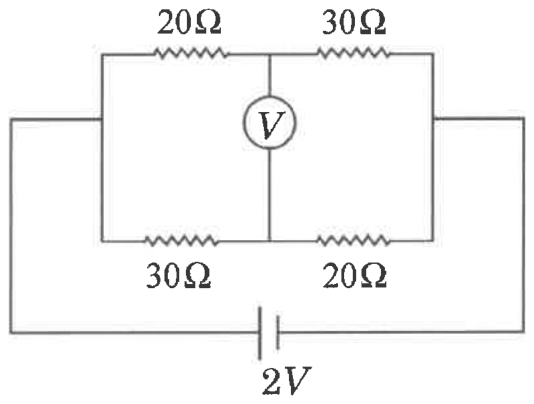
The reading of an ideal voltmeter in the circuit shown is,
- 10.5 V
- 20.4 V
- 30.6 V
- 40 V
Show answer and solution
Correct: option 2, 0.4 V
An ideal voltmeter draws no current, so each branch is simply 50 ohm across 2 V and carries A. In the upper branch the drop across the 20 ohm resistor is 0.8 V; in the lower branch the drop across the 30 ohm resistor is 1.2 V. The two midpoints therefore differ by V, which is the reading.
Question 42NEET 2019 Odisha, Q42
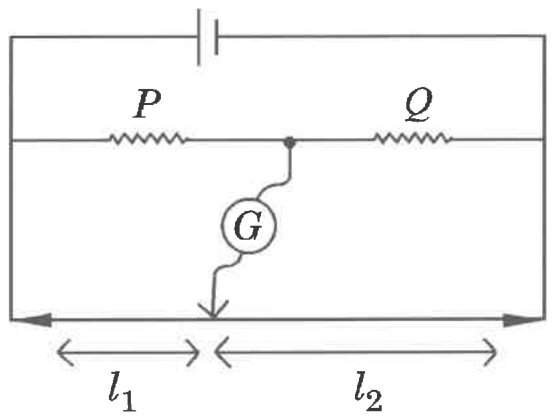
The metre bridge shown is in balance position with . If we now interchange the positions of galvanometer and cell, will the bridge work? If yes, what will be balance condition?
- 1yes,
- 2yes,
- 3yes,
- 4no, no null point
Show answer and solution
Correct: option 2, yes,
A metre bridge is a Wheatstone bridge, and in a Wheatstone bridge the cell and the galvanometer arms are conjugate: interchanging them does not disturb the balance. The bridge still works and the balance condition stays .
Question 43NEET 2019 Odisha, Q43
The relations amongst the three elements of earth's magnetic field, namely horizontal component , vertical component and dip are, ( = total magnetic field)
- 1
- 2
- 3
- 4
Show answer and solution
Correct: option 4,
The angle of dip is the angle the total field makes with the horizontal. Resolving , the horizontal component is and the vertical component is .
Question 44NEET 2019 Odisha, Q44
Two toroids 1 and 2 have total no. of turns 200 and 100 respectively with average radii 40 cm and 20 cm respectively. If they carry same current , the ratio of the magnetic fields along the two loops is,
- 12:1
- 21:2
- 31:1
- 44:1
Show answer and solution
Correct: option 3, 1:1
Inside a toroid , so for the same current. , that is 1:1.
Question 45NEET 2019 Odisha, Q45
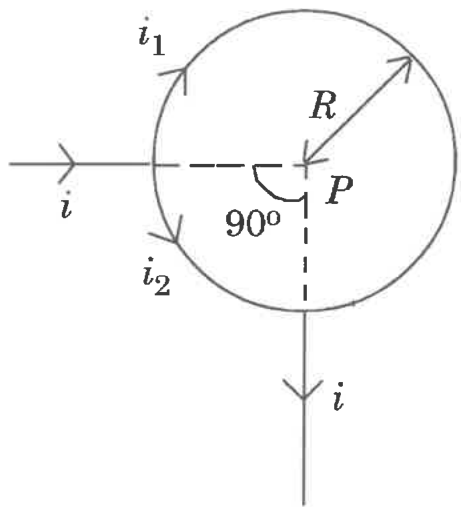
A straight conductor carrying current splits into two parts as shown in the figure. The radius of the circular loop is . The total magnetic field at the centre P of the loop is,
- 1, inward
- 2, inward
- 3zero
- 4, outward
Show answer and solution
Correct: option 3, zero
The two arcs are in parallel, so the current divides inversely as the arc lengths: . The field at the centre due to an arc is proportional to (current arc length), so the two arcs give equal fields, and they are in opposite directions because the currents go round opposite ways. The straight wires point along lines through P and give no field there. The total field is zero.
NEET 2019 Odisha Chemistry questions
Question 46NEET 2019 Odisha, Q46
Which of the following is the correct order of dipole moment?
- 1
- 2
- 3
- 4
Show answer and solution
Correct: option 4,
is trigonal planar, so its bond dipoles cancel and its dipole moment is zero. In the N-F bond dipoles point away from the lone pair and partly cancel it (about 0.23 D), while in the N-H bond dipoles add to the lone pair (about 1.47 D). Water has the largest value (about 1.85 D). So the order is .
Question 47NEET 2019 Odisha, Q47
Crude sodium chloride obtained by crystallisation of brine solution does not contain -
- 1
- 2
- 3
- 4
Show answer and solution
Correct: option 3,
Crude sodium chloride from brine carries sodium sulphate, calcium sulphate, calcium chloride and magnesium chloride as impurities. Magnesium sulphate is not one of them, so is the answer.
Question 48NEET 2019 Odisha, Q48
Which of the alkali metal chloride (MCl) forms its dihydrate salt easily?
- 1RbCl
- 2KCl
- 3LiCl
- 4CsCl
Show answer and solution
Correct: option 3, LiCl
is the smallest alkali metal ion, so it has the highest charge density and the greatest hydration energy. Its salts are therefore often hydrated, and lithium chloride crystallises as . The chlorides of the larger alkali metals crystallise without water.
Question 49NEET 2019 Odisha, Q49
Aluminium chloride in acidified aqueous solution forms a complex 'A', in which hybridisation state of Al is 'B'. What are 'A' and 'B', respectively?
- 1,
- 2,
- 3,
- 4,
Show answer and solution
Correct: option 3, ,
In acidified water aluminium chloride gives the octahedral ion . Aluminium has no inner d orbitals available (its 3d orbitals are the outer ones), so the six bonds use the 3s, three 3p and two 3d orbitals: hybridisation.
Question 50NEET 2019 Odisha, Q50
Which of the following compounds is used in cosmetic surgery?
- 1Silicones
- 2Zeolites
- 3Silica
- 4Silicates
Show answer and solution
Correct: option 1, Silicones
Silicones are chemically inert, water repelling and compatible with body tissue, so they are used in surgical and cosmetic implants. Zeolites, silica and silicates have no such use.
Question 51NEET 2019 Odisha, Q51
Identify the incorrect statement.
- 1Ores are minerals that may contain a metal.
- 2Gangue is an ore contaminated with undesired materials.
- 3The scientific and technological process used for isolation of the metal from its ore is known as metallurgy.
- 4Minerals are naturally occurring chemical substances in the earth's crust.
Show answer and solution
Correct: option 2, Gangue is an ore contaminated with undesired materials.
Gangue is not an ore. It is the unwanted earthy or rocky material (sand, clay and so on) that comes mixed with the ore. The other three statements describe minerals, ores and metallurgy acceptably, so statement (2) is the incorrect one.
Question 52NEET 2019 Odisha, Q52
A compound 'X' upon reaction with produces a colorless gas 'Y' with rotten fish smell. Gas 'Y' is absorbed in a solution of to give as one of the products. Predict the compound 'X'.
- 1
- 2
- 3
- 4
Show answer and solution
Correct: option 3,
The colourless gas with a rotten fish smell is phosphine. Calcium phosphide gives it with water: . Phosphine is absorbed by copper sulphate solution: . So X is .
Question 53NEET 2019 Odisha, Q53
Which of the following oxoacids of phosphorus has strongest reducing property?
- 1
- 2
- 3
- 4
Show answer and solution
Correct: option 1,
The reducing power of a phosphorus oxoacid comes from its P-H bonds. has two P-H bonds, has one, and and have none. So is the strongest reducing agent.
Question 54NEET 2019 Odisha, Q54
Identify the correct formula of 'oleum' from the following.
- 1
- 2
- 3
- 4
Show answer and solution
Correct: option 3,
Oleum (pyrosulphuric acid) is made in the contact process by dissolving in concentrated sulphuric acid: .
Question 55NEET 2019 Odisha, Q55
When neutral or faintly alkaline is treated with potassium iodide, iodide ion is converted into 'X'. 'X' is -
- 1
- 2
- 3
- 4
Show answer and solution
Correct: option 1,
In neutral or faintly alkaline solution permanganate oxidises iodide to iodate: . Iodine is the product only in acidic solution.
Question 56NEET 2019 Odisha, Q56
The Crystal Field Stabilisation Energy (CFSE) for is . The CFSE for will be -
- 1
- 2
- 3
- 4
Show answer and solution
Correct: option 2,
For the same metal ion and the same ligand, the tetrahedral splitting is four ninths of the octahedral splitting: .
Question 57NEET 2019 Odisha, Q57
Match the oxide given in column A with its property given in column B:
| Column - A | | Column - B |
|---|
| (i) | | (a) | Neutral |
| (ii) | | (b) | Basic |
| (iii) | | (c) | Acidic |
| (iv) | | (d) | Amphoteric |
Which of the following options has all correct pairs?
- 1i-a, ii-d, iii-b, iv-c
- 2i-b, ii-d, iii-a, iv-c
- 3i-b, ii-a, iii-d, iv-c
- 4i-c, ii-b, iii-a, iv-d
Show answer and solution
Correct: option 2, i-b, ii-d, iii-a, iv-c
is the oxide of a very electropositive metal and is basic (b). reacts with both acids and bases, so it is amphoteric (d). reacts with neither and is neutral (a). is a non-metal oxide that gives perchloric acid with water, so it is acidic (c). That is i-b, ii-d, iii-a, iv-c.
Question 58NEET 2019 Odisha, Q58
The density of 2 M aqueous solution of NaOH is . The molality of the solution is [Given that molecular mass of NaOH = ]
- 11.67 m
- 21.32 m
- 31.20 m
- 41.56 m
Show answer and solution
Correct: option 1, 1.67 m
One litre of solution weighs g and holds 2 mol, that is 80 g, of NaOH. The water is g kg. Molality m.
Question 59NEET 2019 Odisha, Q59
Orbital having 3 angular nodes and 3 total nodes is -
- 14 f
- 26 d
- 35 p
- 43 d
Show answer and solution
Correct: option 1, 4 f
The number of angular nodes is , so , an f orbital. The total number of nodes is , so . The orbital is 4f (it has no radial node).
Question 60NEET 2019 Odisha, Q60
In hydrogen atom, the de Broglie wavelength of an electron in the second Bohr orbit is -
[Given that Bohr radius, pm]
- 1 pm
- 2105.8 pm
- 3211.6 pm
- 4 pm
Show answer and solution
Correct: option 4, pm
The circumference of the nth orbit holds n wavelengths: . For , , so pm.
Question 61NEET 2019 Odisha, Q61
The volume occupied by 1.8 g of water vapour at 374 °C and 1 bar pressure will be -
[Use ]
- 13.10 L
- 25.37 L
- 396.66 L
- 455.87 L
Show answer and solution
Correct: option 2, 5.37 L
Moles of water and K. L.
Question 62NEET 2019 Odisha, Q62
An ideal gas expands isothermally from to at 300 K against a constant pressure of . The work done on the gas is -
- 1+ 900 kJ
- 2− 900 kJ
- 3+ 270 kJ
- 4− 900 J
Show answer and solution
Correct: option 4, − 900 J
Against a constant external pressure, J. The sign is negative because the gas does work on the surroundings.
Question 63NEET 2019 Odisha, Q63
Reversible expansion of an ideal gas under isothermal and adiabatic conditions are as shown in the figure.
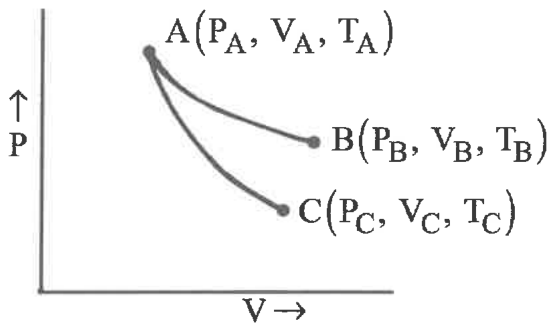
AB Isothermal expansion
AC Adiabatic expansion
Which of the following options is not correct?
- 1
- 2
- 3
- 4
Show answer and solution
Correct: option 2,
In a reversible adiabatic expansion the gas does work at the cost of its own internal energy, so it cools: . Statement (2) is therefore the one that is not correct. The others hold: the isothermal curve lies above the adiabatic one, so more work is done along AB; the entropy of the gas rises in the isothermal expansion but does not change in the reversible adiabatic one; and because AB is isothermal.
Question 64NEET 2019 Odisha, Q64
The pH of 0.01 M NaOH (aq) solution will be -
- 112
- 29
- 37.01
- 42
Show answer and solution
Correct: option 1, 12
NaOH is a strong base, so M and pOH . At 25 °C, pH .
Question 65NEET 2019 Odisha, Q65
Which of the following cannot act both as Bronsted acid and as Bronsted base?
- 1HCl
- 2
- 3
- 4
Show answer and solution
Correct: option 1, HCl
and can each lose a proton or gain one, and can gain a proton to give or lose one to give . HCl only donates a proton in ordinary conditions, so it acts as a Bronsted acid only.
Question 66NEET 2019 Odisha, Q66
The molar solubility of () in 0.1 M solution of NaF will be -
- 1
- 2
- 3
- 4
Show answer and solution
Correct: option 1,
If the solubility is , then and M because of the common ion. , so .
Question 67NEET 2019 Odisha, Q67
The oxidation state of Cr in is -
- 1+ 6
- 2+ 4
- 3− 6
- 4+ 12
Show answer and solution
Correct: option 1, + 6
Chromium has only six valence electrons (), so its oxidation state can never be higher than +6. An oxide of chromium this rich in oxygen must therefore hold some of its oxygen as peroxide (, oxygen at −1), as in the well known peroxide , and chromium is at +6. The value +12 that plain counting with oxide ions would give is impossible.
Question 68NEET 2019 Odisha, Q68
Match the catalyst with the process:
| Catalyst | | Process |
|---|
| (i) | | (a) | The oxidation of ethyne to ethanal |
| (ii) | | (b) | Polymerisation of alkynes |
| (iii) | | (c) | Oxidation of in the manufacture of |
| (iv) | Nickel complexes | (d) | Polymerisation of ethylene |
Which of the following is the correct option?
- 1i-a, ii-c, iii-b, iv-d
- 2i-c, ii-a, iii-d, iv-b
- 3i-c, ii-d, iii-a, iv-b
- 4i-a, ii-b, iii-c, iv-d
Show answer and solution
Correct: option 3, i-c, ii-d, iii-a, iv-b
catalyses the oxidation of to in the contact process (c). with an aluminium alkyl is the Ziegler-Natta catalyst for making polythene (d). is the catalyst of the Wacker process that makes ethanal (a). Nickel complexes are used to polymerise alkynes (b). That is i-c, ii-d, iii-a, iv-b.
Question 69NEET 2019 Odisha, Q69
The most stable carbocation, among the following, is -
- 1
- 2
- 3
- 4
Show answer and solution
Correct: option 1,
Option (2) is a primary carbocation and the least stable. The other three are secondary, so the number of hydrogens on the carbons next to the positive carbon decides, because each one adds a hyperconjugation structure. Option (1) has 5 such hydrogens ( and ), option (4) has 4 and option (3) has 3. So (1) is the most stable.
Question 70NEET 2019 Odisha, Q70
The alkane that gives only one mono-chloro product on chlorination with in presence of diffused sunlight is -
- 1n-pentane
- 2Isopentane
- 32, 2 - dimethylbutane
- 4neopentane
Show answer and solution
Correct: option 4, neopentane
Neopentane, , has twelve hydrogens that are all equivalent, so replacing any one of them gives the same product, 1-chloro-2,2-dimethylpropane. n-Pentane has 3 kinds of hydrogen, isopentane 4 and 2,2-dimethylbutane 3, so each of them gives a mixture.
Question 71NEET 2019 Odisha, Q71
In the following reaction,
,
the number of sigma () bonds present in the product A, is -
- 124
- 218
- 321
- 49
Show answer and solution
Correct: option 3, 21
Three molecules of propyne join in a red hot iron tube to give mesitylene (1,3,5-trimethylbenzene), . It has 6 C-C sigma bonds in the ring, 3 C-C sigma bonds to the methyl groups and 12 C-H bonds (3 on the ring and 9 in the methyl groups): .
Question 72NEET 2019 Odisha, Q72
The liquified gas that is used in dry cleaning along with a suitable detergent is -
- 1
- 2
- 3Water gas
- 4Petroleum gas
Show answer and solution
Correct: option 2,
Liquefied carbon dioxide with a suitable detergent is the green chemistry replacement for tetrachloroethene in dry cleaning. It does not contaminate ground water and is far less harmful.
Question 73NEET 2019 Odisha, Q73
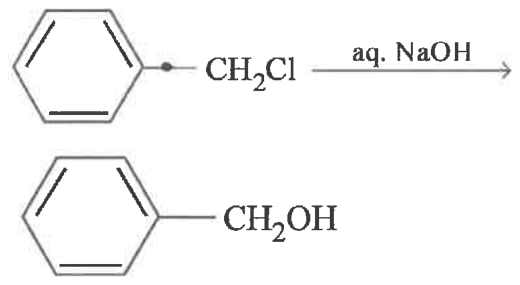
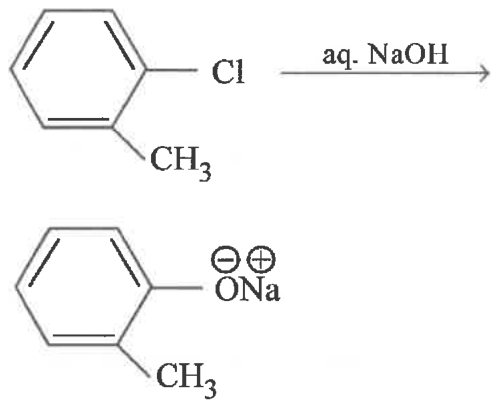
The hydrolysis reaction that takes place at the slowest rate, among the following, is -
- 1
- 2
- 3
- 4
Show answer and solution
Correct: option 3
In option (3) the chlorine is bonded directly to the benzene ring (an aryl halide). Resonance gives the C-Cl bond partial double bond character, the carbon is hybridised and the ring repels the incoming nucleophile, so aryl halides are hydrolysed only under drastic conditions. Allyl chloride (1) and benzyl chloride (2) react fast because their carbocations are stabilised by resonance, and ethyl chloride (4) is an ordinary primary alkyl halide. So (3) is the slowest.
Question 74NEET 2019 Odisha, Q74
When vapours of a secondary alcohol is passed over heated copper at 573 K, the product formed is -
- 1a ketone
- 2an alkene
- 3a carboxylic acid
- 4an aldehyde
Show answer and solution
Correct: option 1, a ketone
Heated copper at 573 K dehydrogenates alcohols. A secondary alcohol loses hydrogen to give a ketone: . A primary alcohol gives an aldehyde, and a tertiary alcohol is dehydrated to an alkene.
Question 75NEET 2019 Odisha, Q75
The number of hydrogen bonded water molecule(s) associated with is -
- 12
- 25
- 33
- 41
Show answer and solution
Correct: option 4, 1
Blue vitriol is . Four water molecules are coordinated to the copper ion. The fifth is not bonded to copper; it is held by hydrogen bonds between the sulphate ion and the coordinated water. So one water molecule is hydrogen bonded.
Question 76NEET 2019 Odisha, Q76
Formula of nickel oxide with metal deficiency defect in its crystal is . The crystal contains and ions. The fraction of nickel existing as ions in the crystal is -
- 10.50
- 20.31
- 30.96
- 40.04
Show answer and solution
Correct: option 3, 0.96
Let of the 0.98 nickel ions be and be . The charge must balance one : , so . The fraction of nickel present as is .
Question 77NEET 2019 Odisha, Q77
Which of the following statements is correct regarding a solution of two components A and B exhibiting positive deviation from ideal behaviour?
- 1 at constant T and P.
- 2Intermolecular attractive forces between A-A and B-B are equal to those between A-B.
- 3Intermolecular attractive forces between A-A and B-B are stronger than those between A-B.
- 4 at constant T and P.
Show answer and solution
Correct: option 3, Intermolecular attractive forces between A-A and B-B are stronger than those between A-B.
A positive deviation from Raoult's law means the vapour pressure is higher than the ideal value. That happens when the A-B attractions are weaker than the A-A and B-B attractions, so molecules escape more easily. For such solutions and are both positive, not zero; options (1), (2) and (4) describe an ideal solution.
Question 78NEET 2019 Odisha, Q78
In water saturated air, the mole fraction of water vapour is 0.02. If the total pressure of the saturated air is 1.2 atm, the partial pressure of dry air is -
- 11.176 atm
- 20.98 atm
- 31.18 atm
- 41.76 atm
Show answer and solution
Correct: option 1, 1.176 atm
The mole fraction of dry air is . By Dalton's law its partial pressure is atm.
Question 79NEET 2019 Odisha, Q79
The standard electrode potential () values of , , and are −1.66 V, 0.80 V, −2.93 V and −0.74 V, respectively. The correct decreasing order of reducing power of the metal is -
- 1K > Al > Ag > Cr
- 2Al > K > Ag > Cr
- 3Ag > Cr > Al > K
- 4K > Al > Cr > Ag
Show answer and solution
Correct: option 4, K > Al > Cr > Ag
The more negative the standard reduction potential, the more easily the metal is oxidised and the stronger it is as a reducing agent. In order of increasing potential: K (−2.93 V), Al (−1.66 V), Cr (−0.74 V), Ag (+0.80 V). So the reducing power falls as K > Al > Cr > Ag.
Question 80NEET 2019 Odisha, Q80
The major products C and D formed in the following reaction respectively are:
- 1 and
- 2 and
- 3 and
- 4 and
Show answer and solution
Correct: option 3, and
HI first cleaves the ether by the path through the stable tert-butyl cation, giving tert-butyl iodide and propan-1-ol. Because HI is in excess and the mixture is heated, the alcohol is also converted into its iodide. The final products are 1-iodopropane and tert-butyl iodide.
Question 81NEET 2019 Odisha, Q81
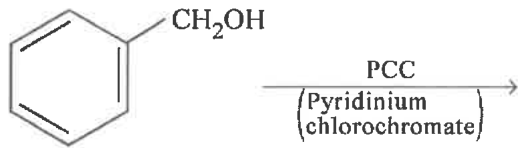
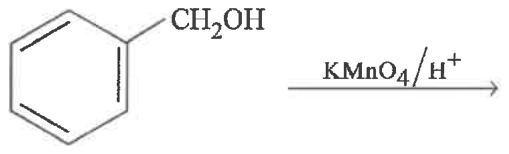
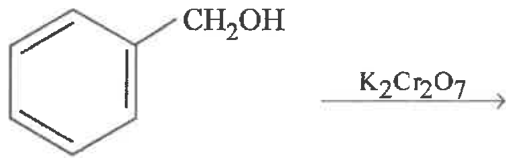
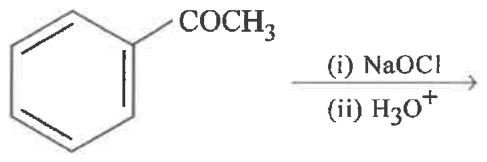
The reaction that does not give benzoic acid as the major product is -
- 1
- 2
- 3
- 4
Show answer and solution
Correct: option 1
PCC is a mild oxidising agent that stops at the aldehyde, so benzyl alcohol gives benzaldehyde in (1). Acidified in (2) and in (3) are strong oxidising agents that take benzyl alcohol all the way to benzoic acid. In (4) acetophenone undergoes the haloform reaction with NaOCl to give sodium benzoate, which gives benzoic acid on acidification.
Question 82NEET 2019 Odisha, Q82
Following limiting molar conductivities are given as
(in ) for will be -
- 1
- 2
- 3
- 4
Show answer and solution
Correct: option 2,
By Kohlrausch's law, . Here and , so . Adding gives .
Question 83NEET 2019 Odisha, Q83
A first order reaction has a rate constant of . The time required for 40 g of this reactant to reduce to 10 g will be -
[Given that ]
- 12000 s
- 2602 s
- 3230.3 s
- 4301 s
Show answer and solution
Correct: option 2, 602 s
s. (Going from 40 g to 10 g is two half-lives of 301 s each.)
Question 84NEET 2019 Odisha, Q84
For a reaction, activation energy and the rate constant at 200 K is . The rate constant at 400 K will be -
[Given that gas constant, ]
- 1
- 2
- 3
- 4
Show answer and solution
Correct: option 4,
From the Arrhenius equation . With the exponential is 1, so at every temperature. The rate constant at 400 K is the same, .
Question 85NEET 2019 Odisha, Q85
The correct option representing a Freundlich adsorption isotherm is -
- 1
- 2
- 3
- 4
Show answer and solution
Correct: option 3,
The Freundlich isotherm is with , so the power of the pressure lies between 0 and 1. Only 0.3 is in that range.
Question 86NEET 2019 Odisha, Q86
Which of the following is paramagnetic?
- 1
- 2
- 3
- 4
Show answer and solution
Correct: option 2,
Molecular orbital theory puts the last two electrons of singly into the two degenerate orbitals, so has two unpaired electrons and is paramagnetic. In , and every electron is paired, so they are diamagnetic.
Question 87NEET 2019 Odisha, Q87
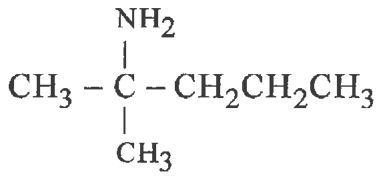
The amine that reacts with Hinsberg's reagent to give an alkali insoluble product is -
- 1
- 2
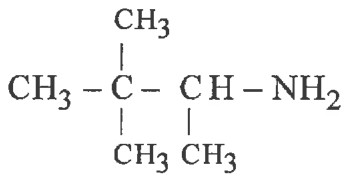
- 3
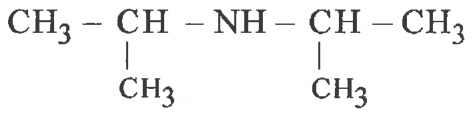
- 4
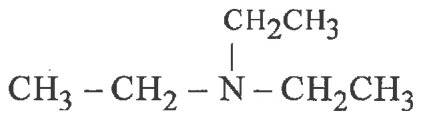
Show answer and solution
Correct: option 3
Hinsberg's reagent is benzenesulphonyl chloride. A primary amine, as in (1) and (2), gives an N-alkyl sulphonamide that still has an acidic N-H hydrogen and dissolves in alkali. A secondary amine, as in (3), gives an N,N-dialkyl sulphonamide with no hydrogen on nitrogen, so it is insoluble in alkali. The tertiary amine in (4) does not react. So the answer is the secondary amine (3).
Question 88NEET 2019 Odisha, Q88
Which structure(s) of proteins remain(s) intact during denaturation process?
- 1Secondary structure only
- 2Tertiary structure only
- 3Both secondary and tertiary structures
- 4Primary structure only
Show answer and solution
Correct: option 4, Primary structure only
Denaturation by heat or a change of pH breaks the hydrogen bonds and other weak interactions that hold the secondary and tertiary structures, so the helices and folds are lost. The peptide bonds are not broken, so the amino acid sequence, the primary structure, stays intact.
Question 89NEET 2019 Odisha, Q89
The polymer that is used as a substitute for wool in making commercial fibres is -
- 1polyacrylonitrile
- 2Buna - N
- 3melamine
- 4nylon - 6, 6
Show answer and solution
Correct: option 1, polyacrylonitrile
Polyacrylonitrile, the addition polymer of acrylonitrile, is used as a substitute for wool in commercial fibres such as orlon and acrilan. Buna-N is a synthetic rubber, melamine polymer is used for unbreakable crockery and nylon-6,6 for sheets, bristles and textile fibres.
Question 90NEET 2019 Odisha, Q90
The artificial sweetener stable at cooking temperature and does not provide calories is -
- 1sucralose
- 2alitame
- 3saccharin
- 4aspartame
Show answer and solution
Correct: option 1, sucralose
Sucralose is a trichloro derivative of sucrose. It is stable at cooking temperature and passes through the body without giving calories. Aspartame breaks down on heating, so it is used only in cold foods, and alitame's sweetness is hard to control.
NEET 2019 Odisha Biology questions
Question 91NEET 2019 Odisha, Q91
In a marriage between male with blood group A and female with blood group B, the progeny had either blood group AB or B. What could be the possible genotype of parents?
- 1 (Male); (Female)
- 2 (Male); (Female)
- 3 (Male); (Female)
- 4 (Male); (Female)
Show answer and solution
Correct: option 3, (Male); (Female)
A child of group B must get from the mother and from the father, so the father is . No child is A or O, so the mother never passes on and is . The cross gives only (AB) and (B).
Question 92NEET 2019 Odisha, Q92
A population of a species invades a new area. Which of the following condition will lead to Adaptive Radiation?
- 1Area with many types of vacant habitats.
- 2Area with many habitats occupied by a large number of species.
- 3Area with large number of habitats having very low food supply.
- 4Area with a single type of vacant habitat.
Show answer and solution
Correct: option 1, Area with many types of vacant habitats.
Adaptive radiation is the evolution of many forms from one ancestral stock as it spreads into different habitats. That needs several kinds of habitat that are empty, so the invaders face no competitors and each group can adapt to a different habitat. Occupied habitats, poor food supply or a single habitat type do not allow this.
Question 93NEET 2019 Odisha, Q93
Identify A, B and C in the diagrammatic representation of the mechanism of hormone action.
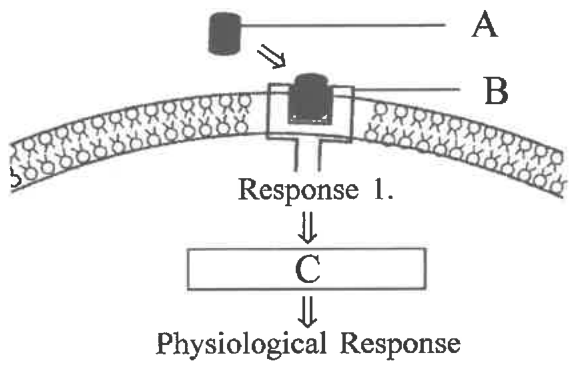
Select the correct option from the following:
- 1A = Steroid Hormone; B = Receptor; C = Second Messenger
- 2A = Protein Hormone; B = Cyclic AMP; C = Hormone-receptor Complex
- 3A = Steroid Hormone; B = Hormone-receptor Complex; C = Protein
- 4A = Protein Hormone; B = Receptor; C = Cyclic AMP
Show answer and solution
Correct: option 4, A = Protein Hormone; B = Receptor; C = Cyclic AMP
The hormone in the picture does not enter the cell; it binds a receptor sitting in the cell membrane, which is how protein hormones act (steroid hormones pass through the membrane to receptors inside the cell). So A is a protein hormone and B is its membrane receptor. Binding generates a second messenger such as cyclic AMP (C), which brings about the physiological response.
Question 94NEET 2019 Odisha, Q94
Humans have acquired immune system that produces antibodies to neutralize pathogens. Still innate immune system is present at the time of birth because it
- 1has natural killer cells which can phagocytose and destroy microbes.
- 2provides passive immunity.
- 3is very specific and uses different macrophages.
- 4produces memory cells for mounting fast secondary response.
Show answer and solution
Correct: option 1, has natural killer cells which can phagocytose and destroy microbes.
Innate immunity is the non-specific defence present from birth. Its cellular barriers include natural killer cells, neutrophils and macrophages, which destroy microbes straight away. Specificity and memory cells belong to acquired immunity, and passive immunity means ready-made antibodies, so the other options do not describe innate immunity.
Question 95NEET 2019 Odisha, Q95
Select the incorrect statement regarding inbreeding.
- 1Continued inbreeding reduces fertility and leads to inbreeding depression.
- 2Inbreeding depression can not be overcome by Out-crossing.
- 3Inbreeding helps in elimination of deleterious alleles from the population.
- 4Inbreeding is necessary to evolve a pureline in any animal.
Show answer and solution
Correct: option 2, Inbreeding depression can not be overcome by Out-crossing.
Inbreeding raises homozygosity, which is needed for a pure line and exposes harmful recessive alleles so that they can be selected out. Continued inbreeding lowers fertility and productivity (inbreeding depression). This is overcome by mating the animals with unrelated animals of the same breed, that is, by out-crossing, so the statement that it cannot be overcome is the incorrect one.
Question 96NEET 2019 Odisha, Q96
A biocontrol agent to be a part of an integrated pest management should be
- 1narrow spectrum and symbiotic
- 2species-specific and inactive on non-target organisms
- 3species-specific and symbiotic
- 4free living and broad spectrum
Show answer and solution
Correct: option 2, species-specific and inactive on non-target organisms
A good biocontrol agent attacks only the target pest and leaves plants, mammals, birds, fish and other insects unharmed. Baculoviruses of the genus Nucleopolyhedrovirus are the textbook example: species-specific, narrow spectrum, and with no effect on non-target organisms. Being symbiotic is not required, and a broad-spectrum agent would harm useful organisms.
Question 97NEET 2019 Odisha, Q97
Which of the following organic compounds is the main constituent of Lecithin?
- 1Cholesterol
- 2Phosphoprotein
- 3Arachidonic acid
- 4Phospholipid
Show answer and solution
Correct: option 4, Phospholipid
Lecithin is phosphatidylcholine: glycerol carrying two fatty acids and a phosphate group joined to choline. A lipid with a phosphate group is a phospholipid, and lecithin is a common phospholipid of cell membranes.
Question 98NEET 2019 Odisha, Q98
The main difference between active and passive transport across cell membrane is:
- 1passive transport is confined to anionic carrier proteins whereas active transport is confined to cationic channel proteins.
- 2active transport occurs more rapidly than passive transport.
- 3passive transport is non-selective whereas active transport is selective.
- 4passive transport requires a concentration gradient across a biological membrane whereas active transport requires energy to move solutes.
Show answer and solution
Correct: option 4, passive transport requires a concentration gradient across a biological membrane whereas active transport requires energy to move solutes.
Passive transport moves substances down their concentration gradient and uses no metabolic energy. Active transport moves solutes against the gradient and spends ATP, as in the sodium-potassium pump. The other options are not general differences: facilitated diffusion is also selective, and neither kind of transport is limited to anions or cations.
Question 99NEET 2019 Odisha, Q99
Match the items given in Column - I with those in Column - II and choose the correct option.
| Column - I | Column - II |
|---|
| (a) Rennin | (i) Vitamin |
| (b) Enterokinase | (ii) Facilitated transport |
| (c) Oxyntic cells | (iii) Milk proteins |
| (d) Fructose | (iv) Trypsinogen |
- 1a-iv, b-iii, c-ii, d-i
- 2a-iii, b-iv, c-i, d-ii
- 3a-iii, b-iv, c-ii, d-i
- 4a-iv, b-iii, c-i, d-ii
Show answer and solution
Correct: option 2, a-iii, b-iv, c-i, d-ii
Rennin in the gastric juice of infants digests milk proteins (iii). Enterokinase from the intestinal mucosa activates trypsinogen to trypsin (iv). Oxyntic (parietal) cells secrete HCl and the intrinsic factor needed to absorb vitamin (i). Fructose is absorbed with the help of carrier proteins, that is, by facilitated transport (ii). So a-iii, b-iv, c-i, d-ii.
Question 100NEET 2019 Odisha, Q100
Kwashiorkor disease is due to -
- 1deficiency of carbohydrates
- 2protein deficiency not accompanied by calorie deficiency
- 3simultaneous deficiency of proteins and fats
- 4simultaneous deficiency of proteins and calories
Show answer and solution
Correct: option 2, protein deficiency not accompanied by calorie deficiency
Kwashiorkor appears when a child's diet has enough calories, mainly from carbohydrate, but too little protein, typically after breast milk is replaced by a starchy diet. A shortage of both protein and calories together causes marasmus instead.
Question 101NEET 2019 Odisha, Q101
Select the correct statement.
- 1Inspiration occurs when atmospheric pressure is less than intrapulmonary pressure.
- 2Expiration is initiated due to contraction of diaphragm.
- 3Expiration occurs due to external intercostal muscles.
- 4Intrapulmonary pressure is lower than the atmospheric pressure during inspiration.
Show answer and solution
Correct: option 4, Intrapulmonary pressure is lower than the atmospheric pressure during inspiration.
Air flows into the lungs only when the pressure inside them (intrapulmonary pressure) is below atmospheric pressure. This is produced by contraction of the diaphragm and the external intercostal muscles, which enlarges the thorax, so these contractions cause inspiration, not expiration. Expiration follows when these muscles relax.
Question 102NEET 2019 Odisha, Q102
The maximum volume of air a person can breathe in after a forced expiration is known as:
- 1Inspiratory Capacity
- 2Total Lung Capacity
- 3Expiratory Capacity
- 4Vital Capacity
Show answer and solution
Correct: option 4, Vital Capacity
Vital capacity is the largest volume of air a person can breathe in after a forced expiration (or breathe out after a forced inspiration). It equals ERV + TV + IRV. Inspiratory capacity is measured from a normal expiration, and total lung capacity also includes the residual volume, which cannot be breathed in or out.
Question 103NEET 2019 Odisha, Q103
All the components of the nodal tissue are autoexcitable. Why does the SA node act as the normal pacemaker?
- 1Only SA node can convey the action potential to the other components.
- 2SA node has the highest rate of depolarisation.
- 3SA node has the lowest rate of depolarisation.
- 4SA node is the only component to generate the threshold potential.
Show answer and solution
Correct: option 2, SA node has the highest rate of depolarisation.
Every part of the nodal tissue can generate action potentials by itself, but the SA node does so at the highest rate, about 70 to 75 per minute. Its impulse reaches the other parts before they fire on their own, so the SA node sets the rhythm of the whole heart.
Question 104NEET 2019 Odisha, Q104
A specialised nodal tissue embedded in the lower corner of the right atrium, close to Atrio-ventricular septum, delays the spreading of impulses to heart apex for about 0.1 sec. This delay allows -
- 1blood to enter pulmonary arteries.
- 2the atria to empty completely.
- 3blood to enter aorta.
- 4the ventricles to empty completely.
Show answer and solution
Correct: option 2, the atria to empty completely.
The tissue described is the AV node. The short delay there holds back ventricular excitation until the atria have finished contracting, so the atria empty completely into the ventricles before the ventricles start to contract. Blood enters the aorta and pulmonary arteries only later, during ventricular systole.
Question 105NEET 2019 Odisha, Q105
Match the following enzymes with their functions:
| |
|---|
| (a) Restriction endonuclease | (i) joins the DNA fragments |
| (b) Restriction exonuclease | (ii) extends primers on genomic DNA template |
| (c) DNA ligase | (iii) cuts DNA at specific position |
| (d) Tag polymerase | (iv) removes nucleotides from the ends of DNA |
Select the correct option from the following:
- 1a-iv, b-iii, c-i, d-ii
- 2a-ii, b-iv, c-i, d-iii
- 3a-iii, b-i, c-iv, d-ii
- 4a-iii, b-iv, c-i, d-ii
Show answer and solution
Correct: option 4, a-iii, b-iv, c-i, d-ii
A restriction endonuclease cuts DNA at a specific position inside the molecule (iii). An exonuclease removes nucleotides from the ends of DNA (iv). DNA ligase joins DNA fragments (i). The heat-stable polymerase used in PCR extends the primers on the genomic DNA template (ii). So a-iii, b-iv, c-i, d-ii.
Question 106NEET 2019 Odisha, Q106
The two antibiotic resistance genes on vector pBR 322 are for
- 1Chloramphenicol and Tetracycline
- 2Tetracycline and Kanamycin
- 3Ampicillin and Tetracycline
- 4Ampicillin and Chloramphenicol
Show answer and solution
Correct: option 3, Ampicillin and Tetracycline
The cloning vector pBR322 carries two selectable markers: the ampicillin resistance gene and the tetracycline resistance gene. Inserting foreign DNA into one of them inactivates it, which is how recombinants are picked out.
Question 107NEET 2019 Odisha, Q107
Exploitation of bioresources of a nation by multinational companies without authorization from the concerned country is referred to as -
- 1Bioethics
- 2Biowar
- 3Bioweapon
- 4Biopiracy
Show answer and solution
Correct: option 4, Biopiracy
Biopiracy is the use of a country's biological resources, or the traditional knowledge about them, by multinational companies and other organisations without proper authorisation from the country and people concerned and without compensatory payment.
Question 108NEET 2019 Odisha, Q108
Carnivorous animals - lions and leopards, occupy the same niche but lions predate mostly larger animals and leopards take smaller ones. This mechanism of competition is referred to as -
- 1Resource partitioning
- 2Competitive exclusion
- 3Character displacement
- 4Altruism
Show answer and solution
Correct: option 1, Resource partitioning
Two species competing for the same resource can coexist if they divide it, for example by feeding at different times, in different places or on different sizes of prey. Lions taking larger prey and leopards taking smaller prey is such a division, called resource partitioning. Competitive exclusion would mean one of the two species is eliminated.
Question 109NEET 2019 Odisha, Q109
Decline in the population of Indian native fishes due to introduction of Clarias gariepinus in river Yamuna can be categorised as
- 1Over exploitation
- 2Alien species invasion
- 3Co-extinction
- 4Habitat fragmentation
Show answer and solution
Correct: option 2, Alien species invasion
Clarias gariepinus, the African catfish, was brought in for aquaculture and is not native to Indian rivers. An introduced species that spreads and causes the decline of native species is an alien species invasion, one of the four major causes of biodiversity loss; here it threatens the native catfishes.
Question 110NEET 2019 Odisha, Q110
Match the following genera with their respective phylum:
| |
|---|
| (a) Ophiura | (i) Mollusca |
| (b) Physalia | (ii) Platyhelminthes |
| (c) Pinctada | (iii) Echinodermata |
| (d) Planaria | (iv) Coelenterata |
Select the correct option:
- 1a-i, b-iii, c-iv, d-ii
- 2a-iii, b-iv, c-ii, d-i
- 3a-iv, b-i, c-iii, d-ii
- 4a-iii, b-iv, c-i, d-ii
Show answer and solution
Correct: option 4, a-iii, b-iv, c-i, d-ii
Ophiura is the brittle star, an echinoderm (iii). Physalia, the Portuguese man-of-war, is a coelenterate (iv). Pinctada is the pearl oyster, a mollusc (i). Planaria is a free-living flatworm of Platyhelminthes (ii). So a-iii, b-iv, c-i, d-ii.
Question 111NEET 2019 Odisha, Q111
Which of the following animals are true coelomates with bilateral symmetry?
- 1Platyhelminthes
- 2Annelids
- 3Adult Echinoderms
- 4Aschelminthes
Show answer and solution
Correct: option 2, Annelids
Annelids have a true coelom lined by mesoderm and are bilaterally symmetrical. Platyhelminthes are bilateral but have no coelom, aschelminthes have only a pseudocoelom, and adult echinoderms are coelomate but radially symmetrical.
Question 112NEET 2019 Odisha, Q112
The contrasting characteristics generally in a pair used for identification of animals in Taxonomic Key are referred to as:
- 1Doublet
- 2Alternate
- 3Lead
- 4Couplet
Show answer and solution
Correct: option 4, Couplet
A taxonomic key is built from pairs of contrasting characters. Each pair is called a couplet, and each of its two statements is called a lead; choosing one lead and rejecting the other takes the user step by step to the identification.
Question 113NEET 2019 Odisha, Q113
Match the following cell structure with its characteristic feature:
| |
|---|
| (a) Tight junctions | (i) Cement neighbouring cells together to form sheet |
| (b) Adhering junctions | (ii) Transmit information through chemical to another cells |
| (c) Gap junctions | (iii) Establish a barrier to prevent leakage of fluid across epithelial cells |
| (d) Synaptic junctions | (iv) Cytoplasmic channels to facilitate communication between adjacent cells |
Select correct option from the following:
- 1a-iii, b-i, c-iv, d-ii
- 2a-iv, b-iii, c-i, d-ii
- 3a-ii, b-iv, c-i, d-iii
- 4a-iv, b-ii, c-i, d-iii
Show answer and solution
Correct: option 1, a-iii, b-i, c-iv, d-ii
Tight junctions stop substances from leaking across an epithelium (iii). Adhering junctions cement neighbouring cells together (i). Gap junctions connect the cytoplasm of adjoining cells so that ions and small molecules pass quickly between them (iv). Synaptic junctions pass information to the next cell through a chemical, the neurotransmitter (ii). So a-iii, b-i, c-iv, d-ii.
Question 114NEET 2019 Odisha, Q114
Which of the following statements is INCORRECT?
- 1A pair of spermatheca is present in the 6th segment of female cockroach.
- 2Female cockroach possesses sixteen ovarioles in the ovaries.
- 3Cockroaches exhibit mosaic vision with less sensitivity and more resolution.
- 4A mushroom-shaped gland is present in the 6th-7th abdominal segments of male cockroach.
Show answer and solution
Correct: option 3, Cockroaches exhibit mosaic vision with less sensitivity and more resolution.
The compound eye of the cockroach, with about 2000 ommatidia, gives mosaic vision that has more sensitivity but less resolution, the opposite of what the statement says. The other statements are correct: each ovary has eight ovarioles (sixteen in all), the pair of spermathecae lies in the 6th segment, and the mushroom gland of the male lies in the 6th-7th abdominal segments.
Question 115NEET 2019 Odisha, Q115
Which of the following cell organelles is present in the highest number in secretory cells?
- 1Endoplasmic reticulum
- 2Lysosomes
- 3Mitochondria
- 4Golgi complex
Show answer and solution
Correct: option 4, Golgi complex
The Golgi complex packages materials for secretion: proteins made on the endoplasmic reticulum are modified in it and sent out in vesicles. Cells that are specialised for secretion therefore have a particularly well developed and abundant Golgi complex.
Question 116NEET 2019 Odisha, Q116
Non-membranous nucleoplasmic structures in nucleus are the site for active synthesis of
- 1rRNA
- 2tRNA
- 3protein synthesis
- 4mRNA
Show answer and solution
Correct: option 1, rRNA
The structures meant are the nucleoli, spherical bodies in the nucleoplasm that have no membrane around them. The nucleolus is the site of active ribosomal RNA synthesis, which is why cells that make a lot of protein have larger and more numerous nucleoli.
Question 117NEET 2019 Odisha, Q117
Which of the following nucleic acids is present in an organism having 70 S ribosomes only?
- 1Double stranded DNA enclosed in nuclear membrane
- 2Double stranded circular DNA with histone proteins
- 3Single stranded DNA with protein coat
- 4Double stranded circular naked DNA
Show answer and solution
Correct: option 4, Double stranded circular naked DNA
An organism with only 70 S ribosomes is a prokaryote (eukaryotic cells have 80 S ribosomes in the cytoplasm as well). The genetic material of a prokaryote is a double stranded circular DNA molecule that is naked: it has no histones and no nuclear membrane around it.
Question 118NEET 2019 Odisha, Q118
After meiosis I, the resultant daughter cells have
- 1same amount of DNA in comparison to haploid gamete.
- 2four times the amount of DNA in comparison to haploid gamete.
- 3same amount of DNA as in the parent cell in S phase.
- 4twice the amount of DNA in comparison to haploid gamete.
Show answer and solution
Correct: option 4, twice the amount of DNA in comparison to haploid gamete.
A gamete has 1C of DNA. The cell entering meiosis has replicated its DNA and holds 4C. Meiosis I separates the homologous chromosomes, each still made of two chromatids, so each daughter cell has 2C, twice the DNA of a haploid gamete. Meiosis II then halves it to 1C.
Question 119NEET 2019 Odisha, Q119
Which of the following is a correct statement?
- 1IUDs increase phagocytosis of sperms in the uterus.
- 2IUDs suppress gametogenesis.
- 3IUDs once inserted need not be replaced.
- 4IUDs are generally inserted by the user herself.
Show answer and solution
Correct: option 1, IUDs increase phagocytosis of sperms in the uterus.
Intra-uterine devices increase the phagocytosis of sperms inside the uterus; copper-releasing ones also reduce sperm motility and fertilising capacity. They do not stop gamete formation, they are inserted by doctors or trained nurses, and they have to be replaced after their working period.
Question 120NEET 2019 Odisha, Q120
Which of the following sexually transmitted diseases do not specifically affect reproductive organs?
- 1AIDS and Hepatitis B
- 2Chlamydiasis and AIDS
- 3Genital warts and Hepatitis-B
- 4Syphilis and Genital herpes
Show answer and solution
Correct: option 1, AIDS and Hepatitis B
HIV attacks helper T-lymphocytes and so damages the immune system, and the hepatitis B virus infects the liver. Both are spread sexually but neither specifically affects the reproductive organs. Chlamydiasis, genital warts, syphilis and genital herpes all affect the genital tract.
Question 121NEET 2019 Odisha, Q121
Select the correct sequence of events.
- 1Gametogenesis Syngamy Gamete transfer Zygote Cell division (Cleavage) Cell differentiation Organogenesis.
- 2Gametogenesis Gamete transfer Syngamy Zygote Cell differentiation Cell division (Cleavage) Organogenesis.
- 3Gametogenesis Gamete transfer Syngamy Zygote Cell division (Cleavage) Cell differentiation Organogenesis.
- 4Gametogenesis Gamete transfer Syngamy Zygote Cell division (Cleavage) Organogenesis Cell differentiation.
Show answer and solution
Correct: option 3, Gametogenesis Gamete transfer Syngamy Zygote Cell division (Cleavage) Cell differentiation Organogenesis.
Gametes are formed first and must be brought together (gamete transfer) before they can fuse (syngamy) to give the zygote. The zygote then divides by cleavage, the cells differentiate into the germ layers and tissues, and only then are organs formed. Option (3) is the only one with both parts in this order.
Question 122NEET 2019 Odisha, Q122
Which of the following hormones is responsible for both the milk ejection reflex and the foetal ejection reflex?
- 1Oxytocin
- 2Relaxin
- 3Estrogen
- 4Prolactin
Show answer and solution
Correct: option 1, Oxytocin
Oxytocin from the posterior pituitary makes smooth muscle contract. It causes the strong uterine contractions of the foetal ejection reflex at birth, and it contracts the cells around the mammary alveoli to eject milk. Prolactin controls milk production, not ejection.
Question 123NEET 2019 Odisha, Q123
No new follicles develop in the luteal phase of the menstrual cycle because:
- 1LH levels are high in the luteal phase.
- 2Both FSH and LH levels are low in the luteal phase.
- 3Follicles do not remain in the ovary after ovulation.
- 4FSH levels are high in the luteal phase.
Show answer and solution
Correct: option 2, Both FSH and LH levels are low in the luteal phase.
In the luteal phase the corpus luteum secretes large amounts of progesterone (with some estrogen), which acts back on the hypothalamus and pituitary and keeps the release of the gonadotropins low. Follicles need FSH and LH to grow, so with both low no new follicle develops.
Question 124NEET 2019 Odisha, Q124
In Australia, marsupials and placental mammals have evolved to share many similar characteristics. This type of evolution may be referred to as -
- 1Cyclical Evolution
- 2Convergent Evolution
- 3Adaptive Radiation
- 4Divergent Evolution
Show answer and solution
Correct: option 2, Convergent Evolution
Marsupials and placental mammals are different groups, yet living in similar habitats has produced look-alike pairs such as the Tasmanian wolf and the placental wolf, or the marsupial mole and the mole. Unrelated groups evolving similar features in response to similar needs is convergent evolution.
Question 125NEET 2019 Odisha, Q125
Match the items of Column - I with Column - II:
| Column - I | Column - II |
|---|
| (a) XX-XO method of Sex Determination | (i) Turner's syndrome |
| (b) XX-XY method of Sex Determination | (ii) Female heterogametic |
| (c) Karyotype-45 | (iii) Grasshopper |
| (d) ZW-ZZ method of Sex Determination | (iv) Female homogametic |
Select the correct option from the following:
- 1a-iii, b-iv, c-i, d-ii
- 2a-iv, b-ii, c-i, d-iii
- 3a-ii, b-iv, c-i, d-iii
- 4a-i, b-iv, c-ii, d-iii
Show answer and solution
Correct: option 1, a-iii, b-iv, c-i, d-ii
The XX-XO method is found in the grasshopper (iii). In the XX-XY method the female is XX and makes one kind of gamete, so she is homogametic (iv). A karyotype of 45 chromosomes (44 + XO) is Turner's syndrome (i). In the ZW-ZZ method of birds the female is ZW, so she is heterogametic (ii). So a-iii, b-iv, c-i, d-ii.
Question 126NEET 2019 Odisha, Q126
What will be the sequence of mRNA produced by the following stretch of DNA?
3' ATGCATGCATGCATG 5' TEMPLATE STRAND
5' TACGTACGTACGTAC 3' CODING STRAND
- 13' UACGUACGUACGUAC 5'
- 25' AUGCAUGCAUGCAUG 3'
- 33' AUGCAUGCAUGCAUG 5'
- 45' UACGUACGUACGUAC 3'
Show answer and solution
Correct: option 4, 5' UACGUACGUACGUAC 3'
The mRNA is built in the 5' to 3' direction, complementary to the template strand. It therefore has the same sequence and polarity as the coding strand, with U in place of T: 5' UACGUACGUACGUAC 3'.
Question 127NEET 2019 Odisha, Q127
Match the following RNA polymerases with their transcribed products:
| |
|---|
| (a) RNA polymerase I | (i) tRNA |
| (b) RNA polymerase II | (ii) rRNA |
| (c) RNA polymerase III | (iii) hnRNA |
Select the correct option from the following:
- 1a-ii, b-iii, c-i
- 2a-iii, b-ii, c-i
- 3a-i, b-iii, c-ii
- 4a-i, b-ii, c-iii
Show answer and solution
Correct: option 1, a-ii, b-iii, c-i
In eukaryotes RNA polymerase I transcribes the rRNAs (28S, 18S and 5.8S) (ii), RNA polymerase II transcribes hnRNA, the precursor of mRNA (iii), and RNA polymerase III transcribes tRNA, 5S rRNA and snRNAs (i). So a-ii, b-iii, c-i.
Question 128NEET 2019 Odisha, Q128
Match the following parts of a nephron with their function:
| |
|---|
| (a) Descending limb of Henle's loop | (i) Reabsorption of salts only |
| (b) Proximal convoluted tubule | (ii) Reabsorption of water only |
| (c) Ascending limb of Henle's loop | (iii) Conditional reabsorption of sodium ions and water |
| (d) Distal convoluted tubule | (iv) Reabsorption of ions, water and organic nutrients |
Select the correct option from the following:
- 1a-i, b-iv, c-ii, d-iii
- 2a-iv, b-i, c-iii, d-ii
- 3a-i, b-iii, c-ii, d-iv
- 4a-ii, b-iv, c-i, d-iii
Show answer and solution
Correct: option 4, a-ii, b-iv, c-i, d-iii
The descending limb of Henle's loop is permeable to water but almost impermeable to electrolytes, so only water is reabsorbed (ii). The proximal convoluted tubule reabsorbs most of the ions and water and nearly all the nutrients (iv). The ascending limb is impermeable to water and lets out salts only (i). The distal convoluted tubule reabsorbs sodium ions and water conditionally, under hormonal control (iii). So a-ii, b-iv, c-i, d-iii.
Question 129NEET 2019 Odisha, Q129
Match the items in Column - I with those in Column - II:
| Column - I | Column - II |
|---|
| (a) Podocytes | (i) Crystallised oxalates |
| (b) Protonephridia | (ii) Annelids |
| (c) Nephridia | (iii) Amphioxus |
| (d) Renal calculi | (iv) Filtration slits |
Select the correct option from the following:
- 1a-iv, b-iii, c-ii, d-i
- 2a-iv, b-ii, c-iii, d-i
- 3a-iii, b-iv, c-ii, d-i
- 4a-iii, b-ii, c-iv, d-i
Show answer and solution
Correct: option 1, a-iv, b-iii, c-ii, d-i
Podocytes of Bowman's capsule leave small gaps called filtration slits (iv). Protonephridia or flame cells are the excretory structures of flatworms, rotifers, some annelids and Amphioxus (iii). Nephridia are the excretory organs of earthworms and other annelids (ii). Renal calculi are stones of crystallised salts such as oxalates (i). So a-iv, b-iii, c-ii, d-i.
Question 130NEET 2019 Odisha, Q130
Which of the following receptors are specifically responsible for maintenance of balance of body and posture?
- 1Tectorial membrane and macula
- 2Crista ampullaris and macula
- 3Basilar membrane and otoliths
- 4Hair cells and organ of corti
Show answer and solution
Correct: option 2, Crista ampullaris and macula
Balance and posture are the work of the vestibular apparatus of the inner ear. Its receptors are the crista ampullaris in the ampulla of each semicircular canal and the macula in the utricle and saccule. The tectorial membrane, basilar membrane and organ of Corti belong to the cochlea and serve hearing.
Question 131NEET 2019 Odisha, Q131
Which of the following statements is not correct?
- 1Rods are very sensitive and contribute to daylight vision.
- 2In the knee-jerk reflex, stimulus is the stretching of muscle and response is its contraction.
- 3An action potential in an axon does not move backward because the segment behind is in a refractory phase.
- 4Depolarisation of hair cells of cochlea results in the opening of the mechanically gated potassium-ion channels.
Show answer and solution
Correct: option 1, Rods are very sensitive and contribute to daylight vision.
Rods are very sensitive to light, which is why they serve twilight (scotopic) vision; daylight (photopic) vision and colour vision are the work of the cones. So statement (1) is not correct. The knee-jerk is a stretch reflex, and an impulse cannot travel backward because the membrane just behind it is refractory.
Question 132NEET 2019 Odisha, Q132
Match the following joints with the bones involved:
| |
|---|
| (a) Gliding joint | (i) Between carpal and metacarpal of thumb |
| (b) Hinge joint | (ii) Between Atlas and Axis |
| (c) Pivot joint | (iii) Between the Carpals |
| (d) Saddle joint | (iv) Between Humerus and Ulna |
Select the correct option from the following:
- 1a-iv, b-ii, c-iii, d-i
- 2a-i, b-iii, c-ii, d-iv
- 3a-iii, b-iv, c-ii, d-i
- 4a-iv, b-i, c-ii, d-iii
Show answer and solution
Correct: option 3, a-iii, b-iv, c-ii, d-i
The joints between the carpals are gliding joints (iii). The elbow, between humerus and ulna, is a hinge joint (iv). The joint between atlas and axis is a pivot joint (ii). The joint between the carpal and the metacarpal of the thumb is a saddle joint (i). So a-iii, b-iv, c-ii, d-i.
Question 133NEET 2019 Odisha, Q133
Which of the following diseases is an auto-immune disorder?
- 1Osteoporosis
- 2Gout
- 3Myasthenia gravis
- 4Arthritis
Show answer and solution
Correct: option 3, Myasthenia gravis
Myasthenia gravis is an auto-immune disorder in which the body attacks its own neuromuscular junctions, causing fatigue, weakness and paralysis of skeletal muscle. Osteoporosis is an age-related loss of bone mass, gout is caused by uric acid crystals collecting in joints, and arthritis is the general term for inflammation of joints.
Question 134NEET 2019 Odisha, Q134
Artificial light, extended work-time and reduced sleep-time disrupt the activity of -
- 1Adrenal gland
- 2Posterior pituitary gland
- 3Thymus gland
- 4Pineal gland
Show answer and solution
Correct: option 4, Pineal gland
The pineal gland secretes melatonin, which regulates the 24-hour (diurnal) rhythm of the body, including the sleep-wake cycle. Its secretion follows the natural cycle of light and darkness, so artificial light at night, long working hours and too little sleep upset its activity.
Question 135NEET 2019 Odisha, Q135
Which of the following conditions will stimulate parathyroid gland to release parathyroid hormone?
- 1Fall in bone levels
- 2Rise in blood levels
- 3Fall in active Vitamin D levels
- 4Fall in blood levels
Show answer and solution
Correct: option 4, Fall in blood levels
Secretion of parathyroid hormone is regulated by the level of calcium ions circulating in the blood. PTH is a hypercalcaemic hormone: it raises blood calcium by releasing it from bone and increasing its reabsorption and absorption. A fall in blood calcium therefore stimulates its release.
Question 136NEET 2019 Odisha, Q136
Prosthetic groups differ from co-enzymes in that -
- 1their association with apoenzymes is transient.
- 2they can serve as co-factors in a number of enzyme - catalyzed reactions.
- 3they require metal ions for their activity.
- 4they (prosthetic groups) are tightly bound to apoenzymes.
Show answer and solution
Correct: option 3, they require metal ions for their activity.
Both are non-protein co-factors of enzymes. A co-enzyme is an organic compound that joins the apoenzyme only for a short time, usually during catalysis, and can serve many reactions. A prosthetic group is an organic compound that stays tightly bound to the apoenzyme, as haem does in peroxidase and catalase. Tight binding to the apoenzyme is therefore the difference.
Question 137NEET 2019 Odisha, Q137
Crossing over takes place between which chromatids and in which stage of the cell cycle?
- 1Non-sister chromatids of homologous chromosomes at Zygotene stage of prophase I.
- 2Non-sister chromatids of non-homologous chromosomes at Pachytene stage of prophase I.
- 3Non-sister chromatids of non-homologous chromosomes at Zygotene stage of prophase I.
- 4Non-sister chromatids of homologous chromosomes at Pachytene stage of prophase I.
Show answer and solution
Correct: option 4, Non-sister chromatids of homologous chromosomes at Pachytene stage of prophase I.
Homologous chromosomes pair (synapsis) in zygotene. In the next stage, pachytene, recombination nodules appear and segments are exchanged between non-sister chromatids of the paired homologous chromosomes, with the enzyme recombinase. So crossing over is between non-sister chromatids of homologous chromosomes at pachytene of prophase I.
Question 138NEET 2019 Odisha, Q138
"Ramachandran plot" is used to confirm the structure of
- 1Triacylglycerides
- 2DNA
- 3RNA
- 4Proteins
Show answer and solution
Correct: option 4, Proteins
A Ramachandran plot shows the allowed pairs of the two backbone rotation angles (phi and psi) of the amino acid residues in a polypeptide. It is used to check whether a proposed protein structure is sterically possible, so it confirms the structure of proteins.
Question 139NEET 2019 Odisha, Q139
Which of the following is not a feature of active transport of solutes in plants?
- 1Occurs through membranes
- 2Requires ATP
- 3Occurs against concentration gradient
- 4Non-selective
Show answer and solution
Correct: option 4, Non-selective
Active transport is carried out by membrane proteins (pumps) that use ATP to move a solute against its concentration gradient. These carrier proteins are very specific about what they carry, so the transport is highly selective. "Non-selective" is the statement that does not describe it.
Question 140NEET 2019 Odisha, Q140
Which of the following bacteria reduce nitrate in soil into nitrogen?
- 1Thiobacillus
- 2Nitrosomonas
- 3Nitrobacter
- 4Nitrococcus
Show answer and solution
Correct: option 4, Nitrococcus
Reduction of nitrate to nitrogen gas is denitrification, carried out by Pseudomonas and Thiobacillus. Nitrosomonas and Nitrococcus oxidise ammonia to nitrite, and Nitrobacter oxidises nitrite to nitrate; these are nitrifying bacteria. So the denitrifier in the list is Thiobacillus.
Question 141NEET 2019 Odisha, Q141
What will be the direction of flow of water when a plant cell is placed in a hypotonic solution?
- 1Water will flow into the cell.
- 2No flow of water in any direction.
- 3Water will flow in both directions.
- 4Water will flow out of the cell.
Show answer and solution
Correct: option 1, Water will flow into the cell.
A hypotonic solution is more dilute than the cell sap, so its water potential is higher than that of the cell. Water moves by osmosis from higher to lower water potential, so there is a net flow of water into the cell and the cell becomes turgid.
Question 142NEET 2019 Odisha, Q142
Where is the respiratory electron transport system (ETS) located in plants?
- 1Inner mitochondrial membrane
- 2Intermembrane space
- 3Mitochondrial matrix
- 4Outer mitochondrial membrane
Show answer and solution
Correct: option 1, Inner mitochondrial membrane
The electron carriers (complexes I to IV) and ATP synthase (complex V) are embedded in the inner mitochondrial membrane. Electrons from NADH and pass along them to oxygen while protons are pumped into the intermembrane space. The Krebs cycle, by contrast, runs in the matrix.
Question 143NEET 2019 Odisha, Q143
In Hatch and Slack pathway, the primary acceptor is -
- 1Phosphoenol pyruvate
- 2Rubisco
- 3Oxaloacetic acid
- 4Phosphoglyceric acid
Show answer and solution
Correct: option 1, Phosphoenol pyruvate
In the (Hatch and Slack) pathway, is first fixed in the mesophyll cells by the enzyme PEP carboxylase, which adds it to the 3-carbon phosphoenol pyruvate (PEP). The product is the 4-carbon oxaloacetic acid. So PEP is the primary acceptor; oxaloacetic acid is the first product, and Rubisco is an enzyme, not an acceptor.
Question 144NEET 2019 Odisha, Q144
Removal of shoot tips is a very useful technique to boost the production of tea-leaves. This is because:
- 1Effect of auxins is removed and growth of lateral buds is enhanced.
- 2Gibberellins delay senescence of leaves.
- 3Gibberellins prevent bolting and are inactivated.
- 4Auxins prevent leaf drop at early stages.
Show answer and solution
Correct: option 4, Auxins prevent leaf drop at early stages.
The growing shoot tip makes auxin, which suppresses the lateral buds below it (apical dominance). Removing the tip (decapitation) removes this auxin, so the lateral buds grow out into branches and the bush carries more leaves. This is why tea plants and hedges are regularly clipped.
Question 145NEET 2019 Odisha, Q145
One scientist cultured Cladophora in a suspension of Azotobacter and illuminated the culture by splitting light through a prism. He observed that bacteria accumulated mainly in the region of:
- 1Orange and yellow light
- 2Blue and red light
- 3Violet and green light
- 4Indigo and green light
Show answer and solution
Correct: option 2, Blue and red light
This is Engelmann's experiment. The aerobic bacteria gather where the alga releases the most oxygen, that is, where photosynthesis is fastest. Chlorophyll absorbs mainly blue and red light, so the bacteria collected in the blue and red regions of the spectrum, giving the first action spectrum of photosynthesis.
Question 146NEET 2019 Odisha, Q146
In order to increase the yield of sugarcane crop, which of the following plant growth regulators should be sprayed?
- 1Gibberellins
- 2Cytokinins
- 3Ethylene
- 4Auxins
Show answer and solution
Correct: option 1, Gibberellins
Sugarcane stores sugar in its stem. Spraying gibberellins lengthens the internodes, so the stem grows longer and the yield rises by as much as 20 tonnes per acre.
Question 147NEET 2019 Odisha, Q147
Given below are four statements pertaining to separation of DNA fragments using Gel electrophoresis. Identify the incorrect statements.
(a) DNA is negatively charged molecule and so it is loaded on gel towards the Anode terminal.
(b) DNA fragments travel along the surface of the gel whose concentration does not affect movement of DNA.
(c) Smaller the size of DNA fragment, larger is the distance it travels through it.
(d) Pure DNA can be visualized directly by exposing to UV radiation.
Choose correct answer from the options given below:
- 1(b), (c) and (d)
- 2(a), (b) and (d)
- 3(a), (c) and (d)
- 4(a), (b) and (c)
Show answer and solution
Correct: option 1, (b), (c) and (d)
(a) is incorrect: DNA is negatively charged, so it is loaded at the cathode end and moves towards the anode. (b) is incorrect: the fragments move through the pores of the gel matrix, and the gel concentration sets the pore size and so affects their movement. (c) is correct: the gel acts as a sieve, so smaller fragments travel farther. (d) is incorrect: DNA is seen under UV light only after staining with ethidium bromide. The incorrect statements are (a), (b) and (d).
Question 148NEET 2019 Odisha, Q148
An enzyme catalysing the removal of nucleotides from ends of DNA is:
- 1Exonuclease
- 2Protease
- 3DNA ligase
- 4Endonuclease
Show answer and solution
Correct: option 4, Endonuclease
Nucleases cut DNA. An exonuclease removes nucleotides one by one from the ends of a DNA strand, while an endonuclease cuts at positions inside the DNA. DNA ligase joins DNA fragments and protease digests proteins. The enzyme described is an exonuclease.
Question 149NEET 2019 Odisha, Q149
In RNAi, the genes are silenced using:
- 1ss - RNA
- 2ds - DNA
- 3ds - RNA
- 4ss - DNA
Show answer and solution
Correct: option 3, ds - RNA
RNA interference silences a specific mRNA with a complementary double-stranded RNA (dsRNA) that binds to it and prevents its translation. This was used to protect tobacco roots against the nematode Meloidogyne incognita.
Question 150NEET 2019 Odisha, Q150
A selectable marker is used to:
- 1select a suitable vector for transformation in a specific crop
- 2mark a gene on a chromosome for isolation using restriction enzyme
- 3help in eliminating the non-transformants, so that the transformants can be regenerated
- 4identify the gene for a desired trait in an alien organism
Show answer and solution
Correct: option 2, mark a gene on a chromosome for isolation using restriction enzyme
A selectable marker is a gene on the vector, such as one for resistance to ampicillin or tetracycline. Only the cells that took up the vector survive on the selective medium, so the marker identifies and removes the non-transformants and lets the transformants grow selectively.
Question 151NEET 2019 Odisha, Q151
Western Ghats have a large number of plant and animal species that are not found anywhere else. Which of the following terms will you use to notify such species?
- 1Threatened
- 2Keystone
- 3Endemic
- 4Vulnerable
Show answer and solution
Correct: option 1, Threatened
A species that is confined to one particular region and found nowhere else is called endemic. A high degree of endemism is one of the features that make the Western Ghats a biodiversity hotspot. Threatened and vulnerable describe the risk of extinction, and a keystone species is one with a very large effect on its community.
Question 152NEET 2019 Odisha, Q152
Which of the following statements about ozone is correct?
- 1Tropospheric ozone is 'good'.
- 2Stratospheric ozone protects us from UV radiations.
- 3Tropospheric ozone protects us from UV radiations.
- 4Stratospheric ozone is 'bad'.
Show answer and solution
Correct: option 2, Stratospheric ozone protects us from UV radiations.
Ozone in the stratosphere is the "good" ozone: it forms a shield that absorbs the ultraviolet radiation from the sun. Ozone formed in the troposphere is the "bad" ozone, a pollutant that harms plants and animals. Only the statement that stratospheric ozone protects us from UV radiations is correct.
Question 153NEET 2019 Odisha, Q153
Exploration of molecular, genetic and species level diversity for novel products of economic importance is known as:
- 1Bioremediation
- 2Bioprospecting
- 3Biopiracy
- 4Bioenergetics
Show answer and solution
Correct: option 4, Bioenergetics
Searching through molecular, genetic and species level diversity for products of economic value is bioprospecting. Bioremediation is the use of organisms to clean up pollutants, biopiracy is the use of bioresources without proper authorisation or compensation, and bioenergetics is the study of energy flow in living systems.
Question 154NEET 2019 Odisha, Q154
Which of the following is an innovative remedy for plastic waste?
- 1Polyblend
- 2Electrostatic precipitator
- 3Burning in the absence of oxygen
- 4Burying 500 m deep below soil surface
Show answer and solution
Correct: option 3, Burning in the absence of oxygen
Polyblend is a fine powder of recycled modified plastic, developed by Ahmed Khan of Bangalore. Mixed with bitumen, it is used to lay roads; it improves the water-repellent property of the bitumen and makes the roads last longer. An electrostatic precipitator removes particulate matter from industrial exhaust and has nothing to do with plastic.
Question 155NEET 2019 Odisha, Q155
Between which among the following, the relationship is not an example of commensalism?
- 1Sea Anemone and Clown fish
- 2Female wasp and fig species
- 3Orchid and the tree on which it grows
- 4Cattle Egret and grazing cattle
Show answer and solution
Correct: option 3, Orchid and the tree on which it grows
In commensalism one species benefits and the other is neither harmed nor helped: the orchid growing as an epiphyte on a tree, the cattle egret feeding on insects stirred up by grazing cattle, and the clown fish protected among the stinging tentacles of the sea anemone. The fig and its wasp both benefit (the wasp pollinates the fig and the fig gives it a place to lay eggs and seeds for its larvae), which is mutualism, not commensalism.
Question 156NEET 2019 Odisha, Q156
If an agricultural field is liberally irrigated for a prolonged period of time, it is likely to face a problem of:
- 1Acidity
- 2Salinity
- 3Metal toxicity
- 4Alkalinity
Show answer and solution
Correct: option 3, Metal toxicity
Irrigation without proper drainage causes waterlogging. The standing water draws salts up to the surface of the soil, where they are left behind as a crust or collect around the roots. The soil therefore becomes saline, which damages crop growth.
Question 157NEET 2019 Odisha, Q157
Which of the following is against the rules of ICBN?
- 1Scientific names are in Latin and should be italicized.
- 2Generic and specific names should be written starting with small letters.
- 3Hand written scientific names should be underlined.
- 4Every species should have a generic name and a specific epithet.
Show answer and solution
Correct: option 1, Scientific names are in Latin and should be italicized.
In binomial nomenclature each name has a generic name and a specific epithet, is in Latin (or Latinised), is printed in italics and is underlined separately when handwritten. The generic name starts with a capital letter and only the specific epithet starts with a small letter. Writing both with small letters is against the rules.
Question 158NEET 2019 Odisha, Q158
Mad cow disease in cattle is caused by an organism which has:
- 1free RNA without protein coat
- 2free DNA without protein coat
- 3inert crystalline structure
- 4abnormally folded protein
Show answer and solution
Correct: option 1, free RNA without protein coat
Mad cow disease (bovine spongiform encephalopathy) is caused by a prion, an infectious agent made only of abnormally folded protein, with no nucleic acid. Free RNA without a protein coat describes a viroid, not a prion.
Question 159NEET 2019 Odisha, Q159
Which of the following statements is correct?
- 1Fungal component of lichens is called phycobiont.
- 2Lichens are not good pollution indicators.
- 3Lichens do not grow in polluted areas.
- 4Algal component of lichens is called mycobiont.
Show answer and solution
Correct: option 1, Fungal component of lichens is called phycobiont.
In a lichen the algal partner is the phycobiont and the fungal partner is the mycobiont, so both statements that name them are reversed. Lichens are very sensitive to air pollution, especially sulphur dioxide, and do not grow in polluted areas, which makes them very good pollution indicators. The correct statement is that lichens do not grow in polluted areas.
Question 160NEET 2019 Odisha, Q160
Match the organisms in column I with habitats in column II.
| Column I | Column II |
|---|
| (a) Halophiles | (i) Hot springs |
| (b) Thermoacidophiles | (ii) Aquatic environment |
| (c) Methanogens | (iii) Guts of ruminants |
| (d) Cyanobacteria | (iv) Salty areas |
Select the correct answer from the options given below:
- 1a-iii, b-iv, c-ii, d-i
- 2a-ii, b-iv, c-iii, d-i
- 3a-iv, b-i, c-iii, d-ii
- 4a-i, b-ii, c-iii, d-iv
Show answer and solution
Correct: option 1, a-iii, b-iv, c-ii, d-i
Halophiles are archaebacteria of extremely salty areas (iv). Thermoacidophiles live in hot springs (i). Methanogens live in marshy areas and in the guts of ruminants, where they produce methane (iii). Cyanobacteria (blue-green algae) are common in aquatic environments (ii). So the match is a-iv, b-i, c-iii, d-ii.
Question 161NEET 2019 Odisha, Q161
In the dicot root the vascular cambium originates from:
- 1Parenchyma between endodermis and pericycle
- 2Intrafascicular and interfascicular tissue in a ring
- 3Tissue located below the phloem bundles and a portion of pericycle tissue above protoxylem.
- 4Cortical region
Show answer and solution
Correct: option 3, Tissue located below the phloem bundles and a portion of pericycle tissue above protoxylem.
In a dicot root the vascular cambium is entirely secondary in origin. It arises from the tissue lying just below the phloem bundles together with the part of the pericycle above the protoxylem, and these join to form a continuous wavy ring that later becomes circular. Intrafascicular and interfascicular cambium describes the dicot stem.
Question 162NEET 2019 Odisha, Q162
Which of the following shows whorled phyllotaxy?
- 1Alstonia
- 2Calotropis
- 3Mustard
- 4China rose
Show answer and solution
Correct: option 1, Alstonia
In whorled phyllotaxy more than two leaves arise at each node and form a whorl, as in Alstonia. Calotropis has opposite leaves (a pair at each node), while mustard and China rose have alternate leaves (one at each node).
Question 163NEET 2019 Odisha, Q163
Regeneration of damaged growing grass following grazing is largely due to:
- 1Intercalary meristem
- 2Secondary meristem
- 3Lateral meristem
- 4Apical meristem
Show answer and solution
Correct: option 1, Intercalary meristem
Grasses have intercalary meristem, a meristem lying between mature tissues at the bases of the internodes and leaves. When grazing animals remove the upper parts, this meristem keeps dividing and regenerates them. The apical meristem is the part that gets eaten.
Question 164NEET 2019 Odisha, Q164
Bicarpellary ovary with obliquely placed septum is seen in:
- 1Solanum
- 2Sesbania
- 3Brassica
- 4Aloe
Show answer and solution
Correct: option 2, Sesbania
The gynoecium of the family Solanaceae is bicarpellary, syncarpous and superior, with a bilocular ovary whose carpels are placed obliquely and a swollen placenta with many ovules. Solanum belongs to this family. Sesbania (Fabaceae) is monocarpellary, Brassica has a false septum (replum) that is not oblique, and Aloe (Liliaceae) is tricarpellary.
Question 165NEET 2019 Odisha, Q165
Match the column I with column II.
| Column I | Column II |
|---|
| (a) Golgi apparatus | (i) Synthesis of protein |
| (b) Lysosomes | (ii) Trap waste and excretory products |
| (c) Vacuoles | (iii) Formation of glycoproteins and glycolipids |
| (d) Ribosomes | (iv) Digesting biomolecules |
Choose the right match from options given below:
- 1a-iii, b-ii, c-iv, d-i
- 2a-i, b-ii, c-iv, d-iii
- 3a-iii, b-iv, c-ii, d-i
- 4a-iv, b-iii, c-i, d-ii
Show answer and solution
Correct: option 1, a-iii, b-ii, c-iv, d-i
The Golgi apparatus is the main site of formation of glycoproteins and glycolipids (iii). Lysosomes hold hydrolytic enzymes that digest biomolecules (iv). Vacuoles store water, sap, waste and excretory products (ii). Ribosomes are the sites of protein synthesis (i). So the match is a-iii, b-iv, c-ii, d-i.
Question 166NEET 2019 Odisha, Q166
The production of gametes by the parents, the formation of zygotes, the and plants, can be understood using
- 1Punnett square
- 2Venn diagram
- 3Pie diagram
- 4A pyramid diagram
Show answer and solution
Correct: option 3, Pie diagram
The Punnett square, developed by Reginald C. Punnett, is a diagram with the gametes of the two parents written along the top row and the left column. The boxes then show every possible zygote, so it gives the genotypes of the and plants and the probability of each.
Question 167NEET 2019 Odisha, Q167
Which of the following statements about methanogens is not correct?
- 1They grow aerobically and breakdown cellulose-rich food.
- 2They produce methane gas.
- 3These can be used to produce biogas.
- 4They are found in the rumen of cattle and their excreta.
Show answer and solution
Correct: option 1, They grow aerobically and breakdown cellulose-rich food.
Methanogens such as Methanobacterium grow anaerobically on cellulosic material and give off methane with carbon dioxide and hydrogen. They live in the rumen of cattle, are present in cattle dung, and are used in biogas plants. The statement that they grow aerobically is the one that is not correct.
Question 168NEET 2019 Odisha, Q168
In mung bean, resistance to yellow mosaic virus and powdery mildew were brought about by:
- 1Tissue culture
- 2Hybridization and selection
- 3Mutation breeding
- 4Biofortification
Show answer and solution
Correct: option 1, Tissue culture
Resistance to yellow mosaic virus and powdery mildew in mung bean was induced by mutations, that is, by mutation breeding: plants are treated with chemicals or radiation such as gamma rays, and those with the desired character are selected and used.
Question 169NEET 2019 Odisha, Q169
Coca alkaloid or cocaine is obtained from:
- 1Erythroxylum coca
- 2Datura
- 3Papaver somniferum
- 4Atropa belladonna
Show answer and solution
Correct: option 2, Datura
Cocaine is obtained from the coca plant, Erythroxylum coca, which is native to South America. It interferes with the transport of the neurotransmitter dopamine. Papaver somniferum gives the opioids (morphine), while Atropa belladonna and Datura are plants with hallucinogenic properties.
Question 170NEET 2019 Odisha, Q170
Among the following pairs of microbes, which pair has both the microbes that can be used as biofertilizers?
- 1Cyanobacteria and Rhizobium
- 2Aspergillus and Cyanobacteria
- 3Aspergillus and Rhizopus
- 4Rhizobium and Rhizopus
Show answer and solution
Correct: option 1, Cyanobacteria and Rhizobium
Biofertilisers are organisms that enrich the nutrient quality of the soil. Rhizobium fixes nitrogen in the root nodules of legumes, and cyanobacteria such as Anabaena, Nostoc and Oscillatoria fix nitrogen in paddy fields. Aspergillus and Rhizopus are saprophytic moulds and are not used as biofertilisers.
Question 171NEET 2019 Odisha, Q171
What type of pollination takes place in Vallisneria?
- 1Flowers emerge above water surface, and pollen is carried by wind.
- 2Male flowers are carried by water currents to female flowers at surface of water.
- 3Pollination occurs in submerged condition by water.
- 4Flowers emerge above surface of water, and pollination occurs by insects.
Show answer and solution
Correct: option 2, Male flowers are carried by water currents to female flowers at surface of water.
In Vallisneria the female flower reaches the surface of the water on a long stalk, and the male flowers or pollen grains are released on to the water surface. They are carried passively by the water currents, and some reach the female flowers. This is pollination by water at the surface (epihydrophily).
Question 172NEET 2019 Odisha, Q172
In which one of the following, both autogamy and geitonogamy are prevented?
- 1Castor
- 2Maize
- 3Wheat
- 4Papaya
Show answer and solution
Correct: option 4, Papaya
Papaya is dioecious: male and female flowers are borne on different plants, so pollen can reach neither the same flower (autogamy) nor another flower of the same plant (geitonogamy). Castor and maize are monoecious, which prevents autogamy but not geitonogamy, and wheat has bisexual flowers.
Question 173NEET 2019 Odisha, Q173
Match the placental types (column - I) with their examples (column - II).
| Column - I | Column - II |
|---|
| (a) Basal | (i) Mustard |
| (b) Axile | (ii) China rose |
| (c) Parietal | (iii) Dianthus |
| (d) Free central | (iv) Sunflower |
Choose the correct answer from the following options:
- 1a-iv, b-ii, c-i, d-iii
- 2a-iii, b-iv, c-i, d-ii
- 3a-ii, b-iii, c-iv, d-i
- 4a-i, b-ii, c-iii, d-iv
Show answer and solution
Correct: option 1, a-iv, b-ii, c-i, d-iii
Basal placentation, with a single ovule at the base of the ovary, is seen in sunflower (iv). Axile placentation is seen in China rose (ii). Parietal placentation, with ovules on the inner wall of the ovary, is seen in mustard (i). Free central placentation, with ovules on a central axis and no septa, is seen in Dianthus (iii). So the match is a-iv, b-ii, c-i, d-iii.
Question 174NEET 2019 Odisha, Q174
Which is the most common type of embryo sac in angiosperms?
- 1Monosporic with two sequential mitotic divisions
- 2Bisporic with two sequential mitotic divisions
- 3Tetrasporic with one mitotic stage of divisions
- 4Monosporic with three sequential mitotic divisions
Show answer and solution
Correct: option 3, Tetrasporic with one mitotic stage of divisions
In most angiosperms only one of the four megaspores stays functional, so the embryo sac develops from a single megaspore (monosporic development, the Polygonum type). Its nucleus divides by three successive mitotic divisions to give 2, then 4, then 8 nuclei, which form the 7-celled, 8-nucleate embryo sac.
Question 175NEET 2019 Odisha, Q175
From the following, identify the correct combination of salient features of Genetic Code -
- 1Universal, Ambiguous, Degenerate
- 2Degenerate, Non-overlapping, Non-ambiguous
- 3Universal, Non-ambiguous, Overlapping
- 4Degenerate, Overlapping, Commaless
Show answer and solution
Correct: option 3, Universal, Non-ambiguous, Overlapping
The genetic code is a triplet code that is degenerate (most amino acids have more than one codon), unambiguous and specific (one codon codes for only one amino acid), nearly universal, and read continuously without punctuation and without overlapping. The only combination with no wrong feature is degenerate, non-overlapping and non-ambiguous.
Question 176NEET 2019 Odisha, Q176
Which scientist experimentally proved that DNA is the sole genetic material in bacteriophage?
- 1Hershey and Chase
- 2Jacob and Monod
- 3Beadle and Tatum
- 4Meselson and Stahl
Show answer and solution
Correct: option 2, Jacob and Monod
Hershey and Chase (1952) grew bacteriophages with radioactive phosphorus, which labels DNA, or radioactive sulphur, which labels protein. Only the radioactive phosphorus entered the infected bacteria, showing that DNA is the genetic material passed on by the phage. Jacob and Monod worked out the lac operon, Beadle and Tatum proposed one gene-one enzyme, and Meselson and Stahl proved semiconservative replication.
Question 177NEET 2019 Odisha, Q177
In the process of transcription in Eukaryotes, the RNA polymerase I transcribes –
- 1rRNAs – 28 S, 18 S and 5.8 S
- 2Precursor of mRNA, hnRNA
- 3mRNA with additional processing, capping and tailing
- 4tRNA, 5 srRNA and snRNAs
Show answer and solution
Correct: option 2, Precursor of mRNA, hnRNA
Eukaryotes have three RNA polymerases in the nucleus. RNA polymerase I transcribes the rRNAs (28S, 18S and 5.8S). RNA polymerase II transcribes hnRNA, the precursor of mRNA. RNA polymerase III transcribes tRNA, 5S rRNA and snRNAs.
Question 178NEET 2019 Odisha, Q178
In which genetic condition, each cell in the affected person, has three sex chromosomes XXY?
- 1Phenylketonuria
- 2Turner's Syndrome
- 3Thalassemia
- 4Klinefelter's Syndrome
Show answer and solution
Correct: option 1, Phenylketonuria
An extra X chromosome in a male gives the karyotype 47, XXY, which is Klinefelter's syndrome; the person is a sterile male with some feminine development such as gynaecomastia. Turner's syndrome is 45, X0, and phenylketonuria and thalassemia are autosomal recessive gene disorders, not chromosome number disorders.
Question 179NEET 2019 Odisha, Q179
What initiation and termination factors are involved in transcription in Eukaryotes?
- 1 and , respectively
- 2 and , respectively
- 3 and , respectively
- 4 and , respectively
Show answer and solution
Correct: option 2, and , respectively
The named factors of transcription are the sigma () factor, which helps RNA polymerase start transcription at the promoter, and the rho () factor, which helps it stop at the terminator. These are the factors of bacterial RNA polymerase as described in the textbook, and they are the only initiation and termination pair among the options, although the question says Eukaryotes.
Question 180NEET 2019 Odisha, Q180
Which of the following statements is correct about the origin and evolution of men?
- 1Homo habilis probably ate meat.
- 2Neanderthal men lived in Asia between 1,00,000 and 40,000 years back.
- 3Agriculture came around 50,000 years back.
- 4The Dryopithecus and Ramapithecus primates existing 15 million years ago, walked like men.
Show answer and solution
Correct: option 2, Neanderthal men lived in Asia between 1,00,000 and 40,000 years back.
Neanderthal man, with a brain size of 1400 cc, lived in near east and central Asia between 1,00,000 and 40,000 years back, so that statement is correct. Homo habilis probably did not eat meat, agriculture came around 10,000 years back, and Dryopithecus and Ramapithecus were hairy and walked like gorillas and chimpanzees.