NEET 2016 Phase 1 Physics questions
Question 1NEET 2016 Phase 1, Q1
From a disc of radius R and mass M, a circular hole of diameter R, whose rim passes through the centre is cut. What is the moment of inertia of the remaining part of the disc about a perpendicular axis, passing through the centre?
- 1
- 2
- 3
- 4
Show answer and solution
Correct: option 2,
The removed piece has radius , so its mass is and its centre is from the axis. By the parallel axis theorem its moment of inertia about the axis is . Subtracting from the full disc, .
Question 2NEET 2016 Phase 1, Q2
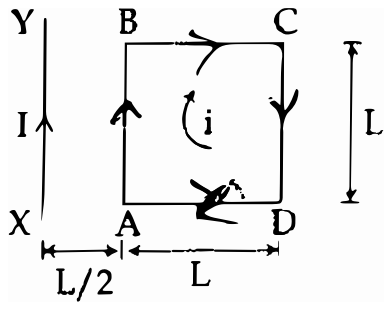
A square loop ABCD carrying a current i, is placed near and coplanar with a long straight conductor XY carrying a current I, the net force on the loop will be:
- 1
- 2
- 3
- 4
Show answer and solution
Correct: option 1,
The forces on BC and AD cancel. Side AB is at distance and side CD at from the wire, and they carry opposite currents, so the net force is .
Question 3NEET 2016 Phase 1, Q3
The magnetic susceptibility is negative for:
- 1diamagnetic material only
- 2paramagnetic material only
- 3ferromagnetic material only
- 4paramagnetic and ferromagnetic materials
Show answer and solution
Correct: option 1, diamagnetic material only
A diamagnetic material is magnetised opposite to the applied field, so its susceptibility is small and negative. Paramagnetic and ferromagnetic materials have positive susceptibility.
Question 4NEET 2016 Phase 1, Q4
A siren emitting a sound of frequency 800 Hz moves away from an observer towards a cliff at a speed of . Then, the frequency of sound that the observer hears in the echo reflected from the cliff is:
(Take velocity of sound in air )
- 1765 Hz
- 2800 Hz
- 3838 Hz
- 4885 Hz
Show answer and solution
Correct: option 3, 838 Hz
The siren approaches the cliff, so the cliff receives and reflects Hz. The cliff and the observer are both at rest, so the observer hears the echo at this same frequency.
Question 5NEET 2016 Phase 1, Q5
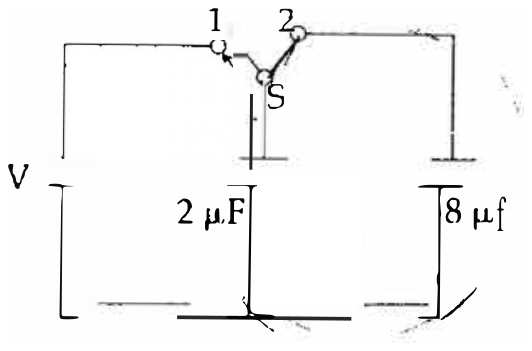
A capacitor of is charged as shown in the diagram. When the switch S is turned to position 2, the percentage of its stored energy dissipated is:
- 10%
- 220%
- 375%
- 480%
Show answer and solution
Correct: option 4, 80%
The initial energy is (in J for V in volts). At position 2 the charge is shared between and , giving a common potential and energy . So of the energy, that is 80%, is dissipated.
Question 6NEET 2016 Phase 1, Q6
In a diffraction pattern due to a single slit of width 'a', the first minimum is observed at an angle 30° when light of wavelength 5000 Å is incident on the slit. The first secondary maximum is observed at an angle of:
- 1
- 2
- 3
- 4
Show answer and solution
Correct: option 4,
First minimum: , so . The first secondary maximum is at , so .
Question 7NEET 2016 Phase 1, Q7
At what height from the surface of earth the gravitation potential and the value of g are and respectively? Take the radius of earth as 6400 km:
- 12600 km
- 21600 km
- 31400 km
- 42000 km
Show answer and solution
Correct: option 1, 2600 km
At distance from the centre, and , so m km. The height is km.
Question 8NEET 2016 Phase 1, Q8
Out of the following options which one can be used to produce a propagating electromagnetic wave?
- 1A charge moving at constant velocity
- 2A stationary charge
- 3A chargeless particle
- 4An accelerating charge
Show answer and solution
Correct: option 4, An accelerating charge
A stationary charge gives only a static electric field and a charge in uniform motion gives steady fields. Only an accelerating charge produces time-varying electric and magnetic fields that sustain each other and radiate as an electromagnetic wave.
Question 9NEET 2016 Phase 1, Q9
Two identical charged spheres suspended from a common point by two massless strings of lengths , are initially at a distance d (d << ) apart because of their mutual repulsion. The charges begin to leak from both the spheres at a constant rate. As a result, the spheres approach each other with a velocity . Then varies as a function of the distance between the spheres, as:
- 1
- 2
- 3
- 4
Show answer and solution
Correct: option 3,
For small angles, equilibrium gives , so . Differentiating, . Since is constant, .
Question 10NEET 2016 Phase 1, Q10
A uniform rope of length L and mass hangs vertically from a rigid support. A block of mass is attached to the free end of the rope. A transverse pulse of wavelength is produced at the lower end of the rope. The wavelength of the pulse when it reaches the top of the rope is . The ratio is:
- 1
- 2
- 3
- 4
Show answer and solution
Correct: option 2,
The frequency stays the same, so . The tension is at the lower end and at the top, so .
Question 11NEET 2016 Phase 1, Q11
A refrigerator works between 4°C and 30°C. It is required to remove 600 calories of heat every second in order to keep the temperature of the refrigerated space constant. The power required is:
(Take 1 cal = 4.2 Joules)
- 12.365 W
- 223.65 W
- 3236.5 W
- 42365 W
Show answer and solution
Correct: option 3, 236.5 W
For an ideal refrigerator the coefficient of performance is . Heat removed per second is W, so the power needed is W.
Question 12NEET 2016 Phase 1, Q12
An air column, closed at one end and open at the other, resonates with a tuning fork when the smallest length of the column is 50 cm. The next larger length of the column resonating with the same tuning fork is:
- 166.7 cm
- 2100 cm
- 3150 cm
- 4200 cm
Show answer and solution
Correct: option 3, 150 cm
A closed pipe resonates at lengths The smallest length is cm, so the next is cm.
Question 13NEET 2016 Phase 1, Q13
Consider the junction diode as ideal. The value of current flowing through AB is:

- 10 A
- 2 A
- 3 A
- 4 A
Show answer and solution
Correct: option 2, A
A is at the higher potential, so the diode is forward biased and, being ideal, has no voltage drop. The current is A.
Question 14NEET 2016 Phase 1, Q14
The charge flowing through a resistance R varies with time t as , where a and b are positive constants. The total heat produced in R is:
- 1
- 2
- 3
- 4
Show answer and solution
Correct: option 1,
The current is , which falls to zero at . The heat is .
Question 15NEET 2016 Phase 1, Q15
A black body is at a temperature of 5760 K. The energy of radiation emitted by the body at wavelength 250 nm is , at wavelength 500 nm is and that at 1000 nm is . Wien's constant, nmK. Which of the following is correct?
- 1
- 2
- 3
- 4
Show answer and solution
Correct: option 4,
By Wien's law the emission peaks at nm. So is the maximum and is greater than ; the energies at 250 nm and 1000 nm are smaller but not zero.
Question 16NEET 2016 Phase 1, Q16
Coefficient of linear expansion of brass and steel rods are and . Lengths of brass and steel rods are and respectively. If is maintained same at all temperatures, which one of the following relations holds good?
- 1
- 2
- 3
- 4
Show answer and solution
Correct: option 4,
For the difference to stay fixed both rods must expand by the same amount for any temperature rise : , so .
Question 17NEET 2016 Phase 1, Q17
A npn transistor is connected in common emitter configuration in a given amplifier. A load resistance of is connected in the collector circuit and the voltage drop across it is 0.8 V. If the current amplification factor is 0.96 and the input resistance of the circuit is , the voltage gain and the power gain of the amplifier will respectively be:
- 14, 3.84
- 23.69, 3.84
- 34, 4
- 44, 3.69
Show answer and solution
Correct: option 1, 4, 3.84
Taking the given current amplification factor 0.96 as the current gain, voltage gain current gain . Power gain current gain voltage gain .
Question 18NEET 2016 Phase 1, Q18
The intensity at the maximum in a Young's double slit experiment is . Distance between two slits is , where is the wavelength of light used in the experiment. What will be the intensity in front of one of the slits on the screen placed at a distance ?
- 1
- 2
- 3
- 4
Show answer and solution
Correct: option 4,
The point in front of a slit is at , so the path difference is , a phase difference of . The intensity is .
Question 19NEET 2016 Phase 1, Q19
A uniform circular disc of radius 50 cm at rest is free to turn about an axis which is perpendicular to its plane and passes through its centre. It is subjected to a torque which produces a constant angular acceleration of . Its net acceleration in at the end of 2.0 s is approximately:
- 18.0
- 27.0
- 36.0
- 43.0
Show answer and solution
Correct: option 1, 8.0
After 2.0 s, . For a point on the rim the centripetal acceleration is and the tangential acceleration is . The net acceleration is .
Question 20NEET 2016 Phase 1, Q20
An electron of mass m and a photon have same energy E. The ratio of de-Broglie wavelengths associated with them is:
( being velocity of light)
- 1
- 2
- 3
- 4
Show answer and solution
Correct: option 1,
For the electron and for the photon . So .
Question 21NEET 2016 Phase 1, Q21
A disk and a sphere of same radius but different masses roll off on two inclined planes of the same altitude and length. Which one of the two objects gets to the bottom of the plane first?
- 1Disk
- 2Sphere
- 3Both reach at the same time
- 4Depends on their masses
Show answer and solution
Correct: option 2, Sphere
For rolling without slipping , which does not depend on mass. is for a solid sphere and for a disk, so the sphere has the larger acceleration and reaches the bottom first.
Question 22NEET 2016 Phase 1, Q22
The angle of incidence for a ray of light at a refracting surface of a prism is 45°. The angle of prism is 60°. If the ray suffers minimum deviation through the prism, the angle of minimum deviation and refractive index of the material of the prism respectively, are:
- 1
- 2
- 3
- 4
Show answer and solution
Correct: option 2,
At minimum deviation , so and . Then .
Question 23NEET 2016 Phase 1, Q23
When an -particle of mass 'm' moving with velocity '' bombards on a heavy nucleus of charge 'Ze', its distance of closest approach from the nucleus depends on m as:
- 1
- 2
- 3
- 4
Show answer and solution
Correct: option 1,
At closest approach all the kinetic energy is electrostatic potential energy: . So .
Question 24NEET 2016 Phase 1, Q24
A particle of mass 10 g moves along a circle of radius 6.4 cm with a constant tangential acceleration. What is the magnitude of this acceleration if the kinetic energy of the particle becomes equal to J by the end of the second revolution after the beginning of the motion?
- 1
- 2
- 3
- 4
Show answer and solution
Correct: option 1,
Only the tangential force does work, so with m. Then .
Question 25NEET 2016 Phase 1, Q25
The molecules of a given mass of a gas have r.m.s. velocity of at 27°C and pressure. When the temperature and pressure of the gas are respectively, 127°C and , the r.m.s. velocity of its molecules in is:
- 1
- 2
- 3
- 4
Show answer and solution
Correct: option 2,
depends only on temperature, not on pressure. So .
Question 26NEET 2016 Phase 1, Q26
A long straight wire of radius a carries a steady current I. The current is uniformly distributed over its cross-section. The ratio of the magnetic fields B and B', at radial distances and 2a respectively, from the axis of the wire is:
- 1
- 2
- 3
- 4
Show answer and solution
Correct: option 3,
Inside the wire , so at , . Outside , so at , . The ratio is 1.
Question 27NEET 2016 Phase 1, Q27
A particle moves so that its position vector is given by . Where is a constant.
Which of the following is true?
- 1Velocity and acceleration both are perpendicular to .
- 2Velocity and acceleration both are parallel to .
- 3Velocity is perpendicular to and acceleration is directed towards the origin.
- 4Velocity is perpendicular to and acceleration is directed away from the origin.
Show answer and solution
Correct: option 3, Velocity is perpendicular to and acceleration is directed towards the origin.
, and , so the velocity is perpendicular to . , which points opposite to , that is towards the origin. This is uniform circular motion.
Question 28NEET 2016 Phase 1, Q28
What is the minimum velocity with which a body of mass must enter a vertical loop of radius R so that it can complete the loop?
- 1
- 2
- 3
- 4
Show answer and solution
Correct: option 4,
At the top the least speed is given by , so . Energy conservation from the bottom to the top, a height , gives , so .
Question 29NEET 2016 Phase 1, Q30
A gas is compressed isothermally to half its initial volume. The same gas is compressed separately through an adiabatic process until its volume is again reduced to half. Then:
- 1Compressing the gas isothermally will require more work to be done.
- 2Compressing the gas through adiabatic process will require more work to be done.
- 3Compressing the gas isothermally or adiabatically will require the same amount of work.
- 4Which of the case (whether compression through isothermal or through adiabatic process) requires more work will depend upon the atomicity of the gas.
Show answer and solution
Correct: option 2, Compressing the gas through adiabatic process will require more work to be done.
On a P-V diagram the adiabatic curve is steeper than the isothermal one, so during compression from the same starting point the adiabatic curve lies above the isothermal. The area under it, which is the work done on the gas, is therefore larger for the adiabatic compression.
Question 30NEET 2016 Phase 1, Q31
A potentiometer wire is 100 cm long and a constant potential difference is maintained across it. Two cells are connected in series first to support one another and then in opposite direction. The balance points are obtained at 50 cm and 10 cm from the positive end of the wire in the two cases. The ratio of emf's is:
- 15 : 1
- 25 : 4
- 33 : 4
- 43 : 2
Show answer and solution
Correct: option 4, 3 : 2
The balancing length is proportional to the emf, so . This gives , so .
Question 31NEET 2016 Phase 1, Q32
A astronomical telescope has objective and eyepiece of focal lengths 40 cm and 4 cm respectively. To view an object 200 cm away from the objective, the lenses must be separated by a distance:
- 137.3 cm
- 246.0 cm
- 350.0 cm
- 454.0 cm
Show answer and solution
Correct: option 4, 54.0 cm
For the objective, , so the image forms 50 cm behind it. For relaxed viewing this image lies at the focus of the eyepiece, so the separation is cm.
Question 32NEET 2016 Phase 1, Q33
Two non-mixing liquids of densities and (n > 1) are put in a container. The height of each liquid is h. A solid cylinder of length L and density d is put in this container. The cylinder floats with its axis vertical and length pL (p < 1) in the denser liquid. The density d is equal to:
- 1
- 2
- 3
- 4
Show answer and solution
Correct: option 4,
Weight equals the total upthrust. With cross-section A: . So .
Question 33NEET 2016 Phase 1, Q34
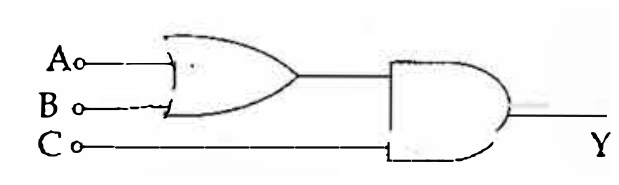
To get output 1 for the following circuit, the correct choice for the input is:
- 1A = 0, B = 1, C = 0
- 2A = 1, B = 0, C = 0
- 3A = 1, B = 1, C = 0
- 4A = 1, B = 0, C = 1
Show answer and solution
Correct: option 4, A = 1, B = 0, C = 1
A and B feed an OR gate whose output goes with C into an AND gate, so . For , C must be 1 and at least one of A and B must be 1. Only A = 1, B = 0, C = 1 satisfies this.
Question 34NEET 2016 Phase 1, Q35
A piece of ice falls from a height h so that it melts completely. Only one-quarter of the heat produced is absorbed by the ice and all energy of ice gets converted into heat during its fall. The value of h is:
[Latent heat of ice is J/kg and g = 10 N/kg]
- 134 km
- 2544 km
- 3136 km
- 468 km
Show answer and solution
Correct: option 3, 136 km
One quarter of the potential energy melts the ice: . So m km.
Question 35NEET 2016 Phase 1, Q36
The ratio of escape velocity at earth () to the escape velocity at a planet () whose radius and mean density are twice as that of earth is:
- 1
- 2
- 3
- 4
Show answer and solution
Correct: option 2,
, so . For the planet this is times the earth's value, so .
Question 36NEET 2016 Phase 1, Q37
If the magnitude of sum of two vectors is equal to the magnitude of difference of the two vectors, the angle between these vectors is:
- 10°
- 290°
- 345°
- 4180°
Show answer and solution
Correct: option 2, 90°
gives , so and .
Question 37NEET 2016 Phase 1, Q38
Given the value of Rydberg constant is , the wave number of the last line of the Balmer series in hydrogen spectrum will be:
- 1
- 2
- 3
- 4
Show answer and solution
Correct: option 3,
The last line (series limit) of the Balmer series is the transition from to . Its wave number is .
Question 38NEET 2016 Phase 1, Q39
A body of mass 1 kg begins to move under the action of a time dependent force N, where and are unit vectors along x and y axis. What power will be developed by the force at the time t?
- 1 W
- 2 W
- 3 W
- 4 W
Show answer and solution
Correct: option 4, W
With mass 1 kg, , and starting from rest . Power W.
Question 39NEET 2016 Phase 1, Q40
An inductor 20 mH, a capacitor and a resistor are connected in series across a source of emf . The power loss in A.C. circuit is:
- 10.51 W
- 20.67 W
- 30.76 W
- 40.89 W
Show answer and solution
Correct: option 1, 0.51 W
and , so . Power W. The nearest option, and the keyed answer, is 0.51 W.
Question 40NEET 2016 Phase 1, Q41
If the velocity of a particle is , where A and B are constants, then the distance travelled by it between 1s and 2s is:
- 1
- 2
- 3
- 4
Show answer and solution
Correct: option 3,
Distance .
Question 41NEET 2016 Phase 1, Q42
A long solenoid has 1000 turns. When a current of 4A flows through it, the magnetic flux linked with each turn of the solenoid is Wb. The self-inductance of the solenoid is:
- 14 H
- 23 H
- 32 H
- 41 H
Show answer and solution
Correct: option 4, 1 H
Total flux linkage is Wb. H.
Question 42NEET 2016 Phase 1, Q43
A small signal voltage is applied across an ideal capacitor C:
- 1Current I(t), lags voltage V(t) by 90°.
- 2Over a full cycle the capacitor C does not consume any energy from the voltage source.
- 3Current I(t) is in phase with voltage V(t).
- 4Current I(t) leads voltage V(t) by 180°.
Show answer and solution
Correct: option 2, Over a full cycle the capacitor C does not consume any energy from the voltage source.
In a pure capacitor the current leads the voltage by 90°, so the average power is zero. Energy stored in one quarter cycle is returned in the next, so over a full cycle the capacitor consumes no energy.
Question 43NEET 2016 Phase 1, Q44
Match the corresponding entries of column 1 with column 2. [Where m is the magnification produced by the mirror]
| Column 1 | Column 2 |
|---|
| (A) | (a) Convex mirror |
| (B) | (b) Concave mirror |
| (C) | (c) Real image |
| (D) | (d) Virtual image |
- 1A-b and c, B-b and c, C-b and d, D-a and d
- 2A-a and c, B-a and d, C-a and b, D-c and d
- 3A-a and d, B-b and c, C-b and d, D-b and c
- 4A-c and d, B-b and d, C-b and c, D-a and d
Show answer and solution
Correct: option 1, A-b and c, B-b and c, C-b and d, D-a and d
Negative magnification means an inverted, real image, which only a concave mirror forms: A and B are concave mirror and real image. An erect, enlarged image () is the virtual image of a concave mirror, so C is concave mirror and virtual image. An erect, diminished image () is the virtual image of a convex mirror, so D is convex mirror and virtual image.
Question 44NEET 2016 Phase 1, Q45
A car is negotiating a curved road of radius R. The road is banked at an angle . The coefficient of friction between the tyres of the car and the road is . The maximum safe velocity on this road is:
- 1
- 2
- 3
- 4
Show answer and solution
Correct: option 2,
At the maximum speed friction acts down the slope. Vertically and horizontally . Dividing gives .
NEET 2016 Phase 1 Chemistry questions
Question 45NEET 2016 Phase 1, Q46
Consider the molecules , and . Which of the given statements is false?
- 1The bond angle in , the bond angle in , and the bond angle in are all greater than .
- 2The bond angle in is larger than the bond angle in .
- 3The bond angle in is smaller than the bond angle in .
- 4The bond angle in is larger than the bond angle in .
Show answer and solution
Correct: option 2, The bond angle in is larger than the bond angle in .
All three central atoms are hybridised, but lone pairs repel more strongly than bond pairs and squeeze the bond angle. has no lone pair (), has one () and has two (). So the angle in water is the smallest of the three, not larger than that in methane, and statement (2) is the false one.
Question 46NEET 2016 Phase 1, Q47
In the reaction
,
X and Y are:
- 1X = 1-Butyne; Y = 3-Hexyne
- 2X = 2-Butyne; Y = 3-Hexyne
- 3X = 2-Butyne; Y = 2-Hexyne
- 4X = 1-Butyne; Y = 2-Hexyne
Show answer and solution
Correct: option 1, X = 1-Butyne; Y = 3-Hexyne
Sodamide removes the acidic terminal hydrogen of ethyne to give the acetylide ion, which attacks ethyl bromide to give , 1-butyne (X). 1-Butyne still has one terminal hydrogen, so the same two steps add a second ethyl group on the other carbon, giving , 3-hexyne (Y).
Question 47NEET 2016 Phase 1, Q48
Among the following, the correct order of acidity is:
- 1
- 2
- 3
- 4
Show answer and solution
Correct: option 2,
The more oxygen atoms on chlorine, the higher its oxidation state and the better the negative charge of the conjugate base is spread out, so the anion is more stable and the acid stronger. Acidity therefore rises steadily from to .
Question 48NEET 2016 Phase 1, Q49
The rate of a first-order reaction is at 10 seconds and at 20 seconds after initiation of the reaction. The half-life period of the reaction is:
- 124.1 s
- 234.1 s
- 344.1 s
- 454.1 s
Show answer and solution
Correct: option 1, 24.1 s
For a first-order reaction the rate is proportional to the concentration, so the rate itself decays exponentially: . Then .
Question 49NEET 2016 Phase 1, Q50
Which one of the following characteristics is associated with adsorption?
- 1 is negative but and are positive
- 2, and all are negative
- 3 and are negative but is positive
- 4 and are negative but is positive
Show answer and solution
Correct: option 2, , and all are negative
Adsorption is spontaneous, so is negative. The adsorbed molecules lose freedom of movement when they are held on the surface, so is negative. With , a negative is then possible only if is negative, that is, adsorption is exothermic. All three are negative.
Question 50NEET 2016 Phase 1, Q51
In which of the following options the order of arrangement does not agree with the variation of property indicated against it?
- 1 (increasing ionic size)
- 2 (increasing first ionisation enthalpy)
- 3 (increasing electron gain enthalpy)
- 4 (increasing metallic radius)
Show answer and solution
Correct: option 3, (increasing electron gain enthalpy)
The answer key gives (3): chlorine, not fluorine, has the most negative electron gain enthalpy, because the incoming electron in the small shell of fluorine meets strong repulsion, so the order should be . Orders (1) and (4) are correct: for isoelectronic ions size falls as nuclear charge rises, and metallic radius grows down the group. Note that order (2) is also not right, since nitrogen with its half-filled subshell has a higher first ionisation enthalpy than oxygen; the official key accepts only (3).
Question 51NEET 2016 Phase 1, Q52
Which of the following statements is false?
- 1 ions form a complex with ATP.
- 2 ions are important in blood clotting.
- 3 ions are not important in maintaining the regular beating of the heart.
- 4 ions are important in the green parts of plants.
Show answer and solution
Correct: option 3, ions are not important in maintaining the regular beating of the heart.
Calcium ions are needed for muscle contraction, including the regular beating of the heart, so statement (3) is false. The others are true: enzymes that use ATP need , which forms a complex with it; is required for blood clotting; and sits at the centre of chlorophyll in green plants.
Question 52NEET 2016 Phase 1, Q53
Which of the following statements about hydrogen is incorrect?
- 1Hydrogen has three isotopes of which tritium is the most common.
- 2Hydrogen never acts as cation in ionic salts.
- 3Hydronium ion, exists freely in solution.
- 4Dihydrogen does not act as a reducing agent.
Show answer and solution
Correct: option 1, Hydrogen has three isotopes of which tritium is the most common.
The examiners dropped this question and gave every candidate the 4 marks.
This question was dropped: the official key gave all candidates the 4 marks, because more than one statement is incorrect. Statement (1) is wrong since protium, not tritium, is by far the most common isotope (tritium occurs only in traces). Statement (4) is also wrong since dihydrogen is a good reducing agent, for example it reduces hot metal oxides such as to the metal.
Question 53NEET 2016 Phase 1, Q54
The correct statement regarding a carbonyl compound with a hydrogen atom on its alpha-carbon, is:
- 1a carbonyl compound with a hydrogen atom on its alpha-carbon never equilibrates with its corresponding enol.
- 2a carbonyl compound with a hydrogen atom on its alpha-carbon rapidly equilibrates with its corresponding enol and this process is known as aldehyde-ketone equilibration.
- 3a carbonyl compound with a hydrogen atom on its alpha-carbon rapidly equilibrates with its corresponding enol and this process is known as carbonylation.
- 4a carbonyl compound with a hydrogen atom on its alpha-carbon rapidly equilibrates with its corresponding enol and this process is known as keto-enol tautomerism.
Show answer and solution
Correct: option 4, a carbonyl compound with a hydrogen atom on its alpha-carbon rapidly equilibrates with its corresponding enol and this process is known as keto-enol tautomerism.
An alpha-hydrogen is acidic and can shift to the carbonyl oxygen, turning the form (keto form) into the form (enol form). The two forms are structural isomers that interconvert rapidly, and this equilibrium is called keto-enol tautomerism.
Question 54NEET 2016 Phase 1, Q55
MY and , two nearly insoluble salts, have the same values of at room temperature. Which statement would be true in regard to MY and ?
- 1The molar solubilities of MY and in water are identical.
- 2The molar solubility of MY in water is less than that of .
- 3The salts MY and are more soluble in 0.5 M KY than in pure water.
- 4The addition of the salt of KY to solution of MY and will have no effect on their solubilities.
Show answer and solution
Correct: option 2, The molar solubility of MY in water is less than that of .
For MY, , so . For , , so . MY is therefore the less soluble salt. Adding KY supplies the common ion and lowers both solubilities, so (3) and (4) are wrong.
Question 55NEET 2016 Phase 1, Q56
In a protein molecule various amino acids are linked together by:
- 1 - glycosidic bond
- 2 - glycosidic bond
- 3peptide bond
- 4dative bond
Show answer and solution
Correct: option 3, peptide bond
The group of one amino acid condenses with the group of the next, losing water and forming a link called a peptide bond. Glycosidic bonds join sugar units in carbohydrates, not amino acids.
Question 56NEET 2016 Phase 1, Q57
- 1All cis-configuration
- 2All trans-configuration
- 3Alternate cis - and trans-configuration
- 4Random cis - and trans-configuration
Show answer and solution
Correct: option 1, All cis-configuration
Natural rubber is cis-1,4-polyisoprene: every double bond in the chain has the cis arrangement, which makes the chains coil and gives rubber its elasticity. The all-trans polymer is gutta-percha, which is hard and not elastic.
Question 57NEET 2016 Phase 1, Q58
Match items of Column I with the items of Column II and assign the correct code:
| Column I | Column II |
|---|
| (a) Cyanide process | (i) Ultrapure Ge |
| (b) Froth floatation process | (ii) Dressing of ZnS |
| (c) Electrolytic reduction | (iii) Extraction of Al |
| (d) Zone refining | (iv) Extraction of Au |
| (v) Purification of Ni |
- 1a-iv, b-ii, c-iii, d-i
- 2a-ii, b-iii, c-i, d-v
- 3a-i, b-ii, c-iii, d-iv
- 4a-iii, b-iv, c-v, d-i
Show answer and solution
Correct: option 1, a-iv, b-ii, c-iii, d-i
Gold is leached from its ore with dilute cyanide solution (a-iv). Froth floatation concentrates sulphide ores such as ZnS (b-ii). Aluminium is obtained by electrolytic reduction of alumina in the Hall-Heroult process (c-iii). Zone refining gives very pure semiconductors such as germanium (d-i). Purification of nickel is done by the Mond process, which is not in Column I.
Question 58NEET 2016 Phase 1, Q59
Which one of the following statements is correct when is passed through acidified solution?
- 1The solution turns blue.
- 2The solution is decolourized.
- 3 is reduced.
- 4Green is formed.
Show answer and solution
Correct: option 4, Green is formed.
is a reducing agent: . The orange dichromate () is reduced to green , present as chromium(III) sulphate, while itself is oxidised to sulphate. The solution turns green; it does not become blue or colourless.
Question 59NEET 2016 Phase 1, Q60
The electronic configurations of Eu (Atomic No. 63), Gd (Atomic No. 64) and Tb (Atomic No. 65) are:
- 1, and
- 2, and
- 3, and
- 4, and
Show answer and solution
Correct: option 4, , and
A half-filled subshell is specially stable. Europium reaches it directly: . Gadolinium keeps and puts its extra electron in : . Terbium then has .
Question 60NEET 2016 Phase 1, Q61
Two electrons occupying the same orbital are distinguished by:
- 1Principal quantum number
- 2Magnetic quantum number
- 3Azimuthal quantum number
- 4Spin quantum number
Show answer and solution
Correct: option 4, Spin quantum number
An orbital is fixed by the values of , and , so two electrons in the same orbital share all three. By the Pauli exclusion principle they must differ in the fourth, the spin quantum number: one has and the other .
Question 61NEET 2016 Phase 1, Q62
When copper is heated with conc. it produces:
- 1 and
- 2 and
- 3, and
- 4 and
Show answer and solution
Correct: option 1, and
Concentrated nitric acid is reduced by copper to nitrogen dioxide: . Dilute acid would give instead.
Question 62NEET 2016 Phase 1, Q63
Which of the following reagents would distinguish cis-cyclopenta-1, 2-diol from the trans-isomer?
- 1Acetone
- 2Ozone
- 3
- 4Aluminium isopropoxide
Show answer and solution
Correct: option 1, Acetone
Acetone reacts with a 1,2-diol to form a cyclic ketal (an acetonide) only when both groups can reach the same carbon. In the cis-diol the two groups are on the same side of the ring and the cyclic ketal forms; in the trans-isomer they point to opposite sides and cannot bridge. So acetone tells the two apart.
Question 63NEET 2016 Phase 1, Q64
The correct thermodynamic conditions for the spontaneous reaction at all temperatures is:
- 1 and
- 2 and
- 3 and
- 4 and
Show answer and solution
Correct: option 3, and
A reaction is spontaneous when is negative. If is negative and is positive, both terms make negative whatever the temperature. This is the condition the answer key takes, option (3).
Question 64NEET 2016 Phase 1, Q65
Lithium has a bcc structure. Its density is and its atomic mass is . Calculate the edge length of a unit cell of Lithium metal. ()
- 1154 pm
- 2352 pm
- 3527 pm
- 4264 pm
Show answer and solution
Correct: option 2, 352 pm
A bcc unit cell holds atoms, and . So , which gives .
Question 65NEET 2016 Phase 1, Q66
Which one of the following orders is correct for the bond dissociation enthalpy of halogen molecules?
- 1
- 2
- 3
- 4
Show answer and solution
Correct: option 2,
Bond enthalpy normally falls down the group as the atoms get larger, so . Fluorine is the exception: its atoms are so small that the lone pairs on the two atoms repel strongly and weaken the bond, placing it below bromine but above iodine. The values are about 243, 193, 158 and 151 for , , and .
Question 66NEET 2016 Phase 1, Q67
Which of the following is an analgesic?
- 1Novalgin
- 2Penicillin
- 3Streptomycin
- 4Chloromycetin
Show answer and solution
Correct: option 1, Novalgin
An analgesic is a pain-relieving drug. Novalgin is a non-narcotic analgesic. Penicillin, streptomycin and chloromycetin (chloramphenicol) are all antibiotics.
Question 67NEET 2016 Phase 1, Q68
Equal moles of hydrogen and oxygen gases are placed in a container with a pin-hole through which both can escape. What fraction of the oxygen escapes in the time required for one-half of the hydrogen to escape?
- 11/8
- 21/4
- 33/8
- 41/2
Show answer and solution
Correct: option 1, 1/8
By Graham's law the rate of effusion is inversely proportional to the square root of the molar mass: . In the time half of the hydrogen escapes, oxygen escapes a quarter as fast, so the fraction of oxygen that escapes is .
Question 68NEET 2016 Phase 1, Q69
Consider the nitration of benzene using mixed conc. and . If a large amount of is added to the mixture, the rate of nitration will be
- 1faster
- 2slower
- 3unchanged
- 4doubled
Show answer and solution
Correct: option 2, slower
The attacking electrophile is the nitronium ion, formed by . Adding supplies a lot of , a product of this equilibrium, which pushes it back to the left. Less is available, so nitration becomes slower.
Question 69NEET 2016 Phase 1, Q70
Predict the correct order among the following
- 1lone pair - lone pair > lone pair - bond pair > bond pair - bond pair
- 2lone pair - lone pair > bond pair - bond pair > lone pair - bond pair
- 3bond pair - bond pair > lone pair - bond pair > lone pair - lone pair
- 4lone pair - bond pair > bond pair - bond pair > lone pair - lone pair
Show answer and solution
Correct: option 1, lone pair - lone pair > lone pair - bond pair > bond pair - bond pair
This is the VSEPR order of repulsions. A lone pair is held by only one nucleus, so it spreads out and takes more room around the central atom than a bond pair shared between two nuclei. Two lone pairs therefore repel most, a lone pair and a bond pair less, and two bond pairs least.
Question 70NEET 2016 Phase 1, Q71
The product obtained as a result of a reaction of nitrogen with is:
- 1
- 2
- 3
- 4
Show answer and solution
Correct: option 1,
Hot calcium carbide takes up nitrogen to give calcium cyanamide and carbon: . The mixture is the fertiliser nitrolim. The formula of calcium cyanamide, , does not appear exactly among the options; the official key takes option (1), printed as , as the intended answer.
Question 71NEET 2016 Phase 1, Q72
Consider the following liquid - vapour equilibrium
Which of the following relations is correct?
- 1
- 2
- 3
- 4
Show answer and solution
Correct: option 4,
The change of vapour pressure with temperature follows the Clausius-Clapeyron equation, , where is the enthalpy of vaporisation. Since is positive, vapour pressure rises with temperature, which rules out the forms with a minus sign.
Question 72NEET 2016 Phase 1, Q73
Match the compounds given in column I with the hybridisation and shape given in column II and mark the correct option.
| Column I | Column II |
|---|
| (a) | (i) distorted octahedral |
| (b) | (ii) square planar |
| (c) | (iii) pyramidal |
| (d) | (iv) square pyramidal |
- 1a-i, b-iii, c-iv, d-ii
- 2a-i, b-ii, c-iv, d-iii
- 3a-iv, b-iii, c-i, d-ii
- 4a-iv, b-i, c-ii, d-iii
Show answer and solution
Correct: option 1, a-i, b-iii, c-iv, d-ii
has six bond pairs and one lone pair (), giving a distorted octahedron (a-i). has three bonds and one lone pair (), so it is pyramidal (b-iii). has five bonds and one lone pair (), so it is square pyramidal (c-iv). has four bonds and two lone pairs (), so it is square planar (d-ii).
Question 73NEET 2016 Phase 1, Q74
Which of the following has longest bond length? (Free bond length in CO is .)
- 1
- 2
- 3
- 4
Show answer and solution
Correct: option 3,
A metal pushes electron density back into the antibonding orbitals of CO (back bonding), which weakens and lengthens the bond. The more negative charge on the metal, the stronger the back donation. carries the largest negative charge of the four, so its bond is the longest.
Question 74NEET 2016 Phase 1, Q75
The pressure of required to make the potential of - electrode zero in pure water at 298 K is
- 1 atm
- 2 atm
- 3 atm
- 4 atm
Show answer and solution
Correct: option 1, atm
For , . This is zero when . In pure water , so atm.
Question 75NEET 2016 Phase 1, Q76
The addition of a catalyst during a chemical reaction alters which of the following quantities?
- 1Entropy
- 2Internal energy
- 3Enthalpy
- 4Activation energy
Show answer and solution
Correct: option 4, Activation energy
A catalyst provides another path with a lower activation energy, so the reaction goes faster. It does not change the reactants or products, so state functions of the reaction such as entropy, internal energy and enthalpy change stay the same.
Question 76NEET 2016 Phase 1, Q77
The ionic radii of and ions are m and m. The coordination number of each ion in AB is
- 16
- 24
- 38
- 42
Show answer and solution
Correct: option 1, 6
The radius ratio is . This lies between 0.414 and 0.732, the range for octahedral voids, so each ion is surrounded by 6 ions of the other kind, as in the NaCl structure.
Question 77NEET 2016 Phase 1, Q78
Which is the correct statement for the given acids?
- 1Phosphinic acid is a diprotic acid while phosphonic acid is a monoprotic acid.
- 2Phosphinic acid is a monoprotic acid while phosphonic acid is a diprotic acid.
- 3Both are triprotic acids.
- 4Both are diprotic acids.
Show answer and solution
Correct: option 2, Phosphinic acid is a monoprotic acid while phosphonic acid is a diprotic acid.
Only hydrogens of groups are acidic; hydrogens bonded directly to phosphorus are not. Phosphinic acid, , has one and two bonds, so it is monoprotic. Phosphonic acid, , has two and one bond, so it is diprotic.
Question 78NEET 2016 Phase 1, Q79
Fog is a colloidal solution of:
- 1Liquid in gas
- 2Gas in liquid
- 3Solid in gas
- 4Gas in gas
Show answer and solution
Correct: option 1, Liquid in gas
Fog is tiny water droplets (the dispersed phase, a liquid) suspended in air (the dispersion medium, a gas). Such a colloid is a liquid aerosol. Gas in gas is never a colloid because gases mix completely.
Question 79NEET 2016 Phase 1, Q80
Which of the following statements about the composition of the vapour over an ideal 1 : 1 molar mixture of benzene and toluene is correct? Assume that the temperature is constant at . (Given, Vapour Pressure Data at , benzene = 12.8 kPa, toluene = 3.85 kPa)
- 1The vapour will contain a higher percentage of benzene.
- 2The vapour will contain a higher percentage of toluene.
- 3The vapour will contain equal amounts of benzene and toluene.
- 4Not enough information is given to make a prediction.
Show answer and solution
Correct: option 1, The vapour will contain a higher percentage of benzene.
By Raoult's law each partial pressure is mole fraction times pure vapour pressure: benzene kPa, toluene kPa. The mole fraction of benzene in the vapour is , so the vapour is richer in benzene, the more volatile component.
Question 80NEET 2016 Phase 1, Q81
The correct statement regarding the comparison of staggered and eclipsed conformations of ethane, is
- 1The staggered conformation of ethane is less stable than eclipsed conformation, because staggered conformation has torsional strain.
- 2The eclipsed conformation of ethane is more stable than staggered conformation, because eclipsed conformation has no torsional strain.
- 3The eclipsed conformation of ethane is more stable than staggered conformation even though the eclipsed conformation has torsional strain.
- 4The staggered conformation of ethane is more stable than eclipsed conformation, because staggered conformation has no torsional strain.
Show answer and solution
Correct: option 4, The staggered conformation of ethane is more stable than eclipsed conformation, because staggered conformation has no torsional strain.
In the staggered form the bonds on the two carbons are as far apart as possible, so the repulsion between their electron pairs (torsional strain) is at its minimum, taken as zero. In the eclipsed form the bonds line up and the strain is greatest. The staggered form is therefore more stable, by about .
Question 81NEET 2016 Phase 1, Q82
- 1Williamson ether synthesis reaction
- 2Alcohol formation reaction
- 3Dehydration reaction
- 4Williamson alcohol synthesis reaction
Show answer and solution
Correct: option 1, Williamson ether synthesis reaction
Sodium hydride removes the proton of the alcohol to give the sodium alkoxide. The alkoxide ion then attacks methyl iodide in an step, displacing iodide and forming an ether (). Making an ether from an alkoxide and an alkyl halide is the Williamson ether synthesis.
Question 82NEET 2016 Phase 1, Q83
The product formed by the reaction of an aldehyde with a primary amine is
- 1Schiff base
- 2Ketone
- 3Carboxylic acid
- 4Aromatic acid
Show answer and solution
Correct: option 1, Schiff base
A primary amine adds to the carbonyl group of the aldehyde and water is then lost: . The product, a substituted imine with a bond, is called a Schiff base.
Question 83NEET 2016 Phase 1, Q84
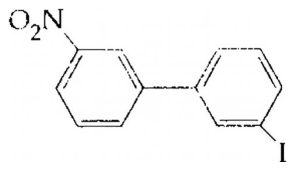
Which of the following biphenyls is optically active?
- 1
- 2
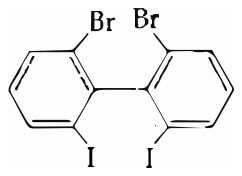
- 3
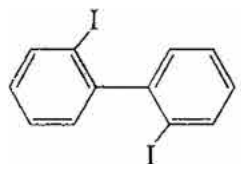
- 4
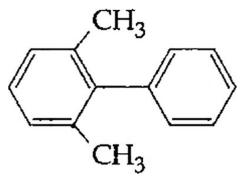
Show answer and solution
Correct: option 2
A biphenyl is optically active when rotation about the bond joining the two rings is blocked and neither ring is symmetrically substituted about that bond. That needs bulky groups at the ortho positions of both rings. In option (2) each ring carries a bromine and an iodine at its two ortho positions, so the rings are locked at an angle and the molecule has no plane of symmetry: it is chiral. The others have too few ortho groups to stop rotation, or (option 4) one ring that is symmetric.
Question 84NEET 2016 Phase 1, Q85
For the following reactions:
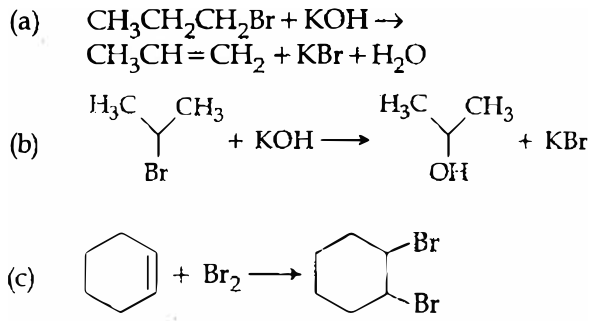
Which of the following statements is correct?
- 1(a) and (b) are elimination reactions and (c) is addition reaction.
- 2(a) is elimination, (b) is substitution and (c) is addition reaction.
- 3(a) is elimination, (b) and (c) are substitution reactions.
- 4(a) is substitution, (b) and (c) are addition reactions.
Show answer and solution
Correct: option 2, (a) is elimination, (b) is substitution and (c) is addition reaction.
In (a) 1-bromopropane loses HBr to give propene, a double bond is formed, so it is elimination. In (b) the of 2-bromopropane is replaced by , which is substitution. In (c) bromine adds across the double bond of cyclohexene to give 1,2-dibromocyclohexane, which is addition.
Question 85NEET 2016 Phase 1, Q86
At the vapour pressure of a solution of 6.5 g of a solute in 100 g water is 732 mm. If , the boiling point of this solution will be:
- 1
- 2
- 3
- 4
Show answer and solution
Correct: option 1,
Pure water has a vapour pressure of 760 mm at , so the relative lowering is , which is the mole fraction of solute. Moles of water , so moles of solute in 100 g of water, a molality of about . Then , and the boiling point is about .
Question 86NEET 2016 Phase 1, Q87
The correct statement regarding RNA and DNA, respectively is:
- 1The sugar component in RNA is arabinose and the sugar component in DNA is 2'-deoxyribose.
- 2The sugar component in RNA is ribose and the sugar component in DNA is 2'-deoxyribose.
- 3The sugar component in RNA is arabinose and the sugar component in DNA is ribose.
- 4The sugar component in RNA is 2'-deoxyribose and the sugar component in DNA is arabinose.
Show answer and solution
Correct: option 2, The sugar component in RNA is ribose and the sugar component in DNA is 2'-deoxyribose.
RNA (ribonucleic acid) contains the pentose sugar -D-ribose. DNA (deoxyribonucleic acid) contains -D-2-deoxyribose, the same sugar without the group on carbon 2'. Arabinose is not part of either.
Question 87NEET 2016 Phase 1, Q88
The correct statement regarding the basicity of arylamines is:
- 1Arylamines are generally less basic than alkylamines because the nitrogen lone-pair electrons are delocalized by interaction with the aromatic ring electron system.
- 2Arylamines are generally more basic than alkylamines because the nitrogen lone-pair electrons are not delocalized by interaction with the aromatic ring electron system.
- 3Arylamines are generally more basic than alkylamines because of aryl group.
- 4Arylamines are generally more basic than alkylamines, because the nitrogen atom in arylamines is sp-hybridized.
Show answer and solution
Correct: option 1, Arylamines are generally less basic than alkylamines because the nitrogen lone-pair electrons are delocalized by interaction with the aromatic ring electron system.
Basicity depends on how freely the nitrogen lone pair can accept a proton. In an arylamine such as aniline the lone pair is in conjugation with the ring and is spread over it by resonance, so it is less available. In an alkylamine the alkyl group pushes electrons towards nitrogen instead. Arylamines are therefore the weaker bases.
Question 88NEET 2016 Phase 1, Q89
Which one given below is a non-reducing sugar?
- 1Maltose
- 2Lactose
- 3Glucose
- 4Sucrose
Show answer and solution
Correct: option 4, Sucrose
A sugar is reducing only if it has a free aldehyde or ketone (hemiacetal) group. In sucrose the glycosidic bond joins C1 of glucose to C2 of fructose, so the reducing groups of both units are used up and sucrose does not reduce Tollens' or Fehling's reagent. Maltose, lactose and glucose each have a free hemiacetal group.
Question 89NEET 2016 Phase 1, Q90
The pair of electron in the given carbanion, , is present in which of the following orbitals?
- 1
- 2
- 3
- 4
Show answer and solution
Correct: option 4,
The negatively charged carbon is part of a triple bond, so it has two positions (one to the other carbon and one for the lone pair) and two bonds. Two positions mean hybridisation, and the lone pair sits in one of the hybrid orbitals.
NEET 2016 Phase 1 Biology questions
Question 90NEET 2016 Phase 1, Q91
Gause's principle of competitive exclusion states that:
- 1More abundant species will exclude the less abundant species through competition.
- 2Competition for the same resources excludes species having different food preferences.
- 3No two species can occupy the same niche indefinitely for the same limiting resources.
- 4Larger organisms exclude smaller ones through competition.
Show answer and solution
Correct: option 3, No two species can occupy the same niche indefinitely for the same limiting resources.
Gause's principle says that two closely related species competing for the same limiting resources cannot coexist indefinitely; the competitively inferior one is eventually eliminated. In other words, two species cannot go on occupying the same niche, which is option (3). Abundance, body size and food preference are not part of the principle.
Question 91NEET 2016 Phase 1, Q92
The two polypeptides of human insulin are linked together by:
- 1Hydrogen bonds
- 2Phosphodiester bond
- 3Covalent bond
- 4Disulphide bridges
Show answer and solution
Correct: option 4, Disulphide bridges
Human insulin is made of two short polypeptide chains, chain A and chain B. They are held together by disulphide bridges (S-S links between cysteine residues). A disulphide bridge is a kind of covalent bond, but the specific and best description is option (4).
Question 92NEET 2016 Phase 1, Q93
The coconut water from tender coconut represents:
- 1Endocarp
- 2Fleshy mesocarp
- 3Free nuclear proembryo
- 4Free nuclear endosperm
Show answer and solution
Correct: option 4, Free nuclear endosperm
In coconut the primary endosperm nucleus first divides many times without wall formation, giving a liquid with thousands of free nuclei. This free nuclear endosperm is the coconut water; the white kernel around it is the cellular endosperm formed later.
Question 93NEET 2016 Phase 1, Q94
Which of the following statements is wrong for viroids?
- 1They lack a protein coat
- 2They are smaller than viruses
- 3They cause infections
- 4Their RNA is of high molecular weight
Show answer and solution
Correct: option 4, Their RNA is of high molecular weight
Viroids, discovered by Diener, are infectious agents made only of a free RNA without a protein coat, and they are smaller than viruses. Their RNA is of low molecular weight, so the statement that it is of high molecular weight is the wrong one.
Question 94NEET 2016 Phase 1, Q95
Which of the following features is not present in the Phylum - Arthropoda?
- 1Chitinous exoskeleton
- 2Metameric segmentation
- 3Parapodia
- 4Jointed appendages
Show answer and solution
Correct: option 3, Parapodia
Arthropods have a chitinous exoskeleton, a metamerically segmented body and jointed appendages. Parapodia are the lateral swimming appendages of aquatic annelids such as Nereis, so they are not found in Arthropoda.
Question 95NEET 2016 Phase 1, Q96
Which of the following most appropriately describes haemophilia?
- 1Recessive gene disorder
- 2X-linked recessive gene disorder
- 3Chromosomal disorder
- 4Dominant gene disorder
Show answer and solution
Correct: option 2, X-linked recessive gene disorder
Haemophilia is caused by a recessive allele of a gene on the X chromosome, so it passes from a carrier mother to her sons. It is a gene (Mendelian) disorder, not a chromosomal one, and the most exact description is X-linked recessive gene disorder.
Question 96NEET 2016 Phase 1, Q97
Emerson's enhancement effect and Red drop have been instrumental in the discovery of:
- 1Photophosphorylation and non-cyclic electron transport
- 2Two photosystems operating simultaneously
- 3Photophosphorylation and cyclic electron transport
- 4Oxidative phosphorylation
Show answer and solution
Correct: option 2, Two photosystems operating simultaneously
Emerson found that the yield of photosynthesis falls sharply in light beyond 680 nm (red drop) and that it rises more than expected when shorter-wavelength light is given at the same time (enhancement effect). This showed that two pigment systems, PS I and PS II, work together in the light reaction.
Question 97NEET 2016 Phase 1, Q98
In which of the following, all three are macronutrients?
- 1Boron, zinc, manganese
- 2Iron, copper, molybdenum
- 3Molybdenum, magnesium, manganese
- 4Nitrogen, nickel, phosphorus
Show answer and solution
Correct: option 1, Boron, zinc, manganese
The examiners dropped this question and gave every candidate the 4 marks.
This question was dropped: the official answer key gave 4 marks to every candidate. Every option contains at least one micronutrient (boron, zinc, manganese, iron, copper, molybdenum and nickel are all micronutrients), so none of the four lists three macronutrients. The macronutrients are C, H, O, N, P, K, S, Ca and Mg.
Question 98NEET 2016 Phase 1, Q99
Name the chronic respiratory disorder caused mainly by cigarette smoking:
- 1Emphysema
- 2Asthma
- 3Respiratory acidosis
- 4Respiratory alkalosis
Show answer and solution
Correct: option 1, Emphysema
Emphysema is a chronic disorder in which the alveolar walls are damaged, so the respiratory surface is reduced. Cigarette smoking is its major cause. Asthma is mostly allergic, and acidosis and alkalosis are disturbances of blood pH.
Question 99NEET 2016 Phase 1, Q100
A system of rotating crops with legume or grass pasture to improve soil structure and fertility is called:
- 1Ley farming
- 2Contour farming
- 3Strip farming
- 4Shifting agriculture
Show answer and solution
Correct: option 1, Ley farming
In ley farming a field is put under grass or legume pasture (a ley) for some years in rotation with arable crops, which rebuilds soil structure and fertility. Contour and strip farming are ways of checking soil erosion on slopes, and shifting agriculture is slash-and-burn cultivation.
Question 100NEET 2016 Phase 1, Q101
Mitochondria and chloroplast are:
(a) semi-autonomous organelles.
(b) formed by division of pre-existing organelles and they contain DNA but lack protein synthesizing machinery.
Which one of the following options is correct?
- 1Both (a) and (b) are correct.
- 2(b) is true but (a) is false.
- 3(a) is true but (b) is false.
- 4Both (a) and (b) are false.
Show answer and solution
Correct: option 3, (a) is true but (b) is false.
Mitochondria and chloroplasts are semi-autonomous: they have their own circular DNA, RNA and 70S ribosomes, and arise by division of pre-existing organelles. Because they do have ribosomes they can make some of their own proteins, so the part of (b) saying they lack protein synthesizing machinery is false. Hence (a) is true and (b) is false.
Question 101NEET 2016 Phase 1, Q102
In context of Amniocentesis, which of the following statement is incorrect?
- 1It is usually done when a woman is between 14-16 weeks pregnant.
- 2It is used for prenatal sex determination.
- 3It can be used for detection of Down syndrome.
- 4It can be used for detection of Cleft palate.
Show answer and solution
Correct: option 4, It can be used for detection of Cleft palate.
In amniocentesis a little amniotic fluid is drawn, usually at 14 to 16 weeks, and the foetal cells in it are examined for their chromosomes. This reveals the sex of the foetus and chromosomal disorders such as Down syndrome. Cleft palate is a structural defect that does not show in the chromosomes, so it cannot be detected this way.
Question 102NEET 2016 Phase 1, Q103
In a chloroplast the highest number of protons are found in:
- 1Stroma
- 2Lumen of thylakoids
- 3Inter membrane space
- 4Antennae complex
Show answer and solution
Correct: option 2, Lumen of thylakoids
During the light reaction protons are released inside the thylakoid by the splitting of water and are also pumped in from the stroma as electrons pass through the carriers. Protons therefore accumulate in the thylakoid lumen, and this gradient drives ATP synthesis as they flow back to the stroma.
Question 103NEET 2016 Phase 1, Q104
Photosensitive compound in human eye is made up of:
- 1Guanosine and Retinol
- 2Opsin and Retinal
- 3Opsin and Retinol
- 4Transducin and Retinene
Show answer and solution
Correct: option 2, Opsin and Retinal
The photopigments of the rods and cones consist of a protein, opsin, joined to retinal, which is an aldehyde of vitamin A. Light makes retinal separate from opsin, which starts the nerve impulse. Retinol is vitamin A itself, not the form present in the pigment.
Question 104NEET 2016 Phase 1, Q105
Spindle fibres attach on to:
- 1Telomere of the chromosome
- 2Kinetochore of the chromosome
- 3Centromere of the chromosome
- 4Kinetosome of the chromosome
Show answer and solution
Correct: option 2, Kinetochore of the chromosome
Kinetochores are small disc-shaped structures on the surface of the centromere. They are the actual sites where the spindle fibres attach to a chromosome at metaphase. Telomeres are chromosome ends, and a kinetosome is the basal body of a cilium.
Question 105NEET 2016 Phase 1, Q106
Which is the National Aquatic Animal of India?
- 1Gangetic shark
- 2River dolphin
- 3Blue whale
- 4Sea-horse
Show answer and solution
Correct: option 2, River dolphin
The Ganges river dolphin (Platanista gangetica) was declared the National Aquatic Animal of India in 2009.
Question 106NEET 2016 Phase 1, Q107
Which of the following is required as inducer(s) for the expression of Lac operon?
- 1glucose
- 2galactose
- 3lactose
- 4lactose and galactose
Show answer and solution
Correct: option 3, lactose
In the lac operon the repressor made by the i gene blocks the operator. Lactose (as allolactose) binds the repressor and inactivates it, so RNA polymerase can transcribe the structural genes. Lactose is therefore the inducer; glucose and galactose are only the products of its breakdown.
Question 107NEET 2016 Phase 1, Q108
Which of the following pairs of hormones are not antagonistic (having opposite effects) to each other?
- 1Parathormone - Calcitonin
- 2Insulin - Glucagon
- 3Aldosterone - Atrial Natriuretic Factor
- 4Relaxin - Inhibin
Show answer and solution
Correct: option 4, Relaxin - Inhibin
Parathormone raises blood calcium and calcitonin lowers it; insulin lowers blood glucose and glucagon raises it; aldosterone retains sodium and raises blood pressure while ANF does the opposite. Relaxin loosens the pelvic ligaments at childbirth and inhibin suppresses FSH secretion, so these two act on unrelated things and are not antagonists.
Question 108NEET 2016 Phase 1, Q109
Microtubules are the constituents of:
- 1Cilia, Flagella and Peroxisomes
- 2Spindle fibres, Centrioles and Cilia
- 3Centrioles, Spindle fibres and Chromatin
- 4Centrosome, Nucleosome and Centrioles
Show answer and solution
Correct: option 2, Spindle fibres, Centrioles and Cilia
Microtubules made of tubulin form the spindle fibres, the nine triplets of a centriole and the 9+2 axoneme of cilia and flagella. Peroxisomes are membrane-bound microbodies, and chromatin and nucleosomes are made of DNA and histones, so the other options each contain something without microtubules.
Question 109NEET 2016 Phase 1, Q110
A complex of ribosomes attached to a single strand of RNA is known as:
- 1Polysome
- 2Polymer
- 3Polypeptide
- 4Okazaki fragment
Show answer and solution
Correct: option 1, Polysome
Several ribosomes can translate the same mRNA at the same time, forming a chain called a polyribosome or polysome. This lets many copies of a polypeptide be made from one mRNA.
Question 110NEET 2016 Phase 1, Q111
Fertilization in humans is practically feasible only if:
- 1the sperms are transported into vagina just after the release of ovum in fallopian tube.
- 2the ovum and sperms are transported simultaneously to ampullary-isthmic junction of the fallopian tube.
- 3the ovum and sperms are transported simultaneously to ampullary-isthmic junction of the cervix.
- 4the sperms are transported into cervix within 48 hrs of release of ovum in uterus.
Show answer and solution
Correct: option 2, the ovum and sperms are transported simultaneously to ampullary-isthmic junction of the fallopian tube.
Fertilization takes place at the ampullary-isthmic junction of the fallopian tube. It can happen only if the ovum and the sperms reach this place at the same time, which is why not every act of copulation leads to pregnancy. The junction is a part of the oviduct, not of the cervix.
Question 111NEET 2016 Phase 1, Q112
Asthma may be attributed to:
- 1bacterial infection of the lungs
- 2allergic reaction of the mast cells in the lungs
- 3inflammation of the trachea
- 4accumulation of fluid in the lungs
Show answer and solution
Correct: option 2, allergic reaction of the mast cells in the lungs
Asthma is an allergic condition. Allergens make the mast cells in the lungs release histamine and similar chemicals, which inflame and narrow the bronchi and bronchioles and cause wheezing and difficulty in breathing.
Question 112NEET 2016 Phase 1, Q113
The Avena curvature is used for bioassay of:
- 1ABA
- 2
- 3IAA
- 4Ethylene
Show answer and solution
Correct: option 3, IAA
In the Avena curvature test an agar block containing auxin is placed on one side of a decapitated oat coleoptile; the coleoptile bends, and the angle of bending measures the amount of auxin. It is therefore the bioassay for auxin (IAA), first used by F. W. Went.
Question 113NEET 2016 Phase 1, Q114
The standard petal of a papilionaceous corolla is also called:
- 1Carina
- 2Pappus
- 3Vexillum
- 4Corona
Show answer and solution
Correct: option 3, Vexillum
A papilionaceous corolla, as in pea, has five petals: one large posterior petal called the standard or vexillum, two lateral wings (alae) and two fused anterior petals forming the keel (carina). Pappus is the modified calyx of Asteraceae.
Question 114NEET 2016 Phase 1, Q115
Tricarpellary, syncarpous gynoecium is found in flowers of:
- 1Liliaceae
- 2Solanaceae
- 3Fabaceae
- 4Poaceae
Show answer and solution
Correct: option 1, Liliaceae
Liliaceae has a gynoecium of three fused carpels with a superior, trilocular ovary and axile placentation. Solanaceae is bicarpellary syncarpous, Fabaceae is monocarpellary and Poaceae is described as monocarpellary.
Question 115NEET 2016 Phase 1, Q116
One of the major components of cell wall of most fungi is:
- 1Chitin
- 2Peptidoglycan
- 3Cellulose
- 4Hemicellulose
Show answer and solution
Correct: option 1, Chitin
The cell wall of fungi is made of chitin, a polymer of N-acetylglucosamine, together with other polysaccharides. Peptidoglycan is the wall material of bacteria, and cellulose and hemicellulose are found in plant cell walls.
Question 116NEET 2016 Phase 1, Q117
Select the incorrect statement:
- 1FSH stimulates the sertoli cells which help in spermiogenesis.
- 2LH triggers ovulation in ovary.
- 3LH and FSH decrease gradually during the follicular phase.
- 4LH triggers secretion of androgens from the Leydig cells.
Show answer and solution
Correct: option 3, LH and FSH decrease gradually during the follicular phase.
During the follicular phase the secretion of LH and FSH rises gradually, stimulating follicle growth and oestrogen secretion, and both peak around the middle of the cycle. The statement that they decrease gradually is therefore incorrect. The other three statements are true.
Question 117NEET 2016 Phase 1, Q118
In meiosis crossing over is initiated at:
- 1Pachytene
- 2Leptotene
- 3Zygotene
- 4Diplotene
Show answer and solution
Correct: option 1, Pachytene
Homologous chromosomes pair during zygotene, and in pachytene recombination nodules appear on the bivalents where crossing over takes place between non-sister chromatids. The chiasmata seen in diplotene are only the visible result of crossing over that happened in pachytene.
Question 118NEET 2016 Phase 1, Q119
A tall true breeding garden pea plant is crossed with a dwarf true breeding garden pea plant. When the plants were selfed the resulting genotypes were in the ratio of:
- 11 : 2 : 1 :: Tall homozygous : Tall heterozygous : Dwarf
- 21 : 2 : 1 :: Tall heterozygous : Tall homozygous : Dwarf
- 33 : 1 :: Tall : Dwarf
- 43 : 1 :: Dwarf : Tall
Show answer and solution
Correct: option 1, 1 : 2 : 1 :: Tall homozygous : Tall heterozygous : Dwarf
TT crossed with tt gives plants that are all Tt. Selfing Tt gives 1 TT : 2 Tt : 1 tt, that is 1 tall homozygous : 2 tall heterozygous : 1 dwarf. The 3 : 1 ratio is the phenotypic ratio, but the question asks for genotypes.
Question 119NEET 2016 Phase 1, Q120
Which of the following is the most important cause of animals and plants being driven to extinction?
- 1Over-exploitation
- 2Alien species invasion
- 3Habitat loss and fragmentation
- 4Co-extinctions
Show answer and solution
Correct: option 3, Habitat loss and fragmentation
All four belong to the 'Evil Quartet' of causes of biodiversity loss, but habitat loss and fragmentation is the most important one. The clearing of tropical rain forests is the standard example.
Question 120NEET 2016 Phase 1, Q121
Which one of the following is a characteristic feature of cropland ecosystem?
- 1Absence of soil organisms
- 2Least genetic diversity
- 3Absence of weeds
- 4Ecological succession
Show answer and solution
Correct: option 2, Least genetic diversity
A cropland is a man-made ecosystem in which one crop variety is grown over a large area (monoculture), so its genetic diversity is very low. Soil organisms and weeds are still present, and succession is prevented by repeated cultivation.
Question 121NEET 2016 Phase 1, Q122
Changes in GnRH pulse frequency in females is controlled by circulating levels of:
- 1estrogen and progesterone
- 2estrogen and inhibin
- 3progesterone only
- 4progesterone and inhibin
Show answer and solution
Correct: option 1, estrogen and progesterone
The hypothalamus releases GnRH in pulses, and the ovarian steroids feed back on it. Rising oestrogen in the follicular phase increases the pulse frequency, while progesterone in the luteal phase slows it down. Inhibin acts mainly on the pituitary to reduce FSH, not on the GnRH pulses.
Question 122NEET 2016 Phase 1, Q123
Which of the following is not a feature of the plasmids?
- 1Independent replication
- 2Circular structure
- 3Transferable
- 4Single-stranded
Show answer and solution
Correct: option 4, Single-stranded
Plasmids are small, circular, extra-chromosomal DNA molecules of bacteria that replicate on their own and can be transferred from one cell to another. Their DNA is double-stranded, so 'single-stranded' is not a feature of plasmids.
Question 123NEET 2016 Phase 1, Q124
Which of the following features is not present in Periplaneta americana?
- 1Schizocoelom as body cavity
- 2Indeterminate and radial cleavage during embryonic development
- 3Exoskeleton composed of N-acetylglucosamine
- 4Metamerically segmented body
Show answer and solution
Correct: option 2, Indeterminate and radial cleavage during embryonic development
The cockroach is an arthropod and a protostome: its coelom is a schizocoelom, its body is segmented and its exoskeleton is chitin, a polymer of N-acetylglucosamine. Indeterminate and radial cleavage is a feature of deuterostomes such as echinoderms and chordates, so it is not found in Periplaneta.
Question 124NEET 2016 Phase 1, Q125
In higher vertebrates, the immune system can distinguish self-cells and non-self. If this property is lost due to genetic abnormality and it attacks self-cells, then it leads to:
- 1Allergic response
- 2Graft rejection
- 3Auto-immune disease
- 4Active immunity
Show answer and solution
Correct: option 3, Auto-immune disease
When the immune system fails to recognise the body's own cells as self and attacks them, the result is an auto-immune disease, for example rheumatoid arthritis. Allergy is an over-reaction to outside antigens and graft rejection is a normal response to foreign tissue.
Question 125NEET 2016 Phase 1, Q127
Joint Forest Management Concept was introduced in India during:
- 11960s
- 21970s
- 31980s
- 41990s
Show answer and solution
Correct: option 3, 1980s
The Government of India introduced the concept of Joint Forest Management in the 1980s, so that forest departments could work together with local communities to protect and manage forests, the communities getting forest products in return.
Question 126NEET 2016 Phase 1, Q128
Pick out the correct statements:
(a) Haemophilia is a sex-linked recessive disease.
(b) Down's syndrome is due to aneuploidy.
(c) Phenylketonuria is an autosomal recessive gene disorder.
(d) Sickle cell anaemia is an X-linked recessive gene disorder.
- 1(a) and (d) are correct.
- 2(b) and (d) are correct.
- 3(a), (c) and (d) are correct.
- 4(a), (b) and (c) are correct.
Show answer and solution
Correct: option 4, (a), (b) and (c) are correct.
Haemophilia is X-linked (sex-linked) recessive, Down's syndrome is trisomy of chromosome 21, which is an aneuploidy, and phenylketonuria is autosomal recessive, so (a), (b) and (c) are correct. Sickle cell anaemia is an autosomal recessive disorder, the gene being on chromosome 11, so (d) is wrong.
Question 127NEET 2016 Phase 1, Q129
Which one of the following statements is wrong?
- 1Cyanobacteria are also called blue-green algae.
- 2Golden algae are also called desmids.
- 3Eubacteria are also called false bacteria.
- 4Phycomycetes are also called algal fungi.
Show answer and solution
Correct: option 3, Eubacteria are also called false bacteria.
Eubacteria are the 'true bacteria', so calling them false bacteria is wrong. Cyanobacteria are the blue-green algae, the chrysophytes include the golden algae (desmids), and Phycomycetes are known as algal fungi.
Question 128NEET 2016 Phase 1, Q130
Proximal end of the filament of stamen is attached to the:
- 1Anther
- 2Connective
- 3Placenta
- 4Thalamus or petal
Show answer and solution
Correct: option 4, Thalamus or petal
A stamen has a filament and an anther. The distal end of the filament carries the anther, and the proximal (lower) end is attached to the thalamus or, in epipetalous stamens, to a petal.
Question 129NEET 2016 Phase 1, Q131
Which of the following approaches does not give the defined action of contraceptive?
- 1Barrier methods - prevent fertilization
- 2Intra uterine devices - increase phagocytosis of sperms, suppress sperm motility and fertilizing capacity of sperms
- 3Hormonal contraceptives - Prevent/retard entry of sperms, prevent ovulation and fertilization
- 4Vasectomy - prevents spermatogenesis
Show answer and solution
Correct: option 4, Vasectomy - prevents spermatogenesis
In vasectomy a small piece of each vas deferens is cut out or tied, which blocks the transport of sperms; the testes go on making sperms, so spermatogenesis is not prevented. The actions given for barrier methods, IUDs and hormonal contraceptives are correct.
Question 130NEET 2016 Phase 1, Q132
The taq polymerase enzyme is obtained from:
- 1Thermus aquaticus
- 2Thiobacillus ferroxidans
- 3Bacillus subtilis
- 4Pseudomonas putida
Show answer and solution
Correct: option 1, Thermus aquaticus
Taq polymerase is the heat-stable DNA polymerase of the bacterium Thermus aquaticus, which lives in hot springs. Because it stays active at the high temperature used to denature DNA, it is the enzyme used in PCR.
Question 131NEET 2016 Phase 1, Q133
Identify the correct statement on 'inhibin':
- 1Inhibits the secretion of LH, FSH and Prolactin.
- 2Is produced by granulose cells in ovary and inhibits the secretion of FSH.
- 3Is produced by granulose cells in ovary and inhibits the secretion of LH.
- 4Is produced by nurse cells in testes and inhibits the secretion of LH.
Show answer and solution
Correct: option 2, Is produced by granulose cells in ovary and inhibits the secretion of FSH.
Inhibin is a hormone made by the granulosa cells of the ovarian follicle (and by the Sertoli or nurse cells in the testis). It acts on the anterior pituitary and selectively suppresses the secretion of FSH, not of LH or prolactin.
Question 132NEET 2016 Phase 1, Q134
Which part of the tobacco plant is infected by Meloidogyne incognita?
- 1Flower
- 2Leaf
- 3Stem
- 4Root
Show answer and solution
Correct: option 4, Root
Meloidogyne incognita is a root-knot nematode. It infects the roots of tobacco plants and greatly reduces the yield; RNA interference was used to make tobacco plants resistant to it.
Question 133NEET 2016 Phase 1, Q135
Antivenom injection contains preformed antibodies while polio drops that are administered into the body contain:
- 1Activated pathogens
- 2Harvested antibodies
- 3Gamma globulin
- 4Attenuated pathogens
Show answer and solution
Correct: option 4, Attenuated pathogens
Antivenom gives passive immunity through ready-made antibodies. The oral polio vaccine gives active immunity: it contains live but weakened (attenuated) polio virus, which makes the body produce its own antibodies and memory cells.
Question 134NEET 2016 Phase 1, Q136
Which one of the following cell organelles is enclosed by a single membrane?
- 1Mitochondria
- 2Chloroplasts
- 3Lysosomes
- 4Nuclei
Show answer and solution
Correct: option 3, Lysosomes
Mitochondria, chloroplasts and nuclei are each bounded by a double membrane (an envelope). Lysosomes are vesicles formed by the Golgi apparatus and are bounded by a single membrane, so option (3) is right.
Question 135NEET 2016 Phase 1, Q137
Lack of relaxation between successive stimuli in sustained muscle contraction is known as:
- 1Spasm
- 2Fatigue
- 3Tetanus
- 4Tonus
Show answer and solution
Correct: option 3, Tetanus
When stimuli reach a muscle so quickly that it cannot relax between them, the twitches fuse into one continuous, sustained contraction called tetanus. A spasm is a sudden involuntary contraction, fatigue is the loss of the ability to contract after prolonged activity, and tonus is the slight steady tension of a resting muscle.
Question 136NEET 2016 Phase 1, Q138
Which of the following is not a stem modification?
- 1Pitcher of Nepenthes
- 2Thorns of citrus
- 3Tendrils of cucumber
- 4Flattened structures of Opuntia
Show answer and solution
Correct: option 1, Pitcher of Nepenthes
The pitcher of Nepenthes is a modified leaf (the leaf lamina forms the pitcher). Thorns of citrus and tendrils of cucumber develop from axillary buds, and the flattened green structures of Opuntia are phylloclades, so all three of those are modified stems.
Question 137NEET 2016 Phase 1, Q139
Water soluble pigments found in plant cell vacuoles are:
- 1Xanthophylls
- 2Chlorophylls
- 3Carotenoids
- 4Anthocyanins
Show answer and solution
Correct: option 4, Anthocyanins
Anthocyanins are water soluble pigments dissolved in the cell sap of the vacuole; they give the red, purple and blue colours of petals and fruits. Chlorophylls, carotenoids and xanthophylls are fat soluble pigments held in the membranes of plastids.
Question 138NEET 2016 Phase 1, Q140
Select the correct statement:
- 1Gymnosperms are both homosporous and heterosporous
- 2Salvinia, Ginkgo and Pinus all are gymnosperms
- 3Sequoia is one of the tallest trees
- 4The leaves of gymnosperms are not well adapted to extremes of climate
Show answer and solution
Correct: option 3, Sequoia is one of the tallest trees
Sequoia, the giant redwood, is a gymnosperm and one of the tallest tree species. The other statements are wrong: all gymnosperms are heterosporous, Salvinia is a pteridophyte (a water fern), and gymnosperm leaves are well adapted to extremes of temperature, humidity and wind (needle shape, thick cuticle, sunken stomata).
Question 139NEET 2016 Phase 1, Q141
Which of the following is not required for any of the techniques of DNA fingerprinting available at present?
- 1Polymerase chain reaction
- 2Zinc finger analysis
- 3Restriction enzymes
- 4DNA - DNA hybridization
Show answer and solution
Correct: option 2, Zinc finger analysis
DNA fingerprinting uses restriction enzymes to cut the DNA, hybridization of the separated fragments with a labelled VNTR probe, and PCR to amplify DNA when the sample is very small. Zinc fingers are DNA-binding motifs of proteins, and their analysis has no part in any fingerprinting technique.
Question 140NEET 2016 Phase 1, Q142
Which type of tissue correctly matches with its location?
Tissue - Location
- 1Smooth muscle - Wall of intestine
- 2Areolar tissue - Tendons
- 3Transitional epithelium - Tip of nose
- 4Cuboidal epithelium - Lining of stomach
Show answer and solution
Correct: option 1, Smooth muscle - Wall of intestine
Smooth (involuntary) muscle forms the wall of hollow organs such as the intestine. Tendons are dense regular connective tissue, not areolar tissue; the tip of the nose has cartilage, while transitional epithelium lines the urinary bladder; and the stomach is lined by columnar epithelium, not cuboidal.
Question 141NEET 2016 Phase 1, Q143
A plant in your garden avoids photorespiratory losses, has improved water use efficiency, shows high rates of photosynthesis at high temperatures and has improved efficiency of nitrogen utilisation. In which of the following physiological groups would you assign this plant?
- 1
- 2
- 3CAM
- 4Nitrogen fixer
Show answer and solution
Correct: option 2,
These are the features of a plant. It concentrates in the bundle sheath cells, so RuBisCO works almost only as a carboxylase and photorespiration is avoided; this gives high photosynthetic rates at high temperature, and better water and nitrogen use efficiency than a plant.
Question 142NEET 2016 Phase 1, Q144
Which of the following structures is homologous to the wing of a bird?
- 1Dorsal fin of a Shark
- 2Wing of a Moth
- 3Hind limb of Rabbit
- 4Flipper of Whale
Show answer and solution
Correct: option 4, Flipper of Whale
Homologous organs have the same origin and basic structure but may do different work. The wing of a bird and the flipper of a whale are both vertebrate forelimbs built on the same pentadactyl bone plan. A moth's wing is only analogous, a shark's dorsal fin is not a limb, and a rabbit's hind limb is not the forelimb.
Question 143NEET 2016 Phase 1, Q145
Which of the following characteristic features always holds true for the corresponding group of animals?
- 1Cartilaginous endoskeleton - Chondrichthyes
- 2Viviparous - Mammalia
- 3Possess a mouth with an upper and a lower jaw - Chordata
- 43 - chambered heart with one incompletely divided ventricle - Reptilia
Show answer and solution
Correct: option 1, Cartilaginous endoskeleton - Chondrichthyes
Every member of Chondrichthyes has a cartilaginous endoskeleton. The others have exceptions: the monotremes (such as the platypus) are egg-laying mammals, the cyclostomes and the protochordates are chordates without jaws, and crocodiles are reptiles with a four-chambered heart.
Question 144NEET 2016 Phase 1, Q146
Which of the following statements is not true for cancer cells in relation to mutations?
- 1Mutations in proto-oncogenes accelerate the cell cycle.
- 2Mutations destroy telomerase inhibitor.
- 3Mutations inactivate the cell control.
- 4Mutations inhibit production of telomerase.
Show answer and solution
Correct: option 4, Mutations inhibit production of telomerase.
Cancer cells keep dividing because telomerase stays active and rebuilds their telomeres; mutations remove the inhibition of telomerase, they do not stop its production. So statement (4) is the untrue one. The other three describe real changes in cancer cells: activated proto-oncogenes speed up the cell cycle and the normal controls on division are lost.
Question 145NEET 2016 Phase 1, Q147
The amino acid Tryptophan is the precursor for the synthesis of:
- 1Melatonin and Serotonin
- 2Thyroxine and Triiodothyronine
- 3Estrogen and Progesterone
- 4Cortisol and Cortisone
Show answer and solution
Correct: option 1, Melatonin and Serotonin
Tryptophan is converted to serotonin (5-hydroxytryptamine), and serotonin is converted to melatonin in the pineal gland. Thyroxine and triiodothyronine are made from tyrosine, while estrogen, progesterone, cortisol and cortisone are steroids made from cholesterol.
Question 146NEET 2016 Phase 1, Q148
Following are the two statements regarding the origin of life:
(a) The earliest organisms that appeared on the earth were non-green and presumably anaerobes.
(b) The first autotrophic organisms were the chemoautotrophs that never released oxygen.
Of the above statements which one of the following options is correct?
- 1(a) is correct but (b) is false.
- 2(b) is correct but (a) is false.
- 3Both (a) and (b) are correct.
- 4Both (a) and (b) are false.
Show answer and solution
Correct: option 3, Both (a) and (b) are correct.
The first living forms arose in an atmosphere without free oxygen, so they were anaerobic and had no chlorophyll (non-green heterotrophs). The first autotrophs were chemoautotrophs, which obtained energy by oxidising inorganic substances and released no oxygen; oxygen came later with photosynthetic organisms. Both statements are correct.
Question 147NEET 2016 Phase 1, Q149
Reduction in pH of blood will:
- 1reduce the rate of heart beat.
- 2reduce the blood supply to the brain.
- 3decrease the affinity of hemoglobin with oxygen.
- 4release bicarbonate ions by the liver.
Show answer and solution
Correct: option 3, decrease the affinity of hemoglobin with oxygen.
A fall in pH means a higher concentration. This shifts the oxygen dissociation curve of haemoglobin to the right (the Bohr effect), so haemoglobin holds oxygen less strongly and releases it more easily to the tissues.
Question 148NEET 2016 Phase 1, Q150
Analogous structures are a result of:
- 1Divergent evolution
- 2Convergent evolution
- 3Shared ancestry
- 4Stabilizing selection
Show answer and solution
Correct: option 2, Convergent evolution
Analogous structures do the same work but have different origins, for example the wings of a butterfly and of a bird. They arise when unrelated groups adapt to the same need, which is convergent evolution. Divergent evolution from a shared ancestor gives homologous structures instead.
Question 149NEET 2016 Phase 1, Q151
Which of the following is a restriction endonuclease?
- 1Hind II
- 2Protease
- 3DNase I
- 4RNase
Show answer and solution
Correct: option 1, Hind II
Hind II, from Haemophilus influenzae, was the first restriction endonuclease to be isolated; it cuts DNA at a specific recognition sequence of six base pairs. Protease digests proteins, RNase digests RNA, and DNase I cuts DNA without recognising a specific sequence, so it is not a restriction enzyme.
Question 150NEET 2016 Phase 1, Q152
The term ecosystem was coined by:
- 1E.P. Odum
- 2A.G. Tansley
- 3E. Haeckel
- 4E. Warming
Show answer and solution
Correct: option 2, A.G. Tansley
The term ecosystem was introduced by A.G. Tansley in 1935 for the living community together with its physical environment. Haeckel coined the term ecology, and Odum and Warming were later and earlier ecologists who did not coin this term.
Question 151NEET 2016 Phase 1, Q153
Which one of the following statements is wrong?
- 1Sucrose is a disaccharide.
- 2Cellulose is a polysaccharide.
- 3Uracil is a pyrimidine.
- 4Glycine is a sulphur containing amino acid.
Show answer and solution
Correct: option 4, Glycine is a sulphur containing amino acid.
Glycine is the simplest amino acid, with only a hydrogen atom as its side chain, so it has no sulphur; the sulphur containing amino acids are cysteine and methionine. The other statements are correct: sucrose is glucose joined to fructose, cellulose is a polymer of glucose, and uracil is a pyrimidine base of RNA.
Question 152NEET 2016 Phase 1, Q154
In bryophytes and pteridophytes, transport of male gametes requires:
- 1Wind
- 2Insects
- 3Birds
- 4Water
Show answer and solution
Correct: option 4, Water
The male gametes (antherozoids) of bryophytes and pteridophytes are flagellated and must swim through a film of water to reach the archegonium. This dependence on water for fertilisation is why these plants grow in moist places.
Question 153NEET 2016 Phase 1, Q155
When does the growth rate of a population following the logistic model equal zero? The logistic model is given as :
- 1when is exactly one.
- 2when nears the carrying capacity of the habitat.
- 3when equals zero.
- 4when death rate is greater than birth rate.
Show answer and solution
Correct: option 1, when is exactly one.
In the growth rate is zero when the bracket is zero, that is when and the population has reached the carrying capacity . When is only near the growth is small but not zero, and a death rate above the birth rate would make the growth negative.
Question 154NEET 2016 Phase 1, Q156
Which one of the following statements is not true?
- 1Tapetum helps in the dehiscence of anther
- 2Exine of pollen grains is made up of sporopollenin
- 3Pollen grains of many species cause severe allergies
- 4Stored pollen in liquid nitrogen can be used in the crop breeding programmes
Show answer and solution
Correct: option 1, Tapetum helps in the dehiscence of anther
The tapetum is the innermost wall layer of the anther and its job is to nourish the developing pollen grains. Dehiscence of the anther is helped by the endothecium, with its fibrous thickenings, so statement (1) is not true. The other three statements are correct.
Question 155NEET 2016 Phase 1, Q157
Which of the following would appear as the pioneer organisms on bare rocks?
- 1Lichens
- 2Liverworts
- 3Mosses
- 4Green algae
Show answer and solution
Correct: option 1, Lichens
In primary succession on bare rock (a xerarch succession) the pioneers are lichens. They secrete acids that dissolve the rock and start the formation of soil, which later allows mosses and other bryophytes to grow.
Question 156NEET 2016 Phase 1, Q158
Which one of the following is the starter codon?
- 1AUG
- 2UGA
- 3UAA
- 4UAG
Show answer and solution
Correct: option 1, AUG
AUG codes for methionine and also acts as the start (initiator) codon of translation. UGA, UAA and UAG are the three stop codons.
Question 157NEET 2016 Phase 1, Q159
Which one of the following characteristics is not shared by birds and mammals?
- 1Ossified endoskeleton
- 2Breathing using lungs
- 3Viviparity
- 4Warm blooded nature
Show answer and solution
Correct: option 3, Viviparity
Birds are oviparous: they lay eggs, while mammals (apart from the monotremes) give birth to young ones. Both groups have a bony endoskeleton, breathe with lungs and are warm blooded, so viviparity is the feature that is not shared.
Question 158NEET 2016 Phase 1, Q160
Nomenclature is governed by certain universal rules. Which one of the following is contrary to the rules of nomenclature?
- 1Biological names can be written in any language
- 2The first word in a biological name represents the genus name, and the second is a specific epithet
- 3The names are written in Latin and are italicised
- 4When written by hand, the names are to be underlined
Show answer and solution
Correct: option 1, Biological names can be written in any language
Under binomial nomenclature a biological name is in Latin or is Latinised, whatever its origin, so that it is the same all over the world; it cannot be written in any language. The other three options state actual rules: genus first and specific epithet second, italics in print, and separate underlining when handwritten.
Question 159NEET 2016 Phase 1, Q161
Blood pressure in the pulmonary artery is:
- 1same as that in the aorta.
- 2more than that in the carotid.
- 3more than that in the pulmonary vein.
- 4less than that in the venae cavae.
Show answer and solution
Correct: option 3, more than that in the pulmonary vein.
Blood flows from higher to lower pressure: the right ventricle pumps it into the pulmonary artery, through the lung capillaries, and it returns through the pulmonary veins, so the pressure in the pulmonary artery is higher than in the pulmonary vein. It is much lower than in the aorta and the carotid artery, which belong to the high-pressure systemic circuit, and higher than in the venae cavae.
Question 160NEET 2016 Phase 1, Q162
Cotyledon of maize grain is called:
- 1plumule
- 2coleorhiza
- 3coleoptile
- 4scutellum
Show answer and solution
Correct: option 4, scutellum
In grasses such as maize the single cotyledon is a shield-shaped structure called the scutellum, lying to one side of the embryonal axis. The coleoptile is the sheath over the plumule and the coleorhiza is the sheath over the radicle.
Question 161NEET 2016 Phase 1, Q163
In the stomach, gastric acid is secreted by the:
- 1gastrin secreting cells
- 2parietal cells
- 3peptic cells
- 4acidic cells
Show answer and solution
Correct: option 2, parietal cells
The parietal (oxyntic) cells of the gastric glands secrete HCl and intrinsic factor. The peptic (chief) cells secrete pepsinogen, and the gastrin secreting cells release the hormone gastrin, which only stimulates acid secretion.
Question 162NEET 2016 Phase 1, Q164
Depletion of which gas in the atmosphere can lead to an increased incidence of skin cancers
- 1Nitrous oxide
- 2Ozone
- 3Ammonia
- 4Methane
Show answer and solution
Correct: option 2, Ozone
Ozone in the stratosphere absorbs most of the sun's ultraviolet radiation. When it is depleted more UV-B reaches the ground, which damages DNA in skin cells and raises the incidence of skin cancers.
Question 163NEET 2016 Phase 1, Q165
Chrysophytes, Euglenoids, Dinoflagellates and Slime moulds are included in the kingdom:
- 1Monera
- 2Protista
- 3Fungi
- 4Animalia
Show answer and solution
Correct: option 2, Protista
Kingdom Protista holds the single-celled eukaryotes. In the five kingdom classification it includes the chrysophytes (diatoms and golden algae), dinoflagellates, euglenoids, slime moulds and protozoans.
Question 164NEET 2016 Phase 1, Q166
Water vapour comes out from the plant leaf through the stomatal opening. Through the same stomatal opening carbon dioxide diffuses into the plant during photosynthesis. Reason out the above statements using one of following options
- 1Both processes cannot happen simultaneously.
- 2Both processes can happen together because the diffusion coefficient of water and is different.
- 3The above processes happen only during night time.
- 4One process occurs during day time, and the other at night.
Show answer and solution
Correct: option 2, Both processes can happen together because the diffusion coefficient of water and is different.
Each gas diffuses independently along its own concentration gradient: water vapour moves out of the leaf while moves in, and the two have different diffusion coefficients. So transpiration and the entry of go on together through open stomata during the day.
Question 165NEET 2016 Phase 1, Q167
In mammals, which blood vessel would normally carry largest amount of urea?
- 1Renal Vein
- 2Dorsal Aorta
- 3Hepatic Vein
- 4Hepatic Portal Vein
Show answer and solution
Correct: option 3, Hepatic Vein
Urea is made in the liver by the ornithine cycle, so the blood leaving the liver in the hepatic vein carries the most urea. The renal vein carries the least, because the kidney has just removed urea from that blood.
Question 166NEET 2016 Phase 1, Q168
Seed formation without fertilization in flowering plants involves the process of:
- 1Sporulation
- 2Budding
- 3Somatic hybridization
- 4Apomixis
Show answer and solution
Correct: option 4, Apomixis
Apomixis is the production of seeds without fertilisation, as in some grasses and members of Asteraceae; it is a form of asexual reproduction that mimics sexual reproduction. Sporulation and budding do not form seeds, and somatic hybridization is the fusion of protoplasts in the laboratory.
Question 167NEET 2016 Phase 1, Q169
Which of the following is wrongly matched in the given table?
| Microbe | Product | Application |
|---|
| (1) | Trichoderma polysporum | Cyclosporin A | immunosuppressive drug |
| (2) | Monascus purpureus | Statins | lowering of blood cholesterol |
| (3) | Streptococcus | Streptokinase | removal of clot from blood vessel |
| (4) | Clostridium butylicum | Lipase | removal of oil stains |
- 1Trichoderma polysporum - Cyclosporin A - immunosuppressive drug
- 2Monascus purpureus - Statins - lowering of blood cholesterol
- 3Streptococcus - Streptokinase - removal of clot from blood vessel
- 4Clostridium butylicum - Lipase - removal of oil stains
Show answer and solution
Correct: option 4, Clostridium butylicum - Lipase - removal of oil stains
Clostridium butylicum is the bacterium used to produce butyric acid, not lipase; the lipases used in detergents to remove oily stains come from other microbes. The other rows are correct: Trichoderma polysporum gives the immunosuppressant cyclosporin A, Monascus purpureus gives cholesterol-lowering statins, and Streptococcus gives the clot buster streptokinase.
Question 168NEET 2016 Phase 1, Q170
In a testcross involving dihybrid flies, more parental-type offspring were produced than the recombinant-type offspring. This indicates:
- 1The two genes are located on two different chromosomes.
- 2Chromosomes failed to separate during meiosis.
- 3The two genes are linked and present on the same chromosome.
- 4Both of the characters are controlled by more than one gene.
Show answer and solution
Correct: option 3, The two genes are linked and present on the same chromosome.
If the two genes assorted independently, a dihybrid test cross would give parental and recombinant types in equal numbers (1:1:1:1). An excess of parental types means the genes tend to be inherited together because they are linked on the same chromosome, with recombinants arising only by crossing over, as Morgan found in Drosophila.
Question 169NEET 2016 Phase 1, Q171
It is much easier for a small animal to run uphill than for a large animal, because:
- 1It is easier to carry a small body weight.
- 2Smaller animals have a higher metabolic rate.
- 3Small animals have a lower requirement.
- 4The efficiency of muscles in large animals is less than in the small animals.
Show answer and solution
Correct: option 2, Smaller animals have a higher metabolic rate.
Metabolic rate per unit of body mass is higher in small animals than in large ones. A small animal can therefore release energy faster for each gram of its body, and the extra effort of running uphill is a smaller addition to what it already spends.
Question 170NEET 2016 Phase 1, Q172
Which of the following is not a characteristic feature during mitosis in somatic cells?
- 1Spindle fibres
- 2Disappearance of nucleolus
- 3Chromosome movement
- 4Synapsis
Show answer and solution
Correct: option 4, Synapsis
Synapsis is the pairing of homologous chromosomes, which happens in the zygotene stage of prophase I of meiosis and not in mitosis. Spindle fibres, the disappearance of the nucleolus and the movement of chromosomes are all seen in mitosis.
Question 171NEET 2016 Phase 1, Q173
Which of the following statements is not correct?
- 1Pollen grains of many species can germinate on the stigma of a flower, but only one pollen tube of the same species grows into the style.
- 2Insects that consume pollen or nectar without bringing about pollination are called pollen/nectar robbers.
- 3Pollen germination and pollen tube growth are regulated by chemical components of pollen interacting with those of the pistil.
- 4Some reptiles have also been reported as pollinators in some plant species.
Show answer and solution
Correct: option 1, Pollen grains of many species can germinate on the stigma of a flower, but only one pollen tube of the same species grows into the style.
The pistil recognises pollen chemically: only compatible pollen of the right species is allowed to germinate, and many pollen tubes of that species, not just one, grow into the style. So statement (1) is not correct. The other three statements are true; for example, some lizards such as the gecko and the garden lizard are known pollinators.
Question 172NEET 2016 Phase 1, Q174
Specialised epidermal cells surrounding the guard cells are called:
- 1Complementary cells
- 2Subsidiary cells
- 3Bulliform cells
- 4Lenticels
Show answer and solution
Correct: option 2, Subsidiary cells
The epidermal cells next to the guard cells that differ in shape and size from the rest are called subsidiary cells; together with the guard cells and the pore they form the stomatal apparatus. Bulliform cells are large water-storing cells of grass leaves, and complementary cells fill the lenticels of bark.
Question 173NEET 2016 Phase 1, Q175
Which of the following guards the opening of hepatopancreatic duct into the duodenum?
- 1Semilunar valve
- 2Ileocaecal valve
- 3Pyloric sphincter
- 4Sphincter of Oddi
Show answer and solution
Correct: option 4, Sphincter of Oddi
The bile duct and the pancreatic duct join to form the hepatopancreatic duct, and its opening into the duodenum is guarded by the sphincter of Oddi. The pyloric sphincter guards the opening of the stomach into the duodenum, the ileocaecal valve lies between the ileum and the caecum, and semilunar valves are in the heart.
Question 174NEET 2016 Phase 1, Q176
Stems modified into flat green organs performing the functions of leaves are known as:
- 1Cladodes
- 2Phyllodes
- 3Phylloclades
- 4Scales
Show answer and solution
Correct: option 3, Phylloclades
A phylloclade is a flattened, green stem of unlimited growth that carries out photosynthesis, as in Opuntia. A phyllode is a flattened petiole, so it is a leaf part, scales are reduced leaves, and a cladode is a green stem branch of only one or two internodes, as in Asparagus.
Question 175NEET 2016 Phase 1, Q177
The primitive prokaryotes responsible for the production of biogas from the dung of ruminant animals, include the:
- 1Halophiles
- 2Thermoacidophiles
- 3Methanogens
- 4Eubacteria
Show answer and solution
Correct: option 3, Methanogens
Methanogens are archaebacteria that live in the rumen of cattle and so are present in their dung. Growing anaerobically on cellulosic material they produce methane, the main component of biogas. Halophiles live in very salty places and thermoacidophiles in hot acidic springs.
Question 176NEET 2016 Phase 1, Q178
A river with an inflow of domestic sewage rich in organic waste may result in:
- 1Drying of the river very soon due to algal bloom.
- 2Increased population of aquatic food web organisms.
- 3An increased production of fish due to biodegradable nutrients.
- 4Death of fish due to lack of oxygen.
Show answer and solution
Correct: option 4, Death of fish due to lack of oxygen.
Microbes that decompose the organic waste use up the dissolved oxygen of the water, so the biochemical oxygen demand (BOD) rises sharply and the dissolved oxygen falls. Fish and other aquatic animals then die for lack of oxygen.
Question 177NEET 2016 Phase 1, Q179
A cell at telophase stage is observed by a student in a plant brought from the field. He tells his teacher that this cell is not like other cells at telophase stage. There is no formation of cell plate and thus the cell is containing more number of chromosomes as compared to other dividing cells. This would result in:
- 1Aneuploidy
- 2Polyploidy
- 3Somaclonal variation
- 4Polyteny
Show answer and solution
Correct: option 2, Polyploidy
If the chromosomes separate but no cell plate forms, cytokinesis fails and both sets of chromosomes stay in one cell. The cell then has whole extra sets of chromosomes, which is polyploidy. Aneuploidy is the gain or loss of single chromosomes, caused by non-disjunction.
Question 178NEET 2016 Phase 1, Q180
A typical fat molecule is made up of:
- 1Three glycerol molecules and one fatty acid molecule
- 2One glycerol and three fatty acid molecules
- 3One glycerol and one fatty acid molecule
- 4Three glycerol and three fatty acid molecules
Show answer and solution
Correct: option 2, One glycerol and three fatty acid molecules
A fat is a triglyceride: glycerol has three hydroxyl groups, and each forms an ester bond with one fatty acid. So one glycerol molecule is joined to three fatty acid molecules.
