AIPMT 2015 Re-test Physics questions
Question 1AIPMT 2015 Re-test, Q136
In the spectrum of hydrogen, the ratio of the longest wavelength in the Lyman series to the longest wavelength in the Balmer series is:
- 1
- 2
- 3
- 4
Show answer and solution
Correct: option 1,
The longest wavelength of a series comes from the smallest jump. Lyman (): . Balmer (): . So .
Question 2AIPMT 2015 Re-test, Q137
The energy of the em waves is of the order of 15 keV. To which part of the spectrum does it belong?
- 1-rays
- 2X-rays
- 3Infra-red rays
- 4Ultraviolet rays
Show answer and solution
Correct: option 2, X-rays
, about angstrom. Wavelengths of this size (photon energies of some keV to tens of keV) are X-rays; ultraviolet photons carry only a few eV and gamma rays usually carry far more.
Question 3AIPMT 2015 Re-test, Q138
An electron moves on a straight line path XY as shown. The abcd is a coil adjacent to the path of electron. What will be the direction of current, if any, induced in the coil?
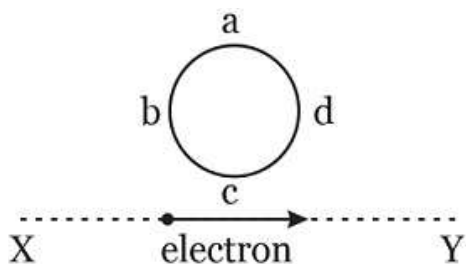
- 1No current induced
- 2abcd
- 3adcb
- 4The current will reverse its direction as the electron goes past the coil
Show answer and solution
Correct: option 4, The current will reverse its direction as the electron goes past the coil
The moving electron is a current along the line, so it produces a magnetic field through the coil. While the electron approaches, the flux through the coil grows; after it passes, the flux falls. By Lenz's law the induced current opposes the change each time, so it flows one way during the approach and the opposite way afterwards: the current reverses as the electron goes past the coil.
Question 4AIPMT 2015 Re-test, Q139
The cylindrical tube of a spray pump has radius R, one end of which has n fine holes, each of radius r. If the speed of the liquid in the tube is V, the speed of the ejection of the liquid through the holes is:
- 1
- 2
- 3
- 4
Show answer and solution
Correct: option 3,
The liquid is incompressible, so the volume flowing per second through the tube equals the total through the n holes (equation of continuity): . Hence .
Question 5AIPMT 2015 Re-test, Q140
The Young's modulus of steel is twice that of brass. Two wires of same length and of same area of cross section, one of steel and another of brass are suspended from the same roof. If we want the lower ends of the wires to be at the same level, then the weights added to the steel and brass wires must be in the ratio of:
- 11 : 1
- 21 : 2
- 32 : 1
- 44 : 1
Show answer and solution
Correct: option 3, 2 : 1
Extension . With the same L and A, equal extensions need , so . The steel wire must carry twice the weight: 2 : 1.
Question 6AIPMT 2015 Re-test, Q141
A potentiometer wire of length L and a resistance r are connected in series with a battery of e.m.f. and a resistance . An unknown e.m.f. E is balanced at a length of the potentiometer wire. The e.m.f. E will be given by:
- 1
- 2
- 3
- 4
Show answer and solution
Correct: option 3,
Current in the wire is , so the potential drop across the whole wire is and the drop per unit length is . At balance the unknown e.m.f. equals the drop across length : .
Question 7AIPMT 2015 Re-test, Q142
A particle is executing a simple harmonic motion. Its maximum acceleration is and maximum velocity is . Then, its time period of vibration will be:
- 1
- 2
- 3
- 4
Show answer and solution
Correct: option 1,
For amplitude A and angular frequency : and . Dividing, , so .
Question 8AIPMT 2015 Re-test, Q143
If vectors and are functions of time, then the value of t at which they are orthogonal to each other is:
- 1
- 2
- 3
- 4
Show answer and solution
Correct: option 4,
Orthogonal vectors have zero dot product: . So , giving .
Question 9AIPMT 2015 Re-test, Q144
A source of sound S emitting waves of frequency 100 Hz and an observer O are located at some distance from each other. The source is moving with a speed of at an angle of with the source observer line as shown in the figure. The observer is at rest. The apparent frequency observed by the observer (velocity of sound in air ), is:
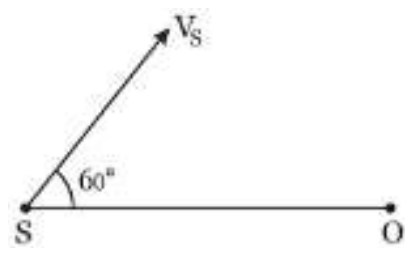
- 197 Hz
- 2100 Hz
- 3103 Hz
- 4106 Hz
Show answer and solution
Correct: option 3, 103 Hz
Only the component of the source velocity along the line SO matters: , directed towards the observer. Then .
Question 10AIPMT 2015 Re-test, Q145
An automobile moves on a road with a speed of . The radius of its wheels is 0.45 m and the moment of inertia of the wheel about its axis of rotation is . If the vehicle is brought to rest in 15 s, the magnitude of average torque transmitted by its brakes to the wheel is:
- 1
- 2
- 3
- 4
Show answer and solution
Correct: option 2,
, so the wheel's initial angular speed is . Angular retardation . Torque .
Question 11AIPMT 2015 Re-test, Q146
A rectangular coil of length 0.12 m and width 0.1 m having 50 turns of wire is suspended vertically in a uniform magnetic field of strength . The coil carries a current of 2 A. If the plane of the coil is inclined at an angle of with the direction of the field, the torque required to keep the coil in stable equilibrium will be:
- 10.12 Nm
- 20.15 Nm
- 30.20 Nm
- 40.24 Nm
Show answer and solution
Correct: option 3, 0.20 Nm
Torque on a current coil is , where is the angle between the field and the normal to the coil. The plane makes with the field, so . . An equal and opposite torque must be applied to hold the coil.
Question 12AIPMT 2015 Re-test, Q147
A parallel plate air capacitor has capacity 'C', distance of separation between plates is 'd' and potential difference 'V' is applied between the plates. Force of attraction between the plates of the parallel plate air capacitor is:
- 1
- 2
- 3
- 4
Show answer and solution
Correct: option 3,
One plate sits in the field of the other, , so the force is . With and (so ): .
Question 13AIPMT 2015 Re-test, Q148
Two vessels separately contain two ideal gases A and B at the same temperature, the pressure of A being twice that of B. Under such conditions, the density of A is found to be 1.5 times the density of B. The ratio of molecular weight of A and B is:
- 1
- 2
- 3
- 42
Show answer and solution
Correct: option 3,
For an ideal gas , so . At the same temperature .
Question 14AIPMT 2015 Re-test, Q149
A satellite S is moving in an elliptical orbit around the earth. The mass of the satellite is very small compared to the mass of the earth. Then,
- 1the acceleration of S is always directed towards the centre of the earth.
- 2the angular momentum of S about the centre of the earth changes in direction, but its magnitude remains constant.
- 3the total mechanical energy of S varies periodically with time.
- 4the linear momentum of S remains constant in magnitude.
Show answer and solution
Correct: option 1, the acceleration of S is always directed towards the centre of the earth.
The only force on the satellite is the earth's gravity, a central force pointing to the earth's centre (the earth hardly moves because it is so much heavier). So the acceleration always points to the centre of the earth. A central force gives no torque, so the angular momentum is constant in both magnitude and direction; gravity is conservative, so the total energy is constant; and the speed changes round an ellipse, so the linear momentum does not stay constant in magnitude.
Question 15AIPMT 2015 Re-test, Q150
In the given figure, a diode D is connected to an external resistance and an e.m.f. of 3.5 V. If the barrier potential developed across the diode is 0.5 V, the current in the circuit will be:
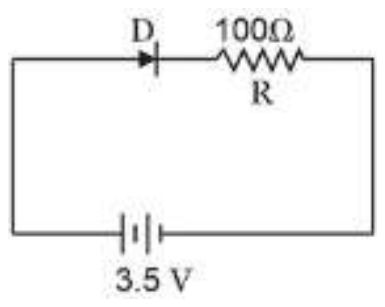
- 135 mA
- 230 mA
- 340 mA
- 420 mA
Show answer and solution
Correct: option 2, 30 mA
The diode is forward biased and drops 0.5 V, leaving across the resistance. .
Question 16AIPMT 2015 Re-test, Q151
A remote-sensing satellite of earth revolves in a circular orbit at a height of above the surface of earth. If earth's radius is and , then the orbital speed of the satellite is:
- 1
- 2
- 3
- 4
Show answer and solution
Correct: option 2,
Orbital speed , using . Here , so .
Question 17AIPMT 2015 Re-test, Q152
The position vector of a particle as a function of time is given by:
Where R is in meters, t is in seconds and and denote unit vectors along x- and y-directions, respectively. Which one of the following statements is wrong for the motion of particle?
- 1Path of the particle is a circle of radius 4 meter.
- 2Acceleration vector is along
- 3Magnitude of acceleration vector is , where is the velocity of particle.
- 4Magnitude of the velocity of particle is 8 meter/second
Show answer and solution
Correct: option 4, Magnitude of the velocity of particle is 8 meter/second
, so the path is a circle of radius 4 m, covered uniformly with . This is uniform circular motion: the acceleration is , directed along , with magnitude . The speed is , not 8 m/s, so the last statement is the wrong one.
Question 18AIPMT 2015 Re-test, Q153
A string is stretched between fixed points separated by 75.0 cm. It is observed to have resonant frequencies of 420 Hz and 315 Hz. There are no other resonant frequencies between these two. The lowest resonant frequency for this string is:
- 1105 Hz
- 2155 Hz
- 3205 Hz
- 410.5 Hz
Show answer and solution
Correct: option 1, 105 Hz
A string fixed at both ends resonates at whole-number multiples of its fundamental, . Two neighbouring resonances therefore differ by exactly : (the two given frequencies are the 3rd and 4th harmonics).
Question 19AIPMT 2015 Re-test, Q154
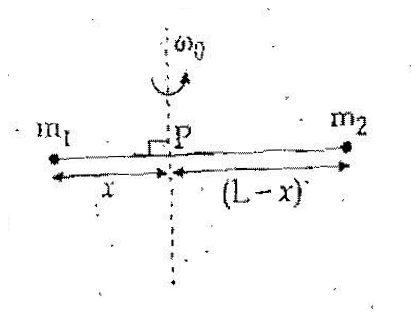
Point masses and are placed at the opposite ends of a rigid rod of length L, and negligible mass. The rod is to be set rotating about an axis perpendicular to it. The position of point P on this rod through which the axis should pass so that the work required to set the rod rotating with angular velocity is minimum, is given by:
- 1
- 2
- 3
- 4
Show answer and solution
Correct: option 1,
Work needed , so it is least when the moment of inertia is least. Setting gives , which is the centre of mass of the two masses.
Question 20AIPMT 2015 Re-test, Q155
At the first minimum adjacent to the central maximum of a single-slit diffraction pattern, the phase difference between the Huygen's wavelet from the edge of the slit and the wavelet from the midpoint of the slit is:
- 1 radian
- 2 radian
- 3 radian
- 4 radian
Show answer and solution
Correct: option 4, radian
The first minimum is where for slit width a. The wavelets from one edge and from the midpoint start a distance apart, so their path difference is . A path difference of half a wavelength is a phase difference of radian, which is why they cancel in pairs.
Question 21AIPMT 2015 Re-test, Q156
A force is acting at a point . The value of for which angular momentum about origin is conserved is:
- 11
- 2
- 32
- 4zero
Show answer and solution
Correct: option 2,
Angular momentum about the origin is conserved when the torque is zero, that is when is parallel (or antiparallel) to . Comparing components, , so and .
Question 22AIPMT 2015 Re-test, Q157
Two particles A and B, move with constant velocities and . At the initial moment their position vectors are and respectively. The condition for particles A and B for their collision is:
- 1
- 2
- 3
- 4
Show answer and solution
Correct: option 2,
They collide if at some time t their positions coincide: , so with . The two vectors must therefore point in the same direction, i.e. have the same unit vector: .
Question 23AIPMT 2015 Re-test, Q158
A nucleus of uranium decays at rest into nuclei of thorium and helium. Then:
- 1The helium nucleus has less kinetic energy than the thorium nucleus.
- 2The helium nucleus has more kinetic energy than the thorium nucleus.
- 3The helium nucleus has less momentum than the thorium nucleus.
- 4The helium nucleus has more momentum than the thorium nucleus.
Show answer and solution
Correct: option 2, The helium nucleus has more kinetic energy than the thorium nucleus.
The uranium nucleus is at rest, so by conservation of momentum the thorium and helium nuclei leave with equal and opposite momenta p. Kinetic energy is , so for equal p the lighter nucleus has more of it. Helium is much lighter than thorium, so it carries more kinetic energy.
Question 24AIPMT 2015 Re-test, Q159
Two metal wires of identical dimensions are connected in series. If and are the conductivities of the metal wires respectively, the effective conductivity of the combination is:
- 1
- 2
- 3
- 4
Show answer and solution
Correct: option 2,
Each wire has length l and area A, so its resistance is . In series the resistances add, and the combination is a wire of length 2l and area A: . Hence and .
Question 25AIPMT 2015 Re-test, Q160
Light of wavelength 500 nm is incident on a metal with work function 2.28 eV. The de Broglie wavelength of the emitted electron is:
- 1
- 2
- 3
- 4
Show answer and solution
Correct: option 4,
Photon energy , so the maximum kinetic energy of an electron is . The fastest electron has the shortest de Broglie wavelength, . Slower electrons have longer wavelengths, so .
Question 26AIPMT 2015 Re-test, Q161
4.0 g of a gas occupies 22.4 litres at NTP. The specific heat capacity of the gas at constant volume is . If the speed of sound in this gas at NTP is , then the heat capacity at constant pressure is
(Take gas constant )
- 1
- 2
- 3
- 4
Show answer and solution
Correct: option 2,
22.4 litres at NTP is one mole, so the molar mass is . Speed of sound gives . Then .
Question 27AIPMT 2015 Re-test, Q162
A series R-C circuit is connected to an alternating voltage source. Consider two situations:
(a) When capacitor is air filled.
(b) When capacitor is mica filled.
Current through resistor is and voltage across capacitor is V then:
- 1
- 2
- 3
- 4
Show answer and solution
Correct: option 3,
Mica is a dielectric, so it raises the capacitance and lowers the reactance . The impedance falls, so the current rises () and a larger share of the source voltage appears across R. The capacitor voltage therefore falls when C increases: .
Question 28AIPMT 2015 Re-test, Q163
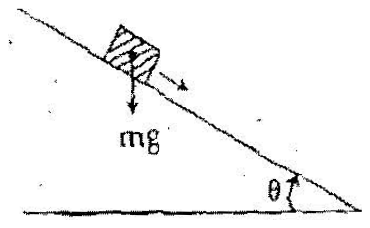
A plank with a box on it at one end is gradually raised about the other end. As the angle of inclination with the horizontal reaches , the box starts to slip and slides 4.0 m down the plank in 4.0 s. The coefficients of static and kinetic friction between the box and the plank will be, respectively:
- 10.4 and 0.3
- 20.6 and 0.6
- 30.6 and 0.5
- 40.5 and 0.6
Show answer and solution
Correct: option 3, 0.6 and 0.5
The box just starts to slip at the angle of repose, so . Sliding from rest, gives . From : , so .
Question 29AIPMT 2015 Re-test, Q164
Two stones of masses m and 2 m are whirled in horizontal circles, the heavier one in a radius and the lighter one in radius r. The tangential speed of lighter stone is n times that of the value of heavier stone when they experience same centripetal forces. The value of n is:
- 11
- 22
- 33
- 44
Show answer and solution
Correct: option 2, 2
Centripetal force is . Lighter stone: . Heavier stone: . Equating, , so and .
Question 30AIPMT 2015 Re-test, Q165
The coefficient of performance of a refrigerator is 5. If the temperature inside freezer is , the temperature of the surroundings to which it rejects heat is:
- 1
- 2
- 3
- 4
Show answer and solution
Correct: option 2,
For an ideal refrigerator, coefficient of performance with temperatures in kelvin. , so , giving and .
Question 31AIPMT 2015 Re-test, Q166
An ideal gas is compressed to half its initial volume by means of several processes. Which of the process results in the maximum work done on the gas?
- 1Isothermal
- 2Adiabatic
- 3Isobaric
- 4Isochoric
Show answer and solution
Correct: option 2, Adiabatic
Work done on the gas is the area under its P-V curve between V and V/2. Starting from the same state, the pressure stays constant in the isobaric process, rises as in the isothermal one and rises fastest, as , in the adiabatic one, so the adiabatic curve lies highest and encloses the largest area. An isochoric process has no volume change and no work. So the adiabatic compression needs the most work.
Question 32AIPMT 2015 Re-test, Q167
A ball is thrown vertically downwards from a height of 20 m with an initial velocity . It collides with the ground, loses 50 percent of its energy in collision and rebounds to the same height. The initial velocity is: (Take )
- 1
- 2
- 3
- 4
Show answer and solution
Correct: option 3,
Energy just before hitting the ground is . Half of it is left after the collision and that must carry the ball back up to height h: . So and .
Question 33AIPMT 2015 Re-test, Q168
On a frictionless surface, a block of mass M moving at speed collides elastically with another block of same mass M which is initially at rest. After collision the first block moves at an angle to its initial direction and has a speed . The second block's speed after the collision is:
- 1
- 2
- 3
- 4
Show answer and solution
Correct: option 2,
In an elastic collision kinetic energy is conserved: . So and .
Question 34AIPMT 2015 Re-test, Q169
If potential (in volts) in a region is expressed as , the electric field (in N/C) at point (1, 1, 0) is:
- 1
- 2
- 3
- 4
Show answer and solution
Correct: option 3,
. At (1, 1, 0) this is .
Question 35AIPMT 2015 Re-test, Q170
Two slits in Young's experiment have widths in the ratio 1 : 25. The ratio of intensity at the maxima and minima in the interference pattern, is:
- 1
- 2
- 3
- 4
Show answer and solution
Correct: option 2,
The intensity from a slit is proportional to its width, so and the amplitudes are in the ratio . .
Question 36AIPMT 2015 Re-test, Q171
The heart of a man pumps 5 litres of blood through the arteries per minute at a pressure of 150 mm of mercury. If the density of mercury be and then the power of heart in watt is:
- 11.50
- 21.70
- 32.35
- 43.0
Show answer and solution
Correct: option 2, 1.70
Power = pressure volume pumped per second. Pressure . Flow rate . Power .
Question 37AIPMT 2015 Re-test, Q172
A proton and an alpha particle both enter a region of uniform magnetic field B, moving at right angles to the field B. If the radius of circular orbits for both the particles is equal and the kinetic energy acquired by proton is 1 MeV, the energy acquired by the alpha particle will be:
- 11 MeV
- 24 MeV
- 30.5 MeV
- 41.5 MeV
Show answer and solution
Correct: option 1, 1 MeV
Radius , so . For the same B and r, . The alpha particle has twice the charge and four times the mass of a proton, so is times the proton's value. Its energy is also 1 MeV.
Question 38AIPMT 2015 Re-test, Q173
The input signal given to a CE amplifier having a voltage gain of 150 is . The corresponding output signal will be:
- 1
- 2
- 3
- 4
Show answer and solution
Correct: option 1,
The amplitude is multiplied by the gain: . A common-emitter amplifier also inverts the signal, a phase shift of , so the phase becomes . Output .
Question 39AIPMT 2015 Re-test, Q174
If dimensions of critical velocity of a liquid flowing through a tube are expressed as , where , and r are the coefficient of viscosity of liquid, density of liquid and radius of the tube respectively, then the values of x, y and z are given by:
- 1
- 2
- 3
- 4
Show answer and solution
Correct: option 2,
, , , . Matching powers: M: ; T: , so and ; L: , so . The values are , that is .
Question 40AIPMT 2015 Re-test, Q175
A circuit contains an ammeter, a battery of 30 V and a resistance 40.8 ohm all connected in series. If the ammeter has a coil of resistance 480 ohm and a shunt of 20 ohm, the reading in the ammeter will be:
- 11 A
- 20.5 A
- 30.25 A
- 42 A
Show answer and solution
Correct: option 2, 0.5 A
The coil and its shunt are in parallel, so the ammeter's resistance is . Total resistance . The ammeter reads the total circuit current, .
Question 41AIPMT 2015 Re-test, Q176
Water rises to a height 'h' in capillary tube. If the length of capillary tube above the surface of water is made less than 'h', then:
- 1water does not rise at all.
- 2water rises upto the tip of capillary tube and then starts overflowing like a fountain.
- 3water rises upto the top of capillary tube and stays there without overflowing.
- 4water rises upto a point a little below the top and stays there.
Show answer and solution
Correct: option 3, water rises upto the top of capillary tube and stays there without overflowing.
Water climbs to the top of the short tube, where the meniscus flattens: its radius of curvature grows until the smaller pressure difference across it just balances the shorter water column ( stays constant). The water therefore stays at the top without overflowing; a fountain would mean a continuous flow with no energy source.
Question 42AIPMT 2015 Re-test, Q177
In an astronomical telescope in normal adjustment a straight black line of length L is drawn on inside part of objective lens. The eye-piece forms a real image of this line. The length of this image is I. The magnification of the telescope is:
- 1
- 2
- 3
- 4
Show answer and solution
Correct: option 1,
In normal adjustment the lenses are apart, so the line on the objective is an object at distance from the eye-piece. From the lens formula, , so and the size ratio is . The telescope's magnification is .
Question 43AIPMT 2015 Re-test, Q178
The value of coefficient of volume expansion of glycerin is . The fractional change in the density of glycerin for a rise of in its temperature, is:
- 10.010
- 20.015
- 30.020
- 40.025
Show answer and solution
Correct: option 3, 0.020
Mass is fixed, so density falls as volume grows: , and for small the fractional change is (a decrease).
Question 44AIPMT 2015 Re-test, Q179
A photoelectric surface is illuminated successively by monochromatic light of wavelength and . If the maximum kinetic energy of the emitted photoelectrons in the second case is 3 times that in the first case, the work function of the surface of the material is:
(h = Planck's constant, c = speed of light)
- 1
- 2
- 3
- 4
Show answer and solution
Correct: option 2,
Einstein's equation for the two cases: and . Substituting the first into the second: , so and .
Question 45AIPMT 2015 Re-test, Q180
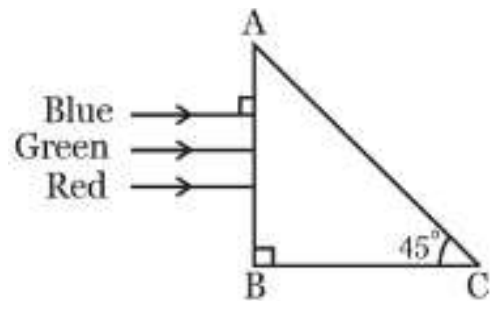
A beam of light consisting of red, green and blue colours is incident on a right angled prism. The refractive index of the material of the prism for the above red, green and blue wavelengths are 1.39, 1.44 and 1.47, respectively.
- 1separate the red colour part from the green and blue colours
- 2separate the blue colour part from the red and green colours
- 3separate all the three colours from one another
- 4not separate the three colours at all
Show answer and solution
Correct: option 1, separate the red colour part from the green and blue colours
The beam enters face AB normally and meets the slanted face AC at . Total internal reflection needs , that is . Green (1.44) and blue (1.47) satisfy this and are totally reflected, while red (1.39) does not and passes out through AC. So red is separated from green and blue.
AIPMT 2015 Re-test Chemistry questions
Question 46AIPMT 2015 Re-test, Q1
2,3-Dimethyl-2-butene can be prepared by heating which of the following compounds with a strong acid?
- 1
- 2
- 3
- 4
Show answer and solution
Correct: option 4,
The product has six carbons with a 2,3-dimethylbutane skeleton. Protonating gives a secondary carbocation next to the quaternary carbon; a methyl shift turns it into the tertiary cation , which loses a proton to give the most substituted alkene, 2,3-dimethyl-2-butene. Options (1) and (2) have a 2-methylpentane skeleton and option (3) has seven carbons, so only option (4) works.
Question 47AIPMT 2015 Re-test, Q2
Gadolinium belongs to 4f series. Its atomic number is 64. Which of the following is the correct electronic configuration of gadolinium?
- 1
- 2
- 3
- 4
Show answer and solution
Correct: option 1,
Xenon accounts for 54 electrons, leaving 10. Gadolinium keeps the extra-stable half-filled subshell and puts the next electron in , so the configuration is , option (1).
Question 48AIPMT 2015 Re-test, Q3
The formation of the oxide ion, , from oxygen atom requires first an exothermic and then an endothermic step as shown below
;
;
Thus process of formation of in gas phase is unfavourable even though is isoelectronic with neon. It is due to the fact that,
- 1oxygen is more electronegative
- 2addition of electron in oxygen results in larger size of the ion.
- 3electron repulsion outweighs the stability gained by achieving noble gas configuration.
- 4 ion has comparatively smaller size than oxygen atom.
Show answer and solution
Correct: option 3, electron repulsion outweighs the stability gained by achieving noble gas configuration.
The second electron has to be pushed onto an ion that is already negative and small, so the repulsion between the incoming electron and costs far more energy (+780 kJ/mol) than is gained by reaching the neon configuration. That is option (3). Option (4) is false as well, because an anion is larger than its parent atom.
Question 49AIPMT 2015 Re-test, Q4
The number of structural isomers possible from the molecular formula is
- 12
- 23
- 34
- 45
Show answer and solution
Correct: option 3, 4
is a saturated amine. The isomers are propan-1-amine and propan-2-amine (primary), N-methylethanamine (secondary) and N,N-dimethylmethanamine (tertiary), which makes 4, option (3).
Question 50AIPMT 2015 Re-test, Q5
If the equilibrium constant for is K, the equilibrium constant for will be:
- 1
- 2
- 3
- 4
Show answer and solution
Correct: option 3,
When every coefficient of an equation is multiplied by a factor , the equilibrium constant is raised to the power . Here the equation is halved, so , option (3).
Question 51AIPMT 2015 Re-test, Q6
Which one of the following pairs of solution is not an acidic buffer?
- 1 and
- 2 and
- 3 and
- 4 and
Show answer and solution
Correct: option 3, and
An acidic buffer needs a weak acid together with a salt of that acid and a strong base. Carbonic, phosphoric and acetic acids are weak, but perchloric acid is a strong acid that ionises completely, so its mixture with cannot resist a change in pH. Option (3).
Question 52AIPMT 2015 Re-test, Q7
Aqueous solution of which of the following compounds is the best conductor of electric current?
- 1Ammonia,
- 2Fructose,
- 3Acetic acid,
- 4Hydrochloric acid,
Show answer and solution
Correct: option 4, Hydrochloric acid,
A solution conducts through its ions. Fructose is a non-electrolyte, and ammonia and acetic acid are weak electrolytes that ionise only slightly. Hydrochloric acid is a strong electrolyte that ionises completely into and , so it conducts best. Option (4).
Question 53AIPMT 2015 Re-test, Q8
Caprolactam is used for the manufacture of:
- 1Terylene
- 2Nylon-6,6
- 3Nylon-6
- 4Teflon
Show answer and solution
Correct: option 3, Nylon-6
Caprolactam is a cyclic amide with six carbons; heating it with water opens the ring and the units join to give Nylon-6. Terylene comes from ethylene glycol and terephthalic acid, Nylon-6,6 from hexamethylenediamine and adipic acid, and Teflon from tetrafluoroethene. Option (3).
Question 54AIPMT 2015 Re-test, Q9
On heating which of the following releases most easily?
- 1
- 2
- 3
- 4
Show answer and solution
Correct: option 1,
A carbonate decomposes more easily when its cation is small and highly charged, because such a cation polarises the carbonate ion strongly. is the smallest, most polarising cation here, so is the least stable to heat; and do not decompose on ordinary heating. Option (1).
Question 55AIPMT 2015 Re-test, Q10
Strong reducing behaviour of is due to:
- 1High oxidation state of phosphorus
- 2Presence of two groups and one bond
- 3Presence of one group and two bonds
- 4High electron gain enthalpy of phosphorus
Show answer and solution
Correct: option 3, Presence of one group and two bonds
In hypophosphorous acid, , phosphorus carries one , one and two bonds. The hydrogens bonded directly to phosphorus are the ones that reduce other substances, and this acid has two of them, so it is a strong reducing agent. Option (3).
Question 56AIPMT 2015 Re-test, Q11
Decreasing order of stability of , , and is:
- 1
- 2
- 3
- 4
Show answer and solution
Correct: option 3,
Stability follows bond order. In the bond order is 2; the extra electrons of the anions go into antibonding orbitals, while the cation has lost one antibonding electron. Bond orders: 2.5, 2, 1.5, 1. So the order is , option (3).
Question 57AIPMT 2015 Re-test, Q12
The number of water molecules is maximum in:
- 118 gram of water
- 218 moles of water
- 318 molecules of water
- 41.8 gram of water
Show answer and solution
Correct: option 2, 18 moles of water
18 g of water is 1 mole ( molecules) and 1.8 g is 0.1 mole. 18 moles contain molecules, far more than the others, so option (2).
Question 58AIPMT 2015 Re-test, Q13
In which of the following pairs, both the species are not isostructural?
- 1,
- 2,
- 3,
- 4diamond, silicon carbide
Show answer and solution
Correct: option 2, ,
and are both pyramidal; and are both tetrahedral; diamond and silicon carbide are both tetrahedral network solids. has four bond pairs and two lone pairs and is square planar, while has no lone pair and is tetrahedral. Option (2).
Question 59AIPMT 2015 Re-test, Q14
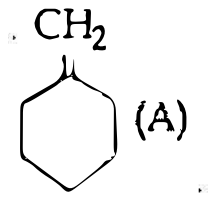
In the reaction with HCl, an alkene reacts in accordance with the Markovnikov's rule, to give a product 1-chloro-1-methylcyclohexane. The possible alkene is:
- 1
- 2
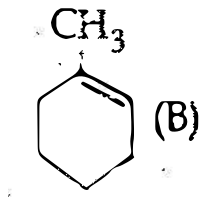
- 3(A) and (B)
- 4
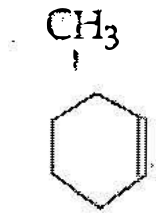
Show answer and solution
Correct: option 3, (A) and (B)
(A) is methylenecyclohexane and (B) is 1-methylcyclohexene. In both, adding to the carbon with more hydrogens gives the same tertiary carbocation on the ring carbon, and chloride then attaches there to give 1-chloro-1-methylcyclohexane. The alkene in option (4) has its double bond away from the methyl-bearing carbon and would put the chlorine on a different carbon. So both (A) and (B) are possible, option (3).
Question 60AIPMT 2015 Re-test, Q15
Assuming complete ionization, same moles of which of the following compounds will require the least amount of acidified for complete oxidation?
- 1
- 2
- 3
- 4
Show answer and solution
Correct: option 3,
Count the electrons one mole of each gives up. gives 1 in every case. Oxalate () adds 2, two nitrite ions () add 4, and sulphite () adds 2, while sulphate cannot be oxidised further. The totals are 3, 5, 1 and 3, so needs the least permanganate. Option (3).
Question 61AIPMT 2015 Re-test, Q16
Reaction of phenol with chloroform in presence of dilute sodium hydroxide finally introduces which one of the following functional group?
- 1
- 2
- 3
- 4
Show answer and solution
Correct: option 2,
This is the Reimer-Tiemann reaction. Dichlorocarbene from chloroform and alkali attacks the phenoxide ring at the ortho position to give a group, which is hydrolysed by the alkali to . The final product is salicylaldehyde, so the group introduced is , option (2).
Question 62AIPMT 2015 Re-test, Q17
The vacant space in bcc lattice unit cell is
- 123%
- 232%
- 326%
- 448%
Show answer and solution
Correct: option 2, 32%
A bcc cell has 2 atoms and . Packing fraction . So 68% is filled and 32% is empty, option (2).
Question 63AIPMT 2015 Re-test, Q18
Which of the statements given below is incorrect?
- 1ONF is isoelectronic with
- 2 is an oxide of fluorine
- 3 is an anhydride of perchloric acid
- 4 molecule is bent
Show answer and solution
Correct: option 2, is an oxide of fluorine
ONF has 8 + 7 + 9 = 24 electrons and has 7 + 16 + 1 = 24, so (1) is true. with water gives , so (3) is true, and ozone is a bent molecule, so (4) is true. Fluorine is more electronegative than oxygen, so is oxygen difluoride, a fluoride of oxygen and not an oxide of fluorine. The incorrect statement is option (2).
Question 64AIPMT 2015 Re-test, Q19
The name of complex ion, is:
- 1Tricyanoferrate (III) ion
- 2Hexacyanidoferrate (III) ion
- 3Hexacyanoiron (III) ion
- 4Hexacyanitoferrate (III) ion
Show answer and solution
Correct: option 2, Hexacyanidoferrate (III) ion
There are six cyanide ligands, named cyanido, so the prefix is hexa. The complex is an anion, so iron takes the ending -ate (ferrate). Its oxidation state is , giving . The name is hexacyanidoferrate(III) ion, option (2).
Question 65AIPMT 2015 Re-test, Q20
If Avogadro number , is changed from to , this would change:
- 1the ratio of chemical species to each other in a balanced equation.
- 2the ratio of elements to each other in a compound.
- 3the definition of mass in units of grams.
- 4the mass of one mole of carbon.
Show answer and solution
Correct: option 4, the mass of one mole of carbon.
Ratios of atoms in a compound and of species in an equation are fixed by nature, and the gram is defined independently of the mole. A mole is just a count of particles, so with a smaller one mole of carbon would hold 1000 times fewer atoms and weigh g instead of 12 g. Option (4).
Question 66AIPMT 2015 Re-test, Q21
Which of the following statements is not correct for a nucleophile?
- 1Nucleophiles attack low density sites
- 2Nucleophiles are not electron seeking
- 3Nucleophile is a Lewis acid
- 4Ammonia is a nucleophile
Show answer and solution
Correct: option 3, Nucleophile is a Lewis acid
A nucleophile is an electron-rich species that donates an electron pair to an electron-poor site; it seeks a nucleus, not electrons. A species that donates an electron pair is a Lewis base, not a Lewis acid. Ammonia, with its lone pair, is a typical nucleophile. The incorrect statement is option (3).
Question 67AIPMT 2015 Re-test, Q22
A gas such as carbon monoxide would be most likely to obey the ideal gas law at:
- 1high temperatures and high pressures.
- 2low temperatures and low pressures.
- 3high temperatures and low pressures.
- 4low temperatures and high pressures.
Show answer and solution
Correct: option 3, high temperatures and low pressures.
A real gas behaves ideally when its molecules are far apart and fast moving, so that their own volume and the attractions between them can be neglected. That is the case at low pressure and high temperature, option (3).
Question 68AIPMT 2015 Re-test, Q23
The hybridization involved in complex is: (At. No. Ni = 28)
- 1
- 2
- 3
- 4
Show answer and solution
Correct: option 3,
Nickel is in the +2 state, . Cyanide is a strong-field ligand, so the eight electrons pair up in four orbitals and leave one orbital empty. This orbital mixes with the and two orbitals to give hybridisation, a square planar and diamagnetic complex. Option (3).
Question 69AIPMT 2015 Re-test, Q24
The heat of combustion of carbon to is kJ/mol. The heat released upon formation of 35.2 g of from carbon and oxygen gas is:
- 1 kJ
- 2 kJ
- 3 kJ
- 4 kJ
Show answer and solution
Correct: option 3, kJ
releases 393.5 kJ for each mole (44 g) of formed. 35.2 g is mol, so the enthalpy change is kJ, option (3).
Question 70AIPMT 2015 Re-test, Q25
20.0 g of a magnesium carbonate sample decomposes on heating to give carbon dioxide and 8.0 g magnesium oxide. What will be the percentage purity of magnesium carbonate in the sample?
(At. Wt.: Mg = 24)
- 160
- 284
- 375
- 496
Show answer and solution
Correct: option 2, 84
, so 84 g of gives 40 g of MgO. 8.0 g of MgO is 0.2 mol and must have come from 0.2 mol, that is 16.8 g, of pure . Purity , option (2).
Question 71AIPMT 2015 Re-test, Q26
What is the mole fraction of the solute in a 1.00 m aqueous solution?
- 10.0354
- 20.0177
- 30.177
- 41.770
Show answer and solution
Correct: option 2, 0.0177
A 1.00 molal solution has 1 mol of solute in 1000 g of water, which is mol of water. Mole fraction of solute , option (2).
Question 72AIPMT 2015 Re-test, Q27
The correct statement regarding defects in crystalline solids is:
- 1Frenkel defect is a dislocation defect.
- 2Frenkel defect is found in halides of alkaline metals.
- 3Schottky defects have no effect on the density of crystalline solids.
- 4Frenkel defects decrease the density of crystalline solids.
Show answer and solution
Correct: option 1, Frenkel defect is a dislocation defect.
In a Frenkel defect the smaller ion leaves its lattice site and sits in an interstitial site, so it is called a dislocation defect and the density does not change. It is seen in solids such as AgCl and ZnS with a large size difference between the ions, not in alkali metal halides, which show Schottky defects. Schottky defects remove ions and lower the density. Only option (1) is correct.
Question 73AIPMT 2015 Re-test, Q28
The stability of +1 oxidation state among Al, Ga, In and Tl increases in the sequence:
- 1
- 2
- 3
- 4
Show answer and solution
Correct: option 4,
Down group 13 the electrons become more reluctant to take part in bonding (the inert pair effect), because the poorly shielding d and f electrons leave them held tightly. So the +1 state grows steadily more stable from Al to Tl: , option (4).
Question 74AIPMT 2015 Re-test, Q29
Two possible stereo-structures of , which are optically active, are called:
- 1Enantiomers
- 2Mesomers
- 3Diastereomers
- 4Atropisomers
Show answer and solution
Correct: option 1, Enantiomers
Lactic acid has one chiral carbon, bonded to H, OH, and COOH. It therefore exists as two forms that are non-superimposable mirror images and rotate plane polarised light in opposite directions. Such a pair is called enantiomers, option (1). Diastereomers and meso forms need at least two chiral centres.
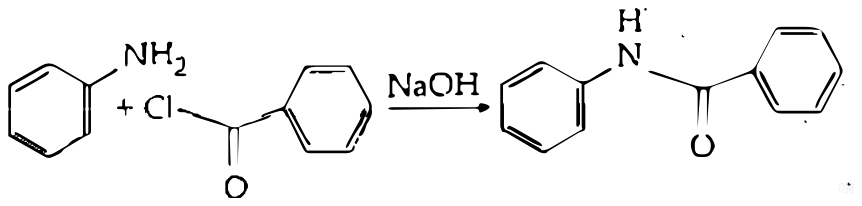
Question 75AIPMT 2015 Re-test, Q30
- 1Acetylation reaction
- 2Schotten-Baumann reaction
- 3Friedel-Craft's reaction
- 4Perkin's reaction
Show answer and solution
Correct: option 2, Schotten-Baumann reaction
Aniline reacts with benzoyl chloride in the presence of aqueous NaOH to give N-phenylbenzamide (benzanilide). Benzoylation of an amine or a phenol with benzoyl chloride and aqueous alkali is the Schotten-Baumann reaction, option (2). It is not acetylation, because the group added is benzoyl and not acetyl.
Question 76AIPMT 2015 Re-test, Q31
The sum of coordination number and oxidation number of the metal M in the complex (where en is ethylenediamine) is:
- 17
- 28
- 39
- 46
Show answer and solution
Correct: option 3, 9
Ethylenediamine and oxalate are both bidentate, so the three ligands give donor atoms: coordination number 6. For the charge, en is neutral, oxalate is and the chloride outside makes the complex ion : , so . The sum is , option (3).
Question 77AIPMT 2015 Re-test, Q32
Reaction of a carbonyl compound with one of the following reagents involves nucleophilic addition followed by elimination of water. The reagent is:
- 1hydrocyanic acid
- 2sodium hydrogen sulphite
- 3a Grignard reagent
- 4hydrazine in presence of feebly acidic solution
Show answer and solution
Correct: option 4, hydrazine in presence of feebly acidic solution
HCN, and Grignard reagents simply add across the bond. Ammonia derivatives such as hydrazine first add to the carbonyl carbon and the adduct then loses a molecule of water to form a bond (a hydrazone); the reaction is run in weakly acidic solution. Option (4).
Question 78AIPMT 2015 Re-test, Q33
Which one of the following esters gets hydrolysed most easily under alkaline conditions?
- 1
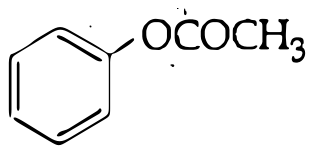
- 2
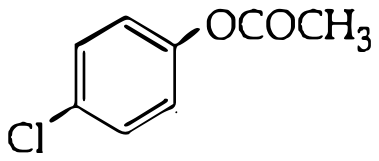
- 3
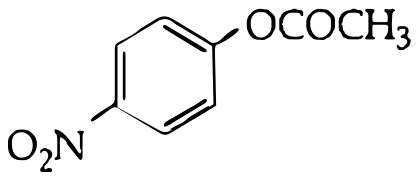
- 4
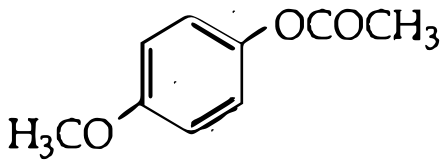
Show answer and solution
Correct: option 3
The four esters are phenyl acetate and its para-chloro, para-nitro and para-methoxy derivatives. In alkaline hydrolysis attacks the carbonyl carbon and the phenoxide ion leaves; an electron-withdrawing group on the ring makes the carbonyl carbon more electron-poor and the phenoxide a better leaving group. The nitro group withdraws electrons most strongly (methoxy donates), so the para-nitro ester in option (3) is hydrolysed most easily.
Question 79AIPMT 2015 Re-test, Q34
In an reaction on chiral centres, there is:
- 1100% retention
- 2100% inversion
- 3100% racemization
- 4inversion more than retention leading to partial racemization
Show answer and solution
Correct: option 4, inversion more than retention leading to partial racemization
An reaction goes through a planar carbocation that can be attacked from either face, which would give a racemic mixture. In practice the leaving group stays close to the face it left for a short time and partly blocks it, so attack from the opposite face is slightly favoured. The product has a little more inversion than retention, that is partial racemization, option (4).
Question 80AIPMT 2015 Re-test, Q35
The rate constant of the reaction is mole per second. If the concentration of A is 5 M then concentration of B after 20 minutes is:
- 10.36 M
- 20.72 M
- 31.08 M
- 43.60 M
Show answer and solution
Correct: option 2, 0.72 M
A rate constant with the units of concentration per time belongs to a zero order reaction, whose rate does not depend on the concentration of A. The amount of B formed is M, option (2).
Question 81AIPMT 2015 Re-test, Q36
What is the pH of the resulting solution when equal volumes of 0.1 M NaOH and 0.01 M HCl are mixed?
- 17.0
- 21.04
- 312.65
- 42.0
Show answer and solution
Correct: option 3, 12.65
Take 1 L of each. NaOH supplies 0.1 mol of and HCl supplies 0.01 mol of , leaving 0.09 mol of in 2 L, so M. pOH and pH , option (3).
Question 82AIPMT 2015 Re-test, Q37
Number of possible isomers for the complex will be: (en = ethylenediamine)
- 13
- 24
- 32
- 41
Show answer and solution
Correct: option 1, 3
The octahedral ion has a cis and a trans form. The trans form has a plane of symmetry and is optically inactive, while the cis form has none and exists as a pair of mirror-image (d and l) isomers. Total: 1 trans + 2 cis = 3 isomers, option (1).
Question 83AIPMT 2015 Re-test, Q38
The variation of the boiling points of the hydrogen halides is in the order .
What explains the higher boiling point of hydrogen fluoride?
- 1The bond energy of HF molecules is greater than in other hydrogen halides.
- 2The effect of nuclear shielding is much reduced in fluorine which polarises the HF molecule.
- 3The electronegativity of fluorine is much higher than for other elements in the group.
- 4There is strong hydrogen bonding between HF molecules.
Show answer and solution
Correct: option 4, There is strong hydrogen bonding between HF molecules.
Boiling breaks the forces between molecules, not the bonds inside them, so bond energy is not the reason. From HCl to HI the boiling point rises with molecular size because van der Waals forces increase. HF is out of line because its molecules are linked by strong hydrogen bonds, which need extra energy to break. Option (4) states this directly; the high electronegativity of fluorine is only the cause of those hydrogen bonds.
Question 84AIPMT 2015 Re-test, Q39
What is the mass of the precipitate formed when 50 mL of 16.9% solution of is mixed with 50 mL of 5.8% NaCl solution?
(Ag = 107.8, N = 14, O = 16, Na = 23, Cl = 35.5)
- 17 g
- 214 g
- 328 g
- 43.5 g
Show answer and solution
Correct: option 1, 7 g
50 mL of 16.9% solution holds 8.45 g of , which is mol. 50 mL of 5.8% solution holds 2.9 g of NaCl, which is mol. They react 1 : 1 to give about 0.05 mol of AgCl, of molar mass 143.3 g: g, option (1).
Question 85AIPMT 2015 Re-test, Q40
The oxidation of benzene by in the presence of air produces:
- 1benzoic acid
- 2benzaldehyde
- 3benzoic anhydride
- 4maleic anhydride
Show answer and solution
Correct: option 4, maleic anhydride
Benzene has no side chain to oxidise, so benzoic acid or benzaldehyde cannot form. With air over hot (about 773 K) the ring itself is broken: two carbons are lost as and the remaining four form maleic anhydride. Option (4).
Question 86AIPMT 2015 Re-test, Q41
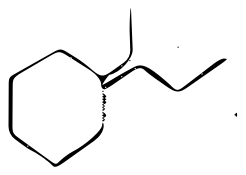
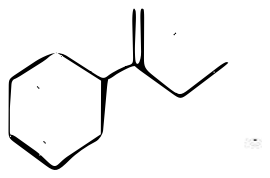
Which of the following is not the product of dehydration of
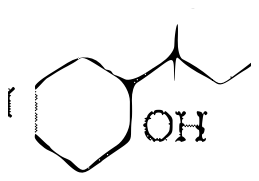
- 1
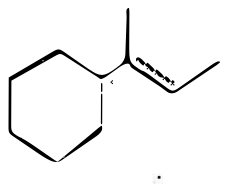
- 2
- 3
- 4
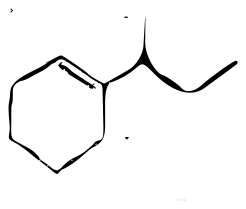
Show answer and solution
Correct: option 4
The alcohol is 2-cyclohexylbutan-2-ol. Losing water gives a tertiary carbocation on the carbon that carried the OH, and a proton is then lost from a carbon next to it: from the of the ethyl group (option 1), from the ring carbon (option 2) or from the methyl group (option 3). Each of these alkenes has its double bond at the carbon that held the OH. In option (4) the double bond lies inside the ring away from that carbon, which would need a rearrangement to a less stable cation, so it is not a product.
Question 87AIPMT 2015 Re-test, Q42
Method by which Aniline cannot be prepared is:
- 1reduction of nitrobenzene with in ethanol.
- 2potassium salt of phthalimide treated with chlorobenzene followed by hydrolysis with aqueous NaOH solution.
- 3hydrolysis of phenylisocyanide with acidic solution.
- 4degradation of benzamide with bromine in alkaline solution.
Show answer and solution
Correct: option 2, potassium salt of phthalimide treated with chlorobenzene followed by hydrolysis with aqueous NaOH solution.
Reduction of nitrobenzene, acid hydrolysis of phenyl isocyanide (which gives aniline and formic acid) and Hofmann bromamide degradation of benzamide all give aniline. Option (2) is the Gabriel phthalimide synthesis, in which the phthalimide anion must displace the halogen of the halide; chlorobenzene does not undergo nucleophilic substitution under these conditions because its bond has partial double bond character. So aniline cannot be made this way.
Question 88AIPMT 2015 Re-test, Q43
Which of the following reaction(s) can be used for the preparation of alkyl halides?
(I)
(II)
(III)
(IV)
- 1(IV) only
- 2(III) and (IV) only
- 3(I), (III) and (IV) only
- 4(I) and (II) only
Show answer and solution
Correct: option 3, (I), (III) and (IV) only
Primary and secondary alcohols react with HCl only when anhydrous is present to help the OH group leave, so (I) and (IV) work and (II), a primary alcohol with HCl alone, does not. A tertiary alcohol forms a stable carbocation and reacts with concentrated HCl even without the catalyst, so (III) works. The answer is (I), (III) and (IV) only, option (3).
Question 89AIPMT 2015 Re-test, Q44
Which is the correct order of increasing energy of the listed orbitals in the atom of titanium?
(At. no. Z = 22)
- 13s 3p 3d 4s
- 23s 3p 4s 3d
- 33s 4s 3p 3d
- 44s 3s 3p 3d
Show answer and solution
Correct: option 2, 3s 3p 4s 3d
Orbitals fill in order of increasing , and for equal values the lower comes first: 3s (3), 3p (4), 4s (4), 3d (5). Titanium is , with 4s filled before 3d, so the order asked for is 3s 3p 4s 3d, option (2).
Question 90AIPMT 2015 Re-test, Q45
In the extraction of copper from its sulphide ore, the metal is finally obtained by the reduction of cuprous oxide with:
- 1copper(I) sulphide
- 2sulphur dioxide
- 3iron(II) sulphide
- 4carbon monoxide
Show answer and solution
Correct: option 2, sulphur dioxide
In the Bessemer converter part of the copper matte is oxidised to cuprous oxide, which then reacts with the remaining sulphide (self-reduction): . The answer key used for this paper gives option (2), sulphur dioxide, which is the gas given off in this step. Note that in this equation the substance that reduces is copper(I) sulphide, option (1), so the key is open to doubt here.
AIPMT 2015 Re-test Biology questions
Question 91AIPMT 2015 Re-test, Q46
Root pressure develops due to:
- 1Increase in transpiration
- 2Active absorption
- 3Low osmotic potential in soil
- 4Passive absorption
Show answer and solution
Correct: option 2, Active absorption
Root cells actively pump mineral ions into the xylem. Water follows by osmosis and builds up a positive pressure in the xylem, called root pressure. It is therefore a result of active absorption, and it is seen best when transpiration is low.
Question 92AIPMT 2015 Re-test, Q47
Which one is a wrong statement?
- 1Brown algae have chlorophyll a and c, and fucoxanthin
- 2Archegonia are found in Bryophyta, Pteridophyta and Gymnosperms
- 3Mucor has biflagellate zoospores
- 4Haploid endosperm is typical feature of gymnosperms
Show answer and solution
Correct: option 3, Mucor has biflagellate zoospores
Mucor is a zygomycete fungus; it reproduces asexually by non-motile sporangiospores and has no flagellated zoospores, so statement (3) is wrong. The other three are correct: brown algae have chlorophyll a, c and fucoxanthin, archegonia occur from bryophytes to gymnosperms, and the gymnosperm endosperm is the haploid female gametophyte.
Question 93AIPMT 2015 Re-test, Q48
Which of the following structures is not found in a prokaryotic cell?
- 1Plasma membrane
- 2Nuclear envelope
- 3Ribosome
- 4Mesosome
Show answer and solution
Correct: option 2, Nuclear envelope
A prokaryotic cell has no membrane-bound nucleus; its DNA lies naked in the nucleoid, so there is no nuclear envelope. Plasma membrane, 70S ribosomes and mesosomes (infoldings of the membrane) are all present.
Question 94AIPMT 2015 Re-test, Q49
Which one of the following animals has two separate circulatory pathways?
- 1Shark
- 2Frog
- 3Lizard
- 4Whale
Show answer and solution
Correct: option 4, Whale
Complete double circulation, with fully separate pulmonary and systemic pathways, needs a four-chambered heart, which is found in birds and mammals. The whale is a mammal. A shark has single circulation, and the frog and lizard have a three-chambered heart with mixing of blood (incomplete double circulation).
Question 95AIPMT 2015 Re-test, Q50
Most animals that live in deep oceanic waters are:
- 1detritivores
- 2primary consumers
- 3secondary consumers
- 4tertiary consumers
Show answer and solution
Correct: option 1, detritivores
No light reaches the deep ocean, so there are no producers there. Most animals of that zone depend on the dead organic matter that sinks from the upper layers, which makes them detritivores.
Question 96AIPMT 2015 Re-test, Q51
An association of individuals of different species living in the same habitat and having functional interactions is
- 1Population
- 2Ecological niche
- 3Biotic community
- 4Ecosystem
Show answer and solution
Correct: option 3, Biotic community
A population has individuals of one species only. Populations of different species that live together in one habitat and interact form a biotic community. An ecosystem would also include the non-living environment, and a niche is the functional role of a species.
Question 97AIPMT 2015 Re-test, Q52
The oxygen evolved during photosynthesis comes from water molecules. Which one of the following pairs of elements is involved in this reaction?
- 1Magnesium and Chlorine
- 2Manganese and Chlorine
- 3Manganese and Potassium
- 4Magnesium and Molybdenum
Show answer and solution
Correct: option 2, Manganese and Chlorine
The splitting of water takes place at the oxygen-evolving complex of photosystem II. This complex contains manganese, and chloride ions (with calcium) are needed for it to work. So the pair is manganese and chlorine.
Question 98AIPMT 2015 Re-test, Q53
Axile placentation is present in:
- 1Argemone
- 2Dianthus
- 3Lemon
- 4Pea
Show answer and solution
Correct: option 3, Lemon
In axile placentation the ovules are borne on a central axis in a multilocular ovary, as in lemon, china rose and tomato. Argemone has parietal, Dianthus has free central and pea has marginal placentation.
Question 99AIPMT 2015 Re-test, Q54
In which of the following both pairs have correct combination?
- 1Gaseous nutrient cycle - Sulphur and Phosphorus
Sedimentary nutrient cycle - Carbon and Nitrogen
- 2Gaseous nutrient cycle - Carbon and Nitrogen
Sedimentary nutrient cycle - Sulphur and Phosphorus
- 3Gaseous nutrient cycle - Carbon and sulphur
Sedimentary nutrient cycle - Nitrogen and Phosphorus
- 4Gaseous nutrient cycle - Nitrogen and sulphur
Sedimentary nutrient cycle - Carbon and Phosphorus
Show answer and solution
Correct: option 2, Gaseous nutrient cycle - Carbon and Nitrogen
Sedimentary nutrient cycle - Sulphur and Phosphorus
In a gaseous cycle the main reservoir is the atmosphere, as for carbon and nitrogen. In a sedimentary cycle the reservoir is the earth's crust, as for sulphur and phosphorus. Only option (2) has both pairs right.
Question 100AIPMT 2015 Re-test, Q55
In mammalian eye, the 'fovea' is the center of the visual field, where
- 1more rods than cones are found
- 2high density of cones occur, but has no rods.
- 3the optic nerve leaves the eye.
- 4only rods are present.
Show answer and solution
Correct: option 2, high density of cones occur, but has no rods.
The fovea is the thinned-out central pit of the macula lutea. Only cones are found there, packed very densely, which makes it the point of sharpest vision. The place where the optic nerve leaves the eye is the blind spot, which has no photoreceptors at all.
Question 101AIPMT 2015 Re-test, Q56
Choose the wrong statement:
- 1Yeast is unicellular and useful in fermentation
- 2Penicillium is multicellular and produces antibiotics
- 3Neurospora is used in the study of biochemical genetics
- 4Morels and truffles are poisonous mushrooms
Show answer and solution
Correct: option 4, Morels and truffles are poisonous mushrooms
Morels and truffles are edible ascomycetes and are prized as food, so statement (4) is wrong. Yeast is a unicellular fungus used in fermentation, Penicillium is a multicellular source of penicillin, and Neurospora is the classic organism of biochemical genetics.
Question 102AIPMT 2015 Re-test, Q57
Which of the following are not membrane-bound?
- 1Mesosomes
- 2Vacuoles
- 3Ribosomes
- 4Lysosomes
Show answer and solution
Correct: option 3, Ribosomes
Ribosomes are particles of rRNA and protein with no membrane around them. Vacuoles and lysosomes are bounded by a single membrane, and mesosomes are themselves infoldings of the plasma membrane.
Question 103AIPMT 2015 Re-test, Q58
In which of the following interactions both partners are adversely affected?
- 1Mutualism
- 2Competition
- 3Predation
- 4Parasitism
Show answer and solution
Correct: option 2, Competition
Competition is a (-, -) interaction: both species lose because they share a limited resource. Mutualism benefits both (+, +), while predation and parasitism benefit one partner and harm the other (+, -).
Question 104AIPMT 2015 Re-test, Q59
A colour blind man marries a woman with normal sight who has no history of colour blindness in her family. What is the probability of their grandson being colour blind?
- 10.25
- 20.5
- 31
- 4Nil
Show answer and solution
Correct: option 2, 0.5
Colour blindness is X-linked recessive. The father () and the normal mother () have normal sons () and carrier daughters (). A son of a carrier daughter (with a normal husband) gets from her with probability , so a grandson through a daughter is colour blind with probability 0.5, which is the keyed answer. Grandsons through the sons are all normal, so counted over all grandsons the chance would be 0.25; the key takes the daughter's sons.
Question 105AIPMT 2015 Re-test, Q60
Ectopic pregnancies are referred to as:
- 1Pregnancies terminated due to hormonal imbalance.
- 2Pregnancies with genetic abnormality.
- 3Implantation of embryo at site other than uterus.
- 4Implantation of defective embryo in the uterus
Show answer and solution
Correct: option 3, Implantation of embryo at site other than uterus.
"Ectopic" means out of place. In an ectopic pregnancy the embryo implants outside the uterus, most often in the fallopian tube.
Question 106AIPMT 2015 Re-test, Q61
Cellular organelles with membranes are:
- 1lysosomes, Golgi apparatus and mitochondria
- 2nuclei, ribosomes and mitochondria
- 3chromosomes, ribosomes and endoplasmic reticulum
- 4endoplasmic reticulum, ribosomes and nuclei
Show answer and solution
Correct: option 1, lysosomes, Golgi apparatus and mitochondria
Lysosomes and the Golgi apparatus are bounded by a single membrane and mitochondria by a double membrane. Every other option contains ribosomes, which have no membrane (and chromosomes have none either).
Question 107AIPMT 2015 Re-test, Q62
- 1Nostoc
- 2Aspergillus
- 3Funaria
- 4Mycoplasma
Show answer and solution
Correct: option 4, Mycoplasma
Mycoplasma are the smallest living cells and completely lack a cell wall. Nostoc (a cyanobacterium), Aspergillus (a fungus) and Funaria (a moss) all have cell walls.
Question 108AIPMT 2015 Re-test, Q63
The term "linkage" was coined by:
- 1W. Sutton
- 2T.H. Morgan
- 3T. Boveri
- 4G. Mendel
Show answer and solution
Correct: option 2, T.H. Morgan
T.H. Morgan, working on Drosophila, found that genes on the same chromosome tend to be inherited together and coined the term linkage for this physical association. Sutton and Boveri proposed the chromosomal theory of inheritance.
Question 109AIPMT 2015 Re-test, Q64
Which of the following biomolecules does have a phosphodiester bond?
- 1Nucleic acids in a nucleotide
- 2Fatty acids in a diglyceride
- 3Monosaccharides in a polysaccharide
- 4Amino acids in a polypeptide
Show answer and solution
Correct: option 1, Nucleic acids in a nucleotide
Nucleotides in a nucleic acid are joined by 3'-5' phosphodiester bonds between the phosphate of one and the sugar of the next. Fatty acids are held to glycerol by ester bonds, monosaccharides by glycosidic bonds and amino acids by peptide bonds, so the nucleic acid option is the keyed one.
Question 110AIPMT 2015 Re-test, Q65
The primary dentition in human differs from permanent dentition in not having one of the following type of teeth:
- 1Incisors
- 2Canine
- 3Premolars
- 4Molars
Show answer and solution
Correct: option 3, Premolars
The milk (primary) set has 20 teeth with the formula 2102/2102: incisors, canines and molars but no premolars. Premolars appear only in the permanent set (2123/2123).
Question 111AIPMT 2015 Re-test, Q66
- 1without cell wall
- 2without plasma membrane
- 3without nucleus
- 4undergoing division
Show answer and solution
Correct: option 1, without cell wall
A protoplast is a plant, fungal or bacterial cell whose cell wall has been removed, usually by enzymes such as cellulase and pectinase. The plasma membrane and all the contents inside it remain.
Question 112AIPMT 2015 Re-test, Q67
In which group of organisms the cell walls form two thin overlapping shells which fit together?
- 1Slime moulds
- 2Chrysophytes
- 3Euglenoids
- 4Dinoflagellates
Show answer and solution
Correct: option 2, Chrysophytes
Diatoms, which belong to the chrysophytes, have silica walls made of two thin overlapping shells that fit together like a soap box. Dinoflagellates have stiff cellulose plates, euglenoids have a protein pellicle and slime moulds have no wall in the vegetative stage.
Question 113AIPMT 2015 Re-test, Q68
The DNA molecule to which the gene of interest is integrated for cloning is called:
- 1Carrier
- 2Transformer
- 3Vector
- 4Template
Show answer and solution
Correct: option 3, Vector
A cloning vector, such as a plasmid or a bacteriophage, is the DNA molecule into which the gene of interest is inserted so that it is carried into the host cell and replicated there.
Question 114AIPMT 2015 Re-test, Q69
Male gametophyte in angiosperms produces:
- 1Three sperms
- 2Two sperms and a vegetative cell
- 3Single sperm and a vegetative cell
- 4Single sperm and two vegetative cells
Show answer and solution
Correct: option 2, Two sperms and a vegetative cell
The pollen grain is the male gametophyte. Its first division gives a vegetative cell and a generative cell, and the generative cell divides once more into two male gametes. The mature male gametophyte is thus three-celled: two sperms and one vegetative cell.
Question 115AIPMT 2015 Re-test, Q70
Coconut water from a tender coconut is:
- 1Degenerated nucellus
- 2Immature embryo
- 3Free nuclear endosperm
- 4Innermost layers of the seed coat
Show answer and solution
Correct: option 3, Free nuclear endosperm
In coconut the primary endosperm nucleus first divides many times without wall formation. The liquid with thousands of free nuclei is the coconut water, that is, free-nuclear endosperm; the white kernel around it is the cellular endosperm.
Question 116AIPMT 2015 Re-test, Q71
The species confined to a particular region and not found elsewhere is termed as:
- 1Rare
- 2Keystone
- 3Alien
- 4Endemic
Show answer and solution
Correct: option 4, Endemic
A species restricted to one region and found nowhere else is endemic to that region. An alien species is one brought in from outside, and a keystone species is one with a very large effect on its community.
Question 117AIPMT 2015 Re-test, Q72
- 1Presence of a segmented body and parthenogenetic mode of reproduction
- 2Presence of different morphic forms
- 3Alternation of generation between asexual and sexual phases of an organism
- 4Occurrence of a drastic change in form during post-embryonic development
Show answer and solution
Correct: option 3, Alternation of generation between asexual and sexual phases of an organism
Metagenesis is the alternation of an asexual and a sexual generation, as in Obelia, where the polyp produces medusae asexually and the medusae form polyps sexually. Different body forms are polymorphism, and a drastic change of form after hatching is metamorphosis.
Question 118AIPMT 2015 Re-test, Q73
The enzyme that is not present in succus entericus is:
- 1lipase
- 2maltase
- 3nucleases
- 4nucleosidase
Show answer and solution
Correct: option 3, nucleases
Succus entericus (intestinal juice) contains disaccharidases such as maltase, dipeptidases, lipases, nucleotidases and nucleosidases. Nucleases, which break nucleic acids into nucleotides, come from the pancreatic juice.
Question 119AIPMT 2015 Re-test, Q74
Eutrophication of water bodies leading to killing of fishes is mainly due to non-availability of:
- 1oxygen
- 2food
- 3light
- 4essential minerals
Show answer and solution
Correct: option 1, oxygen
Nutrient enrichment causes algal blooms. When the algae die, decomposers use up the dissolved oxygen while breaking them down, and fish die for want of oxygen.
Question 120AIPMT 2015 Re-test, Q75
The function of the gap junction is to:
- 1stop substance from leaking across a tissue.
- 2performing cementing to keep neighbouring cells together.
- 3facilitate communication between adjoining cells by connecting the cytoplasm for rapid transfer of ions, small molecules and some large molecules.
- 4separate two cells from each other.
Show answer and solution
Correct: option 3, facilitate communication between adjoining cells by connecting the cytoplasm for rapid transfer of ions, small molecules and some large molecules.
Gap junctions connect the cytoplasm of adjoining cells so that ions and small molecules pass quickly from one to the other. Stopping leakage is the work of tight junctions, and cementing is done by adhering junctions.
Question 121AIPMT 2015 Re-test, Q76
Match the following list of microbes and their importance:
| Microbe | | Importance |
|---|
| (a) | Saccharomyces cerevisiae | (i) | Production of immunosuppressive agents |
| (b) | Monascus purpureus | (ii) | Ripening of Swiss cheese |
| (c) | Trichoderma polysporum | (iii) | Commercial production of ethanol |
| (d) | Propionibacterium shermanii | (iv) | Production of blood-cholesterol lowering agents |
- 1a-iii, b-i, c-iv, d-ii
- 2a-iii, b-iv, c-i, d-ii
- 3a-iv, b-iii, c-ii, d-i
- 4a-iv, b-ii, c-i, d-iii
Show answer and solution
Correct: option 2, a-iii, b-iv, c-i, d-ii
Saccharomyces cerevisiae (yeast) is used for commercial ethanol production (iii). Monascus purpureus gives statins, which lower blood cholesterol (iv). Trichoderma polysporum gives cyclosporin A, an immunosuppressive agent (i). Propionibacterium shermanii ripens Swiss cheese and makes its large holes (ii). So a-iii, b-iv, c-i, d-ii.
Question 122AIPMT 2015 Re-test, Q77
Arrange the following events of meiosis in correct sequence:
(a) Crossing over
(b) Synapsis
(c) Terminalisation of chiasmata
(d) Disappearance of nucleolus
- 1(b), (c), (d), (a)
- 2(b), (a), (d), (c)
- 3(b), (a), (c), (d)
- 4(a), (b), (c), (d)
Show answer and solution
Correct: option 3, (b), (a), (c), (d)
In prophase I, homologous chromosomes pair in zygotene (synapsis), crossing over takes place in pachytene, and the chiasmata terminalise in diakinesis, by the end of which the nucleolus disappears. The order is (b), (a), (c), (d).
Question 123AIPMT 2015 Re-test, Q78
The cutting of DNA at specific locations became possible with the discovery of:
- 1Ligases
- 2Restriction enzymes
- 3Probes
- 4Selectable markers
Show answer and solution
Correct: option 2, Restriction enzymes
Restriction endonucleases recognise specific base sequences and cut DNA at those sites, which is why they are called molecular scissors. Ligases join DNA pieces, probes detect sequences, and selectable markers identify transformed cells.
Question 124AIPMT 2015 Re-test, Q79
During biological nitrogen fixation, inactivation of nitrogenase by oxygen poisoning is prevented by:
- 1Cytochrome
- 2Leghaemoglobin
- 3Xanthophyll
- 4Carotene
Show answer and solution
Correct: option 2, Leghaemoglobin
Nitrogenase is very sensitive to oxygen. In root nodules the pink pigment leghaemoglobin binds oxygen and acts as an oxygen scavenger, keeping the free oxygen level low enough for the enzyme to work.
Question 125AIPMT 2015 Re-test, Q80
Grafted kidney may be rejected in a patient due to:
- 1Innate immune response
- 2Humoral immune response
- 3Cell-mediated immune response
- 4Passive immune response
Show answer and solution
Correct: option 3, Cell-mediated immune response
T-lymphocytes recognise the grafted tissue as non-self and attack it. This cell-mediated immune response is responsible for graft rejection, which is why tissue matching and immunosuppressants are needed.
Question 126AIPMT 2015 Re-test, Q81
The body cells in cockroach discharge their nitrogenous waste in the haemolymph mainly in the form of:
- 1Calcium carbonate
- 2Ammonia
- 3Potassium urate
- 4Urea
Show answer and solution
Correct: option 3, Potassium urate
The cockroach is uricotelic. Its cells release nitrogenous waste into the haemolymph as soluble potassium urate, which the Malpighian tubules take up and convert to uric acid for excretion.
Question 127AIPMT 2015 Re-test, Q82
Filiform apparatus is characteristic feature of:
- 1Synergids
- 2Generative cell
- 3Nucellar embryo
- 4Aleurone cell
Show answer and solution
Correct: option 1, Synergids
The synergids of the embryo sac have finger-like cellulosic thickenings at their micropylar tip called the filiform apparatus, which guides the pollen tube into the synergid.
Question 128AIPMT 2015 Re-test, Q83
Acid rain is caused by increase in the atmospheric concentration of:
- 1 and dust
- 2 and
- 3 and
- 4 and
Show answer and solution
Correct: option 2, and
Sulphur dioxide and nitrogen dioxide from burning fossil fuels are oxidised in the air and dissolve in rain water to form sulphuric and nitric acids, which bring the pH of rain below 5.6.
Question 129AIPMT 2015 Re-test, Q84
The wheat grain has an embryo with one large, shield-shaped cotyledon known as:
- 1Coleoptile
- 2Epiblast
- 3Coleorrhiza
- 4Scutellum
Show answer and solution
Correct: option 4, Scutellum
In grass embryos such as wheat, the single shield-shaped cotyledon lying to one side of the embryonal axis is the scutellum. The coleoptile covers the plumule and the coleorrhiza covers the radicle.
Question 130AIPMT 2015 Re-test, Q85
Among china rose, mustard, brinjal, potato, guava, cucumber, onion and tulip, how many plants have superior ovary?
- 1Four
- 2Five
- 3Six
- 4Three
Show answer and solution
Correct: option 3, Six
A superior ovary (hypogynous flower) is found in china rose, mustard, brinjal, potato, onion and tulip, which makes six. Guava and cucumber have an inferior ovary (epigynous flower).
Question 131AIPMT 2015 Re-test, Q86
Which of the following is not a function of the skeletal system?
- 1Locomotion
- 2Production of erythrocytes
- 3Storage of minerals
- 4Production of body heat
Show answer and solution
Correct: option 4, Production of body heat
Bones give support and leverage for locomotion, their red marrow produces erythrocytes, and they store calcium and phosphate. Body heat is produced mainly by muscle contraction and metabolism, not by the skeleton.
Question 132AIPMT 2015 Re-test, Q87
Golden rice is a genetically modified crop plant where the incorporated gene is meant for biosynthesis of
- 1Vitamin A
- 2Vitamin B
- 3Vitamin C
- 4Omega 3
Show answer and solution
Correct: option 1, Vitamin A
Golden rice carries genes for the synthesis of beta-carotene (provitamin A) in the grain, which gives it the yellow colour. It was developed to fight vitamin A deficiency.
Question 133AIPMT 2015 Re-test, Q88
Chromatophores take part in:
- 1Respiration
- 2Photosynthesis
- 3Growth
- 4Movement
Show answer and solution
Correct: option 2, Photosynthesis
In photosynthetic prokaryotes such as cyanobacteria and purple bacteria, chromatophores are membranous extensions into the cytoplasm that carry the photosynthetic pigments. They are the site of photosynthesis.
Question 134AIPMT 2015 Re-test, Q89
Select the wrong statement:
- 1Mosaic disease in tobacco and AIDS in human being are caused by viruses
- 2The viroids were discovered by D.J. Ivanowski
- 3W.M. Stanley showed that viruses could be crystallized
- 4The term 'contagium vivum fluidum' was coined by M.W. Beijerinek
Show answer and solution
Correct: option 2, The viroids were discovered by D.J. Ivanowski
Viroids were discovered by T.O. Diener in 1971. Ivanowsky (1892) recognised that the agent of tobacco mosaic disease passes through bacteria-proof filters. The other three statements are correct.
Question 135AIPMT 2015 Re-test, Q90
- 1controls multiple traits in an individual.
- 2is expressed only in primitive plants.
- 3is a gene evolved during Pliocene.
- 4controls a trait only in combination with another gene
Show answer and solution
Correct: option 1, controls multiple traits in an individual.
Pleiotropy is the condition in which a single gene affects several phenotypic traits, as the gene for phenylketonuria affects mental development, hair and skin pigmentation.
Question 136AIPMT 2015 Re-test, Q91
Human urine is usually acidic because:
- 1hydrogen ions are actively secreted into the filtrate.
- 2the sodium transporter exchanges one hydrogen ion for each sodium ion, in peritubular capillaries.
- 3excreted plasma proteins are acidic.
- 4potassium and sodium exchange generates acidity.
Show answer and solution
Correct: option 1, hydrogen ions are actively secreted into the filtrate.
The cells of the renal tubule, mainly in the proximal and distal convoluted tubules, actively secrete ions into the filtrate to keep the pH of blood steady. This secreted acid makes the urine slightly acidic (pH about 6). Plasma proteins are not normally excreted, and the sodium-hydrogen exchange takes place across the tubule cells, not in the peritubular capillaries.
Question 137AIPMT 2015 Re-test, Q92
Auxin can be bioassayed by:
- 1Lettuce hypocotyl elongation
- 2Avena coleoptile curvature
- 3Hydroponics
- 4Potometer
Show answer and solution
Correct: option 2, Avena coleoptile curvature
A bioassay measures a hormone by the response of living tissue. Auxin placed on one side of a decapitated oat (Avena) coleoptile makes it bend, and the angle of curvature is proportional to the auxin concentration. Lettuce hypocotyl elongation is a test for gibberellins, hydroponics is soil-less culture and a potometer measures transpiration.
Question 138AIPMT 2015 Re-test, Q93
Which of the following events is not associated with ovulation in human female?
- 1LH surge
- 2Decrease in estradiol
- 3Full development of Graafian follicle
- 4Release of secondary oocyte
Show answer and solution
Correct: option 2, Decrease in estradiol
Ovulation happens around day 14 when the fully grown Graafian follicle ruptures and releases the secondary oocyte, triggered by the LH surge. Estradiol from the growing follicle is at its peak just before ovulation and it is this high level that brings about the LH surge. So a decrease in estradiol is not a feature of ovulation.
Question 139AIPMT 2015 Re-test, Q94
Body having meshwork of cells, internal cavities lined with food filtering flagellated cells and indirect development are the characteristics of phylum:
- 1Protozoa
- 2Coelenterata
- 3Porifera
- 4Mollusca
Show answer and solution
Correct: option 3, Porifera
Sponges have a loose cellular body with a canal system whose chambers are lined by flagellated collar cells (choanocytes) that filter food from the water current. Their development is indirect, with a larval stage. These are the features of phylum Porifera.
Question 140AIPMT 2015 Re-test, Q95
Which one of the following hormones is not involved in sugar metabolism?
- 1Glucagon
- 2Cortisone
- 3Aldosterone
- 4Insulin
Show answer and solution
Correct: option 3, Aldosterone
Insulin lowers blood glucose, glucagon raises it, and cortisone is a glucocorticoid that promotes gluconeogenesis. Aldosterone is a mineralocorticoid: it controls sodium and potassium balance and water retention, not carbohydrate metabolism.
Question 141AIPMT 2015 Re-test, Q96
Which of the following diseases is caused by a protozoan?
- 1Blastomycosis
- 2Syphilis
- 3Influenza
- 4Babesiosis
Show answer and solution
Correct: option 4, Babesiosis
Babesiosis is caused by Babesia, a protozoan that lives in red blood cells and is spread by ticks. Blastomycosis is a fungal disease, syphilis is caused by the bacterium Treponema pallidum and influenza by a virus.
Question 142AIPMT 2015 Re-test, Q97
Outbreeding is an important strategy of animal husbandry because it:
- 1exposes harmful recessive genes that are eliminated by selection.
- 2helps in accumulation of superior genes.
- 3is useful in producing purelines of animals.
- 4is useful in overcoming inbreeding depression.
Show answer and solution
Correct: option 4, is useful in overcoming inbreeding depression.
Continued inbreeding lowers fertility and productivity, which is called inbreeding depression. Mating the animals with unrelated animals (outbreeding, for example an outcross) restores fertility and yield. Exposing harmful recessive genes, accumulating superior genes and producing purelines are all results of inbreeding, not outbreeding.
Question 143AIPMT 2015 Re-test, Q98
A childless couple can be assisted to have a child through a technique called GIFT. The full form of this technique is:
- 1Germ cell internal fallopian transfer
- 2Gamete inseminated fallopian transfer
- 3Gamete intra fallopian transfer
- 4Gamete internal fertilization and transfer
Show answer and solution
Correct: option 3, Gamete intra fallopian transfer
GIFT stands for gamete intra fallopian transfer. An ovum collected from a donor is placed in the fallopian tube of a woman who cannot produce ova but can provide a suitable environment for fertilisation and further development.
Question 144AIPMT 2015 Re-test, Q99
A jawless fish, which lays eggs in fresh water and whose ammocoetes larvae after metamorphosis return to the ocean is:
- 1Petromyzon
- 2Eptatretus
- 3Myxine
- 4Neomyxine
Show answer and solution
Correct: option 1, Petromyzon
Petromyzon (lamprey) is a marine cyclostome that migrates to fresh water to spawn. Its ammocoete larva lives in the river, undergoes metamorphosis and then returns to the sea. Eptatretus, Myxine and Neomyxine are hagfishes, which are wholly marine and have no ammocoete larva.
Question 145AIPMT 2015 Re-test, Q100
The structures that help some bacteria to attach to rocks and/or host tissues are:
- 1Holdfast
- 2Rhizoids
- 3Fimbriae
- 4Mesosomes
Show answer and solution
Correct: option 3, Fimbriae
Fimbriae are small bristle-like fibres that sprout from the surface of some bacteria and help them stick to rocks in streams and to host tissues. Holdfasts and rhizoids are attachment structures of algae and bryophytes, and mesosomes are infoldings of the bacterial cell membrane.
Question 146AIPMT 2015 Re-test, Q101
If you suspect major deficiency of antibodies in a person, to which of the following would you look for confirmatory evidence?
- 1Serum globulins
- 2Fibrinogen in plasma
- 3Serum albumins
- 4Haemocytes
Show answer and solution
Correct: option 1, Serum globulins
Antibodies are immunoglobulins, which make up the gamma globulin fraction of serum proteins. A marked fall in serum globulins therefore confirms an antibody deficiency. Fibrinogen is for clotting, albumins maintain osmotic balance and haemocytes are blood cells.
Question 147AIPMT 2015 Re-test, Q102
In human females, meiosis-II is not completed until?
- 1birth
- 2puberty
- 3fertilization
- 4uterine implantation
Show answer and solution
Correct: option 3, fertilization
The secondary oocyte released at ovulation is arrested in metaphase of meiosis II. Only when a sperm enters it is the second division completed, giving the ovum and the second polar body. So meiosis II is completed at fertilization.
Question 148AIPMT 2015 Re-test, Q103
Which of the following layers in an antral follicle is acellular?
- 1Zona pellucida
- 2Granulosa
- 3Theca interna
- 4Stroma
Show answer and solution
Correct: option 1, Zona pellucida
The zona pellucida is a non-cellular glycoprotein coat secreted around the oocyte. The granulosa, the theca interna and the ovarian stroma are all made of cells.
Question 149AIPMT 2015 Re-test, Q104
In his classic experiments on pea plants, Mendel did not use:
- 1Flower position
- 2Seed colour
- 3Pod length
- 4Seed shape
Show answer and solution
Correct: option 3, Pod length
Mendel studied seven characters of the pea plant: stem height, flower colour, flower position, pod shape, pod colour, seed shape and seed colour. Pod length is not among them.
Question 150AIPMT 2015 Re-test, Q105
Which one of the following fruits is parthenocarpic?
- 1Banana
- 2Brinjal
- 3Apple
- 4Jackfruit
Show answer and solution
Correct: option 1, Banana
A parthenocarpic fruit develops without fertilisation and is therefore seedless. The cultivated banana is the standard example. Brinjal, apple and jackfruit develop after fertilisation and carry seeds.
Question 151AIPMT 2015 Re-test, Q106
In angiosperms, microsporogenesis and megasporogenesis:
- 1occur in ovule
- 2occur in anther
- 3form gametes without further divisions
- 4Involve meiosis
Show answer and solution
Correct: option 4, Involve meiosis
In microsporogenesis the microspore mother cell in the anther divides by meiosis to give microspores, and in megasporogenesis the megaspore mother cell in the ovule divides by meiosis to give megaspores. They occur in different organs, and the spores must divide further by mitosis to form gametes, so the only common feature is meiosis.
Question 152AIPMT 2015 Re-test, Q107
A gene showing codominance has:
- 1both alleles independently expressed in the heterozygote
- 2one allele dominant on the other
- 3alleles tightly linked on the same chromosome
- 4alleles that are recessive to each other
Show answer and solution
Correct: option 1, both alleles independently expressed in the heterozygote
In codominance both alleles of a gene express themselves fully in the heterozygote, as with the and alleles that together give blood group AB. Neither allele masks the other.
Question 153AIPMT 2015 Re-test, Q108
The chitinous exoskeleton of arthropods is formed by the polymerisation of:
- 1lipoglycans
- 2keratin sulphate and chondroitin sulphate
- 3D-glucosamine
- 4N-acetyl glucosamine
Show answer and solution
Correct: option 4, N-acetyl glucosamine
Chitin is a homopolysaccharide made of N-acetyl glucosamine units joined by -1,4 glycosidic bonds. It forms the exoskeleton of arthropods and the cell wall of fungi.
Question 154AIPMT 2015 Re-test, Q109
The imperfect fungi which are decomposers of litter and help in mineral cycling belong to:
- 1Ascomycetes
- 2Deuteromycetes
- 3Basidiomycetes
- 4Phycomycetes
Show answer and solution
Correct: option 2, Deuteromycetes
Deuteromycetes are called imperfect fungi because only their asexual or vegetative phases are known. Many of them are saprophytes that decompose litter and so help in mineral cycling.
Question 155AIPMT 2015 Re-test, Q110
The wings of a bird and the wings of an insect are:
- 1homologous structures and represent convergent evolution
- 2homologous structures and represent divergent evolution
- 3analogous structures and represent convergent evolution
- 4phylogenetic structures and represent divergent evolution
Show answer and solution
Correct: option 3, analogous structures and represent convergent evolution
Bird wings are modified forelimbs with bones, while insect wings are outgrowths of the body wall. They differ in origin and structure but do the same job of flying, so they are analogous. Analogous structures arise when unrelated groups adapt to the same need, which is convergent evolution.
Question 156AIPMT 2015 Re-test, Q111
Flowers are unisexual in:
- 1Onion
- 2Pea
- 3Cucumber
- 4China rose
Show answer and solution
Correct: option 3, Cucumber
Cucumber, like other cucurbits, is monoecious and bears separate male and female flowers on the same plant. Onion, pea and China rose have bisexual flowers.
Question 157AIPMT 2015 Re-test, Q112
Increase in concentration of the toxicant at successive trophic levels is known as:
- 1Biogeochemical cycling
- 2Biomagnification
- 3Biodeterioration
- 4Biotransformation
Show answer and solution
Correct: option 2, Biomagnification
A toxic substance such as DDT or mercury that an organism cannot break down or excrete collects in its body and is passed on to the next trophic level, so its concentration rises along the food chain. This is biomagnification.
Question 158AIPMT 2015 Re-test, Q113
Destruction of the anterior horn cells of the spinal cord would result in loss of:
- 1integrating impulses
- 2sensory impulses
- 3voluntary motor impulses
- 4commissural impulses
Show answer and solution
Correct: option 3, voluntary motor impulses
The anterior (ventral) horn of the grey matter of the spinal cord holds the cell bodies of motor neurons that supply the skeletal muscles. If these cells are destroyed, voluntary motor impulses cannot reach the muscles. Sensory impulses enter through the posterior horn.
Question 159AIPMT 2015 Re-test, Q114
Roots play insignificant role in absorption of water in:
- 1Wheat
- 2Sunflower
- 3Pistia
- 4Pea
Show answer and solution
Correct: option 3, Pistia
Pistia is a free-floating water plant. It takes in water over its general body surface, and its roots serve mainly for balance, so they matter little for water absorption. Wheat, sunflower and pea are land plants that depend on their roots for water.
Question 160AIPMT 2015 Re-test, Q115
Match the columns and identify the correct option.
| Column I | | Column II |
|---|
| (a) | Thylakoids | (i) | Disc-shaped sacs in Golgi apparatus |
| (b) | Cristae | (ii) | Condensed structure of DNA |
| (c) | Cisternae | (iii) | Flat membranous sacs in stroma |
| (d) | Chromatin | (iv) | Infoldings in mitochondria |
- 1a-iii, b-iv, c-ii, d-i
- 2a-iv, b-iii, c-i, d-ii
- 3a-iii, b-iv, c-i, d-ii
- 4a-iii, b-i, c-iv, d-ii
Show answer and solution
Correct: option 3, a-iii, b-iv, c-i, d-ii
Thylakoids are the flattened membranous sacs in the stroma of a chloroplast (iii). Cristae are the infoldings of the inner mitochondrial membrane (iv). Cisternae are the disc-shaped sacs of the Golgi apparatus (i). Chromatin is DNA packed with proteins into a condensed structure (ii). So the match is a-iii, b-iv, c-i, d-ii.
Question 161AIPMT 2015 Re-test, Q116
Identify the correct order of organisation of genetic material from largest to smallest:
- 1Chromosome, genome, nucleotide, gene
- 2Chromosome, gene, genome, nucleotide
- 3Genome, chromosome, nucleotide, gene
- 4Genome, chromosome, gene, nucleotide
Show answer and solution
Correct: option 4, Genome, chromosome, gene, nucleotide
The genome is the complete set of genetic material of an organism and is made up of chromosomes. Each chromosome carries many genes, and each gene is a sequence of many nucleotides. So the order is genome, chromosome, gene, nucleotide.
Question 162AIPMT 2015 Re-test, Q117
Which one of the following hormones though synthesised elsewhere, is stored and released by the master gland?
- 1Melanocyte stimulating hormone
- 2Antidiuretic hormone
- 3Luteinizing hormone
- 4Prolactin
Show answer and solution
Correct: option 2, Antidiuretic hormone
Antidiuretic hormone (vasopressin) is made by neurosecretory cells of the hypothalamus, carried down their axons and stored in the posterior pituitary, which releases it. MSH, LH and prolactin are made in the pituitary itself.
Question 163AIPMT 2015 Re-test, Q118
Read the different components from (a) to (d) in the list given below and tell the correct order of the components with reference to their arrangement from outer side to inner side in a woody dicot stem:
(a) Secondary cortex
(b) Wood
(c) Secondary phloem
(d) Phellem
The correct order is:
- 1(d), (c), (a), (b)
- 2(c), (d), (b), (a)
- 3(a), (b), (d), (c)
- 4(d), (a), (c), (b)
Show answer and solution
Correct: option 4, (d), (a), (c), (b)
The cork cambium cuts off phellem (cork) to the outside and secondary cortex (phelloderm) to the inside. Further in, the vascular cambium forms secondary phloem on its outer side and wood (secondary xylem) on its inner side. From outside to inside the order is phellem, secondary cortex, secondary phloem, wood, that is (d), (a), (c), (b).
Question 164AIPMT 2015 Re-test, Q119
Which of the following joints would allow no movement?
- 1Ball and Socket joint
- 2Fibrous joint
- 3Cartilaginous joint
- 4Synovial joint
Show answer and solution
Correct: option 2, Fibrous joint
In a fibrous joint the bones are held firmly together by dense fibrous connective tissue, as in the sutures of the skull, so no movement is possible. Cartilaginous joints allow limited movement, and synovial joints (including the ball and socket joint) move freely.
Question 165AIPMT 2015 Re-test, Q120
Which one of the following is not applicable to RNA?
- 1Chargaff's rule
- 2Complementary base pairing
- 35' phosphoryl and 3' hydroxyl ends
- 4Heterocyclic nitrogenous bases
Show answer and solution
Correct: option 1, Chargaff's rule
Chargaff's rule (purines equal pyrimidines, A = T and G = C) holds for double-stranded DNA. RNA is usually single stranded, so its bases need not be present in equal amounts. RNA does have heterocyclic bases, a 5' phosphate end and a 3' hydroxyl end, and it can form complementary base pairs within folded regions or with DNA.
Question 166AIPMT 2015 Re-test, Q121
Doctors use stethoscope to hear the sounds produced during each cardiac cycle. The second sound is heard when:
- 1AV node receives signal from SA node
- 2AV valves open up
- 3Ventricular walls vibrate due to gushing in of blood from atria
- 4Semilunar valves close down after the blood flows into vessels from ventricles
Show answer and solution
Correct: option 4, Semilunar valves close down after the blood flows into vessels from ventricles
The first heart sound (lub) is made by the closing of the tricuspid and bicuspid valves at the start of ventricular systole. The second sound (dub) is made by the closing of the semilunar valves at the end of ventricular systole, after blood has been pushed into the aorta and the pulmonary artery.
Question 167AIPMT 2015 Re-test, Q122
During ecological succession:
- 1the changes lead to a community that is in near equilibrium with the environment and is called pioneer community
- 2the gradual and predictable change in species composition occurs in a given area
- 3the establishment of a new biotic community is very fast in its primary phase.
- 4the numbers and types of animals remain constant
Show answer and solution
Correct: option 2, the gradual and predictable change in species composition occurs in a given area
Ecological succession is the gradual and fairly predictable change in the species composition of a given area. The community in near equilibrium with the environment is the climax community, not the pioneer community; primary succession is very slow; and the numbers and kinds of animals change along with the vegetation.
Question 168AIPMT 2015 Re-test, Q123
In the following human pedigree, the filled symbols represent the affected individuals. Identify the type of given pedigree.
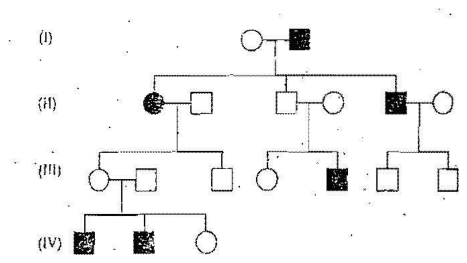
- 1X-linked dominant
- 2Autosomal dominant
- 3X-linked recessive
- 4Autosomal recessive
Show answer and solution
Correct: option 4, Autosomal recessive
In generations III and IV affected children are born to parents who are both unaffected, so the trait is recessive. It is not X-linked recessive, because the affected woman in generation II has an unaffected son, whereas every son of an affected mother would receive her X chromosome and be affected. The trait is therefore autosomal recessive.
Question 169AIPMT 2015 Re-test, Q124
Balbiani rings are sites of:
- 1RNA and protein synthesis
- 2Lipid synthesis
- 3Nucleotide synthesis
- 4Polysaccharide synthesis
Show answer and solution
Correct: option 1, RNA and protein synthesis
Balbiani rings are the large puffs of polytene chromosomes, seen in the salivary glands of insect larvae. At a puff the DNA is uncoiled and is being actively transcribed, so these are sites of RNA synthesis, which leads to protein synthesis.
Question 170AIPMT 2015 Re-test, Q125
Name the pulmonary disease in which alveolar surface area involved in gas exchange is drastically reduced due to damage in the alveolar walls.
- 1Asthma
- 2Pleurisy
- 3Emphysema
- 4Pneumonia
Show answer and solution
Correct: option 3, Emphysema
Emphysema is a chronic disorder, mostly caused by cigarette smoking, in which the alveolar walls are damaged and the respiratory surface is reduced. Asthma is inflammation of the bronchi and bronchioles, pleurisy is inflammation of the pleura and pneumonia is an infection in which the alveoli fill with fluid.
Question 171AIPMT 2015 Re-test, Q126
Which of the following are most suitable indicators of pollution in the environment?
- 1Fungi
- 2Lichens
- 3Conifers
- 4Algae
Show answer and solution
Correct: option 2, Lichens
Lichens are very sensitive to sulphur dioxide and do not grow in polluted areas. Their presence or absence is therefore used as an indicator of pollution.
Question 172AIPMT 2015 Re-test, Q127
Satellite DNA is important because it:
- 1codes for enzymes needed for DNA replication.
- 2codes for proteins needed in cell cycle.
- 3shows high degree of polymorphism in population and also the same degree of polymorphism in an individual, which is heritable from parents to children.
- 4does not code for proteins and is same in all members of the population.
Show answer and solution
Correct: option 3, shows high degree of polymorphism in population and also the same degree of polymorphism in an individual, which is heritable from parents to children.
Satellite DNA is repetitive DNA that does not code for any protein. The number of repeats varies greatly from person to person (high polymorphism), and the pattern is inherited from the parents. This is the basis of DNA fingerprinting. It is not the same in all members of the population.
Question 173AIPMT 2015 Re-test, Q128
Industrial melanism is an example of:
- 1Neo Lamarckism
- 2Neo Darwinism
- 3Natural selection
- 4Mutation
Show answer and solution
Correct: option 3, Natural selection
After industrialisation in England, soot darkened the tree trunks, and the dark form of the peppered moth escaped predators better than the light form and became common. The environment selected one existing variant over the other, which is natural selection.
Question 174AIPMT 2015 Re-test, Q129
A column of water within xylem vessels of tall trees does not break under its weight because of:
- 1Positive root pressure
- 2Dissolved sugars in water
- 3Tensile strength of water
- 4Lignification of xylem vessels
Show answer and solution
Correct: option 3, Tensile strength of water
Water molecules hold strongly to each other (cohesion) and to the xylem walls (adhesion). This gives the water column a high tensile strength, the ability to resist a pulling force, so it is not broken by the transpiration pull or by its own weight.
Question 175AIPMT 2015 Re-test, Q130
The introduction of t-DNA into plants involves:
- 1Allowing the plant roots to stand in water
- 2Infection of the plant by Agrobacterium tumefaciens
- 3Altering the pH of the soil, then heat-shocking the plants
- 4Exposing the plants to cold for a brief period
Show answer and solution
Correct: option 2, Infection of the plant by Agrobacterium tumefaciens
Agrobacterium tumefaciens is a pathogen of dicot plants that transfers a piece of its Ti plasmid, the T-DNA, into the plant genome when it infects the plant. This natural ability is used to deliver genes into plants.
Question 176AIPMT 2015 Re-test, Q131
Pick up the wrong statement:
- 1Nuclear membrane is present in Monera
- 2Cell wall is absent in Animalia
- 3Protista have photosynthetic and heterotrophic modes of nutrition
- 4Some fungi are edible
Show answer and solution
Correct: option 1, Nuclear membrane is present in Monera
Monera are prokaryotes, and a prokaryotic cell has no nuclear membrane, so statement (1) is wrong. Animal cells lack a cell wall, protists include both photosynthetic and heterotrophic forms, and some fungi such as mushrooms are eaten.
Question 177AIPMT 2015 Re-test, Q132
In photosynthesis, the light-independent reactions take place at:
- 1Stromal matrix
- 2Thylakoid lumen
- 3Photosystem I
- 4Photosystem II
Show answer and solution
Correct: option 1, Stromal matrix
The light-independent (dark) reactions, that is the Calvin cycle in which is fixed into sugar, are catalysed by enzymes dissolved in the stroma of the chloroplast. The thylakoid membranes with photosystems I and II carry out the light reactions.
Question 178AIPMT 2015 Re-test, Q133
Which of the following immunoglobulins does constitute the largest percentage in human milk?
- 1IgG
- 2IgD
- 3IgM
- 4IgA
Show answer and solution
Correct: option 4, IgA
IgA is the antibody of body secretions. Colostrum and mother's milk are rich in IgA, which protects the newborn's gut from infection. This is an example of natural passive immunity.
Question 179AIPMT 2015 Re-test, Q134
Which of the following pairs is not correctly matched?
Mode of reproduction - Example
- 1Conidia - Penicillium
- 2Offset - Water hyacinth
- 3Rhizome - Banana
- 4Binary fission - Sargassum
Show answer and solution
Correct: option 4, Binary fission - Sargassum
Penicillium reproduces asexually by conidia, water hyacinth multiplies by offsets and banana by its rhizome, so these three pairs are right. Sargassum is a multicellular brown alga that reproduces vegetatively by fragmentation and sexually; binary fission is the method of single-celled organisms such as Amoeba and bacteria. So the fourth pair is wrongly matched.
Question 180AIPMT 2015 Re-test, Q135
The UN conference of Parties on climate change in the year 2012 was held at:
- 1Warsaw
- 2Durban
- 3Doha
- 4Lima
Show answer and solution
Correct: option 3, Doha
The 2012 Conference of Parties (COP 18) was held at Doha in Qatar. Durban hosted it in 2011, Warsaw in 2013 and Lima in 2014.