AIPMT 2015 Physics questions
Question 1AIPMT 2015, Q136
An electron moving in a circular orbit of radius r makes n rotations per second. The magnetic field produced at the centre has magnitude:
- 1Zero
- 2
- 3
- 4
Show answer and solution
Correct: option 3,
The orbiting electron passes any point n times each second, so it is equivalent to a current in a circular loop of radius r. The field at the centre of a single circular loop is , which is option (3).
Question 2AIPMT 2015, Q137
One mole of an ideal diatomic gas undergoes a transition from A to B along a path AB as shown in the figure,
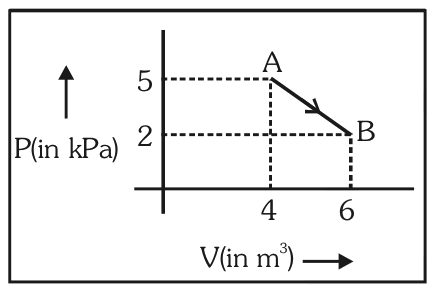
The change in internal energy of the gas during the transition is:
- 1
- 2
- 3
- 4
Show answer and solution
Correct: option 1,
Internal energy depends only on the end states: for a diatomic gas, since . From the graph, and . So , option (1).
Question 3AIPMT 2015, Q138
When two displacements represented by and are superimposed the motion is:
- 1simple harmonic with amplitude
- 2simple harmonic with amplitude
- 3simple harmonic with amplitude
- 4not a simple harmonic
Show answer and solution
Correct: option 2, simple harmonic with amplitude
Both displacements have the same angular frequency and differ in phase by , because . Their sum is with , which is again simple harmonic. The amplitude is , option (2).
Question 4AIPMT 2015, Q139
A particle of unit mass undergoes one-dimensional motion such that its velocity varies according to
where and n are constants and x is the position of the particle. The acceleration of the particle as a function of x, is given by:
- 1
- 2
- 3
- 4
Show answer and solution
Correct: option 1,
Acceleration is . Here , so . This is option (1).
Question 5AIPMT 2015, Q140
If radius of the nucleus is taken to be then the radius of nucleus is nearly:
- 1
- 2
- 3
- 4
Show answer and solution
Correct: option 1,
Nuclear radius depends on the mass number as , not on the atomic number. So , giving , option (1).
Question 6AIPMT 2015, Q141
In a double slit experiment, the two slits are 1 mm apart and the screen is placed 1 m away. A monochromatic light of wavelength 500 nm is used. What will be the width of each slit for obtaining ten maxima of double slit within the central maxima of single slit pattern?
- 10.1 mm
- 20.5 mm
- 30.02 mm
- 40.2 mm
Show answer and solution
Correct: option 4, 0.2 mm
The double slit fringes are spaced apart in angle, where is the slit separation. The central maximum of a single slit of width has angular width . For ten fringes to fit inside it, , so , option (4).
Question 7AIPMT 2015, Q142
For a parallel beam of monochromatic light of wavelength '', diffraction is produced by a single slit whose width 'a' is of the order of the wavelength of the light. If 'D' is the distance of the screen from the slit, the width of the central maxima will be:
- 1
- 2
- 3
- 4
Show answer and solution
Correct: option 4,
The first minima of a single slit pattern lie at angles on either side of the centre. On a screen at distance D they are at , so the central maximum, which stretches from one first minimum to the other, has width . This is option (4).
Question 8AIPMT 2015, Q143
Across a metallic conductor of non-uniform cross section a constant potential difference is applied. The quantity which remains constant along the conductor is:
- 1current
- 2drift velocity
- 3electric field
- 4current density
Show answer and solution
Correct: option 1, current
Charge cannot pile up anywhere in a steady state, so the same current passes through every cross section of the conductor. Current density , electric field and drift velocity all change wherever the area A changes. Only the current stays the same, option (1).
Question 9AIPMT 2015, Q144
On observing light from three different stars P, Q and R, it was found that intensity of violet color is maximum in the spectrum of P, the intensity of green colour is maximum in the spectrum of R and the intensity of red colour is maximum in the spectrum of Q. If , and are the respective absolute temperatures of P, Q and R, then it can be concluded from the above observation that:
- 1
- 2
- 3
- 4
Show answer and solution
Correct: option 1,
By Wien's displacement law is constant, so the star whose spectrum peaks at the shortest wavelength is the hottest. Violet has a shorter wavelength than green, and green shorter than red, so . Therefore , option (1).
Question 10AIPMT 2015, Q145
A potentiometer wire has length 4 m and resistance . The resistance that must be connected in series with the wire and an accumulator of e.m.f. 2V, so as to get a potential gradient 1 mV per cm on the wire is:
- 1
- 2
- 3
- 4
Show answer and solution
Correct: option 4,
A gradient of 1 mV per cm over 400 cm means 0.4 V must drop across the wire. The current in the wire is then . The total resistance of the circuit must be , so the series resistance is , option (4).
Question 11AIPMT 2015, Q146
Consider 3rd orbit of (Helium), using non-relativistic approach, the speed of electron in this orbit will be [given constant, and h (Planck's Constant) ]
- 1
- 2
- 3
- 4
Show answer and solution
Correct: option 1,
In the Bohr model the speed in the nth orbit of a hydrogen-like ion is . With and : . Equivalently it is of the hydrogen ground state speed . Option (1).
Question 12AIPMT 2015, Q147
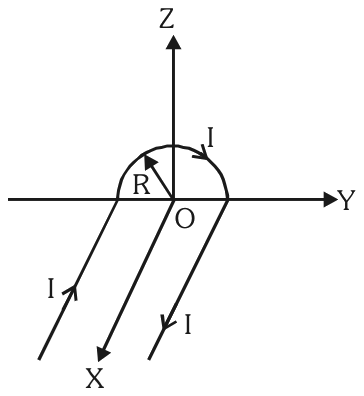
A wire carrying current I has the shape as shown in adjoining figure. Linear parts of the wire are very long and parallel to X-axis while semicircular portion of radius R is lying in Y-Z plane. Magnetic field at point O is:
- 1
- 2
- 3
- 4
Show answer and solution
Correct: option 2,
The semicircle lies in the Y-Z plane, so its field at O is along the X-axis with magnitude ; for the current direction shown the right-hand rule gives . Each straight part is a semi-infinite wire at perpendicular distance R from O, giving , and for both wires the direction is (the currents are opposite and the wires are on opposite sides of O). Adding, , option (2).
Question 13AIPMT 2015, Q148
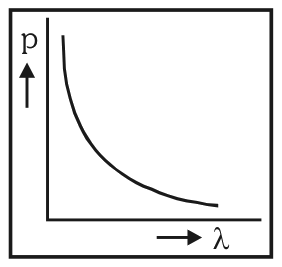
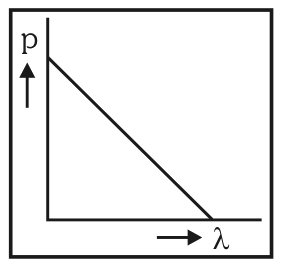
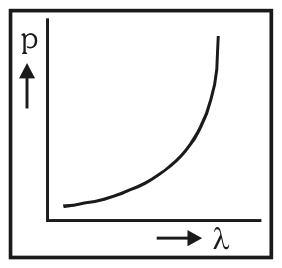
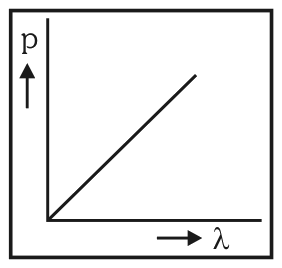
Which of the following figures represent the variation of particle momentum and the associated de-Broglie wavelength?
- 1
- 2
- 3
- 4
Show answer and solution
Correct: option 1
The de Broglie relation is , so is constant and momentum is inversely proportional to wavelength. The graph of p against is therefore a rectangular hyperbola, falling steeply at small and flattening at large . That is the curve in option (1); the straight lines and the rising curve do not fit.
Question 14AIPMT 2015, Q149
A parallel plate air capacitor of capacitance C is connected to a cell of emf V and then disconnected from it. A dielectric slab of dielectric constant K, which can just fill the air gap of the capacitor, is now inserted in it. Which of the following is incorrect?
- 1The energy stored in the capacitor decreases K times.
- 2The change in energy stored is .
- 3The charge on the capacitor is not conserved.
- 4The potential difference between the plates decreases K times.
Show answer and solution
Correct: option 3, The charge on the capacitor is not conserved.
Once the cell is disconnected the plates are isolated, so the charge cannot change. The capacitance becomes KC, so the potential difference falls K times and the energy also falls K times, a change of . Statements (1), (2) and (4) are true, so the incorrect one is (3).
Question 15AIPMT 2015, Q150
The fundamental frequency of a closed organ pipe of length 20 cm is equal to the second overtone of an organ pipe open at both the ends. The length of organ pipe open at both the ends is:-
- 1100 cm
- 2120 cm
- 3140 cm
- 480 cm
Show answer and solution
Correct: option 2, 120 cm
A closed pipe of length has fundamental frequency . An open pipe of length has harmonics , and its second overtone is the third harmonic, . Setting gives , option (2).
Question 16AIPMT 2015, Q151
The refracting angle of a prism is A, and refractive index of the material of the prism is . The angle of minimum deviation is:-
- 1
- 2
- 3
- 4
Show answer and solution
Correct: option 1,
At minimum deviation . Putting gives . So and , option (1).
Question 17AIPMT 2015, Q152
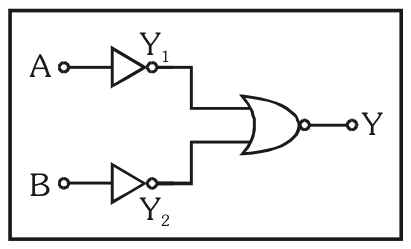
Which logic gate is represented by the following combination of logic gates?
- 1NAND
- 2AND
- 3NOR
- 4OR
Show answer and solution
Correct: option 2, AND
The two input gates are NOT gates, so and . These feed a NOR gate, so . By De Morgan's theorem this equals , which is the AND operation: the output is 1 only when both inputs are 1. Option (2).
Question 18AIPMT 2015, Q153
A Carnot engine, having an efficiency of as heat engine, is used as a refrigerator. If the work done on the system is 10 J, the amount of energy absorbed from the reservoir at lower temperature is:-
- 199 J
- 290 J
- 31 J
- 4100 J
Show answer and solution
Correct: option 2, 90 J
For a Carnot cycle run backwards between the same two temperatures, the coefficient of performance is . With the heat taken from the cold reservoir is , option (2). (The heat given to the hot reservoir is then 100 J, and matches the efficiency.)
Question 19AIPMT 2015, Q154
A certain metallic surface is illuminated with monochromatic light of wavelength, . The stopping potential for photo-electric current for this light is . If the same surface is illuminated with light of wavelength , the stopping potential is . The threshold wavelength for this surface for photoelectric effect is:-
- 1
- 2
- 3
- 4
Show answer and solution
Correct: option 1,
Einstein's equation gives and . Multiplying the second by 3 and equating: , so . Since , the threshold wavelength is , option (1).
Question 20AIPMT 2015, Q155
A radiation of energy 'E' falls normally on a perfectly reflecting surface. The momentum transferred to the surface is (C = Velocity of light):-
- 1
- 2
- 3
- 4
Show answer and solution
Correct: option 1,
Radiation of energy E carries momentum . On perfect reflection at normal incidence its momentum reverses, from to , a change of . By conservation of momentum the surface receives , option (1).
Question 21AIPMT 2015, Q156
A mass m moves in a circle on a smooth horizontal plane with velocity at a radius . The mass is attached to a string which passes through a smooth hole in the plane as shown.
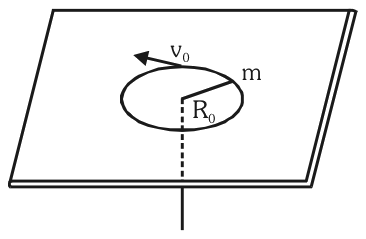
The tension in the string is increased gradually and finally m moves in a circle of radius . The final value of the kinetic energy is:-
- 1
- 2
- 3
- 4
Show answer and solution
Correct: option 2,
The tension always points to the hole, so it has no torque about the hole and the angular momentum of the mass is conserved: , giving . The final kinetic energy is , option (2). The extra energy comes from the work done in pulling the string.
Question 22AIPMT 2015, Q157
Two identical thin plano-convex glass lenses (refractive index 1.5) each having radius of curvature of 20 cm are placed with their convex surfaces in contact at the centre. The intervening space is filled with oil of refractive index 1.7. The focal length of the combination is:-
- 1
- 2
- 3
- 4
Show answer and solution
Correct: option 2,
Treat the system as three thin lenses in contact. Each plano-convex glass lens has . The oil between the convex faces forms a biconcave lens with both radii 20 cm: . Adding powers, , so , option (2).
Question 23AIPMT 2015, Q158
A block A of mass rests on a horizontal table. A light string connected to it passes over a frictionless pulley at the edge of table and from its other end another block B of mass is suspended. The coefficient of kinetic friction between the block and the table is . When the block A is sliding on the table, the tension in the string is:-
- 1
- 2
- 3
- 4
Show answer and solution
Correct: option 2,
For B: . For A, with friction opposing the motion: . Adding gives . Then , option (2).
Question 24AIPMT 2015, Q159
A particle is executing SHM along a straight line. Its velocities at distances and from the mean position are and , respectively. Its time period is:-
- 1
- 2
- 3
- 4
Show answer and solution
Correct: option 1,
In SHM . Writing this for both positions and subtracting removes the amplitude: . So and , option (1).
Question 25AIPMT 2015, Q160
A ship A is moving Westwards with a speed of and a ship B 100 km South of A, is moving Northwards with a speed of . The time after which the distance between them becomes shortest, is:-
- 15 h
- 2 h
- 3 h
- 40 h
Show answer and solution
Correct: option 1, 5 h
Work in the frame of A. The velocity of B relative to A is 10 km/h North plus 10 km/h East, that is towards the north-east, at to the line BA. B is closest to A at the foot of the perpendicular from A to this path, after travelling . Time , option (1).
Question 26AIPMT 2015, Q161
A rod of weight W is supported by two parallel knife edges A and B and is in equilibrium in a horizontal position. The knives are at a distance d from each other. The centre of mass of the rod is at distance x from A. The normal reaction on A is:-
- 1
- 2
- 3
- 4
Show answer and solution
Correct: option 3,
Take torques about knife edge B so that the reaction at B drops out. The weight acts at distance from B and the reaction at distance d. Equilibrium needs , so , option (3). The closer the centre of mass is to A, the larger the share of the weight A carries.
Question 27AIPMT 2015, Q162
The approximate depth of an ocean is 2700 m. The compressibility of water is and density of water is . What fractional compression of water will be obtained at the bottom of the ocean?
- 1
- 2
- 3
- 4
Show answer and solution
Correct: option 2,
The extra pressure at the bottom is . Compressibility is the reciprocal of the bulk modulus, so the fractional compression is , option (2).
Question 28AIPMT 2015, Q163
Two particles of masses , move with initial velocities and . On collision, one of the particles get excited to higher level, after absorbing energy . If final velocities of particles be and then we must have:
- 1
- 2
- 3
- 4
Show answer and solution
Correct: option 2,
Total energy is conserved. Part of the initial kinetic energy, an amount , is stored as excitation energy of one particle, so the kinetic energy left after the collision is the initial kinetic energy minus : . That is option (2); options (3) and (4) are not even dimensionally consistent.
Question 29AIPMT 2015, Q164
Kepler's third law states that square of period of revolution (T) of a planet around the sun, is proportional to third power of average distance r between sun and planet
i.e.
here K is constant.
If the masses of sun and planet are M and m respectively then as per Newton's law of gravitation force of attraction between them is
, here G is gravitational constant.
The relation between G and K is described as:
- 1
- 2
- 3
- 4
Show answer and solution
Correct: option 1,
For a circular orbit gravity supplies the centripetal force: . This gives . Comparing with , , so , option (1).
Question 30AIPMT 2015, Q165
A block of mass 10 kg, moving in x direction with a constant speed of , is subjected to a retarding force F = 0.1 x J/m during its travel from x = 20 m to 30 m. Its final KE will be:
- 1450 J
- 2275 J
- 3250 J
- 4475 J
Show answer and solution
Correct: option 4, 475 J
The initial kinetic energy is . The retarding force (in newton, with x in metre) removes energy . By the work-energy theorem the final kinetic energy is , option (4).
Question 31AIPMT 2015, Q166
A wind with speed 40 m/s blows parallel to the roof of a house. The area of the roof is . Assuming that the pressure inside the house is atmospheric pressure, the force exerted by the wind on the roof and the direction of the force will be:
()
- 1, upwards
- 2, upwards
- 3, downwards
- 4, downwards
Show answer and solution
Correct: option 2, , upwards
By Bernoulli's principle the moving air above the roof is at a lower pressure than the still air inside: . The net force on the roof is . It acts from the higher pressure side to the lower, that is upwards, option (2).
Question 32AIPMT 2015, Q167
Two spherical bodies of mass M and 5 M and radii R and 2 R are released in free space with initial separation between their centres equal to 12 R. If they attract each other due to gravitational force only, then the distance covered by the smaller body before collision is:
- 14.5 R
- 27.5 R
- 31.5 R
- 42.5 R
Show answer and solution
Correct: option 2, 7.5 R
They touch when their centres are apart, so together they move . Only internal forces act, so the centre of mass stays at rest and the distances moved are in the inverse ratio of the masses: . With , the smaller body covers , option (2).
Question 33AIPMT 2015, Q168
A resistance 'R' draws power 'P' when connected to an AC source. If an inductance is now placed in series with the resistance, such that the impedance of the circuit becomes 'Z', the power drawn will be:
- 1
- 2
- 3
- 4
Show answer and solution
Correct: option 4,
With the resistance alone, , where V is the rms voltage. With the inductance in series the rms current is and power is dissipated only in R: . This is option (4).
Question 34AIPMT 2015, Q169
The ratio of the specific heats in terms of degrees of freedom (n) is given by:
- 1
- 2
- 3
- 4
Show answer and solution
Correct: option 2,
By equipartition each degree of freedom contributes per mole to , so . For an ideal gas . Hence , option (2).
Question 35AIPMT 2015, Q170
Figure below shows two paths that may be taken by a gas to go from a state A to a state C.
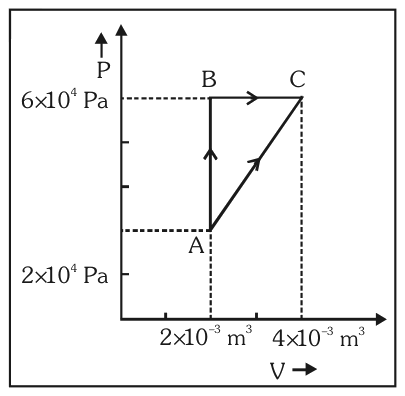
In process AB, 400 J of heat is added to the system and in process BC, 100 J of heat is added to the system. The heat absorbed by the system in the process AC will be:
- 1500 J
- 2460 J
- 3300 J
- 4380 J
Show answer and solution
Correct: option 2, 460 J
Along ABC: AB is at constant volume (no work) and BC is at constant pressure, so . With , . Along the straight path AC the work is the area under the line, . So , option (2).
Question 36AIPMT 2015, Q171
If energy (E), velocity (V) and time (T) are chosen as the fundamental quantities, the dimensional formula of surface tension will be:
- 1
- 2
- 3
- 4
Show answer and solution
Correct: option 2,
Surface tension is energy per unit area. A length is velocity times time, so an area has dimensions . Therefore surface tension , option (2). Check: , the usual dimensions of surface tension.
Question 37AIPMT 2015, Q172
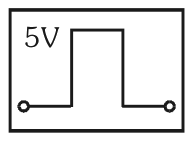
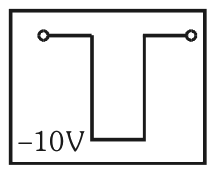
If in a p-n junction, a square input signal of 10 V is applied as shown,
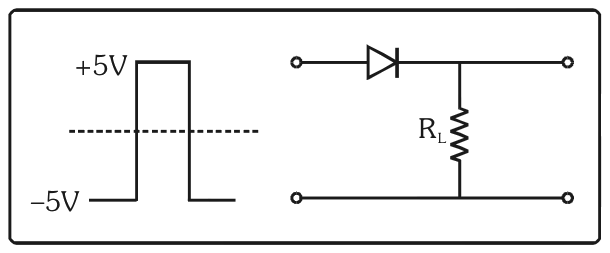
then the output across will be:
- 1
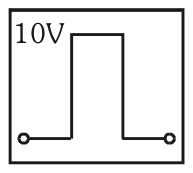
- 2
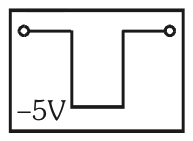
- 3
- 4
Show answer and solution
Correct: option 3
The diode in series with acts as a half-wave rectifier. The input swings between +5 V and -5 V (10 V peak to peak). During the +5 V part the diode is forward biased and, taken as ideal, passes the full +5 V to ; during the -5 V part it is reverse biased and the output is zero. The output is therefore a positive pulse of height 5 V, which is option (3).
Question 38AIPMT 2015, Q173
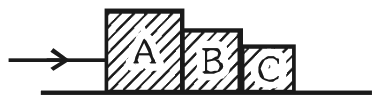
Three blocks A, B and C of masses 4 kg, 2 kg and 1 kg respectively, are in contact on a frictionless surface, as shown. If a force of 14 N is applied on the 4 kg block, then the contact force between A and B is:
- 16 N
- 28 N
- 318 N
- 42 N
Show answer and solution
Correct: option 1, 6 N
All three blocks move together with acceleration . The contact force from A on B is the only horizontal force pushing B and C forward, so it must accelerate their combined mass of 3 kg: , option (1). Check on A: .
Question 39AIPMT 2015, Q174
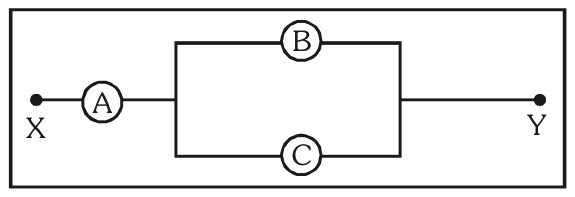
A, B and C are voltmeters of resistance R, 1.5 R and 3R respectively as shown in the figure. When some potential difference is applied between X and Y, the voltmeter readings are , and respectively. Then:
- 1
- 2
- 3
- 4
Show answer and solution
Correct: option 4,
B and C are in parallel, so they read the same voltage, . Their combined resistance is , the same as the resistance of A, which is in series with the pair. Equal resistances in series share the voltage equally, so equals the voltage across the pair. Hence , option (4).
Question 40AIPMT 2015, Q175
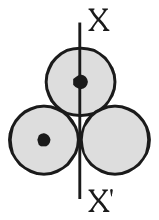
Three identical spherical shells, each of mass m and radius r are placed as shown in figure. Consider an axis XX' which is touching to two shells and passing through diameter of third shell.
Moment of inertia of the system consisting of these three spherical shells about XX' axis is:-
- 1
- 2
- 3
- 4
Show answer and solution
Correct: option 3,
A thin spherical shell has moment of inertia about a diameter. For the shell whose diameter lies on XX' this is its contribution. Each of the other two shells touches the axis, so the axis is a tangent, at distance r from the centre: by the parallel axis theorem each gives . Total , option (3).
Question 41AIPMT 2015, Q176
The electric field in a certain region is acting radially outward and is given by E = Ar. A charge contained in a sphere of radius 'a' centred at the origin of the field, will be given by:
- 1
- 2
- 3
- 4
Show answer and solution
Correct: option 2,
On the surface of the sphere the field has the same magnitude everywhere and is normal to the surface, so the outward flux is . By Gauss's law the enclosed charge is , option (2).
Question 42AIPMT 2015, Q177
The two ends of a metal rod are maintained at temperatures and . The rate of heat flow in the rod is found to be 4.0 J/s. If the ends are maintained at temperatures and , the rate of heat flow will be:
- 116.8 J/s
- 28.0 J/s
- 34.0 J/s
- 444.0 J/s
Show answer and solution
Correct: option 3, 4.0 J/s
In steady conduction the rate of heat flow is : it depends on the temperature difference between the ends, not on the temperatures themselves. The difference is in both cases and the rod is the same, so the rate stays 4.0 J/s, option (3).
Question 43AIPMT 2015, Q178
Two similar springs P and Q have spring constants and , such that . They are stretched, first by the same amount (case a), then by the same force (case b). The work done by the springs and are related as, in case (a) and case (b), respectively:
- 1 ;
- 2 ;
- 3 ;
- 4 ;
Show answer and solution
Correct: option 2, ;
Case (a), same extension x: is proportional to K, so the stiffer spring stores more and . Case (b), same force F: the extension is , so is inversely proportional to K, and . This is option (2).
Question 44AIPMT 2015, Q179
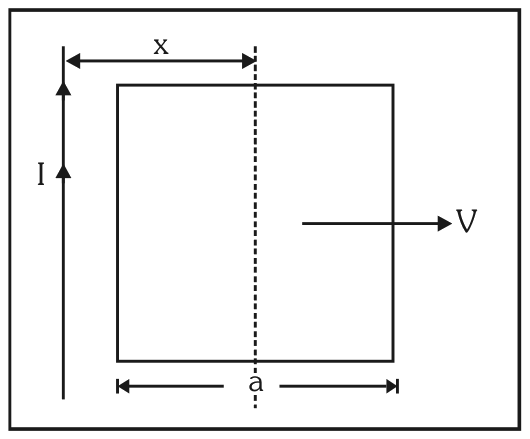
A conducting square frame of side 'a' and a long straight wire carrying current I are located in the same plane as shown in the figure. The frame moves to the right with a constant velocity 'V'. The emf induced in the frame will be proportional to:
- 1
- 2
- 3
- 4
Show answer and solution
Correct: option 3,
The centre of the frame is at distance x from the wire, so the sides parallel to the wire are at and . Each has a motional emf with , and the two oppose each other round the loop (the other two sides give none). Net emf , so it is proportional to , option (3).
Question 45AIPMT 2015, Q180
A particle of mass m is driven by a machine that delivers a constant power k watts. If the particle starts from rest the force on the particle at time t is:
- 1
- 2
- 3
- 4
Show answer and solution
Correct: option 4,
At constant power all the work goes into kinetic energy: , so . Power is also , so . This is option (4).
AIPMT 2015 Chemistry questions
Question 46AIPMT 2015, Q1
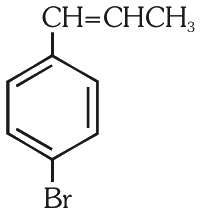
The reaction of with HBr produces:
- 1
- 2
- 3
- 4
Show answer and solution
Correct: option 4,
HBr adds across the side-chain double bond by the ionic mechanism. The proton goes to the carbon that leaves the positive charge on the benzylic carbon, because that carbocation is stabilised by resonance with the ring. Bromide then attacks the benzylic carbon, giving , option (4).
Question 47AIPMT 2015, Q2
In Duma's method for estimation of nitrogen, 0.25 g of an organic compound gave 40 mL of nitrogen collected at 300 K temperature and 725 mm pressure. If the aqueous tension at 300 K is 25 mm, the percentage of nitrogen in the compound is:
- 118.20
- 216.76
- 315.76
- 417.36
Show answer and solution
Correct: option 2, 16.76
Pressure of dry nitrogen mm. Volume at STP mL. Mass of nitrogen g, so the percentage is , option (2).
Question 48AIPMT 2015, Q3
The of , AgCl, AgBr and AgI are respectively, , , , . Which one of the following salts will precipitate last if solution is added to the solution containing equal moles of NaCl, NaBr, NaI and ?
- 1AgCl
- 2AgBr
- 3
- 4AgI
Show answer and solution
Correct: option 3,
A salt starts to precipitate when reaches the value its demands. For the three halides this is , while for the chromate it is , where is the common anion concentration. The square root of is far larger than any of the halide values (for M it is about M against M for AgCl). So needs the most silver ion and precipitates last, option (3).
Question 49AIPMT 2015, Q4
Bithional is generally added to the soaps as an additive to function as a/an:
- 1Dryer
- 2Buffering agent
- 3Antiseptic
- 4Softener
Show answer and solution
Correct: option 3, Antiseptic
Bithional (bithionol) is a chlorinated phenolic sulphide that kills micro-organisms on the skin. It is added to medicated soaps to give them antiseptic action, so option (3) is right.
Question 50AIPMT 2015, Q5
"Metals are usually not found as nitrates in their ores".
Out of the following two (a and b) reasons which is/are true for the above observation?
(a) Metal nitrates are highly unstable.
(b) Metal nitrates are highly soluble in water.
- 1a and b are false
- 2a is false but b is true
- 3a is true but b is false
- 4a and b are true
Show answer and solution
Correct: option 2, a is false but b is true
Nitrates such as and are quite stable solids, so reason (a) is false. Almost all metal nitrates dissolve readily in water, so they are washed away by rain and do not collect as ore deposits; reason (b) is true. Hence option (2).
Question 51AIPMT 2015, Q6
The correct bond order in the following species is:
- 1
- 2
- 3
- 4
Show answer and solution
Correct: option 3,
From the molecular orbital picture, has bond order 2 with two electrons in antibonding orbitals. Adding an electron gives with bond order 1.5; removing one gives with 2.5; removing two gives with 3. So the order is , option (3).
Question 52AIPMT 2015, Q7
The species Ar, and contain the same number of electrons. In which order do their radii increase?
- 1
- 2
- 3
- 4
Show answer and solution
Correct: option 2,
All three have 18 electrons, so the size depends on the nuclear charge pulling on them. The charge rises from Ar (18) to (19) to (20), and the radius shrinks in the same order. Increasing radius is therefore , option (2).
Question 53AIPMT 2015, Q8
The activation energy of a reaction can be determined from the slope of which of the following graphs?
- 1 vs.
- 2 vs.
- 3 vs.
- 4 vs.
Show answer and solution
Correct: option 2, vs.
The Arrhenius equation gives . A plot of against is a straight line of slope , from which is found. Hence option (2).
Question 54AIPMT 2015, Q9
Which of the following pairs of ions are isoelectronic and isostructural?
- 1,
- 2,
- 3,
- 4,
Show answer and solution
Correct: option 3, ,
Electron counts: has , has , while and have 32 each. and both have three bond pairs and one lone pair on the central atom, so both are pyramidal. They are the pair that is isoelectronic and isostructural, option (3).
Question 55AIPMT 2015, Q10
An organic compound 'X' having molecular formula yields phenyl hydrazone and gives negative response to the Iodoform test and Tollen's test. It produces n-pentane on reduction. 'X' could be:
- 12-pentanone
- 23-pentanone
- 3n-amyl alcohol
- 4pentanal
Show answer and solution
Correct: option 2, 3-pentanone
A phenyl hydrazone shows a carbonyl group, and a negative Tollen's test rules out an aldehyde, so X is a ketone. A negative iodoform test means it has no group, which rules out 2-pentanone. Reduction to n-pentane shows a straight five-carbon chain. X is 3-pentanone, option (2).
Question 56AIPMT 2015, Q11
Which of the following options represents the correct bond order?
- 1
- 2
- 3
- 4
Show answer and solution
Correct: option 1,
The extra electron of enters an antibonding orbital, and the electron lost in leaves one. The bond orders are 1.5, 2 and 2.5. So , option (1).
Question 57AIPMT 2015, Q12
Treatment of cyclopentanone
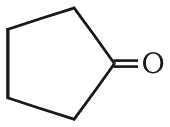
with methyl lithium gives which of the following species?
- 1Cyclopentanonyl cation
- 2Cyclopentanonyl radical
- 3Cyclopentanonyl biradical
- 4Cyclopentanonyl anion
Show answer and solution
Correct: option 4, Cyclopentanonyl anion
Methyl lithium behaves as the carbanion with , a very strong nucleophile and base. Its reaction with the ketone is ionic and leaves the negative charge on the organic part (on oxygen), with lithium as the counter-ion. No cation or radical is formed, so the species is an anion, option (4).
Question 58AIPMT 2015, Q13
The electrolytic reduction of nitrobenzene in strongly acidic medium produces:
- 1Azoxybenzene
- 2Azobenzene
- 3Aniline
- 4p-Aminophenol
Show answer and solution
Correct: option 4, p-Aminophenol
Electrolytic reduction of nitrobenzene in weakly acidic medium gives aniline. In strongly acidic medium the reduction stops at phenylhydroxylamine, which rearranges in the acid to p-aminophenol. Hence option (4).
Question 59AIPMT 2015, Q14
Magnetic moment 2.84 B.M. is given by:
(At. nos, Ni = 28, Ti = 22, Cr = 24, Co = 27)
- 1
- 2
- 3
- 4
Show answer and solution
Correct: option 4,
The spin-only moment is B.M.; 2.84 B.M. corresponds to since . Unpaired electrons: () 1, () 4, () 3, () 2. So the ion is , option (4).
Question 60AIPMT 2015, Q15
A given metal crystallizes out with a cubic structure having edge length of 361 pm. If there are four metal atoms in one unit cell, what is the radius of one atom?
- 1127 pm
- 280 pm
- 3108 pm
- 440 pm
Show answer and solution
Correct: option 1, 127 pm
Four atoms per unit cell means a face-centred cubic lattice, in which atoms touch along the face diagonal: . So pm, option (1).
Question 61AIPMT 2015, Q16
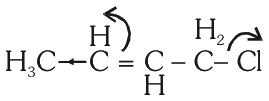
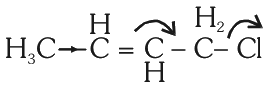
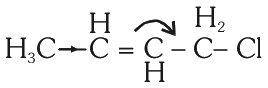
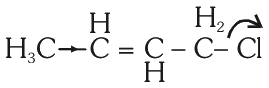
Which of the following is the most correct electron displacement for a nucleophilic reaction to take place?
- 1
- 2
- 3
- 4
Show answer and solution
Correct: option 2
For the chloride to be replaced, the bond pair must shift on to chlorine, and the loss is helped when the electrons of the neighbouring double bond move towards the bond next to it (allylic assistance), with the methyl group pushing electrons towards the double bond. Option (2) shows all three shifts in these directions: methyl towards the double bond, the pair towards the carbon, and the bond pair on to Cl.
Question 62AIPMT 2015, Q17
Which one of the following electrolytes has the same value of van't Hoff's factor (i) as that of the (if all are 100% ionised)?
- 1
- 2
- 3
- 4
Show answer and solution
Correct: option 3,
gives , five ions, so . gives 4 ions, gives 4, gives 3, and gives , five ions. Hence option (3).
Question 63AIPMT 2015, Q18
Nitrogen dioxide and sulphur dioxide have some properties in common. Which property is shown by one of these compounds, but not by the other?
- 1is a reducing agent
- 2is soluble in water
- 3is used as a food-preservative
- 4forms 'acid-rain'
Show answer and solution
Correct: option 3, is used as a food-preservative
Both gases dissolve in water, both can be oxidised further (so can act as reducing agents) and both give acid rain. Only is used to preserve food such as dried fruit and squashes; is not. Hence option (3).
Question 64AIPMT 2015, Q19
The total number of -bond electrons in the following structure is:
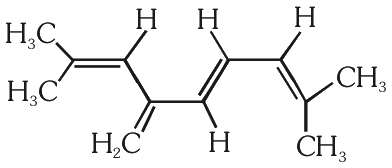
- 18
- 212
- 316
- 44
Show answer and solution
Correct: option 1, 8
The structure has four carbon-carbon double bonds: two at the ends carrying the methyl groups, the group and the unit in the chain. Each double bond has one bond holding two electrons, so there are electrons, option (1).
Question 65AIPMT 2015, Q20
Solubility of the alkaline earth's metal sulphates in water decreases in the sequence:
- 1Ca > Sr > Ba > Mg
- 2Sr > Ca > Mg > Ba
- 3Ba > Mg > Sr > Ca
- 4Mg > Ca > Sr > Ba
Show answer and solution
Correct: option 4, Mg > Ca > Sr > Ba
The sulphate ion is large, so the lattice energies of these sulphates are nearly the same, and the solubility follows the hydration energy of the cation. Hydration energy falls as the cation grows from to , so solubility falls in the order Mg > Ca > Sr > Ba, option (4).
Question 66AIPMT 2015, Q21
Maximum bond angle at nitrogen is present in which of the following?
- 1
- 2
- 3
- 4
Show answer and solution
Correct: option 2,
has no lone pair or odd electron on nitrogen; it is sp hybridised and linear with a bond angle of 180°. (about 134°), (120°) and (about 115°) all have smaller angles. Hence option (2).
Question 67AIPMT 2015, Q22
If the value of an equilibrium constant for a particular reaction is , then at equilibrium the system will contain:
- 1mostly reactants
- 2mostly products
- 3similar amounts of reactants and products
- 4all reactants
Show answer and solution
Correct: option 2, mostly products
The equilibrium constant is the ratio of product concentrations to reactant concentrations at equilibrium. A value as large as means the reaction has gone almost to completion, so the mixture is mostly products, option (2).
Question 68AIPMT 2015, Q23
The number of d-electrons in (Z = 26) is not equal to the number of electrons in which one of the following?
- 1p-electrons in Cl (Z = 17)
- 2d-electrons in Fe (Z = 26)
- 3p-electrons in Ne (Z = 10)
- 4s-electrons in Mg (Z = 12)
Show answer and solution
Correct: option 1, p-electrons in Cl (Z = 17)
is , so it has 6 d-electrons. Fe () has 6 d-electrons, Ne () has 6 p-electrons and Mg () has 6 s-electrons. Cl () has 11 p-electrons, which is not 6, so option (1).
Question 69AIPMT 2015, Q24
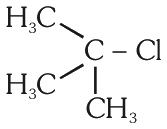
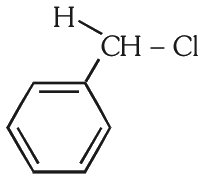
In which of the following compounds, the bond ionisation shall give most stable carbonium ion?
- 1
- 2
- 3
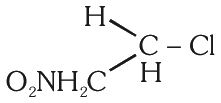
- 4
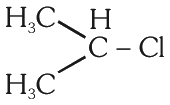
Show answer and solution
Correct: option 2
Ionisation gives, in turn, the tert-butyl cation (1), the benzyl cation (2), a primary cation with an electron-withdrawing nitro group nearby (3) and the isopropyl cation (4). The key takes the benzyl cation as the most stable because its positive charge is spread over the ring by resonance, option (2). The tert-butyl cation, stabilised by nine hyperconjugating hydrogens, is very close in stability, which is why some keys give option (1).
Question 70AIPMT 2015, Q25
A device that converts energy of combustion of fuels like hydrogen and methane, directly into electrical energy is known as:
- 1Electrolytic cell
- 2Dynamo
- 3Ni-Cd cell
- 4Fuel Cell
Show answer and solution
Correct: option 4, Fuel Cell
A fuel cell is a galvanic cell in which a fuel such as hydrogen or methane is oxidised at one electrode and oxygen is reduced at the other, so the energy of combustion comes out directly as electricity. An electrolytic cell uses electricity, a dynamo converts mechanical energy, and a Ni-Cd cell is a rechargeable battery. Hence option (4).
Question 71AIPMT 2015, Q26
Consider the following compounds
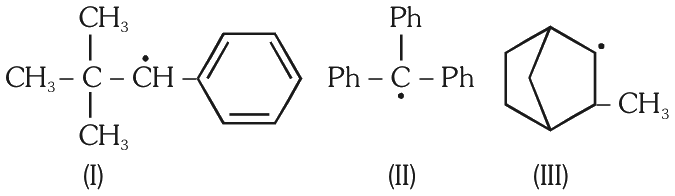
Hyperconjugation occurs in:
- 1II only
- 2III only
- 3I and III
- 4I only
Show answer and solution
Correct: option 2, III only
Hyperconjugation needs a bond on the carbon next to the radical centre. In (I) the neighbours of the radical carbon are a quaternary carbon and a ring carbon, neither with such a hydrogen; in (II) the three neighbours are phenyl carbons. In (III) the carbon next to the radical centre, the one bearing the methyl group, carries a hydrogen. So hyperconjugation occurs in III only, option (2).
Question 72AIPMT 2015, Q27
The reaction
is called:
- 1Williamson continuous etherification process
- 2Etard reaction
- 3Gatterman - Koch reaction
- 4Williamson Synthesis
Show answer and solution
Correct: option 4, Williamson Synthesis
A sodium alkoxide reacts with a primary alkyl halide by nucleophilic substitution to give an ether and sodium chloride. This laboratory route to ethers is the Williamson synthesis, option (4). The continuous etherification process is the acid dehydration of an alcohol, and the other two reactions make aldehydes.
Question 73AIPMT 2015, Q28
Cobalt (III) chloride forms several octahedral complexes with ammonia. Which of the following will not give test of chloride ions with silver nitrate at 25°C?
- 1
- 2
- 3
- 4
Show answer and solution
Correct: option 4,
Cobalt(III) keeps six ligands in its coordination sphere, and only chloride outside the sphere is precipitated by . is , with all three chlorides bound to the metal and none ionisable, so it gives no precipitate. The others have 1, 2 and 3 ionisable chlorides. Hence option (4).
Question 74AIPMT 2015, Q29
A mixture of gases contains and gases in the ratio of 1 : 4 (w/w). What is the molar ratio of the two gases in the mixture?
- 14 : 1
- 216 : 1
- 32 : 1
- 41 : 4
Show answer and solution
Correct: option 1, 4 : 1
Take 1 g of and 4 g of . Moles of and moles of . The ratio is , option (1).
Question 75AIPMT 2015, Q30
Which of the following processes does not involve oxidation of iron?
- 1Decolourization of blue solution by iron
- 2Formation of from Fe
- 3Liberation of from steam by iron at high temperature
- 4Rusting of iron sheets
Show answer and solution
Correct: option 2, Formation of from Fe
In the ligand CO is neutral, so iron stays in oxidation state 0, the same as in the metal. In the other three processes iron goes to (with ), to (with steam) or to hydrated (rust), all oxidations. Hence option (2).
Question 76AIPMT 2015, Q31
Because of lanthanoid contraction, which of the following pairs of elements have nearly same atomic radii? (Numbers in the parenthesis are atomic numbers).
- 1Zr (40) and Nb (41)
- 2Zr (40) and Hf (72)
- 3Zr (40) and Ta (73)
- 4Ti (22) and Zr (40)
Show answer and solution
Correct: option 2, Zr (40) and Hf (72)
The fourteen lanthanoids come between the 4d and 5d series, and the poor shielding by 4f electrons shrinks the atoms that follow. This cancels the usual increase in size down a group, so the 5d element has almost the same radius as the 4d element above it. Zr and Hf are in the same group (group 4), so option (2).
Question 77AIPMT 2015, Q32
Which of the following statements is correct for a reversible process in a state of equilibrium?
- 1
- 2
- 3
- 4
Show answer and solution
Correct: option 2,
In general . At equilibrium and , which gives , option (2).
Question 78AIPMT 2015, Q33
The angular momentum of electron in 'd' orbital is equal to:
- 1
- 2
- 3
- 4
Show answer and solution
Correct: option 4,
Orbital angular momentum is . For a d orbital , so it equals , option (4).
Question 79AIPMT 2015, Q34
The boiling point of 0.2 solution of X in water is greater than equimolal solution of Y in water. Which one of the following statements is true in this case?
- 1Molecular mass of X is greater than the molecular mass of Y.
- 2Molecular mass of X is less than the molecular mass of Y.
- 3Y is undergoing dissociation in water while X undergoes no change.
- 4X is undergoing dissociation in water.
Show answer and solution
Correct: option 4, X is undergoing dissociation in water.
. The solvent and the molality are the same for both solutions, so the larger elevation for X means a larger van't Hoff factor: X gives more particles, that is, it dissociates in water. Molecular mass does not matter once the molality is fixed. Hence option (4).
Question 80AIPMT 2015, Q35
The function of "Sodium pump" is a biological process operating in each and every cell of all animals. Which of the following biologically important ions is also a constituent of this pump:
- 1
- 2
- 3
- 4
Show answer and solution
Correct: option 2,
The sodium pump is the sodium-potassium pump of the cell membrane: it moves out of the cell and into it, using ATP. The other ion involved is therefore , option (2).
Question 81AIPMT 2015, Q36
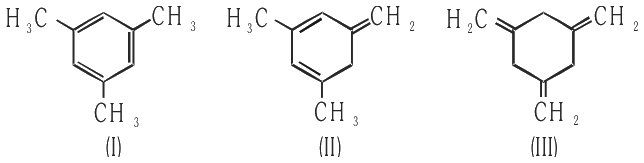
The enthalpy of the hydrogenation of these compounds will be in the order as:
- 1III > II > I
- 2II > III > I
- 3II > I > III
- 4I > II > III
Show answer and solution
Correct: option 1, III > II > I
The more stable an unsaturated compound, the less heat it gives out on hydrogenation. (I) is a benzene ring, strongly stabilised by aromatic resonance. (II) is a conjugated triene with two double bonds in the ring, less stable than (I). (III) has three isolated exocyclic double bonds with no conjugation and is the least stable. So the enthalpy of hydrogenation is III > II > I, option (1).
Question 82AIPMT 2015, Q37
The enolic form of ethyl acetoacetate as below has:
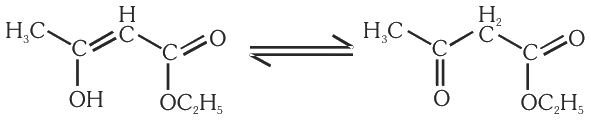
- 116 sigma bonds and 1 pi - bond
- 29 sigma bonds and 2 pi - bonds
- 39 sigma bonds and 1 pi - bond
- 418 sigma bonds and 2 pi - bonds
Show answer and solution
Correct: option 4, 18 sigma bonds and 2 pi - bonds
The enol is . Sigma bonds: 9 C-H, 1 O-H, 4 C-C (counting the sigma part of and the one inside the ethyl group) and 4 C-O (to OH, the sigma part of , and the two of the ester oxygen), 18 in all. Pi bonds: one in and one in . Hence option (4).
Question 83AIPMT 2015, Q38
Biodegradable polymer which can be produced from glycine and aminocaproic acid is:
- 1PHBV
- 2Buna - N
- 3Nylon 6, 6
- 4Nylon 2- nylon 6
Show answer and solution
Correct: option 4, Nylon 2- nylon 6
Glycine (, two carbons) and aminocaproic acid (, six carbons) condense into an alternating polyamide named after the carbon counts of the two monomers, nylon 2-nylon 6. It is biodegradable. Hence option (4).
Question 84AIPMT 2015, Q39
Which of the following species contains equal number of - and - bonds:
- 1
- 2
- 3
- 4
Show answer and solution
Correct: option 1,
has four double bonds: 4 and 4 . has 3 and 4 ; has 6 and 4 ; has 4 and 1 . Only has equal numbers, option (1).
Question 85AIPMT 2015, Q40
Which of these statements about is true:
- 1 has four unpaired electrons and will be in a low-spin configuration.
- 2 has four unpaired electrons and will be in a high spin configuration.
- 3 has no unpaired electrons and will be in a high-spin configuration.
- 4 has no unpaired electrons and will be in a low-spin configuration.
Show answer and solution
Correct: option 4, has no unpaired electrons and will be in a low-spin configuration.
Cobalt is , . Cyanide is a strong-field ligand, so the six d-electrons pair up in the three lower () orbitals, leaving no unpaired electron. A complex in which the electrons pair like this is a low-spin complex. Hence option (4).
Question 86AIPMT 2015, Q41
Which one is not equal to zero for an ideal solution:
- 1
- 2
- 3
- 4
Show answer and solution
Correct: option 1,
An ideal solution obeys Raoult's law exactly, so , and it forms with no heat change and no volume change, so and . Mixing always increases the disorder, so is positive, not zero. Hence option (1).
Question 87AIPMT 2015, Q42
Which property of colloidal solution is independent of charge on the colloidal particles:
- 1Electrophoresis
- 2Electro-osmosis
- 3Tyndall effect
- 4Coagulation
Show answer and solution
Correct: option 3, Tyndall effect
The Tyndall effect is the scattering of light by colloidal particles; it depends on their size and refractive index, not on their charge. Electrophoresis, electro-osmosis and coagulation by electrolytes all arise from the charge on the particles. Hence option (3).
Question 88AIPMT 2015, Q43
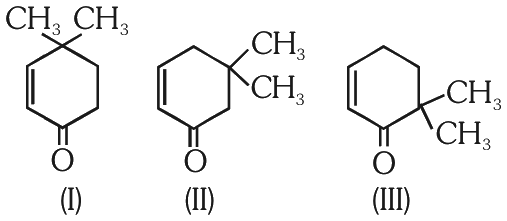
Which of the given compounds can exhibit tautomerism?
- 1I and III
- 2II and III
- 3I, II and III
- 4I and II
Show answer and solution
Correct: option 3, I, II and III
Keto-enol tautomerism needs a hydrogen that can shift to the carbonyl oxygen. (I) and (II) each have a group next to the carbonyl carbon, so they enolise in the usual way. In (III) the saturated -carbon carries two methyl groups and no hydrogen, but the carbonyl is conjugated with the ring double bond and a hydrogen from the -carbon can shift to give a dienol. So all three can show tautomerism, option (3).
Question 89AIPMT 2015, Q44
When initial concentration of a reactant is doubled in a reaction, its half-life period is not affected. The order of the reaction is:
- 1First
- 2Second
- 3More than zero but less than first
- 4Zero
Show answer and solution
Correct: option 1, First
For a reaction of order the half-life varies as . Only for is it independent of the initial concentration, with . Hence option (1).
Question 90AIPMT 2015, Q45
A single compound of the structure:
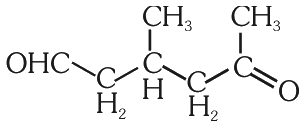
is obtainable from ozonolysis of which of the following cyclic compounds?
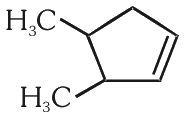
- 1
- 2
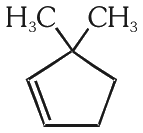
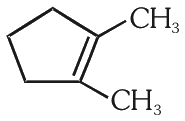
- 3
- 4
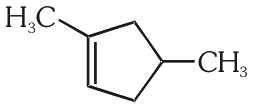
Show answer and solution
Correct: option 4
Ozonolysis cuts a ring double bond and turns each of its carbons into a carbonyl group, so joining the two carbonyl carbons of the product gives back the alkene. The product is ; joining the CHO carbon to the ketone carbon gives a five-membered ring with a methyl on one double-bond carbon and another methyl on the ring carbon two places away, 1,4-dimethylcyclopentene. That is option (4).
AIPMT 2015 Biology questions
Question 91AIPMT 2015, Q46
Which of the following endoparasites of humans does show viviparity?
- 1Enterobius vermicularis
- 2Trichinella spiralis
- 3Ascaris lumbricoides
- 4Ancylostoma duodenale
Show answer and solution
Correct: option 2, Trichinella spiralis
Trichinella spiralis is viviparous: the female, lodged in the wall of the intestine, releases living larvae instead of laying eggs. Enterobius (pinworm), Ascaris (roundworm) and Ancylostoma (hookworm) all lay eggs.
Question 92AIPMT 2015, Q47
Cryopreservation of gametes of threatened species in viable and fertile condition can be referred to as:
- 1Advanced ex-situ conservation of biodiversity
- 2In situ conservation by sacred groves
- 3In situ cryo-conservation of biodiversity
- 4In situ conservation of biodiversity
Show answer and solution
Correct: option 1, Advanced ex-situ conservation of biodiversity
Gametes kept frozen at very low temperature are stored outside the natural habitat of the species, so this is ex situ conservation, and cryopreservation is one of its advanced methods. In situ conservation means protecting the organism within its own habitat, which is not what a frozen store does.
Question 93AIPMT 2015, Q48
Which one of the following matches is correct?
- 1Alternaria, Sexual reproduction absent, Deuteromycetes
- 2Mucor, Reproduction by Conjugation, Ascomycetes
- 3Agaricus, Parasitic fungus, Basidiomycetes
- 4Phytophthora, Aseptate mycelium, Basidiomycetes
Show answer and solution
Correct: option 1, Alternaria, Sexual reproduction absent, Deuteromycetes
Alternaria is an imperfect fungus (Deuteromycetes), a group in which only the asexual stage is known, so the first row is right. Mucor belongs to Phycomycetes (Zygomycetes), not Ascomycetes; Agaricus (mushroom) is a saprophyte, not a parasite; Phytophthora has aseptate mycelium but belongs to Phycomycetes (Oomycetes), not Basidiomycetes.
Question 94AIPMT 2015, Q49
Minerals known to be required in large amounts for plant growth include:
- 1calcium, magnesium, manganese, copper
- 2potassium, phosphorus, selenium, boron
- 3magnesium, sulphur, iron, zinc
- 4phosphorus, potassium, sulphur, calcium
Show answer and solution
Correct: option 4, phosphorus, potassium, sulphur, calcium
Macronutrients are needed in large amounts: C, H, O, N, P, K, S, Ca and Mg. Phosphorus, potassium, sulphur and calcium are all macronutrients. Each of the other options includes micronutrients (manganese, copper, boron, iron, zinc) or selenium, which is not an essential element at all.
Question 95AIPMT 2015, Q50
Which of the following enhances or induces fusion of protoplasts?
- 1Polyethylene glycol and sodium nitrate
- 2IAA and kinetin
- 3IAA and gibberellins
- 4Sodium chloride and potassium chloride
Show answer and solution
Correct: option 1, Polyethylene glycol and sodium nitrate
Naked protoplasts are made to fuse by chemical fusogens, the common ones being polyethylene glycol (PEG) and sodium nitrate. IAA, kinetin and gibberellins are growth regulators used in the culture medium, and ordinary salts such as NaCl and KCl do not cause fusion.
Question 96AIPMT 2015, Q51
Which of these is not an important component of initiation of parturition in humans?
- 1Synthesis of prostaglandins
- 2Release of oxytocin
- 3Release of prolactin
- 4Increase in estrogen and progesterone ratio
Show answer and solution
Correct: option 3, Release of prolactin
Parturition begins when the estrogen to progesterone ratio rises, prostaglandins are made and oxytocin is released, which together bring about strong uterine contractions. Prolactin acts on the mammary glands for milk production and has no part in starting labour.
Question 97AIPMT 2015, Q52
In which of the following gametophyte is not independent free living?
- 1Marchantia
- 2Pteris
- 3Pinus
- 4Funaria
Show answer and solution
Correct: option 3, Pinus
In bryophytes (Marchantia, Funaria) the gametophyte is the main free-living plant body, and in pteridophytes (Pteris) it is a small but independent prothallus. In gymnosperms such as Pinus the male and female gametophytes are highly reduced and stay inside the sporangia on the sporophyte, so they are not free living.
Question 98AIPMT 2015, Q53
Which of the following is not a sexually transmitted disease?
- 1Acquired Immuno Deficiency Syndrome (AIDS)
- 2Trichomoniasis
- 3Encephalitis
- 4Syphilis
Show answer and solution
Correct: option 3, Encephalitis
AIDS (HIV), trichomoniasis (Trichomonas vaginalis) and syphilis (Treponema pallidum) are spread by sexual contact. Encephalitis is an inflammation of the brain, usually from a viral infection that is often carried by mosquitoes, and it is not sexually transmitted.
Question 99AIPMT 2015, Q54
Leaves become modified into spines in:
- 1Pea
- 2Onion
- 3Silk Cotton
- 4Opuntia
Show answer and solution
Correct: option 4, Opuntia
In Opuntia, a cactus, the leaves are reduced to spines to cut down water loss and for defence, while the flattened green stem does the photosynthesis. In pea the leaves form tendrils, in onion they are fleshy storage leaves, and silk cotton has ordinary palmately compound leaves.
Question 100AIPMT 2015, Q55
Which one gives the most valid and recent explanation for stomatal movements?
- 1Potassium influx and efflux
- 2Starch hydrolysis
- 3Guard cell photosynthesis
- 4Transpiration
Show answer and solution
Correct: option 1, Potassium influx and efflux
The accepted explanation is the potassium ion pump theory: ions enter the guard cells, water follows by osmosis, the cells become turgid and the stoma opens; when leaves, the cells go flaccid and the stoma closes. Starch hydrolysis and guard cell photosynthesis are older explanations, and transpiration is a result of open stomata, not the cause of the movement.
Question 101AIPMT 2015, Q56
Which of the following had the smallest brain capacity?
- 1Homo sapiens
- 2Homo neanderthalensis
- 3Homo habilis
- 4Homo erectus
Show answer and solution
Correct: option 3, Homo habilis
Homo habilis had a brain capacity of about 650 to 800 cc. Homo erectus had about 900 cc, Neanderthal man about 1400 cc and modern Homo sapiens about 1350 to 1450 cc, so Homo habilis is the smallest.
Question 102AIPMT 2015, Q57
High value of BOD (Biochemical Oxygen Demand) indicates that:
- 1Water is highly polluted
- 2Water is less polluted
- 3Consumption of organic matter in the water is higher by the microbes
- 4Water is pure
Show answer and solution
Correct: option 1, Water is highly polluted
BOD is the amount of oxygen that microbes would use up to oxidise all the organic matter in a sample of water. The more organic waste the water holds, the higher its BOD, so a high BOD means the water is highly polluted.
Question 103AIPMT 2015, Q58
Sliding filament theory can be best explained as:
- 1Actin and Myosin filaments shorten and slide pass each other
- 2Actin and Myosin filaments do not shorten but rather slide pass each other
- 3When myofilaments slide pass each other, Myosin filaments shorten while Actin filaments do not shorten
- 4When myofilaments slide pass each other Actin filaments shorten while Myosin filament do not shorten
Show answer and solution
Correct: option 2, Actin and Myosin filaments do not shorten but rather slide pass each other
In muscle contraction the thin (actin) filaments slide over the thick (myosin) filaments towards the centre of the sarcomere. The sarcomere and the I band get shorter, but neither kind of filament changes in length.
Question 104AIPMT 2015, Q59
A gymnast is able to balance his body upside down even in the total darkness because of:
- 1Vestibular apparatus
- 2Tectorial membrane
- 3Organ of corti
- 4Cochlea
Show answer and solution
Correct: option 1, Vestibular apparatus
Balance and body posture are sensed by the vestibular apparatus of the inner ear (the semicircular canals and the otolith organ), which works without any help from vision. The cochlea, the organ of Corti and the tectorial membrane are all concerned with hearing.
Question 105AIPMT 2015, Q60
A man with blood group 'A' marries a woman with blood group 'B'. What are all the possible blood groups of their offsprings?
- 1A, B and AB only
- 2A, B, AB and O
- 3O only
- 4A and B only
Show answer and solution
Correct: option 2, A, B, AB and O
A person of group A may be or , and a person of group B may be or . If both are heterozygous, the cross gives (AB), (A), (B) and (O). So all four groups are possible.
Question 106AIPMT 2015, Q61
Typical growth curve in plants is:
- 1Linear
- 2Stair-steps shaped
- 3Parabolic
- 4Sigmoid
Show answer and solution
Correct: option 4, Sigmoid
Growth of a cell, an organ or a whole plant plotted against time gives an S-shaped (sigmoid) curve: a slow lag phase, a rapid exponential (log) phase and then a stationary phase when growth slows down.
Question 107AIPMT 2015, Q62
The UN Conference of Parties on climate change in the year 2011 was held in:
- 1South Africa
- 2Peru
- 3Qatar
- 4Poland
Show answer and solution
Correct: option 1, South Africa
The 2011 conference (COP 17) was held in Durban, South Africa. The later ones were in Doha, Qatar (2012), Warsaw, Poland (2013) and Lima, Peru (2014).
Question 108AIPMT 2015, Q63
A technique of micropropagation is:
- 1Somatic embryogenesis
- 2Protoplast fusion
- 3Embryo rescue
- 4Somatic hybridization
Show answer and solution
Correct: option 1, Somatic embryogenesis
Micropropagation means raising a large number of plants from a small piece of tissue in culture, and somatic embryogenesis (embryos formed from somatic cells in culture) is one way of doing it. Protoplast fusion and somatic hybridization are used to combine two genomes, and embryo rescue saves a hybrid embryo that would otherwise abort.
Question 109AIPMT 2015, Q64
How many pairs of contrasting characters in pea plants were studied by Mendel in his experiments?
- 1Six
- 2Eight
- 3Seven
- 4Five
Show answer and solution
Correct: option 3, Seven
Mendel worked with seven pairs of contrasting characters in garden pea: stem height, flower colour, flower position, pod shape, pod colour, seed shape and seed colour.
Question 110AIPMT 2015, Q65
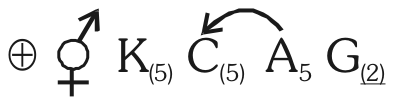
is the floral formula of:
- 1Sesbania
- 2Petunia
- 3Brassica
- 4Allium
Show answer and solution
Correct: option 2, Petunia
The formula shows an actinomorphic, bisexual flower with five united sepals, five united petals, five epipetalous stamens and a bicarpellary syncarpous superior ovary. This is the floral formula of Solanaceae, and Petunia belongs to that family. Sesbania (Fabaceae) is zygomorphic, Brassica (Brassicaceae) has four sepals, four petals and six stamens, and Allium (Liliaceae) has a perianth and a tricarpellary ovary.
Question 111AIPMT 2015, Q66
The crops engineered for glyphosate are resistant/tolerant to:
- 1Bacteria
- 2Insects
- 3Herbicides
- 4Fungi
Show answer and solution
Correct: option 3, Herbicides
Glyphosate is a broad-spectrum herbicide (weed killer). Crops given a gene that makes them tolerant to glyphosate survive when the field is sprayed with it, while the weeds die; such crops are herbicide tolerant.
Question 112AIPMT 2015, Q67
Which of the following statements is not correct?
- 1Goblet cells are present in the mucosa of intestine and secrete mucus
- 2Oxyntic cells are present in the mucosa of stomach and secrete HCl.
- 3Acini are present in the pancreas and secrete carboxypeptidase
- 4Brunner's glands are present in the submucosa of stomach and secrete pepsinogen
Show answer and solution
Correct: option 4, Brunner's glands are present in the submucosa of stomach and secrete pepsinogen
Brunner's glands lie in the submucosa of the duodenum, not the stomach, and they secrete alkaline mucus. Pepsinogen comes from the chief (peptic) cells of the gastric glands. The other three statements are correct: goblet cells secrete mucus, oxyntic (parietal) cells secrete HCl, and the pancreatic acini secrete enzymes that include procarboxypeptidase.
Question 113AIPMT 2015, Q68
In sea urchin DNA, which is double stranded, 17% of the bases were shown to be cytosine. The percentages of the other three bases expected to be present in this DNA are:
- 1G 17%, A 16.5%, T 32.5%
- 2G 17%, A 33%, T 33%
- 3G 8.5%, A 50%, T 24.5%
- 4G 34%, A 24.5%, T 24.5%
Show answer and solution
Correct: option 2, G 17%, A 33%, T 33%
By Chargaff's rule, in double-stranded DNA the amount of G equals C and the amount of A equals T. So G = 17%, and G + C = 34%. The remaining 66% is shared equally between A and T, giving A = 33% and T = 33%.
Question 114AIPMT 2015, Q69
In Bt cotton, the Bt toxin present in plant tissue as pro-toxin is converted into active toxin due to:
- 1Acidic pH of the insect gut
- 2Action of gut micro-organisms
- 3Presence of conversion factors in insect gut
- 4Alkaline pH of the insect gut
Show answer and solution
Correct: option 4, Alkaline pH of the insect gut
The Bt toxin is made as an inactive protoxin. When an insect eats the plant, the alkaline pH of its gut dissolves the crystals and converts the protoxin into the active toxin, which binds to the midgut epithelial cells, makes pores in them and kills the insect.
Question 115AIPMT 2015, Q70
Cytochromes are found in:
- 1Outer wall of mitochondria
- 2Cristae of mitochondria
- 3Lysosomes
- 4Matrix of mitochondria
Show answer and solution
Correct: option 2, Cristae of mitochondria
Cytochromes are electron carriers of the electron transport system, which is located in the inner mitochondrial membrane. The cristae are the infoldings of this inner membrane, so cytochromes are found there and not in the outer membrane or the matrix.
Question 116AIPMT 2015, Q71
Read the following five statements (A to E) and select the option with all correct statements:
(A) Mosses and Lichens are the first organisms to colonise a bare rock.
(B) Selaginella is a homosporous pteridophyte
(C) Coralloid roots in Cycas have VAM
(D) Main plant body in bryophytes is gametophytic, whereas in pteridophytes it is sporophytic
(E) In gymnosperms, male and female gametophytes are present within sporangia located on sporophyte
- 1(B), (C) and (D)
- 2(A), (D) and (E)
- 3(B), (C) and (E)
- 4(A), (C) and (D)
Show answer and solution
Correct: option 2, (A), (D) and (E)
(B) is wrong because Selaginella is heterosporous, producing microspores and megaspores. (C) is wrong because the coralloid roots of Cycas hold nitrogen-fixing cyanobacteria, not VAM (a fungal association). (D) and (E) are correct descriptions of the life cycles, and (A) is taken as correct since lichens and mosses are the early colonisers of bare rock. Only the option with (A), (D) and (E) avoids both wrong statements.
Question 117AIPMT 2015, Q72
Which one of the following is correct?
- 1Serum = Blood + Fibrinogen
- 2Lymph = Plasma + RBC + WBC
- 3Blood = Plasma + RBC + WBC
- 4Plasma = Blood – Lymphocytes
Show answer and solution
Correct: option 3, Blood = Plasma + RBC + WBC
Blood is made of plasma and the formed elements (RBC, WBC and platelets), so the third relation is the correct one among those given. Serum is plasma without the clotting factors, lymph has no RBC, and plasma is blood without all of its formed elements, not just the lymphocytes.
Question 118AIPMT 2015, Q73
The movement of a gene from one linkage group to another is called:
- 1Duplication
- 2Translocation
- 3Crossing over
- 4Inversion
Show answer and solution
Correct: option 2, Translocation
Each chromosome is one linkage group. When a segment carrying a gene moves to a non-homologous chromosome, it changes its linkage group; this is translocation. Crossing over exchanges segments between homologous chromosomes (the same linkage group), and duplication and inversion change a segment within the same chromosome.
Question 119AIPMT 2015, Q74
Which body of the Government of India regulates GM research and safety of introducing GM organisms for public services?
- 1Indian Council of Agricultural Research
- 2Genetic Engineering Approval Committee
- 3Research Committee on Genetic Manipulation
- 4Bio-safety committee
Show answer and solution
Correct: option 2, Genetic Engineering Approval Committee
The Government of India has set up the Genetic Engineering Approval Committee (GEAC) to decide on the validity of GM research and the safety of introducing GM organisms for public services.
Question 120AIPMT 2015, Q75
Rachel Carson's famous book "Silent Spring" is related to:
- 1Noise pollution
- 2Population explosion
- 3Ecosystem management
- 4Pesticide pollution
Show answer and solution
Correct: option 4, Pesticide pollution
Silent Spring (1962) described the harm done to wildlife, especially birds, by the heavy use of pesticides such as DDT. The title refers to a spring without birdsong, so the book is about pesticide pollution.
Question 121AIPMT 2015, Q76
Gastric juice of infants contains:
- 1nuclease, pepsinogen, lipase
- 2pepsinogen, lipase, rennin
- 3amylase, rennin, pepsinogen
- 4maltase, pepsinogen, rennin
Show answer and solution
Correct: option 2, pepsinogen, lipase, rennin
The gastric glands secrete the proenzyme pepsinogen and a small amount of gastric lipase, and in infants also rennin, which helps in the digestion of milk proteins. Nuclease and amylase come from the pancreas (amylase also from saliva), and maltase is an intestinal enzyme.
Question 122AIPMT 2015, Q77
Which of the following is not one of the prime health risks associated with greater UV radiation through the atmosphere due to depletion of stratospheric ozone?
- 1Reduced Immune System
- 2Damage to eyes
- 3Increased liver cancer
- 4Increased skin cancer
Show answer and solution
Correct: option 3, Increased liver cancer
UV-B radiation acts on the exposed surface of the body: it damages DNA in skin cells and causes skin cancer, harms the cornea and causes cataract, and weakens the immune system. It does not reach internal organs, so liver cancer is not one of its risks.
Question 123AIPMT 2015, Q78
Capacitation refers to changes in the:
- 1Ovum before fertilization
- 2Ovum after fertilization
- 3Sperm after fertilization
- 4Sperm before fertilization
Show answer and solution
Correct: option 4, Sperm before fertilization
Capacitation is the set of changes a sperm undergoes inside the female reproductive tract that make it able to fertilise the ovum. It therefore takes place in the sperm before fertilization.
Question 124AIPMT 2015, Q79
Most animals are tree dwellers in a:
- 1Thorn woodland
- 2Temperate deciduous forest
- 3Tropical rain forest
- 4Coniferous forest
Show answer and solution
Correct: option 3, Tropical rain forest
A tropical rain forest has a dense, many-layered canopy that cuts off light from the forest floor, so most of the food (leaves, flowers, fruits) is up in the trees. Most of its animals are therefore arboreal.
Question 125AIPMT 2015, Q80
True nucleus is absent in:
- 1Mucor
- 2Vaucheria
- 3Volvox
- 4Anabaena
Show answer and solution
Correct: option 4, Anabaena
Anabaena is a cyanobacterium (blue-green alga), a prokaryote, so it has no membrane-bound nucleus. Mucor is a fungus and Vaucheria and Volvox are algae; all three are eukaryotes with a true nucleus.
Question 126AIPMT 2015, Q81
Glenoid cavity articulates:
- 1Scapula with acromion
- 2Clavicle with scapula
- 3Humerus with scapula
- 4Clavicle with acromion
Show answer and solution
Correct: option 3, Humerus with scapula
The glenoid cavity is a shallow depression on the scapula into which the head of the humerus fits, forming the ball and socket shoulder joint. The clavicle articulates with the acromion process of the scapula, not with the glenoid cavity.
Question 127AIPMT 2015, Q82
Transmission tissue is characteristic feature of:
- 1Solid style
- 2Dry stigma
- 3Wet stigma
- 4Hollow style
Show answer and solution
Correct: option 1, Solid style
A solid style has no canal; its core is filled with a strand of elongated cells called the transmitting (transmission) tissue, through which the pollen tubes grow. In a hollow style the pollen tubes grow along the lining of the stylar canal instead.
Question 128AIPMT 2015, Q83
- 1Ribosomes
- 2Nucleus
- 3Mitochondria
- 4Chloroplast
Show answer and solution
Correct: option 1, Ribosomes
Ribosomes are made of rRNA and proteins and contain no DNA. The nucleus holds the chromosomal DNA, and mitochondria and chloroplasts each have their own small circular DNA.
Question 129AIPMT 2015, Q84
Gene regulation governing lactose operon of E.coli that involves the lac I gene product is:
- 1Negative and inducible because repressor protein prevents transcription
- 2Negative and repressible because repressor protein prevents transcription
- 3Feedback inhibition because excess of -galactosidase can switch off transcription
- 4Positive and inducible because it can be induced by lactose
Show answer and solution
Correct: option 1, Negative and inducible because repressor protein prevents transcription
The lac I (i) gene makes the repressor protein, which binds to the operator and blocks transcription; regulation by a repressor is negative regulation. The operon is switched on when the inducer (lactose or allolactose) inactivates the repressor, so it is an inducible system.
Question 130AIPMT 2015, Q85
Which of the following does not favour the formation of large quantities of dilute urine?
- 1Caffeine
- 2Renin
- 3Atrial-natriuretic factor
- 4Alcohol
Show answer and solution
Correct: option 2, Renin
Renin starts the renin-angiotensin mechanism: angiotensin II raises blood pressure and releases aldosterone, which increases reabsorption of and water, so less urine is formed. Caffeine and alcohol are diuretics (alcohol suppresses ADH), and atrial natriuretic factor opposes the renin-angiotensin mechanism and increases urine output.
Question 131AIPMT 2015, Q86
What causes a green plant exposed to the light on only one side, to bend toward the source of light as it grows?
- 1Green plants seek light because they are phototropic
- 2Light stimulates plant cells on the lighted side to grow faster
- 3Auxin accumulates on the shaded side, stimulating greater cell elongation there.
- 4Green plants need light to perform photosynthesis
Show answer and solution
Correct: option 3, Auxin accumulates on the shaded side, stimulating greater cell elongation there.
With light from one side, auxin moves to the shaded side of the shoot tip. The higher auxin concentration there makes the cells elongate more than those on the lit side, so the shoot curves towards the light. Saying the plant is phototropic only names the response and does not give its cause.
Question 132AIPMT 2015, Q87
Nuclear envelope is a derivative of:
- 1Membrane of Golgi complex
- 2Microtubules
- 3Rough endoplasmic reticulum
- 4Smooth endoplasmic reticulum
Show answer and solution
Correct: option 3, Rough endoplasmic reticulum
The outer membrane of the nuclear envelope is continuous with the rough endoplasmic reticulum and bears ribosomes, and after cell division the envelope is re-formed from ER membranes. It is therefore regarded as a derivative of the rough ER.
Question 133AIPMT 2015, Q88
Select the correct option:
| I | | II |
|---|
| (a) | Synapsis aligns homologous chromosomes | (i) | Anaphase-II |
| (b) | Synthesis of RNA and protein | (ii) | Zygotene |
| (c) | Action of enzyme recombinase | (iii) | -phase |
| (d) | Centromeres do not separate but chromatids move towards opposite poles | (iv) | Anaphase-I |
| | (v) | Pachytene |
- 1a-ii, b-iii, c-v, d-iv
- 2a-i, b-ii, c-v, d-iv
- 3a-ii, b-iii, c-iv, d-v
- 4a-ii, b-i, c-iii, d-iv
Show answer and solution
Correct: option 1, a-ii, b-iii, c-v, d-iv
Synapsis, the pairing of homologous chromosomes, takes place in zygotene (ii). RNA and proteins are synthesised in the phase (iii). Crossing over, which needs the enzyme recombinase, takes place in pachytene (v). In anaphase I (iv) the homologous chromosomes separate while the centromeres stay undivided, so sister chromatids remain together. Anaphase II is not used.
Question 134AIPMT 2015, Q89
Keel is the characteristic feature of flower of:
- 1Indigofera
- 2Aloe
- 3Tomato
- 4Tulip
Show answer and solution
Correct: option 1, Indigofera
The keel is the pair of fused anterior petals of a papilionaceous corolla, found in the family Fabaceae. Indigofera belongs to Fabaceae. Aloe and tulip are in Liliaceae and tomato is in Solanaceae, which have no keel.
Question 135AIPMT 2015, Q90
Perigynous flowers are found in:
- 1Cucumber
- 2China rose
- 3Rose
- 4Guava
Show answer and solution
Correct: option 3, Rose
In a perigynous flower the ovary sits in the centre of a cup-shaped thalamus and the other floral parts arise from the rim at about the same level; the ovary is half inferior, as in rose, plum and peach. China rose is hypogynous, and cucumber and guava are epigynous.
Question 136AIPMT 2015, Q91
A chemical signal that has both endocrine and neural roles is?
- 1Calcitonin
- 2Epinephrine
- 3Cortisol
- 4Melatonin
Show answer and solution
Correct: option 2, Epinephrine
Epinephrine (adrenaline) is released into the blood by the adrenal medulla as a hormone, and it also acts as a neurotransmitter at nerve endings. Calcitonin, cortisol and melatonin act only as hormones.
Question 137AIPMT 2015, Q92
In which of the following both pairs have correct combination:
- 1In situ conservation: Cryopreservation
Ex situ conservation: Wildlife Sanctuary
- 2In situ conservation: Seed Bank
Ex situ conservation: National Park
- 3In situ conservation: Tissue culture
Ex situ conservation: Sacred groves
- 4In situ conservation: National Park
Ex situ conservation: Botanical Garden
Show answer and solution
Correct: option 4, In situ conservation: National Park
Ex situ conservation: Botanical Garden
In situ conservation protects organisms in their natural habitat: national parks, wildlife sanctuaries, sacred groves. Ex situ conservation keeps them outside it: botanical gardens, seed banks, tissue culture, cryopreservation. Only the pair National Park and Botanical Garden is correct on both lines.
Question 138AIPMT 2015, Q93
HIV that causes AIDS, first starts destroying:
- 1Leucocytes
- 2Helper T- Lymphocytes
- 3Thrombocytes
- 4B- Lymphocytes
Show answer and solution
Correct: option 2, Helper T- Lymphocytes
HIV binds to the CD4 receptor, so it enters helper T-lymphocytes, multiplies in them and kills them. The steady fall in helper T-cells is what weakens the immune response in AIDS.
Question 139AIPMT 2015, Q94
Hysterectomy is surgical removal of:
- 1Prostate gland
- 2Vas deferens
- 3Mammary glands
- 4Uterus
Show answer and solution
Correct: option 4, Uterus
The Greek word hystera means uterus, so hysterectomy is the surgical removal of the uterus. Removal of a part of the vas deferens is vasectomy and removal of a breast is mastectomy.
Question 140AIPMT 2015, Q95
Removal of proximal convoluted tubule from the nephron will result in:
- 1More concentrated urine
- 2No change in quality and quantity of urine
- 3No urine formation
- 4More diluted urine
Show answer and solution
Correct: option 4, More diluted urine
The proximal convoluted tubule reabsorbs about 70 to 80 per cent of the water and electrolytes of the filtrate. Without it most of that water would stay in the tubule, giving a large volume of more dilute urine.
Question 141AIPMT 2015, Q96
A major characteristic of the monocot root is the presence of:
- 1Scattered vascular bundles
- 2Vasculature without cambium
- 3Cambium sandwiched between phloem and xylem along the radius
- 4Open vascular bundles
Show answer and solution
Correct: option 2, Vasculature without cambium
A monocot root has radial, polyarch vascular bundles with no cambium, so it shows no secondary growth. Scattered bundles belong to the monocot stem, and open bundles with cambium belong to dicots.
Question 142AIPMT 2015, Q97
Which of the following characteristics is mainly responsible for diversification of insects on land?
- 1Bilateral symmetry
- 2Exoskeleton
- 3Eyes
- 4Segmentation
Show answer and solution
Correct: option 2, Exoskeleton
The chitinous exoskeleton stops water loss, protects the body and gives attachment to muscles, which let insects live in almost every land habitat. Bilateral symmetry, eyes and segmentation are shared with many groups that did not spread on land in this way.
Question 143AIPMT 2015, Q98
Which of the following cells during gametogenesis is normally diploid?
- 1Spermatid
- 2Spermatogonia
- 3Secondary polar body
- 4Primary polar body
Show answer and solution
Correct: option 2, Spermatogonia
Spermatogonia are the diploid germ cells that divide by mitosis before meiosis begins. Spermatids and both polar bodies are products of meiosis and are haploid.
Question 144AIPMT 2015, Q99
The structures that are formed by stacking of organized flattened membranous sacs in the chloroplasts are:
- 1Grana
- 2Stroma lamellae
- 3Stroma
- 4Cristae
Show answer and solution
Correct: option 1, Grana
The flattened sacs of the chloroplast are thylakoids, and they are stacked like piles of coins to form grana. Stroma lamellae join the grana, the stroma is the matrix, and cristae are folds of the mitochondrial inner membrane.
Question 145AIPMT 2015, Q100
The chromosomes in which centromere is situated close to one end are:
- 1Acrocentric
- 2Telocentric
- 3Sub-metacentric
- 4Metacentric
Show answer and solution
Correct: option 1, Acrocentric
An acrocentric chromosome has its centromere close to one end, giving one very short and one very long arm. In a telocentric chromosome the centromere is at the very tip, in a metacentric one it is in the middle, and in a sub-metacentric one slightly away from the middle.
Question 146AIPMT 2015, Q101
- 1The root dies first
- 2The shoot and root die together
- 3Neither root nor shoot will die
- 4The shoot dies first
Show answer and solution
Correct: option 1, The root dies first
Girdling removes a ring of bark with the phloem but leaves the xylem. Water still reaches the shoot, but food made in the leaves cannot move down to the roots, so the roots starve and die first.
Question 147AIPMT 2015, Q102
Vertical distribution of different species occupying different levels in a biotic community is known as:
- 1Stratification
- 2Zonation
- 3Pyramid
- 4Divergence
Show answer and solution
Correct: option 1, Stratification
Stratification is the vertical layering of species in a community, such as trees in the top layer of a forest, shrubs in the second and herbs and grasses at the bottom.
Question 148AIPMT 2015, Q103
Multiple alleles are present:
- 1At different loci on the same chromosome
- 2At the same locus of the chromosome
- 3On non-sister chromatids
- 4On different chromosomes
Show answer and solution
Correct: option 2, At the same locus of the chromosome
Multiple alleles are more than two alternative forms of one gene, so they all occupy the same locus on homologous chromosomes. The ABO blood group gene with its three alleles is the usual example.
Question 149AIPMT 2015, Q104
The mass of living material at a trophic level at a particular time is called:
- 1Standing state
- 2Net primary productivity
- 3Standing crop
- 4Gross primary productivity
Show answer and solution
Correct: option 3, Standing crop
Standing crop is the mass of living matter (biomass) at a trophic level at a given time. Standing state is the amount of nutrients in the soil, and the productivity terms are rates of biomass production.
Question 150AIPMT 2015, Q105
Which of the following animals is not viviparous?
- 1Elephant
- 2Platypus
- 3Whale
- 4Flying fox (Bat)
Show answer and solution
Correct: option 2, Platypus
Platypus (Ornithorhynchus) is an egg-laying mammal, so it is oviparous. Elephant, whale and bat are placental mammals that give birth to young ones.
Question 151AIPMT 2015, Q106
In an ecosystem the rate of production of organic matter during photosynthesis is termed as:
- 1Gross primary productivity
- 2Secondary productivity
- 3Net productivity
- 4Net primary productivity
Show answer and solution
Correct: option 1, Gross primary productivity
Gross primary productivity is the rate at which organic matter is produced during photosynthesis. Net primary productivity is what is left after the plants' own respiration, and secondary productivity is the rate of formation of new organic matter by consumers.
Question 152AIPMT 2015, Q107
Erythropoiesis starts in:
- 1Liver
- 2Spleen
- 3Red bone marrow
- 4Kidney
Show answer and solution
Correct: option 3, Red bone marrow
Erythropoiesis is the formation of red blood cells. In the adult they are formed in the red bone marrow, which is the keyed answer. Note that in the foetus red cell formation begins earlier, in the yolk sac and then the liver and spleen, so the word "starts" can also be read as pointing to the liver; another unofficial key for this paper gives option (1).
Question 153AIPMT 2015, Q108
Which is the most common mechanism of genetic variation in the population of sexually reproducing organism?
- 1Chromosomal aberrations
- 2Genetic drift
- 3Recombination
- 4Transduction
Show answer and solution
Correct: option 3, Recombination
In sexual reproduction crossing over and independent assortment during meiosis, followed by random fertilisation, reshuffle genes in every generation. This recombination is far more frequent than chromosomal aberrations or drift, and transduction occurs only in bacteria.
Question 154AIPMT 2015, Q109
Blood pressure in the mammalian aorta is maximum during:
- 1Diastole of the right ventricle
- 2Systole of the left ventricle
- 3Diastole of the right atrium
- 4Systole of the left atrium
Show answer and solution
Correct: option 2, Systole of the left ventricle
The left ventricle pumps blood into the aorta. When it contracts, blood is forced into the aorta and the pressure there reaches its peak (systolic pressure).
Question 155AIPMT 2015, Q110
When you hold your breath, which of the following gas changes in blood would first lead to the urge to breathe?
- 1rising concentration
- 2falling concentration
- 3rising and falling concentration
- 4falling concentration
Show answer and solution
Correct: option 1, rising concentration
The chemosensitive area near the respiratory rhythm centre is highly sensitive to and hydrogen ions. When breath is held, builds up in the blood and this rise triggers the urge to breathe; the role of oxygen is quite insignificant.
Question 156AIPMT 2015, Q111
Vascular bundles in monocotyledons are considered closed because:
- 1Cambium is absent
- 2There are no vessels with perforations
- 3Xylem is surrounded all around by phloem
- 4A bundle sheath surrounds each bundle
Show answer and solution
Correct: option 1, Cambium is absent
A vascular bundle is called closed when it has no cambium between xylem and phloem, so it cannot form secondary tissues. Monocot bundles lack cambium; dicot stem bundles have it and are called open.
Question 157AIPMT 2015, Q112
Male gametes are flagellated in:
- 1Anabaena
- 2Ectocarpus
- 3Spirogyra
- 4Polysiphonia
Show answer and solution
Correct: option 2, Ectocarpus
Ectocarpus is a brown alga, and brown algae have pear-shaped gametes with two laterally attached flagella. Anabaena is a cyanobacterium with no gametes, Spirogyra has non-flagellated gametes, and the red alga Polysiphonia has non-motile male gametes.
Question 158AIPMT 2015, Q113
Which one of the following may require pollinators, but is genetically similar to autogamy?
- 1Xenogamy
- 2Apogamy
- 3Cleistogamy
- 4Geitonogamy
Show answer and solution
Correct: option 4, Geitonogamy
Geitonogamy is the transfer of pollen to the stigma of another flower of the same plant. It needs a pollinating agent like cross-pollination, but the pollen comes from the same plant, so genetically it is like autogamy.
Question 159AIPMT 2015, Q114
In ginger vegetative propagation occurs through:
- 1Offsets
- 2Bulbils
- 3Runners
- 4Rhizome
Show answer and solution
Correct: option 4, Rhizome
Ginger is an underground stem called a rhizome, with nodes and buds from which new plants grow. Offsets are seen in water hyacinth, bulbils in Agave and runners in grasses.
Question 160AIPMT 2015, Q115
Which one of the following is not an inclusion body found in prokaryotes?
- 1Cyanophycean granule
- 2Glycogen granule
- 3Polysome
- 4Phosphate granule
Show answer and solution
Correct: option 3, Polysome
Inclusion bodies are reserve material stored in the cytoplasm without a membrane, such as phosphate, cyanophycean and glycogen granules. A polysome is a chain of ribosomes on one mRNA and is concerned with protein synthesis, not storage.
Question 161AIPMT 2015, Q116
A somatic cell that has just completed the S phase of its cell cycle, as compared to gamete of the same species, has:
- 1same number of chromosomes but twice the amount of DNA
- 2twice the number of chromosomes and four times the amount of DNA
- 3four times the number of chromosomes and twice the amount of DNA
- 4twice the number of chromosomes and twice the amount of DNA
Show answer and solution
Correct: option 2, twice the number of chromosomes and four times the amount of DNA
A gamete has n chromosomes and 1C DNA. A somatic cell has 2n chromosomes, and after the S phase its DNA has doubled from 2C to 4C while the chromosome number stays 2n. So it has twice the chromosomes and four times the DNA of a gamete.
Question 162AIPMT 2015, Q117
- 1true breeding homozygotes
- 2different molecular forms of a gene
- 3heterozygotes
- 4different phenotype
Show answer and solution
Correct: option 2, different molecular forms of a gene
Alleles are alternative forms of the same gene that differ slightly in their DNA sequence and code for a pair of contrasting traits. Homozygote and heterozygote describe an individual's genotype, not the alleles themselves.
Question 163AIPMT 2015, Q118
Select the correct matching in the following pairs:
- 1Smooth ER – Synthesis of lipids
- 2Rough ER – Synthesis of glycogen
- 3Rough ER – Oxidation of fatty acids
- 4Smooth ER – Oxidation of phospholipids
Show answer and solution
Correct: option 1, Smooth ER – Synthesis of lipids
The smooth endoplasmic reticulum is the main site of lipid synthesis, including steroid hormones in animal cells. The rough ER carries ribosomes and is concerned with protein synthesis and secretion.
Question 164AIPMT 2015, Q119
The terga, sterna and pleura of cockroach body are joined by:
- 1Muscular tissue
- 2Arthrodial membrane
- 3Cartilage
- 4Cementing glue
Show answer and solution
Correct: option 2, Arthrodial membrane
The hard plates (sclerites) of the cockroach exoskeleton, the dorsal terga, ventral sterna and lateral pleura, are joined to each other by a thin, flexible articular membrane called the arthrodial membrane.
Question 165AIPMT 2015, Q120
Which of the following represents the correct combination without any exception?
Characteristics - Class
- 1Mouth ventral, gills without operculum; skin with placoid scales; persistent notochord - Chondrichthyes
- 2Sucking and circular mouth; jaws absent, integument without scales; paired appendages - Cyclostomata
- 3Body covered with feathers; skin moist and glandular; fore-limbs form wings; lungs with air sacs - Aves
- 4Mammary gland; hair on body; pinnae; two pairs of Limbs - Mammalia
Show answer and solution
Correct: option 1, Mouth ventral, gills without operculum; skin with placoid scales; persistent notochord - Chondrichthyes
All cartilaginous fishes have a ventral mouth, gill slits without an operculum, placoid scales and a notochord that persists through life. Cyclostomes have no paired appendages, bird skin is dry and without glands, and some mammals lack pinnae or two pairs of limbs (for example whales), so the other rows have exceptions or errors.
Question 166AIPMT 2015, Q121
Which one of the following statements is incorrect?
- 1In competitive inhibition, the inhibitor molecule is not chemically changed by the enzyme.
- 2The competitive inhibitor does not affect the rate of breakdown of the enzyme-substrate complex.
- 3The presence of the competitive inhibitor decreases the Km of the enzyme for the substrate.
- 4A competitive inhibitor reacts reversibly with the enzyme to form an enzyme-inhibitor complex.
Show answer and solution
Correct: option 3, The presence of the competitive inhibitor decreases the Km of the enzyme for the substrate.
A competitive inhibitor resembles the substrate and competes for the active site, so more substrate is needed to reach half of the maximum velocity. That means Km increases, not decreases, while the maximum velocity is unchanged. The other three statements are true.
Question 167AIPMT 2015, Q122
Which of the following regions of the brain is incorrectly paired with its function?
- 1Cerebellum - language comprehension
- 2Corpus callosum - communication between the left and right cerebral cortices
- 3Cerebrum - calculation and contemplation
- 4Medulla oblongata - homeostatic control
Show answer and solution
Correct: option 1, Cerebellum - language comprehension
The cerebellum coordinates muscular activity and maintains balance and posture. Language comprehension is a function of the association areas of the cerebrum (Wernicke's area), so this pair is wrong. The other three pairs are correct.
Question 168AIPMT 2015, Q123
Which one of the following statements is not true?
- 1Pollen grains of some plants cause severe allergies and bronchial afflictions in some people
- 2The flowers pollinated by flies and bats secrete foul odour to attract them
- 3Honey is made by bees by digesting - pollen collected from flowers
- 4Pollen grains are rich in nutrients, and they are used in the form of tablets and syrups
Show answer and solution
Correct: option 3, Honey is made by bees by digesting - pollen collected from flowers
Honey is made by bees from the nectar of flowers, not from pollen. The statements about pollen allergy, foul-smelling flowers pollinated by flies and bats, and pollen tablets used as food supplements are true.
Question 169AIPMT 2015, Q124
The active form of Entamoeba histolytica feeds upon:
- 1mucosa and submucosa of colon only
- 2food in intestine
- 3blood only
- 4erythrocytes; mucosa and submucosa of colon
Show answer and solution
Correct: option 4, erythrocytes; mucosa and submucosa of colon
The trophozoite (active form) of Entamoeba histolytica lives in the large intestine, where it dissolves and eats the cells of the mucosa and submucosa and also engulfs red blood cells. This causes the ulcers and blood in the stool seen in amoebic dysentery.
Question 170AIPMT 2015, Q125
Which of the following viruses is not transferred through semen of an infected male?
- 1Human immunodeficiency virus
- 2Chikungunya virus
- 3Ebola virus
- 4Hepatitis B virus
Show answer and solution
Correct: option 2, Chikungunya virus
Chikungunya virus is spread by the bite of Aedes mosquitoes. HIV, hepatitis B virus and Ebola virus can all be present in semen and be passed on through sexual contact.
Question 171AIPMT 2015, Q126
A population will not exist in Hardy - Weinberg equilibrium if:
- 1There are no mutations
- 2There is no migration
- 3The population is large
- 4Individuals mate selectively
Show answer and solution
Correct: option 4, Individuals mate selectively
Hardy-Weinberg equilibrium needs a large population with random mating and no mutation, migration or selection. Selective (non-random) mating changes genotype frequencies, so the equilibrium is disturbed.
Question 172AIPMT 2015, Q127
The guts of cow and buffalo possess:
- 1Chlorella spp.
- 2Methanogens
- 3Cyanobacteria
- 4Fucus spp.
Show answer and solution
Correct: option 2, Methanogens
Methanogens such as Methanobacterium live in the rumen of cattle, where they help break down cellulose and release methane. Chlorella, cyanobacteria and Fucus are photosynthetic and cannot live in the gut.
Question 173AIPMT 2015, Q128
The hilum is a scar on the:
- 1Fruit, where it was attached to pedicel
- 2Fruit, where style was present
- 3Seed, where micropyle was present
- 4Seed, where funicle was attached
Show answer and solution
Correct: option 4, Seed, where funicle was attached
The hilum is the scar on the seed coat marking the point where the developing seed was attached to the fruit through the funicle (stalk of the ovule). The micropyle is a separate small pore above the hilum.
Question 174AIPMT 2015, Q129
Secondary Succession takes place on/in:
- 1Degraded forest
- 2Newly created pond
- 3Newly cooled lava
- 4Bare rock
Show answer and solution
Correct: option 1, Degraded forest
Secondary succession begins where an earlier community has been destroyed but soil is still present, as in a degraded or burnt forest or abandoned farmland. Bare rock, newly cooled lava and a newly created pond have never had life, so they show primary succession.
Question 175AIPMT 2015, Q130
Which one of the following statements is wrong?
- 1Agar - agar is obtained from Gelidium and Gracilaria
- 2Chlorella and Spirulina are used as space food
- 3Mannitol is stored food in Rhodophyceae
- 4Algin and carragen are products of algae
Show answer and solution
Correct: option 3, Mannitol is stored food in Rhodophyceae
Red algae (Rhodophyceae) store food as floridean starch. Mannitol and laminarin are the stored food of brown algae (Phaeophyceae). The other statements are correct: agar comes from Gelidium and Gracilaria, Chlorella and Spirulina are protein-rich space food, and algin and carrageen are obtained from brown and red algae.
Question 176AIPMT 2015, Q131
The following graph depicts changes in two populations (A and B) of herbivores in a grassy field. A possible reason for these changes is that:
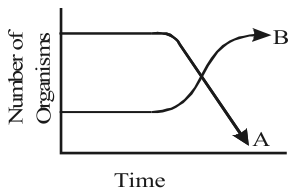
- 1Population B competed more successfully for food than population A
- 2Population A produced more offspring than population B
- 3Population A consumed the members of population B
- 4Both plant populations in this habitat decreased
Show answer and solution
Correct: option 1, Population B competed more successfully for food than population A
In the graph population A falls while population B rises and levels off at a higher number. Both are herbivores using the same grass, so the likely reason is competition in which B gets the food more successfully and A declines. Herbivores do not eat each other, and a fall in the plants would have reduced both.
Question 177AIPMT 2015, Q132
Match each disease with its correct type of vaccine:
| Disease | Type of vaccine |
|---|
| (a) tuberculosis | (i) harmless virus |
| (b) whooping cough | (ii) inactivated toxin |
| (c) diphtheria | (iii) killed bacteria |
| (d) polio | (iv) harmless bacteria |
- 1a-iii, b-ii, c-iv, d-i
- 2a-iv, b-iii, c-ii, d-i
- 3a-i, b-ii, c-iv, d-iii
- 4a-ii, b-i, c-iii, d-iv
Show answer and solution
Correct: option 2, a-iv, b-iii, c-ii, d-i
The tuberculosis vaccine (BCG) is a live weakened, harmless bacterium (iv). The whooping cough vaccine is made of killed bacteria (iii). The diphtheria vaccine is a toxoid, an inactivated toxin (ii). The oral polio vaccine is a weakened, harmless virus (i).
Question 178AIPMT 2015, Q133
Which of the following are the important floral rewards to the animal pollinators?
- 1Nectar and pollen grains
- 2Floral fragrance and calcium crystals
- 3Protein pellicle and stigmatic exudates
- 4Colour and large size flower
Show answer and solution
Correct: option 1, Nectar and pollen grains
Animals visit flowers to collect food, and nectar and pollen grains are the usual rewards. Colour, size and fragrance only attract the visitor; they are not rewards.
Question 179AIPMT 2015, Q134
An abnormal human baby with 'XXX' sex chromosomes was born due to:
- 1formation of abnormal ova in the mother
- 2fusion of two ova and one sperm
- 3fusion of two sperms and one ovum
- 4formation of abnormal sperms in the father
Show answer and solution
Correct: option 1, formation of abnormal ova in the mother
Non-disjunction of the X chromosomes during oogenesis gives an abnormal ovum with two X chromosomes. When it is fertilised by a normal X-carrying sperm the zygote is XXX. This is the most common cause, so the abnormal ovum is the keyed answer.
Question 180AIPMT 2015, Q135
Transpiration and root pressure cause water to rise in plants by:
- 1Pulling and pushing it, respectively
- 2Pushing it upward
- 3Pushing and pulling it, respectively
- 4Pulling it upward
Show answer and solution
Correct: option 1, Pulling and pushing it, respectively
Transpiration from the leaves creates a suction that pulls the water column up through the xylem. Root pressure is a positive pressure developed in the roots that pushes water up from below. So the two act by pulling and pushing, respectively.