The dimensions of are:
- 1
- 2
- 3
- 4
Show answer and solution
Correct: option 3,
The speed of light in vacuum is . The quantity is therefore a speed, with dimensions .
120 questions · 3 h · held on 13 May 2012 · booklet code A
120 single-correct MCQs (30 Physics, 30 Chemistry, 60 Biology), +4/-1, 480 marks.
No official answer key is available online for this paper. Answers are checked against published coaching keys and worked out again in each solution.
The dimensions of are:
Correct: option 3,
The speed of light in vacuum is . The quantity is therefore a speed, with dimensions .
A stone is dropped from a height h. It hits the ground with a certain momentum P. If the same stone is dropped from a height 100% more than the previous height, the momentum when it hits the ground will change by:
Correct: option 2, 41%
The speed on reaching the ground is , so the momentum is . A height 100% more means , so the new momentum is . The momentum rises by about 41%.
A car of mass m is moving on a level circular track of radius R. If represents the static friction between the road and tyres of the car, the maximum speed of the car in circular motion is given by:
Correct: option 4,
On a level road the centripetal force comes only from static friction, whose largest value is . Setting gives ; the mass cancels.
A car of mass m starts from rest and accelerates so that the instantaneous power delivered to the car has a constant magnitude . The instantaneous velocity of this car is proportional to:
Correct: option 2,
With constant power, the work done in time t equals the kinetic energy gained from rest: . So , which is proportional to .
A circular platform is mounted on a frictionless vertical axle. Its radius R = 2 m and its moment of inertia about the axle is . It is initially at rest. A 50 kg man stands on the edge of the platform and begins to walk along the edge at the speed of relative to the ground. Time taken by the man to complete one revolution is:
Correct: option 3, s
Angular momentum about the axle stays zero, so the platform turns the opposite way with : , giving . The angular speed of the man relative to the ground is , so relative to the platform he moves at . One revolution around the platform takes s.
The moment of inertia of a uniform circular disc is maximum about an axis perpendicular to the disc and passing through:
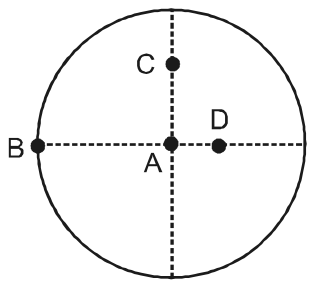
Correct: option 1, B
By the parallel axis theorem , where d is the distance of the axis from the centre A. Of the four points, B lies on the rim and is farthest from the centre, so the moment of inertia is largest about the axis through B.
Three masses are placed on the x-axis: 300 g at origin, 500 g at x = 40 cm and 400 g at x = 70 cm. The distance of the centre of mass from the origin is:
Correct: option 1, 40 cm
cm.
If is escape velocity and is orbital velocity of a satellite for orbit close to the earth’s surface, then these are related by:
Correct: option 4,
For an orbit close to the surface , while the escape velocity from the surface is . Dividing, .
Which one of the following plots represents the variation of gravitational field on a particle with distance r due to a thin spherical shell of radius R? (r is measured from the centre of the spherical shell)
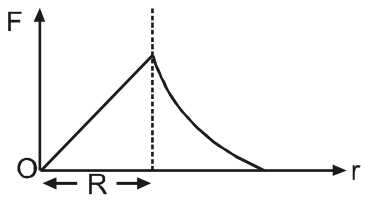
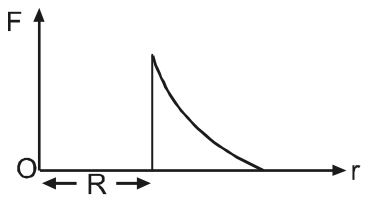
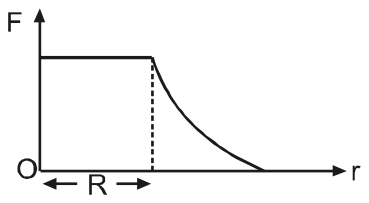
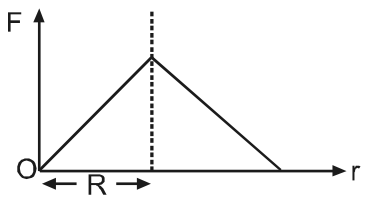
Correct: option 2
Inside a thin spherical shell () the gravitational field is zero. Outside () the shell acts like a point mass at its centre, so the field is : it jumps to at the surface and then falls off as . The plot that is zero up to R and then drops along a curve is option (2).
A slab of stone of area and thickness 0.1 m is exposed on the lower surface to steam at 100°C. A block of ice at 0°C rests on the upper surface of the slab. In one hour 4.8 kg of ice is melted. The thermal conductivity of slab is: (Given latent heat of fusion of ice = ):
Correct: option 1, 1.24 J/m/s/°C
Heat conducted through the slab in time t melts the ice: . So J/m/s/°C.
An ideal gas goes from state A to state B via three different processes as indicated in the P-V diagram:
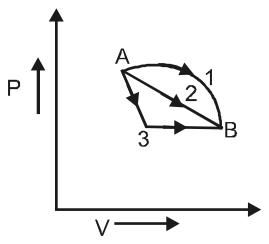
If , , indicate the heat absorbed by the gas along the three processes and , , indicate the change in internal energy along the three processes respectively, then
Correct: option 1, and
Internal energy is a state function, so with the same end states A and B, . The work done by the gas is the area under each path on the P-V diagram; path 1 lies highest and path 3 lowest, so . From the first law , hence .
The equation of a simple harmonic wave is given by Where x and y are in meters and t is in seconds. The ratio of maximum particle velocity to the wave velocity is
Correct: option 2,
Writing gives m, and . Wave velocity and maximum particle velocity . The ratio is (equivalently ).
A train moving at a speed of towards a stationary object, emits a sound of frequency 1000 Hz. Some of the sound reaching the object gets reflected back to the train as echo. The frequency of the echo as detected by the driver of the train is: (speed of sound in air is )
Correct: option 3, 5000 Hz
The stationary object receives because the source approaches it. It reflects this frequency, and the driver, an observer moving towards the reflector, hears Hz.
A parallel plate capacitor has a uniform electric field E in the space between the plates. If the distance between the plates is d and area of each plate is A, the energy stored in the capacitor is:
Correct: option 3,
The energy density of an electric field is and the field fills the volume between the plates, so . The same follows from with and .
Two metallic spheres of radii 1 cm and 3 cm are given charges of C and C, respectively. If these are connected by a conducting wire, the final charge on the bigger sphere is:
Correct: option 2, C
The total charge C is conserved. After connection both spheres are at the same potential , so charge divides in the ratio of the radii, 1 : 3. The bigger sphere holds C.
The power dissipated in the circuit shown in the figure is 30 Watts. The value of R is:
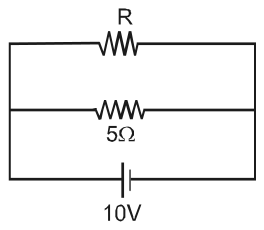
Correct: option 3,
R and the resistor are in parallel across the 10 V cell, so each has 10 V across it. The resistor dissipates W, leaving 10 W for R. Then gives .
Cell having an emf and internal resistance r is connected across a variable external resistance R. As the resistance R is increased, the plot of potential difference V across R is given by:
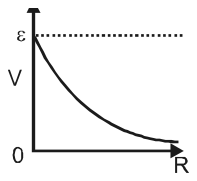
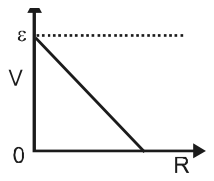
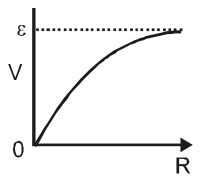
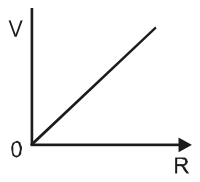
Correct: option 3
The current is , so . V is zero at , rises as R increases, and levels off towards for very large R. That is the rising, saturating curve of option (3).
A proton carrying 1 MeV kinetic energy is moving in a circular path of radius R in uniform magnetic field. What should be the energy of an -particle to describe a circle of same radius in the same field?
Correct: option 2, 1 MeV
The radius is , so for the same R and B the quantity must be the same. An -particle has four times the mass and twice the charge of a proton, so and MeV.
A magnetic needle suspended parallel to a magnetic field requires J of work to turn it through 60°. The torque needed to maintain the needle in this position will be:
Correct: option 2, 3 J
Work to turn the needle from 0° to 60° is J, so J. The torque needed to hold it at 60° is (in N m, which the options print as J).
The instantaneous values of alternating current and voltages in a circuit are given as ampere Volt The average power in Watts consumed in the circuit is:
Correct: option 4,
Average power is . The peak values are each , so the rms values are each , and the phase difference is with . Hence W.
In a coil of resistance , the induced current developed by changing magnetic flux through it, is shown in figure as a function of time. The magnitude of change in flux through the coil in Weber is:
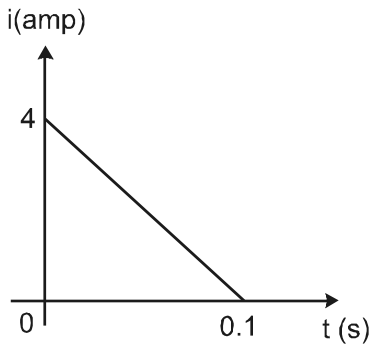
Correct: option 2, 2
The induced current is , so the charge that flows is . The charge is the area under the i-t graph, a triangle: C. Therefore Wb.
The ratio of amplitude of magnetic field to the amplitude of electric field for an electromagnetic wave propagating in vacuum is equal to:
Correct: option 2, reciprocal of speed of light in vacuum
In an electromagnetic wave in vacuum the field amplitudes are related by . So , the reciprocal of the speed of light in vacuum.
For the angle of minimum deviation of a prism to be equal to its refracting angle, the prism must be made of a material whose refractive index:
Correct: option 2, lies between 2 and
With , the prism formula gives . At minimum deviation the angle of incidence is , which must lie between 0° and 90°. So lies between 1 and , and n lies between 2 and .
A rod of length 10 cm lies along the principal axis of a concave mirror of focal length 10 cm in such a way that its end closer to the pole is 20 cm away from the mirror. The length of the image is:
Correct: option 4, 5 cm
The near end is at 20 cm, which is the centre of curvature (), so its image is also at 20 cm. The far end is at 30 cm: , so its image is at 15 cm from the mirror. The image of the rod stretches from 15 cm to 20 cm, a length of 5 cm.
If the momentum of electron is changed by P, then the de Broglie wavelength associated with it changes by 0.5%. The initial momentum of electron will be:
Correct: option 1, 200 P
Since , a small fractional change in wavelength equals the fractional change in momentum in size: . So , which gives the initial momentum .
Two radiations of photons energies 1 eV and 2.5 eV, successively illuminate a photosensitive metallic surface of work function 0.5 eV. The ratio of the maximum speeds of the emitted electrons is:
Correct: option 2, 1 : 2
The photoelectric equation gives the maximum kinetic energies eV and eV. Since , the speeds are in the ratio , that is 1 : 2.
The transition from the state n = 3 to n = 1 in a hydrogen like atom results in ultraviolet radiation. Infrared radiation will be obtained in the transition from:
Correct: option 4,
Infrared photons have less energy than ultraviolet ones, so the transition must release much less energy than . The energy released is proportional to , which is smallest for () among the options. Transitions ending on n = 3 form the Paschen series, which lies in the infrared for hydrogen.
The half life of a radioactive nucleus is 50 days. The time interval between the time when of it has decayed and the time when of it had decayed is:
Correct: option 2, 50 days
At the fraction left undecayed is and at it is . The undecayed amount has halved between the two times, and halving always takes one half life, so days.
The input resistance of a silicon transistor is . Base current is changed by which results in a change in collector current by 2 mA. This transistor is used as a common emitter amplifier with a load resistance of . The voltage gain of the amplifier is:
Correct: option 1, 2000
Current gain . Voltage gain of a common emitter amplifier is .
To get an output Y = 1 in given circuit which of the following input will be correct:
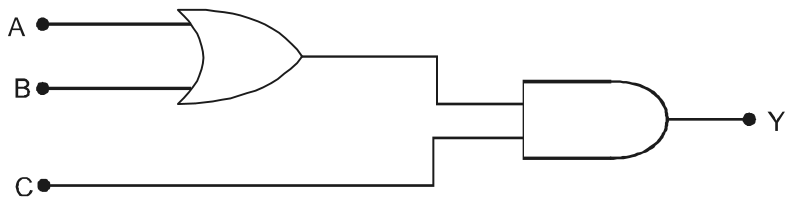
Correct: option 2, A = 1, B = 0, C = 1
A and B feed an OR gate, and its output goes with C into an AND gate, so . Y is 1 only when C = 1 and at least one of A and B is 1. Among the options only A = 1, B = 0, C = 1 has C = 1.
Given that the equilibrium constant for the reaction has a value of 278 at a particular temperature. What is the value of the equilibrium constant for the following reaction at the same temperature?
Correct: option 3,
The second reaction is the first one reversed and halved. Reversing inverts the constant and halving takes its square root, so the new constant is .
Structure of a mixed oxide is cubic close-packed (c.c.p). The cubic unit cell of mixed oxide is composed of oxide ions. One fourth of the tetrahedral voids are occupied by divalent metal A and the octahedral voids are occupied by a monovalent metal B. The formula of the oxide is:
Correct: option 4,
A c.c.p. unit cell has 4 oxide ions, with 8 tetrahedral voids and 4 octahedral voids. A fills one fourth of the tetrahedral voids, , and B fills all 4 octahedral voids. The ratio A : B : O = 2 : 4 : 4 = 1 : 2 : 2, so the formula is .
Given the reaction between 2 gases represented by and to give the compound AB(g). . At equilibrium, the concentration of = M of = M of AB = M. If the reaction takes place in a sealed vessel at 527°C, then the value of will be:
Correct: option 3, 0.62
. The powers of ten cancel because the number of moles of gas is the same on both sides.
Activation energy () and rate constants ( and ) of a chemical reaction at two different temperatures ( and ) are related by:
Correct: option 2 or 4
The answer key accepts options 2 and 4.
From the Arrhenius equation . Subtracting the equation at from the one at gives , which is option (4). Taking the minus sign outside the bracket gives , which is option (2). As printed here the two are the same relation, so both are accepted.
During change of to ion, the electron adds on which one of the following orbitals?
Correct: option 1, orbital
In (16 electrons) the bonding orbitals up to are full and the two degenerate antibonding orbitals hold one electron each. The extra electron of goes into one of these half-filled orbitals, which is why the bond order falls from 2 to 1.5.
Standard reduction potentials of the half reactions are given below: ; V ; V ; V ; V The strongest oxidising and reducing agents respectively are:
Correct: option 1, and
A higher reduction potential means the species on the left is reduced more readily, so it is the stronger oxidising agent: (+2.85 V) is the strongest. The lowest reduction potential means the reverse reaction, oxidation of the species on the right, is the easiest: (+0.53 V) is the strongest reducing agent.
A certain gas takes three times as long to effuse out as helium. Its molecular mass will be:
Correct: option 2, 36 u
By the law of effusion the rate is proportional to , so the time taken for the same amount is proportional to . Then , giving u.
The orbital angular momentum of a p-electron is given as:
Correct: option 1,
Orbital angular momentum is . For a p-electron , giving .
Vapour pressure of chloroform () and dichloromethane () at 25°C are 200 mm Hg and 41.5 mm Hg respectively. Vapour pressure of the solution obtained by mixing 25.5 g of and 40 g of at the same temperature will be: (Molecular mass of = 119.5 u and molecular mass of = 85 u).
Correct: option 1, 173.9 mm Hg
The examiners dropped this question and gave every candidate the 4 marks.
Moles of and moles of , so the mole fractions are 0.312 and 0.688. The law of partial vapour pressures gives mm Hg. This lies between the two pure vapour pressures, as it must, and matches none of the four options, so the key used here marks the question as a bonus (no correct option).
Molar conductivities () at infinite dilution of NaCl, HCl and are 126.4, 425.9 and 91.0 respectively. for will be:
Correct: option 4, 390.5
By the law of independent migration of ions, .
For real gases van der Waals equation is written as where 'a' and 'b' are van der Waals constants. Two sets of gases are: (I) , , and (II) , and The gases given in set-I in increasing order of 'b' and gases given in set-II in decreasing order of 'a', are arranged below. Select the correct order from the following:
Correct: option 4, (I) (II)
The constant 'b' measures the volume of the molecules, so it grows with molecular size, and 'a' measures the attraction between molecules, so it grows with the size and polarisability of the molecule. therefore has the largest 'b' in set I, and in set II the attraction falls in the order (about 2.28, 1.38 and 0.25 ). The answer key used for this paper gives option (4); note that the tabulated values of 'a' fit the set-II order printed in option (3), so the keyed answer is doubtful.
Equal volumes of two monoatomic gases, A and B, at same temperature and pressure are mixed. The ratio of specific heats () of the mixture will be:
Correct: option 4, 1.67
Both gases are monoatomic, so each has and , and a mixture of them has the same molar heat capacities. Hence .
Red precipitate is obtained when ethanol solution of dimethylglyoxime is added to ammoniacal Ni(II). Which of the following statements is not true?
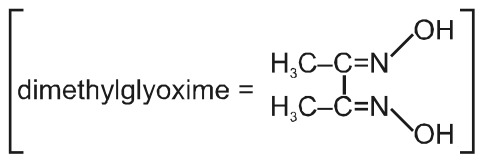
Correct: option 3, Red complex has a tetrahedral geometry.
The red precipitate is bis(dimethylglyoximato)nickel(II). Each dimethylglyoxime ion binds through its two nitrogen atoms (bidentate), () uses hybrid orbitals to give a square planar complex, and the two ligands are held together by symmetrical O–H···O hydrogen bonds. The statement that the complex is tetrahedral is therefore the false one.
Low spin complex of -cation in an octahedral field will have the following energy: ( = Crystal Field Splitting Energy in an octahedral field, P = Electron pairing energy)
Correct: option 2,
In a low spin octahedral complex all six electrons are in the set (). Each electron is stabilised by , giving , and the six electrons form three pairs, costing . The energy is .
Which one of the following does not correctly represent the correct order of the property indicated against it?
Correct: option 3, : increasing melting points
Melting points rise from Ti to Cr but drop sharply at Mn, whose half-filled and filled configuration gives weak metallic bonding, so the order in option (3) is wrong. The other orders hold: the number of oxidation states grows up to Mn, the ions to have 1, 2, 3 and 4 unpaired electrons, and Cr has the highest second ionization enthalpy because the second electron leaves a stable arrangement.
Four successive members of the first series of the transition metals are listed below. For which one of them the standard potential value has a positive sign?
Correct: option 3, Cu (Z = 29)
Copper is the only metal of the first transition series with a positive ( V). Its high enthalpy of atomisation and high ionization enthalpies are not made up for by the hydration enthalpy of . Fe, Co and Ni all have negative values.
In the replacement reaction
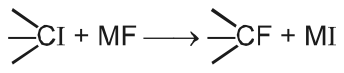
The reaction will be most favourable if M happens to be:
Correct: option 3, Rb
The halogen on carbon is exchanged for fluorine, and the metal fluoride MF becomes the metal iodide MI. The exchange is easiest when MF gives up its fluoride ion readily, that is when MF is the most ionic and has the lowest lattice energy. Among Li, Na, K and Rb the largest cation is , so RbF is the most favourable.
In which of the following arrangements the given sequence is not strictly according to the property indicated against it?
Correct: option 2, : increasing values
Acid strength of the group 16 hydrides increases from to as the H–E bond weakens. A stronger acid has a larger and so a smaller , which means the values decrease along this sequence, not increase. The other three sequences are in the stated order.
Four diatomic species are listed below. Identify the correct order in which the bond order is increasing in them:
Correct: option 4,
From molecular orbital theory, bond order = (bonding electrons − antibonding electrons)/2. (3 electrons) has 0.5, (17 electrons) has 1.5, NO (15 electrons) has 2.5 and (14 electrons, like ) has 3. So the increasing order is .
The catalytic activity of transition metals and their compounds is ascribed mainly to:
Correct: option 3, their ability to adopt variable oxidation state
A transition metal can change its oxidation state easily, so it can form unstable intermediates with the reactants and then return to its original state, which gives a path of lower activation energy. An example is in the contact process, where vanadium moves between +5 and +4.
Which of the following exhibit only + 3 oxidation state?
Correct: option 3, Ac
Actinium () loses its three outer electrons to reach the radon core and shows only the +3 state. Thorium is mainly +4, protactinium goes up to +5 and uranium shows +3 to +6.
The Gibbs' energy for the decomposition of at 500°C is as follows: ; The potential difference needed for the electrolytic reduction of aluminium oxide () at 500°C is at least:
Correct: option 3, 2.5 V
In the equation as written, mol of is reduced, so electrons. Using , the size of the potential is V. At least 2.5 V must be applied.
Chloroamphenicol is an:
Correct: option 4, antibiotic-broad spectrum
Chloramphenicol is an antibiotic that acts against a wide range of Gram-positive and Gram-negative bacteria, so it is a broad spectrum antibiotic. It is used for typhoid, dysentery, meningitis and similar infections.
Consider the following reaction:
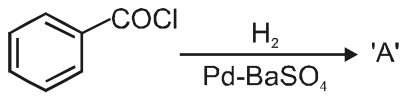
The product 'A' is:
Correct: option 1,
Hydrogen over palladium supported on barium sulphate reduces an acid chloride only as far as the aldehyde (Rosenmund reduction); the barium sulphate poisons the catalyst so the aldehyde is not reduced further. Benzoyl chloride therefore gives benzaldehyde, .
Which one of the following sets forms the biodegradable polymer?


Correct: option 2, and
Glycine () and aminocaproic acid () form the polyamide nylon-2-nylon-6, whose amide links resemble those of proteins and can be broken down by microorganisms. The other sets give Buna-N, terylene and Buna-S, none of which is biodegradable.
An organic compound () (A), when treated with nitrous acid, gave an alcohol and gas was evolved. (A) on warming with and caustic potash gave (C) which on reduction gave isopropylmethylamine. Predict the structure of (A).
Correct: option 1,
An alcohol with evolution of on treatment with nitrous acid, and a reaction with and KOH (carbylamine test), both show that (A) is a primary amine. The isocyanide (C) is reduced to a secondary amine R–NH–; since this is isopropylmethylamine, R is isopropyl. So (A) is isopropylamine, .
Which of the following reagents will be able to distinguish between 1-butyne and 2-butyne?
Correct: option 1,
1-Butyne is a terminal alkyne with an acidic hydrogen on the triply bonded carbon, so it reacts with sodamide to form a sodium alkynide and ammonia. 2-Butyne has no such hydrogen and does not react. HCl, and react with both alkynes alike.
Consider the reaction: What sort of reaction is it?
Correct: option 4, Nucleophilic addition - elimination reaction
The lone pair on nitrogen of hydrazine attacks the electron-poor carbonyl carbon (nucleophilic addition), and the addition product then loses a molecule of water to give the hydrazone with a C=N bond (elimination). It is a nucleophilic addition-elimination reaction.
Which of the following compounds will give a yellow precipitate with iodine and alkali?
Correct: option 1 or 4
The answer key accepts options 1 and 4.
The yellow precipitate is iodoform, , given by compounds with a group joined to carbon or hydrogen, or a group that is oxidised to it. Acetophenone () has the first and 2-hydroxypropane () has the second, so both give the test, and the key accepts options (1) and (4). Methyl acetate and acetamide do not respond.
Which of the following compounds can be used as antifreeze in automobile radiators?
Correct: option 2, Glycol
Ethylene glycol mixes with water in all proportions, lowers its freezing point considerably and, having a high boiling point, does not evaporate from a hot radiator. It is the standard antifreeze for car radiators.
How many organisms in the list given below are autotrophs? Lactobacillus, Nostoc, Chara, Nitrosomonas, Nitrobacter, Streptomyces, Saccharomyces, Trypanosoma, Porphyra, Wolffia
Correct: option 3, Six
Nostoc (cyanobacterium), Chara (green alga), Porphyra (red alga) and Wolffia (flowering plant) are photoautotrophs, and Nitrosomonas and Nitrobacter are chemoautotrophic nitrifying bacteria. That makes six. Lactobacillus, Streptomyces, Saccharomyces (yeast) and Trypanosoma are heterotrophs.
Read the following five statements (A - E) and answer as asked next to them. (A) In Equisetum the female gametophyte is retained on the parent sporophyte. (B) In Ginkgo male gametophyte is not independent. (C) The sporophyte in Riccia is more developed than that in Polytrichum. (D) Sexual reproduction in Volvox is isogamous. (E) The spores of slime molds lack cell walls. How many of the above statements are correct?
Correct: option 4, One
Only (B) is correct: in gymnosperms such as Ginkgo the male gametophyte is highly reduced and stays inside the pollen grain. Equisetum is homosporous with a free-living prothallus, so (A) is wrong. Riccia has the simplest sporophyte (a capsule only) while Polytrichum has foot, seta and capsule, so (C) is wrong. Volvox is oogamous, and slime mould spores have true walls, so (D) and (E) are wrong.
Which one of the following pairs is wrongly matched?
Correct: option 2, Salvinia - Prothallus
Ginkgo is a gymnosperm and bears archegonia, viroids are free RNA without a protein coat, and the embryo sac of mustard has two synergids. Salvinia is a heterosporous fern whose gametophytes are much reduced and develop within the spores rather than as a free-living prothallus, so this is the pair taken as wrongly matched.
In the five-kingdom classification, Chlamydomonas and Chlorella have been included in:
Correct: option 1, Protista
Chlamydomonas and Chlorella are single-celled eukaryotes. In the five-kingdom classification all unicellular eukaryotes are placed in Protista, and the key gives Protista. Algae is not a kingdom in this scheme.
For its activity, carboxypeptidase requires:
Correct: option 1, Zinc
Carboxypeptidase is a protein-digesting enzyme that needs a metal ion as cofactor. The ion is zinc, which is bound at the active site and takes part in breaking the peptide bond.
Which one of the following structures is an organelle within an organelle?
Correct: option 1, Ribosome
Ribosomes are found not only in the cytoplasm but also inside mitochondria and chloroplasts (70S ribosomes), so a ribosome is an organelle that lies within another organelle. Peroxisomes and ER lie free in the cytoplasm, and a mesosome is an infolding of the bacterial cell membrane.
Which one of the following is a wrong statement regarding mutations?
Correct: option 4, Change in a single base pair of DNA does not cause mutation
A change in a single base pair is itself a mutation, called a point mutation; sickle-cell anaemia arises this way. So statement (4) is wrong. Insertions and deletions shift the reading frame, cancer cells often carry chromosomal aberrations, and UV and gamma rays are physical mutagens.
A test cross is carried out to:
Correct: option 1, determine the genotype of a plant at .
In a test cross a plant showing the dominant trait is crossed with the homozygous recessive parent. If all the offspring are dominant the plant is homozygous; if half are recessive it is heterozygous. The cross is thus used to find the unknown genotype of a dominant plant, for example one from the generation.
Read the following four statements (A-D): (A) In transcription, adenosine pairs with uracil. (B) Regulation of lac operon by repressor is referred to as positive regulation. (C) The human genome has approximately 50,000 genes. (D) Haemophilia is a sex-linked recessive disease. How many of the above statements are right?
Correct: option 1, Two
(A) is right: adenine on the DNA template pairs with uracil in the RNA being made. (D) is right: haemophilia is an X-linked recessive disorder. (B) is wrong because control by a repressor is negative regulation, and (C) is wrong because the human genome has roughly 30,000 genes. Two statements are right.
Which one of the following organisms is correctly matched with its three characteristics?
Correct: option 3, Onion: Bulb, Imbricate aestivation, Axile placentation
Onion (Liliaceae) has a bulb, imbricate aestivation of the perianth and axile placentation, so all three features fit. Pea has a non-endospermic seed, tomato has valvate (not twisted) aestivation, and maize is a plant.
How many plants in the list given below have marginal placentation? Mustard, Gram, Tulip, Asparagus, Arhar, Sun hemp, Chilli, Colchicine, Onion, Moong, Pea, Tobacco, Lupin
Correct: option 3, Six
Marginal placentation is the mark of the family Fabaceae, whose single-carpel ovary bears ovules along the ventral suture. Gram, arhar, sun hemp, moong, pea and lupin belong to Fabaceae, which makes six. Mustard has parietal placentation, and the members of Liliaceae and Solanaceae in the list have axile placentation.
Read the following four statements (A-D): (A) Both, photophosphorylation and oxidative phosphorylation involve uphill transport of protons across the membrane. (B) In dicot stems, a new cambium originates from cells of pericycle at the time of secondary growth. (C) Stamens in flowers of Gloriosa and Petunia are polyandrous. (D) Symbiotic nitrogen-fixers occur in free-living state also in soil. How many of the above statements are right?
Correct: option 1, Two
(A) is right: in both chloroplasts and mitochondria protons are pumped across the membrane against their gradient, and ATP is made as they flow back. (D) is right: Rhizobium and Frankia live free in the soil and fix nitrogen only as symbionts. (B) is wrong, because in dicot stems the new (interfascicular) cambium comes from medullary ray cells; the pericycle gives cambium in roots. The key counts two right statements, which treats (C) as wrong, the stamens of Petunia being epipetalous.
Through their effect on plant growth regulators, what do the temperature and light control in the plants?
Correct: option 2, Flowering
Light, through photoperiod, and temperature, through vernalisation, act by way of plant growth regulators to decide when a plant flowers. Flowering is therefore the process they control.
Which one of the following generally acts as an antagonist to gibberellins?
Correct: option 3, ABA
Abscisic acid (ABA) is a growth inhibitor that opposes gibberellins in most situations: gibberellins break seed dormancy and promote germination and growth, while ABA induces dormancy and inhibits them.
As compared to a dicot root, a monocot root has:
Correct: option 2, Many xylem bundles
A monocot root is polyarch, usually with more than six xylem bundles, while a dicot root has two to four. Monocot roots have no secondary growth, so they form no secondary xylem, annual rings or periderm.
For its action, nitrogenase requires:
Correct: option 1, High input of energy
Nitrogenase reduces to ammonia at a very high energy cost: 8 ATP are used for each formed (16 ATP per ). The enzyme is damaged by oxygen and needs anaerobic conditions, so oxygen radicals are of no help.
Vernalisation stimulates flowering in:
Correct: option 3, Carrot
Vernalisation is the promotion of flowering by a period of low temperature. Biennials such as carrot, sugar beet and cabbage need this cold treatment before they flower in their second season.
What is the function of germ pore?
Correct: option 3, Initiation of pollen tube
Germ pores are the spots on a pollen grain where the tough exine is absent. When the pollen germinates on the stigma, the intine pushes out through a germ pore to form the pollen tube.
Which one of the following statements is wrong?
Correct: option 1, When pollen is shed at two-celled stage, double fertilization does not take place.
In over 60 per cent of flowering plants the pollen is shed at the two-celled stage; the generative cell then divides in the pollen tube to give the two male gametes, and double fertilization takes place as usual. Statement (1) is therefore wrong. The other three statements are correct.
Plants with ovaries having only one or a few ovules, are generally pollinated by:
Correct: option 4, Wind
Wind pollination is a matter of chance, and only a few pollen grains reach a stigma. Wind-pollinated flowers usually have a single ovule in each ovary and many flowers packed in an inflorescence, as in the grasses.
Sacred groves are specially useful in:
Correct: option 4, conserving rare and threatened species
Sacred groves are patches of forest protected by local communities for religious reasons, so nothing in them is cut or hunted. They have become the last refuges of many rare and threatened plants and animals, which makes them a form of in situ conservation.
The rate of formation of new organic matter by rabbit in a grassland, is called:
Correct: option 2, Secondary productivity
A rabbit is a herbivore, that is, a consumer. The rate at which consumers form new organic matter is secondary productivity. Primary productivity (gross or net) refers only to producers, the green plants.
Cuscuta is an example of:
Correct: option 1, Ectoparasitism
Cuscuta (dodder) is a leafless parasitic plant that twines around the outside of its host and draws food through haustoria. Since it lives on the external surface of the host it is an ectoparasite. Brood parasitism is seen in birds such as the cuckoo.
The second stage of hydrosere is occupied by plants like:
Correct: option 4, Vallisneria
A hydrosere begins with the phytoplankton stage. The second stage is that of rooted submerged plants such as Hydrilla and Vallisneria. Azolla is a free-floating plant, Typha belongs to the reed-swamp stage and Salix to the much later woodland stage.
Green revolution in India occurred during:
Correct: option 1, 1960's
The Green Revolution in India began in the mid-1960s, when high-yielding semi-dwarf varieties of wheat (and then rice) were introduced along with better irrigation and fertiliser use.
In gobar gas, the maximum amount is that of:
Correct: option 2, Methane
Gobar gas (biogas) is produced when methanogenic bacteria break down cattle dung anaerobically. It is mainly methane, with smaller amounts of carbon dioxide and traces of hydrogen and hydrogen sulphide.
Read the following four statements (A-D): (A) Colostrum is recommended for the new born because it is rich in antigens. (B) Chikungunya is caused by a Gram negative bacterium. (C) Tissue culture has proved useful in obtaining virus-free plants. (D) Beer is manufactured by distillation of fermented grape juice. How many of the above statements are wrong?
Correct: option 1, Two
(A) is wrong: colostrum is valued for its antibodies (IgA), not antigens. (B) is wrong: chikungunya is caused by a virus. (C) is right: meristem culture gives virus-free plants. The answer key used for this paper counts two wrong statements, option (1). Note, however, that (D) is also wrong, since beer is made from fermented malted cereals without distillation, which would make three wrong statements.
Tobacco plants resistant to a nematode have been developed by the introduction of DNA that produced (in the host cells).
Correct: option 1, both sense and anti-sense RNA
This is RNA interference. Nematode-specific genes were introduced into tobacco using Agrobacterium so that the host cells made both sense and anti-sense RNA. The two are complementary and form double-stranded RNA, which silences the matching mRNA of the nematode Meloidogyne incognita, so the parasite cannot survive.
Biolistics (gene-gun) is suitable for:
Correct: option 3, Constructing recombinant DNA by joining with vectors
In biolistics, cells are bombarded with high-velocity micro-particles of gold or tungsten coated with DNA, so that the DNA enters the cell directly. The answer key used for this paper marks option (3). Note that the method is a way of delivering DNA into cells and is described in the textbook as suitable for plant cells, which is option (2); joining DNA to a vector is done with restriction enzymes and ligase.
In genetic engineering, the antibiotics are used:
Correct: option 1, as selectable markers
Cloning vectors carry antibiotic resistance genes, for example for ampicillin and tetracycline in pBR322. When cells are grown on a medium containing the antibiotic, only the transformed cells survive, so the antibiotic serves to select transformants and recombinants. The sequence where replication starts is the ori.
Which one of the following pairs of animals are similar to each other pertaining to the feature stated against them?
Correct: option 4, Sea horse and Flying fish - Cold blooded (poikilothermal)
Sea horse (Hippocampus) and flying fish (Exocoetus) are both bony fishes, and all fishes are cold blooded. Ornithorhynchus (platypus) lays eggs, the crocodile has a four-chambered heart, and the roundworms Ascaris and Ancylostoma are unsegmented.
Which one of the following categories of animals, is correctly described with no single exception in it?
Correct: option 3, All sponges are marine and have collared cells.
Crocodiles have a four-chambered heart, so (1) has an exception, and the egg-laying platypus is an exception to (4). All sponges do have collared cells (choanocytes). The answer key used for this paper marks option (3). Note, however, that a few sponges such as Spongilla live in fresh water, whereas four pairs of gills covered by an operculum on each side is true of every bony fish, which points to option (2).
Which one of the following organisms is scientifically correctly named, correctly printed according to the International Rules of Nomenclature and correctly described?
Correct: option 3, Felis tigris - The Indian tiger, well protected in Gir forests.
Musca domestica is the housefly, an insect. E. coli the bacterium is Escherichia coli; Entamoeba coli is a protozoan. The answer key used for this paper marks option (3). Note, however, that the tiger is Panthera tigris and Gir is known for lions, while option (2) is correct in every part: Plasmodium falciparum is a protozoan and causes malignant malaria, the most serious type.
Which one of the following cellular parts is correctly described?
Correct: option 1, Thylakoids - flattened membranous sacs forming the grana of chloroplasts
Thylakoids are flattened membranous sacs in the stroma of the chloroplast, arranged in stacks called grana. Active ribosomal RNA synthesis occurs in the nucleolus, not centrioles; chloroplast ribosomes are 70S and cytoplasmic ones 80S; lysosomal enzymes work best at an acidic pH.
Identify the meiotic stage in which the homologous chromosomes separate while the sister chromatids remain associated at their centromeres:
Correct: option 3, Anaphase I
In anaphase I the homologous chromosomes of each bivalent move to opposite poles, but the centromeres do not split, so the two sister chromatids of each chromosome stay together. The sister chromatids separate only in anaphase II.
Which one of the following biomolecules is correctly characterised?
Correct: option 1, Lecithin - a phosphorylated glyceride found in cell membrane
Lecithin is a phospholipid, a glyceride carrying a phosphate group, and is found in cell membranes. Palmitic acid is a saturated fatty acid with 16 carbons; adenylic acid is adenosine with a phosphate group (a nucleotide); and in alanine the amino and carboxyl groups are both on the same (alpha) carbon, not anywhere in the molecule.
The idea of mutations was brought forth by:
Correct: option 1, Hugo de Vries, who worked on evening primrose
Hugo de Vries studied the evening primrose (Oenothera lamarckiana) and proposed that new species arise through mutations, large sudden heritable changes, rather than through the small variations that Darwin emphasised.
What is it that forms the basis of DNA Fingerprinting?
Correct: option 4, Satellite DNA occurring as highly repeated short DNA segments
DNA fingerprinting depends on repetitive (satellite) DNA, in which a short sequence is repeated many times in tandem. The number of repeats (VNTRs) at a locus differs greatly between individuals and is inherited, giving each person a characteristic band pattern.
Represented below is the inheritance pattern of a certain type of traits in humans. Which one of the following conditions could be an example of this pattern?
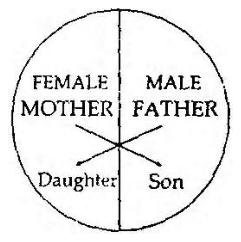
Correct: option 3, Haemophilia
The diagram shows criss-cross inheritance: the trait passes from mother to son and from father to daughter. This is the pattern of an X-linked trait, because a son gets his only X chromosome from his mother and a father passes his X only to daughters. Haemophilia is X-linked recessive; the other three are autosomal recessive disorders.
Given below is the diagrammatic sketch of a certain type of connective tissue. Identify the parts labelled A, B, C and D, and select the right option about them.
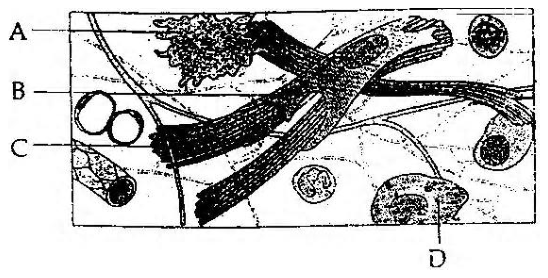
Correct: option 1, A-Macrophage, B-Fibroblast, C-Collagen fibres, D-Mast cells
The sketch is areolar (loose connective) tissue. A is the irregular cell with many processes, a macrophage; B is a fibroblast, the cell that secretes the fibres; C is a bundle of collagen fibres; D is the granule-filled mast cell.
Which one of the following options gives the correct categorisation of six animals according to the type of nitrogenous wastes (A, B, C), they give out? A - AMMONOTELIC, B - UREOTELIC, C - URICOTELIC
Correct: option 3, A: Aquatic Amphibia; B: Frog, Humans; C: Pigeon, Lizards, Cockroach
Aquatic amphibians have plenty of water and excrete ammonia (ammonotelic). The adult frog and humans excrete urea (ureotelic). Pigeon, lizards and cockroach conserve water by excreting uric acid (uricotelic), as birds, reptiles and insects do.
Where do certain symbiotic microorganisms normally occur in human body?
Correct: option 1, Caecum
The caecum is a small blind sac at the start of the large intestine, and it hosts some symbiotic microorganisms. The duodenum receives acidic chyme and digestive juices and has no such resident symbionts.
Which one of the following pairs of chemical substances, is correctly categorised?
Correct: option 3, Troponin and myosin - Complex proteins in striated muscles
Troponin is a protein of the thin (actin) filament and myosin forms the thick filament of striated muscle. Thymosin comes from the thymus, not the thyroid; prolactin is a pituitary hormone, not an enzyme; rhodopsin is the visual pigment of the rods, not a hormone.
The supportive skeletal structures in the human external ears and in the nose tip are examples of:
Correct: option 4, cartilage
The pinna of the ear and the tip of the nose are firm yet flexible because they are supported by cartilage, a skeletal connective tissue with a pliable matrix. Bone would be rigid, and ligament and areolar tissue give no such support.
The four sketches (A, B, C and D) given below, represent four different types of animal tissues. Which one of these is correctly identified in the options given, along with its correct location and function?
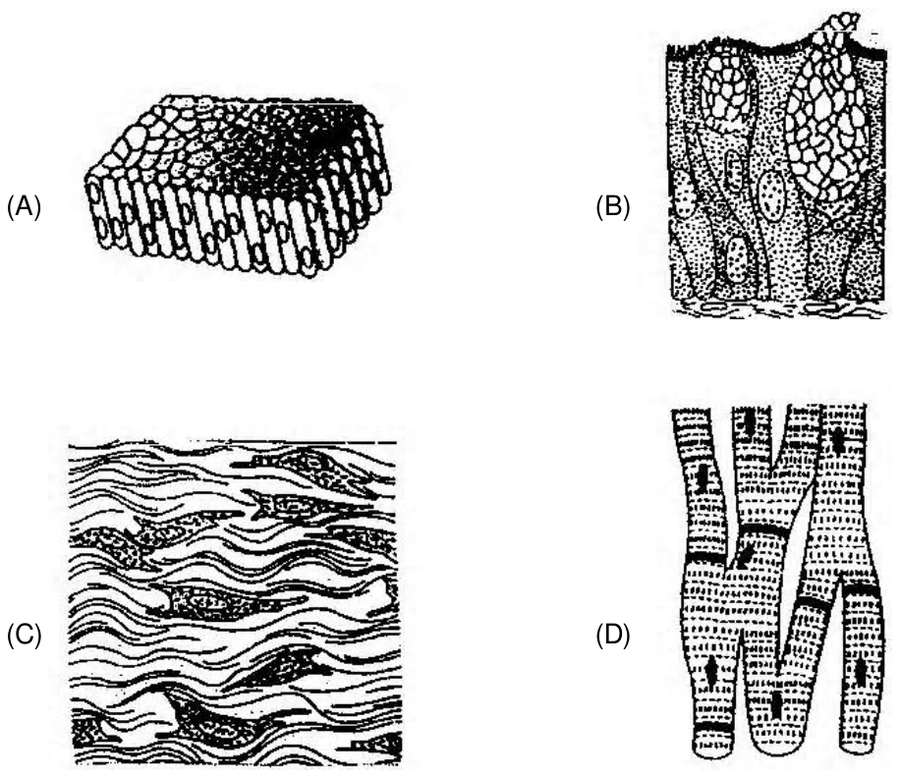
Tissue - Location - Function
Correct: option 1, (B) Glandular epithelium - Intestine - Secretion
Sketch B shows a multicellular glandular epithelium, which is found in the lining of the gut and secretes. C is dense connective tissue of the kind found in tendons, not cartilage; D shows branched striated fibres with intercalated discs, which is cardiac muscle, not smooth muscle; the tubules of the nephron are lined by cuboidal, not columnar, epithelium.
A fall in glomerular filtration rate (GFR) activates:
Correct: option 1, juxta glomerular cells to release renin
A fall in GFR (or in glomerular blood flow or pressure) is sensed by the juxtaglomerular apparatus, whose JG cells release renin. Renin converts angiotensinogen to angiotensin I, which becomes angiotensin II; this raises blood pressure and, by a later step, stimulates aldosterone release, restoring the GFR.
Which one of the following characteristics is common both in humans and adult frogs?
Correct: option 4, Ureotelic mode of excretion
Both humans and adult frogs excrete urea, so both are ureotelic. The frog has a three-chambered heart, external fertilisation and nucleated RBCs, whereas humans have a four-chambered heart, internal fertilisation and RBCs without a nucleus.
Identify the human developmental stage shown below as well as the related right place of its occurrence in a normal pregnant woman, and select the right option for the two together.
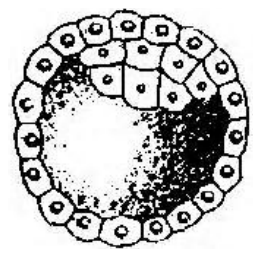
Developmental stage - Site of occurrence
Correct: option 3, Blastocyst - Uterine wall
The figure shows a hollow ball with an outer layer of cells (trophoblast), a cavity and a clump of cells at one side (inner cell mass). This is the blastocyst. It is the stage that reaches the uterus and becomes embedded in the uterine wall (implantation); the morula stages are found in the fallopian tube.
Which one of the following human organs is often called the "graveyard" of RBCs?
Correct: option 3, Spleen
Red blood cells live for about 120 days, after which the worn-out cells are destroyed in the spleen. For this reason the spleen is called the graveyard of RBCs.
The secretory phase in the human menstrual cycle is also called:
Correct: option 3, luteal phase and lasts for about 13 days
After ovulation, around day 14, the ruptured follicle becomes the corpus luteum, whose progesterone makes the endometrium secretory. This secretory phase is therefore the luteal phase, and it runs from ovulation to the next menstruation, about 13 to 14 days. The follicular phase is the proliferative phase before ovulation.
Select the correct statement about biodiversity:
Correct: option 3, Western Ghats have a very high degree of species richness and endemism.
The Western Ghats are one of the biodiversity hotspots, regions defined by very high species richness together with a high degree of endemism. Deserts are poor in species, large-scale monoculture of any one crop reduces diversity, and conservation is a real necessity for every country.
The domestic sewage in large cities:
Correct: option 2, is processed by aerobic and then anaerobic bacteria in the secondary treatment in Sewage Treatment Plants (STPs)
In secondary (biological) treatment the effluent is first aerated so that aerobic microbes in flocs consume the organic matter and lower the BOD; the settled activated sludge is then digested by anaerobic bacteria in the sludge digesters. The high BOD of sewage is due to its organic matter, not its bacteria; aeration is essential; and solids make up only about 0.1 per cent of sewage.
Which one of the following sets of items in the options 1 - 4 are correctly categorised with one exception in it? ITEMS - CATEGORY - EXCEPTION
Correct: option 3, Plasmodium, Cuscuta, Trypanosoma - Protozoan parasites - Cuscuta
Plasmodium and Trypanosoma are protozoan parasites, but Cuscuta is a parasitic flowering plant, so it is a true exception. In the other rows there is no exception at all: UAG is a stop codon, the wombat is an Australian marsupial and diphtheria is a bacterial disease.
Identify the likely organisms (a), (b), (c) and (d) in the food web shown below:
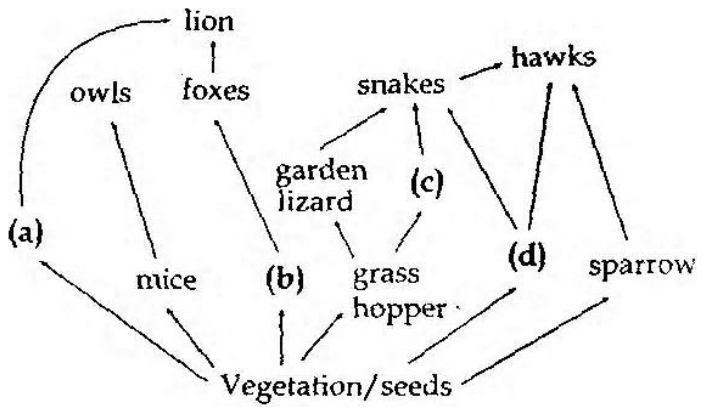
Correct: option 1, a-deer, b-rabbit, c-frog, d-rat
(a) feeds on vegetation and is eaten by the lion, so it is a large herbivore such as deer. (b) is a herbivore eaten by foxes, a rabbit. (c) eats grasshoppers and is eaten by snakes, a frog. (d) eats vegetation or seeds and is eaten by snakes and hawks, a rat.
Consider the following four statements (a-d) and select the option which includes all the correct ones only. (a) Single cell Spirulina can produce large quantities of food rich in protein, minerals, vitamins etc. (b) Body weight-wise the microorganism Methylophilus methylotrophus may be able to produce several times more proteins than the cows per day (c) Common button mushrooms are a very rich source of vitamin C (d) A rice variety has been developed which is very rich in calcium.
Correct: option 4, Statements (a), (b)
(a) and (b) are right: Spirulina is grown as single cell protein, and 250 g of Methylophilus methylotrophus can make about 25 tonnes of protein a day against roughly 200 g from a 250 kg cow. (c) is wrong, as mushrooms are not a rich source of vitamin C, and (d) is wrong, as the biofortified rice variety is rich in iron, not calcium.
Identify the molecules (a) and (b) shown below and select the right option giving their source and use.
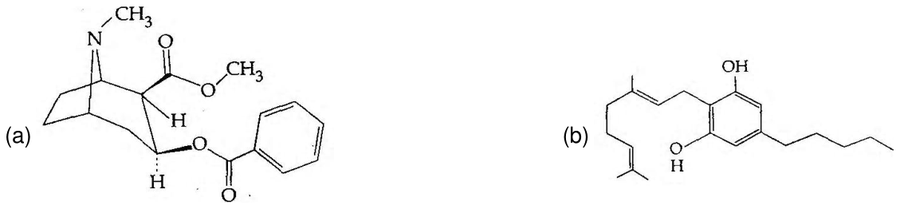
Molecule - Source - Use
Correct: option 4, (a) Morphine - Papaver somniferum - Sedative and pain killer
The answer key used for this paper marks option (4): morphine is an opioid obtained from the latex of the poppy Papaver somniferum and is a very effective sedative and pain killer. The other rows each contain an error: cocaine interferes with, rather than accelerates, the transport of dopamine; heroin is made from morphine, not from Cannabis; and cannabinoids come from Cannabis sativa, not Atropa belladonna. Note that structure (a) as drawn in this copy, with its methyl ester and benzoate groups, is that of cocaine.
Which one of the following statements is correct with respect to immunity?
Correct: option 1, Preformed antibodies need to be injected to treat the bite by a viper snake
A snake bite needs an immediate response, so ready-made antibodies against the venom (antivenom) are injected; this is passive immunisation. Antibodies are made by B-lymphocytes, each antibody has two light and two heavy chains, and graft rejection is brought about by T-lymphocytes (cell-mediated immunity).
The figure below shows three steps (A,B,C) of Polymerase Chain Reaction (PCR). Select the option giving correct identification together with what it represents?
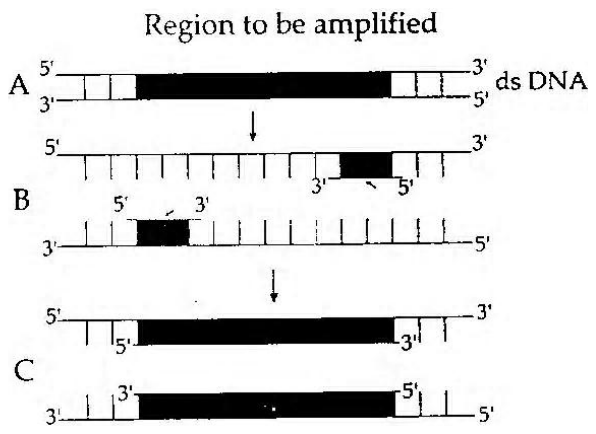
Correct: option 3, C - Extension in the presence of heat stable DNA polymerase
A is the double-stranded DNA being denatured by heat (about 94°C), B shows the two primers annealed to the separated strands, and C shows the primers extended into full new strands. Extension is carried out by the heat-stable Taq DNA polymerase, so option (3) pairs the step and its description correctly.
The first clinical gene therapy was given for treating:
Correct: option 4, Adenosine deaminase deficiency
The first clinical gene therapy was given in 1990 to a four-year-old girl with adenosine deaminase (ADA) deficiency. A functional ADA cDNA was introduced into her lymphocytes with a retroviral vector and the cells were returned to her body.
Which one of the following represents a palindromic sequence in DNA?
Correct: option 1, 5' - GAATTC - 3' 3' - CTTAAG - 5'
A palindromic DNA sequence reads the same on both strands when each is read in the 5' to 3' direction. In option (1) the upper strand reads GAATTC and the lower strand, read 5' to 3', also reads GAATTC. This is the recognition site of EcoRI. None of the other pairs has this property.