Past papers
AIPMT 2011 Mains question paper with solutions
119 questions · 3 h · held on 15 May 2011 · booklet code B
120 single-correct MCQs (30 Physics, 30 Chemistry, 60 Biology), +4/-1, 480 marks.
No official answer key is available online for this paper. Answers are checked against published coaching keys and worked out again in each solution.
Question 99 is not included: the only copy of this paper online is damaged or misprinted there. The numbering of the other questions follows the booklet.
AIPMT 2011 Mains Biology questions
Question 60AIPMT 2011 Mains, Q31
The technique called gamete intrafallopian transfer (GIFT) is recommended for those females:
- 1who cannot produce an ovum
- 2who cannot retain the foetus inside uterus.
- 3whose cervical canal is too narrow to allow passage for the sperms
- 4who cannot provide suitable environment for fertilisation
Show answer and solution
Correct: option 1, who cannot produce an ovum
In GIFT an ovum collected from a donor is transferred into the fallopian tube of another female. It is meant for a woman who cannot produce an ovum herself but can provide a suitable environment for fertilisation and for the further development of the embryo.
Question 61AIPMT 2011 Mains, Q32
Which one of the following is a possibility for most of us in regard to breathing, by making a conscious effort?
- 1One can breathe out air totally without oxygen.
- 2One can breathe out air through eustachian tubes by closing both the nose and the mouth.
- 3One can consciously breathe in and breathe out by moving the diaphragm alone, without moving the ribs at all.
- 4The lungs can be made fully empty by forcefully breathing out all air from them
Show answer and solution
Correct: option 2, One can breathe out air through eustachian tubes by closing both the nose and the mouth.
The key used for this paper gives option (2), on the ground that the eustachian tubes connect the pharynx with the middle ear cavities, so with the nose and mouth closed air can be forced along them. Options (1) and (4) are impossible: expired air always contains oxygen, and a residual volume of air stays in the lungs after the most forceful expiration. Note that this key is unofficial and many books give option (3), breathing with the diaphragm alone, as the answer.
Question 62AIPMT 2011 Mains, Q33
Bacillus thuringiensis forms protein crystals which contain insecticidal protein.
- 1Binds with epithelial cells of midgut of the insect pest ultimately killing it
- 2is coded by several genes including the gene cry
- 3is activated by acid pH of the foregut of the insect pest.
- 4does not kill the carrier bacterium which is itself resistant to this toxin
Show answer and solution
Correct: option 1, Binds with epithelial cells of midgut of the insect pest ultimately killing it
The Bt toxin is made as an inactive protoxin, so it does not harm the bacterium. When an insect eats it, the alkaline pH of the gut dissolves the crystals and activates the toxin. The active toxin binds to the surface of the midgut epithelial cells and makes pores in them, which causes swelling and lysis of the cells and kills the insect. So option (1) is correct. The toxin is activated by alkaline, not acid, pH, and the bacterium survives because the protein is inactive in it, not because it is resistant.
Question 63AIPMT 2011 Mains, Q34
Which one of the following pairs is wrongly matched while the remaining three are correct?
- 1Penicillium - Conidia
- 2Water hyacinth - Runner
- 3Bryophyllum - Leaf buds
- 4Agave - Bulbils
Show answer and solution
Correct: option 2, Water hyacinth - Runner
Water hyacinth (Eichhornia) multiplies vegetatively by offsets, not runners, so pair (2) is wrongly matched. Penicillium reproduces asexually by conidia, Bryophyllum by buds that arise from the notches of its leaf margins, and Agave by bulbils.
Question 64AIPMT 2011 Mains, Q35
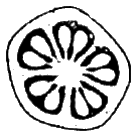
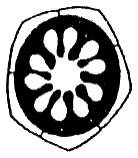
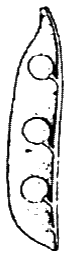
Which one of the following diagrams represents the placentation in Dianthus?
- 1
- 2
- 3
- 4
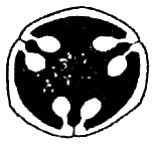
Show answer and solution
Correct: option 2
Dianthus has free central placentation: the ovules are borne on a central axis and there are no septa, so the ovary has a single chamber. Diagram (2) shows this. Diagram (1), with septa joining the central axis to the wall, is axile placentation; diagram (3) is marginal placentation as in pea; diagram (4) is parietal placentation.
Question 65AIPMT 2011 Mains, Q36
Which one of the following statements is totally wrong about the occurrence of notochord, while the other three are correct?
- 1It is present only in larval tail in Ascidians
- 2It is replaced by a vertebral column in adult frog
- 3It is absent throughout life in humans from the very beginning
- 4It is present throughout life in Amphioxus
Show answer and solution
Correct: option 3, It is absent throughout life in humans from the very beginning
Humans are vertebrates, and every vertebrate has a notochord in the embryo, which is later replaced by the vertebral column. So saying it is absent from the very beginning is wrong. The other statements are true: in ascidians (Urochordata) the notochord is found only in the larval tail, in the frog it is replaced by the vertebral column, and in Amphioxus (Cephalochordata) it persists throughout life.
Question 66AIPMT 2011 Mains, Q37
Which one of the following animals may occupy more than one trophic levels in the same ecosystem at the same time?
- 1Sparrow
- 2Lion
- 3Goat
- 4Frog
Show answer and solution
Correct: option 1, Sparrow
A sparrow eats seeds and grains, which makes it a primary consumer, and it also eats insects, which makes it a secondary consumer. So it occupies two trophic levels at the same time. A goat is only a herbivore, and the lion and the frog are carnivores.
Question 67AIPMT 2011 Mains, Q38
Both, hydrarch and xerarch successions lead to:
- 1Medium water conditions
- 2Xeric conditions
- 3Highly dry conditions
- 4Excessive wet conditions
Show answer and solution
Correct: option 1, Medium water conditions
Hydrarch succession starts in wet areas and moves towards drier conditions, while xerarch succession starts in dry areas and moves towards wetter conditions. Both end in mesic conditions, where water is neither too scarce nor in excess.
Question 68AIPMT 2011 Mains, Q39
What happens during fertilisation in humans after many sperms reach close to the ovum?
- 1Secretions of acrosome helps one sperm enter cytoplasm of ovum through zona pellucida
- 2All sperms except the one nearest to the ovum lose their tails
- 3Cells of corona radiata trap all the sperms except one
- 4Only two sperms nearest the ovum penetrate zona pellucida
Show answer and solution
Correct: option 1, Secretions of acrosome helps one sperm enter cytoplasm of ovum through zona pellucida
The enzymes released from the acrosome help a sperm pass through the zona pellucida and the plasma membrane into the cytoplasm of the ovum. Contact of one sperm with the zona pellucida changes the membrane so that no other sperm can enter, which ensures that only one sperm fertilises the ovum.
Question 69AIPMT 2011 Mains, Q40
About which day in a normal human menstrual cycle does rapid secretion of LH (Popularly called LH-surge) normally occurs?
- 114th day
- 220th day
- 35th day
- 411th day
Show answer and solution
Correct: option 1, 14th day
LH and FSH reach their peak in the middle of the 28-day cycle, at about the 14th day. This rapid rise of LH, the LH surge, makes the Graafian follicle rupture and release the ovum (ovulation).
Question 70AIPMT 2011 Mains, Q41
The cells lining the blood vessels belong to the category of:
- 1Smooth muscle tissue
- 2Squamous epithelium
- 3Columnar epithelium
- 4Connective tissue
Show answer and solution
Correct: option 2, Squamous epithelium
The inner lining of blood vessels (the endothelium) is a single layer of thin, flat cells with irregular boundaries. That is simple squamous epithelium, which suits a surface across which substances diffuse. Smooth muscle and connective tissue lie in the wall outside this lining, not at the surface facing the blood.
Question 71AIPMT 2011 Mains, Q42
The pathogen Microsporum responsible for ringworm disease in humans belongs to the same Kingdom of organisms as that of:
- 1Taenia, a tapeworm
- 2Wuchereria, a filarial worm
- 3Rhizopus, a mould
- 4Ascaris, a round worm
Show answer and solution
Correct: option 3, Rhizopus, a mould
Microsporum is a fungus; ringworm is a fungal infection of the skin, nails and scalp. Rhizopus, the bread mould, is also a member of Kingdom Fungi. Taenia, Wuchereria and Ascaris are all worms and belong to Kingdom Animalia.
Question 72AIPMT 2011 Mains, Q43
The figure below shows the structure of a mitochondrion with its four parts labelled (A), (B), (C) and (D). Select the part correctly matched with its function.
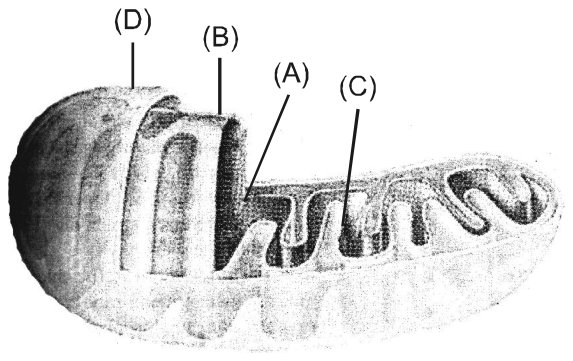
- 1Part (D): Outer membrane – gives rise to inner membrane by splitting
- 2Part (B): Inner membrane – forms infoldings called cristae
- 3Part (C): Cristae – possess single circular DNA molecule and ribosomes
- 4Part (A): Matrix – major site for respiratory chain enzymes
Show answer and solution
Correct: option 2, Part (B): Inner membrane – forms infoldings called cristae
The inner membrane of a mitochondrion is thrown into folds called cristae, which increase its surface area, so the statement about part (B) is correct. The outer membrane does not split to form the inner one. The circular DNA and the ribosomes lie in the matrix, not on the cristae, and the respiratory chain enzymes sit on the inner membrane, not in the matrix.
Question 73AIPMT 2011 Mains, Q44
Read the following statement having two blanks (A and B):
"A drug used for ____(A)____ patients is obtained from a species of the organism ____(B)____."
The one correct option for the two blanks is:
Blank - A, Blank - B
- 1Heart, Penicillium
- 2Organ-transplant, Trichoderma
- 3Swine flu, Monascus
- 4AIDS, Pseudomonas
Show answer and solution
Correct: option 2, Organ-transplant, Trichoderma
Cyclosporin A, obtained from the fungus Trichoderma polysporum, suppresses the immune system and is given to organ-transplant patients so that the graft is not rejected. Penicillium gives the antibiotic penicillin, not a heart drug. Monascus (a yeast) gives statins that lower blood cholesterol, and Pseudomonas gives no drug for AIDS.
Question 74AIPMT 2011 Mains, Q45
Silencing of mRNA has been used in producing transgenic plants resistant to:
- 1Bollworms
- 2Nematodes
- 3White rusts
- 4Bacterial blights
Show answer and solution
Correct: option 2, Nematodes
RNA interference silences a specific mRNA with a complementary double-stranded RNA. Tobacco plants were given nematode-specific genes through Agrobacterium so that they make such RNA, and the nematode Meloidogyne incognita cannot survive in their roots. Resistance to bollworms comes from Bt toxin genes, not from mRNA silencing.
Question 75AIPMT 2011 Mains, Q46
At metaphase, chromosomes are attached to the spindle fibres by their:
- 1Satellites
- 2Secondary constrictions
- 3Kinetochores
- 4Centromere
Show answer and solution
Correct: option 3, Kinetochores
Kinetochores are small disc-shaped structures on the sides of the centromere, and they are the actual sites where spindle fibres attach to a chromosome. The centromere is the primary constriction that holds the two chromatids together and carries the kinetochores. Satellites and secondary constrictions play no part in spindle attachment.
Question 76AIPMT 2011 Mains, Q47
Consider the following statements (A-D) about organic farming:
(A) Utilizes genetically modified crops like Bt cotton
(B) Uses only naturally produced inputs like compost
(C) Does not use pesticides and urea
(D) Produces vegetables rich in vitamins and minerals
Which of the above statements are correct?
- 1(B), (C) and (D)
- 2(C) and (D) only
- 3(B) and (C) only
- 4(A) and (B) only
Show answer and solution
Correct: option 3, (B) and (C) only
Organic farming relies on natural inputs such as compost, manure and biofertilisers, and avoids synthetic pesticides and chemical fertilisers like urea, so (B) and (C) are correct. It does not use genetically modified crops, so (A) is wrong. It makes no particular claim of producing vegetables richer in vitamins and minerals, so (D) is not a defining feature.
Question 77AIPMT 2011 Mains, Q48
One of the constituents of the pancreatic juice while poured into the duodenum in humans, is:
- 1Trypsinogen
- 2Chymotrypsin
- 3Trypsin
- 4Enterokinase
Show answer and solution
Correct: option 1, Trypsinogen
The pancreas releases its protein-digesting enzymes in inactive forms, so the juice entering the duodenum contains trypsinogen. Enterokinase, which comes from the intestinal mucosa and not from the pancreas, converts trypsinogen into trypsin there. Trypsin then activates chymotrypsinogen into chymotrypsin, so neither active enzyme is present in the juice as it is poured in.
Question 78AIPMT 2011 Mains, Q49
Frogs differ from humans in possessing:
- 1paired cerebral hemispheres
- 2hepatic portal system
- 3nucleated red blood cells
- 4thyroid as well as parathyroid
Show answer and solution
Correct: option 3, nucleated red blood cells
The red blood cells of a frog keep their nucleus, while mature human red blood cells have none. Paired cerebral hemispheres, a hepatic portal system, and thyroid and parathyroid glands are found in both frogs and humans, so they are not differences.
Question 79AIPMT 2011 Mains, Q50
Which one of the following option gives the correct matching of a disease with its causative organism and mode of infection.
Disease, Causative Organisms, Mode of Infection
- 1Typhoid, Salmonella typhi, With inspired air
- 2Pneumonia, Streptococcus pneumoniae, Droplet infection
- 3Elephantiasis, Wuchereria bancrofti, infected water and food
- 4Malaria, Plasmodium vivax, Bite of male anopheles mosquito
Show answer and solution
Correct: option 2, Pneumonia, Streptococcus pneumoniae, Droplet infection
Pneumonia is caused by Streptococcus pneumoniae and spreads by inhaling droplets released by an infected person, so that row is correct. Typhoid spreads through contaminated food and water, not air. Elephantiasis is passed on by the bite of a female Culex mosquito, and malaria by the bite of a female, not male, Anopheles mosquito.
Question 80AIPMT 2011 Mains, Q51
Function of companion cells is
- 1Providing energy to sieve elements for active transport
- 2Providing water to phloem
- 3Loading of sucrose into sieve elements by passive transport
- 4Loading of sucrose into sieve elements
Show answer and solution
Correct: option 4, Loading of sucrose into sieve elements
Companion cells are living cells joined to the sieve tube elements by many plasmodesmata, and sucrose made in the leaf is moved through them into the sieve tubes. This phloem loading is an active process that uses ATP, which is why the option calling it passive transport is wrong. Water enters the phloem from the xylem by osmosis, not from the companion cells.
Question 81AIPMT 2011 Mains, Q52
Test cross in plants or in Drosophila involves crossing
- 1between two genotypes with recessive trait
- 2between two hybrids
- 3the hybrid with a double recessive genotype.
- 4between two genotypes with dominant trait
Show answer and solution
Correct: option 3, the hybrid with a double recessive genotype.
In a test cross an individual showing the dominant trait, such as an hybrid, is crossed with the homozygous recessive parent type. Because the recessive parent contributes only recessive alleles, the offspring ratio shows directly which gametes the tested individual makes, and so its genotype. A cross between two hybrids is selfing, which gives the generation.
Question 82AIPMT 2011 Mains, Q53
Some vascular bundles are described as open because these
- 1are surrounded by pericycle but to endodermis
- 2are capable of producing secondary xylem and phloem
- 3possess conjunctive tissue between xylem and phloem
- 4are not surrounded by pericycle
Show answer and solution
Correct: option 2, are capable of producing secondary xylem and phloem
A vascular bundle is called open when cambium is present between its xylem and phloem, as in dicot stems. This cambium can divide and add secondary xylem and secondary phloem. Bundles without cambium, as in monocots, cannot do this and are called closed. The pericycle, endodermis and conjunctive tissue have nothing to do with the term.
Question 83AIPMT 2011 Mains, Q54
In mitochondria, protons accumulate in the
- 1Outer membrane
- 2Inner membrane
- 3Intermembrane space
- 4Matrix
Show answer and solution
Correct: option 3, Intermembrane space
As electrons pass along the electron transport chain in the inner membrane, protons are pumped out of the matrix into the space between the inner and outer membranes. They build up there and form a proton gradient. Their return to the matrix through ATP synthase drives the making of ATP.
Question 84AIPMT 2011 Mains, Q55
The breakdown of detritus into smaller particles by earthworm is a process called
- 1Humification
- 2Fragmentation
- 3Mineralisation
- 4Catabolism
Show answer and solution
Correct: option 2, Fragmentation
Detritivores such as earthworms break detritus into smaller particles, and this first step of decomposition is called fragmentation. Catabolism is the enzymatic breakdown of detritus by bacteria and fungi. Humification is the formation of dark humus, and mineralisation is the release of inorganic nutrients from humus.
Question 85AIPMT 2011 Mains, Q56
Whorled, simple leaves with reticulate venation are present in
- 1Calotropis
- 2Neem
- 3China Rose
- 4Alstonia
Show answer and solution
Correct: option 4, Alstonia
In Alstonia more than two simple leaves arise at each node and form a whorl, and being a dicot it has reticulate venation. Calotropis has opposite leaves, China rose has alternate leaves, and neem has pinnately compound leaves.
Question 86AIPMT 2011 Mains, Q57
Sweet potato is homologous to
- 1Potato
- 2Colocasia
- 3Ginger
- 4Turnip
Show answer and solution
Correct: option 4, Turnip
Homologous organs have the same origin. Sweet potato is a modified root that stores food, and so is turnip, so the two are homologous. Potato (a tuber), Colocasia (a corm) and ginger (a rhizome) are all modified underground stems, so they are only analogous to sweet potato.
Question 87AIPMT 2011 Mains, Q58
The unequivocal proof of DNA as the genetic material came from the studies on a
- 1Bacterium
- 2Fungus
- 3Viroid
- 4Bacterial virus
Show answer and solution
Correct: option 4, Bacterial virus
Hershey and Chase (1952) worked with bacteriophages, viruses that infect bacteria. They labelled the phage DNA with radioactive phosphorus and the protein coat with radioactive sulphur, and found that only the DNA entered the bacterial cell and was passed on to new phages. This settled that DNA, not protein, is the genetic material.
Question 88AIPMT 2011 Mains, Q59
Consider the following four statements whether they are correct or wrong
(A) The sporophyte in liverworts is more elaborate than that in mosses
(B) Salvinia is heterosporous
(C) The life-cycle in all seed-bearing plants is diplontic
(D) In pinus male and female cones are borne on different trees
- 1Statements (A) and (C)
- 2Statements (A) and (D)
- 3Statements (B) and (C)
- 4Statements (A) and (B)
Show answer and solution
Correct: option 2, Statements (A) and (D)
The keyed option names the two wrong statements. (A) is wrong because the sporophyte of mosses is more elaborate than that of liverworts. (D) is wrong because Pinus is monoecious: male and female cones are borne on the same tree. (B) is correct, since Salvinia produces two kinds of spores, and (C) is correct, since gymnosperms and angiosperms have a diplontic life cycle.
Question 89AIPMT 2011 Mains, Q60
Consider the following four statements (A-D) related to the common frog Rana tigrina, and select the correct option stating which ones are true (T) and which ones are false (F)
Statements:
(A) On dry land it would die due to lack of its mouth is forcibly kept closed for a few days
(B) It has four-chambered heart
(C) On dry land it turns uricotelic from ureotelic
(D) Its life-history is carried out in pond water
Options:
(A), (B), (C), (D)
- 1T, F, F, T
- 2T, T, F, F
- 3F, F, T, T
- 4F, T, T, F
Show answer and solution
Correct: option 1, T, F, F, T
(A) is taken as true: on dry land the skin dries and cannot take in oxygen, and with the mouth held shut the frog cannot pump air into its lungs either. (B) is false, because a frog's heart has three chambers, two atria and one ventricle. (C) is false, because an adult frog stays ureotelic. (D) is true, because the eggs are laid and fertilised in water and the tadpole develops there.
Question 90AIPMT 2011 Mains, Q61
In Kranz anatomy, the bundle sheath cells have
- 1Thin walls, many intercellular spaces and no chloroplasts
- 2Thick walls, no intercellular spaces and large number of chloroplasts
- 3Thin walls, no intercellular spaces and several chloroplasts
- 4Thick walls, many intercellular spaces and few chloroplasts
Show answer and solution
Correct: option 2, Thick walls, no intercellular spaces and large number of chloroplasts
In the leaves of plants the vascular bundles are ringed by large bundle sheath cells. These cells have thick walls that do not let gases pass, no intercellular spaces, and a large number of chloroplasts. This keeps the carbon dioxide released inside them concentrated around the enzyme RuBisCO.
Question 91AIPMT 2011 Mains, Q62
Given below is the ECG of a normal human. Which one of its components is correctly interpreted below
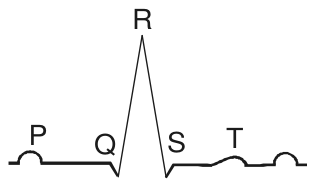
- 1Complex QRS-One complete Pulse
- 2Peak T - Initiation of total cardiac contraction
- 3Peak P and Peak R together - systolic and diastolic blood pressures
- 4Peak P- Initiation of left atrial contraction only
Show answer and solution
Correct: option 3, Peak P and Peak R together - systolic and diastolic blood pressures
The answer key used for this paper gives option (3). In an ECG the P wave marks the depolarisation of both atria, which starts atrial contraction; the QRS complex marks the depolarisation of the ventricles, which starts ventricular systole; and the T wave marks ventricular repolarisation. An ECG records electrical activity and does not measure blood pressure, so the keyed option is doubtful. Since one QRS complex occurs with every ventricular beat, and each beat gives one pulse, many textbooks prefer option (1).
Question 92AIPMT 2011 Mains, Q63
Which one of the following structures in Pheretima is correctly matched with its function
- 1Clitellum - secretes cocoon
- 2Gizzard - absorbs digested food
- 3Setae- defence against predators
- 4Typhlosole - storage of extra nutrients
Show answer and solution
Correct: option 1, Clitellum - secretes cocoon
In the earthworm the clitellum, a glandular band over segments 14 to 16, secretes the cocoon in which the eggs and sperm are placed. The gizzard grinds food, the setae help in locomotion, and the typhlosole is an internal fold of the intestine that increases the area for absorption.
Question 93AIPMT 2011 Mains, Q64
Selaginella and Salvinia are considered to represent a significant step toward evolution of seed habit because:
- 1Female gametophyte is free and gets dispersed like seeds
- 2Female gametophyte lacks archegonia.
- 3Megaspores possess endosperm and embryo surrounded by seed coat.
- 4Embryo develops in female gametophyte which is retained on parent sporophyte.
Show answer and solution
Correct: option 4, Embryo develops in female gametophyte which is retained on parent sporophyte.
Selaginella and Salvinia are heterosporous. Their megaspore grows into a female gametophyte that stays on the parent sporophyte for some time, and the zygote develops into a young embryo inside it. Keeping the female gametophyte and embryo on the parent plant is the forerunner of the seed habit. The female gametophyte still has archegonia, and there is no seed coat or endosperm.
Question 94AIPMT 2011 Mains, Q65
Bulk of carbon dioxide () released from body tissues into the blood is present as
- 1bicarbonate in blood plasma and RBCs
- 2Free in blood plasma
- 370% carbamino-haemoglobin and 30% as bicarbonate
- 4Carbamino-haemoglobin in RBCs
Show answer and solution
Correct: option 1, bicarbonate in blood plasma and RBCs
About 70 per cent of the carbon dioxide in blood is carried as bicarbonate. The enzyme carbonic anhydrase, abundant in red blood cells, converts and water into carbonic acid, which splits into bicarbonate and hydrogen ions. Only about 20 to 25 per cent travels as carbamino-haemoglobin and about 7 per cent is dissolved in plasma.
Question 95AIPMT 2011 Mains, Q66
In angiosperms, Functional megaspore develops into
- 1Embryo sac
- 2Ovule
- 3Endosperm
- 4Pollen sac
Show answer and solution
Correct: option 1, Embryo sac
Of the four megaspores formed by meiosis, one stays functional. Its nucleus divides by mitosis three times to give the 8-nucleate, 7-celled embryo sac, which is the female gametophyte. The ovule is the structure that contains the megaspore, and the endosperm forms only after fertilisation.
Question 96AIPMT 2011 Mains, Q67
Consider the following statements (A)-(D) each with one or two blanks.
(A) Bears go into __(1)__ during winter to __(2)__ cold weather
(B) A conical age pyramid with a broad base represents __(3)__ human population
(C) A wasp pollinating a fig flower is an example of __(4)__
(D) An area with high levels of species richness is known as __(5)__
Which one of the following options give the correct fill ups the respective blank numbers from (1) to (5) in the statements
- 1(2) - stable (4) commensalism, (5) marsh
- 2(1) - aestivation, (5) - escape, (3) - stable, (4) - mutualism
- 3(3) - expanding, (4) - commensalism, (5) biodiversity park
- 4(1)- hibernation, (2) - escape, (3) - expanding, (5) hot spot
Show answer and solution
Correct: option 4, (1)- hibernation, (2) - escape, (3) - expanding, (5) hot spot
Bears go into hibernation in winter to escape the cold, so (1) is hibernation and (2) is escape. A triangular age pyramid with a broad base shows many young individuals, which means an expanding population, so (3) is expanding. The fig and its wasp both benefit, so (4) is mutualism, not commensalism. A region of very high species richness is a hot spot, so (5) is hot spot. Only the last option has every entry right.
Question 97AIPMT 2011 Mains, Q68
What is common between vegetative reproduction and Apomixis
- 1Both are applicable to only dicot plants
- 2Both bypass the flowering phase
- 3Both occur round the year
- 4Both produces progeny identical to the parent
Show answer and solution
Correct: option 4, Both produces progeny identical to the parent
Neither process involves meiosis and fusion of gametes, so the offspring carry the same genes as the parent and are clones. Apomixis makes seeds without fertilisation, so it still needs flowers, which rules out bypassing the flowering phase. Both occur in monocots as well as dicots.
Question 98AIPMT 2011 Mains, Q69
Common cold is not cured by antibiotics because it is
- 1caused by a virus
- 2caused by a Gram-positive bacterium
- 3caused by a Gram-negative bacterium
- 4not an infectious disease
Show answer and solution
Correct: option 1, caused by a virus
The common cold is caused by rhinoviruses. Antibiotics act on bacterial structures and processes, such as the cell wall and bacterial ribosomes, which viruses do not have, so they have no effect on a cold. The cold is infectious and spreads through droplets and contaminated objects.
Question 99AIPMT 2011 Mains, Q70
Which one of the following is not an essential mineral element for plants while the remaining three are
- 1Iron
- 2Manganese
- 3Cadmium
- 4Phosphorus
Show answer and solution
Correct: option 3, Cadmium
Phosphorus is an essential macronutrient, and iron and manganese are essential micronutrients for plants. Cadmium is not among the essential elements; it is a toxic heavy metal that harms plants.
Question 100AIPMT 2011 Mains, Q71
Biodiversity of a geographical region represents
- 1Endangered species found in the region.
- 2The diversity in the organisms living in the region.
- 3Genetic diversity present in the dominant species of the region.
- 4Species endemic to the region.
Show answer and solution
Correct: option 2, The diversity in the organisms living in the region.
Biodiversity is the total variety of living organisms in an area, at the genetic, species and ecosystem levels. Endangered species, endemic species, or the genetic variation of one dominant species each describe only a part of it.
Question 101AIPMT 2011 Mains, Q72
Which one of the following is not considered as a part of the endomembrane system?
- 1Golgi complex
- 2Peroxisome
- 3Vacuole
- 4Lysosome
Show answer and solution
Correct: option 2, Peroxisome
The endomembrane system is made of the endoplasmic reticulum, Golgi complex, lysosomes and vacuoles, whose functions are coordinated with one another. Peroxisomes, like mitochondria and chloroplasts, do not work in coordination with these organelles and are not counted as part of the system.
Question 102AIPMT 2011 Mains, Q73
Which one of the following correctly represents the normal adult human dental formula?
- 1
- 2
- 3
- 4
Show answer and solution
Correct: option 3,
Each half of the upper jaw and each half of the lower jaw of an adult human has 2 incisors, 1 canine, 2 premolars and 3 molars. The dental formula is therefore , which gives teeth.
Question 103AIPMT 2011 Mains, Q74
Select the correct statement with respect to diseases and immunisation:
- 1If due to some reason B-and T-lymphocytes are damaged, the body will not produce antibodies against a pathogen
- 2Injection of dead / inactivated pathogens causes passive immunity
- 3Certain protozoans have been used to mass produce hepatitis B vaccine.
- 4Injection of snake antivenom against snake bite is an example of active immunisation
Show answer and solution
Correct: option 1, If due to some reason B-and T-lymphocytes are damaged, the body will not produce antibodies against a pathogen
Antibodies are made by B-lymphocytes with the help of T-lymphocytes, so if both are damaged no antibodies are produced. Injecting dead or inactivated pathogens is vaccination, which gives active immunity. The hepatitis B vaccine is produced in yeast, not in protozoans. Antivenom contains ready-made antibodies, so it gives passive immunity.
Question 104AIPMT 2011 Mains, Q75
The figure shows four animals (a), (b), (c) and (d). Select the correct answer with respect to a common characteristics of two of these animals.
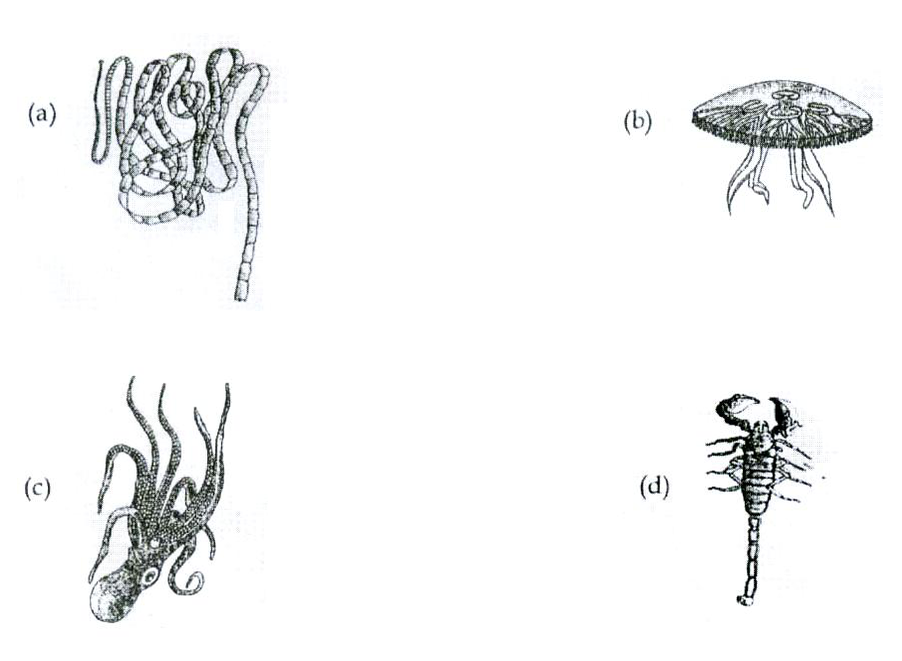
- 1(a) and (d) respire mainly through body wall
- 2(b) and (c) show radial symmetry
- 3(a) and (b) have cnidoblasts for self-defense
- 4(c) and (d) have a true coelom
Show answer and solution
Correct: option 4, (c) and (d) have a true coelom
The animals are (a) a tapeworm (Platyhelminthes), (b) a jellyfish (Cnidaria), (c) an octopus (Mollusca) and (d) a scorpion (Arthropoda). Molluscs and arthropods are coelomates, so (c) and (d) share a true coelom. The scorpion breathes with book lungs, the octopus is bilaterally symmetrical, and the tapeworm has no cnidoblasts, so the other options fail.
Question 105AIPMT 2011 Mains, Q76
In history of biology, human genome project led to the development of:
- 1Biotechnology
- 2Biomonitoring
- 3Bioinformatics
- 4Biosystematics
Show answer and solution
Correct: option 3, Bioinformatics
The Human Genome Project produced an enormous amount of DNA sequence data that had to be stored, retrieved and analysed with fast computers. This need led to the rapid growth of a new field, bioinformatics.
Question 106AIPMT 2011 Mains, Q77
Which one of the following conditions of the zygotic cell would lead to the birth of a normal human female child?
- 1two X chromosomes
- 2only one Y chromosome
- 3only one X chromosome
- 4one X and one Y chromosome
Show answer and solution
Correct: option 1, two X chromosomes
A normal human female has 44 autosomes and two X chromosomes (XX), formed when an egg carrying X is fertilised by a sperm carrying X. A zygote with one X and one Y develops into a male, and one with only a single X (XO) gives Turner's syndrome.
Question 107AIPMT 2011 Mains, Q78
Which one of the following is essential for photolysis of water?
- 1Manganese
- 2zinc
- 3copper
- 4Boron
Show answer and solution
Correct: option 1, Manganese
The splitting of water during the light reaction takes place at photosystem II, in a water-splitting complex that contains manganese. Manganese, along with chloride and calcium ions, is needed for this step, which releases oxygen, protons and electrons.
Question 108AIPMT 2011 Mains, Q79
Which one of the following techniques made it possible to genetically engineer living organism?
- 1Recombinant DNA techniques
- 2X-ray diffraction
- 3Heavier isotope labelling
- 4Hybridization
Show answer and solution
Correct: option 1, Recombinant DNA techniques
Genetic engineering means cutting a chosen gene with restriction enzymes, joining it to a vector with ligase and introducing it into a host organism. These recombinant DNA techniques are what allow genes to be moved between organisms. X-ray diffraction revealed the structure of DNA and isotope labelling showed how it replicates, but neither alters an organism's genes.
Question 109AIPMT 2011 Mains, Q80
Ureters act as urogenital ducts in:
- 1human males
- 2human females
- 3frog's both males and females
- 4frog's males
Show answer and solution
Correct: option 4, frog's males
In a male frog the sperm pass from the testes through the vasa efferentia into the kidney and leave by the ureter, so the ureter carries both urine and sperm and acts as a urogenital duct. In a female frog the ureters and oviducts open separately into the cloaca. In humans the ureters carry only urine.
Question 110AIPMT 2011 Mains, Q81
The type of muscles present in our:
- 1heart are involuntary and unstriated smooth muscles
- 2intestine are striated and involuntary
- 3thigh are striated and voluntary
- 4upper arm are smooth muscle fibres fusiform in shape
Show answer and solution
Correct: option 3, thigh are striated and voluntary
Thigh muscles are skeletal muscles, which show striations and work under our will. Heart muscle is striated (cardiac) though involuntary, intestinal muscle is smooth and unstriated, and the upper arm has skeletal muscle, not fusiform smooth fibres. So only the statement about the thigh is correct.
Question 111AIPMT 2011 Mains, Q82
Read the following four statements (A-D) about certain mistakes in two of them
(A) The first transgenic buffalo, Rosie produced milk which was human alpha-lactalbumin enriched.
(B) Restriction enzymes are used in isolation of DNA from other macro-molecules.
(C) Downstream processing is one of the steps of R-DNA technology.
(D) Disarmed pathogen vectors are also used in transfer of R-DNA into the host.
Which are the two statements having mistakes?
- 1Statement (B) and (C)
- 2Statement (C) and (D)
- 3Statement (A) and (C)
- 4Statement (A) and (B)
Show answer and solution
Correct: option 4, Statement (A) and (B)
(A) is wrong because Rosie was a transgenic cow, not a buffalo. (B) is wrong because restriction enzymes cut DNA at specific sequences; DNA is freed from other macromolecules with enzymes such as lysozyme, cellulase, proteases and RNase. (C) and (D) are correct: downstream processing is a step of recombinant DNA technology, and disarmed pathogens such as Agrobacterium and retroviruses are used as vectors. So the mistakes are in (A) and (B).
Question 112AIPMT 2011 Mains, Q83
The 24 hour (diurnal) rhythm of our body such as the sleep-wake cycle is regulated by the hormone:
- 1calcitonin
- 2prolactin
- 3adrenaline
- 4melatonin
Show answer and solution
Correct: option 4, melatonin
Melatonin, secreted by the pineal gland, sets the 24-hour (diurnal) rhythms of the body, including the sleep-wake cycle and body temperature. Calcitonin lowers blood calcium, prolactin acts on milk formation and adrenaline is the emergency hormone.
Question 113AIPMT 2011 Mains, Q84
Guttation is the result of:
- 1Diffusion
- 2Transpiration
- 3Osmosis
- 4Root pressure
Show answer and solution
Correct: option 4, Root pressure
When transpiration is low, as at night or early morning, the positive pressure built up in the xylem by the roots (root pressure) pushes water out as drops through special openings near the vein tips of leaves. This loss of liquid water is guttation, so it is the result of root pressure.
Question 114AIPMT 2011 Mains, Q85
Examine the figure given below and select the right option giving all the four parts (a, b, c and d) correctly identified.
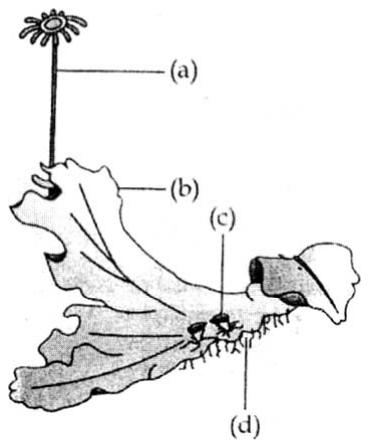
- 1a-Archegoniophore, b-Female thallus, c-Gemma cup, d-Rhizoids
- 2a-Archegoniophore, b-Female thallus, c-Bud, d-Foot
- 3a-Seta, b-Sporophyte, c-Protonema, d-Rhizoids
- 4a-Antheridiophore, b-Male thallus, c-Globule, d-Roots
Show answer and solution
Correct: option 1, a-Archegoniophore, b-Female thallus, c-Gemma cup, d-Rhizoids
The figure is a female thallus of the liverwort Marchantia. The stalked, star-shaped structure (a) is the archegoniophore that carries the archegonia, (b) is the flat female thallus, (c) is a gemma cup holding gemmae for asexual reproduction, and (d) are the rhizoids on the lower surface. A bryophyte has no true roots, and a protonema or seta is not what is shown.
Question 115AIPMT 2011 Mains, Q86
Three of the following pairs of the human skeletal parts are correctly matched with their respective inclusive skeletal category and one pair is not matched. Identify the non-matching pair.
Pairs of skeletal parts - Category
- 1Sternum and Ribs - Axial skeleton
- 2Clavicle and Glenoid Cavity - Pelvic girdle
- 3Humerus and ulna - Appendicular skeleton
- 4Malleus and stapes - Ear ossicles
Show answer and solution
Correct: option 2, Clavicle and Glenoid Cavity - Pelvic girdle
The clavicle and the glenoid cavity (the socket on the scapula that receives the head of the humerus) belong to the pectoral girdle, not the pelvic girdle, so that pair is wrongly matched. The sternum and ribs are part of the axial skeleton, the humerus and ulna are limb bones of the appendicular skeleton, and the malleus and stapes are ear ossicles.
Question 116AIPMT 2011 Mains, Q87
Which one of the following aspects is an exclusive characteristic of living things?
- 1Isolated metabolic reactions occur in vitro
- 2Increase in mass from inside only
- 3Perception of events happening in the environment and their memory
- 4Increase in mass by accumulation of material both on surface as well as internally.
Show answer and solution
Correct: option 3, Perception of events happening in the environment and their memory
Sensing the surroundings and responding to them (consciousness) is found in every living organism and in no non-living object, so it is a defining feature of life. Metabolic reactions carried out in a test tube are not living, and increase in mass also happens in non-living things such as crystals and sand mounds, so growth is not exclusive to life.
Question 117AIPMT 2011 Mains, Q88
"Good ozone" is found in the:
- 1Mesosphere
- 2Troposphere
- 3Stratosphere
- 4Ionosphere
Show answer and solution
Correct: option 3, Stratosphere
Ozone in the stratosphere forms a layer that absorbs harmful ultraviolet radiation from the Sun, which is why it is called good ozone. Ozone formed in the troposphere is a pollutant that harms plants and animals and is called bad ozone.
Question 118AIPMT 2011 Mains, Q89
Which one of the following is a wrong matching of a microbe and its industrial product, while the remaining three are correct?
- 1Yeast - statins
- 2Acetobacter aceti - acid
- 3Clostridium butylicum - lactic acid
- 4Aspergillus niger - citric acid
Show answer and solution
Correct: option 3, Clostridium butylicum - lactic acid
Clostridium butylicum produces butyric acid; lactic acid is made by Lactobacillus. So that pair is wrongly matched. The yeast Monascus purpureus gives statins, Acetobacter aceti gives acetic acid and Aspergillus niger gives citric acid.
Question 119AIPMT 2011 Mains, Q90
The logistic population growth is expressed by the equation:
- 1
- 2
- 3
- 4
Show answer and solution
Correct: option 2,
When resources are limited, the growth rate is reduced by the fraction of the carrying capacity that is still unused, . This gives the Verhulst-Pearl logistic equation . The equation is exponential growth.