AIPMT 2010 Prelims Physics questions
Question 1AIPMT 2010 Prelims, Q1
A block of mass m is in contact with the cart C as shown in the figure.
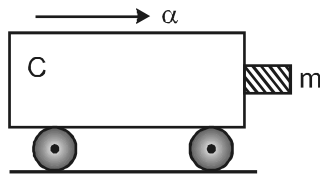
The coefficient of static friction between the block and the cart is . The acceleration of the cart that will prevent the block from falling satisfies
- 1
- 2
- 3
- 4
Show answer and solution
Correct: option 3,
The cart pushes the block forward with a normal force . The only upward force on the block is friction, at most , and it must balance the weight . So , which gives .
Question 2AIPMT 2010 Prelims, Q2
The mass of a nucleus is 0.042 u less than the sum of the masses of all its nucleons. The binding energy per nucleon of nucleus is nearly
- 146 MeV
- 25.6 MeV
- 33.9 MeV
- 423 MeV
Show answer and solution
Correct: option 2, 5.6 MeV
The mass defect is 0.042 u and 1 u is equivalent to about 931.5 MeV, so the binding energy is MeV. The nucleus has 7 nucleons, so the binding energy per nucleon is MeV.
Question 3AIPMT 2010 Prelims, Q3
A circular disk of moment of inertia is rotating in a horizontal plane, about its symmetry axis, with a constant angular speed . Another disk of moment of inertia is dropped coaxially onto the rotating disk. Initially the second disk has zero angular speed. Eventually both the disks rotate with a constant angular speed . The energy lost by the initially rotating disc to friction is
- 1
- 2
- 3
- 4
Show answer and solution
Correct: option 4,
There is no external torque, so angular momentum is conserved: , giving . The final kinetic energy is . Subtracting this from the initial energy gives a loss of .
Question 4AIPMT 2010 Prelims, Q4
Which one of the following statement is false?
- 1Pure Si doped with trivalent impurities gives a p-type semiconductor.
- 2Majority carriers in a n-type semiconductor are holes.
- 3Minority carriers in a p-type semiconductor are electrons.
- 4The resistance of intrinsic semiconductor decreases with increase of temperature.
Show answer and solution
Correct: option 2, Majority carriers in a n-type semiconductor are holes.
An n-type semiconductor is made with pentavalent (donor) impurities, so its majority carriers are electrons and holes are the minority carriers. Statement (2) is therefore false. The other three are true: trivalent doping gives p-type material, electrons are the minority carriers there, and heating an intrinsic semiconductor frees more carriers and lowers its resistance.
Question 5AIPMT 2010 Prelims, Q5
The displacement of a particle along the x axis is given by . The motion of the particle corresponds to
- 1simple harmonic motion of frequency
- 2simple harmonic motion of frequency
- 3non simple harmonic motion
- 4simple harmonic motion of frequency
Show answer and solution
Correct: option 1, simple harmonic motion of frequency
Using , the displacement is . This is a simple harmonic oscillation about the point with angular frequency , so its frequency is .
Question 6AIPMT 2010 Prelims, Q6
The radii of circular orbits of two satellites A and B of the earth, are 4R and R, respectively. If the speed of satellite A is 3V, then the speed of satellite B will be
- 1
- 26V
- 312 V
- 4
Show answer and solution
Correct: option 2, 6V
The orbital speed is , so it varies as . Then , and .
Question 7AIPMT 2010 Prelims, Q7
A beam of cathode rays is subjected to crossed electric (E) and magnetic fields (B). The fields are adjusted such that the beam is not deflected. The specific charge of the cathode rays is given by
(Where V is the potential difference between cathode and anode)
- 1
- 2
- 3
- 4
Show answer and solution
Correct: option 4,
For no deflection the electric and magnetic forces balance, , so the speed is . The electrons gained this speed by falling through the potential difference V: . Hence .
Question 8AIPMT 2010 Prelims, Q8
A ball is dropped from a high platform at t = 0 starting from rest. After 6 seconds another ball is thrown downwards from the same platform with a speed v. The two balls meet at t = 18 s. What is the value of v?
(Take g = 10 m/s)
- 175 m/s
- 255 m/s
- 340 m/s
- 460 m/s
Show answer and solution
Correct: option 1, 75 m/s
In 18 s the first ball falls m. The second ball travels for 12 s and covers m. Setting the two distances equal gives , so m/s.
Question 9AIPMT 2010 Prelims, Q9
A ray of light travelling in a transparent medium of refractive index , falls on a surface separating the medium from air at an angle of incidence of 45°. For which of the following value of the ray can undergo total internal reflection?
- 1
- 2
- 3
- 4
Show answer and solution
Correct: option 3,
Total internal reflection needs the angle of incidence to exceed the critical angle, , that is . Of the given values only is larger than 1.414.
Question 10AIPMT 2010 Prelims, Q10
The period of oscillation of a mass m suspended from a spring of negligible mass is T. If along with it another mass M is also suspended the period of oscillation will now be
- 1T
- 2
- 32T
- 4
Show answer and solution
Correct: option 4,
The period of a spring-mass system is , so it varies as the square root of the suspended mass. The keyed answer takes the added mass to be equal to the first one, so the mass doubles and the period becomes . (As printed, with masses m and M, the general result is , which equals only when M = m.)
Question 11AIPMT 2010 Prelims, Q11
A cylindrical metallic rod in thermal contact with two reservoirs of heat at its two ends conducts an amount of heat Q in time t. The metallic rod is melted and the material is formed into a rod of half the radius of the original rod. What is the amount of heat conducted by the new rod, when placed in thermal contact with the two reservoirs in time t?
- 1
- 2
- 32Q
- 4
Show answer and solution
Correct: option 2,
Heat conducted in time t is , proportional to . Halving the radius makes the area , and since the volume of metal is unchanged the length becomes . So falls by a factor of 16 and the new rod conducts .
Question 12AIPMT 2010 Prelims, Q12
A ball moving with velocity 2 m/s collides head on with another stationary ball of double the mass. If the coefficient of restitution is 0.5, then their velocities (in m/s) after collision will be
- 10, 1
- 21, 1
- 31, 0.5
- 40, 2
Show answer and solution
Correct: option 1, 0, 1
Let the masses be m and 2m. Momentum conservation gives , so . The coefficient of restitution gives . Solving the two equations, and m/s.
Question 13AIPMT 2010 Prelims, Q13
A transverse wave is represented by . For what value of the wavelength is the wave velocity equal to the maximum particle velocity?
- 1
- 2
- 3
- 4A
Show answer and solution
Correct: option 3,
The wave velocity is and the maximum particle velocity is . Equating them gives . Since , this means .
Question 14AIPMT 2010 Prelims, Q14
A particle has initial velocity and has acceleration . Its speed after 10 s is
- 17 units
- 2 units
- 38.5 units
- 410 units
Show answer and solution
Correct: option 2, units
Using with t = 10 s: . Its magnitude is units.
Question 15AIPMT 2010 Prelims, Q15
An engine pumps water through a hose pipe. Water passes through the pipe and leaves it with a velocity of 2 m/s. The mass per unit length of water in the pipe is 100 kg/m. What is the power of the engine?
- 1400 W
- 2200 W
- 3100 W
- 4800 W
Show answer and solution
Correct: option 4, 800 W
The mass of water leaving per second is kg/s. The keyed answer takes the force as the rate of change of momentum, N, and the power as W. (Counting only the kinetic energy given to the water each second, , would give 400 W; the key uses .)
Question 16AIPMT 2010 Prelims, Q16
A thin ring of radius R meter has charge q coulomb uniformly spread on it. The ring rotates about its axis with a constant frequency of f revolutions/s. The value of magnetic induction in Wb/m at the centre of the ring is
- 1
- 2
- 3
- 4
Show answer and solution
Correct: option 4,
The charge q passes any point f times each second, so the rotating ring is equivalent to a current . The field at the centre of a circular current loop is .
Question 17AIPMT 2010 Prelims, Q17
Which one of the following bonds produces a solid that reflects light in the visible region and whose electrical conductivity decreases with temperature and has high melting point?
- 1metallic bonding
- 2van der Waals' bonding
- 3ionic bonding
- 4covalent bonding
Show answer and solution
Correct: option 1, metallic bonding
These are the properties of a metal. Its free electrons reflect visible light and give it lustre, its conductivity falls as the temperature rises because the electrons are scattered more by the vibrating lattice, and metallic bonding is strong enough to give a high melting point. Ionic, covalent and van der Waals' solids are not shiny conductors of this kind.
Question 18AIPMT 2010 Prelims, Q18
A particle moves a distance x in time t according to equation . The acceleration of particle is proportional to
- 1(velocity)
- 2(velocity)
- 3(velocity)
- 4(velocity)
Show answer and solution
Correct: option 1, (velocity)
Differentiating, and . Since , the acceleration is , proportional to (velocity).
Question 19AIPMT 2010 Prelims, Q19
A conducting circular loop is placed in a uniform magnetic field, B = 0.025 T with its plane perpendicular to the loop. The radius of the loop is made to shrink at a constant rate of 1 mm s. The induced emf when the radius is 2 cm, is
- 1
- 2
- 3
- 4
Show answer and solution
Correct: option 2,
With the field perpendicular to the plane of the loop the flux is , so the emf has magnitude . Putting in the values, V, which is .
Question 20AIPMT 2010 Prelims, Q20
The activity of a radioactive sample is measured as counts per minute at t = 0 and counts per minute at t = 5 minutes. The time (in minutes) at which the activity reduces to half its value is
- 1
- 2
- 3
- 4
Show answer and solution
Correct: option 4,
Activity falls as . It drops to in 5 minutes, so and per minute. The half-life is minutes.
Question 21AIPMT 2010 Prelims, Q21
Two particles which are initially at rest, move towards each other under the action of their internal attraction. If their speeds are v and 2v at any instant, then the speed of centre of mass of the system will be
- 12v
- 2zero
- 31.5 v
- 4v
Show answer and solution
Correct: option 2, zero
Only internal forces act on the two particles, so the total momentum of the system stays what it was at the start, which is zero. The centre of mass was at rest initially and therefore remains at rest: its speed is zero whatever the individual speeds are.
Question 22AIPMT 2010 Prelims, Q22
A particle of mass M is situated at the center of a spherical shell of same mass and radius a. The gravitational potential at a point situated at distance from the centre, will be
- 1
- 2
- 3
- 4
Show answer and solution
Correct: option 1,
The point lies inside the shell, where the shell's potential is constant and equal to its surface value . The particle at the centre contributes . Adding the two gives .
Question 23AIPMT 2010 Prelims, Q23
The device that act as a complete electronic circuit is
- 1junction diode
- 2integrated circuit
- 3junction transistor
- 4zener diode
Show answer and solution
Correct: option 2, integrated circuit
An integrated circuit has many components (transistors, diodes, resistors, capacitors) and their connections built on a single chip, so it works as a complete circuit by itself. A diode, a zener diode or a transistor is only a single component of a circuit.
Question 24AIPMT 2010 Prelims, Q24
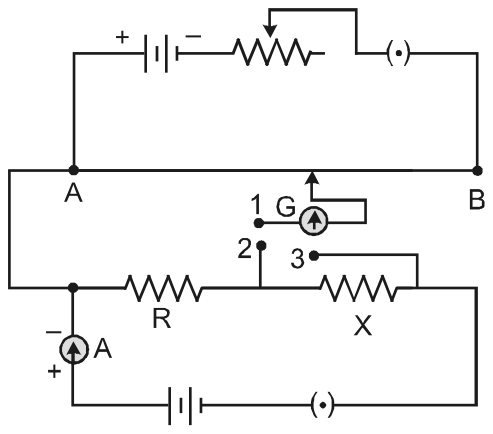
A potentiometer circuit is set up as shown. The potential gradient, across the potentiometer wire, is k volt/cm and the ammeter, present in the circuit reads 1.0 A when two way key is switched off. The balance points, when the key between the terminals (i) 1 and 2 (ii) 1 and 3, is plugged in, are found to be at length cm and cm respectively. The magnitudes, of the resistors R and X, in ohms, are then, equal, respectively, to
- 1 and
- 2 and
- 3 and
- 4 and
Show answer and solution
Correct: option 2, and
A current of 1 A flows through R and X in series. With the key between 1 and 2 the potentiometer balances the potential difference across R alone: , so . With the key between 1 and 3 it balances the potential difference across R and X together: , so .
Question 25AIPMT 2010 Prelims, Q25
A tuning fork of frequency 512 Hz makes 4 beats per second with the vibrating string of a piano. The beat frequency decreases to 2 beats per sec when the tension in the piano string is slightly increased. The frequency of the piano string before increasing the tension was
- 1510 Hz
- 2514 Hz
- 3516 Hz
- 4508 Hz
Show answer and solution
Correct: option 4, 508 Hz
Four beats per second means the string was at 516 Hz or 508 Hz. Increasing the tension raises the string's frequency. From 516 Hz that would move it further from 512 Hz and increase the beats; from 508 Hz it moves closer to 512 Hz and the beats decrease, as observed. So the string was at 508 Hz.
Question 26AIPMT 2010 Prelims, Q26
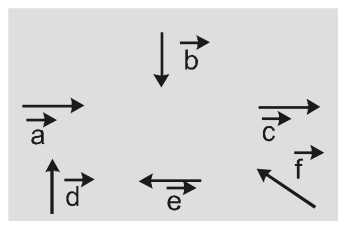
Six vectors, through have the magnitudes and directions indicated in the figure. Which of the following statements is true?
- 1
- 2
- 3
- 4
Show answer and solution
Correct: option 3,
In the figure points up and to the left. points straight up and points to the left, so by the triangle law their sum points up and to the left, along . The other pairs include (downward) or (to the right), which cannot give an up-left resultant. Hence .
Question 27AIPMT 2010 Prelims, Q27
A galvanometer has a coil of resistance 100 ohm and gives a full scale deflection for 30mA current. If it is to work as a voltmeter of 30 volt range, the resistance required to be added will be
- 1900
- 21800
- 3500
- 41000
Show answer and solution
Correct: option 1, 900
At full scale 30 mA must flow when 30 V is applied, so the total resistance has to be . The coil supplies 100 of this, so must be added in series.
Question 28AIPMT 2010 Prelims, Q28
A gramophone record is revolving with an angular velocity . A coin is placed at a distance r from the centre of the record. The static coefficient of friction is . The coin will revolve with the record if
- 1
- 2
- 3
- 4
Show answer and solution
Correct: option 3,
Static friction must supply the centripetal force , and it can be at most . The coin stays in place when , that is .
Question 29AIPMT 2010 Prelims, Q29
Which of the following statement is false for the properties of electromagnetic waves?
- 1Both electric and magnetic field vectors attain the maxima and minima at the same place and same time.
- 2The energy in electromagnetic wave is divided equally between electric and magnetic vectors.
- 3Both electric and magnetic field vectors are parallel to each other perpendicular to the direction of propagation of wave.
- 4These waves do not require any material medium for propagation.
Show answer and solution
Correct: option 3, Both electric and magnetic field vectors are parallel to each other perpendicular to the direction of propagation of wave.
In an electromagnetic wave the electric and magnetic fields are perpendicular to each other, not parallel, and both are perpendicular to the direction of propagation. So statement (3) is false. The other statements are true: the two fields are in phase, they carry equal energy on average, and the wave needs no medium.
Question 30AIPMT 2010 Prelims, Q30
The energy of a hydrogen atom in the ground state is eV. The energy of a ion in the first excited state will be
- 1 eV
- 2 eV
- 3 eV
- 4 eV
Show answer and solution
Correct: option 1, eV
For a hydrogen-like ion eV. For , Z = 2, and the first excited state is n = 2, so eV.
Question 31AIPMT 2010 Prelims, Q31
The dimension of , where is permittivity of free space and E is electric field, is
- 1
- 2
- 3
- 4
Show answer and solution
Correct: option 2,
is the energy stored per unit volume in an electric field. Its dimensions are those of energy divided by volume: .
Question 32AIPMT 2010 Prelims, Q32
In producing chlorine by electrolysis 100 kW power at 125 V is being consumed. How much chlorine per minute is liberated (E.C.E. of chlorine is kg/C)
- 1 kg
- 2 kg
- 3 kg
- 4 kg
Show answer and solution
Correct: option 3, kg
The current is A. By Faraday's first law the mass liberated is kg in one minute.
Question 33AIPMT 2010 Prelims, Q33
A man of 50 kg mass is standing in a gravity free space at a height of 10 m above the floor. He throws a stone of 0.5 kg mass downwards with a speed 2 m/s. When the stone reaches the floor, the distance of the man above the floor will be
- 19.9 m
- 210.1 m
- 310 m
- 420 m
Show answer and solution
Correct: option 2, 10.1 m
No external force acts, so the centre of mass of the man and the stone stays where it was. When the stone has moved 10 m down, the man has moved up by x with , so m. The man is then m above the floor.
Question 34AIPMT 2010 Prelims, Q34
An alpha nucleus of energy bombards a heavy nuclear target of charge Ze. Then the distance of closest approach for the alpha nucleus will be proportional to
- 1
- 2
- 3
- 4
Show answer and solution
Correct: option 3,
At the distance of closest approach d all the kinetic energy has become electrostatic potential energy: . So , which is proportional to Ze, to and to . Only is among the options.
Question 35AIPMT 2010 Prelims, Q35
A lens having focal length f and aperture of diameter d forms an image of intensity I. Aperture of diameter in central region of lens is covered by a black paper. Focal length of lens and intensity of image now will be respectively
- 1f and
- 2 and
- 3f and
- 4 and
Show answer and solution
Correct: option 3, f and
Covering part of a lens does not change its curvature or material, so the focal length stays f. The intensity of the image is proportional to the area that lets light through. The covered disc has half the diameter, so it is of the area; the remaining of the area gives intensity .
Question 36AIPMT 2010 Prelims, Q36
If and represent the increase in internal energy and work done by the system respectively in a thermodynamical process, which of the following is true?
- 1, in a adiabatic process
- 2, in a isothermal process
- 3, in a adiabatic process
- 4, in a isothermal process
Show answer and solution
Correct: option 1, , in a adiabatic process
The first law is . In an adiabatic process no heat is exchanged, , so . In an isothermal process of an ideal gas instead, so the isothermal options are not correct in general.
Question 37AIPMT 2010 Prelims, Q37
The total radiant energy per unit area, normal to the direction of incidence, received at a distance R from the centre of a star of radius r, whose outer surface radiates as a black body at a temperature T K is given by
(where is Stefan's constant)
- 1
- 2
- 3
- 4
Show answer and solution
Correct: option 1,
By Stefan's law the star radiates a total power . At distance R this power is spread evenly over a sphere of area , so the energy received per unit area per second is .
Question 38AIPMT 2010 Prelims, Q38
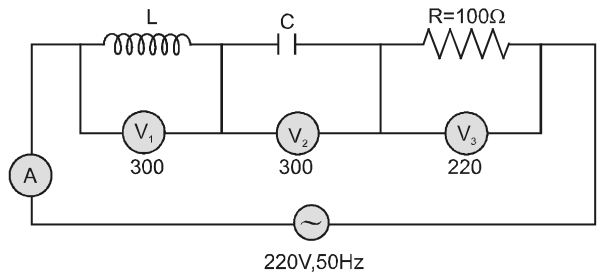
In the given circuit the reading of voltmeter and are 300 volts each. The reading of the voltmeter and ammeter A are respectively
- 1150 V, 2.2 A
- 2220 V, 2.2 A
- 3220 V, 2.0 A
- 4100 V, 2.0 A
Show answer and solution
Correct: option 2, 220 V, 2.2 A
The voltages across L and C are equal in size and opposite in phase, so they cancel and the circuit is at resonance. The whole supply voltage then appears across the resistor, so reads 220 V, and the impedance is just R. The current is A.
Question 39AIPMT 2010 Prelims, Q39
A 220 volt input is supplied to a transformer. The output circuit draws a current of 2.0 ampere at 440 volts. If the efficiency of the transformer is 80% the current drawn by the primary windings of the transformer is
- 13.6 ampere
- 22.8 ampere
- 32.5 ampere
- 45.0 ampere
Show answer and solution
Correct: option 4, 5.0 ampere
The output power is W. With 80% efficiency the input power is W. The primary current is therefore A.
Question 40AIPMT 2010 Prelims, Q40
A source is producing photons per second of wavelength 5000 Å. Another source is producing photons per second of wavelength 5100 Å. Then (power of )/(power of ) is equal to
- 11.00
- 21.02
- 31.04
- 40.98
Show answer and solution
Correct: option 1, 1.00
The power of a source is the number of photons per second times the energy of each, . So .
Question 41AIPMT 2010 Prelims, Q41
A common emitter amplifier has a voltage gain of 50, an input impedance of 100 and an output impedance of 200 . The power gain of the amplifier is
- 1500
- 21000
- 31250
- 450
Show answer and solution
Correct: option 3, 1250
Voltage gain = current gain × resistance gain, and the resistance gain is , so the current gain is . Power gain = voltage gain × current gain .
Question 42AIPMT 2010 Prelims, Q42
A vibration magnetometer placed in magnetic meridian has a small bar magnet. The magnet executes oscillations with a time period of 2 sec in earth's horizontal magnetic field of 24 microtesla. When a horizontal field of 18 microtesla is produced opposite to the earth's field by placing a current carrying wire, the new time period of magnet will be
- 11 s
- 22 s
- 33 s
- 44 s
Show answer and solution
Correct: option 4, 4 s
The period of the magnet is , so it varies as . The net field falls from 24 T to T, a factor of 4, so the period doubles: s.
Question 43AIPMT 2010 Prelims, Q43
Two positive ions, each carrying a charge q, are separated by a distance d. If F is the force of repulsion between the ions, the number of electrons missing from each ion will be (e being the charge on an electron)
- 1
- 2
- 3
- 4
Show answer and solution
Correct: option 3,
Coulomb's law gives , so . Each ion has lost n electrons with , hence .
Question 44AIPMT 2010 Prelims, Q44
The potential difference that must be applied to stop the fastest photoelectrons emitted by a nickel surface, having work function 5.01 eV, when ultraviolet light of 200 nm falls on it, must be
- 12.4 V
- 2 V
- 3 V
- 41.2 V
Show answer and solution
Correct: option 4, 1.2 V
The photon energy is eV. The fastest photoelectrons have kinetic energy eV, so the stopping potential has magnitude 1.2 V, the keyed answer. (It is a retarding potential, so with a sign convention it is written V; the key gives the magnitude.)
Question 45AIPMT 2010 Prelims, Q45
A square surface of side L meter in the plane of the paper is placed in a uniform electric field E (volt/m) acting along the same plane at an angle with the horizontal side of the square as shown in figure. The electric flux linked to the surface in units of volt × meter is
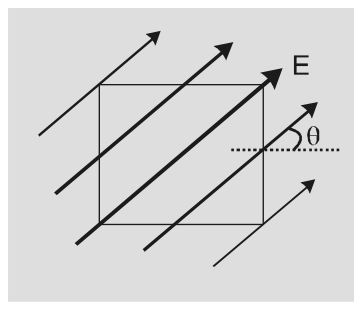
- 1
- 2
- 3
- 4zero
Show answer and solution
Correct: option 4, zero
Flux is , where the area vector is perpendicular to the surface. Here the field lies in the plane of the square, so it is at 90° to the area vector whatever the angle is. No field lines pass through the surface and the flux is zero.
Question 46AIPMT 2010 Prelims, Q46
A series combination of capacitors, each of value is charged by a source of potential difference 4V. When another parallel combination of capacitors, each of value , is charged by a source of potential difference V, it has the same (total) energy stored in it, as the first combination has. The value of , in terms of , is then
- 1
- 2
- 3
- 4
Show answer and solution
Correct: option 4,
The series combination has capacitance and stores . The parallel combination has capacitance and stores . Equating the two gives .
Question 47AIPMT 2010 Prelims, Q47
Electromagnets are made of soft iron because soft iron has
- 1low retentivity and high coercive force
- 2high retentivity and high coercive force
- 3low retentivity and low coercive force
- 4high retentivity and low coercive force
Show answer and solution
Correct: option 3, low retentivity and low coercive force
An electromagnet should lose its magnetism as soon as the current is switched off and should be easy to magnetise and demagnetise. Soft iron suits this because it keeps very little magnetism (low retentivity) and needs only a small reverse field to remove it (low coercive force).
Question 48AIPMT 2010 Prelims, Q48
A square current carrying loop is suspended in a uniform magnetic field acting in the plane of the loop. If the force on one arm of the loop is , the net force on the remaining three arms of the loop is
- 1
- 2
- 3
- 4
Show answer and solution
Correct: option 2,
The net force on any closed current loop in a uniform magnetic field is zero (the loop can only feel a torque). So the forces on all four arms add to zero, and the three remaining arms together must exert .
Question 49AIPMT 2010 Prelims, Q49
Consider the following two statements.
(A) Kirchhoff's junction law follows from the conservation of charge
(B) Kirchhoff's loop law follows from the conservation of energy
Which of the following is correct?
- 1Both (A) and (B) are wrong
- 2(A) is correct and (B) is wrong
- 3(A) is wrong and (B) is correct
- 4Both (A) and (B) are correct
Show answer and solution
Correct: option 4, Both (A) and (B) are correct
The junction law says the currents entering a junction equal the currents leaving it; charge cannot pile up or vanish there, so it is conservation of charge. The loop law says the potential changes round a closed loop add to zero; a charge taken round the loop gains no net energy, so it is conservation of energy. Both statements are correct.
Question 50AIPMT 2010 Prelims, Q50
To get an output Y = 1 from the circuit shown below the input must be
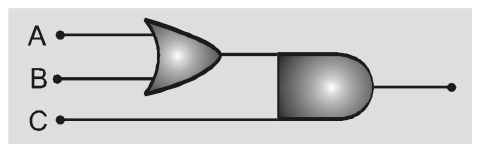
- 1A = 0, B = 1, C = 0
- 2A = 0, B = 0, C = 1
- 3A = 1, B = 0, C = 1
- 4A = 1, B = 0, C = 0
Show answer and solution
Correct: option 3, A = 1, B = 0, C = 1
A and B go into an OR gate, and its output goes with C into an AND gate, so . Y is 1 only when C = 1 and at least one of A and B is 1. Of the options only A = 1, B = 0, C = 1 satisfies this.
AIPMT 2010 Prelims Chemistry questions
Question 51AIPMT 2010 Prelims, Q51
For the reaction,
the value of rate of disappearance of is given as . The rate of formation of and is given respectively as:
- 1 and
- 2 and
- 3 and
- 4 and
Show answer and solution
Correct: option 2, and
Rates are in the ratio of the stoichiometric coefficients: . So forms at and at , which is option (2).
Question 52AIPMT 2010 Prelims, Q52
Liquid hydrocarbons can be converted to a mixture of gaseous hydrocarbons by:
- 1Oxidation
- 2Cracking
- 3Distillation under reduced pressure
- 4Hydrolysis
Show answer and solution
Correct: option 2, Cracking
Cracking (pyrolysis) is the heating of large hydrocarbon molecules so that their carbon chains break into smaller ones. The larger molecules are liquids and the small fragments are gases, so a liquid hydrocarbon gives a mixture of gaseous hydrocarbons. Distillation only separates, and hydrocarbons do not hydrolyse.
Question 53AIPMT 2010 Prelims, Q53
In which of the following pairs of molecules/ions, the central atoms have hybridization?
- 1 and
- 2 and
- 3 and
- 4 and
Show answer and solution
Correct: option 2, and
Count sigma bonds plus lone pairs on the central atom; three means . has 3 bonds and no lone pair (3), and has 2 bonds and 1 lone pair (3), so both are . , and each have a total of 4 and are .
Question 54AIPMT 2010 Prelims, Q54
Which one of the following does not exhibit the phenomenon of mutarotation?
- 1(+) Sucrose
- 2(+) Lactose
- 3(+) Maltose
- 4(–) Fructose
Show answer and solution
Correct: option 1, (+) Sucrose
Mutarotation needs a free hemiacetal or hemiketal group, so that the ring can open and the two anomers can interconvert in solution. In sucrose the anomeric carbons of glucose and fructose are joined to each other in the glycosidic bond, so neither is free and sucrose (a non-reducing sugar) shows no mutarotation. Lactose, maltose and fructose are reducing sugars and do show it.
Question 55AIPMT 2010 Prelims, Q55
Which one of the following species does not exist under normal conditions?
- 1
- 2
- 3
- 4
Show answer and solution
Correct: option 2,
A species with bond order zero does not exist. has 8 electrons: , giving bond order . The bond orders of , and are 0.5, 1 and 1, so they can exist.
Question 56AIPMT 2010 Prelims, Q56
Which of the following complex ions is not expected to absorb visible light?
- 1
- 2
- 3
- 4
Show answer and solution
Correct: option 1,
Colour from d-d transitions is expected when the complex has unpaired d electrons. In , is and the strong-field pairs all the electrons (, square planar), leaving none unpaired. (), (, high spin) and with the weak-field water have 3, 4 and 2 unpaired electrons and are coloured.
Question 57AIPMT 2010 Prelims, Q57
Given are cyclohexanol (I), acetic acid (II), 2, 4, 6-trinitrophenol (III) and phenol (IV). In these the order of decreasing acidic character will be:
- 1III > II > IV > I
- 2II > III > I > IV
- 3II > III > IV > I
- 4III > IV > II > I
Show answer and solution
Correct: option 1, III > II > IV > I
Acidity follows the stability of the anion left behind. Three groups make the picrate ion so stable that 2,4,6-trinitrophenol is a stronger acid than acetic acid. Acetic acid (resonance-stabilised carboxylate) is stronger than phenol, and cyclohexanol, whose alkoxide has no resonance, is the weakest. So III > II > IV > I.
Question 58AIPMT 2010 Prelims, Q58
If pH of a saturated solution of is 12, the value of its is:
- 1
- 2
- 3
- 4
Show answer and solution
Correct: option 4,
pH 12 means pOH 2, so . Each gives one for two , so . .
Question 59AIPMT 2010 Prelims, Q59
The reaction of toluene with in presence of gives 'X' and reaction in presence of light gives 'Y'. Thus, 'X' and 'Y' are:
- 1X = Benzal chloride, Y = o-chlorotoluene
- 2X = m-chlorotoluene, Y = p-chlorotoluene
- 3X = o-and p-chlorotoluene, Y = Trichloromethyl benzene
- 4X = Benzyl chloride, Y = m-chlorotoluene
Show answer and solution
Correct: option 3, X = o-and p-chlorotoluene, Y = Trichloromethyl benzene
With (a Lewis acid) chlorine attacks the ring as an electrophile, and the methyl group directs it to the ortho and para positions, giving o- and p-chlorotoluene. In light the reaction is a free-radical substitution on the side chain, which goes through benzyl chloride and benzal chloride to trichloromethyl benzene. Only option (3) puts ring substitution under X and side-chain substitution under Y.
Question 60AIPMT 2010 Prelims, Q60
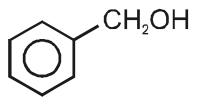
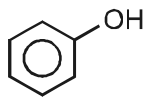
Which one of the following compounds has the most acidic nature?
- 1
- 2
- 3
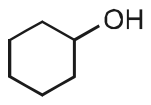
- 4
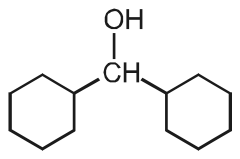
Show answer and solution
Correct: option 2
Option (2) is phenol; the others are benzyl alcohol, cyclohexanol and dicyclohexylmethanol, which are ordinary alcohols. Only in phenol is the O–H on the ring itself, so the phenoxide ion formed is stabilised by resonance with the benzene ring. That makes phenol far more acidic than the alcohols.
Question 61AIPMT 2010 Prelims, Q61
In a set of reactions, ethyl benzene yielded a product D.

- 1
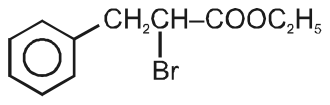
- 2
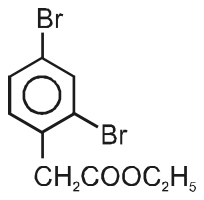
- 3
- 4
Show answer and solution
Correct: option 4
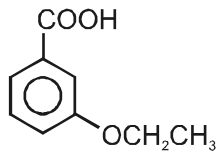
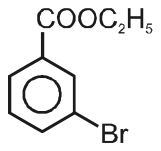
Alkaline oxidises the whole side chain to , so B is benzoic acid. is meta directing, so gives m-bromobenzoic acid (C). Ethanol with acid then esterifies it to ethyl m-bromobenzoate, the structure in option (4).
Question 62AIPMT 2010 Prelims, Q62
What is in mol/L of a solution that is 0.20 M in and 0.10 M in ? ( for )
- 1
- 2
- 3
- 4
Show answer and solution
Correct: option 4,
This is an acidic buffer, for which mol/L.
Question 63AIPMT 2010 Prelims, Q63
For an endothermic reaction, energy of activation is and enthalpy of reaction is (both of these in kJ/mol). Minimum value of will be:
- 1less than
- 2equal to
- 3more than
- 4equal to zero
Show answer and solution
Correct: option 3, more than
In an endothermic reaction the products lie above the reactants, and the top of the energy barrier lies above the products. So , where is the activation energy of the reverse reaction and is positive. Hence must be more than .
Question 64AIPMT 2010 Prelims, Q64
The correct order of increasing reactivity of bond towards nucleophile in the following compounds is:
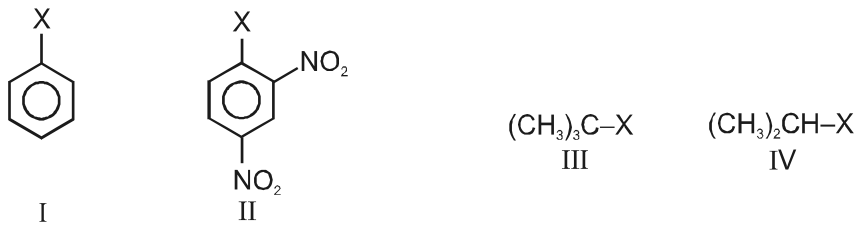
- 1I < II < IV < III
- 2II < III < I < IV
- 3IV < III < I < II
- 4III < II < I < IV
Show answer and solution
Correct: option 1, I < II < IV < III
In the aryl halide (I) the bond has partial double-bond character from resonance, so it is the least reactive. The two groups at the ortho and para positions in II withdraw electrons and make it more reactive than I, though still less than alkyl halides. Of the alkyl halides, the tertiary halide (III) forms the more stable carbocation and reacts faster than the secondary one (IV). So I < II < IV < III.
Question 65AIPMT 2010 Prelims, Q65
For the reduction of silver ions with copper metal, the standard cell potential was found to be at . The value of standard Gibbs energy will be ()
- 1
- 2
- 3
- 4
Show answer and solution
Correct: option 1,
The cell reaction transfers electrons. .
Question 66AIPMT 2010 Prelims, Q66
In which of the following equilibrium and are not equal?
- 1
- 2
- 3
- 4
Show answer and solution
Correct: option 4,
, where counts gas moles only (products minus reactants), so the two are equal only when . In (1), (2) and (3) there are two moles of gas on each side. In (4) the solid carbon is not counted, so there is 1 mole of gas on the left and 2 on the right, , and .
Question 67AIPMT 2010 Prelims, Q67
Which of the following ions will exhibit colour in aqueous solutions?
- 1 (Z = 57)
- 2 (Z = 22)
- 3 (Z = 71)
- 4 (Z = 21)
Show answer and solution
Correct: option 2, (Z = 22)
An ion is coloured when it has unpaired d or f electrons that can absorb visible light. is , with one unpaired electron, so it is coloured (purple). is , is and is ; with empty or completely filled subshells they are colourless.
Question 68AIPMT 2010 Prelims, Q68
Aniline in a set of the following reactions yielded a coloured product 'Y'.
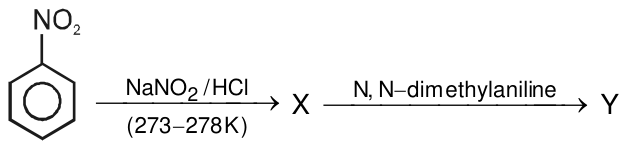
The structure of 'Y' would be:
- 1
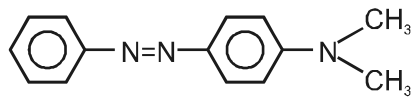
- 2
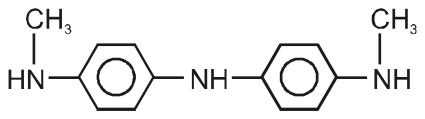
- 3

- 4
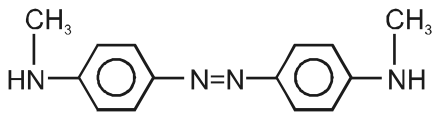
Show answer and solution
Correct: option 1
at 273–278 K diazotises aniline, so X is benzenediazonium chloride. This couples with N,N-dimethylaniline at the position para to the group, giving the azo dye p-(dimethylamino)azobenzene, which has an link between the two rings and on one of them. That is option (1).
Question 69AIPMT 2010 Prelims, Q69
Acetamide is treated with the following reagents separately. Which one of these would yield methyl amine?
- 1-
- 2Sodalime
- 3Hot conc.
- 4
Show answer and solution
Correct: option 1, -
Bromine with sodium hydroxide brings about the Hoffmann bromamide reaction, which turns an amide into the amine with one carbon less: . So acetamide gives methyl amine. The other reagents do not remove the carbonyl carbon to leave an amine.
Question 70AIPMT 2010 Prelims, Q70
An aqueous solution is 1.00 molal in KI. Which change will cause the vapour pressure of the solution to increase?
- 1Addition of NaCl
- 2Addition of
- 3Addition of 1.00 molal KI
- 4Addition of water
Show answer and solution
Correct: option 4, Addition of water
The vapour pressure of a solution rises with the mole fraction of the solvent. Adding water dilutes the solution, raising the mole fraction of water and so the vapour pressure. Adding NaCl or sodium sulphate puts in more solute particles and lowers it, and adding more 1.00 molal KI leaves the concentration unchanged.
Question 71AIPMT 2010 Prelims, Q71
A solution of sucrose (molar mass = ) has been prepared by dissolving 68.5 g of sucrose in 1000 g of water. The freezing point of the solution obtained will be: ( for water = )
- 1
- 2
- 3
- 4
Show answer and solution
Correct: option 3,
Molality , so the depression of freezing point is . The solution therefore freezes below the freezing point of water, at , which is option (1). The answer key of the source copy prints (3), which has the same size but the opposite sign; the working does not support it.
Question 72AIPMT 2010 Prelims, Q72
Which of the following alkaline earth metal sulphates has hydration enthalpy higher than the lattice enthalpy?
- 1
- 2
- 3
- 4
Show answer and solution
Correct: option 2,
The lattice enthalpies of these sulphates are nearly the same because the sulphate ion is so large, while the hydration enthalpy falls as the cation gets bigger. is the smallest ion, so its hydration enthalpy is the highest and exceeds the lattice enthalpy, which is why dissolves readily in water. The sulphates of Ca, Sr and Ba are sparingly soluble or insoluble.
Question 73AIPMT 2010 Prelims, Q73
Which of the following ions has electronic configuration ?
- 1
- 2
- 3
- 4
Show answer and solution
Correct: option 4,
Co (Z = 27) is ; losing three electrons (the two 4s first) leaves . is , is and is .
Question 74AIPMT 2010 Prelims, Q74
An increase in equivalent conductance of a strong electrolyte with dilution is mainly due to:
- 1increase in ionic mobility of ions.
- 2100% ionisation of electrolyte at normal dilution.
- 3increase in both i.e. number of ions and ionic mobility of ions.
- 4increase in number of ions.
Show answer and solution
Correct: option 1, increase in ionic mobility of ions.
A strong electrolyte is already fully ionised, so dilution cannot increase the number of ions. What changes is that the ions move farther apart, the attraction between oppositely charged ions weakens, and each ion moves more freely. The equivalent conductance therefore rises because of the greater ionic mobility.
Question 75AIPMT 2010 Prelims, Q75
Crystal field stabilization energy for high spin octahedral complex is:
- 1
- 2
- 3
- 4
Show answer and solution
Correct: option 4,
In a high spin octahedral complex the electrons are arranged , with no pairing. Each electron contributes and each electron , so CFSE .
Question 76AIPMT 2010 Prelims, Q76
Oxidation states of P in , , are respectively:
- 1+3, +5, +4
- 2+5, +3, +4
- 3+5, +4, +3
- 4+3, +4, +5
Show answer and solution
Correct: option 4, +3, +4, +5
Take H as +1, O as −2 and P as . In : , so . In : , so . In : , so .
Question 77AIPMT 2010 Prelims, Q77
Which of the following statements about primary amines is 'False'?
- 1Alkyl amines are stronger bases than aryl amines
- 2Alkyl amines react with nitrous acid to produce alcohols
- 3Aryl amines react with nitrous acid to produce phenols
- 4Alkyl amines are stronger bases than ammonia
Show answer and solution
Correct: option 3, Aryl amines react with nitrous acid to produce phenols
Primary aryl amines react with nitrous acid in the cold to give diazonium salts, not phenols, so statement (3) is false. Primary alkyl amines give unstable diazonium salts that lose nitrogen and form alcohols. Alkyl groups release electrons and make alkyl amines stronger bases than ammonia, while in aryl amines the lone pair is delocalised into the ring, which makes them weaker.
Question 78AIPMT 2010 Prelims, Q78
The correct order of increasing bond angles in the following species are:
- 1
- 2
- 3
- 4
Show answer and solution
Correct: option 4,
has two lone pairs on chlorine and the smallest angle (about ). also has two lone pairs on its central oxygen, but the bulky chlorine atoms open the angle slightly (about ). has only one lone pair and one odd electron on chlorine, so repulsion on the bond pairs is least and the angle is largest (about ).
Question 79AIPMT 2010 Prelims, Q79
Among the given compounds, the most susceptible to nucleophilic attack at the carbonyl group is:
- 1
- 2
- 3
- 4
Show answer and solution
Correct: option 4,
The reactivity of acid derivatives towards nucleophiles is acid chloride > anhydride > ester > amide. Chlorine withdraws electrons strongly by its −I effect and donates very little back by resonance, so the carbonyl carbon of is the most electron deficient; is also the best leaving group.
Question 80AIPMT 2010 Prelims, Q80
25.3 g of sodium carbonate, is dissolved in enough water to make 250 mL of solution. If sodium carbonate dissociates completely, molar concentration of sodium ion, and carbonate ions, are respectively (Molar mass of )
- 10.955 M and 1.910 M
- 21.910 M and 0.955 M
- 31.90 M and 1.910 M
- 40.477 M and 0.477 M
Show answer and solution
Correct: option 2, 1.910 M and 0.955 M
Moles of , in 0.250 L, so its molarity is 0.955 M. Each formula unit gives two and one , so M and M.
Question 81AIPMT 2010 Prelims, Q81
In a buffer solution containing equal concentration of and HB, the for is . The pH of buffer solution is:
- 110
- 27
- 36
- 44
Show answer and solution
Correct: option 4, 4
HB and are a conjugate pair, so and . With equal concentrations of acid and conjugate base, .
Question 82AIPMT 2010 Prelims, Q82
The existence of two different coloured complexes with the composition of is due to:
- 1linkage isomerism
- 2geometrical isomerism
- 3coordination isomerism
- 4ionization isomerism
Show answer and solution
Correct: option 4, ionization isomerism
is an octahedral complex of the type . The two chloride ligands can sit next to each other (cis, violet) or opposite each other (trans, green), which is geometrical isomerism, option (2). The ion has no ambidentate ligand, no second complex ion and no counter ion in the formula, so linkage, coordination and ionization isomerism do not arise. The answer key of the source copy prints (4); the working does not support it.
Question 83AIPMT 2010 Prelims, Q83
Property of the alkaline earth metals that increases with their atomic number:
- 1Solubility of their hydroxides in water
- 2Solubility of their sulphates in water
- 3Ionization energy
- 4Electronegativity
Show answer and solution
Correct: option 1, Solubility of their hydroxides in water
Down the group the lattice enthalpy of the hydroxides falls faster than the hydration enthalpy of the cations, so the hydroxides become more soluble from Be to Ba. For the sulphates the lattice enthalpy hardly changes while the hydration enthalpy falls, so their solubility decreases. Ionization energy and electronegativity both decrease as the atoms get larger.
Question 84AIPMT 2010 Prelims, Q84
During the kinetic study of the reaction, , following results were obtained:
| Run | | | Initial rate of formation of |
|---|
| I | 0.1 | 0.1 | |
| II | 0.3 | 0.2 | |
| III | 0.3 | 0.4 | |
| IV | 0.4 | 0.1 | |
Based on the above data which one of the following is correct?
- 1rate =
- 2rate =
- 3rate =
- 4rate =
Show answer and solution
Correct: option 4, rate =
Runs I and IV have the same [B]; [A] goes up 4 times and the rate goes up 4 times ( to ), so the order in A is 1. Runs II and III have the same [A]; [B] doubles and the rate goes up 4 times ( to ), so the order in B is 2. Hence rate = .
Question 85AIPMT 2010 Prelims, Q85
Which of the following pairs has the same size?
- 1
- 2
- 3
- 4
Show answer and solution
Correct: option 3,
Zr (4d series) and Hf (5d series) are in the same group, and the 14 lanthanoids come between them. The poor shielding by the 4f electrons (lanthanoid contraction) cancels the usual increase in size down the group, so and have almost the same radius.
Question 86AIPMT 2010 Prelims, Q86
The correct order of the decreasing ionic radii among the following isoelectronic species are:
- 1
- 2
- 3
- 4
Show answer and solution
Correct: option 3,
All four ions have 18 electrons. For isoelectronic ions, the larger the nuclear charge, the more strongly the same electron cloud is pulled in and the smaller the ion. The nuclear charges are S 16, Cl 17, K 19 and Ca 20, so the radii decrease as .
Question 87AIPMT 2010 Prelims, Q87
In which one of the following species the central atom has the type of hybridization which is not the same as that present in the other three?
- 1
- 2
- 3
- 4
Show answer and solution
Correct: option 3,
Count bond pairs plus lone pairs on the central atom. has 4 + 1 = 5, has 2 + 3 = 5 and has 5 + 0 = 5, so all three are . has 5 bond pairs and 1 lone pair, 6 in all, so it is and is the odd one out.
Question 88AIPMT 2010 Prelims, Q88
Standard entropies of , and are 60, 40 and 50 respectively. For the reaction
to be at equilibrium, the temperature should be:
- 1750 K
- 21000 K
- 31250 K
- 4500 K
Show answer and solution
Correct: option 1, 750 K
. At equilibrium , so .
Question 89AIPMT 2010 Prelims, Q89
Which of the following represents the correct order of increasing electron gain enthalpy with negative sign for the elements O, S, F and Cl?
- 1Cl < F < O < S
- 2O < S < F < Cl
- 3F < S < O < Cl
- 4S < O < Cl < F
Show answer and solution
Correct: option 2, O < S < F < Cl
The halogens release more energy on gaining an electron than the group 16 elements. Within each group the second-period element (O, F) is so small that the added electron is repelled by the crowded 2p electrons, so its value is lower than that of the third-period element (S, Cl). The values are about 141 (O), 200 (S), 328 (F) and 349 (Cl) , giving O < S < F < Cl.
Question 90AIPMT 2010 Prelims, Q90
Which one of the following compounds is a peroxide?
- 1
- 2
- 3
- 4
Show answer and solution
Correct: option 2,
A peroxide contains the ion (an O–O link), with oxygen in the −1 state. In barium is +2, so each oxygen is −1: it is . is a superoxide (oxygen −1/2), while and are ordinary dioxides with oxygen at −2.
Question 91AIPMT 2010 Prelims, Q91
Which one is most reactive towards electrophilic reagent?
- 1
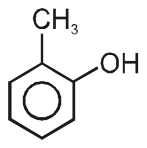
- 2
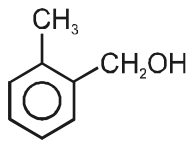
- 3
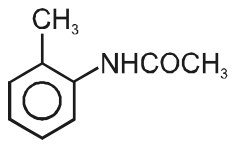
- 4
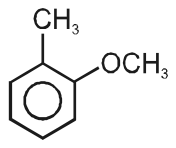
Show answer and solution
Correct: option 1
All four rings carry a methyl group plus a second group at the ortho position: , , and . The more strongly that group pushes electrons into the ring, the faster an electrophile attacks. is the strongest activator of these (stronger than and , whose lone pair is partly drawn to the carbonyl; has no lone pair on the ring atom), so o-cresol in option (1) is the most reactive.
Question 92AIPMT 2010 Prelims, Q92
Which one of the following is employed as a Tranquilizer drug?
- 1Promethazine
- 2Valium
- 3Naproxen
- 4Mifepristone
Show answer and solution
Correct: option 2, Valium
Tranquilizers relieve anxiety and mental tension. Valium (diazepam) is one of them. Promethazine is an antihistamine, naproxen is a pain-relieving anti-inflammatory drug, and mifepristone is an antifertility drug.
Question 93AIPMT 2010 Prelims, Q93
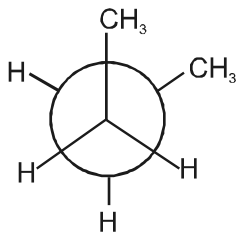
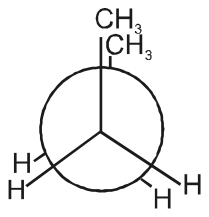
In the following the most stable conformation of n-butane is:
- 1
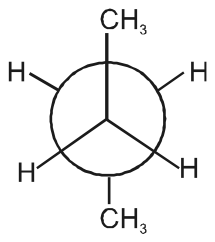
- 2
- 3
- 4
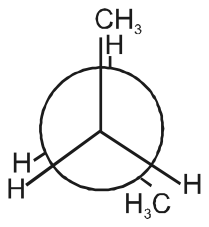
Show answer and solution
Correct: option 1
The most stable conformation of n-butane is the staggered one in which the two methyl groups are opposite each other (anti, 180° apart), because both torsional strain and the repulsion between the bulky methyl groups are at a minimum. Option (1) shows this: one methyl points up on the front carbon and the other points down on the back carbon. Option (2) is the gauche form and the other two are eclipsed forms, which are higher in energy.
Question 94AIPMT 2010 Prelims, Q94
Which of the following reactions will not result in the formation of carbon-carbon bonds?
- 1Reimer-Tiemann reaction
- 2Cannizzaro reaction
- 3Wurtz reaction
- 4Friedel-Crafts acylation
Show answer and solution
Correct: option 2, Cannizzaro reaction
In the Cannizzaro reaction an aldehyde with no alpha hydrogen is oxidised and reduced at the same time, e.g. ; no new C–C bond forms. The Reimer-Tiemann reaction joins a group to the phenol ring, the Wurtz reaction joins two alkyl groups (R–R), and Friedel-Crafts acylation joins an acyl group to the ring, so each of those makes a C–C bond.
Question 95AIPMT 2010 Prelims, Q95
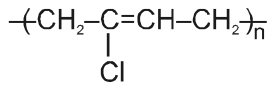
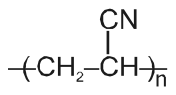
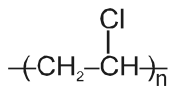
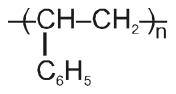
Which of the following structures represents Neoprene polymer?
- 1
- 2
- 3
- 4
Show answer and solution
Correct: option 1
Neoprene is the polymer of chloroprene, 2-chloro-1,3-butadiene (). On polymerisation the repeating unit is , which is option (1). The other three are the repeating units of polyacrylonitrile, PVC and polystyrene.
Question 96AIPMT 2010 Prelims, Q96
Which one is most reactive towards reaction?
- 1
- 2
- 3
- 4
Show answer and solution
Correct: option 3,
The rate of an reaction depends on the stability of the carbocation formed when bromide leaves. gives a tertiary carbocation stabilised by resonance with two phenyl rings and also by the methyl group, the most stable of the four. The others give carbocations with fewer stabilising groups (two phenyls only, one phenyl and one methyl, or one phenyl).
Question 97AIPMT 2010 Prelims, Q97
AB crystallizes in a body centred cubic lattice with edge length 'a' equal to 387 pm. The distance between two oppositely charged ions in the lattice is:
- 1335 pm
- 2250 pm
- 3200 pm
- 4300 pm
Show answer and solution
Correct: option 1, 335 pm
In a body centred cubic arrangement one ion is at the corner and the oppositely charged ion at the body centre, so their distance is half the body diagonal: .
Question 98AIPMT 2010 Prelims, Q98
The number of atoms in 0.1 mol of a triatomic gas is: ()
- 1
- 2
- 3
- 4
Show answer and solution
Correct: option 2,
Number of molecules . Each molecule has 3 atoms, so the number of atoms is .
Question 99AIPMT 2010 Prelims, Q99
Which one of the following molecular hydrides acts as a Lewis acid?
- 1
- 2
- 3
- 4
Show answer and solution
Correct: option 3,
A Lewis acid accepts an electron pair. Diborane is electron deficient: boron does not have a complete octet, so it accepts electron pairs from donors such as or CO. and have lone pairs and are Lewis bases, and is electron precise and is neither.
Question 100AIPMT 2010 Prelims, Q100
The tendency of , and to behave as Lewis acid decreases in the sequence:
- 1
- 2
- 3
- 4
Show answer and solution
Correct: option 2,
The empty 2p orbital of boron receives electron density from a filled p orbital of the halogen (back bonding), which reduces boron's electron deficiency. This overlap is best for fluorine, whose 2p orbital matches boron's in size, and gets weaker for the larger 3p of chlorine and 4p of bromine. So is the weakest Lewis acid and the strongest: .
AIPMT 2010 Prelims Biology questions
Question 101AIPMT 2010 Prelims, Q101
Apomictic embryos in citrus arise from:
- 1Maternal sporophytic tissue in ovule
- 2Antipodal cells
- 3Diploid egg
- 4Synergids
Show answer and solution
Correct: option 1, Maternal sporophytic tissue in ovule
In Citrus, some cells of the nucellus that surround the embryo sac start dividing, push into the embryo sac and grow into embryos without fertilisation. The nucellus is diploid tissue of the mother plant (sporophyte) inside the ovule, so these apomictic embryos come from maternal sporophytic tissue. Antipodals and synergids are haploid cells of the gametophyte and are not the source.
Question 102AIPMT 2010 Prelims, Q102
If due to some injury the chordae tendinae of the tricuspid valve of the human heart is partially non-functional, what will be the immediate effect
- 1The pacemaker will stop working
- 2The blood will tend to flow into the left atrium
- 3The flow of blood into the pulmonary artery will be reduced
- 4The flow of blood into the aorta will be slowed down
Show answer and solution
Correct: option 3, The flow of blood into the pulmonary artery will be reduced
The chordae tendinae hold the flaps of the tricuspid valve shut when the right ventricle contracts. If they fail, the valve leaks and part of the blood goes back into the right atrium instead of forward. Less blood is therefore pushed from the right ventricle into the pulmonary artery. The pacemaker and the left side of the heart are not directly affected at once.
Question 103AIPMT 2010 Prelims, Q103
The nerve centres which control the body temperature and the urge for eating are contained in
- 1Pons
- 2Cerebellum
- 3Thalamus
- 4Hypothalamus
Show answer and solution
Correct: option 1, Pons
The answer key of the source copy marks option (1), Pons, and that keyed answer is recorded here. By the textbook, however, the centres for body temperature, hunger and thirst lie in the hypothalamus at the base of the thalamus, which is option (4). The pons mainly connects different regions of the brain, the cerebellum controls balance and posture, and the thalamus relays sensory and motor signals. The key appears to be in error for this question.
Question 104AIPMT 2010 Prelims, Q104
The plasma membrane consists mainly of
- 1Proteins embedded in a phospholipid bilayer
- 2Proteins embedded in a polymer of glucose molecules
- 3Proteins embedded in a carbohydrate bilayer
- 4Phospholipids embedded in protein bilayer
Show answer and solution
Correct: option 1, Proteins embedded in a phospholipid bilayer
According to the fluid mosaic model, the membrane is a double layer of phospholipids with their polar heads outside and hydrophobic tails inside. Protein molecules sit on the surface of this bilayer or are partly or fully buried in it. So the membrane is mainly proteins embedded in a phospholipid bilayer.
Question 105AIPMT 2010 Prelims, Q105
In unilocular ovary with a single ovule the placentation is
- 1Basal
- 2Free Central
- 3Axile
- 4Marginal
Show answer and solution
Correct: option 1, Basal
In basal placentation the placenta develops at the base of a one-chambered ovary and carries a single ovule, as in sunflower and marigold. Free central and axile placentation carry many ovules on a central axis, and marginal placentation has ovules in rows along the ventral suture, as in pea.
Question 106AIPMT 2010 Prelims, Q106
The genetically-modified (GM) brinjal in India has been developed for
- 1Enhancing shelf life
- 2Enhancing mineral content
- 3Drought-resistance
- 4Insect-resistance
Show answer and solution
Correct: option 4, Insect-resistance
Bt brinjal carries a cry gene from Bacillus thuringiensis. The gene makes a protein that is toxic to the fruit and shoot borer larvae that feed on the plant. The crop was therefore developed for insect resistance, not for shelf life, minerals or drought tolerance.
Question 107AIPMT 2010 Prelims, Q107
Ringworm in humans is caused by
- 1Fungi
- 2Nematodes
- 3Viruses
- 4Bacteria
Show answer and solution
Correct: option 1, Fungi
Ringworm is a skin infection caused by fungi of the genera Microsporum, Trichophyton and Epidermophyton. It shows as dry, scaly, itchy patches on the skin, nails and scalp. In spite of the name, no worm is involved.
Question 108AIPMT 2010 Prelims, Q108
Which one of the following pair is incorrectly matched
- 1Somatostatin - Delta cells (Source)
- 2Corpus luteum - Relaxin (secretion)
- 3Insulin - Diabetes mellitus (disease)
- 4Glucagon - Beta cells (source)
Show answer and solution
Correct: option 4, Glucagon - Beta cells (source)
Glucagon is secreted by the alpha cells of the islets of Langerhans; the beta cells secrete insulin. So the pair in option (4) is wrong. The other pairs are right: delta cells secrete somatostatin, the corpus luteum secretes relaxin late in pregnancy, and lack of insulin causes diabetes mellitus.
Question 109AIPMT 2010 Prelims, Q109
Widal test is used for the diagnosis of
- 1Pneumonia
- 2Tuberculosis
- 3Typhoid
- 4Malaria
Show answer and solution
Correct: option 3, Typhoid
The Widal test detects antibodies in the patient's serum against the antigens of Salmonella typhi, the bacterium that causes typhoid. A positive agglutination reaction confirms typhoid fever.
Question 110AIPMT 2010 Prelims, Q110
Which one of the following is an example of ex-situ conservation
- 1Seed bank
- 2Sacred groves
- 3National park
- 4Wildlife sanctuary
Show answer and solution
Correct: option 1, Seed bank
Ex-situ conservation protects organisms outside their natural home, as in zoos, botanical gardens, seed banks and cryopreservation. A seed bank stores seeds away from the habitat, so it is ex-situ. Sacred groves, national parks and wildlife sanctuaries protect organisms where they naturally live, which is in-situ conservation.
Question 111AIPMT 2010 Prelims, Q111
Which one of the following symbols and its representation used in human pedigree analysis is correct
- 1

- 2

- 3

- 4

Show answer and solution
Correct: option 4
In a pedigree chart a square stands for a male and a circle for a female, and the symbol is shaded when the person is affected. So an open circle is an unaffected female, an open square is an unaffected male, and a shaded diamond is an affected person of unspecified sex. A double line joining a square and a circle shows mating between relatives (a consanguineous mating), so option (4) is the only correct pair.
Question 112AIPMT 2010 Prelims, Q112
The permissible use of the technique amniocentesis is for
- 1Artificial insemination
- 2Transfer of embryo into the uterus of a surrogate mother
- 3Detecting any genetic abnormality
- 4Detecting sex of the unborn foetus
Show answer and solution
Correct: option 3, Detecting any genetic abnormality
In amniocentesis a little amniotic fluid is drawn out and the foetal cells in it are examined for their chromosomes. Its legal use is to detect genetic disorders such as Down's syndrome. It can also reveal the sex of the foetus, but using it for that purpose is banned by law because it led to female foeticide.
Question 113AIPMT 2010 Prelims, Q113
Some hyperthermophilic organisms that grow in highly acidic (pH 2) habitats belong to the two groups
- 1Cyanobacteria and diatoms
- 2Protists and mosses
- 3Liverworts and yeasts
- 4Eubacteria and archaea
Show answer and solution
Correct: option 4, Eubacteria and archaea
Only prokaryotes can live in very hot and strongly acidic places such as hot sulphur springs. These thermoacidophiles are mostly archaea, along with a few eubacteria. Diatoms, mosses, liverworts and yeasts are eukaryotes and cannot survive such conditions.
Question 114AIPMT 2010 Prelims, Q114
Which one of the following statements in regard to the excretion by the human kidneys is correct
- 1Distal convoluted tubule is incapable of reabsorbing
- 2Nearly 99 per cent of the glomerular filtrate is reabsorbed by the renal tubules
- 3Ascending limb of loop of Henle is impermeable to electrolytes
- 4Descending limb of loop of Henle is impermeable to water
Show answer and solution
Correct: option 2, Nearly 99 per cent of the glomerular filtrate is reabsorbed by the renal tubules
The kidneys form about 180 litres of filtrate a day but only about 1.5 litres of urine, so nearly 99 per cent of the filtrate is taken back by the renal tubules. The other statements are wrong: the distal convoluted tubule can reabsorb bicarbonate ions, the ascending limb is permeable to electrolytes but not to water, and the descending limb is permeable to water.
Question 115AIPMT 2010 Prelims, Q115
Which one of the following is not lateral meristem
- 1Interfascicular cambium
- 2Phellogen
- 3Intercalary meristem
- 4Intrafascicular cambium
Show answer and solution
Correct: option 3, Intercalary meristem
Lateral meristems lie along the sides of stems and roots and add girth: the fascicular (intrafascicular) cambium, the interfascicular cambium and the cork cambium (phellogen). The intercalary meristem lies between mature tissues, for example at the base of grass internodes, and adds length. So it is not a lateral meristem.
Question 116AIPMT 2010 Prelims, Q116
Single-celled eukaryotes included in
- 1Fungi
- 2Archaea
- 3Monera
- 4Protista
Show answer and solution
Correct: option 4, Protista
In the five-kingdom classification all single-celled eukaryotes, such as diatoms, dinoflagellates, euglenoids, slime moulds and protozoans, are placed in kingdom Protista. Monera and Archaea are prokaryotes, and fungi are mostly multicellular.
Question 117AIPMT 2010 Prelims, Q117
plants are more efficient in photosynthesis than plants due to
- 1Presence of larger number of chloroplasts in the leaf cells
- 2Presence of thin cuticle
- 3Lower rate of photorespiration
- 4Higher leaf area
Show answer and solution
Correct: option 1, Presence of larger number of chloroplasts in the leaf cells
The answer key of the source copy marks option (1), and that keyed answer is recorded here. By the textbook, however, the reason is option (3): plants first fix in the mesophyll and release it in the bundle sheath cells, which keeps the level around RuBisCO high, so photorespiration hardly occurs and no fixed carbon is lost. The key appears to be in error for this question.
Question 118AIPMT 2010 Prelims, Q118
Which one of the following is used as vector for cloning genes into higher organisms
- 1Salmonella typhimurium
- 2Rhizopus nigricans
- 3Retrovirus
- 4Baculovirus
Show answer and solution
Correct: option 3, Retrovirus
Retroviruses can insert their genetic material into the chromosomes of animal cells. After they are disarmed so that they no longer cause disease, they are used to carry desired genes into animal cells. That makes the retrovirus the vector used for higher organisms among the choices.
Question 119AIPMT 2010 Prelims, Q119
Which one of the following is not a micronutrient
- 1Magnesium
- 2Zinc
- 3Boron
- 4Molybdenum
Show answer and solution
Correct: option 1, Magnesium
Macronutrients are needed by plants in large amounts: C, H, O, N, P, K, S, Ca and Mg. Magnesium, a part of chlorophyll, is therefore a macronutrient. Zinc, boron and molybdenum are needed only in traces and are micronutrients.
Question 120AIPMT 2010 Prelims, Q120
One example of animal having a single opening to the outside that serves both as mouth as well as anus is
- 1Asterias
- 2Ascidia
- 3Fasciola
- 4Octopus
Show answer and solution
Correct: option 3, Fasciola
Flatworms have an incomplete digestive system with one opening that takes in food and also throws out undigested waste. Fasciola, the liver fluke, is a flatworm. Asterias (an echinoderm), Ascidia (a urochordate) and Octopus (a mollusc) have a complete gut with separate mouth and anus.
Question 121AIPMT 2010 Prelims, Q121
Which one of the following structure between two adjacent cells is an effective transport pathway
- 1Plastoquinones
- 2Endoplasmic reticulum
- 3Plasmalemma
- 4Plasmodesmata
Show answer and solution
Correct: option 4, Plasmodesmata
Plasmodesmata are fine cytoplasmic strands that pass through the cell walls and join the cytoplasm of neighbouring plant cells. Water and solutes move from cell to cell through them; this is the symplastic pathway. Plastoquinone is an electron carrier, and the plasmalemma is the membrane around a single cell.
Question 122AIPMT 2010 Prelims, Q122
Which one of the following does not follow the central dogma of molecular biology
- 1Mucor
- 2Chlamydomonas
- 3HIV
- 4Pea
Show answer and solution
Correct: option 3, HIV
The central dogma says information flows from DNA to RNA to protein. HIV is a retrovirus with an RNA genome; its enzyme reverse transcriptase copies the RNA into DNA, which is the reverse direction. Mucor, Chlamydomonas and pea all have DNA genomes and follow the usual flow.
Question 123AIPMT 2010 Prelims, Q123
Which one of the following is not used in organic farming
- 1Earthworm
- 2Oscillatoria
- 3Snail
- 4Glomus
Show answer and solution
Correct: option 3, Snail
Organic farming uses living organisms in place of chemicals. Earthworms make vermicompost, Oscillatoria is a nitrogen-fixing cyanobacterium used as a biofertiliser, and Glomus forms mycorrhiza that helps roots take up phosphorus. Snails feed on crops and are pests, so they are not used.
Question 124AIPMT 2010 Prelims, Q124
Study the four statements (a-d) given below and select the two correct ones out of them
(a) A lion eating a deer and a sparrow feeding on grain are ecologically similar in being consumers
(b) Predator star fish Pisaster helps in maintaining species diversity of some invertebrates
(c) Predators ultimately lead to the extinction of prey species
(d) Production of chemicals such as nicotine, strychnine by the plants are metabolic disorders
The two correct statements are
- 1(c) and (d)
- 2(a) and (d)
- 3(a) and (b)
- 4(b) and (c)
Show answer and solution
Correct: option 3, (a) and (b)
(a) is correct: both the lion and the sparrow feed on other organisms, so both are consumers. (b) is correct: when Pisaster was removed from a rocky shore, more than ten invertebrate species died out through competition. (c) is wrong because predators are prudent and keep prey numbers in check without wiping them out. (d) is wrong because nicotine and strychnine are defence chemicals against grazers, not disorders. So (a) and (b) are the correct pair.
Question 125AIPMT 2010 Prelims, Q125
Toxic agents present in food which interfere with thyroxine synthesis lead to the development of
- 1cretinism
- 2simple goitre
- 3thyrotoxicosis
- 4toxic goitre
Show answer and solution
Correct: option 2, simple goitre
Substances in food that block thyroxine synthesis (goitrogens) lower the thyroxine level in blood. The pituitary then releases more TSH, which makes the thyroid gland enlarge. This enlargement with low hormone output is simple goitre. Thyrotoxicosis and toxic goitre are conditions of excess thyroid hormone.
Question 126AIPMT 2010 Prelims, Q126
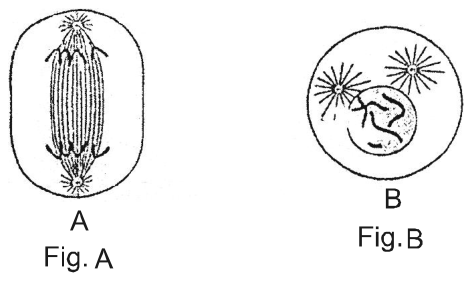
Which stages of cell division do the following figures A and B represent respectively
- 1Telophase – Metaphase
- 2Late Anaphase – Prophase
- 3Prophase – Anaphase
- 4Metaphase – Telophase
Show answer and solution
Correct: option 2, Late Anaphase – Prophase
In figure A the chromosomes have separated into two groups that have reached the opposite poles of the spindle, while the cell has not yet divided; this is late anaphase. In figure B the nuclear envelope is still present, the chromatin has condensed into long threads and the two asters are moving apart; this is prophase.
Question 127AIPMT 2010 Prelims, Q127
A common biocontrol agent for the control of plant disease is
- 1Bacillus thuringiensis
- 2Glomus
- 3Trichoderma
- 4Baculovirus
Show answer and solution
Correct: option 3, Trichoderma
Trichoderma is a free-living fungus common in root ecosystems that attacks several fungi causing plant diseases, so it is used against plant disease. Bacillus thuringiensis and baculoviruses are used against insect pests, and Glomus is a mycorrhizal biofertiliser.
Question 128AIPMT 2010 Prelims, Q128
Carrier ions like facilitate the absorption of substances like
- 1glucose and fatty acids
- 2fatty acids and glycerol
- 3fructose and some amino acids
- 4amino acids and glucose
Show answer and solution
Correct: option 3, fructose and some amino acids
The answer key of the source copy marks option (3), and that keyed answer is recorded here. In the usual account of absorption, however, glucose and amino acids are the nutrients taken into the intestinal cells together with (sodium-coupled transport), which points to option (4), while fructose enters by facilitated transport on carrier proteins without sodium. Fatty acids and glycerol are absorbed as micelles. The key is doubtful for this question.
Question 129AIPMT 2010 Prelims, Q129
The first movements of the foetus and appearance of hair on its head are usually observed during which month of pregnancy
- 1Fifth month
- 2Sixth month
- 3Third month
- 4Fourth month
Show answer and solution
Correct: option 1, Fifth month
In human development the limbs and digits form by the end of the second month and most organ systems by the end of the third month. The first movements of the foetus and hair on the head appear during the fifth month. Fine body hair, eyelids and eyelashes follow by about the end of the sixth month.
Question 130AIPMT 2010 Prelims, Q130
Which two of the following changes (a-d) usually tend to occur in the plain dwellers when they move to high altitudes (3,500 m or more)
(a) Increase in red blood cell size
(b) Increase in red blood cell production
(c) Increased breathing rate
(d) Increase in the thrombocyte count
Changes occurring are
- 1(c) and (d)
- 2(a) and (d)
- 3(a) and (b)
- 4(b) and (c)
Show answer and solution
Correct: option 4, (b) and (c)
At high altitude the air pressure is low and less oxygen reaches the blood. The body makes up for this by breathing faster and by producing more red blood cells, which raises the oxygen-carrying capacity of blood. The size of the red cells and the number of platelets (thrombocytes) do not change. So (b) and (c) are the changes.
Question 131AIPMT 2010 Prelims, Q131
Which one of the following kinds of animals are triploblastic
- 1Sponges
- 2Ctenophores
- 3Corals
- 4Flat worms
Show answer and solution
Correct: option 4, Flat worms
Triploblastic animals have three germ layers: ectoderm, mesoderm and endoderm. This condition starts with the flatworms (Platyhelminthes). Sponges have only a cellular level of organisation, and corals (cnidarians) and ctenophores are diploblastic with two germ layers.
Question 132AIPMT 2010 Prelims, Q132
Stirred-tank bioreactors have been designed for
- 1Purification of the product
- 2Ensuring anaerobic conditions in the culture vessel
- 3Availability of oxygen throughout the process
- 4Addition of preservatives to the product
Show answer and solution
Correct: option 3, Availability of oxygen throughout the process
A stirred-tank bioreactor has a stirrer that mixes the contents evenly and a system that bubbles sterile air through the culture. The curved base and the stirring keep oxygen available to the cells everywhere in the vessel throughout the process. Purification and adding preservatives belong to downstream processing, which is done later.
Question 133AIPMT 2010 Prelims, Q133
The kind of epithelium which forms the inner walls of blood vessels is
- 1columnar epithelium
- 2ciliated columnar epithelium
- 3squamous epithelium
- 4cuboidal epithelium
Show answer and solution
Correct: option 3, squamous epithelium
The inner lining of blood vessels (the endothelium) is a single layer of thin, flat cells with irregular edges, which is simple squamous epithelium. The same tissue lines the air sacs of the lungs, where a thin diffusion surface is also needed.
Question 134AIPMT 2010 Prelims, Q134
Some of the characteristics of Bt cotton are
- 1Medium yield, long fibre and resistance to beetle pests
- 2High yield and production of toxic protein crystals which kill dipteran pests
- 3High yield and resistance to bollworms
- 4Long fibre and resistance to aphids
Show answer and solution
Correct: option 3, High yield and resistance to bollworms
Bt cotton carries the genes cryIAc and cryIIAb from Bacillus thuringiensis. The proteins they code for kill cotton bollworms, which are lepidopteran larvae, so the crop resists bollworms and loses less yield. The toxins used in cotton do not act on beetles, flies (dipterans) or aphids.
Question 135AIPMT 2010 Prelims, Q135
Which one of the following statements about certain given animals is correct
- 1Molluscs are acoelomates
- 2Insects are pseudocoelomates
- 3Flat worms (Platyhelminthes) are coelomates
- 4Round worms (Aschelminthes) are pseudocoelomates
Show answer and solution
Correct: option 4, Round worms (Aschelminthes) are pseudocoelomates
In roundworms the body cavity is not lined by mesoderm; the mesoderm lies as scattered pouches, so the cavity is a pseudocoelom. Flatworms have no body cavity at all (acoelomates), while molluscs and insects (arthropods) have a true coelom. Only option (4) is correct.
Question 136AIPMT 2010 Prelims, Q136
Cu ion released from copper-releasing Intra Uterine Devices (IUDs)
- 1increase phagocytosis of sperms
- 2suppress sperm motility
- 3prevent ovulation
- 4make uterus unsuitable for implantation
Show answer and solution
Correct: option 2, suppress sperm motility
All IUDs increase phagocytosis of sperms inside the uterus. The copper ions released by copper IUDs such as CuT and Cu7 have an added effect: they suppress the motility and the fertilising capacity of sperms. Making the uterus unsuitable for implantation is the action of hormone-releasing IUDs.
Question 137AIPMT 2010 Prelims, Q137
The second maturation division of the mammalian ovum occurs
- 1Until after the ovum has been penetrated by a sperm
- 2Until the nucleus of the sperm has fused with that of the ovum
- 3In the Graafian follicle after the first maturation division
- 4Shortly after ovulation before the ovum makes entry into the fallopian tube
Show answer and solution
Correct: option 1, Until after the ovum has been penetrated by a sperm
The egg is released as a secondary oocyte held at metaphase of the second meiotic division. This division is completed only when a sperm enters the oocyte, and it then gives the ovum and the second polar body. The nuclei of sperm and ovum fuse after that, so option (1) is right.
Question 138AIPMT 2010 Prelims, Q138
Infectious proteins are present in
- 1Prions
- 2Viroids
- 3Satellite viruses
- 4Geminal viruses
Show answer and solution
Correct: option 1, Prions
Prions are infectious agents made only of abnormally folded protein, with no nucleic acid. They cause diseases such as mad cow disease (BSE) and Creutzfeldt-Jakob disease. Viroids are the opposite case: infectious RNA with no protein coat.
Question 139AIPMT 2010 Prelims, Q139
Low in the body fluid may be the cause of
- 1Anaemia
- 2Angina pectoris
- 3Gout
- 4Tetany
Show answer and solution
Correct: option 4, Tetany
Tetany is rapid, sustained spasm of muscles caused by a low level of calcium ions in the body fluids, as happens when parathyroid hormone is deficient. Anaemia is linked to low haemoglobin, angina to poor oxygen supply to heart muscle, and gout to a build-up of uric acid crystals in joints.
Question 140AIPMT 2010 Prelims, Q140
Which one of the following statements about morula in humans is correct
- 1It has far less cytoplasm as well as less DNA than in an uncleaved zygote
- 2It has more or less equal quantity of cytoplasm and DNA as in uncleaved zygote
- 3It has more cytoplasm and more DNA than an uncleaved zygote
- 4It has almost equal quantity of cytoplasm as an uncleaved zygote but much more DNA
Show answer and solution
Correct: option 4, It has almost equal quantity of cytoplasm as an uncleaved zygote but much more DNA
During cleavage the zygote divides again and again without growing, so the 8 to 16 cells of the morula share the cytoplasm that the zygote had. DNA, however, is copied before every division, so the total amount of DNA goes up with the number of cells. The morula therefore has about the same cytoplasm but much more DNA.
Question 141AIPMT 2010 Prelims, Q141
Select the two correct statements out of the four (a-d) given below about lac operon.
(a) Glucose or galactose may bind with the repressor and inactivate it
(b) In the absence of lactose the repressor binds with the operator region
(c) The Z- gene codes for permease
(d) This was elucidated by Francois Jacob and Jacque Monod
The correct statements are
- 1(a) and (c)
- 2(b) and (d)
- 3(a) and (b)
- 4(b) and (c)
Show answer and solution
Correct: option 2, (b) and (d)
(a) is wrong: the inducer that binds and inactivates the repressor is lactose (allolactose), not glucose or galactose. (b) is correct: without lactose the repressor sits on the operator and blocks transcription. (c) is wrong: the z gene codes for beta-galactosidase, and the y gene codes for permease. (d) is correct: Jacob and Monod worked out the lac operon. So (b) and (d) are the correct pair.
Question 142AIPMT 2010 Prelims, Q142
During mitosis ER and nucleolus begin to disappear at
- 1Early metaphase
- 2Late metaphase
- 3Early Prophase
- 4Late prophase
Show answer and solution
Correct: option 4, Late prophase
In early prophase the chromatin condenses and the centrosomes begin to move apart, but the nucleolus and the cell organelles can still be seen. Cells examined at the end of prophase no longer show the Golgi complexes, endoplasmic reticulum, nucleolus and nuclear envelope. These structures therefore start to disappear in late prophase.
Question 143AIPMT 2010 Prelims, Q143
Seminal plasma in human males is rich in
- 1glucose and calcium
- 2DNA and testosterone
- 3ribose and potassium
- 4fructose and calcium
Show answer and solution
Correct: option 4, fructose and calcium
Seminal plasma is the combined secretion of the seminal vesicles, prostate and bulbourethral glands. It is rich in fructose, which supplies energy to the sperms, and also in calcium and certain enzymes. So fructose and calcium is the right choice.
Question 144AIPMT 2010 Prelims, Q144
Virus envelope is known as
- 1Virion
- 2Nucleoprotein
- 3Core
- 4Capsid
Show answer and solution
Correct: option 4, Capsid
The protein coat that surrounds and protects the nucleic acid of a virus is called the capsid; it is built of small subunits called capsomeres. A virion is the whole virus particle, the core is the nucleic acid inside, and nucleoprotein is the nucleic acid together with its protein. Of the choices, only capsid names the covering.
Question 145AIPMT 2010 Prelims, Q145
Satellite DNA is useful tool in
- 1Sex determination
- 2Foretic engineering
- 3Genetic engineering
- 4Organ transplantation
Show answer and solution
Correct: option 2, Foretic engineering
Satellite DNA is made of short sequences repeated many times, and the number of repeats differs widely from person to person. This variation is the basis of DNA fingerprinting, which is used in forensic work to identify individuals and settle parentage. Option (2), as printed in the source copy ("Foretic" appears to be a misprint of forensic), is the keyed answer.
Question 146AIPMT 2010 Prelims, Q146
An element playing important role in nitrogen fixation is
- 1Copper
- 2Manganese
- 3Zinc
- 4Molybdenum
Show answer and solution
Correct: option 4, Molybdenum
Nitrogenase, the enzyme that reduces atmospheric nitrogen to ammonia, is a Mo-Fe protein. Molybdenum is also part of nitrate reductase. So molybdenum is the element with a key role in nitrogen fixation and nitrogen metabolism.
Question 147AIPMT 2010 Prelims, Q147
Breeding of crops with high level of minerals, vitamins and proteins is called
- 1Biofortification
- 2Biomagnification
- 3Micropropagation
- 4Somatic hybridisation
Show answer and solution
Correct: option 1, Biofortification
Biofortification is breeding crops for higher levels of vitamins, minerals, better protein and healthier fats to improve public health. Biomagnification is the rise in concentration of a toxicant along a food chain, micropropagation is raising many plants by tissue culture, and somatic hybridisation is the fusion of protoplasts of two plants.
Question 148AIPMT 2010 Prelims, Q148
Keel is characteristic of the flowers of
- 1Cassia
- 2Calotropis
- 3Bean
- 4Gulmohur
Show answer and solution
Correct: option 3, Bean
Pea and bean flowers have a papilionaceous corolla: one large standard petal, two wings, and two front petals joined into a boat-shaped keel that encloses the stamens and pistil. Cassia and gulmohur have a different (imbricate) arrangement of petals without a keel, and Calotropis has valvate petals.
Question 149AIPMT 2010 Prelims, Q149
Which one of the following cannot be explained on the basis of Mendel's Law of Dominance
- 1Out of one pair of factors one is dominant, and the other recessive
- 2Alleles do not show any blending and both the characters recover as such in generation.
- 3Factors occur in pairs
- 4The discrete unit controlling a particular character is called a factor
Show answer and solution
Correct: option 2, Alleles do not show any blending and both the characters recover as such in generation.
The law of dominance says that characters are controlled by discrete units called factors, that factors occur in pairs, and that in an unlike pair one factor is dominant and the other recessive. The fact that the two alleles do not blend and both parental characters come back unchanged in the generation is explained by the law of segregation, not by dominance.
Question 150AIPMT 2010 Prelims, Q150
ABO blood groups in humans are controlled by the gene I. It has three alleles - , and i. Since there are three different alleles, six different genotypes are possible. How many phenotypes can occur
- 1One
- 2Four
- 3Two
- 4Three
Show answer and solution
Correct: option 2, Four
and are both dominant over i and are co-dominant with each other. Genotypes and give group A, and give group B, gives group AB, and ii gives group O. So the six genotypes give four phenotypes: A, B, AB and O.
Question 151AIPMT 2010 Prelims, Q151
The one aspect which is not a salient feature of genetic code, is its being
- 1Ambiguous
- 2Universal
- 3Specific
- 4Degenerate
Show answer and solution
Correct: option 1, Ambiguous
The genetic code is universal (the same codons are used from bacteria to humans), specific or unambiguous (one codon stands for only one amino acid) and degenerate (most amino acids have more than one codon). Being ambiguous is the opposite of being specific, so it is not a feature of the code.
Question 152AIPMT 2010 Prelims, Q152
Consider the following four statements (a-d) regarding kidney transplant and select the two correct ones out of these.
(a) Even if a kidney transplant is proper the recipient may need to take immunosuppressants for a long time
(b) The cell-mediated immune response is responsible for the graft rejection
(c) The B-lymphocytes are responsible for rejection of the graft
(d) The acceptance or rejection of a kidney transplant depends on specific interferons
The two correct statements are
- 1(c) and (d)
- 2(a) and (c)
- 3(a) and (b)
- 4(b) and (c)
Show answer and solution
Correct: option 3, (a) and (b)
A graft is rejected by the cell-mediated immune response, which is carried out by T-lymphocytes, so (b) is correct and (c) is wrong. Even after good tissue matching the recipient has to take immunosuppressants for life, so (a) is correct. Interferons protect cells against viruses and do not decide graft acceptance, so (d) is wrong. The correct pair is (a) and (b).
Question 153AIPMT 2010 Prelims, Q153
Sertoli cells are found in
- 1adrenal cortex and secrete adrenaline
- 2Seminiferous tubules and provide nutrition to germ cells
- 3Pancreas and secrete progesterone
- 4Ovaries and secrete progesterone
Show answer and solution
Correct: option 2, Seminiferous tubules and provide nutrition to germ cells
Sertoli cells line the inside of the seminiferous tubules of the testis along with the male germ cells. They nourish the developing germ cells, so the second option is right.
Question 154AIPMT 2010 Prelims, Q154
Which one of the following palindromic base sequences in DNA can be easily cut at about the middle by some particular restriction enzyme
- 15'-GATATG-3', 3'-CTACTA-5'
- 25'-GAATTC-3', 3'-CTTAAG-5'
- 35'-CACGTA-3', 5'-CTCAGT-3'
- 45'-CGTTCG-3', 3'-ATGGTA-5'
Show answer and solution
Correct: option 2, 5'-GAATTC-3', 3'-CTTAAG-5'
A palindromic DNA sequence reads the same on both strands when each is read in the 5' to 3' direction. 5'-GAATTC-3' paired with 3'-CTTAAG-5' is such a sequence; it is the recognition site of EcoRI, which cuts between G and A on each strand. The other pairs are neither complementary nor palindromic.
Question 155AIPMT 2010 Prelims, Q155
The two gases making highest relative contribution to the greenhouse gases are
- 1 and
- 2 and
- 3 and
- 4 and
Show answer and solution
Correct: option 4, and
The relative contributions of greenhouse gases to global warming are about 60 per cent for , 20 per cent for , 14 per cent for CFCs and 6 per cent for . The two largest are and .
Question 156AIPMT 2010 Prelims, Q156
Select the correct statement from the ones given below with respect to dihybrid cross.
- 1Genes far apart on the same chromosomes show very few recombinations
- 2Genes loosely linked on the same chromosome show similar recombinations as the tightly linked ones
- 3Tightly linked genes on the same chromosome show very few recombinations
- 4Tightly linked genes on the same chromosomes show higher recombinations
Show answer and solution
Correct: option 3, Tightly linked genes on the same chromosome show very few recombinations
Morgan found that genes lying close together on a chromosome are tightly linked and are mostly inherited together, giving very few recombinants. Genes far apart are loosely linked and give many more recombinants. So only the statement that tightly linked genes show very few recombinations is correct.
Question 157AIPMT 2010 Prelims, Q157
The energy-releasing metabolic process in which substrate is oxidised without an external electron acceptor is called.
- 1Fermentation
- 2Aerobic respiration
- 3Photorespiration
- 4Glycolysis
Show answer and solution
Correct: option 4, Glycolysis
The answer key of the source copy gives Glycolysis: glucose is partly oxidised to pyruvic acid with a net gain of 2 ATP, and no oxygen is used in these steps. Note that the description fits fermentation more exactly, because there the NADH formed is reoxidised by an organic molecule made in the pathway itself (pyruvic acid or acetaldehyde) and no outside electron acceptor is needed at all; glycolysis alone leaves NADH that still has to be reoxidised. Aerobic respiration uses as the external acceptor.
Question 158AIPMT 2010 Prelims, Q158
Phototropic curvature is the result of uneven distribution of
- 1Phytochrome
- 2Cytokinins
- 3Auxin
- 4Gibberellin
Show answer and solution
Correct: option 3, Auxin
When light falls on a shoot tip from one side, auxin collects on the shaded side. The cells there elongate more than those on the lit side, so the shoot bends towards the light. The curvature is therefore due to the uneven distribution of auxin.
Question 159AIPMT 2010 Prelims, Q159
Select the correct statement from the following
- 1Methanobacterium is aerobic bacterium found in rumen of cattle
- 2Biogas, commonly called gobar gas, is pure methane
- 3Activated sludge-sediment in settlement tanks of sewage treatment plant is a rich source of aerobic bacteria
- 4Biogas is produced by the activity of aerobic bacteria on animal waste
Show answer and solution
Correct: option 3, Activated sludge-sediment in settlement tanks of sewage treatment plant is a rich source of aerobic bacteria
Activated sludge is the sediment of flocs, which are masses of aerobic bacteria and fungal filaments formed in the aeration tanks, so it is rich in aerobic bacteria. Methanobacterium is an anaerobe, biogas is a mixture of methane, and other gases, and it is made by anaerobic bacteria, so the other three statements are wrong.
Question 160AIPMT 2010 Prelims, Q160
dB is a standard abbreviation used for the quantitative expression of
- 1A particular pollutant
- 2The dominant Bacillus in a culture
- 3A certain pesticide
- 4The density of bacteria in a medium
Show answer and solution
Correct: option 1, A particular pollutant
dB stands for decibel, the unit in which the loudness of sound is expressed. Noise is undesired high-level sound and is treated as a pollutant, so dB measures a particular pollutant.
Question 161AIPMT 2010 Prelims, Q161
Male and female gametophytes are independent and free-living in
- 1Castor
- 2Pinus
- 3Sphagnum
- 4Mustard
Show answer and solution
Correct: option 3, Sphagnum
Sphagnum is a moss. In bryophytes the gametophyte is the main, green, free-living plant body and it bears the sex organs. In Pinus (a gymnosperm) and in castor and mustard (angiosperms) the male and female gametophytes are very small and stay dependent on the sporophyte.
Question 162AIPMT 2010 Prelims, Q162
The biomass available for consumption by the herbivores and decomposers is called
- 1Secondary productivity
- 2Standing crop
- 3Gross primary productivity
- 4Net primary productivity
Show answer and solution
Correct: option 4, Net primary productivity
Gross primary productivity is the total organic matter made by photosynthesis. Plants use a part of it in respiration; what is left is net primary productivity (NPP = GPP - R). This is the biomass available to herbivores and decomposers.
Question 163AIPMT 2010 Prelims, Q163
The principal nitrogenous excretory compound in humans is synthesised
- 1In kidneys as well eliminated by kidneys
- 2In liver and also eliminated by the same through bile
- 3In the liver, but eliminated mostly through kidneys
- 4In kidneys but eliminated mostly through liver
Show answer and solution
Correct: option 3, In the liver, but eliminated mostly through kidneys
Humans are ureotelic: the main nitrogenous waste is urea. Ammonia is converted to urea in the liver by the ornithine cycle, the urea is carried in the blood to the kidneys, and the kidneys filter it out into urine.
Question 164AIPMT 2010 Prelims, Q164
The chief water conducting elements of xylem in gymnosperms are
- 1Fibres
- 2Transfusion tissue
- 3Tracheids
- 4Vessels
Show answer and solution
Correct: option 3, Tracheids
The xylem of gymnosperms lacks vessels (they are found only in a few forms such as Gnetum). Water is conducted mainly by tracheids, which are long dead cells with tapering ends and pitted walls.
Question 165AIPMT 2010 Prelims, Q165
Injury to adrenal cortex is not likely to affect the secretion of which of the following
- 1Both Androstenedione and Dehydroepiandrosterone
- 2Adrenaline
- 3Cortisol
- 4Aldosterone
Show answer and solution
Correct: option 2, Adrenaline
The adrenal cortex secretes cortisol (a glucocorticoid), aldosterone (a mineralocorticoid) and small amounts of androgens such as androstenedione and dehydroepiandrosterone. Adrenaline is secreted by the adrenal medulla, so damage to the cortex does not affect it.
Question 166AIPMT 2010 Prelims, Q166
The technical term used for the androecium in a flower of China rose (Hibiscus rosa-sinensis) is
- 1Diadelphous
- 2Polyandrous
- 3Polyadelphous
- 4Monadelphous
Show answer and solution
Correct: option 4, Monadelphous
In China rose the filaments of all the stamens are joined into a single bundle, a staminal tube around the style, while the anthers stay free. Stamens united into one bundle are called monadelphous. Two bundles (pea) is diadelphous and many bundles (citrus) is polyadelphous.
Question 167AIPMT 2010 Prelims, Q167
PGA as the first fixation product was discovered in photosynthesis of
- 1Gymnosperm
- 2Angiosperm
- 3Alga
- 4Bryophyta
Show answer and solution
Correct: option 3, Alga
Melvin Calvin and his co-workers supplied radioactive to green algae (Chlorella and Scenedesmus) and found that the first stable product of fixation was the 3-carbon acid PGA. So the discovery was made in an alga.
Question 168AIPMT 2010 Prelims, Q168
The main arena of various types of activities of a cell is
- 1Mitochondria
- 2Cytoplasm
- 3Nucleus
- 4Plasma membrane
Show answer and solution
Correct: option 3, Nucleus
The answer key of the source copy gives Nucleus, taking it as the control centre: it holds the DNA that directs the making of proteins and so governs what the cell does. Note that the NCERT textbook uses these words for the cytoplasm, the semi-fluid matrix in which most chemical reactions of the cell take place, so Cytoplasm is the answer usually expected for this question.
Question 169AIPMT 2010 Prelims, Q169
Darwin's finches are a good example of
- 1Connecting link
- 2Adaptive radiation
- 3Convergent evolution
- 4Industrial melanism
Show answer and solution
Correct: option 2, Adaptive radiation
On the Galapagos Islands many kinds of finches, with beaks suited to different foods, arose from one seed-eating ancestral stock. Evolution of several forms from one starting point, spreading into different habitats, is adaptive radiation.
Question 170AIPMT 2010 Prelims, Q170
Which one of the following statements about all the four of Spongilla, Leech, Dolphin and Penguin is correct
- 1Leech is a fresh water form while all others are marine
- 2Spongilla has special collared cells called choanocytes, not found in the remaining three
- 3All are bilaterally symmetrical
- 4Penguin is homoiothermic while the remaining three are poikilothermic
Show answer and solution
Correct: option 2, Spongilla has special collared cells called choanocytes, not found in the remaining three
Spongilla is a sponge; sponges alone have collar cells (choanocytes) lining the canals, so this statement is true. Spongilla is itself a fresh water sponge and is asymmetrical, so the first and third statements fail. Dolphin is a mammal and is homoiothermic like the penguin, so the fourth is also wrong.
Question 171AIPMT 2010 Prelims, Q171
The figure given below is a diagrammatic representation of response of organisms to abiotic factors. What do a, b and c represent respectively
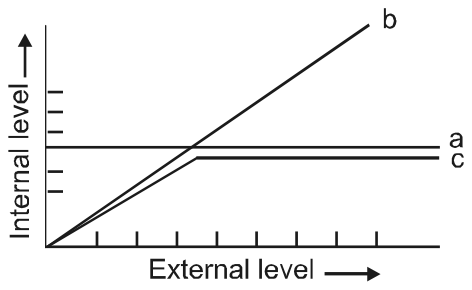
- 1a-regulator, b-partial regulator, c-Conformer
- 2a-partial regulator, b-regulator, c-Conformer
- 3a-regulator, b-conformer, c-partial regulator
- 4a-conformer, b-regulator, c-partial regulator
Show answer and solution
Correct: option 3, a-regulator, b-conformer, c-partial regulator
Line a is flat: the internal level stays constant whatever the external level, which is a regulator. Line b rises in step with the external level, which is a conformer. Line c follows the external level at first and then becomes constant, so the organism regulates only over a part of the range: a partial regulator.
Question 172AIPMT 2010 Prelims, Q172
Algae have cell wall made up of
- 1Hemicellulose, pectins and proteins
- 2pectins, cellulose and proteins
- 3Cellulose, hemicellulose and pectins
- 4Cellulose, galactans and mannans
Show answer and solution
Correct: option 4, Cellulose, galactans and mannans
The cell wall of algae is made of cellulose together with galactans, mannans and minerals such as calcium carbonate. The wall of other plants is made of cellulose, hemicellulose, pectins and proteins. So the option with galactans and mannans is the one for algae.
Question 173AIPMT 2010 Prelims, Q173
An improved variety of transgenic basmati rice
- 1gives high yield and is rich in vitamin A
- 2is completely resistant to all insect pests and diseases of paddy
- 3gives high yield but has no characteristic aroma
- 4does not require chemical fertilizers and growth hormones
Show answer and solution
Correct: option 1, gives high yield and is rich in vitamin A
Genetic modification has been used to raise the nutritional value of food, the known example in rice being vitamin A enriched (golden) rice, along with higher yield. No transgenic crop is completely resistant to all pests and diseases or free of the need for fertilizers, and losing the aroma would not be an improvement, so the first option is the right one.
Question 174AIPMT 2010 Prelims, Q174
In vitro fertilisation is a technique that involves transfer of which one of the following into the fallopian tube
- 1Either zygote or early embryo upto 8 cell stage
- 2Embryo of 32 cell stage
- 3Zygote only
- 4Embryo only, upto 8 cell stage
Show answer and solution
Correct: option 1, Either zygote or early embryo upto 8 cell stage
After fertilisation outside the body, the zygote or an early embryo with up to 8 blastomeres is put into the fallopian tube (ZIFT, zygote intra fallopian transfer). An embryo with more than 8 blastomeres is put into the uterus instead (IUT). So either a zygote or an embryo up to the 8 cell stage goes into the tube.
Question 175AIPMT 2010 Prelims, Q175
Listed below are four respiratory capacities (a-d) and four jumbled respiratory volumes of a normal human adult
| Respiratory capacities | Respiratory volumes |
|---|
| (a) Residual volume | 2500 mL |
| (b) Vital capacity | 3500 mL |
| (c) Inspiratory reserve volume | 1200 mL |
| (d) Inspiratory capacity | 4500 mL |
Which one of the following is the correct matching of two capacities and volumes
- 1(c) 1200 mL, (d) 2500 mL
- 2(d) 3500 mL, (a) 1200 mL
- 3(a) 4500 mL, (b) 3500 mL
- 4(b) 2500 mL, (c) 4500 mL
Show answer and solution
Correct: option 2, (d) 3500 mL, (a) 1200 mL
Residual volume is about 1100 to 1200 mL. Inspiratory reserve volume is 2500 to 3000 mL. Inspiratory capacity is tidal volume plus inspiratory reserve volume, about 500 + 3000 = 3500 mL. Vital capacity is about 4500 mL. Only the option giving inspiratory capacity 3500 mL and residual volume 1200 mL has both pairs right.
Question 176AIPMT 2010 Prelims, Q176
Membrane-bound organelles are absent in
- 1Streptococcus
- 2Chlamydomonas
- 3Plasmodium
- 4Saccharomyces
Show answer and solution
Correct: option 1, Streptococcus
Streptococcus is a bacterium, a prokaryote, and prokaryotic cells have no membrane-bound organelles. Chlamydomonas (an alga), Plasmodium (a protozoan) and Saccharomyces (yeast, a fungus) are all eukaryotes with a nucleus, mitochondria and other membrane-bound organelles.
Question 177AIPMT 2010 Prelims, Q177
The scutellum observed in a grain of wheat or maize is comparable to which part of the seed in other monocotyledons
- 1Endosperm
- 2Aleurone layer
- 3Plumule
- 4Cotyledon
Show answer and solution
Correct: option 4, Cotyledon
In the grass family the embryo has one large shield-shaped cotyledon lying to one side of the embryonal axis; it is called the scutellum. So the scutellum is the single cotyledon of the monocot seed.
Question 178AIPMT 2010 Prelims, Q178
Coiling of garden pea tendrils around any support is an example of
- 1Thigmonasty
- 2Thigmotropism
- 3Thermotaxis
- 4Thigmotaxis
Show answer and solution
Correct: option 2, Thigmotropism
A tendril that touches a support grows less on the side in contact and more on the other side, so it curls around the support. This is a growth movement whose direction is set by the stimulus of touch, which is thigmotropism. A nastic movement is not directional, and a taxis is the movement of a whole organism or cell.
Question 179AIPMT 2010 Prelims, Q179
Restriction endonucleases are enzymes which
- 1Recognize a specific nucleotide sequence for binding of DNA ligase
- 2Restrict the action of the enzyme DNA polymerase
- 3Remove nucleotides from the ends of the DNA molecule
- 4Make cuts at specific positions within the DNA molecule
Show answer and solution
Correct: option 4, Make cuts at specific positions within the DNA molecule
A restriction endonuclease recognises a specific palindromic sequence and cuts the sugar-phosphate backbone of both strands at fixed points inside the DNA. Enzymes that remove nucleotides from the ends are exonucleases.
Question 180AIPMT 2010 Prelims, Q180
If for some reason our goblet cells are non-functional, this will adversely affect
- 1secretion of sebum from the sebaceous glands
- 2maturation of sperms
- 3smooth movement of food down the intestine
- 4production of somatostatin
Show answer and solution
Correct: option 4, production of somatostatin
The answer key of the source copy gives production of somatostatin. Note that this does not agree with the textbook: goblet cells are the mucus-secreting cells of the lining of the gut, and mucus lubricates the food and protects the wall, so their failure would hinder the smooth movement of food down the intestine. Somatostatin comes from the hypothalamus and the delta cells of the pancreas, not from goblet cells.
Question 181AIPMT 2010 Prelims, Q181
Transfer of pollen grains from the anther to the stigma of another flower of the same plant is called
- 1Geitonogamy
- 2Karyogamy
- 3Autogamy
- 4Xenogamy
Show answer and solution
Correct: option 1, Geitonogamy
Autogamy is pollination within the same flower, geitonogamy is between two flowers of the same plant, and xenogamy is between flowers of two different plants. Karyogamy is the fusion of nuclei. The case described is geitonogamy.
Question 182AIPMT 2010 Prelims, Q182
One of the free-living anaerobic nitrogen-fixer is
- 1Rhodospirillum
- 2Rhizobium
- 3Azotobacter
- 4Beijerinckia
Show answer and solution
Correct: option 3, Azotobacter
The answer key of the source copy gives Azotobacter, which is a free-living nitrogen fixer of the soil. Note that the textbook lists Azotobacter and Beijerinckia as free-living aerobic nitrogen fixers and Rhodospirillum as the free-living anaerobic one, so Rhodospirillum is the answer that fits the word anaerobic. Rhizobium is symbiotic.
Question 183AIPMT 2010 Prelims, Q183
Photoperiodism was first characterised in
- 1Potato
- 2Tomato
- 3Cotton
- 4Tobacco
Show answer and solution
Correct: option 4, Tobacco
Garner and Allard (1920) found that the Maryland Mammoth variety of tobacco flowered only when the days were short. This was the first description of the control of flowering by day length, that is, photoperiodism.
Question 184AIPMT 2010 Prelims, Q184
Vasa efferentia are the ductules leading from
- 1Rete testis to vas deferens
- 2Vas deferens to epididymis
- 3Epididymis to urethra
- 4Testicular lobules to rete testis
Show answer and solution
Correct: option 1, Rete testis to vas deferens
The seminiferous tubules open into the rete testis, and the vasa efferentia leave the rete testis and open into the epididymis, which continues as the vas deferens. Of the choices given, only the first starts at the rete testis and leads on towards the vas deferens, so it is the best answer.
Question 185AIPMT 2010 Prelims, Q185
Which one of the following has its own DNA
- 1Dictyosome
- 2Lysosome
- 3Peroxisome
- 4Mitochondria
Show answer and solution
Correct: option 4, Mitochondria
The matrix of a mitochondrion holds a single circular DNA molecule, some RNA and 70S ribosomes, which is why mitochondria are called semi-autonomous. Dictyosomes (Golgi bodies), lysosomes and peroxisomes have no DNA.
Question 186AIPMT 2010 Prelims, Q186
Select the correct statement from the ones given below
- 1Morphine is often given to persons who have undergone surgery as a pain killer
- 2Chewing tobacco lowers blood pressure and heart rate
- 3Cocaine is given to patients after surgery as it stimulates recovery
- 4Barbiturates when given to criminals make them tell the truth
Show answer and solution
Correct: option 1, Morphine is often given to persons who have undergone surgery as a pain killer
Morphine is a very effective sedative and pain killer and is useful for patients who have undergone surgery. Nicotine in tobacco raises blood pressure and heart rate, cocaine is a stimulant drug of abuse and not a recovery medicine, and barbiturates are sedatives, so the other statements are wrong.
Question 187AIPMT 2010 Prelims, Q187
What is true about RBCs in humans
- 1They transport 99.5 per cent of
- 2They transport about 80 per cent oxygen only and the rest 20 per cent of it is transported in dissolved state in blood plasma
- 3They do not carry at all
- 4They carry about 20-25 per cent of
Show answer and solution
Correct: option 4, They carry about 20-25 per cent of
About 97 per cent of is carried by the haemoglobin of RBCs and about 3 per cent dissolved in plasma. Of the , about 20 to 25 per cent is carried by RBCs as carbamino-haemoglobin, about 70 per cent as bicarbonate and about 7 per cent dissolved in plasma. So the last statement is the true one.
Question 188AIPMT 2010 Prelims, Q188
Which one of the following statements about human sperm is correct.
- 1The sperm lysins in the acrosome dissolve the egg envelope facilitating fertilisation
- 2Acrosome serves as a sensory structure leading the sperm towards the ovum
- 3Acrosome serves no particular function
- 4Acrosome has a conical pointed structure used for piercing and penetrating the egg resulting in fertilisation.
Show answer and solution
Correct: option 1, The sperm lysins in the acrosome dissolve the egg envelope facilitating fertilisation
The acrosome is a cap over the sperm nucleus filled with enzymes (sperm lysins such as hyaluronidase). These dissolve the coverings of the ovum so that the sperm can enter. It is not a sense organ and does not pierce the egg mechanically.
Question 189AIPMT 2010 Prelims, Q189
The signals for parturition originate from
- 1Placenta as well as fully developed foetus
- 2Oxytocin released from maternal pituitary
- 3Fully developed foetus only
- 4Placenta only
Show answer and solution
Correct: option 2, Oxytocin released from maternal pituitary
The answer key of the source copy gives oxytocin released from the maternal pituitary; oxytocin makes the uterine muscle contract strongly and drives the expulsion of the baby. Note that the textbook says the signals for parturition originate from the fully developed foetus and the placenta, which set off the foetal ejection reflex, and the release of oxytocin is the result of that reflex. By the textbook the first option is the answer.
Question 190AIPMT 2010 Prelims, Q190
The common nitrogen-fixer in paddy fields is
- 1Azospirillum
- 2Oscillatoria
- 3Frankia
- 4Rhizobium
Show answer and solution
Correct: option 1, Azospirillum
Azospirillum is a nitrogen-fixing bacterium that lives in loose association with the roots of grasses and cereals such as rice. Rhizobium works in the root nodules of legumes and Frankia in the nodules of non-legumes such as Alnus, so neither suits paddy. Of the choices, Azospirillum is the one taken as the common nitrogen fixer of paddy fields.
Question 191AIPMT 2010 Prelims, Q191
Wind pollinated flowers are
- 1Small, producing large number of dry pollen grains
- 2Large producing abundant nectar and pollen
- 3Small, producing nectar and dry pollen
- 4Small, brightly coloured, producing large number of pollen grains
Show answer and solution
Correct: option 1, Small, producing large number of dry pollen grains
Wind-pollinated flowers do not need to attract animals, so they are small, not brightly coloured and have no nectar. They make very large numbers of light, dry, non-sticky pollen grains because most of them are lost in the air.
Question 192AIPMT 2010 Prelims, Q192
Ovary is half-inferior in the flowers of
- 1Plum
- 2Brinjal
- 3Cucumber
- 4Guava
Show answer and solution
Correct: option 4, Guava
The answer key of the source copy gives Guava. Note that this does not agree with the textbook: a half-inferior ovary is found in perigynous flowers, where the other floral parts sit on the rim of the thalamus at about the level of the ovary, as in plum, rose and peach. Guava and cucumber have an inferior ovary (epigynous flowers) and brinjal has a superior ovary. By the textbook the answer is Plum.
Question 193AIPMT 2010 Prelims, Q193
Genetic engineering has been successfully used for producing
- 1Transgenic models for studying new treatments for certain cardiac diseases
- 2Transgenic Cow-Rosie which produces high fat milk for making ghee
- 3Animals like bulls for farm work as they have super power
- 4Transgenic mice for testing safety of polio vaccine before use in humans
Show answer and solution
Correct: option 2, Transgenic Cow-Rosie which produces high fat milk for making ghee
The answer key of the source copy gives the transgenic cow Rosie. Rosie (1997) was indeed the first transgenic cow, but her milk was rich in a human protein, alpha-lactalbumin (2.4 g per litre), not in fat, so the statement as worded is not accurate. The textbook does describe transgenic mice being developed to test the safety of the polio vaccine before it is used on humans, which is the fourth option.
Question 194AIPMT 2010 Prelims, Q194
Which one of the following is one of the characteristics of a biological community
- 1Natality
- 2Mortality
- 3Sex-ratio
- 4Stratification
Show answer and solution
Correct: option 3, Sex-ratio
The answer key of the source copy gives sex-ratio. Note that natality, mortality and sex ratio are all attributes of a population, that is, of the individuals of one species. A community is made of many species, and its characteristics include species composition, dominance and stratification (the vertical layering of species), so Stratification is the answer that fits the textbook.
Question 195AIPMT 2010 Prelims, Q195
The genotype of a plant showing the dominant phenotype can be determined by
- 1Dihybrid cross
- 2Pedigree analysis
- 3Back cross
- 4Test cross
Show answer and solution
Correct: option 4, Test cross
A plant with the dominant phenotype may be homozygous or heterozygous. In a test cross it is crossed with the homozygous recessive parent: if all the offspring show the dominant trait it is homozygous, and if they come in a 1 : 1 ratio it is heterozygous.
Question 196AIPMT 2010 Prelims, Q196
DNA or RNA segment tagged with a radioactive molecule is called
- 1Probe
- 2Clone
- 3Plasmid
- 4Vector
Show answer and solution
Correct: option 1, Probe
A probe is a single-stranded piece of DNA or RNA carrying a radioactive label. It is allowed to hybridise with its complementary sequence and is then found by autoradiography, which is how a particular gene or a mutation is detected.
Question 197AIPMT 2010 Prelims, Q197
Which one of following statements is correct with respect of AIDS
- 1Drug addicts are least susceptible to HIV infection
- 2AIDS patients are being fully cured cent per cent with proper care and nutrition
- 3The causative HIV retrovirus enters helper T-lymphocyte thus reducing their numbers
- 4The HIV can be transmitted through eating food together with an infected person.
Show answer and solution
Correct: option 3, The causative HIV retrovirus enters helper T-lymphocyte thus reducing their numbers
HIV is a retrovirus. After multiplying in macrophages it enters helper T-lymphocytes, replicates in them and destroys them, so their number falls steadily and immunity is lost. Drug addicts who share needles are at high risk, AIDS has no complete cure, and HIV does not spread through food or casual contact.
Question 198AIPMT 2010 Prelims, Q198
Heartwood differs from sapwood in
- 1Absence of vessels and parenchyma
- 2Having dead and non-conducting elements
- 3Being susceptible to pests and pathogens
- 4Presence of rays and fibres
Show answer and solution
Correct: option 2, Having dead and non-conducting elements
Heartwood is the dark central wood of an old stem. Its elements are dead, plugged with tyloses and filled with tannins, resins and gums, so it does not conduct water and only gives mechanical support; these deposits also make it resistant to pests. Sapwood is the outer, lighter wood that still conducts water.
Question 199AIPMT 2010 Prelims, Q199
A renewable exhaustible natural resource is
- 1Petroleum
- 2Minerals
- 3Forest
- 4Coal
Show answer and solution
Correct: option 3, Forest
A forest can regrow, so it is renewable, but it can be used up if it is cut faster than it grows back, so it is also exhaustible. Petroleum, coal and minerals are non-renewable resources.
Question 200AIPMT 2010 Prelims, Q200
The part of Fallopian tube closest to the ovary is
- 1Infundibulum
- 2Cervix
- 3Ampulla
- 4Isthmus
Show answer and solution
Correct: option 1, Infundibulum
Starting from the ovary, the fallopian tube has a funnel-shaped infundibulum with finger-like fimbriae, then the wider ampulla, and last the narrow isthmus that joins the uterus. The cervix is a part of the uterus. So the infundibulum lies closest to the ovary.