AIPMT 2009 Prelims Physics questions
Question 1AIPMT 2009 Prelims, Q1
In the nuclear decay given below:
, the particles emitted in the sequence are:
- 1, ,
- 2, ,
- 3, ,
- 4, ,
Show answer and solution
Correct: option 4, , ,
In the first step rises by 1 with unchanged, which is emission. In the second step falls by 4 and by 2, which is emission. In the last step the excited nucleus drops to its ground state with and unchanged, which is emission. The order is , , .
Question 2AIPMT 2009 Prelims, Q2
A thin circular ring of mass M and radius R is rotating in a horizontal plane about an axis vertical to its plane with a constant angular velocity . If two objects each of mass m be attached gently to the opposite ends of a diameter of the ring, the ring will then rotate with an angular velocity:
- 1
- 2
- 3
- 4
Show answer and solution
Correct: option 1,
No external torque acts about the axis, so angular momentum is conserved. The moment of inertia changes from to . Hence , giving .
Question 3AIPMT 2009 Prelims, Q3
In thermodynamic processes which of the following statements is not true?
- 1In an isochoric process pressure remains constant
- 2In an isothermal process the temperature remains constant
- 3In an adiabatic process = constant
- 4In an adiabatic process the system is insulated from the surroundings
Show answer and solution
Correct: option 1, In an isochoric process pressure remains constant
In an isochoric process it is the volume that stays constant, not the pressure; constant pressure describes an isobaric process. The other three statements are correct descriptions of isothermal and adiabatic processes.
Question 4AIPMT 2009 Prelims, Q4
The number of photo electrons emitted for light of a frequency (higher than the threshold frequency ) is proportional to:
- 1Threshold frequency ()
- 2Intensity of light
- 3Frequency of light ()
- 4
Show answer and solution
Correct: option 2, Intensity of light
Above the threshold frequency each absorbed photon can release one electron, so the number of photoelectrons emitted per second depends on the number of photons arriving per second, that is, on the intensity of the light. The frequency only fixes the maximum kinetic energy of the electrons.
Question 5AIPMT 2009 Prelims, Q5
A simple pendulum performs simple harmonic motion about x = 0 with an amplitude a and time period T. The speed of pendulum at x = a/2 will be:
- 1
- 2
- 3
- 4
Show answer and solution
Correct: option 3,
In SHM with . At , .
Question 6AIPMT 2009 Prelims, Q6
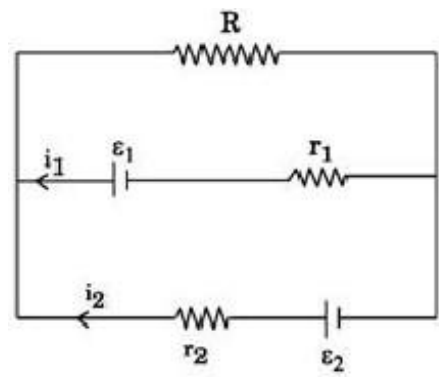
See the electric circuit shown in this Figure. Which of the following equations is a correct equation for it?
- 1
- 2
- 3
- 4
Show answer and solution
Correct: option 4,
The currents and meet at the left junction, so flows through . Going round the loop made of the branch and in the direction of the current, the cell raises the potential by and there are drops of across and across . Kirchhoff's loop rule gives .
Question 7AIPMT 2009 Prelims, Q7
A body, under the action of a force , acquires an acceleration of . The mass of this body must be:
- 110 kg
- 220 kg
- 3 kg
- 4 kg
Show answer and solution
Correct: option 3, kg
The magnitude of the force is . From with , the mass is kg.
Question 8AIPMT 2009 Prelims, Q8
The symbolic representation of four logic gates are given below:
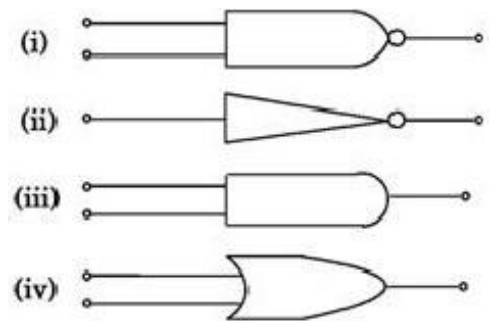
The logic symbols for OR, NOT and NAND gates are respectively:
- 1(iv), (i), (iii)
- 2(iv), (ii), (i)
- 3(i), (iii), (iv)
- 4(iii), (iv), (ii)
Show answer and solution
Correct: option 2, (iv), (ii), (i)
Symbol (i) is an AND shape with a bubble at the output, which is NAND. Symbol (ii) is a triangle with a bubble, which is NOT. Symbol (iii) is the plain AND gate and symbol (iv), with the curved input side, is OR. So OR, NOT and NAND are (iv), (ii) and (i).
Question 9AIPMT 2009 Prelims, Q9
If is the force acting on a particle having position vector and be the torque of this force about the origin, then:
- 1 and
- 2 and
- 3 and
- 4 and
Show answer and solution
Correct: option 2, and
Torque is , and a cross product is perpendicular to both of its factors. So is perpendicular to and to , and both dot products are zero.
Question 10AIPMT 2009 Prelims, Q10
The two ends of a rod of length L and a uniform cross-sectional area A are kept at two temperatures and (). The rate of heat transfer, through the rod in a steady state is given by:
- 1
- 2
- 3
- 4
Show answer and solution
Correct: option 3,
In steady-state conduction the heat current is proportional to the area and to the temperature gradient , with the thermal conductivity as the constant: .
Question 11AIPMT 2009 Prelims, Q11
A p-n photodiode is fabricated from a semiconductor with a band gap of 2.5 eV. It can detect a signal of wavelength:
- 14000 nm
- 26000 nm
- 34000 Å
- 46000 Å
Show answer and solution
Correct: option 3, 4000 Å
The photon energy must be at least the band gap, so the wavelength must not exceed Å. Of the options only 4000 Å is shorter than this, so only that signal is detected.
Question 12AIPMT 2009 Prelims, Q12
If the dimensions of a physical quantity are given by , then the physical quantity will be:
- 1Velocity if a = 1, b = 0, c = - 1
- 2Acceleration if a = 1, b = 1, c = - 2
- 3Force if a = 0, b = - 1, c = - 2
- 4Pressure if a = 1, b = - 1, c = - 2
Show answer and solution
Correct: option 4, Pressure if a = 1, b = - 1, c = - 2
Pressure is force per unit area: , so a = 1, b = -1, c = -2. The other options are wrong: velocity is , acceleration is and force is .
Question 13AIPMT 2009 Prelims, Q13
A transistor is operated in common-emitter configuration at V such that a change in the base current from 100 µA to 200 µA produces a change in the collector current from 5 mA to 10 mA. The current gain is:
- 1100
- 2150
- 350
- 475
Show answer and solution
Correct: option 3, 50
The common-emitter current gain is .
Question 14AIPMT 2009 Prelims, Q14
The mass of a lift is 2000 kg. When the tension in the supporting cable is 28000 N, then its acceleration is:
- 1 upwards.
- 2 downwards.
- 3 upwards.
- 4 downwards.
Show answer and solution
Correct: option 1, upwards.
Taking , the weight is 20000 N, which is less than the tension, so the net force is upward. gives upwards.
Question 15AIPMT 2009 Prelims, Q15
Four identical thin rods each of mass M and length l, form a square frame. Moment of inertia of this frame about an axis through the centre of the square and perpendicular to its plane is:
- 1
- 2
- 3
- 4
Show answer and solution
Correct: option 4,
Each rod has about its own centre, and its centre is from the centre of the square. By the parallel axis theorem each rod contributes . Four rods give .
Question 16AIPMT 2009 Prelims, Q16
Each of the two strings of length 51.6 cm and 49.1 cm are tensioned separately by 20 N force. Mass per unit length of both the strings is same and equal to 1 g/m. When both the strings vibrate simultaneously the number of beats is:
- 17
- 28
- 33
- 45
Show answer and solution
Correct: option 1, 7
The wave speed on each string is . The fundamental frequencies are Hz and Hz. The beat frequency is their difference, 7 per second.
Question 17AIPMT 2009 Prelims, Q17
The number of beta particles emitted by a radioactive substance is twice the number of alpha particles emitted by it. The resulting daughter is an:
- 1isomer of parent
- 2isotone of parent
- 3isotope of parent
- 4isobar of parent
Show answer and solution
Correct: option 3, isotope of parent
Each alpha emission lowers the atomic number by 2 and each beta emission raises it by 1. With two betas for every alpha the atomic number returns to its original value while the mass number falls by 4 per alpha. Same atomic number with a different mass number means the daughter is an isotope of the parent.
Question 18AIPMT 2009 Prelims, Q18
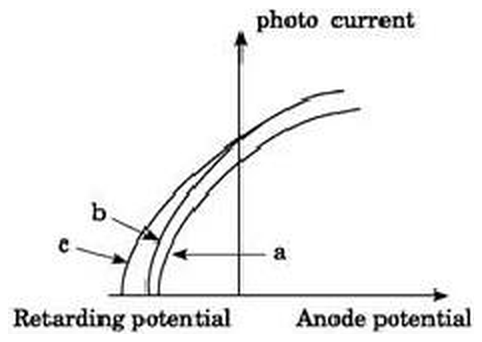
The Figure shows a plot of photo current versus anode potential for a photo sensitive surface for three different radiations. Which one of the following is a correct statement?
- 1curves (a) and (b) represent incident radiations of same frequency but of different intensities.
- 2curves (b) and (c) represent incident radiations of different frequencies and different intensities.
- 3curves (b) and (c) represent incident radiations of same frequency having same intensity.
- 4curves (a) and (b) represent incident radiations of different frequencies and different intensities.
Show answer and solution
Correct: option 1, curves (a) and (b) represent incident radiations of same frequency but of different intensities.
The stopping potential depends only on the frequency of the light, and the saturation current depends on its intensity. Curves (a) and (b) meet the potential axis at the same retarding potential, so they have the same frequency, but they rise to different currents, so their intensities differ. Curve (c) has a different stopping potential and therefore a different frequency.
Question 19AIPMT 2009 Prelims, Q19
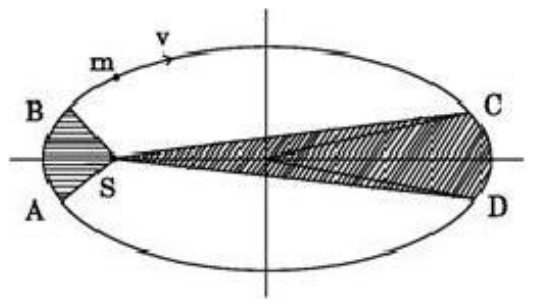
The Figure shows elliptical orbit of a planet m about the sun S. The shaded area SCD is twice the shaded area SAB. If is the time for the planet to move from C to D and is the time to move from A to B then:
- 1
- 2
- 3
- 4
Show answer and solution
Correct: option 2,
By Kepler's second law the line joining the sun and the planet sweeps out equal areas in equal times, so the time taken is proportional to the area swept. Area SCD is twice area SAB, hence .
Question 20AIPMT 2009 Prelims, Q20
A black body at 227°C radiates heat at the rate of 7 Cals/cms. At a temperature of 727°C, the rate of heat radiated in the same units will be:
- 150
- 2112
- 380
- 460
Show answer and solution
Correct: option 2, 112
By Stefan's law the power radiated per unit area is proportional to with in kelvin. The temperatures are 500 K and 1000 K, so the rate rises by a factor , giving .
Question 21AIPMT 2009 Prelims, Q21
The driver of a car travelling with speed 30 m/sec towards a hill sounds a horn of frequency 600 Hz. If the velocity of sound in air is 330 m/s, the frequency of reflected sound as heard by driver is:
- 1555.5 Hz
- 2720 Hz
- 3500 Hz
- 4550 Hz
Show answer and solution
Correct: option 2, 720 Hz
The hill receives sound from an approaching source and reflects it to an approaching observer, so Hz.
Question 22AIPMT 2009 Prelims, Q22
A wire of resistance 12 ohms per meter is bent to form a complete circle of radius 10 cm. The resistance between its two diametrically opposite points, A and B as shown in the Figure, is:
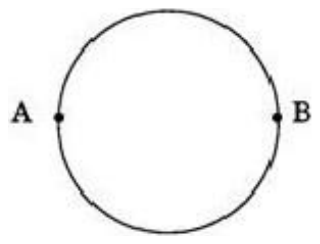
- 1
- 2
- 3
- 4
Show answer and solution
Correct: option 1,
The wire has length m, so its resistance is . Between A and B the two halves, each , are in parallel, which works out to , option (4). The answer key available for this paper marks option (1), , and that is the answer recorded here; the working above does not support it.
Question 23AIPMT 2009 Prelims, Q23
A rectangular, a square, a circular and an elliptical loop, all in the (x - y) plane, are moving out of a uniform magnetic field with a constant velocity, . The magnetic field is directed along the negative z axis direction. The induced emf, during the passage of these loops, out of the field region, will not remain constant for:
- 1the circular and the elliptical loops.
- 2only the elliptical loop.
- 3any of the four loops.
- 4the rectangular, circular and elliptical loops.
Show answer and solution
Correct: option 3, any of the four loops.
The emf is , where is the length of the loop cut by the edge of the field. For a rectangular or square loop with sides along the axes this length stays the same while the loop leaves, so the emf is constant; for a circular or elliptical loop the length changes continuously, so the emf varies. This working points to option (1). The answer key available for this paper marks option (3), and that is the answer recorded here; the working above does not support it.
Question 24AIPMT 2009 Prelims, Q24
A galvanometer having a coil resistance of shows full scale deflection when a current of 1.0 amp passes through it. It can be converted into an ammeter to read currents upto 5.0 amp by:
- 1putting in series a resistance of
- 2putting in series a resistance of
- 3putting in parallel a resistance of
- 4putting in parallel a resistance of
Show answer and solution
Correct: option 3, putting in parallel a resistance of
An ammeter needs a shunt in parallel that carries the extra current. At full scale the coil carries 1 A and the shunt 4 A, with the same potential difference across both: , so in parallel.
Question 25AIPMT 2009 Prelims, Q25
Power dissipated in an LCR series circuit connected to an a.c source of emf is:
- 1
- 2
- 3
- 4
Show answer and solution
Correct: option 4,
The impedance is , the current is and power is dissipated only in the resistance. So .
Question 26AIPMT 2009 Prelims, Q26
Three concentric spherical shells have radii a, b and c (a < b < c) and have surface charge densities , and respectively. If , and denote the potentials of the three shells, then for c = a + b, we have:
- 1
- 2
- 3
- 4
Show answer and solution
Correct: option 4,
A shell of radius and charge density gives potential at points inside it and at distance outside. Adding the three shells: , and . With , , so , while differs because .
Question 27AIPMT 2009 Prelims, Q27
An engine pumps water continuously through a hose. Water leaves the hose with a velocity v and m is the mass per unit length of the water jet. What is the rate at which kinetic energy is imparted to water?
- 1
- 2
- 3
- 4
Show answer and solution
Correct: option 4,
In one second a length of the jet leaves the hose, so the mass leaving per second is . Each unit of mass carries kinetic energy , so the kinetic energy given per second is .
Question 28AIPMT 2009 Prelims, Q28
A bar magnet having a magnetic moment of is free to rotate in a horizontal plane. A horizontal magnetic field T exists in the space. The work done in taking the magnet slowly from a direction parallel to the field to a direction 60° from the field is:
- 112 J
- 26 J
- 32 J
- 40.6 J
Show answer and solution
Correct: option 2, 6 J
The potential energy of a magnet in a field is , so the work done in turning it from 0° to 60° is J.
Question 29AIPMT 2009 Prelims, Q29
In a Rutherford scattering experiment when a projectile of charge and mass approaches a target nucleus of charge and mass , the distance of closest approach is . The energy of the projectile is:
- 1directly proportional to
- 2inversely proportional to
- 3directly proportional to mass
- 4directly proportional to
Show answer and solution
Correct: option 1, directly proportional to
At the distance of closest approach all the kinetic energy of the projectile has become electrostatic potential energy: . For a given the energy is therefore directly proportional to and does not depend on the masses.
Question 30AIPMT 2009 Prelims, Q30
Monochromatic light of wavelength 667 nm is produced by a helium neon laser. The power emitted is 9 mW. The number of photons arriving per sec. on the average at a target irradiated by this beam is:
- 1
- 2
- 3
- 4
Show answer and solution
Correct: option 1,
Each photon has energy J. The number arriving per second is .
Question 31AIPMT 2009 Prelims, Q31
A wave in a string has an amplitude of 2 cm. The wave travels in the + ve direction of x axis with a speed of 128 m/sec. and it is noted that 5 complete waves fit in 4 m length of the string. The equation describing the wave is:
- 1
- 2
- 3
- 4
Show answer and solution
Correct: option 3,
Five waves in 4 m means m, so and . A wave moving in the +x direction has the form , so .
Question 32AIPMT 2009 Prelims, Q32
Which one of the following equations of motion represents simple harmonic motion?
Where , , and are all positive.
- 1acceleration =
- 2acceleration =
- 3acceleration =
- 4acceleration =
Show answer and solution
Correct: option 1, acceleration =
SHM needs an acceleration proportional to the displacement from a fixed point and directed towards it. Writing , the first equation is acceleration , which is SHM about . In the second and third the acceleration is directed away from the equilibrium point, and the fourth is not linear in .
Question 33AIPMT 2009 Prelims, Q33
A student measures the terminal potential difference (V) of a cell (of emf and internal resistance r) as a function of the current (I) flowing through it. The slope, and intercept, of the graph between V and I, then, respectively, equal:
- 1 and
- 2 and
- 3 and
- 4 and
Show answer and solution
Correct: option 1, and
For a cell delivering current, . Compared with the straight line with on the y axis and on the x axis, the slope is and the intercept on the V axis is .
Question 34AIPMT 2009 Prelims, Q34
If a diamagnetic substance is brought near the north or the south pole of a bar magnet, it is:
- 1repelled by the north pole and attracted by the south pole
- 2attracted by the north pole and repelled by the south pole
- 3attracted by both the poles
- 4repelled by both the poles
Show answer and solution
Correct: option 4, repelled by both the poles
A diamagnetic substance is magnetised opposite to the applied field, whatever the direction of that field, so it is pushed from the stronger to the weaker part of the field. It is therefore repelled by either pole of the magnet.
Question 35AIPMT 2009 Prelims, Q35
A bus is moving with a speed of on a straight road. A scooterist wishes to overtake the bus in 100 s. If the bus is at a distance of 1 km from the scooterist, with what speed should the scooterist chase the bus?
- 1
- 2
- 3
- 4
Show answer and solution
Correct: option 4,
The scooterist must close a gap of 1000 m in 100 s, so the speed relative to the bus must be . Adding the speed of the bus, the scooterist needs .
Question 36AIPMT 2009 Prelims, Q36
Sodium has body centred packing. Distance between two nearest atoms is 3.7 Å. The lattice parameter is:
- 14.3 Å
- 23.0 Å
- 38.6 Å
- 46.8 Å
Show answer and solution
Correct: option 1, 4.3 Å
In a body centred cubic cell the nearest neighbours are a corner atom and the body-centre atom, half a body diagonal apart: . So Å.
Question 37AIPMT 2009 Prelims, Q37
The internal energy change in a system that has absorbed 2 Kcals of heat and done 500 J of work is:
- 16400 J
- 25400 J
- 37900 J
- 48900 J
Show answer and solution
Correct: option 3, 7900 J
The heat absorbed is J. By the first law, J.
Question 38AIPMT 2009 Prelims, Q38
Three capacitors each of capacitance C and of breakdown voltage V are joined in series. The capacitance and breakdown voltage of the combination will be:
- 1,
- 2,
- 3,
- 4,
Show answer and solution
Correct: option 2, ,
For equal capacitors in series , so . The applied voltage divides equally among the three, so each reaches its limit only when the total is .
Question 39AIPMT 2009 Prelims, Q39
An explosion blows a rock into three parts. Two parts go off at right angles to each other. These two are, 1 kg first part moving with a velocity of and 2 kg second part moving with a velocity of . If the third part flies off with a velocity of , its mass would be:
- 17 kg
- 217 kg
- 33 kg
- 45 kg
Show answer and solution
Correct: option 4, 5 kg
The rock starts at rest, so the momentum of the third part must balance the resultant of the other two. Their momenta are and at right angles, with resultant . Hence and kg.
Question 40AIPMT 2009 Prelims, Q40
A particle starts its motion from rest under the action of a constant force. If the distance covered in first 10 seconds is and that covered in the first 20 seconds is , then:
- 1
- 2
- 3
- 4
Show answer and solution
Correct: option 2,
A constant force gives a constant acceleration, and starting from rest , so distance is proportional to . Doubling the time from 10 s to 20 s makes the distance four times as large: .
Question 41AIPMT 2009 Prelims, Q41
A body of mass 1 kg is thrown upwards with a velocity 20 m/s. It momentarily comes to rest after attaining a height of 18 m. How much energy is lost due to air friction? ()
- 130 J
- 240 J
- 310 J
- 420 J
Show answer and solution
Correct: option 4, 20 J
The initial kinetic energy is J. At the top the body has only potential energy J. The difference, J, is lost to air friction.
Question 42AIPMT 2009 Prelims, Q42
A conducting circular loop is placed in a uniform magnetic field 0.04 T with its plane perpendicular to the magnetic field. The radius of the loop starts shrinking at 2 mm/s. The induced emf in the loop when the radius is 2 cm is:
- 1
- 2
- 3
- 4
Show answer and solution
Correct: option 4,
The flux is , so the emf has magnitude V, that is .
Question 43AIPMT 2009 Prelims, Q43
The magnetic force acting on a charged particle of charge in a magnetic field of 2 T acting in y direction, when the particle velocity is , is:
- 14 N in z direction
- 28 N in y direction
- 38 N in z direction
- 48 N in - z direction
Show answer and solution
Correct: option 4, 8 N in - z direction
. Here , because and . Multiplying by C gives N, that is 8 N in the direction.
Question 44AIPMT 2009 Prelims, Q44
Two bodies of mass 1 kg and 3 kg have position vectors and , respectively. The centre of mass of this system has a position vector:
- 1
- 2
- 3
- 4
Show answer and solution
Correct: option 1,
.
Question 45AIPMT 2009 Prelims, Q45
The electric potential at a point (x, y, z) is given by
The electric field at that point is:
- 1
- 2
- 3
- 4
Show answer and solution
Correct: option 4,
The field is the negative gradient of the potential. , and . So .
Question 46AIPMT 2009 Prelims, Q46
The mean free path of electrons in a metal is m. The electric field which can give on an average 2 eV energy to an electron in the metal will be in units of V/m:
- 1
- 2
- 3
- 4
Show answer and solution
Correct: option 3,
Between collisions an electron travels one mean free path and gains energy . For this to be 2 eV the potential drop over that distance must be 2 V: V/m.
Question 47AIPMT 2009 Prelims, Q47
The ionization energy of the electron in the hydrogen atom in its ground state is 13.6 eV. The atoms are excited to higher energy levels to emit radiations of 6 wavelengths. Maximum wavelength of emitted radiation corresponds to the transition between:
- 1n = 3 to n = 1 states
- 2n = 2 to n = 1 states
- 3n = 4 to n = 3 states
- 4n = 3 to n = 2 states
Show answer and solution
Correct: option 3, n = 4 to n = 3 states
Atoms excited to level can emit different lines; 6 lines means . The longest wavelength belongs to the transition with the smallest energy gap, which among levels 1 to 4 is n = 4 to n = 3.
Question 48AIPMT 2009 Prelims, Q48
Under the influence of a uniform magnetic field, a charged particle moves with constant speed V in a circle of radius R. The time period of rotation of the particle:
- 1depends on R and not on V
- 2is independent of both V and R
- 3depends on both V and R
- 4depends on V and not on R
Show answer and solution
Correct: option 2, is independent of both V and R
The magnetic force supplies the centripetal force, , so . The period is , which contains neither V nor R.
Question 49AIPMT 2009 Prelims, Q49
The electric field part of an electromagnetic wave in a medium is represented by ;
;
. The wave is:
- 1moving along x direction with frequency Hz and wave length 100 m.
- 2moving along x direction with frequency Hz and wave length 200 m.
- 3moving along - x direction with frequency Hz and wave length 200 m.
- 4moving along y direction with frequency Hz and wave length 200 m.
Show answer and solution
Correct: option 2, moving along x direction with frequency Hz and wave length 200 m.
The phase has the form , which is a wave travelling in the +x direction. The coefficient of gives , so Hz. The coefficient of gives , so m.
Question 50AIPMT 2009 Prelims, Q50
A block of mass M is attached to the lower end of a vertical spring. The spring is hung from a ceiling and has force constant value k. The mass is released from rest with the spring initially unstretched. The maximum extension produced in the length of the spring will be:
- 1
- 2
- 3
- 4
Show answer and solution
Correct: option 4,
At the lowest point the block is momentarily at rest, so the gravitational energy lost equals the energy stored in the spring: , giving , option (1). is the extension at the equilibrium position, about which the block oscillates. The answer key available for this paper marks option (4), , and that is the answer recorded here; the working above does not support it as the maximum extension.
AIPMT 2009 Prelims Chemistry questions
Question 51AIPMT 2009 Prelims, Q151
The state of hybridization of , , and of the hydrocarbon,
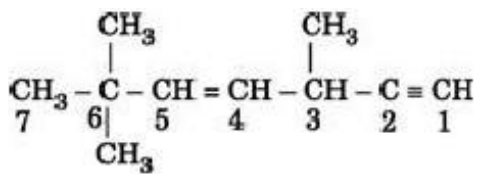
is in the following sequence:
- 1, , and
- 2, , and
- 3, , and
- 4, , and
Show answer and solution
Correct: option 4, , , and
Count the sigma bonds on each carbon. is part of the triple bond, so it is . has four single bonds, so it is . is part of the double bond, so it is . carries four single bonds (three methyl groups and ), so it is .
Question 52AIPMT 2009 Prelims, Q152
Oxidation numbers of P in , of S in and that of Cr in , are respectively:
- 1+3, +6 and +5
- 2+5, +3 and +6
- 3-3, +6 and +6
- 4+5, +6 and +6
Show answer and solution
Correct: option 4, +5, +6 and +6
Take oxygen as and make the sum equal the charge. For : , so P is . For : , so S is . For : , so Cr is .
Question 53AIPMT 2009 Prelims, Q153
Lithium metal crystallises in a body centred cubic crystal. If the length of the side of the unit cell of lithium is 351 pm, the atomic radius of the lithium will be:
- 1151.8 pm
- 275.5 pm
- 3300.5 pm
- 4240.8 pm
Show answer and solution
Correct: option 1, 151.8 pm
In a body centred cubic cell the atoms touch along the body diagonal, so . Then , which matches 151.8 pm.
Question 54AIPMT 2009 Prelims, Q154
Which of the following reactions is an example of nucleophilic substitution reaction?
- 1
- 2
- 3
- 4
Show answer and solution
Correct: option 4,
In the nucleophile attacks the carbon and replaces the halide ion, which is a nucleophilic substitution. The first is the Wurtz coupling, the second is a reduction and the third is the formation of a Grignard reagent.
Question 55AIPMT 2009 Prelims, Q155
In the case of alkali metals, the covalent character decreases in the order:
- 1MF > MCl > MBr > MI
- 2MF > MCl > MI > MBr
- 3MI > MBr > MCl > MF
- 4MCl > MI > MBr > MF
Show answer and solution
Correct: option 3, MI > MBr > MCl > MF
By the Fajans rules a larger anion is more easily polarised by the cation, which gives more covalent character. The iodide ion is the largest and the fluoride ion the smallest, so covalent character falls in the order MI > MBr > MCl > MF.
Question 56AIPMT 2009 Prelims, Q156
Which one of the elements with the following outer orbital configurations may exhibit the largest number of oxidation states?
- 1
- 2
- 3
- 4
Show answer and solution
Correct: option 2,
The number of oxidation states grows with the number of and unpaired electrons that can be used. (manganese) has seven such electrons and shows states from to , more than chromium (, up to ), titanium (, up to ) or vanadium (, up to ).
Question 57AIPMT 2009 Prelims, Q157
The stability of +1 oxidation state increases in the sequence:
- 1Tl < In < Ga < Al
- 2In < Tl < Ga < Al
- 3Ga < In < Al < Tl
- 4Al < Ga < In < Tl
Show answer and solution
Correct: option 4, Al < Ga < In < Tl
Down group 13 the pair is held more and more firmly and takes less part in bonding (the inert pair effect). So the state becomes steadily more stable from Al to Tl: Al < Ga < In < Tl.
Question 58AIPMT 2009 Prelims, Q158
Given:
(i) ,
(ii) ,
Electrode potential, for the reaction, , will be:
- 10.90 V
- 20.30 V
- 30.38 V
- 40.52 V
Show answer and solution
Correct: option 4, 0.52 V
Electrode potentials do not add directly, but does. Reaction (i) minus reaction (ii) gives , so , about 0.52 V.
Question 59AIPMT 2009 Prelims, Q159
For the reaction , if , the value of would be:
- 1
- 2
- 3
- 4
Show answer and solution
Correct: option 4,
The rate is . So .
Question 60AIPMT 2009 Prelims, Q160
Consider the following reaction,
;
the product Z is:
- 1
- 2
- 3
- 4
Show answer and solution
Correct: option 3,
turns ethanol into bromoethane (X). Alcoholic KOH removes HBr to give ethene (Y). Ethene adds cold sulphuric acid to form ethyl hydrogen sulphate, and heating this with water hydrolyses it to ethanol, so Z is .
Question 61AIPMT 2009 Prelims, Q161
The energy absorbed by each molecule () of a substance is and bond energy per molecule is . The kinetic energy of the molecule per atom will be:
- 1
- 2
- 3
- 4
Show answer and solution
Correct: option 4,
The energy left after breaking the bond is . It is shared by the two atoms, so each atom gets .
Question 62AIPMT 2009 Prelims, Q162
Amongst the elements with following electronic configurations, which one of them may have the highest ionization energy?
- 1Ne
- 2Ar
- 3Ne
- 4Ne
Show answer and solution
Correct: option 4, Ne
The configurations are Si, As, Al and P. Ionization energy rises across a period and falls down a group, and a half-filled subshell is extra stable. Phosphorus () is furthest right in the third period, lies above arsenic and has the half-filled subshell, so it has the highest value.
Question 63AIPMT 2009 Prelims, Q163
In the reaction . The rate of appearance of bromine () is related to rate of disappearance of bromide ions as following:
- 1
- 2
- 3
- 4
Show answer and solution
Correct: option 4,
The rate of reaction is . So ; the minus sign is there because the bromide concentration falls while bromine forms.
Question 64AIPMT 2009 Prelims, Q164
A 0.0020 m aqueous solution of an ionic compound freezes at . Number of moles of ions which 1 mol of ionic compound produces on being dissolved in water will be ()
- 13
- 24
- 31
- 42
Show answer and solution
Correct: option 4, 2
, so . The compound therefore gives two ions, and .
Question 65AIPMT 2009 Prelims, Q165
What is the dominant intermolecular force or bond that must be overcome in converting liquid to a gas?
- 1Dipole-dipole interaction
- 2Covalent bonds
- 3London dispersion force
- 4Hydrogen bonding
Show answer and solution
Correct: option 4, Hydrogen bonding
Methanol has an group, so its molecules are held together mainly by hydrogen bonds. These are the strongest attraction between the molecules and must be broken on vaporisation; the covalent bonds inside each molecule stay intact.
Question 66AIPMT 2009 Prelims, Q166
Which of the following oxides is not expected to react with sodium hydroxide?
- 1
- 2
- 3
- 4
Show answer and solution
Correct: option 1,
Sodium hydroxide is a base, so it reacts with acidic and amphoteric oxides. and are acidic and is amphoteric, but is a basic oxide and does not react with it.
Question 67AIPMT 2009 Prelims, Q167
The segment of DNA which acts as the instrumental manual for the synthesis of the protein is:
- 1ribose
- 2gene
- 3nucleoside
- 4nucleotide
Show answer and solution
Correct: option 2, gene
A gene is the stretch of DNA whose base sequence codes for one protein. Ribose is a sugar, a nucleoside is a base joined to a sugar, and a nucleotide is a nucleoside with a phosphate group; these are only building units.
Question 68AIPMT 2009 Prelims, Q168
Maximum number of electrons in a subshell of an atom is determined by the following:
- 1
- 2
- 3
- 4
Show answer and solution
Correct: option 4,
A subshell with azimuthal quantum number has orbitals, and each orbital holds two electrons. The maximum is therefore .
Question 69AIPMT 2009 Prelims, Q169
Half life period of a first-order reaction is 1386 seconds. The specific rate constant of the reaction is:
- 1
- 2
- 3
- 4
Show answer and solution
Correct: option 2,
For a first-order reaction , which is .
Question 70AIPMT 2009 Prelims, Q170
Which one of the following is employed as a tranquilizer?
- 1Naproxen
- 2Tetracycline
- 3Chlorpheninamine
- 4Equanil
Show answer and solution
Correct: option 4, Equanil
Equanil (meprobamate) is a tranquilizer used to relieve anxiety and tension. Naproxen is a pain reliever, tetracycline is an antibiotic and chlorpheniramine is an antihistamine.
Question 71AIPMT 2009 Prelims, Q171
is reduced by electrolysis at low potentials and high currents. If amperes of current is passed through molten for 6 hours, what mass of aluminium is produced? (Assume 100% current efficiency. At. mass of Al = )
- 1
- 2
- 3
- 4
Show answer and solution
Correct: option 1,
Charge passed , which is mol of electrons. , so moles of Al and the mass is .
Question 72AIPMT 2009 Prelims, Q172
Benzene reacts with in the presence of anhydrous to form:
- 1Chlorobenzene
- 2Benzylchloride
- 3Xylene
- 4Toluene
Show answer and solution
Correct: option 4, Toluene
This is Friedel-Crafts alkylation. helps give a methyl electrophile, which replaces one hydrogen of the ring to form methylbenzene, that is toluene.
Question 73AIPMT 2009 Prelims, Q173
Which of the following is not permissible arrangement of electrons in an atom?
- 1
- 2
- 3
- 4
Show answer and solution
Correct: option 2,
For a given , can only take the values from to . With the lowest value is , so is not allowed. The other three sets obey , and .
Question 74AIPMT 2009 Prelims, Q174
The dissociation constants for acetic acid and HCN at are and respectively. The equilibrium constant for the equilibrium
would be:
- 1
- 2
- 3
- 4
Show answer and solution
Correct: option 3,
The equilibrium is the dissociation of acetic acid plus the reverse of the dissociation of HCN. So , and the nearest option is .
Question 75AIPMT 2009 Prelims, Q175
Propionic acid with yields a dibromo product. Its structure would be:
- 1
- 2
- 3
- 4
Show answer and solution
Correct: option 3,
Bromine with red phosphorus is the Hell-Volhard-Zelinsky reaction, which replaces only the hydrogens on the carbon next to the group. Propionic acid has two such hydrogens, so the dibromo product is .
Question 76AIPMT 2009 Prelims, Q176
The values of and for the reaction, are 170 kJ and , respectively. This reaction will be spontaneous at
- 1910 K
- 21110 K
- 3510 K
- 4710 K
Show answer and solution
Correct: option 2, 1110 K
The reaction is spontaneous when , that is when . Only 1110 K is above 1000 K.
Question 77AIPMT 2009 Prelims, Q177
Copper crystallises in a face-centred cubic lattice with a unit cell length of 361 pm. What is the radius of copper atom in pm?
- 1157
- 2181
- 3108
- 4128
Show answer and solution
Correct: option 4, 128
In a face-centred cubic cell the atoms touch along the face diagonal, so . Then .
Question 78AIPMT 2009 Prelims, Q178
- 1
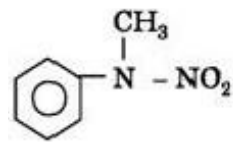
- 2
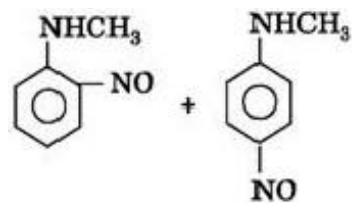
- 3
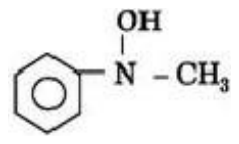
- 4
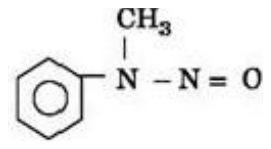
Show answer and solution
Correct: option 4
N-methylaniline is a secondary amine. Nitrous acid, made from and HCl, puts a nitroso group on the nitrogen of a secondary amine, giving the N-nitroso compound (a yellow oil). No diazonium salt forms because the nitrogen has only one hydrogen.
Question 79AIPMT 2009 Prelims, Q179
on heating with periodic acid gives:
- 1
- 2
- 3
- 4
Show answer and solution
Correct: option 3,
Periodic acid breaks the carbon-carbon bond between two neighbouring carbons that each carry an group, and turns each carbon into a carbonyl group. Ethylene glycol therefore gives two molecules of formaldehyde, HCHO.
Question 80AIPMT 2009 Prelims, Q180
According to MO theory which of the following lists ranks the nitrogen species in terms of increasing bond order?
- 1
- 2
- 3
- 4
Show answer and solution
Correct: option 1,
has bond order 3. Each added electron goes into an antibonding orbital and lowers the bond order by 0.5, so has 2.5 and has 2. The increasing order is .
Question 81AIPMT 2009 Prelims, Q181
Out of , , and (Z of Ti = 22, Co = 27, Cu = 29, Ni = 28) the colourless species are:
- 1 and
- 2 and
- 3 and
- 4 and
Show answer and solution
Correct: option 2, and
Colour needs a partly filled subshell so that - transitions can happen. in is and in is , so both are colourless. () and () have unpaired electrons and are coloured.
Question 82AIPMT 2009 Prelims, Q182
Which of the following molecules acts as a Lewis acid?
- 1
- 2
- 3
- 4
Show answer and solution
Correct: option 4,
A Lewis acid accepts an electron pair. Boron in has only six electrons in its valence shell and an empty orbital, so it accepts a pair. The O, P and N compounds have lone pairs and act as Lewis bases.
Question 83AIPMT 2009 Prelims, Q183
The IUPAC name of the compound having the formula is:
- 11-butyn-3-ene
- 2but-1-yne-3-ene
- 31-butene-3-yne
- 43-butene-1-yne
Show answer and solution
Correct: option 3, 1-butene-3-yne
The chain has four carbons with one double and one triple bond. When numbering from either end gives the same set of positions, the double bond gets the lower number, and the ending for the double bond is written before the ending for the triple bond. So the name is 1-butene-3-yne (but-1-en-3-yne).
Question 84AIPMT 2009 Prelims, Q184
Which of the following compounds will exhibit cis-trans (geometrical) isomerism?
- 1Butanol
- 22-Butyne
- 32-Butenol
- 42-Butene
Show answer and solution
Correct: option 4, 2-Butene
Geometrical isomerism needs a double bond with two different groups on each doubly bonded carbon. In 2-butene, , each carbon carries H and , so cis and trans forms exist. Butanol has no double bond and 2-butyne is linear about its triple bond.
Question 85AIPMT 2009 Prelims, Q185
Which of the following does not show optical isomerism?
- 1
- 2
- 3
- 4 (en = ethylenediamine)
Show answer and solution
Correct: option 1,
is of the type ; both its facial and meridional forms have a plane of symmetry, so neither is optically active. The complexes with the chelating ligand en can form non-superimposable mirror images, for example and the cis form of .
Question 86AIPMT 2009 Prelims, Q186
Structures of some common polymers are given. Which one is not correctly presented?
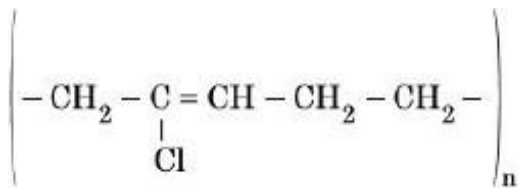
- 1Neoprene
- 2Terylene

- 3Nylon 66

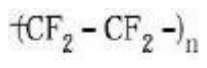
- 4Teflon
Show answer and solution
Correct: option 1, Neoprene
Neoprene is the polymer of chloroprene, , so its repeating unit is with four carbons in the chain. The structure shown has an extra group, so it is the wrong one. The units shown for terylene, nylon 66 and teflon are the usual ones.
Question 87AIPMT 2009 Prelims, Q187
The ionization constant of ammonium hydroxide is at 298 K. Hydrolysis constant of ammonium chloride is:
- 1
- 2
- 3
- 4
Show answer and solution
Correct: option 4,
Ammonium chloride is a salt of a weak base and a strong acid, so .
Question 88AIPMT 2009 Prelims, Q188
Consider the following reaction:
,
the product Z is:
- 1Benzaldehyde
- 2Benzoic acid
- 3Benzene
- 4Toluene
Show answer and solution
Correct: option 2, Benzoic acid
Zinc dust removes the oxygen of phenol to give benzene (X). Friedel-Crafts methylation with and gives toluene (Y). Alkaline oxidises the methyl side chain fully to , so Z is benzoic acid.
Question 89AIPMT 2009 Prelims, Q189
The equivalent conductance of M/32 solution of a weak monobasic acid is and at infinite dilution is . The dissociation constant of this acid is:
- 1
- 2
- 3
- 4
Show answer and solution
Correct: option 4,
Degree of dissociation . For a weak acid .
Question 90AIPMT 2009 Prelims, Q190
The straight chain polymer is formed by:
- 1hydrolysis of followed by condensation polymerisation
- 2hydrolysis of by addition polymerisation
- 3hydrolysis of followed by condensation polymerisation
- 4hydrolysis of followed by condensation polymerisation
Show answer and solution
Correct: option 3, hydrolysis of followed by condensation polymerisation
hydrolyses to , which has two groups and so joins at both ends into a straight silicone chain. gives three groups and a cross-linked polymer, gives only a dimer (it ends chains), and does not hydrolyse.
Question 91AIPMT 2009 Prelims, Q191
From the following bond energies:
bond energy:
bond energy:
bond energy:
bond energy:
Enthalpy for the reaction,
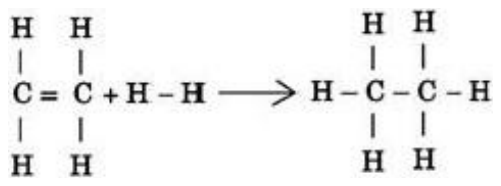
- 1
- 2
- 3
- 4
Show answer and solution
Correct: option 2,
= energy of bonds broken minus energy of bonds formed. Broken: one and one , . Formed: one and two , . So .
Question 92AIPMT 2009 Prelims, Q192
10 g of hydrogen and 64 g of oxygen were filled in a steel vessel and exploded. Amount of water produced in this reaction will be:
- 13 mol
- 24 mol
- 31 mol
- 42 mol
Show answer and solution
Correct: option 2, 4 mol
There are mol of and mol of . In , 2 mol of needs only 4 mol of , so oxygen is the limiting reagent and 4 mol of water forms.
Question 93AIPMT 2009 Prelims, Q193
Among the following which is the strongest oxidising agent?
- 1
- 2
- 3
- 4
Show answer and solution
Correct: option 4,
Fluorine has the highest standard reduction potential of the halogens (), helped by its weak bond and the high hydration energy of the small ion. It accepts electrons most readily, so is the strongest oxidising agent.
Question 94AIPMT 2009 Prelims, Q194
In which of the following molecules / ions , , and , the central atom is hybridized?
- 1 and
- 2 and
- 3 and
- 4 and
Show answer and solution
Correct: option 3, and
Count sigma bonds plus lone pairs on the central atom. B in has 3 bonds and no lone pair, and N in has 2 bonds and 1 lone pair: three in each case, so both are . and have 2 bonds and 2 lone pairs, which is .
Question 95AIPMT 2009 Prelims, Q195
Nitrobenzene can be prepared from benzene by using a mixture of conc. and conc. in the mixture, nitric acid acts as a/an:
- 1acid
- 2base
- 3catalyst
- 4reducing agent
Show answer and solution
Correct: option 2, base
Sulphuric acid is the stronger acid, so it gives a proton to nitric acid: , and then loses water to give the electrophile . Nitric acid accepts the proton, so it acts as a base.
Question 96AIPMT 2009 Prelims, Q196
Which of the following complex ions is expected to absorb visible light?
- 1
- 2
- 3
- 4
Show answer and solution
Correct: option 2,
Absorption of visible light comes from - transitions, which need a partly filled subshell. is , so its complex is coloured. and are and is , so their complexes are colourless.
Question 97AIPMT 2009 Prelims, Q197
What is the in the final solution prepared by mixing 20.0 mL of 0.050 M HCl with 30.0 mL of 0.10 M ?
- 10.40 M
- 20.0050 M
- 30.12 M
- 40.10 M
Show answer and solution
Correct: option 4, 0.10 M
HCl gives mmol of . gives mmol of . After neutralisation 5.0 mmol of is left in 50.0 mL, so .
Question 98AIPMT 2009 Prelims, Q198
Trichloroacetaldehyde, reacts with chlorobenzene in presence of sulphuric acid and produces:
- 1
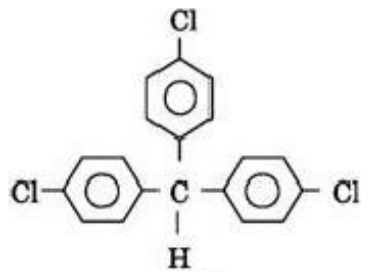
- 2
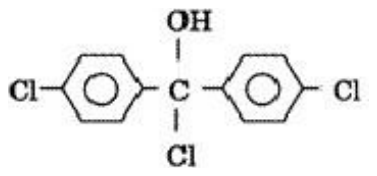
- 3
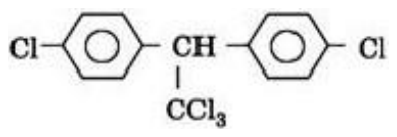
- 4
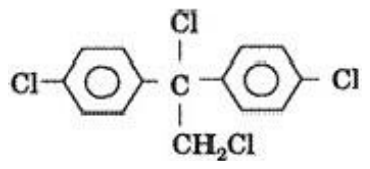
Show answer and solution
Correct: option 3
With sulphuric acid, one molecule of chloral condenses with two molecules of chlorobenzene at their para positions and loses one molecule of water. The aldehyde carbon becomes a CH joined to two p-chlorophenyl rings and still carries the group. This product is DDT.
Question 99AIPMT 2009 Prelims, Q199
For the reaction , it is observed that:
(a) on doubling the initial concentration of A only, the rate of reaction is also doubled and
(b) on doubling the initial concentrations of both A and B, there is a change by a factor of 8 in the rate of the reaction.
The rate of this reaction is given by:
- 1rate =
- 2rate =
- 3rate =
- 4rate =
Show answer and solution
Correct: option 1, rate =
Doubling A alone doubles the rate, so the order in A is 1. Doubling both multiplies the rate by 8; a factor of 2 comes from A, so the factor of 4 comes from B, which means the order in B is 2. Hence rate = .
Question 100AIPMT 2009 Prelims, Q200
Which of the following hormones contains iodine?
- 1testosterone
- 2adrenaline
- 3thyroxine
- 4insulin
Show answer and solution
Correct: option 3, thyroxine
Thyroxine, the hormone of the thyroid gland, is an amino acid derivative with four iodine atoms in each molecule. Testosterone is a steroid, adrenaline is an amine and insulin is a protein; none of them contains iodine.
AIPMT 2009 Prelims Biology questions
Question 101AIPMT 2009 Prelims, Q51
Which one of the following is correct pairing of a body part and the kind of muscle tissue that moves it?
- 1Biceps of upper arm - Smooth muscle fibres
- 2Abdominal wall - Smooth muscle
- 3Iris - Involuntary smooth muscle
- 4Heart wall - Involuntary unstriated muscle
Show answer and solution
Correct: option 2, Abdominal wall - Smooth muscle
The biceps and the muscles of the abdominal wall are skeletal (striated, voluntary) muscles, and the heart wall is cardiac muscle, which is striated and involuntary. The iris is moved by involuntary smooth muscle, so by this working the correct pairing is option (3). The answer key supplied with this copy of the paper marks option (2), and that is the answer recorded here.
Question 102AIPMT 2009 Prelims, Q52
The epithelial tissue present on the inner surface of bronchioles and fallopian tubes is:
- 1Glandular
- 2Ciliated
- 3Squamous
- 4Cuboidal
Show answer and solution
Correct: option 2, Ciliated
Bronchioles and fallopian tubes are lined by ciliated epithelium. The beating cilia move mucus and particles in the airways and the ovum in the fallopian tube in one direction.
Question 103AIPMT 2009 Prelims, Q53
Study the pedigree chart given below:
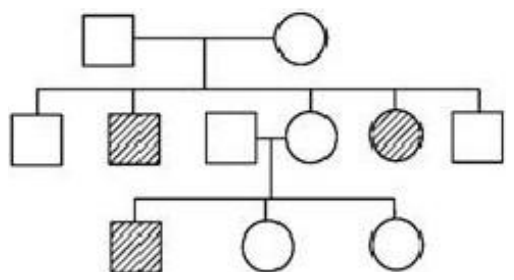
- 1Inheritance of a condition like phenylketonuria as an autosomal recessive trait
- 2The pedigree chart is wrong as this is not possible
- 3Inheritance of a recessive sex-linked disease like haemophilia
- 4Inheritance of a sex-linked inborn error of metabolism like phenylketonuria
Show answer and solution
Correct: option 1, Inheritance of a condition like phenylketonuria as an autosomal recessive trait
Two unaffected parents have affected children, so the trait is recessive and both parents are carriers. One affected child is a daughter; a recessive X-linked trait would need an affected father for that, and the father is unaffected, so the gene is autosomal. Phenylketonuria is an autosomal recessive disorder, which fits option (1).
Question 104AIPMT 2009 Prelims, Q54
Manganese is required in:
- 1Plant cell wall formation
- 2Photolysis of water during photosynthesis
- 3Chlorophyll synthesis
- 4Nucleic acid synthesis
Show answer and solution
Correct: option 2, Photolysis of water during photosynthesis
Manganese is part of the water-splitting complex of photosystem II. Its best defined role is in the photolysis of water, which releases oxygen during photosynthesis.
Question 105AIPMT 2009 Prelims, Q55
Polyethylene glycol method is used for:
- 1Biodiesel production
- 2Seedless fruit production
- 3Energy production from sewage
- 4Gene transfer without a vector
Show answer and solution
Correct: option 4, Gene transfer without a vector
Polyethylene glycol makes the membrane of protoplasts permeable so that naked DNA is taken up directly. It is therefore a method of direct (vectorless) gene transfer.
Question 106AIPMT 2009 Prelims, Q56
- 1Soybean
- 2Sunnhemp
- 3Tobacco
- 4Tulip
Show answer and solution
Correct: option 3, Tobacco
The formula shows an actinomorphic, bisexual flower with five united sepals, five united petals, five epipetalous stamens and a bicarpellary syncarpous superior ovary. This is the floral formula of Solanaceae, the family of tobacco. Soybean and sunnhemp belong to Fabaceae (zygomorphic flowers, ten stamens) and tulip to Liliaceae (trimerous flowers).
Question 107AIPMT 2009 Prelims, Q57
Which one of the following groups of animals is bilaterally symmetrical and triploblastic?
- 1Aschelminthes (round worms)
- 2Ctenophores
- 3Sponges
- 4Coelenterates (Cnidarians)
Show answer and solution
Correct: option 1, Aschelminthes (round worms)
Aschelminthes are bilaterally symmetrical and triploblastic pseudocoelomates. Ctenophores and coelenterates are radially symmetrical and diploblastic, and sponges are mostly asymmetrical with only a cellular level of organisation.
Question 108AIPMT 2009 Prelims, Q58
Which one of the following is commonly used in transfer of foreign DNA into crop plants?
- 1Meloidogyne incognita
- 2Agrobacterium tumefaciens
- 3Penicillium expansum
- 4Trichoderma harzianum
Show answer and solution
Correct: option 2, Agrobacterium tumefaciens
Agrobacterium tumefaciens naturally transfers a piece of its Ti plasmid (T-DNA) into dicot plant cells. The disarmed Ti plasmid is used as a vector to carry foreign genes into crop plants. Meloidogyne is a nematode, and Penicillium and Trichoderma are fungi.
Question 109AIPMT 2009 Prelims, Q59
Which one of the following is the correct matching of the events occurring during menstrual cycle?
- 1Proliferative phase - Rapid regeneration of myometrium and maturation of Graafian follicle.
- 2Development of corpus luteum - Secretory phase and increased secretion of progesterone.
- 3Menstruation - breakdown of myometrium and ovum not fertilised.
- 4Ovulation - LH and FSH attain peak level and sharp fall in the secretion of progesterone.
Show answer and solution
Correct: option 2, Development of corpus luteum - Secretory phase and increased secretion of progesterone.
After ovulation the ruptured follicle becomes the corpus luteum, which secretes a large amount of progesterone during the secretory (luteal) phase. In the proliferative phase and in menstruation it is the endometrium, not the myometrium, that regenerates and breaks down. At ovulation LH and FSH peak, but progesterone is not falling sharply then.
Question 110AIPMT 2009 Prelims, Q60
Which one is the wrong pairing for the disease and its causal organism?
- 1Black rust of wheat - Puccinia graminis
- 2Loose smut of wheat - Ustilago nuda
- 3Root-knot of vegetables - Meloidogyne sp
- 4Late blight of potato - Alternaria solani
Show answer and solution
Correct: option 4, Late blight of potato - Alternaria solani
Late blight of potato is caused by Phytophthora infestans; Alternaria solani causes early blight of potato. The other three pairs are correctly matched.
Question 111AIPMT 2009 Prelims, Q61
Global agreement in specific control strategies to reduce the release of ozone depleting substances, was adopted by:
- 1The Montreal Protocol
- 2The Kyoto Protocol
- 3The Vienna Convention
- 4Rio de Janeiro Conference
Show answer and solution
Correct: option 1, The Montreal Protocol
The Montreal Protocol (signed in 1987, in force from 1989) is the international treaty that controls the emission of ozone depleting substances such as CFCs. The Kyoto Protocol deals with greenhouse gases and the Rio conference with biodiversity and sustainable development.
Question 112AIPMT 2009 Prelims, Q62
What is true about Bt toxin?
- 1Bt protein exists as active toxin in the Bacillus.
- 2The activated toxin enters the ovaries of the pest to sterilise it and thus prevent its multiplication.
- 3The concerned Bacillus has antitoxins.
- 4The inactive protoxin gets converted into active form in the insect gut.
Show answer and solution
Correct: option 4, The inactive protoxin gets converted into active form in the insect gut.
Bacillus thuringiensis makes the Bt protein as an inactive protoxin crystal, so the bacterium itself is not harmed. In the alkaline gut of the insect the crystal dissolves and is converted into the active toxin, which binds to midgut epithelial cells, makes pores and kills the insect.
Question 113AIPMT 2009 Prelims, Q63
Peripatus is a connecting link between:
- 1Mollusca and Echinodermata
- 2Annelida and Arthropoda
- 3Coelenterata and Porifera
- 4Ctenophora and Platyhelminthes
Show answer and solution
Correct: option 2, Annelida and Arthropoda
Peripatus (Onychophora) has annelid features such as a soft, unjointed body wall and nephridia, together with arthropod features such as a haemocoel, tracheae and claws. It is therefore regarded as a connecting link between Annelida and Arthropoda.
Question 114AIPMT 2009 Prelims, Q64
T.O. Diener discovered a:
- 1Free infectious DNA
- 2Infectious protein
- 3Bacteriophage
- 4Free infectious RNA
Show answer and solution
Correct: option 4, Free infectious RNA
In 1971 T.O. Diener discovered viroids, which caused potato spindle tuber disease. A viroid is a free infectious RNA of low molecular weight with no protein coat.
Question 115AIPMT 2009 Prelims, Q65
Seminal plasma in humans is rich in:
- 1fructose and calcium but has no enzymes
- 2glucose and certain enzymes but has no calcium
- 3fructose and certain enzymes but poor in calcium
- 4fructose, calcium and certain enzymes
Show answer and solution
Correct: option 3, fructose and certain enzymes but poor in calcium
The secretions of the seminal vesicles, prostate and bulbourethral glands together form the seminal plasma. As described in the NCERT textbook it is rich in fructose, calcium and certain enzymes, which by this working points to option (4). The answer key supplied with this copy of the paper marks option (3), and that is the answer recorded here.
Question 116AIPMT 2009 Prelims, Q66
A fruit developed from hypanthodium inflorescence is called:
- 1Sorosis
- 2Syconus
- 3Caryopsis
- 4Hesperidium
Show answer and solution
Correct: option 2, Syconus
Hypanthodium is the flask-shaped inflorescence of fig (Ficus) with the flowers inside a fleshy receptacle. The composite fruit formed from it is a syconus. Sorosis develops from a spike or catkin, caryopsis is the fruit of grasses and hesperidium that of citrus.
Question 117AIPMT 2009 Prelims, Q67
The cell junctions called tight, adhering and gap junctions are found in:
- 1Connective tissue
- 2Epithelial tissue
- 3Neural tissue
- 4Muscular tissue
Show answer and solution
Correct: option 2, Epithelial tissue
Epithelial cells are closely packed with little intercellular matrix and are held together by tight junctions (stop leakage), adhering junctions (cement neighbouring cells) and gap junctions (allow exchange of ions and small molecules).
Question 118AIPMT 2009 Prelims, Q68
What will happen if the stretch receptors of the urinary bladder wall are totally removed?
- 1Micturition will continue
- 2Urine will continue to collect normally in the bladder
- 3There will be no micturition
- 4Urine will not collect in the bladder
Show answer and solution
Correct: option 3, There will be no micturition
Micturition is a reflex started by the stretch receptors in the bladder wall, which signal the CNS when the bladder fills. Without these receptors no signal is sent, the micturition reflex is not set off, and so there will be no micturition.
Question 119AIPMT 2009 Prelims, Q69
If a live earthworm is pricked with a needle on its outer surface without damaging its gut, the fluid that comes out is:
- 1coelomic fluid
- 2haemolymph
- 3slimy mucus
- 4excretory fluid
Show answer and solution
Correct: option 1, coelomic fluid
The space between the body wall and the gut of an earthworm is a true coelom filled with coelomic fluid. A needle that passes through the body wall without reaching the gut enters this cavity, so coelomic fluid comes out. Earthworms have a closed blood system and no haemolymph.
Question 120AIPMT 2009 Prelims, Q70
The most popularly known blood grouping is the ABO grouping. It is named ABO and not ABC, because "O" in it refers to having:
- 1overdominance of this type on the genes for A and B types
- 2one antibody only - either anti-A or anti-B on the RBCs
- 3no antigens A and B on RBCs
- 4other antigens besides A and B on RBCs
Show answer and solution
Correct: option 3, no antigens A and B on RBCs
The groups are named after the antigens on the surface of the RBCs. Group O cells carry neither antigen A nor antigen B (the O stands for zero, or null), while the plasma has both anti-A and anti-B antibodies.
Question 121AIPMT 2009 Prelims, Q71
One of the synthetic auxin is:
- 1IAA
- 2GA
- 3IBA
- 4NAA
Show answer and solution
Correct: option 4, NAA
NAA (naphthalene acetic acid) and 2,4-D are synthetic auxins. IAA and IBA have been isolated from plants and are treated as natural auxins, and GA is a gibberellin, not an auxin.
Question 122AIPMT 2009 Prelims, Q72
A person likely to develop tetanus is immunised by administering:
- 1Preformed antibodies
- 2Wide spectrum antibiotics
- 3Weakened germs
- 4Dead germs
Show answer and solution
Correct: option 3, Weakened germs
A person who is already at risk of tetanus needs a quick response, so preformed antibodies (antitoxin) are injected; this is passive immunisation. Weakened or dead germs give active immunity, which takes time to build up. By this working the answer is option (1). The answer key supplied with this copy of the paper marks option (3), and that is the answer recorded here.
Question 123AIPMT 2009 Prelims, Q73
Alzheimer disease in humans is associated with the deficiency of:
- 1glutamic acid
- 2acetylcholine
- 3gamma aminobutyric acid (GABA)
- 4dopamine
Show answer and solution
Correct: option 2, acetylcholine
Alzheimer's disease involves loss of cholinergic neurons in the brain and a fall in the neurotransmitter acetylcholine. Dopamine deficiency is linked with Parkinson's disease.
Question 124AIPMT 2009 Prelims, Q74
Biochemical Oxygen Demand (BOD) in a river water:
- 1has no relationship with concentration of oxygen in the water.
- 2gives a measure of salmonella in the water.
- 3increases when sewage gets mixed with river water.
- 4remains unchanged when algal bloom occurs.
Show answer and solution
Correct: option 3, increases when sewage gets mixed with river water.
BOD is the amount of oxygen that micro-organisms use up to break down the biodegradable organic matter in water. Sewage adds organic matter, so the BOD rises and the dissolved oxygen falls.
Question 125AIPMT 2009 Prelims, Q75
The genetic defect - adenosine deaminase (ADA) deficiency may be cured permanently by:
- 1administering adenosine deaminase activators.
- 2introducing bone marrow cells producing ADA into cells at early embryonic stages.
- 3enzyme replacement therapy.
- 4periodic infusion of genetically engineered lymphocytes having functional ADA cDNA.
Show answer and solution
Correct: option 2, introducing bone marrow cells producing ADA into cells at early embryonic stages.
Enzyme replacement and infusion of engineered lymphocytes have to be repeated, because the enzyme is used up and the lymphocytes are not immortal. If the gene from bone marrow cells producing ADA is introduced into cells at an early embryonic stage, all later cells carry the working gene, which could be a permanent cure.
Question 126AIPMT 2009 Prelims, Q76
Compared to blood our lymph has:
- 1plasma without proteins
- 2more WBCs and no RBCs
- 3more RBCs and less WBCs
- 4no plasma
Show answer and solution
Correct: option 2, more WBCs and no RBCs
Lymph is tissue fluid that has entered the lymphatic vessels. It has no RBCs, a lower protein content than blood plasma, and many lymphocytes, so it has more WBCs and no RBCs.
Question 127AIPMT 2009 Prelims, Q77
- 1caused by substitution of valine by glutamic acid in the beta globin chain of haemoglobin
- 2caused by a change in a single base pair of DNA
- 3characterized by elongated sickle like RBCs with a nucleus
- 4an autosomal linked dominant trait
Show answer and solution
Correct: option 2, caused by a change in a single base pair of DNA
Sickle cell anaemia is due to a point mutation: a single base change (GAG to GUG in the mRNA codon) in the gene for the beta globin chain. It replaces glutamic acid by valine, the reverse of what option (1) says. The disease is autosomal recessive and human RBCs have no nucleus.
Question 128AIPMT 2009 Prelims, Q78
Which of the following plant species you would select for the production of bioethanol?
- 1Zea mays
- 2Pongamia
- 3Jatropha
- 4Brassica
Show answer and solution
Correct: option 3, Jatropha
Bioethanol is made by fermenting sugar or starch, so a starch-rich crop such as maize (Zea mays) is the usual choice. Jatropha and Pongamia give oils that are used for biodiesel. By this working the answer is option (1). The answer key supplied with this copy of the paper marks option (3), and that is the answer recorded here.
Question 129AIPMT 2009 Prelims, Q79
When breast feeding is replaced by less nutritive food low in proteins and calories; the infants below the age of one year are likely to suffer from:
- 1Rickets
- 2Kwashiorkor
- 3Pellagra
- 4Marasmus
Show answer and solution
Correct: option 2, Kwashiorkor
Marasmus is caused by a deficiency of both proteins and calories and is seen in infants below one year when mother's milk is replaced too early by poorer food. Kwashiorkor is caused by protein deficiency without a calorie deficiency and appears in children older than one year. By this working the answer is option (4). The answer key supplied with this copy of the paper marks option (2), and that is the answer recorded here.
Question 130AIPMT 2009 Prelims, Q80
A young infant may be feeding entirely on mother’s milk which is white in colour but the stools which the infant passes out is quite yellowish. What is this yellow colour due to?
- 1Bile pigments passed through bile juice
- 2Undigested milk protein casein
- 3Pancreatic juice poured into duodenum
- 4Intestinal juice
Show answer and solution
Correct: option 1, Bile pigments passed through bile juice
Bile carries the pigments bilirubin and biliverdin, formed from the breakdown of haemoglobin. They pass into the intestine with the bile and colour the faeces yellow.
Question 131AIPMT 2009 Prelims, Q81
Which one of the following has maximum genetic diversity in India?
- 1Mango
- 2Wheat
- 3Tea
- 4Teak
Show answer and solution
Correct: option 2, Wheat
Genetic diversity is the variation within one species. The NCERT textbook gives rice (more than 50,000 strains) and mango (about 1,000 varieties) as the Indian examples, so among these options mango would be chosen by this working, option (1). The answer key supplied with this copy of the paper marks option (2), and that is the answer recorded here.
Question 132AIPMT 2009 Prelims, Q82
Oxygenic photosynthesis occurs in:
- 1Oscillatoria
- 2Rhodospirillum
- 3Chlorobium
- 4Chromatium
Show answer and solution
Correct: option 1, Oscillatoria
Oscillatoria is a cyanobacterium; it has chlorophyll a, splits water and releases oxygen. Rhodospirillum, Chlorobium and Chromatium are purple and green photosynthetic bacteria that use donors other than water and do not release oxygen.
Question 133AIPMT 2009 Prelims, Q83
- 1Mature RBCs
- 2A mature spermatozoan
- 3Hair root
- 4An enucleated ovum
Show answer and solution
Correct: option 1, Mature RBCs
Mature human RBCs lose their nucleus and their mitochondria, so they contain no DNA. A sperm and hair root cells have nuclei, and an enucleated ovum still has DNA in its mitochondria.
Question 134AIPMT 2009 Prelims, Q84
Given below is a schematic break-up of the phases / stages of cell cycle:
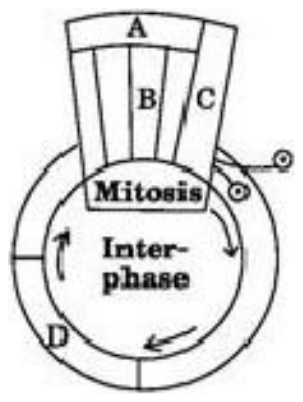
Which one of the following is the correct indication of the stage/phase in the cell cycle?
- 1C-Karyokinesis
- 2D-Synthetic phase
- 3A-Cytokinesis
- 4B-Metaphase
Show answer and solution
Correct: option 2, D-Synthetic phase
Following the arrows round the interphase ring from mitosis, the phases are G1, then S, then G2. D marks the middle part of interphase, which is the S or synthetic phase, when DNA is replicated. In the M phase part of the figure, A covers the whole of mitosis and C is its last part, so the other pairings do not fit.
Question 135AIPMT 2009 Prelims, Q85
Tiger is not a resident in which one of the following national park?
- 1Sunderbans
- 2Gir
- 3Jim Corbett
- 4Ranthambhor
Show answer and solution
Correct: option 2, Gir
Gir National Park in Gujarat is the home of the Asiatic lion and has no tigers. Sunderbans, Jim Corbett and Ranthambhor are all tiger reserves.
Question 136AIPMT 2009 Prelims, Q86
Which one of the following statements is true regarding digestion and absorption of food in humans?
- 1Fructose and amino acids are absorbed through intestinal mucosa with the help of carrier ions like .
- 2Chylomicrons are small lipoprotein particles that are transported from intestine into blood capillaries.
- 3About 60% of starch is hydrolysed by salivary amylase in our mouth.
- 4Oxyntic cells in our stomach secrete the proenzyme pepsinogen.
Show answer and solution
Correct: option 1, Fructose and amino acids are absorbed through intestinal mucosa with the help of carrier ions like .
Three statements are clearly false: chylomicrons pass into the lacteals (lymph vessels), not the blood capillaries; salivary amylase hydrolyses only about 30% of starch; oxyntic cells secrete HCl and intrinsic factor, while chief cells secrete pepsinogen. That leaves option (1), which describes carrier-mediated absorption of fructose and amino acids.
Question 137AIPMT 2009 Prelims, Q87
- 1mRNA and ribosomes
- 2spindle fibres and centromere
- 3two homologous chromosomes
- 4a male and a female gamete
Show answer and solution
Correct: option 3, two homologous chromosomes
Synapsis is the pairing of homologous chromosomes during zygotene of prophase I of meiosis, forming bivalents held by the synaptonemal complex.
Question 138AIPMT 2009 Prelims, Q88
Given below is a diagrammatic sketch of a portion of human male reproductive system. Select the correct set of the names of the parts labelled A, B, C, D.
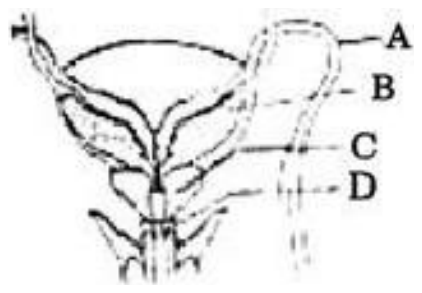
- 1A-vas deferens, B-seminal vesicle, C-prostate, D-bulbourethral gland
- 2A-vas deferens, B-seminal vesicle, C-bulbourethral gland, D-prostate
- 3A-ureter, B-seminal vesicle, C-prostate, D-bulbourethral gland
- 4A-ureter, B-prostate, C-seminal vesicle, D-bulbourethral gland
Show answer and solution
Correct: option 1, A-vas deferens, B-seminal vesicle, C-prostate, D-bulbourethral gland
A is the vas deferens, the duct that loops over the urinary bladder. B is the seminal vesicle lying behind the bladder, C is the prostate around the start of the urethra, and D is the bulbourethral (Cowper's) gland lying below the prostate.
Question 139AIPMT 2009 Prelims, Q89
What is not true for genetic code?
- 1It is nearly universal
- 2It is degenerate
- 3It is unambiguous
- 4A codon in mRNA is read in a non-contiguous fashion
Show answer and solution
Correct: option 4, A codon in mRNA is read in a non-contiguous fashion
The code is nearly universal, degenerate (several codons for one amino acid) and unambiguous (one codon gives one amino acid). Codons are read one after another without gaps or punctuation, that is, in a contiguous fashion, so statement (4) is not true.
Question 140AIPMT 2009 Prelims, Q90
Which one of the following plants is monoecious?
- 1Pinus
- 2Cycas
- 3Papaya
- 4Marchantia
Show answer and solution
Correct: option 1, Pinus
Pinus bears male and female cones on the same tree, so it is monoecious. Cycas, papaya and Marchantia have separate male and female plants and are dioecious.
Question 141AIPMT 2009 Prelims, Q91
Cyclic photophosphorylation results in the formation of
- 1ATP and NADPH
- 2ATP, NADPH and
- 3ATP
- 4NADPH
Show answer and solution
Correct: option 3, ATP
In cyclic photophosphorylation only photosystem I works and the electron returns to it through the electron transport chain. Water is not split and NADP is not reduced, so only ATP is formed.
Question 142AIPMT 2009 Prelims, Q92
The letter T in T-lymphocyte refers to:
- 1Thalamus
- 2Tonsil
- 3Thymus
- 4Thyroid
Show answer and solution
Correct: option 3, Thymus
T-lymphocytes are formed in the bone marrow but mature in the thymus, from which they take their name.
Question 143AIPMT 2009 Prelims, Q93
Foetal ejection reflex in human female is induced by:
- 1release of oxytocin from pituitary
- 2fully developed foetus and placenta
- 3differentiation of mammary glands
- 4pressure exerted by amniotic fluid
Show answer and solution
Correct: option 2, fully developed foetus and placenta
The signals for parturition come from the fully developed foetus and the placenta. They cause mild uterine contractions called the foetal ejection reflex, and this in turn triggers the release of oxytocin from the mother's pituitary.
Question 144AIPMT 2009 Prelims, Q94
Anatomically fairly old dicotyledonous root is distinguished from the dicotyledonous stem by
- 1Absence of secondary phloem
- 2Presence of cortex
- 3Position of protoxylem
- 4Absence of secondary xylem
Show answer and solution
Correct: option 3, Position of protoxylem
Old dicot roots and stems both have secondary xylem, secondary phloem and cortex. The primary xylem still tells them apart: in the root the protoxylem lies towards the outside (exarch), while in the stem it lies towards the centre (endarch).
Question 145AIPMT 2009 Prelims, Q95
- 1Locomotory structures
- 2Membranes connecting the nucleus with plasmalemma
- 3Connections between adjacent cells
- 4Lignified cemented layers between cells
Show answer and solution
Correct: option 3, Connections between adjacent cells
Plasmodesmata are fine cytoplasmic strands that pass through the cell walls and middle lamella and connect the cytoplasm of neighbouring plant cells.
Question 146AIPMT 2009 Prelims, Q96
Removal of introns and joining the exons in a defined order in a transcription unit is called:
- 1Tailing
- 2Transformation
- 3Capping
- 4Splicing
Show answer and solution
Correct: option 4, Splicing
In eukaryotes the primary transcript (hnRNA) contains both exons and introns. Splicing removes the introns and joins the exons in a defined order. Capping adds methyl guanosine triphosphate at the 5' end and tailing adds adenylate residues at the 3' end.
Question 147AIPMT 2009 Prelims, Q97
Phylogenetic system of classification is based on:
- 1Morphological features
- 2Chemical constituents
- 3Floral characters
- 4Evolutionary relationships
Show answer and solution
Correct: option 4, Evolutionary relationships
A phylogenetic system arranges organisms according to their evolutionary relationships, on the assumption that members of a taxon share a common ancestor. Systems based on morphology or floral characters are artificial or natural systems, and one based on chemical constituents is chemotaxonomy.
Question 148AIPMT 2009 Prelims, Q98
Which part of human brain is concerned with the regulation of body temperature?
- 1Cerebellum
- 2Cerebrum
- 3Hypothalamus
- 4Medulla Oblongata
Show answer and solution
Correct: option 3, Hypothalamus
The hypothalamus contains the centres that control body temperature, as well as hunger and thirst. The cerebellum controls balance and the medulla controls respiration and cardiovascular reflexes.
Question 149AIPMT 2009 Prelims, Q99
Semiconservative replication of DNA was first demonstrated in:
- 1Escherichia coli
- 2Streptococcus pneumoniae
- 3Salmonella typhimurium
- 4Drosophila melanogaster
Show answer and solution
Correct: option 1, Escherichia coli
Meselson and Stahl (1958) grew Escherichia coli in a medium with heavy nitrogen, moved it to normal nitrogen and separated the DNA by density gradient centrifugation. The hybrid DNA of the first generation showed that replication is semiconservative.
Question 150AIPMT 2009 Prelims, Q100
Which one of the following pairs of animals comprises 'jawless fishes'?
- 1Mackerels and Rohu
- 2Lampreys and hag fishes
- 3Guppies and hag fishes
- 4Lampreys and eels
Show answer and solution
Correct: option 2, Lampreys and hag fishes
Lampreys (Petromyzon) and hag fishes (Myxine) are cyclostomes of the group Agnatha: they have a circular sucking mouth without jaws. Mackerels, rohu, guppies and eels are bony fishes with jaws.
Question 151AIPMT 2009 Prelims, Q101
Which of the following is a pair of viral diseases?
- 1Common Cold, AIDS
- 2Dysentery, Common Cold
- 3Typhoid, Tuberculosis
- 4Ringworm, AIDS
Show answer and solution
Correct: option 1, Common Cold, AIDS
Common cold is caused by rhinoviruses and AIDS by HIV, so both are viral. Dysentery is bacterial or amoebic, typhoid and tuberculosis are bacterial, and ringworm is a fungal infection.
Question 152AIPMT 2009 Prelims, Q102
Aerobic respiratory pathway is appropriately termed:
- 1Parabolic
- 2Amphibolic
- 3Anabolic
- 4Catabolic
Show answer and solution
Correct: option 2, Amphibolic
The respiratory pathway breaks down substrates (catabolism), but its intermediates are also withdrawn to build fatty acids, amino acids and other compounds (anabolism). A pathway that serves both purposes is called amphibolic.
Question 153AIPMT 2009 Prelims, Q103
A country with a high rate of population growth took measures to reduce it. The Figure below shows age-sex pyramids of populations A and B twenty years apart. Select the correct interpretation about them:
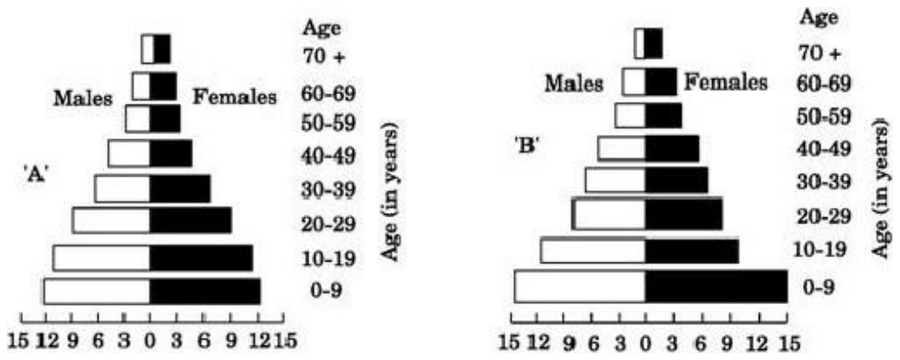
- 1"B" is earlier pyramid and shows stabilised growth rate.
- 2"B" is more recent showing that population is very young.
- 3"A" is the earlier pyramid and no change has occurred in the growth rate.
- 4"A" is more recent and shows slight reduction in the growth rate.
Show answer and solution
Correct: option 4, "A" is more recent and shows slight reduction in the growth rate.
Pyramid B has a very broad base, with the 0-9 group much larger than the 10-19 group, which is the shape of a rapidly growing population. In pyramid A the 0-9 group is about the same size as the 10-19 group, so fewer children are being added. Since the country acted to reduce growth, A is the later pyramid and shows a slight fall in the growth rate.
Question 154AIPMT 2009 Prelims, Q104
Cytoskeleton is made up of:
- 1Callose deposits
- 2Cellulosic microfibrils
- 3Proteinaceous filaments
- 4Calcium carbonate granules
Show answer and solution
Correct: option 3, Proteinaceous filaments
The cytoskeleton is a network of protein filaments in the cytoplasm: microtubules (tubulin), microfilaments (actin) and intermediate filaments. Callose and cellulose belong to the cell wall, and calcium carbonate granules are inclusions.
Question 155AIPMT 2009 Prelims, Q105
An example of axile placentation is:
- 1Dianthus
- 2Lemon
- 3Marigold
- 4Argemone
Show answer and solution
Correct: option 2, Lemon
In axile placentation the ovules are borne on a central axis of a multilocular ovary, as in lemon, china rose and tomato. Dianthus has free central placentation, marigold has basal placentation and Argemone has parietal placentation.
Question 156AIPMT 2009 Prelims, Q106
Which one of the following has haplontic life cycle?
- 1Polytrichum
- 2Ustilago
- 3Wheat
- 4Funaria
Show answer and solution
Correct: option 2, Ustilago
In a haplontic life cycle the only diploid cell is the zygote, which undergoes meiosis. Polytrichum and Funaria are mosses with a haplo-diplontic cycle (a multicellular sporophyte on the gametophyte), and wheat is diplontic. That leaves the smut fungus Ustilago, in which the diploid phase is limited to a single cell that divides by meiosis.
Question 157AIPMT 2009 Prelims, Q107
Steps taken by the Government of India to control air pollution include:
- 1compulsory PUC (Pollution Under Control) certification of petrol driven vehicles which tests for carbon monoxide and hydrocarbons.
- 2permission to use only pure diesel with a maximum of 500 ppm sulphur as fuel for vehicles.
- 3use of non-polluting Compressed Natural Gas (CNG) only as fuel by all buses and trucks.
- 4compulsory mixing of 20% ethyl alcohol with petrol and 20% biodiesel with diesel.
Show answer and solution
Correct: option 1, compulsory PUC (Pollution Under Control) certification of petrol driven vehicles which tests for carbon monoxide and hydrocarbons.
Periodic PUC certification, which measures carbon monoxide and hydrocarbons in the exhaust of petrol vehicles, is compulsory. The other statements overstate the rules: CNG was required for public transport buses in Delhi and not for all buses and trucks, diesel sulphur limits were being brought down in stages to 350 ppm and then 50 ppm, and 20% blending of ethanol and biodiesel was not compulsory.
Question 158AIPMT 2009 Prelims, Q108
Which one of the following is considered important in the development of seed habit?
- 1Heterospory
- 2Haplontic life cycle
- 3Free-living gametophyte
- 4Dependent sporophyte
Show answer and solution
Correct: option 1, Heterospory
Seed habit began with heterospory, the production of small microspores and large megaspores, as in Selaginella and Salvinia. Retention of the megaspore and the female gametophyte on the parent sporophyte, where the embryo then develops, is the forerunner of the seed.
Question 159AIPMT 2009 Prelims, Q109
The annular and spirally thickened conducting elements generally develop in the protoxylem when the root or stem is:
- 1elongating
- 2widening
- 3differentiating
- 4maturing
Show answer and solution
Correct: option 4, maturing
The key gives option (4), maturing. Annular and spiral thickenings leave most of the wall unthickened, so these vessels and tracheids can be stretched; that is why they are usually described as forming in the protoxylem while the organ is still elongating, which is option (1). Our working therefore does not agree with this unofficial key.
Question 160AIPMT 2009 Prelims, Q110
The correct sequence of plants in a hydrosere is:
- 1Volvox Hydrilla Pistia Scirpus Lantana Oak
- 2Pistia Volvox Scirpus Hydrilla Oak Lantana
- 3Oak Lantana Volvox Hydrilla Pistia Scirpus
- 4Oak Lantana Scirpus Pistia Hydrilla Volvox
Show answer and solution
Correct: option 1, Volvox Hydrilla Pistia Scirpus Lantana Oak
A hydrosere starts in open water and ends in forest: phytoplankton (Volvox), rooted submerged plants (Hydrilla), free-floating plants (Pistia), reed-swamp plants (Scirpus), then shrubs (Lantana) and finally trees (Oak). Only the first option follows this order.
Question 161AIPMT 2009 Prelims, Q111
Stroma in the chloroplasts of higher plant contains:
- 1Light-dependent reaction enzymes
- 2Ribosomes
- 3Chlorophyll
- 4Light-independent reaction enzymes
Show answer and solution
Correct: option 4, Light-independent reaction enzymes
The stroma holds the enzymes of the Calvin cycle, that is, of the light-independent (dark) reactions. Chlorophyll and the light reaction machinery are in the thylakoid membranes. The stroma also contains 70S ribosomes, but the keyed answer is the functional feature the question is after, the dark reaction enzymes.
Question 162AIPMT 2009 Prelims, Q112
A health disorder that results from the deficiency of thyroxine in adults and characterised by (i) a low metabolic rate, (ii) increase in body weight and (iii) tendency to retain water in tissues is:
- 1simple goitre
- 2myxoedema
- 3cretinism
- 4hypothyroidism
Show answer and solution
Correct: option 2, myxoedema
Thyroxine deficiency in adults causes myxoedema, with a low metabolic rate, weight gain and puffiness from fluid held in the tissues. Cretinism is the deficiency in childhood, simple goitre is an enlarged thyroid from lack of iodine, and hypothyroidism is the general condition and not the name of this adult disorder.
Question 163AIPMT 2009 Prelims, Q113
Mannitol is the stored food in:
- 1Porphyra
- 2Fucus
- 3Gracilaria
- 4Chara
Show answer and solution
Correct: option 2, Fucus
Brown algae (Phaeophyceae) store food as laminarin and mannitol, and Fucus is a brown alga. Porphyra and Gracilaria are red algae that store floridean starch, and Chara is a green alga that stores starch.
Question 164AIPMT 2009 Prelims, Q114
Which one of the following pairs is wrongly matched?
- 1Alcohol - nitrogenase
- 2Fruit juice - pectinase
- 3Textile - amylase
- 4Detergents - lipase
Show answer and solution
Correct: option 1, Alcohol - nitrogenase
Nitrogenase is the enzyme of biological nitrogen fixation; alcohol is made by yeast fermentation using zymase. Pectinase clarifies fruit juices, amylase removes starch size from textiles, and lipase in detergents removes oily stains, so those three pairs are correct.
Question 165AIPMT 2009 Prelims, Q115
Which of the following is not used as a biopesticide?
- 1Trichoderma harzianum
- 2Nuclear Polyhedrosis Virus (NPV)
- 3Xanthomonas campestris
- 4Bacillus thuringiensis
Show answer and solution
Correct: option 3, Xanthomonas campestris
Xanthomonas campestris is a plant pathogen (it causes black rot of crucifers), not a biocontrol agent. Trichoderma is used against fungal pathogens, NPV against insect pests, and Bacillus thuringiensis produces an insecticidal toxin.
Question 166AIPMT 2009 Prelims, Q116
Which one of the following is a vascular cryptogam?
- 1Ginkgo
- 2Marchantia
- 3Cedrus
- 4Equisetum
Show answer and solution
Correct: option 4, Equisetum
Vascular cryptogams are the pteridophytes: they have xylem and phloem but no seeds. Equisetum (horsetail) is a pteridophyte. Ginkgo and Cedrus are gymnosperms with seeds, and Marchantia is a bryophyte without vascular tissue.
Question 167AIPMT 2009 Prelims, Q117
In a standard ECG which one of the following alphabets is the correct representation of the respective activity of the human heart?
- 1S - start of systole
- 2T - end of diastole
- 3P - depolarisation of the atria
- 4R - repolarisation of ventricles
Show answer and solution
Correct: option 3, P - depolarisation of the atria
The P wave represents depolarisation of the atria, which leads to atrial contraction. The QRS complex is ventricular depolarisation (systole starts just after Q), and the T wave is ventricular repolarisation, its end marking the end of systole.
Question 168AIPMT 2009 Prelims, Q118
Uric acid is the chief nitrogenous component of the excretory products of:
- 1Earthworm
- 2Cockroach
- 3Frog
- 4Man
Show answer and solution
Correct: option 2, Cockroach
Insects such as the cockroach are uricotelic: their Malpighian tubules remove nitrogen as uric acid, which saves water. Earthworm, adult frog and man are mainly ureotelic.
Question 169AIPMT 2009 Prelims, Q119
- 1Transpiration
- 2Guttation
- 3Fighting against infection
- 4Protection against grazing
Show answer and solution
Correct: option 1, Transpiration
Guard cells surround each stoma and, by changing their turgor, open and close the pore. This controls the loss of water vapour (transpiration) and gas exchange. Guttation takes place through hydathodes, not stomata.
Question 170AIPMT 2009 Prelims, Q120
Montreal Protocol aims at:
- 1Biodiversity conservation
- 2Control of water pollution
- 3Control of emission
- 4Reduction of ozone depleting substances
Show answer and solution
Correct: option 4, Reduction of ozone depleting substances
The Montreal Protocol (signed 1987, in force 1989) is the international treaty to control the emission of ozone depleting substances such as CFCs. Carbon dioxide emissions are covered by the Kyoto Protocol.
Question 171AIPMT 2009 Prelims, Q121
DDT residues are rapidly passed through food chain causing biomagnification because DDT is:
- 1moderately toxic
- 2non-toxic to aquatic animals
- 3water soluble
- 4lipo soluble
Show answer and solution
Correct: option 4, lipo soluble
DDT dissolves in fat and is not broken down or excreted, so it collects in the fatty tissue of an organism. Each trophic level eats many organisms of the level below, so the concentration rises along the food chain.
Question 172AIPMT 2009 Prelims, Q122
Vegetative propagation in mint occurs by:
- 1Offset
- 2Rhizome
- 3Sucker
- 4Runner
Show answer and solution
Correct: option 3, Sucker
Mint (Mentha) spreads by suckers: side branches that arise from the underground part of the stem, grow horizontally under the soil and then come up as new shoots. Offsets are found in Pistia and Eichhornia, rhizomes in ginger, and runners in grass and strawberry.
Question 173AIPMT 2009 Prelims, Q123
Select the incorrect statement from the following:
- 1Galactosemia is an inborn error of metabolism
- 2Small population size results in random genetic drift in a population
- 3Baldness is a sex-limited trait
- 4Linkage is an exception to the principle of independent assortment in heredity
Show answer and solution
Correct: option 3, Baldness is a sex-limited trait
Pattern baldness is a sex-influenced trait: the autosomal gene is present in both sexes but behaves as dominant in males and recessive in females. A sex-limited trait is expressed in one sex only, such as milk production. The other three statements are correct.
Question 174AIPMT 2009 Prelims, Q124
Cotyledons and testa respectively are edible parts in:
- 1walnut and tamarind
- 2french bean and coconut
- 3cashew nut and litchi
- 4groundnut and pomegranate
Show answer and solution
Correct: option 4, groundnut and pomegranate
In groundnut the fleshy cotyledons of the seed are eaten, and in pomegranate the juicy outer seed coat (testa) is eaten. In coconut the edible part is the endosperm, in litchi it is the aril, and in tamarind it is the mesocarp, so the other pairs do not fit.
Question 175AIPMT 2009 Prelims, Q125
Which one of the following statements is correct?
- 1Benign tumours show the property of metastasis.
- 2Heroin accelerates body functions.
- 3Malignant tumours may exhibit metastasis.
- 4Patients who have undergone surgery are given cannabinoids to relieve pain.
Show answer and solution
Correct: option 3, Malignant tumours may exhibit metastasis.
Malignant tumours can shed cells that travel in blood and lymph and start new tumours elsewhere, which is metastasis; benign tumours stay in place. Heroin is a depressant that slows body functions, and the painkiller given after surgery is morphine, an opioid, not a cannabinoid.
Question 176AIPMT 2009 Prelims, Q126
The correct sequence of spermatogenetic stages leading to the formation of sperms in a mature human testis is:
- 1spermatogonia - spermatocyte - spermatid - sperms
- 2spermatid - spermatocyte - spermatogonia - sperms
- 3spermatogonia - spermatid - spermatocyte - sperms
- 4spermatocyte - spermatogonia - spermatid - sperms
Show answer and solution
Correct: option 1, spermatogonia - spermatocyte - spermatid - sperms
Spermatogonia divide by mitosis and some become primary spermatocytes. These undergo meiosis (through secondary spermatocytes) to give haploid spermatids, which change shape into sperms by spermiogenesis.
Question 177AIPMT 2009 Prelims, Q127
Use of anti-histamines and steroids give a quick relief from:
- 1Nausea
- 2Cough
- 3Headache
- 4Allergy
Show answer and solution
Correct: option 4, Allergy
Allergy symptoms are caused by histamine and serotonin released from mast cells. Anti-histamines block the action of histamine, and steroids (and adrenaline) suppress the reaction, so the symptoms subside quickly.
Question 178AIPMT 2009 Prelims, Q128
Chipko movement was launched for the protection of:
- 1Forests
- 2Livestock
- 3Wet lands
- 4Grasslands
Show answer and solution
Correct: option 1, Forests
In the Chipko movement of 1974 in the Garhwal Himalayas, local women hugged trees to stop contractors from felling them. It was a movement to protect forests.
Question 179AIPMT 2009 Prelims, Q129
Which one of the following is the most likely root cause why menstruation is not taking place in regularly cycling human female?
- 1maintenance of the hypertrophical endometrial lining
- 2maintenance of high concentration of sex hormones in the blood stream
- 3retention of well-developed corpus luteum
- 4fertilisation of the ovum
Show answer and solution
Correct: option 4, fertilisation of the ovum
If the ovum is fertilised, the embryo implants and hCG keeps the corpus luteum alive. The corpus luteum goes on secreting progesterone, which maintains the endometrium, so no menstruation occurs. The other three options are results of this; fertilisation is the root cause.
Question 180AIPMT 2009 Prelims, Q130
Globulins contained in human blood plasma are primarily involved in:
- 1osmotic balance of body fluids
- 2oxygen transport in the blood
- 3clotting of blood
- 4defence mechanisms of body
Show answer and solution
Correct: option 4, defence mechanisms of body
Plasma globulins, in particular the gamma globulins (antibodies), take part in the defence of the body. Osmotic balance is mainly the work of albumins, clotting needs fibrinogen, and oxygen is carried by haemoglobin in red blood cells.
Question 181AIPMT 2009 Prelims, Q131
Palisade parenchyma is absent in leaves of:
- 1Mustard
- 2Soybean
- 3Gram
- 4Sorghum
Show answer and solution
Correct: option 4, Sorghum
Sorghum is a monocot with isobilateral leaves, in which the mesophyll is not divided into palisade and spongy parenchyma. Mustard, soybean and gram are dicots with dorsiventral leaves that have palisade tissue on the upper side.
Question 182AIPMT 2009 Prelims, Q132
In barley stem vascular bundles are:
- 1closed and scattered
- 2open and in a ring
- 3closed and radial
- 4open and scattered
Show answer and solution
Correct: option 1, closed and scattered
Barley is a monocot. In a monocot stem the vascular bundles are conjoint and closed (no cambium) and are scattered throughout the ground tissue. Open bundles in a ring are found in dicot stems.
Question 183AIPMT 2009 Prelims, Q133
Which one of the following is the correct matching of three items and their grouping category?
| Items | Group |
|---|
| (1) | ilium, ischium, pubis | coxal bones of pelvic girdle |
| (2) | actin, myosin, rhodopsin | muscle proteins |
| (3) | cytosine, uracil, thiamine | pyrimidines |
| (4) | malleus, incus, cochlea | ear ossicles |
- 11
- 22
- 33
- 44
Show answer and solution
Correct: option 1, 1
Each coxal (hip) bone is formed by the fusion of ilium, ischium and pubis, so row (1) is correct. Rhodopsin is a visual pigment and not a muscle protein; thiamine is vitamin B1 and not a pyrimidine base (the base is thymine); and the cochlea is part of the inner ear, the third ear ossicle being the stapes.
Question 184AIPMT 2009 Prelims, Q134
Somaclones are obtained by
- 1Plant breeding
- 2Irradiation
- 3Genetic engineering
- 4Tissue culture
Show answer and solution
Correct: option 4, Tissue culture
Plants raised from somatic cells of one parent by tissue culture (micropropagation) are genetically identical to the parent and to each other. Such plants are called somaclones.
Question 185AIPMT 2009 Prelims, Q135
In the case of peppered moth (Biston betularia) the black-coloured form became dominant over the light-coloured form in England during industrial revolution. This is an example of:
- 1appearance of the darker coloured individuals due to very poor sunlight
- 2protective mimicry
- 3inheritance of darker colour character acquired due to the darker environment
- 4natural selection whereby the darker forms were selected
Show answer and solution
Correct: option 2, protective mimicry
The key gives option (2), protective mimicry. Industrial melanism is the standard example of natural selection: on soot-darkened tree trunks the dark moths were hidden from birds, survived better and left more offspring, which is option (4). Our working therefore does not agree with this unofficial key.
Question 186AIPMT 2009 Prelims, Q136
Transgenic plants are the ones:
- 1generated by introducing foreign DNA into a cell and regenerating a plant from that cell.
- 2produced after protoplast fusion in artificial medium.
- 3grown in artificial medium after hybridization in the field.
- 4produced by a somatic embryo in artificial medium.
Show answer and solution
Correct: option 1, generated by introducing foreign DNA into a cell and regenerating a plant from that cell.
A transgenic plant carries a foreign gene. The gene is introduced into a plant cell and a whole plant is regenerated from that cell, so every cell of the plant has the gene. Protoplast fusion gives somatic hybrids, and the other options describe ordinary tissue culture.
Question 187AIPMT 2009 Prelims, Q137
Which one of the following pairs of food components in humans reaches the stomach totally undigested?
- 1Starch and fat
- 2Fat and cellulose
- 3Starch and cellulose
- 4Protein and starch
Show answer and solution
Correct: option 2, Fat and cellulose
In the mouth only starch is acted on, by salivary amylase. Fat is not digested in the mouth, and humans have no enzyme for cellulose, so fat and cellulose reach the stomach undigested.
Question 188AIPMT 2009 Prelims, Q138
A change in the amount of yolk and its distribution in the egg will affect:
- 1Pattern of cleavage
- 2Number of blastomeres produced
- 3Fertilization
- 4Formation of zygote
Show answer and solution
Correct: option 1, Pattern of cleavage
Yolk slows down or blocks cleavage furrows. Eggs with little, evenly spread yolk divide completely (holoblastic cleavage), while eggs with much yolk divide unequally or only partly (meroblastic cleavage). So the amount and distribution of yolk decide the pattern of cleavage.
Question 189AIPMT 2009 Prelims, Q139
Middle lamella is composed mainly of:
- 1Muramic acid
- 2Calcium pectate
- 3Phosphoglycerides
- 4Hemicellulose
Show answer and solution
Correct: option 2, Calcium pectate
The middle lamella is the layer that cements neighbouring plant cells together. It is made mainly of calcium pectate (with some magnesium pectate).
Question 190AIPMT 2009 Prelims, Q140
Elbow joint is an example of:
- 1hinge joint
- 2gliding joint
- 3ball and socket joint
- 4pivot joint
Show answer and solution
Correct: option 1, hinge joint
The elbow allows movement in one plane only, bending and straightening, like a door hinge. It is a hinge joint, as is the knee.
Question 191AIPMT 2009 Prelims, Q141
Which of the following is a symbiotic nitrogen fixer?
- 1Azotobacter
- 2Frankia
- 3Azolla
- 4Glomus
Show answer and solution
Correct: option 2, Frankia
Frankia is a nitrogen-fixing actinomycete that lives in root nodules of non-legumes such as Alnus and Casuarina. Azotobacter fixes nitrogen but is free-living, Azolla is a fern (its partner Anabaena does the fixing), and Glomus is a mycorrhizal fungus that helps in phosphorus uptake.
Question 192AIPMT 2009 Prelims, Q142
Whose experiments cracked the DNA and discovered unequivocally that a genetic code is a "triplet"?
- 1Hershey and Chase
- 2Morgan and Sturtevant
- 3Beadle and Tatum
- 4Nirenberg and Matthaei
Show answer and solution
Correct: option 4, Nirenberg and Matthaei
Nirenberg and Matthaei used a cell-free system with synthetic RNA (poly-U gave a chain of phenylalanine) and so began the deciphering of the triplet code. Hershey and Chase showed DNA is the genetic material, Morgan and Sturtevant worked on linkage and gene mapping, and Beadle and Tatum gave the one gene-one enzyme idea.
Question 193AIPMT 2009 Prelims, Q143
Which one of the following types of organisms occupy more than one trophic level in a pond ecosystem?
- 1Fish
- 2Zooplankton
- 3Frog
- 4Phytoplankton
Show answer and solution
Correct: option 1, Fish
Fish in a pond feed at several levels: some eat phytoplankton, some eat zooplankton, and larger ones eat smaller fish, so fish occupy more than one trophic level. Phytoplankton are always producers and zooplankton primary consumers.
Question 194AIPMT 2009 Prelims, Q144
Which one of the following acids is a derivative of carotenoids?
- 1Indole-3-acetic acid
- 2Gibberellic acid
- 3Abscisic acid
- 4Indole butyric acid
Show answer and solution
Correct: option 3, Abscisic acid
Abscisic acid is formed by the breakdown of carotenoids (xanthophylls such as violaxanthin). The indole auxins come from tryptophan, and gibberellic acid is a terpene made by a separate pathway.
Question 195AIPMT 2009 Prelims, Q145
The bacterium Bacillus thuringiensis is widely used in contemporary biology as:
- 1Insecticide
- 2Agent for production of dairy products
- 3Source of industrial enzyme
- 4Indicator of water pollution
Show answer and solution
Correct: option 1, Insecticide
Bacillus thuringiensis makes crystal (Cry) proteins that become toxic in the alkaline gut of certain insect larvae and kill them. Its spores are used as a bioinsecticide and its cry genes have been put into crops such as Bt cotton.
Question 196AIPMT 2009 Prelims, Q146
An example of a seed with endosperm, perisperm, and caruncle is:
- 1coffee
- 2lily
- 3castor
- 4cotton
Show answer and solution
Correct: option 3, castor
The castor seed is endospermic, keeps a thin remnant of nucellus as perisperm, and has a caruncle, a spongy outgrowth at the micropylar end. Of the plants listed, castor is the one that has the caruncle.
Question 197AIPMT 2009 Prelims, Q147
Reduction in vascular tissue, mechanical tissue and cuticle is characteristic of:
- 1Mesophytes
- 2Epiphytes
- 3Hydrophytes
- 4Xerophytes
Show answer and solution
Correct: option 3, Hydrophytes
Water plants are supported by the water around them and can absorb water over their whole surface. So they need little mechanical tissue, little xylem and almost no cuticle. Xerophytes show the opposite: thick cuticle and well-developed mechanical and vascular tissue.
Question 198AIPMT 2009 Prelims, Q148
- 1Change in single base pair
- 2Duplication
- 3Deletion
- 4Insertion
Show answer and solution
Correct: option 1, Change in single base pair
A point mutation is a change in a single base pair of DNA, as in sickle-cell anaemia where one base substitution changes one amino acid of the beta globin chain.
Question 199AIPMT 2009 Prelims, Q149
Which one of the following correctly describes the location of some body parts in the earthworm Pheretima?
- 1Four pairs of spermathecae in 4 - 7 segments.
- 2One pair of ovaries attached at intersegmental septum of 14th and 15th segments.
- 3Two pairs of testes in 10th and 11th segments.
- 4Two pairs of accessory glands in 16 - 18 segments.
Show answer and solution
Correct: option 3, Two pairs of testes in 10th and 11th segments.
Pheretima has two pairs of testes, one pair each in the 10th and 11th segments. Its four pairs of spermathecae lie in segments 6 to 9, the pair of ovaries is at the septum between segments 12 and 13, and the two pairs of accessory glands are in segments 17 and 19.
Question 200AIPMT 2009 Prelims, Q150
The kind of tissue that forms the supportive structure in our pinna (external ears) is also found in:
- 1nails
- 2ear ossicles
- 3tip of the nose
- 4vertebrae
Show answer and solution
Correct: option 3, tip of the nose
The pinna is supported by elastic cartilage. Cartilage also supports the tip of the nose. Nails are made of keratin, and ear ossicles and vertebrae are bone.

