AIPMT 2007 Prelims Physics questions
Question 1AIPMT 2007 Prelims, Q151
Dimensions of resistance in an electrical circuit, in terms of dimension of mass M, of length L, of time T and of current I, would be
- 1
- 2
- 3
- 4
Show answer and solution
Correct: option 1,
Power is , so . Power has dimensions , and dividing by gives , which is option (1).
Question 2AIPMT 2007 Prelims, Q152
A particle moving along x-axis has acceleration f, at time t, given , where and T are constant. The particle at t = 0 has zero velocity. In the time interval between t = 0 and the instant when f = 0, the particle's velocity () is
- 1
- 2
- 3
- 4
Show answer and solution
Correct: option 1,
The acceleration becomes zero at . The velocity gained is the integral of the acceleration: . This is option (1).
Question 3AIPMT 2007 Prelims, Q153
A car moves from X to Y with a uniform speed and returns to Y with a uniform speed . The average speed for this round trip is
- 1
- 2
- 3
- 4
Show answer and solution
Correct: option 2,
Let the distance XY be s. The times for the two legs are and , so average speed . The key gives option (2), which is meant to be this expression; the source copy prints its numerator as .
Question 4AIPMT 2007 Prelims, Q154
A particle starting from the origin (0, 0) moves in a straight line in the (x, y) plane. Its co-ordinates at a later time are . The path of the particle makes with the x-axis an angle of
- 1
- 2
- 3
- 4
Show answer and solution
Correct: option 4,
The slope of the straight path is , so , option (4).
Question 5AIPMT 2007 Prelims, Q155
A block B is pushed momentarily along a horizontal surface with an initial velocity V. If is the coefficient of sliding friction between B and the surface, block B will come to rest after a time
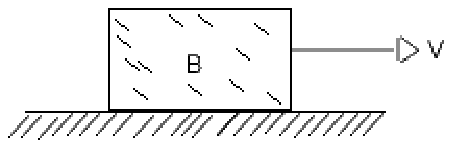
- 1
- 2
- 3
- 4
Show answer and solution
Correct: option 2,
After the push the only horizontal force is friction , giving a retardation . From the block stops after , option (2).
Question 6AIPMT 2007 Prelims, Q156
A vertical spring with force constant K is fixed on a table. A ball of mass m at a height h above the free upper end of the spring falls vertically on the spring so that the spring is compressed by a distance d. The net work done in the process is
- 1
- 2
- 3
- 4
Show answer and solution
Correct: option 3,
The ball falls through a total height , so gravity does work . The spring force opposes the compression and does work . The net work is , option (3).
Question 7AIPMT 2007 Prelims, Q157
A wheel has angular acceleration of and an initial angular speed of 2.00 rad/sec. In a time of 2 sec it has rotated through an angle (in radian) of
- 14
- 26
- 310
- 412
Show answer and solution
Correct: option 3, 10
For constant angular acceleration, rad, option (3).
Question 8AIPMT 2007 Prelims, Q158
and are two vectors and is the angle between them, if the value of is
- 1
- 2
- 3
- 4
Show answer and solution
Correct: option 2,
and . The condition gives , so and , option (2).
Question 9AIPMT 2007 Prelims, Q159
The position x of a particle with respect to time t along x-axis is given by where x is in metres and t in second. What will be the position of this particle when it achieves maximum speed along the +x direction?
- 124 m
- 232 m
- 354 m
- 481 m
Show answer and solution
Correct: option 3, 54 m
Velocity is . It is greatest when , that is at s. The position then is m, option (3).
Question 10AIPMT 2007 Prelims, Q160
A mass of 2.0 kg is put on a flat pan attached to a vertical spring fixed on the ground as shown in the figure. The mass of the spring and the pan is negligible. When pressed slightly and released the mass executes a simple harmonic motion. The spring constant is 200 N/m. What should be the minimum amplitude of the motion so that the mass gets detached from the pan? [Take ]
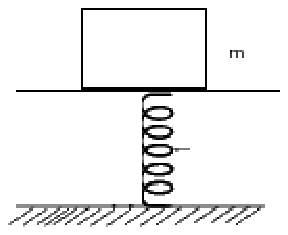
- 14.0 cm
- 28.0 cm
- 310.0 cm
- 4any value less than 12.0 cm
Show answer and solution
Correct: option 3, 10.0 cm
The mass leaves the pan when the downward acceleration of the pan at the top of the motion reaches g, so . Here , so m cm, option (3).
Question 11AIPMT 2007 Prelims, Q161
A particle of mass m moves in the XY plane with a velocity V along the straight line AB. If the angular momentum of the particle with respect to origin O is when it is at A and when it is at B, then
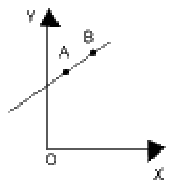
- 1
- 2
- 3
- 4The relationship between and depends upon the slope of the line AB
Show answer and solution
Correct: option 3,
Angular momentum about O is , where d is the perpendicular distance from O to the line of motion. The particle keeps moving along the same line AB with the same velocity, so d does not change and , option (3).
Question 12AIPMT 2007 Prelims, Q162
A uniform rod AB of length l and mass m is free to rotate about point A. The rod is released from rest in the horizontal position. Given that the moment of inertia of the rod about A is , the initial angular acceleration of the rod will be
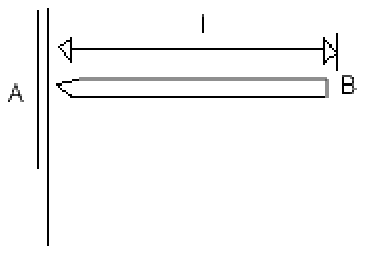
- 1
- 2
- 3
- 4
Show answer and solution
Correct: option 1,
The weight mg acts at the centre of the rod, a distance from A, so the torque about A is . Using : , option (1).
Question 13AIPMT 2007 Prelims, Q163
Two satellites of earth, and are moving in the same orbit. The mass of is four times the mass of . Which one of the following statements is true?
- 1The kinetic energies of the two satellites are equal.
- 2The time period of is four times that of .
- 3The potential energies of earth and satellite in the two cases are equal.
- 4 and are moving with the same speed.
Show answer and solution
Correct: option 4, and are moving with the same speed.
The orbital speed depends only on the earth's mass and the orbit radius, not on the satellite's mass, so both satellites move with the same speed and the same period. Their kinetic and potential energies are proportional to their own masses, so those differ. Option (4) is true.
Question 14AIPMT 2007 Prelims, Q164
Assuming the sun to have a spherical outer surface of radius r, radiating like a black body at temperature , the power received by a unit surface, (normal to the incident rays) at a distance R from the center of the sun is (where is the Stefan's constant).
- 1
- 2
- 3
- 4
Show answer and solution
Correct: option 1,
The sun radiates total power , with the temperature in kelvin. At distance R this is spread over a sphere of area , so the power per unit area is . The key gives option (1), which is meant to be this expression; the source copy prints R in place of in it.
Question 15AIPMT 2007 Prelims, Q165
An engine has an efficiency of 1/6. When the temperature of sink is reduced by , its efficiency is doubled. Temperature of the source is
- 1
- 2
- 3
- 4
Show answer and solution
Correct: option 1,
For a Carnot engine . First ; after lowering the sink, . Subtracting, , so K , option (1).
Question 16AIPMT 2007 Prelims, Q166
A black body is at . It emits energy at a rate which is proportional to
- 1
- 2
- 3
- 4
Show answer and solution
Correct: option 3,
By Stefan's law the rate of emission is proportional to the fourth power of the absolute temperature. K, so the rate is proportional to , option (3).
Question 17AIPMT 2007 Prelims, Q167
The frequency of a light wave in a material is Hz and wavelength is 5000 Å. The refractive index of material will be
- 11.33
- 21.40
- 31.50
- 43.00
Show answer and solution
Correct: option 4, 3.00
Speed of light in the material is . The refractive index is , option (4).
Question 18AIPMT 2007 Prelims, Q168
The phase difference between the instantaneous velocity and acceleration of a particle executing simple harmonic motion is
- 1zero
- 2
- 3
- 4
Show answer and solution
Correct: option 2,
If , then and . The acceleration leads the velocity by , option (2).
Question 19AIPMT 2007 Prelims, Q169
The particle executing simple harmonic motion has a kinetic energy . The maximum values of the potential energy and the total energy are respectively
- 1 and
- 20 and
- 3 and
- 4 and
Show answer and solution
Correct: option 1, and
The maximum kinetic energy is , reached at the mean position where the potential energy is zero, so the total energy is . At the extreme positions the kinetic energy is zero and all of this energy is potential, so the maximum potential energy is also . Option (1).
Question 20AIPMT 2007 Prelims, Q170
A particle executes simple harmonic oscillation with an amplitude a. The period of oscillation is T. The minimum time taken by the particle to travel half of the amplitude from the equilibrium position is
- 1T/2
- 2T/4
- 3T/8
- 4T/12
Show answer and solution
Correct: option 4, T/12
Starting from the equilibrium position, . Setting gives , so , option (4).
Question 21AIPMT 2007 Prelims, Q171
The electric and magnetic field of an electromagnetic wave are
- 1in phase and perpendicular to each other
- 2in phase and parallel to each other
- 3in opposite phase and perpendicular to each other
- 4in opposite phase and parallel to each other
Show answer and solution
Correct: option 1, in phase and perpendicular to each other
In an electromagnetic wave the electric and magnetic fields oscillate at right angles to each other and to the direction of travel, and they reach their maxima and zeros together, so they are in phase. Option (1).
Question 22AIPMT 2007 Prelims, Q175
Three point charges +q, -2q and +q are placed at points (x = 0, y = a, z = 0), (x = 0, y = 0, z = 0) and (x = a, y = 0, z = 0) respectively. The magnitude and direction of the electric dipole moment vector of this charge assembly are
- 1 along +x direction
- 2 along +y direction
- 3 along the line joining points (x = 0, y = 0, z = 0) and (x = a, y = a, z = 0)
- 4 along the line joining points (x = 0, y = 0, z = 0) and (x = a, y = a, z = 0)
Show answer and solution
Correct: option 3, along the line joining points (x = 0, y = 0, z = 0) and (x = a, y = a, z = 0)
Split the -2q at the origin into two charges -q. One pairs with the +q on the y-axis to give a dipole moment qa along +y, the other pairs with the +q on the x-axis to give qa along +x. These two perpendicular moments add to at to both axes, that is along the line from the origin to (a, a, 0). Option (3).
Question 23AIPMT 2007 Prelims, Q176
Two condensers, one of capacity C and the other of capacity C/2, are connected to a V-volt battery, as shown. The work done in charging fully both the condensers is
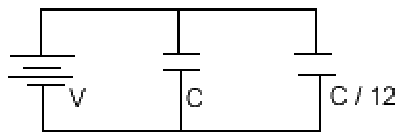
- 1
- 2
- 3
- 4
Show answer and solution
Correct: option 4,
Both condensers are connected across the battery, so they are in parallel and the total capacity is . The energy stored when fully charged is , option (4).
Question 24AIPMT 2007 Prelims, Q177
The total power dissipated in Watts in the circuit shown here is
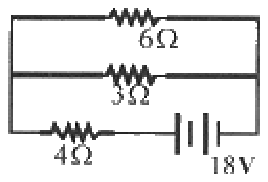
- 14
- 216
- 340
- 454
Show answer and solution
Correct: option 4, 54
The 6 Ω and 3 Ω resistors are in parallel: Ω. This is in series with 4 Ω, so the total resistance is 6 Ω. Power W, option (4).
Question 25AIPMT 2007 Prelims, Q178
A steady current of 1.5 amp flows through a copper voltameter for 10 minute. If the electrochemical equivalent of copper is , the mass of copper deposited on the electrode will be
- 10.27 gm
- 20.40 gm
- 30.50 gm
- 40.67 gm
Show answer and solution
Correct: option 1, 0.27 gm
By Faraday's first law of electrolysis, . The charge passed is C, so gm, option (1).
Question 26AIPMT 2007 Prelims, Q179
If the cold junction of a thermo-couple is kept at and the hot junction is kept at , then the relation between neutral temperature () and temperature of inversion () is
- 1
- 2
- 3
- 4
Show answer and solution
Correct: option 2,
The thermo-emf is a parabolic function of the hot junction temperature, so the neutral temperature lies midway between the cold junction temperature and the temperature of inversion: . With the cold junction at this gives . The key gives option (2), the only option with the form of a half-sum, although as printed it does not reduce to .
Question 27AIPMT 2007 Prelims, Q180
Three resistances P, Q, R each of 2 Ω and an unknown resistance S form the four arms of a Wheatstone bridge circuit. When a resistance of 6 Ω is connected in parallel to S the bridge gets balanced. What is the value of S?
- 11 Ω
- 22 Ω
- 33 Ω
- 46 Ω
Show answer and solution
Correct: option 3, 3 Ω
With P = Q = R = 2 Ω the bridge balances only when the fourth arm is also 2 Ω. So S in parallel with 6 Ω must equal 2 Ω: , which gives Ω, option (3).
Question 28AIPMT 2007 Prelims, Q181
The resistance of an ammeter is 13 Ω and its scale is graduated for a current upto 100 Amps. After an additional shunt has been connected to this ammeter it becomes possible to measure currents upto 750 Amperes by this meter. The value of shunt-resistance is
- 12 KΩ
- 220 Ω
- 32 Ω
- 40.2 Ω
Show answer and solution
Correct: option 3, 2 Ω
At full scale the ammeter carries 100 A and the shunt must carry the remaining A. Both have the same potential difference, so , giving Ω, option (3).
Question 29AIPMT 2007 Prelims, Q182
Under the influence of a uniform magnetic field a charge-particle is moving in a circle of radius R with constant speed V. The time period of the motion
- 1depends on R and not on V
- 2depends on V and not on R
- 3depends on both R and V
- 4is independent of both R and V
Show answer and solution
Correct: option 4, is independent of both R and V
The magnetic force provides the centripetal force: , so . The period is , which contains neither R nor V. Option (4).
Question 30AIPMT 2007 Prelims, Q183
A charged particle (charge q) is moving in a circle of radius R with uniform speed v. The associated magnetic moment is given by
- 1
- 2
- 3
- 4
Show answer and solution
Correct: option 2,
The circulating charge is equivalent to a current . The magnetic moment is current times area: , option (2).
Question 31AIPMT 2007 Prelims, Q184
A beam of electrons passes undeflected through mutually perpendicular electric and magnetic fields. If the electric field is switched off, and the same magnetic field is maintained, the electrons move
- 1along a straight line
- 2in an elliptical orbit
- 3in a circular orbit
- 4along a parabolic path
Show answer and solution
Correct: option 3, in a circular orbit
For the beam to pass undeflected through crossed fields its velocity must be perpendicular to both fields. With the electric field removed, only the magnetic force acts; it is always perpendicular to the velocity and constant in size, so the electrons move in a circular orbit. Option (3).
Question 32AIPMT 2007 Prelims, Q185
The primary and secondary coils of a transformer have 50 and 1500 turns respectively. If the magnetic flux linked with the primary coil is given by , where is in webers, t is time in seconds and is a constant, the output voltage across the secondary coil is
- 130 volts
- 290 volts
- 3120 volts
- 4220 volts
Show answer and solution
Correct: option 3, 120 volts
The emf in the primary is V. The voltages are in the ratio of the turns, so volts, option (3).
Question 33AIPMT 2007 Prelims, Q186
What is the value of inductance L for which the current is a maximum in a series LCR circuit with and ?
- 110 mH
- 2100 mH
- 31 mH
- 4cannot be calculated unless R is known
Show answer and solution
Correct: option 2, 100 mH
The current is greatest at resonance, where . So H mH, option (2). The resistance does not affect the resonance condition.
Question 34AIPMT 2007 Prelims, Q187
A transformer is used to light a 100W and 110V lamp from a 220V mains. If the main current is 0.5A, the efficiency of the transformer is approximately
- 110%
- 230%
- 350%
- 490%
Show answer and solution
Correct: option 4, 90%
Input power from the mains is W and the output power delivered to the lamp is 100 W. Efficiency , which is closest to 90%, option (4).
Question 35AIPMT 2007 Prelims, Q188
Nickel shows ferromagnetic property at room temperature. If the temperature is increased beyond Curie temperature then it will show
- 1diamagnetism
- 2paramagnetism
- 3anti ferromagnetism
- 4no magnetic property
Show answer and solution
Correct: option 2, paramagnetism
Above the Curie temperature thermal agitation destroys the domain alignment of a ferromagnet. The atoms still have magnetic moments, so the material behaves as a paramagnet. Option (2).
Question 36AIPMT 2007 Prelims, Q190
Monochromatic light of frequency Hz is produced by a laser. The power emitted is W. The number of photons emitted, on the average, by the source per second is
- 1
- 2
- 3
- 4
Show answer and solution
Correct: option 2,
Each photon has energy J. The number emitted per second is , option (2).
Question 37AIPMT 2007 Prelims, Q191
In a mass spectrometer used for measuring the masses of ions, the ions are initially accelerated by an electric potential V and then made to describe semicircular paths of radius R using a magnetic field B. If V and B are kept constant, the ratio will be proportional to
- 1
- 2
- 3
- 4
Show answer and solution
Correct: option 3,
Acceleration through V gives , and in the field . Eliminating v: , so . With V and B fixed this is proportional to , option (3).
Question 38AIPMT 2007 Prelims, Q192
If the nucleus has a nuclear radius of about 3.6 fm, then would have its radius approximately as
- 14.8 fm
- 26.0 fm
- 39.6 fm
- 412.0 fm
Show answer and solution
Correct: option 2, 6.0 fm
Nuclear radius varies as . So and fm, option (2).
Question 39AIPMT 2007 Prelims, Q193
In radioactive decay process, the negatively charged emitted -particles are
- 1the electrons orbiting around the nucleus
- 2the electrons present inside the nucleus
- 3the electrons produced as a result of the decay of neutrons inside the nucleus
- 4the electrons produced as a result of collisions between atoms
Show answer and solution
Correct: option 3, the electrons produced as a result of the decay of neutrons inside the nucleus
A nucleus contains no electrons. In beta-minus decay a neutron inside the nucleus changes into a proton, and an electron (with an antineutrino) is created and emitted at that moment. Option (3).
Question 40AIPMT 2007 Prelims, Q194
A nucleus has mass represented by M(A, Z). If and denote the mass of proton and neutron respectively and B.E the binding energy in MeV then
- 1
- 2
- 3
- 4
Show answer and solution
Correct: option 3,
The nucleus has Z protons and neutrons. Its mass is less than the total mass of these separate nucleons, and the binding energy is this mass defect times : . The key gives option (3), which is meant to be this expression; the source copy prints where belongs.
Question 41AIPMT 2007 Prelims, Q195
Two radioactive substances A and B have decay constants and respectively. At t = 0 they have the same number of nuclei. The ratio of number of nuclei of A to those of B will be after a time interval
- 1
- 2
- 3
- 4
Show answer and solution
Correct: option 1,
. Setting this equal to gives , so , option (1).
Question 42AIPMT 2007 Prelims, Q196
The total energy of electron in the ground state of hydrogen atom is -13.6 eV. The kinetic energy of an electron in the first excited state is
- 11.7 eV
- 23.4 eV
- 36.8 eV
- 413.6 eV
Show answer and solution
Correct: option 2, 3.4 eV
The first excited state is n = 2, where the total energy is eV. In a Bohr orbit the kinetic energy equals minus the total energy, so the kinetic energy is 3.4 eV, option (2).
Question 43AIPMT 2007 Prelims, Q197
In the energy band diagram of a material shown below, the open circles and filled circles denote holes and electrons respectively. The material is
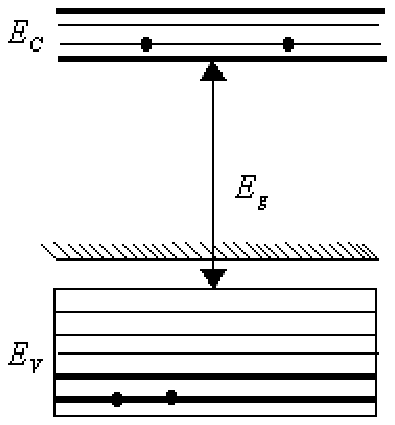
- 1an n-type semiconductor
- 2a p-type semiconductor
- 3an insulator
- 4a metal
Show answer and solution
Correct: option 2, a p-type semiconductor
The diagram has an extra energy level lying just above the valence band, far below the conduction band. Such a level is an acceptor level: it takes electrons from the valence band and leaves holes there as the majority carriers. That is a p-type semiconductor, option (2).
Question 44AIPMT 2007 Prelims, Q198
A common emitter amplifier has a voltage gain of 50, an input impedance of 100 Ω and an output impedance of 200 Ω. The power gain of the amplifier is
- 1100
- 2500
- 31000
- 41250
Show answer and solution
Correct: option 4, 1250
Voltage gain , so the current gain is . Power gain is current gain times voltage gain: , option (4).
Question 45AIPMT 2007 Prelims, Q200
For a cubic crystal structure which one of the following relations indicating the cell characteristics is correct?
- 1 and
- 2 and
- 3 and
- 4 and
Show answer and solution
Correct: option 1, and
A cubic unit cell is a cube: its three edges are equal and all three angles between them are right angles, so and . This is option (1).
AIPMT 2007 Prelims Chemistry questions
Question 46AIPMT 2007 Prelims, Q101
With which of the following configuration an atom has the lowest ionization enthalpy?
- 1
- 2
- 3
- 4
Show answer and solution
Correct: option 4,
In the outermost electron is in the 3s orbital, far from the nucleus and well shielded by the inner electrons (it is an excited state of neon). That electron is held most weakly, so it is removed with the least energy. In the other three configurations the electron must come out of the tightly held second shell.
Question 47AIPMT 2007 Prelims, Q102
An element, X has the following isotopic composition; X: 90%; X: 8.0%; X: 2.0%
The weighted average atomic mass of the naturally occurring element X is closest to:
- 1199 amu
- 2200 amu
- 3201 amu
- 4202 amu
Show answer and solution
Correct: option 2, 200 amu
Average atomic mass amu, which is closest to 200 amu.
Question 48AIPMT 2007 Prelims, Q103
Concentrated aqueous sulphuric acid is 98% by mass and has a density of . Volume of acid required to make one litre of 0.1 M is
- 15.55 mL
- 211.10 mL
- 316.65 mL
- 422.20 mL
Show answer and solution
Correct: option 1, 5.55 mL
One litre of the concentrated acid weighs 1800 g and holds g of , that is mol, so it is 18 M. On dilution : mL, giving mL.
Question 49AIPMT 2007 Prelims, Q104
Consider the following sets of quantum numbers:
| n | l | m | s |
|---|
| (a) | 3 | 0 | 0 | |
| (b) | 2 | 2 | 1 | |
| (c) | 4 | 3 | | |
| (d) | 1 | 0 | | |
| (e) | 3 | 2 | 3 | |
Which of the following sets of quantum number is not possible
- 1a and c
- 2b, c and d
- 3a, b, c and d
- 4b, d and e
Show answer and solution
Correct: option 4, b, d and e
For a given n, l can be 0 to , and m can be to . Set (b) has with , set (d) has with , and set (e) has with ; none of these is allowed. Sets (a) and (c) obey both rules, so the impossible sets are b, d and e.
Question 50AIPMT 2007 Prelims, Q105
The number of moles of that will be needed to react with one mole of sulphite ion in acidic solution is:
- 11
- 2
- 3
- 4
Show answer and solution
Correct: option 4,
In acid goes to (gain of 5 electrons) and goes to (loss of 2 electrons). Balancing electrons: . So 5 mol of sulphite need 2 mol of permanganate, and 1 mol needs mol.
Question 51AIPMT 2007 Prelims, Q106
In a first-order reaction , if k is rate constant and initial concentration of the reactant A is 0.5 M then the half-life is:
- 1
- 2
- 3
- 4
Show answer and solution
Correct: option 1,
For a first-order reaction . The half-life does not depend on the initial concentration, so the 0.5 M is not needed.
Question 52AIPMT 2007 Prelims, Q107
The reaction of hydrogen and iodine monochloride is given as:
This reaction is of first order with respect to and , following mechanisms were proposed:
Mechanism A:
Mechanism B:
; slow
; fast
Which of the above mechanism(s) can be consistent with the given information about the reaction
- 1A only
- 2B only
- 31 and 2 both
- 4Neither 1 nor 2
Show answer and solution
Correct: option 2, B only
The rate law comes from the slow step of the mechanism. Mechanism A is a single step with one and two ICl, which would give rate , second order in ICl. In mechanism B the slow step has one and one ICl, giving rate , first order in each, as observed. So only B fits.
Question 53AIPMT 2007 Prelims, Q108
If 60% of a first order reaction was completed in 60 minutes, 50% of the same reaction would be completed in approximately:
(log 4 = 0.60, log 5 = 0.69)
- 140 minutes
- 250 minutes
- 345 minutes
- 460 minutes
Show answer and solution
Correct: option 3, 45 minutes
. With , . Then minutes, closest to 45 minutes.
Question 54AIPMT 2007 Prelims, Q109
The equilibrium constant of the reaction:
; V at 298 K is:
- 1
- 2
- 3
- 4
Show answer and solution
Correct: option 1,
At 298 K, . Two electrons are transferred, so , which gives .
Question 55AIPMT 2007 Prelims, Q110
0.5 molal aqueous solution of a weak acid (HX) is 20% ionized. If for water is , the lowering in freezing point of the solution is
- 1 K
- 2 K
- 30.56 K
- 41.12 K
Show answer and solution
Correct: option 4, 1.12 K
HX gives two ions, so the van't Hoff factor is . K. A lowering is quoted as a positive amount.
Question 56AIPMT 2007 Prelims, Q111
The efficiency of a fuel cell is given by
- 1
- 2
- 3
- 4
Show answer and solution
Correct: option 4,
A fuel cell turns the energy of a combustion reaction straight into electrical work. The most electrical work it can give is , while the total heat the reaction could release is . Efficiency is useful work over energy available, .
Question 57AIPMT 2007 Prelims, Q112
Consider the following reactions:
(a) ,
(b) ,
(c)
(d)
Enthalpy of formation of is
- 1
- 2
- 3
- 4
Show answer and solution
Correct: option 2,
Enthalpy of formation is the enthalpy change when one mole of a compound is made from its elements in their standard states. Only reaction (b) does that for liquid water: gas and gas give one mole of . Reaction (a) is neutralisation, and (c) and (d) start from compounds. So the answer is the option; from reaction (b) the value itself is .
Question 58AIPMT 2007 Prelims, Q114
The Langmuir adsorption isotherm is deduced using the assumption
- 1The adsorbed molecules interact with each other
- 2The adsorption takes place in multilayers
- 3The adsorption sites are equivalent in their ability to adsorb the particles
- 4The heat of adsorption varies with coverage
Show answer and solution
Correct: option 3, The adsorption sites are equivalent in their ability to adsorb the particles
Langmuir's model assumes a surface with a fixed number of identical sites, each holding one molecule, so only a single layer forms. The adsorbed molecules do not affect one another, so the heat of adsorption is the same at every coverage. Of the four statements only the equivalence of the sites is one of these assumptions; the other three contradict the model.
Question 59AIPMT 2007 Prelims, Q115
The following equilibrium constants are given
;
;
;
The equilibrium constant for the oxidation of by oxygen to give NO is
- 1
- 2
- 3
- 4
Show answer and solution
Correct: option 2,
The target is . It is the first reaction reversed (), plus the second (), plus three times the third (). When reactions are added their constants multiply, so .
Question 60AIPMT 2007 Prelims, Q116
Calculate the pOH of a solution at 25°C that contains M of hydronium ions, i.e. :
- 11.000
- 27.000
- 34.000
- 49.000
Show answer and solution
Correct: option 3, 4.000
. At 25°C, , so .
Question 61AIPMT 2007 Prelims, Q117
A weak acid, HA has a of . If 0.100 mol of this acid is dissolved in one litre of water, the percentage of acid dissociated at equilibrium is closest to
- 10.100%
- 299.0%
- 31.00%
- 499.9%
Show answer and solution
Correct: option 3, 1.00%
For a weak acid , so . That is 1.00% dissociated.
Question 62AIPMT 2007 Prelims, Q118
The fraction of total volume occupied by the atoms present in a simple cube is
- 1
- 2
- 3
- 4
Show answer and solution
Correct: option 2,
A simple cubic cell holds one atom, and the atoms touch along the edge, so . Fraction filled , about 52%.
Question 63AIPMT 2007 Prelims, Q119
Identify the correct order of the size of the following:
- 1
- 2
- 3
- 4
Show answer and solution
Correct: option 3,
All five species have 18 electrons. With the same number of electrons, the one with more protons pulls them in harder and is smaller. Nuclear charge falls in the order Ca (20), K (19), Ar (18), Cl (17), S (16), so size rises as .
Question 64AIPMT 2007 Prelims, Q120
In which of the following pairs, the two species are iso-structural?
- 1 and
- 2 and
- 3 and
- 4 and
Show answer and solution
Correct: option 1, and
and each have three bonded oxygens and one lone pair on the central atom, so both are pyramidal. is see-saw but is square planar; is pyramidal but is planar; is planar but is pyramidal.
Question 65AIPMT 2007 Prelims, Q121
The correct order of C–O bond length among , , is:
- 1
- 2
- 3
- 4
Show answer and solution
Correct: option 1,
A higher bond order means a shorter bond. The C–O bond order is 3 in CO, 2 in and about 1.33 in (one double bond shared over three positions by resonance). So the bond length rises as .
Question 66AIPMT 2007 Prelims, Q122
Which one of the following ionic species has the greatest proton affinity to form stable compound?
- 1
- 2
- 3
- 4
Show answer and solution
Correct: option 3,
The ion with the greatest proton affinity is the strongest base, and the strongest base is the conjugate base of the weakest acid. is a far weaker acid than HI, or a hydrogen halide, so takes up a proton most readily, forming stable .
Question 67AIPMT 2007 Prelims, Q123
In which of the following the hydration energy is higher than the lattice energy?
- 1
- 2
- 3
- 4
Show answer and solution
Correct: option 3,
A salt dissolves in water when its hydration energy is larger than its lattice energy. Down group 2 the lattice energy of the sulphates changes little (the sulphate ion is large), but the hydration energy of the cation falls quickly as it grows. The small ion has a very high hydration energy, so is soluble, while the sulphates of Sr, Ba and Ra are insoluble.
Question 68AIPMT 2007 Prelims, Q124
Which of the following statements, about the advantage of roasting sulphide ore before reduction is not true?
- 1Roasting of the sulphide to the oxide is thermodynamically feasible.
- 2Carbon and hydrogen are suitable reducing agents for metal sulphides.
- 3The of the sulphide is greater than those for and
- 4The is negative for roasting of sulphide ore to oxide
Show answer and solution
Correct: option 2, Carbon and hydrogen are suitable reducing agents for metal sulphides.
Metal sulphides are more stable than and , so carbon and hydrogen cannot reduce a sulphide directly; the statement that they are suitable reducing agents for sulphides is the false one. This is exactly why the ore is first roasted to the oxide, a change with negative , and the oxide is then reduced.
Question 69AIPMT 2007 Prelims, Q125
The correct order of increasing thermal stability of , , and is:
- 1
- 2
- 3
- 4
Show answer and solution
Correct: option 3,
A small, highly charged cation polarises the carbonate ion strongly and makes it break up to the oxide and more easily. Polarising power falls from to to , and the large singly charged polarises least. So stability rises as .
Question 70AIPMT 2007 Prelims, Q126
Sulphides ores of metals are usually concentrated by Froth Flotation process. Which one of the following sulphides ores offers an exception and is concentrated by chemical leaching?
- 1Sphalerite
- 2Argentite
- 3Galena
- 4Copper pyrite
Show answer and solution
Correct: option 2, Argentite
Argentite, , is the ore of silver. It is concentrated by leaching with a dilute sodium cyanide solution in air, which dissolves the silver as the complex . Sphalerite (ZnS), galena (PbS) and copper pyrite () are concentrated by froth flotation.
Question 71AIPMT 2007 Prelims, Q127
Which one of the following anions is present in the chain structure of silicates?
- 1
- 2
- 3
- 4
Show answer and solution
Correct: option 4,
is the single tetrahedron of orthosilicates and is two tetrahedra sharing one corner (pyrosilicates). When each tetrahedron shares two corners a single chain forms, and when each shares three corners the unit is , usually described as a sheet. The answer key of the source used here marks ; the usual textbook answer for a simple chain silicate is .
Question 72AIPMT 2007 Prelims, Q128
Which one of the following orders correctly represents the increasing acid strengths of the given acids?
- 1
- 2
- 3
- 4
Show answer and solution
Correct: option 2,
The more oxygen atoms on chlorine, the higher its oxidation state and the better the negative charge of the anion is spread out, so the acid is stronger. Acid strength therefore rises . The keyed option is the one that ends ; its first term is printed in the source as , where HOCl is meant.
Question 73AIPMT 2007 Prelims, Q129
Which of the following oxidation states are the most characteristic for lead and tin respectively?
- 1+2, +2
- 2+4, +2
- 3+2, +4
- 4+4, +4
Show answer and solution
Correct: option 3, +2, +4
Going down group 14 the pair of s electrons becomes harder to use in bonding (the inert pair effect), so the +2 state becomes more stable than +4. The effect is strongest for lead, whose usual state is +2, while tin is still most stable as +4. So lead is +2 and tin is +4.
Question 74AIPMT 2007 Prelims, Q130
Identify the incorrect statement among the following:
- 1Shielding power of 4f electrons is quite weak
- 2There is a decrease in the radii of the atoms or ions as one proceeds from La to Lu
- 3Lanthanoid contraction is the accumulation of successive shrinkages
- 4As a result of lanthanoid contraction, the properties of 4d series of the transition elements have no similarities with the 5d series of elements
Show answer and solution
Correct: option 4, As a result of lanthanoid contraction, the properties of 4d series of the transition elements have no similarities with the 5d series of elements
4f electrons shield poorly, so from La to Lu the growing nuclear charge pulls the atoms and ions in a little at each step; the total of these small shrinkages is the lanthanoid contraction. Its effect is that the 5d elements are almost the same size as the 4d elements above them (Zr and Hf, for example), so the two series are very similar in properties. The statement that they have no similarities is the incorrect one.
Question 75AIPMT 2007 Prelims, Q131
Which one of the following ions is the most stable in aqueous solution?
(Atomic number. Ti = 22, V = 23, Cr = 24, Mn = 25)
- 1
- 2
- 3
- 4
Show answer and solution
Correct: option 2,
is . In water it is surrounded octahedrally by six molecules, and its three d electrons half-fill the lower set, which is an especially stable arrangement. is a strong oxidising agent (it goes to ), while and are reducing and are easily oxidised.
Question 76AIPMT 2007 Prelims, Q133
Which of the following will give a pair of enantiomorphs?
(en = )
- 1
- 2
- 3
- 4
Show answer and solution
Correct: option 4,
Enantiomorphs are non-superimposable mirror images. In the octahedral ion the cis form, with the two chelating en ligands, has no plane of symmetry and so exists as a pair of mirror-image forms (its trans form is not optically active). The other three complexes have only single-atom-donor ligands arranged with planes of symmetry and cannot be optically active.
Question 77AIPMT 2007 Prelims, Q134
If NaCl is doped with mol % , the concentration of cation vacancies will be ()
- 1
- 2
- 3
- 4
Show answer and solution
Correct: option 4,
Each takes the place of two ions but fills only one site, so it leaves one cation vacancy. mol % means mol of in 100 mol, that is mol per mole of NaCl. Vacancies per mole .
Question 78AIPMT 2007 Prelims, Q135
Which of the following presents the correct order of the acidity in the given compounds?
- 1
- 2
- 3
- 4
Show answer and solution
Correct: option 1,
A halogen on the carbon next to the –COOH group pulls electrons away (the –I effect) and stabilises the carboxylate ion, making the acid stronger. The pull follows electronegativity, F > Cl > Br, and acetic acid with no halogen is the weakest. So acidity falls as .
Question 79AIPMT 2007 Prelims, Q136
The product formed in Aldol condensation is
- 1an alpha, beta unsaturated ester
- 2a beta-hydroxy acid
- 3a beta-hydroxy aldehyde or a beta-hydroxy ketone
- 4an alpha-hydroxy aldehyde or ketone
Show answer and solution
Correct: option 3, a beta-hydroxy aldehyde or a beta-hydroxy ketone
In the aldol reaction, dilute base removes an alpha hydrogen from one molecule of an aldehyde or ketone, and the carbanion formed adds to the carbonyl carbon of a second molecule. The new –OH group ends up on the carbon that is beta to the remaining carbonyl group, so the product is a beta-hydroxy aldehyde (aldol) or a beta-hydroxy ketone (ketol).
Question 80AIPMT 2007 Prelims, Q137
Reduction of aldehydes and ketones into hydrocarbons using zinc amalgam and conc. HCl is called
- 1Wolff-Kishner Reduction
- 2Clemmensen Reduction
- 3Cope Reduction
- 4Dow Reduction
Show answer and solution
Correct: option 2, Clemmensen Reduction
Clemmensen reduction uses zinc amalgam and concentrated HCl to turn the C=O group of an aldehyde or ketone into . Wolff-Kishner reduction does the same change but with hydrazine and a strong base.
Question 81AIPMT 2007 Prelims, Q138
Consider the following compounds
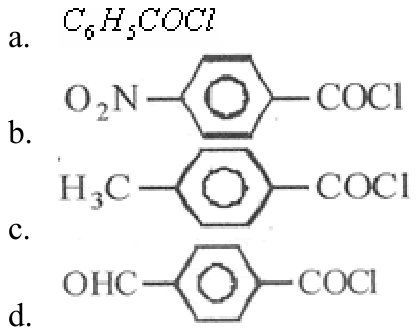
The correct decreasing order of their reactivity towards hydrolysis is
- 1(b) > (d) > (a) > (c)
- 2(b) > (d) > (c) > (a)
- 3(a) > (b) > (c) > (d)
- 4(d) > (b) > (a) > (c)
Show answer and solution
Correct: option 1, (b) > (d) > (a) > (c)
Hydrolysis of an acid chloride starts with water attacking the carbonyl carbon, so the more electron-poor that carbon is, the faster the reaction. A para group withdraws electrons most strongly, CHO withdraws less, and donates electrons. Reactivity therefore falls from the nitro compound (b) to the aldehyde (d) to benzoyl chloride (a) to the methyl compound (c).
Question 82AIPMT 2007 Prelims, Q140
Which one of the following on reduction with lithium aluminium hydride yields a secondary amine?
- 1Methyl Cyanide
- 2Nitroethane
- 3Methylisocyanide
- 4Acetamide
Show answer and solution
Correct: option 3, Methylisocyanide
An isocyanide is reduced at the carbon attached to nitrogen: , dimethylamine, a secondary amine. Methyl cyanide gives ethylamine, nitroethane gives ethylamine and acetamide gives ethylamine, all primary amines.
Question 83AIPMT 2007 Prelims, Q141
The order of decreasing reactivity towards an electrophilic reagent, for the following:
(a) Benzene
(b) Toluene
(c) Chlorobenzene
(d) Phenol
would be
- 1d > b > a > c
- 2a > b > c > d
- 3b > d > a > c
- 4d > c > b > a
Show answer and solution
Correct: option 1, d > b > a > c
An electrophile attacks faster when the ring is richer in electrons. The –OH group of phenol releases electrons strongly by resonance, the group of toluene releases them weakly, and chlorine withdraws electrons by its inductive effect and deactivates the ring below benzene. So the order is phenol > toluene > benzene > chlorobenzene, d > b > a > c.
Question 84AIPMT 2007 Prelims, Q143
Which of the compounds with molecular formula yields acetone on ozonolysis?
- 12-Methyl-1-butene
- 22-Methyl-2-butane
- 33-Methyl-1-butane
- 4Cyclopentane
Show answer and solution
Correct: option 2, 2-Methyl-2-butane
Ozonolysis cuts a C=C bond and puts an oxygen on each carbon. Acetone, , forms only if one doubly bonded carbon carries two methyl groups. That is the case in the 2-methyl-2-butene skeleton: . The source prints this option, the second, as \"2-Methyl-2-butane\". 2-Methyl-1-butene would give butanone and formaldehyde.
Question 85AIPMT 2007 Prelims, Q144
If there is no rotation of plane polarized light by a compound in a specific solvent, thought to be chiral, it may mean that
- 1the compound may be a racemic mixture
- 2the compound is certainly a chiral
- 3the compound is certainly meso
- 4there is no compound in the solvent
Show answer and solution
Correct: option 3, the compound is certainly meso
A sample with chiral centres shows no rotation when the rotations cancel. That happens inside one molecule in a meso compound, which has a plane of symmetry, and it also happens in a racemic mixture, where equal amounts of the two mirror-image forms cancel each other. The answer key of the source used here marks "certainly meso"; since a racemic mixture is equally possible, most textbooks give "may be a racemic mixture" as the answer.
Question 86AIPMT 2007 Prelims, Q145
For the following
(a)
(b)
(c)
the increasing order of nucleophilicity would be:
- 1
- 2
- 3
- 4
Show answer and solution
Correct: option 3,
In water and other protic solvents the small chloride ion is held tightly by hydrogen bonding and is the least free to attack, while the large iodide ion is weakly solvated and its electron cloud is easily distorted. Nucleophilicity therefore rises with size: .
Question 87AIPMT 2007 Prelims, Q147
In the reaction
.........
Which of the following compounds will be formed?
- 1
- 2
- 3
- 4
Show answer and solution
Correct: option 1,
HI first protonates the ether oxygen, and the iodide ion then attacks one of the two carbons next to oxygen by an step. Both are primary, but the ethyl carbon is less crowded than the of the branched isobutyl group, so iodide attacks there. The products are ethyl iodide and isobutyl alcohol.
Question 88AIPMT 2007 Prelims, Q148
Which one of the following vitamins is water-soluble?
- 1Vitamin A
- 2Vitamin B
- 3Vitamin E
- 4Vitamin K
Show answer and solution
Correct: option 2, Vitamin B
The B group vitamins and vitamin C dissolve in water and are not stored in the body to any extent. Vitamins A, D, E and K dissolve in fats and are stored in the liver and fatty tissue.
Question 89AIPMT 2007 Prelims, Q149
RNA and DNA are chiral molecules, their chirality is due to
- 1D-sugar component
- 2L-sugar component
- 3Chiral bases
- 4Chiral phosphate ester units
Show answer and solution
Correct: option 1, D-sugar component
Each nucleotide is made of a base, a sugar and a phosphate. The bases are flat ring molecules and the phosphate group has no chiral centre, but the sugar (ribose in RNA, 2-deoxyribose in DNA) has chiral carbons and belongs to the D series. The chirality of the nucleic acids therefore comes from the D-sugar.
Question 90AIPMT 2007 Prelims, Q150
Which one of the following polymers is prepared by condensation polymerization?
- 1Styrene
- 2Nylon-66
- 3Teflon
- 4Rubber
Show answer and solution
Correct: option 2, Nylon-66
Nylon-66 is made from hexamethylenediamine and adipic acid, which join through amide links with loss of a water molecule at each step; that is condensation polymerisation. Teflon, rubber and the polymer of styrene are all built by addition of unsaturated monomers with nothing lost.
AIPMT 2007 Prelims Biology questions
Question 91AIPMT 2007 Prelims, Q1
Biological organisation starts with:
- 1Atomic level
- 2Submicroscopic molecular level
- 3Cellular level
- 4Organismic level
Show answer and solution
Correct: option 2, Submicroscopic molecular level
The levels of biological organisation are counted from the molecules that make up living matter: molecules build organelles, organelles build cells, and cells build tissues, organs and organisms. So the starting point is the submicroscopic molecular level.
Question 92AIPMT 2007 Prelims, Q2
About 98 percent of the mass of every living organism is composed of just six elements including carbon, hydrogen, nitrogen, oxygen and:
- 1calcium and phosphorous
- 2phosphorus and sulphur
- 3sulphur and magnesium
- 4magnesium and sodium
Show answer and solution
Correct: option 1, calcium and phosphorous
By mass, oxygen, carbon, hydrogen and nitrogen are the four most abundant elements of the body, and the next two are calcium and phosphorus (bones, teeth, nucleic acids, ATP). Sulphur, magnesium and sodium are each present in much smaller amounts.
Question 93AIPMT 2007 Prelims, Q3
Which one of the following is an example of negative feed back loop in humans?
- 1Secretion of sweat glands and constriction of skin blood vessels when it is too hot.
- 2Constriction of skin blood vessels and contraction of skeletal muscles when it is too cold.
- 3Secretion of tears after falling of sand particles into the eye
- 4Salivation of mouth at the sight of delicious food.
Show answer and solution
Correct: option 2, Constriction of skin blood vessels and contraction of skeletal muscles when it is too cold.
In a negative feedback loop the response opposes the change. When the body is too cold, skin vessels constrict to save heat and skeletal muscles contract (shivering) to make heat, bringing the temperature back up. Option 1 is wrong because skin vessels dilate, not constrict, when it is hot; tears and salivation are simple reflexes.
Question 94AIPMT 2007 Prelims, Q4
What is common to whale, seal and shark?
- 1Homoiothermy
- 2Seasonal migration
- 3Thick subcutaneous fat
- 4Convergent evolution
Show answer and solution
Correct: option 4, Convergent evolution
Whale and seal are mammals while shark is a cold-blooded cartilaginous fish with no blubber, so warm-bloodedness and thick subcutaneous fat are not shared. All three have independently acquired a streamlined body and flippers or fins for life in water, which is convergent evolution.
Question 95AIPMT 2007 Prelims, Q5
Which one of the following is not a constituent of cell membrane?
- 1Phospholipids
- 2Cholesterol
- 3Glycolipids
- 4Proline
Show answer and solution
Correct: option 4, Proline
The cell membrane is made of phospholipids, cholesterol, glycolipids, proteins and glycoproteins. Proline is a single amino acid; it occurs only as a part of protein chains and is not itself a membrane constituent.
Question 96AIPMT 2007 Prelims, Q6
Select the wrong statement from the following:
- 1The chloroplasts are generally much larger than mitochondria.
- 2Both chloroplasts and mitochondria contain an inner and an outer membrane
- 3Both chloroplasts and mitochondria have an internal compartment, the thylakoid space bounded by the thylakoid membrane
- 4Both chloroplasts and mitochondria contain DNA.
Show answer and solution
Correct: option 3, Both chloroplasts and mitochondria have an internal compartment, the thylakoid space bounded by the thylakoid membrane
Thylakoids and the thylakoid space are found only in chloroplasts; the inner membrane of a mitochondrion is folded into cristae around the matrix. The other three statements are true of both organelles.
Question 97AIPMT 2007 Prelims, Q7
The overall goal of glycolysis, Krebs cycle and the electron transport system is the formation of:
- 1Nucleic acids
- 2ATP in small stepwise units
- 3ATP in one large oxidation reaction
- 4Sugars
Show answer and solution
Correct: option 2, ATP in small stepwise units
Aerobic respiration oxidises glucose through many small steps, and the energy released at these steps is trapped as ATP a little at a time. Releasing it in one large oxidation would waste most of it as heat.
Question 98AIPMT 2007 Prelims, Q8
If the mean and the median pertaining to a certain character of a population are of the same value, the following is most likely to occur:
- 1a skewed curve
- 2a normal distribution
- 3a bi-modal distribution
- 4a T-shaped curve
Show answer and solution
Correct: option 2, a normal distribution
In a normal distribution the curve is bell-shaped and symmetrical, so the mean and the median (and the mode) fall at the same value. In a skewed curve the mean is pulled away from the median.
Question 99AIPMT 2007 Prelims, Q9
Which one of the following is a slime mould?
- 1Anabaena
- 2Rhizopus
- 3Physarum
- 4Thiobacillus
Show answer and solution
Correct: option 3, Physarum
Physarum is an acellular (plasmodial) slime mould. Anabaena is a cyanobacterium, Rhizopus is a fungus (bread mould) and Thiobacillus is a chemosynthetic bacterium.
Question 100AIPMT 2007 Prelims, Q10
For a critical study of secondary growth in plants, which one of the following pairs is suitable?
- 1Wheat and maiden hair fern
- 2Sugarcane and sunflower
- 3Teak and pine
- 4Deodar and fern
Show answer and solution
Correct: option 3, Teak and pine
Secondary growth by vascular cambium occurs in dicots and gymnosperms. Teak is a woody dicot and pine is a gymnosperm, so both show it. Wheat and sugarcane are monocots and ferns are pteridophytes, which lack secondary growth.
Question 101AIPMT 2007 Prelims, Q11
Which one of the following statements about Mycoplasma is wrong?
- 1They cause disease in plants
- 2They are also called PPLO
- 3They are pleomorphic
- 4They are sensitive to penicillin
Show answer and solution
Correct: option 4, They are sensitive to penicillin
Penicillin acts by blocking cell wall synthesis. Mycoplasma has no cell wall (which is also why it is pleomorphic), so it is not affected by penicillin. It is also known as PPLO and causes diseases in plants and animals.
Question 102AIPMT 2007 Prelims, Q12
In the prothallus of vascular cryptogam, the antherozoids and eggs mature at different times. As a result:
- 1self fertilization is prevented
- 2there is no change in success rate of fertilization
- 3there is high degree of sterility
- 4one can conclude that the plant is apomictic
Show answer and solution
Correct: option 1, self fertilization is prevented
The prothallus of a pteridophyte usually bears both antheridia and archegonia. If the sperms and eggs of the same prothallus mature at different times, they cannot fuse with each other, so self fertilization is prevented and cross fertilization is favoured.
Question 103AIPMT 2007 Prelims, Q13
Two plants can be conclusively said to belong to the same species if they:
- 1have same number of chromosomes
- 2can reproduce freely with each other and form seeds
- 3have more than 90 per cent similar genes
- 4look similar and possess identical secondary metabolites.
Show answer and solution
Correct: option 2, can reproduce freely with each other and form seeds
The biological species concept defines a species as a group of individuals that can interbreed freely and produce offspring. Chromosome number, gene similarity and appearance can be shared by different species.
Question 104AIPMT 2007 Prelims, Q14
If you are asked to classify the various algae into distinct groups, which of the following characters you should choose?
- 1Chemical composition of the cell wall
- 2Types of pigments present in the cell
- 3Nature of stored food materials in the cell
- 4Structural organization of thallus.
Show answer and solution
Correct: option 2, Types of pigments present in the cell
The main groups of algae are named and separated by their pigments: green algae (chlorophyll a and b), brown algae (fucoxanthin) and red algae (phycoerythrin). So the type of pigment is the chief character used.
Question 105AIPMT 2007 Prelims, Q15
Flagellated male gametes are present in all the three of which one of the following sets?
- 1Riccia, Dryopteris and Cycas
- 2Anthoceros, Funaria and Spirogyra
- 3Zygnema, Saprolegnia and Hydrilla
- 4Fucus, Marsilea and Calotropis
Show answer and solution
Correct: option 1, Riccia, Dryopteris and Cycas
Bryophytes (Riccia) and pteridophytes (Dryopteris) have flagellated antherozoids, and Cycas is a gymnosperm with large multiciliate sperms. Spirogyra and Zygnema have non-motile gametes, and the angiosperms Hydrilla and Calotropis have non-flagellated male gametes.
Question 106AIPMT 2007 Prelims, Q16
In gymnosperms, the pollen chamber represents:
- 1the microsporangium in which pollen grains develop
- 2a cell in the pollen grain in which the sperms formed
- 3a cavity in the ovule in which pollen grains are stored after pollination
- 4an opening in the mega gametophyte through which the pollen tube approaches the egg.
Show answer and solution
Correct: option 3, a cavity in the ovule in which pollen grains are stored after pollination
In a gymnosperm ovule some nucellus cells just below the micropyle break down to leave a small cavity, the pollen chamber. Pollen grains drawn in through the micropyle rest here after pollination until they germinate.
Question 107AIPMT 2007 Prelims, Q17
Spore dissemination in some liverworts is aided by:
- 1peristome teeth
- 2elaters
- 3indusium
- 4calyptra
Show answer and solution
Correct: option 2, elaters
The capsule of liverworts such as Marchantia contains elaters, elongated hygroscopic cells that twist as they dry and throw out the spores. Peristome teeth belong to mosses, the indusium to fern sori, and the calyptra is a protective cap.
Question 108AIPMT 2007 Prelims, Q18
Which pair of the following belongs to Basidiomycetes?
- 1Morchella and Mushrooms
- 2Birds' nest fungi and Puffballs
- 3Puffballs and Claviceps
- 4Peziza and Stink horns
Show answer and solution
Correct: option 3, Puffballs and Claviceps
Mushrooms, puffballs, bird's nest fungi and stink horns are Basidiomycetes, while Morchella, Peziza and Claviceps are Ascomycetes. On this working the pair made up only of Basidiomycetes is bird's nest fungi and puffballs, option (2). The source's key gives option (3), which is kept here as the keyed answer although Claviceps is an Ascomycete; the key is unofficial and looks wrong for this question.
Question 109AIPMT 2007 Prelims, Q19
- 1Indian Code of Botanical Nomenclature
- 2Indian Congress of Biological Names
- 3International Code of Botanical Nomenclature
- 4International Congress of Biological Names
Show answer and solution
Correct: option 3, International Code of Botanical Nomenclature
The scientific names of plants are governed by the International Code of Botanical Nomenclature, abbreviated ICBN.
Question 110AIPMT 2007 Prelims, Q20
Ergot of rye is caused by a species of:
- 1Claviceps
- 2Phytophthora
- 3Uncinula
- 4Ustilago
Show answer and solution
Correct: option 1, Claviceps
Ergot of rye is caused by the ascomycete Claviceps purpurea, whose sclerotia replace the grains. Phytophthora causes late blight, Uncinula powdery mildew and Ustilago smut.
Question 111AIPMT 2007 Prelims, Q21
When two species of different genealogy come to resemble each other as a result of adaptation, the phenomenon is termed:
- 1Convergent evolution
- 2Divergent evolution
- 3Microevolution
- 4Co-evolution
Show answer and solution
Correct: option 1, Convergent evolution
Unrelated lineages that adapt to a similar way of life evolve similar features, such as the wings of insects and birds. This coming together of form from different ancestry is convergent evolution.
Question 112AIPMT 2007 Prelims, Q22
Adaptive radiation refers to:
- 1Power of adaptation in an individual to a variety of environments
- 2Adaptations due to Geographical isolation
- 3Evolution of different species from a common ancestor
- 4Migration of members of a species to different geographical areas
Show answer and solution
Correct: option 3, Evolution of different species from a common ancestor
Adaptive radiation is the evolution of many different species from one ancestral stock, each adapted to a different habitat or way of life, as in Darwin's finches and the Australian marsupials.
Question 113AIPMT 2007 Prelims, Q23
The living organisms can be unexceptionally distinguished from the non-living things on the basis of their ability for:
- 1growth and movement
- 2responsiveness to touch
- 3interaction with the environment and progressive evolution
- 4reproduction
Show answer and solution
Correct: option 4, reproduction
Of the choices given, reproduction is the one never shown by non-living things: crystals and mountains can grow and non-living objects can move, and not every organism responds to touch. Hence the keyed answer is reproduction.
Question 114AIPMT 2007 Prelims, Q24
The Finches of Galapagos islands provide an evidence in favour of:
- 1Biogeographical Evolution
- 2Special Creation
- 3Evolution due to Mutation
- 4Retrogressive Evolution
Show answer and solution
Correct: option 1, Biogeographical Evolution
Darwin's finches on the different Galapagos islands evolved from a common mainland ancestor into forms with different beaks suited to the food of each island. This link between geographical distribution and the origin of species is biogeographical evidence of evolution.
Question 115AIPMT 2007 Prelims, Q25
One of the important consequences of geographical isolation is:
- 1Random creation of new species
- 2No change in the isolated fauna
- 3Preventing Speciation
- 4Speciation through reproductive isolation
Show answer and solution
Correct: option 4, Speciation through reproductive isolation
A geographical barrier stops gene flow between populations. Each population then accumulates its own variations until the two can no longer interbreed, that is, they become reproductively isolated and form separate species.
Question 116AIPMT 2007 Prelims, Q26
Industrial melanism as observed in peppered moth proves that:
- 1Melanism is a pollution-generated feature
- 2The true black melanic forms arise by a recurring random mutation
- 3The melanic form of the moth has no selective advantage over lighter form in industrial area
- 4The lighter-form moth has no selective advantage either in polluted industrial area or non-polluted area.
Show answer and solution
Correct: option 2, The true black melanic forms arise by a recurring random mutation
The black form of the peppered moth was not produced by soot; it already arose from time to time by random mutation, and natural selection favoured it on soot-darkened trees. The melanic form does have an advantage in industrial areas and the light form in unpolluted areas, so options 3 and 4 are false.
Question 117AIPMT 2007 Prelims, Q27
The concept of chemical evolution is based on:
- 1Possible origin of life by combination of chemicals
- 2Crystallization of chemicals under suitable environmental conditions
- 3Interaction of water, air and clay under
- 4Effect of solar radiation of chemicals
Show answer and solution
Correct: option 1, Possible origin of life by combination of chemicals
Chemical evolution (Oparin and Haldane) holds that life arose from non-living matter: simple inorganic molecules combined into organic molecules and these into the first living systems. So it is based on the possible origin of life by combination of chemicals.
Question 118AIPMT 2007 Prelims, Q28
Among the human ancestors the brain size was more than 1000 CC in:
- 1Homo habilis
- 2Homo neanderthalensis
- 3Homo erectus
- 4Ramapithecus
Show answer and solution
Correct: option 2, Homo neanderthalensis
Homo habilis had a brain of about 650 to 800 cc and Homo erectus about 900 cc, while Ramapithecus was an ape-like form with a much smaller brain. Neanderthal man had a brain of about 1400 cc, the only one here clearly above 1000 cc.
Question 119AIPMT 2007 Prelims, Q29
Which of the following pairs are correctly matched?
| Animal | Feature |
|---|
| A | Crocodile | 4-Chambered heart |
| B | Sea Urchin | Parapodia |
| C | Obelia | Metagenesis |
| D | Lemur | Thecodont |
- 1Only A and B
- 2A, C and D
- 3B, C and D
- 4Only A and D
Show answer and solution
Correct: option 2, A, C and D
A is correct: crocodiles have a four-chambered heart. B is wrong: sea urchins move with tube feet; parapodia belong to annelids such as Nereis. C is correct: Obelia alternates between polyp and medusa (metagenesis). D is correct: lemurs are mammals, whose teeth are set in sockets (thecodont). So A, C and D.
Question 120AIPMT 2007 Prelims, Q30
Select the correct statement from the following:
- 1Mutations are random and directional
- 2Darwinian variations are small and directionless
- 3Fitness is the end result of the ability to adapt and gets selected by nature
- 4All mammals except whales and camels have seven cervical vertebrae.
Show answer and solution
Correct: option 3, Fitness is the end result of the ability to adapt and gets selected by nature
According to Darwin, fitness is the outcome of the ability to adapt and is what nature selects. Mutations are random and directionless, Darwinian variations are small and directional, and whales and camels too have seven cervical vertebrae (the exceptions are sloths and the manatee).
Question 121AIPMT 2007 Prelims, Q31
Which one of the following is a matching pair of a body feature and the animal possessing it?
- 1Ventral heart - Scorpion
- 2Post-anal tail - Octopus
- 3Ventral Central nervous system - Leech
- 4Pharyngeal gill slits absent in embryo - Chamaeleon
Show answer and solution
Correct: option 3, Ventral Central nervous system - Leech
Leech is an annelid, and annelids have a ventral nerve cord. Scorpion, an arthropod, has a dorsal heart; a post-anal tail is a chordate feature not found in the mollusc Octopus; and Chamaeleon, being a chordate, has pharyngeal gill slits in its embryo.
Question 122AIPMT 2007 Prelims, Q32
What is common between parrot, platypus and kangaroo?
- 1Oviparity
- 2Homoiothermy
- 3Toothless jaws
- 4Functional post-anal tail
Show answer and solution
Correct: option 2, Homoiothermy
Parrot is a bird and platypus and kangaroo are mammals; birds and mammals are both warm-blooded (homoiothermous). Kangaroo is not egg-laying and has teeth, so options 1 and 3 fail.
Question 123AIPMT 2007 Prelims, Q33
What is true about Nereis, Scorpion, Cockroach and Silver fish?
- 1They all belong to the same phylum
- 2They all have jointed paired appendages
- 3They all possess dorsal heart
- 4None of them is aquatic
Show answer and solution
Correct: option 3, They all possess dorsal heart
Nereis is an annelid and the other three are arthropods, so they are not of one phylum, and Nereis has unjointed parapodia and is marine. In both annelids and arthropods the heart or main contractile vessel is dorsal, which is common to all four.
Question 124AIPMT 2007 Prelims, Q34
Which one of the following statement is correct?
- 1Ontogeny repeats phylogeny
- 2Stem cells are specialized cells
- 3There is no evidence of the existence of gills during embryogenesis of mammals
- 4All plant and animal cells are totipotent.
Show answer and solution
Correct: option 1, Ontogeny repeats phylogeny
Haeckel's biogenetic law states that ontogeny (the development of an individual) repeats phylogeny (its evolutionary history). Stem cells are unspecialised, mammalian embryos do show gill slits, and most animal cells are not totipotent.
Question 125AIPMT 2007 Prelims, Q35
"Foolish Seedling" disease of rice led to the discovery of:
- 1IAA
- 2GA
- 3ABA
- 42, 4-D
Show answer and solution
Correct: option 2, GA
Rice seedlings infected by the fungus Gibberella fujikuroi grow abnormally tall and thin (bakanae or foolish seedling disease). The substance from the fungus that causes this was isolated and named gibberellin (GA).
Question 126AIPMT 2007 Prelims, Q36
Passage cells are thin-walled cells found in:
- 1central region of style through which the pollen tube grows towards the ovary.
- 2endodermis of roots facilitating rapid transport of water from cortex to pericycle.
- 3phloem elements that serve as entry points for substances for transport to other plant parts.
- 4testa of seed to enable emergence of growing embryonic axis during seed germination.
Show answer and solution
Correct: option 2, endodermis of roots facilitating rapid transport of water from cortex to pericycle.
Most endodermal cells of a root are thickened, but a few opposite the protoxylem stay thin-walled. These passage cells let water move quickly from the cortex into the pericycle and xylem.
Question 127AIPMT 2007 Prelims, Q37
The first acceptor of electrons from an excited chlorophyll molecule of photosystem II is:
- 1Quinone
- 2Cytochrome
- 3Iron-sulphur protein
- 4Ferredoxin.
Show answer and solution
Correct: option 1, Quinone
Electrons leaving the excited reaction centre of photosystem II pass (through pheophytin) to plastoquinone, a quinone, and only then to the cytochrome complex. Iron-sulphur proteins and ferredoxin accept electrons from photosystem I.
Question 128AIPMT 2007 Prelims, Q38
All enzymes of TCA cycle are located in the mitochondrial matrix except one which is located in inner mitochondrial membranes in eukaryotes and in cytosol in prokaryotes. This enzyme is:
- 1succinate dehydrogenase
- 2lactate dehydrogenase
- 3isocitrate dehydrogenase
- 4malate dehydrogenase
Show answer and solution
Correct: option 1, succinate dehydrogenase
Succinate dehydrogenase is bound to the inner mitochondrial membrane, where it is also complex II of the electron transport chain. Isocitrate and malate dehydrogenases are matrix enzymes, and lactate dehydrogenase is not a TCA cycle enzyme.
Question 129AIPMT 2007 Prelims, Q39
The wavelength of light absorbed by Pr form of phytochrome is:
- 1620 nm
- 2640 nm
- 3680 nm
- 4720 nm
Show answer and solution
Correct: option 3, 680 nm
Pr is the red-absorbing form of phytochrome, with its absorption peak in the red region near 660 to 680 nm; on absorbing it changes to Pfr, which absorbs far-red light near 730 nm. Of the values given, 680 nm is the one for Pr.
Question 130AIPMT 2007 Prelims, Q40
Opening of floral buds into flowers, is type of:
- 1Autonomic movement of growth
- 2Autonomic movement of locomotion
- 3Autonomic movement of variation
- 4Paratonic movement of growth.
Show answer and solution
Correct: option 1, Autonomic movement of growth
A bud opens because the inner (upper) surface of the petals grows faster than the outer surface (epinasty). It is caused by unequal growth and is controlled from within, so it is an autonomic movement of growth.
Question 131AIPMT 2007 Prelims, Q41
Which one of the following pairs, is not correctly matched?
- 1IAA - Cell wall elongation
- 2Abscisic Acid - Stomatal closure
- 3Gibberellic Acid - Leaf fall
- 4Cytokinin - Cell division
Show answer and solution
Correct: option 3, Gibberellic Acid - Leaf fall
Gibberellic acid promotes stem elongation, bolting and seed germination; leaf fall is brought about by abscisic acid and ethylene. The other three pairs are correct.
Question 132AIPMT 2007 Prelims, Q42
One gene - one enzyme relationship was established for the first time in:
- 1Diplococcus pneumoniae
- 2Neurospora crassa
- 3Salmonella typhimurium
- 4Escherichia coli
Show answer and solution
Correct: option 2, Neurospora crassa
Beadle and Tatum produced nutritional mutants of the bread mould Neurospora crassa and showed that each mutant lacked one enzyme, which led to the one gene - one enzyme hypothesis.
Question 133AIPMT 2007 Prelims, Q43
Male gametes in angiosperms are formed by the division of:
- 1Microspore mother cell
- 2Microspore
- 3Generative cell
- 4Vegetative cell
Show answer and solution
Correct: option 3, Generative cell
The microspore divides into a large vegetative (tube) cell and a small generative cell. The generative cell then divides by mitosis to give the two male gametes.
Question 134AIPMT 2007 Prelims, Q44
Two cells A and B are contiguous. Cell A has osmotic pressure 10 atm, turgor pressure 7 atm and diffusion pressure deficit 3 atm. Cell B has osmotic pressure 8 atm, turgor pressure 3 atm and diffusion pressure deficit 5 atm. The result will be:
- 1Movement of water of Cell A to B
- 2Movement of water from Cell B to A
- 3No movement of water
- 4Equilibrium between the two
Show answer and solution
Correct: option 1, Movement of water of Cell A to B
DPD = OP - TP, which gives 3 atm for cell A and 5 atm for cell B. Water moves from the cell with lower DPD to the cell with higher DPD, so it moves from A to B.
Question 135AIPMT 2007 Prelims, Q45
In the leaves of plants, malic acid formation during fixation occurs in the cells of:
- 1Epidermis
- 2Mesophyll
- 3Bundle Sheath
- 4Phloem
Show answer and solution
Correct: option 2, Mesophyll
In plants is first fixed in the mesophyll cells by PEP carboxylase into oxaloacetic acid, which is reduced to malic acid there. Malic acid then moves to the bundle sheath cells, where it is decarboxylated.
Question 136AIPMT 2007 Prelims, Q46
Which of the following is a flowering plant with nodules containing filamentous nitrogen-fixing microorganism?
- 1Cicer arietinum
- 2Casuarina equisetifolia
- 3Crotalaria juncea
- 4Cycas revoluta
Show answer and solution
Correct: option 2, Casuarina equisetifolia
The root nodules of Casuarina contain Frankia, a filamentous nitrogen-fixing actinomycete. Cicer and Crotalaria are legumes with the rod-shaped bacterium Rhizobium, and Cycas is a gymnosperm, not a flowering plant.
Question 137AIPMT 2007 Prelims, Q47
Which one of the following is surrounded by a callose wall?
- 1Pollen grain
- 2Microspore mother cell
- 3Male gamete
- 4Egg
Show answer and solution
Correct: option 2, Microspore mother cell
Before meiosis each microspore (pollen) mother cell lays down a thick wall of callose, which isolates it from its neighbours. The callose is later dissolved by callase to free the microspores.
Question 138AIPMT 2007 Prelims, Q48
Which one of the following elements is not an essential micronutrient for plant growth?
- 1Ca
- 2Mn
- 3Zn
- 4Cu
Show answer and solution
Correct: option 1, Ca
Calcium is needed in large amounts and is a macronutrient. Manganese, zinc and copper are needed only in traces and are micronutrients.
Question 139AIPMT 2007 Prelims, Q49
If you suspect major deficiency of antibodies in person, to which of the following would you look for confirmatory evidence?
- 1Haemocytes
- 2Serum albumins
- 3Serum globulins
- 4Fibrinogen in the plasma
Show answer and solution
Correct: option 3, Serum globulins
Antibodies are immunoglobulins, which form the gamma globulin fraction of the serum proteins. A fall in serum globulins therefore confirms an antibody deficiency. Albumins maintain osmotic pressure and fibrinogen is for clotting.
Question 140AIPMT 2007 Prelims, Q50
Which one of the following is a fat-soluble vitamin and its related deficiency disease?
- 1Calciferol - Pellagra
- 2Ascorbic acid - Scurvy
- 3Retinol - Xerophthalmia
- 4Cobalamine - Beri-beri
Show answer and solution
Correct: option 3, Retinol - Xerophthalmia
Retinol (vitamin A) is fat-soluble and its deficiency causes xerophthalmia. Calciferol is fat-soluble but its deficiency causes rickets, not pellagra; ascorbic acid is water-soluble; and cobalamine deficiency causes pernicious anaemia, not beri-beri.
Question 141AIPMT 2007 Prelims, Q51
Which one of the following mammalian cells is not capable of metabolising glucose to carbon-dioxide aerobically?
- 1Red blood cells
- 2White blood cells
- 3Unstriated muscle cells
- 4Liver cells
Show answer and solution
Correct: option 1, Red blood cells
Aerobic breakdown of glucose to carbon dioxide (Krebs cycle and electron transport) takes place in mitochondria. Mature mammalian red blood cells have no mitochondria, so they get their energy only from anaerobic glycolysis. The other three cell types all have mitochondria.
Question 142AIPMT 2007 Prelims, Q52
Compared to a bull a bullock is docile because of:
- 1lower levels of adrenalin / noradrenalin in its blood
- 2higher levels of thyroxin
- 3higher levels of cortisone
- 4lower levels of blood testosterone
Show answer and solution
Correct: option 4, lower levels of blood testosterone
A bullock is a castrated bull. With the testes removed, very little testosterone is made, and it is testosterone that produces the aggressive male behaviour of a bull. So the bullock is docile because its blood testosterone is low.
Question 143AIPMT 2007 Prelims, Q53
In the human female, menstruation can be deferred by the administration of:
- 1FSH only
- 2LH only
- 3Combination of FSH and LH
- 4Combination of estrogen and progesterone
Show answer and solution
Correct: option 4, Combination of estrogen and progesterone
Menstruation starts when estrogen and progesterone levels fall and the endometrium loses its hormonal support. Giving estrogen together with progesterone keeps the endometrium maintained, so the flow is postponed. FSH and LH act on the ovary and do not hold the endometrium directly.
Question 144AIPMT 2007 Prelims, Q54
In human body, which one of the following is anatomically correct?
- 1Cranial nerves - 10 pairs
- 2Floating ribs - 2 pairs
- 3Collar bones - 3 pairs
- 4Salivary glands - 1 pair
Show answer and solution
Correct: option 2, Floating ribs - 2 pairs
Humans have 12 pairs of ribs, of which the last 2 pairs (11th and 12th) are floating ribs, not attached to the sternum. The others are wrong: there are 12 pairs of cranial nerves, 1 pair of collar bones and 3 pairs of salivary glands.
Question 145AIPMT 2007 Prelims, Q55
In which one of the following preparations are you likely to come across cell junctions most frequently?
- 1Hyaline cartilage
- 2Ciliated epithelium
- 3Thrombocytes
- 4Tendon
Show answer and solution
Correct: option 2, Ciliated epithelium
Cell junctions (tight, adhering and gap junctions) join cells that lie closely packed, which is the case in epithelial tissue. In cartilage and tendon the cells are scattered in a large amount of matrix or fibres, and thrombocytes are free cell fragments in blood. So ciliated epithelium shows the most junctions.
Question 146AIPMT 2007 Prelims, Q56
A drop of each of the following, is placed separately on four slides. Which of them will not coagulate?
- 1Whole blood from pulmonary vein
- 2Blood plasma
- 3Blood serum
- 4Sample from the thoracic duct of lymphatic system
Show answer and solution
Correct: option 3, Blood serum
Clotting needs fibrinogen and the other clotting factors. Serum is the fluid left after blood has clotted, that is plasma without fibrinogen and the used-up clotting factors, so it cannot coagulate. Whole blood, plasma and lymph all still contain fibrinogen and can clot.
Question 147AIPMT 2007 Prelims, Q57
Feeling the tremors of an earthquake a scared resident of seventh floor of a multistoryed building starts climbing down the stairs rapidly. Which hormone initiated this action?
- 1Gastrin
- 2Thyroxin
- 3Adrenaline
- 4Glucagon
Show answer and solution
Correct: option 3, Adrenaline
Fear is an emergency situation. The adrenal medulla releases adrenaline, the fight-or-flight hormone, which raises heart rate, breathing rate and blood glucose and so prepares the body for rapid action.
Question 148AIPMT 2007 Prelims, Q58
A person who is on a long hunger strike and is surviving only on water, will have:
- 1less urea in his urine
- 2more sodium in his urine
- 3less amino acids in his urine
- 4more glucose in his blood.
Show answer and solution
Correct: option 1, less urea in his urine
Urea is made in the liver from the nitrogen of amino acids, most of which come from dietary protein. With no food intake for a long time there is no dietary protein to deaminate and the body conserves its own protein, so less urea is formed and less is excreted. Sodium is conserved and blood glucose tends to fall, not rise.
Question 149AIPMT 2007 Prelims, Q59
Which one of the following pairs of structures distinguishes a nerve cell from other types of cell?
- 1Nucleus and mitochondria
- 2Perikaryon and dendrites
- 3Vacuoles and fibers
- 4Flagellum and medullary sheath
Show answer and solution
Correct: option 2, Perikaryon and dendrites
A neuron is made of a cell body, called the perikaryon or cyton, and processes, the dendrites and the axon. These terms and structures are peculiar to nerve cells. A nucleus and mitochondria are found in almost every cell, and a neuron has no flagellum.
Question 150AIPMT 2007 Prelims, Q60
Which part of ovary in mammals acts as an endocrine gland after evolution?
- 1Vitelline membrane
- 2Graafian follicle
- 3Stroma
- 4Germinal epithelium
Show answer and solution
Correct: option 2, Graafian follicle
After the ovum is released, the ruptured Graafian follicle changes into the corpus luteum. The corpus luteum is a temporary endocrine gland that secretes mainly progesterone (and some estrogen) to maintain the endometrium.
Question 151AIPMT 2007 Prelims, Q61
During the transmission of nerve impulse through a nerve fibre, the potential on the inner side of the plasma membrane has which type of electric charge?
- 1First positive, then negative and again back to positive
- 2First negative, then positive and again back to negative
- 3First positive, then negative and continue to be negative
- 4First negative, then positive and continue to be positive.
Show answer and solution
Correct: option 2, First negative, then positive and again back to negative
At rest the inside of the axon membrane is negative (polarised). When the impulse arrives, sodium ions rush in and the inside becomes positive (depolarisation). Potassium ions then move out and the inside returns to negative (repolarisation). So the sequence is negative, positive, negative.
Question 152AIPMT 2007 Prelims, Q62
A person is having problems with calcium and phosphorous metabolism in his body. Which one of the following glands may not be functioning properly?
- 1Thyroid
- 2Parathyroid
- 3Parotid
- 4Pancreas
Show answer and solution
Correct: option 2, Parathyroid
Parathyroid hormone (PTH) from the parathyroid glands is the main regulator of calcium and phosphate levels: it raises blood calcium by acting on bone, kidney and gut and increases phosphate excretion. A fault in calcium and phosphorus metabolism therefore points to the parathyroid.
Question 153AIPMT 2007 Prelims, Q63
Identify the odd combination of the habitat and the particular animal concerned:
- 1Rann of Kutch - Wild Ass
- 2Dachigam National Park - Snow Leopard
- 3Sunderbans - Bengal Tiger
- 4Periyar - Elephant
Show answer and solution
Correct: option 2, Dachigam National Park - Snow Leopard
Dachigam National Park in Kashmir is known for the hangul (Kashmir stag), not the snow leopard, so that pair is the odd one. The Rann of Kutch is the home of the Indian wild ass, the Sunderbans of the Bengal tiger, and Periyar in Kerala is famous for its elephants.
Question 154AIPMT 2007 Prelims, Q64
In which one of the following the BOD (Biochemical Oxygen Demand) of sewage (S), distillery effluent (DE), paper mill effluent (PE) and sugar mill effluent (SE) have been arranged in ascending order?
- 1S < DE < PE < SE
- 2SE < S < PE < DE
- 3SE < PE < S < DE
- 4PE < S < SE < DE
Show answer and solution
Correct: option 2, SE < S < PE < DE
BOD measures how much biodegradable organic matter a waste water carries. Distillery effluent, which is loaded with dissolved organic matter, has by far the highest BOD (tens of thousands of mg/L), so it must come last, which rules out the first option. Of the remaining orders, the key takes sugar mill effluent as the lowest, then sewage, then paper mill effluent: SE < S < PE < DE.
Question 155AIPMT 2007 Prelims, Q65
Which one of the following ecosystem types has the highest annual net primary productivity?
- 1Temperate deciduous forest
- 2Tropical rain forest
- 3Tropical deciduous forest
- 4Temperate evergreen forest
Show answer and solution
Correct: option 2, Tropical rain forest
Net primary productivity depends on sunlight, temperature and water. A tropical rain forest has high temperature, strong light and heavy rain throughout the year, so plants grow all year round and its annual net primary productivity is the highest of the four forest types.
Question 156AIPMT 2007 Prelims, Q66
Which one of the following is being utilized as a source of biodiesel in the Indian countryside?
- 1Pongamia
- 2Euphorbia
- 3Beetroot
- 4Sugarcane
Show answer and solution
Correct: option 1, Pongamia
Biodiesel is made from non-edible plant oils. The oil-rich seeds of Pongamia (karanj), like those of Jatropha, are used for this in rural India. Beetroot and sugarcane give sugar that is fermented to ethanol, not biodiesel.
Question 157AIPMT 2007 Prelims, Q67
In a coal fired power plant electrostatic precipitators are installed to control emission of:
- 1CO
- 2
- 3
- 4SPM
Show answer and solution
Correct: option 4, SPM
An electrostatic precipitator gives dust particles in the exhaust an electric charge and then collects them on oppositely charged plates. It removes over 99% of the particulate matter (SPM, suspended particulate matter) but does not remove gases such as CO, or oxides of nitrogen.
Question 158AIPMT 2007 Prelims, Q68
Which one of the following is not a bioindicator of water pollution?
- 1Sewage fungus
- 2Sludge-worms
- 3Blood-worms
- 4Stone flies
Show answer and solution
Correct: option 4, Stone flies
Sewage fungus, sludge-worms (Tubifex) and blood-worms (Chironomus larvae) thrive in water that is low in oxygen and rich in organic waste, so their presence indicates pollution. Stone fly nymphs need clean water rich in oxygen and disappear when water is polluted, so they are not indicators of pollution.
Question 159AIPMT 2007 Prelims, Q69
A high density of elephant population in an area can result in:
- 1Predation on one another
- 2Mutualism
- 3Intra specific competition
- 4Inter specific competition
Show answer and solution
Correct: option 3, Intra specific competition
When many individuals of one species live in the same area they need the same food, water and space, so they compete with each other. Competition among members of the same species is intraspecific competition.
Question 160AIPMT 2007 Prelims, Q70
Geometric representation of age structure is a characteristic of:
- 1Ecosystem
- 2Biotic community
- 3Population
- 4Landscape
Show answer and solution
Correct: option 3, Population
Age structure, the proportion of individuals in the pre-reproductive, reproductive and post-reproductive age groups, is an attribute of a population. It is drawn as an age pyramid, which is its geometric representation.
Question 161AIPMT 2007 Prelims, Q71
Which one of the following pairs of organisms are exotic species introduced in India?
- 1Nile perch, Ficus religiosa
- 2Ficus religiosa, Lantana camara
- 3Lantana camara, Water hyacinth
- 4Water hyacinth, Prosopis cineraria
Show answer and solution
Correct: option 3, Lantana camara, Water hyacinth
Lantana camara and water hyacinth (Eichhornia) were both brought into India from tropical America and have become invasive weeds. Ficus religiosa (peepal) and Prosopis cineraria (khejri) are native Indian trees, and the Nile perch was introduced into Lake Victoria in Africa, not into India.
Question 162AIPMT 2007 Prelims, Q72
One of endangered species of Indian medicinal plants is that of:
- 1Nepenthes
- 2Podophyllum
- 3Ocimum
- 4Garlic
Show answer and solution
Correct: option 2, Podophyllum
Podophyllum is a Himalayan medicinal herb whose rhizome yields a drug used against tumours; over-collection has made it endangered. Ocimum (tulsi) and garlic are common cultivated plants, and Nepenthes is an insectivorous plant rather than a medicinal one.
Question 163AIPMT 2007 Prelims, Q73
A genetically engineered micro-organism used successfully in bioremediation of oil spills is a species of:
- 1Bacillus
- 2Pseudomonas
- 3Trichoderma
- 4Xanthomonas
Show answer and solution
Correct: option 2, Pseudomonas
A strain of Pseudomonas putida carrying plasmids for the breakdown of several hydrocarbons, the so-called superbug developed by Ananda Mohan Chakrabarty, can digest the components of crude oil and is used to clean up oil spills.
Question 164AIPMT 2007 Prelims, Q74
A sequential expression of a set of human genes occurs when a steroid molecule binds to the:
- 1Ribosome
- 2Transfer RNA
- 3Messenger RNA
- 4DNA sequence
Show answer and solution
Correct: option 4, DNA sequence
A steroid hormone passes through the cell membrane and joins an intracellular receptor. The hormone-receptor complex then binds to a specific DNA sequence in the nucleus and switches on transcription of a set of genes. Steroids do not act on ribosomes, tRNA or mRNA.
Question 165AIPMT 2007 Prelims, Q75
The Okazaki fragments in DNA chain growth:
- 1polymerize in the 5'-to-3' direction and explain 3'-to-5' DNA replication
- 2result in transcription
- 3polymerize in the 3'-to-5' direction and forms replication fork
- 4prove semi-conservative nature of DNA replication
Show answer and solution
Correct: option 1, polymerize in the 5'-to-3' direction and explain 3'-to-5' DNA replication
DNA polymerase can add nucleotides only in the 5'-to-3' direction. On the template strand where the overall growth of the new strand has to go 3'-to-5', the new DNA is made as short Okazaki fragments, each built 5'-to-3' and later joined by ligase. So the fragments polymerise 5'-to-3' and explain how the lagging strand appears to grow 3'-to-5'.
Question 166AIPMT 2007 Prelims, Q76
In the hexaploid wheat, the haploid (n) and basic (x) numbers of chromosomes are:
- 1n = 21 and x = 7
- 2n = 7 and x = 21
- 3n = 21 and x = 21
- 4n = 21 and x = 14
Show answer and solution
Correct: option 1, n = 21 and x = 7
Bread wheat is hexaploid with chromosomes. The basic number is therefore , and the haploid (gametic) number is .
Question 167AIPMT 2007 Prelims, Q77
Molecular basis of organ differentiation depends on the modulation in transcription by:
- 1Anticodon
- 2RNA polymerase
- 3Ribosome
- 4Transcription factor
Show answer and solution
Correct: option 4, Transcription factor
All cells of an organism carry the same genes; they differentiate because different genes are transcribed in different cells. Which genes are switched on or off is decided by transcription factors, proteins that bind to regulatory DNA and control how RNA polymerase transcribes a gene. RNA polymerase itself is the same in every cell.
Question 168AIPMT 2007 Prelims, Q78
Telomere repetitive DNA sequence control the function of eukaryote chromosomes because they:
- 1prevent chromosome loss
- 2act as replicons
- 3are RNA transcription initiator
- 4help chromosome pairing
Show answer and solution
Correct: option 1, prevent chromosome loss
Telomeres are the repetitive DNA sequences that cap the ends of linear chromosomes. They protect the ends from being degraded or fused with other chromosomes and from being shortened into the genes at each replication, and so prevent the loss of chromosomes.
Question 169AIPMT 2007 Prelims, Q79
Inheritance of skin colour in humans is an example of:
- 1codominance
- 2chromosomal aberration
- 3point mutation
- 4polygenic inheritance
Show answer and solution
Correct: option 4, polygenic inheritance
Human skin colour is controlled by several genes (usually described as three pairs), each dominant allele adding a little more melanin. A trait controlled by many genes with additive effects, giving a continuous range of phenotypes, shows polygenic inheritance.
Question 170AIPMT 2007 Prelims, Q80
A common test to find the genotype of a hybrid is by:
- 1crossing of one progeny with male parent
- 2crossing of one progeny with male parent
- 3crossing of one progeny with female parent
- 4studying the sexual behaviour of progenies.
Show answer and solution
Correct: option 1, crossing of one progeny with male parent
The genotype of a hybrid is found by a test cross, in which the hybrid is crossed back to a parent (the recessive one), and the ratio in the offspring shows whether it is heterozygous. Only the first option describes a cross of the hybrid back to a parent.
Question 171AIPMT 2007 Prelims, Q81
During transcription, RNA polymerase holoenzyme binds to a gene promoter and assumes a saddle-like structure. What is its DNA-binding sequence?
- 1TATA
- 2TTAA
- 3AATT
- 4CACC
Show answer and solution
Correct: option 1, TATA
The promoter of a gene contains a conserved sequence rich in T and A, the TATA box (Pribnow box in prokaryotes), which is the site recognised for binding of RNA polymerase before transcription starts.
Question 172AIPMT 2007 Prelims, Q82
Two genes R and Y are located very close on the chromosomal linkage map of maize plant. When RRYY and rryy genotypes are hybridized, the segregation will show:
- 1Higher number of the parental types.
- 2Higher number of the recombinant types.
- 3Segregation in the expected 9: 3: 3: 1 ratio.
- 4Segregation in 3:1 ratio.
Show answer and solution
Correct: option 1, Higher number of the parental types.
Genes lying very close together on a chromosome are tightly linked, so crossing over between them is rare. The plant therefore forms mostly parental gametes (RY and ry) and few recombinant ones, and the shows many more parental types than recombinants instead of the 9:3:3:1 ratio of independent assortment.
Question 173AIPMT 2007 Prelims, Q83
In maize, hybrid vigour is exploited by:
- 1Inducing mutations.
- 2Bombarding the seeds with DNA.
- 3Crossing of two inbred parental lines.
- 4Harvesting seeds from the most productive plants.
Show answer and solution
Correct: option 3, Crossing of two inbred parental lines.
Hybrid vigour (heterosis) is the superiority of a hybrid over both its parents. In maize it is obtained by crossing two different inbred (homozygous) lines; the heterozygous hybrid seed gives vigorous, high-yielding plants.
Question 174AIPMT 2007 Prelims, Q84
Differentiation of organs and tissues in a developing organism, is associated with:
- 1Deletion of genes
- 2Developmental mutations
- 3Differential expression of genes
- 4Lethal mutations
Show answer and solution
Correct: option 3, Differential expression of genes
All cells of an embryo have the same set of genes. Cells become different from one another because different sets of genes are switched on in different cells and at different times, that is by differential gene expression, not by loss or mutation of genes.
Question 175AIPMT 2007 Prelims, Q85
In pea plants, yellow seeds are dominant to green. If a heterozygous yellow seeded plant is crossed with a green seeded plant, what ratio of yellow and green seeded plants would you expect in generation?
- 13 : 1
- 250 : 50
- 39 : 1
- 41 : 3
Show answer and solution
Correct: option 2, 50 : 50
The cross is Yy × yy, a test cross. The heterozygous parent gives Y and y gametes in equal numbers and the green parent gives only y, so the offspring are Yy (yellow) and yy (green) in a 1 : 1 ratio, that is 50 : 50.
Question 176AIPMT 2007 Prelims, Q86
The length of DNA molecule greatly exceeds the dimensions of the nucleus in eukaryotic cells. How is this DNA accommodated?
- 1Through elimination of repetitive DNA.
- 2Deletion of non-essential genes.
- 3Super-coiling in nucleosomes.
- 4DNAse digestion.
Show answer and solution
Correct: option 3, Super-coiling in nucleosomes.
In eukaryotes the negatively charged DNA is wound around octamers of positively charged histone proteins to form nucleosomes, which are then coiled further into chromatin fibres and chromosomes. This packaging, not any loss of DNA, lets a very long molecule fit in the nucleus.
Question 177AIPMT 2007 Prelims, Q87
In cloning of cattle a fertilized egg is taken out of the mother's womb and:
- 1from this upto eight identical twins can be produced
- 2the egg is divided into 4 pairs of cells which are implanted into the womb of other cows
- 3in the eight cell stage, cells are separated and cultured until small embryos are formed which are implanted into the womb other cows.
- 4in the eight cell stage the individual cells are separated under electrical field for further development in culture media.
Show answer and solution
Correct: option 3, in the eight cell stage, cells are separated and cultured until small embryos are formed which are implanted into the womb other cows.
In embryo cloning of cattle the fertilised egg is allowed to divide to the eight-cell stage. The cells, which are still totipotent, are separated and each is cultured until it forms a small embryo; these embryos are then implanted into surrogate cows, giving genetically identical calves.
Question 178AIPMT 2007 Prelims, Q88
Which one of the following statements is correct?
- 1At present it is not possible to grow maize without chemical fertilizers.
- 2Extensive use of chemical fertilizers may lead to eutrophication of nearby water bodies.
- 3Both Azotobacter and Rhizobium fix atmospheric nitrogen in root nodules of plants.
- 4Cyanobacteria such as Anabaena and Nostoc are important mobilizers of phosphates and potassium for plant nutrition in soil.
Show answer and solution
Correct: option 2, Extensive use of chemical fertilizers may lead to eutrophication of nearby water bodies.
Excess fertiliser is washed by run-off into lakes and ponds, where the added nitrates and phosphates cause algal blooms, that is eutrophication. The other statements are wrong: maize can be grown with manures and biofertilisers, Azotobacter is free-living and does not form nodules, and Anabaena and Nostoc are nitrogen fixers, not phosphate or potassium mobilisers.
Question 179AIPMT 2007 Prelims, Q89
The population of an insect species shows an explosive increase in numbers during rainy season followed by its disappearance at the end of the season. What does this show?
- 1The population of its predators increases enormously.
- 2S-shaped or sigmoid growth of this insect.
- 3The food plants mature and die at the end of the rainy season.
- 4Its population growth curve is of J-type.
Show answer and solution
Correct: option 4, Its population growth curve is of J-type.
A population that grows exponentially and then crashes suddenly, instead of levelling off at a carrying capacity, gives a J-shaped growth curve. The explosive rise in the rainy season followed by the sudden disappearance is exactly this pattern.
Question 180AIPMT 2007 Prelims, Q90
The two polynucleotide chains in DNA are:
- 1semiconservative
- 2parallel
- 3discontinuous
- 4antiparallel
Show answer and solution
Correct: option 4, antiparallel
In the double helix one strand runs in the 5' to 3' direction and its partner runs in the 3' to 5' direction. The two chains are therefore antiparallel. Semiconservative and discontinuous describe replication, not the chains.
Question 181AIPMT 2007 Prelims, Q91
A plant requires magnesium for:
- 1Cell wall development
- 2Holding cells together
- 3Protein synthesis
- 4Chlorophyll synthesis
Show answer and solution
Correct: option 4, Chlorophyll synthesis
Magnesium is the central atom of the porphyrin ring of the chlorophyll molecule, so it is needed for making chlorophyll, and its deficiency causes chlorosis. Cell wall development and holding cells together (calcium pectate of the middle lamella) are roles of calcium.
Question 182AIPMT 2007 Prelims, Q92
- 1Live microbial food supplement
- 2Safe antibiotics
- 3Cancer inducing microbes
- 4New kind of food allergens
Show answer and solution
Correct: option 1, Live microbial food supplement
Probiotics are live beneficial microbes, such as the lactic acid bacteria of curd, taken with food to improve the balance of microbes in the gut. They are not antibiotics, and they are neither harmful nor allergens.
Question 183AIPMT 2007 Prelims, Q93
Bowman's glands are located in the:
- 1olfactory epithelium of our nose
- 2proximal end of uriniferous tubules
- 3anterior pituitary
- 4female reproductive system of cockroach
Show answer and solution
Correct: option 1, olfactory epithelium of our nose
Bowman's glands (olfactory glands) lie in the olfactory mucosa of the nose and secrete the mucus that keeps the olfactory epithelium moist and dissolves odour molecules. They should not be confused with Bowman's capsule, which is at the proximal end of the nephron.
Question 184AIPMT 2007 Prelims, Q94
Increased asthmatic attacks in certain seasons are related to:
- 1Low temperature
- 2Hot and humid environment
- 3Eating fruits preserved in tin containers
- 4Inhalation of seasonal pollen
Show answer and solution
Correct: option 4, Inhalation of seasonal pollen
Asthma is commonly an allergic response. Pollen grains are allergens that are present in the air only in the flowering season of particular plants, so attacks that become more frequent in certain seasons are linked to breathing in seasonal pollen.
Question 185AIPMT 2007 Prelims, Q95
A human male produces sperms with genotypes AB, Ab, aB and ab pertaining to two diallelic characters in equal proportions. What is the corresponding genotype of this person?
- 1AABB
- 2AaBb
- 3AaBB
- 4AABb
Show answer and solution
Correct: option 2, AaBb
The number of gamete types is , where is the number of heterozygous gene pairs. Four types of sperm (AB, Ab, aB, ab) in equal numbers need both pairs to be heterozygous, so the genotype is AaBb. AABB gives one type, and AaBB or AABb give only two.
Question 186AIPMT 2007 Prelims, Q96
Which one of the following pairs is wrongly matched?
- 1Coliforms - Vinegar
- 2Methanogens - Gobar gas
- 3Yeast - Ethanol
- 4Streptomycetes - Antibiotic
Show answer and solution
Correct: option 1, Coliforms - Vinegar
Vinegar (acetic acid) is made by Acetobacter aceti, not by coliforms, which are intestinal bacteria such as E. coli, so this pair is wrong. Methanogens produce the methane of gobar gas, yeast ferments sugar to ethanol, and Streptomyces species give antibiotics such as streptomycin.
Question 187AIPMT 2007 Prelims, Q97
Which one of the following pairs is mismatched?
- 1Bombyx mori - silk
- 2Pila globosa - pearl
- 3Apis indica - honey
- 4Kerria lacca - lac
Show answer and solution
Correct: option 2, Pila globosa - pearl
Pila globosa is the apple snail, a gastropod, and does not give pearls; pearls come from the pearl oyster Pinctada, a bivalve. Bombyx mori is the silkworm, Apis indica the Indian honey bee and Kerria lacca the lac insect, so those pairs are correct.
Question 188AIPMT 2007 Prelims, Q98
Which one of the following is viral disease of poultry?
- 1Pasteurellosis
- 2Salmonellosis
- 3Coryza
- 4New Castle disease
Show answer and solution
Correct: option 4, New Castle disease
New Castle disease (Ranikhet disease) of poultry is caused by a virus. Pasteurellosis (fowl cholera), salmonellosis and infectious coryza are all caused by bacteria.
Question 189AIPMT 2007 Prelims, Q99
Ultrasound of how much frequency is beamed into human body for sonography?
- 145 - 70 MHz
- 230 - 45 MHz
- 315 - 30 MHz
- 41 - 15 MHz
Show answer and solution
Correct: option 4, 1 - 15 MHz
Diagnostic ultrasound uses sound waves of about 1 to 15 MHz. Lower frequencies in this range penetrate deep organs and higher ones give finer detail of shallow structures; frequencies well above this are absorbed too strongly by tissue to be useful.
Question 190AIPMT 2007 Prelims, Q100
Lysozyme that is present in perspiration, saliva and tears, destroys:
- 1most virus-infected cells
- 2certain fungi
- 3certain types of bacteria
- 4all viruses
Show answer and solution
Correct: option 3, certain types of bacteria
Lysozyme is an enzyme of innate immunity that breaks the peptidoglycan of bacterial cell walls, so it kills certain bacteria (mainly Gram-positive ones). It has no action on viruses or virus-infected cells.