AIPMT 2004 Prelims Physics questions
Question 1AIPMT 2004 Prelims, Q1
When three identical bulbs of 60 watt, 200 volt rating are connected in series to a 200 volt supply, the power drawn by them will be:-
- 1180 watt
- 210 watt
- 320 watt
- 460 watt
Show answer and solution
Correct: option 3, 20 watt
Each bulb has resistance . In series the total resistance is , so the power drawn from the same 200 V supply is watt.
Question 2AIPMT 2004 Prelims, Q2
The electric resistance of a certain wire of iron is R. If its length and radius are both doubled, then:-
- 1The resistance will be halved and the specific resistance will remain unchanged
- 2The resistance will be halved and the specific resistance will be doubled
- 3The resistance and the specific resistance, will both remain unchanged
- 4The resistance will be doubled and the specific resistance will be halved
Show answer and solution
Correct: option 1, The resistance will be halved and the specific resistance will remain unchanged
. Doubling doubles the resistance and doubling divides it by 4, so the resistance becomes . Specific resistance depends only on the material (iron), so it does not change.
Question 3AIPMT 2004 Prelims, Q3
Resistances n, each of r ohm, when connected in parallel give an equivalent resistance of R ohm. If these resistances were connected in series, the combination would have a resistance in ohms, equal to
- 1
- 2
- 3
- 4
Show answer and solution
Correct: option 4,
In parallel , so . In series the resistance is .
Question 4AIPMT 2004 Prelims, Q4
The unit of permittivity of free space is:-
- 1Newton metre/Coulomb
- 2Coulomb/Newton metre
- 3Coulomb/(Newton metre)
- 4Coulomb/Newton metre
Show answer and solution
Correct: option 2, Coulomb/Newton metre
From Coulomb's law , so , which has the unit Coulomb/Newton metre.
Question 5AIPMT 2004 Prelims, Q5
A galvanometer acting as a voltmeter will have:-
- 1a high resistance in series with its coil
- 2a low resistance in parallel with its coil
- 3a low resistance in series with its coil
- 4a high resistance in parallel with its coil
Show answer and solution
Correct: option 1, a high resistance in series with its coil
A voltmeter is connected across the component and must draw very little current. A galvanometer is therefore turned into a voltmeter by putting a high resistance in series with its coil.
Question 6AIPMT 2004 Prelims, Q6
Which one of the following statements is true for the speed 'v' and the acceleration 'a' of a particle executing simple harmonic motion
- 1Value of a is zero, whatever may be the value of 'v'
- 2When 'v' is zero, a is zero
- 3When 'v' is maximum, a is zero
- 4When 'v' is maximum, a is maximum
Show answer and solution
Correct: option 3, When 'v' is maximum, a is zero
In SHM and . The speed is greatest at the mean position , where the acceleration is zero; at the extremes the speed is zero and the acceleration is greatest.
Question 7AIPMT 2004 Prelims, Q7
Two springs of spring constants and are joined in series. The effective spring constant of the combination is given by -
- 1
- 2
- 3
- 4
Show answer and solution
Correct: option 3,
In series both springs carry the same force and the extensions add: . So , which gives .
Question 8AIPMT 2004 Prelims, Q8
Of the diodes shown in the following diagrams, which one of the diode is reverse biased?
- 1
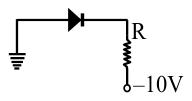
- 2
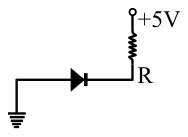
- 3
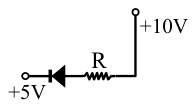
- 4
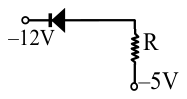
Show answer and solution
Correct: option 2
A diode is reverse biased when its p-side (the base of the arrow) is at a lower potential than its n-side (the bar). In (2) the p-side is earthed (0 V) and the n-side is connected through R to +5 V, so it is reverse biased. In (1) the p-side is at 0 V and the n-side goes to V; in (3) the p-side goes to +10 V and the n-side is at +5 V; in (4) the p-side goes to V and the n-side is at V. Those three are forward biased.
Question 9AIPMT 2004 Prelims, Q9
A car is moving towards a high cliff. The car driver sounds a horn of frequency 'f'. The reflected sound heard by the driver has a frequency 2f. If 'v' be the velocity of sound then the velocity of the car, in the same velocity units, will be -
- 1
- 2
- 3
- 4
Show answer and solution
Correct: option 1,
The cliff receives frequency and acts as a source at rest; the driver moving towards it hears . Setting this equal to gives , so .
Question 10AIPMT 2004 Prelims, Q10
The density of newly discovered planet is twice that of earth. The acceleration due to gravity at the surface of the planet is equal to that at the surface of the earth. If the radius of the earth is R, the radius of the planet would be:-
- 1
- 2
- 3
- 4
Show answer and solution
Correct: option 3,
, so . With the same and twice the density, the radius of the planet must be half that of the earth, .
Question 11AIPMT 2004 Prelims, Q11
A beam of light composed of red and green rays is incident obliquely at a point on the face of a rectangular glass slab. When coming out on the opposite parallel face, the red and green rays emerge from:-
- 1Two points propagating in two different parallel directions
- 2One point propagating in two different directions through slab
- 3One point propagating in the same direction through slab
- 4Two points propagating in two different non parallel directions
Show answer and solution
Correct: option 1, Two points propagating in two different parallel directions
Glass has different refractive indices for red and green, so the two colours are refracted by different angles inside the slab and reach the opposite face at two different points. Each ray leaves a parallel-sided slab parallel to its incident direction, and the incident direction is the same for both, so the two emergent rays are parallel to each other.
Question 12AIPMT 2004 Prelims, Q12
A particle of mass is moving with a velocity and another particle of mass is moving with a velocity . Both of them have the same momentum but their different kinetic energies are and respectively.
If then:
- 1
- 2
- 3
- 4
Show answer and solution
Correct: option 4,
Kinetic energy in terms of momentum is . For the same , , so the heavier particle has the smaller kinetic energy: .
Question 13AIPMT 2004 Prelims, Q13
The refractive index of the material of a prism is and its refracting angle is . One of the refracting surfaces of the prism is made a mirror inwards. A beam of monochromatic light entering the prism from the other face will retrace its path after reflection from the mirrored surface if its angle of incidence on the prism is:-
- 1
- 2
- 3
- 4
Show answer and solution
Correct: option 4,
To retrace its path the ray must strike the mirrored face normally, so and . Snell's law at the first face gives , so .
Question 14AIPMT 2004 Prelims, Q14
A stone is tied to a string of length '' and is whirled in a vertical circle with the other end of the string as the centre. At a certain instant of time, the stone is at its lowest position and has a speed 'u'. The magnitude of the change in velocity as it reaches a position where the string is horizontal (g being acceleration due to gravity) is:-
- 1
- 2
- 3
- 4
Show answer and solution
Correct: option 4,
The stone rises a height , so by energy conservation its speed there is given by . At the lowest point the velocity is horizontal and at the horizontal-string position it is vertical, so the two velocities are perpendicular and .
Question 15AIPMT 2004 Prelims, Q15
In semiconductors at a room temperature
- 1The valence band is completely filled and the conduction band is partially filled
- 2The valence band is completely filled
- 3The conduction band is completely empty
- 4The valence band is partially empty and the conduction band is partially filled
Show answer and solution
Correct: option 4, The valence band is partially empty and the conduction band is partially filled
The energy gap of a semiconductor is small (about 1 eV), so at room temperature some electrons are thermally excited from the valence band to the conduction band. This leaves holes in the valence band (partially empty) and electrons in the conduction band (partially filled).
Question 16AIPMT 2004 Prelims, Q16
The peak voltage in the output of a half wave diode rectifier fed with a sinusoidal signal without filter is 10V. The d.c. component of the output voltage is:-
- 1 V
- 210 V
- 3 V
- 4 V
Show answer and solution
Correct: option 1, V
The output of a half wave rectifier is a half sine pulse in one half cycle and zero in the other. Its average over a full cycle is V.
Question 17AIPMT 2004 Prelims, Q17
A mass of 0.5 kg moving with a speed of 1.5 m/s on a horizontal smooth surface, collides with a nearly weightless spring of force constant k = 50 N/m. The maximum compression of the spring would be:-
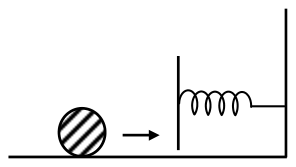
- 10.12 m
- 21.5 m
- 30.5 m
- 40.15 m
Show answer and solution
Correct: option 4, 0.15 m
At maximum compression all the kinetic energy is stored in the spring: . So m.
Question 18AIPMT 2004 Prelims, Q18
If in a nuclear fusion process the masses of the fusing nuclei be and and the mass of the resultant nucleus be , then
- 1
- 2
- 3
- 4
Show answer and solution
Correct: option 2,
Fusion releases energy, and that energy comes from a loss of mass (). The product nucleus is therefore lighter than the two fusing nuclei together: .
Question 19AIPMT 2004 Prelims, Q19
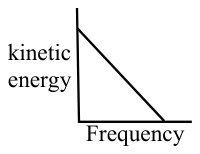
According to Einstein's photoelectric equation, the graph between the kinetic energy of photoelectrons ejected and the frequency of incident radiation is:-
- 1
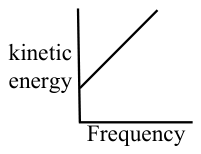
- 2
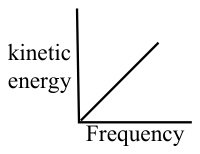
- 3
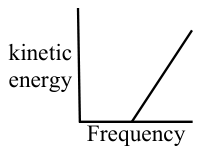
- 4
Show answer and solution
Correct: option 3
Einstein's equation is . Kinetic energy is zero up to the threshold frequency and then rises linearly with frequency, so the graph is a straight line of positive slope that starts from a point on the frequency axis away from the origin, as in graph (3).
Question 20AIPMT 2004 Prelims, Q20
A nucleus represented by the symbol has:-
- 1Z protons and A – Z neutrons
- 2Z protons and A neutrons
- 3A protons and Z – A neutrons
- 4Z neutrons and A – Z protons
Show answer and solution
Correct: option 1, Z protons and A – Z neutrons
Z is the atomic number (number of protons) and A is the mass number (protons plus neutrons). So the nucleus has Z protons and A – Z neutrons.
Question 21AIPMT 2004 Prelims, Q21
The dimensions of universal gravitational constant are:-
- 1
- 2
- 3
- 4
Show answer and solution
Correct: option 4,
From , . Its dimensions are .
Question 22AIPMT 2004 Prelims, Q22
In India electricity is supplied for domestic use at 220 V. It is supplied at 110 V in USA. If the resistance of a 60W bulb for use in India is R, The resistance of a 60W bulb for use in USA will be:-
- 1
- 2
- 3
- 4
Show answer and solution
Correct: option 2,
For a bulb of rated power at voltage , the resistance is . With the same power and half the voltage the resistance is one quarter: .
Question 23AIPMT 2004 Prelims, Q23
The magnetic flux through a circuit of resistance R changes by an amount in a time . Then the total quantity of electric charges Q that passes any point in the circuit during the time is represented by:-
- 1
- 2
- 3
- 4
Show answer and solution
Correct: option 1,
The induced emf is , so the current is . The charge that flows is , independent of the time taken.
Question 24AIPMT 2004 Prelims, Q24
A bullet of mass 2 g is having a charge of 2 C. Through what potential difference must it be accelerated, starting from rest, to acquire a speed of 10 m/s?
- 150 kV
- 25V
- 350 V
- 45kV
Show answer and solution
Correct: option 1, 50 kV
The work done by the field equals the kinetic energy gained: . So V = 50 kV.
Question 25AIPMT 2004 Prelims, Q25
The equation of state for 5g of oxygen at a pressure P and temperature T, when occupying a volume V, will be:-
Where is the gas constant.
- 1
- 2
- 3
- 4
Show answer and solution
Correct: option 4,
The ideal gas equation is , where R is the gas constant. Oxygen () has molar mass 32 g, so 5 g is mole and .
Question 26AIPMT 2004 Prelims, Q26
If denotes the wavelength at which the radioactive emission from a black body at a temperature T K is maximum, then:-
- 1 is independent of T
- 2
- 3
- 4
Show answer and solution
Correct: option 3,
Wien's displacement law states that is a constant for a black body. So the wavelength of maximum emission is inversely proportional to the absolute temperature: .
Question 27AIPMT 2004 Prelims, Q27
The ratio of the radii of gyration of a circular disc about a tangential axis in the plane of the disc and of a circular ring of the same radius about a tangential axis in the plane of the ring is:-
- 1
- 2
- 3
- 4
Show answer and solution
Correct: option 2,
About a diameter the disc has and the ring . By the parallel axis theorem, about a tangent in the plane these become and . Since , the ratio is .
Question 28AIPMT 2004 Prelims, Q28
A round disc of moment of inertia about its axis perpendicular to its plane and passing through its centre is placed over another disc of moment of inertia rotating with an angular velocity about the same axis. The final angular velocity of the combination of discs is:-
- 1
- 2
- 3
- 4
Show answer and solution
Correct: option 2,
No external torque acts, so angular momentum is conserved: . Hence .
Question 29AIPMT 2004 Prelims, Q29
A ball of mass 2 kg and another of mass 4 kg are dropped together from a 60 feet tall building. After a fall of 30 feet each towards earth, their respective kinetic energies will be in the ratio of-
- 1
- 2
- 3
- 4
Show answer and solution
Correct: option 2,
Both balls fall the same height and reach the same speed, so each has kinetic energy , proportional to its mass. The ratio is .
Question 30AIPMT 2004 Prelims, Q30
The half life of radium is about 1600 years. Of 100g of radium existing now, 25g will remain undecayed after:-
- 16400 years
- 22400 years
- 33200 years
- 44800 years
Show answer and solution
Correct: option 3, 3200 years
100 g falling to 25 g is a fall to one quarter, which takes two half lives (). That is years.
Question 31AIPMT 2004 Prelims, Q31
denotes the mass of a proton and that of a neutron. A given nucleus, of binding energy B, contains Z protons and N neutrons. The mass M(N, Z) of the nucleus is given by (c is velocity of light)
- 1
- 2
- 3
- 4
Show answer and solution
Correct: option 2,
A bound nucleus is lighter than its separate nucleons by the mass defect . So .
Question 32AIPMT 2004 Prelims, Q32
A telescope has an objective lens of 10 cm diameter and is situated at a distance of one kilometer from two objects. The minimum distance between these two objects, which can be resolved by the telescope, when the mean wavelength of light is 5000 Å, is of the order of-
- 15 m
- 25 mm
- 35 cm
- 40.5 m
Show answer and solution
Correct: option 2, 5 mm
The limit of resolution of a telescope is rad. At a distance of 1000 m this corresponds to a separation m, which is of the order of 5 mm.
Question 33AIPMT 2004 Prelims, Q33
The phase difference between two waves, represented by
m
m
Where x is expressed in metres and t is expressed in seconds, is approximately:-
- 12.07 radians
- 20.5 radians
- 31.5 radians
- 41.07 radians
Show answer and solution
Correct: option 4, 1.07 radians
Write the cosine as a sine: , so has phase . The phase of is . The difference is radians.
Question 34AIPMT 2004 Prelims, Q34
A block of mass m is placed on a smooth wedge of inclination . The whole system is accelerated horizontally so that the block does not slip on the wedge. The force exerted by the wedge on the block (g is acceleration due to gravity) will be:-
- 1
- 2
- 3
- 4
Show answer and solution
Correct: option 3,
The wedge is smooth, so it exerts only a normal force on the block. The block has no vertical acceleration, so the vertical component of balances the weight: , giving . (The horizontal component provides the acceleration.)
Question 35AIPMT 2004 Prelims, Q35
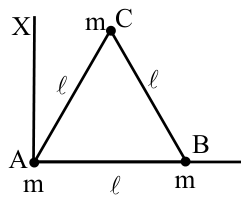
Three particles, each of mass m gram, are situated at the vertices of an equilateral triangle ABC of side cm. (as shown in the figure). The moment of inertia of the system about a line AX perpendicular to AB and in the plane of ABC, in gram cm units will be:-
- 1
- 2
- 3
- 4
Show answer and solution
Correct: option 2,
The distances of the particles from the line AX are: A, zero; B, ; C, (C lies above the midpoint of AB). So .
Question 36AIPMT 2004 Prelims, Q36
Energy E of a hydrogen atom with principal quantum number n is given by eV. The energy of a photon ejected when the electron jumps from n = 3 state to n = 2 state of hydrogen is approximately:-
- 10.85 eV
- 23.4 eV
- 31.9 eV
- 41.5 eV
Show answer and solution
Correct: option 3, 1.9 eV
eV and eV. The photon carries away the difference, eV.
Question 37AIPMT 2004 Prelims, Q37
A wheel having moment of inertia 2 kg–m about its vertical axis, rotates at the rate of 60 rpm about the axis. The torque which can stop the wheel's rotation in one minute would be:-
- 1 N–m
- 2 N–m
- 3 N–m
- 4 N–m
Show answer and solution
Correct: option 2, N–m
60 rpm is 1 revolution per second, so rad/s. To stop in 60 s the angular retardation is rad/s. The torque is N–m.
Question 38AIPMT 2004 Prelims, Q38
Consider a system of two particles having masses and . If the particle of mass is pushed towards the mass centre of particles through a distance 'd', by what distance would the particle of mass move so as to keep the mass centre of particles at the original position:-
- 1
- 2
- 3
- 4
Show answer and solution
Correct: option 1,
For the centre of mass to stay where it is, the mass-weighted displacements must cancel: . So the second particle must move towards the centre of mass through .
Question 39AIPMT 2004 Prelims, Q39
If then the value of is:-
- 1
- 2
- 3
- 4
Show answer and solution
Correct: option 4,
gives , so . Then .
Question 40AIPMT 2004 Prelims, Q40
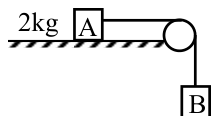
The coefficient of static friction, , between block A of mass 2 kg and the table as shown in the figure is 0.2. What would be the maximum mass value of block B so that the two blocks do not move? The string and the pulley are assumed to be smooth and massless.
()
- 14.0 kg
- 20.2 kg
- 30.4 kg
- 42.0 kg
Show answer and solution
Correct: option 3, 0.4 kg
The blocks stay at rest as long as the weight of B does not exceed the limiting friction on A: . So the maximum kg.
Question 41AIPMT 2004 Prelims, Q41
In a p–n junction photo cell, the value of the photo electromotive force produced by monochromatic light is proportional to:-
- 1The intensity of the light falling on the cell
- 2The frequency of the light falling on the cell
- 3The voltage applied at the p–n junction
- 4The barrier voltage at the p–n junction
Show answer and solution
Correct: option 1, The intensity of the light falling on the cell
Each absorbed photon creates an electron-hole pair, so the number of charge carriers generated per second, and with it the photo-emf, depends on the number of photons arriving per second, that is on the intensity of the light. For a given monochromatic light the frequency is fixed and no external voltage is applied.
Question 42AIPMT 2004 Prelims, Q42
The Bohr model of atoms:-
- 1Uses Einstein's photo electric equation
- 2Predicts continuous emission spectra for atoms
- 3Predicts the same emission spectra for all types of atoms
- 4Assumes that the angular momentum of electrons is quantized
Show answer and solution
Correct: option 4, Assumes that the angular momentum of electrons is quantized
Bohr's postulate is that an electron can revolve only in orbits for which its angular momentum is a whole multiple of . The model gives line (not continuous) spectra that differ from atom to atom, and it does not use the photoelectric equation.
Question 43AIPMT 2004 Prelims, Q43
The output of OR gate is 1:-
- 1If either or both inputs are 1
- 2Only if both inputs are 1
- 3If either input is zero
- 4If both inputs are zero
Show answer and solution
Correct: option 1, If either or both inputs are 1
For an OR gate : the output is 0 only when both inputs are 0, and is 1 when either input or both inputs are 1.
Question 44AIPMT 2004 Prelims, Q44
An electric dipole has the magnitude of its charge as q and its dipole moment is p. It is placed in a uniform electric field E. If its dipole moment is along the direction of the field, the force on it and its potential energy are respectively:-
- 1q.E and p.E
- 2zero and minimum
- 3q.E and maximum
- 42q.E and minimum
Show answer and solution
Correct: option 2, zero and minimum
In a uniform field the forces and on the two charges cancel, so the net force is zero. The potential energy is ; with the dipole moment along the field and , its minimum value.
Question 45AIPMT 2004 Prelims, Q45
A coil of 40 henry inductance is connected in series with a resistance of 8 ohm and the combination is joined to the terminals of a 2 volt battery. The time constant of the circuit is:-
- 11/5 seconds
- 240 seconds
- 320 seconds
- 45 seconds
Show answer and solution
Correct: option 4, 5 seconds
The time constant of an L-R circuit is seconds. It does not depend on the battery voltage.
Question 46AIPMT 2004 Prelims, Q46
One mole of an ideal gas at an initial temperature of T K does 6R joules of work adiabatically. If the ratio of specific heats of this gas at constant pressure and at constant volume is , the final temperature of gas will be:-
- 1(T – 2.4) K
- 2(T + 4) K
- 3(T – 4) K
- 4(T + 2.4) K
Show answer and solution
Correct: option 3, (T – 4) K
In an adiabatic process the work done by the gas comes from its internal energy: . So , giving and K.
Question 47AIPMT 2004 Prelims, Q47
A battery is charged at a potential of 15V for 8 hours when the current flowing is 10A. The battery on discharge supplies a current of 5A for 15 hours. The mean terminal voltage during discharges is 14 V. The "Watt hour" efficiency of the battery is:-
- 180%
- 290%
- 387.5%
- 482.5%
Show answer and solution
Correct: option 3, 87.5%
Energy put in while charging Wh. Energy given out on discharge Wh. Efficiency .
Question 48AIPMT 2004 Prelims, Q48
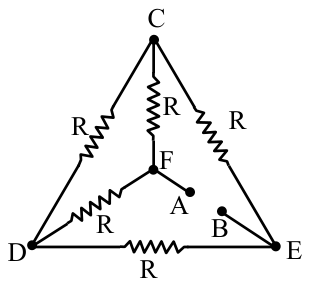
Five equal resistances each of resistance R are connected as shown in the Figure. A battery of V volts is connected between A and B. The current flowing in AFCEB will be
- 1
- 2
- 3
- 4
Show answer and solution
Correct: option 2,
A is joined to F and B is joined to E, so the battery voltage V acts between F and E. The branches F–C–E and F–D–E each hold two resistances R in series, so C and D are at the same potential and the resistance between C and D carries no current. The current in the branch AFCEB is therefore .
Question 49AIPMT 2004 Prelims, Q49
A galvanometer of 50 ohm resistance has 25 divisions. A current of ampere gives a deflection of one division. To convert this galvanometer into a voltmeter having a range of 25 volts, it should be connected with a resistance of:-
- 1245 as a shunt
- 22550 in series
- 32450 in series
- 42500 as a shunt
Show answer and solution
Correct: option 3, 2450 in series
Full-scale current A. A voltmeter needs a series resistance R such that : , so in series.
Question 50AIPMT 2004 Prelims, Q50
A 6 volt battery is connected to the terminals of a three metre long wire of uniform thickness and resistance of 100 ohm. The difference of potential between two points on the wire separated by a distance of 50 cm will be:-
- 13 V
- 21 V
- 31.5 V
- 42 V
Show answer and solution
Correct: option 2, 1 V
The potential falls uniformly along a uniform wire, by V per metre. Across 50 cm (0.5 m) the potential difference is V.
AIPMT 2004 Prelims Chemistry questions
Question 51AIPMT 2004 Prelims, Q51
- 114 elements in the seventh period (atomic no. = 90 to 103) that are filling 5f sublevel.
- 214 elements in the sixth period (atomic no. 58 to 71) that are filling 4f sublevel
- 314 elements in the seventh period (atomic no. = 58 to 71) that are filling 4f sublevel
- 414 elements in the sixth period (atomic no. 90 to 103) that are filling 4f sublevel
Show answer and solution
Correct: option 2, 14 elements in the sixth period (atomic no. 58 to 71) that are filling 4f sublevel
The lanthanoids are the 14 elements that follow lanthanum, cerium (Z = 58) to lutetium (Z = 71). They lie in the sixth period and their 4f sublevel is being filled. Elements 90 to 103 are the actinoids of the seventh period, which fill 5f. So option (2) is right.
Question 52AIPMT 2004 Prelims, Q52
Which of the following forms cationic micelles above certain concentration:
- 1sodium acetate
- 2Urea
- 3Cetyl trimethylammonium chloride
- 4Sodium dodecyl sulphonate
Show answer and solution
Correct: option 3, Cetyl trimethylammonium chloride
A micelle needs an ion with a long hydrocarbon tail. In cetyl trimethylammonium chloride the long-chain part is the cation, , so above the critical micelle concentration it gives cationic micelles. Sodium dodecyl sulphonate has its long chain in the anion and gives anionic micelles, while sodium acetate and urea do not form micelles at all.
Question 53AIPMT 2004 Prelims, Q53
Which of the following does not have a metal-carbon bond:
- 1
- 2
- 3
- 4
Show answer and solution
Correct: option 4,
In aluminium ethoxide, , each ethyl group is joined to aluminium through oxygen (Al-O-C), so there is no metal-carbon bond. The Grignard reagent has an Mg-C bond, Zeise's salt binds ethene to Pt through its carbon atoms, and in each CO is bonded to Ni through carbon.
Question 54AIPMT 2004 Prelims, Q54
Which one of the following is a chain growth polymer:
- 1Nucleic acid
- 2Polystyrene
- 3protein
- 4Starch
Show answer and solution
Correct: option 2, Polystyrene
Chain growth (addition) polymers form when unsaturated monomers add one after another to a growing chain without losing any small molecule. Polystyrene is made this way from styrene. Nucleic acids, proteins and starch are condensation (step growth) polymers formed with loss of water.
Question 55AIPMT 2004 Prelims, Q55
The correct statement in respect of protein haemoglobin is that it:
- 1Maintains blood sugar level
- 2Acts as an oxygen carrier in the blood
- 3Forms antibodies and offers resistance to diseases
- 4Functions as a catalyst for biological reactions
Show answer and solution
Correct: option 2, Acts as an oxygen carrier in the blood
Haemoglobin is the iron-containing transport protein of red blood cells; it binds oxygen in the lungs and releases it in the tissues. Blood sugar is controlled by hormones such as insulin, antibodies are immunoglobulins, and biological catalysts are enzymes.
Question 56AIPMT 2004 Prelims, Q56
A sequence of how many nucleotides in messenger RNA makes a codon for an amino acid:
- 1Four
- 2One
- 3Two
- 4Three
Show answer and solution
Correct: option 4, Three
The genetic code is a triplet code: three consecutive nucleotides of mRNA make one codon, which specifies one amino acid. Three bases give codons, enough for the 20 amino acids, whereas two bases would give only 16.
Question 57AIPMT 2004 Prelims, Q57
The hormone that helps in the conversion of glucose to glycogen is:
- 1Bile acids
- 2Adrenaline
- 3insulin
- 4Cortisone
Show answer and solution
Correct: option 3, insulin
Insulin lowers blood glucose by promoting its uptake and its conversion to glycogen in the liver and muscles. Adrenaline does the opposite (it breaks glycogen down to glucose), cortisone raises blood glucose, and bile acids help digest fats.
Question 58AIPMT 2004 Prelims, Q58
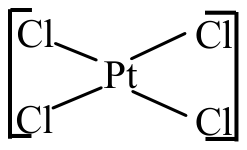
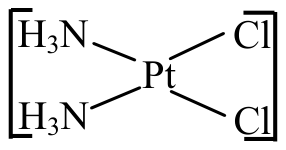
Which of the following is considered to be an anticancer species:
- 1
- 2
- 3
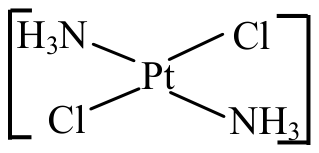
- 4
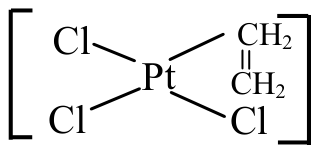
Show answer and solution
Correct: option 2
The anticancer drug is cisplatin, cis-, the square planar complex in which the two ligands are next to each other and the two Cl ligands are next to each other. That is the structure in option (2). Option (3) is the trans isomer, which is not active.
Question 59AIPMT 2004 Prelims, Q59
If the bond energies of H–H, Br–Br and H–Br are 433, 192 and 364 respectively the for the reaction is
- 1+103 kJ
- 2+261 kJ
- 3–103 kJ
- 4–261 kJ
Show answer and solution
Correct: option 3, –103 kJ
= (bond energies of bonds broken) − (bond energies of bonds formed) . So option (3) is right.
Question 60AIPMT 2004 Prelims, Q60
Which of the following is responsible for depletion of the ozone layer in the upper strata of the atmosphere:
- 1Ferrocene
- 2Fullerenes
- 3Freons
- 4Polyhalogens
Show answer and solution
Correct: option 3, Freons
Freons are chlorofluorocarbons. In the stratosphere ultraviolet light splits them to give chlorine atoms, and each chlorine atom destroys many ozone molecules in a chain reaction. This is the main cause of ozone layer depletion.
Question 61AIPMT 2004 Prelims, Q61
Among the following, the pair in which the two species are not isostructural is:
- 1 and
- 2 and
- 3 and
- 4 and
Show answer and solution
Correct: option 4, and
has four bond pairs and no lone pair on Si, so it is tetrahedral (). has four bond pairs and one lone pair on S (), so it is see-saw shaped. The other pairs match: and are both pyramidal, and both tetrahedral, and both octahedral.
Question 62AIPMT 2004 Prelims, Q62
The rate of a first order reaction is at 0.5 M concentration of the reactant. The half life of the reaction is:
- 123.1 min
- 28.73 min
- 37.53 min
- 40.383 min
Show answer and solution
Correct: option 1, 23.1 min
For a first order reaction, rate , so . Then min.
Question 63AIPMT 2004 Prelims, Q63
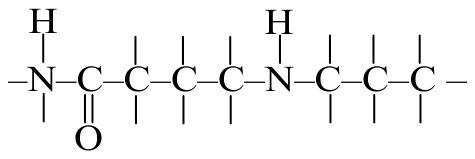
Which one of the following structures represents the peptide chain:
- 1
- 2
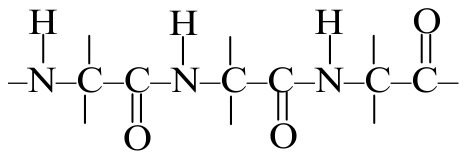
- 3
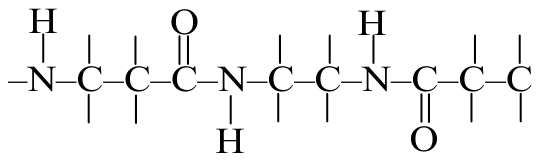
- 4
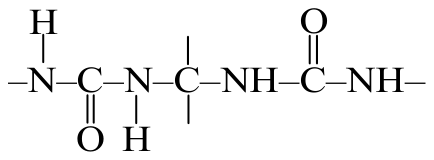
Show answer and solution
Correct: option 2
A peptide chain is made of -amino acid units joined by amide (–CO–NH–) links, so its backbone repeats the unit –NH–C–C(=O)–: a nitrogen carrying H, then the -carbon, then a carbonyl carbon, and then the next nitrogen. Only the structure in option (2) shows this repeating N–C–C(=O) pattern three times.
Question 64AIPMT 2004 Prelims, Q64
Which one of the following can be oxidised to the corresponding carbonyl compound:
- 1o-Nitrophenol
- 2Phenol
- 32-methyl-2-hydroxy propane
- 42-hydroxy propane
Show answer and solution
Correct: option 4, 2-hydroxy propane
2-Hydroxy propane (propan-2-ol) is a secondary alcohol; it has a hydrogen on the carbon bearing the –OH, so it is oxidised to the ketone propanone. 2-Methyl-2-hydroxy propane is a tertiary alcohol with no such hydrogen, and the phenols do not give a corresponding carbonyl compound.
Question 65AIPMT 2004 Prelims, Q65
In an octahedral structure, the pair of d orbitals involved in hybridization is:
- 1
- 2
- 3
- 4
Show answer and solution
Correct: option 4,
In an octahedral complex the six ligands lie along the x, y and z axes. The hybrid orbitals must point along these axes, so the two d orbitals used are the ones whose lobes lie along the axes: and . The , and orbitals point between the axes.
Question 66AIPMT 2004 Prelims, Q66
The frequency of radiation emitted when the electron falls from n = 4 to n = 1 in a hydrogen atom will be (Given ionization energy of H = and ):
- 1
- 2
- 3
- 4
Show answer and solution
Correct: option 2,
The energy of level n is J, so J. Then .
Question 67AIPMT 2004 Prelims, Q67
Camphor is often used in molecular mass determination because:
- 1It has a very high cryoscopic constant
- 2It is volatile
- 3It is solvent for organic substances
- 4It is readily available
Show answer and solution
Correct: option 1, It has a very high cryoscopic constant
Molar mass is found from the depression of freezing point, . Camphor has a very large cryoscopic constant (about ), so even a little solute lowers its melting point by an amount that is easy to measure accurately (Rast method).
Question 68AIPMT 2004 Prelims, Q68
Number of chiral carbons in -D-(+)-glucose is:
- 1Six
- 2Three
- 3Four
- 4Five
Show answer and solution
Correct: option 4, Five
-D-(+)-glucose is the cyclic (pyranose) form. Ring closure makes C-1 a new chiral centre, so C-1, C-2, C-3, C-4 and C-5 are all chiral; C-6 is a group and is not. That gives five chiral carbons (the open-chain form has four).
Question 69AIPMT 2004 Prelims, Q69
The helical structure of protein is stabilized by:
- 1Hydrogen bonds
- 2Ether bonds
- 3Peptide bonds
- 4Dipeptide bonds
Show answer and solution
Correct: option 1, Hydrogen bonds
In the -helix the chain is held in its coiled shape by hydrogen bonds between the N–H of one amide group and the C=O of the amide group four residues further along. Peptide bonds only join the amino acids into the chain (the primary structure).
Question 70AIPMT 2004 Prelims, Q70
Which of the following is least reactive in a nucleophilic substitution reaction:
- 1
- 2
- 3
- 4
Show answer and solution
Correct: option 1,
In vinyl chloride, , a lone pair on chlorine is delocalised into the double bond, which gives the C–Cl bond partial double bond character, and the carbon is hybridised. The bond is therefore short and strong and is very hard to break, so vinyl chloride is the least reactive. Allyl and tert-butyl chlorides are highly reactive and ethyl chloride reacts normally.
Question 71AIPMT 2004 Prelims, Q71
is dipolar, whereas is not. It is because:
- 1 involves hydrogen bonding whereas is a discrete molecule
- 2 is linear and is angular
- 3 is angular and is linear
- 4The electronegativity of F is greater than that of O
Show answer and solution
Correct: option 3, is angular and is linear
Both molecules have polar bonds. is linear, so its two equal bond dipoles point in opposite directions and cancel. is bent (about 104.5°) because of the two lone pairs on oxygen, so its bond dipoles add up to a net dipole moment.
Question 72AIPMT 2004 Prelims, Q72
Considering entropy (S) as a thermodynamic parameter, the criterion for the spontaneity of any process is:
- 1
- 2 only
- 3 only
- 4
Show answer and solution
Correct: option 4,
By the second law, a process is spontaneous when the total entropy of the universe increases: . The entropy of the system alone, or of the surroundings alone, may fall in a spontaneous process.
Question 73AIPMT 2004 Prelims, Q73
- 1Inversely proportional to square of effective nuclear charge
- 2Directly proportional to effective nuclear charge
- 3Directly proportional to square of effective nuclear charge
- 4Inversely proportional to effective nuclear charge
Show answer and solution
Correct: option 4, Inversely proportional to effective nuclear charge
A larger effective nuclear charge pulls the outer electrons closer to the nucleus, so the ion is smaller. For a given shell the radius varies as , that is, inversely as the effective nuclear charge.
Question 74AIPMT 2004 Prelims, Q74
is a strong field ligand. This is due to the fact that:
- 1It is a pseudohalide
- 2It can accept electrons from metal species
- 3It forms high spin complexes with metal species
- 4It carries negative charge
Show answer and solution
Correct: option 2, It can accept electrons from metal species
has empty orbitals that accept electron density from the filled metal d orbitals (back bonding). This -acceptor action strengthens the metal-ligand bond and increases the crystal field splitting, which makes cyanide a strong field ligand; it gives low spin, not high spin, complexes.
Question 75AIPMT 2004 Prelims, Q75
Considering as a weak field ligand, the number of unpaired electrons in will be –
(At. no. of Mn = 25)
- 1Five
- 2Two
- 3Four
- 4Three
Show answer and solution
Correct: option 1, Five
The complex ion is hexaaquamanganese(II). Mn (Z = 25) is , so is . With a weak field ligand the electrons do not pair up and the configuration is , with all five d electrons unpaired.
Question 76AIPMT 2004 Prelims, Q76
The –OH group of an alcohol or the carboxylic acid can be replaced by –Cl, using:
- 1Hypochlorous acid
- 2Chlorine
- 3Hydrochloric acid
- 4Phosphorus pentachloride
Show answer and solution
Correct: option 4, Phosphorus pentachloride
replaces –OH by –Cl in both types of compound: and . Hydrochloric acid does not convert a carboxylic acid into an acid chloride, and chlorine and hypochlorous acid do not replace –OH.
Question 77AIPMT 2004 Prelims, Q77
Reaction of HBr with propene in the presence of peroxide gives:
- 13-bromo propane
- 2Allyl bromide
- 3n-propyl bromide
- 4Isopropyl bromide
Show answer and solution
Correct: option 3, n-propyl bromide
With peroxide, HBr adds by a free radical mechanism in the anti-Markovnikov way (peroxide effect): the bromine atom goes to the terminal carbon. , which is n-propyl bromide. Isopropyl bromide is the product without peroxide.
Question 78AIPMT 2004 Prelims, Q78
Chloropicrin is obtained by the reaction of
- 1Nitric acid on chlorobenzene
- 2Chlorine on picric acid
- 3Nitric acid on chloroform
- 4Steam on carbon tetrachloride
Show answer and solution
Correct: option 3, Nitric acid on chloroform
Chloropicrin is trichloronitromethane, . It forms when concentrated nitric acid replaces the hydrogen of chloroform by a nitro group: .
Question 79AIPMT 2004 Prelims, Q79
Aniline when diazotized in cold and then treated with dimethyl aniline gives a coloured product. Its structure would be:
- 1

- 2

- 3

- 4

Show answer and solution
Correct: option 2
Diazotisation turns aniline into benzenediazonium chloride, . This weak electrophile couples with N,N-dimethylaniline at the position para to the group, giving the azo dye p-dimethylaminoazobenzene, . That is the structure in option (2).
Question 80AIPMT 2004 Prelims, Q80
In a regular octahedral molecule, the number of X–M–X bonds at 180° is:
- 1Two
- 2Six
- 3Four
- 4Three
Show answer and solution
Correct: option 4, Three
In an octahedron the six X atoms lie at the two ends of three mutually perpendicular axes through M. Each axis gives one linear X–M–X arrangement, so there are three X–M–X angles of 180° (the other twelve are 90°).
Question 81AIPMT 2004 Prelims, Q81
Which is the best description of the behavior of bromine in the reaction given below:
- 1Both oxidized and reduced
- 2Oxidized only
- 3Reduced only
- 4Proton acceptor only
Show answer and solution
Correct: option 1, Both oxidized and reduced
Bromine has oxidation number 0 in , +1 in HOBr and −1 in HBr. One bromine atom is oxidised and the other is reduced, so the reaction is a disproportionation: bromine is both oxidized and reduced.
Question 82AIPMT 2004 Prelims, Q82
The maximum number of molecules is present in:
- 15 L of gas at STP
- 20.5 g of gas
- 310 g of gas
- 415 L of gas at STP
Show answer and solution
Correct: option 4, 15 L of gas at STP
Compare the moles: 5 L of at STP is mol; 0.5 g of is mol; 10 g of is mol; 15 L of at STP is mol. The largest number of moles, and so of molecules, is in option (4).
Question 83AIPMT 2004 Prelims, Q83
A compound formed by elements X and Y crystallizes in a cubic structure in which the X atoms are at the corners of a cube and the Y atoms are at the face-centers. The formula of the compound is:
- 1
- 2
- 3
- 4
Show answer and solution
Correct: option 4,
A corner atom is shared by 8 unit cells, so X atoms per cell . A face-centre atom is shared by 2 cells, so Y atoms per cell . The formula is .
Question 84AIPMT 2004 Prelims, Q84
The radioactive isotope which is used in the treatment of cancer can be made by (n, p) reaction. For this reaction the target nucleus is:
- 1
- 2
- 3
- 4
Show answer and solution
Correct: option 2,
In an (n, p) reaction the target absorbs a neutron and gives out a proton: . Balancing mass number gives , so ; balancing charge gives . The target is .
Question 85AIPMT 2004 Prelims, Q85
The enzyme which hydrolyses triglycerides to fatty acids and glycerol is called:
- 1Lipase
- 2Zymase
- 3Pepsin
- 4Maltase
Show answer and solution
Correct: option 1, Lipase
Triglycerides are fats, the esters of glycerol with three fatty acids, and lipases are the enzymes that hydrolyse these ester links. Zymase ferments glucose to ethanol, pepsin breaks down proteins and maltase splits maltose into glucose.
Question 86AIPMT 2004 Prelims, Q86
Standard enthalpy and standard entropy changes for the oxidation of ammonia at 298 K are and , respectively. Standard Gibbs energy change for the same reaction at 298 K is:
- 1
- 2
- 3
- 4
Show answer and solution
Correct: option 1,
. The entropy change must first be converted from J to kJ.
Question 87AIPMT 2004 Prelims, Q87
The solubility product of a sparingly soluble salt is . Its solubility (in moles/litre) is:
- 1
- 2
- 3
- 4
Show answer and solution
Correct: option 2,
. If the solubility is , then . So and .
Question 88AIPMT 2004 Prelims, Q88
Among K, Ca, Fe and Zn, the element which can form more than one binary compound with chlorine is:
- 1Zn
- 2K
- 3Ca
- 4Fe
Show answer and solution
Correct: option 4, Fe
Iron is a transition metal with variable oxidation states, +2 and +3, so it forms two chlorides, and . K (+1), Ca (+2) and Zn (+2) each show only one oxidation state and form only KCl, and .
Question 89AIPMT 2004 Prelims, Q89
The standard e.m.f. of a galvanic cell involving cell reaction with n = 2 is found to be 0.295 V at 25°C. The equilibrium constant of the reaction would be:
(Given F = ; R = )
- 1
- 2
- 3
- 4
Show answer and solution
Correct: option 3,
At equilibrium at 25°C. So and .
Question 90AIPMT 2004 Prelims, Q90
Which one of the following statements about the zeolites is false:
- 1They have open structure which enables them to take up small molecules
- 2Zeolites are aluminosilicates having three dimensional network
- 3Some of the units are replaced by and ions in zeolites
- 4They are used as cation exchangers.
Show answer and solution
Correct: option 3, Some of the units are replaced by and ions in zeolites
Zeolites are three dimensional aluminosilicates with an open, cage-like framework, so they can take up small molecules and exchange cations; statements (1), (2) and (4) are true. In the framework some tetrahedra are replaced only by tetrahedra; there are no octahedral units. So statement (3) is false.
Question 91AIPMT 2004 Prelims, Q91
Which of the following will not form a yellow precipitate on heating with an alkaline solution of iodine:
- 1
- 2
- 3
- 4
Show answer and solution
Correct: option 2,
The yellow precipitate is iodoform, . The iodoform test is given by alcohols that contain the group, which iodine first oxidises to . Butan-2-ol, ethanol and propan-2-ol all have this group; methanol, , does not, so it gives no precipitate.
Question 92AIPMT 2004 Prelims, Q92
Among , , species, the hybridization states at the Ni atom are, respectively: (At. No. of Ni = 28)
- 1
- 2
- 3
- 4
Show answer and solution
Correct: option 1,
In nickel is Ni(0); the strong ligand CO pushes the 4s electrons into 3d (), leaving 4s and 4p for (tetrahedral). In nickel is (); the strong ligand pairs the electrons and frees one 3d orbital, giving (square planar). In the weak ligand causes no pairing, so uses (tetrahedral).
Question 93AIPMT 2004 Prelims, Q93
Among the following series of transition metal ions, the one where all metal ions have electronic configuration is:
- 1
- 2
- 3
- 4
Show answer and solution
Correct: option 3,
Ti, V, Cr and Mn have 4, 5, 6 and 7 valence electrons (3d + 4s). An ion is when two of these are left: (4 − 2), (5 − 3), (6 − 4) and (7 − 5). That is the series in option (3).
Question 94AIPMT 2004 Prelims, Q94
Which of the following coordination compounds would exhibit optical isomerism
- 1Diamminedichloroplatinum (II)
- 2Trans-dicyanobis (ethylenediamine) chromium (III) chloride
- 3Tris-(ethylenediamine) cobalt (III) bromide
- 4Pentaamminenitrocobalt (III) iodide
Show answer and solution
Correct: option 3, Tris-(ethylenediamine) cobalt (III) bromide
has three bidentate ligands around an octahedral centre; it has no plane of symmetry and exists as two non-superimposable mirror images, so it is optically active. The square planar platinum complex, the trans isomer of and all have a plane of symmetry and are not.
Question 95AIPMT 2004 Prelims, Q95
The rapid change of pH near the stoichiometric point of an acid-base titration is the basis of indicator detection. pH of the solution is related to ratio of the concentrations of the conjugate acid (HIn) and base () forms of the indicator by the expression -
- 1
- 2
- 3
- 4
Show answer and solution
Correct: option 1 or 3
The answer key accepts options 1 and 3.
For the indicator , , which gives . So , which is option (3); turning the fraction upside down changes the sign and gives , which is option (1). The two are the same relation, so the key accepts both (1) and (3).
Question 96AIPMT 2004 Prelims, Q96
Using anhydrous as catalyst, which one of the following reactions produces ethylbenzene (PhEt):
- 1
- 2
- 3
- 4
Show answer and solution
Correct: option 2,
This is a Friedel-Crafts alkylation. With (and a trace of HCl) ethene gives the ethyl carbocation, which attacks benzene to form ethylbenzene, . Propene would give isopropylbenzene (cumene), ethane does not react, and ethanol mainly forms a complex with anhydrous instead of alkylating benzene.
Question 97AIPMT 2004 Prelims, Q97
The molecular formula of diphenyl methane,
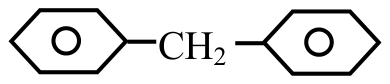
is .
How many structural isomers are possible when one of the hydrogens is replaced by a chlorine atom:
- 14
- 28
- 37
- 46
Show answer and solution
Correct: option 1, 4
The two phenyl rings are equivalent, so diphenylmethane has only four different kinds of hydrogen: those of the group and the ring hydrogens ortho, meta and para to it. Replacing one hydrogen of each kind by chlorine gives 4 structural isomers.
Question 98AIPMT 2004 Prelims, Q98
A solid compound 'X' on heating gives gas and a residue. The residue mixed with water forms 'Y'. On passing an excess of through 'Y' in water, a clear solution, 'Z' is obtained. On boiling 'Z', compound 'X' is reformed. The compound 'X' is:
- 1
- 2
- 3
- 4
Show answer and solution
Correct: option 1,
X is : on heating, . The residue CaO with water gives Y, . Excess gives the soluble bicarbonate Z, , a clear solution, and boiling it gives back . and do not decompose on heating, and calcium bicarbonate does not exist as a solid.
Question 99AIPMT 2004 Prelims, Q99
The work done during the expansion of a gas from a volume of to against a constant external pressure of 3 atm is:
- 1–608 J
- 2+304 J
- 3–304 J
- 4–6 J
Show answer and solution
Correct: option 1, –608 J
. Since , . The sign is negative because the gas does work on the surroundings.
Question 100AIPMT 2004 Prelims, Q100
In molecule, the lone pairs occupy equatorial positions to minimize:
- 1Bond pair – bond pair repulsion only
- 2Lone pair – lone pair repulsion and lone pair–bond pair repulsion
- 3Lone pair–lone pair repulsion only
- 4Lone pair–bond pair repulsion only
Show answer and solution
Correct: option 2, Lone pair – lone pair repulsion and lone pair–bond pair repulsion
Bromine in has three bond pairs and two lone pairs in a trigonal bipyramidal arrangement (). With both lone pairs equatorial they are 120° apart and each has only two bond pairs at 90°; any other placement puts the lone pairs at 90° to each other or gives more lone pair–bond pair contacts at 90°. So this arrangement keeps both lone pair–lone pair and lone pair–bond pair repulsions lowest, giving the T-shape.
AIPMT 2004 Prelims Biology questions
Question 101AIPMT 2004 Prelims, Q101
Blood analysis of a patient reveals an unusually high quantity of carboxy-haemoglobin content. Which of the following conclusions is most likely to be correct? The patient has been inhaling polluted air containing unusually high content of -
- 1Chloroform
- 2Carbon dioxide
- 3Carbon monoxide
- 4carbon disulphide
Show answer and solution
Correct: option 3, Carbon monoxide
Carboxyhaemoglobin is the stable compound formed when carbon monoxide binds to haemoglobin, which it does about 200 times more strongly than oxygen. Carbon dioxide forms carbaminohaemoglobin instead, so a high carboxyhaemoglobin level points to carbon monoxide in the inhaled air.
Question 102AIPMT 2004 Prelims, Q102
You are required to draw blood from a patient and to keep it in a test tube for analysis of blood corpuscles and plasma. You are also provided with the following four types of test tubes. Which of them will you not use for the purpose?
- 1Chilled test tube
- 2Test tube containing heparin
- 3Test tube containing sodium oxalate
- 4Test tube containing calcium bicarbonate
Show answer and solution
Correct: option 4, Test tube containing calcium bicarbonate
To study corpuscles and plasma the blood must stay unclotted. Chilling slows the clotting enzymes, heparin blocks thrombin, and sodium oxalate removes the calcium ions needed for clotting. Calcium bicarbonate supplies calcium ions, which promote clotting, so that tube cannot be used.
Question 103AIPMT 2004 Prelims, Q103
The cardiac pacemaker in a patient fails to function normally. The doctors find that an artificial pacemaker is to be grafted in him. It is likely that it will be grafted at the site of -
- 1Purkinje system
- 2Sinuatrial node
- 3Atrioventricular node
- 4Atrioventricular bundle
Show answer and solution
Correct: option 2, Sinuatrial node
The natural pacemaker of the heart is the sino-atrial node in the wall of the right atrium, which starts each heartbeat. An artificial pacemaker replaces its function, so it is placed to act at the site of the SA node.
Question 104AIPMT 2004 Prelims, Q104
What is a keystone species?
- 1A common species that has plenty of biomass, yet has a fairly low impact on the community's organization
- 2A rare species that has minimal impact on the biomass and on other species in the community
- 3A dominant species that constitutes a large proportion of the biomass and which affects many other species
- 4A species which makes up only a small proportion of the total biomass of a community, yet has a huge impact on the community's organization and survival
Show answer and solution
Correct: option 4, A species which makes up only a small proportion of the total biomass of a community, yet has a huge impact on the community's organization and survival
A keystone species has an effect on its community that is far larger than its abundance or biomass would suggest; removing it changes the whole community structure. A species that is important because it is abundant is a dominant species, not a keystone species.
Question 105AIPMT 2004 Prelims, Q105
The most thoroughly studied of the known bacteria-plant interactions is the :-
- 1Gall formation on certain angiosperms by Agrobacterium
- 2Nodulation of Sesbania stems by nitrogen fixing bacteria
- 3Plant growth stimulation by phosphate–solubilising bacteria
- 4Cyanobacterial symbiosis with some aquatic ferns
Show answer and solution
Correct: option 1, Gall formation on certain angiosperms by Agrobacterium
Crown gall formation by Agrobacterium tumefaciens has been worked out in the greatest detail: the bacterium transfers the T-DNA of its Ti plasmid into the plant genome and this causes the tumour. This knowledge is the basis of its use as a vector in plant genetic engineering.
Question 106AIPMT 2004 Prelims, Q106
Which one of the following precedes re-formation of the nuclear envelope during M phase of the cell cycle :-
- 1Transcription from chromosomes and reassembly of the nuclear lamina
- 2Formation of the contractile ring and formation of the phragmoplast
- 3Formation of the contractile ring and transcription from chromosomes
- 4Decondensation from chromosomes and reassembly of the nuclear lamina
Show answer and solution
Correct: option 2, Formation of the contractile ring and formation of the phragmoplast
The nuclear envelope re-forms in telophase. The contractile ring (animal cells) and the phragmoplast (plant cells) start to form in late anaphase, before that. Decondensation of chromosomes and the return of transcription come with or after the re-formed envelope, so the options that include them do not describe earlier events.
Question 107AIPMT 2004 Prelims, Q107
The richest sources of vitamin are :-
- 1Chocolate and green gram
- 2Rice and hen's egg
- 3Carrot and chicken's breast
- 4Goat's liver and Spirulina
Show answer and solution
Correct: option 4, Goat's liver and Spirulina
Vitamin (cobalamin) is made only by microorganisms and is stored in animal liver, so liver is its richest food source. Spirulina, a cyanobacterium, is also listed as rich in it, while plant foods such as rice, carrot and green gram have practically none.
Question 108AIPMT 2004 Prelims, Q108
In transgenics expression of transgene in target tissue is determined by :-
- 1Transgene
- 2Promoter
- 3Reporter
- 4Enhancer
Show answer and solution
Correct: option 2, Promoter
Where and when a gene is transcribed depends on the promoter placed in front of it: RNA polymerase and tissue-specific transcription factors bind there. A transgene joined to a tissue-specific promoter is therefore expressed only in the target tissue. A reporter gene only shows that expression has happened.
Question 109AIPMT 2004 Prelims, Q109
A normal woman, whose father was colour-blind is married to a normal man. The sons would be :-
- 150% colour-blind
- 2All normal
- 3All colour-blind
- 475 % colour-blind
Show answer and solution
Correct: option 1, 50% colour-blind
Colour blindness is X-linked recessive. The woman received her father's X, so she is a carrier (). Each son gets his X from her, with an equal chance of or , and a Y from the normal father. So half of the sons are colour-blind.
Question 110AIPMT 2004 Prelims, Q110
Age of fossils in the past was generally determined by radio-carbon method and other methods involving radioactive elements found in the rocks. More precise methods, which were used recently and led to the revision of the evolutionary periods for different groups of organisms includes -
- 1Study of the conditions of fossilization
- 2Electron spin resonance (ESR) & fossil DNA
- 3Study of carbohydrates/proteins in rocks
- 4Study of carbohydrates/proteins in fossils
Show answer and solution
Correct: option 2, Electron spin resonance (ESR) & fossil DNA
Electron spin resonance dating measures the electrons trapped in crystals such as tooth enamel by natural radiation and gives more precise ages than the older radioactive methods. Together with the analysis of DNA recovered from fossils, it led to revised dates for several groups.
Question 111AIPMT 2004 Prelims, Q111
What kind of evidence suggested that man is more closely related with chimpanzee than with other hominoid apes?
- 1Comparison of chromosomes morphology only
- 2Evidence from fossil remains and the fossil mitochondrial DNA alone
- 3Evidence from DNA extracted from sex chromosomes, autosomes & mitochondria
- 4Evidence from DNA from sex chromosomes only
Show answer and solution
Correct: option 3, Evidence from DNA extracted from sex chromosomes, autosomes & mitochondria
The close relationship of humans and chimpanzees rests on DNA comparisons from all parts of the genome: autosomes, sex chromosomes and mitochondrial DNA all show the greatest similarity between the two. The other options rely on only one kind of evidence.
Question 112AIPMT 2004 Prelims, Q112
Anthesis is a phenomenon which refers to -
- 1formation of pollen
- 2Development of anther
- 3Opening of flower bud
- 4Reception of pollen by stigma
Show answer and solution
Correct: option 3, Opening of flower bud
Anthesis is the opening of the flower bud, the stage at which the flower becomes functional and its anthers and stigma are exposed for pollination.
Question 113AIPMT 2004 Prelims, Q113
One set of a plant was grown at 12 hours day and 12 hours night period cycles and it flowered while in the other set night phase was interrupted by flash of light and it did not produce flower. Under which one of the following categories will you place this plant?
- 1Darkness neutral
- 2Day neutral
- 3Short day
- 4Long day
Show answer and solution
Correct: option 3, Short day
A short day plant is really a long night plant: it needs an unbroken dark period longer than a critical length. A flash of light in the middle of the night breaks this dark period and stops flowering, which is what happened here. A long day plant would have been helped by the night break.
Question 114AIPMT 2004 Prelims, Q114
Lead concentration in blood is considered alarming if it is -
- 130 µg/100 ml
- 24-6 µg/100 ml
- 310 µg/100 ml
- 420 µg/100 ml
Show answer and solution
Correct: option 3, 10 µg/100 ml
The level of concern for lead in blood set by health agencies is 10 µg per 100 ml (10 µg/dL); at and above this level lead is linked with damage to the nervous system, especially in children. So a reading of 10 µg/100 ml is already taken as alarming.
Question 115AIPMT 2004 Prelims, Q115
In which one of the following enzymes, is copper necessarily associated as an activator -
- 1Tryptophanase
- 2Lactic dehydrogenase
- 3Tyrosinase
- 4Carbonic anhydrase
Show answer and solution
Correct: option 3, Tyrosinase
Tyrosinase, the enzyme that oxidises tyrosine on the way to melanin, is a copper-containing enzyme and is inactive without copper. Carbonic anhydrase needs zinc, and tryptophanase and lactic dehydrogenase do not depend on copper.
Question 116AIPMT 2004 Prelims, Q116
DNA fingerprinting refers to :-
- 1Analysis of DNA samples using imprinting devices
- 2Techniques used for molecular analysis of different specimens of DNA
- 3Techniques used for identification of fingerprints of individuals
- 4Molecular analysis of profiles of DNA samples
Show answer and solution
Correct: option 4, Molecular analysis of profiles of DNA samples
DNA fingerprinting compares the pattern (profile) of variable repeat regions such as VNTRs in DNA samples. The band pattern is characteristic of an individual, so the technique is the molecular analysis of DNA profiles; it has nothing to do with finger impressions.
Question 117AIPMT 2004 Prelims, Q117
Flagella of prokaryotic and eukaryotic cells differ in :-
- 1Location in cell and mode of functioning
- 2Microtubular organization and type of movement
- 3Microtubular organization and function
- 4Type of movement & placement in cell
Show answer and solution
Correct: option 2, Microtubular organization and type of movement
A eukaryotic flagellum has a 9+2 arrangement of microtubules and beats in a whip-like, bending manner. A bacterial flagellum has no microtubules, being a single filament of flagellin, and it rotates like a propeller. Both serve the same function, locomotion, so they differ in microtubular organisation and type of movement.
Question 118AIPMT 2004 Prelims, Q118
The animals with bilateral symmetry in young stage and radial pentamerous symmetry in the adult stage, belong to the phylum -
- 1Mollusca
- 2Cnidaria
- 3Echinodermata
- 4Annelida
Show answer and solution
Correct: option 3, Echinodermata
Echinoderms such as starfish have bilaterally symmetrical larvae, while the adults show five-rayed (pentamerous) radial symmetry.
Question 119AIPMT 2004 Prelims, Q119
In Arthropoda, head and thorax are often fused to form cephalothorax, but in which one of the following classes, is the body divided into head, thorax and abdomen?
- 1Myriapoda
- 2Crustacea
- 3Arachnida and Crustacea
- 4Insecta
Show answer and solution
Correct: option 4, Insecta
Insects have three distinct body regions: head, thorax and abdomen. Crustaceans and arachnids have a cephalothorax, and myriapods have a head followed by a long trunk.
Question 120AIPMT 2004 Prelims, Q120
During transcription, if the nucleotide sequence of the DNA strand that is being coded is ATACG, then the nucleotide sequence in the mRNA would be -
- 1TCTGG
- 2UAUGC
- 3UATGC
- 4TATGC
Show answer and solution
Correct: option 2, UAUGC
The mRNA is complementary to the DNA strand that is read, with uracil in place of thymine: A pairs with U, T with A, C with G and G with C. So ATACG gives UAUGC. The other options contain thymine, which RNA does not have.
Question 121AIPMT 2004 Prelims, Q121
In plants, the first stable product of photosynthesis during the dark reaction is :-
- 1Oxaloacetic acid
- 23-phosphoglyceric acid
- 3Phosphoglyceraldehyde
- 4Malic acid
Show answer and solution
Correct: option 2, 3-phosphoglyceric acid
In the Calvin cycle joins RuBP and the product splits into two molecules of 3-phosphoglyceric acid, a 3-carbon compound, which is why these are called plants. Oxaloacetic acid is the first product in plants.
Question 122AIPMT 2004 Prelims, Q122
Extranuclear inheritance is a consequence of presence of genes in -
- 1Endoplasmic reticulum & mitochondria
- 2Ribosomes and chloroplast
- 3Lysosomes and ribosomes
- 4Mitochondria and chloroplasts
Show answer and solution
Correct: option 4, Mitochondria and chloroplasts
Mitochondria and chloroplasts have their own DNA, and the genes on it are passed on through the cytoplasm, usually of the egg, and not through the nucleus. Endoplasmic reticulum, ribosomes and lysosomes carry no genes.
Question 123AIPMT 2004 Prelims, Q123
Which one of the following hormones is a modified amino acid?
- 1Progesterone
- 2Prostaglandin
- 3Estrogen
- 4Epinephrine
Show answer and solution
Correct: option 4, Epinephrine
Epinephrine (adrenaline) is a catecholamine made from the amino acid tyrosine. Progesterone and estrogen are steroids, and prostaglandins are derived from fatty acids.
Question 124AIPMT 2004 Prelims, Q124
Viruses that infect bacteria, multiply and cause their lysis are called -
- 1Lipolytic
- 2Lytic
- 3Lysogenic
- 4Lysozymes
Show answer and solution
Correct: option 2, Lytic
A lytic (virulent) phage multiplies inside the bacterium and bursts it to release new phages. A lysogenic phage inserts its DNA into the host chromosome and does not lyse the cell at once.
Question 125AIPMT 2004 Prelims, Q125
The recessive genes located on X-chromosomes in humans are always-
- 1Sub-lethal
- 2Expressed in males
- 3Expressed in females
- 4Lethal
Show answer and solution
Correct: option 2, Expressed in males
A male has only one X chromosome and the Y carries no matching allele, so he is hemizygous: any recessive gene on his X is expressed. A female expresses it only when both of her X chromosomes carry it.
Question 126AIPMT 2004 Prelims, Q126
The maximum growth rate occurs in :-
- 1Senescent phase
- 2Lag phase
- 3Exponential phase
- 4Stationary phase
Show answer and solution
Correct: option 3, Exponential phase
In a sigmoid growth curve growth is slow in the lag phase, fastest in the exponential (log) phase, and slows down to nearly zero in the stationary phase. So the maximum growth rate is in the exponential phase.
Question 127AIPMT 2004 Prelims, Q127
Restriction endonucleases :-
- 1Are used in genetic engineering for ligating two DNA molecules
- 2Are used for in vitro DNA synthesis
- 3Are synthesized by bacteria as part of their defense mechanism
- 4Are present in mammalian cells for degradation of DNA when the cell dies
Show answer and solution
Correct: option 3, Are synthesized by bacteria as part of their defense mechanism
Bacteria make restriction endonucleases to cut up the DNA of invading phages, while their own DNA is protected by methylation. Joining DNA is done by ligase and DNA synthesis by DNA polymerase, and these enzymes are not found in mammalian cells.
Question 128AIPMT 2004 Prelims, Q128
In the resting state of the neural membrane, diffusion due to concentration gradients, if allowed, would drive :-
- 1 and out of the cell
- 2 into the cell
- 3 out of the cell
- 4 into the cell
Show answer and solution
Correct: option 2, into the cell
At rest is more concentrated outside the neuron and is more concentrated inside. Diffusion runs down the concentration gradient, so it would carry into the cell and out of it. Only the option with moving in fits.
Question 129AIPMT 2004 Prelims, Q129
Crossing over that results in genetic recombination in higher organisms occurs between :-
- 1Non-sister chromatids of a bivalent
- 2Two daughter nuclei
- 3Two different bivalents
- 4Sister chromatids of a bivalents
Show answer and solution
Correct: option 1, Non-sister chromatids of a bivalent
Crossing over takes place in pachytene of prophase I between non-sister chromatids of the two homologous chromosomes paired in one bivalent. Sister chromatids are identical, so exchange between them gives no new combination.
Question 130AIPMT 2004 Prelims, Q130
Which of the following statements is not true for retroviruses :-
- 1Retroviruses carry gene for RNA-dependent DNA polymerase
- 2The genetic material in mature retroviruses is RNA
- 3Retroviruses are causative agents for certain kinds of cancer in man
- 4DNA is not present at any stage in the life cycle of retroviruses.
Show answer and solution
Correct: option 4, DNA is not present at any stage in the life cycle of retroviruses.
Retroviruses have an RNA genome and carry reverse transcriptase (RNA-dependent DNA polymerase), which copies the RNA into DNA inside the host cell; this DNA is inserted into the host genome. So a DNA stage does exist in their life cycle and statement 4 is the false one. Some retroviruses do cause cancers.
Question 131AIPMT 2004 Prelims, Q131
In a mutational event, when adenine is replaced by guanine, it is a case of -
- 1Transcription
- 2Transition
- 3Transversion
- 4Frameshift mutation
Show answer and solution
Correct: option 2, Transition
Adenine and guanine are both purines. Replacing a purine by another purine (or a pyrimidine by another pyrimidine) is a transition. A transversion swaps a purine for a pyrimidine or the reverse, and a frameshift comes from adding or losing a base.
Question 132AIPMT 2004 Prelims, Q132
Ovulation in the human female normally takes place during the menstrual cycle -
- 1Just before the end of the secretory cycle
- 2At the beginning of the proliferative phase
- 3At the end of the proliferative phase
- 4At the mid secretory phase
Show answer and solution
Correct: option 3, At the end of the proliferative phase
The proliferative (follicular) phase lasts from the end of menstruation to about day 14, when the LH surge makes the Graafian follicle rupture. Ovulation therefore comes at the end of the proliferative phase, and the secretory (luteal) phase follows it.
Question 133AIPMT 2004 Prelims, Q133
Injury to vagus nerve in humans is not likely to affect -
- 1Gastrointestinal movements
- 2Pancreatic secretion
- 3Cardiac movements
- 4Tongue movements
Show answer and solution
Correct: option 4, Tongue movements
The vagus (10th cranial nerve) supplies the heart, the gut and digestive glands including the pancreas. Movements of the tongue are controlled by the hypoglossal (12th cranial) nerve, so they are not affected.
Question 134AIPMT 2004 Prelims, Q134
Which of the following hormones is not a secretion product of human placenta -
- 1Prolactin
- 2Estrogen
- 3Progesterone
- 4Human chorionic gonadotropin
Show answer and solution
Correct: option 1, Prolactin
The placenta secretes hCG, estrogens, progesterone and human placental lactogen. Prolactin is a hormone of the anterior pituitary.
Question 135AIPMT 2004 Prelims, Q135
An ovule which becomes curved so that the nucellus and embryo sac lie at right angles to the funicle is :-
- 1Campylotropous
- 2Anatropous
- 3Orthotropous
- 4Hemitropous
Show answer and solution
Correct: option 4, Hemitropous
In a hemitropous (hemianatropous) ovule the body is turned through 90°, so the nucellus and embryo sac lie at right angles to the funicle. An orthotropous ovule is straight, an anatropous one is turned through 180°, and in a campylotropous ovule the body itself is bent.
Question 136AIPMT 2004 Prelims, Q136
Angiosperms have dominated the land flora primarily because of their -
- 1Property of producing large number of seeds
- 2Nature of self pollination
- 3Domestication by man
- 4Power of adaptability in diverse habitat
Show answer and solution
Correct: option 4, Power of adaptability in diverse habitat
Angiosperms grow in almost every habitat, from deserts to water and from the tropics to the cold regions, thanks to their varied forms, efficient vascular tissue and protected seeds. This ability to adapt to diverse habitats is the main reason for their dominance.
Question 137AIPMT 2004 Prelims, Q137
Edible part of mango is :-
- 1Receptacle
- 2Epicarp
- 3Mesocarp
- 4Endocarp
Show answer and solution
Correct: option 3, Mesocarp
Mango is a drupe. Its pericarp has a thin skin (epicarp), a fleshy, juicy middle layer (mesocarp) that is eaten, and a hard stony endocarp around the seed.
Question 138AIPMT 2004 Prelims, Q138
In chloroplasts, chlorophyll is present in the :-
- 1Inner membrane
- 2Thylakoids
- 3Stroma
- 4Outer membrane
Show answer and solution
Correct: option 2, Thylakoids
Chlorophyll and the other photosynthetic pigments are held in the thylakoid membranes, where the light reaction takes place. The stroma holds the enzymes of the dark reaction, and the two envelope membranes carry no chlorophyll.
Question 139AIPMT 2004 Prelims, Q139
In glycolysis, during oxidation electrons are removed by -
- 1Glyceraldehyde-3-phosphate
- 2
- 3Molecular oxygen
- 4ATP
Show answer and solution
Correct: option 2,
The only oxidation step of glycolysis is the conversion of glyceraldehyde-3-phosphate to 1,3-bisphosphoglycerate. The electrons (as hydrogen) taken from glyceraldehyde-3-phosphate are accepted by , which becomes NADH. Oxygen takes no part in glycolysis.
Question 140AIPMT 2004 Prelims, Q140
Dough kept overnight in warm weather becomes soft and spongy because of :-
- 1Fermentation
- 2Cohesion
- 3Osmosis
- 4Absorption of carbon dioxide from atmosphere
Show answer and solution
Correct: option 1, Fermentation
Yeasts and bacteria in the dough ferment its sugars and release carbon dioxide. The gas bubbles trapped in the dough make it rise and turn soft and spongy.
Question 141AIPMT 2004 Prelims, Q141
In the somatic cell cycle :-
- 1DNA replication takes place in S-phase
- 2A short interphase is followed by a long mitotic phase
- 3 phase follows mitotic phase
- 4In phase DNA content is double the amount of DNA present in the original cell
Show answer and solution
Correct: option 1, DNA replication takes place in S-phase
DNA is replicated in the S (synthesis) phase of interphase. Interphase is long and the M phase is short; the M phase is followed by , not ; and the DNA content is doubled only after S phase, so in it is the same as in the original cell.
Question 142AIPMT 2004 Prelims, Q142
A male human is heterozygous for autosomal genes A and B and is also hemizygous for hemophilic gene h. What proportion of his sperms will be abh :-
- 11/32
- 21/16
- 31/4
- 41/8
Show answer and solution
Correct: option 4, 1/8
His genotype is . A sperm gets a with chance 1/2, b with chance 1/2, and the X chromosome carrying h (rather than the Y) with chance 1/2. Assorting independently, the proportion of abh sperms is .
Question 143AIPMT 2004 Prelims, Q143
India's wheat yield revolution in the 1960s was possible primarily due to :-
- 1Increased chlorophyll content
- 2Mutations resulting in plant height reduction
- 3Quantitative trait mutations
- 4Hybrid seeds
Show answer and solution
Correct: option 3, Quantitative trait mutations
The Green Revolution in wheat came from the semi-dwarf, high-yielding, fertiliser-responsive Mexican varieties such as Sonalika and Kalyan Sona. The key takes yield as a quantitative (polygenic) trait and so credits changes in such traits. Note that the dwarfing (Norin-10) genes of these varieties are themselves height-reducing mutations, so option 2 is the answer many would reach.
Question 144AIPMT 2004 Prelims, Q144
The most likely reason for the development of resistance against pesticides in insects damaging a crop is :-
- 1Genetic recombination
- 2Directed mutations
- 3Acquired heritable changes
- 4Random mutations
Show answer and solution
Correct: option 4, Random mutations
Mutations arise at random, not in response to the pesticide. A few insects happen to carry a mutation that makes them resistant; the pesticide kills the rest, and these survivors multiply. Resistance is thus random mutation followed by selection, not a directed or acquired change.
Question 145AIPMT 2004 Prelims, Q145
The following ratio is generally constant for a given species :-
- 1T + C / G + A
- 2G + C / A+ T
- 3A + C / T + G
- 4A + G / C +T
Show answer and solution
Correct: option 2, G + C / A+ T
By Chargaff's rules A = T and G = C in every double-stranded DNA, so the ratios in options 1, 3 and 4 all equal 1 in every species and tell nothing about a species. The base ratio (G + C)/(A + T) differs from one species to another but is constant within a species.
Question 146AIPMT 2004 Prelims, Q146
A self-fertilizing trihybrid plant forms :-
- 14 different gametes and 16 different zygotes
- 28 different gametes and 16 different zygotes
- 38 different gametes and 32 different zygotes
- 48 different gametes and 64 different zygotes
Show answer and solution
Correct: option 4, 8 different gametes and 64 different zygotes
A plant heterozygous for three genes forms kinds of gametes. On selfing, 8 kinds of male gametes meet 8 kinds of female gametes, giving zygote combinations in the Punnett square.
Question 147AIPMT 2004 Prelims, Q147
Lichens are well known combination of an alga and a fungus where fungus has :-
- 1An epiphytic relationship with the alga
- 2A parasitic relationship with the alga
- 3A symbiotic relationship with the alga
- 4A saprophytic relationship with the alga
Show answer and solution
Correct: option 3, A symbiotic relationship with the alga
In a lichen the alga makes food by photosynthesis and the fungus gives shelter and absorbs water and minerals. Both partners benefit, so the relationship is symbiotic (mutualism).
Question 148AIPMT 2004 Prelims, Q148
Which of the following is expected to have the highest value () in a grassland ecosystem : -
- 1Tertiary production
- 2Gross production (GP)
- 3Net production (NP)
- 4Secondary production
Show answer and solution
Correct: option 2, Gross production (GP)
Gross primary production is the total organic matter made by the producers. Net production is what is left after their respiration, and secondary and tertiary production at the consumer levels are smaller still because energy is lost at each transfer. So gross production has the highest value.
Question 149AIPMT 2004 Prelims, Q149
Lack of independent assortment of two genes A and B in fruit fly Drosophila is due to :-
- 1Recombination
- 2Linkage
- 3Crossing over
- 4Repulsion
Show answer and solution
Correct: option 2, Linkage
Genes lying on the same chromosome tend to be inherited together, which is called linkage, so they do not assort independently. Crossing over and recombination work the other way and separate linked genes.
Question 150AIPMT 2004 Prelims, Q150
In your opinion, which is the most effective way to conserve the plant diversity of an area :-
- 1By creating biosphere reserve
- 2By creating botanical garden
- 3By developing seed bank
- 4By tissue culture method
Show answer and solution
Correct: option 1, By creating biosphere reserve
A biosphere reserve protects the whole natural ecosystem in place (in situ), so all the plant species of the area are conserved together with their habitat and interactions. Botanical gardens, seed banks and tissue culture are ex situ methods that save only selected species.
Question 151AIPMT 2004 Prelims, Q151
If by radiation all nitrogenase enzyme are inactivated, then there will be no:-
- 1Fixation of atmospheric nitrogen
- 2Conversion from nitrate to nitrite in legumes
- 3Conversion from ammonium to nitrate in soil
- 4Fixation of nitrogen in legumes
Show answer and solution
Correct: option 4, Fixation of nitrogen in legumes
Nitrogenase is the enzyme of biological nitrogen fixation: it reduces to ammonia inside the root nodules of legumes, so without it legumes fix no nitrogen. Atmospheric nitrogen can still be fixed without the enzyme, by lightning and by industry, so option (1) is not strictly true. Nitrate to nitrite needs nitrate reductase and ammonium to nitrate is done by nitrifying bacteria, neither of which uses nitrogenase.
Question 152AIPMT 2004 Prelims, Q152
In 1984, the Bhopal gas tragedy took place because methyl isocyanate:-
- 1Reacted with ammonia
- 2Reacted with
- 3Reacted with water
- 4Reacted with DDT
Show answer and solution
Correct: option 3, Reacted with water
Water entered the storage tank of methyl isocyanate (MIC) at the pesticide plant in Bhopal. MIC reacts violently with water, giving off a great deal of heat; the pressure rose and the poisonous gas escaped into the air.
Question 153AIPMT 2004 Prelims, Q153
Which one of the following is the correct matching of a vitamin, its nature and its deficiency disease:
- 1Vitamin K–Fat soluble Beri Beri
- 2Vitamin A–Fat soluble Beri Beri
- 3Vitamin K–Water soluble Pellagra
- 4Vitamin A–Fat soluble Night blindness
Show answer and solution
Correct: option 4, Vitamin A–Fat soluble Night blindness
Vitamins A, D, E and K are fat soluble. Lack of vitamin A causes night blindness, so option (4) is fully correct. Beri-beri is due to lack of vitamin and pellagra to lack of niacin, both water-soluble B vitamins; lack of vitamin K slows blood clotting.
Question 154AIPMT 2004 Prelims, Q154
Photosynthetically active radiation (PAR) represents the following range of wave length
- 1450-950 nm
- 2340-450 nm
- 3400-700 nm
- 4500-600 nm
Show answer and solution
Correct: option 3, 400-700 nm
Photosynthetic pigments absorb only visible light, so PAR is the visible part of the spectrum, 400 to 700 nm (violet to red).
Question 155AIPMT 2004 Prelims, Q155
The technique of obtaining large number of plantlets by tissue culture method is called –
- 1Organ culture
- 2Micropropagation
- 3Macropropagation
- 4Plantlet culture
Show answer and solution
Correct: option 2, Micropropagation
Raising thousands of plants from a small piece of tissue (explant) in culture is called micropropagation. The plants are genetically identical to the parent (somaclones).
Question 156AIPMT 2004 Prelims, Q156
The most abundant element present in the plant is:-
- 1Nitrogen
- 2Manganese
- 3Iron
- 4Carbon
Show answer and solution
Correct: option 4, Carbon
Plant dry matter is mostly carbohydrate (cellulose, starch), protein and lipid, all built on carbon skeletons, so carbon is the most abundant of the four elements listed (about 45% of dry weight). Nitrogen is only about 1 to 4%, and iron and manganese are micronutrients present in traces.
Question 157AIPMT 2004 Prelims, Q157
Cell elongation in internodal regions of the green plants takes place due to:-
- 1Cytokinins
- 2Gibberellins
- 3Ethylene
- 4Indole acetic acid
Show answer and solution
Correct: option 2, Gibberellins
Gibberellins lengthen the internodes: they make rosette plants bolt, increase the length of sugarcane stems and make genetically dwarf plants tall. Cytokinins mainly promote cell division and ethylene promotes ripening and senescence. Indole acetic acid (an auxin) also causes cell elongation, but the marked lengthening of internodes is the typical gibberellin effect.
Question 158AIPMT 2004 Prelims, Q158
Diversification in plant life appeared:-
- 1Due to abrupt mutations
- 2Suddenly on earth
- 3By seed dispersal
- 4Due to long periods of evolutionary changes
Show answer and solution
Correct: option 4, Due to long periods of evolutionary changes
The variety of plants seen today, from algae to flowering plants, arose slowly over hundreds of millions of years as variations accumulated under natural selection. It was neither sudden nor the result of one mutation, and seed dispersal only spreads plants that already exist.
Question 159AIPMT 2004 Prelims, Q159
A terrestrial animal must be able to -
- 1Conserve water
- 2Actively pump salts out through the skin
- 3Excrete large amounts of salts in urine
- 4Excrete large amounts of water in urine
Show answer and solution
Correct: option 1, Conserve water
On land the body keeps losing water by evaporation and in urine, and water is not always available, so the main need is to conserve water (concentrated urine, a waterproof body covering, uric acid or urea as waste). Passing large amounts of water in urine is the need of a freshwater animal, and getting rid of excess salt is the need of a marine one.
Question 160AIPMT 2004 Prelims, Q160
Mast cells of connective tissue contain -
- 1Heparin and histamine
- 2Heparin and calcitonin
- 3Serotonin and melanin
- 4Vasopressin and relaxin
Show answer and solution
Correct: option 1, Heparin and histamine
Mast cells of areolar connective tissue hold granules of heparin (an anticoagulant) and histamine (a vasodilator released in inflammation and allergy); they also release serotonin. Calcitonin, melanin, vasopressin and relaxin come from the thyroid, melanocytes, the hypothalamus and the ovary, not from mast cells.
Question 161AIPMT 2004 Prelims, Q161
Uricotelism is found in -
- 1Fishes and Fresh water protozoans
- 2Birds, reptiles and insects
- 3Frogs and toads
- 4Mammals and birds
Show answer and solution
Correct: option 2, Birds, reptiles and insects
Uricotelic animals excrete nitrogen as uric acid, a nearly insoluble paste that saves water: birds, reptiles, insects and land snails. Bony fishes and freshwater protozoans are ammonotelic, while adult frogs, toads and mammals are ureotelic.
Question 162AIPMT 2004 Prelims, Q162
ATPase enzyme needed for muscle contraction is located in -
- 1Troponin
- 2Myosin
- 3Actin
- 4Actinin
Show answer and solution
Correct: option 2, Myosin
The globular head of the myosin molecule (heavy meromyosin) is an active ATPase with binding sites for ATP and for actin. It splits ATP and uses the energy to form cross bridges and pull the thin filaments. Troponin only binds calcium, and actin and actinin have no ATPase activity.
Question 163AIPMT 2004 Prelims, Q163
Certain characteristic demographic features of developing countries are -
- 1High fertility, high density, rapidly rising mortality rate and very young age distribution
- 2High infant mortality, low fertility, uneven population growth and a very young age distribution
- 3High mortality high density, uneven population growth and a very old age distribution
- 4High fertility, low or rapidly falling mortality rate, rapid population growth and a very young age distribution
Show answer and solution
Correct: option 4, High fertility, low or rapidly falling mortality rate, rapid population growth and a very young age distribution
In developing countries the birth rate stays high while better health care brings the death rate down quickly. The gap between the two gives rapid population growth and an age pyramid with a broad base, that is, a large share of young people.
Question 164AIPMT 2004 Prelims, Q164
Duodenum has characteristic Brunner's glands which secrete two hormones called -
- 1Secretin, Cholecystokinin
- 2Prolactin, parathormone
- 3Estradiol, progesterone
- 4Kinase, estrogen
Show answer and solution
Correct: option 1, Secretin, Cholecystokinin
The two hormones made in the wall of the duodenum are secretin and cholecystokinin; secretin calls for a bicarbonate-rich pancreatic juice and cholecystokinin for bile and pancreatic enzymes. The other pairs come from the pituitary, parathyroid and ovary. (Strictly, Brunner's glands secrete alkaline mucus and the hormones come from endocrine cells of the duodenal mucosa, but option (1) is the only pair of duodenal hormones.)
Question 165AIPMT 2004 Prelims, Q165
Cancer cells are more easily damaged by radiation than normal cells because they are -
- 1Undergoing rapid division
- 2Different in structure
- 3Non-dividing
- 4Starved of mutation
Show answer and solution
Correct: option 1, Undergoing rapid division
Radiation damages DNA, and a cell is most easily killed while it is copying its DNA and dividing. Cancer cells divide rapidly and without control, so more of them are hit at a sensitive stage than slowly dividing normal cells. This is the basis of radiotherapy.
Question 166AIPMT 2004 Prelims, Q166
Which one of the following is not correctly matched
- 1Culex pipiens – Filariasis
- 2Aedes aegypti – Yellow fever
- 3Anopheles culicifacies – Leishmaniasis
- 4Glossina palpalis – Sleeping sickness
Show answer and solution
Correct: option 3, Anopheles culicifacies – Leishmaniasis
Anopheles carries malaria. Leishmaniasis (kala-azar) is spread by the sand fly Phlebotomus, so pair (3) is wrong. Culex spreads filariasis, Aedes aegypti spreads yellow fever (and dengue), and the tsetse fly Glossina spreads sleeping sickness.
Question 167AIPMT 2004 Prelims, Q167
Which one of the following pairs is not correctly matched:-
- 1Serratia – Drug addiction
- 2Spirulina – Single cell protein
- 3Rhizobium – Biofertilizer
- 4Streptomyces – Antibiotic
Show answer and solution
Correct: option 1, Serratia – Drug addiction
Serratia is a bacterium and has nothing to do with drug addiction, so pair (1) is the wrong one. Spirulina is grown as single cell protein, Rhizobium is a nitrogen-fixing biofertilizer, and Streptomyces gives antibiotics such as streptomycin.
Question 168AIPMT 2004 Prelims, Q168
Which one of the following pairs correctly matches a hormone with a disease resulting from its deficiency:-
- 1Insulin – Diabetes insipidus
- 2Thyroxine – Tetany
- 3Parathyroid hormone – Diabetes mellitus
- 4Luteinizing hormone – Failure of ovulation
Show answer and solution
Correct: option 4, Luteinizing hormone – Failure of ovulation
The LH surge at mid-cycle ruptures the Graafian follicle, so a lack of luteinizing hormone means no ovulation. Lack of insulin causes diabetes mellitus (diabetes insipidus is lack of ADH), lack of parathyroid hormone causes tetany, and lack of thyroxine causes cretinism or myxoedema.
Question 169AIPMT 2004 Prelims, Q169
A major component of gobar gas is:-
- 1Methane
- 2Ethane
- 3Butane
- 4Ammonia
Show answer and solution
Correct: option 1, Methane
Gobar gas (biogas) is made when methanogenic bacteria digest cattle dung without air. It is mostly methane (about 50 to 70%), with and traces of hydrogen and hydrogen sulphide.
Question 170AIPMT 2004 Prelims, Q170
A free living nitrogen-fixing cyanobacterium which can also form symbiotic association with the water fern Azolla is:-
- 1Chlorella
- 2Nostoc
- 3Anabaena
- 4Tolypothrix
Show answer and solution
Correct: option 3, Anabaena
Anabaena azollae lives in the leaf cavities of the water fern Azolla and fixes nitrogen there; Anabaena also occurs free living. The Azolla and Anabaena pair is used as a biofertilizer in rice fields. Chlorella is a green alga and does not fix nitrogen.
Question 171AIPMT 2004 Prelims, Q171
In the ABO system of blood groups if both antigens are present but no antibody, the blood group of the individual would be:-
- 1O
- 2AB
- 3A
- 4B
Show answer and solution
Correct: option 2, AB
Group AB has both antigens A and B on the red cells and neither anti-A nor anti-B in the plasma. Group O is the opposite (no antigen, both antibodies), and groups A and B each have one antigen and the antibody against the other.
Question 172AIPMT 2004 Prelims, Q172
Plants adapted to low light intensity have:-
- 1Higher rate of fixation than the sun plants
- 2More extended root system
- 3Leaves modified to spines
- 4Larger photosynthetic unit size than the sun plants
Show answer and solution
Correct: option 4, Larger photosynthetic unit size than the sun plants
Shade plants (sciophytes) collect scarce light by having more antenna chlorophyll molecules for each reaction centre, that is, a larger photosynthetic unit. Their rate of fixation is lower than that of sun plants, and deep roots or spiny leaves are features of plants of dry, bright places.
Question 173AIPMT 2004 Prelims, Q173
The Ti plasmid is often used for making transgenic plants. This plasmid is found in
- 1Rhizobium of the roots of leguminous plants
- 2Agrobacterium
- 3Yeast as a 2 µm plasmid
- 4Azotobacter
Show answer and solution
Correct: option 2, Agrobacterium
Ti means tumour inducing. The Ti plasmid belongs to Agrobacterium tumefaciens, which passes a piece of it (T-DNA) into the cells of dicot plants and causes crown gall. With the tumour genes removed, the plasmid is used as a vector to carry wanted genes into plants.
Question 174AIPMT 2004 Prelims, Q174
During replication of a bacterial chromosome DNA synthesis starts from a replication origin site and:-
- 1Is facilitated by telomerase
- 2Moves in one direction of the size
- 3Moves in bi-directional way
- 4RNA primers are involved
Show answer and solution
Correct: option 3, Moves in bi-directional way
The circular bacterial chromosome has a single origin (ori). Two replication forks start there and move away from each other in opposite directions until they meet, so replication is bidirectional. Telomerase works only on the ends of linear eukaryotic chromosomes. RNA primers are indeed used, but that option does not complete the sentence about how synthesis proceeds from the origin.
Question 175AIPMT 2004 Prelims, Q175
In a plant red fruit (R) is dominant over yellow fruit (r) and tallness (T) is dominant over shortness (t). If a plant with RRTt genotype is crossed with a plant that is rrtt
- 150% will be tall with red fruit
- 275% will be tall with red fruit
- 3All the offspring will be tall with red fruit
- 425% will be tall with red fruit
Show answer and solution
Correct: option 1, 50% will be tall with red fruit
RRTt gives gametes RT and Rt in equal numbers; rrtt gives only rt. The offspring are RrTt (red, tall) and Rrtt (red, short) in a 1 : 1 ratio. All are red, but only half are tall, so 50% are tall with red fruit.
Question 176AIPMT 2004 Prelims, Q176
After a mutation at a genetic locus the character of an organism changes due to the change in:-
- 1DNA replication
- 2Protein synthesis pattern
- 3RNA transcription pattern
- 4Protein structure
Show answer and solution
Correct: option 4, Protein structure
A gene mutation changes the base sequence, so a codon in the mRNA changes and a different amino acid goes into the polypeptide. The altered protein structure changes its function and therefore the character, as in sickle-cell haemoglobin. Replication, transcription and translation themselves go on in the usual way.
Question 177AIPMT 2004 Prelims, Q177
According to Oparin, which one of the following was not present in the primitive atmosphere of the earth:-
- 1Oxygen
- 2Hydrogen
- 3Water vapour
- 4Methane
Show answer and solution
Correct: option 1, Oxygen
Oparin held that the early atmosphere was reducing: it had hydrogen, methane, ammonia and water vapour but no free oxygen. Free oxygen built up much later, after photosynthetic organisms appeared.
Question 178AIPMT 2004 Prelims, Q178
When concentration in blood increases, breathing becomes -
- 1There is no effect on breathing
- 2Slow and deep
- 3Faster and deeper
- 4Shallower and slow
Show answer and solution
Correct: option 3, Faster and deeper
A rise in blood (and hydrogen ions) stimulates the chemosensitive area near the respiratory centre in the medulla and the receptors on the aortic arch and carotid arteries. The respiratory centre then increases both the rate and the depth of breathing so that the extra is washed out.
Question 179AIPMT 2004 Prelims, Q179
Which one of the following pairs is not correctly matched?
- 1Vitamin – Loss of appetite
- 2Vitamin – Beri-beri
- 3Vitamin – Pellagra
- 4Vitamin – Pernicious anaemia
Show answer and solution
Correct: option 1, Vitamin – Loss of appetite
The answer key used for this paper gives (1): the usual deficiency signs listed for vitamin (pyridoxine) are dermatitis, anaemia and convulsions rather than loss of appetite. with beri-beri and with pernicious anaemia are correct. Note that pair (3) is also open to objection: pellagra is caused by lack of niacin, while lack of (riboflavin) causes cheilosis, and many books give (3) as the answer.
Question 180AIPMT 2004 Prelims, Q180
One of the following is a very unique feature of the mammalian body -
- 1Presence of diaphragm
- 2Four chambered heart
- 3Rib cage
- 4Homeothermy
Show answer and solution
Correct: option 1, Presence of diaphragm
A muscular diaphragm separating the chest from the abdomen is found only in mammals. A four-chambered heart and homeothermy are shared with birds, and a rib cage is present in reptiles and birds too.
Question 181AIPMT 2004 Prelims, Q181
Chemically hormones are:-
- 1Proteins, steroids & biogenic amines
- 2Proteins only
- 3Steroids only
- 4Biogenic amines only
Show answer and solution
Correct: option 1, Proteins, steroids & biogenic amines
Hormones belong to several chemical groups: peptides and proteins (insulin, glucagon, pituitary hormones), steroids (cortisol, testosterone, estradiol) and amines made from amino acids (adrenaline, thyroxine). No single group covers them all.
Question 182AIPMT 2004 Prelims, Q182
When a fresh water protozoan possessing a contractile vacuole, is placed in a glass containing marine water, the vacuole will-
- 1Disappear
- 2Increase in size
- 3Decrease in size
- 4Increase in number
Show answer and solution
Correct: option 1, Disappear
In fresh water the cell is hypertonic to its surroundings, water keeps entering by osmosis and the contractile vacuole pumps it out. Sea water is hypertonic to the cell, so water no longer enters (it tends to leave), the vacuole has nothing to collect and it disappears.
Question 183AIPMT 2004 Prelims, Q183
One of the parents of a cross has a mutation in its mitochondria. In that cross, that parent is taken as a male. During segregation of progenies that mutation is found in -
- 1None of the progenies
- 2All the progenies
- 350% of the progenies
- 41/3 of the progenies
Show answer and solution
Correct: option 1, None of the progenies
Mitochondria are passed on only through the cytoplasm of the egg (maternal inheritance); the male gamete adds almost no cytoplasm to the zygote. A mitochondrial mutation carried by the male parent therefore does not reach the , and so none of the have it.
Question 184AIPMT 2004 Prelims, Q184
An ecosystem which can be easily damaged but can recover after some time if damaging effect stops will be having -
- 1High stability and low resilience
- 2Low stability and low resilience
- 3High stability and high resilience
- 4Low stability and high resilience
Show answer and solution
Correct: option 4, Low stability and high resilience
Stability (resistance) is the ability to stay unchanged under a disturbance; being easily damaged means low stability. Resilience is the ability to return to the original state once the disturbance stops; recovering after some time means high resilience.
Question 185AIPMT 2004 Prelims, Q185
In which of the following pairs is the specific characteristic of a soil not correctly matched:-
- 1Terra rossa – Most suitable for roses
- 2Chernozems – Richest soil in the world
- 3Black soil – Rich in calcium carbonate
- 4Laterite – Contains aluminium compound
Show answer and solution
Correct: option 1, Terra rossa – Most suitable for roses
Terra rossa means "red earth": a red, clayey soil formed over limestone, coloured by iron oxide. The name has nothing to do with roses, so pair (1) is wrong. Chernozems are the very fertile black soils of the grasslands, black cotton soil is rich in lime, and laterite is rich in iron and aluminium oxides.
Question 186AIPMT 2004 Prelims, Q186
Recently Govt. of India has allowed mixing of alcohol in petrol. What is the amount of alcohol permitted for mixing in petrol:-
- 110–15%
- 210%
- 35%
- 42.5%
Show answer and solution
Correct: option 3, 5%
At the time of this paper (2004) the Government of India had just permitted petrol blended with 5% ethanol, sold as gasohol, starting in the sugar-producing states in 2003. The permitted share has been raised since then.
Question 187AIPMT 2004 Prelims, Q187
In a longitudinal section of a root, starting from the tip upward, the four zones occur in the following order:-
- 1Root cap, cell division, cell maturation, cell enlargement
- 2Cell division, cell enlargement, cell maturation, root cap
- 3Cell division, cell maturation, cell enlargement, root cap
- 4Root cap, cell division, cell enlargement, cell maturation
Show answer and solution
Correct: option 4, Root cap, cell division, cell enlargement, cell maturation
The tip is covered by the root cap. Just behind it is the meristematic zone (cell division), then the zone of elongation where the new cells enlarge, and above that the zone of maturation where cells differentiate and root hairs arise.
Question 188AIPMT 2004 Prelims, Q188
Presence of gills in the tadpole of frog indicates that:-
- 1Fishes evolved from frog like ancestors
- 2Frogs will have gills in future
- 3Frogs evolved from gilled ancestors
- 4Fishes were amphibious in the past
Show answer and solution
Correct: option 3, Frogs evolved from gilled ancestors
The tadpole breathes with gills like a fish before it changes into a lung-breathing frog. This larval stage repeats a feature of the ancestors (the idea that development recalls ancestry), which is evidence that amphibians evolved from gilled, fish-like ancestors.
Question 189AIPMT 2004 Prelims, Q189
In oogamy fertilization involves -
- 1A large non-motile female gamete and a small motile male gamete
- 2A large non-motile female gamete and a small non-motile male gamete
- 3A large motile female gamete and a small non-motile male gamete
- 4A small non-motile female gamete and a large motile male gamete
Show answer and solution
Correct: option 1, A large non-motile female gamete and a small motile male gamete
Oogamy is the fusion of a large, non-motile egg with a small, motile male gamete (sperm or antherozoid), as in Volvox, Fucus and Chara. In isogamy the two gametes are alike, and in anisogamy both are motile but differ in size.
Question 190AIPMT 2004 Prelims, Q190
Which one of the following is living fossil -
- 1Moss
- 2Saccharomyces
- 3Spirogyra
- 4Cycas
Show answer and solution
Correct: option 4, Cycas
A living fossil is a surviving member of a group that was abundant in the geological past and has changed very little. Cycads flourished in the Mesozoic era and most are extinct; Cycas (like Ginkgo) survives with primitive features such as motile sperms.
Question 191AIPMT 2004 Prelims, Q191
In which one of the following habitats does the diurnal temperature of soil surface vary most?
- 1Forest
- 2Desert
- 3Grassland
- 4Shrub land
Show answer and solution
Correct: option 2, Desert
Bare, dry desert sand under a clear sky heats up strongly by day and loses heat quickly at night, because there is no plant cover, soil moisture or cloud to buffer it. In forest, grassland and shrub land the vegetation and soil water reduce the day-night swing.
Question 192AIPMT 2004 Prelims, Q192
The telomeres of eukaryotic chromosomes consist of short sequences of -
- 1Cytosine rich repeats
- 2Adenine rich repeats
- 3Guanine rich repeats
- 4Thymine rich repeats
Show answer and solution
Correct: option 3, Guanine rich repeats
Telomeres are made of a short sequence repeated many times, TTAGGG in humans. The strand that runs to the 3' end, the one extended by telomerase, is rich in guanine, so telomeres are described as guanine rich repeats.
Question 193AIPMT 2004 Prelims, Q193
Which form of RNA has a structure resembling clover leaf?
- 1hn-RNA
- 2m-RNA
- 3t-RNA
- 4r-RNA
Show answer and solution
Correct: option 3, t-RNA
The single strand of t-RNA folds back on itself and pairs to form arms and loops (the amino acid acceptor arm, the anticodon loop, the D loop and the T loop), which look like a clover leaf when drawn flat. In three dimensions it is an inverted L.
Question 194AIPMT 2004 Prelims, Q194
A nutritionally wild type organism, which does not require any additional growth supplement is known as:-
- 1Holotype
- 2Auxotroph
- 3Prototroph
- 4Phenotype
Show answer and solution
Correct: option 3, Prototroph
A prototroph is the wild type that grows on minimal medium because it can make all the compounds it needs. An auxotroph is a nutritional mutant that grows only when a particular supplement is added. A holotype is the type specimen of a species and phenotype is the outward expression of the genes.
Question 195AIPMT 2004 Prelims, Q195
Which of the following propagates through leaf-tip:-
- 1Sprout-leaf plant
- 2Marchantia
- 3Moss
- 4Walking fern
Show answer and solution
Correct: option 4, Walking fern
In the walking fern (Adiantum caudatum) the long leaf tip bends down, touches the soil and forms roots and a new plant there, so the fern seems to walk. The sprout-leaf plant (Bryophyllum) bears buds in the notches of the leaf margin, Marchantia spreads by gemmae, and moss by fragments and protonema buds.
Question 196AIPMT 2004 Prelims, Q196
Common indicator organism of water pollution is:-
- 1Eichhornia crassipes
- 2Escherichia coli
- 3Entamoeba histolytica
- 4Lemna paucicostata
Show answer and solution
Correct: option 2, Escherichia coli
Escherichia coli lives in the human intestine, so finding it in water shows that the water is contaminated with sewage. The coliform count is the standard test of water quality.
Question 197AIPMT 2004 Prelims, Q197
ELISA is used to detect viruses, where:-
- 1Southern blotting is done
- 2Alkaline phosphatase is the key reagent
- 3Catalase is the key reagent
- 4DNA-probes are required
Show answer and solution
Correct: option 2, Alkaline phosphatase is the key reagent
ELISA (enzyme-linked immunosorbent assay) rests on antigen and antibody binding. The detecting antibody carries an enzyme, usually alkaline phosphatase or peroxidase, which turns a colourless substrate into a coloured product when the antigen is present. Southern blotting and DNA probes detect nucleic acids and are not part of ELISA.
Question 198AIPMT 2004 Prelims, Q198
Phenetic classification of organisms is based on:-
- 1The ancestral lineage of existing organisms
- 2Dendrogram based on DNA characteristics
- 3Sexual characteristics
- 4Observable characteristics of existing organisms
Show answer and solution
Correct: option 4, Observable characteristics of existing organisms
Phenetics (numerical taxonomy) groups organisms by their overall similarity in as many observable characters as possible, each given equal weight, without regard to ancestry. Classification by ancestral lineage is phylogenetic (cladistic) classification.
Question 199AIPMT 2004 Prelims, Q199
If you are provided with root-tips of onion in your class and are asked to count the chromosomes which of the following stages can you most conveniently look into:-
- 1Telophase
- 2Anaphase
- 3Prophase
- 4Metaphase
Show answer and solution
Correct: option 4, Metaphase
At metaphase the chromosomes are at their shortest and thickest and lie spread on the equatorial plate, so each can be seen separately and counted. In prophase they are long and tangled, and in anaphase and telophase they are bunched at the poles.
Question 200AIPMT 2004 Prelims, Q200
When a diploid female plant is crossed with a tetraploid male, the ploidy of endosperm cells in the resulting seed is:-
- 1Pentaploidy
- 2Diploidy
- 3Triploidy
- 4Tetraploidy
Show answer and solution
Correct: option 4, Tetraploidy
Endosperm forms when one male gamete fuses with the two polar nuclei. In the diploid female each polar nucleus is n, together 2n. The male gamete of the tetraploid (4n) plant is 2n. So the endosperm is 2n + 2n = 4n, tetraploid.