AIPMT 2003 Prelims Physics questions
Question 1AIPMT 2003 Prelims, Q1
If a ball is thrown vertically upwards with speed u, the distance covered during the last 't' seconds of its ascent is:
- 1
- 2
- 3
- 4
Show answer and solution
Correct: option 2,
The ascent is the time-reverse of a fall from rest at the top. In the first seconds of a fall from rest a body covers , so the ball covers the same distance in the last seconds of its rise, whatever the value of .
Question 2AIPMT 2003 Prelims, Q2
A particle moves along a circle of radius m with constant tangential acceleration. If the velocity of the particle is 80 m/s at the end of the second revolution after motion has begun, the tangential acceleration is: -
- 1
- 2
- 3
- 4
Show answer and solution
Correct: option 1,
The distance covered in two revolutions is . Starting from rest, , so , which is option (1).
Question 3AIPMT 2003 Prelims, Q3
A thin circular ring M and radius 'r' is rotating about its axis with a constant angular velocity . Four objects each of mass m, are kept gently to the opposite ends of two perpendicular diameters of the ring. The angular velocity of the ring will be -
- 1
- 2
- 3
- 4
Show answer and solution
Correct: option 2,
No external torque acts, so angular momentum about the axis is conserved. The moment of inertia rises from to when the four masses sit on the rim, so and .
Question 4AIPMT 2003 Prelims, Q4
A stationary particle explodes into two particles of masses and which move in opposite directions with velocities and . The ratio of their kinetic energies is:
- 1
- 2
- 3
- 4
Show answer and solution
Correct: option 1,
The total momentum stays zero, so the two fragments have momenta of equal magnitude . Since kinetic energy is , for equal it is inversely proportional to mass, giving .
Question 5AIPMT 2003 Prelims, Q5
A solid cylinder of mass M and radius R rolls without slipping down an inclined plane of length L and height h. What is the speed of its centre of mass when the cylinder reaches its bottom -
- 1
- 2
- 3
- 4
Show answer and solution
Correct: option 3,
Energy is conserved in rolling without slipping: with and . This gives , so .
Question 6AIPMT 2003 Prelims, Q6
When a long spring is stretched by 2 cm, its potential energy is U. If the spring is stretched by 10 cm, the potential energy stored in it will be:
- 1U/5
- 25 U
- 310 U
- 425 U
Show answer and solution
Correct: option 4, 25 U
The energy stored in a spring is , proportional to the square of the stretch. The stretch becomes 5 times larger, so the energy becomes times, that is 25 U.
Question 7AIPMT 2003 Prelims, Q7
The acceleration due to gravity on the planet A is 9 times the acceleration due to gravity on planet B. A man jumps to a height of 2m on the surface of A. What is the height of jump by the same person on the planet B.
- 12/9 m
- 218 m
- 36 m
- 42/3 m
Show answer and solution
Correct: option 2, 18 m
The man leaves the ground with the same speed on both planets, and the height reached is , inversely proportional to . Gravity on B is 9 times weaker than on A, so the jump is 9 times higher: m.
Question 8AIPMT 2003 Prelims, Q8
A monkey of mass 20 kg is holding a vertical rope. The rope will not break when a mass of 25 kg is suspended from it but will break if the mass exceeds 25 kg. What is the maximum acceleration with which the monkey can climb up along the rope? ()
- 1
- 2
- 3
- 4
Show answer and solution
Correct: option 4,
The largest tension the rope can bear is N. For the monkey climbing with acceleration , , so and .
Question 9AIPMT 2003 Prelims, Q9
A man weighs 80 kg. He stands on a weighing scale in a lift which is moving upwards with a uniform acceleration of . What would be the reading on the scale? ()
- 1Zero
- 2400 N
- 3800 N
- 41200 N
Show answer and solution
Correct: option 4, 1200 N
The scale reads the normal force on the man. With the lift accelerating upwards, , so N.
Question 10AIPMT 2003 Prelims, Q10
A ball rolls without slipping. The radius of gyration of the ball about an axis passing through its centre of mass is K. If radius of the ball be R, then the fraction of total energy associated with its rotational energy will be:
- 1
- 2
- 3
- 4
Show answer and solution
Correct: option 3,
Rotational energy is and translational energy is . The rotational fraction is .
Question 11AIPMT 2003 Prelims, Q11
The vector sum of two forces is perpendicular to their vector differences. In that case, the forces:
- 1Are equal to each other
- 2Are equal to each other in magnitude
- 3Are not equal to each other in magnitude
- 4Cannot be predicted
Show answer and solution
Correct: option 2, Are equal to each other in magnitude
Perpendicular vectors have zero dot product: . So : the forces have equal magnitudes, but their directions need not be the same, so they need not be equal vectors.
Question 12AIPMT 2003 Prelims, Q12
Two spheres of masses m and M are situated in air and the gravitational force between them is F. The space around the masses is now filled with a liquid of specific density 3. The gravitational force will now be:
- 13F
- 2F
- 3F/3
- 4F/9
Show answer and solution
Correct: option 2, F
The gravitational force between two masses, , does not depend on the medium between them; unlike the electric force there is no medium constant. The force therefore stays F.
Question 13AIPMT 2003 Prelims, Q13
A man throws ball with the same speed vertically upwards one after the other at an interval of 2 seconds. What should be the speed of the throw so that more than two balls are in the sky at any time? (Given )
- 1More than 19.6 m/s
- 2At least 9.8 m/s
- 3Any speed less than 19.6 m/s
- 4Only with speed 19.6 m/s
Show answer and solution
Correct: option 1, More than 19.6 m/s
For more than two balls to be in the air, the first ball must still be up when the third is thrown, 4 s later. So the time of flight must exceed 4 s, which gives m/s.
Question 14AIPMT 2003 Prelims, Q14
A convex lens is dipped in a liquid whose refractive index is equal to the refractive index of the lens. Then its focal length will
- 1Become zero
- 2Become infinite
- 3Become small, but non-zero
- 4Remain unchanged
Show answer and solution
Correct: option 2, Become infinite
By the lens maker's formula . When the two refractive indices are equal the first bracket is zero, so and the focal length becomes infinite: light passes through without bending.
Question 15AIPMT 2003 Prelims, Q15
An observer moves towards a stationary source of sound with a speed 1/5th of the speed of sound. The wavelength and frequency of the source emitted are and f respectively. The apparent frequency and wavelength recorded by the observer are respectively:
- 1
- 2
- 3
- 4
Show answer and solution
Correct: option 2,
For an observer moving towards a source at rest, . The source is not moving, so the waves in the medium are not squeezed and the wavelength stays .
Question 16AIPMT 2003 Prelims, Q16
The time period of a mass suspended from a spring is T. If the spring is cut into four equal parts and the same mass is suspended from one of the parts, then the new time period will be -
- 1T/4
- 2T
- 3T/2
- 42T
Show answer and solution
Correct: option 3, T/2
The spring constant is inversely proportional to the length, so each quarter has constant . Since , the period becomes .
Question 17AIPMT 2003 Prelims, Q17
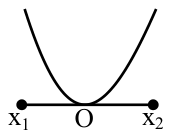
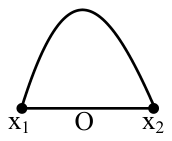
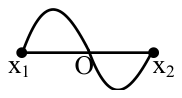
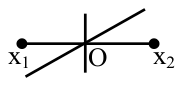
A particle of mass m oscillates with simple harmonic motion between points and , the equilibrium position being O. Its potential energy is plotted. It will be as given below in the graph:
- 1
- 2
- 3
- 4
Show answer and solution
Correct: option 1
The potential energy in SHM is , measured from the equilibrium position. It is zero (minimum) at O and rises as a parabola to its largest value at the extreme points and , which is the upward-opening curve of option (1).
Question 18AIPMT 2003 Prelims, Q18
In case of a forced vibration, the resonance wave becomes very sharp when the:
- 1Damping force is small
- 2Restoring force is small
- 3Applied periodic force is small
- 4Quality factor is small
Show answer and solution
Correct: option 1, Damping force is small
The sharpness of the resonance curve is set by damping: the smaller the damping, the taller and narrower the peak (a large quality factor). So resonance is very sharp when the damping force is small.
Question 19AIPMT 2003 Prelims, Q19
A equiconvex lens is cut into two halves along (i) XOX' and (ii) YOY' as shown in the figure. Let f, f' f" be the focal lengths of the complete lens, of each half in case (i), and of each half in case (ii), respectively
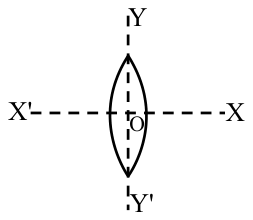
Choose the correct statement from the following-
- 1f' = f, f" = 2f
- 2f' = 2f, f" = f
- 3f' = f, f" = f
- 4f' = 2f, f" = 2f
Show answer and solution
Correct: option 1, f' = f, f" = 2f
Cutting along XOX' (the principal axis) leaves both curved surfaces with the same radii, so each half still has focal length f' = f. Cutting along YOY' gives two plano-convex lenses, each with only one curved surface and so half the power: from for the whole lens, each half has as its power, so f" = 2f.
Question 20AIPMT 2003 Prelims, Q20
We consider the radiation emitted by the human body. Which of the following statements is true:
- 1The radiation emitted is in the infrared region
- 2The radiation is emitted only during the day
- 3The radiation is emitted during the summers and absorbed during the winters
- 4The radiation emitted lies in the ultraviolet region and hence is not visible
Show answer and solution
Correct: option 1, The radiation emitted is in the infrared region
Every body above absolute zero radiates all the time. At body temperature (about 310 K) Wien's law gives a peak wavelength near m, which lies in the infrared.
Question 21AIPMT 2003 Prelims, Q21
An ideal gas heat engine operates in a carnot cycle between 227ºC and 127ºC. It absorbs 6 kcal at the higher temperature. The amount of heat (in kcal) converted into work is equal to -
- 14.8
- 23.5
- 31.6
- 41.2
Show answer and solution
Correct: option 4, 1.2
The temperatures are 500 K and 400 K, so the Carnot efficiency is . Work done is kcal.
Question 22AIPMT 2003 Prelims, Q22
Consider a compound slab consisting of two different materials having equal thicknesses and thermal conductivities K and 2K, respectively. The equivalent thermal conductivity of the slab is -
- 12/6 K
- 2
- 33K
- 44/3 K
Show answer and solution
Correct: option 4, 4/3 K
Heat flows through the two layers one after the other, so their thermal resistances add: . This gives .
Question 23AIPMT 2003 Prelims, Q23
The potential energy of a simple harmonic oscillator when the particle is half way to its end point is -
- 12/3 E
- 21/8 E
- 31/4 E
- 41/2 E
Show answer and solution
Correct: option 3, 1/4 E
The total energy is and the potential energy at displacement is . At this is .
Question 24AIPMT 2003 Prelims, Q24
A charge q is located at the centre of a cube. The electric flux through any face is -
- 1
- 2
- 3
- 4
Show answer and solution
Correct: option 2,
By Gauss's law the total flux through the cube is , and by symmetry it is shared equally by the six faces: each. Multiplying top and bottom by writes this as .
Question 25AIPMT 2003 Prelims, Q25
An electron is moving round the nucleus of a hydrogen atom in a circular orbit of radius r. The coulomb force between the two is -
(where )
- 1
- 2
- 3
- 4
Show answer and solution
Correct: option 4,
The charges are and , so ; the minus sign shows attraction. Writing gives .
Question 26AIPMT 2003 Prelims, Q26
A long solenoid carrying a current produces a magnetic field B along its axis. If the current is doubled and the number of turns per cm is halved, the new value of the magnetic field is -
- 1B/2
- 2B
- 32B
- 44B
Show answer and solution
Correct: option 2, B
Inside a long solenoid . Doubling and halving leaves the product unchanged, so the field is still B.
Question 27AIPMT 2003 Prelims, Q27
A charged particle moves through a magnetic field in a direction perpendicular to it. Then the
- 1Speed of the particle remains unchanged
- 2Direction of the particle remains unchanged
- 3Acceleration remains unchanged
- 4Velocity remains unchanged
Show answer and solution
Correct: option 1, Speed of the particle remains unchanged
The magnetic force is always perpendicular to the velocity, so it does no work and the speed stays constant. It does keep turning the particle in a circle, so the direction, the velocity and the (centripetal) acceleration all keep changing.
Question 28AIPMT 2003 Prelims, Q28
A bar magnet is oscillating in the Earth's magnetic field with a period T. What happens to this period and motion if this mass is quadrupled -
- 1Motion remains S.H. with time period = T/2
- 2Motion remains S.H. with time period = 2T
- 3Motion remains S.H. with time period = 4T
- 4Motion remains S.H. with time and period remains nearly constant
Show answer and solution
Correct: option 2, Motion remains S.H. with time period = 2T
The period of a magnet oscillating in a field is , where the moment of inertia is proportional to the mass and the magnetic moment is unchanged. Four times the mass gives four times , so the period becomes , and the motion is still simple harmonic.
Question 29AIPMT 2003 Prelims, Q29
Two 220 volt, 100 watt bulbs are connected first in series and then in parallel. Each time the combination is connected to a 220 volt a.c. supply line. The power drawn by the combination in each case respectively will be:
- 150 watt, 100 watt
- 2100 watt, 50 watt
- 3200 watt, 150 watt
- 450 watt, 200 watt
Show answer and solution
Correct: option 4, 50 watt, 200 watt
Each bulb has resistance . In series the total resistance is , so the power is W. In parallel each bulb gets the full 220 V and gives its rated 100 W, a total of 200 W.
Question 30AIPMT 2003 Prelims, Q30
An electric kettle has two heating coils. When one of the coils is connected to an a.c. source, the water in the kettle boils in 10 minutes. When the other coil is used the water boils in 40 minutes. If both the coils are connected in parallel, the time taken by the same quantity of water to boil will be:
- 18 min
- 24 min
- 325 min
- 415 min
Show answer and solution
Correct: option 1, 8 min
The same heat is needed each time, so the coils have powers and per minute. In parallel on the same supply the powers add: , so min.
Question 31AIPMT 2003 Prelims, Q31
In a Wheatstone's bridge all the four arms have equal resistance R. If the resistance of the galvanometer arm is also R, the equivalent resistance of the combination as seen by the battery is:
- 1R/4
- 2R/2
- 3R
- 42R
Show answer and solution
Correct: option 3, R
With four equal arms the bridge is balanced, so no current flows in the galvanometer arm and it can be ignored. What is left is two branches of in parallel, which gives .
Question 32AIPMT 2003 Prelims, Q32
Three capacitors each of capacity are to be connected in such a way that the effective capacitance of . This can be done by -
- 1connecting all of them in series
- 2connecting them in parallel
- 3connecting two in series and one in parallel
- 4connecting two in parallel and one in series
Show answer and solution
Correct: option 3, connecting two in series and one in parallel
Two capacitors in series give ; the third in parallel with this pair adds directly: . The other arrangements give , and .
Question 33AIPMT 2003 Prelims, Q33
Solar energy is mainly caused due to:
- 1burning of hydrogen in the oxygen
- 2fission of uranium present in the sun
- 3fusion of protons during synthesis of heavier elements
- 4gravitational contraction
Show answer and solution
Correct: option 3, fusion of protons during synthesis of heavier elements
The Sun's energy comes from thermonuclear fusion in its core: through the proton-proton cycle, hydrogen nuclei (protons) fuse into helium and the lost mass appears as energy. It is neither chemical burning nor fission.
Question 34AIPMT 2003 Prelims, Q34
- 1high resistance and high melting point
- 2high resistance and low melting point
- 3low resistance and low melting point
- 4low resistance and high melting point
Show answer and solution
Correct: option 2, high resistance and low melting point
A fuse must heat up quickly and melt as soon as the current goes above the safe value. That needs a high resistance (more heating) and a low melting point.
Question 35AIPMT 2003 Prelims, Q35
The volume occupied by an atom is greater than the volume of the nucleus by a factor of about
- 1
- 2
- 3
- 4
Show answer and solution
Correct: option 4,
An atom has a radius of about m and a nucleus about m, a ratio of . Volume goes as the cube of the radius, so the ratio of volumes is .
Question 36AIPMT 2003 Prelims, Q36
A photoelectric cell is illuminated by a point source of light 1 m away. When the source is shifted to 2m then -
- 1each emitted electron carries one quarter of the initial energy
- 2number of electrons emitted is half the initial number
- 3each emitted electron carries half the initial energy
- 4number of electrons emitted is a quarter of the initial number
Show answer and solution
Correct: option 4, number of electrons emitted is a quarter of the initial number
The intensity from a point source falls as , so doubling the distance cuts it to one quarter. The number of photoelectrons is proportional to the intensity, so it becomes a quarter; the energy of each electron depends only on the frequency and does not change.
Question 37AIPMT 2003 Prelims, Q37
A sample of radioactive element has a mass of 10 gm at an instant t = 0. The approximate mass of this element in the sample after two mean lives is:
- 11.35 gm
- 22.50 gm
- 33.70 gm
- 46.30 gm
Show answer and solution
Correct: option 1, 1.35 gm
With mean life , the mass left is . After , gm.
Question 38AIPMT 2003 Prelims, Q38
In which of the following systems will be radius of the first orbit (n = 1) be minimum -
- 1Doubly ionized lithium
- 2Singly ionized helium
- 3Deuterium atom
- 4Hydrogen atom
Show answer and solution
Correct: option 1, Doubly ionized lithium
For a one-electron system the Bohr radius is angstrom, so for it is smallest for the largest . Doubly ionized lithium has , against 2 for and 1 for hydrogen and deuterium.
Question 39AIPMT 2003 Prelims, Q39
Reverse bias applied to a junction diode
- 1Lowers the potential barrier
- 2raises the potential barrier
- 3increases the majority carrier current
- 4increases the minority carrier current
Show answer and solution
Correct: option 2, raises the potential barrier
In reverse bias the applied voltage acts in the same direction as the barrier potential, so the barrier becomes higher and the depletion layer wider. Majority carriers are then blocked, and the small minority-carrier current stays almost the same.
Question 40AIPMT 2003 Prelims, Q40
J.J. Thomson's cathode-ray tube experiment demonstrated that
- 1cathode rays are streams of negatively charged ions
- 2all the mass of an atom is essentially in the nucleus
- 3the e/m of electrons is much greater than the e/m of protons
- 4the e/m ratio of the cathode ray particles changes when a different gas is placed in the discharge tube
Show answer and solution
Correct: option 3, the e/m of electrons is much greater than the e/m of protons
Thomson measured e/m for cathode-ray particles and found it the same for every gas and electrode, and about 1800 times larger than the value for the hydrogen ion (proton). The particles are electrons, not ions, and the nucleus came later from Rutherford's experiment, so (3) is the statement that holds.
Question 41AIPMT 2003 Prelims, Q41
Which of the following ray are not electromagnetic waves
- 1X-rays
- 2-rays
- 3-rays
- 4Heat rays
Show answer and solution
Correct: option 3, -rays
-rays are streams of fast electrons, that is charged particles. X-rays, -rays and heat (infrared) rays are all electromagnetic waves.
Question 42AIPMT 2003 Prelims, Q42
A n-p-n transistor conducts when
- 1both collector and emitter are positive with respect to the base
- 2collector is positive and emitter is negative with respect to the base
- 3collector is positive and emitter is at same potential as the base
- 4both collector and emitter are negative with respect to the base
Show answer and solution
Correct: option 2, collector is positive and emitter is negative with respect to the base
A transistor conducts with the emitter-base junction forward biased and the collector-base junction reverse biased. In an n-p-n transistor the base is p-type, so the n-type emitter must be negative and the n-type collector positive with respect to the base.
Question 43AIPMT 2003 Prelims, Q43
According to Curie's law, the magnetic susceptibility of a substance at an absolute temperature T is proportional to -
- 11/T
- 2T
- 3
- 4
Show answer and solution
Correct: option 1, 1/T
Curie's law for a paramagnetic substance is , where is the Curie constant. The susceptibility is inversely proportional to the absolute temperature.
Question 44AIPMT 2003 Prelims, Q44
Diamagnetic material in a magnetic field moves:
- 1from stronger to the weaker parts of the field
- 2from weaker to the stronger parts of the field
- 3perpendicular to the field
- 4in none of the above directions
Show answer and solution
Correct: option 1, from stronger to the weaker parts of the field
A diamagnetic substance is magnetised opposite to the applied field, so it is weakly repelled by a magnet. In a non-uniform field it therefore moves from the stronger part towards the weaker part.
Question 45AIPMT 2003 Prelims, Q45
If a full wave rectifier circuit is operating from 50 Hz mains, the fundamental frequency in the ripple will be:
- 125 Hz
- 250 Hz
- 370.7 Hz
- 4100 Hz
Show answer and solution
Correct: option 4, 100 Hz
A full wave rectifier turns both half-cycles into pulses of the same sign, so the output repeats twice in each input cycle. The ripple frequency is Hz.
Question 46AIPMT 2003 Prelims, Q46
Barrier potential of a p-n junction diode does not depend on -
- 1diode design
- 2temperature
- 3forward bias
- 4doping density
Show answer and solution
Correct: option 1, diode design
The barrier potential is fixed by the material, the doping density on the two sides and the temperature, and the height of the barrier is lowered by a forward bias. It does not depend on the shape or design of the diode.
Question 47AIPMT 2003 Prelims, Q47
The mass of proton is 1.0073 u and that of neutron is 1.0087 u (u = atomic mass unit). The binding energy of is (Given: helium nucleus mass 4.0015 u)
- 10.0305 J
- 20.0305 erg
- 328.4 MeV
- 40.061 u
Show answer and solution
Correct: option 3, 28.4 MeV
The mass defect is u. With 1 u equal to about 931 MeV, the binding energy is MeV.
Question 48AIPMT 2003 Prelims, Q48
The mass number of a nucleus is
- 1always less than its atomic number
- 2always more than its atomic number
- 3sometimes equal to its atomic number
- 4sometimes less than and sometimes more than its atomic number
Show answer and solution
Correct: option 3, sometimes equal to its atomic number
The mass number is , so it can never be less than the atomic number . It is larger than for every nucleus that has neutrons and equal to for ordinary hydrogen, which has none, so it is sometimes equal to the atomic number.
Question 49AIPMT 2003 Prelims, Q49
A nuclear reaction given by
represents
- 1-decay
- 2-decay
- 3fusion
- 4fission
Show answer and solution
Correct: option 1, -decay
The mass number stays the same, the atomic number goes up by one, and an electron and an antineutrino are emitted. That is decay, in which a neutron in the nucleus turns into a proton.
Question 50AIPMT 2003 Prelims, Q50
Following diagram performs the logic function of:

- 1AND gate
- 2NAND gate
- 3OR gate
- 4XOR gate
Show answer and solution
Correct: option 1, AND gate
The first gate is a NAND gate, giving . The second NAND gate has this single signal as its input, so it works as a NOT gate and inverts it: , the AND function.
AIPMT 2003 Prelims Chemistry questions
Question 51AIPMT 2003 Prelims, Q51
The ions , , , and are isoelectronic. Their ionic radii show:
- 1A significant increase from to
- 2A significant decrease from to
- 3An increase from to and then decrease from to
- 4An decrease from to and then increase from to
Show answer and solution
Correct: option 2, A significant decrease from to
All five ions have 10 electrons, while the nuclear charge rises from 8 in to 13 in . The same electron cloud is pulled in more and more strongly, so the radius falls steadily from to .
Question 52AIPMT 2003 Prelims, Q52
Which one of the following compounds is not a protonic acid:
- 1
- 2
- 3
- 4
Show answer and solution
Correct: option 1,
Boric acid, , does not give up its own proton. It acts as a Lewis acid, accepting from water to form and so releasing from the water. The other three (, , ) ionise their own O-H protons.
Question 53AIPMT 2003 Prelims, Q53
The value of Planck's constant is . The velocity of light is . Which value is closest to the wavelength in nanometers of a quantum of light with frequency of :
- 1
- 2
- 3
- 4
Show answer and solution
Correct: option 3,
, which is closest to nm. Planck's constant is not needed.
Question 54AIPMT 2003 Prelims, Q54
Which of the following statements is not correct for sigma- and pi- bonds formed between two carbon atoms:
- 1Sigma-bond is stronger than a pi-bond
- 2Bond energies of sigma- and pi-bonds are of the order of 264 KJ/mol and 347 KJ/mol, respectively
- 3Free rotation of atoms about a sigma bond is allowed but not in case of a pi-bond
- 4Sigma-bond determines the direction between carbon atoms but a pi-bond has no primary effect in this regard
Show answer and solution
Correct: option 2, Bond energies of sigma- and pi-bonds are of the order of 264 KJ/mol and 347 KJ/mol, respectively
A sigma bond comes from head-on overlap and is stronger than a pi bond, which comes from sideways overlap. The C-C sigma bond energy is about 347 kJ/mol and the pi bond about 264 kJ/mol, so option (2) has the two values the wrong way round. The other three statements are true.
Question 55AIPMT 2003 Prelims, Q55
The oxidation states of sulphur in the anions , and follow the order -
- 1
- 2
- 3
- 4
Show answer and solution
Correct: option 1,
Taking oxygen as : in , gives ; in , gives ; in , gives . So the order is .
Question 56AIPMT 2003 Prelims, Q56
The pyknometric density of sodium chloride crystal is while its X-ray density is . The fraction of unoccupied sites in sodium chloride crystal is:
- 1
- 2
- 3
- 4
Show answer and solution
Correct: option 4,
The X-ray density assumes every lattice site is filled; the measured (pyknometric) density is lower because some sites are empty. Fraction unoccupied .
Question 57AIPMT 2003 Prelims, Q57
For the reaction:
at constant temperature, is:
- 1
- 2
- 3
- 4
Show answer and solution
Correct: option 2,
, where counts gases only. Gaseous products: 3 mol; gaseous reactants: mol (water is liquid). , so .
Question 58AIPMT 2003 Prelims, Q58
In Haber process 30 litres of dihydrogen and 30 litres of dinitrogen were taken for reaction which yielded only 50% of the expected product. What will be the composition of gaseous mixture under the above condition in the end:
- 120 litres ammonia, 20 litres nitrogen, 20 litres hydrogen
- 210 litres ammonia, 25 litres nitrogen, 15 litres hydrogen
- 320 litres ammonia, 10 litres nitrogen, 30 litres hydrogen
- 420 litres ammonia, 25 litres nitrogen, 15 litres hydrogen
Show answer and solution
Correct: option 2, 10 litres ammonia, 25 litres nitrogen, 15 litres hydrogen
. Hydrogen is the limiting reagent: 30 L of it could give 20 L of ammonia. Only 50% forms, so 10 L of ammonia is made, using 5 L of nitrogen and 15 L of hydrogen. Left over: L nitrogen and L hydrogen.
Question 59AIPMT 2003 Prelims, Q59
The densities of graphite and diamond at 298 K are 2.25 and 3.31 , respectively. If the standard free energy difference () is equal to 1895 , the pressure at which graphite will be transformed into diamond at 298 K is -
- 1 Pa
- 2 Pa
- 3 Pa
- 4 Pa
Show answer and solution
Correct: option 1, Pa
At constant temperature the free energy change varies with pressure as , and conversion starts when . For one mole (12 g), . So Pa, which is of the order of Pa; the nearest option is Pa.
Question 60AIPMT 2003 Prelims, Q60
What is the entropy change (in ) when one mole of ice is converted into water at ? (The enthalpy change for the conversion of ice to liquid water is 6.0 at )
- 120.13
- 22.013
- 32.198
- 421.98
Show answer and solution
Correct: option 4, 21.98
Melting at the melting point is reversible, so .
Question 61AIPMT 2003 Prelims, Q61
The reaction quotient (Q) for the reaction:
is given by . The reaction will proceed from right to left if:
(where is the equilibrium constant)
- 1
- 2
- 3
- 4
Show answer and solution
Correct: option 3,
When there is more product (relative to reactants) than at equilibrium, so the reaction runs backwards, from right to left, until falls to . is equilibrium, and or drives the forward reaction.
Question 62AIPMT 2003 Prelims, Q62
The activation energy for a simple chemical reaction is in forward direction. The activation energy for reverse reaction:
- 1Is negative of
- 2Is always less than
- 3Can be less than or more than
- 4Is always double of
Show answer and solution
Correct: option 3, Can be less than or more than
. For an exothermic reaction ( negative) the reverse barrier is larger than ; for an endothermic reaction it is smaller. So it can be less than or more than .
Question 63AIPMT 2003 Prelims, Q63
Which of the following statements is not true:
- 1Among halide ions, iodide is the most powerful reducing agent
- 2Fluorine is the only halogen that does not show a variable oxidation state
- 3HOCl is a stronger acid than HOBr
- 4HF is a stronger acid than HCl
Show answer and solution
Correct: option 4, HF is a stronger acid than HCl
The H-F bond is very strong, so HF ionises only slightly in water and is a weak acid, much weaker than HCl. The other statements are true: iodide loses electrons most easily, fluorine shows only the state, and HOCl is stronger than HOBr because chlorine is more electronegative than bromine.
Question 64AIPMT 2003 Prelims, Q64
The method of zone refining of metals is based on the principle of:
- 1Greater mobility of the pure metal than that of the impurity
- 2Higher melting point of the impurity than that of the pure metal
- 3Greater noble character of the solid metal than that of the impurity
- 4Greater solubility of the impurity in the molten state than in the solid
Show answer and solution
Correct: option 4, Greater solubility of the impurity in the molten state than in the solid
In zone refining a narrow molten zone is moved along a rod of the metal. Impurities are more soluble in the melt than in the solid, so they stay in the molten zone and are swept to one end, while pure metal crystallises behind the zone.
Question 65AIPMT 2003 Prelims, Q65
On the basis of the information available from the reaction:
of ,
the minimum e.m.f. required to carry out electrolysis of is ()
- 12.14 V
- 24.28 V
- 36.42 V
- 48.56 V
Show answer and solution
Correct: option 1, 2.14 V
One mole of takes 4 electrons ( Al each losing 3), so . Electrolysis must supply the reverse of this free energy: V.
Question 66AIPMT 2003 Prelims, Q66
The reaction follows first order kinetics. The time taken for 0.8 mole of A to produce 0.6 mole of B is 1 hour. What is the time taken for conversion of 0.9 mole of A to produce 0.675 mole of B
- 11 hour
- 20.5 hour
- 30.25 hour
- 42 hour
Show answer and solution
Correct: option 1, 1 hour
In the first case of A reacts; in the second reacts. For a first order reaction the time for a given fraction to react does not depend on the starting amount, so the time is again 1 hour.
Question 67AIPMT 2003 Prelims, Q67
The solubility product of AgI at is . The solubility of AgI in N solution of KI at is approximately (in ):
- 1
- 2
- 3
- 4
Show answer and solution
Correct: option 2,
KI supplies M, far more than AgI itself gives (common ion effect). So .
Question 68AIPMT 2003 Prelims, Q68
Formation of a solution from two components can be considered as:
(i) Pure solvent separated solvent molecules,
(ii) Pure solvent separated solvent molecules,
(iii) Separated solvent and solute molecules solution,
Solution so formed will be ideal if: -
- 1
- 2
- 3
- 4
Show answer and solution
Correct: option 1,
Step (ii) is meant to be the separation of the solute molecules. By Hess's law the enthalpy of solution is the sum of the three steps, . For an ideal solution the energy spent separating the molecules () is exactly returned on mixing (), so this sum is zero; option (1) is the only one that writes the sum correctly.
Question 69AIPMT 2003 Prelims, Q69
For which one of the following equations is equal to for the product:
- 1
- 2
- 3
- 4
Show answer and solution
Correct: option 3,
An enthalpy of formation is the enthalpy change when one mole of a compound forms from its elements in their standard states. Only fits. In (1) ozone is not the standard state of oxygen, in (2) methane is a compound and two products form, and in (4) CO is a compound and two moles of product form.
Question 70AIPMT 2003 Prelims, Q70
The following equilibria are given:
The equilibrium constant of the reaction
in terms of , and is:
- 1
- 2
- 3
- 4
Show answer and solution
Correct: option 4,
The target reaction is (second equation) (third equation) (first equation): the and cancel and the oxygen adds up to . Adding reactions multiplies their constants, multiplying a reaction by 3 cubes its constant, and reversing one inverts it, so .
Question 71AIPMT 2003 Prelims, Q71
The molar heat capacity of water at constant pressure, C, is 75 . When 1.0 KJ of heat is supplied to 100 g of water which is free to expand, the increase in temperature of water is:
- 11.2 K
- 22.4 K
- 34.8 K
- 46.6 K
Show answer and solution
Correct: option 2, 2.4 K
100 g of water is mol. , so K.
Question 72AIPMT 2003 Prelims, Q72
If the rate of the reaction is equal to the rate constant, the order of the reaction is -
- 10
- 21
- 32
- 43
Show answer and solution
Correct: option 1, 0
Rate . The rate equals whatever the concentration only when , since . So the reaction is zero order.
Question 73AIPMT 2003 Prelims, Q73
The temperature dependence of rate constant (k) of a chemical reaction is written in terms of Arrhenius equation, . Activation energy () of the reaction can be calculated by plotting
- 1k vs T
- 2k vs
- 3log k vs
- 4log k vs
Show answer and solution
Correct: option 3, log k vs
Taking logs, . A plot of against is a straight line with slope , from which is found.
Question 74AIPMT 2003 Prelims, Q74
IUPAC name of the compound given below is:
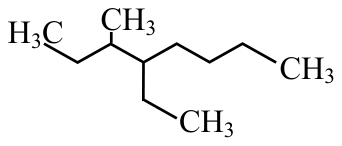
- 14-Ethyl-3-methyloctane
- 23-Methyl-4-ethyloctane
- 32, 3-Diethylheptane
- 45-Ethyl-6-methyloctane
Show answer and solution
Correct: option 1, 4-Ethyl-3-methyloctane
The longest chain has eight carbons (octane). Numbering from the end nearer the branches puts the methyl group on C-3 and the ethyl group on C-4 (3,4 is lower than 5,6 from the other end). Substituents are listed alphabetically, ethyl before methyl, giving 4-ethyl-3-methyloctane.
Question 75AIPMT 2003 Prelims, Q75
In this reaction:
an asymmetric centre is generated. The acid obtained would be:
- 1D-isomer
- 2L-isomer
- 350% D + 50% L -isomer
- 420% D + 80% L -isomer
Show answer and solution
Correct: option 3, 50% D + 50% L -isomer
The carbonyl carbon of ethanal is flat, so attacks from either face with equal chance. The cyanohydrin, and the lactic acid made from it by hydrolysis, is therefore a racemic mixture: 50% D and 50% L.
Question 76AIPMT 2003 Prelims, Q76
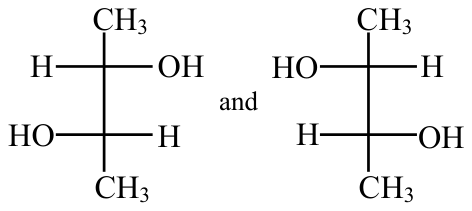
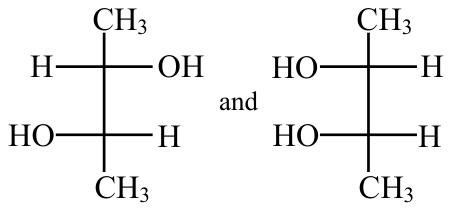
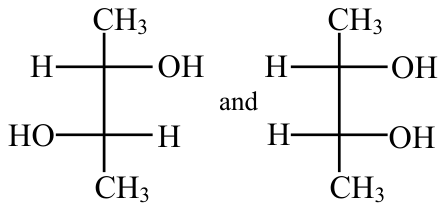
Which of the following pairs of compounds are enantiomers:
- 1
- 2
- 3
- 4
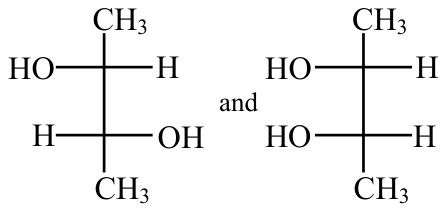
Show answer and solution
Correct: option 1
Enantiomers are non-superimposable mirror images. In pair (1) the second Fischer projection has H and OH swapped at both carbons, which is the mirror image of the first, and the first structure (OH groups on opposite sides) is chiral. In (2) and (3) only one carbon differs, giving diastereomers (the second structure has both OH groups on the same side and is the meso form). In (4) too the second structure is the meso form, not a mirror image of the first.
Question 77AIPMT 2003 Prelims, Q77
In a set of the given reactions, acetic acid yielded a product C.
product C would be
- 1
- 2
- 3
- 4
Show answer and solution
Correct: option 4,
turns acetic acid into acetyl chloride (A). Friedel-Crafts acylation of benzene gives acetophenone, (B). The Grignard reagent adds an ethyl group to the carbonyl carbon, and after hydrolysis this gives the tertiary alcohol .
Question 78AIPMT 2003 Prelims, Q78
The compound on reaction with in the presence of given:
- 1
- 2
- 3
- 4
Show answer and solution
Correct: option 2,
with cleaves the double bond oxidatively. The end has no hydrogen and becomes the ketone acetone; the end is oxidised past the aldehyde to acetic acid. Products: .
Question 79AIPMT 2003 Prelims, Q79
The e.m.f. of a Daniell cell at 298 K is .
When the concentration of is 1.0 M and that of is 0.01 M, the e.m.f. is changed to . What is the relationship between and :
- 1
- 2
- 3
- 4
Show answer and solution
Correct: option 1,
. In the first cell the ratio is , so V; in the second it is , so V. Hence .
Question 80AIPMT 2003 Prelims, Q80
According to the adsorption theory of catalysis, the speed of the reaction increase because:
- 1The concentration of reactant molecules at the active centers of the catalyst becomes high due to adsorption
- 2In the process of adsorption, the activation energy of the molecules becomes large
- 3Adsorption produces heat which increases the speed of the reaction
- 4Adsorption lowers the activation energy of the reaction.
Show answer and solution
Correct: option 3, Adsorption produces heat which increases the speed of the reaction
The source's key gives option (3), and that is the answer recorded here. Our own working does not agree with it: in the adsorption theory the reactant molecules are held on the catalyst surface, which weakens their bonds and provides a path of lower activation energy, as option (4) says, and also raises their concentration at the active centres, as option (1) says. The heat of adsorption is not the reason the reaction speeds up. Treat this key as doubtful.
Question 81AIPMT 2003 Prelims, Q81
Which one of the following characteristics of the transition metals is associated with their catalytic activity:
- 1High enthalpy of atomization
- 2Paramagnetic behaviour
- 3Colour of hydrated ions
- 4Variable oxidation states
Show answer and solution
Correct: option 4, Variable oxidation states
Transition metals can change easily between several oxidation states, so they can form unstable intermediates with the reactants and then be regenerated. This gives a path of lower activation energy, which is why they are good catalysts.
Question 82AIPMT 2003 Prelims, Q82
The basic character of the transition metal monoxides follows the order:
(Atomic nos. Ti = 22, V = 23, Cr = 24, Fe = 26)
- 1VO > CrO > TiO > FeO
- 2CrO > VO > FeO > TiO
- 3TiO > FeO > VO > CrO
- 4TiO > VO > CrO > FeO
Show answer and solution
Correct: option 4, TiO > VO > CrO > FeO
Across the series from Ti to Fe the nuclear charge rises and the metal becomes less electropositive, so its monoxide becomes less ionic and less basic. The basic character therefore falls in the order of atomic number: TiO > VO > CrO > FeO.
Question 83AIPMT 2003 Prelims, Q83
The correct order of ionic radii of , , , and is: -
Atomic nos. Y = 39, La = 57, Eu = 63, Lu = 71.
- 1
- 2
- 3
- 4
Show answer and solution
Correct: option 2,
Because of the lanthanoid contraction the radius falls steadily from through to . belongs to the period above and is taken as the smallest here (in fact its radius is almost the same as that of the last lanthanoid ions). Only option (2) has the lanthanoid ions in the right order, , with at the small end.
Question 84AIPMT 2003 Prelims, Q84
According to IUPAC nomenclature sodium nitroprusside is named as:
- 1Sodium nitroferricyanide
- 2Sodium nitroferrocyanide
- 3Sodium pentacyanonitrosyl ferrate (II)
- 4Sodium pentacyanonitrosyl ferrate (III)
Show answer and solution
Correct: option 3, Sodium pentacyanonitrosyl ferrate (II)
Sodium nitroprusside is . The NO ligand is present as , so with five and an overall charge of on the complex ion, iron is : . Ligands are named alphabetically (cyano before nitrosyl) and the anion ends in -ate: sodium pentacyanonitrosylferrate(II).
Question 85AIPMT 2003 Prelims, Q85
The number of unpaired electrons in the complex ion is: (At. No. Co = 27)
- 12
- 23
- 34
- 4zero
Show answer and solution
Correct: option 3, 4
Cobalt is here, with configuration . Fluoride is a weak field ligand, so the electrons do not pair up and the complex is high spin (, hybridisation). That leaves 4 unpaired electrons.
Question 86AIPMT 2003 Prelims, Q86
Which one of the following octahedral complexes will not show geometric isomerism?
(A and B are monodentate ligands)
- 1
- 2
- 3
- 4
Show answer and solution
Correct: option 4,
In all six octahedral positions are equivalent, so wherever the single B is placed the same arrangement results: no geometric isomers. and have cis and trans forms, and has fac and mer forms.
Question 87AIPMT 2003 Prelims, Q87
- 1Fe(II)
- 2Co(III)
- 3Zn(II)
- 4Ca(II)
Show answer and solution
Correct: option 2, Co(III)
Vitamin (cyanocobalamin) is a coordination compound of cobalt, with Co(III) held at the centre of a corrin ring.
Question 88AIPMT 2003 Prelims, Q88
Among the following which is not the -bonded organometallic compound:
- 1
- 2
- 3
- 4
Show answer and solution
Correct: option 4,
In Zeise's salt, ferrocene and dibenzenechromium the metal is bonded to the electrons of ethene, cyclopentadienyl and benzene. In tetramethyltin each methyl group is joined to tin by an ordinary Sn-C sigma bond, so it is a -bonded organometallic compound.
Question 89AIPMT 2003 Prelims, Q89
The radioisotope, tritium has a half-life of 12.3 years. If the initial amount of tritium is 32 mg, how many milligrams of its would remain after 49.2 years:
- 11 mg
- 22 mg
- 34 mg
- 48 mg
Show answer and solution
Correct: option 2, 2 mg
half-lives. Amount left mg.
Question 90AIPMT 2003 Prelims, Q90
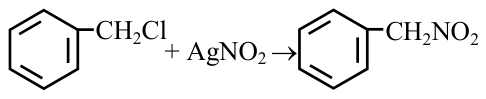
Which one of the following is a free-radical substitution reaction:
- 1
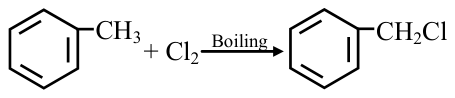
- 2
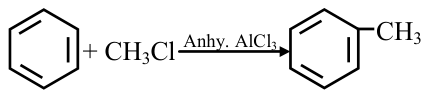
- 3
- 4
Show answer and solution
Correct: option 1
(1) Toluene with chlorine at the boiling point is chlorinated in the side chain to benzyl chloride; this goes through chlorine atoms and a benzyl radical, so it is free-radical substitution. (2) Benzene with chloromethane and anhydrous aluminium chloride is Friedel-Crafts alkylation, an electrophilic substitution. (3) Benzyl chloride with silver nitrite is a nucleophilic substitution. (4) HCN adding to ethanal is a nucleophilic addition.
Question 91AIPMT 2003 Prelims, Q91
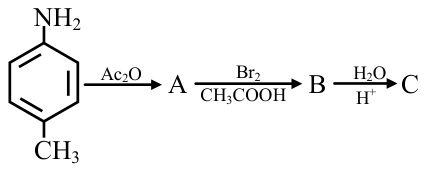
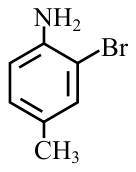
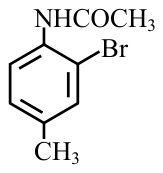
The final product C, obtained in this reaction, would be:
- 1
- 2
- 3
- 4
Show answer and solution
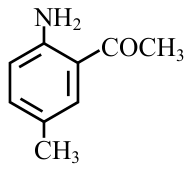
Correct: option 3
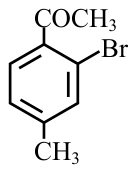
Acetic anhydride acetylates the amino group of p-toluidine, giving the acetamide A. Bromine in acetic acid then substitutes once, ortho to the group (the para position is blocked by the methyl group), giving B. Acid hydrolysis removes the acetyl group and restores the free amine, so C is 2-bromo-4-methylaniline, option (3). Option (4) is B, before hydrolysis.
Question 92AIPMT 2003 Prelims, Q92
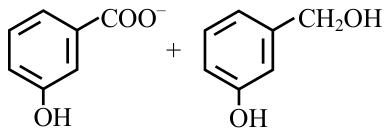
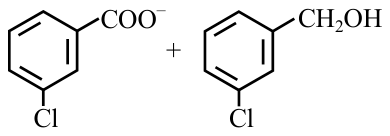
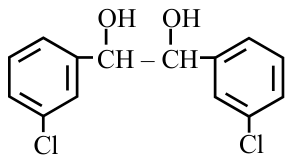
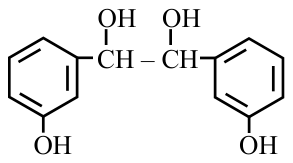
When m-chlorobenzaldehyde is treated with 50% KOH solution, the product(s) obtained is (are)
- 1
- 2
- 3
- 4
Show answer and solution
Correct: option 2
m-Chlorobenzaldehyde has no alpha hydrogen, so with concentrated alkali it undergoes the Cannizzaro reaction: one molecule is oxidised to the m-chlorobenzoate ion and another is reduced to m-chlorobenzyl alcohol. The chlorine on the ring is not replaced under these conditions, which rules out (1) and (4).
Question 93AIPMT 2003 Prelims, Q93
The correct order of reactivity towards the electrophilic substitution of the compounds aniline (I), benzene (II) and nitrobenzene (III) is
- 1III > II > I
- 2II > III > I
- 3I < II > III
- 4I > II > III
Show answer and solution
Correct: option 4, I > II > III
The group pushes electron density into the ring and activates it strongly, while withdraws electrons and deactivates it. So aniline reacts fastest with electrophiles and nitrobenzene slowest: I > II > III.
Question 94AIPMT 2003 Prelims, Q94
Which of the following orders of acid strength is correct:
- 1
- 2
- 3
- 4
Show answer and solution
Correct: option 2,
Approximate values: carboxylic acid about 5, water about 15.7, alcohol about 16 to 18, ethyne about 25. A carboxylate ion is stabilised by resonance; an alkoxide ion is destabilised by the electron-releasing alkyl group compared with hydroxide; the acetylide carbanion is the least stable. So .
Question 95AIPMT 2003 Prelims, Q95
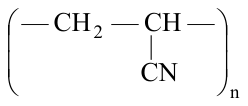
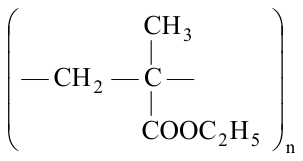
Acrolein is a hard, horny and a high melting point material. Which of the following represent its structure:
- 1
- 2
- 3
- 4
Show answer and solution
Correct: option 1
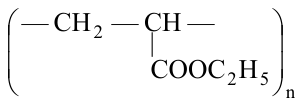
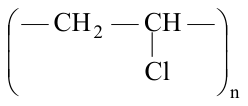
The hard, horny, high-melting material described is the acrylic fibre polyacrylonitrile (sold as Acrilan or Orlon), made by polymerising . Its repeating unit is , option (1). (2) is poly(ethyl methacrylate), (3) is poly(ethyl acrylate) and (4) is PVC.
Question 96AIPMT 2003 Prelims, Q96
A and B in the following reactions are:

- 1
- 2
- 3,
- 4
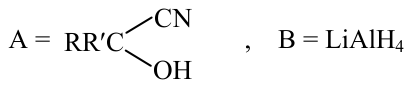
Show answer and solution
Correct: option 4
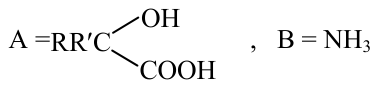
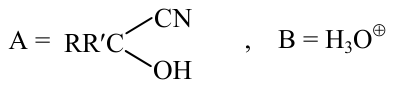
HCN (with KCN) adds across the carbonyl group to give the cyanohydrin , which is A. To turn into the nitrile must be reduced, and does this. Acid hydrolysis () would give the hydroxy acid instead.
Question 97AIPMT 2003 Prelims, Q97
Which one of the following monomers gives the polymer neoprene on polymerization: -
- 1
- 2
- 3
- 4
Show answer and solution
Correct: option 3,
Neoprene is the synthetic rubber made by polymerising chloroprene, 2-chlorobuta-1,3-diene. Option (1) is vinyl chloride (gives PVC) and option (4) is tetrafluoroethene (gives Teflon).
Question 98AIPMT 2003 Prelims, Q98
- 1Oxidation of glucose to glutamate
- 2Conversion of pyruvate to citrate
- 3Oxidation of glucose to pyruvate
- 4Conversion of glucose to haem
Show answer and solution
Correct: option 3, Oxidation of glucose to pyruvate
Glycolysis is the first stage of the breakdown of glucose: in ten enzyme steps in the cytoplasm one glucose molecule is partly oxidised to two molecules of pyruvate, with a net gain of 2 ATP and 2 NADH.
Question 99AIPMT 2003 Prelims, Q99
Phospholipids are esters of glycerol with:-
- 1Three carboxylic acid residues
- 2Two carboxylic acid residues and one phosphate group
- 3One carboxylic acid residue and two phosphate groups
- 4Three phosphate groups
Show answer and solution
Correct: option 2, Two carboxylic acid residues and one phosphate group
In a phospholipid two of the three hydroxyl groups of glycerol are esterified with fatty acids and the third with phosphoric acid (which usually carries a further group such as choline). Three fatty acid residues would make a triglyceride (a fat).
Question 100AIPMT 2003 Prelims, Q100
Chargaff's rule states that in an organism: -
- 1Amount of adenine (A) is equal to that of thymine (T) and the amount of guanine (G) is equal to that of cytosine (C)
- 2Amount of adenine (A) is equal to that of guanine (G) and the amount of thymine (T) is equal to that of cytosine (C)
- 3Amount of adenine (A) is equal to that of cytosine (C) and the amount of thymine (T) is equal to that of guanine (G)
- 4Amounts of all bases are equal
Show answer and solution
Correct: option 1, Amount of adenine (A) is equal to that of thymine (T) and the amount of guanine (G) is equal to that of cytosine (C)
Chargaff found that in double-stranded DNA the amount of adenine equals that of thymine and the amount of guanine equals that of cytosine. This follows from base pairing: A always pairs with T and G with C.
AIPMT 2003 Prelims Biology questions
Question 101AIPMT 2003 Prelims, Q101
Cellular totipotency is demonstrated by:
- 1Only gymnosperm cells
- 2All plant cells
- 3All eukaryotic cells
- 4Only bacterial cells
Show answer and solution
Correct: option 2, All plant cells
Totipotency is the ability of a single cell to grow into a whole organism. It is the basis of plant tissue culture, where a living plant cell from any group can regenerate a complete plant. It is not limited to gymnosperms, and most animal cells lose this ability once they differentiate, so 'all plant cells' is the keyed answer.
Question 102AIPMT 2003 Prelims, Q102
Viruses are no more "alive" than isolated chromosomes because:
- 1They require both RNA and DNA
- 2They both need food molecules
- 3They both require oxygen for respiration
- 4Both require the environment of a cell to replicate
Show answer and solution
Correct: option 4, Both require the environment of a cell to replicate
A virus outside a host is an inert nucleoprotein particle, just as an isolated chromosome is inert outside a cell. Neither feeds nor respires, and a virus has only one kind of nucleic acid. Both can be copied only by using the enzymes, ribosomes and raw materials of a living cell.
Question 103AIPMT 2003 Prelims, Q103
Given below are four matchings of an animal and its kind of respiratory organ:
A. Silver fish – trachea
B. Scorpion – book lung
C. Sea squirt – pharyngeal gills
D. Dolphin – skin
The correct matchings are:
- 1A and D
- 2A, B and C
- 3B and D
- 4C and D
Show answer and solution
Correct: option 2, A, B and C
Silver fish (Lepisma) is an insect and breathes by tracheae. The scorpion is an arachnid with book lungs. The sea squirt is a urochordate with pharyngeal gill slits. The dolphin is a mammal and breathes by lungs, not through its skin, so only A, B and C are correct.
Question 104AIPMT 2003 Prelims, Q104
Convergent evolution is illustrated by:
- 1Rat and dog
- 2Bacterium and protozoan
- 3Starfish and cuttle fish
- 4Dogfish and whale
Show answer and solution
Correct: option 4, Dogfish and whale
Convergent evolution is when unrelated groups come to look alike because they live in the same kind of habitat. The dogfish is a cartilaginous fish and the whale is a mammal, yet both have a streamlined body and fins or flippers for swimming. The other pairs do not show such an acquired likeness.
Question 105AIPMT 2003 Prelims, Q105
Which one of the following sequences was proposed by Darwin and Wallace for organic evolution:
- 1Overproduction, variations, constancy of population size, natural selection
- 2Variations, constancy of population size, overproduction, natural selection
- 3Overproduction, constancy of population size, variations, natural selection
- 4Variations, natural selection, overproduction, constancy of population size
Show answer and solution
Correct: option 3, Overproduction, constancy of population size, variations, natural selection
The argument starts from two observations: organisms produce far more offspring than can survive (overproduction), yet population size stays roughly constant, so there must be a struggle for existence. Since individuals vary, those with favourable variations survive and reproduce, which is natural selection. That order is option (3).
Question 106AIPMT 2003 Prelims, Q106
Random genetic drift in a population probably results from:
- 1Highly genetically variable individuals
- 2Interbreeding within this population
- 3Constant low mutation rate
- 4Large population size
Show answer and solution
Correct: option 2, Interbreeding within this population
Genetic drift is a chance change in allele frequency and is strong only in a small, isolated population whose members breed among themselves. A large population size works against drift, and neither a steady low mutation rate nor high variability causes it. Of the choices, interbreeding within the (small) population is the one linked to drift.
Question 107AIPMT 2003 Prelims, Q107
Bundle of His is a network of:
- 1Muscle fibres distributed throughout the heart walls
- 2Muscle fibres found only in the ventricle wall
- 3Nerve fibres distributed in ventricles
- 4Nerve fibres found throughout the heart
Show answer and solution
Correct: option 2, Muscle fibres found only in the ventricle wall
The bundle of His is part of the conducting system of the heart, which is made of specialised cardiac muscle fibres (nodal tissue), not nerves. It starts from the AV node, runs in the interventricular septum and spreads as Purkinje fibres in the ventricular walls only.
Question 108AIPMT 2003 Prelims, Q108
During prolonged fasting, in what sequence are the following organic compounds used up by the body:
- 1First carbohydrates, next fats and lastly proteins
- 2First fats, next carbohydrates and lastly proteins
- 3First carbohydrates, next proteins and lastly lipids
- 4First proteins, next lipids and lastly carbohydrates
Show answer and solution
Correct: option 1, First carbohydrates, next fats and lastly proteins
The body first uses its carbohydrate store, the glycogen of liver and muscle, which lasts about a day. It then draws on the fat reserves. Proteins form the structure of the body and are broken down for energy only at the end, when the other stores are exhausted.
Question 109AIPMT 2003 Prelims, Q109
Which one of the following contains the largest quantity of extracellular material:
- 1Striated muscle
- 2Areolar tissue
- 3Stratified epithelium
- 4Myelinated nerve fibres
Show answer and solution
Correct: option 2, Areolar tissue
Areolar tissue is a loose connective tissue: its few cells lie far apart in an abundant matrix of ground substance and fibres. Muscle, epithelium and nerve fibres consist of closely packed cells with very little intercellular material.
Question 110AIPMT 2003 Prelims, Q110
If Henle's loop were absent from mammalian nephron, which of the following is to be expected:
- 1There will be no urine formation
- 2There will be hardly any change in the quality and quantity of urine formed
- 3The urine will be more concentrated
- 4The urine will be more dilute
Show answer and solution
Correct: option 4, The urine will be more dilute
Henle's loop sets up the counter-current mechanism that makes the medulla hypertonic, and this is what allows water to be drawn out of the collecting duct. Without the loop filtration would still take place, but the urine could not be concentrated, so it would be more dilute.
Question 111AIPMT 2003 Prelims, Q111
Which group of vertebrates comprises the highest number of endangered species:
- 1Mammals
- 2Fishes
- 3Reptiles
- 4Birds
Show answer and solution
Correct: option 3, Reptiles
The answer key of the source copy gives reptiles. Note that this is doubtful: in the IUCN Red List counts of that period, mammals and birds each had many more threatened species than reptiles, and most books answer this question with mammals. The keyed answer is kept here as given.
Question 112AIPMT 2003 Prelims, Q112
Fluoride pollutions mainly affects:
- 1Brain
- 2Heart
- 3Teeth
- 4Kidney
Show answer and solution
Correct: option 3, Teeth
Excess fluoride, usually taken in with drinking water, causes fluorosis. Its first and most common sign is mottling and staining of the teeth (dental fluorosis); with heavier intake the bones are also affected.
Question 113AIPMT 2003 Prelims, Q113
Two opposite forces operate in the growth and development of every population. One of them relates to the ability to reproduce at a given rate. The force opposing it is called:
- 1Morbidity
- 2Fecundity
- 3Biotic potential
- 4Environmental resistance
Show answer and solution
Correct: option 4, Environmental resistance
The inherent ability of a population to reproduce at a given rate is its biotic potential. It is checked by the sum of the limiting factors of the environment, such as shortage of food and space, predators and disease, which together are called environmental resistance.
Question 114AIPMT 2003 Prelims, Q114
Which one of the following bacteria has found extensive use in genetic engineering work in plants:
- 1Clostridium septicum
- 2Xanthomonas citri
- 3Bacillus coagulans
- 4Agrobacterium tumefaciens
Show answer and solution
Correct: option 4, Agrobacterium tumefaciens
Agrobacterium tumefaciens naturally transfers a piece of its Ti plasmid (the T-DNA) into the genome of the plants it infects. A disarmed Ti plasmid is therefore the standard vector for putting foreign genes into plants.
Question 115AIPMT 2003 Prelims, Q115
Test tube baby means a baby born when
- 1It is developed in a test tube
- 2It is developed through tissue culture method
- 3The ovum is fertilised externally and thereafter implanted in the uterus
- 4It develops from a non-fertilized egg
Show answer and solution
Correct: option 3, The ovum is fertilised externally and thereafter implanted in the uterus
In the test tube baby technique the ovum is fertilised by sperm outside the body (in vitro fertilisation) and the early embryo is then transferred to the uterus, where the rest of development takes place. Only fertilisation happens in the laboratory.
Question 116AIPMT 2003 Prelims, Q116
In which one of the following do the two names refer to one and the same thing:
- 1Kreb's cycle and Calvin cycle
- 2Tricarboxylic acid cycle and citric acid cycle
- 3Citric acid cycle and Calvin cycle
- 4Tricarboxylic acid cycle and urea cycle
Show answer and solution
Correct: option 2, Tricarboxylic acid cycle and citric acid cycle
The Krebs cycle of aerobic respiration is also called the citric acid cycle, after its first product, and the tricarboxylic acid (TCA) cycle, because citric acid has three carboxyl groups. The Calvin cycle belongs to photosynthesis and the urea cycle to nitrogen excretion.
Question 117AIPMT 2003 Prelims, Q117
Down's syndrome is caused by an extra copy of chromosome number 21. What percentage of offspring produced by an affected mother and a normal father would be affected by this disorder:
- 1100%
- 275%
- 350%
- 425%
Show answer and solution
Correct: option 3, 50%
The affected mother has three copies of chromosome 21. At meiosis two copies go to one pole and one to the other, so half her eggs carry two copies and half carry one. With a normal sperm, half the offspring get three copies and are affected: 50%.
Question 118AIPMT 2003 Prelims, Q118
Maximum application of animal cell culture technology today is in the production of:
- 1Insulin
- 2Interferons
- 3Vaccines
- 4Edible proteins
Show answer and solution
Correct: option 3, Vaccines
Viruses multiply only inside living cells, so animal cell cultures are used on a very large scale to grow the viruses needed for vaccines such as polio, measles and rabies. Insulin and interferons are made mostly in genetically engineered microbes.
Question 119AIPMT 2003 Prelims, Q119
Escherichia coli is used as an indicator organism to determine pollution of water with:
- 1Heavy metals
- 2Faecal matter
- 3Industrial effluents
- 4Pollen of aquatic plants
Show answer and solution
Correct: option 2, Faecal matter
Escherichia coli lives in the human intestine and is passed out in large numbers with faeces. Finding it in a water sample (the coliform count) therefore shows that the water is contaminated with sewage or faecal matter.
Question 120AIPMT 2003 Prelims, Q120
Which one of the following pairs correctly matches a hormone with a disease resulting from its deficiency:
- 1Relaxin – Gigantism
- 2Prolactin – Cretinism
- 3Parathyroid hormone – Tetany
- 4Insulin – Diabetes insipidus
Show answer and solution
Correct: option 3, Parathyroid hormone – Tetany
Lack of parathyroid hormone lowers blood calcium, which makes muscles go into sustained spasm (tetany). Gigantism is due to excess growth hormone, cretinism to lack of thyroxine in childhood, and diabetes insipidus to lack of ADH; lack of insulin causes diabetes mellitus.
Question 121AIPMT 2003 Prelims, Q121
- 1Malignant tumours of the connective tissue
- 2Malignant tumours of the skin or mucous membrane
- 3Malignant tumours of the colon
- 4Benign tumours of the connective tissue
Show answer and solution
Correct: option 2, Malignant tumours of the skin or mucous membrane
Cancers are named by the tissue they arise from. A carcinoma is a malignant tumour of epithelial tissue, such as the skin and the mucous membranes lining organs. A malignant tumour of connective tissue is a sarcoma.
Question 122AIPMT 2003 Prelims, Q122
Which endangered animal is the source of the world's finest, lightest, warmest and most expensive wool-the shahtoosh:
- 1Nilgai
- 2Cheetal
- 3Kashmiri goat
- 4Chiru
Show answer and solution
Correct: option 4, Chiru
Shahtoosh is made from the fine underfur of the chiru, the Tibetan antelope, which is killed to obtain it and has become endangered as a result. The Kashmiri goat gives pashmina, a different wool.
Question 123AIPMT 2003 Prelims, Q123
Which one of the following is a matching pair of an animal and a certain phenomenon it exhibits:
- 1Pheretima – Sexual dimorphism
- 2Musca – Complete metamorphosis
- 3Chameleon – Mimicry
- 4Taenia – Polymorphism
Show answer and solution
Correct: option 2, Musca – Complete metamorphosis
The housefly Musca passes through egg, larva (maggot), pupa and adult, which is complete metamorphosis. Pheretima (earthworm) is hermaphrodite, so it has no sexual dimorphism; the chameleon shows colour change (camouflage), not mimicry; Taenia is not polymorphic.
Question 124AIPMT 2003 Prelims, Q124
Short-lived immunity acquired from mother to foetus across placenta or through mother's milk to the infant is categorised as:
- 1Active immunity
- 2Passive immunity
- 3Cellular immunity
- 4Innate non-specific immunity
Show answer and solution
Correct: option 2, Passive immunity
The foetus receives ready-made IgG antibodies across the placenta and the infant receives IgA in colostrum and milk. Because the antibodies are received and not made by the baby's own immune system, the protection is passive and lasts only a short time.
Question 125AIPMT 2003 Prelims, Q125
In recent years, DNA sequences (nucleotide sequence) of mt-DNA and Y chromosomes were considered for the study of human evolution, because:
- 1They are small, and therefore, easy to study
- 2They are uniparental in origin and do not take part in recombination
- 3Their structure is known in greater detail
- 4They can be studied from the samples of fossil remains
Show answer and solution
Correct: option 2, They are uniparental in origin and do not take part in recombination
Mitochondrial DNA is inherited only from the mother and the Y chromosome only from the father, and neither is reshuffled by recombination. They pass down a lineage unchanged except for mutations, so differences between them can be used to trace maternal and paternal ancestry.
Question 126AIPMT 2003 Prelims, Q126
What is true about T-lymphocytes in mammals:
- 1There are three main types-cytotoxic T-cells, helper T-cells and suppressor T-cells
- 2These originate in lymphoid tissues
- 3They scavenge damaged cells and cellular debris
- 4These are produced in thyroid
Show answer and solution
Correct: option 1, There are three main types-cytotoxic T-cells, helper T-cells and suppressor T-cells
T-lymphocytes arise from stem cells of the bone marrow and mature in the thymus, not the thyroid. Their main types are cytotoxic (killer), helper and suppressor T-cells. Scavenging of debris is the work of macrophages.
Question 127AIPMT 2003 Prelims, Q127
Industrial melanism is an example of:
- 1Drug resistance
- 2Darkening of skin due to smoke from industries
- 3Protective resemblance with the surroundings
- 4Defensive adaptation of skin against ultraviolet radiations
Show answer and solution
Correct: option 3, Protective resemblance with the surroundings
In industrial areas of England soot darkened the tree trunks, and dark (melanic) peppered moths, being hidden from birds against this background, were selected for and became common. This is natural selection for protective resemblance with the surroundings; the smoke did not darken the moths themselves.
Question 128AIPMT 2003 Prelims, Q128
In a random mating population in equilibrium, which of the following brings about a change in gene frequency in a non-directional manner:
- 1Mutations
- 2Random drift
- 3Selection
- 4Migration
Show answer and solution
Correct: option 1, Mutations
The source key gives mutations: a mutation is a random event with no relation to the needs of the organism, so the change it makes in gene frequency has no fixed direction, whereas selection and migration push frequencies in a particular direction. Note that random genetic drift is also non-directional by definition, and many books give that as the answer.
Question 129AIPMT 2003 Prelims, Q129
Darwin in his 'Natural Selection Theory' did not believe in any role of which one of the following in organic evolution:
- 1Parasites and predators as natural enemies
- 2Survival of the fittest
- 3Struggle for existence
- 4Discontinuous variations
Show answer and solution
Correct: option 4, Discontinuous variations
Darwin held that evolution proceeds by the selection of small, continuous variations, acting through the struggle for existence (which includes natural enemies) and the survival of the fittest. He gave no importance to sudden, discontinuous variations (sports); these were later stressed by de Vries as mutations.
Question 130AIPMT 2003 Prelims, Q130
Which one of the following describes correctly the homologous structures:
- 1Organs with anatomical similarities, but performing different functions
- 2Organs with anatomical dissimilarities but performing same function
- 3Organs that have no function now, but had an important function in ancestors
- 4Organs appearing only in embryonic stage and disappearing later in the adult
Show answer and solution
Correct: option 1, Organs with anatomical similarities, but performing different functions
Homologous organs share the same basic structure and origin but are modified for different functions, like the forelimbs of whale, bat and human. Option (2) describes analogous organs and option (3) vestigial organs.
Question 131AIPMT 2003 Prelims, Q131
Ommatidia serve the purpose of photoreception in:
- 1Cockroach
- 2Frog
- 3Humans
- 4Sunflower
Show answer and solution
Correct: option 1, Cockroach
Ommatidia are the visual units of the compound eye of arthropods; each compound eye of a cockroach has about 2000 of them and gives mosaic vision. Frog and humans have simple camera-type eyes.
Question 132AIPMT 2003 Prelims, Q132
During its life-cycle, Fasciola hepatica (liver fluke) infects its intermediate host and primary host at the following larval stage respectively:
- 1Redia and miracidium
- 2Cercaria and redia
- 3Metacercaria and cercaria
- 4Miracidium and metacercaria
Show answer and solution
Correct: option 4, Miracidium and metacercaria
The ciliated miracidium hatches from the egg in water and bores into the snail, the intermediate host. Sporocyst, redia and cercaria follow inside the snail; the cercaria leaves and encysts on grass as a metacercaria, which infects the sheep (primary host) when eaten.
Question 133AIPMT 2003 Prelims, Q133
Sycon belongs to a group of animals, which are best described as:
- 1Unicellular or acellular
- 2Multicellular without any tissue organization
- 3Multicellular with a gastrovascular system
- 4Multicellular having tissue organization, but no body cavity
Show answer and solution
Correct: option 2, Multicellular without any tissue organization
Sycon is a sponge (phylum Porifera). Sponges are multicellular but have only the cellular level of organisation: their cells are loosely arranged and do not form true tissues. They have a canal system, not a gastrovascular cavity.
Question 134AIPMT 2003 Prelims, Q134
During translation initiation in prokaryotes, a GTP molecule is needed in:
- 1Formation of formyl-met-tRNA
- 2Binding of 30S subunit of ribosome with mRNA
- 3Association of 30 S-mRNA with formyl-met-tRNA
- 4Association of 50 S subunit of ribosome with initiation complex
Show answer and solution
Correct: option 3, Association of 30 S-mRNA with formyl-met-tRNA
The initiator formyl-met-tRNA is brought to the 30S subunit–mRNA complex by initiation factor IF2 carrying a GTP molecule. Charging of the tRNA uses ATP, and the 30S subunit binds mRNA through base pairing with its 16S rRNA without GTP.
Question 135AIPMT 2003 Prelims, Q135
In the genetic code dictionary, how many codons are used to code for all the 20 essential amino acids:
- 120
- 264
- 361
- 460
Show answer and solution
Correct: option 3, 61
Three bases taken from four kinds give codons. Three of them (UAA, UAG and UGA) are stop codons that code for no amino acid, so codons code for the 20 amino acids.
Question 136AIPMT 2003 Prelims, Q136
Which of the following discoveries resulted in a Nobel Prize:
- 1X-rays induce sex-linked recessive lethal mutations
- 2Cytoplasmic inheritance
- 3Recombination of linked genes
- 4Genetic engineering
Show answer and solution
Correct: option 1, X-rays induce sex-linked recessive lethal mutations
H. J. Muller showed in 1927 that X-rays greatly increase the rate of mutation in Drosophila, detecting the mutations as sex-linked recessive lethals. He received the Nobel Prize in 1946 for this discovery.
Question 137AIPMT 2003 Prelims, Q137
The linkage map of X-chromosome of fruitfly has 66 units, with yellow body gene (y) at one end and bobbed hair (b) gene at the other end. The recombination frequency between these two genes (y and b) should be:
- 160%
- 2> 50%
- 3≤ 50%
- 4100%
Show answer and solution
Correct: option 3, ≤ 50%
Map distances add up along a chromosome, but the recombination frequency actually observed between two genes can never be more than 50%, because double and multiple crossovers between distant genes restore the parental combinations. Genes 66 units apart behave as if assorting independently, so the frequency is at most 50%.
Question 138AIPMT 2003 Prelims, Q138
Genes for cytoplasmic male sterility in plants are generally located in:
- 1Chloroplast genome
- 2Mitochondrial genome
- 3Nuclear-genome
- 4Cytosol
Show answer and solution
Correct: option 2, Mitochondrial genome
Cytoplasmic male sterility, as in maize, is inherited through the female parent because the genes responsible lie in the mitochondrial DNA. They make the pollen fail to develop.
Question 139AIPMT 2003 Prelims, Q139
Systemic heart refers to:
- 1The heart that contracts under stimulation from nervous system
- 2Left auricle and left ventricle in higher vertebrates
- 3Entire heart in lower vertebrates
- 4The two ventricles together in humans
Show answer and solution
Correct: option 2, Left auricle and left ventricle in higher vertebrates
In birds and mammals the left auricle and left ventricle receive oxygenated blood and pump it to the whole body through the systemic circulation, so this side is called the systemic heart. The right side, which sends blood to the lungs, is the pulmonary heart.
Question 140AIPMT 2003 Prelims, Q140
What used to be described as Nissl granules in a nerve cell are now identified as:
- 1Cell metabolites
- 2Fat granules
- 3Ribosomes
- 4Mitochondria
Show answer and solution
Correct: option 3, Ribosomes
Nissl granules are the basophilic bodies seen in the cell body and dendrites of a neuron. The electron microscope shows them to be stacks of rough endoplasmic reticulum with many ribosomes, the sites of protein synthesis.
Question 141AIPMT 2003 Prelims, Q141
Chromosomes in a bacterial cell can be 1–3 in number and:
- 1Are always circular
- 2Are always linear
- 3Can be either circular or linear, but never both within the same cell
- 4Can be circular as well as linear within the same cell
Show answer and solution
Correct: option 1, Are always circular
The genetic material of a typical bacterium is a single, double-stranded, circular DNA molecule lying naked in the nucleoid, and this is the keyed answer. (A few bacteria, such as Borrelia and Agrobacterium tumefaciens, are now known to have linear chromosomes as well, but that is beyond the textbook description.)
Question 142AIPMT 2003 Prelims, Q142
Two crosses between the same pair of genotypes or phenotypes in which the sources of the gametes are reversed in one cross, is known as:
- 1Test cross
- 2Reciprocal cross
- 3Dihybrid cross
- 4Reverse cross
Show answer and solution
Correct: option 2, Reciprocal cross
In a reciprocal cross the same two types are crossed twice with the sexes exchanged: the type used as the female parent in the first cross is the male parent in the second. A test cross is a cross of an individual with the recessive parent type.
Question 143AIPMT 2003 Prelims, Q143
What does "lac" refer to in what we call the lac operon:
- 1Lactose
- 2Lactase
- 3Lac insect
- 4The number 1,00,000
Show answer and solution
Correct: option 1, Lactose
The lac operon of Escherichia coli is the set of genes for the uptake and breakdown of the sugar lactose, and it is switched on by lactose. 'lac' is short for lactose.
Question 144AIPMT 2003 Prelims, Q144
The genes controlling the seven pea characters studied by Mendel are now known to be located on how many different chromosomes:
- 1Seven
- 2Six
- 3Five
- 4Four
Show answer and solution
Correct: option 4, Four
The pea has seven pairs of chromosomes, but Mendel's seven genes lie on only four of them: chromosomes 1, 4, 5 and 7. The genes on the same chromosome are far enough apart to assort almost independently.
Question 145AIPMT 2003 Prelims, Q145
Which one of the following traits of garden pea studied by Mendel was a recessive feature:
- 1Axial flower position
- 2Green seed colour
- 3Green pod colour
- 4Round seed shape
Show answer and solution
Correct: option 2, Green seed colour
For seed colour yellow is dominant and green is recessive. Axial flower position, green pod colour and round seed shape are all dominant traits (their recessive forms are terminal, yellow and wrinkled).
Question 146AIPMT 2003 Prelims, Q146
Which one of the following conditions though harmful in itself, is also a potential saviour from a mosquito borne infectious disease:
- 1Thalassaemia
- 2Sickle cell anaemia
- 3Pernicious anaemia
- 4Leukemia
Show answer and solution
Correct: option 2, Sickle cell anaemia
People heterozygous for the sickle cell gene are resistant to malaria, which is spread by the Anopheles mosquito, because the malarial parasite cannot grow well in their red blood cells. This is why the gene remains common in malarial regions.
Question 147AIPMT 2003 Prelims, Q147
Pattern baldness, moustaches and beard in human males are examples of:
- 1Sex linked traits
- 2Sex limited traits
- 3Sex differentiating traits
- 4Sex-determining traits
Show answer and solution
Correct: option 2, Sex limited traits
The genes for these traits are on autosomes and are present in both sexes, but they are expressed in males only (or mainly), under the influence of male hormones. Such traits are called sex limited; sex linked traits are those whose genes lie on the sex chromosomes.
Question 148AIPMT 2003 Prelims, Q148
Degeneration of a genetic code is attributed to the:
- 1First member of a codon
- 2Second member of a codon
- 3Entire codon
- 4Third member of a codon
Show answer and solution
Correct: option 4, Third member of a codon
The code is degenerate because most amino acids have more than one codon. Codons for the same amino acid usually share the first two bases and differ only in the third, where pairing with the anticodon is loose (the wobble position).
Question 149AIPMT 2003 Prelims, Q149
When a cluster of genes show linkage behaviour they:
- 1Do not show a chromosome map
- 2Show recombination during meiosis
- 3Do not show independent assortment
- 4Induce cell division
Show answer and solution
Correct: option 3, Do not show independent assortment
Linked genes lie on the same chromosome and tend to be inherited together, so they do not assort independently as Mendel's second law would predict. The parental combinations appear more often than the recombinants.
Question 150AIPMT 2003 Prelims, Q150
During embryonic development, the establishment of polarity along anterior/posterior, dorsal/ventral or medial/lateral axis is called:
- 1Organizer phenomena
- 2Axis formation
- 3Anamorphosis
- 4Pattern formation
Show answer and solution
Correct: option 1, Organizer phenomena
The answer key of the source copy gives organizer phenomena, the term for the action of an organizer region, such as the dorsal lip of the blastopore, which induces neighbouring cells and so directs the layout of the embryonic axes. Note that the description in the question fits the term axis formation (a part of pattern formation) more directly, so the keyed answer is doubtful.
Question 151AIPMT 2003 Prelims, Q151
During transcription, the DNA site at which RNA polymerase binds is called:-
- 1Promoter
- 2Regulator
- 3Receptor
- 4Enhancer
Show answer and solution
Correct: option 1, Promoter
RNA polymerase recognises and attaches to the promoter, a DNA sequence just upstream of the structural gene, and starts transcription from there. Regulator and enhancer sequences only modify how often this happens, so the answer is promoter.
Question 152AIPMT 2003 Prelims, Q152
Christmas disease is another name for:-
- 1Haemophilia B
- 2Hepatitis B
- 3Down's syndrome
- 4Sleeping sickness
Show answer and solution
Correct: option 1, Haemophilia B
Haemophilia B is caused by deficiency of clotting factor IX, which is also called the Christmas factor after the first patient described. Hence it is known as Christmas disease.
Question 153AIPMT 2003 Prelims, Q153
In Drosophila, the sex is determined by:-
- 1The ratio of number of X-chromosomes to the sets of autosomes
- 2X and Y chromosomes
- 3The ratio of pairs of X-chromosomes to the pairs of autosomes
- 4Whether the egg is fertilized or develops parthenogenetically
Show answer and solution
Correct: option 1, The ratio of number of X-chromosomes to the sets of autosomes
Bridges' genic balance theory says that sex in Drosophila depends on the X/A ratio, the number of X chromosomes divided by the number of haploid sets of autosomes. A ratio of 1.0 gives a female and 0.5 gives a male; the Y chromosome is needed only for fertility.
Question 154AIPMT 2003 Prelims, Q154
Which one of the following pairs is not correctly matched:-
- 1Vitamin C – Scurvy
- 2Vitamin – Pellagra
- 3Vitamin – Pernicious anaemia
- 4Vitamin – Beri-beri
Show answer and solution
Correct: option 4, Vitamin – Beri-beri
Beri-beri is caused by lack of vitamin (thiamine), not , so pair (4) is wrongly matched and is the keyed answer. Vitamin C with scurvy and with pernicious anaemia are correct. Note that pellagra is usually attributed to niacin (, or in older books) rather than , so pair (2) as printed here is also doubtful.
Question 155AIPMT 2003 Prelims, Q156
During anaerobic digestion of organic waste, such as in producing biogas, which one of the following is left undegraded:-
- 1Lipids
- 2Lignin
- 3Hemi-cellulose
- 4Cellulose
Show answer and solution
Correct: option 2, Lignin
The anaerobic bacteria of a biogas digester break down lipids, cellulose and hemicellulose into simpler compounds and finally methane. Lignin, a complex phenolic polymer, resists anaerobic attack and remains in the spent slurry.
Question 156AIPMT 2003 Prelims, Q157
Which one of the following concerns photophosphorylation:-
- 1ADP + AMP ATP
- 2ADP + Inorganic ATP
- 3ADP + Inorganic ATP
- 4AMP + Inorganic ATP
Show answer and solution
Correct: option 2, ADP + Inorganic ATP
Photophosphorylation is the formation of ATP from ADP and inorganic phosphate using light energy in the chloroplast. Option (2) shows exactly this; option (3) lacks light and the others use the wrong substrates.
Question 157AIPMT 2003 Prelims, Q158
The major role of minor elements inside living organisms is to act as:-
- 1co-factors of enzymes
- 2Building blocks of important amino acids
- 3Constituent of hormones
- 4Binder of cell structure
Show answer and solution
Correct: option 1, co-factors of enzymes
Minor elements (micronutrients such as Zn, Mn, Cu, Mo and Fe) are needed only in traces, mainly as activators or cofactors of enzymes. Building amino acids and cell structures is the work of major elements such as C, H, O, N and S.
Question 158AIPMT 2003 Prelims, Q159
Which element is located at the centre of the porphyrin ring in chlorophyll:-
- 1Calcium
- 2Magnesium
- 3Potassium
- 4Manganese
Show answer and solution
Correct: option 2, Magnesium
Chlorophyll has a porphyrin head made of four pyrrole rings with a magnesium atom held at its centre, and a phytol tail.
Question 159AIPMT 2003 Prelims, Q160
The major portion of the dry weight of plants comprises of:-
- 1Nitrogen, phosphorus and potassium
- 2Calcium, magnesium and sulphur
- 3Carbon, nitrogen and hydrogen
- 4Carbon, hydrogen and oxygen
Show answer and solution
Correct: option 4, Carbon, hydrogen and oxygen
Plant dry matter is mostly carbohydrate (cellulose, starch) and other organic compounds, so carbon, hydrogen and oxygen together make up well over 90% of the dry weight. Mineral elements form only a small part.
Question 160AIPMT 2003 Prelims, Q161
Which one of the following mineral elements plays an important role in biological nitrogen fixation:-
- 1Copper
- 2Manganese
- 3Zinc
- 4Molybdenum
Show answer and solution
Correct: option 4, Molybdenum
Nitrogenase, the enzyme that reduces to ammonia, is a Mo-Fe protein, so molybdenum is essential for biological nitrogen fixation.
Question 161AIPMT 2003 Prelims, Q162
- 1Are always open
- 2Open during the day and close at night
- 3Open during the night and close during the day
- 4Never open
Show answer and solution
Correct: option 3, Open during the night and close during the day
CAM plants are succulents of dry habitats. They open their stomata at night to take in and store it as malic acid, and keep them shut in the day to save water.
Question 162AIPMT 2003 Prelims, Q163
In a flowering plant, archesporium gives rise to:-
- 1Only the wall of the sporangium
- 2Both wall and the sporogenous cells
- 3Wall and the tapetum
- 4Only tapetum and sporogenous cells
Show answer and solution
Correct: option 2, Both wall and the sporogenous cells
In an anther the archesporial cells divide periclinally into outer primary parietal cells and inner primary sporogenous cells. The parietal cells build the wall layers (including the tapetum) and the sporogenous cells form the microspore mother cells, so the archesporium gives both the wall and the sporogenous tissue.
Question 163AIPMT 2003 Prelims, Q164
Differentiation of shoot is controlled by:-
- 1High auxin : cytokinin ratio
- 2High cytokinin : auxin ratio
- 3High gibberellin : auxin ratio
- 4High gibberellin : cytokinin ratio
Show answer and solution
Correct: option 2, High cytokinin : auxin ratio
In tissue culture (Skoog and Miller), callus forms shoots when cytokinin is high relative to auxin, and roots when auxin is high relative to cytokinin. So shoot differentiation needs a high cytokinin : auxin ratio.
Question 164AIPMT 2003 Prelims, Q165
The cells of the quiescent centre are characterised by:-
- 1Having dense cytoplasm and prominent nuclei
- 2Having light cytoplasm and small nuclei
- 3Dividing regularly to add to the corpus
- 4Dividing regularly to add to tunica
Show answer and solution
Correct: option 2, Having light cytoplasm and small nuclei
The quiescent centre is a group of almost inactive cells in the root apex. They divide very rarely and have little RNA and protein synthesis, so their cytoplasm is light and their nuclei small. Tunica and corpus belong to the shoot apex.
Question 165AIPMT 2003 Prelims, Q166
In sugarcane plant is fixed in malic acid, in which the enzyme that fixes is:-
- 1Ribulose biphosphate carboxylase
- 2Phosphoenol pyruvic acid carboxylase
- 3Ribulose phosphate kinase
- 4Fructose phosphatase
Show answer and solution
Correct: option 2, Phosphoenol pyruvic acid carboxylase
Sugarcane is a plant. In its mesophyll cells PEP carboxylase joins to phosphoenol pyruvic acid to give oxaloacetic acid, which is reduced to malic acid, so the label first appears in a 4-carbon acid.
Question 166AIPMT 2003 Prelims, Q167
Stomata of a plant open due to:-
- 1Influx of potassium ions
- 2Efflux of potassium ions
- 3Influx of hydrogen ions
- 4Influx of calcium ions
Show answer and solution
Correct: option 1, Influx of potassium ions
In light, guard cells pump out and take in . The rise in solute concentration draws in water, the guard cells become turgid and the pore opens. Loss of closes it.
Question 167AIPMT 2003 Prelims, Q168
Plants deficient of element zinc, show its effect on the biosynthesis of plant growth hormone -
- 1Auxin
- 2Cytokinin
- 3Ethylene
- 4Abscissic acid
Show answer and solution
Correct: option 1, Auxin
Zinc is required for the synthesis of tryptophan, the precursor of indole acetic acid. Zinc-deficient plants therefore make less auxin and show stunted growth with small leaves.
Question 168AIPMT 2003 Prelims, Q169
Which one of the following is wrong in relation to photorespiration:-
- 1It occurs in chloroplasts
- 2It occurs in daytime only
- 3It is a characteristic of plants
- 4It is a characteristic of plants
Show answer and solution
Correct: option 3, It is a characteristic of plants
Photorespiration starts in the chloroplast when RuBisCO binds , happens only in light, and is typical of plants. plants concentrate around RuBisCO in the bundle sheath and show almost no photorespiration, so statement (3) is the wrong one.
Question 169AIPMT 2003 Prelims, Q170
In which one of the following nitrogen is not a constituent:-
- 1Idioblast
- 2Bacteriochlorophyll
- 3Invertase
- 4Pepsin
Show answer and solution
Correct: option 1, Idioblast
Invertase and pepsin are enzymes, hence proteins containing nitrogen, and bacteriochlorophyll has nitrogen in its pyrrole rings. An idioblast is a specialised plant cell that stores non-nitrogenous ergastic matter such as tannins, oils or calcium oxalate crystals, so it is the keyed answer.
Question 170AIPMT 2003 Prelims, Q171
Diffuse porous wood is characteristics of those plants which are growing in:-
- 1Alpine region
- 2Cold winter regions
- 3Temperate climate
- 4Tropics
Show answer and solution
Correct: option 4, Tropics
In the tropics growth conditions are nearly uniform through the year, so the cambium forms vessels of similar size throughout the wood, giving diffuse porous wood. Ring porous wood, with large vessels in spring wood, is typical of regions with marked seasons.
Question 171AIPMT 2003 Prelims, Q172
The apical meristem of the root is present
- 1Only in radicles
- 2Only in tap roots
- 3Only in adventitious roots
- 4In all the roots
Show answer and solution
Correct: option 4, In all the roots
Every root, whether the radicle, a tap root, a lateral root or an adventitious root, grows in length by a root apical meristem lying just behind the root cap.
Question 172AIPMT 2003 Prelims, Q173
- 1The classification of organisms based on broad morphological characters
- 2Delimiting various taxa of organism and establishing their relationships
- 3The classification of organisms based on their evolutionary history and establishing their phylogeny on the totality of various parameters from all fields of studies
- 4Identification and arrangement of organisms on the basis of cytological characteristics
Show answer and solution
Correct: option 3, The classification of organisms based on their evolutionary history and establishing their phylogeny on the totality of various parameters from all fields of studies
Biosystematics (new systematics) classifies organisms according to their evolutionary relationships, using evidence from every field: morphology, cytology, genetics, biochemistry, ecology and so on. Option (3) states this; the others rely on a single kind of character or describe ordinary taxonomy.
Question 173AIPMT 2003 Prelims, Q174
Juicy hair-like structures observed in the lemon fruit develop from:-
- 1Exocarp
- 2Mesocarp
- 3Endocarp
- 4Mesocarp and endocarp
Show answer and solution
Correct: option 3, Endocarp
Lemon is a hesperidium. The glandular rind is the exocarp, the white spongy layer is the mesocarp, and the membranous endocarp lining the segments bears the juicy unicellular hairs that are eaten.
Question 174AIPMT 2003 Prelims, Q175
Which fractions of the visible spectrum of solar radiations are primarily absorbed by carotenoids of the higher plants:-
- 1Blue and green
- 2Green and red
- 3Red and violet
- 4Violet and blue
Show answer and solution
Correct: option 4, Violet and blue
Carotenoids absorb mainly in the 400 to 500 nm range, that is violet and blue light, and reflect yellow, orange and red, which gives them their colour.
Question 175AIPMT 2003 Prelims, Q176
Nicotiana sylvestris flowers only during long days and N. tabacum flowers only during short days. If raised in the laboratory under different photoperiods, they can be induced to flower at the same time and can be cross-fertilized to produce self-fertile offspring. What is the best reason for considering N. sylvestris and N. tabacum to be separate species:-
- 1They cannot interbreed in nature
- 2They are reproductively distinct
- 3They are physiologically distinct
- 4They are morphologically distinct
Show answer and solution
Correct: option 1, They cannot interbreed in nature
By the biological species concept, species are groups that do not interbreed under natural conditions. The two plants flower in different seasons, so in nature they never cross (temporal isolation), even though they can be crossed artificially. That makes option (1) the best reason.
Question 176AIPMT 2003 Prelims, Q177
In which kingdom would you classify the archaea and nitrogen-fixing organism, if the five-kingdom system of classification is used:
- 1Plantae
- 2Fungi
- 3Protista
- 4Monera
Show answer and solution
Correct: option 4, Monera
Archaea and nitrogen-fixing bacteria and cyanobacteria are all prokaryotes. In Whittaker's five-kingdom system every prokaryote is placed in Monera.
Question 177AIPMT 2003 Prelims, Q178
Which of the following plants are used as green manure in crop fields and in sandy soils:-
- 1Crotalaria juncea and Alhagi camelorum
- 2Calotropis procera and Phyllanthus niruri
- 3Saccharum munja and Lantana camara
- 4Dichanthium annulatum and Azolla nilotica
Show answer and solution
Correct: option 1, Crotalaria juncea and Alhagi camelorum
Green manures are mostly quick-growing legumes that are ploughed back to add nitrogen and humus. Crotalaria juncea (sunn hemp) and Alhagi camelorum are both legumes, the latter growing well in sandy soil. The other pairs include non-legume weeds and grasses.
Question 178AIPMT 2003 Prelims, Q179
Which one pair of examples will correctly represent the grouping Spermatophyta according to one of the schemes of classifying plants:-
- 1Acacia, Sugarcane
- 2Pinus, Cycas
- 3Rhizopus, Triticum
- 4Ginkgo, Pisum
Show answer and solution
Correct: option 4, Ginkgo, Pisum
Spermatophyta are the seed plants, made up of gymnosperms and angiosperms. Ginkgo (a gymnosperm) with Pisum (an angiosperm) represents both divisions of the group, whereas pair (1) has only angiosperms, pair (2) only gymnosperms, and Rhizopus is a fungus.
Question 179AIPMT 2003 Prelims, Q180
Plants reproducing by spores such as mosses and ferns are grouped under the general term:-
- 1Cryptogams
- 2Bryophytes
- 3Sporophytes
- 4Thallophytes
Show answer and solution
Correct: option 1, Cryptogams
Plants without flowers and seeds that reproduce by spores (algae, bryophytes and pteridophytes) are together called cryptogams. Bryophytes cover only the mosses and their relatives, not ferns.
Question 180AIPMT 2003 Prelims, Q181
The chief advantage of encystment to an Amoeba is:-
- 1The ability to survive during adverse physical conditions
- 2The ability to live for some time without ingesting food
- 3Protection from parasites and predators
- 4The chance to get rid of accumulated waste products
Show answer and solution
Correct: option 1, The ability to survive during adverse physical conditions
When the pond dries up or the temperature becomes unfavourable, Amoeba rounds up and secretes a resistant cyst wall. Inside it the animal survives the adverse conditions and can also be dispersed, emerging when conditions improve.
Question 181AIPMT 2003 Prelims, Q182
Bartholin's glands are situated:-
- 1On the sides of the head of some amphibians
- 2At the reduced tail end of birds
- 3On either side of vagina in humans
- 4On either side of vas deferens in humans
Show answer and solution
Correct: option 3, On either side of vagina in humans
Bartholin's glands (greater vestibular glands) are a pair of glands lying on either side of the vaginal opening in the human female. Their secretion lubricates the vestibule.
Question 182AIPMT 2003 Prelims, Q183
- 1Cytoplasm of Chlorella
- 2Mycelium of a green mould such as Aspergillus
- 3Spore capsule of a moss
- 4Pollen tube of Pinus
Show answer and solution
Correct: option 3, Spore capsule of a moss
Chlorenchyma is a tissue of parenchyma cells containing chloroplasts. The capsule of a moss sporophyte has such green photosynthetic tissue in its wall and apophysis. Chlorella is a single cell, a mould has no chlorophyll, and a pollen tube is not a green tissue.
Question 183AIPMT 2003 Prelims, Q184
Boron in green plants assists in:-
- 1Activation of enzymes
- 2Acting of enzyme cofactor
- 3Photosynthesis
- 4Sugar transport
Show answer and solution
Correct: option 4, Sugar transport
Boron is needed for the movement of sugars through the phloem (as well as for pollen germination and cell elongation). It is not known mainly as an enzyme activator, so sugar transport is the answer.
Question 184AIPMT 2003 Prelims, Q185
Which one of the following is categorised under living fossils:-
- 1Pinus
- 2Cycas
- 3Selaginella
- 4Metasequoia
Show answer and solution
Correct: option 2 or 4
The answer key accepts options 2 and 4.
A living fossil is a surviving member of a group that is otherwise known mostly from fossils and has changed little. Cycas is the usual textbook example among cycads, and Metasequoia (dawn redwood) was known only as a fossil until living trees were found in China. The key accepts both (2) and (4).
Question 185AIPMT 2003 Prelims, Q186
ELISA is used to detect viruses where the key reagent is:-
- 1Alkaline phosphatase
- 2Catalase
- 3DNA probe
- 4RNase
Show answer and solution
Correct: option 1, Alkaline phosphatase
In ELISA an antibody is linked to an enzyme, commonly alkaline phosphatase or peroxidase. When the antibody binds the viral antigen, the enzyme turns a colourless substrate into a coloured product, which shows the presence of the virus.
Question 186AIPMT 2003 Prelims, Q187
Tobacco mosaic virus is a tubular filament of size:-
- 1300 × 10 nm
- 2300 × 5 nm
- 3300 × 20 nm
- 4700 × 30 nm
Show answer and solution
Correct: option 3, 300 × 20 nm
The tobacco mosaic virus is a rigid rod about 300 nm long and about 18 nm in diameter. The closest option is 300 × 20 nm.
Question 187AIPMT 2003 Prelims, Q188
Mycorrhiza is an example of:-
- 1Symbiotic relationship
- 2Ectoparasitism
- 3Endoparasitism
- 4Decomposers
Show answer and solution
Correct: option 1, Symbiotic relationship
Mycorrhiza is an association between a fungus and the roots of a higher plant. The fungus supplies water and minerals, especially phosphorus, and receives sugars from the plant, so both gain: a symbiotic (mutualistic) relationship.
Question 188AIPMT 2003 Prelims, Q189
In alcohol fermentation:-
- 1Triose phosphate is the electron donor while acetaldehyde is the electron acceptor
- 2Triose phosphate is the electron donor while pyruvic acid is the electron acceptor
- 3There is no electron donor
- 4Oxygen is the electron acceptor
Show answer and solution
Correct: option 1, Triose phosphate is the electron donor while acetaldehyde is the electron acceptor
In glycolysis glyceraldehyde 3-phosphate (a triose phosphate) is oxidised and its electrons go to NAD, giving NADH. In alcoholic fermentation pyruvic acid is first decarboxylated to acetaldehyde, and the NADH then reduces acetaldehyde to ethanol. So triose phosphate is the donor and acetaldehyde the final acceptor.
Question 189AIPMT 2003 Prelims, Q190
Phenetic classification is based on:-
- 1The ancestral lineage of existing organisms
- 2Observable characteristics of existing organisms
- 3Dendrograms based on DNA characteristics
- 4Sexual characteristics
Show answer and solution
Correct: option 2, Observable characteristics of existing organisms
Phenetics (numerical taxonomy) groups organisms by overall similarity in as many observable characters as possible, giving each equal weight, without considering ancestry. Classification by ancestral lineage is phylogenetic or cladistic.
Question 190AIPMT 2003 Prelims, Q191
Sexual reproduction in Spirogyra is an advanced feature because it shows:-
- 1Different size of motile sex organs
- 2Same size of motile sex organs
- 3Morphologically different sex organs
- 4Physiologically differentiated sex organs
Show answer and solution
Correct: option 4, Physiologically differentiated sex organs
In the conjugation of Spirogyra the gametes are non-motile and look alike, but one moves through the conjugation tube (behaving as male) while the other stays in place (behaving as female). They are alike in form but different in behaviour, that is physiological anisogamy.
Question 191AIPMT 2003 Prelims, Q192
Which one of the following statements about viruses is correct:-
- 1Viruses possess their own metabolic system
- 2All viruses contain both RNA and DNA
- 3Viruses are obligate parasites
- 4Nucleic acid of viruses is known as capsid
Show answer and solution
Correct: option 3, Viruses are obligate parasites
Viruses have no metabolic machinery and multiply only inside a living host cell, so they are obligate parasites. A virus has either DNA or RNA, never both, and the capsid is its protein coat, not the nucleic acid.
Question 192AIPMT 2003 Prelims, Q193
Which one of the following pairs of plants are not seed producers:-
- 1Fern and Funaria
- 2Funaria and Ficus
- 3Ficus and Chlamydomonas
- 4Punica and Pinus
Show answer and solution
Correct: option 1, Fern and Funaria
A fern is a pteridophyte and Funaria is a moss; both reproduce by spores and form no seeds. Ficus and Punica are angiosperms and Pinus is a gymnosperm, all seed plants, so only pair (1) has two non-seed plants.
Question 193AIPMT 2003 Prelims, Q194
Species are considered as:-
- 1Real basic units of classification
- 2The lowest units of classification
- 3Artificial concept of human mind which cannot be defined in absolute terms
- 4Real units of classification devised by taxonomists
Show answer and solution
Correct: option 1 or 2
The answer key accepts options 1 and 2.
The species is the basic unit of classification and the only category that exists as a natural, interbreeding group; it is also the lowest category in the taxonomic hierarchy. Higher categories are the ones devised by taxonomists. The key accepts both (1) and (2).
Question 194AIPMT 2003 Prelims, Q195
Which one of the following triplet codes, is correctly matched with its specificity for an amino acid in protein synthesis or as 'start' or 'stop' codon:-
- 1UCG – Start
- 2UUU – Stop
- 3UGU – Leucine
- 4UAC – Tyrosine
Show answer and solution
Correct: option 4, UAC – Tyrosine
UAC (like UAU) codes for tyrosine. UCG codes for serine (the start codon is AUG), UUU codes for phenylalanine (the stop codons are UAA, UAG and UGA), and UGU codes for cysteine.
Question 195AIPMT 2003 Prelims, Q196
- 1An auxin
- 2A gibberellin
- 3Abscissic acid
- 4Cytokinin
Show answer and solution
Correct: option 4, Cytokinin
Coconut milk, a liquid endosperm, promotes cell division in tissue cultures. Its active substances are cytokinins such as zeatin-type compounds, so the coconut milk factor is a cytokinin.
Question 196AIPMT 2003 Prelims, Q197
Gray spots of oat are caused by deficiency of:-
- 1Cu
- 2Zn
- 3Mn
- 4Fe
Show answer and solution
Correct: option 3, Mn
Manganese deficiency in oats produces greyish-brown spots and streaks on the leaves, the disease called grey speck or grey spot of oats.
Question 197AIPMT 2003 Prelims, Q198
Genetic Map is one that:-
- 1Establishes sites of the genes on a chromosome
- 2Establishes the various stages in gene evolution
- 3Shows the stages during the cell division
- 4Shows the distribution of various species in a region
Show answer and solution
Correct: option 1, Establishes sites of the genes on a chromosome
A genetic (linkage) map shows the order of genes on a chromosome and the relative distances between them, worked out from recombination frequencies. It was first prepared by Sturtevant for Drosophila.
Question 198AIPMT 2003 Prelims, Q199
The aleurone layer in maize grain is specially rich in:-
- 1Proteins
- 2Starch
- 3Lipids
- 4Auxins
Show answer and solution
Correct: option 1, Proteins
The aleurone layer is the outermost layer of the endosperm in a cereal grain. Its cells are filled with protein (aleurone) grains, while the rest of the endosperm stores mainly starch.
Question 199AIPMT 2003 Prelims, Q200
The term "antibiotic" was coined by:-
- 1Edward Jenner
- 2Louis Pasteur
- 3Selman Waksman
- 4Alexander Fleming
Show answer and solution
Correct: option 3, Selman Waksman
Selman Waksman, who discovered streptomycin, introduced the word antibiotic in 1942. Fleming discovered penicillin but did not coin the term; Jenner and Pasteur worked on vaccination.