AIPMT 2002 Prelims Physics questions
Question 1AIPMT 2002 Prelims, Q1
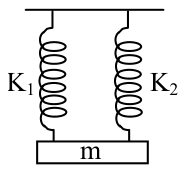
A mass is suspended separately by two different springs in successive order then time period is and respectively. If it is connected by both spring as shown in figure then time period is , the correct relation is:-
- 1
- 2
- 3
- 4
Show answer and solution
Correct: option 2,
For a spring, , so . In the figure the two springs are side by side (in parallel), so the effective constant is . Hence , that is .
Question 2AIPMT 2002 Prelims, Q2
When an oscillator completes 100 oscillation its amplitude reduced to of initial value. What will be its amplitude, when it completes 200 oscillation:-
- 1
- 2
- 3
- 4
Show answer and solution
Correct: option 4,
In damped oscillation the amplitude falls by the same factor in equal times, . If 100 oscillations reduce it to , the next 100 reduce it by another factor of , giving of the initial value.
Question 3AIPMT 2002 Prelims, Q3
A circular disc is to be made by using iron and aluminium so that it acquired maximum moment of inertia about geometrical axis. It is possible with:-
- 1Aluminium at interior and iron surround to it
- 2Iron at interior and aluminium surround to it
- 3Using iron and aluminium layers in alternate order
- 4Sheet of iron is used at both external surface and aluminium sheet as internal layers
Show answer and solution
Correct: option 1, Aluminium at interior and iron surround to it
Moment of inertia is , so it is largest when most of the mass lies far from the axis. Iron is denser than aluminium, so the iron should form the outer ring and the lighter aluminium the inner part.
Question 4AIPMT 2002 Prelims, Q4
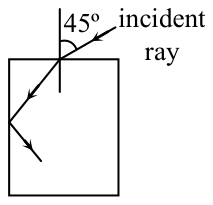
For the given incident ray as shown in figure, the condition of total internal reflection of this ray the minimum refractive index of prism will be:-
- 1
- 2
- 3
- 4
Show answer and solution
Correct: option 3,
At the top face , so . The refracted ray meets the vertical side face at angle of incidence , and total internal reflection needs . Squaring, , which gives , so the minimum is .
Question 5AIPMT 2002 Prelims, Q5
The value of Planck's constant is:-
- 1 J/s
- 2 kg–m/s
- 3 kg–m
- 4 J–s
Show answer and solution
Correct: option 2, kg–m/s
From , Planck's constant has the unit of energy divided by frequency, that is J s. Since , J s is the same as . The other options are J/s or lack the time unit, so they are wrong.
Question 6AIPMT 2002 Prelims, Q6
Displacement between max. P.E. position and max. K.E. position for a particle executing simple harmonic motion is:-
- 1
- 2
- 3
- 4
Show answer and solution
Correct: option 3,
Potential energy is maximum at the extreme positions () and kinetic energy is maximum at the mean position (). The displacement between the two is therefore , where is the amplitude.
Question 7AIPMT 2002 Prelims, Q7
A disc is rotating with angular speed . If a child sits on it, what is conserved:-
- 1Linear momentum
- 2Angular momentum
- 3Kinetic energy
- 4Potential energy
Show answer and solution
Correct: option 2, Angular momentum
When the child sits on the disc no external torque acts on the disc and child system about the axis, so its angular momentum is conserved. The moment of inertia rises and the angular speed falls, so the kinetic energy is not conserved.
Question 8AIPMT 2002 Prelims, Q8
Which is having minimum wavelength:-
- 1X-rays
- 2Ultra violet rays
- 3-rays
- 4Cosmic rays
Show answer and solution
Correct: option 4, Cosmic rays
In the order of decreasing wavelength the listed radiations run ultraviolet, X-rays, -rays and then cosmic rays, which have the highest energy and so the shortest associated wavelength. The key therefore takes cosmic rays. (Cosmic rays are mostly fast particles; among electromagnetic waves proper, -rays have the shortest wavelength.)
Question 9AIPMT 2002 Prelims, Q9
If particles are moving with same velocity, then De-Broglie wavelength is maximum for:-
- 1Proton
- 2-particle
- 3Neutron
- 4-particle
Show answer and solution
Correct: option 4, -particle
, so at the same velocity the wavelength is largest for the smallest mass. A -particle is an electron, far lighter than a proton, a neutron or an -particle, so it has the maximum wavelength.
Question 10AIPMT 2002 Prelims, Q10
When ultraviolet rays incident on metal plate then photoelectric effect does not occur, it occurs by incidence of:-
- 1Infrared rays
- 2X-rays
- 3Radio wave
- 4Light wave
Show answer and solution
Correct: option 2, X-rays
If ultraviolet light cannot eject electrons, its frequency is below the threshold frequency of the metal. Only radiation of higher frequency can work. Of the options only X-rays have a higher frequency than ultraviolet; infrared, radio and visible light are all lower.
Question 11AIPMT 2002 Prelims, Q11
What is the cause of “Green house effect”:-
- 1Infra-red rays
- 2Ultra violet rays
- 3X-rays
- 4Radio waves
Show answer and solution
Correct: option 1, Infra-red rays
The warm earth re-radiates energy as infrared rays. Gases such as carbon dioxide and water vapour absorb this infrared radiation and send part of it back, which keeps the surface warm. So the greenhouse effect is due to infrared rays.
Question 12AIPMT 2002 Prelims, Q12
Which of the following is not the property of cathode rays:-
- 1It produces heating effect
- 2It does not deflect in electric field
- 3It casts shadow
- 4It produces fluorescence
Show answer and solution
Correct: option 2, It does not deflect in electric field
Cathode rays are streams of electrons, which carry negative charge, so they are deflected by electric and magnetic fields. They do heat the target, cast shadows of obstacles and cause fluorescence. The statement that they are not deflected in an electric field is therefore not a property.
Question 13AIPMT 2002 Prelims, Q13
A solid sphere of radius R is placed on smooth horizontal surface. A horizontal force 'F' is applied at height 'h' from the lowest point. For the maximum, acceleration of centre of mass, which is correct:-
- 1
- 2
- 3
- 4No relation between h and R
Show answer and solution
Correct: option 4, No relation between h and R
The surface is smooth, so there is no friction and F is the only horizontal force. The acceleration of the centre of mass is wherever the force is applied; the height h only changes the torque and hence the spin. So there is no relation between h and R.
Question 14AIPMT 2002 Prelims, Q14
Diameter of human eye lens is 2 mm. What will be the minimum distance between two points to resolve them, which are situated at a distance of 50 meter from eye. The wavelength of light is 5000 Å:-
- 12.32 m
- 24.28 mm
- 31.25 cm
- 412.48 cm
Show answer and solution
Correct: option 3, 1.25 cm
The angular limit of resolution is about rad. At 50 m this corresponds to a separation of m cm. (With the factor 1.22 for a circular aperture the value is about 1.5 cm, and 1.25 cm is still the nearest option.)
Question 15AIPMT 2002 Prelims, Q15
A bulb is located on a wall. Its image is to be obtained on a parallel wall with the help of convex lens. If the distance between parallel walls is 'd' then required focal length of lens placed in between the walls is:-
- 1Only
- 2Only
- 3More than but less than
- 4Less than or equal to
Show answer and solution
Correct: option 4, Less than or equal to
For a convex lens the least distance between a real object and its real image is . A real image on the other wall is possible only if , that is .
Question 16AIPMT 2002 Prelims, Q16
The Wien's displacement law express relation between:-
- 1Wavelength corresponding to maximum energy and temperature
- 2Radiation energy and wavelength
- 3Temperature and wavelength
- 4Colour of light and temperature
Show answer and solution
Correct: option 1, Wavelength corresponding to maximum energy and temperature
Wien's displacement law is , a constant, where is the wavelength at which the emitted energy is maximum and T is the absolute temperature of the body. So it relates the wavelength of maximum energy to temperature.
Question 17AIPMT 2002 Prelims, Q17
Which of the following is best close to an ideal black body:-
- 1Black lamp
- 2Cavity maintained at constant temperature
- 3Platinum black
- 4A lump of charcoal heated to high temp.
Show answer and solution
Correct: option 2, Cavity maintained at constant temperature
A small hole in a cavity kept at a constant temperature absorbs practically all radiation that enters, because the radiation is trapped by repeated reflections inside, and it emits radiation characteristic of that temperature. Lamp black and platinum black absorb only about 96 to 98 percent, so the cavity is the closest to an ideal black body.
Question 18AIPMT 2002 Prelims, Q18
For a black body at temperature 727°C, its radiating power is 60 watt and temperature of surrounding is 227°C. If temperature of black body is changed to 1227°C then its radiating power will be:-
- 1304 W
- 2320 W
- 3240 W
- 4120 W
Show answer and solution
Correct: option 2, 320 W
Net power radiated is proportional to . With K, the first case gives and the second gives . So W.
Question 19AIPMT 2002 Prelims, Q19
Consider two rods of same length and different specific heats (, ), conductivities (, ) and area of cross-sections (, ) and both having temperature and at their ends. If rate of loss of heat due to conduction is equal, then:-
- 1
- 2
- 3
- 4
Show answer and solution
Correct: option 1,
The rate of heat conduction is . The length and the end temperatures are the same for both rods, so equal rates need . Specific heat does not enter the steady conduction rate.
Question 20AIPMT 2002 Prelims, Q20
The efficiency of carnot engine is 50% and temperature of sink is 500K. If temperature of source is kept constant and its efficiency raised to 60%, then the required temperature of the sink will be:-
- 1100 K
- 2600 K
- 3400 K
- 4500 K
Show answer and solution
Correct: option 3, 400 K
. From the source is at K. For 60% efficiency, , so K.
Question 21AIPMT 2002 Prelims, Q21
Unit of Stefan's constant is:-
- 1Watt-m-K
- 2Watt-m/K
- 3Watt/m–K
- 4Watt/mK
Show answer and solution
Correct: option 4, Watt/mK
Stefan's law gives the power radiated per unit area as , so has the unit , that is Watt/mK.
Question 22AIPMT 2002 Prelims, Q23
An object of mass 3kg is at rest. Now a force of is applied on the object then velocity of object at t = 3 second is:-
- 1
- 2
- 3
- 4
Show answer and solution
Correct: option 2,
. Integrating from rest, . At s this is .
Question 23AIPMT 2002 Prelims, Q24
A body of mass m is placed on earth surface which is taken from earth surface to a height of h = 3R then change in gravitational potential energy is:-
- 1
- 2
- 3
- 4
Show answer and solution
Correct: option 3,
, using . With this is .
Question 24AIPMT 2002 Prelims, Q25
A point P consider at contact point of a wheel on ground which rolls on ground without slipping then value of displacement of point P when wheel completes half of rotation (If radius of wheel is 1m):-
- 12m
- 2 m
- 3 m
- 4 m
Show answer and solution
Correct: option 2, m
In half a rotation the wheel advances horizontally and point P goes from the bottom to the top of the wheel, a vertical rise of . The displacement is m for m.
Question 25AIPMT 2002 Prelims, Q26
A block of mass 10 kg placed on rough horizontal surface having coefficient of friction = 0.5, if a horizontal force of 100 N acting on it then acceleration of the block will be:-
- 110 m/s
- 25 m/s
- 315 m/s
- 40.5 m/s
Show answer and solution
Correct: option 2, 5 m/s
Friction is N (taking ). The net force is N, so .
Question 26AIPMT 2002 Prelims, Q27
A lift of mass 1000 Kg which is moving with acceleration of 1 m/s in upward direction, then the tension developed in string which is connected to lift is:-
- 19800 N
- 210,800 N
- 311000 N
- 410,000 N
Show answer and solution
Correct: option 2, 10,800 N
For upward acceleration, , so N.
Question 27AIPMT 2002 Prelims, Q28
A particle (A) is dropped from a height and another particle (B) is projected in horizontal direction with speed of 5 m/s from the same height then correct statement is:-
- 1Particle (A) will reach at ground first with respect to particle (B)
- 2Particle (B) will reach at ground first with respect to particle (A)
- 3Both particles will reach at ground simultaneously
- 4Both particles will reach at ground with same speed
Show answer and solution
Correct: option 3, Both particles will reach at ground simultaneously
Both particles start with zero vertical velocity from the same height and have the same downward acceleration g, so both take to fall. They reach the ground together. B lands with a greater speed because it keeps its horizontal velocity, so option (4) is wrong.
Question 28AIPMT 2002 Prelims, Q29
A rod of length is 3m and its mass acting per unit length is directly proportional to distance x from one of its end then its centre of gravity from that end will be at:-
- 11.5 m
- 22 m
- 32.5 m
- 43.0 m
Show answer and solution
Correct: option 2, 2 m
With mass per unit length , . For m this is 2 m.
Question 29AIPMT 2002 Prelims, Q30
If kinetic energy of a body is increased by 300% then percentage change in momentum will be
- 1100%
- 2150%
- 3265%
- 473.2%
Show answer and solution
Correct: option 1, 100%
An increase of 300% makes the kinetic energy 4 times its first value. Since , the momentum becomes times, which is an increase of 100%.
Question 30AIPMT 2002 Prelims, Q31
For a transistor = 0.96, then current gain for common emitter configuration:-
- 112
- 26
- 348
- 424
Show answer and solution
Correct: option 4, 24
. The common emitter current gain is .
Question 31AIPMT 2002 Prelims, Q32
A wave travelling in positive X-direction with A = 0.2 m velocity = 360 m/s and = 60 m, then correct expression for the wave is:-
- 1
- 2
- 3
- 4
Show answer and solution
Correct: option 3,
Frequency Hz. A wave moving along +X is . The plus sign would mean travel along negative X.
Question 32AIPMT 2002 Prelims, Q33
A whistle revolves in a circle with angular speed = 20 rad/sec using a string of length 50 cm. If the frequency of sound from the whistle is 385 Hz, then what is the minimum frequency heard by an observer which is far away from the centre:- ( = 340 m/s)
- 1385 Hz
- 2374 Hz
- 3394 Hz
- 4333 Hz
Show answer and solution
Correct: option 2, 374 Hz
The whistle's speed is m/s. The lowest frequency is heard when the whistle moves directly away from the observer: Hz.
Question 33AIPMT 2002 Prelims, Q34
- 1High potential at N side and low potential at P side
- 2High potential at P side and low potential at N side
- 3P and N both are at same potential
- 4Undetermined
Show answer and solution
Correct: option 1, High potential at N side and low potential at P side
At an unbiased junction, electrons diffuse from N to P and holes from P to N. This leaves fixed positive donor ions on the N side and fixed negative acceptor ions on the P side of the depletion layer. So the N side is at the higher potential and the P side at the lower potential.
Question 34AIPMT 2002 Prelims, Q35
The given truth table is for which logic gate:-
- 1NAND
- 2XOR
- 3NOR
- 4OR
Show answer and solution
Correct: option 1, NAND
The output is 0 only when both inputs are 1 and is 1 in every other case. That is the complement of AND, , which is the NAND gate.
Question 35AIPMT 2002 Prelims, Q36
For the given circuit of P-N junction diode which is correct:-
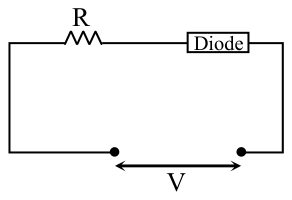
- 1In F.B. the voltage across R is V
- 2In R.B. the voltage across R is V
- 3In F.B. the voltage across R is 2 V
- 4In R.B. the voltage across R is 2 V
Show answer and solution
Correct: option 1, In F.B. the voltage across R is V
In forward bias an ideal diode conducts with negligible resistance and negligible voltage drop, so the whole applied voltage V appears across R. In reverse bias the diode does not conduct, no current flows and the voltage across R is zero.
Question 36AIPMT 2002 Prelims, Q37
Specific resistance of a conductor increases with:
- 1Increase in temperature
- 2Increase in cross section area
- 3Increase in cross section and decrease in length
- 4Decrease in cross section area
Show answer and solution
Correct: option 1, Increase in temperature
Specific resistance (resistivity) is a property of the material and does not depend on the length or the cross section of the piece. For a conductor it rises with temperature, because the electrons collide more often with the vibrating ions.
Question 37AIPMT 2002 Prelims, Q38
For a series LCR circuit the power loss at resonance is:-
- 1
- 2
- 3
- 4
Show answer and solution
Correct: option 3,
Power is dissipated only in the resistance; the inductor and the capacitor consume no average power. At resonance , the impedance equals R and the power loss is .
Question 38AIPMT 2002 Prelims, Q39
Some charge is being given to a conductor. Then its potential:-
- 1Is maximum at surface
- 2Is maximum at centre
- 3Is remain same throughout the conductor
- 4Is maximum somewhere between surface and centre
Show answer and solution
Correct: option 3, Is remain same throughout the conductor
In electrostatic equilibrium the electric field inside a conductor is zero, so no work is done in moving a charge between any two points of it. The whole conductor, surface and interior, is therefore at one potential.
Question 39AIPMT 2002 Prelims, Q40
For a cell terminal P.D. is 2.2V when circuit is open and reduces to 1.8V when cell is connected to a resistance of R = 5. Determine internal resistance of cell (r) is then:-
- 1
- 2
- 3
- 4
Show answer and solution
Correct: option 1,
The open circuit P.D. is the emf, V. The current is A. Then .
Question 40AIPMT 2002 Prelims, Q41
To convert a galvanometer into a voltmeter one should connect a:-
- 1High resistance in series with galvanometer
- 2Low resistance in series with galvanometer
- 3High resistance in parallel with galvanometer
- 4Low resistance in parallel with galvanometer
Show answer and solution
Correct: option 1, High resistance in series with galvanometer
A voltmeter is connected across the circuit element and must draw very little current, so it needs a high resistance. This is obtained by joining a high resistance in series with the galvanometer. A low resistance in parallel (a shunt) makes an ammeter instead.
Question 41AIPMT 2002 Prelims, Q42
A capacitor of capacity charged upto V volt and then connected to an uncharged capacitor . Then final P.D. across each will be
- 1
- 2
- 3
- 4
Show answer and solution
Correct: option 2,
The charge is conserved and is shared until both capacitors have the same potential difference. Common P.D. .
Question 42AIPMT 2002 Prelims, Q43
Identical charges (–q) are placed at each corner of a cube of side 'b' then electrical potential energy of charge (+q) which is placed at centre of cube will be
- 1
- 2
- 3
- 4
Show answer and solution
Correct: option 3,
Each corner is at a distance of half the body diagonal, , from the centre. The energy of +q with the eight charges is .
Question 43AIPMT 2002 Prelims, Q44
Which of the following are suitable for the fusion process:-
- 1Light nuclei
- 2heavy nuclei
- 3Element must be lying in the middle of the periodic table
- 4Middle elements, which are lying on binding energy curve
Show answer and solution
Correct: option 1, Light nuclei
Light nuclei have a low binding energy per nucleon. When they fuse into a heavier nucleus the binding energy per nucleon rises and energy is released. Heavy nuclei release energy by fission, and nuclei in the middle of the curve are already the most stable.
Question 44AIPMT 2002 Prelims, Q45
The magnetic field of given length of wire for single turn coil at its centre is 'B' then its value for two turns coil for the same wire is:-
- 1
- 2
- 34B
- 42B
Show answer and solution
Correct: option 3, 4B
The field at the centre of a coil is . Making two turns from the same wire halves the radius () and doubles N, so the field becomes times, that is 4B.
Question 45AIPMT 2002 Prelims, Q46
A charge 'q' moves in a region where electric field and magnetic field both exist, then force on it is:-
- 1
- 2
- 3
- 4
Show answer and solution
Correct: option 2,
The total (Lorentz) force is the sum of the electric force and the magnetic force . The order of the cross product matters, so gives the wrong direction.
Question 46AIPMT 2002 Prelims, Q47
Two bar magnets having same geometry with magnetic moments M and 2M, are firstly placed in such a way that their similar poles are same side then its time period of oscillation is . Now the polarity of one of the magnet is reversed then time period of oscillation is , then:-
- 1
- 2
- 3
- 4
Show answer and solution
Correct: option 1,
and the moment of inertia is the same in both cases. With like poles together ; with one reversed . A smaller net moment gives a longer period, so (in fact ).
Question 47AIPMT 2002 Prelims, Q48
The velocity of electromagnetic wave is parallel to:-
- 1
- 2
- 3
- 4
Show answer and solution
Correct: option 2,
In an electromagnetic wave , and the direction of travel are mutually perpendicular, and the wave travels along . points the opposite way.
Question 48AIPMT 2002 Prelims, Q49
A sample of radioactive element containing active nuclei. Half life of element is 10 days, then number of decayed nuclei after 30 days:-
- 1
- 2
- 3
- 4
Show answer and solution
Correct: option 3,
30 days is 3 half lives, so the nuclei left are . The number decayed is .
Question 49AIPMT 2002 Prelims, Q50
A deuteron is bombarded on nucleus then -particle is emitted then product nucleus is -
- 1
- 2
- 3
- 4
Show answer and solution
Correct: option 4,
. Conserving charge, ; conserving mass number, . The product is .
Question 50AIPMT 2002 Prelims, Q51
, nucleus absorb a neutron and disintegrate in , and x So, What will be the product x:
- 13 - neutrons
- 22 - neutrons
- 3 - particle
- 4 - particle
Show answer and solution
Correct: option 2, 2 - neutrons
Charge and mass number must balance. Charge: , so x carries no charge and must be neutrons. Mass number: on the left and in the two fragments, which leaves 3 mass units, that is 3 neutrons (option 1). The answer key used for this paper gives option 2 (2 neutrons), so that is the marked answer, but the balance of mass numbers as printed supports 3 neutrons.
Question 51AIPMT 2002 Prelims, Q52
In Hydrogen atom, energy of first excited state is eV. Then find out KE of same orbit of Hydrogen atom:
- 1 eV
- 2 eV
- 3 eV
- 4 eV
Show answer and solution
Correct: option 1, eV
In a Bohr orbit the kinetic energy equals minus the total energy: and . With eV, the kinetic energy is eV.
AIPMT 2002 Prelims Chemistry questions
Question 52AIPMT 2002 Prelims, Q22
Number of atom per unit cell in B.C.C.:-
- 19
- 24
- 32
- 41
Show answer and solution
Correct: option 3, 2
A body-centred cubic cell has 8 corner atoms, each shared by 8 cells, and one atom at the body centre that belongs wholly to the cell. The count is .
Question 53AIPMT 2002 Prelims, Q53
Reaction ; . In equilibrium condition. Pressure of is depends on:
- 1Increase mass of
- 2Increase mass of
- 3Increase temp. on Eq.
- 4Increase mass of and both
Show answer and solution
Correct: option 3, Increase temp. on Eq.
For this heterogeneous equilibrium only the gas appears in the equilibrium constant, so is fixed by the pressure of alone and adding more of either solid changes nothing. changes only with temperature; the reaction is endothermic, so heating raises and with it the oxygen pressure.
Question 54AIPMT 2002 Prelims, Q54
Solubility of – type electrolytes is Mole/lit. then find out of electrolytes:
- 1
- 2
- 3
- 4
Show answer and solution
Correct: option 4,
gives and , so . With , .
Question 55AIPMT 2002 Prelims, Q55
1 M and 2.5 litre solution mixed with another 0.5 M and 3 litre solution. Then find out molarity of resultant solution:
- 10.80 M
- 21.0 M
- 30.73 M
- 40.50 M
Show answer and solution
Correct: option 3, 0.73 M
Moles add and volumes add. Total moles and total volume litre, so the molarity is M.
Question 56AIPMT 2002 Prelims, Q56
- 1
- 2
- 3
- 4
Show answer and solution
Correct: option 2,
(strong acid, strong base) is neutral and is acidic. Both and hydrolyse to give basic solutions, but carbonate is the conjugate base of the much weaker acid , so it hydrolyses more and has the highest pH.
Question 57AIPMT 2002 Prelims, Q57
Solution of 0.1 N and 0.1 N has pH 9.25, Then find out of :
- 19.25
- 24.75
- 33.75
- 48.25
Show answer and solution
Correct: option 2, 4.75
This is a basic buffer: . The concentrations are equal, so the log term is zero and .
Question 58AIPMT 2002 Prelims, Q58
Vander waal's real gas, act as a ideal gas, at which conditions:
- 1High temp., Low pressure
- 2Low temp., High pressure
- 3High temp., High pressure
- 4Low temp., Low pressure
Show answer and solution
Correct: option 1, High temp., Low pressure
At low pressure the molecules are far apart, so their own volume and their mutual attraction are negligible; at high temperature their kinetic energy is large compared with the attraction. Both correction terms of the van der Waals equation then vanish and the gas behaves ideally.
Question 59AIPMT 2002 Prelims, Q59
- 1
- 2
- 3
- 4
Show answer and solution
Correct: option 1,
Entropy change is heat absorbed reversibly divided by temperature, , so its unit is joule per kelvin, and per mole for molar entropy: .
Question 60AIPMT 2002 Prelims, Q60
In a closed insulated container a liquid is stirred with a paddle to increase the temperature which of the following is true:
- 1,
- 2
- 3,
- 4
Show answer and solution
Correct: option 1, ,
The container is insulated, so no heat crosses the boundary and . Stirring does work on the liquid, and by the first law , which is not zero because the temperature rises.
Question 61AIPMT 2002 Prelims, Q61
2 mole of ideal gas at 27ºC temp. is expanded reversibly from 2 lit. to 20 lit. Find entropy change (R = 2 cal/mol K):
- 192.1
- 20
- 34
- 49.2
Show answer and solution
Correct: option 4, 9.2
For a reversible isothermal expansion of an ideal gas . Here .
Question 62AIPMT 2002 Prelims, Q62
Heat of combustion for , and are , and Kcal/mol. then for is:
- 1 Kcal
- 2 Kcal
- 3 Kcal
- 4 Kcal
Show answer and solution
Correct: option 1, Kcal
The reaction enthalpy equals the heats of combustion of the reactants minus those of the products: Kcal.
Question 63AIPMT 2002 Prelims, Q63
, rate of reaction is equals to:
- 1
- 2
- 3
- 4
Show answer and solution
Correct: option 2,
The rate is the same when each change is divided by its coefficient: . Hence .
Question 64AIPMT 2002 Prelims, Q64
It would be a zero order reaction when:
- 1The rate of reaction is proportional to square of conc. of A
- 2The rate of reaction remains same at any conc. of A
- 3The rate remains unchanged at any conc. of B and C
- 4The rate of reaction doubles if conc. of B is increased to double
Show answer and solution
Correct: option 2, The rate of reaction remains same at any conc. of A
For a zero order reaction, rate , so the rate does not depend on the concentration of the reactant A at all. That is exactly option 2; independence from the products B and C says nothing about the order in A.
Question 65AIPMT 2002 Prelims, Q65
Which has maximum molecules:
- 17 gm
- 22 gm
- 316 gm
- 416 gm
Show answer and solution
Correct: option 2, 2 gm
The number of molecules is proportional to the number of moles. : mol; : mol; : mol; : mol. 2 gm of has the most.
Question 66AIPMT 2002 Prelims, Q66
A solution contains non volatile solute of molecular mass . Which of the following can be used to calculate the molecular mass of solute in terms of osmotic pressure:
Note: mass of solute
Volume of solution
Osmotic pressure
- 1
- 2
- 3
- 4
Show answer and solution
Correct: option 2,
Osmotic pressure is with . So , and rearranging gives .
Question 67AIPMT 2002 Prelims, Q67
A solution containing components A and B follows Raoult's law:
- 1A – B attraction force is greater than A – A and B – B
- 2A – B attraction force is less than A – A and B – B
- 3Attraction force remains same in A – A and B – B
- 4Volume of solution is different from sum of volume of solute and solvent
Show answer and solution
Correct: option 3, Attraction force remains same in A – A and B – B
A solution that obeys Raoult's law is ideal: the A–B attraction is the same as the A–A and B–B attractions, so mixing causes no heat change and no volume change. Stronger A–B attraction gives a negative deviation, weaker gives a positive deviation, and a volume change also means the solution is not ideal.
Question 68AIPMT 2002 Prelims, Q68
Which reaction is not feasible:
- 1
- 2
- 3
- 4
Show answer and solution
Correct: option 2,
Oxidising power falls down the group: . A halogen can displace only a halide lying below it, so oxidises iodide, oxidises bromide and oxidises water, but cannot oxidise bromide to .
Question 69AIPMT 2002 Prelims, Q69
In electrolysis of when Pt electrode is taken then is liberated at cathode while with Hg cathode it forms sodium amalgam:
- 1Hg is more inert than Pt
- 2More voltage is required to reduce at Hg than at Pt
- 3Na is dissolved in Hg while it does not dissolve in Pt
- 4Conc. of ions is larger when Pt electrode is taken
Show answer and solution
Correct: option 2, More voltage is required to reduce at Hg than at Pt
Hydrogen has a very high overvoltage on mercury, so a much larger voltage is needed to discharge at Hg than at Pt. At a mercury cathode it therefore becomes easier to discharge , and the sodium formed dissolves in the mercury as amalgam.
Question 70AIPMT 2002 Prelims, Q70
Which of the following statement is true:
- 1Silicon exhibits 4 coordination number in its compound
- 2Bond energy of is less than
- 3Mn(III) oxidation state is more stable than Mn (II) in aqueous state
- 4Elements of 15th gp shows only + 3 and + 5 oxidation states
Show answer and solution
Correct: option 2, Bond energy of is less than
The F–F bond is weaker than the Cl–Cl bond because the lone pairs on the two small fluorine atoms repel each other strongly. The others fail: silicon can also show coordination number 6 as in , () is more stable than in water, and group 15 elements also show other states such as .
Question 71AIPMT 2002 Prelims, Q71
Which of the following order is wrong:
- 1 – Acidic
- 2 – Ist IP
- 3 - Basic
- 4 - Ionic radius
Show answer and solution
Correct: option 2, – Ist IP
Beryllium () has a filled s subshell, while boron loses a higher-energy 2p electron, so the first ionisation potential of B is lower than that of Be. The correct order is , which makes option 2 wrong. The other three orders are correct.
Question 72AIPMT 2002 Prelims, Q72
General electronic configuration of lanthanides is
- 1
- 2
- 3
- 4
Show answer and solution
Correct: option 1,
In the lanthanides the 4f subshell is being filled, so with the configuration is . In general terms this is .
Question 73AIPMT 2002 Prelims, Q73
An atom has electronic configuration , you will place it in which group:
- 1Fifth
- 2Fifteenth
- 3Second
- 4Third
Show answer and solution
Correct: option 1, Fifth
The element is a d-block element (vanadium, ). For d-block elements the group number is the number of electrons plus the electrons: , so it belongs to the fifth group.
Question 74AIPMT 2002 Prelims, Q74
Which of the following is iso-electronic:
- 1,
- 2,
- 3,
- 4,
Show answer and solution
Correct: option 3, ,
Count the electrons. : and : , so they are isoelectronic. The others do not match: has 22, has 23, has 24 and has 32.
Question 75AIPMT 2002 Prelims, Q75
Which of the following has bonding
- 1
- 2
- 3
- 4
Show answer and solution
Correct: option 2,
A – bond needs a central atom with vacant d orbitals. N, B and C belong to the second period and have none, so their bonds are –. Sulphur in sulphite has empty 3d orbitals that overlap with the filled 2p orbitals of oxygen.
Question 76AIPMT 2002 Prelims, Q76
In ion number of bond pair and lone pair of electrons on nitrogen atom are:
- 12, 2
- 23, 1
- 31, 3
- 44, 0
Show answer and solution
Correct: option 4, 4, 0
In nitrate, nitrogen forms one double bond and two single bonds to oxygen (three bonds and one bond), which uses all of its valence electrons. So nitrogen has 4 bond pairs and no lone pair.
Question 77AIPMT 2002 Prelims, Q77
Which of the following shows maximum number of oxidation states:
- 1Cr
- 2Fe
- 3Mn
- 4V
Show answer and solution
Correct: option 3, Mn
Manganese () can use all seven of its 3d and 4s electrons and shows every oxidation state from to , the largest range in the 3d series. Cr goes up to , V up to and Fe commonly up to .
Question 78AIPMT 2002 Prelims, Q78
Atomic number of Cr and Fe are respectively 24 and 26, which of the following is paramagnetic with the spin of electron:
- 1
- 2
- 3
- 4
Show answer and solution
Correct: option 4,
is , so has three unpaired electrons and is paramagnetic. In the carbonyls the strong-field CO pairs all the electrons of Cr(0) and Fe(0), and in the electrons of are all paired, so those three are diamagnetic.
Question 79AIPMT 2002 Prelims, Q79
The hypothetical complex chloro diaquatriammine cobalt (III) chloride can be represented as:
- 1
- 2
- 3
- 4
Show answer and solution
Correct: option 1,
The name gives one chloro, two aqua and three ammine ligands on cobalt(III), with chloride outside as the counter ion. The complex ion has charge , so two chloride ions are needed outside the bracket.
Question 80AIPMT 2002 Prelims, Q80
In the silver plating of copper, is used instead of . The reason is:
- 1A thin layer of Ag is formed on Cu
- 2More voltage is required
- 3 ions are completely removed from solution
- 4Less availability of ions, as Cu can not displace Ag from ion
Show answer and solution
Correct: option 4, Less availability of ions, as Cu can not displace Ag from ion
With the copper would displace silver chemically, giving a fast, rough and loose deposit. The stable complex keeps the concentration of free very low, so copper cannot displace silver from it and the metal is laid down slowly and evenly by the current.
Question 81AIPMT 2002 Prelims, Q81
when reacts with forms , which is insoluble in water. It is soluble in excess of , due to formation of the following complex:
- 1
- 2
- 3
- 4
Show answer and solution
Correct: option 2,
Cyanide reduces copper(II) to copper(I), which is why is formed. The copper stays in the state when it dissolves in excess cyanide: . The anion needs three potassium ions.
Question 82AIPMT 2002 Prelims, Q82
Position of non polar & polar part in micelle
- 1Polar at outer surface but non polar at inner surface
- 2Polar at inner surface non polar at outer surface
- 3Distributed over all the surface
- 4Are present in the surface only
Show answer and solution
Correct: option 1, Polar at outer surface but non polar at inner surface
In a micelle formed in water, the non-polar hydrocarbon tails avoid water and cluster in the interior, while the polar (ionic) heads stay on the outside in contact with water. So the polar part is at the outer surface and the non-polar part is inside.
Question 83AIPMT 2002 Prelims, Q83
In borax bead test which compound is formed
- 1Ortho borate
- 2Meta borate
- 3Double oxide
- 4Tetra borate
Show answer and solution
Correct: option 2, Meta borate
On heating, borax gives a glassy bead of sodium metaborate and boric anhydride. The in the bead reacts with a metal oxide to give a coloured metaborate, for example .
Question 84AIPMT 2002 Prelims, Q84
Zn gives gas with & but not with because:
- 1Zn act as oxidising agent when react with
- 2 is weaker acid then &
- 3In electrochemical series Zn is above hydrogen
- 4 is reduced in preference to hydronium ion
Show answer and solution
Correct: option 4, is reduced in preference to hydronium ion
Nitric acid is an oxidising acid: the nitrate ion is a stronger oxidising agent than , so zinc reduces nitrate (to oxides of nitrogen or ammonium, depending on the concentration) instead of reducing hydronium ions to hydrogen. Zinc is the reducing agent here, and nitric acid is not a weak acid.
Question 85AIPMT 2002 Prelims, Q85
IUPAC name of the following is
- 11, 5-hexenyne
- 21-hexene-5-yne
- 31-hexyne-5-ene
- 41, 5-hexynene
Show answer and solution
Correct: option 2, 1-hexene-5-yne
The six-carbon chain contains a double bond and a triple bond at the two ends. When numbering from either end gives the same set of positions, the double bond gets the lower number, and "ene" is written before "yne". The name is 1-hexene-5-yne (hex-1-en-5-yne).
Question 86AIPMT 2002 Prelims, Q86
- 1
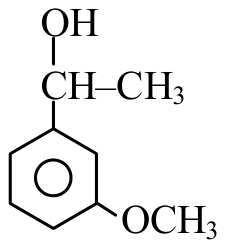
- 2
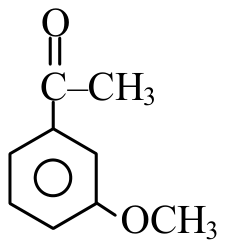
- 3
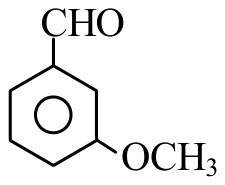
- 4
Show answer and solution
Correct: option 2
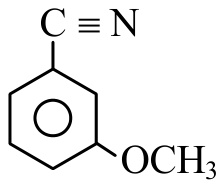
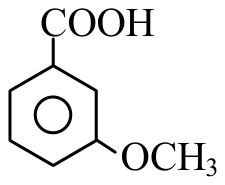
A Grignard reagent adds once to the carbon of a nitrile group to give an imine salt, . Acid hydrolysis turns this into a ketone, so the group becomes and the product is the methyl ketone (3-methoxyacetophenone), option 2. The methoxy group is not affected.
Question 87AIPMT 2002 Prelims, Q87
n-propyl alcohol and isopropyl alcohol can be chemically distinguished by which reagent:
- 1
- 2Reduction
- 3Oxidation with Potassium dichromate
- 4Ozonolysis
Show answer and solution
Correct: option 3, Oxidation with Potassium dichromate
Oxidation with dichromate gives different products: n-propyl alcohol, a primary alcohol, gives propanal and then propanoic acid, while isopropyl alcohol, a secondary alcohol, gives the ketone acetone. These products are easily told apart. reacts with both in the same way, and neither alcohol is reduced or undergoes ozonolysis.
Question 88AIPMT 2002 Prelims, Q88
In the following reaction product 'P' is:
- 1
- 2
- 3
- 4
Show answer and solution
Correct: option 3,
This is the Rosenmund reduction. Hydrogen over palladium that is partly poisoned by barium sulphate reduces an acid chloride only as far as the aldehyde: . The poisoned catalyst stops further reduction to the alcohol.
Question 89AIPMT 2002 Prelims, Q89
- 1Resonating structures
- 2Tautomers
- 3Geometrical isomers
- 4Optical isomers
Show answer and solution
Correct: option 1, Resonating structures
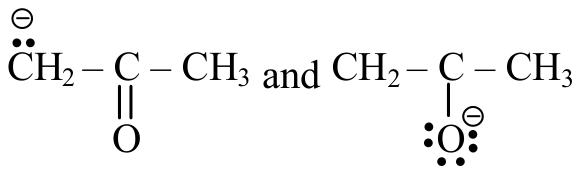
The two structures are the carbanion form and the oxygen-anion (enolate) form of the same ion. They have the same arrangement of atoms and differ only in where the electrons and the negative charge are placed, so they are resonating structures. Tautomers would differ in the position of a hydrogen atom.
Question 90AIPMT 2002 Prelims, Q90
Reactivity order of halides for dehydrohalogenation is:
- 1
- 2
- 3
- 4
Show answer and solution
Correct: option 2,
In dehydrohalogenation the carbon–halogen bond is broken, so the weaker the bond and the better the leaving group, the faster the reaction. The C–X bond strength falls from C–F to C–I, so the reactivity order is R–I > R–Br > R–Cl > R–F.
Question 91AIPMT 2002 Prelims, Q91
Monomer of is:
- 12-methyl propene
- 2Styrene
- 3Propylene
- 4Ethene
Show answer and solution
Correct: option 1, 2-methyl propene
The repeating unit comes from an addition polymer. Putting back the double bond between its two chain carbons gives , which is 2-methylpropene (isobutylene); the polymer is polyisobutylene.
Question 92AIPMT 2002 Prelims, Q92
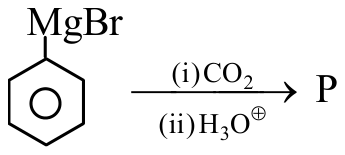
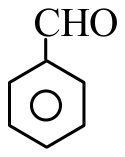
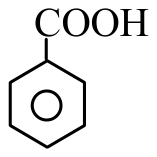
In the above reaction product 'P' is:
- 1
- 2
- 3
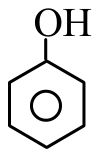
- 4
Show answer and solution
Correct: option 2
Phenylmagnesium bromide adds to carbon dioxide to give the salt , and acid hydrolysis of this salt gives benzoic acid, . Carbonation of a Grignard reagent is a standard way of making a carboxylic acid with one more carbon atom.
Question 93AIPMT 2002 Prelims, Q93
- 1Glucose
- 2Fructose
- 3Ribose
- 4Sucrose
Show answer and solution
Correct: option 1, Glucose
Cellulose is a straight-chain polysaccharide made only of -D-glucose units joined by -1,4-glycosidic linkages.
Question 94AIPMT 2002 Prelims, Q94
Z in the above reaction sequence is:
- 1
- 2
- 3
- 4
Show answer and solution
Correct: option 1,
Cyanide replaces chloride to give X, . Hydrogen over nickel reduces the nitrile to the primary amine Y, . Acetic anhydride acetylates the amine, so Z is the amide .
Question 95AIPMT 2002 Prelims, Q95
When phenol is treated with and , the product formed is:
- 1Benzaldehyde
- 2Salicylaldehyde
- 3Salicylic acid
- 4Benzoic acid
Show answer and solution
Correct: option 2, Salicylaldehyde
This is the Reimer–Tiemann reaction. Chloroform and alkali give dichlorocarbene, which attacks the phenoxide ion at the ortho position; hydrolysis then puts a group there, giving salicylaldehyde (o-hydroxybenzaldehyde). Salicylic acid would need or instead.
Question 96AIPMT 2002 Prelims, Q96
The percentage of C, H and N in an organic compound are 40%, 13.3% and 46.7% respectively then empirical formula is:
- 1
- 2
- 3
- 4
Show answer and solution
Correct: option 3,
Divide each percentage by the atomic mass: C , H , N . Dividing by the smallest value gives C : H : N , so the empirical formula is .
Question 97AIPMT 2002 Prelims, Q97
- 1Edible proteins
- 2Proteins with specific structure
- 3Nitrogen containing carbohydrates
- 4Carbohydrates
Show answer and solution
Correct: option 2, Proteins with specific structure
Enzymes are globular proteins. Each one has a definite three-dimensional structure with an active site of a particular shape, which is what makes an enzyme specific for its substrate.
Question 98AIPMT 2002 Prelims, Q98
Geometrical isomers are differ in:
- 1Position of functional group
- 2Position of atoms
- 3Spatial arrangement of atoms
- 4Length of carbon chain
Show answer and solution
Correct: option 3, Spatial arrangement of atoms
Geometrical (cis–trans) isomers have the same atoms joined in the same order; they differ only in how the groups are arranged in space about a double bond or a ring. A different position of the functional group or a different chain length would make them structural isomers.
Question 99AIPMT 2002 Prelims, Q99
When is treated with , the product formed is:
- 1
- 2
- 3
- 4
Show answer and solution
Correct: option 2,
Sodamide is a very strong base. It removes two molecules of from the geminal dihalide, one after the other, to give an alkyne: (propyne).
Question 100AIPMT 2002 Prelims, Q100
Which is not true statement:
- 1-carbon of -amino acid is asymmetric
- 2All proteins are found in L-form
- 3Human body can synthesize all proteins they need
- 4At pH = 7 both amino and carboxylic groups exist in ionised form
Show answer and solution
Correct: option 2, All proteins are found in L-form
The amino acids of natural proteins have the L configuration, but \"L-form\" describes an amino acid, not a whole protein, and D-amino acids do occur in some natural peptides, so option 2 is the statement taken as not true. Near pH 7 an amino acid exists as a zwitterion with and , and the body builds all its own proteins from amino acids. Option 1 is true for every protein amino acid except glycine.
AIPMT 2002 Prelims Biology questions
Question 101AIPMT 2002 Prelims, Q101
Which is a reducing sugar:-
- 1Galactose
- 2Gluconic acid
- 3-methyl galactoside
- 4Sucrose
Show answer and solution
Correct: option 1, Galactose
A reducing sugar has a free aldehyde or ketone group (a free anomeric carbon) that can reduce Benedict's or Fehling's reagent. Galactose is a monosaccharide with a free anomeric carbon, so it is reducing. In gluconic acid the aldehyde group is already oxidised to an acid, in -methyl galactoside the anomeric carbon is locked in a glycosidic bond, and in sucrose both anomeric carbons are used in the bond between glucose and fructose.
Question 102AIPMT 2002 Prelims, Q102
Significance of mimicry is -
- 1Attack (Offence)
- 2Protection (Defence)
- 3Both (1) & (2)
- 4Isolation
Show answer and solution
Correct: option 3, Both (1) & (2)
Mimicry is the resemblance of one organism to another organism or to its surroundings. It can protect the mimic from predators (protective mimicry, as in a harmless butterfly resembling a distasteful one) and it can also help a predator approach its prey unnoticed (aggressive mimicry, as in a praying mantis resembling a leaf or flower). So it serves both defence and offence.
Question 103AIPMT 2002 Prelims, Q103
Which of the following is correct match -
- 1Down Syndrome = 21st Chromosome
- 2Sickle cell anaemia = X – Chromosome
- 3Haemophilia = Y – Chromosome
- 4Parkinson Disease = X & Y Chromosome
Show answer and solution
Correct: option 1, Down Syndrome = 21st Chromosome
Down syndrome is trisomy of chromosome 21, so the first pair is correct. Sickle cell anaemia is an autosomal recessive disorder (the beta-globin gene is on chromosome 11), haemophilia is X-linked recessive and not Y-linked, and Parkinson disease is not a sex-chromosome disorder.
Question 104AIPMT 2002 Prelims, Q104
Some bacteria able to grow in Streptomycin containing medium due to -
- 1Natural selection
- 2Induced mutation
- 3Reproductive isolation
- 4Genetic drift
Show answer and solution
Correct: option 1, Natural selection
A few bacteria in a population already carry a chance mutation that makes them resistant to streptomycin. When the antibiotic is present the sensitive cells die and the resistant ones survive and multiply, which is natural selection of pre-existing variants (as shown by Lederberg's replica plating experiment). The antibiotic does not induce the mutation.
Question 105AIPMT 2002 Prelims, Q105
In a population, unrestricted reproductive capacity is called as -
- 1Biotic potential
- 2Fertility
- 3Carrying capacity
- 4Birth rate
Show answer and solution
Correct: option 1, Biotic potential
Biotic potential is the maximum, inherent capacity of a population to reproduce when resources are unlimited and nothing checks its growth. Carrying capacity is the largest population the environment can support, and birth rate and fertility describe the actual reproduction achieved.
Question 106AIPMT 2002 Prelims, Q106
Change in sequence of nucleotide in DNA is called as -
- 1Mutagen
- 2Mutation
- 3Recombination
- 4Translation
Show answer and solution
Correct: option 2, Mutation
A mutation is a heritable change in the nucleotide sequence of DNA. A mutagen is the agent that causes such a change, recombination is the reshuffling of existing genes, and translation is the synthesis of a polypeptide on mRNA.
Question 107AIPMT 2002 Prelims, Q107
Reason of fast speciation in present day crop plants is -
- 1Mutation
- 2Isolation
- 3Polyploidy
- 4Sexual Reproduction
Show answer and solution
Correct: option 3, Polyploidy
Polyploidy, the multiplication of whole chromosome sets, produces a new reproductively isolated form in a single step, so it gives very rapid speciation. Many crop plants such as wheat, cotton and potato are polyploids. Mutation and isolation act much more slowly.
Question 108AIPMT 2002 Prelims, Q108
Which of the following is important for speciation:-
- 1Seasonal isolation
- 2Reproductive isolation
- 3Behavioural isolation
- 4Tropical isolation
Show answer and solution
Correct: option 2, Reproductive isolation
A new species arises only when a population can no longer exchange genes with its parent population, that is, when it becomes reproductively isolated. Seasonal and behavioural isolation are only particular kinds of reproductive isolation, so the general term is the best answer.
Question 109AIPMT 2002 Prelims, Q109
Which of the following are homologous organs:-
- 1Wings of birds & Locust
- 2Wings of birds (Sparrow) & Pectoral fins of fish
- 3Wings of bat & Butterfly
- 4Legs of frog & Cockroach
Show answer and solution
Correct: option 2, Wings of birds (Sparrow) & Pectoral fins of fish
Homologous organs share the same origin and basic plan even if their work differs. The wing of a bird and the pectoral fin of a fish are both vertebrate paired forelimbs (pectoral appendages), so they are homologous. A vertebrate limb or wing compared with an insect wing or leg has a different origin and structure; those pairs are analogous at most.
Question 110AIPMT 2002 Prelims, Q110
Genetic drift operates in:-
- 1Small isolated population
- 2Large isolated population
- 3Fast reproductive population
- 4Slow reproductive population
Show answer and solution
Correct: option 1, Small isolated population
Genetic drift is the random change of allele frequencies from one generation to the next purely by chance. Chance sampling errors are significant only when the population is small and isolated; in a large population they average out.
Question 111AIPMT 2002 Prelims, Q111
There is no life on moon due to the absence of -
- 1
- 2Water
- 3Light
- 4Temperature
Show answer and solution
Correct: option 2, Water
Life as we know it needs liquid water as the medium for all its chemical reactions. The moon has no liquid water (and no atmosphere to hold it), so life cannot exist there. Oxygen is not essential for all life, since anaerobes live without it, and the moon does receive light.
Question 112AIPMT 2002 Prelims, Q112
According to fossils which discovered up to present time, origin and evolution of man was started from which country -
- 1France
- 2Java
- 3Africa
- 4China
Show answer and solution
Correct: option 3, Africa
The oldest hominid fossils, such as Australopithecus and Homo habilis, have been found in East and South Africa, so the origin of man is traced to Africa. The Java and Peking (China) fossils are of the later Homo erectus, and the Cro-Magnon fossils of France are later still.
Question 113AIPMT 2002 Prelims, Q113
Impulse of heart beat originates from:-
- 1S.A. Node
- 2A. V. Node
- 3Vagus Nerve
- 4Cardiac Nerve
Show answer and solution
Correct: option 1, S.A. Node
The human heart is myogenic. The sino-atrial (S.A.) node in the wall of the right atrium generates the impulse by itself at the highest rate and so acts as the pacemaker; the A.V. node only relays it to the ventricles. Nerves merely change the rate of the beat.
Question 114AIPMT 2002 Prelims, Q114
Which cartilage is present on the end of long bones -
- 1Calcified cartilage
- 2Hyaline cartilage
- 3Elastic cartilage
- 4Fibrous cartilage
Show answer and solution
Correct: option 2, Hyaline cartilage
The ends of long bones are capped by articular cartilage, which is hyaline cartilage. It gives a smooth, glassy surface that reduces friction at the joint. Elastic cartilage is found in the pinna and epiglottis and fibrous cartilage in the intervertebral discs.
Question 115AIPMT 2002 Prelims, Q115
- 1U.V. rays
- 2Visible rays
- 3Infrared rays
- 4X-rays
Show answer and solution
Correct: option 1, U.V. rays
Melanin is the dark pigment made by melanocytes of the skin. It absorbs ultraviolet radiation from sunlight and so protects the deeper cells and their DNA from U.V. damage.
Question 116AIPMT 2002 Prelims, Q116
Continuous bleeding from an injured part of body is due to deficiency of:-
- 1Vitamin - A
- 2Vitamin - B
- 3Vitamin - K
- 4Vitamin - E
Show answer and solution
Correct: option 3, Vitamin - K
Vitamin K is needed by the liver to make prothrombin and several other clotting factors. Without it blood does not clot properly, so bleeding from a wound continues. That is why it is called the anti-haemorrhagic vitamin.
Question 117AIPMT 2002 Prelims, Q117
What will happen if ligaments are cut or broken:-
- 1Bones will move freely at joints
- 2No movement at joint
- 3Bone will become unfix
- 4Bone will become fixed
Show answer and solution
Correct: option 3, Bone will become unfix
Ligaments are bands of dense connective tissue that tie one bone to another at a joint and hold the bones in place. If they are cut, the bones are no longer held together and get dislocated, that is, the bone becomes unfixed.
Question 118AIPMT 2002 Prelims, Q118
Which of the following statement is true for Lymph:-
- 1WBC and serum
- 2All components of blood except RBCs and some proteins
- 3RBCs, WBCs and Plasma
- 4RBCs, Proteins and Platelets
Show answer and solution
Correct: option 2, All components of blood except RBCs and some proteins
Lymph is tissue fluid that has entered the lymph vessels. It is formed by filtration of blood through capillary walls, so it has plasma and white blood cells (mainly lymphocytes) but lacks red blood cells and the larger plasma proteins, which cannot pass through.
Question 119AIPMT 2002 Prelims, Q119
Choose the correct sequence of stages of growth curve for Bacteria:-
- 1Lag, Log, stationary, Decline phase
- 2Lag, Log, Stationary phase
- 3Stationary, Lag, Log, Decline phase
- 4Decline, Lag, Log phase
Show answer and solution
Correct: option 1, Lag, Log, stationary, Decline phase
A bacterial culture first adjusts to the medium with little division (lag phase), then divides at a constant fast rate (log or exponential phase), then stops increasing as nutrients run out and wastes collect (stationary phase), and finally the number of living cells falls (decline or death phase).
Question 120AIPMT 2002 Prelims, Q120
The semilog of per minute growing bacteria is plotted against time. What will the shape of graph:-
- 1Sigmoid
- 2Hyperbolic
- 3Ascending straight line
- 4Descending straight line
Show answer and solution
Correct: option 3, Ascending straight line
Bacteria growing steadily double at regular intervals, so . Taking logarithms gives , which is the equation of a straight line with a positive slope. So a semilog plot of number against time is an ascending straight line.
Question 121AIPMT 2002 Prelims, Q121
Mainly which hormones control menstrual cycle in human beings:-
- 1FSH
- 2LH
- 3FSH, LH, Estrogen
- 4Progesterone
Show answer and solution
Correct: option 3, FSH, LH, Estrogen
The menstrual cycle is run by the interplay of pituitary and ovarian hormones: FSH makes the follicles grow, the follicles secrete estrogen which rebuilds the endometrium, and the LH surge causes ovulation. No single hormone controls the cycle, so the option listing FSH, LH and estrogen together is the best one.
Question 122AIPMT 2002 Prelims, Q122
When both ovary of rat are removed then which hormone is decreased in blood:-
- 1Oxytocin
- 2Prolactin
- 3Estrogen
- 4Gonadotrophic releasing factor
Show answer and solution
Correct: option 3, Estrogen
Estrogen is secreted by the follicles of the ovary, so removing both ovaries makes its level in blood fall. Oxytocin, prolactin and the gonadotrophin releasing factor come from the hypothalamus and pituitary; with the negative feedback of estrogen gone, the releasing factor would in fact rise.
Question 123AIPMT 2002 Prelims, Q123
Which of the following statement is correct for node of Ranvier of nerve:-
- 1Neurilemma is discontinuous
- 2Myelin sheath is discontinuous
- 3Both neurilemma & Myelin sheath are discontinuous
- 4Covered by myelin sheath
Show answer and solution
Correct: option 2, Myelin sheath is discontinuous
Nodes of Ranvier are the gaps between two neighbouring Schwann cells along a myelinated nerve fibre. At these points the myelin sheath is absent, that is, discontinuous, while the neurilemma continues over the node. This lets the impulse jump from node to node.
Question 124AIPMT 2002 Prelims, Q124
Which of the following is used in the treatment of Thyroid cancer:-
- 1
- 2
- 3
- 4
Show answer and solution
Correct: option 1,
The thyroid gland takes up and concentrates iodine to make thyroxine. Radioactive iodine-131 given to the patient therefore collects in thyroid tissue, and its radiation destroys the cancerous thyroid cells with little harm to other organs.
Question 125AIPMT 2002 Prelims, Q125
Hydrolytic enzymes which act on low pH are called as:-
- 1Protease
- 2-Amylase
- 3Hydrolases
- 4Peroxidase
Show answer and solution
Correct: option 3, Hydrolases
Lysosomes contain many digestive enzymes (lipases, proteases, nucleases, carbohydrases) that work best at acidic pH; together they are called acid hydrolases. Protease and amylase name single kinds of enzyme, and peroxidase is an oxidising enzyme of peroxisomes, so the general term hydrolases is the answer.
Question 126AIPMT 2002 Prelims, Q126
Stool of a person contain whitish grey colour due to malfunction of which type of organ:-
- 1Pancreas
- 2Spleen
- 3Kidney
- 4Liver
Show answer and solution
Correct: option 4, Liver
The brown colour of stool comes from stercobilin, which is formed from the bile pigments made by the liver. If the liver does not work properly or bile cannot reach the intestine, the pigments are missing and the stool becomes pale, whitish grey (clay coloured).
Question 127AIPMT 2002 Prelims, Q127
Adrenalin direct affect on:-
- 1S.A. Node
- 2-cells of Langerhans
- 3Dorsal root of spinal cord
- 4Epithelial cells of stomach
Show answer and solution
Correct: option 1, S.A. Node
Adrenalin, the emergency hormone of the adrenal medulla, acts directly on the S.A. node (the pacemaker) and increases the rate of the heart beat as well as the force of contraction.
Question 128AIPMT 2002 Prelims, Q128
Acromegaly is caused by:-
- 1Excess of S.T.H.
- 2Excess of Thyroxin
- 3Deficiency of Thyroxin
- 4Excess of Adrenalin
Show answer and solution
Correct: option 1, Excess of S.T.H.
Acromegaly results from over-secretion of growth hormone (somatotrophic hormone, S.T.H.) of the anterior pituitary in an adult. As the long bones can no longer lengthen, the bones of the jaw, hands and feet thicken and enlarge. Excess of the same hormone in childhood gives gigantism.
Question 129AIPMT 2002 Prelims, Q129
In fluid mosaic model of plasma membrane
- 1Upper layer is non-polar and hydrophilic
- 2Polar layer is hydrophobic
- 3Phospholipids form a bimolecular layer in middle part
- 4Proteins form a middle layer
Show answer and solution
Correct: option 3, Phospholipids form a bimolecular layer in middle part
In the fluid mosaic model of Singer and Nicolson the membrane is a bilayer of phospholipids with their polar, hydrophilic heads facing outwards and their non-polar, hydrophobic tails facing inwards; proteins are embedded in or attached to this bilayer like a mosaic. So the phospholipids form the bimolecular layer. Non-polar parts are hydrophobic and polar parts hydrophilic, which rules out the first two options.
Question 130AIPMT 2002 Prelims, Q130
Organisms which obtain energy by the oxidation of reduced inorganic compounds are called:-
- 1Photo autotrophs
- 2Chemo autotrophs
- 3Saprozoic
- 4Coproheterotrophs
Show answer and solution
Correct: option 2, Chemo autotrophs
Chemoautotrophs, such as nitrifying, sulphur and iron bacteria, oxidise reduced inorganic substances like ammonia, nitrite, hydrogen sulphide or ferrous iron and use the energy released to make their food from . Photoautotrophs use light energy instead, and the other two feed on ready-made organic matter.
Question 131AIPMT 2002 Prelims, Q131
In which condition, the gene ratio remains constant for any species:-
- 1Sexual selection
- 2Random mating
- 3Mutation
- 4Gene flow
Show answer and solution
Correct: option 2, Random mating
By the Hardy-Weinberg principle, allele (gene) frequencies stay constant from generation to generation in a large population with random mating and with no mutation, selection, gene flow or drift. Sexual selection, mutation and gene flow all change the frequencies, so random mating is the condition asked for.
Question 132AIPMT 2002 Prelims, Q132
Which of the following occurs more than one and less than five in a chromosome:-
- 1Chromatid
- 2Chromomere
- 3Centromere
- 4Telomere
Show answer and solution
Correct: option 4, Telomere
Telomeres are the two ends of a chromosome, so an unreplicated chromosome has two and a replicated one, with two chromatids, has four chromatid ends: always more than one and fewer than five. A chromosome may have only one chromatid, normally has one centromere, and has a great many chromomeres.
Question 133AIPMT 2002 Prelims, Q133
Ribosomes are produced in:
- 1Nucleolus
- 2Cytoplasm
- 3Mitochondria
- 4Golgi body
Show answer and solution
Correct: option 1, Nucleolus
The nucleolus is the site where ribosomal RNA is made and joined with ribosomal proteins to form the ribosomal subunits, which then pass out to the cytoplasm. So the nucleolus is called the ribosome factory of the cell.
Question 134AIPMT 2002 Prelims, Q134
Mitotic spindle is mainly composed of which protein:-
- 1Actin
- 2Tubulin
- 3Actomyosin
- 4Myoglobin
Show answer and solution
Correct: option 2, Tubulin
Spindle fibres are microtubules, and microtubules are built from the protein tubulin. Actin and actomyosin belong to microfilaments and muscle, and myoglobin is the oxygen-storing pigment of muscle.
Question 135AIPMT 2002 Prelims, Q135
Cancerous cells can easily be destroyed by radiations due to:-
- 1Rapid cell division
- 2Lack of nutrition
- 3Fast mutation
- 4Lack of oxygen
Show answer and solution
Correct: option 1, Rapid cell division
Radiation damages DNA, and the damage is most lethal to cells that are dividing, because they replicate their DNA often and have little time to repair it. Cancer cells divide rapidly and without control, so they are destroyed more easily than the surrounding normal cells.
Question 136AIPMT 2002 Prelims, Q136
Which fungal disease spreads by seed and flowers:-
- 1Loose smut of Wheat
- 2Corn stunt
- 3Covered smut of Barley
- 4Soft rot of Potato
Show answer and solution
Correct: option 1, Loose smut of Wheat
Loose smut of wheat is caused by the fungus Ustilago tritici (U. nuda var. tritici). Its spores infect the flowers at flowering time and the fungus stays dormant inside the embryo of the seed, so the disease is internally seed-borne. Corn stunt and soft rot of potato are not fungal diseases, and covered smut of barley is carried on the seed surface without flower infection.
Question 137AIPMT 2002 Prelims, Q137
Sequence of which of the following is used to know the phylogeny:-
- 1m-RNA
- 2r-RNA
- 3t-RNA
- 4DNA
Show answer and solution
Correct: option 2, r-RNA
Ribosomal RNA is present in all organisms, does the same job everywhere and changes very slowly, so comparing rRNA base sequences (for example 16S rRNA) shows how closely organisms are related. Woese used this to work out phylogeny and to separate archaebacteria from other bacteria.
Question 138AIPMT 2002 Prelims, Q138
Which of the following secretes toxins during storage conditions of crop plants:-
- 1Aspergillus
- 2Penicillium
- 3Fusarium
- 4Colletotrichum
Show answer and solution
Correct: option 1, Aspergillus
Aspergillus flavus grows on stored grains and oilseeds such as groundnut and maize when they are damp, and secretes aflatoxins, which are poisonous and cancer-causing. It is the best known storage fungus that produces toxins.
Question 139AIPMT 2002 Prelims, Q139
Which of the following plants produces seeds but not flowers:-
- 1Maize
- 2Mint
- 3Peepal
- 4Pinus
Show answer and solution
Correct: option 4, Pinus
Pinus is a gymnosperm: it bears naked seeds on cones and has no flowers or fruits. Maize, mint and peepal are angiosperms, which all produce flowers.
Question 140AIPMT 2002 Prelims, Q140
Best material for the study of mitosis in laboratory:-
- 1Anther
- 2Root tip
- 3Leaf tip
- 4Ovary
Show answer and solution
Correct: option 2, Root tip
The root tip has an apical meristem whose cells divide by mitosis all the time, so a squash of an onion root tip shows every stage. Anthers and ovaries are used to study meiosis, and a leaf tip has no active meristem.
Question 141AIPMT 2002 Prelims, Q141
In five kingdom system, the main basis of classification:-
- 1Structure of nucleus
- 2Nutrition
- 3Structure of cell wall
- 4Asexual reproduction
Show answer and solution
Correct: option 2, Nutrition
Whittaker's five kingdom system uses cell structure, body organisation, mode of nutrition, reproduction and phylogenetic relationships. The three kingdoms of multicellular eukaryotes are separated chiefly by mode of nutrition: plants are photosynthetic, fungi absorptive and animals ingestive. So nutrition is taken as the main basis.
Question 142AIPMT 2002 Prelims, Q142
Which of the following is without exception in Angiosperms:-
- 1Presence of vessels
- 2Double fertilisation
- 3Secondary growth
- 4Autotrophic nutrition
Show answer and solution
Correct: option 2, Double fertilisation
Double fertilisation, in which one male gamete fuses with the egg and the other with the polar nuclei, occurs in all angiosperms. The other features have exceptions: a few angiosperms lack vessels, most monocots have no secondary growth, and parasites such as Cuscuta are not autotrophic.
Question 143AIPMT 2002 Prelims, Q143
Which bacteria is utilized in Gober gas plant:-
- 1Methanogens
- 2Nitrifying bacteria
- 3Ammonifying bacteria
- 4Denitrifying bacteria
Show answer and solution
Correct: option 1, Methanogens
In a gobar gas (biogas) plant cattle dung is digested without air. Methanogens such as Methanobacterium, which also live in the rumen of cattle and so are present in dung, break down the organic matter and release methane, the main part of biogas.
Question 144AIPMT 2002 Prelims, Q144
During the formation of bread it becomes porous due to release of by the action of:-
- 1Yeast
- 2Bacteria
- 3Virus
- 4Protozoans
Show answer and solution
Correct: option 1, Yeast
Baker's yeast (Saccharomyces cerevisiae) ferments the sugars in the dough and gives off . The gas bubbles make the dough rise and leave the bread soft and porous.
Question 145AIPMT 2002 Prelims, Q145
In protozoa like Amoeba and Paramecium, a organ is found for osmoregulation which is:-
- 1Contractile vacuole
- 2Mitochondria
- 3Nucleus
- 4Food vacuole
Show answer and solution
Correct: option 1, Contractile vacuole
Freshwater protozoans keep taking in water by osmosis. The contractile vacuole collects this extra water and pumps it out of the cell, so it is the organelle of osmoregulation. The food vacuole is for digestion.
Question 146AIPMT 2002 Prelims, Q146
Which of the following is absent in polluted water:-
- 1Hydrilla
- 2Water hyacinth
- 3Larva of stone fly
- 4Blue green algae
Show answer and solution
Correct: option 3, Larva of stone fly
Stonefly larvae need clean water rich in dissolved oxygen, so they disappear when water is polluted and are used as indicators of clean water. Water hyacinth and blue green algae flourish in polluted, nutrient-rich water, and Hydrilla also tolerates it.
Question 147AIPMT 2002 Prelims, Q147
What is true for individuals of same species
- 1Live in same niche
- 2Live in same habitat
- 3Interbreeding
- 4Live in different habitat
Show answer and solution
Correct: option 3, Interbreeding
By the biological species concept, a species is a group of individuals that can interbreed freely in nature and produce fertile offspring. Members of one species may live in the same or in different habitats, so interbreeding is the feature that is always true.
Question 148AIPMT 2002 Prelims, Q148
In which era reptiles were dominated:-
- 1Coenozoic era
- 2Mesozoic era
- 3Paleozoic era
- 4Archaeozoic era
Show answer and solution
Correct: option 2, Mesozoic era
The Mesozoic era (Triassic, Jurassic and Cretaceous periods) was the time when dinosaurs and other reptiles ruled land, sea and air, so it is called the age of reptiles. The Coenozoic era is the age of mammals.
Question 149AIPMT 2002 Prelims, Q149
Number of wild life is continuously decreasing. What is the main reason of this:-
- 1Predation
- 2Cutting down of forest
- 3Destruction of habitat
- 4Hunting
Show answer and solution
Correct: option 3, Destruction of habitat
Loss and fragmentation of habitat is the most important cause of the decline of wild animals and plants: when forests, wetlands and grasslands are cleared, the organisms lose their food, shelter and breeding places. Cutting down forests is only one form of habitat destruction, so the wider option is the answer; hunting and predation matter much less.
Question 150AIPMT 2002 Prelims, Q150
In Angiosperms pollen tube liberate their male gametes into the:-
- 1Central cell
- 2Antipodal cells
- 3Egg cell
- 4Synergids
Show answer and solution
Correct: option 4, Synergids
The pollen tube enters the embryo sac through the filiform apparatus of one of the synergids and bursts inside that synergid, releasing the two male gametes there. One gamete then moves to the egg and the other to the central cell for double fertilisation.
Question 151AIPMT 2002 Prelims, Q151
Maximum green house gas released by which country:-
- 1India
- 2France
- 3U.S.A.
- 4Britain
Show answer and solution
Correct: option 3, U.S.A.
Among the four countries listed, the U.S.A. was by far the largest emitter of greenhouse gases such as carbon dioxide, because of its very high fossil-fuel use. India, France and Britain each released much less.
Question 152AIPMT 2002 Prelims, Q152
What is the direction of micropyle in anatropous ovule:-
- 1Upward
- 2Downward
- 3Right
- 4Left
Show answer and solution
Correct: option 2, Downward
An anatropous ovule is turned through 180 degrees, so the body is inverted and the micropyle comes to lie close to the funicle and hilum, pointing downward towards the placenta.
Question 153AIPMT 2002 Prelims, Q153
Which type of association is found in between entomophilous flower and pollinating agent:-
- 1Mutualism
- 2Commensalism
- 3Cooperation
- 4Co-evolution
Show answer and solution
Correct: option 1, Mutualism
An insect-pollinated flower gets its pollen carried, and the insect gets nectar or pollen as food. Both partners benefit, which is mutualism. In commensalism only one partner would benefit.
Question 154AIPMT 2002 Prelims, Q154
In which of the following notochord is present in embryonic stage:-
- 1All chordates
- 2Some chordates
- 3Vertebrates
- 4Non chordates
Show answer and solution
Correct: option 1, All chordates
A notochord at some stage of life is a defining character of the phylum Chordata, so every chordate has it at least in the embryo. In vertebrates it is later replaced by the vertebral column; non-chordates never have it.
Question 155AIPMT 2002 Prelims, Q155
In Angiosperm all the four microspores of tetrad are covered by a layer which is formed by:-
- 1Pectocellulose
- 2Callose
- 3Cellulose
- 4Sporopollenin
Show answer and solution
Correct: option 2, Callose
The four microspores of a tetrad are held together inside a common wall of callose (a glucan). The enzyme callase from the tapetum later dissolves it to free the microspores. Sporopollenin forms the exine of each individual pollen grain, not the common layer.
Question 156AIPMT 2002 Prelims, Q156
In which of the animal dimorphic nucleus is found:-
- 1Amoeba proteus
- 2Trypanosoma gambiense
- 3Plasmodium vivax
- 4Paramecium caudatum
Show answer and solution
Correct: option 4, Paramecium caudatum
Ciliates such as Paramecium caudatum have two kinds of nuclei: a large macronucleus that controls metabolism and a small micronucleus used in reproduction. Amoeba, Trypanosoma and Plasmodium have only one kind of nucleus.
Question 157AIPMT 2002 Prelims, Q157
Two different species can not live for long duration in the same niche or habitat. This law is:-
- 1Allen's law
- 2Gause's law
- 3Competitive exclusion principle
- 4Weismann's theory
Show answer and solution
Correct: option 2, Gause's law
The statement that two species competing for the same resources cannot coexist indefinitely was given by Gause, so it is called Gause's law (it is also known as the competitive exclusion principle). The key gives Gause's law. Allen's law is about shorter extremities in cold climates and Weismann's theory is about the germplasm.
Question 158AIPMT 2002 Prelims, Q158
Which of the following is a correct pair:-
- 1Cuscuta – parasite
- 2Dischidia – insectivorous
- 3Opuntia – predator
- 4Capsella – hydrophyte
Show answer and solution
Correct: option 1, Cuscuta – parasite
Cuscuta (dodder) is a total stem parasite that has no chlorophyll and takes food from its host through haustoria. Dischidia is an epiphyte with pitcher-like leaves, Opuntia is a xerophyte and Capsella is a mesophytic land plant, so the other pairs are wrong.
Question 159AIPMT 2002 Prelims, Q159
Bamboo plant is growing in a far forest then what will be the trophic level of it:-
- 1First trophic level ()
- 2Second trophic level ()
- 3Third trophic level ()
- 4Fourth trophic level ()
Show answer and solution
Correct: option 1, First trophic level ()
Bamboo is a green plant that makes its own food by photosynthesis, so it is a producer. Producers always occupy the first trophic level, wherever they grow.
Question 160AIPMT 2002 Prelims, Q160
Which pigment absorbs the red and far-red light
- 1Cytochrome
- 2Phytochrome
- 3Carotenoids
- 4Chlorophyll
Show answer and solution
Correct: option 2, Phytochrome
Phytochrome exists in two interconvertible forms: Pr absorbs red light (about 660 nm) and Pfr absorbs far-red light (about 730 nm). It controls photoperiodic responses such as flowering and seed germination.
Question 161AIPMT 2002 Prelims, Q161
Opening and closing of stomata is due to the:-
- 1Hormonal change in guard cells
- 2Change in Turgor pressure of guard cells
- 3Gaseous exchange
- 4Respiration
Show answer and solution
Correct: option 2, Change in Turgor pressure of guard cells
When guard cells take in water they become turgid, their thin outer walls bulge and the pore opens; when they lose water and become flaccid the pore closes. So stomatal movement is caused directly by the change in turgor pressure of the guard cells.
Question 162AIPMT 2002 Prelims, Q162
How many ATP molecules produced by Aerobic oxidation of one molecule of glucose:-
- 12
- 24
- 338
- 434
Show answer and solution
Correct: option 3, 38
Complete aerobic oxidation of one glucose gives 2 ATP in glycolysis, 2 ATP (GTP) in the Krebs cycle and 34 ATP from oxidative phosphorylation of 10 NADH and 2 , a total of 38 ATP in the classical count.
Question 163AIPMT 2002 Prelims, Q163
Choose the correct match
Bladderwort, sundew, venus flytrap:-
- 1Nepenthes, Dionaea, Drosera
- 2Nepenthes, Utricularia, Vanda
- 3Utricularia, Drosera, Dionaea
- 4Dionaea, Trapa, Vanda
Show answer and solution
Correct: option 3, Utricularia, Drosera, Dionaea
These are insectivorous plants: bladderwort is Utricularia, sundew is Drosera and Venus flytrap is Dionaea. Nepenthes is the pitcher plant, Vanda is an epiphytic orchid and Trapa is the water chestnut.
Question 164AIPMT 2002 Prelims, Q164
In Photosynthesis energy from light reaction to dark reaction is transferred in the form of:-
- 1ADP
- 2ATP
- 3RUDP
- 4Chlorophyll
Show answer and solution
Correct: option 2, ATP
The light reaction makes ATP (and NADPH), and these are used in the dark reaction to reduce carbon dioxide to sugar. Of the options, ATP is the energy carrier; ADP is the spent form and RuDP is the carbon dioxide acceptor.
Question 165AIPMT 2002 Prelims, Q165
Which of the following absorb light energy for photosynthesis:-
- 1Chlorophyll
- 2Water molecule
- 3
- 4RUBP
Show answer and solution
Correct: option 1, Chlorophyll
Chlorophyll is the pigment that traps light energy, mainly in the blue and red regions, and passes it to the reaction centre. Water is the electron donor, oxygen is a by-product and RuBP is the carbon dioxide acceptor.
Question 166AIPMT 2002 Prelims, Q166
Seed dormancy is due to the:-
- 1Ethylene
- 2Abscisic acid
- 3IAA
- 4Starch
Show answer and solution
Correct: option 2, Abscisic acid
Abscisic acid is a growth inhibitor that induces and maintains dormancy of seeds and buds. Gibberellins counter its effect and break dormancy.
Question 167AIPMT 2002 Prelims, Q167
Edible part in mango is:-
- 1Mesocarp
- 2Epicarp
- 3Endocarp
- 4Epidermis
Show answer and solution
Correct: option 1, Mesocarp
Mango is a drupe. Its pericarp has a thin skin-like epicarp, a fleshy juicy mesocarp, which is the part eaten, and a hard stony endocarp around the seed.
Question 168AIPMT 2002 Prelims, Q168
What is true for cleavage:-
- 1Size of embryo increase
- 2Size of cells decrease
- 3Size of cells increase
- 4Size of embryo decrease
Show answer and solution
Correct: option 2, Size of cells decrease
Cleavage is a series of rapid mitotic divisions of the zygote without growth between divisions. The total size of the embryo stays the same, so the cells (blastomeres) become smaller with each division.
Question 169AIPMT 2002 Prelims, Q169
- 1Potato
- 2Peanut
- 3Onion
- 4Garlic
Show answer and solution
Correct: option 2, Peanut
A geocarpic fruit develops under the soil. In peanut (groundnut) the stalk of the fertilised ovary elongates and pushes it into the soil where the pod ripens. Potato is a stem tuber, and onion and garlic are bulbs, not fruits.
Question 170AIPMT 2002 Prelims, Q170
In which animal nerve cell is present but brain is absent:-
- 1Sponge
- 2Earthworm
- 3Cockroach
- 4Hydra
Show answer and solution
Correct: option 4, Hydra
Hydra, a cnidarian, has nerve cells joined in a diffuse nerve net with no brain or ganglia. Sponges have no nerve cells at all, while earthworm and cockroach have a brain (cerebral ganglia).
Question 171AIPMT 2002 Prelims, Q171
In bacteria, plasmid is:-
- 1Extra chromosomal material
- 2Main DNA
- 3Non functional DNA
- 4Repetitive gene
Show answer and solution
Correct: option 1, Extra chromosomal material
A plasmid is a small circular double-stranded DNA molecule that lies outside the main bacterial chromosome and replicates on its own. It is functional and often carries genes such as those for antibiotic resistance.
Question 172AIPMT 2002 Prelims, Q172
Transformation experiment was first performed on which bacteria:-
- 1E. coli
- 2Diplococcus pneumoniae
- 3Salmonella
- 4Pasteurella pestis
Show answer and solution
Correct: option 2, Diplococcus pneumoniae
Griffith (1928) discovered transformation using Diplococcus (Streptococcus) pneumoniae: heat-killed smooth (S) cells turned live rough (R) cells into virulent S cells in mice.
Question 173AIPMT 2002 Prelims, Q173
Which statement is correct for bacterial transduction:-
- 1Transfer of some genes from one bacteria to another bacteria through virus
- 2Transfer of some genes from one bacteria to another bacteria by conjugation
- 3Bacteria obtained its DNA directly
- 4Bacteria obtained DNA from other external source
Show answer and solution
Correct: option 1, Transfer of some genes from one bacteria to another bacteria through virus
Transduction is the transfer of bacterial genes from one bacterium to another by a bacteriophage (virus). Transfer by cell contact is conjugation, and direct uptake of free DNA from the surroundings is transformation.
Question 174AIPMT 2002 Prelims, Q174
Which steroid is used for transformation:-
- 1Cortisol
- 2Cholesterol
- 3Testosterone
- 4Progesterone
Show answer and solution
Correct: option 2, Cholesterol
The key gives cholesterol. Cholesterol is the parent steroid of the body: it is the starting material that is transformed into the other steroids, such as cortisol, testosterone, progesterone, bile acids and vitamin D.
Question 175AIPMT 2002 Prelims, Q175
Main function of lenticel is:-
- 1Transpiration
- 2Guttation
- 3Gaseous exchange
- 4Bleeding
Show answer and solution
Correct: option 3, Gaseous exchange
Lenticels are pores in the bark made of loosely packed complementary cells. They let oxygen and carbon dioxide pass between the inner tissues of the woody stem and the air. A little water vapour is also lost through them, but that is not their main function.
Question 176AIPMT 2002 Prelims, Q176
Which of the following is the example of sex linked disease:-
- 1AIDS
- 2Colour blindness
- 3Syphilis
- 4Gonorrhoea
Show answer and solution
Correct: option 2, Colour blindness
Colour blindness is caused by a recessive gene on the X chromosome, so it is a sex-linked disorder. AIDS, syphilis and gonorrhoea are sexually transmitted infections, not inherited sex-linked diseases.
Question 177AIPMT 2002 Prelims, Q177
- 1All angiosperms and some gymnosperm
- 2Most of the angiosperm and few gymnosperms
- 3All angiosperms, all gymnosperms and some pteridophyta
- 4All pteridophyta
Show answer and solution
Correct: option 2, Most of the angiosperm and few gymnosperms
Vessels are typical of angiosperms, but a few primitive angiosperms (for example Drimys and Trochodendron) lack them, so it is most, not all. Gymnosperms generally lack vessels, except a few such as Gnetum and Ephedra.
Question 178AIPMT 2002 Prelims, Q178
In E. coli, during lactose metabolism repressor binds to:-
- 1Regulator gene
- 2Operator gene
- 3Structural gene
- 4Promoter gene
Show answer and solution
Correct: option 2, Operator gene
In the lac operon the repressor protein, made by the regulator (i) gene, binds to the operator and blocks RNA polymerase from transcribing the structural genes. Lactose (the inducer) removes the repressor from the operator.
Question 179AIPMT 2002 Prelims, Q179
Four radial V.B. are found in:-
- 1Dicot root
- 2Monocot root
- 3Dicot stem
- 4Monocot stem
Show answer and solution
Correct: option 1, Dicot root
Radial vascular bundles, with xylem and phloem on different radii, are found in roots. A dicot root usually has two to four xylem and phloem groups (often tetrarch), while a monocot root has many (polyarch). Stems have conjoint bundles.
Question 180AIPMT 2002 Prelims, Q180
Which of the following is the example of pleiotropic gene:-
- 1Haemophilia
- 2Thalassemia
- 3Sickle cell anaemia
- 4Colour blindness
Show answer and solution
Correct: option 3, Sickle cell anaemia
A pleiotropic gene affects several characters. The sickle cell gene changes haemoglobin and, as a result, causes sickling of red cells, anaemia, blocked capillaries, organ damage and also resistance to malaria, so it is the standard example of pleiotropy.
Question 181AIPMT 2002 Prelims, Q181
A gene said to be dominant if:-
- 1It express it's effect only in homozygous stage
- 2It expressed only in heterozygous condition
- 3It expressed both in homozygous and heterozygous condition
- 4It never expressed in any condition
Show answer and solution
Correct: option 3, It expressed both in homozygous and heterozygous condition
A dominant allele shows its effect whether it is present in two copies (AA) or one copy (Aa). A recessive allele is expressed only in the homozygous condition.
Question 182AIPMT 2002 Prelims, Q182
Axillary bud and terminal bud derived from the activity of:-
- 1Lateral meristem
- 2Intercalary meristem
- 3Apical meristem
- 4Parenchyma
Show answer and solution
Correct: option 3, Apical meristem
The terminal bud contains the shoot apical meristem. As the shoot grows, some cells of this apical meristem are left behind in the leaf axils and form the axillary buds. So both buds come from the apical meristem.
Question 183AIPMT 2002 Prelims, Q183
If a diploid cell is treated with colchicine then it becomes:-
- 1Triploid
- 2Tetraploid
- 3Diploid
- 4Monoploid
Show answer and solution
Correct: option 2, Tetraploid
Colchicine stops spindle formation, so the duplicated chromosomes do not separate into two cells. The chromosome number of the cell doubles from 2n to 4n, making it tetraploid.
Question 184AIPMT 2002 Prelims, Q184
What is the reason of formation of embryoid from pollen grain in tissue culture medium
- 1Cellular totipotency
- 2Organogenesis
- 3Double fertilization
- 4Test tube culture
Show answer and solution
Correct: option 1, Cellular totipotency
A pollen grain can form an embryoid and then a whole plant in culture because a plant cell carries the full genetic information and can express it to regenerate a complete plant. This ability is cellular totipotency.
Question 185AIPMT 2002 Prelims, Q185
A plant of -generation with genotype "AABbCC". On selfing of this plant what is the phenotypic ratio in -generation:-
- 13 : 1
- 21 : 1
- 39 : 3 : 3 : 1
- 427 : 9 : 9 : 9 : 3 : 3 : 3 : 1
Show answer and solution
Correct: option 1, 3 : 1
The plant is homozygous for A and C and heterozygous only for B, so it behaves as a monohybrid. Selfing Bb gives BB : Bb : bb = 1 : 2 : 1, which is a phenotypic ratio of 3 : 1.
Question 186AIPMT 2002 Prelims, Q186
In a DNA percentage of thymine is 20% then what is the percentage of guanine:-
- 120%
- 240%
- 330%
- 460%
Show answer and solution
Correct: option 3, 30%
By Chargaff's rule A = T and G = C. If T is 20% then A is 20%, so A + T = 40% and G + C = 60%. Guanine is half of that, 30%.
Question 187AIPMT 2002 Prelims, Q187
A diseased man marries a normal woman. They get three daughter and five sons. All the daughter were diseased and sons were normal. The gene of this disease is:-
- 1Sex linked dominant
- 2Sex linked recessive
- 3Sex limited character
- 4Autosomal dominant
Show answer and solution
Correct: option 1, Sex linked dominant
A father gives his X chromosome to all his daughters and his Y to all his sons. Every daughter is affected and no son is, so the gene is on the father's X chromosome, and since one copy is enough to affect the daughters (the mother is normal) it is dominant: X-linked dominant.
Question 188AIPMT 2002 Prelims, Q188
Out of 64 codons, 61 codons code for 20 types of amino acid it is called:-
- 1Degeneracy of genetic code
- 2Overlapping of gene
- 3Wobbling of codon
- 4Universality of codons
Show answer and solution
Correct: option 1, Degeneracy of genetic code
With 61 sense codons for only 20 amino acids, most amino acids are coded by more than one codon. This property is called degeneracy of the genetic code.
Question 189AIPMT 2002 Prelims, Q189
Jacob and Monod studied lactose metabolism in E. coli and proposed operon concept. Operon concept applicable for:-
- 1All prokaryotes
- 2All prokaryotes and some eukaryotes
- 3All prokaryotes and all eukaryotes
- 4All prokaryotes and some protozoans
Show answer and solution
Correct: option 1, All prokaryotes
An operon is a group of structural genes transcribed together under one promoter and operator. This kind of gene regulation is characteristic of prokaryotes, and the key gives all prokaryotes; eukaryotic genes are generally regulated individually.
Question 190AIPMT 2002 Prelims, Q190
- 1Fibrous protein
- 2Globular protein
- 3Lipid
- 4Carbohydrate
Show answer and solution
Correct: option 1, Fibrous protein
Collagen is a structural protein of connective tissue made of three polypeptide chains wound into a long triple helix, forming strong insoluble fibres. It is therefore a fibrous protein.
Question 191AIPMT 2002 Prelims, Q191
Lipids are insoluble in water because lipids molecules are:-
- 1Hydrophilic
- 2Hydrophobic
- 3Neutral
- 4Zwitter ions
Show answer and solution
Correct: option 2, Hydrophobic
Lipids are made largely of long non-polar hydrocarbon chains that cannot form hydrogen bonds with water. Being hydrophobic (water-repelling), they do not dissolve in water but dissolve in organic solvents.
Question 192AIPMT 2002 Prelims, Q192
Exon part of m-RNAs have code for:-
- 1Protein
- 2Lipid
- 3Carbohydrate
- 4Phospholipid
Show answer and solution
Correct: option 1, Protein
Exons are the coding sequences that remain in the mature mRNA after the introns are removed. Their codons are translated into the amino acid sequence of a protein.
Question 193AIPMT 2002 Prelims, Q193
Which of the following statement is true:-
- 1Vessels are multicellular and with wide lumen
- 2Tracheids are multicellular and with narrow lumen
- 3Vessels are unicellular and with narrow lumen
- 4Tracheids are unicellular and with wide lumen
Show answer and solution
Correct: option 1, Vessels are multicellular and with wide lumen
A vessel is a long tube formed by many cells (vessel members) joined end to end with perforated end walls, and it has a wide lumen. A tracheid is a single elongated cell with tapering ends and a narrower lumen.
Question 194AIPMT 2002 Prelims, Q194
Which of the following enzymes are used to join bits of DNA:-
- 1Ligase
- 2Primase
- 3DNA polymerase
- 4Endonuclease
Show answer and solution
Correct: option 1, Ligase
DNA ligase seals the gap between two DNA fragments by forming a phosphodiester bond, so it joins bits of DNA, such as Okazaki fragments or a cut gene and a vector. Endonuclease cuts DNA, primase makes RNA primers and DNA polymerase adds nucleotides.
Question 195AIPMT 2002 Prelims, Q195
Which of the following crops have been brought to India from New world:-
- 1Cashewnut, potato, rubber
- 2Mango, tea
- 3Tea, rubber, mango
- 4Coffee
Show answer and solution
Correct: option 1, Cashewnut, potato, rubber
Cashew nut, potato and rubber are all native to the Americas (the New World) and were introduced into India. Mango is native to India, tea to China and north-east India, and coffee to Africa, so the other options are wrong.
Question 196AIPMT 2002 Prelims, Q196
Manipulation of DNA in genetic engineering became possible due to the discovery of:-
- 1Restriction endonuclease
- 2DNA ligase
- 3Transcriptase
- 4Primase
Show answer and solution
Correct: option 1, Restriction endonuclease
Restriction endonucleases cut DNA at specific recognition sequences, which made it possible to cut out a chosen gene and open a vector at a matching site. Their discovery is what made recombinant DNA work possible.
Question 197AIPMT 2002 Prelims, Q197
There are three genes a, b and c. The percentage of crossing over between a and b is 20%, b and c is 28% and a and c is 8%. What is the sequence of genes on chromosome
- 1b, a, c
- 2a, b, c
- 3a, c, b
- 4None
Show answer and solution
Correct: option 1, b, a, c
Crossing over percentage measures map distance. The largest distance, 28 units, is between b and c, so they are the outer genes and a lies between them: b to a is 20 and a to c is 8, and 20 + 8 = 28. The order is b, a, c.
Question 198AIPMT 2002 Prelims, Q198
Which of the following reunites the exon segments after RNA splicing:-
- 1RNA polymerase
- 2RNA primase
- 3RNA ligase
- 4RNA proteases
Show answer and solution
Correct: option 3, RNA ligase
In splicing the introns are cut out and the exons are then joined end to end. A joining enzyme is a ligase, so RNA ligase reunites the exons. RNA polymerase makes RNA, and primase makes primers for DNA replication.
Question 199AIPMT 2002 Prelims, Q199
Introduction of food plants developed by genetic engineering is not desirable because -
- 1Economy of developing countries may suffer
- 2These products are less tasty as compared to the already existing products
- 3This method is costly
- 4There is danger of coming viruses, allergens and toxins with introduced crop
Show answer and solution
Correct: option 4, There is danger of coming viruses, allergens and toxins with introduced crop
The main objection to genetically modified food crops is about safety: the inserted genes and their products may bring new allergens or toxins, and viral sequences used in the constructs could be transferred. Cost and taste are not the main concerns.
Question 200AIPMT 2002 Prelims, Q200
Nucleus of a donor embryonal cell/somatic cell is transferred to an enucleated egg cell. Then after the formation of organism, what shall be true:-
- 1Organism will have extranuclear genes of the donor cell
- 2Organism will have extra nuclear genes of recipient cell
- 3Organism will have extra nuclear genes of both donor and recipient cell
- 4Organism will have nuclear genes of recipient cell
Show answer and solution
Correct: option 2, Organism will have extra nuclear genes of recipient cell
Only the nucleus comes from the donor, so the nuclear genes are the donor's. The cytoplasm, with its mitochondria and their DNA, belongs to the enucleated egg, so the extranuclear genes of the organism are those of the recipient cell.