AIPMT 2001 Prelims Physics questions
Question 1AIPMT 2001 Prelims, Q1
The dimension of Planck constant equals to that of:
- 1Energy
- 2Momentum
- 3Angular momentum
- 4Power
Show answer and solution
Correct: option 3, Angular momentum
From , has the dimensions of energy time, . Angular momentum has the same dimensions , so option (3) is right.
Question 2AIPMT 2001 Prelims, Q2
Following truth table represent which logic gate –
- 1XOR
- 2NOT
- 3NAND
- 4AND
Show answer and solution
Correct: option 3, NAND
The output is 0 only when both inputs are 1 and is 1 in every other case. That is the AND output inverted, , which is a NAND gate.
Question 3AIPMT 2001 Prelims, Q3
Which rays contain (+ Ve) charged particle:
- 1-rays
- 2-rays
- 3-rays
- 4X-rays
Show answer and solution
Correct: option 1, -rays
An -particle is a helium nucleus with charge . -rays are electrons (negative), while -rays and X-rays are electromagnetic radiation with no charge.
Question 4AIPMT 2001 Prelims, Q4
An electron having mass 'm' and kinetic energy E enter in uniform magnetic field B perpendicularly, then its frequency will be:
- 1
- 2
- 3
- 4
Show answer and solution
Correct: option 3,
The magnetic force supplies the centripetal force: , so . The frequency of revolution is , which does not depend on the kinetic energy.
Question 5AIPMT 2001 Prelims, Q5
A particle is thrown vertically upward. Its velocity at half of the height is 10 m/s. Then the maximum height attained by it:
(g = 10 m/s)
- 18 m
- 220 m
- 310 m
- 416 m
Show answer and solution
Correct: option 3, 10 m
From half the maximum height the particle rises a further and stops, so . Hence m.
Question 6AIPMT 2001 Prelims, Q6
A particle is projected making angle 45º with horizontal having kinetic energy K. The kinetic energy at highest point will be:
- 1
- 2
- 32K
- 4K
Show answer and solution
Correct: option 2,
At the highest point only the horizontal velocity remains. Kinetic energy there is .
Question 7AIPMT 2001 Prelims, Q7
A black body has wavelength corresponding to maximum energy at 2000 K. Its wavelength corresponding to maximum energy at 3000 K will be:
- 1
- 2
- 3
- 4
Show answer and solution
Correct: option 2,
Wien's displacement law gives constant. So , which gives .
Question 8AIPMT 2001 Prelims, Q8
Two particles having mass 'M' and 'm' are moving in a circular path having radius R & r respectively. If their time period are same then the ratio of angular velocity will be:
- 1
- 2
- 31
- 4
Show answer and solution
Correct: option 3, 1
Angular velocity is , which depends only on the time period. Since both particles have the same , their angular velocities are equal and the ratio is 1, whatever the masses and radii.
Question 9AIPMT 2001 Prelims, Q9
A child is sitting on a swing. Its minimum and maximum heights from the ground is 0.75 m and 2 m respectively, its maximum speed will be
- 110 m/s
- 25 m/s
- 38 m/s
- 415 m/s
Show answer and solution
Correct: option 2, 5 m/s
The speed is greatest at the lowest point. By conservation of energy, , so m/s.
Question 10AIPMT 2001 Prelims, Q10
The current (I) in the circuit will be:
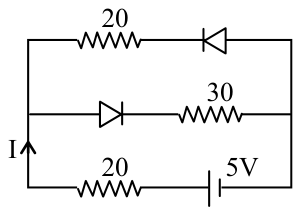
- 1 A
- 2 A
- 3 A
- 4 A
Show answer and solution
Correct: option 2, A
For the direction of the current I, the diode in the 30 branch is forward biased and the diode in the upper 20 branch is reverse biased, so the upper branch carries no current. Treating the diodes as ideal, the current flows through 30 and the lower 20 in series: A.
Question 11AIPMT 2001 Prelims, Q12
Two springs A and B having spring constant and . () are stretched by applying force of equal magnitude. If energy stored in spring A is E then energy stored in B will be:
- 12E
- 2
- 3
- 44E
Show answer and solution
Correct: option 1, 2E
With the same force , the extension is and the energy stored is , which is inversely proportional to . Since , spring B stores twice the energy, .
Question 12AIPMT 2001 Prelims, Q13
A charge Q C is placed at the centre of cube, the flux coming out from any surfaces will be:
- 1
- 2
- 3
- 4
Show answer and solution
Correct: option 1,
By Gauss's law the total flux through the cube is with C. The charge is at the centre, so the flux is shared equally by the six faces: each face gets .
Question 13AIPMT 2001 Prelims, Q14
X(n, ) , then X will be:
- 1
- 2
- 3
- 4
Show answer and solution
Correct: option 1,
The reaction is . Balancing mass number: , so . Balancing charge: . So X is .
Question 14AIPMT 2001 Prelims, Q15
Half life of radioactive element is 12.5 Hour and its quantity is 256 gm. After how much time its quantity will remain 1 gm:
- 150 Hrs
- 2100 Hrs
- 3150 Hrs
- 4200 Hrs
Show answer and solution
Correct: option 2, 100 Hrs
The quantity falls by a factor of , which takes 8 half-lives. Time needed hours.
Question 15AIPMT 2001 Prelims, Q16
A scientist says that the efficiency of his heat engine which work at source temperature 127ºC and sink temperature 27ºC to 26%, then
- 1It is impossible
- 2It is possible but less probable
- 3It is quite probable
- 4Data are incomplete
Show answer and solution
Correct: option 1, It is impossible
The greatest possible efficiency between these temperatures is the Carnot value . No engine can exceed it, so a claim of 26% is impossible.
Question 16AIPMT 2001 Prelims, Q17
A cricketer catches a ball of mass 150 gm. in 0.1 second moving with speed 20 ms. Then he experiences force of:
- 1300 N
- 230 N
- 33 N
- 40.3 N
Show answer and solution
Correct: option 2, 30 N
Force equals the rate of change of momentum: N.
Question 17AIPMT 2001 Prelims, Q18
If the tension and diameter of a sonometer wire of fundamental frequency n is doubled and density is halved then its fundamental frequency will become
- 1
- 2
- 3n
- 4
Show answer and solution
Correct: option 3, n
For a wire of diameter and density , the mass per unit length is , so . Doubling and halving multiplies the square root by , and doubling divides by 2. The frequency stays .
Question 18AIPMT 2001 Prelims, Q19
The total energy of particle performing SHM depend on:
- 1K, a, m
- 2K, a
- 3K, a, x
- 4K, x
Show answer and solution
Correct: option 2, K, a
The total energy in SHM is , where is the force constant and the amplitude. It is the same at every displacement and, written this way, does not involve the mass, so it depends on K and a only.
Question 19AIPMT 2001 Prelims, Q20
With what velocity should a particle be projected so that its height becomes equal to radius of earth -
- 1
- 2
- 3
- 4
Show answer and solution
Correct: option 1,
At height the particle is from the centre and momentarily at rest. Energy conservation: , so and .
Question 20AIPMT 2001 Prelims, Q21
A disc is placed on a surface of pond which has refractive index . A source of light is placed 4 m below the surface of liquid. The minimum radius of disc will be so light is not coming out
- 1
- 23m
- 36m
- 44m
Show answer and solution
Correct: option 2, 3m
Light escapes only inside a cone of half-angle equal to the critical angle , where , so . The disc must cover the circle of radius m; rays beyond it are totally internally reflected.
Question 21AIPMT 2001 Prelims, Q22
A ray of light travelling in air has wavelength , frequency n, velocity v and intensity I. If this ray enters into water then these parameter are , n', v' and I' respectively. Which relation is correct
- 1
- 2n = n'
- 3v = v'
- 4I = I'
Show answer and solution
Correct: option 2, n = n'
Frequency is fixed by the source and does not change when light passes from one medium to another, so n = n'. The speed and wavelength both fall in water, and the intensity falls because part of the light is reflected at the surface.
Question 22AIPMT 2001 Prelims, Q23
A cylindrical rod having temperature and at its end. The rate of flow of heat cal/sec. If all the linear dimension are doubled keeping temperature remain const. then rate of flow of heat will be:
- 1
- 2
- 3
- 4
Show answer and solution
Correct: option 2,
The rate of heat flow is . Doubling every linear dimension makes the area and the length , so the rate becomes times: .
Question 23AIPMT 2001 Prelims, Q24
If then angle between A and B will be:
- 190º
- 2120º
- 30º
- 460º
Show answer and solution
Correct: option 2, 120º
Let each magnitude be . Then , which gives and .
Question 24AIPMT 2001 Prelims, Q25
Optical fibre are based on:
- 1Total internal reflection
- 2Less scattering
- 3Refraction
- 4Less absorption coefficient
Show answer and solution
Correct: option 1, Total internal reflection
Light entering the denser core of a fibre strikes the core-cladding boundary at more than the critical angle and is totally internally reflected again and again, so it is guided along the fibre with very little loss.
Question 25AIPMT 2001 Prelims, Q26
Which one among shows particle nature of light.
- 1P.E.E.
- 2Interference
- 3Refraction
- 4Polarization
Show answer and solution
Correct: option 1, P.E.E.
The photoelectric effect (P.E.E.) can only be explained by light arriving as photons of energy , each ejecting one electron. Interference, refraction and polarization are explained by the wave picture of light.
Question 26AIPMT 2001 Prelims, Q27
Two waves having equation
If in the resultant wave the frequency and amplitude remains equals to amplitude of superimposing waves. Then phase diff. between them:
- 1
- 2
- 3
- 4
Show answer and solution
Correct: option 2,
The resultant amplitude of two waves of amplitude with phase difference is . Setting this equal to gives , so and .
Question 27AIPMT 2001 Prelims, Q28
In Thomson mass spectrograph then the velocity of undeflected electron beam will be:
- 1
- 2
- 3
- 4
Show answer and solution
Correct: option 1,
The beam passes undeflected when the electric force balances the magnetic force: . This gives , the ratio of the magnitudes of the two fields.
Question 28AIPMT 2001 Prelims, Q29
Energy per unit volume for a capacitor having area A and separation d kept at potential difference V is given by:
- 1
- 2
- 3
- 4
Show answer and solution
Correct: option 1,
The energy density of an electric field is , and between the plates . So the energy per unit volume is . Options (3) and (4) are the total energy, not the energy per unit volume.
Question 29AIPMT 2001 Prelims, Q30
On the horizontal surface of a truck a block of mass 1 kg is placed ( = 0.6) and truck is moving with acceleration 5 m/s then the frictional force on block will be:
- 15N
- 26N
- 35.88N
- 48N
Show answer and solution
Correct: option 1, 5N
To move with the truck the block needs a force N. The limiting friction is N, which is more than 5 N, so the block does not slip and static friction supplies exactly 5 N.
Question 30AIPMT 2001 Prelims, Q31
Tangent galvanometer is used to measure:
- 1Potential difference
- 2Current
- 3Resistance
- 4In measuring charge
Show answer and solution
Correct: option 2, Current
In a tangent galvanometer the field of the current-carrying coil is set at right angles to the Earth's horizontal field, and the needle deflects by where . It therefore measures current.
Question 31AIPMT 2001 Prelims, Q32
A capacitor of capacity C and reactance X if capacitance and frequency become double then reactance will be:
- 14X
- 2
- 3
- 42X
Show answer and solution
Correct: option 3,
Capacitive reactance is . Doubling both and makes the denominator four times larger, so the reactance becomes .
Question 32AIPMT 2001 Prelims, Q33
A disc is rolling the velocity of its centre of mass is then which one will be correct:
- 1The velocity of highest point is and point of contact is zero
- 2The velocity of highest point is and point of contact is
- 3The velocity of highest point is and point of contact is
- 4The velocity of highest point is and point of contact is
Show answer and solution
Correct: option 1, The velocity of highest point is and point of contact is zero
In rolling without slipping, . At the top the rotational velocity adds to , giving . At the point of contact it is opposite to , giving zero.
Question 33AIPMT 2001 Prelims, Q34
If specific resistance of a potentiometer wire is m and current flow through it is 0.1 A, cross-sectional area of wire is m then potential gradient will be:
- 1 V/m
- 2 V/m
- 3 V/m
- 4 V/m
Show answer and solution
Correct: option 1, V/m
Potential gradient is the potential drop per unit length: V/m.
Question 34AIPMT 2001 Prelims, Q35
For a coil having L = 2 mH, current flow through it is then the time at which emf become zero:
- 12 s
- 21 s
- 34 s
- 43 s
Show answer and solution
Correct: option 1, 2 s
The induced emf is , and . This is zero (for ) when s.
Question 35AIPMT 2001 Prelims, Q36
For a common emitter circuit if then current gain for common emitter circuit will be:
- 149
- 298
- 34.9
- 425.5
Show answer and solution
Correct: option 1, 49
Here . The common emitter current gain is .
Question 36AIPMT 2001 Prelims, Q37
A dipole of moment is placed in uniform electric field then torque acting on it is given by:
- 1
- 2
- 3
- 4
Show answer and solution
Correct: option 2,
The two charges of the dipole feel equal and opposite forces , forming a couple of magnitude that turns towards . In vector form this is .
Question 37AIPMT 2001 Prelims, Q38
If number of turn, area and current through it is given by n, A and i respectively then its magnetic moment will be:
- 1niA
- 2
- 3
- 4
Show answer and solution
Correct: option 1, niA
One turn carrying current and enclosing area has magnetic moment . For turns the moments add, giving .
Question 38AIPMT 2001 Prelims, Q39
The equation of a wave is represented by:
m, then the velocity of wave will be:
- 1100 m/s
- 24 m/s
- 31000 m/s
- 40.00 m/s
Show answer and solution
Correct: option 3, 1000 m/s
Comparing with gives rad/s and m. Wave velocity m/s.
Question 39AIPMT 2001 Prelims, Q40
The interplanar distance in a crystal is m. The value of maximum wavelength which can be diffracted:
- 1 m
- 2 m
- 3 m
- 4 m
Show answer and solution
Correct: option 2, m
Bragg's law is . The wavelength is largest for and , so m.
Question 40AIPMT 2001 Prelims, Q41
The energy of hydrogen atom in nth orbit is then the energy in nth orbit of singly ionised helium atom will be:
- 1
- 2
- 3
- 4
Show answer and solution
Correct: option 1,
For a one-electron atom the energy of the nth orbit is proportional to . Singly ionised helium has one electron and , so its energy is times that of hydrogen: .
Question 41AIPMT 2001 Prelims, Q42
Among which the magnetic susceptibility does not depend on the temperature:
- 1Dia-magnetism
- 2Paramagnetism
- 3Ferro-magnetism
- 4Ferrite
Show answer and solution
Correct: option 1, Dia-magnetism
Diamagnetism comes from induced orbital moments that oppose the applied field and is not affected by thermal agitation, so its susceptibility is independent of temperature. Paramagnetic susceptibility follows Curie's law (), and ferromagnets and ferrites also change with temperature.
Question 42AIPMT 2001 Prelims, Q43
The resistance of each arm of the wheat stone bridge is 10 ohm. A resistance of 10 ohm is connected in series with galvanometer then the equivalent resistance across the battery will be:
- 110 ohm
- 215 ohm
- 320 ohm
- 440 ohm
Show answer and solution
Correct: option 1, 10 ohm
With all four arms equal the bridge is balanced, so no current flows through the galvanometer branch and the extra 10 ohm in it has no effect. The network is two series pairs of 20 ohm in parallel: ohm.
Question 43AIPMT 2001 Prelims, Q44
Copper and silicon is cooled from 300 K to 60 K, the specific resistance:
- 1Decrease in copper but increase in silicon
- 2Increase in copper but decrease in silicon
- 3Increase in both
- 4Decrease in both
Show answer and solution
Correct: option 1, Decrease in copper but increase in silicon
Copper is a metal: on cooling, the lattice vibrations weaken, electrons are scattered less and the resistivity falls. Silicon is a semiconductor: on cooling, fewer charge carriers are thermally excited, so its resistivity rises.
Question 44AIPMT 2001 Prelims, Q46
250 N force is required to raise 75 kg mass from a pulley. If rope is pulled 12 m then the load is lifted to 3m, the efficiency of pulley system will be:
- 125%
- 233.3%
- 375%
- 490%
Show answer and solution
Correct: option 3, 75%
Work put in J. Useful work done on the load J (taking m/s). Efficiency .
Question 45AIPMT 2001 Prelims, Q47
A photo-cell is illuminated by a source of light, which is placed at a distance d from the cell. If the distance become d/2, then number of electrons emitted per second will be:
- 1Remain same
- 2Four times
- 3Two times
- 4One-fourth
Show answer and solution
Correct: option 2, Four times
The intensity from a small source varies as , so halving the distance makes the intensity four times. The number of photoelectrons emitted per second is proportional to the intensity, so it also becomes four times.
Question 46AIPMT 2001 Prelims, Q48
and represent the mass of neutron and proton respectively. An element having mass M has N neutron and Z-protons, then the correct relation will be:
- 1
- 2
- 3
- 4
Show answer and solution
Correct: option 1,
A nucleus is always lighter than its separate nucleons. The missing mass (the mass defect) is the binding energy released when the nucleus forms, divided by . So .
Question 47AIPMT 2001 Prelims, Q49
A 1 kg stationary bomb is exploded in three parts having mass 1 : 1 : 3 respectively. Parts having same mass move in perpendicular direction with velocity 30 ms, then the velocity of bigger part will be:
- 1 ms
- 2 ms
- 3 ms
- 4 ms
Show answer and solution
Correct: option 1, ms
The parts have masses 0.2 kg, 0.2 kg and 0.6 kg. Each small part has momentum kg m/s, and as they are perpendicular their resultant is kg m/s. The total momentum must stay zero, so and ms.
Question 48AIPMT 2001 Prelims, Q50
Energy is released in nuclear fission is due to
- 1Few mass is converted into energy
- 2Total binding energy of fragments is more than the B.E. of parental element
- 3Total B.E. of fragments is less than the B.E. of parental element
- 4Total B.E. of fragments is equals to the B.E. of parental element is
Show answer and solution
Correct: option 2, Total binding energy of fragments is more than the B.E. of parental element
The fission fragments have a higher binding energy per nucleon than the heavy parent nucleus, so their total binding energy is greater than the parent's. The difference in binding energy is what is released; this is the keyed option (2). The mass lost in option (1) is the same energy seen another way, but the key gives the binding-energy statement.
AIPMT 2001 Prelims Chemistry questions
Question 49AIPMT 2001 Prelims, Q45
In BCC, the distance between two nearest atoms will be:
- 1
- 2
- 3
- 4
Show answer and solution
Correct: option 2,
In a body-centred cubic cell the nearest neighbours are a corner atom and the body-centre atom. They are half the body diagonal apart: , where is the edge of the cube.
Question 50AIPMT 2001 Prelims, Q51
The correct acidic order of following is:
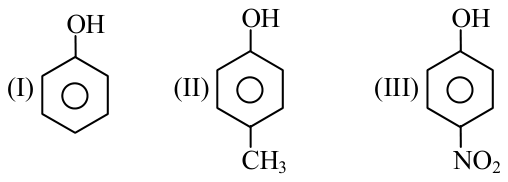
- 1I > II > III
- 2III > I > II
- 3II > III > I
- 4I > III > II
Show answer and solution
Correct: option 2, III > I > II
I is phenol, II is p-cresol and III is p-nitrophenol. The nitro group withdraws electrons and stabilises the phenoxide ion, so III is the strongest acid; the methyl group releases electrons and destabilises the phenoxide ion, so II is the weakest. The order is III > I > II.
Question 51AIPMT 2001 Prelims, Q52
obtained by chlorination of n-butane, will be:
- 1Meso form
- 2Racemic mixture
- 3d-form
- 4l-form
Show answer and solution
Correct: option 2, Racemic mixture
2-Chlorobutane has one chiral carbon. Free-radical chlorination passes through a planar secondary butyl radical that chlorine attacks equally from both faces, so the d and l forms are made in equal amounts: a racemic mixture.
Question 52AIPMT 2001 Prelims, Q53
Which alkene on ozonolysis gives and :
- 1
- 2
- 3
- 4
Show answer and solution
Correct: option 1,
Ozonolysis cuts the double bond and puts an oxygen on each carbon. Joining the carbonyl carbons of propanal and acetone gives (2-methylpent-2-ene), which is option (1).
Question 53AIPMT 2001 Prelims, Q54
Intermediates formed during reaction of with and KOH are:
- 1RCONHBr and RNCO
- 2RNHCOBr and RNCO
- 3RNH-Br and RCONHBr
- 4
Show answer and solution
Correct: option 1, RCONHBr and RNCO
This is the Hofmann bromamide reaction. The amide is first brominated on nitrogen to the N-bromoamide RCONHBr; base removes the remaining N-H proton and the R group migrates to nitrogen as bromide leaves, giving the isocyanate RNCO, which is then hydrolysed to the amine .
Question 54AIPMT 2001 Prelims, Q55
An organic compound A() on reaction with Na/diethyl ether gives a hydrocarbon which on monochlorination gives only one chloro derivative then, A is:
- 1t-butyl chloride
- 2sec. butyl chloride
- 3Iso butyl chloride
- 4n-butyl chloride
Show answer and solution
Correct: option 1, t-butyl chloride
The Wurtz reaction joins two alkyl groups. Two t-butyl groups give 2,2,3,3-tetramethylbutane, , in which all eighteen hydrogens are equivalent, so only one monochloro product is possible. The other three chlorides give octanes with several kinds of hydrogen.
Question 55AIPMT 2001 Prelims, Q56
Which of the following is incorrect:
- 1 is used in detection of phenol
- 2Fehling solution is used in detection of glucose
- 3Tollen reagent is used in detection of unsaturation
- 4 is used in detection of carbonyl compound
Show answer and solution
Correct: option 3, Tollen reagent is used in detection of unsaturation
Tollens' reagent (ammoniacal silver nitrate) detects aldehydes by the silver mirror; unsaturation is detected with bromine water or Baeyer's reagent. The other three statements are true: phenols give a violet colour with neutral , glucose reduces Fehling solution, and carbonyl compounds form crystalline bisulphite addition products.
Question 56AIPMT 2001 Prelims, Q57
Which of following give positive Fehling solution test
- 1Sucrose
- 2Glucose
- 3Fats
- 4Protein
Show answer and solution
Correct: option 2, Glucose
Fehling solution is reduced by a free aldehyde group. Glucose is a reducing sugar and gives the red precipitate of . Sucrose is non-reducing because both anomeric carbons are tied up in the glycosidic link, and fats and proteins have no such group.
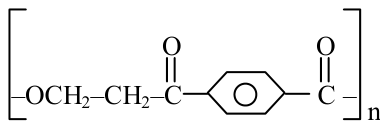
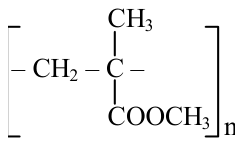
Question 57AIPMT 2001 Prelims, Q58
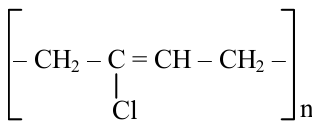
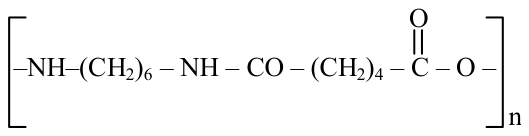
Which of the following is not correctly matched
- 1Neoprene
- 2Nylon-66
- 3Terylene
- 4PMMA
Show answer and solution
Correct: option 3, Terylene
Terylene is the polyester of ethylene glycol and terephthalic acid, so its repeating unit is . The unit drawn in (3) has the glycol carbon bonded straight to the carbonyl carbon with one oxygen missing, so it is not Terylene. Neoprene (polychloroprene) and PMMA are drawn correctly. Note that the Nylon-66 unit as printed in this copy ends in an extra oxygen, which is also not the true amide unit ; the keyed answer is (3).
Question 58AIPMT 2001 Prelims, Q59
Which of the following is correct:
- 1Cyclo heptane is an aromatic compound
- 2Diastase is an enzyme
- 3Acetophenone is an ether
- 4All the above
Show answer and solution
Correct: option 2, Diastase is an enzyme
Diastase is the enzyme that breaks starch down to maltose. Cycloheptane is a saturated alicyclic ring with no delocalised electrons, so it is not aromatic, and acetophenone () is a ketone, not an ether.
Question 59AIPMT 2001 Prelims, Q60
The incorrect IUPAC name is:
- 1 2-methyl-3-butanone
- 2 2, 3-dimethyl pentane
- 3 4-methyl-2-pentyne
- 4 2-bromo-3-chloro butane
Show answer and solution
Correct: option 1, 2-methyl-3-butanone
The carbonyl group must get the lowest number, so the chain in (1) is numbered from the end nearer C=O and the name is 3-methyl-2-butanone. The other names are right: the longest chain in (2) has five carbons with methyls on C2 and C3, the triple bond in (3) gets position 2, and in (4) the substituents are numbered 2 and 3 with bromo cited first alphabetically.
Question 60AIPMT 2001 Prelims, Q61
In preparation of alkene from alcohol using which is effective factor:
- 1Porosity of
- 2Temperature
- 3Concentration
- 4Surface area of
Show answer and solution
Correct: option 2, Temperature
Over alumina the product is decided by temperature: at about 520 K two alcohol molecules lose water to give an ether, while at about 620 K one molecule is dehydrated to the alkene. Temperature is therefore the deciding factor.
Question 61AIPMT 2001 Prelims, Q62
Which of following is correct:
- 1Any aldehyde gives secondary alcohol on reduction
- 2Reaction of vegetable oil with give glycerin
- 3, iodine with NaOH gives iodoform
- 4Sucrose on reaction with NaCl give invert sugar
Show answer and solution
Correct: option 3, , iodine with NaOH gives iodoform
Ethanol is oxidised by /NaOH to acetaldehyde, which has a group and gives yellow iodoform, . Aldehydes give primary alcohols on reduction, and invert sugar is made by hydrolysing sucrose with acid or invertase, not with NaCl. Statement (3) is the keyed one.
Question 62AIPMT 2001 Prelims, Q63
Which of the following is correct about H-bonding in nucleotide:
- 1A–T G–C
- 2A–G T–C
- 3G–T A–C
- 4A–A T–T
Show answer and solution
Correct: option 1, A–T G–C
In DNA a purine always pairs with its complementary pyrimidine: adenine with thymine through two hydrogen bonds and guanine with cytosine through three.
Question 63AIPMT 2001 Prelims, Q64
Which is correct statement:
- 1Starch is polymer of -glucose
- 2Amylose is a component of cellulose
- 3Proteins are composed of only one type of amino acid
- 4In cyclic structure of fructose, there are four carbons and one oxygen atom
Show answer and solution
Correct: option 1, Starch is polymer of -glucose
Starch (amylose and amylopectin) is built from -D-glucose units, so (1) is correct. Amylose is a component of starch, not of cellulose, and proteins contain many different amino acids. Free fructose exists mainly as a six-membered pyranose ring of five carbons and one oxygen; only its furanose form, as found in sucrose, has four ring carbons, so (4) is not taken as correct.
Question 64AIPMT 2001 Prelims, Q65
(peptide bond)
which statement is incorrect about peptide bond:
- 1C–N bond length in proteins is longer than usual bond length of N-bond
- 2Spectroscopic analysis show planar structure of group
- 3C–N bond length in proteins is smaller than usual bond length of C–N bond
- 4None of above
Show answer and solution
Correct: option 1, C–N bond length in proteins is longer than usual bond length of N-bond
The lone pair on nitrogen is delocalised into the C=O group, which gives the C–N bond partial double-bond character. The bond is therefore shorter than a normal C–N single bond and the group is planar, so (2) and (3) are true and the statement that the bond is longer is the incorrect one.
Question 65AIPMT 2001 Prelims, Q66
In steam distillation of toluene, the pressure of toluene in vapour is:
- 1Equal pressure of barometer
- 2Less than pressure of barometer
- 3Equal to vapour pressure to toluene in simple distillation
- 4More than vapour pressure of toluene in simple distillation
Show answer and solution
Correct: option 2, Less than pressure of barometer
In steam distillation the mixture boils when the sum of the vapour pressures of water and the organic liquid equals atmospheric pressure, . The partial pressure of toluene alone is therefore less than the barometric pressure.
Question 66AIPMT 2001 Prelims, Q67
A compound of molecular formula is shows optical isomerism, compound will be
- 12, 3-dimethyl pentane
- 22, 2-dimethyl butane
- 32-methyl hexane
- 4None of the above
Show answer and solution
Correct: option 1, 2, 3-dimethyl pentane
In 2,3-dimethylpentane, C3 carries four different groups: H, methyl, ethyl and isopropyl, so it is a chiral centre and the compound is optically active. 2-Methylhexane has no such carbon, and 2,2-dimethylbutane is .
Question 67AIPMT 2001 Prelims, Q68
Change in enthalpy for reaction
If heat of formation of and are & kJ/mol respectively:
- 1 kJ/mol
- 2 kJ/mol
- 3 kJ/mol
- 4 kJ/mol
Show answer and solution
Correct: option 1, kJ/mol
kJ.
Question 68AIPMT 2001 Prelims, Q70
Enthalpy of is negative. If enthalpy of combustion of and are x and y respectively. Then which relation is correct:
- 1
- 2
- 3
- 4
Show answer and solution
Correct: option 2,
Subtracting the combustion equation of from that of gives the reaction asked, so its enthalpy is . This is negative, hence (both are negative numbers and methane's is the more negative).
Question 69AIPMT 2001 Prelims, Q71
For the reaction rate and rate constant are and respectively. Then conc. of at that time will be:
- 11.732
- 23
- 3
- 4
Show answer and solution
Correct: option 2, 3
The unit shows the reaction is first order, so rate . Then .
Question 70AIPMT 2001 Prelims, Q72
A human body required the 0.01 Curie activity of radioactive substance after 24 hours. Half life of radioactive is 6 hours. Then max. activity of radioactive substance that can be injected will be:
- 10.08
- 20.04
- 30.16
- 40.32
Show answer and solution
Correct: option 3, 0.16
24 hours is four half-lives, in which the activity falls to of its starting value. The starting activity must be Curie.
Question 71AIPMT 2001 Prelims, Q73
When a bio chemical reaction is carried out in laboratory out side the human body in the absence of enzyme, then the rate of reaction obtained is times, then activation energy of reaction in the presence of enzyme is:
- 1
- 2P is required
- 3Different from, obtained in laboratory
- 4Can't say any things
Show answer and solution
Correct: option 3, Different from, obtained in laboratory
An enzyme is a catalyst: it opens a path with a lower activation energy, which is why the reaction is a million times faster in the body. The activation energy with the enzyme is therefore different from (lower than) the value measured in the laboratory without it.
Question 72AIPMT 2001 Prelims, Q74
Molarity of liquid HCl if density of liq. HCl is 1.17 gm/cc:
- 136.5
- 218.25
- 332.05
- 442.10
Show answer and solution
Correct: option 3, 32.05
One litre of liquid HCl weighs g. With molar mass 36.5 g/mol this is mol in a litre, so the molarity is 32.05 M.
Question 73AIPMT 2001 Prelims, Q75
Percentage of Se in peroxidase anhydrous enzyme is 0.5% by weight (at. wt = 78.4) then minimum molecular weight of peroxidase anhydrous enzymes is:
- 1
- 2
- 315.68
- 4
Show answer and solution
Correct: option 1,
The smallest possible molecule contains one Se atom, so 78.4 must be 0.5% of the molecular weight: .
Question 74AIPMT 2001 Prelims, Q76
Sp. vol. of cylindrical virus particle is cc/gm. Whose radius and length are 7 Å & 10 Å respectively. If . Find mol. wt. of virus:
- 11.54 kg/mol.
- 2 kg/mol.
- 3 kg/mol.
- 4 kg/mol.
Show answer and solution
Correct: option 1, 1.54 kg/mol.
Volume of one particle cc. Mass of one particle g, and multiplying by gives g/mol, that is 15.4 kg/mol. The digits 1.54 match option (1), which is the keyed answer, although the power of ten printed in the options of this copy does not agree with the working.
Question 75AIPMT 2001 Prelims, Q77
Pure water can be obtain from sea water by
- 1Centrifugation
- 2Plasmolysis
- 3Reverse osmosis
- 4Sedimentation
Show answer and solution
Correct: option 3, Reverse osmosis
When a pressure greater than the osmotic pressure is applied to sea water across a semipermeable membrane, water flows from the salt solution to the pure side. This reverse osmosis is used for desalination. The other methods cannot remove dissolved salts.
Question 76AIPMT 2001 Prelims, Q78
Standard electrode potential are
If , and Fe block are kept together, then:
- 1 increases
- 2 decreases
- 3 remains unchanged
- 4 decreases
Show answer and solution
Correct: option 2, decreases
The couple with the higher potential is reduced and the other is oxidised: , with V, which is positive and so spontaneous. is used up and increases.
Question 77AIPMT 2001 Prelims, Q79
Which is not correct regarding the adsorption of a gas on surface of solid:
- 1On increasing temp. adsorption increase continuously
- 2Enthalpy & entropy change is –ve
- 3Adsorption is more for some specific substance
- 4Reversible
Show answer and solution
Correct: option 1, On increasing temp. adsorption increase continuously
Adsorption is exothermic and the gas loses freedom on the surface, so both and are negative. Because it is exothermic, raising the temperature lowers the extent of adsorption (even chemisorption falls after an initial rise), so it never increases continuously with temperature.
Question 78AIPMT 2001 Prelims, Q81
Which of the following two species in the pair are isostructural:
- 1,
- 2,
- 3,
- 4,
Show answer and solution
Correct: option 1, ,
and both have two bond pairs and three lone pairs on the central atom () and are linear. In the other pairs the shapes differ: pyramidal and planar; planar and pyramidal; trigonal bipyramidal and square pyramidal.
Question 79AIPMT 2001 Prelims, Q82
In which of the following bond angle is maximum:
- 1
- 2
- 3
- 4
Show answer and solution
Correct: option 2,
All four central atoms are hybridised, but only has no lone pair, so it keeps the full tetrahedral angle of . Lone pairs in (about ), and squeeze the bond angle to smaller values.
Question 80AIPMT 2001 Prelims, Q83
Which of the following statement is not correct
- 1 is less basic than
- 2In Lanthanide series ionic radius of ions decreases
- 3La is actually an element of transition series rather Lanthanide
- 4Atomic radius of Zr and Hf are same because of Lanthanide contraction
Show answer and solution
Correct: option 1, is less basic than
Across the lanthanides the ion gets smaller, the M–OH bond becomes more covalent and the hydroxide becomes less basic. So is the most basic and the least, and statement (1) is wrong. The other statements are true.
Question 81AIPMT 2001 Prelims, Q84
Correct order of Ist IP among following elements Be, B, C, N, O is:
- 1B < Be < C < O < N
- 2B < Be < C < N < O
- 3Be < B < C < N < O
- 4Be < B < C < O < N
Show answer and solution
Correct: option 1, B < Be < C < O < N
Ionisation energy generally rises across a period, with two exceptions here: Be (, filled subshell) is above B, and N (, half-filled) is above O. The order is B < Be < C < O < N.
Question 82AIPMT 2001 Prelims, Q85
Which of the following will give maximum number of isomers:
- 1
- 2
- 3
- 4
Show answer and solution
Correct: option 4,
shows cis-trans isomerism and, because SCN is ambidentate (bonding through S or N), linkage isomerism as well, giving the largest number of isomers. has only cis and trans forms, (2) has no isomers and (3) has only an optical pair.
Question 83AIPMT 2001 Prelims, Q86
Coordination number of Ni in is
- 13
- 26
- 34
- 42
Show answer and solution
Correct: option 2, 6
The complex meant is . Oxalate is a bidentate ligand that binds through two oxygen atoms, so three oxalate ions give bonds to nickel: coordination number 6.
Question 84AIPMT 2001 Prelims, Q87
Which of following organometallic compound is and bonded:
- 1
- 2
- 3
- 4
Show answer and solution
Correct: option 3,
In a metal carbonyl, CO gives its carbon lone pair to the metal (a bond) and the metal gives electrons back into the empty orbital of CO (a bond), so the M–CO bond has both and character. Ferrocene and Zeise's salt are complexes and is only bonded.
Question 85AIPMT 2001 Prelims, Q88
Which statement is incorrect:
- 1 – Tetrahedral, paramagnetic
- 2 - Square planar, diamagnetic
- 3 - Tetrahedral, diamagnetic
- 4 – Tetrahedral, paramagnetic
Show answer and solution
Correct: option 1, – Tetrahedral, paramagnetic
In nickel is in the zero state; the strong-field CO pairs all ten electrons in , giving hybridisation: tetrahedral and diamagnetic. Calling it paramagnetic is wrong. is and diamagnetic, and is with two unpaired electrons.
Question 86AIPMT 2001 Prelims, Q89
In X-H-----Y, X and Y both are electronegative elements:
- 1Electron density on X will increase and on H will decrease
- 2In both electron density will increase
- 3In both electron density will decrease
- 4On X electron density will decrease and on H increases
Show answer and solution
Correct: option 1, Electron density on X will increase and on H will decrease
X is more electronegative than H and pulls the bonding pair towards itself, so electron density rises on X and falls on H. The partly positive hydrogen is then attracted by the lone pair of Y, which is the hydrogen bond.
Question 87AIPMT 2001 Prelims, Q90
Main axis of a diatomic molecule is z, molecular orbital and overlaps to form, which of the following orbital:
- 1 molecular orbital
- 2 molecular orbital
- 3 molecular orbital
- 4No bond will form
Show answer and solution
Correct: option 1, molecular orbital
With z as the internuclear axis, the orbitals overlap end to end and give a orbital. The and orbitals lie at right angles to the axis and overlap sideways with the same orbital on the other atom ( with , with ), which gives molecular orbitals.
Question 88AIPMT 2001 Prelims, Q91
Which of the following will exhibit maximum ionic conductivity:
- 1
- 2
- 3
- 4
Show answer and solution
Correct: option 1,
Conductivity grows with the number of ions a complex gives in solution. gives 5 ions ( and the complex anion), gives 4, gives 3 and gives none.
Question 89AIPMT 2001 Prelims, Q92
The following quantum no's are possible for how many orbital , ,
- 11
- 22
- 33
- 44
Show answer and solution
Correct: option 1, 1
A set of three values , and fixes exactly one orbital (here one of the five orbitals). So only 1 orbital fits.
Question 90AIPMT 2001 Prelims, Q93
In , , , order of proton accepting tendency will be:
- 1
- 2
- 3
- 4
Show answer and solution
Correct: option 3,
A stronger base has a weaker conjugate acid. The conjugate acids in order of increasing strength are , so the bases in order of decreasing proton-accepting tendency are . The alkyl group makes the amine a stronger base than ammonia.
Question 91AIPMT 2001 Prelims, Q94
The Beans are cooked earlier in pressure cooker, because:
- 1B.P. increase with increasing pressure
- 2B.P. decrease with increasing pressure
- 3Extra pressure of pressure cooker, softens the beans
- 4Internal energy is not lost while cooking in pressure cooker
Show answer and solution
Correct: option 1, B.P. increase with increasing pressure
A liquid boils when its vapour pressure equals the pressure above it. The higher pressure inside the cooker raises the boiling point of water above , and at this higher temperature the food cooks faster.
Question 92AIPMT 2001 Prelims, Q95
The most convenient method to protect the bottom of ship made of iron is:
- 1Coating it with Red lead oxide
- 2White tin plating
- 3Connecting it with Mg block
- 4Connecting it with Pb block
Show answer and solution
Correct: option 3, Connecting it with Mg block
Magnesium is far more easily oxidised than iron, so a block of Mg connected to the hull acts as a sacrificial anode and corrodes in place of the iron (cathodic protection). Lead and tin are less reactive than iron and would make the iron corrode faster where exposed.
Question 93AIPMT 2001 Prelims, Q96
Zn convert it's melted state to its solid state, it has HCP structure, then find out nearest no. of nearest atom:
- 16
- 28
- 312
- 44
Show answer and solution
Correct: option 3, 12
In hexagonal close packing each atom touches six atoms in its own layer, three in the layer above and three in the layer below, so the coordination number is 12.
Question 94AIPMT 2001 Prelims, Q97
Nitrogen form , but phosphorous form , it's at a time convert in , reason is:
- 1Triple bond present between phosphorous atom
- 2 bonding is weak
- 3 bonding is strong
- 4Multiple bond form easily
Show answer and solution
Correct: option 2, bonding is weak
Phosphorus atoms are large and their orbitals overlap poorly sideways, so bonds between them are weak. Phosphorus therefore prefers three single P–P bonds per atom, as in tetrahedral , to a triply bonded .
Question 95AIPMT 2001 Prelims, Q98
Ionisation constant of is and concentration of ions is . Then find out initial concentration of molecules:
- 1
- 2
- 3
- 4
Show answer and solution
Correct: option 4,
For a weak acid , so .
Question 96AIPMT 2001 Prelims, Q99
Solubility of a salt is then find out solubility product:
- 1
- 2
- 3
- 4
Show answer and solution
Correct: option 2,
, so .
Question 97AIPMT 2001 Prelims, Q100
If a species emits firstly a positron, then two and two and at last one is also after initially it finally converts into stable species so correct relation will be:
- 1,
- 2,
- 3,
- 4,
Show answer and solution
Correct: option 1, ,
Here b is the mass number and a the atomic number. Three particles in all lower the mass number by 12, so . The atomic number changes by (positron), (three ) and (two ), so .
AIPMT 2001 Prelims Biology questions
Question 98AIPMT 2001 Prelims, Q11
Biological importance of Ozone layer is:
- 1It stops ultraviolet rays
- 2Ozone layer reduces green house effect
- 3Ozone layer reflects radio waves
- 4Ozone layer controls ratio in atmosphere
Show answer and solution
Correct: option 1, It stops ultraviolet rays
Ozone in the stratosphere absorbs most of the Sun's harmful ultraviolet radiation, which would otherwise damage DNA and living tissue. Radio waves are reflected by the ionosphere, not by the ozone layer, and ozone does not reduce the greenhouse effect.
Question 99AIPMT 2001 Prelims, Q101
Independent assortment of genes does not takes place when:-
- 1Genes are located on homologous chromosomes
- 2Genes are linked and located on same chromosome
- 3Genes are located on non-homologous chromosome
- 4All the above
Show answer and solution
Correct: option 2, Genes are linked and located on same chromosome
Independent assortment needs the two genes to separate freely at meiosis, which happens when they lie on different (non-homologous) chromosomes. Genes that are linked on the same chromosome travel together into the gametes, so they do not assort independently.
Question 100AIPMT 2001 Prelims, Q102
What is true for monoclonal antibodies:-
- 1These antibodies obtained from one parent and for one antigen
- 2These obtained from different parents and for one antigen
- 3These obtained from one parent and for many antigens
- 4These obtained from many parents and for many antigen
Show answer and solution
Correct: option 2, These obtained from different parents and for one antigen
Monoclonal antibodies are identical antibodies directed against a single antigen. They are made by a hybridoma, which is formed by fusing two different cells, an antibody-producing B lymphocyte and a myeloma cell; the key reads these as the "different parents". Note that many books prefer "one parent and one antigen", because all the antibody molecules come from one clone of cells; the answer shown here is the one given in the key.
Question 101AIPMT 2001 Prelims, Q103
- 1Inducer binds with repressor
- 2Co-repressor does not binds with repressor
- 3Corepressor binds with inducer
- 4cAMP have negative effect on lac operon
Show answer and solution
Correct: option 1, Inducer binds with repressor
In negative control the operon is switched off by a repressor protein sitting on the operator. In an inducible operon such as lac, the inducer (lactose or allolactose) binds to the repressor and changes its shape so that it leaves the operator, and transcription starts. A co-repressor binds to the repressor, not to the inducer, and cAMP has a positive effect on the lac operon.
Question 102AIPMT 2001 Prelims, Q104
What is true for plasmid:-
- 1Plasmids are widely used in gene transfer
- 2These are found in virus
- 3Plasmid contain gene for vital activities
- 4These are main part of chromosome
Show answer and solution
Correct: option 1, Plasmids are widely used in gene transfer
Plasmids are small, circular, extrachromosomal DNA molecules of bacteria that replicate on their own. Because they can carry a foreign gene into a host cell, they are the most widely used vectors in gene transfer. They are not found in viruses, are not part of the chromosome, and carry no genes essential for life.
Question 103AIPMT 2001 Prelims, Q105
Mendel obtained wrinkled seeds in pea due to deposition of sugars instead of starch. It was due to which enzyme:-
- 1Amylase
- 2Invertase
- 3Diastase
- 4Absence of starch branching enzyme
Show answer and solution
Correct: option 4, Absence of starch branching enzyme
Round pea seeds have the starch branching enzyme, which turns sugar into branched starch. In the recessive (rr) seeds this enzyme is missing, so sugar builds up, the seed takes in more water and then wrinkles as it dries.
Question 104AIPMT 2001 Prelims, Q106
Before the European invader which vegetable was absent in India:-
- 1Potato and Tomato
- 2Simla mirch and Brinjal
- 3Maize and chichinda
- 4Bitter gourd
Show answer and solution
Correct: option 1, Potato and Tomato
Potato and tomato are native to South America and were brought to India by the Europeans (the Portuguese). Brinjal, chichinda (snake gourd) and bitter gourd are old Indian vegetables, so the other choices are not wholly foreign.
Question 105AIPMT 2001 Prelims, Q107
Which of the following is true pair of biofertilizers:-
- 1Azolla and BGA
- 2Nostoc and legume
- 3Rhizobium and grasses
- 4Salmonella & E. coli
Show answer and solution
Correct: option 1, Azolla and BGA
Azolla (a water fern that houses Anabaena) and blue-green algae (BGA) both fix atmospheric nitrogen and are used as biofertilisers in rice fields. Nostoc does not pair with legumes, Rhizobium lives in legume roots and not in grasses, and Salmonella and E. coli are not biofertilisers.
Question 106AIPMT 2001 Prelims, Q108
Ratio of complementary genes is:-
- 19 : 3 : 4
- 212 : 3 : 1
- 39 : 3 : 3 : 4
- 49 : 7
Show answer and solution
Correct: option 4, 9 : 7
With complementary genes the character appears only when a dominant allele of both genes is present (A_B_, 9 out of 16). The other three classes (3 + 3 + 1 = 7) look alike, so the ratio is 9 : 7. 9 : 3 : 4 is recessive epistasis and 12 : 3 : 1 is dominant epistasis.
Question 107AIPMT 2001 Prelims, Q109
When dominant and recessive alleles express itself together it is called:-
- 1Co-dominance
- 2Dominance
- 3Amphidominance
- 4Pseudo dominance
Show answer and solution
Correct: option 1, Co-dominance
When both alleles of a pair show their effect side by side in the heterozygote, neither hiding the other, the condition is co-dominance. The AB blood group, in which both and are expressed, is the usual example.
Question 108AIPMT 2001 Prelims, Q110
A and B genes are linked. What shall be genotype of progeny in a cross between AB/ab and ab/ab:-
- 1AAbb and aabb
- 2AaBb and aabb
- 3AABB and aabb
- 4None
Show answer and solution
Correct: option 2, AaBb and aabb
With linkage the AB/ab parent forms only the parental gametes AB and ab, and the ab/ab parent forms only ab. The progeny are therefore AB/ab (AaBb) and ab/ab (aabb).
Question 109AIPMT 2001 Prelims, Q111
Which statement correct about centre of origin of plant:-
- 1More diversity in improved variety
- 2Frequency of dominant gene is more
- 3Climatic condition more favourable
- 4None
Show answer and solution
Correct: option 2, Frequency of dominant gene is more
According to Vavilov, a crop shows its greatest variation at its centre of origin, and the forms found there carry mostly dominant genes; recessive forms become commoner towards the edge of the range. So the frequency of dominant genes is higher at the centre of origin.
Question 110AIPMT 2001 Prelims, Q112
Probability of four son to a couple is:-
- 1
- 2
- 3
- 4
Show answer and solution
Correct: option 3,
Each child is a son with probability , and each birth is independent. The probability of four sons is .
Question 111AIPMT 2001 Prelims, Q113
Two nonallelic genes produces the new phenotype when present together but fail to do so independently then it is called:-
- 1Epistasis
- 2Polygene
- 3Non complementary gene
- 4Complementary gene
Show answer and solution
Correct: option 4, Complementary gene
Two non-allelic genes that give a character only when both are present in the dominant form, and not when either is alone, are complementary genes (9 : 7 ratio in the ). In epistasis one gene hides the effect of another, and polygenes add up their effects.
Question 112AIPMT 2001 Prelims, Q114
Which of the following cut the DNA from specific places:-
- 1Restriction endonuclease (EcoRI)
- 2Ligase
- 3Exonuclease
- 4Alkaline phosphate
Show answer and solution
Correct: option 1, Restriction endonuclease (EcoRI)
A restriction endonuclease recognises a specific base sequence and cuts the DNA within it; EcoRI cuts at GAATTC. Ligase joins DNA pieces, and an exonuclease removes nucleotides from the ends, not from specific sites.
Question 113AIPMT 2001 Prelims, Q115
Tetradynamous conditions occur in:-
- 1Cruciferae
- 2Malvaceae
- 3Solanaceae
- 4Liliaceae
Show answer and solution
Correct: option 1, Cruciferae
Tetradynamous stamens are six in number, four long (inner) and two short (outer). This is the characteristic androecium of Cruciferae (the mustard family). Malvaceae has monadelphous stamens.
Question 114AIPMT 2001 Prelims, Q116
Which is correct pair for edible part:-
- 1Tomato – Thalamus
- 2Maize - Cotyledons
- 3Guava - Mesocarp
- 4Date palm - Pericarp
Show answer and solution
Correct: option 4, Date palm - Pericarp
In date palm the fleshy pericarp of the one-seeded berry is eaten and the hard seed is thrown away. In tomato the pericarp and placentae are eaten, in maize the starchy endosperm, and in guava the thalamus and pericarp together.
Question 115AIPMT 2001 Prelims, Q117
Bicarpellary gynoecium and oblique ovary occurs in:-
- 1Mustard
- 2Banana
- 3Pisum
- 4Brinjal
Show answer and solution
Correct: option 4, Brinjal
In Solanaceae the gynoecium is bicarpellary and syncarpous, and the ovary is placed obliquely with a swollen placenta. Brinjal belongs to this family. Mustard is also bicarpellary but its ovary is not oblique, and Pisum has one carpel.
Question 116AIPMT 2001 Prelims, Q118
- 1Epicarp
- 2Mesocarp and less developed endocarp
- 3Endocarp and less developed mesocarp
- 4Epicarp & mesocarp
Show answer and solution
Correct: option 3, Endocarp and less developed mesocarp
The banana fruit is a berry. Its peel is the epicarp, which is removed, and the soft part eaten is mainly the endocarp along with the poorly developed mesocarp.
Question 117AIPMT 2001 Prelims, Q119
In Hydra, waste material of food digestion and nitrogenous waste material removed from:-
- 1Mouth and mouth
- 2Body wall and body wall
- 3Mouth and body wall
- 4Mouth and tentacles
Show answer and solution
Correct: option 3, Mouth and body wall
Hydra has a single opening to its gastrovascular cavity, so undigested food is thrown out through the mouth. It has no excretory organs; the nitrogenous waste, ammonia, diffuses out through the general body wall.
Question 118AIPMT 2001 Prelims, Q120
In which of the following animal post anal tail is found
- 1Earthworm
- 2Lower invertebrate
- 3Scorpion
- 4Snake
Show answer and solution
Correct: option 4, Snake
A post-anal tail is one of the basic characters of chordates. Of the animals listed only the snake is a chordate; earthworm and scorpion are non-chordates in which the anus is at the end of the body.
Question 119AIPMT 2001 Prelims, Q121
In which of the following haemocyanin pigment is found:-
- 1Annelida
- 2Echinodermata
- 3Insecta
- 4Lower chordata
Show answer and solution
Correct: option 1, Annelida
Haemocyanin is a copper-containing respiratory pigment that is dissolved in the plasma and turns blue when it carries oxygen. The key gives Annelida. Note that standard texts describe haemocyanin in molluscs and in arthropods such as crustaceans, while annelids usually have haemoglobin (erythrocruorin) or chlorocruorin, so this key answer is doubtful; it is shown here as given in the key.
Question 120AIPMT 2001 Prelims, Q122
Anemophily type of pollination is found in
- 1Salvia
- 2Bottle brush
- 3Vallisneria
- 4Coconut
Show answer and solution
Correct: option 4, Coconut
Anemophily is pollination by wind. Coconut produces a large amount of light, dry pollen that is carried by wind. Salvia is pollinated by insects, bottle brush by birds and Vallisneria by water.
Question 121AIPMT 2001 Prelims, Q123
What is the eye of potato:-
- 1Axillary bud
- 2Accessory bud
- 3Adventitious bud
- 4Apical bud
Show answer and solution
Correct: option 1, Axillary bud
A potato tuber is a swollen underground stem. Each eye is a node with a scale leaf, and in its axil lies an axillary bud that can grow into a new shoot.
Question 122AIPMT 2001 Prelims, Q124
Due to discovery of which of the following in 1980, the evolution was termed as RNA world:
- 1m-RNA, t-RNA- r-RNA synthesise proteins
- 2In some virus RNA is genetic material
- 3RNA have enzymatic property
- 4RNA is not found in all cells
Show answer and solution
Correct: option 3, RNA have enzymatic property
In the early 1980s Cech and Altman showed that some RNA molecules (ribozymes) act as enzymes. An RNA that can both store information and catalyse reactions could have come before DNA and proteins, which is the RNA world idea.
Question 123AIPMT 2001 Prelims, Q125
- 1 – Maize
- 2 – Kranz anatomy
- 3Calvin cycle - PGA
- 4Hatch and Slack cycle – O.A.A.
Show answer and solution
Correct: option 1, – Maize
Maize is a plant, so pairing it with is wrong. The other pairs are correct: leaves show Kranz anatomy, the first stable product of the Calvin cycle is PGA, and that of the Hatch and Slack cycle is oxaloacetic acid.
Question 124AIPMT 2001 Prelims, Q126
Which breaks dormancy of potato tuber:-
- 1Gibberellin
- 2IAA
- 3ABA
- 4Zeatin
Show answer and solution
Correct: option 1, Gibberellin
Gibberellins break the dormancy of seeds, buds and tubers, and treating potato tubers with gibberellin makes them sprout. ABA does the opposite and keeps them dormant.
Question 125AIPMT 2001 Prelims, Q127
Hormone responsible for senescence:-
- 1ABA
- 2Auxin
- 3GA
- 4Cytokinin
Show answer and solution
Correct: option 1, ABA
Abscisic acid promotes senescence and abscission of leaves and fruits. Auxin, gibberellin and especially cytokinin delay ageing.
Question 126AIPMT 2001 Prelims, Q128
Which of the following prevents the fall of fruits:-
- 1
- 2NAA
- 3Ethylene
- 4Zeatin
Show answer and solution
Correct: option 2, NAA
Auxins stop the formation of the abscission layer in young fruits. NAA, a synthetic auxin, is sprayed to prevent pre-harvest fruit drop. Ethylene instead promotes abscission.
Question 127AIPMT 2001 Prelims, Q129
Loading of phloem is related to:-
- 1Increase of sugar in phloem
- 2Elongation of phloem cell
- 3Separation of phloem parenchyma
- 4Strengthening of phloem fiber
Show answer and solution
Correct: option 1, Increase of sugar in phloem
Phloem loading is the active transfer of sugar (sucrose) from the leaf mesophyll into the sieve tubes at the source. It raises the sugar concentration in the phloem, water follows by osmosis, and the pressure so produced drives the flow.
Question 128AIPMT 2001 Prelims, Q130
Which pigment system inactivated in red drop:-
- 1PS-I and P.S-II
- 2PS – I
- 3PS – II
- 4None
Show answer and solution
Correct: option 3, PS – II
Red drop is the sharp fall in the yield of photosynthesis in light of wavelength beyond about 680 nm. Such light is absorbed by PS I but not by PS II, so PS II stays inactive and non-cyclic electron flow stops.
Question 129AIPMT 2001 Prelims, Q131
- 1Tobacco
- 2Glycine max
- 3Mirabilis jalapa
- 4Spinach
Show answer and solution
Correct: option 4, Spinach
Spinach is a long day plant; it flowers only when the day is longer than its critical length. Tobacco (Maryland Mammoth) and soyabean (Glycine max) are short day plants.
Question 130AIPMT 2001 Prelims, Q132
What is true for photolithotrophs:-
- 1Obtain energy from radiations and hydrogen from organic compounds
- 2Obtain energy from radiations and hydrogen from inorganic compounds
- 3Obtain energy from organic compounds
- 4Obtain energy from inorganic compounds
Show answer and solution
Correct: option 2, Obtain energy from radiations and hydrogen from inorganic compounds
"Photo" means the energy comes from light, and "litho" means the hydrogen (electron) donor is an inorganic substance such as or . Organisms that use organic hydrogen donors with light are photo-organotrophs.
Question 131AIPMT 2001 Prelims, Q133
In which of the following plant sunken stomata are found:-
- 1Nerium
- 2Hydrilla
- 3Mango
- 4Guava
Show answer and solution
Correct: option 1, Nerium
Nerium is a xerophyte. Its stomata lie sunken in pits lined with hairs on the lower surface of the leaf, which cuts down water loss. Hydrilla is a submerged plant without working stomata.
Question 132AIPMT 2001 Prelims, Q134
What is the best pH of the soil for cultivation of plants:-
- 13.4 – 5.4
- 26.5 – 7.5
- 34.5 – 8.5
- 45.5 – 6.5
Show answer and solution
Correct: option 4, 5.5 – 6.5
Most crop plants grow best in slightly acidic soil, because the mineral nutrients are most available to the roots at about pH 5.5 to 6.5. In strongly acidic or alkaline soil several nutrients become unavailable.
Question 133AIPMT 2001 Prelims, Q135
Which fish selectively feed on larva of mosquito:-
- 1Gambusia
- 2Rohu
- 3Clarias
- 4Exocoetus
Show answer and solution
Correct: option 1, Gambusia
Gambusia is a small larvivorous fish that feeds on mosquito larvae. It is released into ponds and tanks for the biological control of mosquitoes and so of malaria.
Question 134AIPMT 2001 Prelims, Q136
Which one of the following is correct match
- 1Reserpine – Tranquilliser
- 2Cocaine – opiatic narcotic
- 3Morphine – Hallucinogenic
- 4Bhang – Analgesic
Show answer and solution
Correct: option 1, Reserpine – Tranquilliser
Reserpine, from Rauwolfia, is a tranquilliser that also lowers blood pressure. Cocaine is a stimulant and not an opiate, morphine is an opiate pain-killer and not a hallucinogen, and bhang is a hallucinogenic product of Cannabis.
Question 135AIPMT 2001 Prelims, Q137
- 1The amount of utilised by organisms in water
- 2The amount of utilized by micro organisms for decomposition
- 3The total amount of present in water
- 4All of the above
Show answer and solution
Correct: option 2, The amount of utilized by micro organisms for decomposition
Biochemical oxygen demand is the amount of oxygen used up by micro-organisms while they decompose the organic matter present in a sample of water. A high B.O.D. means the water carries much organic pollution.
Question 136AIPMT 2001 Prelims, Q138
In grasses what happens in micro spore mother cell for the formation of mature pollen grains:-
- 1One meiotic and two mitotic divisions
- 2One meiotic & one mitotic divisions
- 3One meiotic division
- 4One mitotic division
Show answer and solution
Correct: option 1, One meiotic and two mitotic divisions
The microspore mother cell divides by meiosis to give four microspores. In grasses the pollen is shed at the three-celled stage: one mitosis gives the vegetative and generative cells, and a second mitosis of the generative cell gives two male gametes. So there is one meiotic and two mitotic divisions.
Question 137AIPMT 2001 Prelims, Q139
What is the intensity of sound in normal conversation:-
- 110 – 20 decibel
- 230 – 60 decibel
- 370 – 90 decibel
- 4120 – 150 decibel
Show answer and solution
Correct: option 2, 30 – 60 decibel
Ordinary conversation is heard at roughly 30 to 60 decibels. 10 to 20 decibels is a whisper or rustling leaves, and sound above about 80 decibels counts as noise that can harm hearing.
Question 138AIPMT 2001 Prelims, Q140
Adventive embryony in citrus is due to:-
- 1Nucellus
- 2Integuments
- 3Zygotic embryo
- 4Fertilized egg
Show answer and solution
Correct: option 1, Nucellus
In Citrus some diploid cells of the nucellus around the embryo sac start dividing, push into the embryo sac and grow into extra embryos. This adventive embryony is why a citrus seed often has many embryos.
Question 139AIPMT 2001 Prelims, Q141
- 1Hallucinogenic
- 2Sedative
- 3Stimulant
- 4Tranquiliser
Show answer and solution
Correct: option 1, Hallucinogenic
LSD (lysergic acid diethylamide), obtained from the ergot fungus Claviceps, is a powerful hallucinogen. It changes perception, thoughts and feelings.
Question 140AIPMT 2001 Prelims, Q142
- 1Corpus luteum – Graafian follicles
- 2Sebum-sweat
- 3Bundle of His – Pacemaker
- 4Vit. - Niacin
Show answer and solution
Correct: option 1, Corpus luteum – Graafian follicles
The corpus luteum is formed from the Graafian follicle itself after ovulation, so the two are stages of the same structure. Sebum and sweat come from different glands, the pacemaker is the SA node and not the bundle of His, and niacin is vitamin , not .
Question 141AIPMT 2001 Prelims, Q143
Salmonella is related with:-
- 1Typhoid
- 2Polio
- 3T.B.
- 4Tetanus
Show answer and solution
Correct: option 1, Typhoid
Typhoid is caused by the bacterium Salmonella typhi. Polio is caused by a virus, T.B. by Mycobacterium tuberculosis and tetanus by Clostridium tetani.
Question 142AIPMT 2001 Prelims, Q144
Difference in gram and gram bacteria is due to -
- 1Cell wall
- 2Cell membrane
- 3Ribosome
- 4Cytoplasm
Show answer and solution
Correct: option 1, Cell wall
Gram staining depends on the cell wall. Gram positive bacteria have a thick peptidoglycan wall that holds the crystal violet stain, while gram negative bacteria have a thin peptidoglycan layer and an outer lipid-rich membrane, so they lose the stain on washing with alcohol.
Question 143AIPMT 2001 Prelims, Q145
- 1Part between two H-line
- 2Part between two A-line
- 3Part between two I-band
- 4Part between two Z-line
Show answer and solution
Correct: option 4, Part between two Z-line
A sarcomere is the part of a myofibril between two successive Z-lines. It is the functional unit of contraction, with a whole A-band in the middle and half an I-band on each side.
Question 144AIPMT 2001 Prelims, Q146
Which statement is correct for muscle contraction:-
- 1Length of H-zone become decrease
- 2Length of A-band remains constant
- 3Length of I-band become increase
- 4Length of two Z-line become increase
Show answer and solution
Correct: option 1 or 2
The answer key accepts options 1 and 2.
During contraction the thin filaments slide over the thick filaments towards the centre of the sarcomere. The H-zone and the I-band become shorter and the Z-lines come closer, while the A-band, which is the length of the thick filaments, stays the same. So statements (1) and (2) are both correct, and the key accepts either.
Question 145AIPMT 2001 Prelims, Q147
Characteristics character of human cornea
- 1Secreted by conjunctiva and glandular
- 2It has lacrimal gland which secrete tears
- 3Blood circulation is absent in cornea
- 4In old age it become harden and white layer deposit on it which causes the cataract
Show answer and solution
Correct: option 3, Blood circulation is absent in cornea
The cornea is the transparent front part of the outer coat of the eye and has no blood vessels; it gets its oxygen and food from the air, the tears and the aqueous humour. Cataract is the clouding of the lens, not of the cornea, and tears are made by the lacrimal gland, which is not part of the cornea.
Question 146AIPMT 2001 Prelims, Q148
Which of the most infectious disease is:-
- 1Hepatitis -B
- 2AIDS
- 3Cough and cold
- 4Malaria
Show answer and solution
Correct: option 1, Hepatitis -B
Among the choices the key picks hepatitis B: the hepatitis B virus spreads through blood and body fluids like HIV but is far more easily passed on, since a very small amount of infected blood is enough. Malaria needs a mosquito vector to pass from person to person.
Question 147AIPMT 2001 Prelims, Q149
Interferons are synthesized in response to
- 1Mycoplasma
- 2Bacteria
- 3Viruses
- 4Fungi
Show answer and solution
Correct: option 3, Viruses
Interferons are proteins released by cells that have been infected by a virus. They make the neighbouring uninfected cells resistant to viral infection.
Question 148AIPMT 2001 Prelims, Q150
Cauliflower mosaic virus contains:-
- 1ss RNA
- 2ds RNA
- 3ds DNA
- 4ss DNA
Show answer and solution
Correct: option 3, ds DNA
Most plant viruses have single-stranded RNA, but cauliflower mosaic virus is an exception: its genome is circular double-stranded DNA.
Question 149AIPMT 2001 Prelims, Q151
- 1Coal mining
- 2Calcium fluoride
- 3Cement factory
- 4Bauxite mining
Show answer and solution
Correct: option 3, Cement factory
Workers in cement factories breathe in fine dust carrying silica and asbestos-like fibres for years. This long-term irritation of the lung lining is linked with lung cancer. Coal dust mainly causes black lung (pneumoconiosis), fluoride causes fluorosis, and bauxite mining is not the classic cause, so the keyed option is cement factory.
Question 150AIPMT 2001 Prelims, Q152
When water moves through a semipermeable membrane then which of the following pressure develops:
- 1O.P.
- 2S.P.
- 3T.P.
- 4W.P.
Show answer and solution
Correct: option 1, O.P.
Movement of water across a semipermeable membrane towards the more concentrated solution is osmosis. The pressure that builds up because of this entry of water, and which would just stop it, is the osmotic pressure (O.P.).
Question 151AIPMT 2001 Prelims, Q153
Proteinaceous pigment which control the activities concerned with light:
- 1Phytochrome
- 2Chlorophyll
- 3Anthocyanin
- 4Carotenoids
Show answer and solution
Correct: option 1, Phytochrome
Phytochrome is a chromoprotein that exists in two interconvertible forms, Pr and Pfr. It senses red and far-red light and controls light-dependent responses such as flowering and seed germination. Chlorophyll, anthocyanin and carotenoids are not proteins.
Question 152AIPMT 2001 Prelims, Q154
Glycolate induces opening of stomata in:
- 1Presence of oxygen
- 2Low conc.
- 3High
- 4 absent
Show answer and solution
Correct: option 2, Low conc.
Glycolate is formed in guard cells when the concentration is low (it is a photorespiratory product). Its metabolism is linked with the build-up of solutes that makes guard cells turgid, so stomata open under low ; high closes them.
Question 153AIPMT 2001 Prelims, Q155
Enzyme first used for nitrogen fixation:
- 1Nitrogenase
- 2Nitroreductase
- 3Transferase
- 4Transaminase
Show answer and solution
Correct: option 1, Nitrogenase
The first step of biological nitrogen fixation is the reduction of to ammonia, and this is done by nitrogenase. Transaminases act later, when the ammonia is built into amino acids.
Question 154AIPMT 2001 Prelims, Q156
Maximum number of bases in plasmids discovered so far:
- 150 kilo base
- 2500 kilo base
- 35000 kilo base
- 45 kilo base
Show answer and solution
Correct: option 2, 500 kilo base
Plasmids are small extra-chromosomal circles of DNA, usually a few kilobases long. The largest ones known when this was asked were of the order of some hundreds of kilobases, so 500 kilo base is the keyed answer.
Question 155AIPMT 2001 Prelims, Q157
Passive absorption of minerals depend on
- 1Temperature
- 2Temperature and metabolic inhibitor
- 3Metabolic inhibitor
- 4Humidity
Show answer and solution
Correct: option 1, Temperature
Passive absorption is diffusion of ions along their gradient and uses no metabolic energy, so metabolic inhibitors do not affect it. Being a physical process, its rate still changes with temperature.
Question 156AIPMT 2001 Prelims, Q158
Half life period of is:
- 1500 years
- 25000 years
- 350 years
- 4 years
Show answer and solution
Correct: option 2, 5000 years
The half-life of carbon-14 is about 5730 years, which is why it is used to date remains up to a few tens of thousands of years old. Of the given values, 5000 years is the closest.
Question 157AIPMT 2001 Prelims, Q159
Which one correctly matched:
- 1Vit. E – Tocopherol
- 2Vit. D – Riboflavin
- 3Vit. B – Calciferol
- 4Vit. A – Thiamine
Show answer and solution
Correct: option 1, Vit. E – Tocopherol
Vitamin E is tocopherol. Calciferol is vitamin D, riboflavin is vitamin , thiamine is vitamin , and vitamin A is retinol, so only the first pair is correct.
Question 158AIPMT 2001 Prelims, Q160
E. coli about to replicate was placed in a medium containing radioactive thymidine for five minutes. Then it was made to replicate in a normal medium. Which of the following observation shall be correct:
- 1Both the strands of DNA will be radioactive
- 2One strand radioactive
- 3Each strand half radioactive
- 4None is radioactive
Show answer and solution
Correct: option 2, One strand radioactive
DNA replication is semiconservative. Radioactive thymidine goes only into the strand made while the label is present, and that strand stays intact afterwards. A DNA molecule that carries the label therefore has one radioactive strand paired with one unlabelled strand.
Question 159AIPMT 2001 Prelims, Q161
Most abundant organic compound on earth is
- 1Protein
- 2Cellulose
- 3Lipids
- 4Steroids
Show answer and solution
Correct: option 2, Cellulose
Cellulose is the main structural material of every plant cell wall, so it makes up the largest share of the organic matter in the biosphere.
Question 160AIPMT 2001 Prelims, Q162
Male XX and female XY sometime occur due to
- 1Deletion
- 2Transfer of segments in X and Y chromosomes
- 3Aneuploidy
- 4Hormonal imbalance
Show answer and solution
Correct: option 2, Transfer of segments in X and Y chromosomes
Maleness depends on the testis-determining region of the Y chromosome. If abnormal exchange between X and Y moves this segment to an X, an XX individual becomes male, and a Y that has lost it gives an XY female. The chromosome number is normal, so it is not aneuploidy.
Question 161AIPMT 2001 Prelims, Q163
No. of Barr body in XXXX female:
- 11
- 22
- 33
- 44
Show answer and solution
Correct: option 3, 3
Only one X chromosome stays active in a cell and every other X is condensed into a Barr body. Number of Barr bodies = number of X chromosomes .
Question 162AIPMT 2001 Prelims, Q164
Types of RNA polymerase required in nucleus for RNA synthesis:
- 11
- 22
- 33
- 44
Show answer and solution
Correct: option 3, 3
A eukaryotic nucleus has three RNA polymerases: RNA polymerase I makes rRNA (28S, 18S and 5.8S), RNA polymerase II makes the precursor of mRNA (hnRNA), and RNA polymerase III makes tRNA, 5S rRNA and snRNA.
Question 163AIPMT 2001 Prelims, Q165
What is true for Archaebacteria:
- 1All Halophiles
- 2All photosynthetic
- 3All fossils
- 4Oldest living beings
Show answer and solution
Correct: option 4, Oldest living beings
Archaebacteria are regarded as the most ancient group of living organisms and still survive in extreme habitats. Only some are halophiles (others are methanogens and thermoacidophiles), they are not all photosynthetic, and they are living forms, not fossils.
Question 164AIPMT 2001 Prelims, Q166
Extranuclear inheritance occurs in:
- 1Killer Paramaecium
- 2Killer Amoeba
- 3Euglena
- 4Hydra
Show answer and solution
Correct: option 1, Killer Paramaecium
The killer trait of Paramecium is carried by kappa particles in the cytoplasm, which pass to the offspring with the cytoplasm and not through nuclear genes. It is a standard example of extranuclear (cytoplasmic) inheritance.
Question 165AIPMT 2001 Prelims, Q167
Extranuclear chromosomes occur in:
- 1Peroxisome, Ribosome
- 2Chloroplast and Mitochondria
- 3Mitochondria and Ribosome
- 4Chloroplast and Lysosome
Show answer and solution
Correct: option 2, Chloroplast and Mitochondria
Chloroplasts and mitochondria are semi-autonomous organelles with their own circular DNA and 70S ribosomes. Ribosomes, lysosomes and peroxisomes have no DNA.
Question 166AIPMT 2001 Prelims, Q168
Spoilage of oil can be detected by which fatty acid:
- 1Oleic acid
- 2Linolenic acid
- 3Linoleic acid
- 4Erucic acid
Show answer and solution
Correct: option 4, Erucic acid
The keyed answer is erucic acid, a long-chain (22-carbon) unsaturated fatty acid found in mustard and rapeseed oil. Its level is used as a marker of the quality of an edible oil, and a high value marks the oil as unfit for use.
Question 167AIPMT 2001 Prelims, Q169
When we migrate from dark to light, we fail to see for sometimes but after a time visibility becomes normal. It is example of
- 1Accommodation
- 2Adaptation
- 3Mutation
- 4Photoperiodism
Show answer and solution
Correct: option 2, Adaptation
On moving from dark into bright light the visual pigments are bleached and the pupil has to narrow, so vision is poor for a short while and then recovers. This adjustment of the eye to a change in light intensity is adaptation. Accommodation is the focusing of the lens for near and far objects.
Question 168AIPMT 2001 Prelims, Q170
In plants inulin and pectin are
- 1Reserved material
- 2Wastes
- 3Excretory material
- 4Insect attracting material
Show answer and solution
Correct: option 1, Reserved material
Inulin is a polymer of fructose stored in the roots and tubers of plants such as Dahlia, and pectin is a polysaccharide laid down in cell walls and fruits. Both are stored polysaccharides, not wastes or excretory products, so the keyed option is reserve material.
Question 169AIPMT 2001 Prelims, Q171
Gene and cistron words are sometimes used synonymously because:
- 1One cistron contains many genes
- 2One gene contains many cistrons
- 3One gene contains one cistron
- 4One gene contains no cistron
Show answer and solution
Correct: option 3, One gene contains one cistron
A cistron is the stretch of DNA that codes for one polypeptide, which is the functional unit of a gene. Since one gene corresponds to one cistron, the two words are used for the same thing.
Question 170AIPMT 2001 Prelims, Q172
Element necessary for the middle lamella
- 1Ca
- 2Zn
- 3K
- 4Cu
Show answer and solution
Correct: option 1, Ca
The middle lamella that cements neighbouring plant cells is made mainly of calcium pectate (with some magnesium pectate), so calcium is needed to form it.
Question 171AIPMT 2001 Prelims, Q173
Cycas have two cotyledons but not included in angiosperms because of:
- 1Naked ovules
- 2Seems like monocot
- 3Circinate ptyxis
- 4Compound leaves
Show answer and solution
Correct: option 1, Naked ovules
The defining feature of angiosperms is that the ovules are enclosed in an ovary. In Cycas the ovules lie exposed on megasporophylls, so it is a gymnosperm even though its embryo has two cotyledons.
Question 172AIPMT 2001 Prelims, Q174
- 1Monera and fungi
- 2Fungi and plants
- 3Protista and Animalia
- 4Anibalia and Mogna
Show answer and solution
Correct: option 1, Monera and fungi
Dead plant matter is broken down by saprotrophic bacteria (kingdom Monera) and fungi, which secrete enzymes on the remains and absorb the products. Plants are producers and animals are consumers.
Question 173AIPMT 2001 Prelims, Q175
What is true for cyanobacteria:
- 1Oxygenic with nitrogenase
- 2Oxygenic without nitrogenase
- 3Non oxygenic with nitrogenase
- 4Non oxygenic without nitrogenase
Show answer and solution
Correct: option 1, Oxygenic with nitrogenase
Cyanobacteria have chlorophyll a and split water in photosynthesis, so they release oxygen. Many of them, such as Nostoc and Anabaena, also fix nitrogen with nitrogenase in their heterocysts.
Question 174AIPMT 2001 Prelims, Q176
m-RNA is synthesised on DNA template in which direction:
- 1
- 2
- 3Both
- 4Any
Show answer and solution
Correct: option 1,
RNA polymerase adds each new nucleotide to the free 3'-OH end of the growing chain, so mRNA always grows in the direction (the template strand is read ).
Question 175AIPMT 2001 Prelims, Q177
- 1Metallo flavo protein
- 2Fe containing porphyrin pigment
- 3Glycoprotein
- 4Lipid
Show answer and solution
Correct: option 2, Fe containing porphyrin pigment
Cytochromes are electron carriers whose prosthetic group is haem, an iron-containing porphyrin ring. The iron changes between and as electrons pass along the chain.
Question 176AIPMT 2001 Prelims, Q178
Which of the following less general in characters as compared to genus:
- 1Species
- 2Division
- 3Class
- 4Family
Show answer and solution
Correct: option 1, Species
Going down the taxonomic hierarchy the shared characters become more specific. Species is the only category below genus, so it is less general than genus; family, class and division are above it and more general.
Question 177AIPMT 2001 Prelims, Q179
Adhesive pad of fungi penetrate the host with the help of:
- 1Mechanical pressure and enzymes
- 2Hooks and suckers
- 3Softening by enzymes
- 4Only by mechanical pressure
Show answer and solution
Correct: option 1, Mechanical pressure and enzymes
The adhesive pad (appressorium) fixes the fungus to the host surface and sends out a fine infection peg. The peg enters by physical force together with enzymes such as cutinase and cellulase that soften the host wall, so both act together.
Question 178AIPMT 2001 Prelims, Q180
- 1Mitochondria
- 2Flagella
- 3Spindle fibres
- 4Centriole
Show answer and solution
Correct: option 1, Mitochondria
Flagella (9 + 2 arrangement), centrioles (9 triplets) and spindle fibres are all built of microtubules. Mitochondria have membranes, a matrix, DNA and ribosomes but no microtubules.
Question 179AIPMT 2001 Prelims, Q181
Which aquatic fern performs nitrogen fixation:
- 1Azolla
- 2Nostoc
- 3Salvia
- 4Salvinia
Show answer and solution
Correct: option 1, Azolla
Azolla is a water fern whose leaf cavities house the cyanobacterium Anabaena azollae, which fixes nitrogen; it is used as a biofertiliser in rice fields. Nostoc is a cyanobacterium and not a fern, Salvia is a flowering plant, and Salvinia is a water fern that does not fix nitrogen.
Question 180AIPMT 2001 Prelims, Q182
Roots of which plant contains a red pigment which have affinity for oxygen:
- 1Carrot
- 2Soyabean
- 3Mustard
- 4Radish
Show answer and solution
Correct: option 2, Soyabean
Soyabean is a legume, and its root nodules contain leghaemoglobin, a red pigment that binds oxygen and so protects nitrogenase. Carrot, mustard and radish do not form such nodules.
Question 181AIPMT 2001 Prelims, Q183
Triticale is obtained by crossing wheat with
- 1Oat
- 2Barley
- 3Maize
- 4Rye
Show answer and solution
Correct: option 4, Rye
Triticale is a man-made cereal produced by crossing wheat (Triticum) with rye (Secale) and doubling the chromosomes of the hybrid; the name joins the two genus names.
Question 182AIPMT 2001 Prelims, Q184
At the time of organogenesis genes regulate the process at different levels and at different time due to:
- 1Promoter
- 2Regulator
- 3Intron
- 4Exon
Show answer and solution
Correct: option 4, Exon
The keyed answer is exon. Exons are the coding parts of a split gene, and the reasoning behind the key is that different sets of exons are expressed and joined in different tissues and at different times, giving different products as organs form. Many would argue for regulator genes here, since they are what switch genes on and off.
Question 183AIPMT 2001 Prelims, Q185
A mutant strain of – Bacteriophage, R-II, fails to lyse the E. coli but when two strains R-II and R-II are mixed then they lyse the E. coli. What may be the possible reason:
- 1Bacteriophage transforms in wild
- 2It is not mutated
- 3Both strains have similar cistrons
- 4Both strains have different cistrons
Show answer and solution
Correct: option 4, Both strains have different cistrons
This is Benzer's complementation test. If the two mutations lie in different cistrons, each phage supplies the working product that the other lacks, and together they lyse the cell. Mutations in the same cistron would not complement.
Question 184AIPMT 2001 Prelims, Q186
Reason of diversity in living being:
- 1Mutation
- 2Long term evolutionary change
- 3Gradual change
- 4Short term evolutionary change
Show answer and solution
Correct: option 2, Long term evolutionary change
The huge variety of living forms is the result of evolution going on over millions of years, with variations piling up and new species branching off. Mutation only supplies the raw material, and short-term change cannot produce this much diversity.
Question 185AIPMT 2001 Prelims, Q187
Sickle cell anaemia is due to:
- 1Change of Amino Acid in -chain of Haemoglobin
- 2Change of Amino Acid in -chain of Haemoglobin
- 3Change of Amino acid in both and chain of Haemoglobin
- 4Change of Amino acid either or chain of Haemoglobin
Show answer and solution
Correct: option 2, Change of Amino Acid in -chain of Haemoglobin
In sickle cell anaemia a point mutation (GAG to GUG) replaces glutamic acid with valine at the sixth position of the -globin chain. The -chain is unchanged.
Question 186AIPMT 2001 Prelims, Q188
Similarities in organism with different genotype indicates:
- 1Microevolution
- 2Macroevolution
- 3Convergent evolution
- 4Divergent evolution
Show answer and solution
Correct: option 3, Convergent evolution
When unrelated organisms with different genetic make-up come to look or work alike because they live in similar conditions, it is convergent evolution (analogous structures). Divergent evolution is the opposite: related forms becoming different.
Question 187AIPMT 2001 Prelims, Q189
What is correct for Blood group 'O':
- 1No antigens but both a and b antibodies are present
- 2A antigen and b antibody
- 3Antigen and Antibody both absent
- 4A and B antigens and a, b, antibodies
Show answer and solution
Correct: option 1, No antigens but both a and b antibodies are present
Red cells of group O carry neither antigen A nor antigen B, while the plasma has both anti-A and anti-B antibodies. That is why group O is the universal donor.
Question 188AIPMT 2001 Prelims, Q190
Which of the following is closest relative of man:
- 1Chimpanzee
- 2Gorilla
- 3Orangutan
- 4Gibbon
Show answer and solution
Correct: option 1, Chimpanzee
Chromosome banding patterns, protein sequences and DNA comparisons all show the chimpanzee to be the living ape most similar to humans, closer than the gorilla, orangutan or gibbon.
Question 189AIPMT 2001 Prelims, Q191
Which of the following is correct order of the evolutionary history of man:
- 1Peking man, Homo sapiens, Neanderthal man, Cro-Magnon man
- 2Peking man, Neanderthal man, Homo sapiens, Cro-Magnon man
- 3Peking man, Heidelberg man, Neanderthal man, Cro-Magnon man
- 4Peking man, Neanderthal man, Homo sapiens, Heidelberg man
Show answer and solution
Correct: option 3, Peking man, Heidelberg man, Neanderthal man, Cro-Magnon man
Peking man is a form of Homo erectus and is the oldest of these. Heidelberg man came next, then Neanderthal man, and Cro-Magnon man is the most recent, being an early modern Homo sapiens.
Question 190AIPMT 2001 Prelims, Q192
Which cells do not form layer and remains structurally separate:
- 1Epithelial cells
- 2Muscle cells
- 3Nerve cells
- 4Gland cells
Show answer and solution
Correct: option 3, Nerve cells
Neurons do not join into sheets. Each one stays a separate unit and meets the next only at synapses, where a gap lies between them. Epithelial and gland cells form layers, and muscle cells are bound into bundles.
Question 191AIPMT 2001 Prelims, Q193
During an injury Nasal septum gets damaged and for its recovery which cartilage preferred:
- 1Elastic cartilage
- 2Hyaline cartilage
- 3Calcified cartilage
- 4Fibrous cartilage
Show answer and solution
Correct: option 2, Hyaline cartilage
The nasal septum is made of hyaline cartilage, so the same kind of cartilage is the right one to repair it. Elastic cartilage is found in the ear pinna and epiglottis, and fibrous cartilage in the intervertebral discs.
Question 192AIPMT 2001 Prelims, Q194
- 1Cyanobacteria
- 2Chemoheterotrophs
- 3Autotrophs
- 4Photoautotrophs
Show answer and solution
Correct: option 2, Chemoheterotrophs
The first cells arose in a sea rich in ready-made organic molecules and with no free oxygen. They were anaerobes that took in these molecules for food, that is, chemoheterotrophs. Autotrophs, including cyanobacteria, came later.
Question 193AIPMT 2001 Prelims, Q195
Frequency of an allele in an isolated population may change due to:
- 1Genetic drift
- 2Gene flow
- 3Mutation
- 4Natural selection
Show answer and solution
Correct: option 1, Genetic drift
An isolated population gets no gene flow and is usually small. In a small population chance alone can shift allele frequencies from one generation to the next, and this random change is genetic drift.
Question 194AIPMT 2001 Prelims, Q196
In Lederberg's replica plating experiment what shall be used to obtain streptomycin resistant strain:
- 1Minimal medium and streptomycin
- 2Complete medium and streptomycin
- 3Only minimal medium
- 4Only complete medium
Show answer and solution
Correct: option 2, Complete medium and streptomycin
The master plate is copied onto plates of complete medium containing streptomycin. The complete medium lets every kind of cell grow, and the antibiotic kills all but the resistant ones, so only resistant colonies appear. This showed the mutants existed before exposure to the drug.
Question 195AIPMT 2001 Prelims, Q197
Forthcoming generations are less adaptive than their parental generation due to:
- 1Natural selection
- 2Mutation
- 3Genetic drift
- 4Adaptation
Show answer and solution
Correct: option 2, Mutation
Natural selection and adaptation raise fitness. Mutations are random, and most of them are harmful or disturb gene combinations that already work well, so mutation is what can leave offspring less well adapted than their parents.
Question 196AIPMT 2001 Prelims, Q198
During regeneration, modification of an organ to other organ is known as:
- 1Morphallogenesis
- 2Epimorphosis
- 3Morphallaxis
- 4Accretionary growth
Show answer and solution
Correct: option 2, Epimorphosis
The keyed answer is epimorphosis, regeneration in which cells at the cut surface divide to form new tissue that rebuilds the missing part. Note that remodelling of the existing tissue into the lost parts with little new growth, as in Hydra, is called morphallaxis, and many would choose that option for this wording.
Question 197AIPMT 2001 Prelims, Q199
Occurrence of endemic species in South America and Australia due to:
- 1These species has been extinct from other regions
- 2Continental separation
- 3There is no terrestrial route to these places
- 4Retrogressive evolution
Show answer and solution
Correct: option 2, Continental separation
South America and Australia broke away from the other land masses by continental drift. Their animals and plants then evolved in isolation, giving forms found nowhere else, such as the marsupials of Australia.
Question 198AIPMT 2001 Prelims, Q200
Darwin's theory of pangenesis shows similarity with theory of inheritance of acquired characters then what shall be correct according to it:
- 1Useful organs become strong and developed while useless organs become extinct. These organs help in struggle for survival
- 2Size of organs increase with aging
- 3Development of organs is due to will power
- 4There should be some physical basis of inheritance
Show answer and solution
Correct: option 4, There should be some physical basis of inheritance
In pangenesis every body part gives off tiny particles called gemmules (pangenes) that collect in the gametes and carry the characters to the offspring. Like Lamarck's idea, this needs a material carrier of characters from body to germ cells, so the point it makes is that inheritance must have a physical basis.