AIPMT 2000 Prelims Physics questions
Question 1AIPMT 2000 Prelims, Q1
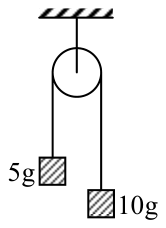
Two masses as shown are suspended from a massless pulley. Calculate the acceleration of the system when masses are left free:
- 12g/3
- 2g/3
- 3g/9
- 4g/7
Show answer and solution
Correct: option 2, g/3
For two masses over a light pulley, . With the two masses in the ratio 5 to 10, .
Question 2AIPMT 2000 Prelims, Q2
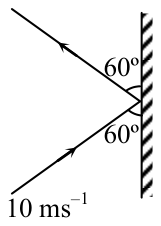
A body of mass 3 kg hits a wall at an angle of & returns at the same angle. The impact time was 0.2 s. Calculate the force exerted on the wall:
- 1 N
- 2 N
- 3100 N
- 4 N
Show answer and solution
Correct: option 1, N
The figure shows the path making with the wall, so the velocity component perpendicular to the wall is and it reverses, while the component along the wall is unchanged. Change in momentum . Force N.
Question 3AIPMT 2000 Prelims, Q3
A mass of 1kg is thrown up with a velocity of 100 m/s. After 5 seconds, it explodes into two parts. One part of mass 400 g comes down with a velocity 25 m/s Calculate the velocity of other part:
- 140 m/s upward
- 240 m/s downward
- 3100 m/s upward
- 460 m/s downward
Show answer and solution
Correct: option 3, 100 m/s upward
Taking , the velocity after 5 s is m/s upward. Momentum is conserved in the explosion: , so and m/s upward.
Question 4AIPMT 2000 Prelims, Q4
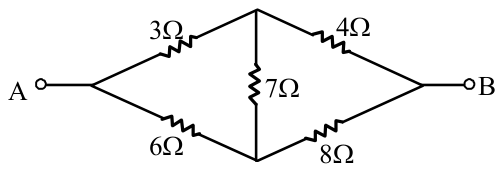
Calculate the net resistance of the circuit between A and B:
- 18/3
- 214/3
- 316/3
- 422/3
Show answer and solution
Correct: option 2, 14/3
The network is a Wheatstone bridge with , so it is balanced and no current flows in the resistor. The upper branch is and the lower branch is . In parallel, .
Question 5AIPMT 2000 Prelims, Q5
A capacitor is charged with a battery and energy stored is U. After disconnecting battery another capacitor of same capacity is connected in parallel with it. Then energy stored in each capacitor is:
- 1U/2
- 2U/4
- 34 U
- 42 U
Show answer and solution
Correct: option 2, U/4
With the battery removed the charge is fixed and is shared equally, so each capacitor holds . Energy of each .
Question 6AIPMT 2000 Prelims, Q6
Two projectiles of same mass and with same velocity are thrown at an angle & with the horizontal, then which quantity will remain same:
- 1Time of flight
- 2Horizontal range of projectile
- 3Max height acquired
- 4All of them
Show answer and solution
Correct: option 2, Horizontal range of projectile
Range , and , so complementary angles give the same range. Time of flight () and maximum height () are different for and .
Question 7AIPMT 2000 Prelims, Q7
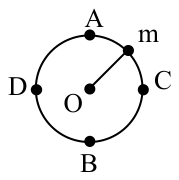
A mass is performing vertical circular motion (see figure). If the average velocity of the particle is increased, then at which point the string will break:
- 1A
- 2B
- 3C
- 4D
Show answer and solution
Correct: option 2, B
The tension is greatest at the lowest point, where the string must both support the weight and supply the centripetal force: , and the speed is also greatest there. So the string breaks at the bottom point B.
Question 8AIPMT 2000 Prelims, Q8
For the given reaction, the particle X is:
- 1Neutron
- 2Anti neutrino
- 3Neutrino
- 4Proton
Show answer and solution
Correct: option 3, Neutrino
This is positron () decay, in which a proton changes into a neutron: . Mass number and charge are already balanced by the positron, so X is the neutral, nearly massless neutrino. (An antineutrino accompanies decay.)
Question 9AIPMT 2000 Prelims, Q9
A man is slipping on a frictionless inclined plane & a bag falls down from the same height. Then the speed of both is related as:
- 1
- 2
- 3
- 4 and can't related
Show answer and solution
Correct: option 3,
With no friction, mechanical energy is conserved for both. Each loses the same height , so each reaches the bottom with speed , whatever the path. Hence .
Question 10AIPMT 2000 Prelims, Q10
A body of weight 72 N moves from the surface of earth at a height half of the radius of the earth, then gravitational force exerted on it will be:
- 136 N
- 232 N
- 3144 N
- 450 N
Show answer and solution
Correct: option 2, 32 N
Gravitational force varies as from the centre. At height the distance is , so the force is N.
Question 11AIPMT 2000 Prelims, Q11
Rainbow is formed due to:
- 1Scattering & refraction
- 2Total internal reflection & dispersion
- 3Reflection only
- 4Diffraction and dispersion
Show answer and solution
Correct: option 2, Total internal reflection & dispersion
Sunlight entering a raindrop is refracted and split into colours (dispersion), reflected internally at the back of the drop, and refracted out again. Of the choices, internal reflection with dispersion describes this.
Question 12AIPMT 2000 Prelims, Q12
Gravitational force is required for:
- 1Stirring of liquid
- 2Convection
- 3Conduction
- 4Radiation
Show answer and solution
Correct: option 2, Convection
Natural convection happens because heated fluid becomes less dense and rises while cooler, denser fluid sinks. This buoyancy exists only where there is gravity. Conduction and radiation do not need it.
Question 13AIPMT 2000 Prelims, Q13
For a plane convex lens () has radius of curvature 10 cm. It is silvered on its plane surface. Find focal length after silvering:
- 110 cm
- 220 cm
- 315 cm
- 425 cm
Show answer and solution
Correct: option 1, 10 cm
Focal length of the lens: , so cm. With the plane face silvered, light passes through the lens twice and reflects from a plane mirror (infinite focal length), so and cm.
Question 14AIPMT 2000 Prelims, Q14
By photo electric effect, Einstein proved:
- 1
- 2
- 3
- 4
Show answer and solution
Correct: option 1,
Einstein explained the photoelectric effect by treating light as photons, each of energy , one photon giving its energy to one electron. This established the quantum relation .
Question 15AIPMT 2000 Prelims, Q15
Maximum frequency of emission is obtained for the transition:
- 1n = 2 to n = 1
- 2n = 6 to n = 2
- 3n = 1 to n = 2
- 4n = 2 to n = 6
Show answer and solution
Correct: option 1, n = 2 to n = 1
Emission needs a jump from a higher to a lower level, so only options (1) and (2) are emissions. Energy released for is eV, and for is eV. The larger energy means the larger frequency, so to .
Question 16AIPMT 2000 Prelims, Q16
For a hollow cylinder & a solid cylinder rolling without slipping on an inclined plane, then which of these reaches earlier on the ground:
- 1Solid cylinder
- 2Hollow cylinder
- 3Both simultaneously
- 4Can't say anything
Show answer and solution
Correct: option 1, Solid cylinder
For rolling down an incline, . For a solid cylinder , for a hollow cylinder it is 1. The solid cylinder has the larger acceleration and reaches the ground first.
Question 17AIPMT 2000 Prelims, Q17
To find out degree of freedom, the correct expression is:
- 1
- 2
- 3
- 4
Show answer and solution
Correct: option 1,
For a gas with degrees of freedom, and , so . Rearranging gives .
Question 18AIPMT 2000 Prelims, Q18
The frequency order of for -rays (b), X-rays (a), UV-rays (c):
- 1b > a > c
- 2a > b > c
- 3c > b > a
- 4a > c > b
Show answer and solution
Correct: option 1, b > a > c
In the electromagnetic spectrum, gamma rays have the highest frequency, then X-rays, then ultraviolet. So (b) > X (a) > UV (c), that is b > a > c.
Question 19AIPMT 2000 Prelims, Q19
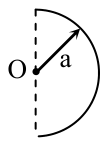
Electric field at centre O of semicircle of radius 'a' having linear charge density given is given by
- 1
- 2
- 3
- 4
Show answer and solution
Correct: option 3,
An element carries charge and gives a field at O. By symmetry only the components along the axis of the semicircle add: .
Question 20AIPMT 2000 Prelims, Q20
The width of river is 1 km. The velocity of boat is 5 km/hr. The boat covered the width of river with shortest will possible path in 15 min. Then the velocity of river stream is:
- 13 km/hr
- 24 km/hr
- 3 km/hr
- 4 km/hr
Show answer and solution
Correct: option 1, 3 km/hr
For the shortest path the boat goes straight across, so its resultant velocity is perpendicular to the flow: km/hr. The boat's own speed (5 km/hr) is the hypotenuse, so the river speed is km/hr.
Question 21AIPMT 2000 Prelims, Q21
Motion of a particle is given by equation m, The value of acceleration of the particle at t = 1 sec. is:
- 110 m/s
- 232 m/s
- 323 m/s
- 416 m/s
Show answer and solution
Correct: option 2, 32 m/s
Velocity and acceleration . At s, .
Question 22AIPMT 2000 Prelims, Q22
A charge Q is situated at the corner of a cube, the electric flux passed through all the six faces of the cube is:
- 1
- 2
- 3
- 4
Show answer and solution
Correct: option 2,
Eight identical cubes can be stacked around the corner so that the charge sits at the centre of a larger cube, through which the total flux is by Gauss's law. By symmetry each of the eight cubes gets an equal share, so the flux through the given cube is .
Question 23AIPMT 2000 Prelims, Q23
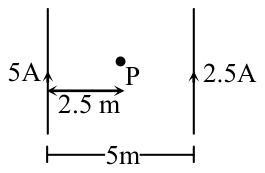
For adjoining fig., The magnetic field at point, 'P' will be:
- 1
- 2
- 3
- 4
Show answer and solution
Correct: option 3,
P is 2.5 m from each wire and both currents flow the same way (upward in the figure). The 5 A wire on the left gives into the page at P; the 2.5 A wire on the right gives out of the page. Net field , into the page ().
Question 24AIPMT 2000 Prelims, Q24
A charge having q/m equal to C/kg and with velocity m/s enters into a uniform magnetic field B = 0.3 tesla at an angle with direction of field. Then radius of curvature will be:
- 10.01 cm
- 20.5 cm
- 31 cm
- 42 cm
Show answer and solution
Correct: option 2, 0.5 cm
Only the velocity component perpendicular to the field makes the charge circle: m cm.
Question 25AIPMT 2000 Prelims, Q25
The value of quality factor is:
- 1
- 2
- 3
- 4L/R
Show answer and solution
Correct: option 1,
The quality factor of a series LCR circuit is the ratio of the reactance of the inductor (or capacitor) at resonance to the resistance: . It is dimensionless, which none of the other options is.
Question 26AIPMT 2000 Prelims, Q26
Two stationary sources each emitting waves of wave length . An observer moves from one source to other with velocity u. Then number of beats heard by him:
- 1
- 2
- 3
- 4
Show answer and solution
Correct: option 1,
Let the wave speed be and the frequency . The source he approaches is heard at and the one he leaves at . Beat frequency .
Question 27AIPMT 2000 Prelims, Q27
A string is cut into three parts, having fundamental frequencies , and respectively. Then original fundamental frequency 'n' related by the expression as:
- 1
- 2
- 3
- 4
Show answer and solution
Correct: option 1,
At the same tension, the fundamental frequency of a string is inversely proportional to its length: . Since , we get .
Question 28AIPMT 2000 Prelims, Q28
The equations of two waves given as and , Where , then resultant wave represent:
- 1a circle (c.w)
- 2a circle (a.c.w)
- 3an Ellipse (c.w)
- 4an ellipse (a.c.w)
Show answer and solution
Correct: option 2, a circle (a.c.w)
Substituting , and , so : a circle. When the phase goes from 0 to the point moves from to , that is from the top to the left, which is anticlockwise.
Question 29AIPMT 2000 Prelims, Q29
The relation between and is:
( = half life, decay constant)
- 1
- 2
- 3
- 4
Show answer and solution
Correct: option 1,
From , putting at gives , so .
Question 30AIPMT 2000 Prelims, Q30
The ratio (W/Q) for a carnot-engine is , Now the temp. of sink is reduced by C, then this ratio becomes twice, therefore the initial temp. of the sink and source are respectively:
- 1C, C
- 2C, C
- 3C, C
- 497 K, 37 K
Show answer and solution
Correct: option 2, C, C
gives . After lowering the sink by 62 K, , so and K C. Then K C. Sink C, source C.
Question 31AIPMT 2000 Prelims, Q31
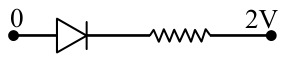
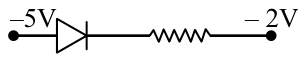
From the following diode circuit. Which diode in forward biased condition:
- 1

- 2
- 3
- 4
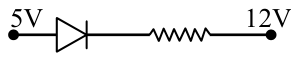
Show answer and solution
Correct: option 1
A diode is forward biased when its p-side (the base of the triangle, on the left in each picture) is at a higher potential than its n-side. In (1) the left end is at 0 V and the right end at −2 V, so the p-side is higher: forward biased. In (2) 0 V against 2 V, in (3) −5 V against −2 V and in (4) 5 V against 12 V the left end is lower, so those are reverse biased.
Question 32AIPMT 2000 Prelims, Q32
Given Truth table is correct for:
- 1NAND
- 2AND
- 3NOR
- 4OR
Show answer and solution
Correct: option 2, AND
The output is 1 only when both inputs are 1 and is 0 in every other row. That is , the AND gate.
Question 33AIPMT 2000 Prelims, Q33
The bob of simple pendulum having length , is displaced from mean position to an angular position with respect to vertical. If it is released, then velocity of bob at lowest position:
- 1
- 2
- 3
- 4
Show answer and solution
Correct: option 1,
At angle the bob is higher than the lowest point by . Energy conservation gives , so .
Question 34AIPMT 2000 Prelims, Q34
If N and m/s, then instantaneous power is:
- 1195 watt
- 245 watt
- 375 watt
- 4100 watt
Show answer and solution
Correct: option 2, 45 watt
Instantaneous power watt.
Question 35AIPMT 2000 Prelims, Q35
For the adjoining diagram, a triangular lamina is shown the correct relation between , & is
(I – moment of inertia)
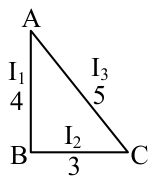
- 1
- 2
- 3
- 4
Show answer and solution
Correct: option 2,
, and are about the sides AB (4), BC (3) and AC (5). The moment of inertia is larger when the mass lies farther from the axis. About BC the lamina extends up to 4 units away, about AB up to 3 units, and about AC only up to the altitude units. For a triangular lamina about a side, , so ; of the options only is true.
Question 36AIPMT 2000 Prelims, Q36
Two spherical bob of masses and are hung vertically from two strings of length and respectively. They are executing SHM with frequency relation , Then:
- 1
- 2
- 3 &
- 4 &
Show answer and solution
Correct: option 1,
For a simple pendulum , which does not depend on the mass. , so .
Question 37AIPMT 2000 Prelims, Q37
Nuclear-Fission is best explained by:
- 1Liquid droplet theory
- 2Yukawa -meson theory
- 3Independent particle model of the nucleus
- 4Proton-proton cycle
Show answer and solution
Correct: option 1, Liquid droplet theory
In the liquid drop model (Bohr and Wheeler) the nucleus behaves like a charged drop: when it absorbs a neutron it oscillates, stretches and splits into two smaller drops, which is fission. Yukawa's theory explains the nuclear force, and the proton-proton cycle is a fusion process.
Question 38AIPMT 2000 Prelims, Q38
Who evaluated the mass of electron indirectly with help of charge:
- 1Thomson
- 2Millikan
- 3Rutherford
- 4Newton
Show answer and solution
Correct: option 2, Millikan
Thomson had measured only the ratio . Millikan's oil-drop experiment gave the charge itself, and combining it with gave the mass of the electron, .
Question 39AIPMT 2000 Prelims, Q39
A car battery of emf 12 V and internal resistance , receives a current of 60 Å from external source, then terminal voltage of battery is:
- 112 V
- 29 V
- 315 V
- 420 V
Show answer and solution
Correct: option 3, 15 V
Reading the current as 60 A: the battery is being charged, so current is driven into it against its emf and the terminal voltage is above the emf. V.
Question 40AIPMT 2000 Prelims, Q40
Two bulbs of (40 W, 200 V), and (100 W, 200 V). Then correct relation for their resistance:
- 1
- 2
- 3
- 4No relation can be predicted
Show answer and solution
Correct: option 2,
. At the same rated voltage the lower-power bulb has the higher resistance: and . So .
Question 41AIPMT 2000 Prelims, Q42
A tall man of height 6 feet, want to see his full image. Then required minimum length of the mirror will be:
- 112 feet
- 23 feet
- 36 feet
- 4Any length
Show answer and solution
Correct: option 2, 3 feet
In a plane mirror, a ray from the feet (or the top of the head) reaches the eye after reflecting at a point midway in height between the eye and the feet (or head). So the mirror needs to be only half the person's height: feet.
Question 42AIPMT 2000 Prelims, Q43
The potentiometer is best for measuring voltage, as:
- 1It has a sensitive galvanometer
- 2It has wire of high resistance
- 3It measures p.d. like in closed circuit
- 4It measures p.d. like in open circuit
Show answer and solution
Correct: option 4, It measures p.d. like in open circuit
At the balance point the galvanometer shows no deflection, so no current is drawn from the source being measured. The potentiometer therefore reads the potential difference as it is on open circuit, with no drop across the internal resistance, which a voltmeter cannot do.
Question 43AIPMT 2000 Prelims, Q44
For a planet having mass equal to mass of the earth but radius is one fourth of radius of the earth. Then escape velocity for this planet will be
- 111.2 km/s
- 222.4 km/s
- 35.6 km/s
- 444.8 km/s
Show answer and solution
Correct: option 2, 22.4 km/s
. With the same mass and , km/s.
Question 44AIPMT 2000 Prelims, Q45
The correct relation for , for a transistor:
- 1
- 2
- 3
- 4
Show answer and solution
Correct: option 2,
, and . So .
Question 45AIPMT 2000 Prelims, Q48
When an electron do transition from n = 4 to n = 2, then emitted line in spectrum will be:
- 1First line of Lyman series
- 2Second line of Balmer series
- 3First line of Paschen series
- 4Second line of Paschen series
Show answer and solution
Correct: option 2, Second line of Balmer series
Lines ending on belong to the Balmer series. The first Balmer line is and the second is .
Question 46AIPMT 2000 Prelims, Q49
A bubble in glass slab () when viewed from one side appears at 5 cm and 2 cm from other side, then thickness of slab is:
- 13.75 cm
- 23 cm
- 310.5 cm
- 42.5 cm
Show answer and solution
Correct: option 3, 10.5 cm
Real depth apparent depth. The real distances of the bubble from the two faces are cm and cm, so the thickness is cm.
Question 47AIPMT 2000 Prelims, Q50
Which pair have not equal dimensions:
- 1Energy and torque
- 2Force and impulse
- 3Angular momentum and Planck's constant
- 4Elastic modulus and pressure
Show answer and solution
Correct: option 2, Force and impulse
Force is while impulse (force time) is , so they differ. Energy and torque are both , angular momentum and Planck's constant are both , and elastic modulus and pressure are both .
AIPMT 2000 Prelims Chemistry questions
Question 48AIPMT 2000 Prelims, Q41
According to the Faraday Law of electrolysis, the mass deposited at electrode proportional to:
- 1
- 2
- 3
- 4'm' does not depend on Q
Show answer and solution
Correct: option 2,
Faraday's first law of electrolysis: the mass deposited at an electrode is directly proportional to the charge passed, , where is the electrochemical equivalent.
Question 49AIPMT 2000 Prelims, Q46
The life span of atomic hydrogen is:
- 1Fraction of one sec.
- 2One year
- 3One hour
- 4One day
Show answer and solution
Correct: option 1, Fraction of one sec.
Atomic hydrogen has an unpaired electron and is extremely reactive; the atoms recombine to almost at once. Its life is only a fraction of a second.
Question 50AIPMT 2000 Prelims, Q47
The cations and anions are arranged in alternate form in:
- 1Metallic crystal
- 2Ionic crystal
- 3Co-valent crystal
- 4Semi-conductor crystal
Show answer and solution
Correct: option 2, Ionic crystal
An ionic crystal such as NaCl is built of positive and negative ions placed alternately on the lattice and held by electrostatic attraction. Metallic crystals have positive ions in a sea of electrons, and covalent and semiconductor crystals are made of atoms joined by shared electrons.
Question 51AIPMT 2000 Prelims, Q51
Increasing order of electrophilic substitution for following compounds:
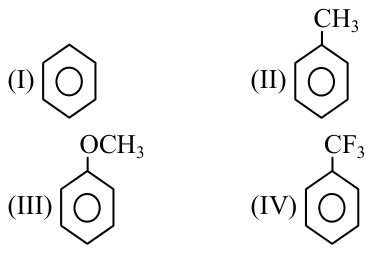
- 1IV < I < II < III
- 2III < II < I < IV
- 3I < IV < III < II
- 4II < III < I < IV
Show answer and solution
Correct: option 1, IV < I < II < III
Electrophilic substitution is faster when the ring is richer in electrons. donates strongly by resonance and donates weakly by induction and hyperconjugation, so both activate the ring, the methoxy group more. withdraws electrons strongly and deactivates the ring below benzene. The order is IV < I < II < III.
Question 52AIPMT 2000 Prelims, Q52
Ethyl benzoate can be prepared from benzoic acid by using:
- 1Ethyl alcohol
- 2Ethyl alcohol and dry HCl
- 3Ethyl chloride
- 4Sodium ethoxide
Show answer and solution
Correct: option 2, Ethyl alcohol and dry HCl
A carboxylic acid forms an ester with an alcohol only in the presence of an acid catalyst (Fischer esterification): . Alcohol alone reacts far too slowly, and ethyl chloride or sodium ethoxide do not esterify the free acid.
Question 53AIPMT 2000 Prelims, Q53
Polarization in acrolein as:
- 1
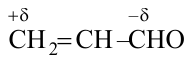
- 2
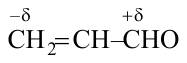
- 3
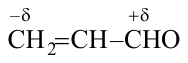
- 4
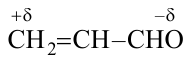
Show answer and solution
Correct: option 4
In acrolein the C=C bond is conjugated with the C=O group. Oxygen is the most electronegative atom, so the electrons are drawn towards it through the conjugated system: . The terminal carbon therefore carries the partial positive charge and the oxygen the partial negative charge, which is the picture in option 4.
Question 54AIPMT 2000 Prelims, Q54
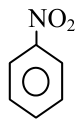
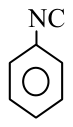
A B C N-methyl aniline then A is:
- 1
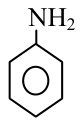
- 2
- 3
- 4
Show answer and solution
Correct: option 2
Work backwards. N-methylaniline, , is formed by reducing phenyl isocyanide, , so C is phenyl isocyanide. An isocyanide is made from a primary amine with and KOH (carbylamine reaction), so B is aniline. Aniline is obtained by reducing nitrobenzene, so A is nitrobenzene, option 2.
Question 55AIPMT 2000 Prelims, Q55
First product of the reaction between RCHO and :
- 1
- 2
- 3
- 4
Show answer and solution
Correct: option 1,
Hydrazine adds to the carbonyl group and a molecule of water is lost, giving a hydrazone: . This hydrazone is the first product (further heating with base would reduce it to the alkane).
Question 56AIPMT 2000 Prelims, Q56
In Friedal craft reaction Toluene can be prepared by:
- 1
- 2
- 3
- 4
Show answer and solution
Correct: option 1,
Friedel-Crafts alkylation puts an alkyl group on benzene using an alkyl halide and anhydrous : . Acetyl chloride would give acetophenone, and would link two rings.
Question 57AIPMT 2000 Prelims, Q57
Which reagent converts propene to 1-propanol:
- 1
- 2
- 3
- 4Aq. KOH
Show answer and solution
Correct: option 2,
1-Propanol is the anti-Markovnikov hydration product of propene. Hydroboration-oxidation (, then ) places the OH on the less substituted carbon and gives . Acid-catalysed hydration and oxymercuration-demercuration follow Markovnikov's rule and give 2-propanol, and aqueous KOH does not react with an alkene.
Question 58AIPMT 2000 Prelims, Q58
Reduction by of hydrolysed product of an ester gives:
- 1Two alcohols
- 2Two aldehyde
- 3One acid and one alcohol
- 4Two acids
Show answer and solution
Correct: option 1, Two alcohols
Hydrolysis of an ester gives a carboxylic acid RCOOH and an alcohol . reduces the acid to the primary alcohol and leaves unchanged, so two alcohols are obtained.
Question 59AIPMT 2000 Prelims, Q59
-D-glucose and -D-glucose are:
- 1Epimers
- 2Anomer
- 3Enantiomers
- 4Diastereomers
Show answer and solution
Correct: option 2, Anomer
The two cyclic forms of D-glucose differ only in the configuration at C-1, the hemiacetal (anomeric) carbon created when the ring closes. Stereoisomers that differ only at this carbon are called anomers.
Question 60AIPMT 2000 Prelims, Q60
- 1Teflon
- 2Orlon
- 3Polythene
- 4Nylon-6
Show answer and solution
Correct: option 1, Teflon
Tetrafluoroethene polymerises by addition to polytetrafluoroethene, , which is Teflon. Orlon comes from acrylonitrile, polythene from ethene and nylon-6 from caprolactam.
Question 61AIPMT 2000 Prelims, Q61
Correct order of stability is:
- 11-butene > Trans-2-butene > Cis-2-butene
- 2Trans-2-butene > 1-butene > Cis-2-butene
- 3Trans-2-butene > Cis-2-butene > 1-butene
- 4Cis-2-butene > Trans-2-butene > 1-butene
Show answer and solution
Correct: option 3, Trans-2-butene > Cis-2-butene > 1-butene
A more substituted double bond is more stable because of more hyperconjugation: both 2-butenes (disubstituted, six -hydrogens) are more stable than 1-butene (monosubstituted, two -hydrogens). Of the 2-butenes the trans isomer is more stable because its two methyl groups are far apart, while in the cis isomer they crowd each other. So trans-2-butene > cis-2-butene > 1-butene.
Question 62AIPMT 2000 Prelims, Q62
2-butene shows geometrical isomerism due to:
- 1Restricted rotation about double bond
- 2Free rotation about double bond
- 3Free rotation about single bond
- 4Chiral carbon
Show answer and solution
Correct: option 1, Restricted rotation about double bond
Rotation about C=C would break the bond, so it does not happen at ordinary temperatures. Each doubly bonded carbon of 2-butene carries two different groups (H and ), so the fixed arrangement gives separate cis and trans isomers.
Question 63AIPMT 2000 Prelims, Q63
Dihedral angle in staggered form of ethane is:
- 1
- 2
- 3
- 4
Show answer and solution
Correct: option 3,
In the Newman projection of staggered ethane each C-H bond of the front carbon lies midway between two C-H bonds of the back carbon. The bonds on one carbon are apart, so the angle between a front and the nearest back C-H bond is . ( is the eclipsed form.)
Question 64AIPMT 2000 Prelims, Q64
Which one is responsible for produce energy in bio reaction:
- 1Thyroxine
- 2Adrenelene
- 3Oestrogen
- 4Projestrone
Show answer and solution
Correct: option 1, Thyroxine
Thyroxine, the iodine-containing hormone of the thyroid gland, controls the basal metabolic rate, that is, the rate at which food is oxidised in the cells to release energy. Oestrogen and progesterone are sex hormones, and adrenaline acts only in emergency responses, so thyroxine is the keyed answer.
Question 65AIPMT 2000 Prelims, Q65
Average molar kinetic energy of CO and at same temperature is:
- 1
- 2
- 3
- 4Can't say any thing. Both volumes are not given
Show answer and solution
Correct: option 1,
The average kinetic energy of one mole of an ideal gas is . It depends only on the temperature, not on the nature of the gas or its volume, so at the same temperature the two values are equal.
Question 66AIPMT 2000 Prelims, Q66
For given energy, corresponding wavelength will be Joules ( J x sec., m/sec.)
- 165.3 nm.
- 26.53 nm.
- 33.4 nm.
- 4653 nm.
Show answer and solution
Correct: option 4, 653 nm.
, so .
Question 67AIPMT 2000 Prelims, Q67
Equilibrium constant Kp for following reaction:
- 1
- 2
- 3
- 4
Show answer and solution
Correct: option 1,
In a heterogeneous equilibrium the active mass of a pure solid is constant and is taken as 1, so solids do not appear in the expression. Only the gas remains, giving .
Question 68AIPMT 2000 Prelims, Q68
Correct relation b/w dissociation constant's of a di-basic acid:
- 1
- 2
- 3
- 4
Show answer and solution
Correct: option 2,
The first proton leaves a neutral molecule, but the second has to leave an ion that is already negatively charged, which holds it more strongly. The second ionisation is therefore always weaker, so .
Question 69AIPMT 2000 Prelims, Q69
For a any reversible reaction. If increases concentration of reactants. Then effect on equilibrium constant:
- 1Depend's on amount of concentration
- 2Unchange
- 3Decrease
- 4Increase
Show answer and solution
Correct: option 2, Unchange
The equilibrium constant of a reaction depends only on temperature. Adding more reactant shifts the position of equilibrium towards the products, but the concentrations readjust so that the ratio keeps the same value. The constant is unchanged.
Question 70AIPMT 2000 Prelims, Q70
A cube of any crystal A-atom placed at every corners and B-atom placed at every centre of face. The formula of compound:
- 1AB
- 2
- 3
- 4
Show answer and solution
Correct: option 2,
A corner atom is shared by 8 cubes, so A atoms per unit cell . A face-centre atom is shared by 2 cubes, so B atoms per unit cell . The formula is .
Question 71AIPMT 2000 Prelims, Q71
In quantitative analysis of second group in lab. gas is passed in acidic medium for ppt. When and react with KCN, then in which of the following condition, ppt will not be formed due to relative stability:
- 1 - More stable
- Less stable
- 2 - Less stable
- More stable
- 3 - More stable
- Less stable
- 4 - Less stable
- More stable
Show answer and solution
Correct: option 3, - More stable
- Less stable
Excess KCN reduces to copper(I) and forms the very stable complex , which gives almost no free copper ions, so cannot precipitate copper sulphide. Cadmium stays as cadmium(II) in , which is much less stable and releases enough for yellow CdS to precipitate. Option 3 has both the correct formulas and the correct stabilities.
Question 72AIPMT 2000 Prelims, Q72
- 1
- 2
- 3
- 4
Show answer and solution
Correct: option 4,
A conjugate acid is formed by adding one proton to the base: .
Question 73AIPMT 2000 Prelims, Q73
Which statement is wrong about pH and
- 1pH of neutral water does not zero
- 2Adding 1N, 1N soln of and NaOH pH will be seven
- 3pH of dilute and hot is more than concentrate and cold
- 4Mixing solution of and HCl, pH will be less than 7
Show answer and solution
Correct: option 2, Adding 1N, 1N soln of and NaOH pH will be seven
Equal amounts of acetic acid (weak acid) and NaOH (strong base) give sodium acetate, whose acetate ion is hydrolysed by water to release , so the pH is above 7, not 7. Statement 2 is the wrong one. The others hold: neutral water has pH 7, a more dilute acid has a higher pH, and a mixture of two acids is acidic.
Question 74AIPMT 2000 Prelims, Q74
A 300 gram radioactive sample has half life of 3 hour's. After 18 hour's remaining quantity will be:
- 14.68 gram
- 22.34 gram
- 33.34 gram
- 49.37 gram
Show answer and solution
Correct: option 1, 4.68 gram
Number of half-lives . Amount left , which is the 4.68 gram of option 1.
Question 75AIPMT 2000 Prelims, Q75
Which of the following compound is electron defficient:
- 1
- 2
- 3
- 4
Show answer and solution
Correct: option 2,
In boron has only three bond pairs, six electrons in its valence shell, so its octet is incomplete and it readily accepts an electron pair (a Lewis acid). has a complete octet and an expanded one. Monomeric also has an incomplete octet, but is the standard example and the keyed answer.
Question 76AIPMT 2000 Prelims, Q76
- 1
- 2
- 3
- 4
Show answer and solution
Correct: option 2,
Carbon and nitrogen belong to the second period and have no d orbitals, so their bonds with oxygen are -. Phosphorus has vacant 3d orbitals; in its s and p orbitals are used in the four bonds and the bond to oxygen is formed by a d orbital of P with a p orbital of O.
Question 77AIPMT 2000 Prelims, Q77
Which statement is wrong:
- 1Bond energy of
- 2Electronegativity of F > Cl
- 3F is more oxidising than Cl
- 4Electron affinity of Cl > F
Show answer and solution
Correct: option 1, Bond energy of
The F atom is very small, so the lone pairs on the two atoms of repel each other strongly and weaken the bond: the bond energy of (about 158 kJ/mol) is less than that of (about 243 kJ/mol). Statement 1 is wrong. The other three are true; chlorine has the higher electron affinity for the same reason of fluorine's small size.
Question 78AIPMT 2000 Prelims, Q78
Which compound form linear polymer due to H-bond:
- 1
- 2
- 3HBr
- 4HCl
Show answer and solution
Correct: option 2,
HBr and HCl do not form hydrogen bonds of any strength. Water has two lone pairs and two hydrogens, so each molecule bonds to four others and builds a three-dimensional network. Ammonia has only one lone pair on nitrogen, so each molecule can accept just one hydrogen bond and the molecules join into chains. Of the given options is the keyed answer.
Question 79AIPMT 2000 Prelims, Q79
- 1Octahedral
- 2Square planar
- 3Trigonal bipyramidal
- 4Square pyramidal
Show answer and solution
Correct: option 3, Trigonal bipyramidal
Iron is in the zero oxidation state. The strong-field CO ligands pair up its eight valence electrons into four 3d orbitals, leaving one 3d, the 4s and the three 4p orbitals for hybridisation. Five hybrid orbitals point to the corners of a trigonal bipyramid.
Question 80AIPMT 2000 Prelims, Q80
Correct order of dissociation energy of and is:
- 1
- 2
- 3
- 4None
Show answer and solution
Correct: option 1,
has 10 bonding and 4 antibonding electrons, bond order . has lost one bonding electron, bond order . A higher bond order means a stronger bond, so the dissociation energy of is greater.
Question 81AIPMT 2000 Prelims, Q81
Isoelectronic species are:
- 1
- 2
- 3
- 4
Show answer and solution
Correct: option 1,
Count the electrons: CO has , has , has and has . All four species in option 1 have 14 electrons. In the other options the counts differ (for example CO 14, CN 13, NO 15, 12).
Question 82AIPMT 2000 Prelims, Q82
- 1
- 2
- 3
- 4
Show answer and solution
Correct: option 2,
Colour in transition metal ions comes from d-d transitions, which need at least one d electron. is , so it is colourless. (), () and () have unpaired d electrons and are coloured.
Question 83AIPMT 2000 Prelims, Q83
- 1Chlorophyll
- 2Haemoglobin
- 3Vitamin-12
- 4Vitamin-B
Show answer and solution
Correct: option 1, Chlorophyll
Chlorophyll, the green pigment of plants, is a porphyrin complex with at its centre. Haemoglobin contains iron and vitamin contains cobalt.
Question 84AIPMT 2000 Prelims, Q84
Which of the following element exhibit maximum oxidation state:
- 1Cr
- 2Mn
- 3Fe
- 4V
Show answer and solution
Correct: option 2, Mn
Mn () can use all seven of its valence electrons and shows +7, as in . The highest states of the others are lower: Cr +6, V +5 and Fe +6 (rare).
Question 85AIPMT 2000 Prelims, Q85
Which of the following statement is correct for the stability of ions of ethyl alcohol and phenol:
- 1Delocalisation of -electrons in phenoxide ion
- 2Delocalisation of electrons in ethoxide ion
- 3Inductive effect of ethyl and phenyl group
- 4Localisation of -electrons in phenoxide ion
Show answer and solution
Correct: option 1, Delocalisation of -electrons in phenoxide ion
In the phenoxide ion the negative charge on oxygen is spread over the benzene ring by resonance, which stabilises the ion. In the ethoxide ion the charge stays on oxygen and is even intensified by the electron-releasing ethyl group. This delocalisation in phenoxide is why phenol is a stronger acid than ethanol.
Question 86AIPMT 2000 Prelims, Q86
Which compound has planar structure:
- 1
- 2
- 3
- 4
Show answer and solution
Correct: option 1,
In xenon has four bond pairs and two lone pairs (). The lone pairs take opposite positions of the octahedron, leaving the four fluorines at the corners of a square, so the molecule is square planar. is see-saw shaped and is tetrahedral. ( is T-shaped; is the keyed answer.)
Question 87AIPMT 2000 Prelims, Q87
Which complex compound will give four isomers:
- 1
- 2
- 3
- 4
Show answer and solution
Correct: option 3,
The complex ion in option 3 is octahedral of the type . The three groups can sit on one face (fac, one arrangement) or in one plane (mer), and in the mer form the position opposite a can be taken by , Cl or Br (three arrangements). That gives four geometrical isomers. has only two optical isomers, has three (trans, and a cis pair of mirror images), and option 4 has none.
Question 88AIPMT 2000 Prelims, Q88
Which species does not exhibits paramagnetism:
- 1
- 2
- 3CO
- 4NO
Show answer and solution
Correct: option 3, CO
A species with an odd number of electrons must have an unpaired electron: (13), (17) and NO (15) are all paramagnetic. CO has 14 electrons, the same arrangement as , with every electron paired, so it is diamagnetic.
Question 89AIPMT 2000 Prelims, Q89
For the disproportionation of copper:
, is: (Given for is 0.34 V & for is 0.15 V:
- 10.49 V
- 2 V
- 30.38 V
- 4 V
Show answer and solution
Correct: option 3, 0.38 V
First find for by adding free energies (): , so V. In the disproportionation one is reduced to Cu (cathode, 0.53 V) and the other is oxidised to (anode couple, 0.15 V). V.
Question 90AIPMT 2000 Prelims, Q90
Cell reaction is spontaneous when:
- 1 is negative
- 2 is positive
- 3 is positive
- 4 is negative
Show answer and solution
Correct: option 1, is negative
A process is spontaneous when its free energy decreases. For a cell , so a spontaneous cell reaction has a positive cell emf and a negative . The sign of a single reduction potential alone does not decide it; the keyed answer is option 1.
Question 91AIPMT 2000 Prelims, Q91
At infinite dilution equivalent conductances of & ions are 127 & 76 respectively. Equivalent conductance of at infinite dilutions is:
- 1139.5
- 2101.5
- 3203
- 4279
Show answer and solution
Correct: option 1, 139.5
The keyed answer treats the given values as ionic conductances per mole of ions. One equivalent of contains half a mole of and one mole of , so by Kohlrausch's law . (If 127 were already the conductance per equivalent of , as the wording says, the sum would be .)
Question 92AIPMT 2000 Prelims, Q92
J
J
J
for the following reaction is:
- 1 J
- 2 J
- 3 J
- 4 J
Show answer and solution
Correct: option 1, J
The required reaction is (first equation) (second equation) (third equation): the 2Zn and cancel and . So J.
Question 93AIPMT 2000 Prelims, Q93
At latent heat of fusion of a compound is 2930 J/mol. Entropy change is:
- 19.77 J/mol-K
- 210.77 J/mol-K
- 39.07 J/mol-K
- 40.977 J/mol-K
Show answer and solution
Correct: option 1, 9.77 J/mol-K
For a phase change at its equilibrium temperature , with K.
Question 94AIPMT 2000 Prelims, Q94
For the reaction which one is true:
- 1
- 2
- 3
- 4
Show answer and solution
Correct: option 1,
, where counts only gases. Here (the ethanol and water are liquids), so .
Question 95AIPMT 2000 Prelims, Q95
For the reaction which of the following relation correctly represents the consumption & formation of reactants and products:
- 1
- 2
- 3
- 4
Show answer and solution
Correct: option 1,
The rate is each concentration change divided by its coefficient, negative for a reactant. With the coefficients printed in the question (3 for , 5 for ): , so . The minus sign shows that bromide is used up while bromine forms.
Question 96AIPMT 2000 Prelims, Q96
From the colligative properties of solution which one is the best method for the determination of mol. wt of proteins & polymers:
- 1Osmotic pressure
- 2Lowering in V.P.
- 3Lowering is freezing point
- 4Elevation in B.Pt.
Show answer and solution
Correct: option 1, Osmotic pressure
Proteins and polymers have very high molar masses, so even a concentrated solution contains very few moles and the changes in vapour pressure, freezing point and boiling point are too small to measure. Osmotic pressure is large enough to measure even for very dilute solutions, and it is measured at room temperature, so the molecules are not damaged by heating.
Question 97AIPMT 2000 Prelims, Q97
Which one of the following method is commonly used method for destruction of colloid:
- 1Dialysis
- 2Condensation
- 3Filteration by animal membrane
- 4By adding electrolyte
Show answer and solution
Correct: option 4, By adding electrolyte
Colloidal particles stay dispersed because they all carry the same kind of charge and repel one another. Ions of an added electrolyte neutralise this charge, the particles come together and settle out (coagulation). Dialysis and filtration through an animal membrane purify a sol, and condensation is a way of preparing one.
Question 98AIPMT 2000 Prelims, Q98
Volume of obtained by the complete decomposition of 9.85 gm. is:
- 12.24 lit.
- 21.12 lit.
- 30.84 lit.
- 40.56 lit.
Show answer and solution
Correct: option 2, 1.12 lit.
. Molar mass of , so moles . One mole of carbonate gives one mole of , so the volume at STP is litre.
Question 99AIPMT 2000 Prelims, Q99
Oxidation numbers of A, B and C are +2, +5 and respectively possible formula of compound is:
- 1
- 2
- 3
- 4
Show answer and solution
Correct: option 2,
The oxidation numbers in a neutral compound add up to zero. For : . The others do not balance: option 1 gives , option 3 gives and option 4 gives .
Question 100AIPMT 2000 Prelims, Q100
R and S enantiomer are differ in:
- 1Rotation of PPL
- 2Solubility in achiral solvent
- 3Chemical properties
- 4Dipole moment
Show answer and solution
Correct: option 1, Rotation of PPL
Enantiomers are mirror images, so they have the same physical properties (solubility in ordinary solvents, dipole moment, melting point) and the same chemical properties towards achiral reagents. They differ only in the direction in which they rotate plane polarised light: one turns it to the right and the other to the left by the same angle.
AIPMT 2000 Prelims Biology questions
Question 101AIPMT 2000 Prelims, Q101
The first step for initiation of photosynthesis will be:
- 1Photolysis of water
- 2Excitement of chlorophyll molecule due to absorption of light
- 3ATP formation
- 4Glucose formation
Show answer and solution
Correct: option 2, Excitement of chlorophyll molecule due to absorption of light
Photosynthesis begins when a chlorophyll molecule absorbs a photon and one of its electrons is raised to an excited state. Photolysis of water, ATP formation and sugar formation all follow from this event, so option (2) is the first step.
Question 102AIPMT 2000 Prelims, Q102
When the plants are grown in magnesium deficient but urea rich soil; the symptoms expressed are:
- 1Yellowish leaves
- 2Colourless petiole
- 3Dark green leaves
- 4Shoot apex die
Show answer and solution
Correct: option 1, Yellowish leaves
Magnesium is the central atom of the chlorophyll molecule. Even with plenty of nitrogen from urea, chlorophyll cannot be made without magnesium, so the leaves lose their green colour and turn yellow (chlorosis).
Question 103AIPMT 2000 Prelims, Q103
For the synthesis of one glucose molecule the calvin cycle operates for:
- 12 times
- 24 times
- 36 times
- 48 times
Show answer and solution
Correct: option 3, 6 times
Each turn of the Calvin cycle fixes one molecule of . Glucose has six carbon atoms, so six turns are needed to make one glucose molecule.
Question 104AIPMT 2000 Prelims, Q104
Plants take zinc in form of:
- 1
- 2
- 3
- 4
Show answer and solution
Correct: option 2,
Mineral elements are absorbed by roots as ions from the soil solution. Zinc is taken up as the divalent cation , not as a compound or as the free metal.
Question 105AIPMT 2000 Prelims, Q105
The bacteria generally used for genetic engineering is:
- 1Agrobacterium
- 2Bacillus
- 3Pseudomonas
- 4Clostridium
Show answer and solution
Correct: option 1, Agrobacterium
Agrobacterium tumefaciens naturally transfers a piece of its Ti plasmid (T-DNA) into plant cells. The modified Ti plasmid is therefore widely used as a vector to carry desired genes into plants, which makes Agrobacterium the answer among these options.
Question 106AIPMT 2000 Prelims, Q106
For assimilation of one molecule; the energy required in form of ATP &
- 12 ATP & 2
- 25 ATP & 3
- 33 ATP & 2
- 418 ATP & 12
Show answer and solution
Correct: option 3, 3 ATP & 2
In the Calvin cycle, fixing one uses 2 ATP and 2 in the reduction of two PGA molecules and 1 more ATP to regenerate RuBP. That is 3 ATP and 2 per ; 18 ATP and 12 is the total for a whole glucose.
Question 107AIPMT 2000 Prelims, Q107
Which is the first Acceptor enzyme in plants:
- 1RuDP Carboxylase
- 2Phosphoric acid
- 3RUBISCO
- 4PEP-Carboxylase
Show answer and solution
Correct: option 4, PEP-Carboxylase
In plants is first fixed in the mesophyll cells, where PEP carboxylase joins it to phosphoenolpyruvate to give oxaloacetic acid. RuBisCO (RuDP carboxylase) acts only later, in the bundle sheath cells.
Question 108AIPMT 2000 Prelims, Q108
According to mendelism which character is showing dominance:
- 1Terminal position of flower
- 2Green colour in seed coat
- 3Wrinkled seed
- 4Green pod colour
Show answer and solution
Correct: option 4, Green pod colour
In Mendel's pea characters, green pod colour is dominant over yellow. Terminal flower position and wrinkled seed are recessive, and green seed colour is also the recessive form, so option (4) is the dominant character.
Question 109AIPMT 2000 Prelims, Q109
Due to the cross between TTRr × ttrr the resultant progenies showed how many percent plants tall, red flowered:
- 150%
- 275%
- 325%
- 4100%
Show answer and solution
Correct: option 1, 50%
TT × tt gives only Tt, so every plant is tall. Rr × rr gives Rr and rr in a 1 : 1 ratio, so half the plants are red flowered. Tall and red flowered plants are therefore 100% × 50% = 50%.
Question 110AIPMT 2000 Prelims, Q110
Which is showing accurate pairing:
- 1Syphilis - Treponema pallidum
- 2AIDS - Bacillus conjugalis
- 3Gonorrhoea - Leishmania donovani
- 4Typhoid - Mycobacterium leprae
Show answer and solution
Correct: option 1, Syphilis - Treponema pallidum
Syphilis is caused by the spirochaete Treponema pallidum. AIDS is caused by the virus HIV, gonorrhoea by Neisseria gonorrhoeae (Leishmania donovani causes kala-azar), and typhoid by Salmonella typhi (Mycobacterium leprae causes leprosy).
Question 111AIPMT 2000 Prelims, Q111
Which is expressing right appropriate pairing:
- 1Brassicaceae - Sunflower
- 2Malvaceae - Cotton
- 3Papilionaceae - Catechu
- 4Liliaceae - Wheat
Show answer and solution
Correct: option 2, Malvaceae - Cotton
Cotton (Gossypium) belongs to Malvaceae. Sunflower is in Asteraceae (Compositae), catechu (Acacia catechu) is in Mimosaceae, and wheat is a grass of Poaceae (Gramineae).
Question 112AIPMT 2000 Prelims, Q112
- 1Fungi
- 2Algae
- 3Virus
- 4Cyanobacteria
Show answer and solution
Correct: option 3, Virus
Fungi, algae and cyanobacteria are cellular organisms with their own metabolism and so have a full set of enzymes. A virus is only nucleic acid in a protein coat with no metabolic machinery of its own; it depends on the enzymes of the host cell.
Question 113AIPMT 2000 Prelims, Q113
Virus are living, because:
- 1They multiply in host cells
- 2Carry anaerobic respiration
- 3Carry metabolic activity
- 4Cause infection
Show answer and solution
Correct: option 1, They multiply in host cells
Viruses do not respire or carry out any metabolism of their own. Their one living property is reproduction: inside a host cell they replicate their genetic material and produce new virus particles.
Question 114AIPMT 2000 Prelims, Q114
If the apical bud has been removed then we observe:
- 1More lateral branches
- 2More axillary buds
- 3Plant growth stops
- 4Flowering stops
Show answer and solution
Correct: option 1, More lateral branches
Auxin from the apical bud suppresses the growth of the axillary buds below it (apical dominance). Removing the apical bud removes this inhibition, so the existing axillary buds grow out into lateral branches.
Question 115AIPMT 2000 Prelims, Q115
Which hormone is responsible for fruit ripening:
- 1Ethylene
- 2Auxin
- 3Ethyl chloride
- 4Cytokinin
Show answer and solution
Correct: option 1, Ethylene
Ethylene is the gaseous plant hormone that triggers ripening; it raises the rate of respiration in the fruit (the climacteric rise) and brings about softening and colour change.
Question 116AIPMT 2000 Prelims, Q116
Eight nucleated embryosac is a:
- 1Only monosporic
- 2Only bisporic
- 3Only tetra sporic
- 4Any of the above
Show answer and solution
Correct: option 4, Any of the above
An eight-nucleate embryo sac can arise from one megaspore (monosporic, Polygonum type), from two megaspore nuclei (bisporic, Allium type) or from all four (tetrasporic, Adoxa type). So the eight-nucleate condition is not limited to any one type.
Question 117AIPMT 2000 Prelims, Q117
Which is the cause of damage to relative biological effectiveness:
- 1High temperature
- 2Pollution
- 3Radiation
- 4Low temperature
Show answer and solution
Correct: option 2, Pollution
The key gives Pollution. Relative biological effectiveness (RBE) is a term from radiation biology: it compares the biological damage done by different kinds of ionising radiation for the same absorbed dose, which points to Radiation, option (3). The keyed answer is kept here as printed in the unofficial key; treat it with caution.
Question 118AIPMT 2000 Prelims, Q118
Which is the reason for highest biomass in aquatic ecosystem:
- 1Nano plankton, blue green algae, green algae
- 2Sea grass, and slime molds
- 3Benthonic and brown algae
- 4Diatoms
Show answer and solution
Correct: option 3, Benthonic and brown algae
The key gives benthonic and brown algae. Planktonic forms are tiny and short-lived, so their standing mass at any moment is small, whereas attached bottom-dwelling algae such as the large brown kelps have big, long-lived bodies and build up a large standing biomass.
Question 119AIPMT 2000 Prelims, Q119
- 1Carrot
- 2Radish
- 3Ground nut
- 4Turnip
Show answer and solution
Correct: option 3, Ground nut
A geocarpic fruit is one that develops under the soil. In groundnut the stalk of the fertilised ovary (the peg) grows down into the soil and the pod ripens there. Carrot, radish and turnip are swollen roots, not fruits.
Question 120AIPMT 2000 Prelims, Q120
Endosperm is formed during the double fertilization by:
- 1Two polar nuclei & one male gamete
- 2One polar nuclei & one male gamete
- 3Ovum and male gamete
- 4Two polar nuclei & two male gametes
Show answer and solution
Correct: option 1, Two polar nuclei & one male gamete
In double fertilisation one male gamete fuses with the egg to form the zygote. The other male gamete fuses with the two polar nuclei (triple fusion) to give the triploid primary endosperm nucleus, which develops into the endosperm.
Question 121AIPMT 2000 Prelims, Q121
By which action a seed coat becomes permeable to water:
- 1Scarification
- 2Stratification
- 3Vernalization
- 4All of the above
Show answer and solution
Correct: option 1, Scarification
Scarification is the weakening or scratching of a hard seed coat by abrasion, acid or other means so that water and gases can enter. Stratification is a chilling treatment of moist seeds and vernalisation is a cold treatment that promotes flowering; neither acts on the seed coat.
Question 122AIPMT 2000 Prelims, Q122
What is true for mammalia:
- 1Platypus is oviparous
- 2Bats have feather
- 3Elephant is a ovo viviparous
- 4Diaphragm is absent in them
Show answer and solution
Correct: option 1, Platypus is oviparous
The platypus is a monotreme, an egg-laying mammal. Bats have hair and a skin membrane for flight, not feathers; the elephant is viviparous; and a muscular diaphragm is a characteristic of all mammals.
Question 123AIPMT 2000 Prelims, Q123
Which of the following character is not found in all the chordates:
- 1Diaphragm
- 2Coelom
- 3Pharyngeal gill clefts
- 4Dorsal nerve cord
Show answer and solution
Correct: option 1, Diaphragm
A dorsal hollow nerve cord and pharyngeal gill clefts are defining chordate features, and all chordates are coelomate. A muscular diaphragm separating thorax and abdomen is found only in mammals.
Question 124AIPMT 2000 Prelims, Q124
Hair are found in the inflorescences of Zea mays are the modification of:
- 1Style
- 2Stigma
- 3Spathe
- 4Filaments
Show answer and solution
Correct: option 1, Style
The long silky threads (corn silk) hanging from the female inflorescence of maize are the very long styles of the individual flowers; each one catches pollen and leads to one grain.
Question 125AIPMT 2000 Prelims, Q125
Pneumatophores are found in:
- 1The vegetation which is found in marshy and saline lake
- 2The vegetation which found in saline soil
- 3Xerophytes
- 4Epiphytes
Show answer and solution
Correct: option 1, The vegetation which is found in marshy and saline lake
Pneumatophores are roots that grow vertically upward out of waterlogged mud to take in air. They are typical of mangrove plants such as Rhizophora, which grow in marshy, saline, oxygen-poor swamps.
Question 126AIPMT 2000 Prelims, Q126
Concentration of urine depends upon which organ:
- 1Bowman's capsule
- 2Length of Henle's loop
- 3P.C.T.
- 4Network of capillaries arising from glomerulus
Show answer and solution
Correct: option 2, Length of Henle's loop
The loop of Henle works as a counter-current system that builds up a high solute concentration in the medulla, which draws water out of the collecting duct. The longer the loop, the steeper this gradient and the more concentrated the urine.
Question 127AIPMT 2000 Prelims, Q127
In which point pulmonary artery is different from pulmonary vein:
- 1Its lumen is broad
- 2Its wall is thick
- 3It have valves
- 4It does not possess endothelium
Show answer and solution
Correct: option 2, Its wall is thick
Like all arteries, the pulmonary artery carries blood pumped under pressure from the ventricle and has a thick, muscular and elastic wall with a narrower lumen. The pulmonary vein has a thin wall and a wider lumen; both are lined by endothelium.
Question 128AIPMT 2000 Prelims, Q128
Reason, why hair loss is more in old age:
- 1Reduction of blood supply
- 2Decrease in protein synthesis
- 3Low energy production
- 4Reduced storage of glycogen
Show answer and solution
Correct: option 1, Reduction of blood supply
The key gives reduction of blood supply. Hair follicles are nourished by the capillaries of the dermal papilla; with age the circulation to the skin falls, the follicles are poorly nourished and shrink, and hair is lost faster than it is replaced.
Question 129AIPMT 2000 Prelims, Q129
What is the work of copper T:
- 1To inhibit ovulation
- 2To inhibit fertilization
- 3To inhibit implantation of blastocyst
- 4To inhibit gametogenesis
Show answer and solution
Correct: option 3, To inhibit implantation of blastocyst
Copper T is an intra-uterine device. It does not stop ovulation or gamete formation; by its presence in the uterus it makes the uterine lining unsuitable for a blastocyst to implant, which is the answer the key takes. (The present NCERT text also stresses that the copper ions released reduce sperm motility and fertilising capacity.)
Question 130AIPMT 2000 Prelims, Q130
What is the work of progesterone which is present in oral contraceptive pills:
- 1To inhibit ovulation
- 2To check oogenesis
- 3To check entry of sperms into cervix & to make them inactive
- 4To check sexual behaviour
Show answer and solution
Correct: option 1, To inhibit ovulation
The progestogen in the pill acts by negative feedback on the hypothalamus and pituitary, suppressing the release of FSH and LH. Without the LH surge no ovum is released, so ovulation is inhibited.
Question 131AIPMT 2000 Prelims, Q131
Conversion of ammonia to urea is done by ……… Cycle:
- 1Ornithine cycle
- 2Arginine cycle
- 3Fumaric cycle
- 4Citrulline cycle
Show answer and solution
Correct: option 1, Ornithine cycle
In the liver, ammonia and carbon dioxide are converted to urea by the urea cycle, which is named the ornithine cycle (Krebs-Henseleit cycle) because ornithine is the carrier that is regenerated at the end of each turn.
Question 132AIPMT 2000 Prelims, Q132
What is name of joint between ribs and sternum:
- 1Cartilaginous joint
- 2Angular joint
- 3Gliding joint
- 4Fibrous joints
Show answer and solution
Correct: option 1, Cartilaginous joint
The ribs do not meet the sternum bone to bone; they are joined to it through bars of hyaline cartilage (the costal cartilages). A joint in which the bones are held together by cartilage is a cartilaginous joint.
Question 133AIPMT 2000 Prelims, Q133
Bone related with skull is:
- 1Coracoid
- 2Arytenoid
- 3Pterygoid
- 4Atlas
Show answer and solution
Correct: option 3, Pterygoid
The pterygoid is a bone of the skull (part of the palate region). The coracoid belongs to the pectoral girdle, the arytenoid is a cartilage of the larynx, and the atlas is the first vertebra.
Question 134AIPMT 2000 Prelims, Q134
Melatonin is secreted by:
- 1Pineal body
- 2Skin
- 3Pituitary Gland
- 4Thyroid
Show answer and solution
Correct: option 1, Pineal body
Melatonin is the hormone of the pineal gland; it helps regulate the daily (sleep-wake) rhythm. It should not be confused with melanin, the pigment of the skin.
Question 135AIPMT 2000 Prelims, Q135
- 1Anterior lobe of pituitary
- 2Middle lobe of pituitary
- 3Posterior lobe of pituitary
- 4Endostyle
Show answer and solution
Correct: option 2, Middle lobe of pituitary
Melanocyte stimulating hormone (MSH) is secreted by the pars intermedia, the middle (intermediate) lobe of the pituitary. It acts on melanocytes and controls skin pigmentation.
Question 136AIPMT 2000 Prelims, Q136
A person who is eating boiled potato his food contains the component is:
- 1Cellulose which is digested by cellulase
- 2Starch which is not digested
- 3Lactose which is not digested
- 4DNA which can be digested by pancreatic DNA'ase
Show answer and solution
Correct: option 4, DNA which can be digested by pancreatic DNA'ase
Potato cells contain nuclei and therefore DNA, which pancreatic DNAase breaks down. The other statements are false: humans make no cellulase, starch is digested by amylase, and lactose is a milk sugar that is not present in potato.
Question 137AIPMT 2000 Prelims, Q137
In mammals milk is digested by action of:
- 1Rennin
- 2Amylase
- 3Intestinal bacteria
- 4Invertase
Show answer and solution
Correct: option 1, Rennin
Rennin, a protein-digesting enzyme of the gastric juice of young mammals, curdles milk by converting soluble casein into insoluble calcium paracaseinate, so that the milk protein stays in the stomach and can be digested. Amylase acts on starch and invertase on sucrose.
Question 138AIPMT 2000 Prelims, Q138
What happens if bone of frog is kept in dilute hydrochloric acid:
- 1Will become flexible
- 2Will turn black
- 3Will break in pieces
- 4Will shrink
Show answer and solution
Correct: option 1, Will become flexible
The hardness of bone comes from its mineral salts, mainly calcium phosphate and carbonate. Dilute hydrochloric acid dissolves these salts and leaves only the organic matrix of collagen (ossein), so the decalcified bone keeps its shape but becomes soft and flexible.
Question 139AIPMT 2000 Prelims, Q139
Which disease of man is similar with cattle's, bovine spongiform encephalopathy:
- 1Encephalitis
- 2Jakob-Creutzfeldt disease
- 3Spongiocitis of cerebrum
- 4Spondylitis
Show answer and solution
Correct: option 2, Jakob-Creutzfeldt disease
Bovine spongiform encephalopathy (mad cow disease) is a prion disease in which the brain tissue becomes spongy. The corresponding prion disease of humans is Creutzfeldt-Jakob disease.
Question 140AIPMT 2000 Prelims, Q140
Erythroblastosis foetalis is caused when:
- 1 female & male
- 2 female & male
- 3 female & male
- 4 female & male
Show answer and solution
Correct: option 1, female & male
The disease arises when an Rh-negative mother carries an Rh-positive foetus, which needs an Rh-positive father. Antibodies the mother formed against the Rh antigen during an earlier such pregnancy cross the placenta and destroy the red blood cells of the foetus.
Question 141AIPMT 2000 Prelims, Q141
Depolarization of axolema during nerve conduction takes place because of:
- 1Equal amount of & move out across axolema
- 2 move inside and move more out side
- 3More outside
- 4None
Show answer and solution
Correct: option 2, move inside and move more out side
On stimulation the sodium channels of the axon membrane open and ions rush into the axon, making the inside positive; this inflow is what depolarises the membrane. Of the options only (2) has moving inward; the outward movement of that follows restores the resting state.
Question 142AIPMT 2000 Prelims, Q142
Which statement is true for WBC:
- 1Non nucleated
- 2In deficiency cancer is caused
- 3Manufactured in thymus
- 4Can squeeze through blood capillaries
Show answer and solution
Correct: option 4, Can squeeze through blood capillaries
White blood cells can change shape and pass out through the walls of capillaries into the tissues, a process called diapedesis. They are nucleated, blood cancer (leukaemia) is an excess and not a deficiency of them, and they are produced mainly in the bone marrow.
Question 143AIPMT 2000 Prelims, Q143
- 1Sweat = temperature regulation
- 2Saliva = sense of food taste
- 3Sebum = sexual attraction
- 4Humerus = Hind leg
Show answer and solution
Correct: option 1, Sweat = temperature regulation
Evaporation of sweat takes heat from the skin and so cools the body. Saliva moistens food and begins starch digestion, sebum oils the skin and hair, and the humerus is the bone of the upper arm (fore limb).
Question 144AIPMT 2000 Prelims, Q144
Which gland secretes odourous secretion in mammals:
- 1Bartholins
- 2Prostate
- 3Anal gland
- 4Liver-bile
Show answer and solution
Correct: option 3, Anal gland
Many mammals have anal (scent) glands whose strong-smelling secretion is used to mark territory and to signal to other animals. Bartholin's glands secrete a lubricating fluid, the prostate adds fluid to semen, and the liver secretes bile.
Question 145AIPMT 2000 Prelims, Q145
Characteristic of simple epithelium is:
- 1They are arranged indiscriminately
- 2They make a definite layer
- 3Continue to divide and help in organ function
- 4None
Show answer and solution
Correct: option 2, They make a definite layer
A simple epithelium is a single, regular layer of closely packed cells all resting on a basement membrane, so its cells form one definite layer rather than an irregular mass.
Question 146AIPMT 2000 Prelims, Q146
Which food should be eaten in deficiency of Rhodopsin in eyes:
- 1Carrot & ripe papaya
- 2Guava, banana
- 3Mango & Potato
- 4None
Show answer and solution
Correct: option 1, Carrot & ripe papaya
Rhodopsin, the visual pigment of the rods, is made from the protein opsin and retinal, a derivative of vitamin A. Carrot and ripe papaya are rich in carotene, which the body converts to vitamin A.
Question 147AIPMT 2000 Prelims, Q147
Which factor is responsible for inhibition of enzymatic process during feed back:
- 1Substrate
- 2Enzymes
- 3End product
- 4Temperature
Show answer and solution
Correct: option 3, End product
In feedback inhibition the final product of a metabolic pathway, once it accumulates, binds to an enzyme early in the pathway (usually at an allosteric site) and slows it down, so that no more product is made than is needed.
Question 148AIPMT 2000 Prelims, Q148
During viral infection the protein formed in host cells to resist is:
- 1Interferon
- 2Antitoxin
- 3Antibody
- 4Histone
Show answer and solution
Correct: option 1, Interferon
Cells infected by a virus release proteins called interferons, which make neighbouring uninfected cells resistant to viral multiplication. Antibodies and antitoxins are made by the B cells of the immune system, not by the infected host cells, and histones are DNA-packing proteins.
Question 149AIPMT 2000 Prelims, Q149
The movement of ions against the concentration gradient will be:
- 1Active transport
- 2Osmosis
- 3Diffusion
- 4All
Show answer and solution
Correct: option 1, Active transport
Diffusion and osmosis are passive and move substances down a gradient. Moving ions from a lower to a higher concentration needs carrier proteins (pumps) and energy from ATP, which is active transport.
Question 150AIPMT 2000 Prelims, Q150
Which is not a vestigial organ in man:
- 1Third molar
- 2Nails
- 3Segmental muscles of abdomen
- 4Coccyx
Show answer and solution
Correct: option 2, Nails
Nails are functional structures that protect the tips of the fingers and toes. The third molar (wisdom tooth), the segmental muscles of the abdomen and the coccyx (tail bone) are all reduced remnants with little or no function, i.e. vestigial.
Question 151AIPMT 2000 Prelims, Q151
Homo sapiens have evolved in:
- 1Paleocene
- 2Pleistocene
- 3Oligocene
- 4Miocene
Show answer and solution
Correct: option 2, Pleistocene
Modern man, Homo sapiens, appeared during the Pleistocene epoch (the ice ages) of the Quaternary period. The Paleocene, Oligocene and Miocene are much older epochs of the Tertiary, when only earlier primates and apes existed.
Question 152AIPMT 2000 Prelims, Q152
Character which is closely related to human evolution:
- 1Disappearance of tail
- 2Reduction in size of jaws
- 3Binocular vision
- 4Flat nails
Show answer and solution
Correct: option 2, Reduction in size of jaws
Binocular vision and flat nails are shared by primates in general, and the tail is already lost in all apes. The shortening of the jaws, with smaller teeth and a flatter face, is a change that took place along the human line itself, so it is the character most closely tied to human evolution.
Question 153AIPMT 2000 Prelims, Q153
Which evidence of evolution related to Darwin's finches:
- 1Evidences from biogeographical distribution
- 2Evidences from comparative anatomy
- 3Evidences from embryology
- 4Evidences from palaeontological
Show answer and solution
Correct: option 1, Evidences from biogeographical distribution
Darwin's finches live on the Galapagos Islands, where one ancestral stock from the mainland spread to different islands and gave rise to many species with different beaks. This adaptive radiation on isolated islands is evidence from the geographical distribution of organisms (biogeography).
Question 154AIPMT 2000 Prelims, Q154
Who is directly related to man:
- 1Gorilla
- 2Rhesus
- 3Gibbon
- 4Orangutan
Show answer and solution
Correct: option 1, Gorilla
Among the listed primates the gorilla, an African great ape, is the closest relative of man. The orangutan and the gibbon branched off earlier, and the rhesus is a monkey, which is more distant still.
Question 155AIPMT 2000 Prelims, Q155
Lemur edri-edri is found in:
- 1Madagascar
- 2Mauritius
- 3India
- 4Sri Lanka
Show answer and solution
Correct: option 1, Madagascar
Lemurs, including the indri, are primitive primates that are found naturally only on the island of Madagascar, where they evolved in isolation.
Question 156AIPMT 2000 Prelims, Q156
Coconut milk is used in tissue culture in which present:
- 1Cytokinin
- 2Auxin
- 3Gibberellin
- 4Ethylene
Show answer and solution
Correct: option 1, Cytokinin
Coconut milk is a liquid endosperm that is rich in cytokinins such as zeatin. Cytokinins promote cell division, which is why coconut milk is added to tissue culture media.
Question 157AIPMT 2000 Prelims, Q157
A giant rat is formed in the laboratory, what is the reason:
- 1Gene mutation
- 2Gene synthesis
- 3Gene manipulation
- 4Gene replication
Show answer and solution
Correct: option 3, Gene manipulation
The giant rat (or mouse) was made by introducing a growth hormone gene into the fertilised egg, producing a transgenic animal. This is deliberate gene manipulation (genetic engineering), not a chance mutation.
Question 158AIPMT 2000 Prelims, Q158
Plasmid has been used as vector because:
- 1It is circular DNA which have capacity to join to eukaryotic DNA
- 2It can move between prokaryotic and eukaryotic cells
- 3Both ends show replication
- 4It has antibiotic resistance gene
Show answer and solution
Correct: option 1, It is circular DNA which have capacity to join to eukaryotic DNA
A plasmid is a small circular, self-replicating DNA molecule of bacteria. It can be cut open with a restriction enzyme and joined to a piece of foreign (eukaryotic) DNA, and the recombinant plasmid then carries that DNA into a host cell, which is what makes it a vector. The antibiotic resistance gene only helps in selecting the transformed cells.
Question 159AIPMT 2000 Prelims, Q159
Irregularity is found in drosophila during the organ differentiation for example- in place of wing, long legs are formed. Which gene is responsible for:
- 1Double dominant gene
- 2Homeotic gene
- 3Complementary gene
- 4Plastid
Show answer and solution
Correct: option 2, Homeotic gene
Homeotic genes decide which organ develops on each body segment of Drosophila. A mutation in a homeotic gene makes one organ grow in the place of another, such as legs where wings or antennae should be.
Question 160AIPMT 2000 Prelims, Q160
Which cell organelle is concerned with glycosylation of protein:
- 1Ribosome
- 2Peroxisome
- 3Endoplasmic reticulum
- 4Mitochondria
Show answer and solution
Correct: option 3, Endoplasmic reticulum
Glycosylation, the addition of sugar chains to proteins, begins in the lumen of the rough endoplasmic reticulum (and is completed in the Golgi complex). Ribosomes only make the polypeptide chain, and peroxisomes and mitochondria do not glycosylate proteins.
Question 161AIPMT 2000 Prelims, Q161
Similarity in DNA and RNA:
- 1Both are polymer of nucleotides
- 2Both have similar pyrimidine
- 3Both have similar sugar
- 4Both are genetic material
Show answer and solution
Correct: option 1, Both are polymer of nucleotides
DNA and RNA are both polynucleotides, that is, polymers of nucleotides joined by phosphodiester bonds. They differ in sugar (deoxyribose and ribose) and in one pyrimidine (thymine and uracil), and RNA is the genetic material only in some viruses.
Question 162AIPMT 2000 Prelims, Q162
Aquatic fern is used to increase the yield in paddy crop:
- 1Azolla
- 2Salvinia
- 3Marsilea
- 4Isoetes
Show answer and solution
Correct: option 1, Azolla
Azolla is a small floating water fern whose leaves hold the nitrogen-fixing cyanobacterium Anabaena azollae. Grown in rice fields, it adds nitrogen to the soil and acts as a biofertiliser that raises the paddy yield.
Question 163AIPMT 2000 Prelims, Q163
Plant group with largest ovule, largest tree, and largest gametes:
- 1Gymnosperm
- 2Angiosperm
- 3Bryophyta
- 4Pteridophyta
Show answer and solution
Correct: option 1, Gymnosperm
Gymnosperms hold all three records: Cycas has the largest ovule and the largest male gametes and egg, and Sequoia, the giant redwood, is among the tallest and largest trees.
Question 164AIPMT 2000 Prelims, Q164
In ferns, Meiosis takes place at the time of:
- 1Spore formation
- 2Spore germination
- 3Gamete formation
- 4Antheridia and archegonia formation
Show answer and solution
Correct: option 1, Spore formation
The fern plant is a diploid sporophyte. Spore mother cells in its sporangia divide by meiosis to form haploid spores, so meiosis occurs at spore formation. The spores grow into a haploid prothallus that forms gametes by mitosis.
Question 165AIPMT 2000 Prelims, Q165
Similarity in Ascaris lumbricoides and Anopheles stephensi:
- 1Sexual dimorphism
- 2Metamerism
- 3Anaerobic respiration
- 4Endoparasitism
Show answer and solution
Correct: option 1, Sexual dimorphism
In both animals the male and the female can be told apart by their appearance: the male Ascaris is smaller with a curved tail, and male and female Anopheles differ in antennae and mouthparts. Ascaris is unsegmented, and Anopheles is neither an endoparasite nor an anaerobe, so the other options fail.
Question 166AIPMT 2000 Prelims, Q166
Length of one loop of B- DNA:
- 13.4 nm.
- 20.34 nm.
- 320 nm.
- 410 nm.
Show answer and solution
Correct: option 1, 3.4 nm.
In B-DNA one complete turn of the double helix has about 10 base pairs, each 0.34 nm apart, so the pitch is . The value 0.34 nm is the distance between two neighbouring base pairs.
Question 167AIPMT 2000 Prelims, Q167
Primary function of enteronephric nephridia of Pheretima:
- 1Osmoregulation
- 2Excretion of nitrogenous waste
- 3Respiration
- 4Locomotion
Show answer and solution
Correct: option 2, Excretion of nitrogenous waste
Nephridia are the excretory organs of the earthworm, and the key takes their main work to be the removal of nitrogenous waste. Enteronephric nephridia (the septal and pharyngeal ones) pour this waste into the gut instead of to the outside, which also lets the worm reabsorb water. Because that water saving is the special feature of the enteronephric type, many books give osmoregulation as the answer; the key used here gives excretion.
Question 168AIPMT 2000 Prelims, Q168
Which statement is correct:
- 1A. indica is largest wild honey bee
- 2Wax is waste material of honey bee
- 3C.V. Fritsch discovered the transmission methods in honey bee
- 4Drone of honey bee is diploid
Show answer and solution
Correct: option 3, C.V. Fritsch discovered the transmission methods in honey bee
Karl von Frisch worked out how honey bees pass on information about food through their round and waggle dances. The largest wild honey bee is Apis dorsata, not A. indica; wax is a useful secretion of the workers' wax glands, not a waste; and drones develop from unfertilised eggs and are haploid.
Question 169AIPMT 2000 Prelims, Q169
- 1Nucleotide
- 2Nucleoside
- 3Nucleic acid
- 4Vitamin
Show answer and solution
Correct: option 1, Nucleotide
ATP is made of the base adenine, the sugar ribose and three phosphate groups. A base plus a sugar is a nucleoside, and a nucleoside with phosphate is a nucleotide, so ATP is a nucleotide.
Question 170AIPMT 2000 Prelims, Q170
- 1Phenyl alanine
- 2Glycine
- 3Aspartic acid
- 4Serine
Show answer and solution
Correct: option 1, Phenyl alanine
Essential amino acids cannot be made in the body and must come from food. Phenylalanine is one of them, while glycine, aspartic acid and serine can be made by the body.
Question 171AIPMT 2000 Prelims, Q171
- 1t-RNA
- 2m-RNA
- 3r-RNA
- 4DNA
Show answer and solution
Correct: option 1, t-RNA
The anticodon is a set of three bases on one loop of the tRNA molecule. It pairs with the matching codon on mRNA during translation.
Question 172AIPMT 2000 Prelims, Q172
In three dimensional view the molecule of t-RNA is:
- 1L-shaped
- 2S-shaped
- 3Y-shaped
- 4E-shaped
Show answer and solution
Correct: option 1, L-shaped
The clover-leaf form of tRNA is only its two-dimensional picture. In three dimensions the arms fold over each other to give a compact L-shaped molecule.
Question 173AIPMT 2000 Prelims, Q173
Saline solution is given to patients of Cholera because:
- 1 prevents water loss from body
- 2NaCl function as regulatory material
- 3NaCl produces energy
- 4NaCl is antibacterial
Show answer and solution
Correct: option 1, prevents water loss from body
Cholera causes severe diarrhoea, so the body loses a great deal of water and salts. Sodium ions help the body absorb and hold water, so saline restores the fluid and prevents further dehydration. NaCl neither gives energy nor kills the bacteria.
Question 174AIPMT 2000 Prelims, Q174
Function of telomeres in nucleus:
- 1Poleward movement
- 2To initiate the RNA synthesis
- 3To seal the ends of chromosome
- 4To recognize the homologous chromosome
Show answer and solution
Correct: option 3, To seal the ends of chromosome
Telomeres are the special ends of a chromosome. They seal the ends, so that chromosomes do not stick to one another and the ends are not lost. Poleward movement is the job of the centromere region.
Question 175AIPMT 2000 Prelims, Q175
Spindle fibre unite with which structure of chromosomes:
- 1Chromocentre
- 2Chromomere
- 3Kinetochore
- 4Centriole
Show answer and solution
Correct: option 3, Kinetochore
The kinetochore is a disc-shaped protein structure on the centromere of each chromatid. Spindle fibres attach to it and pull the chromosomes during division.
Question 176AIPMT 2000 Prelims, Q176
Which of the following have carbohydrate as prosthetic group:
- 1Glycoprotein
- 2Chromoprotein
- 3Lipoprotein
- 4Nucleoprotein
Show answer and solution
Correct: option 1, Glycoprotein
A conjugated protein is named after its non-protein (prosthetic) part. In a glycoprotein that part is a carbohydrate; in a chromoprotein it is a pigment, in a lipoprotein a lipid and in a nucleoprotein a nucleic acid.
Question 177AIPMT 2000 Prelims, Q177
Viable material of endangered species can be preserved by:
- 1Gene bank
- 2Gene library
- 3Herbarium
- 4Gene pool
Show answer and solution
Correct: option 1, Gene bank
A gene bank stores living material such as seeds, pollen, gametes, embryos and tissues, often at very low temperature, so that the species can be raised again. A herbarium holds dried, dead plants, and a gene library is a collection of cloned DNA fragments.
Question 178AIPMT 2000 Prelims, Q178
Proteoglycan in cartilages which is part of polysaccharide:
- 1Chondroitin
- 2Ossein
- 3Cassin
- 4Cartilegen
Show answer and solution
Correct: option 1, Chondroitin
The matrix of cartilage is made of proteoglycans whose polysaccharide part is chondroitin sulphate. Ossein is the protein of the bone matrix.
Question 179AIPMT 2000 Prelims, Q179
Mongolian idiots are due to trisomy in 21st chromosome is called:
- 1Down's syndrome
- 2Turner's syndrome
- 3Klinefelter's syndrome
- 4Triplex syndrome
Show answer and solution
Correct: option 1, Down's syndrome
An extra copy of chromosome 21 (trisomy 21) causes Down's syndrome, which used to be called mongolism. Turner's syndrome is XO and Klinefelter's syndrome is XXY.
Question 180AIPMT 2000 Prelims, Q180
What happens in plants during vascularisation:
- 1Differentiation of procambium, formation of primary phloem followed by formation of primary xylem
- 2Differentiation of procambium followed by the formation of primary phloem and xylem simultaneously
- 3Formation of procambium, primary phloem and xylem simultaneously
- 4Differentiation of procambium followed by the formation of secondary xylem
Show answer and solution
Correct: option 2, Differentiation of procambium followed by the formation of primary phloem and xylem simultaneously
Vascular tissue arises in steps. The procambium is first set apart from the apical meristem, and its cells then mature into primary phloem and primary xylem together. Secondary xylem comes much later, from the vascular cambium.
Question 181AIPMT 2000 Prelims, Q181
Which of the following ribosomes are engaged in protein synthesis in animal cell:
- 1Ribosomes which occur on nuclear membrane and E.R.
- 2Ribosomes of only cytosol
- 3Ribosomes of only nucleolus and cytosol
- 4Ribosomes of only mitochondria and cytosol
Show answer and solution
Correct: option 1, Ribosomes which occur on nuclear membrane and E.R.
Ribosomes bound to the endoplasmic reticulum and to the outer nuclear membrane (which is continuous with the E.R.) actively make proteins. The other options each say 'only' and so leave out these bound ribosomes, and the nucleolus only assembles ribosomal subunits.
Question 182AIPMT 2000 Prelims, Q182
- 1Dolly sheep
- 2Polly sheep
- 3Molly sheep
- 4Dog
Show answer and solution
Correct: option 1, Dolly sheep
Dolly the sheep, born in 1996 at the Roslin Institute, was the first mammal cloned from the nucleus of an adult body cell. Polly and Molly were later transgenic sheep.
Question 183AIPMT 2000 Prelims, Q183
Which of the following is initiation codon:
- 1UAG
- 2AUC
- 3AUG
- 4CCU
Show answer and solution
Correct: option 3, AUG
AUG is the start codon; it codes for methionine and begins translation. UAG is a stop codon, AUC codes for isoleucine and CCU for proline.
Question 184AIPMT 2000 Prelims, Q184
Method of DNA replication in which two strands of DNA separates and synthesize new strands:
- 1Dispersive
- 2Conservative
- 3Semiconservative
- 4Non conservative
Show answer and solution
Correct: option 3, Semiconservative
In semiconservative replication the two strands of the parent DNA separate and each acts as a template for a new strand. Every daughter molecule therefore has one old and one new strand.
Question 185AIPMT 2000 Prelims, Q185
In Drosophila the XXY condition leads to femaleness whereas in human beings the same condition leads to Klinefelter's syndrome in male. It proves:
- 1In human beings Y chromosome is active in sex determination
- 2Y chromosome is active in sex determination in both human beings and Drosophila
- 3In Drosophila Y-chromosome decides femaleness
- 4Y chromosome of man have genes for syndrome
Show answer and solution
Correct: option 1, In human beings Y chromosome is active in sex determination
An XXY human is male, so the presence of the Y chromosome decides maleness in man. An XXY Drosophila is female because its sex depends on the ratio of X chromosomes to autosomes, and the Y plays no part in deciding sex.
Question 186AIPMT 2000 Prelims, Q186
In which stage of cell cycle, DNA replication occurs:
- 1 - phase
- 2S - phase
- 3 - phase
- 4M - phase
Show answer and solution
Correct: option 2, S - phase
DNA is copied in the S (synthesis) phase of interphase, where its amount doubles. and are growth phases before and after it, and M is the division phase.
Question 187AIPMT 2000 Prelims, Q187
Black rust of wheat is caused by:
- 1Puccinia
- 2Ustilago
- 3Albugo
- 4Phytophthora
Show answer and solution
Correct: option 1, Puccinia
Black (stem) rust of wheat is caused by the fungus Puccinia graminis tritici. Ustilago causes smuts, Albugo causes white rust of crucifers and Phytophthora causes late blight of potato.
Question 188AIPMT 2000 Prelims, Q188
Which of the following animals have scattered cells with cell – tissue grade organisation:
- 1Sponge
- 2Hydra
- 3Liver fluke
- 4Ascaris
Show answer and solution
Correct: option 2, Hydra
Coelenterates such as Hydra are at the cell-tissue grade: their cells are arranged in two layers that work as simple tissues, with cells like nerve cells and cnidoblasts scattered among them. Sponges are only at the cellular grade, and the liver fluke and Ascaris have organs.
Question 189AIPMT 2000 Prelims, Q189
Blastopore is the pore of:
- 1Archenteron
- 2Blastocoel
- 3Coelom
- 4A.C.
Show answer and solution
Correct: option 1, Archenteron
During gastrulation cells move inwards to form a new cavity, the archenteron or primitive gut. Its opening to the outside is the blastopore.
Question 190AIPMT 2000 Prelims, Q190
- 1Holoblastic equal
- 2Holoblastic unequal
- 3Superficial
- 4Discoidal
Show answer and solution
Correct: option 1, Holoblastic equal
The mammalian egg has almost no yolk, so the whole egg divides (holoblastic cleavage) and the blastomeres formed are nearly equal in size. Superficial cleavage is seen in insects and discoidal cleavage in the heavily yolked eggs of birds and reptiles.
Question 191AIPMT 2000 Prelims, Q191
Extranuclear DNA is found in:
- 1Lysosome and chloroplast
- 2Chloroplast and mitochondria
- 3Mitochondria and lysosome
- 4Golgi and E.R.
Show answer and solution
Correct: option 2, Chloroplast and mitochondria
Mitochondria and chloroplasts are semi-autonomous organelles with their own circular DNA and ribosomes. Lysosomes, the Golgi complex and the E.R. contain no DNA.
Question 192AIPMT 2000 Prelims, Q192
Which of the following is used to manufacture ethanol from starch:
- 1Penicilline
- 2Saccharomyces
- 3Azotobacter
- 4Lactobacillus
Show answer and solution
Correct: option 2, Saccharomyces
Yeast, Saccharomyces cerevisiae, ferments the sugars obtained from starchy materials into ethanol and carbon dioxide. Lactobacillus gives lactic acid, and Azotobacter is a nitrogen-fixing bacterium.
Question 193AIPMT 2000 Prelims, Q193
A student observed an algae with chl. 'a' 'd' and phycoerythrin it should belong to:
- 1Phaeophyta
- 2Rhodophyta
- 3Chlorophyta
- 4Bacillariophyta
Show answer and solution
Correct: option 2, Rhodophyta
Red algae (Rhodophyta) have chlorophyll a and d along with the red pigment phycoerythrin. Brown algae have chlorophyll a and c with fucoxanthin, and green algae have chlorophyll a and b.
Question 194AIPMT 2000 Prelims, Q194
- 1Oxidative enzymes
- 2Hydrolytic enzymes
- 3Reductive enzymes
- 4Anabolic enzymes
Show answer and solution
Correct: option 2, Hydrolytic enzymes
Lysosomes are filled with hydrolytic enzymes (acid hydrolases such as proteases, lipases and nucleases) that break down materials at acidic pH. Oxidative enzymes belong to mitochondria and peroxisomes.
Question 195AIPMT 2000 Prelims, Q195
Role of enzyme in reactions:
- 1Decrease activation energy
- 2Increase activation energy
- 3Inorganic catalyst
- 4None of the above
Show answer and solution
Correct: option 1, Decrease activation energy
An enzyme speeds up a reaction by lowering its activation energy, the energy barrier the substrate must cross. Enzymes are organic catalysts (mostly proteins), not inorganic ones.
Question 196AIPMT 2000 Prelims, Q196
What happens in light reaction (Photo chemical reaction):
- 1Formation of ATP and
- 2Formation of ATP
- 3Formation of sugar
- 4Breakdown of sugar
Show answer and solution
Correct: option 1, Formation of ATP and
In the light reaction, light energy drives electron flow that produces both ATP (photophosphorylation) and the reduced coenzyme , with oxygen released from water. Sugar is formed later in the dark reaction using these two products.
Question 197AIPMT 2000 Prelims, Q197
Most of the mutations are:
- 1Harmful
- 2Harmful and recessive
- 3Beneficial
- 4Dominant
Show answer and solution
Correct: option 2, Harmful and recessive
A mutation is a random change in a gene, so it usually spoils a working gene and is harmful, and it is usually recessive to the normal allele. Option (2) states both features and is therefore the most complete answer.
Question 198AIPMT 2000 Prelims, Q198
- 1Starch
- 2Proteins
- 3Glycogen
- 4Chitin
Show answer and solution
Correct: option 3, Glycogen
Fungi store their reserve food as glycogen and oil, as animals do. Starch is the reserve of green plants, and chitin is the material of the fungal cell wall, not a food store.
Question 199AIPMT 2000 Prelims, Q199
Living beings maintain continuity of life by:
- 1Adaptation
- 2DNA–replication and its transfer in next generation
- 3RNA synthesis
- 4None of the above
Show answer and solution
Correct: option 2, DNA–replication and its transfer in next generation
Life continues from one generation to the next because the genetic material, DNA, is copied and passed on to the offspring during reproduction. Adaptation helps survival but does not by itself carry life forward.
Question 200AIPMT 2000 Prelims, Q200
What shall be the effect of destruction of wild life:
- 1Wild gene of disease resistance will not be obtained
- 2Soil erosion
- 3Floods
- 4Green house effect
Show answer and solution
Correct: option 1, Wild gene of disease resistance will not be obtained
Wild plants and animals are a store of useful genes, such as genes for disease resistance that breeders transfer into crops and livestock. If wild life is destroyed, these genes are lost for ever. Soil erosion and floods follow from loss of forest cover rather than of wild life as such.