The error in measurement of radius of a sphere is 0.1% then error in its volume is -
- 10.3%
- 20.4%
- 30.5%
- 40.6%
Show answer and solution
Correct: option 1, 0.3%
, so the percentage error in is three times the percentage error in : .
200 single-correct MCQs (Physics 1-50, Chemistry 51-100, Biology 101-200 in this copy); marking scheme not stated in the file.
No official answer key is available online for this paper. Answers are checked against published coaching keys and worked out again in each solution.
Question 100 is not included: the only copy of this paper online is damaged or misprinted there. The numbering of the other questions follows the booklet.
The error in measurement of radius of a sphere is 0.1% then error in its volume is -
Correct: option 1, 0.3%
, so the percentage error in is three times the percentage error in : .
A body starts falling from height 'h' and travels distance h/2 during last second of motion then time of flight is (In second) -
Correct: option 2,
Let the time of flight be . Then and the first half of the height is covered in seconds: . Dividing, , so and s.
The K.E. of a person is just half of K.E. of a boy whose mass is just half of that person. If person increases its speed by 1 m/s, then its K.E. equals to that of boy then initial speed of person was -
Correct: option 1, m/s
Let the person have mass and speed , and the boy mass and speed . First condition: , so . Second condition: , so and m/s.
Two particles separated at a horizontal distance X as shown in fig. they projected at the same line as shown in fig. with different initial speeds. The time after which the horizontal distance between them become zero -
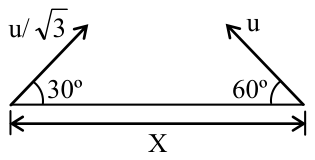
Correct: option 1,
The horizontal velocities are for one particle and for the other, directed towards each other. They close the horizontal gap at a rate , so the time is .
For a particle displacement time relation is . Its displacement when its velocity is zero -
Correct: option 3, 0
, so and . The velocity is zero at , where .
If 100N force is applied to 10 kg. block as shown in diagram then acceleration produced for slab -
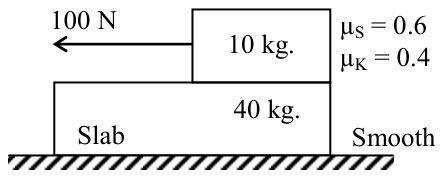
Correct: option 2,
If the two moved together the acceleration would be and the slab would need a friction force of N. The largest static friction is N, so the block slides on the slab. The slab is then pulled only by kinetic friction N (the floor is smooth), giving .
The current in 8Ω resistance is (See fig.)
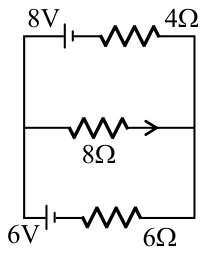
Correct: option 1, 0.69 A
The three branches are in parallel between the same two junctions. Let the potential difference across the 8 Ω resistance be . The currents from the two cell branches add up to the current in the 8 Ω branch: . This gives , so V and the current is A.
The effective capacity of the network between terminals A and B is -
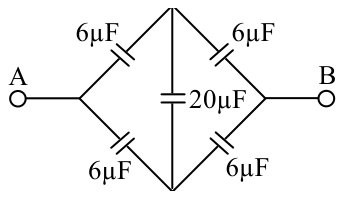
Correct: option 1, 6 μF
The four 6 μF capacitors form a balanced Wheatstone bridge, so there is no potential difference across the 20 μF capacitor and it can be removed. Each path from A to B is then two 6 μF capacitors in series (3 μF), and the two paths in parallel give μF.
If the power dissipated in 5Ω is 20 W then power dissipated in 4Ω is -
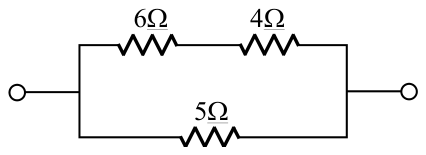
Correct: option 1, 4 W
For the 5 Ω resistance , so and V. The same 10 V is across the series pair 6 Ω + 4 Ω = 10 Ω, so the current in it is 1 A. Power in the 4 Ω resistance is W.
The value of R for which power in it is maximum-
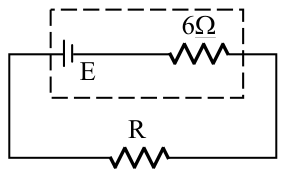
Correct: option 2, 6Ω
By the maximum power transfer theorem the power delivered to the external resistance is greatest when it equals the internal resistance of the source. The source (dashed box) has an internal resistance of 6 Ω, so Ω.
Initially plane of coil is parallel to the uniform magnetic field B. In time it makes to perpendicular to the magnetic field, then charge flows in depends on this time as -
Correct: option 3,
The charge that flows is , the change of flux divided by the resistance of the circuit. The flux changes from 0 to whatever the time taken, so the charge does not depend on , that is .
A current carrying coil (I = 5A, R = 10 cm.) having 50 number of turns find field at its centre-
Correct: option 1, 1.57 mT
At the centre of a circular coil T mT.
Eight equals charged tiny drops are combined to form a big drop. If the potential on each drop is 10V then potential of big drop will be -
Correct: option 1, 40V
Volume is conserved, so the big drop has radius , and its charge is . Its potential is V. In general .
For a inductor coil L = 0.04 H, then workdone by source to establish a current of 5A in it is -
Correct: option 2, 1.00 J
The key used for this paper gives 1.00 J, which is J. Note that the energy stored in the magnetic field of the inductor is J, and the work done against the back emf of an ideal inductor equals this stored energy, so on the standard treatment the answer would be 0.5 J (option 1). The keyed answer is kept here as the source gives it.
The terminal potential difference of a cell is greater than its emf when -
Correct: option 3, A battery of higher emf is connected in its parallel
The terminal potential difference is , larger than the emf, only when current is driven through the cell against its emf, that is when the cell is being charged. This happens when a battery of higher emf is joined in parallel with it (like terminals together): the stronger battery forces current backwards through the cell.
In millikan oil drop experiment a charged drop falls with a terminal velocity V. If an electric field E is applied vertically upwards it moves with terminal velocity 2V in upward direction. If electric field reduces to E/2 then its terminal velocity will be -
Correct: option 1,
The viscous force is proportional to the speed, . Falling freely: . With field : , so . With field the upward electric force is , and the net driving force is upward, so the terminal velocity is (upward).
For a vibration magnetometer, the time period of suspended bar magnet can be reduced by -
Correct: option 3, Moving it towards equator
The time period is , where is the horizontal component of the earth's magnetic field. becomes smaller when becomes larger, and is largest at the magnetic equator and falls to zero at the poles. So the magnet should be moved towards the equator.
The truth table for the following network is:
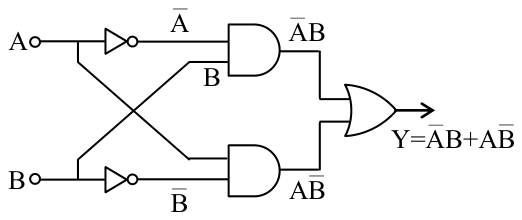
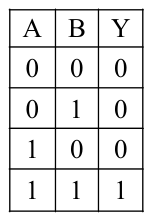
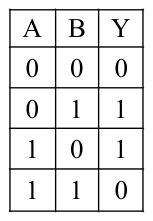
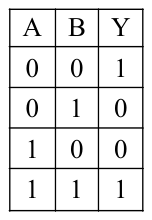
Correct: option 2
The upper AND gate gives and the lower AND gate gives ; the OR gate adds them, so . This is the exclusive-OR function: only when the two inputs are different. So the outputs for (A, B) = (0,0), (0,1), (1,0), (1,1) are 0, 1, 1, 0, which is the table in option (2).
Zener diode is used as -
Correct: option 4, D.C. voltage stabilizer
In reverse breakdown the voltage across a Zener diode stays almost constant while the current through it changes over a wide range. Connected in reverse bias across a load, it therefore holds the d.c. output voltage steady, so it is used as a D.C. voltage stabilizer (regulator).
Depletion layer has (for an unbiased PN junction) -
Correct: option 3, Static ions
Near the junction, electrons from the n-side and holes from the p-side diffuse across and recombine. This leaves the region without mobile charge carriers; what remains are the fixed (immobile) donor and acceptor ions. So the depletion layer contains static ions.
A cylindrical tube (L = 125 cm) is resonant with a tuning fork of frequency 330 Hz. If it is filling by water then to get resonance again, minimum length of water column is ( = 330 m/s) -
Correct: option 1, 50 cm
m cm. A tube closed at one end resonates for air column lengths = 25 cm, 75 cm, 125 cm. The 125 cm tube is the third of these. Pouring in water shortens the air column, and the next resonance is at 75 cm, so the least water column is cm.
Initial pressure and volume of a gas are P and V respectively. First its volume is expanded to 4V by isothermal process and then again its volume makes to be V by adiabatic process then its final pressure is ( = 1.5) -
Correct: option 4, 2P
Isothermal expansion to : . Adiabatic compression back to : , so .
A sphere maintained at temperature 600 K, has cooling rate R in an external environment of 200 K temp. If its temp. falls to 400 K then its cooling rate will be -
Correct: option 1,
By Stefan's law the net rate of loss of heat is proportional to . At 600 K: . At 400 K: . The new rate is .
A particle is projected with velocity 'u' makes an angle w.r.t. horizontal. Now it breaks in two identical parts at highest point of trajectory. If one part is retrace its path, then velocity of other part is -
Correct: option 1,
At the highest point the velocity is , horizontal. The part that retraces its path must leave with velocity . Conserving momentum for a particle of mass splitting into two masses : , so .
The amplitude of a S.H.O. reduces to 1/3 in first 20 secs. then in first 40 sec. its amplitude becomes -
Correct: option 2,
In damped oscillation the amplitude falls exponentially, , so it falls by the same factor in equal times. It becomes in the first 20 s and falls by another factor of in the next 20 s, so after 40 s it is of the initial amplitude.
Two springs A and B () are stretched by same suspended weights then ratio of workdone in stretching is -
Correct: option 1, 1 : 2
For the same stretching force , the extension is and the work done is , so . Hence .
A spring elongated by length 'L' when a mass 'M' is suspended to it. Now a tiny mass 'm' is attached and then released, its time period of oscillation is -
Correct: option 1,
The mass stretches the spring by , so the spring constant is . With the extra mass the oscillating mass is , and . This is option (1), where the elongation is written as .
Frequency of simple pendulum in a free falling lift is -
Correct: option 1, Zero
In a freely falling lift the effective acceleration due to gravity is . The time period becomes infinite, so the bob does not oscillate and the frequency is zero.
The energy and capacity of a charged parallel plate capacitor are E and C respectively. Now a dielectric slab of is inserted in it then energy and capacity becomes (Assuming charge on plates remains constant)
Correct: option 3, , 6C
The dielectric multiplies the capacity by , so it becomes . With the charge fixed, the energy is , which is inversely proportional to the capacity, so it becomes .
The current conduction in a discharge tube is due to -
Correct: option 4, +ve ions, and electrons
In a discharge tube the gas at low pressure is ionised: atoms lose electrons and become positive ions. The free electrons drift to the anode and the positive ions drift to the cathode, and both movements carry the current.
A light of amplitude A and wavelength is incident on a metallic surface, then saturation current flows is proportional to (assume cut off wave length = ) -
Correct: option 2, , if
Photoelectrons are emitted only when the wavelength is shorter than the cut-off wavelength, . The saturation current is proportional to the intensity of the light, and intensity is proportional to the square of the amplitude, .
Light of wavelength 3000 Å in Photoelectric effect gives electron of max. K.E. 0.5 eV. If wavelength change to 2000 Å then max. K.E. of emitted electrons will be:
Correct: option 3, Greater than 0.5 eV
. A shorter wavelength means a photon of higher energy (about 6.2 eV at 2000 Å against about 4.1 eV at 3000 Å), while the work function is unchanged. So the maximum kinetic energy becomes greater than 0.5 eV.
The K.E. of electron and photon is same then relation between their De-Broglie wavelength:
Correct: option 3,
For a photon of energy , . For an electron of kinetic energy , . The ratio is , which is greater than 1 for any ordinary energy because MeV is very large compared with . So .
The total energy of an electron is 3.555 MeV, then its Kinetic energy is:
Correct: option 2, 3.045 MeV
Total energy = rest mass energy + kinetic energy. The rest mass energy of an electron is MeV, so the kinetic energy is MeV.
Two identically charged particles A and B initially at rest, are accelerated by a common potential difference V. They enters into a transverse uniform magnetic field B. They describe a circular path of radii and respectively then their mass ratio is:
Correct: option 1,
After acceleration through the kinetic energy is , so the momentum is . The radius in the field is . With , and the same, , so .
A radio-active elements emits one and particles then mass no. of daughter element is:
Correct: option 1, Decreased by 4
An particle is a helium nucleus, so its emission lowers the mass number by 4 (and the atomic number by 2). A particle is an electron; its emission raises the atomic number by 1 and leaves the mass number unchanged. So the mass number is decreased by 4.
The half life of a radio nuclide is 77 days then its decay constant is:
Correct: option 3, 0.009/day
per day.
For a prism its refractive index is cot A/2 then minimum angle of deviation is:
Correct: option 2, 180 – 2A
At minimum deviation . Setting this equal to gives . So and .
Two conducting slabs of heat conductivity and are joined as shown in fig. The temp. at ends of the slabs are and () the, final temp. () of junction is:
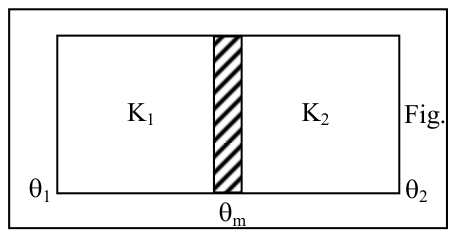
Correct: option 1,
In the steady state the same heat current flows through both slabs. Taking the slabs to have the same thickness and area (as drawn), . Solving, .
A particle starts from rest with constant acceleration. The ratio of space-average velocity to the time average velocity is:
Correct: option 3,
Let the final velocity be after time and distance . Time average: grows linearly with time, so the average is . Space average: , so . The ratio is .
If radius of earth shrinks by 1% then for acceleration due to gravity:
Correct: option 4, Equal change at all locations
With the mass unchanged, at the surface. A 1% decrease in raises by about 2%, and this formula is the same for every point on the surface, so (leaving aside the small effect of rotation) the change is equal at all locations.
Rohini satellite is at a height of 500 km. and Insat-B is at a height of 3600 km. from surface of earth then relation between their orbital velocity (, ) is:
Correct: option 1,
The orbital velocity is , where is the distance from the centre of the earth. The satellite in the lower orbit moves faster. Rohini is lower than Insat-B, so its orbital velocity is the greater one: (the options print the second symbol as ).
For moon, its mass is 1/81 of earth mass and its diameter is 1/3.7 of earth dia. If acceleration due to gravity at earth surface is then at moon its value is:
Correct: option 2,
, so .
When a spring is subjected to 4N force its length is a metre and if 5N is applied length is b metre. If 9N is applied its length is:
Correct: option 3, 5b – 4a
Let the natural length be and the spring constant . Then and . Subtracting, , and then . For 9 N the length is .
For a body angular velocity and radius vector is then its velocity is:
Correct: option 1,
. With and : , , . So .
When a stick is released (as shown in fig.). Its free end velocity when it strikes the ground is:
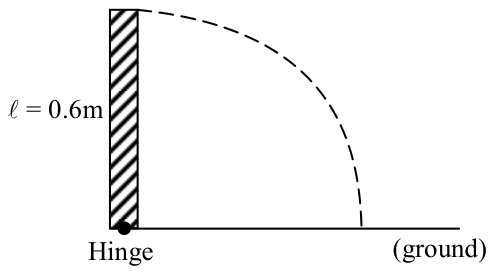
Correct: option 1, 4.2 m/s
The stick turns about the hinge, and its centre of mass falls by . Energy conservation: , so . The free end moves with m/s.
Frequency of an E.M. waves is 10 MHz then its wavelength is:
Correct: option 1, 30 m
m.
Two particles are projected with same initial velocity one makes angle with horizontal while other makes an angle with vertical. If their common range is R then product of their time of flight is directly proportional to:
Correct: option 1,
The angles of projection are and , so and . Their product is , which is directly proportional to .
In compound microscope the magnification is 95, and the distance of object from objective lens 1/3.8 cm and focal length of objective is cm. What is the magnification of eye pieces when final image is formed at least distance of distinct vision:
Correct: option 1, 5
For the objective, with cm and cm: , so cm. The magnification of the objective is . Total magnification = objective × eyepiece, so the eyepiece gives .
On the basis of unit cell concept a crystal has:
Correct: option 1, 7 systems
Unit cells are classified by the lengths of their edges and the angles between them into 7 crystal systems (cubic, tetragonal, orthorhombic, monoclinic, triclinic, hexagonal and rhombohedral). The number 14 counts the Bravais lattices, 32 the point groups and 230 the space groups.
Phenyl acetylene reacts with dil. in presence of gives:
Correct: option 1,
Water adds across the triple bond in the Markovnikov sense, so the OH goes to the carbon attached to the ring. The enol formed tautomerises to the ketone (acetophenone), which is option (1).
According to Hardy Schultze law the order of coagulation power of cations will be:
Correct: option 2,
The Hardy Schulze rule says that the higher the charge on the coagulating ion, the greater its coagulating power. So the order follows the charge: .
Which of the following compound gives p-cresol with p-methyl diazonium chloride:
Correct: option 1,
Warming a diazonium salt with water replaces the group by , so the p-methyl diazonium salt gives p-cresol. would replace the group by H (giving toluene) and phenol would give an azo dye by coupling.
Mole ratio of and gas is 8 : 1 what will be the ratio of wt.:
Correct: option 4, 1 : 2
Mass = moles molar mass. Hydrogen: g; oxygen: g. The ratio of weights is .
Ionization energy of second orbit of will be:
Correct: option 3, 30.6 eV
For a one-electron species the energy needed to remove the electron from orbit is eV. With and this is eV.
Which of the following electronic configuration will have maximum I.P. difference between II and III I.P.:
Correct: option 2,
The biggest jump comes where the third electron has to be taken from a complete noble-gas core. In (magnesium) the first two electrons leave from 3s, and the third must come from the stable shell, so the gap between the second and third ionisation potentials is the largest.
The concentration of a solution is changed from 0.2 to 0.4, then what will be rate and rate constant. The reaction is of first order and rate constant is :
Correct: option 3, ;
For a first-order reaction, rate . At the new concentration, rate . The rate constant does not depend on concentration, so it stays .
Half life of a radioactive sample is 4 days. After 16 days how much quantity of matter remain undecayed:
Correct: option 3,
16 days is half-lives. The fraction left is .
Structure of trans 2-hexanal is:
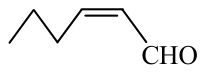
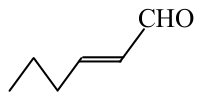
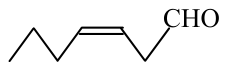
Correct: option 2
The name is meant as trans-2-hexenal: a six-carbon chain with CHO as carbon 1 and a double bond between carbons 2 and 3, with the CHO group and the propyl group on opposite sides. Option (1) has the two groups on the same side of the double bond (cis), and option (3) has a between the double bond and CHO, so its double bond is at carbon 3. Option (2) has the CHO directly on the double bond with the chain on the opposite side, which is the trans form.
Which of the following gives ethyl benzene with phenyl methyl ketone:
Correct: option 1,
Zinc amalgam with concentrated HCl (Clemmensen reduction) reduces a carbonyl group to , turning into . stops at the alcohol and is an oxidising agent.
Acetaldehyde reacts with semicarbazide product will be:
Correct: option 1,
Semicarbazide is . Its group next to NH (the one not attached to the carbonyl, so not deactivated by resonance) condenses with the aldehyde, losing water: . This semicarbazone is option (1).
Cyanohydrin of the following compound on hydrolysis gives optically active product:
Correct: option 2,
Hydrolysis of a cyanohydrin gives an -hydroxy acid. From the product is lactic acid, , whose central carbon carries four different groups, so it is chiral. HCHO gives and acetone gives , neither of which has a chiral carbon.
Which of the following is a chiral compound:
Correct: option 1 or 2
The answer key accepts options 1 and 2.
In 2-methylpentanoic acid, C-2 carries H, , and propyl: four different groups, so it is chiral. In 3-methylpentanoic acid, C-3 carries H, , and , so it is chiral too. In 4-methylpentanoic acid, C-4 carries two methyl groups and is not chiral. The key accepts both (1) and (2).
Compound 'A' on chlorination gives compound 'B'. 'B' reacts with alc. KOH gives gas 'C', which decolourises Baeyer reagent and ozonolysis of compound 'C' gives only HCHO compound 'A' is:
Correct: option 1,
An alkene that gives only HCHO on ozonolysis is ethene, , so C is ethene. Ethene comes from (B) by loss of HCl with alcoholic KOH, and comes from chlorination of ethane. So A is .
Monomer of natural rubber is:
Correct: option 3,
Natural rubber is cis-1,4-polyisoprene. Its monomer is isoprene, 2-methylbuta-1,3-diene, , which is option (3).
Which of the following compound contain zero oxidation state of Fe:
Correct: option 3,
CO is a neutral ligand and has no charge, so iron is in the 0 state. With as the ligand, iron is +2 in and +3 in .
A compound contain C, H and O. If C = 40% and H = 6.67% then empirical formula of compound will be:
Correct: option 1,
Oxygen is . Moles: C , H , O . Dividing by 3.33 gives C : H : O = 1 : 2 : 1, so the empirical formula is .
reacts with in excess of water gives:
Correct: option 2,
The acid protonates the ammonia ligands to , which breaks up the complex and frees . With nitrate as the anion the copper is left as copper nitrate: , that is .
Cr in has number of unpaired electron:
Correct: option 2, 3
Ammonia is neutral and the three bromide ions are outside the complex, so chromium is with configuration . The three d electrons occupy the three orbitals singly, giving 3 unpaired electrons.
Sucrose on hydrolysis gives:
Correct: option 3, D(+) Glucose + D(–) Fructose
Sucrose is made of one glucose and one fructose unit, both of the D family. Hydrolysis gives dextrorotatory D(+)-glucose and laevorotatory D(–)-fructose; because fructose rotates more strongly, the mixture is laevorotatory (invert sugar).
Order of acidic strength of the following compound will be:
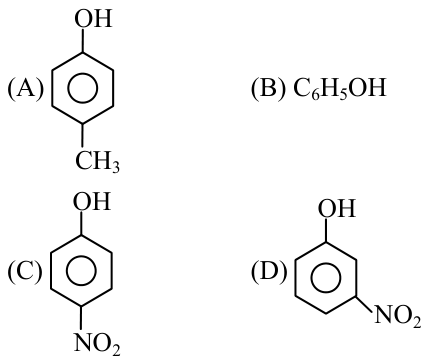
Correct: option 1, C > D > B > A
A is p-cresol, B is phenol, C is p-nitrophenol and D is m-nitrophenol. A nitro group withdraws electrons and stabilises the phenoxide ion; at the para position it does so by both resonance and induction, at the meta position by induction only, so C is more acidic than D. The methyl group of p-cresol donates electrons and makes it weaker than phenol. Order: C > D > B > A.
Which of the following comp. is coloured and has unpaired electron:
Correct: option 1,
In copper is , , with one unpaired electron, and it is coloured. (Cr +6) and (Mn +7) are coloured through charge transfer but are with no unpaired electron, and is low-spin with all electrons paired.
Which of the following does not reduce Fehling solution:
Correct: option 3, Sucrose
A sugar reduces Fehling solution only if it has a free aldehyde or ketone (hemiacetal) group. In sucrose the reducing groups of glucose (C-1) and fructose (C-2) are both used up in the glycosidic bond, so it is a non-reducing sugar. Glucose, fructose and maltose are all reducing sugars.
O.N. of P in pyrophosphoric acid is:
Correct: option 1, + 5
Pyrophosphoric acid is . Taking H as +1 and O as –2: , so and .
Which of the following example behave as a Lewis acid , , :
Correct: option 4, , stannous chloride, stannic chloride
A Lewis acid accepts an electron pair. has an incomplete octet on boron; has an empty p orbital and takes up to form ; uses empty d orbitals to form . All three behave as Lewis acids.
In which of the following comp. H atom is directly linked with phosphorus:
Correct: option 1 or 2
The answer key accepts options 1 and 2.
has two P–H bonds and one P–OH group (it is monobasic), and has one P–H bond and two P–OH groups (dibasic). In and every hydrogen is on oxygen. The key accepts both (1) and (2).
a, b, c, d, e and f are:
Correct: option 3, a = 4, b = 1, c = 10, d = 1, e = 3, f = 4
Nitrogen goes from +5 in to –3 in , a gain of 8 electrons, and each Zn loses 2, so 4 Zn are needed per nitrate. Balancing O with 3 and H with 10 gives (charge +9 on each side). So a, b, c, d, e, f = 4, 1, 10, 1, 3, 4.
Determine the value of cell for the following reaction: Equilibrium constant is
Correct: option 1, 0.1773
At equilibrium . Two electrons are transferred (, ), so V.
What will be the con when 4 gm NaOH dissolved in 1000 ml. of water:
Correct: option 2,
4 g of NaOH is mol, so in 1 litre M. Then M.
What is true for a cyclic process:
Correct: option 2 or 3
The answer key accepts options 2 and 3.
In a cyclic process the system returns to its starting state, so every state function is unchanged: and . Work is not a state function and is generally not zero. The key accepts both (2) and (3).
Increasing order of bond length is:
Correct: option 4,
Bond length increases as bond order falls. From molecular orbital theory the bond orders are = 3, NO = 2.5, = 2 and = 1.5. So the bond length increases in the order .
A system is expanded under adiabatic process:
Correct: option 2, decreases
In an adiabatic process , so . When the system expands it does work on the surroundings, is negative, and the internal energy falls (the temperature drops).
Which of the following is true for a reaction in which all the reactant & product are liquids:
Correct: option 1,
, where is the change in moles of gas. With only liquids there is no gas and the volume change is negligible, so and .
Clemmensen's reaction is:
Correct: option 1,
Clemmensen reduction converts a carbonyl group to using zinc (amalgam) and hydrochloric acid, as in option (1). Option (2), with hydrazine and a base, is the Wolff-Kishner reduction, and option (3) is reduction with HI and red phosphorus.
Which of the following reaction gives by isocyanide:
Correct: option 2, Carbyl amine reaction
In the carbylamine reaction a primary amine is heated with chloroform and alcoholic KOH to give an isocyanide: . Reimer-Tiemann gives a hydroxy aldehyde and Hoffmann bromamide gives an amine.
In a gaseous mixture which of , and gases have same rate of diffusion:
Correct: option 2, ,
By Graham's law the rate of diffusion is proportional to , so gases with equal molar mass diffuse at the same rate. and both have molar mass 44, while is 46.
Compound 'A' in acidic medium does not give ppt with but in medium gives a ppt comp. 'A' is:
Correct: option 3,
belongs to group IV of qualitative analysis: ZnS has a fairly high solubility product, so it does not precipitate in acid, where the sulphide ion concentration is very low, but it does precipitate (white ZnS) when is passed in ammoniacal medium. gives a sulphide precipitate even in acid (group II).
reacts with gives the product:
Correct: option 1,
This is the first step in making dichromate from chromite ore (): fusing the ore with sodium carbonate in air gives sodium chromate, . The iron ends up as , so the listed product is .
A compound has solubility of this comp. will be:
Correct: option 2,
gives one and two , so for solubility : . Then , and mol/L.
on oxidation gives:
Correct: option 4,
When hydrogen peroxide is oxidised (acts as a reducing agent), its oxygen goes from –1 to 0: . So the product is oxygen gas.
What is false for mole fraction:
Correct: option 2,
A mole fraction is the moles of one component divided by the total moles, so it always lies between 0 and 1 and can never be negative or greater than 1. The statement that it can range from –2 to 2 is therefore false.
MgO and NaCl has similar structure. In MgO magnesium is surrounded by how many oxygen atoms:
Correct: option 3, 6
In the rock-salt (NaCl) structure each cation sits in an octahedral hole and has 6 nearest anions (6 : 6 coordination). So each in MgO is surrounded by 6 oxide ions.
General behaviour of is:
Correct: option 2, Gives
Ozone is unstable and readily breaks down as ; in almost all its reactions it uses only one oxygen atom for oxidation and sets free a molecule of . The key takes this release of as its general behaviour. (Since ozone is an oxidising agent, option (4) can also be argued.)
400 ml gas at 500 torr and 666.6 ml gas at 600 torr taken in a container of 3 litre then the total pressure of mixture:
Correct: option 1, 200 torr
At constant temperature each gas obeys in the 3000 ml container. Partial pressures: torr and torr. By Dalton's law the total is torr.
Which of the following is steroid hormones:
Correct: option 1, Progesterone
Progesterone is a sex hormone with the steroid ring skeleton. Cholesterol is a steroid but not a hormone, ACTH is a peptide hormone and adrenaline is an amine hormone derived from an amino acid.
The dipole moment of compound AB is 10.92 D and that of compound CD is 12.45 D. The bond length AB is 2.72 Å and that of CD is 2.56 Å then for these compound true statement is:
Correct: option 2, More ionic nature in CD
Fractional ionic character = observed dipole moment divided by the moment for complete charge separation, (in D, with in Å). For AB: . For CD: . CD has the larger ionic character.
The bombardment of -particle on , emits proton then new atom will be:
Correct: option 1,
Balance mass number and atomic number: gives and . The new nucleus is .
Half life of a substance is 77 days then its decay constant will be:
Correct: option 3, 0.009
Radioactive decay is first order, so per day.
How many ATP will be formed by oxidation of 1 mole glucose:
Correct: option 1, 36
Complete aerobic oxidation of one glucose gives, by the classical count, 38 ATP in all; in most eukaryotic cells 2 ATP are spent carrying the NADH made in glycolysis into the mitochondria, leaving a net gain of 36 ATP. Of the options given, 36 is the accepted figure.
Number of base pairs in human chromosomes:
Correct: option 1,
The haploid human genome, spread over 23 chromosomes, holds about base pairs. Of the values given, only is of that order, so option (1) is right.
Total amount of fixed annually by plants:
Correct: option 4, ton
The textbook estimate of the carbon dioxide fixed by photosynthesis on the whole earth each year is about 70 billion tonnes of carbon, usually quoted as roughly tonnes of . That is option (4); the other values are far too small or impossibly large.
Most stable pesticides:
Correct: option 2, Organochlorines
Organochlorines such as DDT, BHC and aldrin are chlorinated hydrocarbons that resist breakdown and stay in soil and in body fat for many years. Organophosphates and the plant product azadirachtin are degraded quickly, and Bordeaux mixture is a copper fungicide. The most persistent group is therefore the organochlorines.
Best economic method to harvest the solar energy:
Correct: option 2, Energy plantation
Green plants trap sunlight at no cost and store it as biomass. Raising fast-growing trees and shrubs for fuel (an energy plantation) therefore harvests solar energy cheaply and on a large scale, while solar cells and cookers are costly devices of limited capacity and growing sugar cane only to burn it is wasteful.
Main reason of disturbance of biological diversity:
Correct: option 4, Destruction of natural habitats
Loss and fragmentation of habitat, through clearing of forests, draining of wetlands and spread of farms and towns, removes the living space of whole communities at once. It is the largest single cause of species loss, greater than hunting, soil erosion or climate effects.
Best method to preserve the wild relatives of plants:
Correct: option 1, By growing them in natural habitats
Wild relatives of crop plants are best kept in situ, that is, growing in their own natural habitat, where the whole population survives and goes on evolving with its environment. Gene libraries, seed stores and cryopreservation are ex situ methods that keep only a sample of the variation.
Practical purpose of taxonomy or classification:
Correct: option 1, Facilitate the identification of unknown species
Classification arranges organisms into named groups with stated characters, so an unknown specimen can be placed and identified by comparing it with those groups. That is its everyday practical use. Origin and evolutionary history are theoretical aims, and medicinal plants are only one special case.
Koch's postulates not applicable to:
Correct: option 1, Mycobacterium leprae
Koch's postulates require the suspected germ to be isolated from the patient and grown in pure culture on artificial medium. Mycobacterium leprae, the leprosy bacillus, has never been grown on artificial media, so the postulates cannot be fulfilled for it. The bacteria of tuberculosis, pneumonia and cholera can all be cultured.
Amount of cellular DNA increases during:
Correct: option 2, Fertilisation
At fertilisation the haploid nucleus of the male gamete joins the haploid nucleus of the egg, so the zygote holds twice the DNA of either gamete. Cytokinesis only divides the cytoplasm, a mutation changes the sequence and not the amount, and respiration does not involve DNA.
Initiation codon in eukaryotes:
Correct: option 4, AUG
Translation starts at the codon AUG, which codes for methionine in eukaryotes. UGA is a stop codon, CCA codes for proline and AGA for arginine.
Transition of exarch bundles of root to endarch bundles of stem occurs in:
Correct: option 2, Hypocotyl
The radial, exarch vascular arrangement of the root changes into the conjoint, endarch arrangement of the stem in the root-stem transition zone. This zone lies in the hypocotyl, the part of the seedling axis between the radicle and the cotyledons.
Which induces the development of corpus Luteum:
Correct: option 1, LH
The mid-cycle surge of luteinising hormone (LH) from the anterior pituitary brings about ovulation and then changes the ruptured Graafian follicle into the corpus luteum. FSH acts earlier, on follicle growth, and oestrogen is a product of the follicle.
Plant pathogenic bacteria are mostly:
Correct: option 2, Gram – Non spore forming
Most bacteria that cause plant diseases, such as Xanthomonas, Pseudomonas, Erwinia and Agrobacterium, are Gram negative rods that do not form spores. So option (2) describes them.
First transgenic plant:
Correct: option 3, Tobacco
The first transgenic plant was tobacco, produced in 1983 by transferring a foreign gene with the Ti plasmid of Agrobacterium tumefaciens. Transgenic tomato, potato and maize came later.
Dolly sheep was obtained by:
Correct: option 1, Cloning the udder cell (somatic cell) fused with unnucleated oocyte
Dolly was made by somatic cell nuclear transfer: a cell from the udder (mammary gland) of an adult ewe was fused with an egg cell whose own nucleus had been removed, and the resulting embryo was grown in a surrogate mother. No gametes were fused, so option (1) is right.
CCK and secretin secreted by:
Correct: option 3, Duodenum
Cholecystokinin (CCK) and secretin are both released by endocrine cells in the lining of the duodenum when acidic chyme and fats arrive from the stomach. They act on the pancreas and gall bladder. The stomach makes gastrin instead.
Suspensory ligaments are found in:
Correct: option 2, Eyes
In the eye the lens is held in place by suspensory ligaments that join it to the ciliary body. Pulling or slackening of these ligaments changes the shape of the lens during accommodation.
Life span of worker honey bee:
Correct: option 3, 90 days
The key gives 90 days. A worker bee lives only a few weeks to a few months, much less than the queen, which lives for years; in the busy season most workers live about six weeks, and those raised late in the year survive for several months. Of the options the key takes the longest figure, 90 days.
Parathormone deficiency leads to:
Correct: option 1, Decrease of level in blood
Parathormone raises blood calcium by releasing it from bone, increasing its reabsorption in the kidney and its absorption from food. When the hormone is deficient the blood calcium level falls, which can cause tetany. A raised level and bone loss are effects of too much hormone.
Gene composed of:
Correct: option 2, Polynucleotide
A gene is a stretch of DNA, and DNA is a polynucleotide: a chain of nucleotides, each made of a sugar, a phosphate and a nitrogen base. Nitrogen bases alone are only one part of a nucleotide, and amino acids build proteins.
Ornithophily takes place in:
Correct: option 1, Yellow flower having nectaries
Ornithophily is pollination by birds. Birds have a poor sense of smell and visit flowers for nectar, so bird-pollinated flowers are brightly coloured, scentless and rich in nectar. The key takes the option that names both the bright colour and the nectaries, option (1).
Bhopal gas tragedy is related with:
Correct: option 3, Methyl Iso cyanate (MIC)
In December 1984 methyl isocyanate (MIC), used in making the pesticide carbaryl, leaked from a pesticide plant in Bhopal and killed thousands of people.
Concentration of DDT is highest in:
Correct: option 3, Top consumer
DDT is not broken down or excreted; it is stored in body fat. At each step of a food chain the amount per unit of body mass rises (biomagnification), so the top consumer carries the highest concentration.
Percentage energy transferred to higher trophic level in food chain is:
Correct: option 2, 10%
By Lindeman's ten per cent law only about 10% of the energy of one trophic level is passed on to the next. The rest is lost as heat in respiration or remains unused.
What change occurs by changing one base in DNA:
Correct: option 4, Does not necessarily change the phenotype
The genetic code is degenerate, so a changed base may give a codon for the same amino acid (a silent mutation), or the new amino acid may not alter the working of the protein, or the change may be recessive. So a single base change does not necessarily change the phenotype; the options with "always" are wrong.
HIV infects:
Correct: option 2, T – helper cells
HIV attaches to the CD4 receptor, which is found on helper T lymphocytes. The virus multiplies in these cells and destroys them, and the fall in their number causes the immune deficiency of AIDS.
Which of the following statement is true for bryophyta -
Correct: option 3, Gametophyte is dominant and sporophyte is mostly parasitic
In bryophytes the main, green, independent plant body is the haploid gametophyte. The sporophyte (foot, seta and capsule) stays attached to it and depends on it wholly or partly for food. Bryophytes have rhizoids, not true roots.
Lichens can be used as:
Correct: option 1, Bio-indicator for water and air pollution
Lichens are very sensitive to pollutants, above all sulphur dioxide, and disappear from polluted places. Their presence or absence therefore shows the level of pollution, which makes them bio-indicators. They indicate pollution but do not check or reduce it, so option (4) is wrong.
Biotic and abiotic components form:
Correct: option 1, Community
The key gives Community. Strictly, living (biotic) and non-living (abiotic) components together make an ecosystem, and a community is only the living part: all the populations of an area. Ecosystem is not among the options printed in this copy, and community is the nearest of the four.
Endosperm in Gymnosperm is:
Correct: option 4, Haploid
In gymnosperms the endosperm is the female gametophyte itself. It forms before fertilisation from the haploid megaspore, so it is haploid. The triploid endosperm formed by triple fusion is found only in angiosperms.
The plant having the largest flower is:
Correct: option 3, Total root parasite
The largest flower belongs to Rafflesia. It has no leaves or chlorophyll and lives entirely inside the roots of its host vine, taking all its food from them, so it is a total root parasite.
Anabaena is associated with Azolla's:
Correct: option 2, Leaves
The nitrogen-fixing cyanobacterium Anabaena azollae lives in cavities in the upper lobes of the leaves of the water fern Azolla. Azolla is a fern and has no flowers.
The allele for tallness is dominant over that of dwarfness. This is called:
Correct: option 4, Law of dominance
When two different alleles of a gene are together, one (here tall) shows itself and hides the other (dwarf). This is Mendel's law of dominance. Segregation deals with the separation of alleles into gametes, and independent assortment with two or more genes.
Oxytocin mainly helps in:
Correct: option 2, Child birth
Oxytocin makes the smooth muscle of the uterus contract strongly during labour, so its main role is in child birth. It also causes ejection of milk, but the production of milk is the work of prolactin.
What ratio is expected in offsprings if father is colour blind and mother's father was colour blind:
Correct: option 1, 50% daughter – colour blind
Colour blindness is X-linked recessive. The father is . The mother received from her colour blind father, so she is a carrier, . Daughters get from the father and either or from the mother, so half of the daughters are colour blind. Half of the sons are colour blind too, so neither of the two options about all the sons holds.
When AABBcc is crossed with AaBbCc then the ratio of hybrid for all the three genes is:
Correct: option 1, 1/8
Take each gene separately. AA Aa gives Aa with probability , BB Bb gives Bb with probability , and cc Cc gives Cc with probability . The chance of AaBbCc is .
Which hormone is concerned with the concentration of urine:
Correct: option 2, Vasopressin
Vasopressin (ADH) makes the distal tubule and collecting duct permeable to water, so more water is reabsorbed and the urine becomes concentrated. Without it a large volume of dilute urine is passed.
Ventricular contraction in command of:
Correct: option 1, S.A. Node
The key gives the S.A. node. Every heartbeat starts as an impulse from the sino-atrial node, the pacemaker; the impulse passes over the atria to the A.V. node and then through the bundle of His and the Purkinje fibres to the ventricles. On this view the whole beat, ventricular contraction included, is commanded by the S.A. node, while the A.V. node and Purkinje fibres only carry its impulse onward.
Which of the following does not contain metal:
Correct: option 1, Glycoproteins
Glycoproteins are proteins joined to carbohydrate and have no metal. Ferritin stores iron, cytochromes carry iron in their haem group, and chromoproteins such as haemoglobin and haemocyanin have a metal-containing pigment.
Double unit membrane is absent in:
Correct: option 1, Ribosomes
Ribosomes are particles of rRNA and protein with no membrane at all. The nucleus and plastids are enclosed by a double membrane envelope. The key takes ribosomes, the one structure here without any membrane.
Function of Nucleases:
Correct: option 2, Breaks phosphodiester bond
Nucleases cut nucleic acids by hydrolysing the phosphodiester bonds that join one nucleotide to the next. Removing terminal nucleotides describes only exonucleases, and peptide bonds are broken by proteases.
What is phytotron:
Correct: option 1, A device to grow the plants in controlled environment
A phytotron is a set of chambers in which plants are grown under fully controlled light, temperature, humidity and other conditions, so the effect of each factor on growth can be studied.
Species diversity is maximum in:
Correct: option 1, Tropical rain forest
Tropical rain forests have warmth, heavy rain and a stable climate all year, with many layers of vegetation. They hold more species than any other land habitat, far more than temperate forests or deserts.
Exponential growth is shown by:
Correct: option 2, A cell in tissue culture
The key gives a cell in tissue culture. In a culture with plenty of nutrients and space each cell divides into two and both daughter cells keep dividing, so the number doubles at each generation, which is exponential (geometric) growth. Growth in an embryo or a whole plant is soon limited and follows a sigmoid course.
Which of the following is secondary pollutant
Correct: option 1, PAN
A secondary pollutant is formed in the air from primary pollutants. Peroxyacetyl nitrate (PAN) is made when nitrogen oxides and hydrocarbons react in sunlight, as in photochemical smog. The key treats the other three as pollutants released directly from sources.
According to forestry commission report 1997 the total forest cover of India:
Correct: option 2, 19.5%
The forest survey report of 1997 put India's forest cover at a little over 19% of the land area, about 19.3%. The nearest option is 19.5%.
During injury mast cells secrete:
Correct: option 1, Histamine
When tissue is injured the mast cells release histamine, which widens the blood vessels and makes them leaky, producing the redness and swelling of inflammation. Mast cells also hold heparin, but the injury response asked about is histamine release. Prothrombin comes from the liver and antibodies from plasma cells.
Nitrogen fixing bacteria converts:
Correct: option 1,
Nitrogen fixation is the reduction of atmospheric to ammonia by the enzyme nitrogenase. Options (2) and (3) are steps of nitrification, and option (4) is denitrification.
Insulin differs from Growth hormone in:
Correct: option 3, Affects metabolism of fats by inducing lipogenesis
Both hormones are anabolic for protein: they raise amino acid uptake and protein synthesis. They differ in their effect on fat. Insulin promotes the making and storage of fat (lipogenesis), while growth hormone breaks fat down (lipolysis).
Homologous organs are:
Correct: option 4, Pectoral fins of fishes and forelimbs of horse
Homologous organs share the same origin and basic plan even if their use differs. The pectoral fins of fishes and the forelimbs of a horse are both the anterior paired appendages of vertebrates, so the key takes option (4). Insect wings and the wings of bats or birds are analogous: same use, different origin.
Which arrangement is in correct ascending order:
Correct: option 4, Species < genus < family < order
In the taxonomic hierarchy each category is contained in the next higher one: species, genus, family, order, class, phylum, kingdom. Similar species make a genus, related genera make a family and related families make an order, so the ascending sequence is species < genus < family < order.
In stomach after physical and chemical digestion food is called:
Correct: option 1, Chyme
The churning of the stomach wall mixes the food thoroughly with acidic gastric juice, turning it into a semi-fluid paste called chyme. Bolus is the chewed food that is swallowed, and chyle is the milky, fat-rich lymph formed in the small intestine.
Exchange of bicarbonates and chloride ions between RBC and plasma is called:
Correct: option 1, Chloride shift
Inside the RBC, is converted to bicarbonate, which diffuses out into the plasma. To keep the cell electrically neutral, chloride ions move in from the plasma. This exchange is the chloride shift (Hamburger phenomenon). The Bohr effect is the effect of and pH on oxygen binding, and the Haldane effect is the effect of oxygenation on carriage.
Which gland decreases in size with increasing age:
Correct: option 3, Thymus
The thymus is large in childhood and begins to shrink after puberty; in old people it is largely replaced by fat and fibrous tissue, which is one reason immunity weakens with age. The other glands listed do not degenerate in this way.
Which of following occurs in maximum concentration in blood plasma (ECF):
Correct: option 4,
Sodium is the chief cation of the extracellular fluid, at about 140 mEq per litre of plasma, far above calcium, magnesium and potassium, which are each present at only a few mEq per litre. Potassium and magnesium are mainly intracellular ions.
Large scale death of fishes occur in:
Correct: option 3, Eutrophic lake
A eutrophic lake is over-rich in nutrients, so algae grow in dense blooms. When the algae die, decomposers use up the dissolved oxygen, and the fishes die in large numbers from lack of oxygen. An oligotrophic lake is poor in nutrients and stays well oxygenated.
A normal human being requires how much calories per day:
Correct: option 1, 2500 k. cal
An average adult doing moderate work needs roughly 2500 kcal of energy a day. 4000 and 5000 kcal are needed only for very heavy labour, and 686 kcal is the energy released by oxidising one mole of glucose, not a daily requirement.
Which of the following yield maximum energy:
Correct: option 2, Aerobic respiration in germinating seeds
Aerobic respiration oxidises glucose completely to and water and yields about 36 to 38 ATP per glucose. Glycolysis alone, fermentation and other anaerobic pathways oxidise glucose only partly and give a net gain of just 2 ATP per glucose.
Main reason of water bloom in rivers, lakes, sea etc. is:
Correct: option 2, Cyanobacteria and dinoflagellates
Water blooms are sudden population explosions of planktonic organisms in nutrient-rich water. In fresh water they are caused mainly by cyanobacteria (blue-green algae) such as Microcystis and Anabaena, and in the sea by dinoflagellates such as Gonyaulax, which cause red tides.
Insectivorous plants grow in the soil which is deficient in:
Correct: option 4, N
Insectivorous plants are green and make their own carbohydrates, but they grow in waterlogged or marshy soils that are poor in nitrogen. They trap and digest insects to obtain the nitrogen they lack.
Which pair is of insectivorous plants:
Correct: option 3, Aldrovanda and Utricularia
Aldrovanda (waterwheel plant) and Utricularia (bladderwort) are both insectivorous. In the other pairs only one member is: Drosera and Dionaea are insectivorous, but Vallisneria and Hydrilla are ordinary submerged hydrophytes and Rafflesia is a total root parasite.
What shall be the water potential of a root hair cell absorbing water from the soil:
Correct: option 2, Less than zero
Pure water has the highest water potential, which is taken as zero. The solutes in the cell sap lower the water potential of a root hair cell to a negative value, lower than that of the soil water, so water moves in from the soil. The value is therefore less than zero.
Deficiency of oxygen affects most the:
Correct: option 1, Brain
Brain cells have a very high metabolic rate, depend almost entirely on aerobic respiration of glucose and store hardly any oxygen or fuel. They begin to be damaged within a few minutes without oxygen, much sooner than skin, kidney or intestine.
Maximum DDT in birds feeding on:
Correct: option 1, Fishes
DDT is not broken down or excreted, so its concentration rises at each step of a food chain (biomagnification). Aquatic food chains are long (water, plankton, small fish, large fish), so fish-eating birds sit at the top of the longest chain and accumulate the most DDT.
Fully digested food reaches to liver by:
Correct: option 1, Hepatic portal vein
Digested food absorbed into the blood capillaries of the intestine is collected by the hepatic portal vein and carried straight to the liver. The hepatic artery brings oxygenated blood to the liver, and the hepatic vein carries blood away from it.
Fraternal twin one baby is haemophilic while baby's brother is normal then which statement is true:
Correct: option 3, Mother is heterozygous
Haemophilia is X-linked recessive, and a son gets his X chromosome from his mother. Fraternal twins come from two different eggs. One child received the X carrying the haemophilia allele and the normal brother received the X with the normal allele, so the mother must carry both alleles: she is heterozygous (a carrier). The sex of the affected baby cannot be fixed from this information.
Which one is associated with occupational hazard is:
Correct: option 2, Pneumoconiosis
Pneumoconiosis is the general name for lung fibrosis caused by breathing in dust at work, as in mining, stone grinding and similar industries, so it is the occupational disease in the broadest sense. Silicosis is one particular kind of pneumoconiosis, which is why the key prefers the general term. Fluorosis comes from excess fluoride in drinking water, and asthma is usually an allergic condition.
Azolla is used in the cultivation of:
Correct: option 4, Rice
Azolla is a small water fern whose leaves house the nitrogen-fixing cyanobacterium Anabaena azollae. It grows on the standing water of paddy fields and is used there as a biofertiliser, adding nitrogen for the rice crop.
Which one produce gas by decomposing the gobar (Dung) in gobar gas:
Correct: option 3, Methanogenic bacteria
In a gobar gas plant the dung is digested anaerobically. Methanogenic bacteria such as Methanobacterium, which also live in the rumen of cattle and so are present in dung, convert the breakdown products into biogas, which is mostly methane with carbon dioxide.
Pantothenic acid & Biotin associated with:
Correct: option 2, Vitamin B complex
Pantothenic acid (vitamin , a part of coenzyme A) and biotin (vitamin , also called vitamin H) are both water-soluble members of the vitamin B complex. Vitamins D, K and E are fat-soluble vitamins.
Which one is wrong pair:
Correct: option 4, Beriberi – Vitamin K
Beriberi is caused by deficiency of vitamin (thiamine), not vitamin K; lack of vitamin K causes delayed blood clotting. The other pairs are correct: scurvy with vitamin C, rickets with vitamin D, and night blindness and xerophthalmia with vitamin A.
Maximum photosynthesis takes place by:
Correct: option 1, Phytoplankton
Oceans cover about 70% of the earth's surface, and the phytoplankton living in them (diatoms, dinoflagellates and other algae) are credited with the largest share of the world's photosynthesis. Zooplankton are animals and do not photosynthesise.
Reptiles like mammals originated in:
Correct: option 2, Triassic
The key takes the Triassic period, the opening period of the Mesozoic era, as the time of the mammal-like reptiles (therapsids), the group from which the first mammals arose at the end of that period. Note that many texts place the first appearance of mammal-like reptiles earlier, in the Permian; the answer given here is the one in the key.
Dental formula of adolescent human being before seventeen year:
Correct: option 1,
The adult formula is : in each half jaw 2 incisors, 1 canine, 2 premolars and 3 molars. The third molars (wisdom teeth) erupt only after about 17 years of age, so before that there are just 2 molars in each half jaw, giving , 28 teeth in all. is the milk dentition of a child.
Molecular weight of DNA in yeast is:
Correct: option 1,
This is a recall question. Yeast is a eukaryote, so its DNA is much larger than that of a virus or a plasmid, whose molecular weights are in the range of to ; of the values offered, the key takes the largest, . This figure cannot be worked out from first principles.
Minute quantity of hormones & steroid are detected by:
Correct: option 2, Radio immunoassay
Radioimmunoassay uses a radioactively labelled hormone that competes with the hormone in the sample for a specific antibody. It is sensitive enough to measure hormones and steroids present in blood in nanogram or picogram amounts. An electroencephalogram records the electrical activity of the brain.
Hybridoma is:
Correct: option 4, A fusion of tumour somatic cell with non tumour somatic cell
A hybridoma is made by fusing a myeloma cell (a tumour cell, which divides without limit) with a normal antibody-producing B lymphocyte. Both are somatic cells. The hybrid cell keeps dividing and keeps secreting one kind of antibody, which is how monoclonal antibodies are produced.
Which substance can be used as male contraceptive in future:
Correct: option 4, Progesterone
A hormonal contraceptive for men has to stop sperm production, which depends on FSH and LH from the pituitary. Progesterone-like hormones (progestins) suppress the release of these gonadotropins by negative feedback and so shut down spermatogenesis; this is the option the key gives. Giving FSH or LH would stimulate the testes rather than suppress them.
Genetic material of prokaryotic cell:
Correct: option 1, Non histonic double stranded DNA
A prokaryotic cell has a single circular molecule of double-stranded DNA lying naked in the cytoplasm as the nucleoid. It is not wound around histone proteins as the DNA of eukaryotes is, so it is non-histonic double-stranded DNA.
Ligament consist of:
Correct: option 2, Yellow fibres + Collagen (white) fibres
A ligament joins bone to bone and must stretch a little. It is dense connective tissue made mainly of yellow elastic fibres together with some white collagen fibres. Yellow fibres and elastic fibres are the same thing, and muscle fibres are not part of a ligament.
Tendon consist of:
Correct: option 4, Only collagen fibres
A tendon joins a muscle to a bone and has to be strong and inextensible. It is dense regular connective tissue made of parallel bundles of white collagen fibres only, with rows of fibroblasts between them. It has no muscle fibres, and white fibres are not elastic.
Industrial melanism is example of:
Correct: option 1, Natural selection
In industrial England, soot darkened the tree trunks. Dark (melanic) forms of the peppered moth Biston betularia were then better hidden from birds than the light forms and increased in number. A change in the proportions of existing forms because the environment favours one of them is natural selection.
Casparian bands are found in:
Correct: option 1, Endodermis
The cells of the root endodermis have a band of suberin, the Casparian strip, on their radial and transverse walls. It is waterproof and forces water and minerals to pass through the cell membranes of the endodermal cells before entering the stele.
Funaria's male gametes are:
Correct: option 3, Biflagellate
Funaria is a moss. The antherozoids of all bryophytes are small, coiled and have two flagella, and they swim through a film of water to reach the archegonium. Multiflagellate male gametes are found in pteridophytes such as ferns.
E. coli are used in production of:
Correct: option 4, Interferon
Human genes for proteins such as insulin and interferon have been inserted into E. coli by recombinant DNA technology, and the bacteria then make these proteins in bulk. Rifampicin is an antibiotic derived from a product of an actinomycete, and ecdysone is the moulting hormone of insects.
Which one is obtained by S. Miller in his experiments on origin of life before 1953:
Correct: option 2, Amino acids
Miller passed electric sparks through a mixture of methane, ammonia, hydrogen and water vapour, imitating the supposed primitive atmosphere. After about a week the liquid contained amino acids such as glycine, alanine and aspartic acid, showing that organic molecules could form without life.
Which protein found in maximum amount:
Correct: option 4, RUBISCO
RuBisCO (ribulose bisphosphate carboxylase-oxygenase), the enzyme that fixes in the Calvin cycle, makes up a large part of the soluble protein of every green leaf. It is the most abundant protein in the whole biosphere.
After ovulation follicles converted into:
Correct: option 1, Corpus luteum
After the Graafian follicle ruptures and releases the ovum, what remains of it changes under the influence of LH into the yellow corpus luteum, which secretes progesterone. The corpus albicans is the white scar left later when the corpus luteum degenerates. Corpus cavernosa are in the penis and the corpus callosum is in the brain.
Minor change in gene's structure is called:
Correct: option 2, Point mutation
A change in a single base pair of a gene, by substitution, addition or deletion, is the smallest change a gene can undergo and is called a point mutation. Sickle-cell anaemia is the classic example. Forward and backward (reverse) mutations describe the direction of a change, not its size.
Green house effect is:
Correct: option 3, Global warming
Gases such as , methane, CFCs and nitrous oxide let sunlight in but absorb the heat radiated back by the earth, as the glass of a greenhouse does. The rise in these gases traps more heat and raises the earth's temperature, which is global warming.
What will be happen if the number of organism increased at a place:
Correct: option 3, Both
More organisms in one place means more demand for the same limited food, space and other resources. Members of the same species then compete with one another (intraspecific competition), and so do different species that need the same resources (interspecific competition). Both kinds increase.
What is vaccine:
Correct: option 1, Treated bacteria, virus & protein
A vaccine is a preparation of killed or weakened (attenuated) bacteria or viruses, or of their antigenic proteins or inactivated toxins. It cannot cause the disease but makes the body form antibodies and memory cells against the pathogen.
Shell of egg in bird becomes thin (not properly formed) due to the pollution of pesticides. This is due to interference in the activity of:
Correct: option 3, Calmodulin
Pesticides such as DDT disturb calcium metabolism in the shell gland of birds, so too little calcium carbonate is laid down and the shell is thin and breaks easily. The key attributes this to interference with calmodulin, the calcium-binding protein that controls calcium-dependent processes in the cell.
Agglutination occurs in blood present in a test tube. This indicate:
Correct: option 2, Antigens are present on R.B.C.
Agglutination is the clumping of red cells when antibodies bind to antigens on the red cell surface. The blood group antigens A and B are on the surface of the RBCs, while the antibodies are in the plasma. Clumping can take place only if the red cells carry the antigen, so it shows that antigens are present on the RBCs.
Secondary structure of protein, which is attached to lipid layer and lining the pores of cell membrane will be:
Correct: option 1, -Helix
The parts of a membrane protein that cross the lipid bilayer are usually coiled into -helices. In a helix all the peptide groups are hydrogen-bonded within the chain and the non-polar side chains point outwards into the lipid, and several helices placed side by side can enclose a channel or pore.
Recently extinct animal from India is:
Correct: option 1, Acinonyx
Acinonyx jubatus, the cheetah, was hunted out in India and was last recorded there around the middle of the twentieth century. The one-horned rhinoceros, the lion (in Gir) and the tiger still survive in India, although they are threatened.
Simplest reflex action in human is:
Correct: option 1, Mono synaptic
The simplest reflex arc has only two neurons, one sensory and one motor, with a single synapse between them in the spinal cord. The knee-jerk (stretch) reflex is of this monosynaptic type. Reflexes with interneurons have more synapses and are more complex.
In inducible operon, regulatory gene synthesize:
Correct: option 3, Repressor
In an inducible operon such as the lac operon, the regulator gene (i gene) codes for an active repressor protein, which binds to the operator and blocks transcription until an inducer inactivates it. Promoter and operator are DNA sequences, not gene products, and an aporepressor is made in repressible operons such as the trp operon.
Neuroglial cells associated with:
Correct: option 3, Brain
Neuroglial cells (astrocytes, oligodendrocytes, microglia and others) are the supporting cells of nervous tissue. They make up more than half the volume of the brain and spinal cord, where they support, protect and nourish the neurons.
Diatomaceous earth is used as heat insulator in boilers and steam pipes because the cell wall of diatom:
Correct: option 2, Composed of silicon dioxide
Diatom cell walls (frustules) are impregnated with silica, , and do not decay. Their deposits form diatomaceous earth, a light, porous, heat-resistant material that conducts heat poorly, so it is used for insulation, as well as for filtering and polishing.