AIPMT 1998 Prelims Physics questions
Question 1AIPMT 1998 Prelims, Q1
Boron has two isotopes and . If atomic weight of Boron is 10.81 then ratio of to in nature will be:
- 115 : 16
- 219 : 81
- 381 : 19
- 420 : 53
Show answer and solution
Correct: option 2, 19 : 81
The atomic weight is the abundance-weighted mean of the isotope masses. If the fraction of is , then , so . The isotopes are therefore present as 19% and 81%, a ratio of 19 : 81.
Question 2AIPMT 1998 Prelims, Q2
A hollow sphere of radius 1m is given a positive charge of . The electric field at the centre of hollow sphere will be:
- 1
- 2
- 3Zero
- 4Infinite
Show answer and solution
Correct: option 3, Zero
The charge sits on the surface of the hollow sphere. A Gaussian surface drawn anywhere inside encloses no charge, so by Gauss's law the field at every inside point, including the centre, is zero.
Question 3AIPMT 1998 Prelims, Q3
Following table is for which logic gate:
| Input A | Input B | Output C |
|---|
| 0 | 0 | 1 |
| 0 | 1 | 1 |
| 1 | 0 | 1 |
| 1 | 1 | 0 |
- 1AND
- 2OR
- 3NAND
- 4NOT
Show answer and solution
Correct: option 3, NAND
The output is 0 only when both inputs are 1 and is 1 in every other case. That is the AND output inverted, , which is the NAND gate.
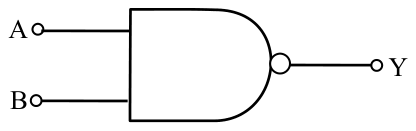
Question 4AIPMT 1998 Prelims, Q4
- 1AND
- 2NAND
- 3EX-OR
- 4OR
Show answer and solution
Correct: option 2, NAND
The symbol is the D-shaped AND gate with a small circle (an inverter bubble) at its output. An AND gate followed by NOT gives , the NAND gate.
Question 5AIPMT 1998 Prelims, Q5
For a wave , for what value of is the maximum particle velocity equal to two times the wave velocity:
- 1
- 2
- 3
- 4
Show answer and solution
Correct: option 1,
The maximum particle velocity is and the wave velocity is . Setting gives . Since , this means .
Question 6AIPMT 1998 Prelims, Q6
Two pendulums suspended from same point having length 2m and 0.5m. If they displaced slightly and released then they will be in same phase, when small pendulum will have completed:
- 12 oscillation
- 24 oscillation
- 33 oscillation
- 45 oscillation
Show answer and solution
Correct: option 1, 2 oscillation
The period of a simple pendulum is proportional to , so . The long pendulum takes twice as long per swing, so the two are first in phase again when the long one has completed 1 oscillation and the short one 2 oscillations.
Question 7AIPMT 1998 Prelims, Q7
For protecting a magnetic needle it should be placed:
- 1In iron box
- 2In wooden box
- 3In metallic box
- 4None of these
Show answer and solution
Correct: option 1, In iron box
Soft iron has a very high permeability, so external magnetic field lines crowd into the walls of an iron box and pass around the space inside. The inside is magnetically shielded, which protects the needle. Wood, and metals in general, do not shield a magnetic field in this way.
Question 8AIPMT 1998 Prelims, Q8
A circular ring of mass M and radius R is rotating about its axis with constant angular velocity . Two particle each of mass m are attached gently to the opposite ends of a diameter of the ring. The angular velocity of the ring will now become:
- 1
- 2
- 3
- 4
Show answer and solution
Correct: option 3,
No external torque acts, so angular momentum about the axis is conserved. The moment of inertia changes from to , so and .
Question 9AIPMT 1998 Prelims, Q9
If , then work done in first 4s. will be (Mass of the particle is 3 gram):
- 1384 mJ
- 2168 mJ
- 3192 mJ
- 4None of these
Show answer and solution
Correct: option 1, 384 mJ
The velocity is , which is 0 at and at . By the work-energy theorem the work done equals the gain in kinetic energy: .
Question 10AIPMT 1998 Prelims, Q10
If force , then function of impulse with time will be:
- 1
- 2
- 3
- 4
Show answer and solution
Correct: option 1,
Impulse is the time integral of force: .
Question 11AIPMT 1998 Prelims, Q11
Half life period of two elements are 40 minute and 20 minute respectively, then after 80 minute ratio of the remaining nuclei will be (Initially both have equal active nuclei):
- 14 : 1
- 21 : 2
- 38 : 1
- 416 : 1
Show answer and solution
Correct: option 1, 4 : 1
In 80 minutes the first element goes through 2 half-lives and the second through 4. The fractions left are and . Starting from equal numbers, the ratio of remaining nuclei is .
Question 12AIPMT 1998 Prelims, Q12
A particle of mass m is tied to a string of length L and whirled into a horizontal plane. If tension in the string is T then the speed of the particle will be:
- 1
- 2
- 3
- 4
Show answer and solution
Correct: option 1,
In a horizontal circle the tension supplies the centripetal force, so , where is the length of the string (called L in the question). Hence .
Question 13AIPMT 1998 Prelims, Q13
If the light of wavelength is incident on metal surface, the ejected fastest electron has speed v. If the wavelength is changed to , the speed of the fastest emitted electron will be:
- 1Smaller than
- 2Greater than
- 32v
- 4Zero
Show answer and solution
Correct: option 2, Greater than
Einstein's equation gives . With wavelength the photon energy becomes , so . The new kinetic energy is more than of the old one, so is greater than .
Question 14AIPMT 1998 Prelims, Q14
A coil of one loop is made from a wire of length L and thereafter a coil of two loops is made from same wire, then the ratio of magnetic field at the centre of coils will be:
- 11 : 4
- 21 : 1
- 31 : 8
- 44 : 1
Show answer and solution
Correct: option 1, 1 : 4
The field at the centre of a coil of N turns and radius r is . With the same wire, two loops have half the radius ( instead of ), so B is multiplied by 2 for the turns and by 2 again for the radius. The second field is 4 times the first, and the ratio is 1 : 4.
Question 15AIPMT 1998 Prelims, Q15
The speed of a boat is 5 km/hr in still water. It crosses a river of width 1 km along the shortest possible path in 15 minutes. The velocity of river water is:
- 13 km/hr
- 24 km/hr
- 35 km/hr
- 42 km/hr
Show answer and solution
Correct: option 1, 3 km/hr
On the shortest path the boat moves straight across, so its resultant velocity is km/hr, perpendicular to the current. The boat's 5 km/hr is the hypotenuse of the velocity triangle, so the river speed is km/hr.
Question 16AIPMT 1998 Prelims, Q16
Two identical balls A and B are moving with velocity and respectively. They collide head on elastically then their velocities after collision will be:
- 1 &
- 2 &
- 3 &
- 4 &
Show answer and solution
Correct: option 1, &
In a head-on elastic collision between equal masses, momentum and kinetic energy are both conserved only if the two bodies exchange velocities. So A leaves with and B with .
Question 17AIPMT 1998 Prelims, Q17
A small ball is suspended from a thread. It is lifted up with an acceleration and lowered with an acceleration then the ratio of tensions in the thread in both cases will be:
- 11 : 3
- 23 : 1
- 31 : 1
- 4
Show answer and solution
Correct: option 2, 3 : 1
Here . Accelerating upward, ; accelerating downward, . The ratio is 3 : 1.
Question 18AIPMT 1998 Prelims, Q18
One part of a device is connected with the negative terminal of a battery and another part is connected with the positive terminal of a battery. If their ends now altered, current does not flow in circuit, then the device will be:
- 1P–N Junction
- 2Transistor
- 3Zener diode
- 4Triode
Show answer and solution
Correct: option 1, P–N Junction
A device that conducts for one polarity of the battery and blocks when the connections are reversed is a rectifier. A P–N junction does exactly this: it conducts in forward bias and passes practically no current in reverse bias.
Question 19AIPMT 1998 Prelims, Q19
Light enters at an angle of incidence in a transparent rod of refractive index n. For what value of the refractive index of the material of the rod, the light once entered into it will not leave it through its lateral face whatsoever be the value of angle of incidence:
- 1
- 21.0
- 31.3
- 41.4
Show answer and solution
Correct: option 1,
If the ray is refracted at angle r at the end face, it meets the lateral face at , and this must exceed the critical angle: . The hardest case is grazing incidence, where . Then gives . So the rod traps all the light when n is greater than (about 1.414), which none of the other values satisfies.
Question 20AIPMT 1998 Prelims, Q20
coulomb charge liberated 1 gm silver (Ag). If now charge is doubled then the amount of liberated Ag will be:
- 11 gm
- 22 gm
- 33 gm
- 44 gm
Show answer and solution
Correct: option 2, 2 gm
By Faraday's first law of electrolysis the mass liberated is proportional to the charge passed, . Doubling the charge doubles the mass, from 1 gm to 2 gm.
Question 21AIPMT 1998 Prelims, Q21
Work function of a metal surface is eV. If a light of wavelength 5000Å falls on it then the maximum K.E. of ejected electron will be -
- 11.2 eV
- 20.98 eV
- 30.45 eV
- 40 eV
Show answer and solution
Correct: option 2, 0.98 eV
The photon energy is eV. The maximum kinetic energy is eV.
Question 22AIPMT 1998 Prelims, Q22
If time of mean position from amplitude (extreme) position is 6 s. then the frequency of SHM will be:
- 10.01 Hz
- 20.02 Hz
- 30.03 Hz
- 40.04 Hz
Show answer and solution
Correct: option 4, 0.04 Hz
Going from the extreme position to the mean position takes a quarter of a period, so s. The frequency is Hz, which is closest to 0.04 Hz.
Question 23AIPMT 1998 Prelims, Q23
Two coil have a mutual inductance 0.005 H. The current changes in first coil according to equation where and rad/sec. The maximum value of emf in second coil is:
- 1
- 2
- 3
- 4
Show answer and solution
Correct: option 4,
The induced emf is in magnitude, so its maximum is volt.
Question 24AIPMT 1998 Prelims, Q24
Resistance of a Galvanometer coil is and Shunt resistance is connected with it. If main current is 1 A then the current flow through resistance will be:
- 10.2 A
- 20.8 A
- 30.1 A
- 40.4 A
Show answer and solution
Correct: option 2, 0.8 A
The shunt is in parallel with the galvanometer, so the current divides in the inverse ratio of the resistances. The current in the shunt is A (the other 0.2 A goes through the coil).
Question 25AIPMT 1998 Prelims, Q25
If a ladder is not in balance against a smooth vertical wall, then it can be made in balance by:
- 1Decreasing the length of ladder
- 2Increasing the length of ladder
- 3Increasing the angle of inclination
- 4Decreasing the angle of inclination
Show answer and solution
Correct: option 3, Increasing the angle of inclination
With a smooth wall, taking torques about the foot gives the wall's push as , and friction at the floor must equal N. So the ladder stays put only if , a condition that does not involve the length. Making the ladder steeper (a larger angle with the floor) reduces the friction needed and brings it into balance.
Question 26AIPMT 1998 Prelims, Q26
For a Rocket propulsion velocity of exhaust gases relative to rocket is 2 km/s. If mass of rocket system is 1000 kg, then the rate of fuel consumption for a rocket to rise up with acceleration will be:
- 112.25 kg/s
- 217.5 kg/s
- 37.35 kg/s
- 45.2 kg/s
Show answer and solution
Correct: option 3, 7.35 kg/s
The thrust must support the weight and give the acceleration: . So kg/s.
Question 27AIPMT 1998 Prelims, Q27
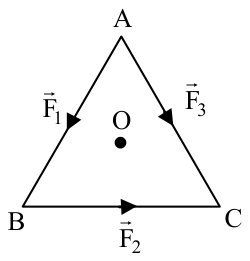
O is the centre of an equilateral triangle ABC , , are three forces acting along the sides AB, BC and AC as shown in fig. What should be the magnitude of so that total torque about O is zero:
- 1
- 2
- 3
- 4Not possible
Show answer and solution
Correct: option 1,
O is the same perpendicular distance d from all three sides. (from A to B) and (from B to C) go round the triangle in the same sense and give torques and in the same direction, while along AC goes round in the opposite sense and gives the other way. For zero net torque, , so .
Question 28AIPMT 1998 Prelims, Q28
When volume changes from V to 2V at constant pressure(P) then the change in internal energy will be:
- 1PV
- 23PV
- 3
- 4
Show answer and solution
Correct: option 3,
For an ideal gas . At constant pressure , so .
Question 29AIPMT 1998 Prelims, Q29
A gas of volume changes 2 litre to 10 litre at constant temperature 300K, then the change in internal energy will be:
- 112 J
- 224 J
- 336 J
- 40 J
Show answer and solution
Correct: option 4, 0 J
The internal energy of an ideal gas depends only on its temperature. The temperature stays at 300 K, so the internal energy does not change whatever the change in volume.
Question 30AIPMT 1998 Prelims, Q30
When three identical bulbs are connected in series, the consumed power is 10W. If they are now connected in parallel then the consumed power will be:
- 130W
- 290W
- 3 W
- 4270W
Show answer and solution
Correct: option 2, 90W
On the same supply . In series the resistance is 3R, so W and W. In parallel the resistance is R/3, so the power is W.
Question 31AIPMT 1998 Prelims, Q31
A ball is dropped from a height of 5 m, if it rebound upto height of 1.8 m, then the ratio of velocities of the ball after and before rebound is:
- 1
- 2
- 3
- 4
Show answer and solution
Correct: option 1,
The speed on reaching or leaving the ground is , so the ratio of the speed after rebound to the speed before is .
Question 32AIPMT 1998 Prelims, Q32
Two long parallel wires are at a distance of 1m. If both of them carry one ampere of current in same direction, then the force of attraction on unit length of the wires will be:
- 1 N/m
- 2 N/m
- 3 N/m
- 4 N/m
Show answer and solution
Correct: option 1, N/m
The force per unit length between parallel currents is N/m. This is the definition of the ampere.
Question 33AIPMT 1998 Prelims, Q33
For the diffraction from a crystal with Å and Bragg's angle , then for the second order diffraction 'd' will be:
- 11.15 Å
- 20.75 Å
- 30.55 Å
- 42.1 Å
Show answer and solution
Correct: option 1, 1.15 Å
Bragg's law is . With : Å.
Question 34AIPMT 1998 Prelims, Q34
If the frequency of a spring is n after suspending mass M, now 4M mass is suspended from spring then the frequency will be:
- 12n
- 2n/2
- 3n
- 4None of the above
Show answer and solution
Correct: option 2, n/2
The frequency of a mass on a spring is , proportional to . Making the mass 4 times larger halves the frequency, giving n/2.
Question 35AIPMT 1998 Prelims, Q35
A standing wave having 3 nodes and 2 antinodes is formed between 1.21 Å distance then the wavelength is:
- 11.21 Å
- 22.42 Å
- 30.605 Å
- 44.84 Å
Show answer and solution
Correct: option 1, 1.21 Å
Neighbouring nodes are half a wavelength apart. Three nodes with two antinodes between them make two loops, so the distance is . Hence Å.
Question 36AIPMT 1998 Prelims, Q36
In hot wire Ammeter due to flowing of current temperature of wire is increased by . If value of current is doubled, then increases in temperature will be:
- 1
- 2
- 3
- 4
Show answer and solution
Correct: option 2,
The heat produced, and so the rise in temperature of the wire, is proportional to (Joule's law). Doubling the current makes the rise 4 times as large: .
Question 37AIPMT 1998 Prelims, Q37
A car is moving with velocity V. If stop after applying brake at a distance of 20 m. If velocity of car is doubled, then how much distance it will cover (travel) after applying brake:
- 140 m
- 280 m
- 3160 m
- 4320 m
Show answer and solution
Correct: option 2, 80 m
With the same retardation, , so the stopping distance is proportional to the square of the speed. Doubling the speed makes the distance 4 times as long: m.
Question 38AIPMT 1998 Prelims, Q38
A charge q is placed in an uniform electric field E. If it is released, then the K.E of the charge after travelling distance y will be:
- 1qEy
- 22qEy
- 3
- 4
Show answer and solution
Correct: option 1, qEy
The field exerts a constant force qE on the charge. Starting from rest, the kinetic energy gained equals the work done by this force over the distance y, which is qEy.
Question 39AIPMT 1998 Prelims, Q39
In the Bohr model of H-atom, an electron (e) is revolving around a proton (p) with velocity v, if r is the radius of orbit and m is mass and is vacuum permittivity, the value of v is:
- 1
- 2
- 3
- 4
Show answer and solution
Correct: option 1,
The Coulomb attraction provides the centripetal force: . So and .
Question 40AIPMT 1998 Prelims, Q40
Electric field at the equator of a dipole is E. If strength and distance is now doubled then the electric field will be:
- 1E/2
- 2E/8
- 3E/4
- 4E
Show answer and solution
Correct: option 3, E/4
On the equatorial line of a short dipole . Doubling the dipole strength p doubles the field, and doubling r divides it by 8, so the new field is .
Question 41AIPMT 1998 Prelims, Q41
Turn ratio of a step-up transformer is 1 : 25. If current in load coil is 2A, then the current in primary coil will be:
- 125A
- 250A
- 30.25A
- 40.5A
Show answer and solution
Correct: option 2, 50A
For an ideal transformer . A step-up transformer raises the voltage and lowers the current, so the primary current is A.
Question 42AIPMT 1998 Prelims, Q42
If a source moves perpendicularly from listener then the change in frequency will be:
- 12 n
- 2n
- 3n/2
- 4Zero
Show answer and solution
Correct: option 4, Zero
The Doppler shift depends only on the component of the source's velocity along the line joining source and listener. When the source moves at right angles to that line this component is zero, so the frequency heard does not change.
Question 43AIPMT 1998 Prelims, Q43
For nuclear reaction:
- 1
- 2
- 3
- 4
Show answer and solution
Correct: option 2,
Charge and mass number are conserved. Atomic number: , so . Mass number: , so . The missing nucleus is , krypton.
Question 44AIPMT 1998 Prelims, Q44
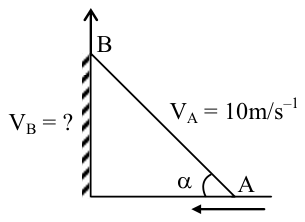
A rigid rod is placed against the wall as shown in figure. When its velocity of lower end is and its base makes an angle with horizontal, then the vertical velocity of its end B will be:
- 1
- 2
- 3
- 4
Show answer and solution
Correct: option 2,
The rod is rigid, so both ends must have the same velocity component along the rod. For A this is and for B, which moves along the wall, it is . So .
Question 45AIPMT 1998 Prelims, Q45
Radiation energy corresponding to the temperature T of the sun is E. If its temperature is doubled, then its radiation energy will be:
- 132 E
- 216 E
- 38 E
- 44 E
Show answer and solution
Correct: option 2, 16 E
By Stefan's law the energy radiated is proportional to . Doubling the temperature multiplies it by , giving 16 E.
Question 46AIPMT 1998 Prelims, Q46
The cause of potential barrier in a P–N junction diode is:
- 1Concentration of positive and negative ions near the junction
- 2Concentration of positive charges near the junction
- 3Depletion of negative charges near the junction
- 4Increment in concentration of holes and electrons near the junction
Show answer and solution
Correct: option 1, Concentration of positive and negative ions near the junction
Near the junction, electrons and holes diffuse across and recombine. This leaves fixed positive donor ions on the N side and fixed negative acceptor ions on the P side. These two layers of uncovered ions set up the electric field, and so the potential barrier, across the junction.
Question 47AIPMT 1998 Prelims, Q47
Common emitter circuit is used as amplifier, its current gain is 50. If input resistance is and input voltage is 5 volt then output current will be:
- 1250 mA
- 230 mA
- 350 mA
- 4100 mA
Show answer and solution
Correct: option 1, 250 mA
The input (base) current is mA. The output (collector) current is the current gain times this: mA.
Question 48AIPMT 1998 Prelims, Q48
We consider a thermodynamic system. If represents the increase in its internal energy and W the work done by the system, which of the following statements is true?
- 1 in an isothermal process
- 2 in an isothermal process
- 3 in an adiabatic process
- 4 in an adiabatic process
Show answer and solution
Correct: option 3, in an adiabatic process
The first law is . In an adiabatic process , so : work done by the system comes out of its internal energy. In an isothermal process of an ideal gas instead, so the first two statements fail.
Question 49AIPMT 1998 Prelims, Q49
A point Q lies on the perpendicular bisector of an electrical dipole of dipole moment p. If the distance of Q from the dipole is r (much larger than the size of the dipole), then the electric field at Q is proportional to:
- 1 and
- 2 and
- 3 and
- 4 and
Show answer and solution
Correct: option 4, and
On the perpendicular bisector (equatorial line) of a short dipole the field is . It is proportional to p and to .
Question 50AIPMT 1998 Prelims, Q50
A particle, with restoring force proportional to displacement and resisting force proportional to velocity is subjected to a force . If the amplitude of the particle is maximum for and the energy of the particle maximum for , then:
- 1 and
- 2 and
- 3 and
- 4 and
Show answer and solution
Correct: option 2, and
Here is the natural frequency of the undamped oscillator. The key treats this as simple resonance: when the driving frequency equals the oscillator responds most strongly, so both the amplitude and the energy are taken to be greatest there, and . Note that an exact treatment with damping puts the amplitude maximum slightly below , at , while the velocity and energy maximum is exactly at ; on that basis many books prefer the first option. The answer shown here is the one given in the key.
AIPMT 1998 Prelims Chemistry questions
Question 51AIPMT 1998 Prelims, Q51
Correct order of –I effect is:
- 1
- 2
- 3
- 4
Show answer and solution
Correct: option 3,
The –I effect measures how strongly a group pulls electrons through sigma bonds. A group carrying a full positive charge, , pulls hardest. Between the neutral groups, fluorine is more electronegative than oxygen, so F comes before OR. The order is .
Question 52AIPMT 1998 Prelims, Q52
Aspirin can be prepared by the reaction of acetyl chloride with:
- 1Benzoic acid
- 2Phenol
- 3p-hydroxy benzoic acid
- 4o-hydroxy benzoic acid
Show answer and solution
Correct: option 4, o-hydroxy benzoic acid
Aspirin is acetylsalicylic acid (2-acetoxybenzoic acid). It is made by acetylating the –OH group of salicylic acid, which is o-hydroxybenzoic acid, with acetyl chloride or acetic anhydride.
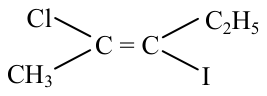
Question 53AIPMT 1998 Prelims, Q53
- 1(Z)-2-chloro-3-iodo-2-pentene
- 2(E)-2-chloro-3-iodo-2-pentene
- 32-iodo-3-chloro-pentene
- 4None of the above
Show answer and solution
Correct: option 2, (E)-2-chloro-3-iodo-2-pentene
The chain is pent-2-ene with Cl on C-2 and I on C-3, so the name is 2-chloro-3-iodo-2-pentene. On C-2 the higher-priority group is Cl (over ); on C-3 it is I (over ). Cl and I lie on opposite sides of the double bond, so the configuration is E.
Question 54AIPMT 1998 Prelims, Q54
Which of the following does not give iodoform test:
- 13-pentanone
- 22-pentanone
- 3Ethanol
- 4Ethanal
Show answer and solution
Correct: option 1, 3-pentanone
The iodoform test needs a group, or a group that is oxidised to it. 2-Pentanone and ethanal have and ethanol has . 3-Pentanone, , has no methyl group next to the carbonyl, so it does not respond.
Question 55AIPMT 1998 Prelims, Q55
The product formed by the reaction of
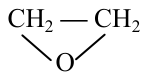
- 1
- 2
- 3
- 4
Show answer and solution
Correct: option 1,
The compound is ethylene oxide (oxirane). The R group of the Grignard reagent attacks one ring carbon and opens the strained ring, giving . Hydrolysis then gives the primary alcohol , two carbons longer than R.
Question 56AIPMT 1998 Prelims, Q56
Which of the following is not the characteristic of arenes:
- 1More stability
- 2Resonance
- 3Delocalization of electrons
- 4Electrophilic addition
Show answer and solution
Correct: option 4, Electrophilic addition
Arenes are stabilised by resonance, that is, by delocalisation of the ring electrons. Addition would destroy this aromatic stabilisation, so their typical reaction is electrophilic substitution, not electrophilic addition.
Question 57AIPMT 1998 Prelims, Q57
Which of the following gives most easily electrophilic substitution reaction:
- 1
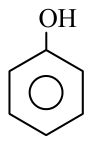
- 2
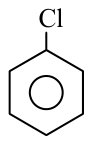
- 3
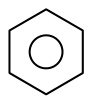
- 4
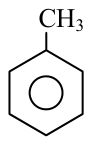
Show answer and solution
Correct: option 1
The four compounds are phenol, chlorobenzene, benzene and toluene. Electrophilic substitution is fastest on the most electron-rich ring. The –OH group donates a lone pair into the ring by resonance and activates it far more than does, while –Cl deactivates the ring. Phenol reacts most easily.
Question 58AIPMT 1998 Prelims, Q58
Which of the following does not give claisen condensation reaction:
- 1
- 2
- 3
- 4None of the above
Show answer and solution
Correct: option 1,
Claisen condensation needs an ester with a hydrogen on the carbon next to the ester carbonyl, so that a base can form the enolate. Ethyl benzoate, , has no such hydrogen and cannot condense with itself. The other two esters both have -hydrogens.
Question 59AIPMT 1998 Prelims, Q59
Percentage of C, H & N are given as follows:
C = 40% H = 13.33% N = 46.67%
The empirical formula will be:
- 1
- 2
- 3
- 4
Show answer and solution
Correct: option 3,
Divide each percentage by the atomic mass: C , H , N . Dividing by the smallest, 3.33, gives C : H : N = 1 : 4 : 1. The empirical formula is .
Question 60AIPMT 1998 Prelims, Q60
Glucose + x phenyl hydrazine osazone 'x' will be:
- 12
- 23
- 34
- 41
Show answer and solution
Correct: option 2, 3
Osazone formation uses three molecules of phenylhydrazine per glucose. The first forms the phenylhydrazone at C-1, the second oxidises the C-2 –CHOH– group to a carbonyl (and is itself reduced to aniline and ammonia), and the third condenses with that new carbonyl. So x = 3.
Question 61AIPMT 1998 Prelims, Q61
The base found in DNA but not in RNA:
- 1Thymine
- 2Adenine
- 3Guanine
- 4Cytosine
Show answer and solution
Correct: option 1, Thymine
Adenine, guanine and cytosine occur in both nucleic acids. The fourth base is thymine in DNA and uracil in RNA, so thymine is the one found only in DNA.
Question 62AIPMT 1998 Prelims, Q62
2-Bromo pentane reacts with ethanolic KOH gives main product:
- 1Trans-2-pentene
- 2Cis-2-pentene
- 31-pentene
- 4None of the above
Show answer and solution
Correct: option 1, Trans-2-pentene
Alcoholic KOH brings about dehydrohalogenation. By Saytzeff's rule the more substituted alkene, 2-pentene, is preferred over 1-pentene. Of its two geometrical forms the trans isomer is the more stable and is formed in the larger amount.
Question 63AIPMT 1998 Prelims, Q63
Which of the following does not give nucleophilic substitution with alcohol:
- 1
- 2Acetic anhydride
- 3Ether
- 4None
Show answer and solution
Correct: option 3, Ether
Acetyl chloride and acetic anhydride have a reactive acyl carbon with a good leaving group ( or acetate), so an alcohol attacks them and forms an ester. An ether has no such centre and no good leaving group, so it does not react with an alcohol.
Question 64AIPMT 1998 Prelims, Q64
Aniline reacts with water, gives respectively:
- 1p-Bromo aniline, p-chloro aniline
- 22, 4, 6 tri bromo aniline, p-chloro aniline
- 32, 4, 6 tri bromo aniline, Benzene diazonium chloride
- 4p-bromo aniline, Benzene diazonium chloride
Show answer and solution
Correct: option 3, 2, 4, 6 tri bromo aniline, Benzene diazonium chloride
The group activates the ring so strongly that bromine water substitutes both ortho positions and the para position, giving 2,4,6-tribromoaniline. With in the cold, the primary aromatic amine is diazotised to benzene diazonium chloride.
Question 65AIPMT 1998 Prelims, Q65
A complex compound which is formed by ligands nitrate and chloride. It gives two moles of AgCl precipitate with . What will be its formulae:
- 1
- 2
- 3
- 4
Show answer and solution
Correct: option 1,
Only chloride outside the coordination sphere is ionised and precipitated by . Two moles of AgCl mean two ionisable chlorides per formula unit. That is ; the other formulae have one or no chloride outside the bracket.
Question 66AIPMT 1998 Prelims, Q66
Which of the following molecule is not paramagnetic:
- 1
- 2
- 3
- 4None of the above
Show answer and solution
Correct: option 3,
A species is paramagnetic when it has unpaired electrons. is (one unpaired electron) and is (four unpaired). has the argon configuration with every electron paired, so it is diamagnetic.
Question 67AIPMT 1998 Prelims, Q67
The number of antibonding electron pair in is:
- 14
- 23
- 32
- 41
Show answer and solution
Correct: option 1, 4
The peroxide ion has 18 electrons: . The antibonding orbitals , and the two orbitals are all full, which is 8 antibonding electrons, or 4 pairs. (Counting only the valence shell would give 3 pairs; the key counts the inner shell as well.)
Question 68AIPMT 1998 Prelims, Q68
When A + Water C + B, B is reacted with D, gas C again obtained. 'D' gives 'C' with . B gives yellow colour with bunsen flame. C is a flammable gas then what would be A, B, C and D:
- 1K, , NaOH, Zn
- 2Na, NaOH, , Zn
- 3Li, , LiOH, Zn
- 4None of the above
Show answer and solution
Correct: option 2, Na, NaOH, , Zn
A yellow flame shows that B is a sodium compound, so A is sodium: . B is NaOH and the flammable gas C is . D gives hydrogen both with NaOH and with dilute , so it is an amphoteric metal, zinc.
Question 69AIPMT 1998 Prelims, Q69
The concentration of solution will change when it is placed in a container which is made of:
- 1Al
- 2Cu
- 3Ag
- 4None
Show answer and solution
Correct: option 1, Al
A metal displaces zinc from its salt solution only if it is a stronger reducing agent than zinc, that is, if it lies above zinc in the activity series. Aluminium does ( V against V for zinc), so it reacts with and changes its concentration. Copper and silver are less reactive than zinc and do nothing.
Question 70AIPMT 1998 Prelims, Q70
The cell reaction of an electrochemical cell is . The change in free energy will be the function of:
- 1
- 2
- 3
- 4
Show answer and solution
Correct: option 2,
For the cell reaction, , and the reaction quotient is because the solid metals have unit activity. So depends on .
Question 71AIPMT 1998 Prelims, Q71
Constant =
Constant =
then product. The constant of reaction will be:
- 1
- 2
- 3
- 4None of these
Show answer and solution
Correct: option 2,
The required reaction, , is the first reaction reversed (constant ) added to the second reaction (constant ). When reactions are added their constants multiply, so the constant is .
Question 72AIPMT 1998 Prelims, Q72
Density of which of the following substance not decreases on adding in vapours:
- 1
- 2
- 3Ether
- 4Coke
Show answer and solution
Correct: option 4, Coke
, and ether are liquids that dissolve bromine and form a solution. Coke is a porous solid: it does not dissolve bromine but adsorbs the vapour on its surface, so it only gains mass and its density does not fall. The key gives coke.
Question 73AIPMT 1998 Prelims, Q73
In which of the following molecule the internuclear distance will be maximum:
- 1CsI
- 2CsF
- 3LiF
- 4LiI
Show answer and solution
Correct: option 1, CsI
The internuclear distance in an ionic compound is the sum of the cation and anion radii. is the largest of the cations given and the largest of the anions, so CsI has the greatest distance.
Question 74AIPMT 1998 Prelims, Q74
The fertilizer which makes the soil acidic:
- 1
- 2Super phosphate of lime
- 3
- 4
Show answer and solution
Correct: option 1,
Ammonium sulphate is a salt of a weak base and a strong acid. Its ammonium ion hydrolyses, , releasing , so repeated use makes the soil acidic. Sodium acetate hydrolyses to give a basic solution and calcium nitrate is neutral.
Question 75AIPMT 1998 Prelims, Q75
The chiral centre is absent in:
- 1
- 2
- 3
- 4
Show answer and solution
Correct: option 1,
A chiral carbon carries four different groups. In every carbon has at least two identical hydrogens, so there is no chiral centre. In the others one carbon has four different groups: C-2 with , H, D, ; C-2 with , H, Cl, ; and C-2 with , H, OH, .
Question 76AIPMT 1998 Prelims, Q76
Number of isomers of complex are:
- 12
- 23
- 34
- 45
Show answer and solution
Correct: option 3, 4
Both ions are complexes, so the ligands can be exchanged between the two metals (coordination isomerism). The possible salts are , , and , which is 4 isomers.
Question 77AIPMT 1998 Prelims, Q77
emitted one and particles, then it will become:
- 1
- 2
- 3
- 4None
Show answer and solution
Correct: option 1,
An particle lowers the mass number by 4 and the atomic number by 2. Each particle raises the atomic number by 1 and leaves the mass number unchanged. After one and two the atomic number is back to n and the mass number is m − 4, so the product is an isotope of the same element, .
Question 78AIPMT 1998 Prelims, Q78
When then number of neutron will be in X:
- 13
- 25
- 37
- 49
Show answer and solution
Correct: option 4, 9
Each emission raises the atomic number by 1 without changing the mass number. So X has atomic number and mass number 14. Its number of neutrons is .
Question 79AIPMT 1998 Prelims, Q79
1% solution of other compound is isotonic with 5% sucrose (sugar) solution. Then molecular wt. of compound will be:
- 132.4
- 268.4
- 3129.6
- 434.2
Show answer and solution
Correct: option 2, 68.4
Isotonic solutions at the same temperature have the same molar concentration. For the same volume of solution, , where 342 is the molar mass of sucrose. So .
Question 80AIPMT 1998 Prelims, Q80
First ionization potential of Be and B will be:
- 18.8 and 8.8
- 26.6 and 6.6
- 36.6 and 8.8
- 48.8 and 6.6
Show answer and solution
Correct: option 4, 8.8 and 6.6
Beryllium () loses an electron from a filled 2s subshell, while boron () loses a 2p electron that is higher in energy and better shielded. So the first ionization potential of Be is larger than that of B, which only the pair 8.8 and 6.6 shows.
Question 81AIPMT 1998 Prelims, Q81
Which of the following gives colour with the water:
- 1
- 2
- 3
- 4None
Show answer and solution
Correct: option 2,
An aqueous ion is coloured when it has a partly filled d subshell that allows d–d transitions. is and is coloured in water. is and has no d electrons, so both are colourless.
Question 82AIPMT 1998 Prelims, Q82
Number of significant number will be in following numbers:
(a) 161 cm (b) 0.0161 (c) 1.61
- 13, 3, 3
- 23, 4, 3
- 33, 2, 3
- 43, 4, 4
Show answer and solution
Correct: option 1, 3, 3, 3
All non-zero digits are significant, and zeros that only locate the decimal point (the leading zeros in 0.0161) are not. Each of the three numbers has just the digits 1, 6 and 1 as significant figures, so the counts are 3, 3, 3.
Question 83AIPMT 1998 Prelims, Q83
Maximum impurity in Pig iron will be of:
- 1Mn
- 2P
- 3Graphite
- 4S
Show answer and solution
Correct: option 3, Graphite
Pig iron from the blast furnace contains about 4% carbon, present as graphite or as iron carbide, and only smaller amounts of Si, Mn, P and S. Carbon (graphite) is therefore the main impurity.
Question 84AIPMT 1998 Prelims, Q84
- 1Same number of cation and decrease in anions
- 2Cations and anions are replaces from their sites
- 3Maximum number of cations and anions are same
- 4None
Show answer and solution
Correct: option 1, Same number of cation and decrease in anions
In a Schottky defect equal numbers of cations and anions are missing from their lattice sites, so the crystal stays electrically neutral and its density falls. Option (1), an equal number of cations and anions being lost, is the statement that describes this.
Question 85AIPMT 1998 Prelims, Q85
Maximum oxidation state will be of:
- 1La
- 2Gd
- 3Eu
- 4Am
Show answer and solution
Correct: option 4, Am
The lanthanoids La, Gd and Eu show +3 (Eu also +2) and nothing higher. Americium is an actinoid; its 5f, 6d and 7s electrons are close in energy, and it shows oxidation states up to +6. So Am has the highest oxidation state.
Question 86AIPMT 1998 Prelims, Q86
The IUPAC name of will be:
- 1Triaminebromochloronitrocobaltate (III)
- 2Triaminebromochloronitrocobalt (III)
- 3Triaminebromonitrochlorocobalt (III)
- 4Triaminenitrochlorocobalt (III)
Show answer and solution
Correct: option 2, Triaminebromochloronitrocobalt (III)
The complex is neutral, so the metal is named cobalt, not cobaltate. With , and as ligands, cobalt is in the +3 state. Ligands are named in alphabetical order: ammine, bromo, chloro, nitro. This gives triamminebromochloronitrocobalt(III), which is option (2).
Question 87AIPMT 1998 Prelims, Q87
By which activation energy calculate:
- 1At a constant temp.
- 2At two different temp.
- 3For reversible reaction
- 4For volatile reaction
Show answer and solution
Correct: option 2, At two different temp.
From the Arrhenius equation, . Measuring the rate constant at two different temperatures gives ; a single temperature is not enough.
Question 88AIPMT 1998 Prelims, Q88
In the Haemoglobin (Molecular wt = 67200) iron found 0.33% (by weight). The number of iron atom will be in its one molecule:
- 11
- 22
- 33
- 44
Show answer and solution
Correct: option 4, 4
Mass of iron in one mole of haemoglobin of g. Dividing by the atomic mass of iron, . So one molecule contains 4 iron atoms.
Question 89AIPMT 1998 Prelims, Q89
When one mole ammonia and one mole oxygen taken:
- 1Oxygen is completely consumed
- 2Ammonia is completely consumed
- 3Both (1) and (2) are correct
- 4No one is correct
Show answer and solution
Correct: option 1, Oxygen is completely consumed
4 mol of need 5 mol of , so 1 mol of needs 1.25 mol of . Only 1 mol of oxygen is present, so oxygen is the limiting reagent and is used up completely, while 0.2 mol of ammonia is left over.
Question 90AIPMT 1998 Prelims, Q90
In formal charge on every oxygen atom and P-O bond order is respectively:
- 10.75 and 1.25
- 20.5 and 2
- 31 and 1.5
- 40.75 and 2
Show answer and solution
Correct: option 1, 0.75 and 1.25
Each resonance structure has one P=O and three P– bonds, and the four oxygens are equivalent. The charge of −3 is shared by four oxygens, on each (negative). The bond order is the 5 bonds spread over 4 positions, .
Question 91AIPMT 1998 Prelims, Q91
The radius of hydrogen shell is 0.53Å, then in first excited state radius of shell will be:
- 12.12 Å
- 21.06 Å
- 38.5 Å
- 44.24 Å
Show answer and solution
Correct: option 1, 2.12 Å
The Bohr radius of the nth orbit of hydrogen is Å. The first excited state is , so Å.
Question 92AIPMT 1998 Prelims, Q92
Mole fraction of solute is 0.2 in solution then lowering in V.P . If lowering in V.P. then mole fraction of solvent will be in solution:
- 10.2
- 20.4
- 30.6
- 40.8
Show answer and solution
Correct: option 3, 0.6
By Raoult's law the lowering of vapour pressure is proportional to the mole fraction of the solute: . Doubling from 10 to 20 doubles the mole fraction of solute from 0.2 to 0.4. The mole fraction of solvent is then .
Question 93AIPMT 1998 Prelims, Q93
Uncertainity in position of a and He is similar. If uncertainity in momentum of is , then uncertainity in momentum of He will be:
- 1
- 2
- 3
- 4None of these
Show answer and solution
Correct: option 1,
Heisenberg's relation is , and it does not contain the mass. If is the same for the electron and the helium atom, is also the same, . (It is the uncertainty in velocity that would differ.)
Question 94AIPMT 1998 Prelims, Q94
The number of molecules of ATP produced in the lipid metabolism of a molecule of palmitic acid is:
- 156
- 236
- 3130
- 486
Show answer and solution
Correct: option 3, 130
Palmitic acid () goes through 7 rounds of -oxidation, giving 8 acetyl-CoA, 7 and 7 NADH. With the older values this is ATP. Of the options, 130 is the accepted figure (2 ATP equivalents are spent in activating the acid, giving a net of 129).
Question 95AIPMT 1998 Prelims, Q95
Identify the correct statement regarding entropy:
- 1At absolute zero of temperature, the entropy of all crystalline substances is taken to be zero
- 2At absolute zero of temperature, the entropy of a perfectly crystalline substance is +ve
- 3At absolute zero of temperature, entropy of a perfectly crystalline substance is taken to be zero
- 4At C, the entropy of a perfectly crystalline substance is taken to be zero
Show answer and solution
Correct: option 3, At absolute zero of temperature, entropy of a perfectly crystalline substance is taken to be zero
This is the third law of thermodynamics: the entropy of a perfectly crystalline substance is zero at absolute zero (0 K). It applies only to perfect crystals, not to all crystalline substances, and at 0 K, not at C.
Question 96AIPMT 1998 Prelims, Q96
The edge length of face centred unit cubic cells is 508 pm. If the radius of the cation is 110 pm, the radius of the anion is:
- 1144 pm
- 2398 pm
- 3288 pm
- 4618 pm
Show answer and solution
Correct: option 1, 144 pm
In a face-centred ionic crystal of the NaCl type, a cation and an anion touch along the edge, so the edge length is . Then pm and pm.
Question 97AIPMT 1998 Prelims, Q97
At the critical micelle concentration (CMC) the surfactant molecules:
- 1Associate
- 2Dissociate
- 3Decompose
- 4Become completely soluble
Show answer and solution
Correct: option 1, Associate
Below the CMC, surfactant molecules behave as ordinary dissolved ions. At and above the CMC they come together into aggregates called micelles, with the hydrocarbon tails inside and the polar heads outside. So they associate.
Question 98AIPMT 1998 Prelims, Q98
Which one of the following pairs of substances on reaction will not evolve gas?
- 1Copper and HCl (aqueous)
- 2Iron and steam
- 3Iron and (aqueous)
- 4Sodium and ethyl alcohol
Show answer and solution
Correct: option 1, Copper and HCl (aqueous)
Copper lies below hydrogen in the activity series, so it cannot displace hydrogen from dilute HCl. Iron reacts with steam (giving and ) and with dilute , and sodium reacts with ethanol to give sodium ethoxide and .
Question 99AIPMT 1998 Prelims, Q99
The second order Bragg diffraction of X-rays with Å from a set of parallel planes in a metal occurs at an angle . The distance between the scattering planes in the crystal is:
- 12.00 Å
- 21.00 Å
- 30.575 Å
- 41.15 Å
Show answer and solution
Correct: option 4, 1.15 Å
Bragg's law: . With , Å and , Å.
Question 100AIPMT 1998 Prelims, Q100
One mole of an ideal gas at 300 K is expanded isothermally from an initial volume of 1 litre to 10 litres. The for this process is ( cal. ):
- 11381.1 cal.
- 2Zero
- 3163.7 cal.
- 49 lit. atm.
Show answer and solution
Correct: option 2, Zero
The internal energy of an ideal gas depends only on its temperature. In an isothermal process the temperature does not change, so , whatever the change in volume. (The 1381.1 cal is the work, , not .)
AIPMT 1998 Prelims Biology questions
Question 101AIPMT 1998 Prelims, Q101
If Mendel might have studied 7 pairs of characters in a plant with 12 chromosomes instead of 14 then:
- 1He could not discovered independent assortment
- 2He might have discovered linkage
- 3He might have discovered crossing over
- 4He might have not observed dominance
Show answer and solution
Correct: option 1, He could not discovered independent assortment
Pea has 14 chromosomes, that is 7 pairs, so each of Mendel's 7 characters could sit on a different pair and assort freely. With 12 chromosomes there are only 6 pairs, so at least two of the 7 characters would lie on the same chromosome and be inherited together. Those two would not give the 9:3:3:1 ratio, so the law of independent assortment could not have been framed, which is the keyed option (1).
Question 102AIPMT 1998 Prelims, Q102
Contraction in gall bladder stimulated by:
- 1CCK
- 2PZ
- 3Secretin
- 4Enterogastrin
Show answer and solution
Correct: option 1, CCK
Cholecystokinin (CCK), released by the duodenal mucosa when fat and protein arrive, makes the gall bladder contract and pour bile into the duodenum. Secretin mainly brings out the watery bicarbonate part of pancreatic juice. So the answer is CCK.
Question 103AIPMT 1998 Prelims, Q103
Water is essential for bryophyta:
- 1For fertilization and homosporous nature
- 2Water should be filled in archegonium for fertilization
- 3Water is necessary for movement of sperm
- 4For dissemination of spores
Show answer and solution
Correct: option 3, Water is necessary for movement of sperm
The male gametes (antherozoids) of bryophytes are flagellated and must swim through a film of water from the antheridium to the archegonium. That is why bryophytes are called the amphibians of the plant kingdom. Spores are spread by air, not water, so option (3) is right.
Question 104AIPMT 1998 Prelims, Q104
Which of the following yields citric acid:
- 1Penicillium citricum
- 2Aspergillus niger
- 3Saccharomyces
- 4Azospirillum
Show answer and solution
Correct: option 2, Aspergillus niger
Citric acid is made industrially by fermenting sugar with the fungus Aspergillus niger. Saccharomyces is the yeast used for alcohol and Azospirillum is a nitrogen-fixing bacterium.
Question 105AIPMT 1998 Prelims, Q105
Saccharomyces cerevisiae is used in the formation of:
- 1Ethanol
- 2Methanol
- 3Acetic acid
- 4Antibiotics
Show answer and solution
Correct: option 1, Ethanol
Saccharomyces cerevisiae (brewer's yeast) ferments sugars anaerobically to ethanol and carbon dioxide, which is the basis of brewing and of industrial alcohol. Acetic acid is made by Acetobacter and antibiotics mostly by Penicillium and Streptomyces.
Question 106AIPMT 1998 Prelims, Q106
AA Bb Cc genotypes form how many types of gametes:
- 14
- 28
- 32
- 46
Show answer and solution
Correct: option 1, 4
The number of gamete types is , where is the number of heterozygous gene pairs. AA is homozygous, Bb and Cc are heterozygous, so and types: ABC, ABc, AbC and Abc.
Question 107AIPMT 1998 Prelims, Q107
Indicator of water pollution:
- 1E. coli
- 2Chlorella
- 3Beggiatoa
- 4Ulothrix
Show answer and solution
Correct: option 1, E. coli
Escherichia coli lives in the human intestine, so finding it in water shows contamination with sewage (faecal matter). The coliform count is the standard test of how polluted drinking water is.
Question 108AIPMT 1998 Prelims, Q108
- 1ds circular
- 2ss circular
- 3ds Linear
- 4ss Linear
Show answer and solution
Correct: option 1, ds circular
The bacterial chromosome of E. coli is a single double-stranded DNA molecule whose ends are joined, so it is a closed circle lying in the nucleoid without a nuclear membrane. Hence ds circular.
Question 109AIPMT 1998 Prelims, Q109
- 1ss RNA
- 2ds RNA
- 3ss DNA
- 4ds DNA
Show answer and solution
Correct: option 1, ss RNA
HIV is a retrovirus. Its genome is single-stranded RNA (two identical copies in each particle), which reverse transcriptase copies into DNA inside the host cell. So the answer is ss RNA.
Question 110AIPMT 1998 Prelims, Q110
- 1DNA-ligase
- 2Restriction endonuclease
- 3Exonuclease
- 4Peptidase
Show answer and solution
Correct: option 2, Restriction endonuclease
Restriction endonucleases cut DNA inside the strand at specific recognition sequences, so they are called molecular scissors or knives. DNA ligase does the opposite job of joining fragments, exonucleases only remove nucleotides from the ends, and peptidases act on proteins.
Question 111AIPMT 1998 Prelims, Q111
Genetic engineering involves:
- 1Use of restriction endonuclease on bacterial DNA and formation of new traits
- 2Use of Ligase for cutting DNA
- 3Developing instruments
- 4Use of statistic in genetics
Show answer and solution
Correct: option 1, Use of restriction endonuclease on bacterial DNA and formation of new traits
Genetic engineering means cutting DNA with restriction endonucleases, joining the wanted gene into a vector and so giving the host organism a new trait. Ligase joins DNA and does not cut it, so option (2) is false. Option (1) describes the technique.
Question 112AIPMT 1998 Prelims, Q112
Which is wrong for cytochrome P-450
- 1It contains Fe
- 2It concern with oxidation
- 3It is a pigment
- 4It is a coloured cell
Show answer and solution
Correct: option 4, It is a coloured cell
Cytochrome P-450 is a haem protein: it contains iron, is coloured (a pigment, named after its absorption peak at 450 nm) and carries out oxidation reactions such as the hydroxylation of drugs. It is a molecule, not a cell, so the wrong statement is option (4).
Question 113AIPMT 1998 Prelims, Q113
Enamel of teeth is secreted by:
- 1Ameloblast
- 2Odontoblast
- 3Osteoblast
- 4Osteoclast
Show answer and solution
Correct: option 1, Ameloblast
Enamel, the hardest substance of the body, is laid down by ameloblasts, which come from ectoderm. Odontoblasts secrete dentine, osteoblasts form bone and osteoclasts break bone down.
Question 114AIPMT 1998 Prelims, Q114
If a female having gene for haemophilia and colour-blindness on its one X-chromosome marries a normal male then what are the chances in their offsprings:
- 150% son diseased and 50% normal
- 2All normal offsprings
- 3100% daughters are carrier
- 4100% son diseased
Show answer and solution
Correct: option 1, 50% son diseased and 50% normal
Write the mother as and the father as . A son gets his X from the mother: half the sons get and have both disorders, half get the normal X and are normal. Daughters get a normal X from the father, so none is affected and only half are carriers. So option (1) is correct.
Question 115AIPMT 1998 Prelims, Q115
First child of a normal male and female is albino, what are the chances of second child to be albino:
- 125%
- 250%
- 375%
- 4100%
Show answer and solution
Correct: option 1, 25%
Albinism is autosomal recessive, so an albino child (aa) from normal parents shows both parents are carriers (Aa). Aa × Aa gives aa with probability 1/4. Each birth is an independent event, so the chance for the second child is again 25%.
Question 116AIPMT 1998 Prelims, Q116
Species separated by geographical barriers are called:
- 1Allopatric
- 2Sympatric
- 3Sibling
- 4Endemic
Show answer and solution
Correct: option 1, Allopatric
Allopatric species (or populations) live in different areas separated by a barrier such as a mountain range or sea. Sympatric species share the same area, and sibling species look alike but do not interbreed.
Question 117AIPMT 1998 Prelims, Q117
Point mutation induced by:
- 1Adenine
- 2Guanine
- 33-cytosine
- 4Bromouracil
Show answer and solution
Correct: option 4, Bromouracil
5-Bromouracil is a base analogue of thymine. It gets built into DNA in place of thymine and then sometimes pairs with guanine instead of adenine, so an A-T pair is changed to G-C, a single base (point) mutation. Adenine and guanine are the normal bases.
Question 118AIPMT 1998 Prelims, Q118
Reason for trisomy in Down's syndrome:
- 1Non disjunction during sperm formation
- 2Non disjunction during egg formation
- 3Non disjunction at the time of egg or sperm formation
- 4Addition of one extra chromosome during mitosis
Show answer and solution
Correct: option 3, Non disjunction at the time of egg or sperm formation
Down's syndrome is trisomy of chromosome 21. The extra chromosome comes from a gamete with two copies of 21, produced when the pair fails to separate in meiosis. This non-disjunction can happen while either the egg or the sperm is formed (more often the egg), so option (3) is the complete statement.
Question 119AIPMT 1998 Prelims, Q119
Multivalent chromosome form by:
- 1Inversion
- 2Deletion
- 3Reciprocal translocation
- 4Point mutation
Show answer and solution
Correct: option 3, Reciprocal translocation
In a reciprocal translocation two non-homologous chromosomes exchange segments. At meiosis the two translocated and the two normal chromosomes must all pair together, giving a cross-shaped group of four (a multivalent) in place of two bivalents. Inversions give loops and deletions give a buckle, not multivalents.
Question 120AIPMT 1998 Prelims, Q120
A cup have bacterial cells. Each bacterial cell divides in 35 minutes. What shall be the number of bacteria after 175 min.
- 1
- 2
- 3
- 4
Show answer and solution
Correct: option 3,
Number of generations . Each division doubles the number, so the count becomes .
Question 121AIPMT 1998 Prelims, Q121
Deficiency of protein leads to:
- 1Rickets
- 2Scurvy
- 3Kwashiorkor
- 4Carotenemia
Show answer and solution
Correct: option 3, Kwashiorkor
Kwashiorkor is the disease of young children whose diet has too little protein: oedema, thin limbs, a swollen belly and poor growth. Rickets is from lack of vitamin D and scurvy from lack of vitamin C.
Question 122AIPMT 1998 Prelims, Q122
- 1Glucose + galactose
- 2Glucose + fructose
- 3Glucose + glucose
- 4Glucose + mannose
Show answer and solution
Correct: option 1, Glucose + galactose
Lactose (milk sugar) is a disaccharide of one glucose and one galactose joined by a -1,4 glycosidic bond. Glucose + fructose is sucrose and glucose + glucose is maltose.
Question 123AIPMT 1998 Prelims, Q123
True statement for cellulose molecule:
- 1-1-4 linkage, unbranched
- 2-1-4 linkage, branched
- 3-1-4 linkage, branched
- 4-1-6 linkage, unbranched
Show answer and solution
Correct: option 1, -1-4 linkage, unbranched
Cellulose is a straight chain of -glucose units joined by -1,4 glycosidic bonds, with no branches. -1,4 chains with -1,6 branches describe amylopectin and glycogen.
Question 124AIPMT 1998 Prelims, Q124
True statement for Ulothrix:
- 1Filamentous thallus and flagellated reproductive structures
- 2Branched thallus
- 3Flagellated cells absent
- 4None of the above
Show answer and solution
Correct: option 1, Filamentous thallus and flagellated reproductive structures
Ulothrix is a green alga with an unbranched filament attached by a holdfast. It reproduces by flagellated zoospores (four flagella) and by biflagellate isogametes. So option (1) is true and (2) and (3) are false.
Question 125AIPMT 1998 Prelims, Q125
Which of the following exercise a control over transcription:
- 1Operator
- 2Regulator
- 3Promoter
- 4Recon
Show answer and solution
Correct: option 2, Regulator
In the operon model the regulator gene makes the repressor protein, and the repressor decides whether the structural genes are transcribed or not. The regulator is therefore the controlling gene, which is the keyed answer. The operator is only the site where the repressor binds and the promoter the site where RNA polymerase binds; a recon is the unit of recombination.
Question 126AIPMT 1998 Prelims, Q126
Vitamin which induces maturation of R.B.C.:
- 1
- 2A
- 3
- 4D
Show answer and solution
Correct: option 3,
Vitamin (cyanocobalamin), together with folic acid, is needed for DNA synthesis in the red cell precursors of the bone marrow. Without it the cells stay large and immature, giving pernicious (megaloblastic) anaemia.
Question 127AIPMT 1998 Prelims, Q127
- 1Dentary
- 2Maxilla
- 3Premaxilla
- 4Palatine
Show answer and solution
Correct: option 1, Dentary
In mammals each half of the lower jaw (mandible) is a single bone, the dentary. Maxilla, premaxilla and palatine are bones of the upper jaw and palate.
Question 128AIPMT 1998 Prelims, Q128
Number of bones in hind limb of man:
- 114
- 224
- 326
- 430
Show answer and solution
Correct: option 4, 30
One lower limb has femur 1, patella 1, tibia 1, fibula 1, tarsals 7, metatarsals 5 and phalanges 14. The total is .
Question 129AIPMT 1998 Prelims, Q129
Which of the following stimulates the secretion of gastric juice:
- 1Gastrin
- 2Enterogastrone
- 3Secretin
- 4Hepatocrinin
Show answer and solution
Correct: option 1, Gastrin
Gastrin, released by the pyloric part of the stomach when food arrives, makes the gastric glands secrete HCl and pepsinogen. Enterogastrone does the opposite and slows gastric secretion, and secretin acts mainly on the pancreas.
Question 130AIPMT 1998 Prelims, Q130
- 12.46 crore years
- 22.46 lakh year
- 31 lakh year
- 41 crore year
Show answer and solution
Correct: option 1, 2.46 crore years
Dryopithecus was an ape-like primate of the Miocene, living roughly 20 to 25 million years ago. 25 million years is 2.5 crore years, so the closest option is 2.46 crore years.
Question 131AIPMT 1998 Prelims, Q131
Which of the following statement is true:
- 1Homo erectus is direct ancestor of Homo sapiens
- 2Neanderthal man is direct ancestor of modern man
- 3Australopithecus is direct ancestor of modern man
- 4Fossils of cromagnon man first found in Ethiopia
Show answer and solution
Correct: option 1, Homo erectus is direct ancestor of Homo sapiens
Homo sapiens arose from Homo erectus. Neanderthal man was a side branch that died out, Australopithecus came much earlier and is not the direct ancestor, and Cro-Magnon fossils were first found in France, not Ethiopia. So only option (1) is true.
Question 132AIPMT 1998 Prelims, Q132
Which statement is wrong for Cycas:
- 1Xylem have vessels
- 2Female flowers well developed
- 3It has coralloid roots
- 4Circinate ptyxis
Show answer and solution
Correct: option 1, Xylem have vessels
Like most gymnosperms, Cycas has xylem made of tracheids only; vessels are absent, so statement (1) is wrong and is the keyed answer. Cycas does have coralloid roots with blue-green algae, and its young leaves are coiled (circinate ptyxis).
Question 133AIPMT 1998 Prelims, Q133
Evolution of heart from one to two, three and four chambered proves:
- 1Biogenetic law of Haeckel
- 2Lamarckism
- 3Hardy weinberg's law
- 4Neo Darwinism
Show answer and solution
Correct: option 1, Biogenetic law of Haeckel
Haeckel's biogenetic law says ontogeny repeats phylogeny. The heart of a developing mammal passes through stages like the two-chambered heart of fishes and the three-chambered heart of amphibians before becoming four-chambered, the same order as in the vertebrate series. This is taken as support for the biogenetic law.
Question 134AIPMT 1998 Prelims, Q134
What is necessary for ripening of fruits:
- 180% of ethylene
- 2Abscisic acid
- 32, 4 D
- 4A.M.O. - 16
Show answer and solution
Correct: option 1, 80% of ethylene
Ethylene is the fruit-ripening hormone: it raises the rate of respiration (the climacteric) and brings about softening and colour change. Abscisic acid is a growth inhibitor, 2,4-D is an auxin weedkiller and AMO-1618 is a growth retardant, so the ethylene option is the answer.
Question 135AIPMT 1998 Prelims, Q135
Which of the following induces morphogenesis in tissue culture:
- 1Gibberellin
- 2Cytokinin
- 3IAA
- 4Ethylene
Show answer and solution
Correct: option 2, Cytokinin
In tissue culture a callus forms organs only when cytokinin is supplied: a high cytokinin to auxin ratio gives shoot buds and a low ratio gives roots. Cytokinin is therefore the hormone credited with inducing morphogenesis.
Question 136AIPMT 1998 Prelims, Q136
Which weedicide can defoliate the complete forest:
- 12, 4-D
- 2AMO-1618
- 3MH
- 4ABA
Show answer and solution
Correct: option 1, 2, 4-D
2,4-D is a synthetic auxin used as a weedkiller, and in high doses (mixed with 2,4,5-T as Agent Orange) it was sprayed to strip the leaves from whole forests. AMO-1618 and MH are growth retardants and ABA is a natural inhibitor.
Question 137AIPMT 1998 Prelims, Q137
Heterosis (Hybrid vigour) desirable in vegetatively propagated plants because:
- 1Heterosis is maintained for a longer duration
- 2These plants are easy to cultivate
- 3Vegetative reproduction help to multiply fast
- 4It is due to homozygosity
Show answer and solution
Correct: option 1, Heterosis is maintained for a longer duration
Hybrid vigour depends on heterozygosity, and it is lost when the hybrid reproduces sexually because the genes segregate. In vegetative propagation there is no meiosis, so every plant keeps the hybrid genotype and the vigour lasts generation after generation.
Question 138AIPMT 1998 Prelims, Q138
What is correct for stages of Puccinia:
- 1Telia and aecia on wheat
- 2Telia and uredo stage on wheat
- 3Telia and aecia on barberry
- 4None
Show answer and solution
Correct: option 2, Telia and uredo stage on wheat
Puccinia graminis has two hosts. On wheat it forms the uredospores (uredo stage) and later the teleutospores (telia). On barberry it forms the pycnia and aecia. So telia and uredo on wheat is correct.
Question 139AIPMT 1998 Prelims, Q139
- 1Rickettsiae
- 2Chlamydia
- 3Salmonella typhi
- 4Mycobacterium
Show answer and solution
Correct: option 3, Salmonella typhi
Typhoid fever is caused by the bacterium Salmonella typhi, which enters with contaminated food and water and is confirmed by the Widal test. Mycobacterium causes tuberculosis and leprosy.
Question 140AIPMT 1998 Prelims, Q140
- 1Biodegradable insecticide
- 2Di auxin (2-4,D and 2, 4, 5 T) weedicide
- 3Biofertilizer
- 4Biopesticide
Show answer and solution
Correct: option 2, Di auxin (2-4,D and 2, 4, 5 T) weedicide
Agent Orange was a mixture of two synthetic auxins, 2,4-D and 2,4,5-T, used as a herbicide and defoliant in the Vietnam war. It is neither an insecticide nor a biological product.
Question 141AIPMT 1998 Prelims, Q141
- 1Pinus
- 2Cycas
- 3Ephedra
- 4Sequoia
Show answer and solution
Correct: option 2, Cycas
Cycas has the largest male gametes in the plant kingdom: top-shaped, with a spiral band of many flagella, and big enough to be seen with the naked eye. In Pinus, Ephedra and Sequoia the male gametes are small and non-motile.
Question 142AIPMT 1998 Prelims, Q142
Hollow air filled bones (pneumatic bones) occurs in:
- 1Mammals
- 2Reptiles
- 3Urodela
- 4Aves
Show answer and solution
Correct: option 4, Aves
Birds have long bones with air cavities connected to the air sacs. These pneumatic bones make the skeleton light, an adaptation for flight.
Question 143AIPMT 1998 Prelims, Q143
Non-symbiotic nitrogen fixing bacteria:
- 1Rhizobium
- 2Azospirillum
- 3Azotobacter
- 4Nitrosomonas
Show answer and solution
Correct: option 3, Azotobacter
Azotobacter is a free-living aerobic bacterium of the soil that fixes atmospheric nitrogen. Rhizobium fixes nitrogen only in root nodules, Azospirillum lives in loose association with grass roots, and Nitrosomonas is a nitrifying bacterium that oxidises ammonia rather than fixing nitrogen.
Question 144AIPMT 1998 Prelims, Q144
Extrastelar secondary growth takes place by:
- 1Vascular cambium
- 2Phellogen
- 3Phellem
- 4Phelloderm
Show answer and solution
Correct: option 2, Phellogen
Secondary growth outside the stele is the work of the cork cambium (phellogen), which arises in the cortex. It cuts off cork (phellem) to the outside and secondary cortex (phelloderm) to the inside; those two are its products. The vascular cambium is responsible for stelar secondary growth.
Question 145AIPMT 1998 Prelims, Q145
If is absent in atmosphere of earth then:
- 1Temperature will decrease
- 2Temperature will increase
- 3Plants will flourish well
- 4No effect
Show answer and solution
Correct: option 1, Temperature will decrease
Carbon dioxide is a greenhouse gas: it absorbs the infrared radiation given off by the earth and keeps the surface warm. Without it more heat would escape to space and the temperature would fall. Plants would also be unable to photosynthesise.
Question 146AIPMT 1998 Prelims, Q146
Acacia, Prosopis and Capparis belongs to:
- 1Deciduous forest
- 2Tropical forest
- 3Thorn forest
- 4Evergreen forest
Show answer and solution
Correct: option 3, Thorn forest
Acacia, Prosopis and Capparis are spiny, small-leaved xerophytes of dry regions with very little rain, such as Rajasthan. This vegetation is called thorn forest.
Question 147AIPMT 1998 Prelims, Q147
- 1Arboreal
- 2Fossorial
- 3Crepuscular
- 4Nocturnal
Show answer and solution
Correct: option 2, Fossorial
Desert animals escape the heat and the loss of water by living in burrows, where it is cooler and more humid; burrowing animals are called fossorial, which is the keyed answer. There are few trees, so they are not arboreal. Many desert animals also come out only at night.
Question 148AIPMT 1998 Prelims, Q148
Which part not have only involuntary muscles:
- 1Urethra
- 2Iris
- 3Heart muscles
- 4Blood vessels
Show answer and solution
Correct: option 1, Urethra
The iris and the walls of blood vessels have smooth muscle and the heart has cardiac muscle, all involuntary. The urethra has an internal sphincter of smooth muscle but also an external sphincter of striated muscle under the will, which is how urination is held back. So the urethra is the part that is not purely involuntary.
Question 149AIPMT 1998 Prelims, Q149
- 1Platyhelminthes
- 2Arthropoda
- 3Annelida
- 4Aschelminthes
Show answer and solution
Correct: option 1, Platyhelminthes
Flatworms excrete through protonephridia ending in flame cells, which are also called solenocytes. Arthropods use Malpighian tubules or green glands, and annelids typically use nephridia. So the keyed answer is Platyhelminthes.
Question 150AIPMT 1998 Prelims, Q150
Which characteristic is true for Obelia:
- 1Metagenesis
- 2Morphogenesis
- 3Apolysis
- 4Pedogeny
Show answer and solution
Correct: option 1, Metagenesis
Obelia has two forms in its life cycle: the fixed polyp colony buds off medusae asexually, and the free-swimming medusae produce gametes that give rise to new polyps. This regular alternation of an asexual and a sexual form, both diploid, is called metagenesis.
Question 151AIPMT 1998 Prelims, Q151
In angiosperm, characters of flowers are used in classification because:
- 1Characters of flowers are conservative
- 2Flowers are large
- 3Flowers are attractive
- 4None of the above
Show answer and solution
Correct: option 1, Characters of flowers are conservative
Floral characters change very little with the environment in which the plant grows, unlike vegetative characters such as leaf size or plant height. Because they are stable (conservative), they are reliable for classifying angiosperms. Size and attractiveness of flowers have nothing to do with it.
Question 152AIPMT 1998 Prelims, Q152
Transport of gases in alveoli takes place by:
- 1Active transport
- 2Passive transport
- 3Simple diffusion
- 4None
Show answer and solution
Correct: option 3, Simple diffusion
Oxygen and carbon dioxide cross the thin alveolar and capillary walls down their partial pressure gradients. No carrier and no energy are involved, so the exchange is simple diffusion, which is the most exact of the choices.
Question 153AIPMT 1998 Prelims, Q153
Oral contraceptives contain:
- 1Progesterone
- 2LH
- 3Oxytocin
- 4Sterols
Show answer and solution
Correct: option 1, Progesterone
Contraceptive pills contain progestogens, alone or together with oestrogen. They suppress the release of FSH and LH, so ovulation does not occur. LH and oxytocin are not used in pills, so progesterone is the answer.
Question 154AIPMT 1998 Prelims, Q154
In S-phase, DNA is replicated in a medium containing radioactive thymidine, radioactivity will be observed in:
- 1Euchromatin
- 2Heterochromatin
- 3Both
- 4Nucleolus
Show answer and solution
Correct: option 3, Both
Thymidine is built only into newly made DNA. In S-phase all the DNA of the nucleus is copied, the loosely packed euchromatin as well as the condensed heterochromatin (which replicates later in the same phase). So the label appears in both.
Question 155AIPMT 1998 Prelims, Q155
- 1It forms stable compound with hemoglobin
- 2It blocks mitosis
- 3It is mutagenic
- 4It causes defoliation
Show answer and solution
Correct: option 1, It forms stable compound with hemoglobin
Carbon monoxide binds haemoglobin about 200 times more strongly than oxygen and forms stable carboxyhaemoglobin. The haemoglobin so bound cannot carry oxygen, so the tissues are starved of it.
Question 156AIPMT 1998 Prelims, Q156
Function of thyrocalcitonin:
- 1To reduce the calcium level in blood
- 2To increase the calcium level in blood
- 3Oppose the action of thyroxine
- 4Maturation of gonads
Show answer and solution
Correct: option 1, To reduce the calcium level in blood
Thyrocalcitonin (calcitonin) is secreted by the parafollicular cells of the thyroid. It lowers blood calcium by checking the release of calcium from bone, the opposite of parathyroid hormone, which raises it.
Question 157AIPMT 1998 Prelims, Q157
Osmotic potential and water potential of pure water respectively:
- 10 and 0
- 20 and 1
- 3100 and 0
- 4100 and 100
Show answer and solution
Correct: option 1, 0 and 0
Pure water at atmospheric pressure is taken as the reference, so its water potential is zero. It has no dissolved solute, so its osmotic (solute) potential is also zero. Adding solute makes both values negative.
Question 158AIPMT 1998 Prelims, Q158
A normal leaf cell have how many genomes:
- 11
- 22
- 33
- 44
Show answer and solution
Correct: option 2, 2
A genome is one complete haploid set of chromosomes. A leaf cell is a diploid () body cell of the sporophyte, so it carries two genomes, one from each parent.
Question 159AIPMT 1998 Prelims, Q159
- 1Actin
- 2Myosin
- 3Troponin
- 4Tropomyosin
Show answer and solution
Correct: option 1, Actin
Actin and myosin are the two contractile proteins of muscle, while troponin and tropomyosin are regulatory proteins that control their interaction. Both of the first two options are therefore contractile proteins; the answer key used here gives actin, the protein of the thin filament that slides during contraction.
Question 160AIPMT 1998 Prelims, Q160
- 1Sarcomere
- 2Muscle fiber
- 3Actin
- 4None
Show answer and solution
Correct: option 1, Sarcomere
The part of a myofibril between two successive Z-lines is the sarcomere. It shortens when the thin filaments slide over the thick ones, so it is the structural and functional unit of contraction.
Question 161AIPMT 1998 Prelims, Q161
Oxidation of palmitic and yield:
- 1129 ATP
- 2132 ATP
- 336 ATP
- 476 ATP
Show answer and solution
Correct: option 1, 129 ATP
The question refers to palmitic acid, a 16-carbon fatty acid. Seven rounds of beta-oxidation give 7 (14 ATP), 7 NADH (21 ATP) and 8 acetyl CoA, each worth 12 ATP in the Krebs cycle (96 ATP). That is 131 ATP, and 2 ATP are spent to activate the fatty acid, leaving 129 ATP.
Question 162AIPMT 1998 Prelims, Q162
Total amount of energy trapped by green plants in food is called:
- 1Gross primary production
- 2Net primary production
- 3Standing crop
- 4Standing state
Show answer and solution
Correct: option 1, Gross primary production
The total organic matter made by photosynthesis is the gross primary production. Net primary production is what remains after the plants' own respiration is subtracted. Standing crop is the living mass present at one time, and standing state is the amount of nutrients in the soil.
Question 163AIPMT 1998 Prelims, Q163
- 1To help in cell division
- 2Cell membrane formation
- 3Respiration
- 4Pinocytosis
Show answer and solution
Correct: option 1, To help in cell division
Microtubules made of tubulin form the spindle fibres that move the chromosomes apart in mitosis and meiosis. They take no direct part in membrane formation, respiration or pinocytosis.
Question 164AIPMT 1998 Prelims, Q164
Difference between eukaryotes and prokaryotes:
- 1ss circular DNA in prokaryotes
- 2Histone with prokaryotic DNA
- 3Operon in eukaryotes
- 4Membrane bound organelles in eukaryotes
Show answer and solution
Correct: option 4, Membrane bound organelles in eukaryotes
Eukaryotic cells have membrane-bound organelles such as the nucleus, mitochondria and endoplasmic reticulum, which prokaryotes lack. The other statements are wrong: prokaryotic DNA is double-stranded and circular, it has no histones, and operons are typical of prokaryotes.
Question 165AIPMT 1998 Prelims, Q165
According to five kingdom system blue green algae belongs to:
- 1Metaphyta
- 2Monera
- 3Protista
- 4Algae
Show answer and solution
Correct: option 2, Monera
Blue-green algae (cyanobacteria) are prokaryotes with no true nucleus. Whittaker's five kingdom system puts all prokaryotes in the kingdom Monera.
Question 166AIPMT 1998 Prelims, Q166
Bacteria are essential in carbon cycle as:
- 1Decomposer
- 2Synthesizer
- 3Consumer
- 4Pri. Producer
Show answer and solution
Correct: option 1, Decomposer
Bacteria break down dead plants, animals and wastes and release their carbon as . Without this decomposition the carbon would stay locked in dead matter and the cycle would stop.
Question 167AIPMT 1998 Prelims, Q167
What occurs in crossing over:
- 1Recombination
- 2Mutation
- 3Independent assortment
- 4None
Show answer and solution
Correct: option 1, Recombination
In crossing over, non-sister chromatids of homologous chromosomes exchange segments during pachytene. This produces new combinations of linked genes, which is recombination. Independent assortment is about genes on different chromosomes.
Question 168AIPMT 1998 Prelims, Q168
- 1Mast cells
- 2Fibroblast
- 3Histiocytes
- 4Plasma cells
Show answer and solution
Correct: option 1, Mast cells
Mast cells of connective tissue release histamine (along with heparin and serotonin), which widens blood vessels in inflammation and allergy. Fibroblasts make fibres, histiocytes are phagocytes and plasma cells make antibodies.
Question 169AIPMT 1998 Prelims, Q169
Arterial blood pressure in human beings:
- 1120 and 80 mm Hg
- 2150 and 100 mm Hg
- 350 and 100 mm Hg
- 4None
Show answer and solution
Correct: option 1, 120 and 80 mm Hg
In a healthy adult the systolic (pumping) pressure is about 120 mm Hg and the diastolic (resting) pressure about 80 mm Hg, written as 120/80.
Question 170AIPMT 1998 Prelims, Q170
Which of the following survives a temperature of 104 to 106°C:
- 1Marine Archaebacteria
- 2Hot water spring thermophiles
- 3Seeds of angiosperms
- 4Eubacteria
Show answer and solution
Correct: option 2, Hot water spring thermophiles
Only heat-loving archaebacteria (thermoacidophiles) live at such temperatures; their branched-chain membrane lipids and heat-stable enzymes keep working near and above the boiling point of water. The answer key used here gives the thermophiles of hot water springs. Seeds and ordinary eubacteria are killed well below this temperature.
Question 171AIPMT 1998 Prelims, Q171
Mental retardness in man occur due to:
- 1Loss of one X chromosome
- 2Addition of one X chromosome
- 3Slight growth in Y
- 4Overgrowth in Y
Show answer and solution
Correct: option 2, Addition of one X chromosome
A man with an extra X chromosome (47, XXY) has Klinefelter's syndrome: underdeveloped testes, sterility, some female features and often slow mental development. Loss of an X in a male (YO) is not viable, and changes in the size of the Y do not cause this.
Question 172AIPMT 1998 Prelims, Q172
- 1Bone deformation
- 2Muscular dystrophy and paralysis
- 3Asphyxia
- 4Cardiac arrest
Show answer and solution
Correct: option 2, Muscular dystrophy and paralysis
Lathyrism comes from eating khesari dal (Lathyrus sativus) over a long time. Its neurotoxin damages motor nerves, giving weakness and stiffness of the leg muscles and finally paralysis of the legs.
Question 173AIPMT 1998 Prelims, Q173
A cell 'A' with D.P.D. = 8 is surrounded by three cells 'B', 'C' and 'D' with D.P.D. respectively 4, 6 and 5. What shall be the direction of water movement:
- 1
- 2
- 3
- 4
Show answer and solution
Correct: option 1,
Water moves from a cell with lower diffusion pressure deficit to one with higher D.P.D. Cell A has the highest D.P.D. (8), more than B (4), C (6) and D (5). So water enters A from all three neighbours, as the first diagram shows.
Question 174AIPMT 1998 Prelims, Q174
What change occurs during conversion of proto chlorophyll to chlorophyll:
- 1Addition of 2H in one pyrrole ring
- 2Loss of 2H
- 3Addition of Mg
- 4Loss of Mg
Show answer and solution
Correct: option 1, Addition of 2H in one pyrrole ring
Protochlorophyll already has magnesium at its centre. In light it is reduced: two hydrogen atoms are added to one of its pyrrole rings, which turns it into chlorophyll. So the change is a gain of 2H, not a change in Mg.
Question 175AIPMT 1998 Prelims, Q175
Transduction in bacteria carried out by:
- 1Bacteriophage
- 2B.G.A.
- 3Mycoplasma
- 4Rickettsiae
Show answer and solution
Correct: option 1, Bacteriophage
Transduction is the transfer of a piece of DNA from one bacterium to another by a virus. The carrier is a bacteriophage, which packs some host DNA by mistake and injects it into the next cell it infects.
Question 176AIPMT 1998 Prelims, Q176
Which of the following most used in genetic engineering:
- 1E. coli and Agrobacterium
- 2Mycobacteria and Salmonella
- 3Aspergillus
- 4Penicillium
Show answer and solution
Correct: option 1, E. coli and Agrobacterium
Escherichia coli is the usual host for cloning genes, and its plasmids and enzymes are standard tools. Agrobacterium tumefaciens, with its Ti plasmid, is the natural vector used to put genes into plants. The others are not routine tools of genetic engineering.
Question 177AIPMT 1998 Prelims, Q177
Variations in proteins are due to:
- 1Sequence of amino acids
- 2Number of amino acids
- 3R-group
- 4None
Show answer and solution
Correct: option 1, Sequence of amino acids
The same 20 amino acids make all proteins. What makes one protein different from another is the order in which the amino acids are joined (the primary structure), which decides its folding and function.
Question 178AIPMT 1998 Prelims, Q178
Genetic drift in mendelian population takes place in:
- 1Small population
- 2Large population
- 3Oceanic population
- 4Never occurs
Show answer and solution
Correct: option 1, Small population
Genetic drift is a chance change in gene frequency. Chance has a large effect only when few individuals breed, so drift is important in small populations (the Sewall Wright effect) and negligible in large ones.
Question 179AIPMT 1998 Prelims, Q179
Embryo of sunflower have:
- 1Two cotyledons
- 2One cotyledons
- 3Eight cotyledons
- 4Cotyledons absent
Show answer and solution
Correct: option 1, Two cotyledons
Sunflower (Helianthus) is a dicotyledonous plant, so its embryo has two cotyledons.
Question 180AIPMT 1998 Prelims, Q180
Effect of light and dark rhythm on plants:
- 1Photonasty
- 2Phototropism
- 3Photoperiodism
- 4Photomorphogenesis
Show answer and solution
Correct: option 3, Photoperiodism
The response of a plant, mainly its flowering, to the relative lengths of day and night is photoperiodism. Phototropism is bending towards light, and photonasty is a non-directional movement caused by light.
Question 181AIPMT 1998 Prelims, Q181
- 1Two codominant and one recessive allele
- 2Two codominant and two recessive allele
- 3Two incompletely dominant genes
- 4Two pseudo alleles
Show answer and solution
Correct: option 1, Two codominant and one recessive allele
The gene I has three alleles. and are codominant, since both are expressed in the AB group, and is recessive to both. So there are two codominant alleles and one recessive allele.
Question 182AIPMT 1998 Prelims, Q182
Walking fern name of Adiantum is due to:
- 1Dispersal by animals
- 2Reproduction by spores
- 3Vegetative reproduction
- 4Power of locomotion
Show answer and solution
Correct: option 3, Vegetative reproduction
In Adiantum the tip of a leaf bends down, touches the soil, forms roots and grows into a new plant. Repeating this, the fern seems to walk across the ground. This is vegetative reproduction, not real movement.
Question 183AIPMT 1998 Prelims, Q183
Modern farmers can increase the yield of Paddy upto 50% by the use of:
- 1Cyanobacteria
- 2Rhizobium
- 3Cyanobacteria in Azolla pinnata
- 4Farm yard manure
Show answer and solution
Correct: option 3, Cyanobacteria in Azolla pinnata
The water fern Azolla pinnata carries the nitrogen-fixing cyanobacterium Anabaena azollae in its leaves. Grown in flooded rice fields it adds a large amount of fixed nitrogen and raises the yield of paddy greatly. Rhizobium works only with legumes.
Question 184AIPMT 1998 Prelims, Q184
Which destroys the acetyl choline esterase:
- 1Malathion
- 2CO
- 3KCN
- 4Colchicine
Show answer and solution
Correct: option 1, Malathion
Malathion is an organophosphate insecticide. Organophosphates inactivate acetylcholinesterase, so acetylcholine is not broken down at the synapse. CO binds haemoglobin, KCN blocks cytochrome oxidase and colchicine stops spindle formation.
Question 185AIPMT 1998 Prelims, Q185
Growth of leaf primordia:
- 1First apical then marginal
- 2Only apical
- 3Only marginal
- 4Lateral
Show answer and solution
Correct: option 1, First apical then marginal
A leaf primordium first grows in length by its apical meristem, forming the axis of the leaf. Later the marginal meristems on its sides become active and spread out the flat lamina.
Question 186AIPMT 1998 Prelims, Q186
Reason for elimination of wild life is:
- 1Deforestation
- 2Forest fire
- 3Floods
- 4Less Rain fall
Show answer and solution
Correct: option 1, Deforestation
Loss of habitat is the main cause of the disappearance of wild life. Cutting down forests removes the food, shelter and breeding places of animals over large areas and for good, while fires, floods and poor rain act only now and then.
Question 187AIPMT 1998 Prelims, Q187
Beside and other green house gas from agriculture area:
- 1
- 2
- 3
- 4CFC
Show answer and solution
Correct: option 3,
Fields treated with nitrogen fertilisers give off oxides of nitrogen through the action of soil bacteria, and these (chiefly nitrous oxide, ) trap heat. Among the options the oxide of nitrogen is the answer. CFCs come from industry, not from farming.
Question 188AIPMT 1998 Prelims, Q188
In which biome a new plant may adapt soon:
- 1Tropical rain forest
- 2Desert
- 3Mangrove
- 4Sea island
Show answer and solution
Correct: option 1, Tropical rain forest
A tropical rain forest has warmth, plenty of water and a long growing season all through the year, so a newly arrived plant meets the least stress there. Deserts, mangroves and sea islands have harsh conditions such as drought, salt and wind.
Question 189AIPMT 1998 Prelims, Q189
In present times the origin of life is not possible from inorganic compounds due to:
- 1Raw material not available
- 2High conc. of in atmosphere
- 3Decrease in temperature
- 4Excess of pollution
Show answer and solution
Correct: option 2, High conc. of in atmosphere
Life arose in a reducing atmosphere with no free oxygen. The present atmosphere is oxidising: free oxygen would oxidise simple organic molecules as soon as they formed, so they cannot build up into living systems.
Question 190AIPMT 1998 Prelims, Q190
On Galapagos island Darwin observed variation in beaks of birds (Darwin's finches) and he concluded:
- 1Inter species variation
- 2Intraspecies variation
- 3Natural selection according to food
- 4Inheritance of acquired characters
Show answer and solution
Correct: option 3, Natural selection according to food
The finches of the different islands came from a common seed-eating ancestor. Their beaks differ according to the food available, such as seeds, insects or cactus. Darwin took this as natural selection fitting each form to its food (adaptive radiation).
Question 191AIPMT 1998 Prelims, Q191
A male insect mistakes a flower of orchid to be its female due to shape and perform the act of copulation and induce pollination. This is an example of:
- 1Mimicry
- 2Pseudo copulation
- 3Pseudo pollination
- 4None
Show answer and solution
Correct: option 1, Mimicry
In the orchid Ophrys the flower looks like the female of a bee or wasp; this resemblance is mimicry, the answer given by the key used here. The male's attempt to mate with the flower, during which it carries the pollen, is called pseudocopulation.
Question 192AIPMT 1998 Prelims, Q192
Correct sequence of embryo development:
- 1Gamete → Zygote → Morula → Blastula → Gastrula
- 2Gamete → Zygote → Blastula → Morula → Gastrula
- 3Gamete → Neurula → Gastrula
- 4Gamete → Neurula → Morula
Show answer and solution
Correct: option 1, Gamete → Zygote → Morula → Blastula → Gastrula
Gametes fuse to form the zygote. Cleavage turns it into a solid ball of cells, the morula, which becomes the hollow blastula. Cell movements then form the germ layers in the gastrula. The neurula comes only after the gastrula.
Question 193AIPMT 1998 Prelims, Q193
Segments of DNA which can move in genome:
- 1Transposons
- 2Introns
- 3Exons
- 4Cistrons
Show answer and solution
Correct: option 1, Transposons
Transposons, or jumping genes, are DNA segments that can shift from one place in the genome to another. They were discovered in maize by Barbara McClintock. Introns, exons and cistrons are parts of genes with fixed positions.
Question 194AIPMT 1998 Prelims, Q194
- 1Digestive system
- 2Blood vascular system
- 3Nervous system
- 4Respiratory system
Show answer and solution
Correct: option 3, Nervous system
Botulism is caused by the toxin of Clostridium botulinum in badly preserved food. The toxin is a neurotoxin: it stops the release of acetylcholine at nerve endings and causes paralysis.
Question 195AIPMT 1998 Prelims, Q195
Temperature variation in Pacific ocean in present time is called:
- 1Cyclone effect
- 2El Nino effect
- 3Green house effect
- 4Gaudikov's effect
Show answer and solution
Correct: option 2, El Nino effect
The periodic warming of the surface water of the central and eastern Pacific Ocean is the El Nino effect. It upsets rainfall and weather in many parts of the world.
Question 196AIPMT 1998 Prelims, Q196
Sewage purification is performed by:
- 1Microbes
- 2Fertilisers
- 3Antibiotics
- 4Antiseptics
Show answer and solution
Correct: option 1, Microbes
In sewage treatment, aerobic bacteria and fungi in the aeration tanks use up the organic matter and lower the BOD, and anaerobic bacteria then digest the sludge. Antibiotics and antiseptics would kill these useful microbes.
Question 197AIPMT 1998 Prelims, Q197
Effect of anaesthetics on body:
- 1Inhibits Na-K pump
- 2Kills nerves
- 3Stops brain functions
- 4Inactivates skin cells
Show answer and solution
Correct: option 1, Inhibits Na-K pump
An anaesthetic stops nerve fibres from carrying impulses for a time by blocking the movement of sodium ions across the nerve membrane. Of the options, interference with the sodium-potassium ion movement is the one that describes this. The nerves are not killed and the effect wears off.
Question 198AIPMT 1998 Prelims, Q198
Two opposite forces operate in the growth and development of every population. One of them related to the ability to reproduce at a given rate. The force opposite to it is called:
- 1Fecundity
- 2Environmental resistances
- 3Biotic control
- 4Mortality
Show answer and solution
Correct: option 2, Environmental resistances
The inborn capacity of a population to increase is its biotic potential. All the factors that hold this increase back, such as shortage of food and space, predators and disease, together make up the environmental resistance.
Question 199AIPMT 1998 Prelims, Q199
Transfusion tissue is present in the leaves of:
- 1Pinus
- 2Dryopteris
- 3Cycas
- 4Both (1) and (3)
Show answer and solution
Correct: option 4, Both (1) and (3)
Transfusion tissue, made of tracheids and parenchyma, carries water and food sideways in gymnosperm leaves that have no side veins. It is found in the needle of Pinus and in the leaflet of Cycas. Dryopteris is a fern and has none.
Question 200AIPMT 1998 Prelims, Q200
- 1Secondary phloem
- 2Cork
- 3Cambium
- 4All of these
Show answer and solution
Correct: option 2, Cork
Periderm is made of the cork (phellem), the cork cambium (phellogen) and the secondary cortex (phelloderm). Secondary phloem is formed by the vascular cambium and is not part of it, so 'All of these' is wrong and cork is the answer.